Does this explain why Facebook suppressed Hunter Biden revelations?
By Andrea Widburg | American Thinker | October 18, 2020
The moment the New York Post reported on some of the sleazy, corrupt details contained on Hunter Biden’s hard drive, Twitter and Facebook, the social media giants most closely connected to the way Americans exchange political information, went into overdrive to suppress the information and protect Joe Biden. In the case of Facebook, though, perhaps one of those protectors was, in fact, protecting herself.
The person currently in charge of Facebook’s election integrity program is Anna Makanju. That name probably doesn’t mean a lot to you, but it should mean a lot – and in a comforting way — to Joe Biden.
Before ending up at Facebook, Makanju was a nonresident Senior Fellow at the Atlantic Council. The Atlantic Council is an ostensibly non-partisan think tank that deals with international affairs. In fact, it’s a decidedly partisan organization.
In 2009, James L. Jones, the Atlantic Council’s chairman left the organization to be President Obama’s National Security Advisor. Susan Rice, Richard Holbrooke, Eric Shinseki, Anne-Marie Slaughter, Chuck Hagel, and Brent Scowcroft also were all affiliated with the Atlantic Council before they ended up in the Obama administration.
The Atlantic Council has received massive amounts of foreign funding over the years. Here’s one that should interest everyone: Burisma Holdings donated $300,000 dollars to the Atlantic Council, over the course of three consecutive years, beginning in 2016. The information below may explain why it began paying that money to the Council.
Not only was the Atlantic Council sending people into the Obama-Biden administration, but it was also serving as an outside advisor. And that gets us back to Anna Makanju, the person heading Facebook’s misleadingly titled “election integrity program.”
Makanju also worked at the Atlantic Council. The following is the relevant part of Makanju’s professional bio from her page at the Atlantic Council (emphasis mine):
Anna Makanju is a nonresident senior fellow with the Transatlantic Security Initiative. She is a public policy and legal expert working at Facebook, where she leads efforts to ensure election integrity on the platform. Previously, she was the special policy adviser for Europe and Eurasia to former US Vice President Joe Biden, senior policy adviser to Ambassador Samantha Power at the United States Mission to the United Nations, director for Russia at the National Security Council, and the chief of staff for European and NATO Policy in the Office of the Secretary of Defense. She has also taught at the Woodrow Wilson School at Princeton University and worked as a consultant to a leading company focused on space technologies.
Makanju was a player in the faux Ukraine impeachment. Early in December 2019, when the Democrats were gearing up for the impeachment, Glenn Kessler mentioned her in an article assuring Washington Post readers that, contrary to the Trump administration’s claims, there was nothing corrupt about Biden’s dealings with Ukraine. He made the point then that Biden now raises as a defense: Biden didn’t pressure Ukraine to fire prosecutor Viktor Shokin to protect Burisma; he did it because Shokin wasn’t doing his job when it came to investigating corruption.
Kessler writes that, on the same day in February 2016 that then-Ukrainian President Poroshenko announced that Shokin had offered his resignation, Biden spoke to both Poroshenko and Prime Minister Arseniy Yatsenyuk. The White House version is that Biden gave both men pep talks about reforming the government and fighting corruption. And that’s where Makanju comes in:
Anna Makanju, Biden’s senior policy adviser for Ukraine at the time, also listened to the calls and said release of the transcripts would only strengthen Biden’s case that he acted properly. She helped Biden prepare for the conversations and said they operated at a high level, with Biden using language such as Poroshenko’s government being “nation builders for a transformation of Ukraine.”
A reference to a private company such as Burisma would be “too fine a level of granularity” for a call between Biden and the president of another country, Makanju told The Fact Checker. Instead, she said, the conversation focused on reforms demanded by the International Monetary Fund, methods to tackle corruption and military assistance. An investigation of “Burisma was just not significant enough” to mention, she said.
Let me remind you, in case you forgot, that Burisma started paying the Atlantic Council a lot of money in 2016, right when Makanju was advising Biden regarding getting rid of Shokin.
In other words, there’s a really good chance that Sundance was correct when he wrote at The Conservative Treehouse:
That’s right folks, the Facebook executive currently blocking all of the negative evidence of Hunter and Joe Biden’s corrupt activity in Ukraine is the same person who was coordinating the corrupt activity between the Biden family payoffs and Ukraine.
You just cannot make this stuff up folks.
The incestuous networking between Democrats in the White House, Congress, the Deep State, the media, and Big Tech never ends. That’s why the American people wanted and still want Trump, the true outsider, to head the government. They know that Democrats have turned American politics into one giant Augean Stable and that Trump is the Hercules who (we hope) can clean it out.
UPDATE: It turns out that Makanju also has a Soros connection, for she received a fellowship from a foundation that Soros’s brother, Paul, and his wife, Daisy, created for immigrants and their children. It does not appear that Paul Soros was part of his brother’s empire, but the Soros connection is still intriguing, as well as being another reminder that, no matter where you look on the left, the same names keep turning up.
DNI says ‘No Evidence’ of Russian interference in Hunter Biden scandal, accuses Schiff of ‘politicizing intelligence’
RT | October 19, 2020
US Director of National Intelligence John Ratcliffe has refuted claims that alleged emails detailing Hunter Biden’s business dealings in Ukraine and China when his father was VP are part of a Russian election interference effort.
“Hunter Biden’s laptop is not part of some Russian disinformation campaign,” Ratcliffe said during a Monday interview on Fox Business. “The intelligence community doesn’t believe that because there is no intelligence that supports that,” he added.
The director’s comments were a direct rebuttal of Congressman Adam Schiff, who claimed on Saturday, without any evidence, that the story about the Democratic presidential candidate’s son was coming “from the Kremlin.”
Ratcliffe addressed Schiff’s words directly, saying, “It’s funny that some of the people who complain the most about intelligence being politicized are the ones politicizing the intelligence.”
The official went on to say that while he couldn’t reveal any details of the ongoing investigation, he was free to clarify that it “doesn’t center around Russian disinformation.”
The speculation on foreign involvement began last Wednesday just as the New York Post published a series of alleged leaked emails, implying that Biden Jr. might have involved his then-vice president father in personal business dealings abroad.
Twitter rolls out ‘DISPUTED’ warnings for users trying to post ‘misleading’ content after backlash over Biden emails censorship
RT | October 16, 2020
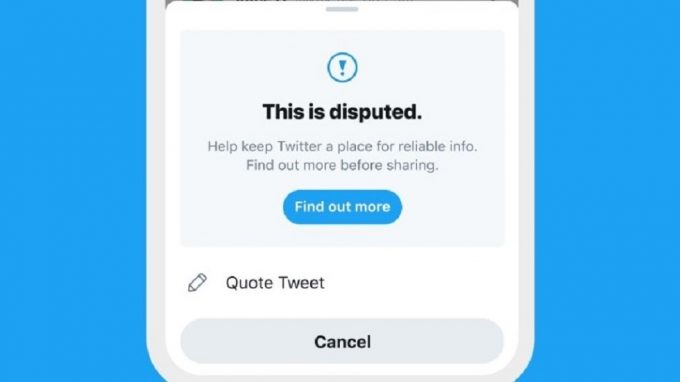
Twitter is cracking down on the spread of “misleading” content ahead of the US election, as users attempting to retweet anything similar to the NYPost’s Hunter Biden leaks will now get a warning the material is “disputed.”
Attempting to retweet offending content will trigger a prompt warning the user that the material they’re trying to post is “disputed,” Twitter revealed on Friday, posting an image of the new warning screen.
The user will be able to click a button to “find out more” about why Twitter doesn’t want the material shared, and then presumably post it anyway.
The new feature arrives in the aftermath of a major controversy arising from Twitter’s censorship of a series of stories critical of Democratic presidential candidate Joe Biden, published by the New York Post based on emails supposedly extracted from his son Hunter’s laptop.
Conservative politicians, lawmakers and press have slammed Twitter for prohibiting users from even linking to the story, and some users who shared details of the stories found themselves locked out of their account for reasons that ranged from sharing “hacked material” to posting “personal information” without permission.
The social media giant’s guidelines for what is considered “misleading” are themselves somewhat nebulous, having grown since the start of the Covid-19 pandemic to encompass not just “disinformation” but also “disputed” content, a vague descriptor that could apply to most of what users post on the platform.
The Republican National Committee on Friday filed a complaint with the Federal Election Commission charging Twitter had illegally meddled on behalf of the Biden campaign when it squelched the spread of the Biden-laptop stories. The platform had even briefly blocked a link to the US Congress website, when Republicans on the House Judiciary Committee attempted to skirt Twitter’s censorship by reposting one of the banned articles on their official .gov page.
Twitter also apologized to its users for a prolonged outage on Thursday night, which left many speculating about whether the platform was testing an intensified form of censorship ahead of November’s elections. The site blamed a “system change initiated earlier than planned” that had “affect[ed] most of our servers” – an explanation which likely did little to put conspiracy theories to rest.
Facebook subsidiary Instagram rolled out a feature similar to Twitter’s ‘wrongthink warning’ last year, which alerts users when they are about to post something “potentially offensive.” In April, Facebook began alerting users as to whether they’d shared, replied to, or otherwise interacted with posts that were later deemed to be “misinformation,” specifically content concerning the novel coronavirus that had been “debunked” by the World Health Organization.
In June, the platform further expanded its wrongthink-alert system, warning users when they attempted to share articles that were over 90 days old – regardless of whether they were true or not.
Facebook has also resorted to somewhat more subtle tactics of “shadowbanning” – which on Wednesday was once again confirmed by its communications chief Andy Stone, a former Democratic Party staffer. He tweeted that the platform was restricting the spread of the New York Post’s story until the platform’s fact-checkers could stamp their own judgment on the material.
Useful Idiot or Trojan Horse? Belarusian opposition figure Tikhanovskaya’s links to NATO’s Atlantic Council adjunct raise eyebrows
By Kit Klarenberg | RT | October 16, 2020
‘Accidental politician’ Svetlana Tikhanovskaya has captured the West’s imagination, her lack of political experience presenting an ideal blank canvas for news-narrative weaving – and all too easily manipulated by malign forces.
From the moment she announced her candidacy for the Belarusian presidency after her husband Sergey was spuriously jailed for electioneering activities that would be considered normal in the rest of Europe, Tikhanovskaya has been a darling of the Western media. With her improbable ascension from stay-at-home mother to leading opposition figure, then proto-revolutionary leader-in-exile, documented on an almost daily basis.
Along the way, Tikhanovskaya has been keen to stress the upheaval in Belarus is neither pro-Western nor pro-Russian in character, but pro-democracy, a key message reiterated uncritically over and again by mainstream journalists. However, not a single one has deigned to mention, much less question, the fact that one of her key confidantes, Franak Viacorka, is a ‘non-resident fellow’ at Atlantic Council, a think tank that aggressively propagandizes in support of NATO, and wider American financial, political, military and ideological interests in Europe and beyond.
This position isn’t mentioned in his Twitter bio, and it’s unclear precisely when he became Tikhanovskaya’s ‘international relations advisor.’ Viacorka’s Atlantic Council appointment was announced on August 15 – in a Washington Post op-ed published the same day, he and Melinda Haring, deputy director of the council’s Eurasia Center, painted a glowing, provocative portrait of the would-be president of Belarus, framing her as part of a wider feminist uprising against the country’s “deeply patriarchal” elite, an upheaval central to the radical shakeup of the country.
The council billed Viacorka as a “journalist from Belarus,” which is true, to an extent. A long-time anti-Lukashenko activist, his campaigning as a teenager in the run-up to the 2006 presidential election was even the subject of an award-winning documentary. Subsequently, he spent seven years at US government-controlled media outlets Radio FreeEurope and Radio Liberty, before moving to Washington DC in August 2018 to serve as Digital Media Strategist for the US Agency for Radio Free Europe’s parent company US Agency for Global Media (USAGM), a role which ended just before he joined the Atlantic Council. In August 2018, USAGM’s then-CEO acknowledged its media outlets’ “global priorities reflect US national security interests.”
Founded in 1961, the council is best understood as NATO’s intellectual wing-cum-propaganda arm. Just as the alliance’s paradoxical purpose is, in the phrase of academic Richard Sakwa, “to manage the security risks created by its existence,” so too the organization exists to promote the notion of a Russian threat, in order to justify NATO’s post-Cold War endurance.
In this sense, the Atlantic Council is no different from most other ‘think tanks’ in that its raison d’etre is to defend and further the concerns of its financiers – in pursuit of that goal, as with most other lobby groups of this nature, it often publishes highly dubious, biased ‘research’ under the guise of objective academic inquiry, and recruits to its ranks individuals who advance its objectives in some way, promoting these as ‘independent experts.’
Some clue as to the council’s concerns and aims can be found in the publicly-available list of its key donors, which includes the US embassies of UAE and Bahrain, Ukrainian oligarch Victor Pinchuk, defense giant Raytheon, the UK Foreign & Commonwealth Office (FCO), and the US State Department. From 2006 to 2016, the council’s annual revenue leaped ten-fold, from $2 million to $21 million – a period in which, concurrently and not coincidentally, corporate and state budgets typically reserved for lobbying firms were increasingly directed to think tanks. Its board of directors is likewise highly illustrative, a veritable ‘who’s who’ of warmongers, comprising Henry Kissinger, Condoleezza Rice, Colin Powell, Robert Gates, Michael Hayden, David Petraeus, and many others.
Despite a host of council apparatchiks frequently popping up in media reporting, and in turn influencing debate, public perceptions and government policy, one would be hard-pressed to find a single mainstream article making even passing reference to the organization’s politically-charged agenda and funding sources. Indeed, the Atlantic Council’s press relations strategy has been astonishingly effective, its in-house ‘fellows’ and Digital Forensics Lab (DFRLab) operatives universally positioned as experts in an array of fields, ever-ready to provide insight on pressing issues in the form of op-eds, marketable quotes and more.
There’s no more palpable example of this phenomenon than former DFRLab chief Ben Nimmo, who for years has been widely-touted as an eminent authority on Moscow’s ‘information warfare’ and ‘cyber operations,’ as well as on Kremlin strategy and thinking – despite boasting zero discernible acumen in Russian politics, data analysis, information technology, or social media. Despite his palpable lack of relevant skills, Nimmo’s tour of duty at DFRLab saw him appear in a panoply of articles, reports and academic papers on the threat posed to the world by Russian ‘disinformation,’ in the process disseminating a vast amount of damaging untruths himself.
He was also a pivotal player in the council’s ‘anti-fake news’ partnership with Facebook. Launched in May 2018, DFRLab was granted exclusive and unprecedented access to the social media giant’s private data, in order to identify and study “disinformation networks,” before earmarking particular accounts and pages for deletion and banning. That an effective wing of Western state power was afforded such capacity failed to provoke any mainstream alarm, even when the initiative got off to a highly inauspicious start – a number of accounts Nimmo identified as Kremlin-directed ‘bots’ and ‘trolls’ and which were subsequently banned by social networks turned out to be real people.
Since then, at intermittent intervals this partnership has led to the purging of untold numbers of pages and accounts from the social network, among them many alternative media outlets, independent journalists, political groups, and other legitimate information sources, highlighting issues and events the mainstream media consistently downplays or ignores, including US interventionism, drug legalization, police brutality and more.
Viacorka’s work for the Atlantic Council to date hasn’t been quite so destructive, authoring articles for its website, and making appearances on major news networks, promoting Tikhanovskaya as the legitimate president of Belarus and perpetuating disputed and extremely questionable claims that she’d received up to 70 percent of the vote in that country’s recent election – key messages the council itself began aggressively advancing the day after the election.
Ever since, Tikhanovskaya has repeatedly appealed to US and EU leaders to recognize her as the winner and duly-elected president of Belarus, claiming she’ll step aside within six months of taking office, but her call has been ignored by international bodies and every government in the world, bar that of Lithuania.
Instead, typically at most an election re-run has been called-for, a somewhat odd display of reticence, given Washington, London, Berlin and Paris have priors in formally recognizing individuals with far less legitimate claims than she as de-facto leaders of countries, such as Juan Guaido in Venezuela. This may suggest Western governments aren’t actually as convinced of her alleged landslide victory as they publicly profess to be, and fear Lukashenko’s removal from office by external and internal force and/or without a viable, stable alternative in place could mean the country descends into further chaos, and in turn becoming a fresh flashpoint in Europe.
Viacorka himself acknowledged the disorganized nature of the protests in an Atlantic Council article – while taking as inevitable Lukashenko’s ouster and Belarus’ transition to democracy, he bemoaned how “a lack of coordination between the different elements within the protest movement” had left it “vulnerable to the divide-and-conquer tactics of authorities.”
Viacorka went on to note that, in a bid to address this “absence of leadership,” Tikhanovskaya had founded a Coordination Council to serve as the country’s effective government in waiting. He dubbed the endeavor “the main threat to Lukashenko” and “the first attempt to create a credible alternative,” but his description raises serious questions about whether it’s a legitimate attempt to provide a coherent, tangible face to the movement, or an opportunistic hostile takeover.
“The Coordination Council provides a degree of clarity for government officials and international observers looking to gain a better understanding of who represents the diverse opposition movement… The Council must occupy the political vacuum at the forefront of Belarus’s democratic uprising. Leaderless street protests have shaken the Lukashenka regime to its foundations, but they are not enough to bring about the kind of historic transition to democracy millions of Belarusians now expect… The Council features a number of members drawn from the professional classes… who are expected to play important roles in the attempt to move beyond today’s mass protests towards a national political transition,” Viacorka wrote.
One wonders whether the coordination council was an idea Viacorka himself presented to Tikhanovskaya in his capacity as her ‘international relations advisor’ – and if, in turn, his thinking was in any way influenced by the Atlantic Council.
Whatever the truth of the matter, it’s almost certain the Atlantic Council’s meddling in Belarusian politics has a clandestine element, given the organization’s key role in the UK Foreign & Commonwealth Office’s (FCO) initiative Open Information Partnership (OIP). Officially, under its auspices DFRLab, Bellingcat, Zinc Network and Media Diversity Institute “work together through peer-to-peer learning, training and working groups to pioneer methods to expose disinformation,” in collaboration with a sizable network of NGOs across Europe.
However, leaked documents make clear the endeavor is, in fact, a secret UK government information warfare outfit seeking to covertly further Whitehall’s global policy objectives, by, among other things, influencing “elections taking place in countries of particular interest to the FCO.” A file setting out the terms of the project indicates Belarus is one of a dozen “high impact, priority countries” for the OIP, strongly suggesting this year’s presidential vote was very much “of interest” to the project.
The same document indicates DFRLab, Bellingcat, Zinc Network and Media Diversity Institute had conducted a secret operation in Ukraine, Moldova and Belarus in 2018, “delivering audience insights and recommendations to increase reach and resonance of selected independent media outlets.”
While innocent-enough sounding, examples offered of the organization’s work offered elsewhere in the file indicate OIP has engaged in numerous ‘astroturfing’ initiatives across Eastern Europe, helping organizations and individuals to produce flashy, FCO-funded propaganda masquerading as independent citizen journalism, which is then amplified globally via its NGO network and other channels.
For instance, in Ukraine the Open Information Partnership worked with a 12-strong group of online ‘influencers’ “to counter Kremlin-backed messaging through innovative editorial strategies, audience segmentation, and production models that reflected the complex and sensitive political environment,” in the process allowing them to “reach wider audiences with compelling content that received over four million views.”
In Russia and Central Asia, OIP established a covert network of ‘YouTubers,’ helping them create videos “promoting media integrity and democratic values.” Participants were also taught how to “make and receive international payments without being registered as external sources of funding” and “develop editorial strategies to deliver key messages,” while the consortium minimized their “risk of prosecution” and managed “project communications” to ensure the existence of the network, and indeed OIP’s role, were kept “confidential.”
Were similar efforts undertaken in Belarus at some point subsequently, and if so, how many of the citizen journalists on the ground covering the protests this year have received funding and training from OIP, and what role has the organization and its extensive pan-European NGO matrix played in promoting their “compelling content” the world over?
At the very least, another leaked FCO file indicates a number of organizations in the country had exploratory discussions with OIP, including the Belarusian Association of Journalists, and Euroradio – both were said to have “expressed an eagerness to be part of the network,” and to be operating in “the most vital space in the entire network.”
It may be significant that Franak Viacorka has been a prominent amplifier of Euroradio’s “fearless” coverage of the unrest that has engulfed the streets of Minsk for the past two months.
Claims of dramatic loss of Great Barrier Reef corals are false
Corals expert hits out at media reports
GWPF | October 15, 2020
Claims that Australia’s Great Barrier Reef has lost half of its coral cover between 1995 and 2017 have received global media coverage.
The stories were based on a new paper co-authored by controversial Australian researcher, Professor Terry Hughes of James Cook University.
But according to Professor Peter Ridd, a leading authority on the Great Barrier Reef, these claims are false.
According to Professor Ridd, the best data on coral cover is taken by the Australian Institute of Marine Science (AIMS), who have been measuring over 100 reefs every year since 1986:
“AIMS data shows that coral cover fluctuates dramatically with time but there is roughly the same amount of coral today as in 1995. There was a huge reduction in coral cover in 2011 which was caused by two major cyclones that halved coral cover. Cyclones have always been the major cause of temporary coral loss on the Reef.”

Coral cover of the Great Barrier Reef 1986-2019; AIMS/Peter Ridd 2020
This is not the first time that Professor Hughes has made such claims about coral loss. His previous study was strongly criticised by the AIMS scientists responsible for collecting and publishing the coral data.
Moreover, Professor Hughes has refused to make public the raw data upon which he made this claim, despite repeated requests.
“This latest work by Prof Hughes needs a thorough quality-audit to test its veracity”, says Ridd. “Prime-facie, there are excellent grounds to treat it with great scepticism.”
Contact
Professor Peter Ridd
e: peterridd@yahoo.com.au
New UN Climate Row: Alarming Report Contradicts Its Own Data
By Edwin Timmer, De Telegraaf, 14 October 2020
Amsterdam: The United Nations has become caught up in a new climate row over a recent UN report which claims to show an increase in climate disasters – but which seems to be contradicted by its own data.
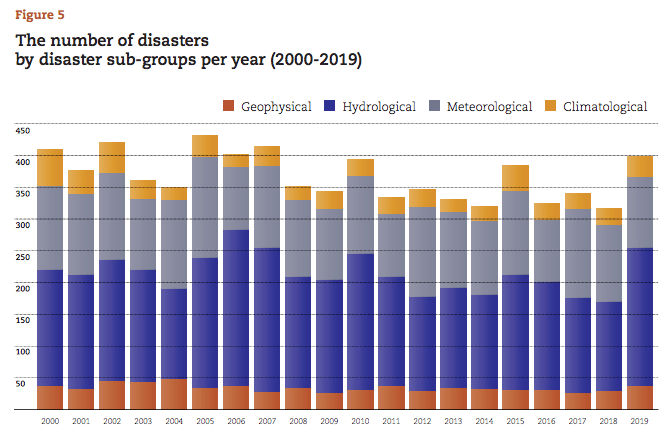
The row was triggered by the new report on “Human Cost of Disasters”. The report announced a “staggering rise in climate-related disasters over the last twenty years”. However, the same report contains a graph showing that the number of climate-related disasters has actually decreased by 15 percent since 2000.
It is not the only contentious element of the report by the United Nations Office for Disaster Risk Reduction (UNDRR) in Geneva. Some of the data used is also said to be unreliable while the alarmist language of Mami Mizutori, Special Representative of the Secretary-General for Disaster Risk Reduction and Head of UNDRR, seems to have been inspired by activist groups like Extinction Rebellion.
Due to the fuss, there is now an international call for at least rectification. “This is a huge, embarrassing blunder,” said Benny Peiser, director of the Global Warming Policy Forum, a British think tank. “The United Nations must immediately withdraw this report and apologise for misleading the public.”
Roger Pielke Jr, a renowned American scientist in the field of natural disasters – and anything but climate denier – also regrets the sharp position by the UNDRR. In an e-mail to De Telegraaf he says that the authors have drawn “flawed conclusions”.
It is not the first time that the UN is accused of climate exaggeration. UNICEF stated last year that hurricane disasters in the Caribbean is driving more and more children to flee. “Pure scare tactics,” said a hurricane expert at the time. And a report by the IPCC once predicted that the Himalayas would be glacier-free by 2035. That also turned out to be a scientific mistake.
However, the UNDRR report substantiates its statement about increasing climate disasters with data from the renowned Belgian Centre for Research on the Epidemiology of Disasters (CRED). Between 1980 and 1999, the Leuven database counted 4,212 disasters and 7,348 from the turn of the century to 2020. Ergo: the climate has gone wild.
“This is clear evidence that in a world where the global average temperature in 2019 was 1.1˚C above the preindustrial period, the impacts are being felt in the increased frequency of extreme weather events including heatwaves, droughts, flooding, winter storms, hurricanes and wildfires.”, according to the report, which also included CRED researcher Joris van Loenhout.
But here too, the report goes wrong, warns Pielke Jr. The data on disasters from the last century are, as the CRED has repeatedly acknowledged, flawed – and therefore unreliable. During the time before the internet existed, not every disaster was reported the way it is now.
British blogger Paul Homewood also discovered a “leap” in the number of disasters the Belgian institute listed which suddenly rose in 1998 — exactly the year the CRED began to receive US funding to start publishing statistics.
The datasets about the two different periods are therefore too different in quality, says Pielke Jr. “You should not draw any conclusions about a changing frequency in climatic extremes on the basis of this data set,” says the researcher at the University of Colorado.
Van Loenhout disputes this criticism. In an e-mail the researcher trained in Utrecht acknowledges that CRED has previously been critical of its own database, but claims that much of the data has been improved recently. Of the dataset dating back to 1900, only the first 60 years may not be reliable, he says. “Disasters will be missing.”
But that is not a problem for the current report, he claims. “From about 1960-1970 onward, the completeness of the data is much greater, and the share of missing disasters much smaller. We are constantly working to improve completeness, and this is also happening for previous years and decades. For this reason, statements made in 2004 and 2006 are now somewhat outdated, as the completeness of the database has since improved,” says Van Loenhout.
Pielke Jr is surprised that, to his knowledge, this is the first time that the Belgian institute is suddenly so convinced of its older data. The American also disagrees with Van Loenhout’s criticism that he should not deduce a downward trend in climate-related disasters over the past 20 years. “Nonsense. Of course you can – it’s the definition of a trend.”
The fierce clash can be explained by the significant deviation of the UNDRR findings with the research studies that Pielke Jr has published. Time and again he has shown that despite an increase in financial damage from natural disasters, there has not been a change in the intensity of most weather extremes. Increasing damage is due to the growth of population, real estate and properties in vulnerable areas.
The UN’s Intergovenmental Panel on Climate Change (IPCC) has confirmed these findings: the near future may bring an increase in floods or hurricanes. But until now this is barely detectable. “Everything I find is consistent with the IPCC,” says Pielke Jr.
One of the most telling trends the American scientist has highlighted is this: the number of fatalities from natural disasters in the past 100 years has fallen by 95 percent — despite a rapidly growing world population. This makes the UNDRR report much more dogmatic about climate trends than its sibling the IPCC, both under the same UN umbrella.
This does not stop UN envoy Mizutori from adopting an alarmist tone. She commends UN staff and volunteers who have saved countless lives in past natural disasters. “But it is being made more and more difficult for them, especially by industrialised countries that are terribly lacking in reducing their greenhouse gas emissions to the level agreed in the Paris Agreement.”
GWPF director Benny Peiser is appalled by this political blame game. As if residents of industrial countries are guilty of future deaths from natural disasters in other countries. “This is no longer science, but a purely political report.”
Translation GWPF
FBI Informant Was ‘One Of The Most Active Leaders’ Pushing ‘Crackpot’ Whitmer Kidnapping Plot: Defense
By Chris Menahan | InformationLiberation | October 13, 2020
An FBI informant was “one of the most active leaders” in the alleged plot to kidnap Michigan Gov Gretchen Whitmer, according to a defense attorney for one of the accused.
From the Detroit Free Press :
There was no real plan to kidnap Gov. Gretchen Whitmer, but only “military wannabes” who engaged in “big talk” and played with guns in the woods, defense lawyers argued in court Tuesday.
As one defense lawyer suggested, the case appears to be one of “big talk between crackpots,” or “people who talk a lot … but are never going to do anything.”
“Have you ever dealt with big talkers?” defense attorney Scott Graham asked an FBI agent on cross examination, adding: “There’s kind of a military-wanna-be theme that runs between the militias.”
[…] Defense lawyers contend that there was no probable cause to arrest and charge the suspect, arguing, among other things, that the suspects had no operational plan to do anything, were engaged in all legal activities — including talking in encrypted group chats and practicing military exercises with lawfully owned guns — and that it was the informants and undercover agents who “pushed” others to do illegal things.
“One of the most active leaders was your informant,” Graham said.
If this was another FBI frame-up job certainly it wouldn’t be the first and it won’t be the last.
The FBI’s affidavit revealed they had multiple informants and undercover agents involved in this operation going all the way back to June.
They could have arrested these saps months ago but likely chose to wait until right before the election for maximum political impact.
FBI used MEDIA REPORTS seeded by British spy to ‘corroborate’ Steele Dossier, declassified spreadsheet shows
By Nebojsa Malic | RT | October 13, 2020
The FBI sought to ‘verify’ information in the notorious dossier at the heart of Russiagate by using media articles seeded by the actual dossier author, British spy Christopher Steele, newly released evidence has shown.
The so-called Steele Dossier is the centerpiece of ‘Russiagate,’ the conspiracy theory that Donald Trump “colluded” with Moscow in the 2016 US presidential election. The dossier’s most bombastic claim was that Russia had “kompromat” on him in the form of sex tapes from a Moscow hotel involving urinating prostitutes.
Steele compiled the dossier for Fusion GPS, a DC-based firm paid by Hillary Clinton’s presidential campaign through the DNC. The FBI then used it to obtain a FISA warrant to spy on Trump campaign aide Carter Page in October 2016, and extended it three times well into 2017.
A 94-page spreadsheet made public on Monday, however, shows the FBI relied heavily on media reports to corroborate Steele’s claims – in many cases, the very same reports Steele had planted himself.
According to analyst Stephen McIntyre, footnotes listed in the spreadsheet show that 39 percent of the footnotes lead to Washington, DC media outlets, another 29 percent are redacted, and Steele himself was cited on 18 occasions, somehow self-verifying his own work.
In one instance, McIntyre notes, the FBI triple counted an article from the Daily Beast as three separate sources. Other media outlets named in the document are CNN, The New York Times, The Washington Post, Yahoo News and Mother Jones.
The FBI had actually decided to fire Steele as a paid informant in September 2016 – before obtaining the Page warrant – because he leaked to the media, specifically Yahoo and Mother Jones, but that never raised any red flags either with the warrant or the corroboration, apparently.
Moreover, the Bureau knew in December 2016 that the “primary sub-source” (PSS) for the dossier was a Russian national they had investigated as a foreign agent in 2009, but the investigation was abandoned without explanation and this fact was never flagged. Even after interviewing the PSS in January 2017, and establishing that most of the dossier was fabricated outright, the FBI continued to use it at the FISA court to extend the Page warrant.
Another source the FBI used to corroborate Steele was Cody Shearer, a long-time Clinton operative who produced a memo alleging that Russian intelligence had a sex tape of Trump. That amounts to more circular reporting, however, as Steele was reportedly given the Shearer dossier by State Department official Jonathan Winer, and then handed it over to his FBI contacts in October 2016.
The spreadsheet is the first confirmation that the FBI actually used the ‘Shearer Dossier,’ whose existence was first reported by the Guardian in January 2018, as part of a push by Democrats to show that the Steele dossier wasn’t the sole grounds for the FISA warrants.
Just last week, however, Director of National Intelligence John Ratcliffe declassified notes from then-CIA chief John Brennan, who said he warned the Obama administration about a plan by Hillary Clinton to smear Trump with allegations of ‘Russian collusion’ as a means of “distracting the public from her use of a private email server” before the 2016 election.
The two-year probe by Special Counsel Robert Mueller came up with zero evidence of “collusion” between the Trump campaign and Russia, much less Trump himself – and while it argued that Moscow “meddled” in US elections, it offered no evidence beyond its own assertions contained in indictments that were subsequently dropped when challenged in court.
While all these revelations have amounted to an indictment of the entire ‘Russiagate’ affair, the media that gave each other awards for their coverage of ‘collusion’ has never apologized for any of it. To this day, millions of Americans continue to believe their president is a “Russian agent.”
Opaque, Unaccountable: Dangers of the New COVID Bio-Security Complex
By Patrick Henningsen | 21st Century Wire | October 13, 2020
Seven months into this crisis, it can’t be any clearer. Just as they did following 9/11, western governments are using the COVID ‘pandemic’ crisis as a pretext to usher in whole new layer of security state bureaucracy, and one which has the power to penetrate more deeply into our lives.
For those who are old enough to remember, prior to September 11, 2001, there was no such thing as a Department of Homeland Security (DHS), and yet in a matter of a few years, this federal department quickly grew into one of the largest federal agencies taking in tens of billions of taxpayer dollars each year ever since. In fact, the term Homeland didn’t even exist in America before that. But it was the perceived threat which provided it’s raison d’etre – buttressed by an incessant barrage of propaganda by the state and its media adjuncts, which made this new paradigm a reality. Soon, all of these new state apparatuses and security initiatives were all nestled neatly under the new banner of the Global War on Terror.
In 2020, this exact process has been repeated, only this time the threat isn’t the spectre of radical Islamist terror coming from foreign lands, but something much closer to home.
According to our governments, the new threat is your neighbour, your teacher, the shopkeeper, and even your family members.
And you are a threat to each of them.
And everyone is a threat to each other.
I described this dialectic in the recent special edition of New Dawn Magazine. Here’s a brief passage from my article entitled, “THE GREAT RESET: A Global Flu d’Etat”:
From the onset, computer-modeled predictions wildly overestimated death tolls in key countries. This was not by accident as the initial political and mass media campaign of shock and awe placed populations in an applied cognitive framework of helplessness and dependency.
The same psychological levers were activated in the immediate aftermath of the attacks of 11 September 2001. Psychologically traumatised western electorates not only accepted any level of state and corporate security, infringement of civil liberties and invasion of privacy, many even demanded their governments prosecute overseas wars to eliminate the perceived threat, at that time, of al Qaeda and international terrorism. Subsequently, a new normal was rolled-out globally, a series of endless wars and a leviathan of ‘anti-terror’ measures and digital surveillance at home.
Despite efforts to try and convince the public that everyone is a potential terrorist, the climate of fear was difficult to maintain. The genius of the COVID crisis is that the Establishment has now managed to convince us that everyone is a potential carrier of a deadly pathogen and that anyone who so much as sneezes in the vicinity of any- one else could not only kill them but also trigger a deadly ‘second wave’ of the pandemic.
Phase one of The Great Reset.
This week, the UK Government announced its latest round of emergency measure and regional lockdowns, supposedly for fighting the coronavirus.
Their new “Tier Three” lockdown system will determine whether towns or cities will be allowed to keep pubs, gyms and other leisure facilities open, for up to a further six months. But who knows when it will end. This has prompted concerned members of public, along with a few brave officials, to ask who exactly is setting this new Three-Tier system?
According to government officials, the new system will classify regions as either ‘medium’, ‘high’ or ‘very high’ levels, with high and above triggering new local lockdowns.
Welcome to thin end of the state’s bio-surveillance wedge. Similar protocols are being rolled out in Five Eyes Alliance nations the United States, Canada, Australia and New Zealand.
Just as with the global war on terror, governments have now erected an entirely new level within the ever-expanding national security state. In the UK, it’s called the Joint Bio Security Centre (JBC), formed in July, and already a £9 billion operation. Expect that number to grow substantially as the security complex discovers new and more complex systems required to keep pace with a new global bio surveillance and biological arms race.
“Led by a senior spy, the JBC does not publish details of its deliberations, the sources of its evidence or its key personnel. Nevertheless, its advice to ministers is understood to have guided recent decisions on where to enforce the local lockdowns affecting millions of people across the country,” said The Telegraph.
Is COVID really so deadly that the state needs to reconfigure all of its public health agencies under a new command and control hierarchy? Indeed, many asked the same question about al-Qaeda 20 years ago.
Unfortunately, few officials are demanding any answers or calling for accountability. There is only one such inquisitive public servant so far, Dr Greg Clark MP, Chairman of Science and Technology Committee, who believes that the British public are owed some answers as to who is in this opaque group, and which person(s) is making the final decisions for these rather arbitrary ‘alert levels’ being issued by the government.
Exactly what is the remit of this new JBC? According to the Institute for Government:
The centre will have two main jobs. The first is as an independent analytical function to provide real-time analysis about infection outbreaks. It will look in detail to identify and respond to outbreaks of Covid-19 as they arise. The centre will collect data about the prevalence of the disease and analyse that data to understand infection rates across the country.
Its second job is to advise on how the government should respond to spikes in infections – for example by closing schools or workplaces in local areas where infection levels have risen. Should UK government ministers decide to impose different restrictions in different areas and regions across England, it will be on the advice of the JBC.
And just as we suspected, here’s the salient point:
The JBC looks to be based on the Joint Terrorism Analysis Centre (JTAC). JTAC analyses intelligence related to terrorism and sets threat levels, which in turn inform ministers’ decisions on protecting the public and operational deployments by the police and other agencies.
The current Three-Tier alert system was based on the following framework devised for the JBC in determining new Covid-19 alert levels:
- Level 1: Covid-19 is not known to be present in the UK
- Level 2: Covid-19 is present in the UK, but the number of cases and transmission is low
- Level 3: a Covid-19 epidemic is in general circulation
- Level 4: a Covid-19 epidemic is in general circulation; transmission is high or rising exponentially
- Level 5: as level 4 and there is a material risk of healthcare services being overwhelmed.
If it looks and sounds like a military operation, that’s because it is. This is the first time that the science of epidemiology has been brushed aside in favour of a one-size-fits-all, military-style approach to mitigating a viral pandemic.
The JBC insists that they are only providing recommendations “informed by the data collected and analysed by the JBC.” It is therefore up to Downing Street and its chief medical officer to issue the final alert level. Presumably they will be processing testing data, along with NHS Track and Trace, as well as data from the Office of National Statistics, and Public Health England (if it still exists).
We’re told that the JBC is being headed by an intelligence chief from GCHQ, cybersecurity director Dr Clare Gardiner. According to her biography, she’s a “qualified epidemiologist, medical researcher, and cybersecurity director.”
The Telegraph adds, “She reports to Baroness Dido Harding, the chief of NHS Test and Trace, while the entire JBC organisation falls under the control of the Department of Health, which answers to the Mr Hancock. Government sources insisted the body was largely staffed by civil servants meaning it was “not appropriate” to release their identities.”
Lockdowns are no trivial matter and deeply impact the lives of millions of people, and carry with them the most grave economic and social consequences. They also cost lives. Hence, the concern here is one of transparency, and it is unknown if this new ‘bio-intelligence’ agency will be engaging with independent scientists, or will it merely collate data and liase with government-appoint science advisors. It seems odd to be blending the civil service and signals intelligence with the science departments. From a political and bureaucratic point of view, it’s certainly convenient for politicians to have yet another compartment to whom they can ‘pass the buck’ and use plausible deniability for obfuscation purposes. If nothing else, it gives Ministers yet another panel of ‘experts’ to defer to – the familiar illusion of impressive depth and deep considerations supposedly informing the Ministers’ final assessments – when in reality, it just becomes more convoluted. Drowning in unaccountable bureaucracy. That’s where the epic mistakes are usual made.
Just as with the disastrous War on Terror, there is a serious danger that an entirely new division of security state technocracy will inevitably become a money sink, operating in its own bubble within an already knotted civil service, and propelled by endless feedback loops – creating more problems than were there to begin with.
It’s important to point out that such historic and sweeping changes in government can only be achieved amid a climate of fear. Since the beginning of this crisis, the mainstream media have been dedicated to delivering that fear. During the War on Terror, the media scooped up whatever government and the intelligence community were serving, and just ran with it. Without them, the government could never have realised any of its newfound powers. It’s the same now with COVID. You need only to replace the anti-terror mavens in intelligence community with The Science committees. This is precisely ‘the intellectual artillery’ of government joined-up with the media, which Spengler warned about almost a century ago in his treatise, The Decline of the West.
Make no mistake about it – freedom and democracy are under attack from a new and revitalised, COVID-inspired security industrial complex.
Judging by the lack of tenacity by media in being willing to hold any of the Five Eyes government to account for their horrendous performances thus far, it seems unlikely that the media will challenge this new bio-security arm that much.
One can only hope the penny drops much sooner with this leviathan, than it has with previous security state paradigm shifts.
***
Footnotes:
1 Decline of The West, Volumes I & II: https://archive.org/details/in.ernet.dli.2015.283129/page/n471/mode/2up
***
Author Patrick Henningsen is an American writer and global affairs analyst and founder of independent news and analysis site 21st Century Wire, and is host of the SUNDAY WIRE weekly radio show broadcast globally over the Alternate Current Radio Network (ACR). He has written for a number of international publications and has done extensive on-the-ground reporting in the Middle East including work in Syria and Iraq. See his archive here.
Featured Video
Dan Dicks with James Corbett on Solutions Watch
or go to
Aletho News Archives – Video-Images
From the Archives
MMR (Measles, Mumps and Rubella) – Vaccine Risk Statement
MMR Vaccine (Measles, Mumps, and Rubella) Is It Safer Than Measles, Mumps and Rubella?
Physicians for Informed Consent | December 2024
… It has not been proven that the MMR vaccine is safer than measles, mumps, and rubella. The vaccine package insert raises questions about safety testing for cancer, genetic mutations, and impaired fertility. Although VAERS tracks some adverse events, it is too inaccurate to measure against the risk of measles, mumps, and rubella. Clinical trials do not have the ability to detect less common adverse reactions, and epidemiological studies are limited by the effects of chance and possible confounders. Safety studies of the MMR vaccine are particularly lacking in statistical power. A review of more than 60 MMR vaccine studies conducted for the Cochrane Library states, “The design and reporting of safety outcomes in MMR vaccine studies, both pre- and post-marketing, are largely inadequate.”19 Because permanent sequelae (aftereffects) from measles, mumps, and rubella are so rare (especially in children with normal levels of vitamin A and infected after birth),6,15-17 the level of accuracy of the research studies available is insufficient to rule out the possibility that the MMR vaccine causes greater death or permanent disability than measles, mumps, and rubella. – Read full article
Blog Roll
 Aletho News
- Moscow issues warning to NATO over Russian exclave
- Yes, the Iran war has destroyed Trump’s presidency
- The fallacy of US delusions about Iran’s economic collapse
- Hezbollah denies Syria cell link, warns of Israeli plan to sow discord
- The legacy of US sanctions, war, and occupation in Iraq
- Iraqi resistance group rejects disarmament, vows to maintain support for Lebanon
- Sheikh al-Asadi warns of Iraqi government compliance with US demands
- How to MAKE THE CONSPIRATORS PAY for their crimes! Dan Dicks with James Corbett on Solutions Watch
- There’s a drought in academia: A drought in honest research on the subject of drought and other weather extremes
- Department of War Awards $20.7 Billion Contract to Raytheon for Air-to-Air Missiles
- If Americans Knew
- An error has occurred; the feed is probably down. Try again later.
- No Tricks Zone
- Green Energy Debacle: German Expert Professor Fritz Vahrenholt Warns Of Severe Economic And Social Consequences
- Two More Paleo Reconstructions Affirm Meters-Higher Sea Levels Across Ireland, Brazil 7000-6000 Years Ago
- New Study: Earth And Venus Surface Warmth Largely Explained By Convection And Lapse Rate, Not CO2 Or Radiation
- 2025 Nature Paper Claiming Worsening Global Drought Gets RETRACTED …Heavily Flawed
- New Study: ‘Global Drought Shows No Detectable Recent Acceleration Under Climate Warming’
- Economic Masterminds: German Socialists Suggest Taxing Productivity Gains Stemming From Using AI
- The South China Sea Has Not Been Cooperating With The Climate Change Narrative
- Energy Crisis: Germany Enters Heating Season With Historically Low Gas Reserve Fill Levels
- New Study: The Antarctic Ice Sheet Gained Mass From 2020-2024 Due To Staggering Snow And Ice Accumulation
- Study: Ocean Heating Rates From Thousands Of Years Ago ‘Dwarf’ Modern Ocean Heating Rates

