How to kill a thriving metropolis in 7 months: NYC’s Covid-19 failure is a vicious spiral directed by sadists

By Helen Buyniski | RT | October 12, 2020
Seven months into the pandemic, as many US states inch back toward ‘normal’, New York is in the grips of a crime wave, reinvigorated lockdowns, and widespread fear of pretty much everything. Thank local government.
New York City has lost billions of dollars in tax revenues on tourism, music, art, theatre, restaurant dining, and everything else that once fueled its mammoth economy over the seven-month Covid-19 pandemic shutdown. It’s in worse shape than most US states, and unlike many others, its continued misfortunes are largely of its own making.
The shuttering of the city’s iconic Broadway theaters alone has sent hundreds of thousands out of work and signaled to both wealthy city inhabitants and out-of-town visitors that their cash is better spent elsewhere. Theaters announced just weeks ago that performances would be cancelled through March 2021, and the Metropolitan Opera House canceled its entire season through 2021.
New York’s famed restaurant scene isn’t faring any better. The ‘lucky’ establishments are finally – as of two weeks ago – allowed to operate at 1/4 capacity indoors, which given the amount of money they’ve lost over the last 6 months is a band-aid on a cannonball wound. The unlucky ones in New York Governor Cuomo’s newly-invoked ‘red zones’ must continue to seat patrons outdoors in the freezing cold as summer gives way to a damp, chilly autumn. To make matters worse, there’s no Thanksgiving parade, no Black Friday shopping, no fun allowed.
Perhaps pandemic-fearing wealthy New Yorkers would have left anyway, taking their tax dollars with them. But tourism might have filled some of the gap. What city in its right mind would turn up its nose at $11.5 billion, the estimated total spent by out-of-town visitors to the city’s famed theatrical productions alone? Why leave that money on the table, especially when the virus that had held the industry hostage for months has been steadily on the wane? With Governor Cuomo demanding billions in relief from the federal government to make up an economic shortfall that stems from his own policies, surely he can’t afford to keep the state (and its largest city)’s biggest draws closed down indefinitely?
Pleas to cancel rent have fallen on deaf ears, and starving artists’ efforts at workarounds have been squashed. Cuomo even passed an executive order in August – with the coronavirus “peak” safely receding in the rearview mirror – to ban ticketed live performances, and has revoked liquor licenses from bars that failed to serve food with their takeaway drinks. Is it any wonder the city is hemorrhaging cash, as well as the creative and interesting people who put it on the map?
MURDER, SHE COUGHED
To understand the motivation someone like Cuomo could have for destroying the city whose economy once kept his state alive, it helps to grasp the concept of the “self-licking ice-cream cone,” a phrase that has been attributed to NASA scientists but can in general describe any system that exists for little reason other than to continually justify its own existence.
Every politician who’s ever harbored dreams of becoming a totalitarian dictator has embraced the directive “never let a crisis go to waste,” and both Cuomo and NYC mayor Bill de Blasio are true believers. After attaining unprecedented powers through the emergency measures passed under cover of Covid-19, they aren’t about to let them go quietly, and have seemingly set up a perpetual motion machine of crisis that – accidentally or otherwise – ensures NYC will remain forever financially in the hole. The type of cash lifelines that might get the city back on its feet – as a post-9/11 tourism blitz did – are blocked (no one’s going to visit a New York where dancing, drinking, and taking in a show are off-limits). Average New Yorkers, too, are paralyzed by the thought of the scary virus lurking just outside their door, ultimately learning to love their captors, Stockholm-Syndrome-style – if this month’s fawning New Yorker profile of Cuomo is any indication.
With the virus no longer nearly as much of a danger as it was back in April, the would-be dictators have put together what looks for all the world like a diabolical plan to empty out the city and take advantage of artificially-lowered property values.
First, the criminals are unleashed. Bogged down with a directive to enforce the ever-growing range of social-distancing and mask-related offenses, New York’s police are no match for the flood of actual criminals released into the streets under statewide “bail reform” that all but guarantees the “catch and release” of muggers, rioters, and other criminals whose offenses stop short of rape and murder. Even more miscreants have been paroled early due to Covid-19-related overcrowding excuses.
Next, the threats are broadcast 24/7 over every media outlet. CCTV videos of horrific, unprovoked attacks on old women, small children, everyday middle-aged types, a jazz pianist, a would-be rape victim on a subway platform – the point is made that everyone is a potential victim. The solution is presented as a paradox: do New Yorkers who’ve just spent months demanding the city rein in its police want more cops patrolling the streets? Surely that’s not very “woke” of them. While they hem and haw, the rampage continues, and the debate ends with helpless, fear-crazed city dwellers throwing up their hands and begging Cuomo and de Blasio to Do Something, Anything, to Make the Bad Men Stop. Both men play dumb – there’s nothing they can do! Better get used to crime, or flee!
TERROR IN THE TUNNELS
The plight of the subway is instructive. The city’s legendary 24-hour train system was ordered to close down service from 1am to 5am back in May, ostensibly for “cleaning” because of the virus. The homeless people who’d taken to sleeping on the cars in the wee hours were a health risk, New Yorkers were told, and the city promised free transit alternatives for those whose jobs required them to be able to move around during those times (promises which in many cases did not materialize). Ridership, already severely curtailed due to pandemic fears, was down 90 percent at one point, sending the already cash-strapped system deep into the red.
Now, we’re told, the lack of people (and cops) on the subway has made it a predator’s playground. The lack of witnesses makes it easy for unscrupulous crooks to nab a wallet, attack an innocent commuter, and otherwise strike fear into the hearts of those New Yorkers who still think there’s a future for their city. “We need more cops!” the law and order types cry, only to find the MTA is deeper in the financial hole than ever and de Blasio is leery of upping the police budget. Presumably, the next move will be to decrease operating hours still further, guaranteeing the downward spiral continues indefinitely.
A tourism and entertainment-based city without so much as a public transit system is, quite simply, doomed. The only question, then, is why are de Blasio and Cuomo so determined to run New York into the ground?
Cuomo’s “economic reopening council” is guided by private equity partners who actually make their profits off the carcasses of dead and dying businesses, so it’s no mystery why he’s eager to see restaurants and theaters crash and burn. Private equity stands to make billions on all the vacant office space and abandoned properties from city institutions forced to pull up stakes. If Cuomo does what his deep-pocketed donors tell him – he’s not called “Governor 1 Percent” by progressives for nothing – he might even get that rumored Attorney General spot he’s being reportedly considered for in a Democratic Joe Biden administration. And perhaps de Blasio – despite never polling above 0.1 percent during the 2020 primaries – actually thinks he has a shot at the governor role.
Better to reign in hell than to serve in heaven, as the saying goes.
Helen Buyniski is an American journalist and political commentator at RT. Follow her on Twitter @velocirapture23
The Greatest Scientific Fraud Of All Time — Part XXVII
By Francis Menton | Manhattan Contrarian | October 5, 2020
It has been more than a year since I last added a post to this series. The previous post in the series, Part XXVI, appeared on August 20, 2019. For all of the prior twenty-six posts, go to this composite link.
There are two reasons for a new post at this time. The first is that there is some new work out from a guy named Tony Heller. The new work can be found at Heller’s website here, with a date of October 1. Heller also indicates that he intends to continue to add to and supplement this work. Heller is an independent researcher who particularly focuses on the subject of this series: alterations to past officially-reported government climate data to create an impression of warming that did not exist in the data as originally reported. Heller is quite skilled at going through reams of government climate data, and turning those data into useful graphs to demonstrate his points. However, in the past I have sometimes been frustrated with Heller’s work for not including sufficient links to enable a reader to verify that his assertions about data alteration are correct. Thankfully, in the current piece, Heller has corrected that issue, and provides the links so that you can see for yourself that the government has changed the data it previously reported in order to artificially enhance the apparent warming trend.
The second reason for a new post at this time is that President Trump has — finally! — hired two climate skeptics into positions of authority over the bureaucracy that compiles, and later alters, the climate data. On September 12, Trump named David Legates to the position of Deputy Assistant Secretary of Commerce for Observation and Prediction. And on September 21, Trump named Ryan Maue as Chief Scientist at the National Oceanic and Atmospheric Administration (NOAA). NOAA is the main bureaucracy where the principal climate data are compiled, and is a part of the Department of Commerce. (Another agency, NASA, is also involved in these efforts.). Both Legates and Maue have been known as people who refuse to accept much of official climate orthodoxy. It is completely bizarre that these appointments would only occur less than two months before the election that could turn Trump out of office, but there you go.
Heller’s October 1 piece, titled “Alterations To The US Temperature Record,” is one of the most thorough and careful that he has done on this subject. Note that the piece only deals with the temperature records of the US, not the entire world. The temperature records of the US and of the rest of the world present very different issues for researchers trying to assess the accuracy of government-reported warming trends. For the rest of the world, no contemporaneously-generated data exist for most of the surface area and for most of the time period between the late nineteenth century and now. Before the recent years, there just were no (or very few) measurement stations or instruments for vast regions like the oceans, the Southern Hemisphere, Africa, Siberia, and so forth. Therefore, for those and other areas, much of what passes for historical temperature data, particularly from about 1880 to 1960, has actually been created or interpolated after the fact by computer algorithms, which then just so happen to show the trend that the programmers and their bosses would like to see. But for the US, the situation is different. For the entire period back to the late nineteenth century, there has existed a dense network of ground thermometers to record temperatures throughout this country. Therefore, if prior reported data showed cooling trends, and now you want to report a warming trend, that necessarily requires changing prior reported data. Heller:
The US temperature is very important, because the vast majority of stations which NOAA has long-term daily temperature data for are located in the US.
So, have prior officially-reported US temperatures been altered to create and enhance warming trends? The answer is absolutely, clearly, yes. If you haven’t followed this series prior to now, you may be surprised to learn that fact. Remarkably, as Heller points out, NOAA, and its co-bureaucracy NASA, do not deny that they have altered the data, and don’t even make serious efforts to hide the fact. Heller:
Reality is that the data alterations are no secret, and that NOAA and NASA acknowledge that they do it.
It’s not that the alterations are secret, but rather that the bureaucrats make it as difficult as possible to track the alterations, to learn the basis for the alterations, and to figure out what has changed and by how much. Periodically, new versions of data sets are issued, with no detailed documentation of what has changed or on what basis. When NOAA and NASA come out with their latest breathless press release about the “hottest year ever,” and so forth, there is no mention of prior officially-reported data that would contradict the claim. Often earlier data have simply been written over as new, altered data are substituted, making it impossible to track the changes unless you happen to be fortunate enough to have captured a screenshot of the old data before it got modified.
Nevertheless, there are notable examples where the prior data continue to be accessible, and Heller has done some yeoman’s work to compile a number of damning instances. I urge you to read his whole piece, but I’ll give you here what is undoubtedly the most notable and shocking example. In 1999, then NASA/GISS head James Hansen, a noted climate alarmist, came out with a big research paper titled “GISS analysis of surface temperature change.” Heller links to this paper in his piece, and you can see from the url that it is an official NASA document. The paper was part of the then growing climate alarm movement at the time, and contained a collection of claims designed to scare you out of your wits about impending climate change apocalypse. Examples from the abstract:
The rate of temperature change was higher in the past 25 years than at any previous time in the period of instrumental data. The warmth of 1998 was too large and pervasive to be fully accounted for by the recent El Nino. . . .
And so on and on. But Hansen made the mistake of including in the paper a graph of the official NASA temperature data for the US from 1880 to 1999, as it existed at that time. You can find that graph as Exhibit 6 to the 1999 paper. Here it is:

What jumps off the page — and what Heller drives home with his red circles — is that 1934 is the warmest year, approximately 0.6 deg C (or one full degree F) warmer than 1998, which in fact is only the fifth warmest year on this chart, also trailing 1921, 1931, and 1953.
But today NASA has a new chart up on its website, with data through 2019, supposedly generated out of the same data base, but just a new and improved “version” of same. You can go to that link to see NASA’s full chart through 2019, and to verify that this is in fact an official NASA chart. But Heller takes the step of truncating this 2019 chart at 2000 to emphasize the comparison to NASA’s prior chart that went to 1999. Here is the 2019 NASA chart truncated to 2000:

Now 1998 is notably warmer than 1934, and for that matter, also warmer than 1921, 1931 and 1953. The earlier years in the chart have all gotten cooler and the later years all warmer. A declining trend in temperatures from the 1930s to the 1990s has been turned into a warming trend.
How did that happen? What is the basis for the alterations? You will never get that answer out of NOAA or NASA.
Go through Heller’s post to see other examples of earlier and later NASA and NOAA temperature charts, for instance for the state of Texas, or for average daily high temperatures for the full US. Somehow, in each case, cooling trends have been turned into strong warming trends, particularly from the 1930s to 1990s.
And finally, Heller’s pièce de résistance: He calculates the quantitative alterations in the data for each year, and demonstrates that the effect of the alterations is to make the temperature graph match near-perfectly to the changing level of CO2 in the atmosphere. The data have been altered to fit the hypothesis. Heller:
The implication of this is that the huge adjustments being made to the US temperature record are being made to match global warming theory, which is the exact opposite of how science should be done. The unadjusted data shows essentially no correlation between CO2 and temperature.
So, Messrs. Legates and Maue, you now have at least a few months to blow the lid off this scandal. Really, that is all the time it should take. The American people deserve to have an honest accounting of what is going on. Now is our chance.
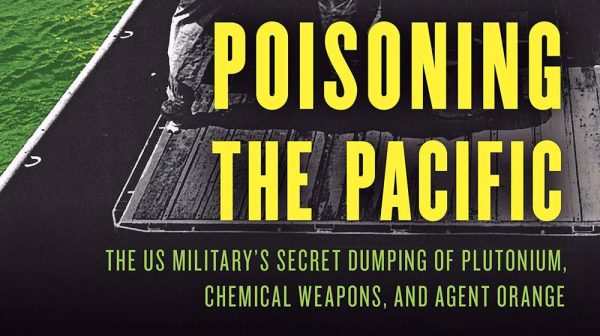
‘Poisoning the Pacific’ details US military’s secret dumping of poison into Far East
Press TV – October 11, 2020
A new book has revealed that the US military has contaminated the Pacific Ocean with radioactive waste and weapons-grade chemicals for decades.
The new book titled Poisoning the Pacific, written by British journalist Jon Mitchell, details how the US military has been disposing toxic substances, including plutonium, dioxin, and VX nerve agent at the Pacific.
Based on more than 12,000 pages of US government documents, Poisoning the Pacific narrates the story of soldiers, their families, and residents who have been exposed to poisonous substances.
The documents have been obtained under the US Freedom of Information Act (FOIA) and through interviews with local residents, military veterans and researchers.
The US government, however, has covered up the extent of the damage and refused to help the victims.
In one case, Leroy Foster – a US Air Force master sergeant who was assigned to the Anderson Air Force Base in Guam in 1968 – was ordered to mix “diesel fuel with Agent Orange” and spray “it by truck all over the base to kill the jungle overgrowth.”
Soon after, Foster suffered serious skin complaints and eventually fell sick with Parkinson’s and ischemic heart disease. Later, his teenage daughter had cancer, and his grandchild was born with 12 fingers, 12 toes, and a heart murmur. Foster died in 2018.
“My reporting has helped these sick men and women to receive compensation from the US government. Investigative journalism is ultimately a job that ought to help people suffering from mistreatment to receive the justice they deserve,” Mitchell says in his book.
The voices of the suffering indigenous groups in the Pacific region, however, consistently go unheard, said Mitchell, who in 2015 was awarded Japan’s Freedom of the Press Lifetime Achievement Award for his work about the environmental impact and damage caused by US military presence in Okinawa.
Researchers report that villages where herbicides were believed to have been sprayed by the US suffered higher rates of infant deaths from birth defects.
The US government was split over claims of herbicide use on Guam following an investigation in 2017. The Department of Defense reported that tests on soil did not contain herbicides, but the Environmental Protection Agency reported the opposite.
The health and environmental impacts on Guam mirror those that have happened to local residents and US soldiers based in Okinawa, Japan, where the US has maintained a base for decades.
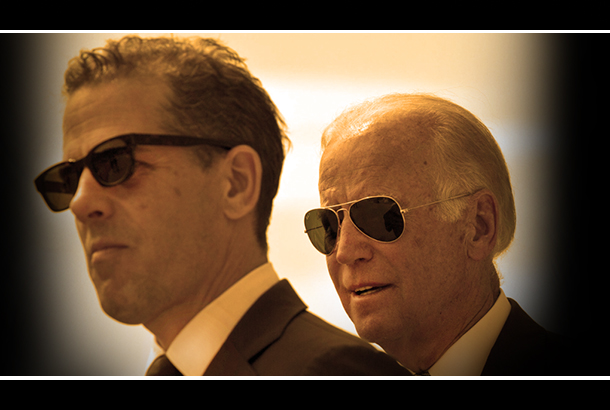
When Will the Truth About the Bidens’ Ukraine Deals & Financial Bonanza Come Out?
By Ekaterina Blinova – Sputnik – 10.10.2020
Despite the US mainstream media and the FBI appearing uninterested in the latest GOP study concerning Hunter Biden’s financial transactions and occupations during his father’s vice presidency, the investigation may go full throttle if Joe Biden is defeated in the 2020 campaign, suggests US investigative journalist George Eliason.
The FBI has refused to either confirm or deny the existence of any ongoing investigations concerning Hunter Biden, the son of former Vice President and Democratic presidential nominee Joe Biden, The Federalist reported on 8 October, citing an exclusively obtained bureau letter written in response to a 24 September request by Republican Congressman Jim Jordan, the ranking member on the House Judiciary Committee.
Why FBI Unlikely to React Before the Election
On 24 September, Jordan sent a letter to FBI Director Christopher Wray asking what investigative steps – if any – the intelligence agency had taken in response to the GOP report detailing misconduct and suspicious financial transactions involving Hunter Biden, his family, and his associates.
Nevertheless, the FBI has yet to respond to Jordan’s questions concerning potential inquiries into:
· Hunter Biden receiving millions of dollars from foreign nationals with questionable background and funding individuals “involved in human trafficking and organised prostitution”;
· Hunter’s Chinese transactions “involv[ing] potential criminal activity”;
· a bribe allegedly paid by Ukrainian gas firm Burisma’s owner to the country’s officials to stop investigations against him while Hunter served on the company’s board.
Although Republican congressmen are urging the FBI to look into the Bidens’ potential misconduct, there is little if any chance of the Senate pressuring Wray into launching a formal investigation before the November election, believes George Eliason, a Donbass-based American investigative journalist.
“The last thing the Senate will do is make any move that looks partisan or trying to influence the election”, Eliason stresses. “After the election it is possible, if Biden loses. On the chance of a Biden win, the investigation will be mute”.GOP Report Sheds Light on Hunter Biden’s Gains
The GOP report indicates that Hunter Biden’s financial gains from foreign sources substantially increased during his father’s tenure as US vice president and after, citing a potential conflict of interest.
Referring to Treasury records, the document also alleges “potential criminal activity relating to transactions among and between Hunter Biden, his family, and his associates with Ukrainian, Russian, Kazakh and Chinese nationals”.
Several days before the release of the committee’s findings, Just the News reported that the Financial Crimes Enforcement Network (FinCEN), a bureau of the US Treasury Department, had “flagged several foreign transactions to Hunter Biden-connected businesses as ‘suspicious’ during the end of the Obama administration and the beginning of the Trump administration”. These findings were highlighted in the agency’s Suspicious Activity Reports (SARs) which, according to the media outlet, “is [per se] not evidence of wrongdoing, but it is usually a starting point for investigation”.
In addition to receiving $4 million in “questionable financial transactions” with foreign financiers, Hunter Biden was spotted sending funds to individuals “linked to what ‘appears to be an Eastern European prostitution or human trafficking ring'”, the GOP report reads.
Republican investigators specifically turned the spotlight on Hunter Biden’s role in the Ukrainian gas firm Burisma when his father served as the Obama administration’s “public face” of its policy towards the Eastern European state. In May 2014, Hunter joined the firm’s board of directors, despite having no experience in energy, and was paid as much as $50,000 per month.
“The Bidens were in the front seat [of the Obama administration’s Ukraine politics] the entire time”, Eliason recollects. “Joe Biden’s support for the Ukrainian diaspora and fulfilling their wants in Ukraine has been unwavering. The fact that Ukraine became a cash cow for his family that early makes it very clear”.
Thus, in December 2014, the owner of Burisma, Mykola Zlochevsky, reportedly gave a $7 million bribe to Ukrainian officials to have the case against him closed and his $23-million assets in the UK unfrozen while Hunter Biden was on Burisma’s board. According to the GOP document, the case was reported to the FBI by a DOJ official at the US Embassy in Kiev in 2015, but no action seemingly followed. While US State Department officials considered Zlochevsky “corrupt” at the time, then Vice President Biden avoided denouncing the Ukrainian oligarch, the document says.
More Facts May Emerge After 2020 Campaign
While the FBI keeps silent, the US left-leaning mainstream media have downplayed the study, saying that it does not show whether Hunter Biden’s actions influenced US government policy in any way.
CBS News, in particular, has drawn attention to the fact that “the report does not assert that the former vice president pushed for the firing of a Ukrainian prosecutor in order to protect Burisma, a central claim made by President Trump and his allies”. For its part, the Biden campaign denounced the GOP research as a political attack amid the 2020 presidential campaign.
“The MSM has been firmly behind Biden and has to step back further than is now possible with credibility”, says Eliason referring to the mainstream media’s previous efforts to bury the anti-Biden sexual harassment allegations put forward by Tara Reade, a former staff assistant in Biden’s US Senate office. “As far as not affecting US policy, it’s a fogging ploy to relieve Biden from any culpability in crimes the evidence is very strong pointing to his involvement”.
Meanwhile, the Ukrainian probe into the alleged Biden-Poroshenko tapes, concerning the ouster of then Ukrainian Prosecutor General Viktor Shokin – who was investigating Burisma Holdings – in exchange for a $1 billion loan, is still ongoing, the journalist emphasises.
Ukrainian Prosecutor General Iryna Venediktova confirmed in mid-September that the tapes are being examined: “We are waiting for the results of the research. We will react only where it is prescribed by law … Ukraine does not interfere in the affairs of other states. We remain in the field of criminal justice”, she stated on Savik Shuster’s YouTube podcast on 12 September.
Eliason believes that more facts concerning the Bidens may surface when the presidential campaign is over, as it will no longer be seen as an attempt to interfere in the elections. Furthermore, in case Biden loses and Trump retains office, the situation “would be cut and dry”, which would help US investigators to eventually sort things out.
Pelosi & husband invest up to $1 million in CrowdStrike, tech firm that launched Russiagate – report
RT | October 10, 2020
Newly-filed financial disclosures show House Speaker Nancy Pelosi and her husband have invested up to $1 million in CrowdStrike, American cybersecurity technology company and the originator of ‘Russian hacking’ claims.
Financial disclosures show Pelosi (D-California) and her husband Paul buying CrowdStrike shares on September 3, according to a RealClearInvestigations report by journalist Aaron Mate. Since then, the stock went from $129.25 a share to $142.97.
Reached for comment, Pelosi’s spokesman Drew Hammill insisted she was “not involved” in her husband’s investments and “not aware of the investment until the required filing was made.” Pelosi invests in publicly traded companies all the time and “fully complies with House Rules and the relevant statutory requirements,” Hammill added.
CrowdStrike seems like a lucrative investment prospect, according to Mate’s report. The company’s valuation went from $1 billion in 2017 to $6.7 billion in 2019, when they went public – and then almost doubled to $11.4 billion. Its revenue rose from $52.75 million in 2017 to $481.41 million in 2020, Mate reports.
The company was hired by the DNC to address the breach of its email system in 2016. It blamed “Russia” for the alleged hack, but never provided the actual servers to the FBI, offering instead images and redacted reports.
CrowdStrike President Shawn Henry testified to the House Intelligence Committee in December 2017 that the company never had “concrete evidence” the data was actually “exfiltrated” from the servers. Instead, he said, they “saw activity that we believed was consistent with activity we’d seen previously and had associated with the Russian Government.”
This testimony was kept classified until May this year, when it was released to the public under pressure from Acting Director of National Intelligence Richard Grenell. In the intervening years, the claim that ‘Russia hacked the DNC’ became an article of faith in Washington, underlying the investigation into President Donald Trump’s “collusion” with the Kremlin led by Robert Mueller.
Prior to joining CrowdStrike, Henry worked under Mueller at the FBI. The company’s co-founder and chief technology officer, Dmitry Alperovitch, used to be a senior fellow at the Atlantic Council, the pro-NATO think tank which thrives on hostility towards Russia.
In addition to feeding the Russiagate frenzy and profiting from it, CrowdStrike also donated to Democrats – about $100,000 to the Democratic Governors Association in 2016 and 2017, according to Mate.
Michael Mann Appeals to, Then Ignores Scientific Consensus on 60 Minutes
By James Taylor – Climate Realism – October 5, 2020
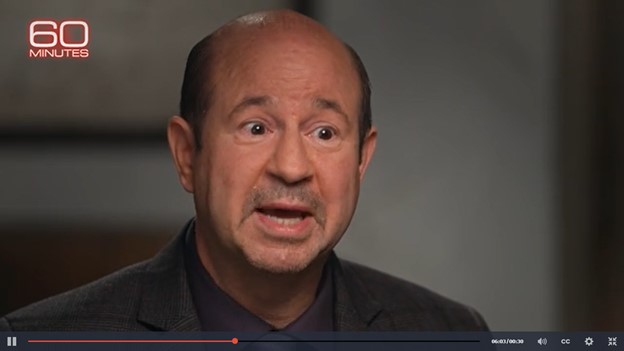
Prominent scientist and climate activist Michael Mann appealed to an asserted scientific consensus to chastise President Donald Trump on CBS’s 60 Minutes program last night. Ironically, Mann himself ignored clear scientific consensus in order to promote his own, out-of-the-mainstream climate change theories.
While interviewing Mann, CBS’s Scott Pelley said, “There have always been fires in the West. There have always been hurricanes in the East. How do we know that climate change is involved in this?” Pelley followed up with, “The president says about climate change, ‘Science doesn’t know.’”
Replied Mann, “The president doesn’t know, and he should know better. He should know that the world’s leading scientific organizations, our own U.S. National Academy of Sciences, and national academies of every major industrial nation, every scientific society in the United States that’s weighed in on the matter. This is a scientific consensus. There’s about as much scientific consensus about human-caused climate change as there is about gravity.”
Mann’s description of the conclusions of the “scientific consensus” however, is exactly the opposite of what scientific bodies report.
As documented in Climate at a Glance: Hurricanes, the United Nations Intergovernmental Panel on Climate Change (IPCC) expresses “low confidence” in any connection between climate change and changes in hurricane activity.
Similarly, as documented in Climate at a Glance: U.S. Wildfires, U.S. wildfires are much less frequent and severe than they were in the first half of the 20th century – 100 years of global warming ago. Moreover, the IPCC reports a decrease in drought conditions – which is the primary climate factor regarding wildfires – in the global region including the U.S. West. Moreover, the IPCC finds no evidence of an increase in drought globally, either.
Ultimately, data, evidence, and scientific facts are far more indicative of scientific truth than a real or imagined consensus of scientists. Yet, to the extent Michael Mann wishes to invoke consensus as a scientific argument, the clear consensus of scientists is that Mann is promoting extreme climate theories that have no basis in reality.
James Taylor is Director of the Arthur B. Robinson Center for Climate and Environmental Policy at The Heartland Institute.
As Boris Johnson announces Britain’s ‘great reset’, were the Covid ‘conspiracy theorists’ right all along?
By Neil Clark | RT | October 7, 2020
The UK Prime Minister’s remote speech to his party conference saw him dismiss the idea of returning to normality. Is he using Covid-19 to follow the World Economic Forum’s ‘Great Reset’ agenda, as many have warned?
‘It’s not really about public health or a virus. They have another agenda.’ That’s what the so-called ‘conspiracy theorists’ have been saying since March, when the first British lockdowns were imposed and our lives were turned upside down.
Those ‘conspiracy theorists’ were denounced, as always, as ‘cranks’ and ‘flat-Earthers’ but here we are in October, and, let’s face it, there is absolutely no sign, despite very low numbers of deaths ‘with’ Coronavirus, that we are returning to anything like normal. In fact, in his keynote speech yesterday, Prime Minister Boris Johnson specifically ruled out a return to normal, not even with a vaccine.
“After all we have been through, it isn’t enough just to go back to normal. We have lost too much. History teaches us that things of this magnitude – wars, famines, plagues, events that affect the vast bulk of humanity, as this virus has – they do not just come and go. They can be the trigger for economic and social change.”
When I heard Johnson utter those words I thought, ‘where have I heard this stuff before?’ Well, the answer is in the book ‘Covid-19: The Great Reset’ by Klaus Schwab, the executive chairman of the World Economic Forum, and Thierry Malleret. They too, like Johnson, invoked the Second World War as the trigger for fundamental changes, not only to the global order and global economy, but to society and the way human beings interact with one another. Like Johnson, they don’t want to return to normal. “Many of us are pondering when things will return to normal. The short response is never.”
Instead, Schwab and Malleret want a world changed forever by a virus which they admit is only ‘mild’ compared to others in history. Covid-19 is seen as the catalyst for the ‘Fourth Industrial Revolution’.
As to where all this is heading, I recommend you read Schwab’s ‘Great Reset’, and his earlier ‘The Fourth Industrial Revolution’, but please don’t do so late at night, because they will probably give you nightmares. Schwab’s elitist Davos-man utopia is a trans-human, socially distanced, utterly soulless dystopia for the rest of us. Think of the most terrifying sci-film you’ve ever watched and that still doesn’t go anywhere near it. And the worst thing is that it is sold to us as some kind of ‘progressive’ vision.
Johnson, in his speech yesterday, showed he’s a fully-signed up ‘Great Resetter’. It was, for me, the most chilling oration ever made by any British prime minister at a party conference.
The man who justified a national lockdown in March on a purely temporary three-week basis to ‘flatten the curve’, and ‘protect the NHS’, and who said in the summer, after the lockdown had lasted three months, that he hoped Britain would return to ‘significant normality’ by November, now tells us: “We have been through too much frustration and hardship just to settle for the status quo ante – to think that life can go on as it was before the plague; and it will not… We are resolving not to go back to 2019.”
For Johnson, using the globalists’ phrase ‘Build Back Better’, this is the time to launch Britain on the ‘Fourth Industrial Revolution’. “From internet shopping to working from home, it looks as though Covid has massively accelerated changes in the world of work… as old jobs are lost and as new ones are created… The Covid crisis is a catalyst for change…” he said.
Did Schwab actually write his speech? It looks like it. Although Johnson didn’t use the phrase ‘The Fourth Industrial Revolution’, he did mention a ‘Green Industrial Revolution’ twice.
Johnson foresees a future in which every home in Britain relies on wind power (he certainly produces a lot of that), and “instead of being dragged on big commutes to the city” people can “start a business in their home town… and bring up their children in the neighbourhoods where they grew up themselves.”
Working from home is here to stay, with “gigabit broadband,” shopping from home, conferencing from home… in fact, let’s do everything from home. Who needs to meet other human beings? Not that there’d be anywhere to meet, with pubs, cinemas and theatres all closed down due to the never-ending coronavirus restrictions.
Johnson pledged to make Britain “the greatest place on Earth” but to me it sounds more like hell. The question, as ever, is who benefits?
The World Economic Forum, founded by Schwab, has been incredibly influential when it comes to the changes we’ve already seen in 2020, and what is being openly planned for the future. It was the WEF which co-hosted the ‘Event 201’ conference in New York in October 2019, which modelled a fictional global pandemic.
It was at the WEF’s annual meeting in Davos on January 24, 2020 that Bill Gates’ Coalition for Epidemic Preparedness and Innovations (CEPI) held a press conference to announce a ‘new partnership’ to develop vaccines for the virus, when the number of confirmed worldwide cases was still in the hundreds.
It was the WEF’s Schwab who declared in June: “The pandemic represents a rare but narrow window of opportunity to reflect, reimagine and reset our world.”
It was the WEF that in July was promoting a Covid-19 ‘Health Passport’ app, the ‘brainchild’ of one of its ‘Young Global Leaders’, as the future for travel and attending events.
And for those who don’t have the app or a ‘negative‘ test result? Well, you can just stay at home.
If you take a look at the ‘founding partners’ of the WEF’s Centre for the Fourth Industrial Revolution you’ll see names such as Microsoft, Palantir, Facebook, Netflix and Gavi, The Vaccine Alliance, founded by the Bill and Melinda Gates Foundation.
Yes, that’s right, hi-tech online giants and hi-tech multi-billionaires supporting a big shift towards a stay-at-home, ‘do everything on the Internet’ society.
Is it a ‘conspiracy theory’ to say that Covid-19 is being used as a convenient opportunity to introduce long-planned changes to the economy and society, when those pushing for such changes like Schwab openly talk of there being a “rare but narrow window” for a major ‘reset’?
Actually, after Johnson’s speech yesterday, the biggest ‘conspiracy theorists’ now are those who DON’T think the British government is working to another agenda.
Neil Clark is a journalist, writer, broadcaster and blogger. His award winning blog can be found at http://www.neilclark66.blogspot.com. He tweets on politics and world affairs @NeilClark66
The War on Truth, Dissent and Free Speech
Syria, the OPCW Douma Investigation and the Working Group on Syria, Propaganda and Media
Dr Piers Robinson | OffGuardian | October 6, 2020
On Saturday 13 June 2020 the Times newspaper published its third attack on academics associated with researching British government propaganda and the war in Syria. This time the attack focused on smearing myself and Professor David Miller with the objective of discrediting an academic organization we established, the Organisation for Propaganda Studies (OPS), designed to foster research and writing on propaganda.
The article contained multiple falsehoods and distortions and was similar in style to previous attacks aimed at character assassination mainly through employment of the ‘conspiracy theorist’ smear. Most prominently the hatchet pieces misleadingly conflated work by members of the Working Group on Syria, Propaganda and Media (WGSPM), of which myself and Miller are also members, with the OPS. Formal complaints from the OPS are in process and the Times has already been forced to issue a number of corrections.
Of course, character assassination as a propaganda tactic is widespread and there is even a Routledge academic handbook on the subject, the ‘Routledge Handbook of Character Assassination and Reputation Management’, which was published in 2019 and contains 30 odd chapters. The attacks by the Times have been amplified by similar pieces written by Chris York for the Huffington Post.
In total, approximately 20 articles have been produced attacking those of us who are working on the war in Syria and questioning important aspects of UK propaganda operations. The bulk of these articles have been written by just two journalists, Dominic Kennedy for the Times newspaper and Chris York for the Huffington Post. This represents an extraordinarily intensive and sustained campaign against us.
Why on earth have we gotten into so much trouble?
A history of the attacks is instructive. Attention first started to be paid by former Guardian journalist Brian Whitaker in February 2018 when he penned a series of crude hatchet pieces on his blog smearing academics associated with the then newly established WGSPM. At that point Huffington Post journalist Chris York had already been attempting for several months to make contact with me, Professor Tim Hayward and journalist Vanessa Beeley.
But it was several weeks after Whitaker’s smears that the attacks started in earnest. Following the now controversial alleged chemical weapon attack in Douma, Syria, on 7th April 2018, the US UK and France bombed Syrian government targets claiming Syria was responsible for the attack. At the same moment these air attacks were underway, the Times of London published four articles which included one on the Front page, photographs of some of us from WGSPM and an editorial.
These articles smeared the academics as ‘conspiracy theorists’ for questioning official narratives regarding chemical weapon attacks in Syria, as ‘Assadists’ and also implied the existence of nefarious links with Russia. Chris York of the Huffington Post then followed the Times attack with multiple articles attacking us. The articles followed a similar pattern to the Times’ hatchet pieces involving allegations of ‘conspiracism’, ‘war crimes denial’, being pro Assad and pro Putin etc. More than two years later, attack pieces are still being published.
The vast bulk of the output of WGSPM has concerned the issues of alleged chemical weapon attacks in Syria and, in particular, the Douma event. The working group’s briefing notes documented serious anomalies and issues regarding these attacks and, in particular, critically analysed both the OPCW investigations of these alleged attacks and also identified the involvement of UK-linked actors, including the late James Le Mesurier (founder of the White Helmets) and Hamish de Bretton-Gordon.
The evidence, as the working group briefing notes set out, is that the OPCW Douma investigation was manipulated in order to ensure the finger was pointed at Syrian government responsibility for the alleged chemical weapon attack. In reality, the evidence did not demonstrate an attack had occurred and, in fact, pointed toward the attack having been staged.
Our findings have been presented at an event at the UK House of Commons and at the Harvard-Sussex Program on Chemical and Biological Weapons.
The WGSPM has not been alone in raising questions and a wide body of material now corroborates its work. For example, even at the time of the Douma attack credible individuals voiced doubt about the likelihood of the Syrian government launching a chemical weapon attack in Douma just as its forces were on the brink of retaking the enclave.
For example, both retired Major General Jonathan Shaw and Admiral Lord West questioned the tactical logic of any such an attack and the latter raised the possibility the event was carried out by opposition groups.
Following the publication of the final OPCW report on Douma in March 2019, an engineering report was leaked to WGSPM and which concluded that the chlorine gas cylinders had likely been manually placed at the alleged attack scenes rather than having been dropped from a Syrian air force helicopter. This engineering report, it subsequently transpired, had been rejected by OPCW management on spurious grounds.
During the Autumn of 2019 the Courage Foundation hosted a panel at which a former OPCW official briefed a panel of trusted and authoritative individuals, including José Bustani the first Director General of the OPCW, about significant procedural and scientific flaws regarding chemistry, ballistics, toxicology and witness statements.
An open letter addressed to OPCW states parties from the Courage Foundation followed and was signed by eminent voices such as Professor Noam Chomsky, Hans von Sponeck (former UN Assistant Secretary-General), GCHQ whistleblower Katharine Gun, former UNSCOM weapons inspector Scott Ritter, film director and producer Oliver Stone and John Pilger.
Since then, multiple documents have been published by Wikileaks evidencing irregularities with respect to the Douma FFM investigation whilst journalists such as Peter Hitchens (Mail on Sunday ), Stefania Maurizi (formerly of La Repubblica ) and Robert Fisk (The Independent ) have reported on the issue.
Peter Hitchens has been a particularly vociferous voice defending the reputations of two OPCW staff who have been subjected to a malicious internal investigation aimed at smearing their reputations. In 2020, further leaks have been published by The Grayzone in the United States including statements from further OPCW persons and, most recently, Aaron Maté published an article in the leading US current affairs magazine The Nation.
Finally, and by no means least, former OPCW inspector Ian Henderson addressed an Arria Formula meeting of the UN Security Council at which he detailed the irregularities and misconduct he had experienced with respect to the FFM Douma investigation. In September 2020, a second Arria Formula meeting was held at which OPCW Syia FFMs and the Douma investigation were again debated and which included, again, the former OPCW Inspector Ian Henderson. And, this week at a UN Security Council meeting, a statement from OPCW First Director-General José Bustani was read out in which yet again raised concerns about the conduct of the OPCW Douma investigation.
To any casual observer it should be abundantly clear that the activities and output of the WGSPM is entirely legitimate. Our work has been at the forefront of an issue that has been discussed by mainstream media journalists and has been corroborated by information from people within the OPCW itself.
Why then have the Times of London and the Huffington Post published approximately 20 articles (including three Times leaders) in 2 years targeting us?
In general, the behaviour of both the Times and the Huffington Post is disturbing and suggestive of a deliberate campaign aimed at suppressing public debate regarding both the war in Syria and the involvement of the UK government in supporting activities aimed at the overthrow of the Syrian government.
UK involvement in the Syrian war has included direct support for opposition groups as well as potentially criminal activity relating to the OPCW and connection with the staging of alleged chemical weapon attacks.
In the last few weeks, a large volume of FCO documents have been leaked which document a vast ‘strategic communication’ operation aimed at supporting the war against Syria. According to Ben Norton from the Grayzone:
[V]irtually every major Western corporate media outlet was influenced by the UK government-funded disinformation campaign exposed in the trove of leaked documents, from the New York Times to the Washington Post, CNN to The Guardian, the BBC to Buzzfeed.
In fact, there are some indications that the media attacks might be the direct result of deliberate media alignment with the UK government position on Syria and its well-established policy seeking to overthrow the existing Syrian government. Specifically, two of the authors of the original Times attack on the academics, Dominic Kennedy and Deborah Haynes, are identified in leaked documents as being associated with the UK government-funded propaganda operation known as the Integrity Initiative.
The Integrity Initiative leaks provided powerful insights on how propaganda operations were being built around “clusters” of journalists. Haynes has subsequently denied involvement with the article whilst Kennedy has repeatedly refused to answer questions regarding the relationship between his articles and the Integrity Initiative.
Most notably, Times columnist Oliver Kamm has stated in public that the late James Le Mesurier ‘had reached out to this newspaper to urge us to keep on their [the academics] case’.
Regarding Huffington Post, Chris York’s line manager, Jess Brammar, is a member of the Defence and Security Media Advisory Committee which works with the UK government on influencing and controlling media reporting of defence and security related issues. Further information regarding the organizational details and scale of media-related activities aimed at suppressing criticism of UK Syria policy is still being investigated and information will be published in due course by WGSPM.
However, even if it is, as of yet, unclear whether the attacks are at the behest of those involved in UK government/FCO strategic communication operations related to Syria, it is certainly the case that they have a deleterious impact on open public debate and academic research. People might reasonably expect mainstream media to uphold, defend and encourage research and debate, as opposed to smear honest academics who are simply doing their jobs.
Even more seriously, the available evidence indicates that the alleged attack in Douma involved the murder of captive civilians. That means the event surrounding Douma likely involve an extremely serious, and indeed horrific, war crime. Those seeking to hinder those in pursuit of the truth run the risk of complicity, whether knowing or unknowingly, in a war crime and run legal jeopardy as a result.
A final note. The late Julian Perry Robinson, one of the world’s leading experts on chemical and biological weapons, was in communication with the Working Group. In an earlier era, Robinson played a key role challenging the false claim made by the US government that Soviet-backed forces in Laos and Cambodia were deploying toxins.
At the time of his death, he was completing a chronology regarding chemical weapons and the war in Syria. Writing about the events surrounding alleged chemical weapon attacks in Syria and the vicious attacks against WGSPM, he noted that:
It is not immediately clear from their pronouncements that the critics of the WGSPM just quoted have in fact adequately studied the Group’s publications. They certainly seem not to have done their reading with the care that might have been expected ahead of such vicious denigrations.
So is the Group simply becoming a victim of the fake news and other acts of information warfare it has itself been seeking to counter? Is the WGSPM being maliciously targeted by enemies that its principled research and outreach seem to have created?
— Part 8: The Chemical Warfare Reported From Syria: a documented chronology detailing reports of events in Syria since 1982 said to have involved use of chemical weapons, by Julian Perry Robinson
It was Julian Perry Robinson who subsequently invited WGSPM member Professor Paul McKeigue to present at the Harvard-Sussex Program on Chemical and Biological Weapons roundtable meeting in March 2020.
If a figure of such standing and brilliance wished for his colleagues to hear our analysis, where does this leave the Times and the Huffington Post who have so relentlessly sought to silence us through character assassination and smears?
Not, I would suggest, in a very good place.
Russia slams ‘disgraceful’ ban on founding OPCW chief speaking at UN Security Council on Syria
RT | October 6, 2020
An ex-OPCW chief, sacked under US pressure, has been barred from briefing the UN Security Council about a controversial probe into an alleged 2018 chemical attack in Syria. Russia called it a “shame” and published his speech.
Jose Bustani, a Brazilian diplomat who led the Organization for the Prohibition of Chemical Weapons (OPCW) from 1997 until 2002, was invited by Moscow to speak at a UN Security Council meeting about the so-called “Syrian chemical dossier,” but his appearance was blocked at the last minute by Belgium, Germany, Estonia, France, the US and the UK.
“What has happened now is yet more sad proof that Western delegations fear the uncomfortable truth,” Russia’s ambassador to the UN, Vassily Nebenzia, stressed while addressing the UN global body on Monday.
He said the six countries had “made history” because the Security Council has never voted “on the presence or absence of a briefer proposed by the [UNSC] president.” Prohibiting the former OPCW director general from speaking was a “shame and disgrace,” Nebenzia concluded, promising to publish Bustani’s statement after the meeting.
UK envoy Jonathan Allen said that Bustani is not in a position to “provide relevant knowledge or information.”
Shortly afterwards, the undelivered speech appeared on the website of the Russian mission to the UN. In it, the sacked OPCW chief raised “serious questions” over “whether the independence, impartiality, and professionalism of some of the organization’s work is being severely compromised, possibly under pressure from some member states.”
As a major example, Bustani cited an OPCW investigation into the alleged use of chemical weapons in the Syrian city of Douma on April 7, 2018. Western governments, and media outlets, maintain that forces loyal to Damascus dropped two gas cylinders as part of an offensive against jihadist forces, killing scores of civilians.
The allegations were used as a pretext for a major US-led airstrike against Syrian government forces later that year. The OPCW launched a probe into the “chemical attack,” and in early March of 2019, the final report by the Fact-Finding Mission (FFM) of the OPCW stated that there were “reasonable grounds” to believe that canisters filled with “molecular chlorine” were dropped from Syrian aircraft in Douma.
The final report gave credence to the Western show of force by implicating the Syrian government of Bashar Assad in conducting the attack, which the Syrian authorities vehemently deny.
Shortly after the release of the OPCW report, an internal memo by OPCW engineers was leaked, suggesting the canisters were likely just placed at the site of the “attack,” and did not come from the skies. Still, the final report did not include such information, and a senior OPCW official reportedly ordered the removal of “all traces” of the dissenting opinion, according to WikiLeaks.
Months later, Bustani noted that he was invited to an expert panel which heard the testimony of an unnamed OPCW investigator, who came forward with damning evidence that his own organization had engineered a report based on a flawed conclusion and likely deliberately steered toward the outcome favored by the West.
That expert provided “compelling and documentary evidence of highly questionable, and potentially fraudulent conduct in the investigative process,” Bustani’s statement recalled. The Brazilian diplomat had been so stunned by the testimony that he personally called on the OPCW to be “resurrected to become the independent and non-discriminatory body it used to be.”
However, he continued, the chemical weapons watchdog did not respond to any calls for greater transparency about the controversial Douma investigation. The probe was “hidden behind an impenetrable wall of silence and opacity, making any meaningful dialogue impossible.”
In conclusion, Bustani called on Fernando Arias, the current OPCW chief, to hear the grievances of OPCW inspectors who voiced dissenting opinions on the Douma incident. They “have dared to speak out against possible irregular behavior in your organization,” Bustani argued, adding that it is “in the world’s interest that you hear them out.”
Bustani noted that he had been removed from his OPCW position “following a US-orchestrated campaign in 2002.” Back then, he was trying to send chemical weapons inspectors to Iraq prior to the 2003 US invasion there. A UN tribunal ruled that his sacking was unlawful.
As our (un)civil war escalates towards the real thing, America is in throes of unrest unlike any in its history
By Michael Rectenwald | RT | October 5, 2020
Nearly two thirds of Americans believe the US is on course for civil war. One third now support political violence. The first Civil War’s death toll won’t be beaten, but the second’s nation-destroying potential will be unequalled.
The American left and right no longer inhabit a common moral universe. In fact, that imagined universe does not exist. The old, cherished political notions no longer apply, if they ever did. Not only are the terms ‘left’ and ‘right’ complete misnomers under the current configuration, but the players are not as they seem, or as they are made out to seem.
First, Trump is hardly the stereotypical right-wing despot that the ‘resistance’ makes him out to be, his rough demeanor and coarse rhetoric notwithstanding. At the same time, the Democrats are hardly the vaunted champions of the ‘working class’ as imagined under the old dispensation. Instead, the resistance to Trump is actually led by an entrenched political establishment, although their supporters apparently remain unimpressed by this minor detail.
Take a look at this ironic and unlikely political alignment. It should go a long way toward understanding the perturbations throwing the nation into convulsions. The resistance includes the Democratic Party machine, the loyal Democratic Party voters, the ‘never-Trumpers’ among the Republican establishment, the permanent bureaucracy or ‘deep state’, the riotous Antifa and Black Lives Matter foot soldiers, and, but for a few isolated and dwindling islands, the entirety of the mainstream media. Given its uncontested hegemony, this establishment-backed resistance inhabits a parallel universe of its own making and projects a fabricated simulacrum as reality.
The resistance establishment controls the official narrative, which includes a few prominent elements: the tropes that Trump is an inveterate liar, a huckster profiting from his incumbency, and a criminal who is committing unspeakable (and undiscoverable) crimes against the nation and humanity at large. Nancy Pelosi (D-CA), the Speaker of the House, went so far as to call Trump, the sitting president, an “enemy of the state.” This establishment resistance routinely declares Trump a dictator. It now asserts as an incontrovertible article of faith that he will refuse to vacate the White House should he lose the upcoming election.
The death of civility
Despite its own chicanery and possible criminality, the resistance establishment is so sure that its success is guaranteed that Hillary Clinton boldly urged Joe Biden not to concede the election under any circumstances. Rumors have even been floated that a contingent of military generals are prepared to remove Trump from the presidential domicile, if or when it comes to that. And now, since Trump contracted the coronavirus, Democratic Party leaders, a frothing media, and ardent party supporters have been unable to contain their glee at the prospect of his early demise.
As an indication that ‘civility’ is a thing of the past, one may point to the recent spate of tweets by Trump haters openly wishing for his death by Covid. Such posts became so prevalent and glaring that Twitter was forced to introduce a new policy declaring that any tweets wishing for the death of a politician would be removed. Conspicuously missing was any mention of even temporarily banning tweeters who infringe the policy. Such banning is routine for pro-Trump posters – and for far lesser infractions – if they are not contrived by the tech giant in the first place.
Meanwhile, Trump supporters are routinely caricatured as a reactionary and irredeemably racist band of blind loyalists, including a significant contingent of white supremacists willing and already engaging in acts of racist violence. Even as Antifa and Black Lives Matter rampage and riot, leaving rubble in their wake, rightwing extremists, we are told, are the greatest domestic threat to national tranquility.
A very American coup?
At the same time, Trump Republicans and their few allies in an otherwise overwhelmingly Democrat-favored corporate media point to a growing body of evidence that a coup has been ongoing since before Trump assumed power. The director of national intelligence, John Ratcliffe, recently alleged in a letter published by Sen. Lindsey Graham (R-SC), just hours before the first (and perhaps last) presidential debate, that Hillary Clinton orchestrated “a campaign plan to stir up a scandal” – by linking Trump to Russia in 2016. The letter also claims that then-President Barack Obama knew about her intent and role in the contrived affair and did nothing to prevent his former secretary of state from ordering up the concoction.
While the resistance hurls an endless series of increasingly outrageous accusations and epithets at Trump, pro-Trump forces in the state nevertheless continue to pile up dirt on the Democrats and their assets in the permanent bureaucracy. For example, the Senate Judiciary Committee’s investigations into the ‘Crossfire Hurricane’ investigation of the Trump team’s supposed collusion with Russia has revealed evidence that a Russian asset, suspected by the CIA of being a spy, was the underlying source for the “dirty dossier” that prompted the FBI investigation. The committee has pointed to evidence that former FBI Director James Comey knew the dossier was unsubstantiated garbage peddled by a gutter-sniping mercenary hack when he or his staff members submitted FISA applications.
Added to this, the Department of Justice has since reported that more than two dozen phones belonging to members of Special Counsel Robert Mueller’s team were “accidentally” wiped clean of data before the Justice Department’s inspector general could comb them for records.
Ironically, the Senate Judiciary Committee has also asserted that the son of former VP and current presidential candidate Joe Biden, namely Hunter Biden, actually engaged in a kind of ‘Russian collusion’ – when he received a whopping 3.5 million dollars from Elena Baturina, the wife of the corrupt former mayor of Moscow. Hunter Biden then allegedly funneled a part of these funds into human trafficking and prostitution rings. This alleged swindle, gained on the basis of his father’s influence peddling, would be added to the vast sums reportedly collected from corrupt oligarchs in Ukraine, China, and elsewhere.
All of these claims are either scoffed at and deemed conspiracies prima facie, or simply memory-holed by a complicit press. Nothing, it appears, will ever come of any of them.
Meanwhile, the vastly outflanked pro-Trump camp maintains that the attempted coup extends to the upcoming presidential election. Fears are escalating that the Democratic Party’s election machinery has already been set in motion, harvesting fraudulent or otherwise invalid mail-in ballots in favor of Biden. These deep misgivings are compounded by early reports of dumped and discarded ballots for Trump.
Anarchy in the USA
Among the ground forces in both camps, some informed and some merely inflamed by baseless rhetoric, hostility has reached fever pitch. According to Georgetown University’s Institute of Politics and Public Service, 83 percent of Americans believe that behavior once considered unacceptable is now deemed acceptable in the political sphere. Apparently, this behavior includes violence and threats of violence. Other studies found that 61 percent Americans polled believe the country is headed inexorably towards civil war. Other reports indicate that a nearly equal number of Democrats and Republicans (33 percent and 34 percent, respectively) believe that violence will be justified if their side loses the impending presidential election, up from just eight percent on both sides who believed that three years ago.
The ‘left’ justifies its campaign of violence given the supposedly disproportionate unjustified police violence against blacks. The ‘right’ justifies its pondered response as necessary self-defense and defense of the nation after months of almost unhampered rampages.
Surging gun sales across the country suggest that many Americans fear continued and increasing conflict. First-time gun and ammunition purchases have reached an all-time high. One might reasonably suppose that potential counter measures from pro-Trump ground forces are being seriously contemplated. The prospect of a protracted election controversy has both camps suggesting that they’re booted up and ready for action. Any state response to such action, on the other hand, remains unclear. Who, after all, will have the authority to direct state police forces if Democrats and their supporters claim that Trump’s ‘occupation’ of the White House is illegitimate?
Pro-Trump pundits warn that the violence coming from ‘leftists’ since May has only been a warm-up act for November 3 and beyond. There are so many related and somewhat disparate theories being floated that one’s head is left spinning. But suffice to say, anyone the least bit cognizant of the state of affairs is bracing for a massive confrontation.
‘Things fall apart’
The current and looming strife is demoralizing in the extreme, especially given the utterly incommensurable accounts held by the opposing sides. It is especially alarming to me, living as I do in urban Pennsylvania – a ‘swing state’ with the potential to be a center of a disputed election result that looks to tip over into open mortal combat. I plan on voting in the early morning, then driving immediately to another, probably uncontested, state.
The alarming state of affairs has led me to revisit a harrowing poem by William Butler Yeats, ‘The Second Coming’. The first stanza captures the temper and pitch of the moment so well that I quote in its entirety:
Turning and turning in the widening gyre
The falcon cannot hear the falconer;
Things fall apart; the centre cannot hold;
Mere anarchy is loosed upon the world,
The blood-dimmed tide is loosed, and everywhere
The ceremony of innocence is drowned;
The best lack all conviction, while the worst
Are full of passionate intensity.
I met my first grandchild for the first time the other day. And I wept with trepidation for his future.
Michael Rectenwald is an author of ten books, including the most recent, Beyond Woke. He was Professor of Liberal Arts at NYU from 2008 through 2019. Follow him on Twitter @TheAntiPCProf
Featured Video
Dan Dicks with James Corbett on Solutions Watch
or go to
Aletho News Archives – Video-Images
From the Archives
MMR (Measles, Mumps and Rubella) – Vaccine Risk Statement
MMR Vaccine (Measles, Mumps, and Rubella) Is It Safer Than Measles, Mumps and Rubella?
Physicians for Informed Consent | December 2024
… It has not been proven that the MMR vaccine is safer than measles, mumps, and rubella. The vaccine package insert raises questions about safety testing for cancer, genetic mutations, and impaired fertility. Although VAERS tracks some adverse events, it is too inaccurate to measure against the risk of measles, mumps, and rubella. Clinical trials do not have the ability to detect less common adverse reactions, and epidemiological studies are limited by the effects of chance and possible confounders. Safety studies of the MMR vaccine are particularly lacking in statistical power. A review of more than 60 MMR vaccine studies conducted for the Cochrane Library states, “The design and reporting of safety outcomes in MMR vaccine studies, both pre- and post-marketing, are largely inadequate.”19 Because permanent sequelae (aftereffects) from measles, mumps, and rubella are so rare (especially in children with normal levels of vitamin A and infected after birth),6,15-17 the level of accuracy of the research studies available is insufficient to rule out the possibility that the MMR vaccine causes greater death or permanent disability than measles, mumps, and rubella. – Read full article
Blog Roll
 Aletho News
- Moscow issues warning to NATO over Russian exclave
- Yes, the Iran war has destroyed Trump’s presidency
- The fallacy of US delusions about Iran’s economic collapse
- Hezbollah denies Syria cell link, warns of Israeli plan to sow discord
- The legacy of US sanctions, war, and occupation in Iraq
- Iraqi resistance group rejects disarmament, vows to maintain support for Lebanon
- Sheikh al-Asadi warns of Iraqi government compliance with US demands
- How to MAKE THE CONSPIRATORS PAY for their crimes! Dan Dicks with James Corbett on Solutions Watch
- There’s a drought in academia: A drought in honest research on the subject of drought and other weather extremes
- Department of War Awards $20.7 Billion Contract to Raytheon for Air-to-Air Missiles
- If Americans Knew
- An error has occurred; the feed is probably down. Try again later.
- No Tricks Zone
- Green Energy Debacle: German Expert Professor Fritz Vahrenholt Warns Of Severe Economic And Social Consequences
- Two More Paleo Reconstructions Affirm Meters-Higher Sea Levels Across Ireland, Brazil 7000-6000 Years Ago
- New Study: Earth And Venus Surface Warmth Largely Explained By Convection And Lapse Rate, Not CO2 Or Radiation
- 2025 Nature Paper Claiming Worsening Global Drought Gets RETRACTED …Heavily Flawed
- New Study: ‘Global Drought Shows No Detectable Recent Acceleration Under Climate Warming’
- Economic Masterminds: German Socialists Suggest Taxing Productivity Gains Stemming From Using AI
- The South China Sea Has Not Been Cooperating With The Climate Change Narrative
- Energy Crisis: Germany Enters Heating Season With Historically Low Gas Reserve Fill Levels
- New Study: The Antarctic Ice Sheet Gained Mass From 2020-2024 Due To Staggering Snow And Ice Accumulation
- Study: Ocean Heating Rates From Thousands Of Years Ago ‘Dwarf’ Modern Ocean Heating Rates


