More Explosive Leaks From OPCW Show Trump Bombed Syria On False Grounds
By Tyler Durden | ZeroHedge | July 27, 2020
As the ongoing increased sanctions regimen on Syria demonstrates, Washington’s pursuit of regime change against Assad is not over, despite Damascus clearly having won the war, and with the US having wisely ditched talk of some kind of overt major Iraq-style military intervention (as was the case under Obama in August 2013).
While mainstream media has largely “moved on” from coverage of Syria (so much for feigned humanitarian “concern” for millions of Syrians suffering under severe American-led sanctions!), some analysts like independent journalist Aaron Maté have been detailing damning leaks from the chemical weapons watchdog Organization for the Prohibition of Chemical Weapons (OPCW).
“A series of leaked documents from the OPCW raise the possibility that the Trump administration bombed Syria on false grounds and pressured officials at the world’s top chemical weapons watchdog to cover it up,” Maté’s latest report in The Nation begins.
“Two OPCW officials, highly regarded scientists with more than 25 years of combined experience at the organization, challenged the whitewash from inside. Yet unlike many whistle-blowers of the Trump era, they have found no champion, or even an audience, within establishment circles in the United States,” the report continues.
Recall that President Trump bombed Syria on two occasions. On the last occasion, in April 2018, Damascus was pummeled with a series of major tomahawk missile strikes ostensibly in response to claims by the primarily Saudi-backed jihadist group Jaysh al-Islam that the Syrian Army had carried out a chemical weapons attack on civilians. It was the all too familiar pattern which went back to 2013: “rebels” on the brink of being wiped out make a last ditch unverified claim in order to draw Western military support, then the mainstream media runs with it because it already fits the narrative of the “monster” Assad, and then right away it’s American and allied “bombs away” with no questions asked.
But Maté now documents an avalanche of leaks and internal dissent within the global chemical weapons watchdog group OPCW to say the US once again attacked a Middle East country based on lies (and just like in neighboring Iraq, don’t forget that some 1,000 or more American troops occupy the oil-rich northeast section of Syria).
My bad: Western state-funded Bellingcat “gathered evidence… long before the OPCW.”
Ignore then those “truthers/and or propagandists” who for some silly reason listen to actual OPCW scientists w/ actual credentials & who actually conducted the OPCW’s investigation in Syria. https://t.co/zjtDShQ2eL
— Aaron Maté (@aaronjmate) July 25, 2020
Maté’s report finds that “Since May 2019, internal OPCW documents, including a trove published by WikiLeaks, reveal that the Douma investigators’ initial report reached different conclusions than their organization’s published version. They were overruled by senior officials who kept evidence from the public.”
The Nation report outlines leaks’ key revelations as follows:
Senior OPCW officials reedited the Douma investigators’ initial report to produce a version that sharply deviated from the original. Key facts were removed or misrepresented and conclusions were rewritten to support the allegation that a chlorine gas attack had occurred in Douma. Yet the team’s initial report did not conclude that a chemical attack occurred, and left open the possibility that victims were killed in a “non-chemical related” incident.
Four experts from a OPCW and NATO-member state conducted a toxicology review at the OPCW team’s request. They concluded that observed symptoms of the civilians in Douma, particularly the rapid onset of excessive frothing, as well as the concentration of victims filmed in the apartment building so close to fresh air, “were inconsistent with exposure to chlorine, and no other obvious candidate chemical causing the symptoms could be identified.”
Chemical tests of the samples collected in Douma showed that chlorine compounds were, in most cases, detected at what amounted to trace quantities in the parts-per-billion range. Yet this finding was not disclosed publicly. Furthermore, it later emerged that the chemicals themselves did not stand out as unique: According to the author of the initial report, the OPCW’s top expert in chemical weapons chemistry, they could have resulted from contact with household products such as bleach or come from chlorinated water or wood preservatives.
The author of the initial report protested the revisions in an e-mail expressing his “gravest concern.” The altered version “misrepresents the facts,” he wrote, thereby “undermining its credibility.”
Following the e-mail of protest over the manipulation of the team’s findings, the OPCW published a watered-down interim report in July 2018. Around that time, OPCW executives decreed that the probe would be handled by a so-called “core team,” which excluded all of the Douma investigators who had traveled to Syria, except for one paramedic. It was this core team—not the inspectors who had been deployed to Douma and signed off on the original document—that produced the final report of March 2019.
After the e-mail of protest, and just days before the interim report was published on July 6, a US government delegation met with members of the investigation team to try to convince them that the Syrian government had committed a chemical attack with chlorine. According to veteran reporter Jonathan Steele, who interviewed one of the whistle-blowers, the Douma team saw the meeting as “unacceptable pressure and a violation of the OPCW’s declared principles of independence and impartiality.” Interference by state parties is explicitly prohibited under the Chemical Weapons Convention.
The inference drawn from the OPCW’s final report—widely disseminated, including by the Trump administration—was that gas cylinders found in Douma likely came from Syrian military aircraft. An unpublished engineering study reached the opposite conclusion. The study evaluated competing hypotheses: Either the cylinders were dropped from the sky or they were manually placed. There is “a higher probability,” it concluded, “that both cylinders were manually placed… rather than being delivered from aircraft.” At “Location 4,” where a cylinder was found on a bed, the study determined that the cylinder was too large to have penetrated the hole in the roof above; at the other site, “Location 2,” the observed damage to the cylinder and to the roof it allegedly penetrated were incompatible with an aircraft bombing. Ballistics experts also said it was more likely that the crater had been made by an explosion, probably from an artillery round, a rocket, or a mortar. With both cylinders, the study concluded, “the alternative hypothesis”—that the cylinders were manually placed and that the craters were caused by other means—”produced the only plausible explanation for observations at the scene.”
Of course, the media is seeking for these revelations to be memory-holed right way.
They are being conveniently ignored, and not just ignored, but covered up.
New WikiLeaks Bombshell: 20 Inspectors Dissent From Syria Chemical Attack Narrative https://t.co/vrQaBZIT7T
— zerohedge (@zerohedge) December 15, 2019
* * *
Read the full in-depth investigative report at The Nation.
Cybereason Announces New Plans to “Accelerate” Access to US Govt Networks Ahead of 2020 Election
By Whitney Webb | The Last American Vagabond | July 27, 2020
A cybersecurity firm tied to Israeli intelligence’s Unit 8200 that simulated a series of terrorist attacks occurring on the U.S. 2020 election has announced a new hire with deep ties to the U.S. intelligence and defense communities with the goal of gaining greater access to U.S. government networks.
A cybersecurity company tied to Israeli intelligence and a series of unnerving simulations regarding cyber-terrorist attacks on the upcoming U.S. elections has recently announced a new hire who plans to aid the company in further penetrating the U.S. public sector. Last Wednesday, the company Cybereason announced that it had hired Andrew Borene as its Managing Director for its recently launched U.S. public sector business. Borene, who boasts longstanding ties to the U.S. intelligence community and the Pentagon, “will accelerate Cybereason’s partner and customer presence in the U.S. public sector,” according to a Cybereason press release.
“My goal is to build a strong business for Cybereason within the U.S. public sector and I am planning to recruit a group of direct support executives, veterans and alumni of the elite [U.S.] military units and agencies that have defended our nation in the information age. I’ll also work to establish a network of the best channel and delivery partners for federal, state and local governments,” Borene said per the press release.
Eric Appel, Cybereason’s General Manager for North American Sales, stated that “We’re excited about Andrew joining Cybereason and the opportunity in the U.S. public sector for Cybereason to make a profound impact on helping the nation’s federal civilian, military, state and local government agencies…”
Borene will likely be successful in his ability to recruit a sales team of prominent alumni from the U.S. intelligence and defense communities to market Cybereason’s products throughout the U.S. government. Prior to joining Cybereason, Borene was a senior advisor to the Intelligence Advanced Research Projects Activity (IARPA), the intelligence community’s “DARPA” equivalent that is housed within the Office of the Director of National Intelligence (ODNI). He served in that capacity on behalf of intelligence contractor Booz Allen Hamilton. Prior to that, Borene served as Associate Deputy General Counsel to the Pentagon and was previously a military intelligence officer for the U.S. Marine Corps.
Borene’s private sector experience is also significant, as he was a senior executive at IBM. Notably, the current Chief Information Officer for the CIA, Juliane Gallina, had served alongside Borene as a top IBM executive prior to taking her current position at the agency. In addition, Borene also boasts ties to Wall Street as a veteran of Wells Fargo’s investment banking division.
In addition, Borene has deep ties to Washington’s foreign policy establishment as a “life member” of the Council on Foreign Relations (CFR) and to the national security-think tank nexus through his senior fellowship at the National Security Institute (NSI). NSI’s board includes former NSA directors, Keith Alexander and Michael Hayden (also a former CIA director); former Deputy Defense Secretary and “architect” of the Iraq War, Paul Wolfowitz; former director of the Defense Intelligence Agency, David Shedd; and a variety of other former top intelligence and defense officials as well as Silicon Valley executives and venture capitalists.
Notably, Borene is the latest addition to Cybereason with ties to the U.S. intelligence and defense communities as the company’s advisors include Robert Bigman, former Chief Information Security Officer for the CIA as well as Peter Sherlock, the former Chief Operating Officer of MITRE corporation, a major intelligence and defense contractor connected to the Ptech-9/11 controversy.
Cybereason: a front for Israeli Military Intelligence
Cybereason’s announcement of its hire of Andrew Borene coincided with its launch of its new “U.S. public sector business,” meaning that Cybereason now seeks to have its cybersecurity software running on even more of the U.S. government’s most classified networks. Cybereason, for years, has already been running on several sensitive U.S. government networks through its partnerships with IT contractors for intelligence and defense, such as Lockheed Martin (also a Cybereason investor), WWT and Leidos. However, Borene’s hire and this new publicly announced pivot towards the U.S. public sector clearly demonstrates the company’s interest in further deepening its presence on U.S. government networks.
Cybereason’s pivot is concerning for several reasons. First, its co-founders are alumni of Israel’s Unit 8200, an elite unit of the Israeli Intelligence corps that is part of the IDF’s Directorate of Military Intelligence and is involved mainly in signal intelligence, surveillance, cyberwarfare and code decryption. It is also well-known for its surveillance of Palestinian civilians and for using intercepted communications as blackmail in order to procure informants among Palestinians living under occupation in the West Bank.
In addition, all three Cybereason co-founders, after leaving Unit 8200, went on to work for two private Israel-based tech/telecom companies with a notorious history of aggressive espionage against the U.S. government: Amdocs and Comverse Infosys (the latter is now known as Verint Systems Inc.). This raises the possibility that Cybereason software could potentially be used as a backdoor by unauthorized actors, given that the company’s co-founders all previously worked for firms that have a history of placing backdoors into U.S. telecommunications and electronic infrastructure as well as aggressively spying on U.S. federal agencies.
Also notable is the fact that the company’s current CEO and co-founder Lior Div was much more than the average Unit 8200 officer during his time in the unit, as he “served as a commander [in Unit 8200] and carried out some of the world’s largest cyber offensive campaigns against nations and cybercrime groups. For his achievements, he received the Medal of Honor, the highest honor bestowed upon Unit 8200 members,” according to his biography. Troublingly, in an interview that Div gave to TechCrunch last year, Div stated that his work at Cybereason is “the continuation of the six years of training and service he spent working with the Israeli army’s 8200 Unit.”
This is particularly noteworthy given that Israel’s government has openly admitted that an on-going intelligence operation, first initiated in 2012 – the year Cybereason was founded, involves Israeli military intelligence and intelligence operations that had previously done “in house” (i.e. as part of Unit 8200, Mossad, etc.) being spun off into private companies, specifically start-ups in the “cyber” realm.
This operation is part of Israeli Prime Minister Benjamin Netanyahu’s “deliberate policy” to have former members of Israel’s “military and intelligence units … merge into companies with local partners and foreign partners” in order to make it all but impossible for major corporations and foreign governments to boycott Israel and to also to ensure that Israel becomes the world’s dominant “cyber power.”
One notable report on this policy, published by Israeli outlet Calcalist Tech, interviewed dozens of Israeli military, intelligence and government officials and noted that “since 2012, cyber-related and intelligence projects that were previously carried out in-house in the Israeli military and Israel’s main intelligence arms are transferred to companies that in some cases were built for this exact purpose.” The article also states that beginning in 2012, Israel’s intelligence and military intelligence agencies began to outsource “activities that were previously managed in-house, with a focus on software and cyber technologies.”
“Simulating” the Cancellation of the 2020 Election
In light of Cybereason’s background and the “acceleration” of their presence on U.S. government networks, the timing of their redoubled efforts to court the U.S. public sector add additional layers of concern given that it precedes the U.S. 2020 election by a matter of months. Since last year, Cybereason has conducted multiple simulations focused on the 2020 election, which were attended by federal officials from the FBI, DHS and the U.S. Secret Service and all of which ended in disaster. In those simulations, the 2020 election was ultimately canceled and martial law was then declared due to the chaos created by a group of hackers led by Cybereason employees.
Notably, Cybereason stood to gain nothing financially from the simulations given that their software could not have prevented the attacks waged against the U.S.’ electoral infrastructure in the exercise and the company framed their hosting of the simulations as merely “altruistic” because of their professed desire to help “protect” U.S. election infrastructure. The attacks conducted in the simulations by Cybereason employees included creating power grid blackouts, the use of deep fakes to sow confusion, creating havoc with municipal sewage systems and crashing self-driving cars into voters waiting in line to cast their ballots, killing 32 and injuring over a hundred people.
In the months since I first wrote about Cybereason and their 2020 “doomsday” simulations back in January, U.S. government officials and mass media alike have been warning that these same types of attacks that Cybereason simulated are likely to come to pass on this upcoming election day, scheduled for November 3rd of this year. More recently, in less than a week, headlines like “Election Security Experts Expect ‘Chaos’ Unless Action Taken,” “New York’s Pandemic Voting ‘Chaos’ Set to Go Nationwide in November,” and “Foreign adversaries ‘seeking to compromise’ presidential campaigns, intel warns,” among others, have been published in major U.S. media outlets.
While these narratives have asserted that China, Russia and/or Iran will be to blame for such attacks, it is worth noting that a tight-knit web of Israeli state-owned and private companies tied to Israeli military intelligence now run the software controlling key parts of the power grid in New York, California and elsewhere in the U.S.; are the main global producers of deep fakes; and the main providers of “security” software for self-driving and semi-self-driving cars, the quantity of which on U.S. streets has grown dramatically as a result of the coronavirus crisis.
With Cybereason’s newly announced push to run its software on critical U.S. government networks at both the federal and state levels, the company’s history of simulating terror attacks on critical U.S. infrastructure and their openly admitted and on-going ties to Israeli military intelligence deserve more scrutiny than ever as the U.S. election draws closer.
Sky News Miss the Story
By Craig Murray | July 27, 2020
Sky News are today carrying the story that Nicola Sturgeon attended a meeting with Salmond’s former Chief of Staff, Geoff Aberdein, about a historic sexual allegation made against Alex Salmond on 29 March 2018, several days before she claimed to parliament that she first heard of it. It will prove in the long term still more significant that this meeting also contradicts Sturgeon’s claim that it was Alex Salmond who first told her of the existence of the allegations.
This all appears to come as news to James Matthews, the Sky reporter. The extraordinary thing is, that both he and I sat through the testimony under oath on this point of Geoff Aberdein at the Alex Salmond trial.
On 8 to 9 March 2018 … had contacted him to say she was involved in a process of looking at complaints about Alex Salmond. He had spoken to Kevin Pringle and Duncan Hamilton by conference call to discuss this. On 29 March 2018 he had held a meeting with Nicola Sturgeon in the Scottish Parliament to discuss this. On 2 April he had attended a further meeting in Sturgeon’s home.
Matthews obviously thought it of no significance – but then again, it was defence evidence and Matthews, in common with the entire mainstream media, reported virtually zero of the defence evidence. Today’s Sky News article helpfully gives links to the headlines of their Salmond trial stories:
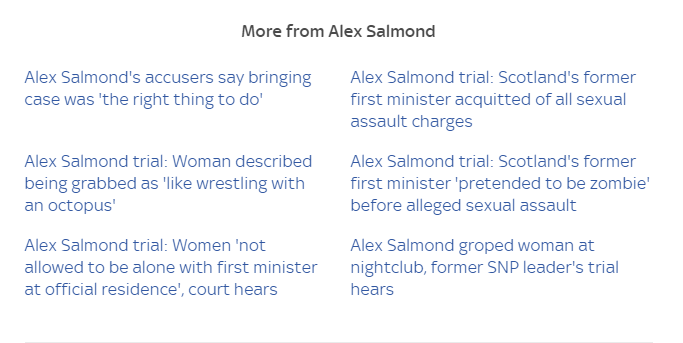
As you will see, lurid allegations from the prosecution witnesses – lurid allegations which were untrue – were prominently featured as the headlines. You will search those reports in vain for detail or even a bare outline of the defence case. The verdict is treated as a shock, and then we are straight in to stories querying the verdict.
Matthews and all the MSM hacks came for a hanging. They thus missed the real story, which is of a conspiracy at the highest levels of the Scottish Government to frame Alex Salmond. This finally seems to have penetrated even James Matthews’ thick skull. Had he been paying attention to the defence evidence, he could have published today’s article two months ago.
This relates to the single allegation in the Salmond trial which was about a real incident which actually happened, as opposed to a fiction, a distinction the jury appears to have made by finding only this one “Not Proven” and the others “Not Guilty”. Salmond stated it was a case of working very late together and drinking, getting intimate and going a bit too far with a cuddle. At the time he made a formal apology through a civil service process, which was accepted, and given the choice of transfer the official continued to work closely with him.
The separate official who contacted Aberdein about weaponising this initial Salmond allegation is somebody extremely close to Nicola Sturgeon and very senior in her office. She first contacted Aberdein on 8-9 March – almost a full month before Sturgeon claims she first knew of the allegation.
Anybody who knows how Sturgeon operates would find it extremely improbable that a senior member of her office would be undertaking such discussions without her knowledge. It is simply impossible that the staff member would then go on to arrange a meeting with Sturgeon herself on the subject, without Sturgeon’s prior knowledge and agreement. So we can be extremely confident that Sturgeon knew about the allegation before 29 March, and very probably before 9 March.
It seems from the Sky article that Sturgeon’s defence is to call Geoff Aberdein a liar.
A Scottish government spokesperson told Sky News that Ms Sturgeon does not dispute that the 29 March meeting took place but refutes the suggestion that it involved discussion of the Scottish government’s Salmond inquiry.
This may be difficult for Aberdein as at the 29 March meeting the only other person present was the senior official from Sturgeon’s office, a person whose truthfulness I am by no means alone in holding in great doubt. But in his sworn evidence Aberdein stated that he had a teleconference to discuss the development with Duncan Hamilton and Kevin Pringle, both persons of considerable probity.
I was deeply shocked, indeed shaken, on Friday evening when I was shown a new letter from the Crown Office, denying the existence of a document relevant to my own defence which I know for certain to exist and to be held by the Crown – it was one of those documents, proving the wider conspiracy, excluded from the Salmond trial by the judge as “collateral evidence”. I am now just as shocked by the above Scottish government statement about the 29 March meeting. Lies, evasions, sophistry and denials are perhaps to be expected from politicians, but they are being communicated by civil servants, which says something about the degree of corruption in Scotland today.
I am very sorry, but Scottish politics are about to get very dirty indeed. The degree of penetration and influence by the UK security services behind these events must not be underestimated.
Slate: The First Undeniable Climate Change Deaths
By Eric Worrall | Watts Up With That? | July 25, 2020
When record breaking cold occurs it is just weather, but according to Slate, climate attribution, the science of retrofitting explanations to unusual weather events after they happened, can demonstrate that a single unusual heatwave is evidence of climate change.
The First Undeniable Climate Change Deaths
In 2018 in Japan, more than 1,000 people died during an unprecedented heat wave. In 2019, scientists proved it would have been impossible without global warming.
By DANIEL MERINO JULY 23, 20205:45 AM
uly 23, 2018, was a day unlike any seen before in Japan. It was the peak of a weekslong heat wave that smashed previous temperature records across the historically temperate nation. The heat started on July 9, on farms and in cities that only days earlier were fighting deadly rains, mudslides, and floods. As the waters receded, temperatures climbed. By July 15, 200 of the 927 weather stations in Japan recorded temperatures of 35 degrees Celsius, about 95 degrees Fahrenheit, or higher. Food and electricity prices hit multiyear highs as the power grid and water resources were pushed to their limits. Tens of thousands of people were hospitalized due to heat exhaustion and heatstroke. On Monday, July 23, the heat wave reached its zenith. The large Tokyo suburb of Kumagaya was the epicenter, and around 3 p.m., the Kumagaya Meteorological Observatory measured a temperature of 41.1 degrees Celsius, or 106 F. It was the hottest temperature ever recorded in Japan, but the record was more than a statistic. It was a tragedy: Over the course of those few weeks, more than a thousand people died from heat-related illnesses.
On July 24, the day after the peak of the heat wave, the Japan Meteorological Agency declared it a natural disaster. A disaster it was. But a natural one? Not so much.
In early 2019, researchers at the Japan Meteorological Agency started looking into the circumstances that had caused the unprecedented, deadly heat wave. They wanted to consider it through a relatively new lens—through the young branch of meteorology called attribution science, which allows researchers to directly measure the impact of climate change on individual extreme weather events. Attribution science, at its most basic, calculates how likely an extreme weather event is in today’s climate-changed world and compares that with how likely a similar event would be in a world without anthropogenic warming. Any difference between those two probabilities can be attributed to climate change.
…
Read more: https://slate.com/technology/2020/07/climate-change-deaths-japan-2018-heat-wave.html
The Slate article quotes Yukiko Imada of the Japan Meteorological Agency. The abstract of Yukiko Imada’s study;
The July 2018 High Temperature Event in Japan Could Not Have Happened without Human-Induced Global Warming
Yukiko Imada, Masahiro Watanabe, Hiroaki Kawase, Hideo Shiogama, Miki Arai
The high temperature event in July 2018 caused record-breaking human damage throughout Japan. Large-ensemble historical simulations with a high-resolution atmospheric general circulation model showed that the occurrence rate of this event under the condition of external forcings in July 2018 was approximately 20%. This high probability was a result of the high-pressure systems both in the upper and lower troposphere in July 2018. The event attribution approach based on the large-ensemble simulations with and without human-induced climate change indicated the following: (1) The event would never have happened without anthropogenic global warming. (2) The strength of the two-tiered high-pressure systems was also at an extreme level and at least doubled the level of event probability, which was independent of global warming. Moreover, a set of the large-ensemble dynamically downscaled outputs revealed that the mean annual occurrence of extremely hot days in Japan will be expected to increase by 1.8 times under a global warming level of 2°C above pre-industrial levels.
Read more: https://www.jstage.jst.go.jp/article/sola/15A/0/15A_15A-002/_article/-char/ja/
Climate attribution science would be a little more believable if it could predict unusual events in advance, say give a year or two warning that Japan was about to suffer an extreme heatwave. Providing explanations of events which have already happened does not demonstrate skill.
Fossil Fuel “Subsidies” In The UK

By Paul Homewood | Not A Lot Of People Know That | July 25, 2020
It has often been claimed that the UK is one of the leading subsidisers of fossil fuels in Europe. But I have always had great difficulty in getting hold of the actual numbers which form the basis of such claims.
Fortunately, Bruce Everett’s study, which I published earlier, includes a full spreadsheets of his workings, including detail of the OECD’s estimation of subsidies. Detail is here.
The following table summarises what the OECD call subsidies in the UK:
| OECD Fossil Fuel Subsidies 2015 | £m |
| Tied Oil Scheme | 1205 |
| Reduced Rate of VAT | 4249 |
| North Sea Tax Breaks | 137 |
| Exemption from CCL | 727 |
| Inherited Coal Liabilities | 232 |
| Total | 6550 |
- The tied oil scheme essentially applies to oils which are not to be used for fuel, for instance lubrication. This cannot be regarded as a subsidy for fossil fuel, as it merely applies the same tax treatment as alternative products, such as synthetic oils.
- Reduced rate of VAT mainly applies to the rate of 5% which is charged to domestic users of gas and power. Again, this is not a fossil fuel subsidy, or even taxation foregone, as it applies to all sources of power including renewables. There is no law or precedent that says energy should be taxed at the full rate of 20%, and many other goods are zero rated, as energy used to be.
- North Sea oil tax breaks are not subsidies either – they simply define what expenses are allowable and when they can be claimed against corporation tax. Such breaks are common across many industries, and even after allowing for them, overall corporation tax rates on oil and gas producers remains substantially higher than other businesses.
- Exemption from the Climate Change Levy – businesses pay the levy on purchases of electricity, gas and coal, but there are certain exemptions, such as use in CHPs, non fuel use and not used in the UK. Also intensive energy users can claim partial exemption if they sign Climate Change Agreements, committing them to reducing emissions of CO2. The bottom line, of course, is that the CCL is an extra tax on fossil fuel use, so any “exemption” cannot be regarded as a subsidy.
- Finally, inherited coal industry liabilities. When the coal industry was privatised in the 1990s, there were massive liabilities outstanding dating back decades, for instance for workers’ compensation claims and environmental clean ups. As part of the sale, the state retained responsibility for these liabilities. Once again, these are not “subsidies”, merely a cost associated with coal production many decades ago.
Bottom line is that there are no subsidies for fossil fuels in the UK.
Isabel Maxwell: Israel’s “Back Door” Into Silicon Valley
This is Part II of the series “The Maxwell Family Business: Espionage” and focuses on Isabel Maxwell. Part I can be found here.
By Whitney Webb | The Last American Vagabond | July 25, 2020
By moving in “the same circles as her father” and vowing to “work only on things involving Israel,” Isabel Maxwell became a pivotal liaison for the entry of Israeli intelligence-linked tech firms into Silicon Valley with the help of Microsoft’s two co-founders, Paul Allen and Bill Gates.
In 1992, Israel’s government created the Yozma Program at the urging of Chief Scientist of Israel’s Ministry of Industry and Trade – Yigal Erlich – as Erlich moved to leave that position. The Yozma Program aimed to “incentivize venture investment” by creating state-linked venture capital funds, which later spawned a myriad of Israeli hi-tech start ups with merging them with major, foreign technology companies. According to Erlich’s website, he had lobbied Israel’s government to launch Yozma because he had “identified a market failure and a huge need in Israel to establish for the first time a professionally-managed venture capital industry that will fund the exponential growth of high tech ventures coming out of Israel.” He then “convinced the Israeli government to allocate $100 million for his venture capital vision.”
Erlich’s vision would also result in the fusion of Israel’s hi-tech sector, which he helped to create, with Israel’s intelligence apparatus, with numerous Israeli hi-tech conglomerates created with funding from the Yozma program and its successors doubling as tools of Israeli espionage. Notably, not long before Erlich convinced Israel to place $100 million into this program, Israeli intelligence, thanks largely to the work of infamous spymaster Rafi Eitan, had learned the benefits of placing backdoors for their intelligence services into commercial software through the theft and subversion of the PROMIS software. As noted in Part I of this series, Israel’s bugged version of PROMIS was largely marketed by Robert Maxwell.
After the Yozma program was established, the first venture capital fund it created was called Gemini Israel Ventures and Israel’s government chose a man named Ed Mlavksy to lead it. Mlavksy, at the time, was the Executive Director of the Israel-U.S. Bi-national Industrial Research and Development Foundation (BIRD), where Erlich was Chairman of the Executive Committee. Mlavsky states that, while heading the BIRD foundation, “he was responsible for investments of $100 million in more than 300 joint projects between U.S. and Israeli high-tech companies.” BIRD’s connections to Gemini Israel Ventures and the Yozma Program in general are interesting, given that – just a few years prior – it had come under scrutiny for its role in the one of the worst spy cases in U.S. history – the Jonathan Pollard affair.
Jonathan Pollard had been a naval intelligence analyst turned Israeli spy who passed troves of documents regarding U.S. military technology (specifically nuclear technology) as well as clandestine U.S. intelligence operations to Israeli intelligence, specifically to the now defunct spy agency Lekem. Pollard’s handler was none other than Rafi Eitan, who had engineered Israel’s outsized role in the PROMIS software scandal. In the indictment of Pollard for espionage, it was noted that Pollard delivered documents to agents of Israel at two locations, one of which was an apartment owned by Harold Katz, the then-legal counsel to the BIRD foundation and an adviser to Israel’s military, which oversaw Lekem. Government officials told the New York Times at the time that they believed Katz “has detailed knowledge about the [Pollard] spy ring and could implicate senior Israeli officials.”
Journalist Claudia Wright, writing in 1987, openly speculated about whether the close ties between Katz and Pollard’s handlers meant that BIRD itself had been used to pass funds to Pollard or that BIRD funds themselves, most of which were provided by U.S. taxpayers as opposed to public claims of “joint” funding, had been used to pay Pollard for his “services” to Israel. In her article, she notes that Mlavsky had considerable discretion over the use of those funds while the U.S. official in charge of overseeing the U.S.’ interests in BIRD did “not know how investment is regulated” by the foundation. In addition, no U.S. official had access to any audit of the foundation, which were said to be conducted by an Israel-based accounting firm with no U.S. offices. The New York Times noted at the time that Katz specifically “may have knowledge of the method used to pay Mr. Pollard, who received tens of thousands of dollars from his Israeli handlers.”
After BIRD’s Mlavsky was chosen to head Gemini Israel Ventures, one of the first companies the firm invested in was called CommTouch (now known as Cyren and majority owned by Warburg-Pincus). Founded in 1991 by Gideon Mantel, a former officer in a “special bomb-squad unit” for the Israel Defense Forces (IDF), alongside Amir Lev and Nahum Sharfman, CommTouch was initially focused “on selling, maintaining and servicing stand-alone email client software products for mainframe and personal computers.” They specifically courted Original Equipment Manufacturers (OEMs), meaning companies whose products are used as components in the products of another company that are then sold to end users. Integration of its products into those of major software and hardware developers would allow CommTouch’s products to be widely used but unseen. A Wired article discussing CommTouch noted as much, stating that CommTouch products are meant “to be as seamless and unnoticeable as the copper is to a phone caller.”
However, from their founding through early 1997, CommTouch struggled to stay afloat, unable to turn a profit and unable to secure any notable deals or to expand its company beyond 25 employees. Yet, thanks to Gemini Israel Ventures and “grants” from Israel’s government, which were used to finance the research and development of its products, CommTouch managed to stay afloat. As late as 2006, CommTouch noted in official documents that the company “has a history of losses and may never achieve profitability,” further noting that they hemorrhaged millions of dollars a year in net losses. Clearly, the decision by Gemini Israel Ventures and Israel’s government to continue to pour money into a decidedly unprofitable company for several years was motivated by something other than profits.
At some point in early 1997, CommTouch decided to enter the U.S. market and began seeking out a new President for the firm who had “local clout.” “We knew exactly what we were looking for,” Gideon Mantel later told Wired ofCommTouch’s search, “Someone who knows her way around the Valley.” They found their woman in the daughter of Israeli “superspy” and PROMIS salesman par excellence, Isabel Maxwell.
An Intriguing Pedigree
Mantel and CommTouch allegedly chose to court Isabel Maxwell for their company’s presidency through an unspecified placement company and were “attracted to her expertise and insight in Silicon Valley when it sought her out.” The Israeli outlet Globes states that Gideon Mantel “went to Isabel Maxwell as soon as he arrived in Silicon Valley and realized that in order to progress, an e-mail solutions company like CommTouch needed help from someone who knew the rules of the game.” Wired offers a similar portrayal, further adding that it was “Gideon Mantel [who] got Isabel Maxwell to take the job.”
Mantel told Jewish Weekly that while Maxwell’s pedigree, i.e. being Robert Maxwell’s daughter, “was very intriguing at the beginning… it wasn’t her name that made the decision for us.” However, Mantel, in separate reports, compares Isabel to her father on numerous occasions when praising her professional abilities. For example, he told Haaretz that Isabel “is not cowed by anyone, and she never gives in…. She got all that at home. They taught her to go after things and not give up.” Similarly, he told Wired that “Like her father, she is a fighter,” later adding that “She always charges. She has no fear. Of course, it is from her father. It is in her blood.” Given that Robert Maxwell is rarely posthumously remembered (in media anyway) as “a fighter” and “fearless,” it goes without saying that Mantel views him with a degree of reverence that he also associates with his daughter Isabel.
Isabel, notably, has herself stated on several occasions that her acceptance of Mantel’s offer to be CommTouch’s President was also informed by her father’s controversial ties to Israel.
She told Haaretz that her reasons for accepting the CommTouch presidency was “from the heart” because it was “a chance to continue her father’s involvement in Israel,” leading her to reject other more lucrative job offers from actually established companies that she had received at the time. She similarly described her reasons for joining CommTouch to Jewish Weekly as “an affair of the heart,” adding that “it had to do with my father and my history.” The New York Times quoted her as saying that she had “considered other California-based Internet start-ups [in 1997], but felt a pull toward CommTouch and the Israeli connection.”
Isabel has some interesting views on her father, whom she describes as the “ultimate survivor,” and his involvement in Israel. She describes him as “highly complex,” adding that she doesn’t “have rose-coloured glasses about him,” but nonetheless says she is “proud” of his controversial legacy and that “if he were alive today that he would be proud of us too.” She said something similar to The Guardian in 2002, stating that “‘I’m sure [my father would] be thrilled to know what I’m doing now,’…. throwing back her head and laughing loudly.” In addition, when asked who the most influential person in her life had been, Isabel responded “My father was most influential in my life. He was a very accomplished man and achieved many of his goals during his life. I learned very much from him and have made many of his ways my own.”
Isabel told Haaretz around that same time that “When I was with him [her father], I felt power. Like being at the White House… Beyond that, it was a collective power, not my personal power. I was part of this unit,” apparently referring to her other siblings, Ghislaine and Christine among them, and suggesting that they were collectively extensions of their father’s power.
However, Isabel stands out from her other siblings, and even Ghislaine, in terms of a sense of loyalty to her father and to the state of Israel. According to Elizabeth Maxwell, Isabel’s mother, Isabel “is also loyal to the memory of her father, and to what Judaism represents in her life. All my children were brought up as Anglicans, but Isabel was very taken by the Jewish faith and the politics in Israel” compared to her other children, including Ghislaine.
Indeed, Isabel has close relationships to several prominent former Mossad officials and Israeli heads of state, with several of those relationships having been “forged by her father.” A now scrubbed report published by the Jerusalem Post in 2003, entitled “Isabel Maxwell Fights Back,” notes that “Maxwell travels in the same circles as her father, but she is more comfortable behind the camera, not in front of it…she is carrying on her father’s legacy in Israel, albeit in her own way.” It also noted that, by 2003, Isabel was visiting Israel every month, visiting her father’s grave on the Mount of Olives at least once every visit.
Arguably the most interesting part of the now-scrubbed Jerusalem Post article is the way in which Isabel views her father’s legacy. In discussing the book by Gordon Thomas and Martin Dillon, Robert Maxwell, Israel’s Superspy: The Life and Death of a Media Mogul, Isabel – even though she participated in interviews for the book – rejected its premise that her father was a “spy”and went on a private smear campaign against the book and its authors prior to its publication.
Tellingly, she does not object to the book’s contents regarding her father’s activities on Israel’s behalf, including his role in the PROMIS software scandal or Iran-Contra, but merely objects to the use of the word “spy” to describe those activities. “My father was certainly a ‘patriot’ and helped in back business and political channels between governments,” Isabel told the Jerusalem Post, “But that did not and does not make him a ‘spy.’” It could be said, then, that Isabel would view her subsequent career “in back business and political channels” via the “same circles as her father” as similarly “patriotic.” Yet, for those that consider her father a “spy” for his activities, that would also mean extending the same to Isabel, who self-identifies as Israeli.
Aside from her father’s own ties to Israeli intelligence, it is worth noting that Isabel’s own history – up to the point she joined CommTouch – involved her working for the Israeli intelligence front company used by her father to sell bugged PROMIS software in the U.S., Information on Demand, and subsequently the search engine Magellan, of which she shared ownership with her sister Christine (whose ties to U.S. intelligence will be explored in Part IV) and her sister Ghislaine, a sexual blackmailer and sex trafficker operating on behalf of U.S. and Israeli intelligence. Isabel’s past with both Magellan and Information on Demand were clearly known to CommTouch at the time of Isabel’s hiring. It also worth noting that, on several occasions, Isabel credits CommTouch’s success with the ties of all of its Israeli employees to the Israeli military and military intelligence, resulting in – per Isabel – a “dogged work ethic” and a “trained mind-set” among its Israeli workforce.
As will be shown in more detail in Part III of this series, upon departing CommTouch, Isabel deepened her already close ties to prominent Israeli politicians and intelligence officials, serving alongside ex-Mossad directors and counting former Israeli chief intelligence officers and heads of state among her “family friends” and business partners. This involvement continued during the period when her son was given a prominent position at the Middle East affairs desk at the State Department when it was headed by Hillary Clinton, who – as many are now aware – has close and controversial ties to Isabel’s sister, Ghislaine.
Microsoft’s Co-founders put CommTouch “On the Map”
Upon taking the job at the Israeli tech firm, Maxwell’s promotion of the company was called “almost messianic” even though her enthusiasm was described as “hard to fathom” given the lackluster performance of the company and its products. However, soon after becoming CommTouch’s president, her personal connections to prominent figures in Silicon Valley – forged through her past work at Magellan – paid off and the company announced new partnerships with Sun Microsystems, Cisco, and Nippon Telephone and Telegraph, among others. At CommTouch, Maxwell managed“all sales and marketing activities for CommTouch and co-direct[ed] strategic business development.”
Some reports have noted that Maxwell’s connections with prominent Silicon Valley figures were the key to her professional success, with Globes noting that “Everyone who has worked closely with Maxwell says that her advantage lies in her ability to help penetrate the market with a new product by opening the right doors,” an “advantage” also ascribed to her father while he sold bugged PROMIS software on behalf of Israeli intelligence. Yet, despite Isabel’s penchant for “opening the right doors,” reports well into Maxwell’s career at CommTouch still referred to the firm as “an obscure software developer.”
However, out of all the alliances and partnerships Isabel negotiated early on during her time at CommTouch, it was her dealings with Microsoft co-founders Bill Gates and Paul Allen that would put CommTouch “on the map.” Maxwell had previously negotiated a major deal with Microsoft’s Bill Gates earlier during her time as the McKinley Group/Magellan’s Executive Vice President, resulting in Microsoft announcing that the Maxwell-owned Magellan would power the search option for the company’s MSN service.
Yet, it appears that Microsoft’s co-founders did much more than put CommTouch “on the map,” but ended up preventing the collapse of its initial public offering, a fate that had befallen Isabel Maxwell’s previous company, the McKinely Group, not long before. Indeed, CommTouch kept pushing back its IPO until a massive investment from firms tied to Microsoft co-founder Paul Allen was announced in July 1999.
The investment from Allen’s Vulcan Ventures Inc. and Go2Net Inc resulted in a jump in “interest in the stock sale and in CommTouch, until now an obscure software developer,” according to a Bloomberg report, and also inflated their stock price immediately prior to their going public. The money from Allen-linked investment would be specifically used “to expand sales and marketing and build its presence in international markets.” Allen’s decision to invest in the company seems odd from a financial perspective, given that CommTouch had never turned a profit and had netted over $4 million in losses just the year before. Yet, thanks to Allen’s timely investment and apparent coordination with the company’s repeated delays of its IPO, CommTouch was valued at over $230 million when it went public, as opposed to a $150 million valuation just weeks prior to Allen’s investment.
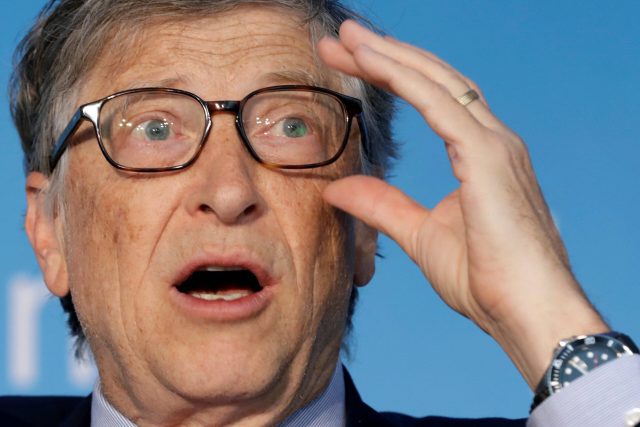
Bill Gates at Deal Book Conference in New York, 2019
It’s not exactly clear why Paul Allen came to the rescue of CommTouch’s IPO and what he expected to gain from his investment. However, it is worth pointing out that Allen was among the members of an exclusive online community of elites set up in 2004 called “Small World,” whose membership also included Jeffrey Epstein and Epstein-linked figures like Lynn Forester de Rothschild and Naomi Campbell, as well as Petrina Khashoggi, the daughter of Adnan Khashoggi, a former client of Epstein’s. Small World’s largest shareholder was Harvey Weinstein, the now-disgraced media mogul who was a business partner of Epstein and was since accused by a number of women of sexual abuse.
Less than three months after Allen’s investments in CommTouch in October 1999, the company announced that it had struck a major deal with Microsoft whereby “Microsoft will utilize the CommTouch Custom MailTM service to provide private label web-based email solutions for select MSN partners and international markets.” In addition, per the agreement, “CommTouch will provide MSN Messenger Service and Microsoft Passport to its customers while building upon its Windows NT expertise by supporting future MSN messaging technologies.”
The agreement came less than two years after Microsoft had purchased Hotmail, which – up until the CommTouch/Microsoft agreement – had been one of CommTouch’s main competitors for its web-based e-mail services. In other words, this meant that Microsoft would use CommTouch’s “behind the scenes” software as the backbone of its web-based e-mail services, Hotmail included. “We are looking forward to further enhancing our relationship with Microsoft by integrating other state-of-the-art Microsoft products,” Gideon Mantel of CommTouch said upon the deal’s public announcement.
In December 1999, Microsoft then announced that it had invested $20 million in the company by purchasing 4.7% of CommTouch stock. The announcement pushed CommTouch stock prices from $11.63 a share to $49.13 in just a few hours time. Part of that deal had been finalized by Richard Sorkin, a recently appointed CommTouch director. Sorkin had just become a multimillionaire following the sale of Zip2, Elon Musk’s first company where Sorkin had been CEO.
It further appears that Bill Gates, then head of Microsoft, made a personal investment in CommTouch at the behest of Isabel Maxwell. In an October 2000 article published in The Guardian, Isabel “jokes about persuading Bill Gates to make a personal investment” in CommTouch sometime during this time frame.
The article then oddly notes the following regarding Isabel Maxwell and Bill Gates:
“In a faux southern belle accent, [Isabel] purrs: ‘He’s got to spend $375m a year to keep his tax free status, why not allow me to help him.’ She explodes with laughter.”
Given that individuals as wealthy as Gates cannot have “tax free status” and that this article was published soon after the creation of the Bill and Melinda Gates Foundation, Isabel’s statements suggest that it was the Bill and Melinda Gates Foundation Trust, which manages the foundation’s endowment assets, that had made this sizable investment in CommTouch. Furthermore, it is worth highlighting the odd way in which Isabel describes her dealings with Gates, speaking of her interactions with him in a way not found in any of Isabel’s numerous other interviews on a wide variety of topics (i.e. “purring”, speaking in a fake Southern accent). This odd behavior may have been related to Isabel’s previous interactions with Gates and/or the mysterious relationship between Gates and Epstein, alluded to in a 2001 Evening Standard article, and eyewitness testimony regarding Epstein’s and Ghislaine Maxwell’s comments about Bill Gates in 1995, discussed in Part I of this series.
After 2000, CommTouch’s business and clout expanded rapidly, with Maxwell subsequently crediting Bill Gates-led Microsoft and Paul Allen’s investment for the company’s shifting fortunes. Maxwell, as quoted in the 2002 book Fast Alliances, states that Microsoft viewed CommTouch as a key “distribution network,” adding that “Microsoft’s investment in us put us on the map. It gave us instant credibility, validated our technology and service in the marketplace.” By this time, Microsoft’s ties to CommTouch had deepened with new partnerships, including CommTouch’s hosting of Microsoft Exchange.
Though Isabel was able to secure lucrative investments and alliances for CommTouch and see its products integrated into key software and hardware components produced and sold by Microsoft and other tech giants, she was unable to turn the tide of the company’s dire financial performance, with CommTouch netting a loss of $4.4 million in 1998 and similar losses well into the 2000s, with net losses totalling $24 million in the year 2000 (just one year after the sizable investments from Microsoft, Paul Allen and Bill Gates). The losses continued even after Isabel formally left the company and became President Emeritus in 2001. By 2006, the company was over $170 million in debt.
The One-Woman Liaison Between Israel and Silicon Valley
Isabel Maxwell would leave her role at CommTouch in 2001, but remained President Emeritus for years afterward retaining a sizable amount of CommTouch stock then-valued at around $9.5 million. While Maxwell remained honorary president, CommTouch added Yair Shamir, son of former Israeli Prime Minister and friend of Robert Maxwell, Yitzhak Shamir, to its board. Yair Shamir, Chairman of the Israeli government owned corporation, IAI (Israeli Aerospace Industries) when he joined CommTouch’s board, had previously managed Scitex when it was owned by Robert Maxwell. After nearly collapsing due to its long-standing debt burden a few years later, CommTouch was rebranded as Cyren and, today, runs in the background of Microsoft, Google, Intel, McAfee and Dell products, among many others.
Haaretz wrote in 2002 that Isabel, as CommTouch was in dire financial straits, had decided to “work only on things involving Israel. Even the failure of CommTouch, the Israeli Internet company she headed, hasn’t deterred her: She still believes in the medium, and she still believes in Israel.” Maxwell would subsequently create “a unique niche for herself in high tech as a liaison between Israeli companies in the initial development stages and private angel investors in the US” as a private consultant, subsequently creating Maxwell Communications Network in 2006. That company offered “cross-border communications, funding and market research to leading venture capitalists and hi-tech companies in the US and Israel.” However, she notes that her “specialty” was in “helping Israeli high-tech companies.”
During this period (2001-2006), Isabel would also head an Israeli tech company that “protects children online,” at a time when her sister – Ghislaine Maxwell – was actively abusing and trafficking children as part of an intelligence-linked operation alongside Jeffrey Epstein. Isabel took the job at iCognito (now Pure Sight) “because it [the company] is in Israel, and because of its technology.” She also joined the board of the Israeli company Backweb alongside Gil Shwed, a famous alumnus of Unit 8200 (often likened to Israel’s NSA equivalent) and co-founder of Israeli tech giant Check Point, which is a long-time partner of CommTouch.
Isabel’s close involvement with former Israeli heads of state and heads of intelligence would only deepen after leaving CommTouch, particularly with former Israeli Prime Minister Shimon Peres. The Jerusalem Post described the Peres-Isabel relationship as “close” and “forged by her father.” Isabel was also in close contact with former Mossad deputy director David Kimche (until his death in 2010) and former head of Israeli military intelligence and Prime Minister Ehud Barak. Notably, Ehud Barak, in addition in being a major player in the Israeli-U.S. hi-tech scene, was also closely associated with Jeffrey Epstein and Isabel’s sister Ghisaline, having recruited Epstein for Israeli military intelligence and overseeing the Lekem agency at the time of the PROMIS scandal (including Robert Maxwell’s role) and the Pollard Affair as well as Israel’s involvement Iran-Contra. Barak was also a frequent visitor to Epstein’s island and slept over in New York apartments that were owned by Epstein’s brother and which housed many of Epstein’s underage “sex slaves.”
Also notable is the fact that Ghislaine Maxwell and Jeffrey Epstein would themselves become involved in Isabel’s world, i.e. the growing nexus between Silicon Valley and Israel, courting and allegedly blackmailing major Silicon Valley executives while also investing in Israeli intelligence-connected start-ups. During this time, Isabel was a major player in venture capital networks and other organizations aiming to further develop ties between Israeli intelligence-linked start-ups and U.S. tech companies, which is now part of an openly admitted Israeli intelligence operation (in which Microsoft plays a major role). The ties of Isabel, Ghislaine and Epstein to this hi-tech world of Israeli espionage, as well as Isabel having inspired what would later become Ghislaine’s TerraMar project and her ties to powerful groups like the World Economic Forum and even the Hillary Clinton-led State Department, will be explored in the next installment of this series.
Whitney Webb has been a professional writer, researcher and journalist since 2016. She has written for several websites and, from 2017 to 2020, was a staff writer and senior investigative reporter for Mint Press News. She currently writes for The Last American Vagabond.
UK ‘Educational’ Site Tells Students What to Think About Russia & ‘Ruthless’ Putin
Sputnik – 25.07.2020
British media and some UK officials have long been obsessed with seeing a trace of the “Kremlin’s hand” in all developments in the world and accusing Russia and its president Vladimir Putin of all possible evils.
Following the 2018 Salisbury scandal that resulted in a new low in the relationship between London and Moscow, it’s far from surprising that British media have remained deeply critical regarding Russia and its president.
Now, a UK government-backed website is set to ‘educate’ British students about “ruthless” Vladimir Putin, accusing him of “outrageous criminal conduct both at home and overseas”.
The media website in question is The Day, which was founded in 2011 by former Executive Editor of the Daily Mail Richard Addis. It is currently working with UK schools and colleges to raise the “critical literacy skills” of British children by helping “explain current affairs in short articles” and it just published a damning hit piece on Russia and its president.
Presumably joining Osama bin Laden and other terrorists and pariahs, Vladimir Putin was branded “the most dangerous man in the world”.
According to the publication, the Russian president himself orchestrated attacks on former spies Alexander Litvinenko and Sergei Skripal, and was apparently responsible for the death of “a passenger plane full of civilians” in Ukraine.
The article asks its young readers whether the “shameless” Russian president “can be stopped” at all in his evil activities. These unsubstantiated claims, which are purportedly proffered to enlighten British students about what is going on in the world, may sound ridiculous to those aware of all the details surrounding the aforementioned cases, particularly the poisoning of former GRU agent Sergei Skripal. There are just too many inconsistencies in Britain’s allegations that it was Russian agents who came to Salisbury to fatally intoxicate the man and his daughter, including the absence of eye witness accounts, lack of video footage confirming the alleged acts and even the well-being of Skripal’s neighbours and those who were involved in evidence-collection after the poisonous attack.
However, this did not stop ex-UK PM Theresa May from jumping to the conclusion in March 2018, before any investigation was launched, that it could have been no one else but Russian agents who attacked Skripals at their home in Salisbury that spring.
Other allegations mentioned in the article, in a matter-of-fact fashion, include Russia’s meddling and collusion with then-Presidential candidate Trump during the 2016 US presidential election, which were not supported by Mueller Report after a two-year of investigation. The piece even discusses Russia’s alleged interference in the Brexit referendum and the UK’s 2019 general election, notions that were rejected by the UK Electoral Commission and doubted by PM Boris Johnson.
“So, as the invasion of Crimea showed, nothing can be done to bring his rogue state to heel,” the article goes on, ignoring the results of the 2014 referendum in Crimea, which wholeheartedly voted to join Russia following a violent political coup in Ukraine.
In the end of the damning piece, young readers are asked whether Russia should be expelled from the United Nations and are suggested a number of fun activities – such as making a collage of the Russian president “playing hopscotch”.
The Day was among the news services that partnered with the UK government’s Commission on Fake News and the Teaching of Critical Literacy Skills in Schools several years ago to conduct surveys about the ability of British children to identify fake reporting.In 2018, the commission effectively concluded that “only 2% of children and young people in the UK have the critical literacy skills they need to tell whether a news story is real or fake”. Therefore, it recommended that the government engage with schools and families more deeply to tackle this issue, suggesting that media organisations should play a vital role in this battle against “fake news”.
And The Day took the call. The media service tasks itself with selecting “the most important news of the day”, with journalists writing their analysis and publishing pieces for schools around the world, not only the UK, apparently. It is not clear, however, how the website’s stories on Russia referring to Vladimir Putin as a “toxic” or “terrible” politician are linked to the website’s declared goals.
However, The Day’s stories are sent to partner schools to then be presented by teachers in class and discussed by students at home with their families.
“… to help readers ask good questions rather than believe they have the answers”, Editor in Chief Addis notes.
English-speakers are thus set to learn about all these highly disputed allegations about Russia and its president in a form of them being treated as factual evidence.
Meanwhile, following the most recent developments, it became a trend for British media and officials to “blame Russia for everything”, in an apparent need to distract the public from other more vivid problems, including the ongoing stalemate in Brexit negotiations and rising number of COVID-19 cases. In addition to the Russiagate hoax, Moscow was also recently accused of spying on the UK’s COVID-19 research, despite Russia itself being in the last stages of trials of its own anti-coronavirus vaccines. Russian researchers also have an official contract with British-Swedish pharmaceutical company AstraZeneca over joint efforts to produce the Oxford vaccine, so the claims that Russia is “stealing” efforts to combat the virus seem even more dubious.
The British Parliament’s Intelligence and Security Committee has just concluded in its 50-page report that “Russia poses a significant threat to the UK”, while slamming the national government for turning a blind eye to these security issues, even though it “had not seen or sought evidence of successful interference in UK democratic processes”.
It now seems that in case of Armageddon or a zombie apocalypse, The Day would also blame Russia and Vladimir Putin personally.
Russia Report… A Triumph of Orwellian Bombast
By Finian Cunningham | Strategic Culture Foundation | July 24, 2020
The sensational headlines screaming on the front pages of British newspapers this week showed that the parliamentary Russia Report was a triumph of bombast.
The Daily Mail led with “Damning Russia Dossier” while The Times heralded “MI5 to get more powers” and “Tough new laws will combat threat of Russian spies”. The Times also splashed its front page with a large photograph of Russian President Vladimir Putin seemingly lurking behind a curtain, which just goes to show how much British journalism has descended into cartoonish trivia.
There is sound reason why the British government delayed until this week publication of the so-called Russia Report by a cross-party parliamentary committee. That’s plainly because there is nothing in it that could in any way substantiate lurid claims of alleged Russian interference in British politics.
The 55-page document was neither “damning” nor “devastating” as The Daily Mail asserted. The groundless hype suggests that the headline writers simply were looking for something to sell to readers regardless of facts.
Boris Johnson, the prime minister, received a copy of the report 10 months ago, but decided to postpone its publication until after the general election that was held in December. That delay led to claims that his Conservative government was hiding something sinister. There were procedural hiccups from the Intelligence and Security Committee (ISC) being replaced with new members. However, now that the report is published any rational reader can see that the real cause of the delay is down to the report being a dud, despite all the breathless speculation. It is an empty vessel, with no evidence or substantive detail. It consists of entirely prejudiced assertions that Russia is “a hostile state” and the UK “is clearly a target for Russia disinformation campaigns and political influence”.
The nine lawmakers on the committee and their nine predecessors acknowledge among their sources for the report the following individuals: Anne Applebaum, William Browder and Christopher Steele. All of them are zealously anti-Russia and are prodigious purveyors of “Russian interference” narratives to anyone who will listen to them. Steele is the notorious former MI6 spy who cooked up the ludicrous “Russia Dossier” for the Democrats to smear Trump with in the 2016 elections. That dossier fueled the bogus “Russiagate” scandal.
Of course, the main sources for the parliamentary committee are British intelligence agencies, MI6, MI5 and GCHQ. Candid admission of all those sources should underscore with redlines that the so-called report is nothing but a propaganda screed. Yet the British media treat it with deference and respect as if it is a credible, objective assessment.
What is rather laughable is the unrestrained prejudice of the authors who are, in reality, propagandists more suited to being frozen in Cold War mentality than offering any kind of “expertise”. They claim Russian politics is “paranoid” and “nihilistic” driven by “zero-sum calculation”. All those attributed defects are merely self-projection by the authors of this report and their sources.
It is rather telling that in place of anything resembling substance of alleged Russian interference, the parliamentarians refer to “open sources” of media influence by Russian state-owned RT and Sputnik. They accuse these media of “direct support of a pro-Russian narrative in relation to particular events”. Oh, how shocking! And the British state-owned BBC does not also do the same?
Again referring to “open sources” – meaning public media reports – the parliamentarians claim that the Kremlin interfered in the Scottish referendum on independence back in 2014. So just because Russian news media featured that subject in its coverage is supposed to be “evidence” of Kremlin interference. The absurd accusation is also a convenient way to smear Scottish pro-independence.
Oddly enough, the report says there was no manifest Russian interference in the 2016 Brexit referendum. Well that’s handy. The Tory government wouldn’t want to smear its ambitions of reviving the British empire, that’s for sure.
The ISC publication is a self-serving dud that is “not worth a penny”, as Russian lawmaker Aleksy Chepa put it.
It is loaded with complacent British self-regard and knee-jerk Russophobia.
The parliamentarians repeatedly rebuke the British government and state intelligence for not taking the “threat” of alleged Russian meddling seriously enough.
A more plausible explanation is because there is negligible Russian meddling in British politics, as Moscow has consistently stated. If the British government and its spooks fail to get excited – in private – about allegations of Russian malfeasance it’s because there is actually nothing to the allegations. Still, the parliamentarian anti-Russia ideologues assume to know better. They are convinced that Britain is a target for Kremlin hostility and they lambast the government and intelligence services for “not making it a priority issue”.
The Orwellian plot thickens when the authors of the boilerplate Russian Report then conclude by urging MI5 to be given more secretive powers to collaborate with social media networks in order to control information in the name of combating a “hostile state threat”. This is a sinister, anti-democratic call worthy of a dictatorship for censoring and blackballing any dissenting views under the guise of “defending democracy”.
One area where the ISC document begins to deal with reality – but only superficially and misleadingly – is on the subject of super-rich Russian expatriates living in London, which is dubbed “Londongrad”. Many of these oligarchs are beneficiaries of looting Russian state assets during the privatization-robbery frenzy under former President Boris Yeltsin. They are not “friends of Putin” as the British lawmakers make out. These shady oligarchs are often big donors to the Conservative party, not because they want to inject pro-Russian influence, but rather because they are typically opposed to the current Russian government and are seeking to destabilize it. If there is any Russian “influence” in British politics it is that which promotes illegal regime-change policies in opposition to the Russian state.
In every aspect the much-vaunted Russia Report is a worthless pile of propaganda. Even a glimmer resembling something real – the Russian oligarchs in Londongrad – turns out to be an inversion of reality. And yet, pathetically, the British media amplify the nonsense with reverence and gravitas.
The “Russia Report”: Deep State reinforcing delusion to spread fear and seize power
“Suppressed” report should be a lesson to those who begged for its release – be careful what you wish for.
By Kit Knightly | OffGuardian | July 22, 2020
The “Russia report” is an action plan for the intelligence agencies to hand MI5 direct control over the mechanisms of British democracy, and give the government legal power to control social media.
Nobody in the mainstream will tell you this. The media are going to tell you it’s a “shocking condemnation Britain’s vulnerability to hostile state actors” or something similar, the Remainers will tell you it’s cast iron evidence the Brexit vote was rigged, and Luke Harding will tell you it means “they” are all around us and you should buy a copy of his book.
The truth is it’s just the latest of the Deep State’s plays to secure as much power as possible as quickly as possible. If anything, it already feels old-fashioned, being authored in a pre-Covid world, but that doesn’t mean it can’t be put to use in service of the world’s “new normal”.
In terms of actual content, there’s nothing new here. It’s just a collection of familiar proven lies and unproven accusations in the service of four primary agendas:
- Invalidating the result of the Brexit referendum
- Boosting funding/resources for the UK’s “Cyber Offensive capabilities”
- Ceding more powers to MI5 to oversee and “protect” our democratic processes
- Creating a “protocol” that empowers the government/intelligence agencies to force social media companies to censor and/or ban certain material, opinions, websites or users
You can plow through the whole thing here if you really feel the need.
For those outside the UK, who may not be aware of this story, sometime last year it was “leaked” that the UK parliament’s Intelligence and Security Committee had prepared a report on “Russian interference” in UK politics. In a brilliant piece of PR manoeuvring, Boris Johnson refused to make the report public.
This decision manipulated those who consider themselves “the left” in British politics to clamour for the release of the “Russia Report”, believing there would be something in it that Boris didn’t want us to see. This was an act of pure naivety by Corbynista influencers, and deliberate public manipulation by the “leftist” media.
Yesterday Boris Johnson’s government finally “caved” to this pressure, and released a “confidential report” which tells us nothing we haven’t been told a million times before. This apparently secret testimony has been blasted across headlines in every broadsheet and tabloid for years.
Russia is accused of poisoning the Skripals, leaking the DNC emails, using “bots and trolls” to influence public opinion…and so and so on.
The witnesses called are all either actual spies (Christopher Steele), or “journalists” heavily involved with the Integrity Initiative (Edward Lucas). No evidence is supplied, save the tired old links to “academic studies” conducted by bought-and-paid-for NATO shills like Ben Nimmo and Bellingcat (whose direct funding from the likes of the Atlantic Council and National Endowment for Democracy represents a massive conflict of interest that is never once mentioned in the report).
In that way, the report is massively dated. Its lies, worn smooth through repetition, are dry and stale.
But that’s not the point of this report. That’s the first part of the Hegelian Dialectic. The “problem”, long since mythologised, created by force of repetition without ever being evidenced. This report is far more concerned with generating a “reaction”, and the procuring consent for a pre-planned “solution” (the report doesn’t shy away from this obvious structure – using the terms “threat” and “reaction” instead).
In short, buried in the 55 pages of waffle, repetition and bureaucratic double-talk, are key suggestions to take a more warlike stance against Russia and parlay this into a simultaneous crackdown on dissent at home, all while securing shiny new powers for MI5.
Firstly, the UK plans to strike a new attitude on “attribution” of alleged cyber attacks, claiming, apparently with a straight face:
The UK has historically been reticent in attributing cyber attacks – as recently as 2010, this Committee was asked to redact mention of Russia as a perpetrator of cyber attacks, on diplomatic grounds.
But the UK’s “reticence” to blame Russia for cyber attacks is over, they now intend to “name and shame” foreign actors who carry out cyber attacks:
there has to now be a cost attached to such activity. When attacks can be traced back – and we accept that this is in itself resource-intensive – the Government must always consider ‘naming and shaming’.
[NOTE: This section on “attribution” would be an absolutely ideal time to mention that another state player – namely the US military – has the technology to carry out cyber attacks and make it appear to have come from somewhere else. We know they know, because of the Wikileaks Vault 7 leaks, but they don’t mention it.]
Oh, and they’re going to “leverage” their diplomatic relations to force those countries who would rather not start a new cold war based on the testimony of lunatics, fraudsters and underwear salesmen, to publicly blame Russia for… pretty much everything:
it is apparent that not everyone is keen to adopt this new approach and to ‘call out’ Russia on malicious cyber activity. The Government must now leverage its diplomatic relationships to develop a common international approach when it comes to the attribution of malicious cyber activity by Russia and others.
This is dishonest, and potentially dangerous, but this kind of geo-political positioning is very much the long game. It’s the short term stuff, the local stuff, we should really worry about.
Like handing over powers to “monitor” and “protect” the democratic processes of the country to MI5 [our emphasis]:
Overall, the issue of defending the UK’s democratic processes and discourse has appeared to be something of a ‘hot potato’, with no one organisation recognising itself as having an overall lead. Whilst we understand the nervousness around any suggestion that the intelligence and security Agencies might be involved in democratic processes […] that cannot apply when it comes to the protection of those processes […] Protecting our democratic discourse and processes from hostile foreign interference is a central responsibility of Government, and should be a ministerial priority. In our opinion, the operational role must sit primarily with MI5
They recommend this, based on MI5’s pre-existing “relationship built with social media companies”. They don’t mention, at this stage, how social media companies have “built a relationship” with MI5, or what role they might serve in “protecting democracy”, but it’s not hard to guess.
Social Media is an important theme in the report, actually, being mentioned fifteen times in 47 pages.
Firstly, we’re told that social media companies must bear the brunt of the blame for “hostile state activity” being at all effective:
we note that – as with so many other issues currently – it is the social media companies which hold the key and yet are failing to play their part
Before they add the government must seek a “protocol” by which social media companies remove any material the UK government deems “hostile state use” of their platform:
The Government must now seek to establish a protocol with the social media companies to ensure that they take covert hostile state use of their platforms seriously, and have clear timescales within which they commit to removing such material
Any companies who refuse to do this will be “named and shamed”.
You might think “well, this protocol could easily be used against people with no state affiliation whatsoever”, and you’d be right. It could. The government admits as much, but doesn’t seem to have a problem with it:
Such a protocol could, usefully, be expanded to encompass the other areas in which action is required from the social media companies, since this issue is not unique to Hostile State Activity
This would be a good time to note that the Atlantic Council employees this report cites have, in the past, labelled people “bots” who are definitely, provably not bots. This includes noted independent journalists and a world-renowned concert pianist.
The proposed “protocol” opens up an avenue for the state to silence dissident individuals by similarly “mistaking” them for state-backed agents.
Another thing the report is keen on is boosting the UK’s “Offensive Cyber” capabilities:
this is an era of hybrid warfare and an Offensive Cyber capability is now essential. The Government announced its intention to develop an Offensive Cyber capability in September 2013, and in 2014 the National Offensive Cyber Programme (NOCP) […]The UK continues to develop its Offensive Cyber capability.
What their offensive cyber capabilities ARE, and how they use them, is never described. Are they used solely against other states, or against domestic politic parties, organizations and individuals too? They don’t say.
Is cyberwarfare even legal under international law? Well, no. In fact, the way the report dances around the idea that cyberwarfare is actually potentially illegal under international law is a thing of beauty:
While the UN has agreed that international law, and in particular the UN Charter, applies in cyberspace, there is still a need for a greater global understanding of how this should work in practice […] Achieving a consensus on this common approach will be a challenging process, but as a leading proponent of the Rules Based International Order it is essential that the UK helps to promote and shape Rules of Engagement, working with our allies.
The fact that people out there can even begin to cite this report in earnest when it describes the UK as a “key defender of a Rules Based International Order” just boggles my mind.
The real scary stuff comes later though, in the “legislation” section.
The UK is already one of the most surveilled countries in the world, and the report happily mentions that last February, the UK police/intelligence agencies got [our emphasis]:
new powers to stop, question, search or detain any person entering the UK gained Royal Assent in February 2019; it is not necessary for there to be suspicion of engagement in hostile activity in order to use these powers.
Following on from this, the report recommends a new Espionage Act and a Foreign Agent Registration Act, to “crackdown” on espionage.
Hearings resulting from these acts could be “closed material proceedings” to protect national security.
For those who don’t know, in UK law a “closed material proceeding” is a hearing where a prosecutor presents some evidence directly to a judge which is kept secret from both the public and the defense counsel.
Until this new legislation is passed, the report warns, “the Intelligence Community’s hands are tied.”
To sum up, the long-awaited Russia report is – surprise surprise – not a trove of secrets and corruption which could bring down the Johnson government. It was never going to be that, despite what all the fake-left “journalists” were saying, and what all the Labour supporters who should know better were tweeting.
It was actually sickening to watch so many people, especially in Corbyn’s camp, cry-out for this report and not realise they were getting played. It’s the oldest trick in the book. Cheap reverse psychology that doesn’t work on children past the age of about five, but apparently does work on the majority of the members of the Labour party.
Thanks to their gullibility, no one is questioning the honesty, providence or intentions of a report which finds, in short:
- MI5 should have more control over our democratic systems.
- We should spend more money on developing cyber attack ability.
- We should investigate and maybe overturn the Brexit vote.
- We should pass authoritarian new legislation
- Social Media companies should take down whatever the government says they should take down.
People who are supposed to guard against tyranny and hold power to account have abandoned their posts to take part in anti-Russia hysteria which endangers what remains of our civil liberties.
As a result, we’re getting headlines like this:
GUARDIAN : Report damns number 10 and spy agencies over Russia
And this:
MAIL : Now tame the Russian bear
And this:
THE TIMES : MI5 to get more powers
It’s the same old lies, on the same old topics, told by the same old people, for the same old reasons. The only difference is, this time, they managed to trick some of the gullible “woke” left into begging for it.
Pangs of conscience or howl of an empty wallet? Steele claims he never meant for infamous Russiagate dossier to go public
RT | July 22, 2020
Former British spy Christopher Steele insists he never wanted the notorious Trump dossier, which was central to the Russiagate investigation, to be made public. The belated pang of conscience emerged in response to a new lawsuit.
Steele would have done “whatever I could do to prevent” BuzzFeed from publishing the dossier, he told London’s High Court in a written statement on Wednesday.
The document, which Steele compiled at the behest of the US opposition research firm Fusion GPS and Hillary Clinton’s campaign in 2016, was published in early January 2017, shortly before Donald Trump’s inauguration.
The former spy’s pang of conscience might have had something to do with the defamation lawsuit by Russian tech entrepreneur Aleksey Gubarev. One of the claims in the Steele dossier was that Gubarev’s Webzilla internet service provider was used by Russian security services to hack the Clinton campaign. The tech executive has not only denied the claim but sued both BuzzFeed and Steele for making it.
Despite his professed remorse, however, Steele admitted he provided copies of the “pre-election” dossier, compiled between June and October 2016, to the FBI and the State Department because of its “national security implications.” Another copy was sent to a UK national security official in the days following the election, lest the Trump administration “compromise British sources and operations.”
He whipped up a second version in December 2016, and gave that to the same UK official, as well as the since-deceased Arizona Senator John McCain – who leaked it to a number of US media outlets, including BuzzFeed, Steele explained.
That second memo, he wrote, was “self-evidently sensitive and confidential,” meaning it was never intended to make it into print, where Gubarev could read it and sue him.
Steele has admitted the dossier was largely “unverifiable,” presumably intended to serve as the basis for further investigation that could confirm or deny its claims. Earlier this week, internet sleuths suggested that Steele’s mysterious Russian source was in fact a Washington-based Brookings Institute researcher, who lacked firsthand knowledge of any of its salacious claims.
Steele has previously said that his 17-page report was commissioned with the intention of giving Clinton legal basis to challenge the 2016 election. While the legal challenge never happened, the dossier saw plenty of uses in “further investigation” of Trump, both official and in the court of public opinion.
The FBI used it as the backbone of its request for a FISA warrant to spy on Trump’s campaign via aide Carter Page, whom Steele claimed met secretly with Russian agents in Moscow. The dossier also underpinned special counsel Robert Mueller’s sprawling ‘Russiagate’ probe.
While Mueller ultimately came up empty in his efforts to prove the Trump campaign had colluded with the Russian government to get the president elected, relations between the US and Russia deteriorated considerably as Trump’s cabinet urged him to take a more antagonistic position toward Moscow so as not to be seen as the ‘Putin puppet’ the media and Democrats were determined to call him anyway.
Was Jeffrey Epstein’s Boss Ghislaine Maxwell Helping Mossad Run Pedophile Rings for Prince Andrew and the Ruling Elite?

By Marco de Wit | Laiton Lehti | October 13, 2019
Video introduction to this article. (If the video is deleted by Youtube you can find it also here in Bitchute.)
The Epstein Pedoscandal Mossad Timeline shows in detail how Jeffrey Epstein and Ghislaine Maxwell were working for the Israeli intelligence agency, Mossad.

Link to Unz.com article
The timeline generated many comments at Unz.com but surprisingly most of them dealt whether Epstein was a pedophile or not. This despite the overwhelming evidence of pedophilia.
Many have also totally missed – or are afraid to notice – the big picture: Israeli intelligence agencies and especially Mossad seem to be running pedophile rings that blackmail Western political, business and scientific leaders.
Furthermore, it seems that Ghislaine Maxwell was and still is the master mind behind many of these pedophile rings.
One of the reasons Epstein and Ghislaine were able to continue sex trafficking with impunity for so long was the appearance that Epstein was a victim of jealous people and overzealous police. Many people thought that Epstein had only had sex with a 17-year old girl who had lied about her age.
This excuse worked well because in Florida the age of consent is 18 while in most other American states it is 16.
Link to Wikipedia
Epstein was able to play the martyr by not only claiming that unscrupulous girls had lied their age but also by implying that the age of consent is too high anyway in Florida.
This was also one reason why in New Mexico where Epstein had his Zorro Ranch the officials refused to register him as a sex offender. In New Mexico the age of consent was 16 until in 2018 it was raised to 18.
Furthermore, unlike in many other states, in New Mexico the courts recognize a mistake of age defense.
New Mexico courts recognize a mistake of age defense. The mistake of age defense is basically ”I thought she was 17.” However, this is no guarantee that this defense will work in court. Moreover, the mistake of age is the creation of judges in the absence of a direct statute addressing the defense. State lawmakers may pass a law overriding the courts on this issue at any time. (LegalMatch)
In reality the Epstein-Ghislaine case is not whether it is wrong for an adult to have sex with a 17 year old. Instead it is about many other things such as prostitution, grooming, pedophilia and the exploitation of children.
This all is connected to global politics involving sex trafficking, drug and arms trade, money laundering, Ponzi schemes, spy networks and blackmailing for Mossad.
Epstein’s victims were caught in a web of international spy network that used them as pawns for blackmail operations. The younger the girls were, the more leverage Israel would have over politicians, billionaires and scientists. Thus Epstein and Ghislaine tried to also recruit girls who were well under the age of 16.
What is more, they personally enjoyed having sex with these very young girls. Both Epstein and Ghislaine seem to have been pedophiles who were attracted to prepubescent girls and boys, i.e. small children.
Pedophilia is defined as:
Pedophilia (alternatively spelt paedophilia) is a psychiatric disorder in which an adult or older adolescent experiences a primary or exclusive sexual attraction to prepubescent children.[1][2] (Wikipedia)
Note that in order to be a pedophile it is enough to have merely occasional sexual attraction to prepubescent, i.e. sexually immature children who have not yet developed secondary sex characteristics, such as breasts.
Julie Brown from Miami Herald notes that Courtney Wild was only 14 when she was recruited into Epstein’s sex ring.
Wild still had braces on her teeth when she was introduced to him in 2002 at the age of 14.
She was fair, petite and slender, blonde and blue-eyed. (emphasis added. Miami Herald)

Link to Miami Herald
Julie Brown also notes that Epstein preferred girls who were not only white [and non-Jewish] but also appeared prepubescent.
Wild, who later helped recruit other girls, said Epstein preferred girls who were white, appeared prepubescent and those who were easy to manipulate into going further each time. (Emphasis added. Miami Herald)
For Epstein and Ghislaine it was important that the girls at the very least looked like small children. This is obviously why they preferred girls who were under 16.
Courtney Wild told the police that she brought Epstein over 70 girls and they were all under 16.
By the time I was 16, I had probably brought him 70 to 80 girls who were all 14 and 15 years old… (Emphasis added. Miami Herald)
Some girls were even younger. According to the police many were 13 year old.
The girls — mostly 13 to 16 — were lured to his pink waterfront mansion by Wild and other girls, who went to malls, house parties and other places where girls congregated, and told recruits that they could earn $200 to $300 to give a man — Epstein — a massage, according to an unredacted copy of the Palm Beach police investigation obtained by the Herald. (Emphasis added. Miami Herald)
It is also important to note that even 13 was not the minimum age for Epstein and Ghislaine. In fact, there was no limit to how young the girls could be. Both Epstein and Ghislaine Maxwell emphasized that the younger the better.
Eventually, she said Maxwell trained her to recruit new girls for Epstein.
“Jeffrey was very particular in the kind of girls he wanted. First off, the younger the better.”
Epstein said that to her, Giuffre claimed, and “Maxwell said that too. During the training and telling me how to do it, she said ‘You always have to go for the youngest-looking ones.’” (Emphasis added. The Daily Beast)
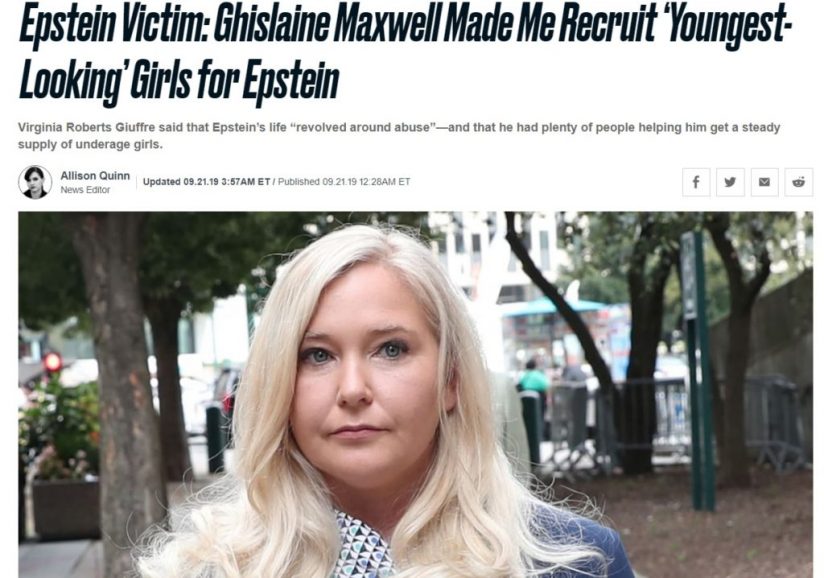
Link to The Daily Beast
It seems the primary purpose was not even blackmail since especially Epstein was having sex with these young girls all the time. On some days Epstein was having sex several times a day.
Sex games were more important for Epstein than work. Obviously, he was extremely attracted to these young girls.
Palm Beach multimillionaire Jeffrey Epstein, 54, was accused of assembling a large, cult-like network of underage girls — with the help of young female recruiters — to coerce into having sex acts behind the walls of his opulent waterfront mansion as often as three times a day, the Town of Palm Beach police found. (Emphasis added. Miami Herald)
In six months, I never saw him do a day’s work,” Ransome told The Telegraph. ”I never saw him work. He was literally sexually abusing us all day long. (Emphasis added. Business Insider)
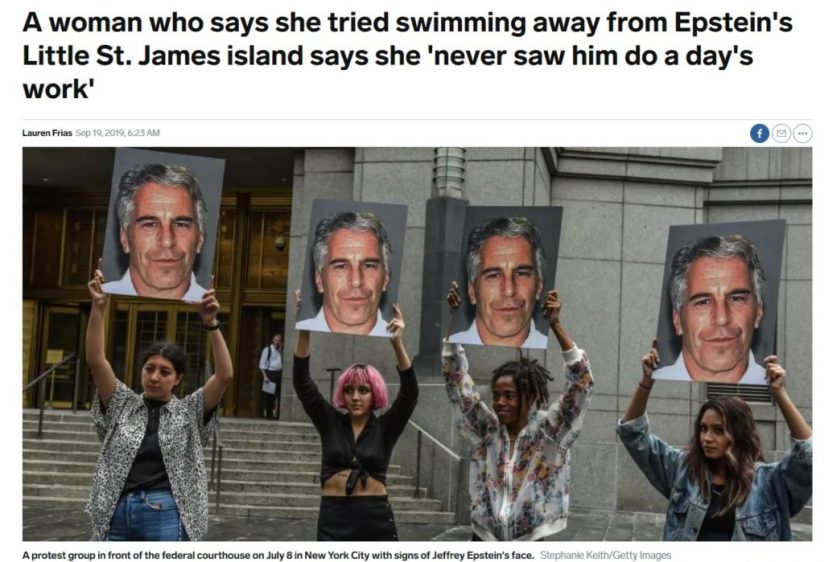
Link to Business Insider
Ghislaine also seemed to be obsessed with sex. Just like her father, Robert Maxwell she was rumored to be interested in unconventional sex which includes also sex with young children.
As she [Ghislaine] posed for the pics, which ran in a publication meant to promote Sotheby’s vintage fashion collection, she allegedly let slip comments that hinted at a twisted double life.
“She didn’t talk about Epstein, but during the shoot she did tell a story about how she just hosted a dinner party for a number of young girls, and she put dildos at each place setting,” the source said. “Ghislaine then described how during the dinner two guests, who were a couple, began demonstrating how to do the perfect fellatio on a man for all at the table. She was laughing about it.” …
“A friend of mine has a whole theory about her, that Epstein was like her father Robert Maxwell, who himself is believed to have had some strange sexual practices.” (Page Six)
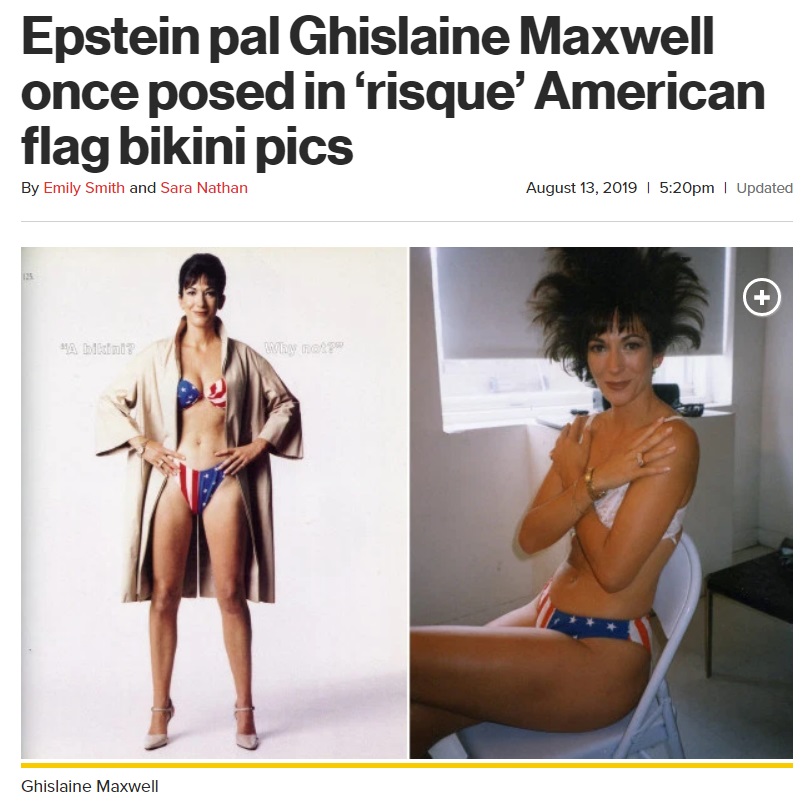
Link to PageSix
The Epstein Mossad-Timeline shows how Ghislaine was most probably trained by Mossad to use sex to gather information. That training would not have been too difficult for her since she was hypersexual. Many even considered her a nymphomaniac.
In fact, even many Israeli Jews – who usually have much fewer sexual taboos than puritan English and Americans – were shocked by her raunchy sexuality.
Flirtatious indeed: I understand from a mutual friend that after school she travelled to Israel and visited a kibbutz; she was immediately ostracised by the other girls for making a rather-too-obvious beeline for the Adonis-like lifeguard at the kibbutz pool. Very quickly she got her way, as she would with much in her life. (Tatler. Emphasis added.)
Even Ghislaine’s friend were sometimes shocked by her open sexuality that so often contrasted with her otherwise lady-like behavior and position in high society.
Ghislaine was, added Mason, ‘fantastically entertaining’ and ‘saucy’ – the paper said that she talked openly about sex.
In fact, said another acquaintance who saw her often at parties, she was ‘obsessed by sex. She’s Sphinx-like, mysterious. The last time I saw her, five, 10 years ago, I said what are you up to? And she said “I’m selling this product – stainless-steel mini dumb-bells – that you put up your fanny. For exercising your vaginal muscles, exercise your pelvic floor, learn the Singapore Grip. I’m giving seminars in LA and they all turn up and I tell them, this is how you keep your man.”’ (Tatler. Emphasis added.)
Epstein and Ghislaine were both hypersexual. All kind of sex interested them. Little girls were just part of the menu. Or more specifically, the best – and most profitable – part.
Epstein and Ghislaine were so attracted to young girls that nothing seemed to satisfy them. Perhaps this is why Epstein and Ghislaine created the highly risky sexual pyramid scheme. The girls were offered two alternatives: Either satisfy Epstein and Ghislaine sexually or get more girls to satisfy them.
In this way Epstein and Ghislaine were able to recruit literally hundreds of young girls. However, some of these girls went to the police and the sexual pyramid scheme collapsed.
When Epstein got out of jail in 2009 he had half-learned his lesson: American girls are too risky.
Now Epstein and Ghislaine would only concentrate on East European girls with the help of their Jewish-Ukrainian friend Peter Listerman.
One of the lesser-known shadowy figures linked to Jeffrey Epstein and his sex ring of teenage girls and young women is Ukrainian-born Peter Listerman, who has worked as a businessman and television presenter but is most known for his “match-making” abilities.
What match-making really means is that Listerman procures women, often underage, for the jet-set society to use for sexual purposes. His “clients” include Russian oligarchs and American businessmen and seems to have also included Jeffrey Epstein. (Citizen Truth)
Link to the Citizen Truth.org
Listerman has such a bad reputation that he is shunned even in Ukraine!
Tatiana Savchenko, who founded the first modeling school in Odessa, Ukraine explained to the Daily Beast the lengths she had to go to keep Listerman from getting his hands on young women and trafficking them for sex work.
She claimed that he would frequently approach her students and attempt to lure them with promises of a luxurious lifestyle, and that “It took a lot of work to keep him from tricking our teen models in his traps.” (Citizen Truth)
Peter Listerman is the usual suspect. Link to Fishki.net
Do you think I am kidding? I am Peter Listerman! Link to Fishki.net
Both Epstein and Listerman were attracted to very young girls. Neither even tried to hide it much. In fact, Epstein was quite open about his attraction to tweens.
Just three months ago, as federal prosecutors were closing in with new charges, Mr. Epstein had a conversation with R. Couri Hay, a publicist, about continuing to improve his reputation. Mr. Epstein asserted that what he was convicted of did not constitute pedophilia, said Mr. Hay, who declined to represent him.
The girls he had sex with were “tweens and teens,” Mr. Epstein told him. (The New York Times)
But what is a tween?
Preadolescent is generally defined as those ranging from age 10 to 13 years.[4][6] … While known as preadolescent in psychology, the terms preteen, preteenager or tween are common in everyday use. (Wikipedia)
Epstein was right, of course. What he was convicted of in 2007 did not constitute pedophilia. However, that is precisely one reason why people are so outraged!
Epstein and Ghislaine did not see any problem of recruiting, grooming and having sex also with tweens. And apparently neither did the Justice Department and the FBI led by Robert Mueller!
But it gets even worse. As pointed out in the Epstein Pedoscandal Mossad Timeline, it seems that Epstein and Ghislaine were after even younger girls.
In 2003 Epstein financed Jean-Luc Brunell’s(?) and Jeff Fuller’s(J) new modelling agency MC2 that seemed to have worked with Peter Listerman.
MC2 obviously refers to the famous Einstein equation E = MC2, the energy-mass equivalence. Equally obviously, E equals Epstein, the energy, whereas the girls equal MC2, the mass energized by Epstein.

Jean-Luc Brunell
Brunell is generally known as the sleaziest man in model business who has long faced accusations that girls were drugged and raped in his employ. Already in the 80s he was the subject of a famous 60 Minutes expose on sexual abuse in the modeling industry
Despite all this – or for the very reason – Epstein invested in MC2 and became particularly close to its founders Brunel and Fuller.
The agency operates in New York, Miami and Tel Aviv. It’s in practice half-Israeli.
Many call Israel the capital of human trafficking and organ harvesting.

MC2 concentrates on importing East European girls to Israel and America. The younger the better.

Marina Lynchuk of MC2

Lolita Lvola from MC2

Linta Lapinda from MC2
Brunel seems to have given 12-year old triplets to Epstein as a birthday present.
’Jeffrey bragged after he met them that they were 12-year-olds and flown over from France because they’re really poor over there, and their parents needed the money or whatever the case is and they were absolutely free to stay and flew out,’ Giuffre said.
She said she saw the three girls with her own eyes and that Epstein had repeatedly described to her how the girls had massaged him and performed oral sex on him. They were flown back to France the next day.

Link to Daily Mail
It seems that even tweens were not young enough for Epstein.
According to court papers in 2005 Brunel called Epstein and left a message that “he is sending him a 16-year-old Russian girl for purposes of sex”. However, the written message says something even worse.
The message, filed as an exhibit in the case, was written on an office message pad, partly in code, and read: “He [Brunel] has a teacher for you to teach you how to speak Russian. She is 2×8 years old not blonde. Lessons are free and you can have your 1st today if you call.” (New York Post)
Does it mean that two eight year olds are involved? Or does 2 x 8 mean to sex 8 year old? (2=to, x=sex)
Why would the lessons be free and why is it relevant that the ”teacher” is not a blond?

There is no denying that Epstein and Ghislaine sexualised even small children. This became clear in 2005 when police raided Epstein’s Palm Peach mansion.
In one photo that was hanging on the wall a small six or seven year old girl was bending over in a tiny dress. Police blurred out the photo in the video taken during the raid.

Link to The Daily Mail
Despite all this only the Russian Television was actively trying to expose Epstein and Ghislaine.
RT aired this video already nine years ago!
The description on the video is even more revealing. It even mentions the 12-year old triplets.
The American TV networks were actively suppressing the story for years.
The American media has also been trying to cover up the fact that Jeffrey Epstein was most probably murdered in his cell. He had to be silenced.
But it gets even worse.
This hung on Ghislaine’s home wall.

NEW YORK CITY, NY – MARCH 13: Atmosphere at Hamish Bowles, Ghislaine Maxwell and Lillian von Stauffenberg dinner for ALLEGRA HICKS at Home of Ghislaine Maxwell on March 13, 2007 in New York City. (Photo by Patrick McMullan/Patrick McMullan via Getty Images). Link to Getty Images.
The so called artwork seems to be full of pedophile symbols.


Link to Wikileaks.org
The quality of the photos taken at Ghislaine’s home are so good that even more symbols have been found in her artwork.
For some reason the mainstream media has not picked up on this pedophilia angle. No mainstream media journalist has even tried to ask why would Ghislaine have such art and symbols on her home wall.
This despite the fact that Ghislaine is most probably an Israeli superspy just like was her father, Robert Maxwell. She probably has been trained to use sex – including pedophilia – as a tool for blackmail and manipulation.
At the time in Israel females molesting little boys was not even considered rape.
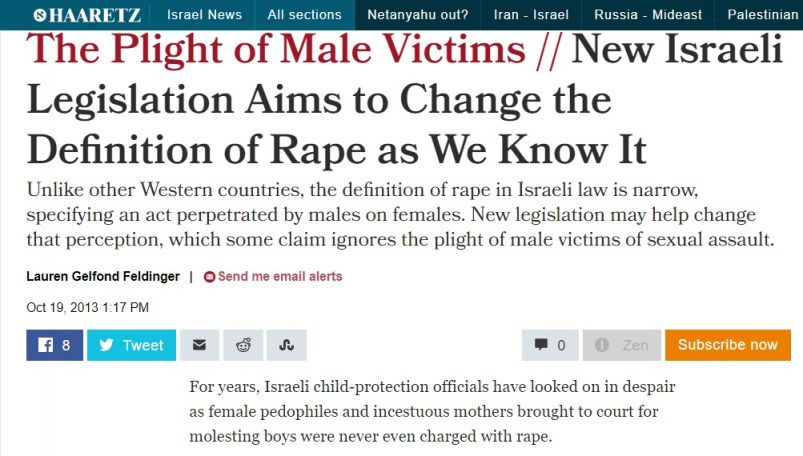
Link to Haaretz.com
Nor have mainstream journalists asked where was Ghislaine when Madeline McCann was abducted.
That would not be an unreasonable question since one of the E-Fit images looks a lot like Ghislaine.

Link to Enchanted Life Path.com
Furthermore, two of the E-Fit images (1A, 1B) look like the Podesta brothers. John Podesta was White House Chief of Staff to Bill Clinton and the Chairman of the 2016 Hillary Clinton presidential campaign.
Ghislaine and Epstein were close to the Clintons and the Podesta brothers have been directly linked also to Pizzagate.

Link to Pizzagate Map created by Tuukka Pensala
Was Ghislaine helping to run also Pizzagate and other pedophile rings for Mossad?
At least she seems to be perfectly trained to do just that. First, her own hypersexuality, family background and possible training by Mossad made it easy for her to master mind the pedophilia ring she run with Epstein.
Second, Ghislaine and Epstein had all the apparel to help run also other pedophile rings: Lolita express airplanes and helicopters, Zorro Ranch in New Mexico and luxury mansions in New York, Palm Peach and Paris.
Even more importantly they had their own island in the Virgin Islands.
In the 90s Epstein bought Little St. James island from the Virgin islands. It had a mansion which Epstein expanded.
Soon locals started to call it the Pedophile Island.
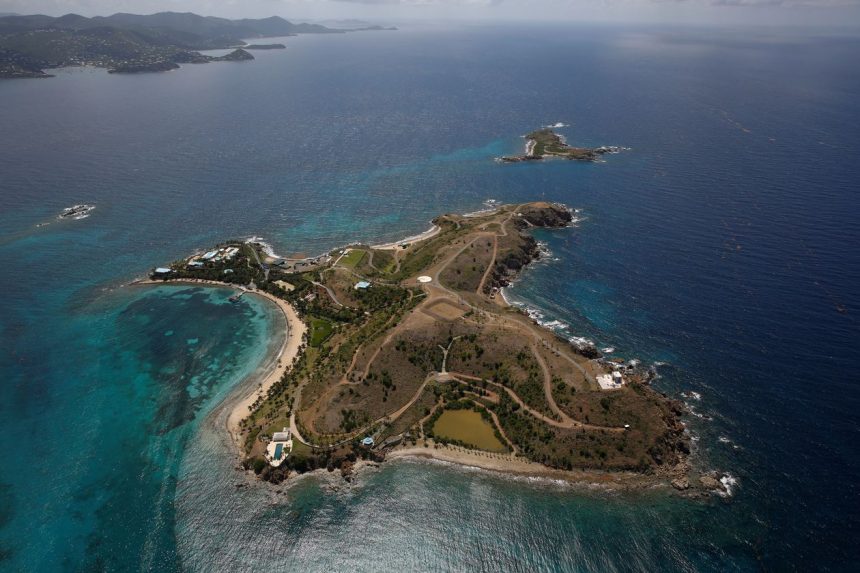
Little St. James island. Link to Wall Street Journal article
The island seems to have tunnels with several underground entrances.
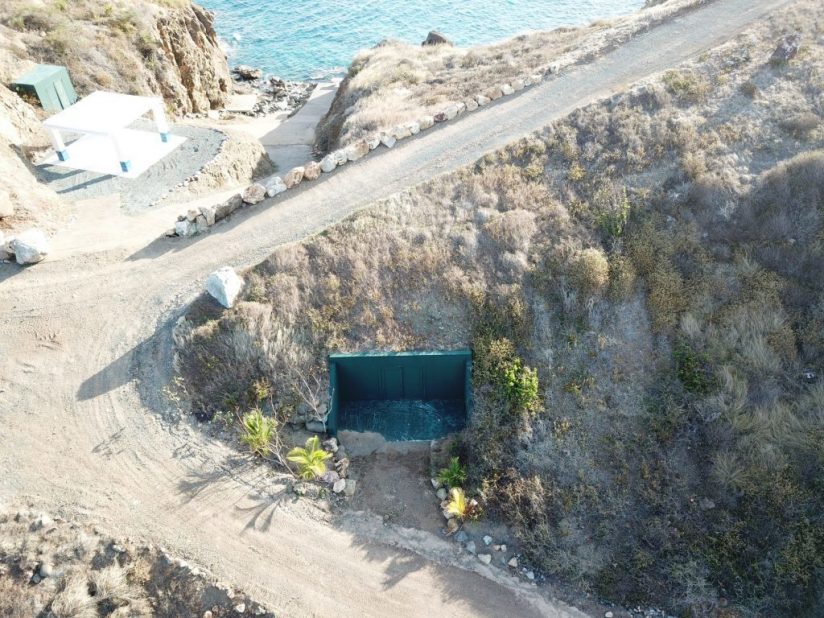
Underground entrance
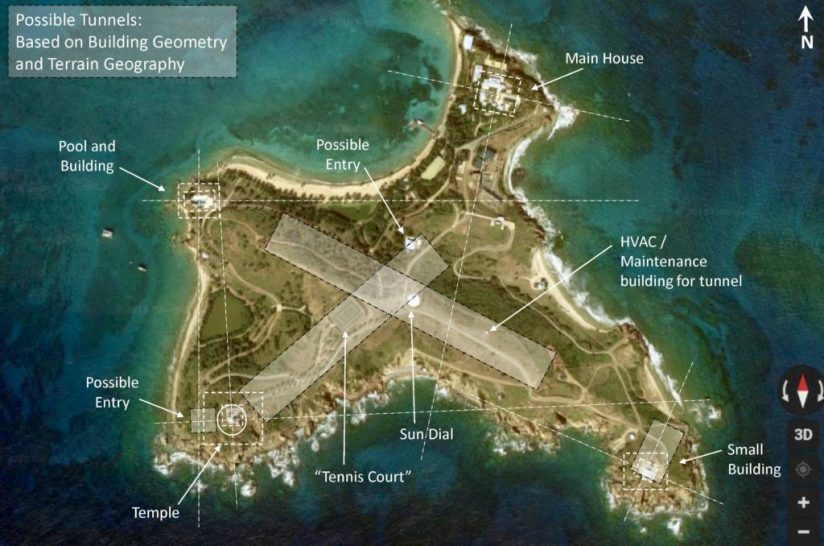
Link to Twitter
The island also has a strange temple.
We Are Change’s Luke Rudkowski and the Dollar Vigilante’s Jeff Berwick secretly visited the island but were soon chased out.
Ghislaine has a Helicopter Pilot License and often transported quests to the island.
On the weekends in the 1990s, Maxwell would have her Rollerblades FedExed to Epstein’s island in the Caribbean, and said she got her helicopter’s license so she could transport anyone she liked without pilots knowing who they were.
Maxwell also said the island had been completely wired for video; the friend thought that she and Epstein were videotaping everyone on the island as an insurance policy, as blackmail.
A source close to Maxwell says she spoke glibly and confidently about getting girls to sexually service Epstein, saying this was simply what he wanted, and describing the way she’d drive around to spas and trailer parks in Florida to recruit them. She would claim she had a phone job for them, “and you’ll make lots of money, meet everyone, and I’ll change your life.” …
Maxwell had one other thing to tell this woman: “When I asked what she thought of the underage girls, she looked at me and said, ‘they’re nothing, these girls. They are trash.’” (Emphasis added. Vanity Fair)
Ghislaine was naturally using Epstein’s helicopters. Some of them shared their FAA tail number with a US contractor, Dyncorp. That would have helped Ghislaine and Epstein to fly drugs and children.
FAA records and Epstein’s pilot’s flight manifest indicate that Epstein’s Bell helicopter used the same tail number of N474AW. This was the same tail number used until 2006 by State Department contractor Dyncorp for counter-insurgency operations in Latin America.
The congruence of Epstein’s Bell N474AW and Dincorp’s Bronco N474AW is noteworthy. In 2002, the year Epstein’s aircraft fleet stands accused of flying underage teen girls, some between the ages of 12 and 15, coincided with Dyncorp’s trafficking in underage females between the ages of 12 and 15 from Kosovo and Bosnia in the Balkans.
One Dyncorp whistleblower reported to The Washington Times’s Insight magazine’s Kelly O’Meara in 2002 the following on one Dyncorp employee in Bosnia:
[he] owned a girl who couldn’t have been more than 14 years old. It’s a sick sight anyway to see any grown man [having sex] with a child, but to see some 45-year-old man who weights 400 pounds with a little girl, it just makes you sick.”
Tail number N474AW has been shared between Epstein’s Bell helicopter like the one in this photo. (Emphasis added. Political Bull Pen)

DynCorp’s pedophilia ring became internationally infamous with the release of the movie Whistleblower.

Link to Wikipedia
Helicopters can always be seen. However, Ghislaine also has a license to operate submarines!
In 2012 – three years after Epstein got out of jail – Maxwell founded The TerraMar Project,[51] a nonprofit organization that advocated protecting ocean waters.
She gave a lecture for TerraMar at the University of Texas at Dallas and a TED talk, at TEDx Charlottesville in 2014.[52] Maxwell accompanied Stuart Beck(J), a 2013 TerraMar board member, to two United Nations meetings to discuss the project.[17] (Wikipedia)
In 2014, a United Nations event featured Maxwell as a speaker. According to her bio in the program, Maxwell’s “web-based non-profit” aimed “to protect the Oceans by empowering a global community of ocean citizens.” It further described Maxwell as “a private helicopter pilot and an Emergency Medical Technician and a qualified ROV and Deepworker submarine pilot.”
A former Coast Guard officer, Borgerson was also a fellow at the Council on Foreign Relations, which featured Borgerson and Maxwell as speakers during one 2014 talk titled “Governing the Ocean Commons: Growing Challenges, New Approaches.” Friends of Maxwell, according to The New York Times, said Borgerson became her boyfriend. Maxwell had allegedly described Borgerson as a “Navy SEAL” to her pals.
Maxwell’s dubious charity also roped in the Clinton Global Initiative, the now-defunct networking platform for the Clinton Foundation. In the fall of 2013, CGI named TerraMar as one of the “commitments to action” at their annual meeting. (Emphasis added. Daily Beast)
Did the Pedophile Island have an underground submarine base? Was it a part of global pedophile network?
And was the Ocean Citizens project an attempt to escape national jurisdictions and thus gain at least a partial immunity from police investigations and prosecutions?

Link to TerraMar Project
Interestingly, as late as 2016 Epstein bought also the nearby Great St. James Island. He started to build on the island without permits.
There were rumors that he was building underground. For some reason the mainstream media has had no interest in this second island.
Why is the mainstream media not interested in Ghislaine’s many links to pedophilia?
Perhaps because Ghislaine has so many powerful friends. The photo of the pedophile artwork on Ghislaine’s wall was taken 13 March 2007 during a party at Ghislaine’s New York townhouse. The guest list included a curious combination of elite Jews, aristocratic Brits and American WASPs.

Atmosphere==
Hamish Bowles, Ghislaine Maxwell and Lillian von Stauffenberg dinner for ALLEGRA HICKS. Home of Ghislaine Maxwell. March 13, 2007©Patrick McMullan. Photo-Patrick McMullan/Patrick McMullan.com. Link to Quick N Dirty
The party was in Ghislaine’s huge 7000-square-foot townhouse. It is located in the most opulent and prestigious neighborhood of America, the Upper East Side, New York on East 65th Street just off Park Avenue. Epstein’s townhouse was only 10 blocks away.
Ghislaine’s five story townhouse. Link to Street Easy

Ghislaine’s townhouse floor plan. Link to Street Easy
Ghislaine’s townhouse 2nd floor gallery. Link to Street Easy
There are reports from reliable sources that the townhouse was sold in 2000 to Ghislaine by Lynn Forester de Rothschild. The very same woman who had introduced Epstein and Ghislaine to Alan Dershowits and the Clintons in the 90s.
The Manhattan property, which is close to Epstein’s mansion, is owned by Lynn Forester de Rothschild, wife of British financier Sir Evelyn de Rothschild. (See The Times and the original article.)
According to Business Insider Forester sold the townhouse to Ghislaine for less than half the price.
Forester sold the mansion for about $8.5 million less than its assessed market value, which was more than $13.4 million.
Was this a pay-off to Ghislaine from the King of Jews, the Rothschilds for services rendered?

Hillary Clinton, Evelyn de Rothschild, Bill Clinton and Lynn Forester de Rothschild. Link to Mint Press
It probably is also relevant that at the time of the sale of the townhouse the Prime Minister of Israel was Ehud Barak. In the 80s he had been the head of Aman, the Israeli Military Intelligence Agency. As the Epstein Pedoscandal Mossad Timeline revealed, both Epstein and Ghislaine worked for the Israeli intelligence agencies already in the 80s during the Iran-Contra operation.
Note that it was around year 2000 that Epstein and Ghislaine started the pedophile operation in earnest. In the 80s and 90s blackmail operations were a side show but now it became the main show involving hundreds of young girls.
Sexual blackmail – especially involving little children – can be an extremely efficient way to influence key politicians and even military officials. A successful blackmail operation can achieve more than several army divisions. No wonder Barak was so close to Epstein and Ghislaine.
Furthermore, in 2000 the president of Israel was Moshe Katsev who was sexually harassing and even raping his female subordinates. Later Katsev would be convicted of rape.
It was also in 2000 when the Israeli Vice-Consul of Rio de Janeiro, Arie Scher and Hebrew language Professor George Schteinberg were running a pedophile ring for Israeli tourists. When the Brasilian police started to investigate the Israeli consulate Scher managed to flee back to Israel.

In Israel Scher was not prosecuted. Instead in 2005 he was promoted to Consul of Canberra, the capital of Australia. A spokesman for the Israeli Foreign Ministry in Jerusalem, Mark Regev explained:
He [Arie Scher] was a young and single man at the time [in Brazil]. Now he is married and he’s six years older and there is no reason why he shouldn’t make an excellent diplomatic appointment in Australia.
Australia refused to let Scher enter the country.
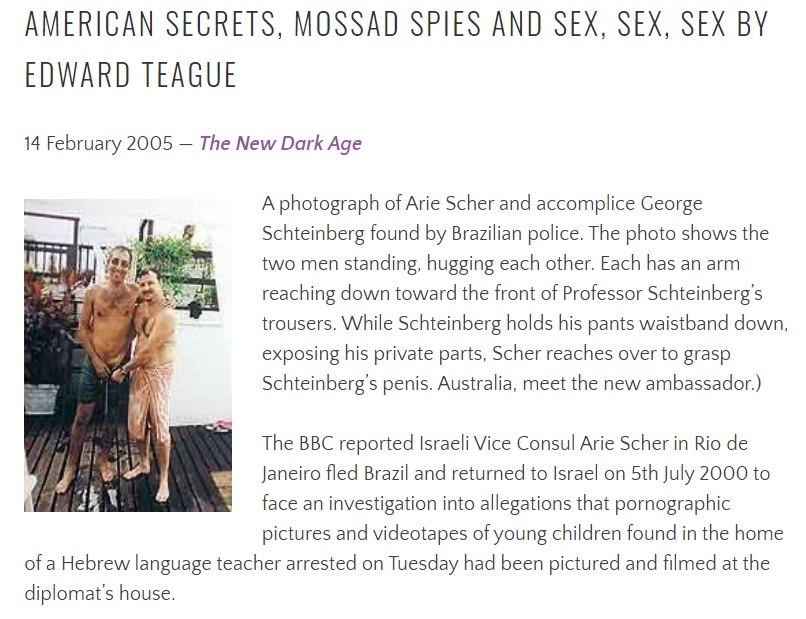
Link to William Bowles Info
The most shocking part of the Arie/Aryeh Scher story is that the mainstream media was not interested. Either the stories have been scrubbed from the internet or no stories were ever written by mainstream journalists except one short story by BBC in 2000 and one even smaller story by The Sydney Morning Herald in 2005. Even more surprisingly Youtube does not seem to have any videos about the Scher case.
No wonder Barak was absolutely convinced that the Western mainstream media would never dare to criticize Israel and its intelligence agencies. Not even when Mossad was running pedophile rings.
It was probably the Israeli leaders Shimon Peres, Ehud Barak and Moshe Katsev together with the ultra-Zionist Mega Group who made sure Epstein and especially the Maxwell family had not only immunity from prosecution but also all the blackmail apparel necessary including luxury townhouses, airplanes, yachts, submarines, ranch and a private island. All, of course, bugged to the hilt.

Israeli Prime Minister Ehud Barak (R) talks to Shimon Peres, Minister of Regional Planning, after Barak’s speech at the opening session of parliament in Jerusalem 30 October 2000. Barak said that he believed peace was still possible in the Middle East but that Israel did not have a partner prepared to make compromises. AFP PHOTO / SVEN NACKSTRAND (Photo credit should read SVEN NACKSTRAND/AFP/Getty Images)
Here the pedophile artwork at Ghislaine’s New York townhouse can be seen behind Lillian von Staufenberg who in March 2007 together with Ghislaine and Hamish Bowles organized a dinner party in honor of Allegra Hicks. This at a time when Epstein had already been charged with abusing young girls.
Karen Groos, Allegra Hicks, Lillian von Stauffenberg==
Hamish Bowles, Ghislaine Maxwell and Lillian von Stauffenberg dinner for ALLEGRA HICKS==
Home of Ghislaine Maxwell, NYC==
March 13, 2007==
©Patrick McMullan==
Photo-Patrick McMullan/Patrick McMullan.com==
Link to QuickNDirty
Why would Ghislaine have such a suspicious artwork on her wall knowing that it would probably be photographed during the parties?
Why would Ghislaine and her quests take such a huge risk? Or was it a sign meant to be seen? Was Ghislaine flaunting her power?
Ghislaine and her quests seemed to be absolutely sure that the mainstream media would not dare to ask embarrassing questions.
They were right, of course. The mainstream media knows its place.
However, occasionally some courageous mainstream journalist or editor does try to give hints. Some have even reported on Ghislaine’s hyper-sexual reputation and her orgies. It is just that the stories have mostly been scrubbed from the internet.
Fortunately, Whitney Webb from Mintpress has found many of the scrubbed stories. Some of them mention the Mossad connection and others note the orgies. For example, in 2003 a British newspaper, The Evening Standard reported a revealing rumor.
Salacious reports have crossed the Atlantic about Ghislaine hosting bizarre parties at her house to which she invites a dozen or so young girls, then brandishes a whip and teaches them how to improve their sexual techniques.
It seems that Ghislaine was not only a madame to Epstein but also to the ruling elite. This would both explain her popularity and the fact that the media – and especially the American media – dares not to criticize her too much. Not even after her boyfriend Epstein was charged with sex trafficking minors!
Ghislaine’s friends are just too powerful. After the March 2007 party the British Daily Mail newspaper was amazed how Ghislaine could still have attracted such creme de la creme of the highest elite. Even more amazingly, the elite was practically swooning over her.
The night before the party, the hostess [Ghislaine] had been inundated with calls from disgruntled socialites, irked that they hadn’t received an invitation.
The hostess greeted their objections with her customary charm, but remained unmoved. As always, her list had been carefully edited, and she intended it to stay that way.
Among the select few were Hollywood star Matthew Modine, Kennedy family member Mrs Anthony Radziwill, Peggy Siegel, PR consultant to the stars, and Julie Janklow, heir to a literary dynasty.
There was a Rockefeller on the list, as well as the inevitable countesses, billionaires and New York luminaries.

Link to Daily Mail
The guests at the party included also Renee Rockefeller who is married to Mark Rockefeller, the son of ex-Vice President Nelson Rockefeller and nephew of David Rockefeller.

Allegra Hicks, Renee Rockefeller==
Hamish Bowles, Ghislaine Maxwell and Lillian von Stauffenberg dinner for ALLEGRA HICKS. Home of Ghislaine Maxwell, NYC. March 13, 2007 ©Patrick McMullan/Patrick McMullan.com. Link to QuickNDirty
David Rockefeller lived at 146 East on the same 65th Street in the Upper East Side as Ghislaine. They were practically neighbors. Ghislaine would have to walk only two minutes to visit David.
David liked to pose for photos in his Beetle Room next to his favorite Picasso painting depicting a nude child ”prostitute”.

David Rockefeller. Link to Jeffrey Harris Desing.com
David was often visited by his close friend Jacob Rothschild, the patriarch of the Rothschild family.
The very same family that got Ghislaine her luxury townhouse next door.
The patriarchs, Jacob Rothschild and David Rockefeller. Link to Jeffrey Harris Design.com
As shown by the Epstein Pedoscandal Mossad Timeline both Epstein and Ghislaine continued to move in the highest circles long after Epstein got out of jail. In fact, only last year Ghislaine was invited to a secret writers’ retreat hosted by the richest man in the world, Jeff Bezos.
Link to The Daily Mail
Not only billionaires but also royalty kept in close contact with Ghislaine.
Prince Andrew was recently interviewed by the BBC about his relationship with Epstein, Ghislaine and their sex slave Virginia Roberts.
Amazingly, Andrew claimed she has no recollection of Epstein’s and Ghislaine’s sex slave, Virginia Roberts. This despite the fact that they were photographed together!
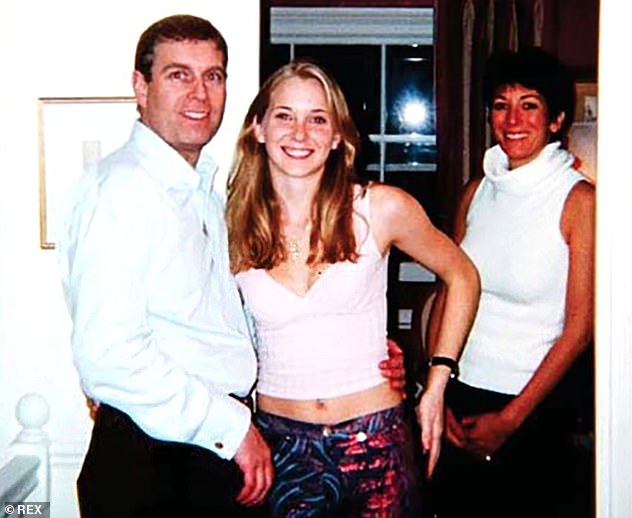
Prince Andrew, Virginia Roberts and Ghislaine Maxwell. Link to Daily Mail

Link to The Sun.com
Hardly anybody believes Andrew. The queen had no choice but to sack his own son.
Link to Daily Mail
Andrew got sacked because he was caught in a lie.
Andrew claimed he could not have had sex with the 17-year old Virginia in 2001 because he had stayed with the British consul general.
The problem is the consul general does not recall Andrew staying with him.
Link to Daily Mail
Curiously, most of the mainstream media has forgotten that it was Ghislaine who recruited and manipulated Virginia Roberts to become a sex slave.
Even the BBC forgot this crucial fact despite Andrew mentioning Ghislaine many times during the interview.
Time and again, the Prince invoked his friendship with Maxwell, 57, daughter of disgraced media tycoon Robert Maxwell, as the reason he came into paedophile Epstein’s orbit.
Asked when he last saw Maxwell, Andrew said his last contact was ’earlier this year, funnily enough’, when she ’was here doing some rally’. (Daily Mail)
Andrew claimed to have met Ghislaine last spring. In fact, they met in June just after US prosecutors reopened the case against Epstein.
The Duke of York held a meeting with Ghislaine Maxwell in London two weeks after US prosecutors announced they wanted to reopen their investigation into Jeffrey Epstein. …
The meeting took place on or about June 5, the day before Ms Maxwell took part in a four-day charity motoring rally from London to Monte Carlo.
Did Ghislaine demand that Andrew help make sure that the her own parallel case would not be reopened?
After meeting Andrew she literally disappeared from the face of the earth.
The ex-socialite has not been seen since although rumours have placed her in Brazil, France, the American mid-West and even the UK.
‘No one knows where she is,’ a lawyer for one of Epstein’s victims said last night. ‘She’s done the greatest disappearing act known to man – or woman.’ (Daily Mail)
Link to Daily Mail
Shockingly, during the BBC interview Prince Andrew mentioned Ghislaine many times and seemed to be proud of their friendship. Despite this the interviewer did not dare to ask questions about their relationship.
Was this a message to all: Leave Ghislaine alone.
Ghislaine is obviously protected not only by the royal family but also by the whole ruling elite. No wonder that she has the Get-Out-of-Jail-Free card.
Ghislaine also tries to protect other Epstein associates.
Link to Daily Mail
Prince Andrew is now afraid to go to the US.
Five women who accuse Jeffrey Epstein of abusing them say Prince Andrew witnessed how people were given massages at the sex offender’s homes.
The lawyer for the women has told BBC Panorama he plans to serve subpoenas to force the Duke of York to testify as a witness in all five cases.
He says the prince could have important information about sex trafficking. (BBC)
Link to BBC story and video
The BBC has now finally zoomed in on Ghislaine.
Another Epstein victim, Sarah Ransome told Panorama Ghislaine Maxwell, one of Prince Andrew’s oldest friends, worked hand in hand with Epstein.
”Ghislaine controlled the girls. She was like the Madam,” she said.
”She was like the nuts and bolts of the sex trafficking operation and she would always visit Jeffrey on the island to make sure the girls were doing what they were supposed to be doing.
”She knew what Jeffrey liked. She worked and helped maintain Jeffrey’s standard by intimidation, by intimidating the girls, so this was very much a joint effort.”
Ms Maxwell could not be reached for comment but has previously denied any involvement in or knowledge of Epstein’s abuse. (BBC)
But the American media is still not interested in Ghislaine.
What the American mainstream media always willfully forgets is that Ghislaine Maxwell is the key person and mastermind behind the whole pedo sex trafficking operation.
The key role of Ghislaine is not surprising. After all, her father was an Israeli super spy, Robert Maxwell.
But perhaps this is the very reason why the American media is not interested.
For years Ghislaine has been at the center of a vast pedophile sex trafficking network. But still to this day the American police has never dared to even interview her.
She simply knows too much.
Featured Video

Dan Dicks with James Corbett on Solutions Watch
or go to
Aletho News Archives – Video-Images
From the Archives
$1.5bn up in smoke: US THAAD missile stockpile dries up defending Israel against Iran
By Ivan Kesic | Press TV | July 2, 2025
According to American media, defense news outlets, and independent analysts, the 12-day Israeli military aggression against Iran significantly depleted the US stockpile of THAAD (Terminal High Altitude Area Defense) interceptor missiles.
Citing official sources, American magazine Newsweek reported on Friday that the US transferred a substantial portion of its advanced missile defense capabilities to support the Israeli regime, an effort with questionable results and a critical impact on US strategic reserves.
THAAD, developed by Lockheed Martin arms manufacturing company, is a key component of Israel’s multi-layered air defense architecture. It is designed to intercept medium-range ballistic missiles, including those launched from Iran and Yemen.
The US-made system is capable of targeting short-, medium-, and intermediate-range ballistic missiles during their terminal phase, whether inside or outside Earth’s atmosphere.
THAAD uses a “hit-to-kill” method, relying on kinetic energy rather than explosive warheads to destroy incoming threats, intercepting at altitudes of up to 150 km and ranges between 150-200 km.
Operated exclusively by American personnel, the US military maintains eight THAAD batteries with an estimated 350–400 interceptors in total. The eighth battery was activated during the June 20 Israeli aggression against Iran and is capable of intercepting hypersonic missiles. … continue
Blog Roll
 Aletho News
- Zionist Bought Senate Blocks Information About American Citizens Killed By Israel
- While Gaza dominates the UN, these are the people keeping it alive
- New Report: “Scholasticide and Genocide in Gaza: Assessment, Testimonies and Legal Analysis”
- ‘THAAD Delusion’: Iran war exposes US missile shield limits – The Atlantic
- Moscow issues warning to NATO over Russian exclave
- Yes, the Iran war has destroyed Trump’s presidency
- The fallacy of US delusions about Iran’s economic collapse
- Hezbollah denies Syria cell link, warns of Israeli plan to sow discord
- The legacy of US sanctions, war, and occupation in Iraq
- Iraqi resistance group rejects disarmament, vows to maintain support for Lebanon
- If Americans Knew
- Mamdani releases plan to combat antisemitism and hate crimes in New York City
- Iran’s Revolutionary Guards Publish Letter to the American People
- DMFI launches $1 million ad campaign supporting Virginia’s Elaine Luria
- US Senate blocks resolution seeking report on Americans killed by Israel
- Israeli Attacks Kill Ten Palestinians in Gaza
- Massacre at Minab: The School That Became a Grave
- Israeli media: The IDF Shows It Doesn’t Turn a Blind Eye; It Actively Emboldens Settler Havoc
- As settlers ravage West Bank, Israeli forces kill 10 in Gaza – Daily Update
- New Report: “Scholasticide and Genocide in Gaza: Assessment, Testimonies and Legal Analysis”
- Ex-Biden officials are desperate for a Gaza scapegoat
- No Tricks Zone
- Green Energy Debacle: German Expert Professor Fritz Vahrenholt Warns Of Severe Economic And Social Consequences
- Two More Paleo Reconstructions Affirm Meters-Higher Sea Levels Across Ireland, Brazil 7000-6000 Years Ago
- New Study: Earth And Venus Surface Warmth Largely Explained By Convection And Lapse Rate, Not CO2 Or Radiation
- 2025 Nature Paper Claiming Worsening Global Drought Gets RETRACTED …Heavily Flawed
- New Study: ‘Global Drought Shows No Detectable Recent Acceleration Under Climate Warming’
- Economic Masterminds: German Socialists Suggest Taxing Productivity Gains Stemming From Using AI
- The South China Sea Has Not Been Cooperating With The Climate Change Narrative
- Energy Crisis: Germany Enters Heating Season With Historically Low Gas Reserve Fill Levels
- New Study: The Antarctic Ice Sheet Gained Mass From 2020-2024 Due To Staggering Snow And Ice Accumulation
- Study: Ocean Heating Rates From Thousands Of Years Ago ‘Dwarf’ Modern Ocean Heating Rates

