A prominent Hong Kong pundit and anti-China activist named Kong Tsung-gan is in fact an American man with ties to Amnesty International and key Hong Kong separatist figures.
According to an investigation by The Grayzone, the man, who has been posing online as a Hong Kong native, has become a go-to source for Western media.
Kong employed by an American teacher, who is a ubiquitous figure at local protests, is routinely cited as a grassroots activist and writer by major media organizations and published in English-language media.
The character has been created to disseminate anti-China propaganda behind the cover of yellowface and his prolific digital presence and uninterrogated reputation in mainstream Western media has helped him to better do the job.
The content he focuses on aims to hype up the Hong Kong “freedom struggle” while at the same time he calls for the US to turn up the heat on China.
China enacted a national security law for Hong Kong earlier this month, criminalizing sedition, secession, and subversion against the mainland and allowing Chinese national security institutions to operate in the city for the first time since 1997, when Hong Kong returned from British to Chinese rule but attained semi-autonomy.
The legislation has been harshly criticized by Western countries, which allege that it harms the city’s semi-autonomous status. Beijing rejects the allegation.
The truth about Kong’s identity has been circulating on social media in Hong Kong, and even last December, The Standard mentioned a brief account about it.
Several locals, who spoke to The Grayzone, expressed their outrage over what they referred to as a deceptive stunt they considered not only unethical, but racist.
After his first appearance on Twitter under the username @KongTsungGan in March 2015, Kong tweeted mostly about Tibet and the Hong Kong Umbrella Movement.
He at some point changed his Twitter avatar to a black-and-white headshot of an unknown Asian person, but later changed it to an image showing Liu Xia, the wife of the late Nobel Prize-winning dissident Liu Xiaobo who celebrated the US wars on Vietnam, Afghanistan, and Iraq.
Liu Xiaobo, a right-wing ideologue, was rewarded with the 2014 Democracy Award by the National Endowment for Democracy – the favorite meddling machine of the US government.
So now we don’t have to listen to what those doctors said in front of the US Supreme Court, because it turns out that one of them has some whacky beliefs about sex with demons causing reproductive disorders. What a relief.
I’m not going to pretend that the things Dr. Stella Immanuel has said don’t sound just a little crazy to me. They do. But I’ve been observing this game long enough to have a pretty good idea of how this works:
Someone says something that contradicts the dominant narrative (in this case, the narrative about medical science), and the machine that supports that narrative goes into overdrive to discredit them, with whatever information they can dig up–as long as it doesn’t involve discussing the actual substance of what the person has said.
I understand that for some people, maybe even for a great many, that is the end of the conversation. So for everyone who is satisfied with the “fringe doctors promoting hydroxychloroquine also believe demon sex causes fybroids” narrative–please, stop here. Your ride is over, and you may go on believing that this group of doctors and other professionals has been thoroughly discredited by these statements.
For everyone else, if you are at all interested in why such a coordinated effort has been launched to silence and discredit this group, why–even before the sex demon stuff was uncovered–videos of the group’s press conference were quickly yanked from YouTube, and why their own website was taken down without warning by its host, SquareSpace, (their new website can now be found here) then please keep reading.
WHAT THE AMERICA’S FRONTLINE DOCTORS GROUP SAID:
What follows is a brief summary of the key points made by the group America’s Frontline Doctors at their press conference last week. I will not comment on the validity of their claims, however founder Dr. Simone Gold has provided support for much of what the group said, in a white paper that can be found here.
1. They believe that hydroxychloroquine is an effective treatment for Covid-19.
This is the claim made by several of the speakers, including Dr. Immanuel, based on their own clinical experience, as well as on multiple published studies. Many of those studies are listed here, and here.
2. State licensing boards are using their power to forcibly prevent people from having access to this drug.
According to Dr. Gold, many states have empowered their pharmacists to not honor prescriptions for hydroxychloroquine to be used in treating Covid-19. This, she says, is unprecedented: “It has never happened that a state has threatened a doctor for prescribing a universally accepted safe generic cheap drug off-label.”
Meanwhile, says Gold, the drug is available over the counter in many other countries, including Iran and Indonesia, where it can be found “in the vitamin section”.
3. There is a coordinated campaign to discredit and suppress information about the drug hydroxychloroquine as a possible treatment for Covid-19:
“If it seems like there is an orchestrated attack going on against hydroxychloroquine,” said Dr. James Todaro, “it’s because there is.”
Dr. Todaro is speaking from experience. He was the co-author of a March 13 white paper arguing for the use of hydroxychloroquine against Covid-19. The paper was made public on Google Docs, received a lot of attention, and was then removed–without warning–by Google. (It has since been put back up.)
4. The World Health Organization (the authority upon which YouTube CEO Susan Wojcickihas said she bases her company’s policy on “misinformation”) halted its trials of hydroxychloroquine based on a blatantly fraudulent study that relied on data that it appears never even existed. The WHO later resumed trials after independent investigators discovered the problems and the study’s authors retracted it.
5. We should be able to have a free and open discussion about this.
Dr. Dr. Joseph Lapado from UCLA, sums it up:
We’ve been using (hydroxychloroquine) for a long time. But all of a sudden it’s been escalated to this area of looking like some poisonous drug. That just doesn’t make sense… At the very least, we can live in a world where there are differences of opinion about the effectiveness of hydroxychloroquine, but still allow more data to come, still allow physicians who feel they have expertise with it to use that medication, and still, you know, talk and learn and get better at helping people with Covid-19.
WHY THE ALL-OUT MEDIA ASSAULT ON THE FRONTLINE DOCTORS?:
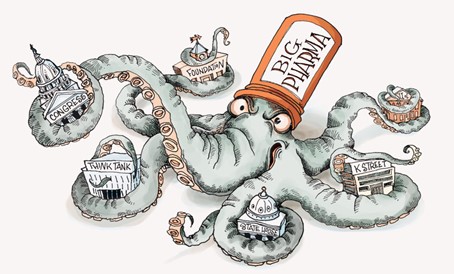
The influence that the pharmaceutical industry wields over media outlets is no secret. As of 2018, an estimated 70% of all news advertising in the US came from pharmaceutical companies. I have written elsewhere about how “reporting” on medical issues can be difficult to distinguish from outright marketing for drug companies.
Social-media platforms are not immune to this influence, whether it comes via advertising dollars; “partnerships” such as that between the CDC Foundation and MailChimp (which like many other platforms, has an explicit policy of censoring content about vaccines that does not align with the positions of the CDC and the WHO); direct investment, such as that of Google’s parent company Alphabet; or indeed at the behest of politicians such as Congressman Adam Schiff, who last year wrote to the CEOs of Amazon, Facebook and Google, requesting that those companies censor information and products that did not conform to the officially sanctioned position on vaccines. All three complied.
So it should come as small surprise that both Google and YouTube have now taken to removing content supportive of hydroxychloroquine, a drug that is no longer covered by patent, and can be made and sold by any generic producer, for a fraction of the price that Gilead, for example, might charge for its still-patented Remdesivir. Twitter and Facebook have likewise removed posts about the drug, most notably–and with no visible sense of irony–removing posts of the video in which the Frontline Doctors speak out about widespread media censorship of the topic. (You can now see those videos on Bitchute.)
One need not have an opinion on the merits of the drug hydroxychloroquine in order to recognize that something very odd is happening here. Something that doesn’t seem to have anything to do with free and open inquiry or honest scientific discourse.
Many argue that the politicization of this drug is founded in a desire to unseat President Trump, that the opposition to it is primarily because it was endorsed by Trump, and if it is deemed to be a failure (or even better, dangerous to patients) it will be a powerful strike against the president. That may well be part of what has motivated this. But there is another motivation, having to do with the desire to push a more expensive medication onto the market, and to push a new vaccine on the world’s population.
More broadly, it has to do with the narrative that those in the business of selling drugs demand we believe: that we are all in desperate need of their products (but only the ones still under patent) if we are to be healthy–or indeed, if we are to survive at all.
If it turns out that this “new” virus is easily treatable, with hydroxychloroquine or anything else, then the industry’s dreams go up in smoke. If hydroxychloroquine turns out to be a safe and effective way of treating Covid-19 (as multiplestudies and the experience in many other countriesoutside of the US indicate it may be) then there is much less reason for anyone to receive a vaccine for it, let alone the entire world’s population. Likewise, there is no pressing need to develop a new, more expensive treatment.
But even more than that: If it turns out that hydroxychloroquine is after all a safe and effective treatment for Covid-19, then this whole episode – the silencing of dissenting voices, the “fact-checking” on social media, the campaigns against “misinformation” – will be revealed in plain sight, for what it has always been: Nothing more than a well-funded marketing campaign and damage-control effort on behalf of the industry that wants you to believe that you need to use its expensive products in order to go on living.
So when a group of doctors took to the steps of the US Supreme Court and told the world how they were having success using a cheap anti-malarial that had been in use for 65 years to treat the most deadly contagion of our generation, it was a massive blow to the narrative upon which the pharmaceutical purveyors’ success depends. And over the next few days, as viewers engaged in a race with the censors, quickly downloading videos before they were removed, to post them on other platforms… it became clear that the censors and the gatekeepers had lost control of the conversation.
This is not only about hydroxychloroquine. Every time media outlets or social-media platforms engage in outright censorship of content, in a way that happens to benefit pharmaceutical companies, both parties lose just a little more credibility. The actions we are witnessing now are not the actions of an industry confident in the value of what it provides to the world. They are the actions of a desperate, threatened creature. They are the actions of an entity that is not strengthened by the truth, but weakened by it. That is what these (increasingly obvious) acts of censorship tell us. What we are witnessing are the pangs of a lumbering, wounded, behemoth.
The United States national election is now only three months away and it should be expected that the out-and-out lies emanating from both parties will increase geometrically as the polling date nears. One of the more interesting claims regarding the election itself is the White House assertion that large scale voting by mail will permit fraud, so much so that the result of the voting will be unreliable or challenged. To be sure, it is not as if voter fraud is unknown in the United States. The victory of John F. Kennedy 1960 presidential election has often been credited to all the graveyards in Mayor Richard Daley’s Chicago voting to swing Illinois into the Democratic camp.
The Democrats are insisting that voting by mail is perfectly safe and reliable, witness the use of absentee ballots for many years. The assertions by Democratic Party-affiliated voting officials in several states and also from friends on the federal level have been played in the media to confirm that fraud in elections has been insignificant recently. That may be true, up until now.
The Democrats, of course, have an agenda. For reasons that are not altogether clear, they believe that voting by mail would benefit them primarily, so they are pushing hard for their supporters to register in their respective states and cast their ballots at the local mail box. Nevertheless, there should be some skepticism whenever a major American political party wants something. In this case, the Democrats are likely assuming that people at lower income levels who will most likely vote for them cannot be bothered to register and vote if it requires actually going somewhere to do it. They have spoken of “expansion of voting,” presumably to their benefit. The mail is a much easier option.
A Fox News host has rejected the impelling logic behind the mail option, saying “Can’t we just have this one moment to vote for one candidate every four years, and show up and put a ballot in without licking an envelope or pressing on a stamp? If you can shop for food, if you can buy liquor, you can vote once every four years.”
The fundamental problem with the arguments coming from both sides is that there is no national system in the United States for registering and voting. Elections are run at state level and the individual states have their own procedures. The actual ballots also differ from voting district to voting district. To determine what safeguards are actually built into the system is difficult as how electoral offices actually function is considered sensitive information by many, precisely because it might reveal vulnerabilities in the process.
To determine how one might actually vote illegally, I reviewed the process required for registering and voting by mail in my own state of Virginia. In Virginia one can both register and vote without any human contact at all. The registration process can be accomplished by filling out an online form, which is linked here. Note particularly the following: the form requires one to check the box indicating U.S. citizenship. It then asks for name and address as well as social security number, date of birth and whether one has a criminal record or is otherwise disqualified to vote. You then have to sign and date the document and mail it off. Within ten days, you should receive a voter’s registration card for Virginia which you can present if you vote in person, though even that is not required.
But also note the following: no documents have to be presented to support the application, which means that all the information can be false. You can even opt out of providing a social security number by indicating that you have never been issued one, even though the form indicates that you must have one to be registered, and you can also submit a temporary address by claiming you are “homeless.” Even date of birth information is useless as the form does not ask where you were born, which is how birth records are filed by state and local governments. Ultimately, it is only the social security number that validates the document and that is what also appears on the Voter’s ID Card, but even that can be false or completely fabricated, as many illegal immigrant workers in the U.S. have discovered.
In a state like Virginia, the actual mail-in ballot requires your signature and that of a witness, who can be anyone. That is also true in six other states. Thirty-one states only require your own signature while only three states require that the document be notarized, a good safeguard since it requires the voter to actually produce some documentation. Seven states require your additional signature on the ballot envelope and two states require that a photocopy of the voter ID accompany the ballot. In other words, the safeguards in the system vary from state to state but in most cases, fraud would be relatively easy.
And then there is the issue of how the election commissions in the states will be overwhelmed by tens of thousands of mail-in ballots that they might be receiving in November. That overload would minimize whatever manual checking of names, addresses and social security numbers might otherwise take place. Jim Bovard has speculated how “The American political system may be on the eve of its worst legitimacy crisis since the Civil War. Early warning signals indicate that many states could suffer catastrophic failures in counting votes in November… Because of the pandemic, many states are switching primarily to mail-in voting even though experiences with recent primaries were a disaster. In New York City, officials are still struggling to count mail-in ballots from the June primary. Up to 20% of ballots ‘were declared invalid before even being opened, based on mistakes with their exterior envelopes,’ the Washington Post noted, thanks largely to missing postmarks or signatures. In Wisconsin, more than 20,000 ‘primary ballots were thrown out because voters missed at least one line on the form, rendering them invalid.’ Some states are mailing ballots to all the names on the voting lists, providing thousands of dead people the chance to vote from the grave.”
Add into the witch’s cauldron the continued use of easily hacked antiquated voting machines as well as confusing ballots in many districts, and the question of whether an election can even be run with expectations of a credible result becomes paramount. President Trump has several times claimed that the expected surge in mail-in voting could result in “the most corrupt vote in our nation’s history.” Trump is often wrong when he speaks or tweets spontaneously, but this time he just might be right.
New research shows that the most widely prescribed type of drug in the history of medicine is a waste of money. One major study found that the more ‘bad’ cholesterol was lowered, the greater the risk of heart attacks and strokes.
In the midst of the Covid-19 pandemic, almost every other medical condition has been shoved onto the sidelines. However, in the UK last year, heart attacks and strokes (CVD) killed well over 100,000 people – which is at least twice as many as have died from Covid-19.
CVD will kill just as many this year, which makes it significantly more important than Covid-19, even if no one is paying much attention to it right now. So, it is good to see that research goes on, and papers are still being published.
One of the most significant, and of great interest to me personally, was a critical examination of the benefits of lowering cholesterol. This was published on August 4. The paper was called ‘Hit or miss: the new cholesterol targets,’ and it came out in Evidence Based Medicine, one of the key titles that sits under the umbrella of British Medical Journal publishing.
It was carefully worded, as all clinical papers are, but a key section of the press release was as follows: “Setting targets for ‘bad’ (LDL) cholesterol levels to ward off heart disease and death in those at risk might seem intuitive, but decades of research have failed to show any consistent benefit for this approach, reveals an analysis of the available data, published online in BMJ Evidence Based Medicine.”
What is being said here is the following. Everyone thinks that lowering LDL, aka ‘bad cholesterol,’ is considered the single most important way to reduce the risk of heart disease and strokes. However, “decades of research have failed to show any consistent benefit for this approach.”
Surely this flies in the face of almost all the advice we have been bombarded with for the last 50 years or so. Cholesterol – by which we really mean low density lipoprotein (LDL) – is a killer and must be lowered. This is the whole point of statins, the single most widely prescribed type of drug in the history of medicine. Drugs that have racked up sales of nearly $1 trillion since their launch.
Now, newer and far more expensive LDL-lowering medications are available, riding on the success of statins. They are injectable, rather than tablets, and the cost is far higher. In the US, you are looking at around $5,000 per year. In the UK, one of these drugs, Repatha, costs the NHS just over £4,000 ($5,200) per year. These drugs are known as PCSK9-inhibitors.
These are eye-watering costs. It is estimated that around seven million people in the UK take statins currently. If everyone converted to a PCSK9-inhibitor, this would cost the NHS £28 billion ($36.4 billion) a year – not far off the entire defense budget.
But do these drugs work, does lowering LDL work? Surely it does, surely it must. The answer is, not necessarily. Yes, statins have been found to reduce the risk of cardiovascular disease, not by a massive amount, but the effect exists. At least in some studies, if not all.
However, many other drugs also reduce the risk of cardiovascular disease without having any effect on LDL levels, e.g. aspirin. A number of researchers have long argued that the benefits of statins are mainly due to “off-target” effects, by which they mean that, yes, statins lower LDL, but they also have effects on many other things and it is the “other things” that provide the benefit.
For example, statins have been found to have quite strong anti-coagulant (anti-blood-clotting) effects. Same as aspirin, as highlighted in the 2013 paper, ‘Anticoagulant effects of statins and their clinical implications.’ It states: “There is evidence indicating that statins… may produce several cholesterol-independent antithrombotic [anti-coagulant] effects.”
So, it has always remained possible that the main benefit of statins was not due to their impact on lowering LDL. It is because of something else that they do.
In this recent study, the authors decided to examine this possibility. So they gathered together all the LDL lowering trials – at least those big enough, and long enough to count – and try to establish whether the amount that the LDL was lowered matched the reduction, if any, in cardiovascular disease. The technical term for this is “dose-response.”
Or, to put this another way, if the LDL hypothesis is correct, the greater the LDL lowering, the greater the benefit on CVD should be. What did they find? Here are the key findings – from the press release:
“Their analysis showed that over three quarters of all the trials reported no positive impact on the risk of death and nearly half reported no positive impact on risk of future cardiovascular disease.
“And the amount of LDL cholesterol reduction achieved didn’t correspond to the size of the resulting benefits, with even very small changes in LDL cholesterol sometimes associated with larger reductions in risk of death or cardiovascular ‘events,’ and vice versa.
“Thirteen of the clinical trials met the LDL cholesterol reduction target, but only one reported a positive impact on risk of death…
“Considering that dozens of [randomized controlled trials] of LDL-cholesterol reduction have failed to demonstrate a consistent benefit, we should question the validity of this theory.”
And they conclude:
“In most fields of science the existence of contradictory evidence usually leads to a paradigm shift or modification of the theory in question, but in this case the contradictory evidence has been largely ignored, simply because it doesn’t fit the prevailing paradigm.”
In short, what they found was that there was absolutely no correlation between the amount that LDL was lowered and the resulting benefit on CVD. In fact, the benefit was inverse i.e. the less the LDL was lowered, the greater the benefit.
This is a hugely important finding that really ought to be shouted from the rooftops. I admit I have a horse in the race, having long argued that LDL has nothing to do with heart disease (and being roundly condemned for doing so). So, it is nice to have my thoughts so powerfully supported in a peer-reviewed, high-impact journal.
For the average person on the street, what this research means is that you should stop worrying about your LDL levels, and obsessively trying to get them down with drugs or diet. Tucked away in the paper was this significant finding:
“Moreover, consider that the Minnesota Coronary Experiment, a four-year long RCT [randomized controlled trial] of a low-fat diet involving 9,423 subjects, actually reported an increase in mortality and cardiovascular events despite a 13 percent reduction in total cholesterol.”
Cholesterol (LDL) went down, CVD went up. We really are wasting a colossal amount of money.
Malcolm Kendrick is a doctor and author who works as a GP in the National Health Service in England. His blog can be read here and his book, ‘Doctoring Data – How to Sort Out Medical Advice from Medical Nonsense,’ is available here.
Vienna – Protesters in Vienna are demanding an immediate end to Austria’s military cooperation with the Israeli regime.
The slogan of protesters gathered outside the American embassy in Vienna is “No to Austrian subordination to US/Israeli interests.”
They say the Austrian government’s decision to involve its intelligence forces in cyber maneuvers with Israel is meant to serve the interests of the US and Israel despite concerns it could lead to mass surveillance of the Austrian population.
Not much is known about the maneuvers, reportedly involving the Israeli military, the German Armed Forces, and units from Austria and Switzerland, during which cyber attacks would be simulated and countered.
Protesters also condemned the Austrian government for refusing to vote against Israel’s recent illegal annexation plans.
Pro-Palestinian groups in Austria, such as the Palestine Solidarity Platform, and the Boycott, Divestment and Sanctions Movement (BDS) have been facing increasing government restrictions amid allegations of promoting anti-Semitism, an accusation they say is being used to misrepresent their goal of opposing Israeli occupation and aggression.
New scandalous information about the 2014 Maidan coup d’état in Ukraine has emerged that implicates Lithuania’s important role in instigating the violent events. David Zhvania, a former Member of the Ukrainian Parliament, revealed on his YouTube channel that the seizure of power in Ukraine was financed in “several ways.”
“One of the external sources was the Lithuanian embassy, through which money and weapons were transferred, and the internal channel was Diamantbank. I have documented evidence to support my words,” said the former ally of Petro Poroshenko, the previous president of Ukraine.
Zhvania called on Prosecutor General Irina Venediktova to initiate criminal proceedings and to summon him for questioning. According to the former MP, “Ukrainians should finally find out the truth” on who funded Maidan and who was bribed. He then admitted he was a member of a “criminal group that carried out a coup.”
“To help the conspirators, I used my political influence and my position as head of the State-Building Committee,” he said, adding that he would testify against himself, “but with one condition.”
“Please guarantee my security because I know who the people of Poroshenko are. They can easily order me to be removed,” he stressed.
Mass protests in Kiev began in November 2013 after preparations for the signing of an association agreement between Ukraine and the European Union were suspended. This set off mass anti-Russian hysteria and by the end of February 2014, a coup d’état took place in Ukraine, ousting President Viktor Yanukovych from power. This led to Petro Poroshenko becoming president and ultra-nationalists, including neo-Nazis, gained significant power in Ukraine and instigated a war with the Russian-speaking minority of Eastern Ukraine.
Although U.S. and Western European involvement in Maidan are well documented and known, Zhvania’s admissions are the first admittance of how a small Baltic country of under 3 million people played a key role in destabilizing Ukraine. Lithuania’s role was not only with financial support, but also with arms transfers. Although some may be sceptical that Lithuania played such a role, Zhvania is confident enough in his allegations that he announced he is willing to submit “documented evidence” to the Prosecutor General’s Office of Ukraine.
The question arises whether the Prosecutor’s Office will accept Zhvania’s testimony and evidence. Such a testimony and submission of evidence would further question the legitimacy of the Maidan events as a fight for freedom and democracy in Ukraine. If the legitimacy of Maidan is questioned, ultra-nationalists in Ukraine could become hysterical and instigate political destabilization to maintain and protect the powers they attained when Yanukovych was ousted. This is something the Prosecutor’s Office would be considering.
Lithuania was an active supporter of the 2004-2005 Orange Revolution that brought pro-Western President Viktor Yushchenko to power in Ukraine. Although Yushchenko was unconstitutionally brought to power, for Lithuania this was not a problem so long as Kiev had a pro-Western orientation. It is therefore not surprising that in 2014 it again supported reactionary forces in Ukraine. From the beginning of the conflict in Donbass, the eastern region of Ukraine where the majority of the Russian-speaking minority are, Lithuania started to provide official military support to Ukraine with armaments and advisers, and informally by recruiting and sending mercenaries.
As Lithuania has taken a pro-American position since the collapse of the Soviet Union in 1991, the country’s leadership has aggressively served Washington’s ambitions of limiting Russian influence and expanding American interests in the post-Soviet space. It is for this reason that Lithuania, Ukraine and Poland created the “Lublin Triangle,” a trilateral platform for these three countries to counter supposed “ongoing Russian aggression” and show their “firm support” for Western institutions. In their joint declaration published online, the Foreign Affairs Ministers of the three countries condemned Russia’s “ongoing aggression” and its “attempted annexation” of Crimea, while welcoming Ukraine’s “European choice.” Effectively the trilateral platform is a pillar for the three countries to enact Washington’s main foreign policy priorities in the region, that they call “Central Europe” instead of Eastern Europe. Claiming that Poland, Lithuania and Ukraine are in Central Europe instead of the geographical reality that they are in Eastern Europe, is an awkward attempt by these countries to disassociate themselves from Western orientalization that the East is primitive and/or backwards.
If Zhvania’s statements that Lithuania’s role in Maidan are confirmed to be true, it would certainly not come as a surprise, but as mentioned, they delegitimize the initial claims that the movement was a struggle for democracy and Western European values in Ukraine. It would also confirm that Lithuania interfered in the internal affairs of another state and participated in an unconstitutional coup. Effectively, if proven true, the supposed values of Western Europe that Maidan struggled for would prove to be a sham as it was not achieved through the will of the people, but rather through foreign funds and weapons, including those from seemingly insignificant states like Lithuania.
Paul Antonopoulos is an independent geopolitical analyst.
Senior Lebanese political analyst Anees Naqqash provides his analysis of the recent flareup on the Lebanese-Israeli border, an incident which is becoming the subject of many questions, theories and debates.
In this interview on Al-Manar TV, Naqqash says something ‘very strange and major’ occurred in this incident, and perhaps the ambiguity will be removed in the future. However, the senior analyst, who is closely-tied to Hezbollah, affirmed that the events at the border were a ‘major scandal for the entire state of Israel’.
Here’s the necessary context:
For days Israeli forces had been on high alert on the Lebanese border after Tel Aviv understood that a Hezbollah reprisal attack was imminent after the Lebanese group announced that one of its cadres (namely Ali Kamil Mohsen) had been killed by an Israeli airstrike near Damascus International Airport.
On the 27th of July, 2020, a military incident occurred at the border between Lebanon and Israel. Much debate ensued regarding what actually occurred. As the apparent cross-border fire unfolded on that Monday afternoon at the Shebaa Farms border region, Israeli media reported the developing situation minute by minute, albeit with contradictory accounts. Meanwhile, Hezbollah remained silent, while Lebanese media outlets like Al Mayadeen TV largely relayed Israeli media’s breaking news reports.
The final account that Israeli media and officials generally settled on hours later was this: the Israeli army had thwarted a Hezbollah infiltration attempt into Israeli-controlled territory, and that the army remains alert for any future attempts to breach the border.
Thereafter, when the dust had settled, Hezbollah issued a statement denying Israeli media reports that a Hezbollah infiltration attempt was foiled, and asserted that all the fire that was opened was carried out unilaterally by the Israelis. Hezbollah unequivocally asserted that there were no ‘clashes’, nor exchange of cross-border fire, nor ‘martyrs’ that fell from its side, but rather ‘terrified and anxious’ Israeli forces ‘firing at each other’.
The Hezbollah statement also assured that the reprisal for Israel’s killing of Ali Kamil Mohsen, one of its cadres in Syria, is undoubtedly coming.
Source: Al-Manar TV
Date: July 27,2020
Transcript:
Host:
Mr. Anees, let us return to the point raised by Mr. Hijazi (Al-Manar journalist) regarding the (various) scenarios. What are the potential scenarios that led the enemy entity (Israel) to this situation today? Is it truly the case that the huge (Israeli) confusion and tension (in anticipation of the promised Hezbollah reprisal), this idea (invoked initially by Nasrallah, that the Israelis ought to wait for the reprisal by) “standing on a leg and a half” , also after Hezbollah’s (media) statement, which we’re going to mention after a while, and I don’t know how much they’ll last standing on a leg and a half moving forward… what are the scenarios that led to this scene? Or is it truly a trick (by Israeli officials) aimed at getting rid of the burden of (Hezbollah’s promised) reprisal through any way possible, by say fabricating a story or scenario to reach this end?
Naqqash:
This scenario, in which (the Israelis purposefully) commit an attack against their own selves in order to prevent Hezbollah from responding by drawing a statement from Hezbollah (in which the Lebanese group can claim) that “We have retaliated and carried out our reprisal”, this (possibility) is abit unlikely, unless of course (the Israelis) are that stupid, But whoever knows Hezbollah well, knows that they won’t engage in such a game.
There’s something that I don’t know how we will reach one day, but something (in what occurred today) looks like the Ansariya operation (of 1997, which occurred at the Lebanese coastal town of Ansariya). When the Ansariya operation took place, Robert Fisk, the famous correspondent from The Independent, came to me and said, “Anees, my estimation of this operation is that it is impossible for it to have occurred in the manner in which it did.” In what sense (did Fisk mean)? (He meant that) Hezbollah (during the Ansariya operation) was awaiting the Israeli special forces in order to trap them, and these (Israeli special) forces do not move into action except by the command of the (Israeli) Prime Minister and (Israeli army’s) Chief of Staff, so this means complete secrecy, a large part of the (Israeli army) does not know about the movements (of these special forces).
Fisk continued, “So, I believe that Hezbollah was awaiting (the arrival of these forces at Ansariya), and there’s no way (this ambush could have occurred) except by (Hezbollah) having penetrated the Israeli (Chief of) Staff Command.” (Fisk) wasn’t joking at all. He said “my estimation”, and you know Fisk’s (journalistic) experience, he has extensive experience in the (Middle East) region for over 30 years. I replied to Fisk’s claim and told him, “No, I don’t think it required (Hezbollah) to penetrate the (Israeli Chief of) Staff Command. There’s something major that happened, maybe one day it will be clarified.”
What was the major thing (that was revealed later)? That an (Israeli) spy drone had been capturing images of an area (in the Lebanese town of) Ansariya, (Hezbollah) operatives (had intercepted this drone) and were collecting these images, which allowed them in turn to uncover the enemy’s intended target (i.e. Hezbollah anticipated where the Israeli special forces were intending to land and strike). They uncovered the enemy’s intended target via the enemy’s eye (in the sky). Through the enemy’s eye they prepared for them an ambush.
I believe the day will come when the major fact (behind today’s events) is revealed, because what happened today was very strange. It wasn’t merely a confused Israeli soldier who was firing a M16 or PKM, or even a single tank firing at an invisible target. Rather, it consisted of extremely heavy shelling from several (Israeli) sources of fire, all of which were targeting an (Israeli) military base, and this lasted for several minutes. The information was delivered to the (Israeli) prime minister and he (immediately) issued threats and assessed the (magnitude of the) situation. Something major occurred at this (military) site. I think that the enemy today is extremely confused to the maximum level possible. What happened to its forces? Who gave the order to open fire? What (is the nature of the) penetration that took place? What camouflage (tactics) were used?
During war, armies carry out spy missions, deception operations, I give him fake targets (to shoot at), and perhaps behind these fake targets his own forces could be stationed. All this occurs. What happened today? No one can say exactly what happened, but one thing could be said, “It is a scandal for the Zionist enemy and its army and its (entire) state as a (political) entity, because it is not just the (Israeli) Northern (Army) Command which is involved in this scandal, as I said in the beginning, from the Prime Minister, to the ‘Minister of War’, to the (local commanders) on the ground, all are embroiled in this scandal.
Something major has happened today, which is forcing (the Israelis) to reconsider their calculations. Great powers today are looking at this (Israeli) entity today and saying: something major has happened. This is an entity that cannot be relied upon (to achieve any military advances). This reminds us of reports written by great powers after 2006 which said that this army cannot win any (future) war, because its performance in 2006 was one of the worst performances, (a war waged against) only two thousand fighters from Hezbollah. Today the situation is (even) totally different in terms of (Hezbollah’s) numbers, equipment and weapons, but this is another issue. Yet the confusion that took place today, the scenario that caused a total collapse of the (Israeli) media and intelligence (apparatus), of the Chief of Staff, of the Prime Minister, to the (actual) Israeli base on the ground that bombarded the other military base.
Recently I received information that large plumes of smoke were rising from some (Israeli) bases. My estimates were that the enemy was evacuating from these bases and did not want (Hezbollah) to know that it had evacuated. This base (that was bombarded by Israel) was part of the scenario. Did the enemy evacuate this base in order to create this scenario? This would indicate the level of disgrace of the Zionist enemy, as it imagines Hezbollah would feel satisfied with this scenario and claim that it carried out this operation. It’s as if (the Israelis) are convincing themselves that (Hezbollah) might do such a thing. And this is impossible (Hezbollah would never do it) . As you heard today (the Israelis) saying: “What annoys us more is that Hezbollah did has not issued a statement yet.” And when the situation became clear, Hezbollah issued that very clear statement, and by doing so, revealed the weakness of the enemy, as it revealed Hezbollah had no hands in the clashes, and that the Israelis were clashing with themselves. Today there is a great defeat for the enemy at all levels, and this must be further closely studied.
(Important note: Please help us keep producing independent translations for you by contributing as little as $1/month here)
The head of the US agency for Global Media has announced an investigation into state-funded Voice of America (VOA) for possible election meddling, after its service in Urdu promoted a clip of Joe Biden courting Muslim votes.
The probe, announced by the newly-appointed agency CEO Michael Pack on Thursday, aims to determine whether federal employees of the broadcaster, funded exclusively through taxpayer money, “transgressed the VOA Charter, VOA’s Best Practices Guide, VOA’s Journalistic Code,” and whether they committed US election interference and a federal offence by airing a video “that can only be described as an apparent election advertisement for [the] presumptive Democratic presidential nominee.”
The clip, which was branded with a VOA logo, shows Biden addressing the Million Muslim Votes Summit earlier this month and citing a hadith (saying of Islam’s Prohet Mohammed), while making a series of election pledges such as the ending of travel restrictions to countries with substantial Muslim populations, labeled by US President Donald Trump’s detractors as a “Muslim ban.”
“Your voice is your vote. Muslim American voices matter. I’ll be a president who seeks out and incorporates the ideas and concerns of Muslim Americans on everyday issues that matter most to our communities,” Biden says in the clip.
The ad, which also features the first two Muslim women to be elected to Congress, Michigan Rep. Rashida Tlaib and Rep. Ilhan Omar of Minnesota, sees Biden’s promise of “having Muslim American voices as part of my administration.”
The video urges American Muslims to go out and vote, calling the effort “the largest Muslim voter mobliziation in America.”
Also on rt.com Envoy demands VOA ramp up anti-Iran efforts to ‘support’ Iranians… because what they really need is more US-funded propaganda
The clip was shared on the VOA’s Urdu website as well as across its social media, before it was scrapped.
In his statement, Pack said that the agency is seeking to find those behind “this significant content and editorial breakdown.”
“USAGM staff members who attempt to influence American elections will be held accountable.”
Ever since Pack was confirmed by the Senate in early June to lead the agency, mainstream media and Democrats have been sounding alarms over the VOA, initially set up in 1942 as a propaganda arm of the US government, potentially becoming an outlet for the wrong kind of propaganda – that is, a mouthpiece for the Trump campaign. However, that does not seem to be the case, at least, for now.
Newly unsealed files tied to the Jeffrey Epstein sex-trafficking case imply that former US President Bill Clinton visited the investor’s private island along with “young girls,” and that the FBI knew well about the minors’ abuse.
Comprising hundreds of pages of documents, the trove was released on Thursday night following a judge’s order last week to have it unsealed, over the objections of Ghislaine Maxwell, a former girlfriend to Epstein who has recently been charged as an accomplice in his alleged sex-trafficking operation.
The records stem from a 2015 defamation suit filed by Epstein accuser Virginia Giuffre, which was placed under lock and key after the case was settled in 2017, but was recently unsealed, as a result of a lawsuit brought last year by conservative blogger Mike Cernovich and the Miami Herald newspaper.
Among other revelations, the documents indicate that former US president Bill Clinton consorted with “young girls” during at least one visit to Epstein’s private resort in the Virgin Islands, where the billionaire was said to host regular “sex orgies.”
“When you were present with Jeffery Epstein and Bill Clinton on the island, who else was there?” one witness – presumably Giuffre – was asked during an interview, to which she replied that Epstein, Maxwell, an unidentified woman named “Emmy” and “2 young girls” had been on the island with the former POTUS. The witness did not elaborate on Clinton’s interactions with the girls, however.
The same witness also told her attorney in 2011 that she had overheard Epstein saying that Clinton owed him “favors,” but noted she couldn’t tell whether he was joking.
“He would laugh it off. You know, I remember asking Jeffrey ‘What’s Bill Clinton doing here?’… and he laughed it off and said ‘well he owes me a favor,’” she said. “He never told me what favors they were. I never knew. I didn’t know if he was serious.”
“He told me a long time ago that everyone owes him favors. They’re all in each other’s pockets.”
One of America’s top law enforcement agencies was also apparently aware that underage girls were still being abused at Epstein’s properties as far back as 2011 – years after he was sentenced for similar crimes in his first criminal case. During her defamation suit, Giuffre said she had provided the FBI a now widely circulated photo of herself and the UK’s Prince Andrew – where he is pictured smiling with an arm around her bare waist.
In 2014, moreover, Giuffre contacted the FBI to request evidence they had previously seized from Epstein’s residences to aid her civil case, suggesting the bureau had for long been informed of her allegations regarding Epstein and his continued involvement with minor girls.
President Donald Trump also made an appearance in the unsealed papers. However, an associate of Epstein, Juan Alessi, said in an interview that Trump “never” stayed overnight while visiting Epstein’s Palm Beach estate, and that he did not receive any “massages” there, as “he’s got his own spa.” An alleged victim also maintained that while Trump and Epstein were “good friends,” Trump made no attempts to “flirt” with her.
Despite repeatedly insisting he had no ties to Epstein’s sex-trafficking ring, legal scholar and former Harvard Law School professor Alan Dershowitz is directly accused in the documents of having “sexual relations” with an underage girl. He is also said to have witnessed “the sexual abuse of many other minors by Epstein and several of Epstein’s co-conspirators,” and would later help to negotiate an undisclosed immunity deal for himself during Epstein’s first criminal case.
More than 1,000 pages of documents from Giuffre’s civil defamation case had previously been released in August 2019, indicating that a long list of wealthy and powerful figures regularly spent time with Epstein at his lavish properties. One day after that trove was unsealed, Epstein was found hanging in his Manhattan prison cell, dead from an apparent suicide after being charged with sex trafficking and imprisoned some weeks previously.
Maxwell was arrested and charged with procuring minors for sexual abuse earlier this month, after keeping a low profile in the period following Epstein’s death. She has pleaded not guilty to six criminal counts and remains in custody without bail, after prosecutors had labeled her an “extreme” flight risk.
Chris Stevens was an ambitious US State Department employee who volunteered to participate in the overthrow of the Libyan government in 2011. He covertly arrived in Libya in early 2011 aboard a Greek cargo ship with CIA personnel and set up operations in Benghazi to coordinate illegal shipments of weaponry into Libya and organized attacks on the Libyan army. After Africa’s most prosperous nation was in ruins, Stevens became the US Ambassador to Libya in Tripoli and was given a new mission of shipping tons of arms to Syria to destroy that nation. He traveled to Benghazi in September 2012 to check on progress and was attacked. Stevens was captured, beaten, and killed. The Obama administration hid these facts and proclaimed Chris Stevens an American hero who had traveled to Benghazi to mediate peace among warring factions when he was killed by terrorists.
_______________________________
“Slain Ambassador Chris Stevens Slipped Into Libya on a Cargo Ship During Revolution”; Amy Bingham; ABC News; September 12, 2012; https://abcnews.go.com/Politics/OTUS/…
The president has his politically driven narrative. And then there’s reality.
By Nicholas Kristof
Opinion Columnist
July 29, 2020, 4:23 p.m. ET
PORTLAND, Ore. — I’ve been on the front lines of the protests here, searching for the “radical-left anarchists” who President Trump says are on Portland streets each evening.
I thought I’d found one: a man who for weeks leapt into the fray and has been shot four times with impact munitions yet keeps coming back. I figured he must be a crazed anarchist.
But no, he turned out to be Dr. Bryan Wolf, a radiologist who wears his white doctor’s jacket and carries a sign with a red cross and the words “humanitarian aid.” He pleads with federal forces not to shoot or gas protesters.
“Put your gun barrels down!” he cries out. “Why are you loading your grenade launchers? We’re just standing ——”
And then they shoot.
Dr. Wolf, an assistant professor at Oregon Health Sciences University, helps at a medic stand operated by volunteers from the medical school. Could they be radical-left anarchists? No, they’ve imposed order on the anarchy of the street by establishing qualifications for field medics and a hierarchy among them, so that any badly injured protester will immediately get the right kind of care.
See, they are organized so they can’t anarchists!
Also, they are anarchists so they can be an organization, and thus they are not liable under the Racketeer Influenced Corrupt Organization law!
Accomplishing all this while tear gas is swirling and impact munitions are whizzing by, without even asking for insurance cards — that seems the opposite of what fanatical anarchists might do.
Maybe the rioting anarchists were in front of the crowd, where there are discussions about Black Lives Matter? I found musicians and activists and technicians, who were projecting a huge sign on the wall of a nearby building — “Fed Goons Out of PDX” — that seemed a bit geeky for anarchists.
Oh, wait, there was a man using angry language about the federal “occupation” and calling it “abhorrent.” Lots of protesters don’t seem to like him, so could he be a crazed anarchist rioter?
Oops, no, that’s just Portland Mayor Ted Wheeler, sputtering after being tear-gassed by the feds.
Listen up, people, we at the New York Times spent the last six years telling you in excruciating detail about the menace posed by the radical right. If the radical left were important, wouldn’t we have, you know, gotten around to mentioning them? So, logically, they don’t exist.
The American political system may be on the eve of its worst legitimacy crisis since the Civil War. Early warning signals indicate that many states could suffer catastrophic failures in counting votes in November. The election will occur amidst the vast economic devastation inflicted by a political class that responded to COVID by seizing almost unlimited power. And Deep State federal agencies have already proven that they will trample the law to sabotage election results.
America could soon see a hundred-times worse replay of the Florida presidential balloting 20 years ago in the Bush-Gore showdown. Some Florida counties had antiquated voting equipment while others had harebrained ballot designs that confounded voters. The Florida Supreme Court ordered a manual recount of disputed votes but the Supreme Court, in a 5-to-4 decision, stopped the recount because it could result in “a cloud upon what [George W. Bush] claims to be the legitimacy of his election,” Justice Antonin Scalia wrote. Two days, the same Supreme Court majority blocked any subsequent recounting because it was “not well calculated to sustain the confidence that all citizens must have in the outcome of elections.” Unfortunately, “legitimacy via blocked recounts” may also be the epithet for the 2020 presidential election.
Because of the pandemic, many states are switching primarily to mail-in voting even though experiences with recent primaries were a disaster. In New York City, officials are still struggling to count mail-in ballots from the June primary. Up to 20% of ballots “were declared invalid before even being opened, based on mistakes with their exterior envelopes,” the Washington Post noted, thanks largely to missing postmarks or signatures. In Wisconsin, more than 20,000 “primary ballots were thrown out because voters missed at least one line on the form, rendering them invalid.”
Some states are mailing ballots to all the names on the voting lists, providing thousands of dead people the chance to vote from the grave. President Trump claims that the shift to mail-in voting could result in “the most corrupt vote in our nation’s history.” Trump is often wrong on issues but even a New York Daily News article tagged the recent primary results a “dumpster fire.” Delayed election results and potentially millions of disputed ballots could minimize support for whoever is designated the next president.
Elections supposedly choose which candidates are selected to follow the law and uphold the Constitution, but COVID shutdown dictates vividly how political power is now practically unlimited. Michigan governor Gretchen Whitmer prohibited “all public and private gatherings of any size” (prohibiting people from visiting friends) and also prohibited purchasing seeds for spring planting in stores after she decreed that a “nonessential” activity. Oregon Governor Kate Brown banned the state’s four million residents from leaving their homes except for essential work, buying food, and other narrow exemptions, and also banned all recreational travel – even though much of her state had almost zero COVID cases.
In the name of reducing risks, politicians entitled themselves to destroy tens of millions of jobs. Permitting governors to shut down churches was not on the ballot but that didn’t stop many states from banning worship services at the same time politicians cheered mass protests that scorned “stay-at-home” orders.
The media has often whitewashed the damage from COVID power grabs in part because every restriction was supposedly justified by “science.” After New York Gov. Andrew Cuomo dictated that nursing homes must admit COVID patients, more than 6,000 elderly nursing home residents were killed by the coronavirus. Cuomo has yet to reveal which “science” textbook spawned this policy (which several other states also imposed). Were those state governments grossly incompetent or were they murderous? It doesn’t matter because Trump made rude comments about N.I.H. honcho and media darling Anthony Fauci. What’s the point of voting for politicians who merely need to invoke dubious statistical extrapolations to sow death and economic devastation?
Finally, does the presidential election even matter? Deep State federal agencies are a Godzilla that have established their prerogative to undermine if not overturn election results. The FBI has achieved saint-like status among many liberals for its efforts to topple Trump. For almost three years, the nation’s political life was roiled by an investigation driven by false allegations that the Trump campaign colluded with Russia in the 2016 election. As George Washington University professor Jonathan Turley observed last week, the media continues to ignore “one of the biggest stories in decades. The Obama administration targeted the campaign of the opposing party based on false evidence.” Obama officials who exploited the CIA and other intelligence agencies to illicitly target Trump campaign officials have laughed all the way to million-dollar book advances.
During the Trump impeachment effort, the establishment media openly cheered the Deep State. New York Times columnist James Stewart assured readers that the secretive agencies “work for the American people,” New York Times editorial writer Michelle Cottle hailed the Deep State as “a collection of patriotic public servants,” and Washington Post columnist Eugene Robinson captured the Beltway’s verdict: “God bless the Deep State!” The media has almost completely abandoned its watchdog role, and its veneration will make it easier for the FBI, CIA, and National Security Agency to ravage not just elections but also Americans’ rights and liberties in the coming years.
Even before the voting starts, surveys show that for the first time “a majority of Americans (55 percent) are dissatisfied with their system of government,” the Atlantic reported. The percentage of Americans who “expressed trust in government in Washington” has fallen from 73% in 1958 to only 17% now, according to the Pew Research Center. But those numbers could quickly become far more ominous for our political ruling class.
What happens if Trump continues to repel many if not most potential voters, and then Biden comes across in the presidential debates as clueless and doddering as did Special Counsel Robert Mueller in a congressional hearing last July? How many Americans will feel forced to choose between a scoundrel and an idiot?
Many pundits and professors presume that a Biden victory in November will magically re-legitimize the American political system. But almost all the problems of recent years will continue or intensify. The Centers for Disease Control and the Food and Drug Administration, both of which horribly botched the nation’s response to COVID, will continue bollixing public health crises. U.S. foreign policy will continue to be reckless and self-defeating, with American pretensions to global hegemony becoming ever more ludicrous. Deficit spending will continue to spin out of control, spiraling closer to the day when the Federal Reserve’s sorcery fails to entrance financial markets. Unfortunately, both Democrats and Republicans appear willing to bankrupt the nation to perpetuate their own power.
Federal legitimacy hinges on the Constitution, but there is not a snowball’s chance in hell that either Trump or Biden will “make America constitutional again.” As Thomas Jefferson declared in 1786, “An elective despotism was not the government we fought for.” What’s the point of voting if “government under the law” is not a choice on Election Day? American political legitimacy will continue plummeting as long as politicians scorn any legal and constitutional limits on their power.
James Bovard is the author of ten books, including Public Policy Hooligan, Attention Deficit Democracy, The Bush Betrayal, and Lost Rights: The Destruction of American Liberty. He has written for the New York Times, Wall Street Journal, Playboy, Washington Post, New Republic, Reader’s Digest, and many other publications. He is a member of the USA Today Board of Contributors, a frequent contributor to The Hill, and a contributing editor for American Conservative.
According to American media, defense news outlets, and independent analysts, the 12-day Israeli military aggression against Iran significantly depleted the US stockpile of THAAD (Terminal High Altitude Area Defense) interceptor missiles.
Citing official sources, American magazine Newsweek reported on Friday that the US transferred a substantial portion of its advanced missile defense capabilities to support the Israeli regime, an effort with questionable results and a critical impact on US strategic reserves.
THAAD, developed by Lockheed Martin arms manufacturing company, is a key component of Israel’s multi-layered air defense architecture. It is designed to intercept medium-range ballistic missiles, including those launched from Iran and Yemen.
The US-made system is capable of targeting short-, medium-, and intermediate-range ballistic missiles during their terminal phase, whether inside or outside Earth’s atmosphere.
THAAD uses a “hit-to-kill” method, relying on kinetic energy rather than explosive warheads to destroy incoming threats, intercepting at altitudes of up to 150 km and ranges between 150-200 km.
Operated exclusively by American personnel, the US military maintains eight THAAD batteries with an estimated 350–400 interceptors in total. The eighth battery was activated during the June 20 Israeli aggression against Iran and is capable of intercepting hypersonic missiles. … continue
This site is provided as a research and reference tool. Although we make every reasonable effort to ensure that the information and data provided at this site are useful, accurate, and current, we cannot guarantee that the information and data provided here will be error-free. By using this site, you assume all responsibility for and risk arising from your use of and reliance upon the contents of this site.
This site and the information available through it do not, and are not intended to constitute legal advice. Should you require legal advice, you should consult your own attorney.
Nothing within this site or linked to by this site constitutes investment advice or medical advice.
Materials accessible from or added to this site by third parties, such as comments posted, are strictly the responsibility of the third party who added such materials or made them accessible and we neither endorse nor undertake to control, monitor, edit or assume responsibility for any such third-party material.
The posting of stories, commentaries, reports, documents and links (embedded or otherwise) on this site does not in any way, shape or form, implied or otherwise, necessarily express or suggest endorsement or support of any of such posted material or parts therein.
The word “alleged” is deemed to occur before the word “fraud.” Since the rule of law still applies. To peasants, at least.
Fair Use
This site contains copyrighted material the use of which has not always been specifically authorized by the copyright owner. We are making such material available in our efforts to advance understanding of environmental, political, human rights, economic, democracy, scientific, and social justice issues, etc. We believe this constitutes a ‘fair use’ of any such copyrighted material as provided for in section 107 of the US Copyright Law. In accordance with Title 17 U.S.C. Section 107, the material on this site is distributed without profit to those who have expressed a prior interest in receiving the included information for research and educational purposes. For more info go to: http://www.law.cornell.edu/uscode/17/107.shtml. If you wish to use copyrighted material from this site for purposes of your own that go beyond ‘fair use’, you must obtain permission from the copyright owner.
DMCA Contact
This is information for anyone that wishes to challenge our “fair use” of copyrighted material.
If you are a legal copyright holder or a designated agent for such and you believe that content residing on or accessible through our website infringes a copyright and falls outside the boundaries of “Fair Use”, please send a notice of infringement by contacting atheonews@gmail.com.
We will respond and take necessary action immediately.
If notice is given of an alleged copyright violation we will act expeditiously to remove or disable access to the material(s) in question.
All 3rd party material posted on this website is copyright the respective owners / authors. Aletho News makes no claim of copyright on such material.
 Newly unsealed files tied to the Jeffrey Epstein sex-trafficking case imply that former US President Bill Clinton visited the investor’s private island along with “young girls,” and that the FBI knew well about the minors’ abuse.


