The UN’s Planet Saving Delusion
The UN couldn’t help Haiti recover from an earthquake. But it’s gonna rescue the planet.

This graphic accompanies the UNESCO editorial. Read it online here; download it here
By Donna Laframboise | Big Picture News | February 19, 2020
UNESCO is supposed to be about cultural preservation. Toward the end of last year, its in-house magazine nevertheless published a special issue on climate change. The official editorial employs the usual cliches. Catastrophic consequences. The “greatest global challenge of our times.” Blah, blah.
Hilariously, this editorial implies that, without a UN plan, the planet simply won’t survive. Earth to UNESCO: could we spend five minutes talking about how the UN has failed – tragically and comprehensively – to save Haiti?
That nation has less than 12 million people. It’s slightly smaller than the US state of Maryland. Because it comprises half of an island, its borders are well-defined. The UN has been a significant presence there since 2004, yet Haiti remains a basket case.
After a devastating earthquake struck in 2010, rebuilding was a huge job at which the UN was spectacularly inept. But that isn’t the half of it. UN peacekeepers then infected the already traumatized local population with cholera.
The peacekeepers were from Nepal, which had just experienced a cholera outbreak. The UN took no steps to ensure its personnel weren’t carrying the disease. Nor did it establish proper sanitation at their encampment. Untreated sewage got dumped into the country’s most important river, contaminating water that was used for drinking, cooking, and bathing.
A news report from Haiti, October 2010:
This triggered the worst cholera epidemic of modern times, an epidemic Haitian doctors were ill-equipped to combat since the disease had never been recorded there before.
The 10,000 deaths and decade of sickness that followed is a UN-caused calamity. But when Ban Ki-moon finally got around to apologizing for how the situation had been handled, six years after the epidemic began, he failed to take full responsibility. The UN, you see, is protected by diplomatic immunity. There’s a permanent get-of-jail-free-card in its back pocket. It can never be held truly accountable for the harm it inflicts.
Anyone who imagines the UN is capable of saving the entire planet needs to take a few days out of their life to read two books. The first is written by Jonathan Katz, the Associated Press journalist stationed in Haiti when the earthquake occurred. It’s titled: The Big Truck That Went By: How the World Came to Save Haiti and Left Behind a Disaster.
The other is called Deadly River: Cholera and Cover-up in Post-Earthquake Haiti. It tells the story of Renaud Piarroux, a French physician who was called in to investigate. Written by his medical colleague, Ralph Frerichs, it shows the UN failing one moral test after another.
Rather than receiving cooperation and assistance, Piarroux, who had led efforts to stamp out cholera elsewhere, had to battle the UN itself.
It is standard procedure in such situations to identify the source of an outbreak as quickly as possible. In this instance, officials at several UN bodies – including the World Health Organization (WHO) – insisted there were more important considerations than assigning blame. Frerichs writes:
there was an active effort to suppress any search for the origin. [p. 34]
all international officials, with no exceptions, adopted the same position, exonerating [UN] soldiers. [p.66]
The [UN’s Office for Coordination of Humanitarian Affairs] maps continued to falsify where cholera began… [p. 70]
For years the UN, aided and abetted by certain prominent experts, tried to link the outbreak to climate change:
it became apparent that there was an active effort to obfuscate the role of the Nepalese UN peacekeepers, aided by those who believed that cholera originates from climatic or environmental changes… [p 108]
There was not a single piece of evidence to support the environmental hypothesis that [cholera] had been lying dormant and then…had been upset by the January 2010 earthquake. The outbreak had occurred nine months after the earthquake! [p. 137]
On January 6, the members of the ‘independent’ UN panel were announced… The panel members were… firmly tied to the environmental theory. [pp. 160-161]
At the end of its investigation, even the UN panel had to dismiss the environmental hypothesis… [p. 182]
Overall, the UN report was a whitewash that chose not to talk about the peacekeepers, yet criticized the victims. Here are a few more quotes from the book:
How could the supposedly independent UN panel have failed to identify the humans responsible for the… outbreak? [p. 189]
the panel did not hesitate to assign some blame to Haitians and to their local public health environment. [p. 190]
Details on the source [of the cholera] were also omitted from [a WHO publication] when the scientific facts were clearly known…WHO regulations have long stipulated that ‘all information available on the origin of infection’ must be reported. [p. 194]
The UN is a massive bureaucracy. Bureaucracies are never held accountable. They’re staffed by careerists who hop from assignment to assignment, avoiding the consequences of the decisions they make about other people’s lives.
When something goes wrong, the buck gets passed here, there, and everywhere. There’s little incentive for UN personnel to acknowledge their mistakes, never mind learn from them.
The world is comprised of doers and talkers. Haiti shows us that UN personnel are good at talking and writing reports. But they’re pathetic at getting anything done in the real world.
At ground zero of a terrible natural disaster, UN personnel made things worse rather than better. They then wasted precious time denying, stonewalling, and covering up the harm they’d inflicted.
Pentagon expects US public to buy lame excuse about missing weapons sent to Syria, Iraq
‘We weren’t keeping inventory’
By Nebojsa Malic | RT | February 20, 2020
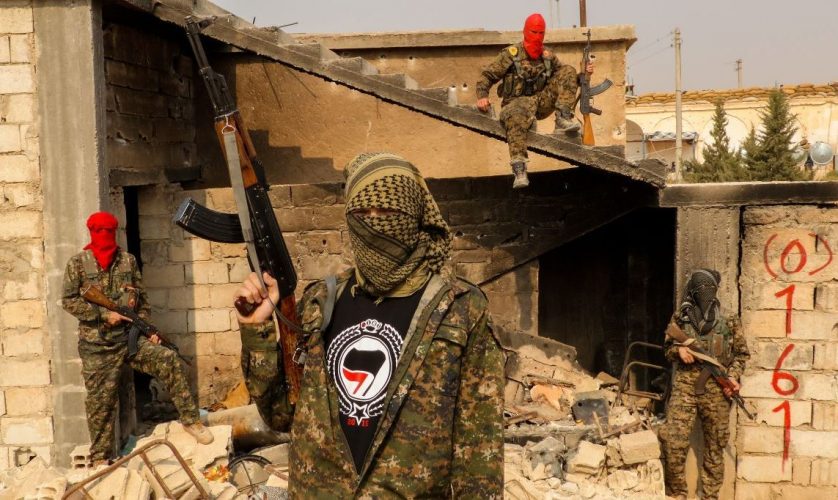
US weapons worth some $715 million dollars were warehoused poorly and soldiers handling them did not keep receipts or records, so it’s impossible to tell how many, if any, ended up in wrong hands, the Pentagon says.
Supply units in Kuwait and elsewhere “did not maintain comprehensive lists of all equipment purchased and received” or “stored weapons outside in metal shipping containers, exposing the equipment to harsh environmental elements, such as heat and humidity.”
This is according to the partially redacted report by the Department of Defense’s inspector general (IG), of an audit into the “Counter Islamic State of Iraq and Syria Train and Equip Fund” (CTEF), dated February 13 and published this week.
That is not to say that $715 million worth of US weapons, intended for the Iraqi military and “Vetted Syrian Opposition” – as the euphemism for US-allied militia goes – has gone missing, as some reports may have suggested. In Pentagon-speak, there was “a lack of a central repository for accountability documentation.” Once you cut through the obtuse verbiage, the IG report basically says there’s no way of figuring any of that out, because the troops charged with running the program did not maintain records or receipts.
The audit was commissioned because the DOD has requested $173.2 million for weapons, ammunition, vehicles, and other CTEF-S equipment for the current fiscal year, which began in October. Without accurate records, the Pentagon risks buying stuff it doesn’t need and “further overcrowding” the warehouses in Kuwait, which is what caused the pricey hardware to be stored outside in the first place.
Even though the Trump administration declared Islamic State (IS, formerly ISIS) defeated back in March 2019, ensuring the “enduring defeat” of the terrorists apparently requires that the weapons and equipment must flow. While the US taxpayers don’t have a choice in footing the bill, expecting them to swallow the explanation – that their noble men and women in uniform are just too stupid, lazy or incompetent to keep a ledger – sounds a bit rich.
Washington has a notoriously spotty record of pouring weapons into Syria and Iraq. At one point in 2015, the Pentagon admitted the failure of its program to train and equip “Vetted Syrian Opposition” (also known as “moderate rebels”). Having spent $2 million per fighter, the US saw them defect to the Al-Qaeda affiliate group Al-Nusra, bringing the US-supplied weapons and kit along.
So the Pentagon doubled down in 2016, spending untold millions to train “dozens” of rebels in Turkey. It is unclear how many of those “moderates” took part in last year’s assault on areas held by US-allied Kurdish militias.
As late as September 2016, Al-Nusra commanders openly talked about getting US weapons, both “directly” and via third countries, such as Saudi Arabia. The Syrian government has since dealt the militants one defeat after another, and currently advances on their last remaining strongholds in the Idlib province.
While the US government and media have objected to these operations – and NATO member Turkey actually sent troops and tanks to Idlib in an attempt to halt them – a spokesman for the anti-IS coalition has just openly admitted Idlib is a nest of terrorists.
UK ran propaganda campaigns in Syria as cover for spying and potential military operations

The British military has several specialised propaganda and information warfare units, the largest of which is the Berkshire-based 77th Brigade
Press TV – February 19, 2020
The extent of the British government’s involvement in sophisticated propaganda campaigns in Syria appears to have been under-estimated.
In an exclusive report, the London-based Middle East Eye (MEE – a news and analysis outlet), has revealed that the UK covertly funded so-called “citizen journalists” inside Syria, often without the knowledge of the individuals affected, thus placing them in harm’s way.
The so-called citizen journalists who had been duped by British government officials were tasked to produce TV footage, radio programmes, social media, posters, magazines and in some cases even children’s comics.
FCO/MoD venture
The project was jointly masterminded by the Foreign and Commonwealth Office (FCO) and the Ministry of Defence (MoD), who used an anthropologist (with a counter-terrorism background) to supervise the operation.
The British military is known to make extensive use of anthropologists to supervise so-called “cultural” projects, which are in most cases barely concealed intelligence operations.
In that context, it is not altogether surprising that front companies run by former British military intelligence officers competed to win lucrative FCO-MoD contracts.
MEE reveals that “nine” companies bid for the contracts, most of which were run by former British “diplomats, intelligence officers and army officers”.
The division of labour between the FCO and the MoD appears to have been fairly simple: the FCO awarded the contracts whilst the MOD managed them, sometimes using serving (as opposed to former) military intelligence officers.
Turkish connection
The successful companies established offices in Istanbul and Reyhanli (Turkey) and Amman (Jordan), and set about employing local Syrians who in turn recruited Syrians inside Syria to act as “citizen journalists”, or more accurately propagandists, and in some cases spies.
People involved in the clandestine British-led operations have described it as a “shady shady business” and an extensive effort to “pump out propaganda, inside Syria and outside”.
For their part, British officials were understandably anxious to keep the operation a secret, forbidding managers and implementers to “speak publicly (to the media or at academic conferences) about their work without the explicit permission of HMG [Her Majesty’s Government]”.
MEE claims that two Syrian “citizen journalists” captured and murdered by militant groups on the suspicion of spying were connected to the British-led information manipulation operation.
In terms of funding, at the peak of the operation in 2015, the project was in receipt of £410,000 per month.
The operations were wound down once it became clear that the Syrian government – and its Iranian and Russian allies – were prevailing in the country’s complex proxy wars.
The real agenda
But chillingly, documents uncovered by MEE appear to indicate that the British government was using the propaganda operations to establish a foothold in Syria in anticipation of a military intervention involving British forces.
According to the core document (laying out the blueprint of the project), the operations should have “the capability to expand back into the strategic as and when the opportunity arises, to help build an effective opposition political-military interface.”
Those familiar with the British military’s idiosyncratic language would readily understand those words to mean that the UK was expecting to deploy a significant military force inside Syria with a view to shaping the country’s political future.
 A failed project
This latest revelation comes in the wake of the suspicious death of the White Helmets founder, James Le Mesurier, in Istanbul last November.
Le Mesurier was a former British military intelligence officer who is alleged to have also acted as an MI6 agent.
The failure of the joint FCO-MoD propaganda project, in addition to the death of Le Mesurier (who is alleged to have been murdered to protect secrets), point to the collapse of Britain’s Syria policy, which for years banked on the flawed assumption that the Syrian government would fall.
Everything You Wanted to Know About Pete Buttigieg, But Were Too Afraid to Ask
By Robert Bridge | Strategic Culture Foundation | February 19, 2020
Rhodes Scholar. Afghan vet. Mayor. An impressive resume, to be sure, but to have made the fantastic leap from local politics to the doorstep of the Oval Office – at the age of just 38 – seems altogether impossible without some serious behind-the-scenes connections.
Let’s just cut right to the chase with a couple questions that the media has glaringly failed to consider about the top-polling Democratic presidential candidate. First, the most obvious one. How on earth does a young Midwestern mayor, regardless of his polished resume, jump to the front of the serving line, past hundreds of veteran politicians who have quietly nurtured presidential ambitions inside of the Beltway their entire lives?
As The Economist emphatically stated this week, “Mr Buttigieg is ridiculously young to be doing so well.”
Second, if the mayor of South Bend, Indiana (pop. 101,166) is now in serious contention to challenge Donald Trump in November, what exactly does that say about the depth of the Democratic bench, loaded as it is with Senators, House members, Governors and various state officials with far more political experience and acumen?
While the Oval Office has seen its share of pretenders, and even actors, the great majority of those men who made it to the pinnacle of power have spent at least some time in high political office before contemplating a presidential run. Incidentally, it is on this particular point, political experience, which could make a Trump-Buttigieg debate a very interesting spectacle. Although Buttigieg has limited political experience, Trump had none before he entered the White House, although certainly proving his abilities once in office.
For Pete’s sake!
Born on January 19, 1982, Buttigieg graduated valedictorian from St. Joseph High School in 2000. That same year he won a JFK ‘Profiles in Courage’ essay contest on the subject of none other than Bernie Sanders, the democratic socialist the incredibly rising mayor is competing against for the November nod. “Above all, I commend Bernie Sanders for giving me an answer to those who say American young people see politics as a cesspool of corruption, beyond redemption,” Buttigieg wrote. His trip to Washington D.C. to collect his prize included a meeting with members of the Kennedy clan, an honor that must have left a deep impression on the 18 year old.
Upon graduation from Harvard University, Buttigieg did a stint (2007-2010) at the Chicago office of McKinsey & Co, the discreet U.S. management consulting firm. During his time there, the young upstart took a trip to perhaps the most unlikely destinations in the world, Somaliland, a self-proclaimed independent state in Africa that is struggling for international recognition to this day. In other words, not a trip to Disneyland.
Just before embarking on his African adventure (Summer of 2008), Buttigieg was taken on as a fellow with the Truman National Security Project, a neoliberal think tank that has been described as “a powerful and exclusive club for the best and brightest young progressives in the country.” Among its esteemed alumni is none other than Madeleine Albright, chief architect of NATO’s obliteration of Yugoslavia. Meanwhile, the founder of the Truman Project, Rachel Kleinfeld, deserves some consideration.
Upon graduating from Oxford, Kleinfeld took up employment with Booz Allen Hamilton, the private contractor that carried out a long list of services for the military. It has also been described as “the world’s most profitable spy organization.” The head of the company at the time was none other than James Woolsey, the neoconservative former CIA director who has advocated for a fiercely interventionist U.S. foreign policy, notably the 2003 invasion of Iraq.
Back to Somaliland. In addition to Buttigieg’s affiliation with the Truman Center, where he now sits on the advisory board, his Somalian ‘vacation’ managed to garner special attention in The New York Times, suggesting this was much more than your ordinary getaway.
“Somaliland is pursuing investment and support from China and Gulf countries,” Buttigieg wrote in the Times piece, co-authored by Nathaniel Myers, who also went along for the joyride. “Such support might be enough to ensure Somaliland’s survival and eventual growth, but it will crowd out America’s chance to win the gratitude of a potentially valuable ally in a very troubled area.”
Possibly more than just incidentally, Myers, a Harvard buddy of Buttigieg, now serves as Senior Transition Advisor at USAID – Office of Transition Initiatives (OTI), which works to destabilize governments deemed unfavorable to U.S. interests.
Just over a year later, in September 2009, Buttigieg, and despite his participation in anti-war rallies while at Harvard, signed up for the U.S. Navy Reserve. Due to his particular “pedigree,” writes Stars and Stripes magazine, he was sworn in as an ensign in naval intelligence without any prior preparation, which is not the traditional route for enlistees. In 2014, he was deployed to Afghanistan, which required Buttigieg to take a seven-month leave of absence from his mayoral duties in South Bend. Here is where the political upstart’s career begins to look a little sketchy.
According to The Grayzone, Buttigieg “spent his six months in Afghanistan in 2014 with a little-known unit that operated under the watch of the Drug Enforcement Administration. It was the Afghanistan Threat Finance Cell (ATFC), according to his appointment papers.”
What exactly did Special Officer Pete Buttigieg do in this unit, which was founded by none other than the future CIA chief General David Patreaus, who at the time was the head of U.S. Central Command? Well, that’s hard to say because the job description that appears in his discharge papers is left conveniently blank. This, and the fact that the ATFC has direct links to U.S. intelligence has fueled rumors with regards to who or what was responsible for placing the mayor of South Bend, Indiana on the political fast lane.
But those sorts of connections alone cannot explain Buttigieg’s meteoric rise in Washington, D.C., especially when the young upstart spent the majority of his time in South Bend. No, Pete Buttigieg would require boatloads of cash to earn such fame in such a short time. And as it turns out, the money has been pouring into his coffers from some of the wealthiest families in the country.
Buttigieg attracts the bucks
According to federal election data, forty billionaires and their spouses have donated to Pete Buttigieg’s presidential campaign, putting his campaign war chest at around $52 million, the most collected among all the Democratic candidates. An analysis of the contributions shows that the majority of the billionaire donators came from the financial, media and technology sectors.
Of particular interest, however, is how much the tech titans of Silicon Valley have lavished the democratic frontrunner with attention as well as infusions of hard cash. In December, for example, Rex Reed, co-founder of Netflix, helped organize a fundraising dinner at a wine cellar in Palo Alto, California, which gave Buttigieg’s Democratic opponents a golden opportunity to expose his billionaire connections.
“Billionaires in wine caves should not pick the next president of the United States,” Elizabeth Warren told Buttigieg in a December debate.
Buttigieg responded that he was “literally the only person on this stage who is not a millionaire or a billionaire,” and that therefore Warren had failed the “purity test.”
It’s not just billionaires, however, who are cracking open their wallets for the Indiana native. The list includes more than 200 foreign policy and intelligence officials, including Anthony Lake, national security adviser for President Clinton, former National Security Council spokesman Ned Price, and former deputy CIA director David Cohen, among many others. Although such support from the foreign policy and intelligence community doesn’t prove cause and effect, it has helped spawn a number of online conspiracy theories that Buttigieg is something of a Manchurian candidate, propped up by a deep state desperate to beat the swamp drainer Donald J. Trump.
Those ideas were brought to a boil during the Iowa caucus when the aptly named app Shadow, designed to perform the simple task of reporting the polling results in a timely and efficient manner, fizzled out just as Bernie Sanders had taken a commanding lead over Buttigieg. Would it come as any surprise that Shadow Inc. has a very shadowy history?
“Shadow Inc. was picked in secret by the Iowa Democratic Party after its leaders consulted with the Democratic National Committee on vetting vendors and security protocols for developing a phone app used to gather and tabulate the caucus results,” AP reported. “Shadow Inc. was launched by ACRONYM, a nonprofit corporation founded in 2017 by Tara McGowan, a political strategist who runs companies aimed at promoting Democratic candidates and priorities.”
McGowan is married to none other than Michael Halle, a senior strategist for Pete Buttigieg’s presidential campaign, which records show has also paid Shadow Inc. $42,500 for the use of software.
And people wonder why there are so many ‘conspiracy theorists’ running around these days.
In any case, the glitch led to many days of debate as to who really won the Midwestern state, a debate that continues today. Yet despite that state of mass confusion, Buttigieg didn’t miss an opportunity to seize victory from the claws of (possible) defeat, announcing just hours after the technological breakdown that he had been “victorious” in Iowa. Meanwhile, Sanders’ supporters saw it as yet another brazen move by the DNC to sideline the democratic socialist.
So how does one explain the incredible string of political success for the young star of the Democratic Party? Is he really so politically talented and smart that there was no choice but to let him move to the front of the pack? That seems hard to believe since his speeches come off as hollow and scripted, a rhetorical trick that many politicians with far more experience have perfected. And how about all those billionaires, former state officials and people from the national security apparatus who have come forward to support him? A case of billionaire grassroots democracy in action, or just more good luck for the South Bend native?
As it stands, Pete Buttigieg remains a great mystery, a proverbial dark horse on the U.S. political scene. While there can be no question that he has a long future in American politics, it is too early to tell if that will be a good thing for the American people. There is still a lot of unpacking to do on the life and times of the former mayor of South Bend, Indiana.
Leaked Docs Point to No Buk Missile Systems Around MH17 Crash Area, Dutch Journo Reveals
Sputnik – February 18, 2020
Leaked papers pertaining to the finalised JIT investigation that the source has bona fide reason to believe are authentic do not corroborate the study’s findings. They cite witness testimonies as well as a number of discrepancies in the probe that suggest the Boeing was downed by an air-to-air missile, rather than a surface-to-air rocket.
According to new data from unpublished MH17 Joint Investigation Team documents obtained and analysed by Bonanza Media investigative journalist Max van der Werff, there were no Buk missile systems in the vicinity of where the Malaysian Airlines Boeing crashed in eastern Ukraine on 17 July 2014.
The journalist concludes, citing a letter from Dutch Military Intelligence, that it “becomes apparent that flight MH17 was flying beyond the range of all identified and operational Ukrainian and Russian locations where 9K37M1 Buk M1 systems were deployed.”
The letter, dated 21 September 2016, which is exactly one week before JIT held a press-conference on 28 September, proves the Dutch team obtained evidence that no Russian Buk system had crossed into Ukraine from Russia only days before the presser, der Werff wrote.
Fighter Jets ‘Audible’
Another leak studied by the journalist is the text of an interview conducted by a Dutch police officer on 28 July 2015 with a male witness from Ukraine, as well as the man’s in-depth email where he described the timeline of events.
He reportedly recalled two fighter jets in the sky circling over the town a few minutes before the Boeing 777 went down following a loud bang over his head and a horizontal white trail penetrating the sky.
“Two airplanes were audible, not the big one, the Boeing, but fighter jets were audible since these were constantly flying overhead, the noise had already become familiar”, he is quoted by der Werff as saying.
According to the resident of the Torez suburbs, roughly 20 kilometres from Hrabove, where the Boeing crashed, no missiles were fired from the ground in the immediate vicinity.
Separately, he assumed the earlier circulated photos of the incident contain inconsistencies.
“This photograph that served as evidence of the missile is erroneous, since the photograph showed different weather conditions”, the man explained, adding:
“Because at that time the sky was rather heavily overcast. The position of the Sun in that photograph is unlike the Sun you see at 17:00 hrs”.
Image Metadata Altered?
Then there is another leak suggesting that roughly a year after the crash, between 22 April 2015 and 2 July 2015, imagery specialist Shaun Ellis and geospatial analyst Tim Johns from Australia were still examining the circulated non-primary images dated around the time of the crash and first published by Paris Match.
As part of the so-dubbed Operation AVENELLA, they reportedly concluded that the metadata from these files “appears to have been manipulated. For example, the date modified is prior to the date the file was created”, something that the pros believe is not accidental.
Three of the four analysed images were found to have been antedated: so that the day of creation fell after, not before the modification date.
“Various reasons could explain why this is so, none can be proved without additional information”, Max van der Werff concludes, adding separately that the image dimensions vary, suggesting the images could have been cropped, or intentionally resaved in a smaller format.
More Witness Data
The last but not least leak is a “Record Of Interview” (ROI) between an officer from the Australian Federal Police and German journalist Billy Six. In the shorthand report, Six talks among other things, about those witnesses that saw Ukrainian fighter jets in the sky on the day of the MH17’s demise. Max van der Werff asserted he knows his colleague Six personally.
“The latter confirmed to me he was interviewed a day before the Dutch Safety Board held a press conference on 13 October 2015″, der Werff wrote noting this information matches the transcript mentioning 12 October 2015 as the date of the ROI. The journalist said this is “a strong indication that the batch of JIT documents leaked to us is authentic”. He, however, refused to specify the source who had provided him with the JIT documents.
Dutch-Led Five-Year MH17 Probe
Malaysian Airlines Flight MH17 was en route from Amsterdam to Kuala Lumpur when it was downed over eastern Ukraine on 17 July 2014 as the region was mired in a conflict with the new Ukrainian government set up after a coup in Kiev earlier that year. As a result, all 298 passengers – largely Dutch – and crew on board were killed in the crash.
Kiev and the self-proclaimed republics in the east of the country blamed each other for the downing, with the republics contending that the military equipment they had at their disposal would not allow them to shoot down an aircraft at that altitude. The US and a number of European nations blamed the incident on Russia, a claim that was made even before an official investigation was launched, with the West repeatedly citing Russia being at odds with Ukraine over Crimea and Donbass.
A Joint Investigative Team (JIT) consisting of Australia, Belgium, Malaysia, the Netherlands, and Ukraine was set up to probe the MH17 case, but Russia was left out of the process despite the latter’s offers of assistance and readiness to help investigate the incident.
The JIT probe concluded last year that the aircraft was downed by a Buk missile, purportedly launched from a Russian anti-aircraft missile brigade stationed in the city of Kursk, not far from the Ukrainian border.
However, no concrete evidence has hitherto been provided as proof, with the Russian side dissatisfied by the Netherlands’ unwillingness to make use of Russia’s domestic investigation results.
Three Russian nationals were charged with murder – Igor Girkin, Sergei Dubinsky, and Oleg Pulato. One Ukrainian, Leonid Kharchenko has also been charged, with a trial scheduled for 9 March.
Israeli court orders Facebook to unblock account of NSO Group employee
MEMO | February 18, 2020
A Tel Aviv court ordered Facebook Inc to unblock the private account of a worker at Israeli surveillance company NSO Group, and similar rulings are expected for other employees in the coming days, an NSO spokeswoman said on Tuesday.
A group of NSO employees filed suit against Facebook in November, saying the social media giant had unfairly blocked their private accounts when it sued NSO in October.
Facebook-owned messaging service WhatsApp accused the Israeli firm of helping government spies break into the phones of about 1,400 users in a hacking spree targeting diplomats, political dissidents, journalists and senior government officials across the globe.
The NSO employees said their Facebook and Instagram accounts, and also those of former workers and family members, had been blocked.
Ruling on their complaint, Tel Aviv District Court ordered the account of one employee to be restored by Wednesday afternoon.
“We are certain that following the court’s unequivocal statements, Facebook will reverse the action it took against other employees,” the NSO spokeswoman said.
Facebook officials could not immediately comment.
The company said in November it had disabled “relevant accounts” after attributing a “sophisticated cyber attack” to the NSO Group and its employees, saying the measure was necessary for security reasons.
Read also:
UK to help controversial Israel spyware firm to sell product
Antarctica’s ‘Hottest Day’? Not So Fast
By Michael Pile | Quadrant | February 18, 2020
Have you ever wondered how to play the Climate Game, or game the climate? If so, look no further than a remote research station on the northern tip of the Antarctic Peninsula, a submarine-shaped office tower on Geneva’s Avenue de la Paix and an international media pack determined to ramp a single yet-to-be-confirmed measurement into another bogus climate scare.
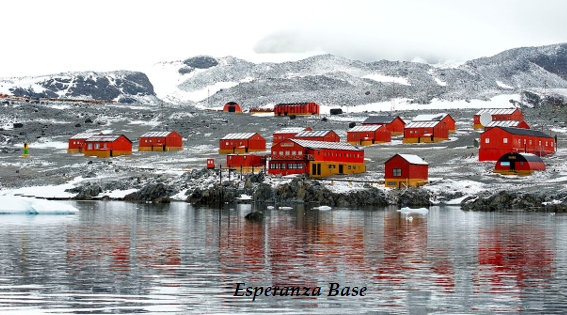
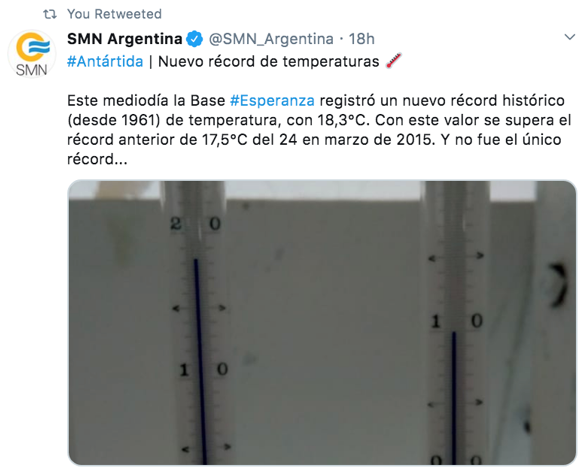
The research station is the Argentine base, Esperanza, coordinates: 63°23′51″S 56°59′52″W. It claimed to have set a new record temperature of 18.3°C on February 6 this year, beating the previous record of 17.5°C on March 24, 2015, according to a tweet (below) from Servicio Meteorológico Nacional (SMN), Argentina’s national meteorological service.
It was déjà vu all over again for the alarmist MSM.
BBC – Scientists warn that global warming is causing so much melting at the South Pole, it will eventually disintegrate – causing the global sea level to rise by at least three metres (10ft) over centuries.
NY Times – Antarctica, the coldest, windiest and driest continent on Earth, set a record high temperature on Thursday, underscoring global warming”. It went on to claim: “the high temperature is in keeping with the earth’s overall warming trend, which is in large part caused by emissions of greenhouse gases.
The Guardian – Antarctica is “one of the fastest warming places on earth, heating by almost 3°C [5.4°F] over the past 50 years”
The Guardian makes that claim despite recent research suggesting a cooling trend since the year 2000, contradicting the carbon dioxide-driven global warming scare. (Media’s horribly dishonest Antarctica warming propaganda, WUWT, February 9, 2020) Five years earlier, on April 1, 2015, it reported on the previous record under the headline: “Antarctica records unprecedented high temperatures – two temperature readings register ominous new potential measurements of accelerating climate change.” “What was incontestable,” the paper’s journalist concluded, “were the unprecedentedly high temperature readings on the Antarctic ice mass.”
Jack Weatherall: Warmists are feeling a polar chill
Yet mean monthly temperatures at Esperanza range from −10.5 °C (13.1 °F) in July, the coldest month, to 1.4 °C (34.5 °F) in January, the warmest month. During summer (December–February), the average high is between 3.7 and 4.3 °C (38.7 and 39.7 °F) while the average low is between −2.0 and −1.2 °C (28.4 and 29.8 °F). In winter, mean temperatures are around −6.0 °C (21.2 °F). So what is going on here?
ClimateChangeDispatch.com’s Thomas Richard ridiculed the Pavlovian alarmism:
To put this in perspective, it would be the equivalent of taking a temperature measurement in Reykjavík, Iceland, and proclaiming that this measurement is indicative of the temperature of the Arctic region, or worse, Tasiilaq (Ammassalik), Greenland. It’s a ridiculous statement and utterly useless. It is well known that West Antarctica is heavily influenced by underground volcanic activity, and hidden beneath its icy exterior is a myriad of active rift systems.
The glass, steel and aluminium tower adjacent Geneva’s Jardin Botaniques is the global headquarters of the World Meteorological Organisation (WMO) According to a local travel agency, Geneva Live Tourism, the building is “respectful of the environment,” and its “grandiose allure with the double façade seeming to dominate the surrounding space”. WMO is the beating heart of Big Climate. It is the UN’s “expert agency and voice regarding the state and behaviour of the Earth’s atmosphere, its interaction with the oceans, its climate and the resulting distribution of water resources.” WMO issued a media release on the Esperanza result on February 7. It was a qualified announcement – New record for Antarctic continent reported – for the “likely legitimate record” was subject to formal verification.
A committee for WMO’s World Weather and Climate Extremes Archive (WWCEA) will now verify whether this indeed is a new record for the Antarctic continent, which is defined as the main continental landmass.
Dr Randall Cerveny, a professor of geographical sciences at Arizona State University, has been the WWCEA rapporteur – or gatekeeper – since its formation 14 years ago. “Everything we have seen thus far indicates a likely legitimate record but we will of course begin a formal evaluation of the record once we have full data from SMN and on the meteorological conditions surrounding the event.” Crucially, he also made this comment:
the record appears to be likely associated (in the short term) with what we call a regional “foehn” event over the area: a rapid warming of air coming down a slope/mountain.
What is a foehn event? According to WUWT blogger Jim Steele,
… foehn events cause rapid extreme temperature jumps simply due to changes in the air pressure as winds descend from a mountain top. During the 2015 foehn event, Esperanza’s daily temperature jumped from 0°C [32°F] 2 days before, to a record setting 17.5°C [63.5°F]. Elsewhere, Antarctic foehn winds are common and have been extensively studied, often raising maximum temperatures by 10+°C [18+°F] above normal.
In other words, it was just local weather, not a consequence of so-called dangerous anthropogenic global warming, aka “climate change”. “Verification was important”, Cerveny said. “It helps to build up a picture of the weather and climate in one of Earth’s final frontiers.”
The WMO media release noted that: “the Antarctic, like the Arctic, is poorly covered in terms of weather observations and forecasts, even though both play an important role in driving climate and ocean patterns and in sea level rise.”
Despite a lack of data, WMO could not resist the opportunity to trumpet a warming warning. Included in the release were ominous comments on the Pine Island and Thwaites glaciers. The latter, allegedly, is “one of the largest contributors to global sea level rise from the West Antarctic Ice Sheet”. There was no mention of its precise “contribution”. That, dear reader, is another story, one about why the BBC failed to mention the many active volcanoes underneath this region, yet found space to jest about “snotsicles”. Spending £38 million of US/UK government funding to “prove” we are in a “climate emergency” has never been such fun.
Scientists fear the Thwaites Glacier could be beginning a process of catastrophic collapse. There is more than three metres of potential sea level rise in the ice of West Antarctica, enough to swamp many of the great cities of the world and drive hundreds of millions of people from their homes.
In any case, speculating about the threat of global sea-level rise, despite the region’s prevailing temperature profiles, is surely a fool’s game.
The Antarctic Peninsula (the northwest tip near to South America) is among the fastest warming regions of the planet, almost 3°C over the last 50 years. The amount of ice lost annually from the Antarctic ice sheet increased at least six-fold between 1979 and 2017. Most of the ice loss takes place by melting of the ice shelves from below, due to incursions of relatively warm ocean water, especially in west Antarctica and to a lesser extent along the peninsula and in east Antarctica.
We will need more than the IPCC’s brave 2C warming guesstimate to melt the massive southern polar ice block.
Spanning 14 million km2 (roughly twice the size of Australia), the Antarctic’s average annual temperature ranges from about −10°C on the Antarctic coast to −60°C at the highest parts of the interior. Its immense ice sheet is up to 4.8km thick and contains 90% of the world’s fresh water, enough to raise sea level by around 60 metres were it all to melt.
There is another important issue here too: geographical semantics. The WMO release conflates the Antarctic Peninsula with the continental Antarctic ice sheet. Little surprise, then, most of the MSM missed the fact that the Antarctic Peninsula is not the Antarctic continent or “region”. The former refers to the narrow northwest tip nearest to South America. As for the latter, the WMO – controversially – defines it as “everywhere south of 60 degrees latitude”. (See Antarctica map)
The Esperanza base is actually outside the Antarctic Circle, which runs 66°33′48.0″ south of the Equator. It is misleading – some might say mischievous – to imply that “record” temperature measurements on the Antarctic Peninsula – less than 5 per cent of the continent and especially those taken on islands at its northern extremity, are meaningful for Antarctica itself, as the WMO does here by including this sentence in its February 7 media release: “The record for the Antarctic region – that is, everywhere south of 60 degrees latitude – is 19.8C, taken on Signy Island in January 1982.”
The British Antarctic Survey (BAS) Signy Research Station at Factory Cove, Borge Bay, Signy Island, is also outside the Antarctic Circle. Located at Lat. 60°43’0″S, Long. 45°36’0″W in the South Orkney Islands group, it is 1300 km from the Falkland Islands, 900 km from South Georgia, 600 km from the Antarctic Peninsula, and 3250 km from the South Pole. According to the BAS website, meteorological records at this summer-only site “were kept by professional meteorologists from 1947 to 1969 and by station volunteers from 1969 to 1995.” How much confidence can we have, then, in the 19.8C reading of January 30, 1982 — a record maximum for any station south of 60°S — especially when the month is prone to significant variation, including “sudden falls in temperature”, down to -7°C?
Whatever the case, a recent detailed analysis of meteorological conditions prevailing at the time – prompted by Dr Cerveny and the WMO Committee on Antarctic Temperature Extremes — confirms that it, too, was due to foehn (or fohn) warming:
At the time of the record temperature exceptionally warm air was being advected southwards towards the South Orkney Islands from the subtropical South Atlantic…. Since conditions conducive to föhn occur relatively frequently, föhn warming may have a significant influence on the local climate and ecology of Signy Island.
As mentioned, WMO’s WWCEA committee rightly is not prepared to declare a new record for Esperanza without further investigation, at this stage referring only to a potential new Antarctic (continent) high temperature:
The Argentine research base, Esperanza, on the northern tip of the Antarctic Peninsula, set a new record temperature of 18.3°C on 6 February 2020, potentially beating the former record of 17.5°C on 24 March 2015.
WWCEAC would “now verify whether this indeed is a new record for the Antarctic continent, which is defined as the main continental landmass.” It has not done so yet, so we await the rapporteur’s “decision and relevant documentation” to be posted on this site (here).
Dr. Cerveny, incidentally, proposed creating WMO’s global archive for verifying, certifying and storing world weather extremes in 2006. As Rapporteur he has called an “ad hoc extremes committee” to “provide an expert and unbiased recommendation” on whether the new extreme qualifies for the archive. This process is easier said than done, for if “the truth be told, world record extremes are mistakenly created all the time.”
For example a “fat finger” error such as hand digitizing a 28.0°C as 82.0 would create a world record observation that every quality control system would say was invalid. Additionally, instrumentation problems can generate a report far in excess of the meteorological conditions. But sometimes a combination of fairly extreme meteorological conditions with minor instrumentation problems, such as calibration errors, can necessitate considerable detective work to determine whether a new world record observation was indeed valid or not. Since weather records are often used as indicators that the Earth’s climate is changing and/or becoming more extreme, confirmation of new weather extreme records should be recognized as a high priority in the meteorology community.
An alert blogger, Nicholas McGinley, made the following post at WUWT :
I am having a hard time verifying this report from Esperanza station.
The thermometer data from the last five days did not show anything close to what is being reported, when I looked earlier this evening. But now I checked again, and the numbers have changed completely. Here is a Tweet I posted with the two graphs side by side:It has become nearly impossible to trust anything these days.
Besides for all of that … when a short term blip is announced as if it is a representation of the entire state of the planet, while in Alaska a two month trend of temps is showing the coldest period ever recorded in that entire state, something is not at all right.
Dr Cerveny and WMO’s WWCEA committee presumably will sort it all out soon. After all, it did so when a Czech Republic automatic weather station on Davies Dome in the northern part of Ulu Peninsula, James Ross Island, recorded a temperature of 17.9°C (64.2°F) on 23 March 2015, “a day before the current WMO accepted record of 17.5°C (63.5°F) was observed at Esperanza Base (Argentina) in the same general location in the Antarctic Region”.
The committee adjusted the Davies Dome observation down to 17.0°C ± 0.2°C (62.6°F ± 0.4°F) and declared it to be “the second-highest temperature recorded in the Antarctic Region (continent only).”
The recommendation follows a detailed discussion by the committee of the probability that the station experienced solar radiation bias on the temperature-recording instrument at the time of the record observation. In simple terms, the committee suggested that the temperature sensor at Davies Dome was heated to around 0.9°C (1.6°F) above the true air temperature by a combination of high solar radiation (coming both directly from the sun and also reflected from the underlying ice surface) and low wind speed.
Establishing a “true air temperature” in Antarctica, however the continent is defined, clearly can be a challenge. If one automatic weather station reading can be reduced (“adjusted downwards”) after a “detailed discussion” due to the probability of “solar radiation bias”, then what is the reliability of other station readings?
One item that ought to be on the committee’s agenda is a ten-minute video uploaded on February 9, 2020: Climate Alarmists fleeing to Antarctica. As author Tony Heller demonstrates, with winter and the (temporary) collapse of Arctic melting hysteria, climate alarmists have flown south to the other pole. Let’s hope none of them ended up at Esperanza Base and the Thwaites Glacier.
Repeat of Iowa caucus looms in Nevada as problems are illuminated (& ignored)
By Helen Buyniski | RT | February 17, 2020
The same issues that led to the Democratic debacle in Iowa earlier this month are poised to make next week’s vote in Nevada equally hellish – yet party leaders seem unwilling to connect the dots or recognize the problem.
Early voters in Nevada have already faced long lines, technical difficulties, and monumental uncertainty about the voting process with voting underway since Saturday due to close Tuesday before the general caucus this coming Saturday.
We’ve seen this movie before
The slow-motion car-crash caucus volunteers have sketched out in their heads bears a strong resemblance to the events of Iowa. They’re willing to discuss it in interviews with the media, but always anonymously, for fear of angering what is apparently a vengeful party. But the Democratic National Committee chair Tom Perez and his state-level minions insist all is well.
The off-the-shelf Google forms that were quickly substituted for the buggy app that killed the Iowa caucus have already malfunctioned at some early voting sites, leaving some Nevadans waiting for three or four hours trying to vote. Meanwhile, no one seems to be on the same page regarding how the results from 80 early voting sites will be distributed among the 2,000 precincts where caucuses are to be held. Local politician Dan Rolle discovered the paper ballots used for early voting lacked precinct numbers, seemingly guaranteeing the party would be unable to count those votes and distribute them to the proper precinct by Saturday.
Some volunteers have reportedly received no training in using their DNC-purchased iPads, which they are supposed to use to scan the paper ballots marked up by early voters. A web-based Google app that has been dubbed the “Caucus Calculator” is supposed to divvy these up and send them around to the precincts for caucus day – wrinkles pointed out by Rolle notwithstanding. Caucus site leader Seth Morrison warned that volunteers were using an “untested software tool,” advising CNN viewers in Nevada to vote early because the volunteers had “never seen or handled” the tool being prepared for Saturday’s caucus. Perez seemed more concerned that a CNN reporter had called the “online tool” an “app” than he was to learn that volunteers didn’t know how to use it. At the same time, Rolle observed that the tool wasn’t being used at all.
One presidential aide suggested to the Washington Post that Nevada Democrats were “making it up as they go along” in their belated rush to conjure up a technological solution to replace the Shadow app. As an added wrinkle, Nevada was supposed to use two versions of the app, which was notoriously built by former Hillary Clinton staffers with money from the Pete Buttigieg campaign – one to tabulate the early votes, and another for the caucus.
Keeping everyone in the loop regarding replacement processes has proved difficult, with multiple campaigns’ aides complaining that notice of a critical conference call nearly passed them by. One aide was unable to join in at all because he was in the middle of a training session. Another update on process reportedly made it to journalists before the party distributed it to all the campaigns.
‘Trust us, we’re experts’
The party has reportedly brought in “security experts” to troubleshoot early voting issues, though this is hardly encouraging given the prevalence of DNC insiders among these so-called experts. The replacement process for the Shadow app was reportedly designed with input from the Department of Homeland Security, the DNC, and Google, and Nevada Democratic Party executive director Alana Mounce insisted the party was “confident in our backup plans and redundancies” in a memo to the campaigns on Thursday.
Nevada Democrats have done their best to squelch rumors that the contest is rigged, explaining that former Buttigieg staffer Emily Goldman, hired earlier this month as “voter protection director” for the party, will not have the ability to affect the caucus outcome. And the progressive watchdogs have moved on to Utah, where the state party chair has a history of virulently attacking Vermont senator Bernie Sanders.
Sanders leads the pack of Democratic contenders in Nevada, according to RealClearPolitics, with former vice president Joe Biden trailing by three points. Buttigieg, the beneficiary of the Iowa mess, lags behind even billionaire Tom Steyer. Sanders emerged the victor from the New Hampshire primary, though media coverage mystifyingly focused on the second-place finish of Buttigieg and Minnesota senator Amy Klobuchar – even talking up New York plutocrat Michael Bloomberg, who wasn’t on the ballot in that state, rather than discuss the democratic socialist’s triumph.
Bolivia: An election in the midst of an ongoing coup
By Vijay Prashad | Globetrotter | February 12, 2020
On May 3, 2020, the Bolivian people will go to the polls once more. They return there because President Evo Morales had been overthrown in a coup in November 2019. Morales had just won a presidential election in October for a term that would have begun in January 2020. Based on a preliminary investigation by the Organization of American States (OAS) that claimed that there was fraud in the election, Morales was prematurely removed from office; the term for his 2014 presidential election victory did not end until January. Yet, he was told by the military to leave office. An interim president—Jeanine Áñez—appointed herself. She said she was taking this office only on an interim basis and would not run for election when Bolivia held another election. She is a candidate for the May 3 election. (For more information on what is happening in Bolivia, see this overview from Tricontinental: Institute for Social Research.)
Meanwhile, Morales has been in exile in Argentina. His party—the Movement for Socialism (MAS)—has candidates for the presidency and the vice presidency, but their party cadres and followers are facing a difficult time making their case to the people. Their radio stations have been blocked, their leaders arrested or exiled (or sitting in foreign embassies waiting for asylum), their cadre beaten up and intimidated.
The United Nations secretary-general’s personal envoy Jean Arnault released a statement on February 3 that expressed caution about the elections. The situation in Bolivia, Arnault said, is “characterized by an exacerbated polarization and mixed feelings of hope, but also of uncertainty, restlessness and resentment after the serious political and social crisis of last year.” This careful language of the UN needs to be looked at closely. When Arnault says there is “exacerbated polarization,” he means that the situation is extremely tense. When he asks that the interim government “outlaw hate speech and direct or indirect incitement to violence or discrimination,” he means that the government and its far-right followers need to be very careful about what they say and how much violence they use in this election.
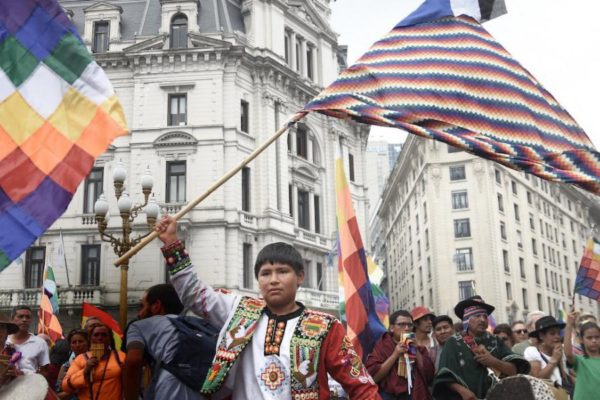
On February 6, Morales spoke in Buenos Aires, where he urged an end to the violence so that the election could bring the fractured country together. He called for a national agreement between all sides to end the dangerous situation. In a pointed way, Morales called upon the government to respect diversity, noting that people wearing distinct clothes and wearing the signs of a certain political party were facing intimidation and violence. He meant the indigenous population of Bolivia, and the supporters of MAS; it is widely accepted that the violence has been coming from the far right’s paramilitary shock troops, and the intimidation has been coming from the government.
For instance, the Bolivian authorities have been routinely charging MAS leaders with sedition, terrorism, and incitement to violence. Morales faced these charges, along with dozens of important MAS leaders, most recently Gustavo Torrico who has been arrested. Matters are so bad that the UN’s special rapporteur on the independence of judges and lawyers, Diego García-Sayán, took to Twitter to express his concern at the “use of judicial and fiscal institutions for the purpose of political persecution. The number of illegal detentions grows.” This has not stopped Áñez, who says she will move her government to investigate at least 592 people who held high office in Morales’ 14 years in government. This means that the entirety of the MAS leadership will likely face harassment between now and the May 3 election.
U.S. Interference
In 2013, Morales expelled the U.S. government agency USAID; he accused USAID of working to undermine his elected government. Before that, Morales, as is his constitutional right, informed Salvador Romero—the head of the election agency (TSE)—that when his term ended in 2008, he would not be retained. This is a normal practice.
Romero went to the U.S. Embassy to complain. He met with U.S. Ambassador Philip Goldberg to complain about this and urged the U.S. to do something. It was clear that Romero and Goldberg knew each other well. When Romero left his post at the TSE, the U.S. establishment took care of him. He went to work at the National Democratic Institute in Honduras. The National Democratic Institute, based in Washington, is loosely affiliated with the U.S. Democratic Party, and is part of the universe that includes the National Endowment for Democracy. These are all U.S. government-funded agencies that operate overseas to “oversee” what is known as “democracy promotion,” including elections.
Romero essentially worked for the U.S. government in Honduras during the first election after the U.S.-instigated coup of 2009. During this election in 2013, violence against the supporters of Xiomara Castro, the candidate of the left-wing Libre Party, was routine. The day before the election, for instance, two leaders of the National Center of Farmworkers (CNTC)—María Amparo Pineda Duarte and Julio Ramón Maradiaga—were killed as they returned home from a training for Libre election workers. This was the atmosphere of this very tight election, which returned to power the U.S.-backed conservative candidate Juan Orlando Hernández of the National Party. Romero, at that time, was quite pleased with the results. He told the New York Times then that “despite ‘the general perception of fraud,’” the election was just fine.
Right after the coup in November, Áñez brought Romero back to La Paz as the head of the election court, the TSE. He has his old job back. This would have made Bruce Williamson, the U.S. charge d’affaires to Bolivia, very happy. The U.S. has its man at the helm of the May 3 election in Bolivia.
And then Trump said he is sending USAID to Bolivia to help prepare the ground for the election. On January 9, the USAID team arrived to “give technical aid to the electoral process in Bolivia.” Technical aid. The phrase should give a reasonable person pause.
Ten days later, Trump’s legal adviser Mauricio Claver-Carone arrived in La Paz and gave a series of interviews in which he accused Morales of terrorism and creating instability. This was a direct attack at MAS and interference with Bolivia’s electoral process.
If the U.S. intervenes in Bolivia, that is just “democracy promotion.”
But even with the violence from the government and its fascistic paramilitaries, even with Romero at the helm of the TSE, even with USAID on the ground, and even with the shenanigans of Claver-Carone, MAS is fighting to win. The candidates for MAS are Luis Arce Catacora (president) and David Choquehuanca Céspedes (vice president). Catacora was the minister of economy and public finance under Morales and the architect of the administration’s economic success. Céspedes was the foreign minister in that government. He managed Bolivia’s policy of international sovereignty and is an important person to Bolivia’s indigenous and peasant movements. Early polls show that the MAS ticket is in first place.
Vijay Prashad is an Indian historian, editor and journalist. He is a writing fellow and chief correspondent at Globetrotter, a project of the Independent Media Institute. He is the chief editor of LeftWord Books and the director of Tricontinental: Institute for Social Research. He has written more than twenty books, including The Darker Nations: A People’s History of the Third World (The New Press, 2007), The Poorer Nations: A Possible History of the Global South (Verso, 2013), The Death of the Nation and the Future of the Arab Revolution (University of California Press, 2016) and Red Star Over the Third World (LeftWord, 2017). He writes regularly for Frontline, the Hindu, Newsclick, AlterNet and BirGün.
Don’t Let Trump’s Budget Proposal Be Used to Distract You From the Real Spenders
By Thomas L. Knapp | Garrison Center | February 15, 2020
As a political junkie, I get lots of email pleas from politicians and political advocacy groups. Today, I got one from US Representative Alexandria Ocasio-Cortez (D-NY). Well, not exactly. That’s what the “from” header said, but the message was signed “Team AOC” and delivered via Daily Kos.
What does Team AOC want me to know? That “Donald Trump is robbing the working and middle class to give huge tax breaks to the wealthiest among us.” His latest budget proposal, they say, “is a classic right-wing plan that would gut our most critical social programs.”
I probably dislike Trump’s budget proposal as much as Alexandria Ocasio-Cortez does, if not more, and if not for all the same reasons. It asks Congress for way too much, and way too much of what it asks for is corporate welfare for arms manufacturers in the guise of “defense.”
But Team AOC wants me to do more than dislike it. They want me to take it seriously, so that I donate money to help them “fight” it.
I don’t take it seriously. I dislike it in the same way I like a bad movie or a poorly written novel. It’s fiction, and not particularly entertaining fiction.
As Peter Suderman writes at Reason, “[t]he president’s annual budget proposal has about as much impact on the budget process as the lunch menu in the Rayburn House Office Building cafeteria, possibly less, given that one actually impacts the disposition of sitting members of Congress.”
For nearly a century, under the Budget and Accounting Act of 1921, the president has been required by law to submit an annual budget request.
And for nearly a century, Congress has felt free to ignore that budget request.
In theory, Trump can ask for anything and everything he might, in his wildest dreams, want.
As a practical matter, since the Democrats control the US House of Representatives, he gets whatever the Democratic Party decides to let him have.
Yes, he can veto what they offer. Yes, the two sides can dig in, triggering a “government shutdown” that’s more dramatic production than true crisis.
But when the smoke clears, the president gets not one thin dime to spend unless Congress appropriates it. That was true when big-spending Republicans controlled Congress during the Obama years, and it’s true now.
Don’t let Congress con you. They, not the president, are responsible for government spending, deficits, and debt.
Thomas L. Knapp (Twitter: @thomaslknapp) is director and senior news analyst at the William Lloyd Garrison Center for Libertarian Advocacy Journalism (thegarrisoncenter.org).
The Koch-Soros Quincy Project: A Train Wreck of Neocon and ‘Humanitarian’ Interventionists
By Daniel McAdams | Ron Paul Institute | February 15, 2020
Those hoping the non-interventionist cause would be given some real muscle if a couple of oligarchs who’ve made fortunes from global interventionism team up and pump millions into Washington think tanks will be sorely disappointed by the train wreck that is the Koch/Soros alliance.
The result thus far has not been a tectonic shift in favor of a new direction, with new faces and new ideas, but rather an opportunity for these same old Washington think tanks, now flush with even more money, to re-brand their pet interventionisms as “restraint.”
The flagship of this new alliance, the Quincy Institute for Responsible Statecraft, was sold as an earth-shattering breakthrough – an “odd couple” of “left-wing” Soros and “right-wing” Koch boldly tossing differences aside to join together and “end the endless wars.”
That organization is now up and running and it isn’t pretty.
To begin with, the whole premise is deeply flawed. George Soros is no “left-winger” and Koch is no “right-winger.” It’s false marketing, like the claim that drinking Diet Coke will make you skinny. Both are globalist oligarchs who continue to invest hundreds of millions of dollars to create the kind of world where the elites govern with no accountability except to themselves, and “the interagency,” rather than an elected President of the US, makes US foreign policy.
As libertarian intellectual Tom Woods once famously quipped, “No matter whom you vote for, you always wind up getting John McCain.” That is exactly the world Koch and Soros want. It’s a world of Davos with fangs, not Mainstreet, USA.
A ‘New Vision’?
Anyone doubting that Quincy is just a mass re-branding effort for the same failed foreign policies of the past two decades need look no further than that organization’s first big public event, a February 26th conference with Foreign Policy Magazine, to explore “A New Vision for America in the World.”
Like pouring old wine into new bottles, this “new vision” is being presented by the very same people and institutions who gave us the “old vision” – you know, the one they pretend to oppose.
How should anyone interested in restraining foreign policy – let alone actual non-interventionism – react to the kick-off presentation of the Quincy Institute’s conference, “Perspective on U.S. Global Leadership in the 21st Century,” going to disgraced US General David Petraeus?
Petraeus is, among many other things, an architect of the disastrous and failed “surge” policy in Iraq. He is still convinced (at least as of a few years ago) that “we won” in Iraq… but that we dare not end the occupation lest we lose what we “won.” How’s that for “restraint”?
While head of the CIA, he teamed up with then-Secretary of State Hillary Clinton to develop and push the brilliant idea of directly and overtly training and equipping al-Qaeda and other jihadists to overthrow the secular government of Bashar Assad. How’s that for “restraint”?
When a tape leaked of Fox News contributor Kathleen T. McFarland meeting with Petraeus at the behest of then-Fox Chairman Roger Ailes to convince him to run for US president, Petraeus told her that the CIA in his view is “a national asset… a treasure.” He then went on to speak favorably of the CIA’s role in Libya.
But the absurdity of leading the conference with such an unreconstructed warmongering interventionist is only the beginning of the trip down the Quincy conference rabbit hole.
Rogues’ Gallery of Washington’s Worst
Shortly following the disgraced general is a senior official from the German Marshal Fund, Julianne Smith, to give us “A New Vision for America’s Role in the World.” Her organization, readers will recall, is responsible for some of the most egregious warmongering propaganda.
The German Marshal Fund launched and funds the Alliance for Securing Democracy, an organization led by such notable proponents of “restraint” as neoconservative icon William Kristol, John McCain Institute head David Kramer, Michael “Trump is an agent of Putin” Morell, and, among others, the guy who made millions out of scaring the hell out of Americans, former Homeland-Security-chief-turned-airport-scanner-salesman Michael Chertoff.
The Alliance for Securing Democracy was responsible for the discredited “Hamilton 68 Dashboard,” a magic tool they claimed would seek and destroy “Russian bots” in the social media. After the propaganda value of such a farce had been reaped, Alliance fellow Clint Watts admitted the whole thing was bogus.
Moving along, so as not to cherry pick the atrocities in this conference, moderating the section on the Middle East is one “scholar,” Mehdi Hasan, who actually sent a letter to Facebook demanding that the social media company censor more political speech! He has attacked what he calls “free speech fundamentalists.”
Joining the “Regional Spotlight: Asia-Pacific” is Patrick Cronin of the thoroughly – and proudly – neoconservative Hudson Institute. Cronin’s entire professional career consists of position after position at the center of Washington’s various “regime change” factories. From a directorial position at the mis-named US Institute for Peace to “third-ranking position” at the US Agency for International Development to “senior director of the Asia-Pacific Security Program at the [neoconservative] Center for a New American Security.” This is a voice of “restraint”?
Later, the segment on “Ending Endless War” features at least two speakers who absolutely oppose the idea. Rosa Brooks, Senior Fellow at the “liberal interventionist” New America Foundation, wrote not long ago that, “There’s No Such Thing as Peacetime.” In the article she argued the benefits of “abandon[ing] the effort to draw increasingly arbitrary lines between peacetime and wartime and instead focus[ing] on developing institutions and norms capable of protecting rights and rule-of-law values at all times.” In other words, war is endless so man up and get used to it.
This may be the key for how you end endless war. Just stop calling it “war.”
Brooks’ fellow panelist, Tom Wright, hails from the epicenter of liberal interventionism, the Brookings Institution, where he is director of the “Center on the United States and Europe.” Brookings loves “humanitarian interventions” and has published pieces attempting to convince us that the attack on Libya was not a mistake.
Wright himself is featured in the current edition of the Council on Foreign Relations’ publication Foreign Affairs arguing that old interventionist shibboleth that the disaster in Iraq was not caused by the US invasion, but rather by Obama’s withdrawal.
This Quincy Institute champion of “restraint” concludes his latest piece arguing that:
Now is not the time for a revolution in U.S. strategy. The United States should continue to play a leading role as a security provider in global affairs.
How revolutionary!
The moderator of that final panel in the upcoming Quincy Institute first conference is Loren DeJonge Schulman, a deputy director at the above-named Center for a New American Security. Before joining that neoconservative think tank, Schulman served as Senior Advisor to National Security Advisor Susan Rice! Among her other international crimes, readers will recall that Rice was a chief architect of the US attack on Libya.
Schulman’s entire career is, again, in the service of, alternatively, the war machine and the regime change machine.
The Quincy Institute’s first big event, which it bills as a showcase for a new foreign policy of “restraint,” is in fact just another gathering of Washington’s usual warmongers, neocons, and “humanitarian” interventionists.
Quincy has been received with gushing praise from people who should know better. Any of those gushers who look at this first Quincy conference and continue to maintain that a revolution in foreign policy is afoot are either lying to us or lying to themselves.
But Wait… There’s More!
Sadly, the fallout extends beyond just this particular new institute and this particular event.
Those who continue to push the claim that Koch and Soros are changing their spots and now supporting restraint and non-interventionism should be made to explain why the most egregiously warmongering and interventionist organizations are finding themselves on the receiving end of oligarch largese.
Just days ago a glowing article in Politico detailed the recipients of millions of Koch dollars to promote “restraint.” Who is leading the Koch brigades in the battle for a non-interventionist, “restrained” foreign policy?
Politico reveals:
Libertarian business tycoon Charles Koch is handing out $10 million in new grants to promote voices of military restraint at American think tanks, part of a growing effort by Koch to change the U.S. foreign policy conversation.
The grants, details of which were shared exclusively with POLITICO, are being split among four institutions: the Atlantic Council; the Center for the National Interest; the Chicago Council on Global Affairs; and the RAND Corporation.
The Atlantic Council has been pushing US foreign policy toward war with Russia for years, pumping endless false propaganda and neocon lies to fuel the idea that Russia is engaged in an “asymmetric battle” against the US, that the mess in Ukraine was the result of a Russian out-of-the-blue invasion rather than an Obama Administration coup d’etat, that Russia threw the elections to Putin’s agent Trump, and that Moscow is seeking to to sap and impurify all of our precious bodily fluids.
The Atlantic Council’s “Disinfo Portal,” a self-described “one-stop interactive online portal and guide to the Kremlin’s information war,” is raw, overt war propaganda. It is precisely the kind of war propaganda that has fueled three years of mass hysteria called “Russiagate,” which though proven definitively to be an utter fraud, continues to animate most of Washington’s thinking on the Left and Right to this day.
The Atlantic Council, through something it calls a “Digital Forensic Research Lab,” works with giant social media outlets to identify and ban any independent or alternative news outlets who deviate from the view that the US is besieged by enemies, from Syria to Iran to Russia to China and beyond, and that therefore it must continue spending a trillion dollars per year to maintain its role as the unipolar hyperpower. Thus, the Atlantic Council – a US government funded entity – colludes with social media to silence any deviation from US government approved foreign policy positions.
And these are the kinds of organizations that Koch and Soros claim are going to save us from Washington’s interventionist foreign policy?
Equally upsetting is the “collateral damage” that the Koch/Soros alliance and its love child Quincy hath wrought. To see once-vibrant and reliably non-interventionist upstarts like The American Conservative Magazine (TAC) lured away from the vision of its founders, Pat Buchanan and Taki Theodoracopulos, to slip into the warm Hegelian embrace of well-funded compromise is truly heartbreaking. It is to witness the soiling of that once-brave publication’s vindication for being right about Iraq War 2.0 while virtually all of Washington was wrong.
Incidentally, and to add insult to injury, it is precisely these kinds of Washington institutions who most viciously attacked TAC in those days who now find themselves trusted partners and even “expert” sources!
TAC ! Beware! It’s not too late to wake up and smell the deception!
How to End Endless Wars (The Easy Way)
If a Soros-Koch alliance was actually interested in ending endless US wars and re-orienting our currently hyper-interventionist foreign policy toward “restraint,” it would simply announce that not another penny in campaign contributions would go to any candidate for House, Senate, or President who did not vow publicly in writing to vote against or veto any legislation that did not reduce military spending, that imposed sanctions overseas, that threatened governments overseas, that appropriated funds in secret or overtly to destabilize or overthrow governments overseas, or that sent foreign “aid” to any government overseas.
It would cost pennies to make such an announcement and stick to it, and the result would be a massive shift in the American body politic toward what the current alliance advertises itself as promoting.
But Koch/Soros don’t really want to end endless US interventions overseas. They want to fund the same old think tanks who are responsible for the disaster that is US foreign policy, re-brand interventionism as non-interventionism, and hope none of us rubes in flyover country notices.
To paraphrase what Pat Buchanan said about Democrats in his historic 1992 convention speech, the whitewashing of Washington’s most egregiously interventionist institutions and experts as “restrained” non-interventionists is “the greatest single exhibition of cross-dressing in American political history.”
Chinese FM after Pompeo & Esper speeches: Replace ‘China’ with ‘US’, and maybe lies become facts?
RT | February 15, 2020
Beijing has issued a scathing rebuke of Mike Pompeo’s claim that China is involved in covert activities as part of its desire to obtain greater power, noting that the allegation might be true – if he were referring to Washington.
“All these accusations against China are lies, not based on facts,” Foreign Minister Wang Yi told the Munich Security Conference on Saturday. “But if we replace the subject of the lie from China to America, maybe those lies become facts?”
Earlier during the conference, US Secretary of State Mike Pompeo accused China of using tech firms such as Huawei in order to pursue its desire for dominance. He also claimed that companies that receive assistance from Beijing are “Trojan horses” in the service of Chinese intelligence.
His comments were echoed by Pentagon chief Mark Esper, who alleged that Huawei’s 5G technology serves Beijing’s “nefarious strategy” of compromising Western infrastructure.
Washington has repeatedly claimed that Huawei poses an existential security threat to its allies. However, these allegations have been largely dismissed by Europe. The UK has already decided to allow Huawei limited participation in its 5G network, and countries such as Germany, Portugal and Italy have been vocal critics of US pressure to cut all ties with the Chinese firm.
Featured Video
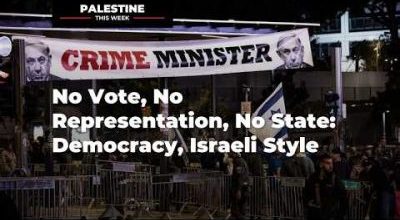
No Vote, No Representation, No State: Democracy, Israeli Style
or go to
Aletho News Archives – Video-Images
From the Archives
Sanctions, War and the Policy of Dual Containment
By SASAN FAYAZMANESH | March 17, 2008
It is now nearly three decades since the Unites States adopted the policy of dual containment of Iran and Iraq. While much has been written about the containment of Iraq, there has been very little in-depth analysis of this policy when it comes to Iran. In a book that is going to be released on March 31, 2008, entitled The United States and Iran: Sanctions, Wars and the Policy of Dual Containment (Routledge), I attempt to address this shortcoming by investigating when and why the US policy of containment of Iran came about, how it evolved, and where it stands today.[1] To the extent that Israel has been involved in US policy making, the study will also include the role that Israel has played in the containment of Iran. Also, since the fate of Iran has been inextricably linked to that of Iraq, occasionally the investigation will overlap with the containment of Iraq.
The policy of dual containment of Iran and Iraq originated during the Carter Administration, but it was not until the Clinton Administration that the expression “dual containment” became popular. … continue
Blog Roll
 Aletho News
- Europe’s Establishment Is Embracing War – and Losing Voters
- NATO chief advocates war of aggression
- No Vote, No Representation, No State: Democracy, Israeli Style
- Zionist Bought Senate Blocks Information About American Citizens Killed By Israel
- While Gaza dominates the UN, these are the people keeping it alive
- New Report: “Scholasticide and Genocide in Gaza: Assessment, Testimonies and Legal Analysis”
- ‘THAAD Delusion’: Iran war exposes US missile shield limits – The Atlantic
- Moscow issues warning to NATO over Russian exclave
- Yes, the Iran war has destroyed Trump’s presidency
- The fallacy of US delusions about Iran’s economic collapse
- If Americans Knew
- Mamdani releases plan to combat antisemitism and hate crimes in New York City
- Iran’s Revolutionary Guards Publish Letter to the American People
- DMFI launches $1 million ad campaign supporting Virginia’s Elaine Luria
- US Senate blocks resolution seeking report on Americans killed by Israel
- Israeli Attacks Kill Ten Palestinians in Gaza
- Massacre at Minab: The School That Became a Grave
- Israeli media: The IDF Shows It Doesn’t Turn a Blind Eye; It Actively Emboldens Settler Havoc
- As settlers ravage West Bank, Israeli forces kill 10 in Gaza – Daily Update
- New Report: “Scholasticide and Genocide in Gaza: Assessment, Testimonies and Legal Analysis”
- Ex-Biden officials are desperate for a Gaza scapegoat
- No Tricks Zone
- Green Energy Debacle: German Expert Professor Fritz Vahrenholt Warns Of Severe Economic And Social Consequences
- Two More Paleo Reconstructions Affirm Meters-Higher Sea Levels Across Ireland, Brazil 7000-6000 Years Ago
- New Study: Earth And Venus Surface Warmth Largely Explained By Convection And Lapse Rate, Not CO2 Or Radiation
- 2025 Nature Paper Claiming Worsening Global Drought Gets RETRACTED …Heavily Flawed
- New Study: ‘Global Drought Shows No Detectable Recent Acceleration Under Climate Warming’
- Economic Masterminds: German Socialists Suggest Taxing Productivity Gains Stemming From Using AI
- The South China Sea Has Not Been Cooperating With The Climate Change Narrative
- Energy Crisis: Germany Enters Heating Season With Historically Low Gas Reserve Fill Levels
- New Study: The Antarctic Ice Sheet Gained Mass From 2020-2024 Due To Staggering Snow And Ice Accumulation
- Study: Ocean Heating Rates From Thousands Of Years Ago ‘Dwarf’ Modern Ocean Heating Rates

