Internet Free Speech All but Dead
Unelected, unnamed censors are operating across the Internet to suppress “unapproved” content.

By Philip Giraldi | Global Research | June 8, 2019
The Internet was originally promoted as a completely free and uncensored mechanism for people everywhere to exchange views and communicate, but it has been observed by many users that that is not really true anymore. Both governments and the service providers have developed a taste for controlling the product, with President Barack Obama once considering a “kill switch“ that would turn off the Internet completely in the event of a “national emergency.”
President Donald Trump has also had a lot to say about fake news and is reported to be supporting limiting protections relating to the Internet. In May, a “net neutrality” bill that would have prevented service providers from manipulating Internet traffic passed in the House of Representatives, but it is reported to be “dead on arrival” in the Senate, so it will never be enacted.
Social networking sites have voluntarily employed technical fixes that restrict some content and have also hired “reviewers” who look for objectionable material and remove it. Pending European legislation, meanwhile, might require Internet search engines to eliminate access to many unacceptable old posts. YouTube has already been engaged in deleting existing old material and is working with biased “partners” like the Anti-Defamation League (ADL) to set up guidelines to restrict future content. Many users of Facebook will have already undoubtedly noted that some contacts have been blocked temporarily (or even permanently) and denied access to the site.
Google now automatically disables or limits searches for material that it deems to be undesirable. If Google does not approve of something it will either not appear in search results or it will be very low on the list. And what does come up will likely favor content that derives from those who pay Google to promote their products or services. Information that originates with competitors will either be very low in the search results or even blocked. Google is consequently hardly an unbiased source of information.
In May 2017 Facebook announced that it would be hiring 3,000 new censors, and my own experience of social networking censorship soon followed. I had posted an article entitled “Charlottesville Requiem” that I had written for a website. At the end of the first day, the site managers noticed that, while the article had clearly attracted a substantial Facebook readership, the “likes” for the piece were not showing up on the screen counter, i.e., were not being tabulated. It was also impossible to share the piece on Facebook, as the button to do so had been removed.
The “likes” on sites like Facebook, Yahoo! news comments, YouTube, and Google are important because they automatically determine how the piece is distributed throughout the site. If there are a lot of likes, the piece goes to the top when a search is made or when someone opens the page. Articles similarly can be sent to Coventry if they receive a lot of dislikes or negative marks, so the approvals or disapprovals can be very important in determining what kind of audience is reached or what a search will reveal.
In my case, after one day my page reverted to normal, the “likes” reappeared, and readers were again able to share the article. But it was clear that someone had been managing what I had posted, apparently because there had been disapproval of my content based on what must have been a political judgment.
A couple of days later, I learned of another example of a similar incident. The Ron Paul Institute (RPI) website posts much of its material on YouTube (owned by Google) on a site where there had been advertising that kicked back to RPI a small percentage of the money earned. Suddenly, without explanation, both the ads and rebate were eliminated after a “manual review” determined the content to be “unsuitable for all advertisers.” This was a judgment rendered apparently due to disapproval of what the institute does and says. The ability to comment on and link from the pieces was also turned off.
Dissident British former diplomat Craig Murray also noted in April 2018 the secretive manipulation of his articles that are posted on Facebook, observing that his “site’s visitor numbers [were] currently around one-third normal levels, stuck at around 20,000 unique visitors per day. The cause [was] not hard to find. Normally over half of our visitors arrive via Facebook. These last few days, virtually nothing has come from Facebook. What is especially pernicious is that Facebook deliberately imposes this censorship in a secretive way.
“The primary mechanism when a block is imposed by Facebook is that my posts to Facebook are simply not sent into the timelines of the large majority of people who are friends or who follow. I am left to believe the post has been shared with them, but in fact it has only been shown to a tiny number. Then, if you are one of the few recipients and do see the post and share it, it will show to you on your timeline as shared, but in fact the vast majority of your own friends will also not receive it. Facebook is not doing what it is telling you it is doing—it shows you it is shared—and Facebook is deliberately concealing that fact from you. Twitter has a similar system known as ‘shadow banning.’ Again, it is secretive and the victim is not informed.”
More recently, pressure to censor Internet social networking and information sites has increased, coming both from government and from various interested constituencies. In late May, Facebook founder and CEO Mark Zuckerberg met with French President Emmanuel Macron to discuss how to eliminate “hate speech” on the Internet.
The two men agreed that the United States Internet model, in spite of already being heavily manipulated, is too laissez faire, and expressed an interest in exploring the French system where it is considered acceptable to ban unacceptable points of view. Zuckerberg suggested that it might serve as a good model for the entire European Union. France is reportedly considering legislation that establishes a regulator with power to fine Internet companies up to 4% of their global revenue, which can in some cases be an enormous sum, if they do not curb hateful expressions.
So unelected, unnamed censors are operating all around the Internet to control the content, which I suppose should surprise no one, and the interference will only get worse as both governments and service providers are willing to do what it takes to eliminate views that they find unacceptable—which, curiously enough, leads one to consider how “Russiagate” came about and the current hysteria being generated in the conventional media and also online against both Venezuela and Iran. How much of the anger is essentially fake, being manipulated or even fabricated by large companies that earn mega billions of dollars by offering under false pretenses a heavily managed product that largely does what the government wants? Banning hate speech will be, unfortunately, only the first step in eliminating any and all criticisms of the status quo.
More Evidence US Armed Syria Terrorists as Trump Pleads Ceasefire
By Finian Cunningham | Strategic Culture Foundation | June 9, 2019
Remember when Donald Trump was running for president back in 2016, and he bragged he would “bomb the hell out of” terrorists in Syria. Now, in a reversal, Trump is calling on Syrian and allied Russian forces to stop bombing Idlib, the last redoubt of terror groups in Syria.
Trump urged Syria, Russia and Iran to “stop bombing the hell out of Idlib” claiming that civilians were being indiscriminately killed in the offensive to retake the renegade northwest province.
It seems like a strange plea from the American president. Idlib is unquestionably a stronghold for internationally proscribed terror groups, mainly Jabhat al Nusra (rebranded as Hayat Tahrir al Sham). Syrian government forces backed by Russian air power say it is their sovereign right to rout the militants, who have reportedly broken ceasefire agreements to launch attacks on civilian areas in government-controlled areas, as well as on the Russian air base at Hmeimim.
Moscow rejected Trump’s characterization of indiscriminate killing of civilians, saying that its operations along with Syrian forces are being directed at defeating illegally armed militants.
Moreover, the offensive to retake Idlib comes as new evidence emerges of the massive – albeit covert – international military support given to the various terror groups during Syria’s nearly eight-year war. Syrian state media this week reported arsenals of weaponry recently recovered in Damascus countryside and further south in the Daraa area.
The arsenals included rows and rows of heavy machine-guns, sniper rifles and US-made TOW missiles. Much of the weaponry was also of Israeli-origin, according to reports.
A separate find showed tonnes of C-4 plastic explosive, which Syrian military intelligence said was “US-made”. Up to four tonnes (4,000 kgs) were recovered this time around. Half a kilo of this lethal material is enough to kill several people.
This is not, of course, the first time that such huge caches of US, Israeli and NATO-origin weaponry have been recovered from territory formerly held by terrorists in Syria. There have been numerous such finds, which also included industrial chemicals made in Germany and Saudi Arabia, capable of producing sarin and other highly toxic munitions. That implies military-grade logistics and technical know how.
Taken together, the unavoidable conclusion is that internationally proscribed terrorist groups have been systematically weaponized by the US, its NATO allies, Israel and the Arab regimes of Saudi Arabia and Qatar. The array of weaponry indicates international and state-level organization, not haphazard procurement from disparate private arms dealers.
A plausible configuration for how the weapons which came into Syria were delivered and paid for is the following: most likely through smuggling routes from Turkey, Jordan and Israel. The oil-rich Arab monarchs would have footed the bill. The American CIA and Britain’s MI6 managed the logistics and weapons handling. The circuitous supply chain was sufficiently obscure to avoid oversight by the US Congress and European parliaments. But the bottom line is that terrorist organizations were evidently weaponized by Washington and its allies for the objective of regime change in Damascus.
That is why President Trump and other Western leaders do not have any moral authority whatsoever when they make belated calls for a ceasefire in Idlib province.
Syria has faced an international criminal conspiracy to destroy its nation. Washington and other NATO states have been fully complicit in directing that conspiracy by arming terror groups to the teeth. Western corporate news media have served as propaganda cover for the entire criminal enterprise, lionizing the terrorists as “rebels”, and continually demonizing the Syrian army and its allies in their efforts to liberate the country from the foreign-sponsored scourge. Recall the disgraceful Western media distortion over the liberation of Aleppo by the Syrian army and Russia in 2016-2017, endeavoring to portray that defeat of besieging terror groups as a “massacre”. The Western media never followed up their hysterical charade with subsequent reports of how Aleppo citizens actually rejoiced in their liberation from Western-backed “rebels”.
The infernal problem of conflict and violence in Syria is the direct consequence of Western states embarking on a criminal scheme years before the war started in 2011 in order to overthrow the government of President Bashar al Assad.
A proud and rich ancient civilization of pluralist tolerance among religions and ethnicities was almost destroyed by the nefarious regime-change war. It was largely due to Russia’s military intervention at the end of 2015 in support of its Syrian ally, as well as support from Iran and Lebanon’s Hezbollah, that turned the tide of war and saved Syria from being plunged into a failed state over-run by jihadist warlords.
Syrian state forces have every legal and moral right to finish this war by conquering the last bastion of foreign-backed terror groups holding out in Idlib. Those groups have forfeited any respite by their repeated violation of ceasefire agreements with the Syrian government, violations which targeted civilian areas.
Trump’s apparent concern over civilian deaths is no doubt misinformed by his intelligence agencies who have been covertly sponsoring the terror groups and their media agents, the so-called White Helmets.
In any case, as more evidence emerges of the systematic weaponization of terrorists by the US and its allies, the calls for “restraint” out of Washington and other Western capitals should be treated with contempt. If they had any genuine concern for civilian safety, they would be providing information on the whereabouts of other weapons caches hidden in Syria and supplied to their terrorist mercenaries.
A USS Liberty’s Hero’s Passing
This article was written in 2014 on the occasion of Halbardier’s death.
By Ray McGovern | Consortium News
Terry Halbardier, who as a 23-year old seaman in 1967 thwarted Israeli attempts to sink the USS Liberty, died on Aug. 11 in Visalia, California. It took the U.S. government 42 years after the attack to recognize Halbardier’s heroism by awarding him the Silver Star, a delay explained by Washington’s determination to downplay Israeli responsibility for the 34 Americans killed and the 174 wounded.
On June 8, 1967, during the Six-Day War, the Israeli military attacked the USS Liberty, an American spy ship which had been monitoring Israeli transmissions about the conflict. Intercepted Israeli communications indicated that the goal was to sink the Liberty and leave no survivors.

USS Liberty receives assistance from units of the Sixth Fleet, after she was attacked and seriously damaged by Israeli forces off the Sinai Peninsula on June 8, 1967. (US Navy photo)
Warplanes and torpedo boats had already killed 34 and wounded 174, when Halbardier slid over the Liberty’s napalm-glazed deck to jury-rig an antenna and get an SOS off to the Sixth Fleet. The Israelis intercepted the SOS and broke off the attack immediately. In effect, Halbardier prevented the massacre of all 294 onboard. Still, the infamy of the attack on the Liberty was two-fold.
First, the Liberty, a virtually defenseless intelligence collection platform prominently flying an American flag in international waters, came under deliberate attack by Israeli aircraft and three 60-ton Israeli torpedo boats off the coast of the Sinai on a cloudless June afternoon during the six-day Israeli-Arab war. Second, President Lyndon Johnson called back carrier aircraft dispatched to defend the Liberty lest Israel be embarrassed, the start of an unconscionable cover-up, including top Navy brass, that persists to this day.
Given all they have been through, the Liberty survivors and other veterans who joined Halbardier to celebrate his belated receipt of the Silver Star on May 27, 2009 can be forgiven for having doubted that the day of the hero’s recognition would ever come.
In the award ceremony at the Visalia (California) office of Rep. Devin Nunes, the Republican congressman pinned the Silver Star next to the Purple Heart that Halbardier found in his home mailbox three years ago. Nunes said, “The government has kept this quiet I think for too long, and I felt as my constituent he [Halbardier] needed to get recognized for the services he made to his country.”

Terry Halbardier got off an SOS message saving the Liberty from Israeli destruction
Nunes got that right. Despite the many indignities the Liberty crew has been subjected to, the mood in Visalia was pronouncedly a joyous one of Better (42 years) Late Than Never. And, it did take some time for the moment to sink in: Wow, a gutsy congressman not afraid to let the truth hang out on this delicate issue.
Treatment Accorded the Skipper
I was present that day and I could not get out of my head the contrast between this simple, uncomplicated event and the earlier rigmarole that senior Navy officers went through to pin a richly deserved Medal of Honor on another hero of that day, the Liberty’s skipper, Captain William McGonagle.
Although badly wounded by Israeli fire on June 8, 1967, McGonagle was able to keep the bombed, torpedoed, napalmed Liberty afloat and limping toward Malta, where what was left of the bodies of the 34 crewmen killed and the 174 wounded could be attended to. Do the math: yes, killed and wounded amounted to more than two-thirds of the Liberty crew of 294.
I remembered what a naval officer involved in McGonagle’s award ceremony told one of the Liberty crew: “The government is pretty jumpy about Israelthe State Department even asked the Israeli ambassador if his government had any objections to McGonagle getting the medal.”
When McGonagle received his award, the White House (the normal venue for a Medal of Honor award) was all booked up, it seems, and President Lyndon Johnson (who would have been the usual presenter) was unavailable.
So it fell to the Secretary of the Navy to sneak off to the Washington Navy Yard on the banks of the acrid Anacostia River, where he presented McGonagle with the Medal of Honor and a citation that described the attack but not the identity of the attackers.
Please don’t misunderstand. The Liberty crew is not big on ceremony. They are VERY-not-big on politicians who wink when Navy comrades are killed and wounded at sea. The Liberty survivors are big on getting the truth out about what actually happened that otherwise beautiful day in June 1967.
The award of the Silver Star to Terry Halbardier marked a significant step in the direction of truth telling. Halbardier said he accepted his Silver Star on behalf of the entire 294-man crew. He and fellow survivor Don Pageler expressed particular satisfaction at the wording of the citation, which stated explicitly — with none of the usual fudging — the identity of the attackers: “The USS Liberty was attacked by Israeli aircraft and motor torpedo boats in the East Mediterranean Sea.”
In the past, official citations, like Captain McGonagle’s, had avoided mentioning Israel by name when alluding to the attack. I think former U.S. Ambassador Edward Peck put it best in condemning this kind of approach as “obsequious, unctuous subservience to the peripheral interests of a foreign nation at the cost of the lives and morale of our own service members and their families.” Strong words for a diplomat. But right on.
Just a Guy From Texas
Were it not for Halbardier’s bravery, ingenuity, and technical expertise, the USS Liberty would surely have sunk, taking down much if not all of the crew.
You see, the first thing the Israeli aircraft bombed and strafed were the Liberty’s communications antennae and other equipment. They succeeded in destroying all the antennae that were functional. One antenna on the port side, though, had been out of commission and had escaped damage.
In receiving the Silver Star, Halbardier made light of his heroism, claiming that he was just a guy from Texas who could do a whole lot with simple stuff like baling wire. (In the infantry we called this kind of thing a “field expedient.”)
In any case, with his can-do attitude and his technical training, he figured he might be able to get that particular antenna working again. But first he would have to repair a cable that had been destroyed on deck and then connect the antenna to a transmitter.
The deck was still being strafed, but Halbardier grabbed a reel of cable, ran out onto the deck, and attached new cable to the antenna so a radioman could get an SOS out to the Sixth Fleet in the Mediterranean.
Voila. “Mayday” went out; almost immediately the Israeli aircraft and torpedo ships broke off the attack and went back to base; the Israeli government sent a quick apology to Washington for its unfortunate “mistake;” and President Johnson issued orders to everyone to make believe the Israelis were telling the truth, or at least to remain silent.
To their discredit, top Navy brass went along, and the Liberty survivors were threatened with court martial and prison if they so much as mentioned to their wives what had actually happened. They were enjoined as well from discussing it with one another.
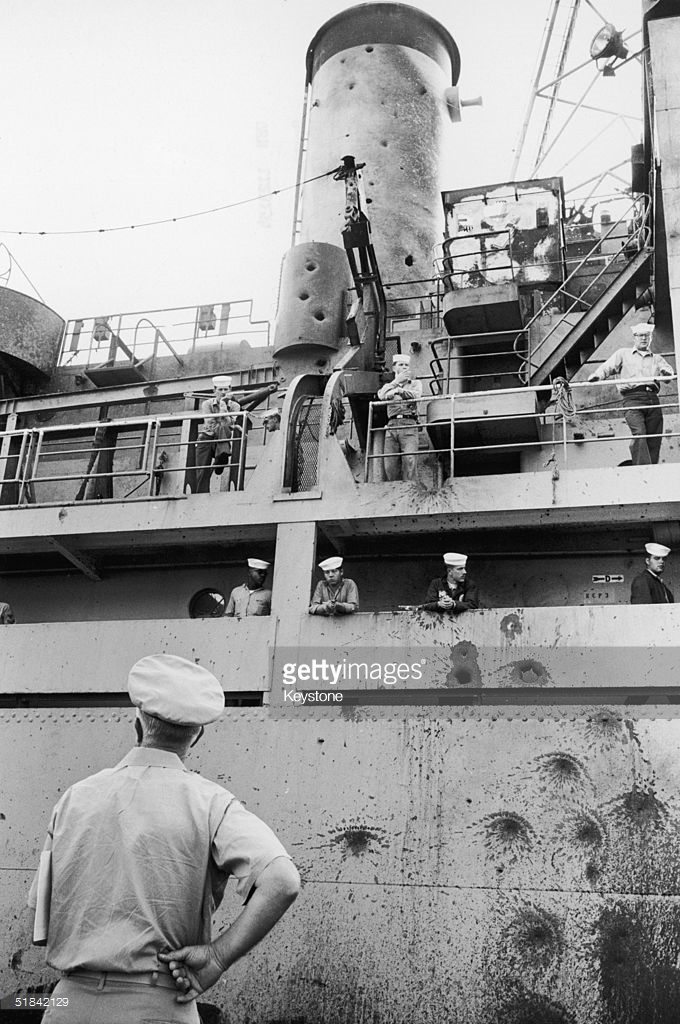
The shot-up Liberty
As Liberty crewman Don Pageler put it, “We all headed out after that, and we didn’t talk to each other.” The circumstances were ready-made for serious Post-Traumatic Stress Disorder.
The stories shared by Liberty survivors after the award ceremony, including descriptions of the macabre but necessary effort to reassemble torpedoed body parts, and the plague of survivor’s guilt, were as heart-rending as any I have heard. They are stories that should be shared more widely for those muzzled far too long.
These were the deep emotional scars to supplement the ones all over Halbardier’s body, some of which he uncovered when asked by the local press gathered there in Visalia. Typically, Halbardier made light of the shrapnel that had to be plucked out of his flesh, emphasizing that he was lucky compared to some of the other crew.
No Mistake
Despite Israeli protestations, the accumulated evidence, including intercepted voice communications, is such that no serious observer believes Israel’s “Oops” excuse of a terrible mistake. The following exchanges are excerpts of testimony from U.S. military and diplomatic officials given to Alison Weir, founder of “If Americans Knew” and author of American Media Miss the Boat:
Israeli pilot to ground control: “This is an American ship. Do you still want us to attack?”
Ground control: “Yes, follow orders.”
“But sir, it’s an American ship, I can see the flag!”
Ground control: “Never mind; hit it!”
Haviland Smith, a CIA officer stationed in Beirut during the Six-Day War, says he was told that the transcripts were “deep-sixed,” because the U.S. government did not want to embarrass Israel.
Equally telling is the fact that the National Security Agency (NSA) destroyed voice tapes seen by many intelligence analysts, showing that the Israelis knew exactly what they were doing. I asked a former CIA colleague, who was also an analyst at that time, what he remembered of those circumstances. Here is his e-mail reply:
“The chief of the analysts studying the Arab-Israeli region at the time told me about the intercepted messages and said very flatly and firmly that the pilots reported seeing the American flag and repeated their requests of confirmation of the attack order. Whole platoons of Americans saw those intercepts. If NSA now says they do not exist, then someone ordered them destroyed.”
One need hardly add at this point that the destruction of evidence without investigation is an open invitation to repetition in the future. Think the more recent torture-interrogation videotapes.
As for the legal side: the late Captain Ward Boston, unburdened himself on his accomplice role as the Navy lawyer appointed as senior counsel to Adm. Isaac Kidd, who led a one-week (!) investigation and then followed orders to pronounce the attack on the Liberty a case of “mistaken identity.” Boston signed a formal declaration on Jan. 8, 2004, in which he said he was “outraged at the efforts of the apologists for Israel in this country to claim that this attack was a case of ‘mistaken identity.’” Boston continued:
“The evidence was clear. Both Adm. Kidd and I believed with certainty that this attack was a deliberate effort to sink an American ship and murder its entire crew Not only did the Israelis attack the ship with napalm, gunfire, and missiles, Israeli torpedo boats machine-gunned three lifeboats that had been launched in an attempt by the crew to save the most seriously wounded, a war crime
“I know from personal conversations I had with Adm. Kidd that President Lyndon Johnson and Secretary of Defense Robert McNamara ordered him to conclude that the attack was a case of ‘mistaken identity’ despite overwhelming evidence to the contrary.”
W. Patrick Lang, Col., USA (ret.), who was the Defense Intelligence Agency’s top analyst for the Middle East for eight years, recounted the Israeli air attacks as follows: “The flight leader spoke to his base to report that he had the ship in view, that it was the same ship he had been briefed on, and that it was clearly marked with the U.S. flag
“The flight commander was reluctant. That was very clear. He didn’t want to do this. He asked them a couple of times, ‘Do you really want me to do this?’ I’ve remembered it ever since. It was very striking. I’ve been harboring this memory for all these years.”
Lang, of course, is not alone. So too Terry Halbardier, who told those assembled at his Silver Medal award ceremony, “I think about it [the attack on the Liberty] every day.”
Why Sink the Ship?
What we know for sure is, as the independent commission headed by former Chairman of the Joint Chiefs of Staff, Adm. Thomas Moorer put it, the attack “was a deliberate attempt to destroy an American ship and kill her entire crew.”
What we do not know for sure is why the Israelis wanted that done. Has no one dared ask the Israelis? One view is that the Israelis did not want the United States to find out they were massing troops to seize the Golan Heights from Syria and wanted to deprive the U.S. of the opportunity to argue against such a move.

USS Liberty after the attack
James Bamford offers an alternative view in his excellent book, Body of Secrets. Bamford adduces evidence, including reporting from an Israeli journalist eyewitness and an Israeli military historian, of wholesale killing of Egyptian prisoners of war at the coastal town of El Arish in the Sinai.
The Liberty was patrolling directly opposite El Arish in international waters but within easy range to pick up intelligence on what was going on there. And the Israelis were well aware of that. But the important thing here is not to confuse what we know (the deliberate nature of the Israeli attack) with the ultimate purpose behind it, which remains open to speculation.
Also worth noting is the conventional wisdom prevalent in our Fawning Corporate Media (FCM) that Egypt forced Israel into war in June 1967. An excellent, authoritative source has debunked that, none other than former Israeli Prime Minister Menachem Begin! In an unguarded moment in 1982, when he was prime minister, he admitted publicly:
“In June 1967, we had a choice. The Egyptian army concentrations in the Sinai approaches do not prove that [Egyptian President] Nasser was really about to attack us. We must be honest with ourselves. We decided to attack him.”
Thus, the Israeli attack admittedly amounted to starting a war of aggression, and the occupied West Bank territories and the Golan Heights gained by the Israelis in the 1967 war remain occupied to this day. The post World War II tribunal at Nuremberg distinguished a “war of aggression” from other war crimes, terming it the “supreme international crime, differing from other war crimes only in that it contains the accumulated evil of the whole.”
Perhaps the attempt to sink the Liberty and finish off all survivors qualifies as one of those accumulated evils. Terry Halbardier summed it up this way when he was awarded his Silver Star: “There’s lots of theories but let’s just say they didn’t want us listening in to what they wanted to do.”
Getting Away With Murder
In sum, on June 8, 1967, the Israeli government learned that it could get away with murder, literally, and the crime would be covered up, so strong is the influence of the Israel Lobby in our Congress, and indeed, in the White House. And those USS Liberty veterans who survived well enough to call for an independent investigation have been hit with charges of, you guessed it, anti-Semitism.
Does all this have relevance today? Of course. Israeli Prime Minister Benjamin Netanyahu understands that there is little that Israel could do that would earn the opprobrium of the U.S. Congress or retaliation from the White House, whether it’s building illegal settlements or slaughtering civilians in Gaza. The Israelis seem convinced they remain in the catbird’s seat, largely because of the Israel Lobby’s influence with U.S. lawmakers and opinion makers.
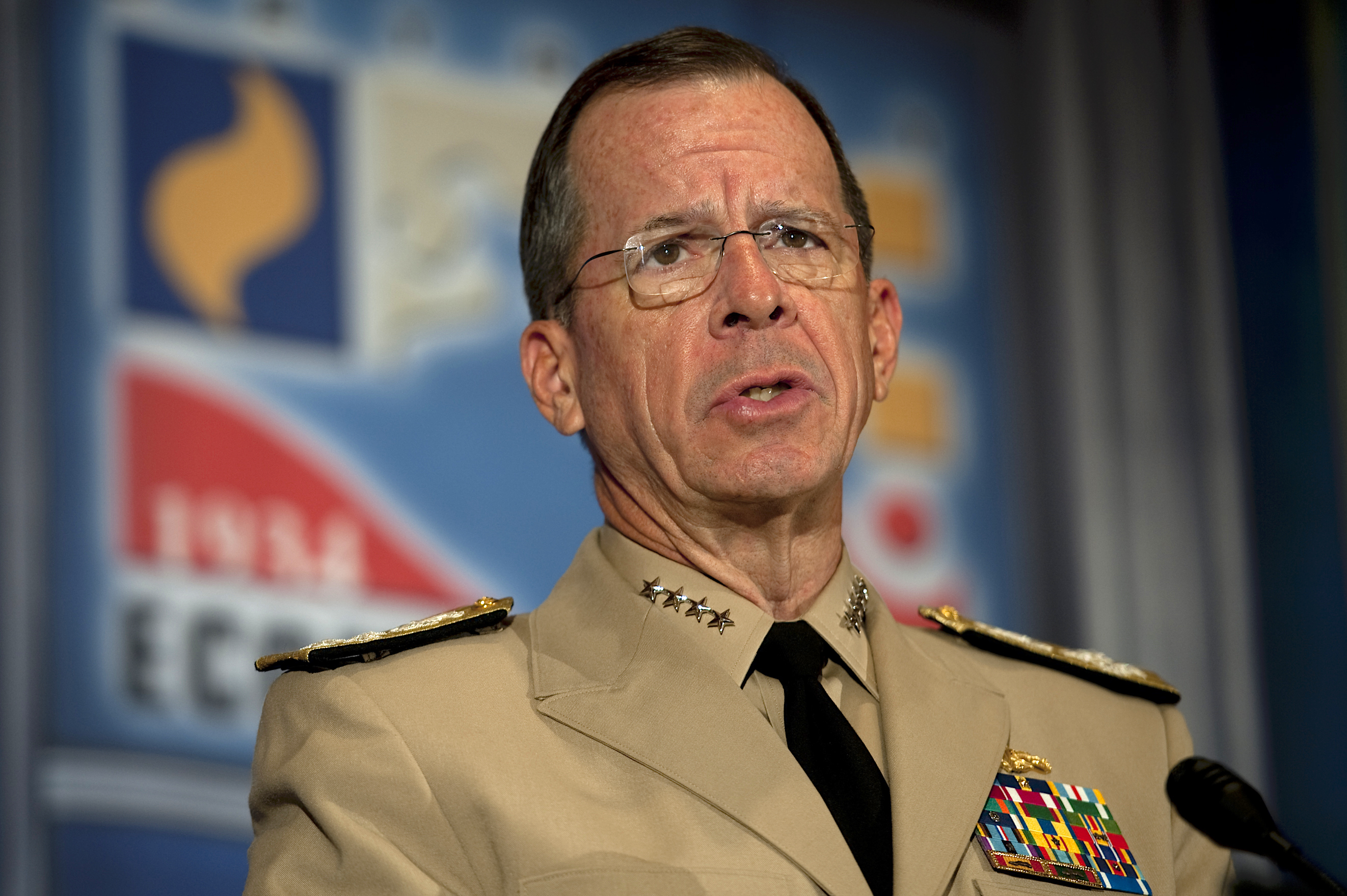
Navy Adm. Mike Mullen, (DoD Photo by Mass Communication Specialist Chad J. McNeeley)
One of the few moments when a U.S. official has had the audacity to face Israel down came from significantly a U.S. Navy admiral. In early July 2008, Chairman of the Joint Chiefs of Staff, Adm. Mike Mullen, was sent to Israel to read the riot act to then-Israeli Prime Minister Ehud Olmert, who seemed to be itching to start hostilities with Iran while President George W. Bush was in office.
We learned from the Israeli press that Mullen, fearing some form of Israeli provocation, went so far as to warn the Israelis not to even think about another incident like the attack on the USS Liberty on June 8, 1967, that the Israelis should disabuse themselves of the notion that U.S. military support would be knee-jerk automatic if Israel somehow provoked open hostilities with Iran.
This is the only occasion I am aware of in which a U.S. official of such seniority braced Israel about the Liberty incident. A gutsy move, especially with Vice President Dick Cheney and national security aide Elliott Abrams then in the White House, two hawks who might well bless, or even encourage, an Israeli provocation that would make it very difficult for Washington to avoid springing to the defense of its “ally.”
The Israelis know that Mullen knows that the attack on the Liberty was deliberate. Mullen could have raised no more neuralgic an issue to take a shot across an Israeli bow than to cite the attack on the Liberty. The Jerusalem Post reported that Mullen cautioned that a Liberty-type incident must be avoided in any future military actions in the Middle East.
Perhaps Mullen had learned something from the heroism of Terry Halbardier
Ray McGovern works with Tell the Word, the publishing arm of the ecumenical Church of the Saviour in inner-city Washington. After serving as an Army infantry/intelligence officer, he spent a 27-year career as a CIA analyst. He is co-founder of Veteran Intelligence Professionals for Sanity (VIPS).
How the U.S. Weaponizes “Internet Freedom”
By Julianne Tveten | American Herald Tribune | June 8, 2019
Several weeks ago, Edward Snowden took to Twitter to weigh in on the recent coup attempt in Venezuela. “Big: Venezuela’s opposition leader just launched a coup,” he wrote. “Reports coming in that the government is now blocking access to social media in response. Any interference with the right of the people to communicate freely must be condemned.”
Snowden, of course, was referring to the U.S.-backed attempt to oust the elected Venezuelan President Nicolás Maduro and install right-wing opposition party member Juan Guaidó. Yet Snowden’s concerns didn’t revolve around the damages visited upon Venezuela. Instead, as his critics observed, his focus on Internet access revealed a decidedly libertarian set of values: Sure, a potential (albeit failing) coup was in progress, hurling the Venezuelan people into the throes of imperialist upheaval—but wouldn’t someone think of the Internet access?
This time, it seemed Snowden, who was catapulted into international recognition for exposing the National Security Agency (NSA)’s surveillance abuses, was doing the U.S. government’s bidding. For decades, U.S. institutions have weaponized the arbitrary notion of “Internet freedom” for political gain. Their goal: to villainize “enemy states” in order to sustain U.S. hegemony, technologically and otherwise.
By various accounts, the notion of “Internet freedom” entered U.S. policy during the Clinton Administration, in the early stages of the Internet’s commercialization. In 1997, then-President Bill Clinton and Vice President Al Gore argued that “governments must adopt a non-regulatory, market-oriented approach to electronic commerce” and warned against those that “will impose extensive regulations on the Internet and electronic commerce.” Stating that the “private sector should lead,” their proposal envisaged the Internet, first and foremost, as a global marketplace governed by laissez-faire individualism.
Hillary Clinton cemented this concept in a 2010 speech, insisting that the United States would confront governments that implemented online “censorship,” including, but not limited to, China, Iran, and North Korea—countries, like Venezuela, that have worked to develop infrastructures and economies independent of the U.S.’s capitalist framework. Clinton also touted the role of the private sector in such an effort. Advocating for an Internet defined by “free expression” and, most important, free markets, she lauded the Global Network Initiative, an “anti-censorship” collaboration among tech firms like Microsoft, Google, Yahoo, and various NGOs.
The Clintons’ Internet-policy postures have persisted into the present day. The U.S. nonprofit and Global Network Initiative member NetBlocks, for example, regularly issues reports warning of limited Internet access throughout the world. Among its most commonly cited countries, by far, is Venezuela. Over the course of the attempted Venezuelan coup, which began in January, NetBlocks has published dozens of reports of restrictions to access of various U.S. web services, including YouTube, Google, and Bing. Instead of offering geopolitical context to explain why a country might be forced to limit access, these reports offer an alternative narrative: A beleaguered country’s temporary (if exaggerated) shutdowns of a few websites, rather than a U.S.-led coup, are the real problem.
Think tank Freedom House, which is significantly funded by the U.S. government, offers similar assessments. According to its 2018 “Freedom on the Net” report, “digital authoritarianism” is on the rise, thanks largely to China, a country that has long curbed access to—and thus constrained the market and influence of—U.S. tech platforms. Not coincidentally, Freedom House has ranked China the least “free” country for four consecutive years, with Syria, Iran, and Cuba closely trailing. Meanwhile, Freedom House, as well as NetBlocks, have been consistent sources for U.S. corporate media, including the Washington Post and the New York Times.
For all of their admonitions about censorship abroad, these “watchdogs” have done little to underscore the censorship committed by U.S. tech companies. Freedom House concedes that “Internet freedom” has declined in the United States; the reasons it provides relate to such valid and significant issues as network monopolies, the FCC’s assault on net neutrality, and the “digital divide.” Nowhere, however, does Freedom House acknowledge Google’s and U.S. social media’s inveterate silencing of left-leaning media and organizations, nor the punitive surveillance activists disproportionately face. Instead, the think tank routinely deems the U.S. Internet “free.”
This dovetails with another cause of “free Internet” acolytes: U.S. access to other countries’ data. Various countries, such as China, Russia, and Vietnam, have required storage of their data on devices within their own countries’ borders—a policy known as data localization. An assertion of sovereignty, data localization is often in direct opposition to the vision of an “open” Internet outlined by the Clintons. In other words, as it blocks foreign companies’ and governments’ access to international digital data, it wrests control of the Internet from the U.S. Right on cue, Freedom House’s 2018 report condemned China, Russia, Vietnam, and other countries’ decisions to institute data localization.
An illustrative scenario took place in 2013. In the wake of revelations that part of the NSA’s surveillance program included spying on Brazil, Brazil’s then-president Dilma Rousseff proposed a shift toward data localization. Aptly enough, former Google executive Eric Schmidt fretted not long before Rousseff’s proposal that data localization—which would corrode his company’s profits—might lead to a “balkanized Internet”:
“The real danger [from] the publicity about all of this is that other countries will begin to put very serious encryption – we use the term ‘balkanization’ in general – to essentially split the Internet and that the Internet’s going to be much more country specific. That would be a very bad thing, it would really break the way the Internet works, and I think that’s what I worry about.”
Schmidt’s concerns echo those of the Clintons. A “free” and “open” “global” Internet, they claim, is a democratic forum, the “great equalizer”; all countries will thereby be more enlightened for connecting to Google, Microsoft, Amazon, and other multibillion-dollar U.S. corporations with military contracts. This rationale permeates corporate media and think tanks, both of which characterize a “balkanized Internet” as a civilizational regression. What these proclamations omit is the fact that there are reasons some countries don’t agree with the U.S.’s digital prescriptions. The Internet doesn’t exist in a political vacuum; it’s an extension of geopolitical relations and all of the iniquities that accompany them.
These fearmongering editorials and reports will continue, invoking imperialism’s dog whistles: “censorship,” “authoritarianism,” and other affronts to putative “freedom.” Yet these are only a problem to those who would believe that the U.S.’s superpower status is some sort of good. Vulnerable countries’ efforts to defend themselves from the scourge of exploitation, in any way they see fit, aren’t a pity or a threat; they’re a liberatory necessity. No matter what the U.S. insists, there are plenty of places—digital and physical—where its capitalist metrics of “freedom” simply don’t belong.
Julianne Tveten’s work has appeared at In These Times, Fairness & Accuracy In Reporting, The Nation, Pacifica Radio and elsewhere.
Unlike Pompeo’s claim, Iran’s missiles not for developing nukes: FM Zarif
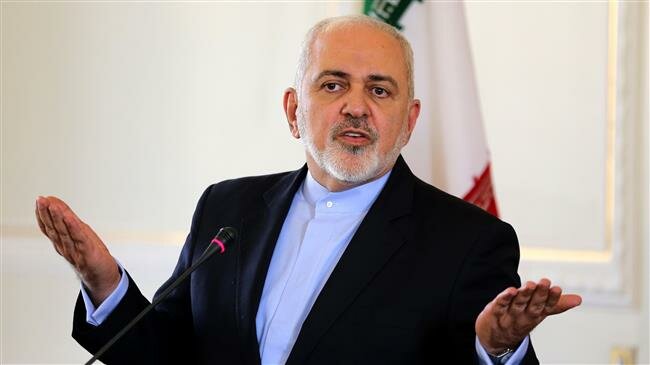
Iranian Foreign Minister Mohammad Javad Zarif
Press TV – June 7, 2019
Iranian Foreign Minister Mohammad Javad Zarif has categorically rejected a claim by US Secretary of State Mike Pompeo about Iran’s missile program, saying Tehran does not seek to develop nuclear weapons.
“Our missiles are not ‘designed’ for nukes, which we’re not developing,” Zarif said in a post on his official Twitter account on Friday.
In an interview with The Washington Times this week, Pompeo once again reaffirmed the US administration’s strategy of applying economic pressure on Iran.
“The objectives are to change the behavior of the Islamic Republic of Iran. … No terror around the world, no expeditionary terror around the world, put your missile program back inside a set of constraints that had been identified in UN Security Council Resolution 2231 and … have a permanent commitment not to develop your nuclear program,” Pompeo said.
Resolution 2231 endorsed the multilateral nuclear accord, officially known as the Joint Comprehensive Plan of Action (JCPOA), which was signed between Iran and the major world powers, including the United States, in 2015.
Under the JCPOA, Iran undertook to put limits on its nuclear program in exchange for the removal of nuclear-related sanctions imposed against Tehran. However, US President Donald Trump pulled his country out of the JCPOA in May 2018 and re-imposed harsh sanctions against the Islamic Republic in defiance of global criticisms.
The US administration claims that Tehran had violated the JCPOA with a series of ballistic missiles tests over the past four years.
In his tweet, Zarif said the US and its allies are in no position to criticize the Islamic Republic’s missile program and lashed out at the West for making arms deals with the countries that are killing the Yemeni people.
“The US—which violated UNSCR 2231 in withdrawing from JCPOA—or its allies (in violation of its provision on normalizing economic relations w/Iran) are in no position to push a conceited interpretation of its missile provision while pouring weapons into hands that kill Yemenis,” the top Iranian diplomat said.
An American think tank said in April that it has found new data showing US arms deals with Saudi Arabia and the UAE are “dramatically understated” and billions more than previously reported.
The data collected by arms trade watchdog Security Assistance Monitor (SAM) shows the US has struck at least $68.2 billion worth of deals with the two countries since they started their war in Yemen.
In another tweet, Zarif said that Resolution 2231 has “called upon” Iran not to undertake any activity aimed at designing ballistic missiles capable of carrying nuclear warheads.
He emphasized that the Security Council resolution does not enforces any prohibition in this regard.
French President Emmanuel Macron also on Thursday accused Tehran of making efforts to achieve nuclear arms and said France and the US both wanted to stop Tehran getting nuclear arms and new talks should focus on curbing its ballistic missiles program and on other issues.
In a Thursday meeting with the US president, Macron listed four common priorities of the US and France in addressing “Iranian behavior”: preventing Iran from getting a nuclear weapon, reducing Iran’s ballistic activity, containing Iran’s regional activity and establishing peace in the region.
However, Iranian Foreign Ministry Spokesman Abbas Moussavi rejected French calls for wider international talks over its nuclear program and said Macron’s comments will be of no help to saving the Iran nuclear deal and will just further deepen distrust among its signatories.
Meanwhile, during a meeting with heads of international news agencies on Thursday, Russian President Vladimir Putin once again stressed the importance of preserving the multilateral nuclear agreement, saying Moscow does not approve of “what is being done against Iran.”
In reaction to Macron’s remarks, the Russian leader drew a line between Iran’s nuclear and missile programs and said, “Yes, someone may be concerned by Iran’s missile programs. But that’s a different problem.”
Mueller Caught In Another Deception; Key ‘Russia Link’ Exposed As Informant For US, Ukraine
By Tyler Durden | Zero Hedge | June 7, 2019
A Ukrainian businessman painted in the Mueller report as a sinister link to Russia was actually a “sensitive” intelligence source for the US State Department who informed on Ukrainian and Russian issues – and passed messages between the Washington and Kiev, according to The Hill‘s John Solomon.
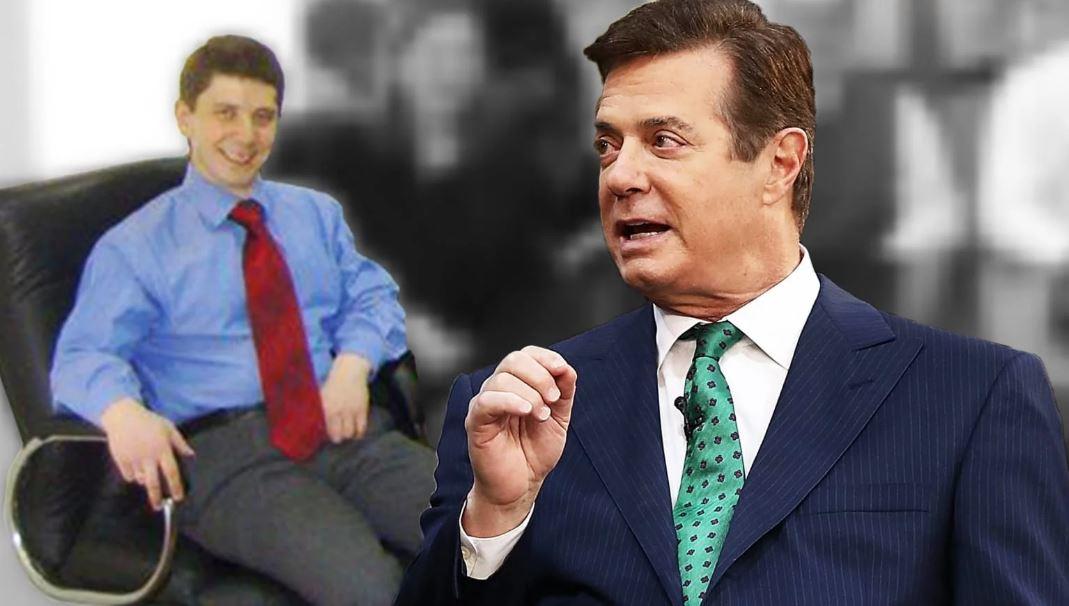
Konstantin Kilimnik, who worked for Trump campaign chairman Paul Manafort, was described on page 6 of the Mueller report as having “ties to Russian intelligence” – and was cast in a sinister light as a potential threat to democracy. Mueller completely omitted the fact that Kilimnik was working as an informant and intermediary between America and Ukraine, and subsequently indicted him for obstruction of justice.
Kilimnik was not just any run-of-the-mill source, either.
He interacted with the chief political officer at the U.S. Embassy in Kiev, sometimes meeting several times a week to provide information on the Ukraine government. He relayed messages back to Ukraine’s leaders and delivered written reports to U.S. officials via emails that stretched on for thousands of words, the memos show.
The FBI knew all of this, well before the Mueller investigation concluded. –The Hill
“Purcell described what he considered an unusual level of discretion that was taken with handling Kilimnik,” said one FBI interview report reviewed by Solomon. “Normally the head of the political section would not handle sources, but Kasanof informed Purcell that KILIMNIK was a sensitive source.”
Purcell told the FBI that Kilimnik provided “detailed information about OB (Ukraine’s opposition bloc) inner workings” that sometimes was so valuable it was forwarded immediately to the ambassador. Purcell learned that other Western governments relied on Kilimnik as a source, too.
“One time, in a meeting with the Italian embassy, Purcell heard the Italian ambassador echo a talking point that was strikingly familiar to the point Kilimnik had shared with Purcell,” the FBI report states. –The Hill
And Mueller mentioned none of this in his report despite knowing about it since 2018 – more than a year before the final report.

Three sources with direct knowledge of the inner workings of Mueller’s office confirmed to me that the special prosecutor’s team had all of the FBI interviews with State officials, as well as Kilimnik’s intelligence reports to the U.S. Embassy, well before they portrayed him as a Russian sympathizer tied to Moscow intelligence or charged Kilimnik with participating with Manafort in a scheme to obstruct the Russia investigation. –The Hill
Kilimnik was described by Purcell’s predecessor, Alexander Kasanov, as one of the few reliable informants spying on former Ukrainian President Victor Yanukovych, whose Party of Regions had hired Manafort’s lobbying firm.
Kasanof described Kilimnik as one of the few reliable insiders the U.S. Embassy had informing on Yanukovych. Kilimnik began his relationship as an informant with the U.S. deputy chief of mission in 2012-13, before being handed off to the embassy’s political office, the records suggest.
“Kilimnik was one of the only people within the administration who was willing to talk to USEMB,” referring to the U.S. embassy, and he “provided information about the inner workings of Yanukovych’s administration,” Kasanof told the FBI agents.
“Kasanof met with Kilimnik at least bi-weekly and occasionally multiple times in the same week,” always outside the embassy to avoid detection, the FBI wrote. “Kasanof allowed Kilimnik to take the lead on operational security” for their meetings. –The Hill
And, despite the Mueller report suggesting Kilimnik is a Russian stooge, state officials told the FBI that he did not appear to hold any allegiance to the Kremlin, and had been “flabbergasted at the Russian invasion of Crimea.”
“Most sources of information in Ukraine were slanted in one direction or another,” Kasanof told the FBI. “Kilimnik came across as less slanted than others.”
Solomon corroborated the FBI interviews with Kasanov and Purcell with “scores of State Department emails” which contain regular intelligence dispatches from Kilimnik on what was going on inside of the Yanukovych administration, the Crimea conflict, and Ukrainian and Russian politics.
Not a threat
Contrary to the dire threat to national security implied in the Mueller report, Kilimnik was allowed to enter the United States twice in 2016 to meet with State officials – meaning he clearly wasn’t flagged in visa databases as a foreign intelligence threat.
Mueller also painted a one-sided picture of Kilimnik’s peace plan for Crimea which he had presented to the Trump administration – suggesting that it was a “backdoor” way for Russia to control part of eastern Ukraine. In fact, Kilimnik had presented the idea to the Obama administration in 2016.
As Solomon notes “That’s what many in the intelligence world might call “deception by omission.”
Specifically, the Mueller report flagged Kilimnik’s delivery of a peace plan to the Trump campaign for settling the two-year-old Crimea conflict between Russia and Ukraine.
“Kilimnik requested the meeting to deliver in person a peace plan for Ukraine that Manafort acknowledged to the Special Counsel’s Office was a ‘backdoor’ way for Russia to control part of eastern Ukraine,” the Mueller report stated.
But State emails showed Kilimnik first delivered a version of his peace plan in May 2016 to the Obama administration during a visit to Washington. Kasanof, his former handler at the U.S. Embassy in Ukraine, had been promoted to a top policy position at State, and the two met for dinner on May 5, 2016.
The day after the dinner, Kilimnik sent an email to Kasanof’s official State email address recounting the peace plan they had discussed the night before. –The Hill
While Kilimnik did not respond to The Hill for comment, he slammed the “made-up narrative” about him in a May email to the Washington Post, adding “I have no ties to Russian or, for that matter, any intelligence operation.”
That said, as Solomon writes “Kilimnik holds Ukrainian and Russian citizenship, served in the Soviet military, attended a prestigious Russian language academy and had contacts with Russian oligarch Oleg Deripaska. So it is likely he had contacts over the years with Russian intelligence figures. There also is evidence Kilimnik left the U.S.-funded International Republican Institute (IRI) in 2005 because of concerns about his past connections to Russia, though at least one IRI witness disputed that evidence to the FBI, the memos show.”
However Mueller’s omission of his “extensive, trusted assistance to the State Department seems inexplicable.”
We learn this four days after deceptive edits were found in the Mueller report regarding a phone call between attorneys for President Trump and former national security adviser Mike Flynn designed to make it appear as though Trump was attempting to strongarm Flynn and possibly obstruct justice by shaping witness testimony.
As Solomon concludes – “A few more such errors and omissions, and Americans may begin to wonder if the Mueller report is worth the paper on which it was printed.”
The Trust Project: Big Media and Silicon Valley’s Weaponized Algorithms Silence Dissent

Trust Project founder Sally Lehrman speaks at the 2018 organization of News Ombudsmen conference. Photo | ONO
By Whitney Webb | MintPress News | June 7, 2019
After the failure of Newsguard — the news rating system backed by a cadre of prominent neoconservative personalities — to gain traction among American tech and social media companies, another organization has quietly stepped in to direct the news algorithms of tech giants such as Google, Facebook, and Microsoft.
Though different from Newsguard, this group, known as “The Trust Project,” has a similar goal of restoring “trust” in corporate, mainstream media outlets, relative to independent alternatives, by applying “trust indicators” to social-media news algorithms in a decidedly untransparent way. The funding of “The Trust Project” — coming largely from big tech companies like Google; government-connected tech oligarchs like Pierre Omidyar; and the Knight Foundation, a key Newsguard investor — suggests that an ulterior motive in its tireless promotion of “traditional” mainstream media outlets is to limit the success of dissenting alternatives.
Of particular importance is the fact that the Trust Project’s “trust indicators” are already being used to control what news is promoted and suppressed by top search engines like Google and Bing and massive social-media networks like Facebook. Though the descriptions of these “trust indicators” — eight of which are currently in use — are publicly available, the way they are being used by major tech and social media companies is not.
The Trust Project’s goal is to increase public trust in the very same traditional media outlets that Newsguard favored and to use HTML-embedded codes in favored news articles to promote their content at the expense of independent alternatives. Even if its effort to promote “trust” in establishment media fail, its embedded-code hidden within participating news sites allow those establishment outlets to skirt the same algorithms currently targeting their independent competition, making such issues of “trust” largely irrelevant as it moves to homogenize the online media landscape in favor of mainstream media.
The Trust Project’s director, Sally Lehrman, made it clear that, in her view, the lack of public trust in mainstream media and its declining readership is the result of unwanted “competition by principle-free enterprises [that] further undermines its [journalism’s] very role and purpose as an engine for democracy.”
Getting to know the Trust Project
The Trust Project describes itself as “a consortium of top news companies” involved in developing “transparency standards that help you easily assess the quality and credibility of journalism.” It has done this by creating what it calls “Trust Indicators,” which the project’s website describes as “a digital standard that meets people’s needs.” However, far from meeting “people’s needs,” the Trust Indicators seem aimed at manipulating search engine and social-media news algorithms to the benefit of the project’s media partners, rather than to the benefit of the general public.
The origins of the Trust Project date back to a 2012 “roundtable” hosted by the Markkula Center for Applied Ethics at Santa Clara University, a center funded by former Apple CEO Mike Markkula. That roundtable became known as the Roundtable on Digital Journalism Ethics and was created by journalist Sally Lehrman, then working at the Markkula Center, in connection with the New Media Executive Roundtable and Online Credibility Watch of the Society of Professional Journalists. Lehrman has explicitly stated that the Trust Project is open only to “news organizations that adhere to traditional standards.”
The specific idea that spurred the creation of the Trust Project itself was born at a 2014 meeting of that roundtable, when Lehrman “asked a specialist in machine learning at Twitter, and Richard Gingras, head of Google News, if algorithms could be used to support ethics instead of hurting them, and they said yes. Gingras agreed to collaborate.” In other words, the idea behind the Trust Project, from the start, was aimed at gaming search-engine and social-media algorithms in collusion with major tech companies like Google and Twitter.

Sally Lehrman discusses the Trust Project at 2018 WordCamp For Publishers
As the Trust Project itself notes, the means of altering algorithms were developed in tandem with tech-giant executives like Gingras and “top editors in the industry from 80 news outlets and institutions,” all of which are corporate, mainstream media outlets. Notably, the Trust Project’s media partners, involved in creating these new “standards” for news algorithms, include major publications owned by wealthy oligarchs: the Washington Post, owned by the world’s richest man, Jeff Bezos; the Economist, directed by the wealthy Rothschild family; and the Globe and Mail, owned by Canada’s richest family, the Thomsons, who also own Thomson Reuters. Other Trust Project partners include The New York Times, Mic, Hearst Television, the BBC and the USA Today network.
Other major outlets are represented on the News Leadership Council of the Markkula Center, including the Financial Times, Gizmodo Media, and The Wall Street Journal. That council — which also includes Gingras and Andrew Anker, Facebook’s Director of Product Management — “guides the Trust Project on our Trust Indicators.”
These “Trust Indicators” are the core of the Trust Project’s activities and reveal one of the key mechanisms through which Google, Twitter and Facebook have been altering their algorithms to favor outlets with good “Trust Indicator” scores. Trust Indicators, on their face, are aimed at making news publications “more transparent” as a means of generating increased trust with the public. Though a total of 37 have been developed, it appears only eight of them are currently being used.
These eight indicators are listed and described by the Trust Project as follows:
- Best Practices: What are the news outlet’s standards? Who funds it? What is the outlet’s mission? Plus commitments to ethics, diverse voices, accuracy, making corrections and other standards.
- Author/Reporter Expertise: Who made this? Details about the journalist, including their expertise and other stories they have worked on.
- Type of Work: What is this? Labels to distinguish opinion, analysis and advertiser (or sponsored) content from news reports.
- Citations and References: What’s the source? For investigative or in-depth stories, access to the sources behind the facts and assertions.
- Methods: How was it built? Also for in-depth stories, information about why reporters chose to pursue a story and how they went about the process.
- Locally Sourced? Was the reporting done on the scene, with deep knowledge about the local situation or community? Lets you know when the story has local origin or expertise.
- Diverse Voices: What are the newsroom’s efforts and commitments to bringing in diverse perspectives? Readers noticed when certain voices, ethnicities, or political persuasions were missing.
- Actionable Feedback: Can we participate? A newsroom’s efforts to engage the public’s help in setting coverage priorities, contributing to the reporting process, ensuring accuracy and other areas. Readers want to participate and provide feedback that might alter or expand a story.
How the Trust Project makes these indicators available to the public can be seen in its new project, the Newsroom Transparency Tracker, where it provides a table of “transparency” for participating media outlets. Notably, that table conflates actual transparency practices with simply providing the Trust Project with outlet policies and guidelines related to the above indicators.
For example, The Economist gets a perfect transparency “score” for having provided the Trust Project links to its ethics policy, mission statement and other information requested by the project. However, the fact that those policies exist and are provided to the Trust Project does not mean that the publication’s policies are, in fact, transparent or ethical in terms of their content or in practice. The fact that The Economist provided links to its policies does not make the publication more transparent, but — in the context of the Newsroom Transparency Tracker’s table — it provides the appearance of transparency, though such policy disclosures by The Economist are unlikely to translate into any changes to its well-known biases and slanted reporting towards certain issues.
Trust Indicators manipulate big tech algorithms
The true power of the Trust Indicators comes in a form that is not visible to the general public. These Trust Indicators, while occasionally displayed on partner websites, are also coupled with “machine-readable signals” embedded in the HTML code of participating websites and articles used by Facebook, Google, Bing and Twitter. As Lehrman noted in a 2017 article, the Trust Project was then “already working with these four companies, all of which have said they want to use our indicators to prioritize honest, well-reported news over fakery and falsehood.” Gingras of Google News also noted that the Trust Indicators are used by Google as “cues to help search engines better understand and rank results … [and] to help the myriad algorithmic systems that mold our media lives.”
A press release from the Trust Project last year further underscores the importance of the embedded “indicators” to alter social-media and search-engine algorithms:
While each Indicator is visible to users on the pages of the Project’s news partners, it is also embedded in the article and site code for machines to read — providing the first, standardized technical language that offers contextual information about news sites’ commitments to transparency.”
Despite claiming to increase public knowledge of “news sites’ commitments to transparency,” the way that major tech companies like Google and Facebook are using these indicators is anything but transparent. Indeed, it is largely unknown how these indicators are used, though there are a few clues.
For instance, CBS News cited Craig Newmark — the billionaire founder of Craigslist, who provided the Trust Project’s seed funding — as suggesting that “Google’s search algorithm could rank trusted sources above others in search results” by using the project’s Trust Indicators.
Last year, the Trust Project stated that Bing used “the ‘Type of Work’ Trust Indicator to display whether an article is news, opinion or analysis.” It also stated that “when Facebook launched its process to index news Pages, they worked with the Trust Project to make it easy for any publisher to add optional information about their Page.” In Google’s case, Gingras was quoted as saying that Google News uses the indicators “to assess the relative authoritativeness of news organizations and authors. We’re looking forward to developing new ways to use the indicators.”
Notably, the machine-readable version of these Trust Indicators is available only to participating institutions, which are currently corporate, mainstream publications. Though WordPress and Drupal plug-ins are being developed to make those embedded signals to search engines and social media available to smaller publishers, it will be made available only to “qualified publishers,” a determination that will presumably be made by the Trust Project and its associates.
Richard Gingras, in a statement made in 2017, noted that “the indicators can help our algorithms better understand authoritative journalism — and help us to better surface it to consumers.” Thus, it is abundantly clear that these indicators, which are embedded only into “qualified” and “authoritative” news websites, will be used to slant search-engine and social-media news algorithms in favor of establishment news websites.
The bottom line is that these embedded and exclusive indicators allow certain news outlets to avoid the crushing effects of recent algorithm changes that have seen traffic to many news websites, including MintPress, plummet in recent years. This is leading towards a homogenization of the online news landscape by starving independent competitors of web traffic while Trust Project-approved outlets are given an escape valve through algorithm manipulation.
The tech billionaires behind the Trust Project
Given the Trust Project’s rich-get-richer impact on the online news landscape, it is not surprising to find that it is funded by rich and powerful figures and forces with a clear stake in controlling the flow of news and information online.
According to its website, the Trust Project currently receives funding from Craig Newmark Philanthropies, Google, Facebook, eBay founder Pierre Omidyar’s Democracy Fund, the John S. and James L. Knight Foundation (often abbreviated as the Knight Foundation), and the Markkula Foundation. Its website also states that Google was “an early financial supporter” and that it had originally been funded by Craig Newmark, the founder of Craigslist. As previously mentioned, the Trust Project’s co-founder is Richard Gingras, current Google vice president of News. The Trust Project’s website described Gingras’s current role with the organization as “a powerful evangelist” who “can always be counted upon for expert advice and encouragement.” Newmark’s current role at the Trust Project is described as that of a “funder and valued connector.”
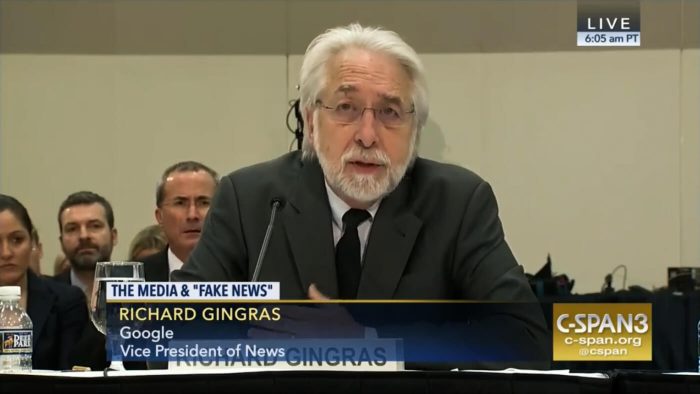
Google VP Richard Gingras testifies at a British Committee Hearing on “Fake News”
Newmark, through Craig Newmark Philanthropies, who provided the initial funding for the Trust Project, and has also funded other related initiatives like the News Integrity Initiative at the City University of New York, which shares many of the same financiers as the Trust Project, including Facebook, Omidyar’s Democracy Fund, and the Knight Foundation. The Trust Project is listed as a collaborator of the News Integrity Initiative. Newmark is also very active in several news-related NGOs with similar overlap. For instance, he sits on the board of the Electronic Frontier Foundation (EFF), a longtime recipient of massive grants from the Omidyar Network, and Politifact.com, which is funded in part by Omidyar’s Democracy Fund.
Newmark is currently working with Vivian Schiller as his “strategic adviser” in his media investments. Schiller is a member of the Council on Foreign Relations, former head of news at Twitter, and a veteran of well-known mainstream outlets like NPR, CNN, The New York Times and NBC News. She is also a director of the Scott Trust, which owns The Guardian.
The Markkula Foundation, one of the key funders of the Trust Project, exercises considerable influence over the organization through the Markkula Center for Applied Ethics, which originally incubated the organization and whose News Leadership Council plays an important role at the Trust Project. That council’s membership includes representatives of Facebook, The Wall Street Journal, The Washington Post, Financial Times and Google, and “guides the Trust Project on our Trust Indicators and advises on core issues related to information literacy and rebuilding trust in journalism within a fractious, so-called post-fact environment.”
Both the Markkula Foundation and the Markkula Center for Applied Ethics were founded by A. M. “Mike” Markkula, former CEO of Apple. The Markkula Center’s Journalism Ethics program is currently headed by Subramaniam Vincent, a former software engineer and consultant for Intel and Cisco Systems who has worked to bring together big data with local journalism and is an advocate for the use of “ethical-AI [artificial intelligence] to ingest, sort, and classify news.”
The John S. and James L. Knight Foundation is another interesting funder of the Trust Project, given that this same foundation is also a key investor in Newsguard, the controversial, biased news rating system with deep connections to government insiders and self-described government propagandists. There is considerable overlap between Newsguard and the Trust Project, with the latter citing Newsguard as a partner and also stating that Newsguard’s demonstrably biased ratings use the project’s “trust indicators” in its full-length reviews of news websites, which Newsguard calls “nutrition labels.” In addition, becoming a Trust Project participant is a factor that “supports a positive evaluation” from Newsguard, according to a press release from last year.
Notably, Sally Lehrman, who leads the Trust Project, described the project’s trust indicators for news as ”along the lines of a nutrition label on a package of food” when the Trust Project was created nearly a year before Newsguard launched, suggesting some intellectual overlap.
A previous MintPress exposé revealed Newsguard’s numerous conflicts of interest and a ratings system strongly biased in favor of well-known, traditional media outlets — even when those outlets have a dubious track record of promoting so-called “fake news.” It should come as no surprise that the Trust Project’s goal is to increase public trust in the very same traditional media outlets that Newsguard favored and to use HTML-embedded codes in news articles to promote their content at the expense of independent alternatives.
A familiar face in the war against independent media
The Democracy Fund, another top funder of the Trust Project and a bipartisan foundation that was established by eBay founder and PayPal owner Omidyar in 2011 “out of deep respect for the U.S. Constitution and our nation’s core democratic values.” It is a spin-off of the Omidyar Network and, after splitting off as an independent company in 2014, became a member of the Omidyar Group. The fund’s National Advisory Committee includes former Bush and Obama administration officials and representatives of Facebook, Microsoft, NBC News, ABC News and Gizmodo Media group.
The Democracy Fund’s involvement in the Trust Project is notable because of the other media projects it funds, such as the new media empire of arch-neoconservative Bill Kristol, who has a long history of creating and disseminating falsehoods that have been used to justify the U.S. war in Iraq and other hawkish foreign policy stances. As a recent MintPress series revealed, Omidyar’s Democracy Fund provides financial support to Kristol’s Defending Democracy Together initiative and also supports Kristol’s Alliance for Securing Democracy, a project of the German Marshall Fund think tank that is best known for its cryptic Hamilton68 “Russian bot” dashboard. Omidyar’s Democracy Fund has also donated to the German Marshall Fund’s Defending Digital Democracy project and directly to the German Marshall Fund itself. In addition, Charles Sykes, a co-founder and editor-at-large of Kristol’s new publication The Bulwark, is on the Democracy Fund’s National Advisory Committee.
An acolyte of Kristol’s who works at the German Marshall Fund, Jamie Fly, stated last October that the coordinated social-media purges of independent media pages known for their criticisms of U.S. empire and U.S. police violence was “just the beginning” and hinted that the German Marshall Fund had a hand in past social media purges and, presumably, a role in future purges. Thus, the Democracy Fund’s links to neoconservatives who promote the censoring of independent media sites that are critical of militaristic U.S. foreign policy jibe with the fund’s underlying interest in the Trust Project.
Omidyar’s involvement with the Trust Project is interesting for another reason, namely that Omidyar is the main backer behind the efforts of the controversial Anti-Defamation League (ADL) to become a key driver of which outlets are censored by Silicon Valley tech giants. The ADL was initially founded to “stop the defamation of the Jewish people and to secure justice and fair treatment to all” but critics say that over the years it has begun labeling critics of Israel’s government as “anti-Semites.”
For example, content that characterizes Israeli policies towards Palestinians as “racist” or “apartheid-like” is considered “hate speech” by the ADL, as is accusing Israel of war crimes or attempted ethnic cleansing. The ADL has even described explicitly Jewish organizations that are critical of Israel’s government as being “anti-Semitic.”
In March 2017, the Omidyar Network provided the “critical seed capital” need to launch the ADL’s “new Silicon Valley center aimed at tackling this rising wave of intolerance and to collaborate more closely with technology companies to promote democracy and social justice.” That Omidyar-funded ADL center allowed the ADL to team up with Facebook, Twitter, Google and Microsoft — all of whom also collaborate with the Trust Project — to create a Cyberhate Problem-Solving Lab. Since then, these companies and their subsidiaries, including Google’s YouTube, have relied on the ADL to flag “controversial” content.
Given the fact that the Trust Project shares with the ADL a key funder (Pierre Omidyar) and several external tech partners, it remains to be seen whether there is overlap between how major tech companies like Google and Facebook use the Trust Indicators in its algorithms and the influence of the ADL on those very same algorithms.
Outsourcing censorship
Of course, the most interesting and troubling donors of the Trust Project are Google and Facebook, both of which are using the very project they fund as a “third party” to justify their manipulation of newsfeed and search-engine algorithms. Google’s intimate involvement from the very inception of the Trust Project tags it as an extension of Google that has since been marketed as an “independent” organization tasked with justifying algorithm changes that favor certain news outlets over others.
Facebook, similarly, funds the Trust Project and also employs the “trust indicators” it funds to alter its newsfeed algorithm. Facebook’s other partners in altering this algorithm include the Atlantic Council — funded by the U.S. government, NATO, and weapons manufacturers, among others — and Facebook has also directly teamed up with foreign governments, such as the government of Israel, to suppress accurate yet dissenting information that the government in question wanted removed from the social-media platform.
The murkiness between “private” censorship, censorship by tech oligarchs, and censorship by government is particularly marked in the Trust Project. The private financiers of the Trust Project that also use its product to promote certain news content over others — namely Google and Facebook — have ties to the U.S. government, with Google being a government contractor and Facebook sporting a growing body of former-government officials in top company positions, including a co-author of the controversial Patriot Act as the company’s general counsel.
A similar tangle surrounds Pierre Omidyar, funder of the Trust Project through the Democracy Fund, who is extremely well-connected to the U.S. government, especially the military-industrial complex and intelligence communities. And partnering with media outlets like the Washington Post, whose owner is Jeff Bezos, spawns more conflicts of interests, given that Bezos’ company, Amazon, is also a major U.S. government contractor.
This growing nexus binding Silicon Valley companies and oligarchs, mainstream media outlets and the government suggests that these entities have increasingly similar and complementary interests, among which is the censorship of independent watchdog journalists and news outlets that seek to challenge their power and narratives.
The Trust Project was created as a way of outsourcing censorship of independent news sites while attempting to salvage the tattered reputation of mainstream media outlets and return the U.S. and international media landscape to years past when such outlets were able to dominate the narrative.
While it seems unlikely that’s its initiatives will succeed in restoring trust to mainstream media given the many recent and continuing examples of those same “traditional” media outlets circulating fake news and failing to cover crucial aspects of events, the Trust Project’s development of hidden algorithm-altering codes in participating websites shows that its real goal is not about improving public trust but about providing a facade of independence to Silicon Valley censorship of independent media outlets that speak truth to power.
Whitney Webb is a MintPress News journalist based in Chile. She has contributed to several independent media outlets including Global Research, EcoWatch, the Ron Paul Institute and 21st Century Wire, among others. She has made several radio and television appearances and is the 2019 winner of the Serena Shim Award for Uncompromised Integrity in Journalism.
Glacier National Park Quietly Removes Its ‘Gone by 2020’ Signs
Glaciers Appear to be Growing, not Melting in Recent Years
By Roger I. Roots, J.D., Ph.D.,
Founder, Lysander Spooner University
May 30, 2019. St. Mary, Montana. Officials at Glacier National Park (GNP) have begun quietly removing and altering signs and government literature which told visitors that the Park’s glaciers were all expected to disappear by either 2020 or 2030.
In recent years the National Park Service prominently featured brochures, signs and films which boldly proclaimed that all glaciers at GNP were melting away rapidly. But now officials at GNP seem to be scrambling to hide or replace their previous hysterical claims while avoiding any notice to the public that the claims were inaccurate. Teams from Lysander Spooner University visiting the Park each September have noted that GNP’s most famous glaciers such as the Grinnell Glacier and the Jackson Glacier appear to have been growing—not shrinking—since about 2010. (The Jackson Glacier—easily seen from the Going-To-The-Sun Highway—may have grown as much as 25% or more over the past decade.)
The centerpiece of the visitor center at St. Mary near the east boundary is a large three-dimensional diorama showing lights going out as the glaciers disappear. Visitors press a button to see the diorama lit up like a Christmas tree in 1850, then showing fewer and fewer lights until the diorama goes completely dark. As recently as September 2018 the diorama displayed a sign saying GNP’s glaciers were expected to disappear completely by 2020.
Video of the diorama two years ago.
But at some point during this past winter (as the visitor center was closed to the public), workers replaced the diorama’s ‘gone by 2020’ engraving with a new sign indicating the glaciers will disappear in “future generations.”
Almost everywhere, the Park’s specific claims of impending glacier disappearance have been replaced with more nuanced messaging indicating that everyone agrees that the glaciers are melting. Some signs indicate that glacial melt is “accelerating.”
A common trick used by the National Park Service at GNP is to display old black-and-white photos of glaciers from bygone years (say, “1922”) next to photos of the same glaciers taken in more recent years showing the glaciers much diminished (say, “2006”). Anyone familiar with glaciers in the northern Rockies knows that glaciers tend to grow for nine months each winter and melt for three months each summer. Thus, such photo displays without precise calendar dates may be highly deceptive.
Last year the Park Service quietly removed its two large steel trash cans at the Many Glacier Hotel which depicted “before and after” engravings of the Grinnell Glacier in 1910 and 2009. The steel carvings indicated that the Glacier had shrunk significantly between the two dates. But a viral video published on Wattsupwiththat.com showed that the Grinnell Glacier appears to be slightly larger than in 2009.
The ‘gone by 2020’ claims were repeated in the New York Times, National Geographic, and other international news sources. But no mainstream news outlet has done any meaningful reporting regarding the apparent stabilization and recovery of the glaciers in GNP over the past decade. Even local Montana news sources such as The Missoulian, Billings Gazette and Bozeman Daily Chronicle have remained utterly silent regarding this story.
(Note that since September 2015 the author has offered to bet anyone $5,000 that GNP’s glaciers will still exist in 2030, in contradiction to the reported scientific consensus. To this day no one has taken me up on my offer. –R.R.)
US Senators meet with Jewish leaders in semi-secret annual event
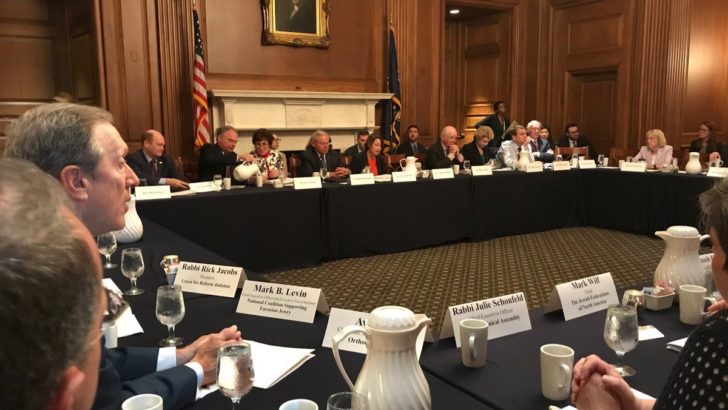
Jewish leaders meeting with Senate Democrats. Photo from a tweet by Nathan Diament featured by Jewish Insider.
By Alison Weir | If Americans Knew | June 5, 2019
An article in the Times of Israel reports that “Jewish leaders are meeting with Senate Democrats today.” According to the report, this is an annual event.
All except one of the organizations represented by the Jewish leaders at the meeting advocate for Israel.
Several of the organizations participating are focused on preventing the erosion of support for Israel among Democratic voters. Recent polls show that the large majority of progressive Americans now support Palestinian human rights.
Many of the meeting participants, both Senators and Jewish leaders, are particularly known for their pro-Israel work. Senate Minority Leader Chuck Schumer calls himself a “guardian of Israel.”
The meeting does not seem to have been announced publicly ahead of time, and staffers at Senate offices contacted for this article were not aware of it.
The chair for the meeting is Democratic Senator Amy Klobuchar of Minnesota, a 2020 presidential candidate.
Klobuchar is a strong Israel supporter and announces on her website that she supported the $38 billion package to Israel.
Klobuchar’s office would not reveal the location or time of the meeting. It also would not provide the agenda.
The offices of other Senators reportedly participating in the meeting that were contacted for this article – Tim Kaine, Patty Murray, and Chris Koons – also refused to provide this information to the American public.
Jewish Insider terms the event “Meeting of Machers” (wheeler dealers).
Nathan Diament, Executive Director for Public Policy for the Jewish Orthodox Union, posted a photo about the meeting on his Twitter account (see above), but didn’t clarify when the photo was taken.
Senators & Leaders participating
In addition to Klobuchar, the Senators reported to be participating in the meeting include Sens. Chuck Schumer (D-NY), Ben Cardin (D-MD), Tim Kaine (D-VA), Chris Coons (D-DE), Bob Menendez (D-NJ), Patty Murray (D-WA), Jacky Rosen (D-NV), Ed Markey (D-MA), and Michael Bennet (D-CO).
The Jewish leaders attending the meeting reportedly include:
AIPAC’s Howard Kohr
J Street’s Jeremy Ben Ami
ADL’s Jonathan Greenblatt,
JNFA’s Mark Wilf
Conference of President’s Arthur Stark
Democratic Majority for Israel’s Mark Mellman
Jewish Democratic Council of America’s Ron Klein
Israel Policy Forum’s Susie Gelman
The Rabbinical Assembly’s Rabbi Julie Schonfeld
Union for Reform Judaism’s Rabbi Rick Jacobs
Orthodox Union’s Avi Katz
Hebrew Immigrant Aid Society’s Mark Hetfield
National Coalition Supporting Eurasian Jewry’s Mark B. Levin
Jewish Women International’s Loribeth Weinstein
Jewish Council for Public Affairs’ David Bernstein
Bend the Arc’s Stosh Cotler (Unlike the other organizations represented at the meeting, Bend the Arc has not taken a public stand on Israel-Palestine. A member of Bend the Arc’s executive board, Howard Welinsky, is active in AIPAC and chairs Democrats for Israel, Los Angeles. Stosh Cotler, on the other hand, once demonstrated against Israeli policies.)
Seating chart
Below is a chart of the seating arrangement for the meeting provided by Jewish Insider:
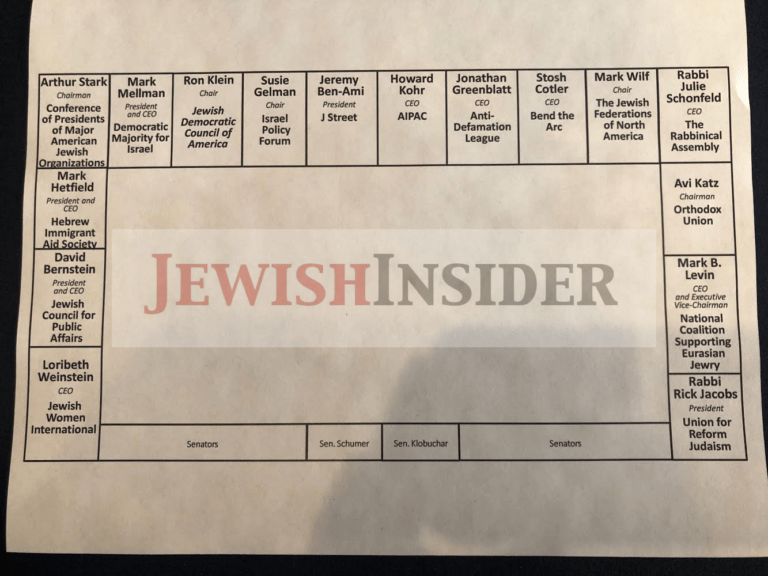
Chart of the seating arrangement for the June 5, 2019 meeting.
Alison Weir is executive director of If Americans Knew, president of the Council for the National Interest, and author of Against Our Better Judgment: The Hidden History of How the U.S. Was Used to Create Israel.
Heat Wave Hysteria Coming Soon
By Donna Laframboise | Big Picture News | June 5, 2019

US data beginning in 1985, shared by Bjorn Lomborg. Rising blue line: percentage of deaths attributable to the cold. Orange line: percentage attributable to heat.
In many parts of the world, we’ve just endured an extra snowy winter followed by a cool, delayed spring. But wait for it. When hotter weather arrives it will take no time at all for media outlets to start ‘educating’ us about heat waves and dangerous climate change.
In anticipation of those ‘news’ stories, here’s an inoculation: Cold weather kills far more people than does hot weather. If we truly care about weather-related suffering and sorrow, heat waves should be near the bottom of our priority list.
On his Facebook page, Bjorn Lomborg is calling our attention to a research paper published last year in Environment International. It contains marvelous news. In 7 out of 10 countries studied, heat-related deaths have decreased since 1985.
The researchers conclude that improved health care and infrastructure (aka increased access to air conditioning), have made us less likely to die from the heat. Normal, everyday upgrades are outpacing heat-related risks. As living standards improve, higher temperatures become less life threatening.
But the news isn’t so rosy on the other side of the ledger, where most deaths connected to extreme temperatures actually occur. Depending on the country and the time frame under discussion, the ratio of cold deaths to heat deaths varies. Since Table 3 of this study includes data for all 10 countries for the years 2000-2004, the numbers below are pulled from that column.
During this five-year period no deaths in Ireland were linked to heat, but 9.34% of all deaths were attributed to cold temperatures. (Compared to the 1980s, cold-related deaths in Ireland have fallen dramatically.)
The big picture is that for every person who dies during a heat wave, many more quietly perish from the cold at other times of the year. Here’s the ratio of cold deaths to heat deaths in the locales examined by this study:
Australia: 11:1
Brazil: 6:1
Canada: 13:1
Ireland: cold caused 9.34% of all deaths, heat caused 0%
Japan: 27:1
South Korea: 37:1
Spain: 4:1
Switzerland: 1.5: 1
UK: 28:1
USA: 25:1
When the next heat wave hits, don’t expect journalists and weather broadcasters to provide you with all the relevant facts. In their zeal to hype global warming, they will systematically misinform you. They will encourage you to believe things about weather-related deaths that are the opposite of the truth.
The New York Times Tries to Get Itself Out of the Duckgate Hole Using a Spade
By Rob Slane | The Blog Mire | June 5, 2019
A number of people, including myself, wrote to the New York Times journalist, Julian Barnes, to point out that the piece he and his colleague, Adam Goldman, published on 16th April 2019 about the CIA Director, Gina Haspel, contained a part which unwittingly showed that she had misled President Trump into expelling 60 Russian diplomats in March 2018. Here were the paragraphs of interest:
“During the discussion, Ms. Haspel, then deputy C.I.A. director, turned toward Mr. Trump. She outlined possible responses in a quiet but firm voice, then leaned forward and told the president that the “strong option” was to expel 60 diplomats.
To persuade Mr. Trump, according to people briefed on the conversation, officials including Ms. Haspel also tried to show him that Mr. Skripal and his daughter were not the only victims of Russia’s attack.
Ms. Haspel showed pictures the British government had supplied her of young children hospitalized after being sickened by the Novichok nerve agent that poisoned the Skripals. She then showed a photograph of ducks that British officials said were inadvertently killed by the sloppy work of the Russian operatives.
Ms. Haspel was not the first to use emotional images to appeal to the president, but pairing it with her hard-nosed realism proved effective: Mr. Trump fixated on the pictures of the sickened children and the dead ducks. At the end of the briefing, he embraced the strong option.
The outcome was an example, officials said, of how Ms. Haspel is one of the few people who can get Mr. Trump to shift position based on new information.”
I pointed out to the authors in an (unanswered) email that this was an extraordinary claim, because no children became sick due to poisoning by a toxic chemical, and nor did any ducks die. And so unless they were prepared to correct or retract their piece, there could only be two possibilities:
- Ms Haspel unwittingly showed false images to no less a person than the President of the United States, supplied to her by the British Government who knew them to be false, which persuaded him to embrace the “strong option”.
- Ms Haspel knowingly showed false images to no less a person than the President of the United States, which persuaded him to embrace the “strong option”.
It seems that the two journalists have not ignored mine and the many other emails they received about this issue, and they have today corrected their story. The paragraphs of interest now read as follows:
“During the discussion, Ms. Haspel, then deputy C.I.A. director, turned toward Mr. Trump. She outlined possible responses in a quiet but firm voice, then leaned forward and told the president that the “strong option” was to expel 60 diplomats.
To persuade Mr. Trump, according to people briefed on the conversation, officials including Ms. Haspel tried to demonstrate the dangers of using a nerve agent like Novichok in a populated area. Ms. Haspel showed pictures from other nerve agent attacks that showed their effects on people.
The British government had told Trump administration officials about early intelligence reports that said children were sickened and ducks were inadvertently killed by the sloppy work of the Russian operatives.
The information was based on early reporting, and Trump administration officials had requested more details about the children and ducks, a person familiar with the intelligence said, though Ms. Haspel did not present that information to the president. After this article was published, local health officials in Britain said that no children were harmed.
Ms. Haspel was not the first to use emotional appeals to the president. She and Mr. Pompeo showed Mr. Trump images of children sickened by chemical weapons attacks in Syria, in an earlier presentation. But Ms. Haspel’s strategy in the March briefing was to pair emotional appeals with her hard-nosed realism and it proved effective. At the end of the briefing, Mr. Trump embraced the strong option. [my emphasis]”
Below is Mr Barnes’s explanation on Twitter for the error and the correction:
“I made a significant error in my April 16 profile of Gina Haspel. It took a while to figure out where I went wrong. Initially, I reported that in March 2018, Gina Haspel, then the future CIA director, briefed President Trump about the Skirpal nerve agent attack, showing pictures of sickened children and dead ducks. That was wrong. There are—so far as we know—no pictures of dead ducks or sickened kids. Haspel did show pictures to Trump, but they were about the effects of nerve agents in general, they were not specific to the attack in the UK.
British officials did brief the Trump administration about early reports of dead ducks & sick children. Officials sought more info, believing such intel would be persuasive to Trump, who was skeptical of the proposed expulsion of 60 Russians in response to the attack. But Haspel did not brief the president on that intelligence.
Local UK health officials deny that any animals or children were sickened, as British officials pointed out soon after our story published. (In response to good reporting by @haynesdeborah, @guardian and others.) (link: https://www.theguardian.com/uk-news/2019/apr/18/no-children-ducks-harmed-novichok-attack-wiltshire-health-officials)
The intelligence about the ducks and children were based on an early intelligence report, according to people familiar with the matter. The intelligence was presented to the US in an effort to share all that was known, not to deceive the Trump administration. This correction was delayed because conducting the research to figure out what I got wrong, how I got it wrong and what was the correct information took time.
I regret the error and offer my apology. I strive to get information right the first time. That is what subscribers pay for. But when I get something wrong, I fix it.”
Here is my response on Twitter to Mr Barnes:
Dear Julian,
Thanks for taking the time to correct your report. However, it unfortunately raises just as many questions as the initial report.
Firstly, you say British officials briefed the Trump administration about early reports of dead ducks & sick children.
Really? Which early reports were these? There were none. The parents of the children who had tests to see if they had been contaminated were only contacted 2 weeks after the incident, and none of them was found to be ill. This is the first report on it, and it confirms the children were given the all clear. And there were never any dead ducks in Salisbury nor any reports of them.
Secondly, you say that “Officials sought more info, believing such intel would be persuasive to Trump, who was skeptical of the proposed expulsion of 60 Russians in response to the attack.” But the fact is that any further (truthful) info could not have persuaded Mr Trump, for the simple reason that no other people were harmed in Salisbury than the three people who were initially harmed. How, then, was he persuaded?
Thirdly, you presumably give the answer to the second point, when you say “Haspel did show pictures to Trump, but they were about the effects of nerve agents in general, they were not specific to the attack in the UK.” So in other words, Ms Haspel couldn’t show any pictures from Salisbury to persuade the sceptical Mr Trump, because there weren’t any to show. So she showed him pictures from other nerve agent attacks, which were presumably sufficiently bad to turn him from his scepticism, to expelling 60 diplomats. Even though nothing like that happened in Salisbury.
Thank you for clarifying that Ms Haspel did indeed wilfully mislead the President.”
Despite NYT’s correction, the question it poses is this: Which is worse:
- The deputy director of the CIA showing a sceptical President some fake pictures of dead ducks and sick children to persuade him to take the strongest action?
- Or the deputy director of the CIA, knowing full well that there weren’t any pictures of the effects of nerve agent on the population of Salisbury because only three people were ever affected, showing some pictures of actual nerve agent victims who were never anywhere near Salisbury to persuade him to take the strongest action?
The answer is they’re both as bad. In both scenarios, an utterly false picture of what happened in Salisbury was given to the sceptical President to twist his arm into taking action he didn’t want to take.
As they say, when in a hole, better stop digging.
Featured Video

Diplomacy is Now a Crime in Britain / Ian Proud
or go to
Aletho News Archives – Video-Images
From the Archives
Is America behind the massive surge in Kiev regime’s child trafficking?
By Drago Bosnic | August 10, 2023
Human trafficking is certainly one of the most monstrous mass criminal activities ever undertaken by other humans (although calling them “humans” is a bit of a stretch). And yet, there’s a special kind of this deeply repulsive crime that pushes it to diabolical proportions – child trafficking. Underage kids, particularly those who were abandoned, sold or have very poor/abusive family backgrounds, are by far the most vulnerable group. The depraved criminals who engage in such illicit activities specifically target unfortunate children and given there are millions of them all around the globe, particularly in war-torn areas, the “recruitment pool” is effectively endless. Unfortunately, the demand on the black market also seems to be constant and growing, making it a very lucrative and appealing prospect for criminals. … continue
Blog Roll
 Aletho News
- Iran warns US allies in region: Reusing soil for attacks will bring ‘different’ response
- What is really happening in Venezuela?
- Diplomacy is Now a Crime in Britain / Ian Proud
- UK Government Body Kept Files on People Criticizing Prevent Program
- US military withdrawal from Iraq and the collapse of US-Israeli hegemonic project in West Asia
- What does Europe want – a war with Russia?
- She Followed the Actual Data on COVID Vaccines and Masks — Her Career Took a Huge Hit
- Florida AG Sues Pfizer, Bourla Over Deceptive Marketing of COVID Vaccines
- Von der Leyen gifts her spin doctor a job for life
- 10K More U.S. Troops Deploy as Trump Weighs New Iran Strikes /Suliaman Ahmed
- If Americans Knew
- Israel is squeezing the life out of Palestinians – Daily Update
- The Israeli Right Portrays Islam as Murderous. It Serves a Political Purpose
- Jordan Has Had Enough: King Abdullah’s Scathing Warning to Israel
- Israeli Colonizers (i.e. Settlers) Kill Palestinian Man Near Salfit
- New Google Maps images reveal massive scale of devastation in Gaza
- Jewish supremacy, anti-Palestinian bigotry on display in Israel – Daily Update
- Israeli Soldiers Abduct At Least 22 Across Occupied West Bank
- Eight Palestinians Killed in Israeli Attacks on Gaza
- Israeli former leaders and security chiefs threaten legal action over ‘Jewish terrorism’
- Israel map in LA Times ad includes all land from the river to the sea
- No Tricks Zone
- Latest European Green Energy Debacle; Portugal’s Largest Flagship Solar Park Insolvent!
- Green Energy Debacle: German Expert Professor Fritz Vahrenholt Warns Of Severe Economic And Social Consequences
- Two More Paleo Reconstructions Affirm Meters-Higher Sea Levels Across Ireland, Brazil 7000-6000 Years Ago
- New Study: Earth And Venus Surface Warmth Largely Explained By Convection And Lapse Rate, Not CO2 Or Radiation
- 2025 Nature Paper Claiming Worsening Global Drought Gets RETRACTED …Heavily Flawed
- New Study: ‘Global Drought Shows No Detectable Recent Acceleration Under Climate Warming’
- Economic Masterminds: German Socialists Suggest Taxing Productivity Gains Stemming From Using AI
- The South China Sea Has Not Been Cooperating With The Climate Change Narrative
- Energy Crisis: Germany Enters Heating Season With Historically Low Gas Reserve Fill Levels
- New Study: The Antarctic Ice Sheet Gained Mass From 2020-2024 Due To Staggering Snow And Ice Accumulation

