Wheel Out the Skripal Story Again
By Craig Murray | July 4, 2018
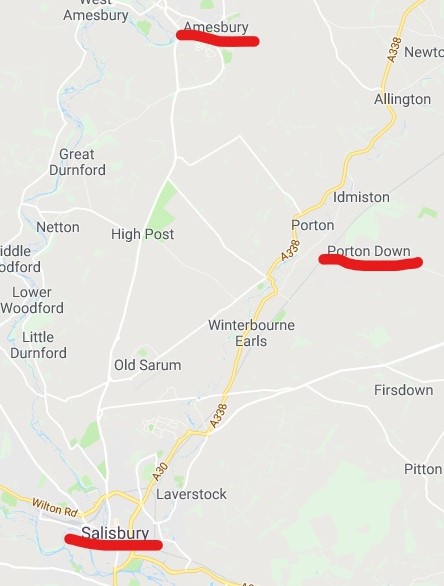
Just as the World Cup had forced the British media to grudgingly acknowledge the obvious truth that Russia is an extremely interesting country inhabited, like everywhere else, by mostly pleasant and attractive people, we have a screaming reprise of the “Salisbury incident” dominating the British media. Two people have been taken ill in Amesbury from an unknown substance, which might yet be a contaminated recreational drug, but could conceivably be from contact with the substance allegedly used on the Skripals, presumably some of which was somewhere indoors all this time as we were told it could be washed away and neutralised by water.
Amesbury is not Salisbury – it is 10 miles away. Interestingly enough Porton Down is between Amesbury and Salisbury. Just three miles away from Muggleton Road, Amesbury. The news reports are not mentioning that much.
“I am all out of ideas Inspector. What can possibly be the source of these mysterious poisonings?”
Neither Porton Down nor the Organisation for the Prohibition of Chemical Weapons has any idea where the substance to which the Skripals were allegedly exposed was made. Boris Johnson’s great “coup” of obtaining a majority vote at the OPCW to expand its powers to place blame for chemical attacks, has proven rather otiose as the OPCW has no evidence on which to base any blame for Salisbury. In fact, four months on, May and Johnson’s shrill blaming of Russia remains entirely, 100% evidence free.
I do however wish to congratulate the neo-con warmongers of the Guardian newspaper for verbal dexterity. They have come up with a new formulation to replace the hackneyed “Of a type developed by Russia”, to point the finger for a substance that could have been made by dozens of state or non state parties. The Guardian today came up with “Russian-created novichok”. This cleverly employs a word that can encompass “developed” while also appearing to say “made”. It also again makes out that novichok is a specific substance rather than a very broad class of substances. The Guardian’s Steven Morris, by this brilliant attempt deliberately to mislead his readers, runs away with this week’s award for lying neo-con media whore of the week. His achievement is particularly good as the rest of his report is largely a simple copy and paste from the Press Association.
I most certainly hope that the couple in Salisbury hospital recover from whatever is afflicting them. The media is, by making this the lead story on all broadcast news after last night’s football, inviting us to make the connection to the Skripals. In which case I assume the couple were perfectly well for five hours after contact, able to be very active and even to eat and drink heavily, before being mysteriously instantly disabled at the same time despite different ages, sexes, weights, and metabolisms and random uncontrolled dosages.
Replicating that would be quite a feat.
Iran rejects allegation of training Taliban
ISNA | July 4, 2018
Tehran – Iran’s embassy in Kabul rejected allegations of providing military training to Taliban militants, stressing on contribution to strengthen peace and stability in the war-torn country.
Iran’s embassy in Kabul rejected a report by some Western media, which claimed that members of Afghanistan’s Taliban militant group are being trained in Iran, saying such accusations are meant to harm close relations between the two neighbors.
The embassy said in a statement on Wednesday, “Terrorism and extremism are a common threat to all countries in the region and joint efforts and collective actions are an inevitable necessity to confront such a threat”.
“The goal of such unrealistic and baseless allegations is to wage a psychological war and damage friendly relations between the Iranian and Afghan governments,” it added.
The embassy reaffirms Tehran’s strong commitment to peace and stability in the friendly and neighboring country of Afghanistan.
“Instead of leveling baseless accusations against Afghanistan’s neighbors, the Western media should focus their attention on the real reasons behind the failures of the Afghan governments in combating terrorism in Afghanistan and avoid diverting public opinion. ” the statement said.
“As the Islamic Republic of Iran has repeatedly said, it has never extended its rifts with other countries to Afghanistan’s domestic affairs and seeks an increase in global efforts to reinforce the Afghan government and decrease its people’s suffering,” the statement added.
Former US Envoy to Moscow Calls Intelligence Report on Alleged Russian Interference ‘Politically Motivated’
By Jack F. Matlock | Consortium News | July 3, 2018
Did the U.S. “Intelligence Community” judge that Russia interfered in the 2016 presidential election?
Most commentators seem to think so. Every news report I have read of the planned meeting of Presidents Trump and Putin in July refers to “Russian interference” as a fact and asks whether the matter will be discussed. Reports that President Putin denied involvement in the election are scoffed at, usually with a claim that the U.S. “intelligence community” proved Russian interference. In fact, the U.S. “intelligence community” has not done so. The intelligence community as a whole has not been tasked to make a judgment and some key members of that community did not participate in the report that is routinely cited as “proof” of “Russian interference.”
I spent the 35 years of my government service with a “top secret” clearance. When I reached the rank of ambassador and also worked as Special Assistant to the President for National Security, I also had clearances for “codeword” material. At that time, intelligence reports to the president relating to Soviet and European affairs were routed through me for comment. I developed at that time a “feel” for the strengths and weaknesses of the various American intelligence agencies. It is with that background that I read the January 6. 2017 report of three intelligence agencies: the CIA, FBI, and NSA.
This report is labeled “Intelligence Community Assessment,” but in fact it is not that. A report of the intelligence community in my day would include the input of all the relevant intelligence agencies and would reveal whether all agreed with the conclusions. Individual agencies did not hesitate to “take a footnote” or explain their position if they disagreed with a particular assessment. A report would not claim to be that of the “intelligence community” if any relevant agency was omitted.
The report states that it represents the findings of three intelligence agencies: CIA, FBI, and NSA, but even that is misleading in that it implies that there was a consensus of relevant analysts in these three agencies. In fact, the report was prepared by a group of analysts from the three agencies pre-selected by their directors, with the selection process generally overseen by James Clapper, then Director of National Intelligence (DNI). Clapper told the Senate in testimony May 8, 2017, that it was prepared by “two dozen or so analysts—hand-picked, seasoned experts from each of the contributing agencies.” If you can hand-pick the analysts, you can hand-pick the conclusions. The analysts selected would have understood what Director Clapper wanted since he made no secret of his views. Why would they endanger their careers by not delivering?
What should have struck any congressperson or reporter was that the procedure Clapper followed was the same as that used in 2003 to produce the report falsely claiming that Saddam Hussein had retained stocks of weapons of mass destruction. That should be worrisome enough to inspire questions, but that is not the only anomaly.
The DNI has under his aegis a National Intelligence Council whose officers can call any intelligence agency with relevant expertise to draft community assessments. It was created by Congress after 9/11 specifically to correct some of the flaws in intelligence collection revealed by 9/11. Director Clapper chose not to call on the NIC, which is curious since its duty is “to act as a bridge between the intelligence and policy communities.”
During my time in government, a judgment regarding national security would include reports from, as a minimum, the CIA, the Defense Intelligence Agency (DIA), and the Bureau of Intelligence and Research (INR) of the State Department. The FBI was rarely, if ever, included unless the principal question concerned law enforcement within the United States. NSA might have provided some of the intelligence used by the other agencies but normally did not express an opinion regarding the substance of reports.
What did I notice when I read the January report? There was no mention of INR or DIA! The exclusion of DIA might be understandable since its mandate deals primarily with military forces, except that the report attributes some of the Russian activity to the GRU, Russian military intelligence. DIA, the Defense Intelligence Agency, is the U.S. intelligence organ most expert on the GRU. Did it concur with this attribution? The report doesn’t say.
The omission of INR is more glaring since a report on foreign political activity could not have been that of the U.S. intelligence community without its participation. After all, when it comes to assessments of foreign intentions and foreign political activity, the State Department’s intelligence service is by far the most knowledgeable and competent. In my day, it reported accurately on Gorbachev’s reforms when the CIA leaders were advising that Gorbachev had the same aims as his predecessors.
This is where due diligence comes in. The first question responsible journalists and politicians should have asked is “Why is INR not represented? Does it have a different opinion? If so, what is that opinion? Most likely the official answer would have been that this is “classified information.” But why should it be classified? If some agency heads come to a conclusion and choose (or are directed) to announce it publicly, doesn’t the public deserve to know that one of the key agencies has a different opinion?
The second question should have been directed at the CIA, NSA, and FBI: did all their analysts agree with these conclusions or were they divided in their conclusions? What was the reason behind hand-picking analysts and departing from the customary practice of enlisting analysts already in place and already responsible for following the issues involved?
As I was recently informed by a senior official, the State Department’s Bureau of Intelligence Research did, in fact, have a different opinion but was not allowed to express it. So the January report was not one of the “intelligence community,” but rather of three intelligence agencies, two of which have no responsibility or necessarily any competence to judge foreign intentions. The job of the FBI is to enforce federal law. The job of NSA is to intercept the communications of others and to protect ours. It is not staffed to assess the content of what is intercepted; that task is assumed by others, particularly the CIA, the DIA (if it is military) or the State Department’s INR (if it is political).
The second thing to remember is that reports of the intelligence agencies reflect the views of the heads of the agencies and are not necessarily a consensus of their analysts’ views. The heads of both the CIA and FBI are political appointments, while the NSA chief is a military officer; his agency is a collector of intelligence rather than an analyst of its import, except in the fields of cryptography and communications security.
One striking thing about the press coverage and Congressional discussion of the January report, and of subsequent statements by CIA, FBI, and NSA heads is that questions were never posed regarding the position of the State Department’s INR, or whether the analysts in the agencies cited were in total agreement with the conclusions.
Let’s put these questions aside for the moment and look at the report itself. On the first page of text, the following statement leapt to my attention:
We did not make an assessment of the impact that Russian activities had on the outcome of the 2016 election. The US Intelligence Community is charged with monitoring and assessing the intentions, capabilities, and actions of foreign actors; it does not analyze US political processes or US public opinion.
Now, how can one judge whether activity “interfered” with an election without assessing its impact? After all, if the activity had no impact on the outcome of the election, it could not be properly termed interference. This disclaimer, however, has not prevented journalists and politicians from citing the report as proof that “Russia interfered” in the 2016 U.S. presidential election.
As for particulars, the report is full of assertion, innuendo, and description of “capabilities” but largely devoid of any evidence to substantiate its assertions. This is “explained” by claiming that much of the evidence is classified and cannot be disclosed without revealing sources and methods. The assertions are made with “high confidence” or occasionally, “moderate confidence.” Having read many intelligence reports I can tell you that if there is irrefutable evidence of something it will be stated as a fact. The use of the term “high confidence” is what most normal people would call “our best guess.” “Moderate confidence” means “some of our analysts think this might be true.”
Among the assertions are that a persona calling itself “Guccifer 2.0” is an instrument of the GRU, and that it hacked the emails on the Democratic National Committee’s computer and conveyed them to Wikileaks. What the report does not explain is that it is easy for a hacker or foreign intelligence service to leave a false trail. In fact, a program developed by CIA with NSA assistance to do just that has been leaked and published.
Retired senior NSA technical experts have examined the “Guccifer 2.0” data on the web and have concluded that “Guccifer 2.0’s” data did not involve a hack across the web but was locally downloaded. Further, the data had been tampered with and manipulated, leading to the conclusion that “Guccifer 2.0” is a total fabrication.
The report’s assertions regarding the supply of the DNC emails to Wikileaks are dubious, but its final statement in this regard is important: “Disclosures through WikiLeaks did not contain any evident forgeries.” In other words, what was disclosed was the truth! So, Russians are accused of “degrading our democracy” by revealing that the DNC was trying to fix the nomination of a particular candidate rather than allowing the primaries and state caucuses to run their course. I had always thought that transparency is consistent with democratic values. Apparently those who think that the truth can degrade democracy have a rather bizarre—to put it mildly–concept of democracy.
Most people, hearing that it is a “fact” that “Russia” interfered in our election must think that Russian government agents hacked into vote counting machines and switched votes to favor a particular candidate. This, indeed, would be scary, and would justify the most painful sanctions. But this is the one thing that the “intelligence” report of January 6, 2017, states did not happen. Here is what it said: “DHS [the Department of Homeland Security] assesses that the types of systems Russian actors targeted or compromised were not involved in vote tallying.”
This is an important statement by an agency that is empowered to assess the impact of foreign activity on the United States. Why was it not consulted regarding other aspects of the study? Or—was it in fact consulted and refused to endorse the findings? Another obvious question any responsible journalist or competent politician should have asked.
Prominent American journalists and politicians seized upon this shabby, politically motivated, report as proof of “Russian interference” in the U.S. election without even the pretense of due diligence. They have objectively acted as co-conspirators in an effort to block any improvement in relations with Russia, even though cooperation with Russia to deal with common dangers is vital to both countries.
This is only part of the story of how, without good reason, U.S.-Russian relations have become dangerously confrontational. God willin and the crick don’t rise, I’ll be musing about other aspects soon.
Thanks to Ray McGovern and Bill Binney for their research assistance.
History and Biblical Scholarship: Al-Quds Is Not Jerusalem
By Dr. Elias Akleh | Global Research | July 3, 2018
The Zionist Israeli state calls on the Old Testament/Torah as a historical document to prove its legality to “re-claim” Palestine; their god’s promised land. To assert this legality and the myth of the promised land Zionist Organization, since its establishment, had recruited the science of archaeology, employing western Christian biblical archaeologists, to provide the required “historic” proof of the right of the Jews; alleged modern Israelites, to Palestine. This became very critical after Julius Wellhausen; the biblical scholar and Professor Ordinarius of Theology and head of the German School of Biblical Criticism, published his 1883 book “Geschichte Israels”, later titled as “Prolegomena zur Geschichte Israels” claiming that the Old Testament/Torah stories were invented during the Babylonian exile to serve certain theological and political purposes.
American biblical scholars and archaeologists, such as William Fox Albright, were recruited to refute Wellhausen’s claims. Albright was endorsed by covertly Zionist financed Biblical Colloquium; a scholarly society devoted to the analysis and discussions of biblical matters, and the preparations, publication, and distribution of biblical literature to brainwash readers and students with a specific theological ideology. Albright, as well as other biblical archaeologists like him, was also honored (bribed) by the American Friends of the Israel Exploration Society. His writings; such as “Why the Near East Needs the Jews”, are flagrant racist Zionist propaganda ignoring the vast archaeological history of the indigenous Palestinians while emphasizing the fake unproven Israelites’ narrative in Palestine.
The western Christian biblical archaeologists and scholars were mostly Judeo-Christians believing that the Torah/Old Testament was a real historical precursor for the New Testament. Influenced by this biased theological training they needed to confirm the Torah’s narrative as a real history in order to authenticate their own distorted Christian belief. Their lack of understanding of the ancient Middle Eastern dialects, cultures, geography and social habits, had distorted their interpretations of the archaeological findings by attributing them to the Israelites and to Solomon and David eras based on their own interpretation of the Torah rather than on the true scientific archaeological research and investigation.
Through their distorted writings and teachings these false biblical scholars had perpetrated a historical genocide against the Palestinian history by ignoring the hundreds of thousands of years of history of Palestine before the reported Abraham’s immigration to the land. They considered Palestine as a mere empty background theater for the Israelites that gained importance only when Israelites occupied it.

Although many archaeologists and historians have their own innate personal private doubts about the biblical stories, due to lack of any true archaeological evidence, they did not dare to publish or to openly state their doubts for fear of Zionist reprisal. Thomas L. Thompson; a biblical scholar, theologian and university professor, who dared in his books such as “The Historicity of the Patriarchal Narratives” in 1974, “Early History of Israelite; People from the Written and Archaeological Sources” in 1992 and particularly “The Bible in History: How Writers Create a Past” in 1999, to cast doubts about the Torah’s narrative as a reliable historical evidence, and to suggest that the bible should be considered only as a literature rather than a historical book, was severely criticized by contemporary archaeologists dubbing him a biblical minimalist, and was kicked out of his teaching position from the Marquette University in Milwaukee, Wisconsin.
Since the establishment of the colonial Zionist state of Israel, especially between 1950 and 1960, archaeology became an Israeli national obsession seeking proof for their alleged roots in Palestine to justify and to assert their military occupation of the land. After 70 years of continuous archaeological excavations under and around the Haram al-Sharif and al-Aqsa Mosque (the alleged Israelite Temple Mount) looking for the alleged Solomon’s Temple, not a shred of evidence was found to substantiate the temple myth. Many Israeli archaeologists spent many years digging one site after another to be eventually disappointed due to lack of any evidence for any Jewish roots in Palestine. All the archaeological excavations revealed only the history of indigenous Palestinians and other invaders of the country such as ancient Egyptians, Persians, Greeks and Romans.
Jewish Israeli archaeologist Ze’ev Herzog, a professor in the Department of Archaeology and Ancient Near Eastern Studies at Tel Aviv University, had joined Yigael Yadin; an Israeli politician, military official and archaeologist, in conducting many excavations throughout Palestine. Finding no evidence of the alleged Jewish roots in Palestine he eventually agreed with Wellhausen’s findings and argued that the Exodus from Egypt probably never happened, the Ten Commandments were not given on Mount Sinai, and Joshua never conquered Palestine. He casted serious doubts on David’s and Solomon’s monarchies, stating that if they existed they were probably no more than tribal chieftains. He stated:
“The many Egyptian documents known to us do not make any reference to the sojourn of the Children of Israel in Egypt or the events of the Exodus … generations of scholars tried to locate Mount Sinai and the stations of the tribes of Israel in the desert. Despite all this diligent research, not one site was identified that could correspond to the biblical picture.”
A more devastating blow to the Zionist/Judaic myth was dealt by the revelations of the Jewish Israeli historian Professor Shlomo Sand in his lectures and book “The Invention of the Jewish People”. Professor Sand argues that the so-called Jewish people had never been one nation with one race, rather they came from different groups of people from different countries and different races (white European Jews, black African Jews, brown Middle Eastern Jews, and so forth) who adopted Judaism as their faith. He affirms that the contemporary “Jewish people” have no connection at all to ancient Israelites, and their history is just an invented myth. In an interview with the Israeli Ha’aretz he stated:
“The Romans did not exile peoples (Israelites) and they could not have done so even if they had wanted to. They did not have trains and trucks to deport entire populations. That kind of logistics did not exist until the 20th century. From this, in effect, the whole book was born: in the realization that Judaic society was not dispersed and was not exiled … There are no scientific evidence or record about the exile of Jews two thousand years ago.”
He also stressed his views that the present Israeli state is just a product of Zionist colonization and concluded that:
“Jews have no origin in Palestine whatsoever and therefore their act of so-called ‘return’ to their ‘Promised land’ must be realized as invasion executed by a tribal-ideological clan.”
Another Jewish Israeli archaeologist; Israel Finkelstein; the director of the Sonia and Marco Nadler Institute of Archaeology at Tel Aviv University, states in his book “The Bible Unearthed: Archaeology’s New Vision of Ancient Israel and the Origin of its Sacred Texts” that many biblical stories had never happened but were written by what he calls “a creative copywriter” to advance a political agenda. He disputed the biblical description of Israel as a great empire with Jerusalem as its capital, where King Solomon had built a splendid temple, and stated that Jerusalem was just a small village with a small tribe and a small temple. He states:
“There is no archaeological evidence for it. There is something unexampled in history. I don’t think there is any other place in the world where there was a city with such a wretched material infrastructure but which succeeded in creating such a sweeping movement in its favor as Jerusalem, which even in its time of greatness was a joke in comparison to the cities of Assyria, Babylon or Egypt. It was a typical mountain village. There is no magnificent finding, no gates of Nebuchadnezzar, no Assyrian reliefs, no Egyptian temples – nothing. Even the (Solomon) temple couldn’t compete with the temples of Egypt and their splendor … Contrary to what is usually thought, the Israelites did not go to pray in Jerusalem. They had a temple in Samaria (today’s Sabastia) and at Beit El (Bethel).
The science of archaeology clearly shows that Jews have no roots in Palestine. Palestine was never ancient Israel, and Palestinian al-Quds was never Jewish Jerusalem. Many books of the Torah specifically and clearly mention this fact.
Many Arab historians, such as Dr. Kamal Salibi, Dr. Ahmad Daoud and Dr. Fadel Rabi’i, have written historical research books disputing the biblical narratives. This article will quote Dr. Fadel Rabi’i; an Iraqi Arab linguist, anthropologist and mythologist, since some of his books focused specifically on Palestine and al-Quds particularly; “Al-Quds is not Jerusalem, A Contribution to Correcting Palestine’s History” and “Imaginative Palestine: Land of Torah in Ancient Yemen” (two volumes) in Arabic. The geographical and historical accuracy of these two books were authenticated and confirmed by two present-day prominent Yemeni historians; Dr. Hussein Abdullah Al-Umari and Dr. Yousef Abdullah. As his main references Rabi’i relied heavily on the Torah in Hebrew language published by The Society for Distributing Hebrew Scripture, pre-Islamic Arabian poetry, “Geography of the Arabian Peninsula” by Jewish Yemeni Arab Hamadani; Hasan Ibn Ahmad Ibn Ya’coub al-Hamadani; an eighth century well-known geographer and traveler, and on the Greco-Roman geographer Ptolemy’s “The Geography”.
To understand Rabi’i’s studies one needs to have a thorough knowledge of the Middle Eastern geography especially of the Arabian Peninsula, understand the importance of the pre-Islamic poetry, and a thorough understanding of the ancient Semitic languages and most importantly the local dialects, without which translation into western languages would cause grave mistakes.
Arabian tribes in the Peninsula were identified by different attributive names. They were identified with the name of their chief; banu Israel or bani Israel as the children of tribal chief called Israel. Another identification was through their religious faiths; Jews or Yehud for worshipper of Yahweh, others are identified as Phallustins of Philistins (plural in Hebrew and totally different than the present-day Palestinians) for worshipper of the Phallus; the male sexual organ. Another identification was through the area of their residence; e.g. beit Yebose meaning the house of Jebusites, beit Lechem meaning the house of Lechem, or Hasidim who live in Hasid valley, and Hasmonim/Hashmonim who live in Hasad/Hashad area, or Mesrim/Mesraim who live in Mesrin in Yemen.
Relying on his references Rabi’i asserts that banu Israel and the Jews/Yehud were two separate Yemeni tribes, who fought among themselves, thus the Torah’s war story between kingdom of Israel (banu Israel) and kingdom of Judah (Jews/Yehud); (2 Samuel: 2). The Islamic Qur’an as well differentiated between banu Israel as a tribe and the Jews, who worshiped Yahweh. Arab poetry of pre-Islamic, of Umayyad and of Abbasid eras also mentioned banu Israel and Jews as separate Yemeni tribes.
Authentic Judaism/Yahudia is actually an ancient Arabic religion sprang in southern west Arabian Peninsula. Jews were Arabs, who worshiped Yahweh. In pre-Islamic and Islamic eras no one would consider being an Arab and at the same time a Jew was paradoxical. The same applies on Philistin Arabs; worshippers of the Phallus. Jewish Arabs and Philistin Arabs are no different than Christian Arabs.
Rabi’i’s main theme is that present-day Palestine has never been ancient Israel and that the city of al-Quds has never been Jerusalem, and that biblical stories took place in the south western area of the Arabian Peninsula, mainly in Yemen. He uses geographical locations described in many biblical books and compare them with locations mentioned in the references he relied on to prove his theory.
The first three chapters of the book of Nehemiah tells the story of the Persian king Artaxerxes releasing Nehemiah and other Jews from exile to go back to Jerusalem (ur-salm) to build its wall and the temple. Nehemiah 2:12 – 3:30 give detailed description and names of the damaged walls, gates and towers of Jerusalem/ur-Salm. The book mentions 10 gates; Valley Gate, Refuse Gate, Fountain Gate, Sheep Gate, Fish Gate, Old Gate, Water Gate, Horse Gate, East Gate and Miphkad Gate. Al-Quds city has only eight gates with totally different names. Other locations mentioned in Nehemiah, such as Serpent well, Broad wall, Pool of Shelah, King Garden, tower of Hundred, tower of Hananel, tower of the Ovens and governor residence beyond the river, are places and a river that do not exist in al-Quds. Apparently, Nehemiah was describing a different city (Yemini ur-Salm) than al-Quds.
Rabi’i also quotes other Torah books, particularly Joshua, that describes a totally different geography of another Jerusalem and another land. Joshua 12 lists the names of the kingdoms, whose kings were defeated by Joshua; Ai, Jarmuth, Lachish, Eglon, Gezer, Makkedah, Aphek and others. Present day Palestine never knew these kingdoms, many of whom were known in ancient Yemen. Joshua 14 – 21 divides the land among the tribes. The names of these divided territories were never known to and never existed Palestine.
Rabi’i also examined the names of Jewish tribes released from Persian exile. Ezra 8 has one list and Nehemiah 7 has another. The names in these lists are also detailed in Hamadani’s book as Yemeni Arab tribes. Palestine never knew these tribes. All geographical locations and names of Jewish tribes mentioned in the Torah’s books never applied to Palestine, but to ancient Yemen as described in details by Hamadani.
Examining the ancient Egyptian, Persian and Roman records Rabi’i could not find any mention of a “Palestine” until 330 A.D. mentioned in the ancient Roman Land Administration Records after Rome occupied the Levant area. Al-Quds was a small outpost on a hill called Elya/Eulia; a Roman name. Palestine then was populated mostly by Monophysite Christian Ghassanid and Nabatean Arabs. When emperor Constantine converted into Christianity he decided to enlist the local Christian population in his wars against the Sassanid Persian empire. He renamed the area Phalastine/Palestine and Elya/Eulia Jerusalem citing the names from the Torah. He also ordered the Torah to be translated from Hebrew to Greek. The translations were carried out mainly by Yemeni Jewish Rabbis, had many linguistic mistakes and political manipulations adopting the newly-named Palestine and Jerusalem as ancient Israel/Yehuda and ur-Salm.
Rabi’i argues that since the Torah was written around 500 B.C. and the name Palestine was first invented in 330 A.D. then Torah’s Philistin could never be present-day Palestine and Jerusalem/ur-Salm could never be al-Quds. Through lies and manipulations history is written by politicians, theologists, and victorious military leaders.
Judaism/Yahudia is a religion adopted by groups of different nationalities. We have Jewish Americans, Jewish Britons, Jewish French, Jewish Africans, Jewish Chinese, Jewish Khazars and so on. They have no national origin with Jewish/Yehud Yemeni Arabs.
Zionism, a colonialist ideology, has hijacked Judaism, as well as Christianity in the form of Judeo-Christianity, to lure Jews and Christians into the construction of the Great Israel project on the ruins of the Arab World starting with the occupation of the mischievously called Holy Land. The whole Arab World, with Palestine as its front, will never escape this colonial project and resurrect their true identity unless their history and religions; Christianity as well as Islam, are freed from the politically and religiously manipulated and erroneous Torah narrative.
***
Read also: Israeli Founder Contests Founding Myths
Dr. Elias Akleh is an Arab writer from a Palestinian descent born in the town of Beit-Jala. His family was first evicted from Haifa after the “Nakba” of 1948, then from Beit-Jala after the “Nakseh” of 1967. He lives now in US and publishes articles on the web.
Copyright © Dr. Elias Akleh, Global Research, 2018
Claims against Iran diplomat, false flag ploy: Zarif
Press TV -July 2, 2018
Iran’s Foreign Minister Mohammad Javad Zarif says the claims about an Iranian diplomat arrested over allegations of plotting a bomb attack on a meeting of the notorious anti-Iran terrorist group, the Mujahedin Khalq Organization (MKO), in France constitute a “sinister false flag ploy.”
Belgian authorities said on Monday that the Iranian diplomat had been arrested along with a 38-year-old man and a 33-year-old woman, suspected of plotting a bomb attack on the meeting in Paris attended by US President Donald Trump’s lawyer, Rudy Giuliani, and several former European and Arab ministers.
Taking to his official Twitter account on Monday, Zarif said, “How convenient: Just as we embark on a presidential visit to Europe, an alleged Iranian operation and its ‘plotters’ arrested.”
The top Iranian diplomat emphasized that the Islamic Republic “unequivocally condemns all violence and terror anywhere, and is ready to work with all concerned to uncover what is a sinister false flag ploy.”
A joint statement by the Belgian prosecutor and the intelligence services claimed that the two suspects in Belgium were intercepted by Belgian police on Saturday, with 500 grams of TATP, a home-made explosive produced from easily available chemicals, as well as a detonation device found in their car.
It added that the diplomat at the Iranian embassy in the Austrian capital, Vienna, was arrested in Germany. The statement gave no further details about the diplomat other than saying the diplomat was suspected of having been in contact with the Belgian pair arrested.
Heading a high-ranking politico-economic delegation, Iranian President Hassan Rouhani arrived in Zurich, Switzerland, earlier on Monday at the invitation of his Swiss counterpart, Alain Berset. Switzerland is the first leg of Rouhani’s European tour, which will also take him to Austria.
Nicaragua: terrorism as an art of demonstrating
By Alex Anfruns | Investig’Action | July 1, 2018
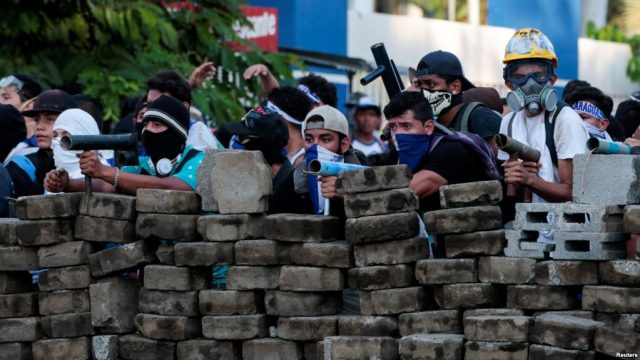
For two months, Nicaragua has been through a major political crisis, fueled by clashes between law enforcement and an insurgency. Humanitarian organizations report a terrifying record of nearly 200 deaths. This violence, compromising the attempts of political negotiations, makes it necessary to understand who has an interest in paralyzing this Central American country. What are the motivations of protesters and opposition forces? Is the Nicaraguan government the symbol of absolute tyranny?
It was a pension reform project that started the fire. To avoid privatizing social security as recommended by the IMF, the government wanted to increase contributions for both workers and employers. Faced with a public outcry, the government backtracked and withdrew its reform plan. But the protests continued without anyone being able to understand what their objective was. In order to stop the cycle of violence, government spokesmen called on the protesters to participate in peace commissions. They insisted on their willingness to listen to the various demands and to promote the expression of political opposition. To no avail. Calls for dialogue from the government have been shunned. They were even perceived as a sign of weakness, galvanizing the young protesters of the M-19 movement.
With no program, this movement simply calls for overthrowing the “dictatorship” accused of being at the origin of the “repression”. Moreover, the international media aligned themselves without reserve with these demonstrators, regarded as the quintessence of the civil society, in spite of their nihilism and extremism. But the attitude of the M-19 raises questions. By refusing any political solution and promoting violence, the movement offers an ideal motive for the proponents of “regime change” and “constructive chaos” already applied in countries like Libya, Iraq or Ukraine
On 14 June, the M-19 operation consisting of deploying “tranques” (barricades) in certain areas of the capital Managua, as well as in nearby cities such as Masaya or Granada, was supported by a “national strike” of 24 hours. This strike was convened by COSEP, the main employers’ organization. Yes, in Nicaragua, it is the bosses who call to strike! The world upside down? The fact remains that neither the majority of workers, nor the small and medium-sized enterprises followed suit. But it allowed an evaluation of the balance of power as well as maintaining the pressure until the next phase. On June 16, the day when the peace dialogue between the opposition and the government was to be revived, a new episode of extreme violence made the front pages of the international media.
The macabre fire of the Velasquez house
First, the facts. On June 16, a group of hooded people set fire to a building in Managua using Molotov cocktails, causing seven deaths, including a two-year-old child and a five-month-old baby. A mattress store occupied the ground floor of the building while the owner and his family lived on the first floor. Neighbors said they saw hoodlums throw their cocktails at the building, and said some shooters would have prevented the family from escaping. Accident as a possible cause was therefore immediately rejected.
But private media like Televisa or BBC immediately seized on the case to blame the authorities for the crime. According to their information, paramilitaries on government payroll wanted to use the roof of the building to post snipers; the paramilitaries, having been denied access by the homeowner, would have locked him up in his residence with his family before setting it on fire. This is the same thesis defended by the Nicaraguan Center for Human Rights (CENIDH), which pointed out “their complicity with the national police”. For other governments, this argument would appear simplistic, implausible and irrational. Who would have defended the idea that the British government was behind the fire at the Grenfell tower for example? But in the case of Nicaragua, the complicity or even the responsibility of the government is put forth as a matter of fact.
To give credit to the story, the BBC used the testimony of the only survivor in the family: “Hooded people came with police officers and locked up nine people in a room on the second floor and burned us alive.” According to the same testimony, the offenders carried “mortars, weapons, and Molotov bombs”. We can only respect the bereavement of the survivor. But it cannot be dismissed that under shock, and calling for divine justice, she felt the need to find an immediate culprit. This is why it cannot be excluded that her testimony has been influenced in some way so as to channel her anger and to politically exploit it. In an effort to get closer to the truth, it is necessary to look for additional information and to cross-check it with other testimonies and documents.
The problem is that observers are facing a real war of images. Filmed from the balcony of the burned house, an amateur video was immediately relayed on social media. It aims at reinforcing the thesis of police forces and para-police organizations participation. Filmed by the eldest son of the family, Alfredo Pavon, one of the victims of the fire, this video is certainly interesting. But we see only a convoy of five police vans stopping near the house after a motorcycle chase, after which the police fires some warning shots and arrests a young biker. It’s hard to turn this into evidence. This document is nevertheless used to sow doubt, or even to point at the authorities as being responsible for the crime. Widely shared by the media in the aftermath of the crime, the video continues to be broadcast in a loop and feed hate comments…
However, these images have in fact been taken out of context: the recording was made on April 21, that is, at the very beginning of this crisis. What it reveals above all is that this precise area had been the scene of clashes between the two camps since the beginning of the crisis. This corresponds to information sent by Nicaraguan citizens, which indicates that the Carlos Marx district is controlled by the opposition. Indeed, it is hard to believe, as the opposition says, that police forces have surrounded the same neighborhood for two months, without being able to quell the protest movement until June 16, when they finally decided to use the roof of the Velasquez family to post snipers. And that’s not all. According to the same version, short of obtaining the family’s approval, the authorities acted brutally by setting the house on fire, without anticipating that it would cause a resurgence of tensions instead of calming them down.
Not really intimidated by the crime in the Velasquez house, four members of the M-19 were present on the scene the same day, to record a video where they accuse the government of “state terrorism” and call to support their movement. They take the opportunity to send a message to the negotiation table: “We are not going to remove the barricades, they are in our hands and those of the people, and we will not take them off. I want you to know: if the people do not unite, it will end up in new massacres like this one”. But have their accusations, carried by certain media and Internet users on social media, been the subject of a real inquiry gathering enough facts?
Retaliation against the right to work?
TeleSur journalist, Madelein Garcia, reports a completely different version: the people responsible for the fire are “delinquents recruited by the opposition”, “hooded men who attacked with mortars and Molotov cocktails the family home, after reading in a media that snipers of the police were hiding there.” Garcia explains that according to a friend of the family, “the hooded men asked for mattresses, the owner refused and that’s when they burned the house for revenge.”
Moreover, a disturbing screen shot of the April 19 movement was relayed via social media, including several photos of the owner of the premises, the father Velasquez Pavon, accompanied by explicit threats against him. The document dates from 2 days before the fire, that is to say at the time of the strike organized by COSEP. The commentary indicates that he did not respect the strike directive, preferring to continue working. In the eyes of his attackers, that would have been enough to make him automatically suspicious of sympathy with the government. The M-19 would have then relayed the identity and address of one of the future victims, threatening to “disappear” these “infiltrated” Sandinistas who “refuse to strike by pretending to support the people”.
Since the release of this document, it appears that the text and photos have been removed from the account, the group administrators explaining that it could be a forgery. An explanation that did not convince everyone: some remember seeing these photos before the day of the fire, and point out that the area was under the control of the opposition, including through the “tranques” (barricades).
Who to believe? We only have amateur videos published by Velasquez Pavon on his Facebook account in recent months. He proudly presents his mattress making workshop and says he works tirelessly. Would the small business owner Velasquez Pavon have been the target of opposition or paramilitary forces? Two days after the employers’ strike, would there have been any reprisals against the right to work of the Nicaraguan people? The dead do not speak; it is difficult to answer these questions. But respect for the victims requires a real independent investigation, which is incompatible with political and media manipulation.
Who wants to eliminate the Sandinistas?
Without the same outrage from the media, other killings and attacks have clearly targeted citizens and buildings associated with Sandinismo.
On the same day that the Velasquez house was burned, a funeral home located a few meters from the house was also ransacked and set on fire.
Still near the scene of the incident, two men were spotted in the street dismantling the barricades of the opposition. They were shot dead on the spot. The killers sprinkled gasoline on one of the corpses and set it on fire. Before leaving, they put objects on the burned body to create a macabre scene. It was Francisco Aráuz Pineda, from a historical family of the Sandinista Revolution.
Here is a non-exhaustive timeline sequence of violent actions that took place in just three weeks:
- On May 28, the public prosecutor’s office in Masaya was subjected to arson, while the police reported an attack on their offices.
- On May 29 protesters set fire to the offices of Tu Nueva Radio Ya, considered a pro-government media.
- On May 31, the offices of Caruna, a financial services cooperative, were set on fire.
- On June 9 it was Radio Nicaragua’s turn, destroyed by the flames. That same day, a young Sandinista activist died in a motorcycle accident while trying to dodge a trap in a barricade in San José de Jinotepe, Carazo.
- On June 12, a gang kidnapped and brutally tortured 3 workers at San José College in Jinotepe. In the context of the clashes, 2 historic Sandinista militants were murdered. Also that day, the mayor’s house was ransacked and burned.
- On June 13, another group held captive and brutally tortured Leonel Morales, a leader of the National Union of Students of Nicaragua (UNEN). The emergency doctors at Bautista Hospital treated serious wounds caused by a bullet lodged in the young man’s abdomen, which would indicate a clear intention to kill. The authors of this attack had come from the vicinity of the Polytechnic University of Managua.
- On June 15, the day after the employers strike, Sandinista lawyer and activist Marlon Medina Tobal was shot dead while walking beside a barricade in the city of Leon. On the same day, demonstrators armed with mortars were spotted in Jinotepe town.
- On June 18, criminals threw a burning tire inside the house of Rosa Argentina Solís, a 60-year-old communal leader … for “totally supporting the government of the constitutional president Daniel Ortega and reminded that he had won the elections by a majority of votes.” The same day, the house of the mother of Sandinista MP José Ramón Sarria Morales was the subject of arson. Then nine members of his family were held captive and tortured.
- On June 18, Sandinista activist Yosep Joel Mendoza Sequeira, a resident of Simón Bolivar Matagalpa neighborhood, was held captive and savagely tortured. The same day, a video was relayed via social media, where a young woman accused of sympathy with the government is humiliated and tortured during an interrogation.
- On June 21, after being held by men manning barricades in Zaragoza, Stiaba, a young Sandinista youth activist named Sander Bonilla was savagely tortured under the impassive gaze of a priest.
- On June 22, an anti-Sandinist group fired at the house of the teacher Mayra Garmendia in Jinotega and burned the building where her family was, who managed to escape.
The similarities with the crimes perpetrated in Venezuela by the anti-Chavista opposition a year ago suggest that this wave of violence is primarily motivated by a deep ideological hatred that goes beyond the framework of ordinary crime.
When the dead are brought back to life
To these brutal attacks that speak for themselves, we can add the confusion maintained by the protesters themselves with the complicity of the private media.
- Thus, on April 23, at the very beginning of the protests, motorcyclists carrying Molotov cocktails shot at point blank range Roberto Carlos Garcia Paladino, a 40-year-old man who died on the spot. His mother, Janeth Garcia, denounced the opposition for using his image by making him a student victim of repression. “They are carrying the flag with his image, as if it were a flag of struggle, but he was not a student, you can verify it without problems.”
- On May 4 a video with the testimony of José Daniel García is broadcast. He denounces the use of his own photo in a demonstration, looking as if he was killed in the clashes. Alerted by his mother, García demands that his photo be removed. According to him, this “manipulation is intended to deceive the people”. Similar cases where the dead are resurrected have been identified:
- On May 13, a Frente Sandinista activist, Heriberto Rodríguez, was shot dead in the head near a cinema in Masaya. The private media say he was murdered during a protest, portraying him as a martyr of the anti-government struggle, while Sandinismo’s Voice media claims he was killed by gangs of criminals allied with the right.
- On May 16, a group of demonstrators near the Metrocentro Mall in Managua threw down a metal art installation called “The Tree of Life”. After demolishing it, they stomped on it. The filmmaker of Guatemalan origin Eduardo Spiegler, who was there at the time of the incident, was crushed by the weight of the metal construction and died on the spot. His picture will be used to make it look as if he was a student victim of the repression, which some will denounce as manipulation.
- On May 30, the 18-year-old Mario Alberto Medina’s family, who died in September 2017, condemns the “unscrupulous actions of people who are using the young man’s photographs to add them to the list of dead”.
Other people also discovered the presence of their name or photo in a list of dead claimed by the protesters: Christomar Baltodano, Karla Sotelo, Marlon Joshua Martinez, Marlon Jose Davila, William Daniel Gonzalez … Much like in Venezuela in 2014, the public was intoxicated by a massive campaign of fake news via social media.
Observers on the “good side” of the barricade
If we want to broaden the perspective, short of exposing the long history, it is necessary to return to the chronology of the facts. On June 15, the Catholic Church’s peace dialogue had just resumed after the talks had been interrupted since May 23. The new agenda between the government and the opposition renewed the authorization granted to a list of international organizations to participate in observation missions in the country, in order to identify all murders and acts of violence as well as their leaders, with an integral plan of care for victims in order to achieve effective justice. They included observers from the Inter-American Commission on Human Rights (IACHR), as well as the EU.
An organization dependent of the Organization of American States (aligned with Washington), the IACHR had already carried out a mission between May 17 and May 21. Then it continued to issue reports, the last of which coincided with the day of the strike. Its record attributed to the government of Daniel Ortega the central responsibility in this crisis, while recognizing the presence of armed groups with “homemade mortars filled with gunpowder” in the ranks of the demonstrators. The wording is not very eloquent: the reader of the release is unlikely to imagine the scenes of horror that these groups were responsible for.
On June 14, the Nicaraguan Foreign Ministry replied in a letter that the work of the IACHR had still not taken into account “evidence of atrocious crimes, cruel and degrading treatment, kidnapping and other acts of violence committed against the population and especially against public officials and persons known to be Sandinistas “. Given the biased stance it is accused of, the authorization to visit the premises that the Ortega government granted to the IACHR on June 26, must be considered as a concession in the framework of peace negotiations between the two parties. Especially since institutions like Amnesty International have clearly shown that they are on the other side of the barricade, turning a deaf ear to the testimonies that are not aligned with the dominant narrative.
Caution is therefore required. If we assume the hypothesis of a political motive behind the frightening crime of the Velasquez house, the arrival of the investigators of the IACHR could have constituted a special motivation, in order to attract the international public opinion’s attention. Be that as it may, it did not take long to happen.
First, on June 18 the Civic Alliance, the political opposition movement engaged in dialogue with the government, announced its withdrawal from the negotiation table and demanded the presence of external observers. The reactions were immediate, notably that of the representative of the OAS Luis Almagro and the IACHR… and finally the unavoidable press release of the spokesperson of the US Department of State Heather Nauert, condemning the ‘current violence sponsored by the government, including the attack on June 16 against the residence and trade of a family…”. Nauert recommended that the government should carry on according to the points on the peace agenda, including the planned visit of observers of the IACHR. Her conclusion is quite significant: the United States “takes note of the general appeal of Nicaraguans for new presidential elections” and “considers that the elections would be a constructive way forward”!
This statement contains a thinly veiled threat: it is an interference with the sovereignty of Nicaragua. It relies on a new balance of power, starting from the mid-June sequence – the strike and the peace agreement, undermined by the new violence of the weekend, which has had as a result the opposition leaving the negotiation table. Nauert therefore puts pressure on the Ortega government, which is now confronted on the one hand with increased street violence and lack of dialogue with the political opposition, and on the other hand with the arrival of the observation missions – who have probably already decided in advance the conclusion of their report.
Is “regime change” a thing of the past?
Unless one is uncontrollably naive, everyone will have noticed that the United States continues to regard Latin America as its backyard. For we cannot dismiss the role played in Nicaragua by a certain international activism, which is centered on the United States Congress, where the Nica Act was approved last November. Under the initiative of Ileana Ros-Lehtinen, an anti-Castro Cuban-American elected member of the Republican party, this law aims to stifle the Nicaraguan economy, blocking international loans. The reason? “Human rights violations, the regression of democracy in Nicaragua, and the dismantling of the free elections system in this country”.
When the United States presents itself as the defender of human rights and the champion of democracy in the world, it should be remembered that in recent years bodies dedicated to “promoting democracy”, such as USAID or the NED, showered opposition movements with dollars (support that the protesters do not hide). Simultaneously, Senator Marco Rubio proposed to use the Magnitsky Act as a weapon of financial sanctions against the Vice-President of the mixed enterprise Albanisa. What was Rubio’s aim? “Not only to support the desire for new elections as soon as possible to change the government, but also change the constitution, because a new government on the basis of corruption and dictatorship is more or less the same thing.” Helping to overthrow the government elected by the Nicaraguan people is not enough, so you have to write directly a new constitution in its place, to prevent these Latinos from returning to bad habits!
All these mechanisms of destabilization correspond to the different phases of a real hybrid war. In the view of the neoconservative strategists, “constructive chaos” is far better than the loss of the areas of direct influence of yesteryear. If Nicaragua is again in the line of sight of US imperialism, the real reasons are mostly economic.
Nicaragua, theater of a long US strategic war
As early as 1825, the Federal Republic of Central America, a political entity stemming from the wars of independence, had commissioned a study on the creation of a canal on the Lake Nicaragua Canal route. It was a strategic project for the economic development and survival of the young republic. But following the creation of the Independent State of Nicaragua in 1838, the Central American Federation broke out, dividing it into six different political entities (Guatemala, Belize, El Salvador, Honduras, Nicaragua and Costa Rica). What about the economic integration project in the region? It fell into oblivion.

For the United States, the break-up of Central America was therefore very advantageous from a strategic point of view. In 1846, the Colombian government with the United States signed the Mallarino-Bidlak Treaty, by which Colombia was to ensure free circulation in this region, where the United States planned to create an inter-oceanic canal. Following the vision of US Marine Corps Captain Alfred Thayer, the goal was to better control maritime trade. The new agreement offered US troops the pretext to intervene militarily 14 times, relying on the legal foundations of the treaty. Thus the United States played a decisive role in the separation of Colombia and the Department of Panama on November 3, 1903.
As a reminder, as early as 1823, the United States had issued a warning to the European powers who would be tempted to regain control over the young emerging republics. It was the famous Monroe Doctrine: “America for Americans”. Translation: The United States were keeping a “right of interference” on its southern neighbors. Well, in 1850 the United States signed a similar treaty with England, which since 1661 had established a protectorate over the coastal region of Mosquitia, allying itself with the indigenous Mosquito people against the Spaniards. The agreement between the two powers provided for the shared control of the coast and the circulation of goods in the future canal. But in 1860, Nicaragua signed another agreement with England, by which it formally renounced the protectorate. In its place, the Kingdom of Mosquitia was created, with a constitution based on English laws. In 1904, Mosquitia was finally incorporated in Nicaragua.
On December 6, 1904, facing the US Congress, President Theodore Roosevelt proclaimed the “Big Stick” doctrine, also known as the “Roosevelt Corollary.” This foreign policy was practiced in the period between 1898 and 1934 where, in order to protect its commercial interests, the United States occupied several Latin American countries, in what would become known as the “banana wars”. William Howard Taft, who had been appointed Secretary of War in the Roosevelt administration, did not hesitate to use force in several countries. Significantly, the same Taft was responsible for overseeing the construction of the Panama Canal, which was finally inaugurated in 1914.
It must be remembered that the initial project for the construction of the Panama Canal was first granted by Colombia to France thanks to the signing of the Salgar-Wyse agreement. The works, led by Ferdinand de Lesseps, the engineer responsible for the Suez Canal in Egypt, began in 1878 and lasted ten years, but was abandoned in 1888. The abandonment of the project by the French led to the United States resuming the idea of the canal and commissioned a study of the American Congress at the Walker Commission. Finally, the choice was on Nicaragua and a construction treaty was signed. But this country opposed the granting of a route planned by the United States, and envisaged the possibility of granting it to Germany. In retaliation, in August 1912, the United States sent troops to Nicaragua. They would only return home after 21 years of occupation, turning the country into a sort of protectorate. The invasion served the purpose of preventing another country from building a canal in the area. In 1916, the newly elected Adolfo Diaz government, with the kind support of the US Marines, signed with the United States the Bryan-Chamorro Treaty, through which that country obtained the concession for the canal for a period of 99 years and the authorization to install a naval base.
The success of the Panama Canal and the long invasion of Nicaragua by the United States threw the other canal project into the dustbin of history. But not forever. Daniel Ortega, the historical leader of the Sandinista Revolution who was president of Nicaragua in the 1980s and re-elected in 2006, brought back the project. In 2013, the National Assembly approved a law granting the concession of the new Transoceanic Canal to the private Chinese company HKND. If it saw the light of day, it would be three times the size of the Panama Canal. In other words, there would be a serious competition issue.
Translated from French by Tamarvlad
Senate Minority Leader Introduces ‘Democrats Only’ Marijuana Prohibition Roll-back Bill
By Daniel McAdams | Ron Paul Institute | June 29, 2018
In October, a Gallup poll found, for the first time, majority support among Republicans for legalizing marijuana. Such majority support had already existed among Democrats and independents. Then, this month, huge majorities of delegates at the Republican Party of Texas state convention approved party platform planks calling for decriminalizing marijuana possession; moving marijuana from Schedule 1 to Schedule 2 of the United States government’s Controlled Substances Act; allowing the cultivation, manufacture, and sale of hemp and hemp products; and expanding the state’s low-THC cannabis oil medical program. And, this week, voters approved a medical marijuana ballot measure in Oklahoma, another “conservative” state, making it the 30th state to legalize medical marijuana.
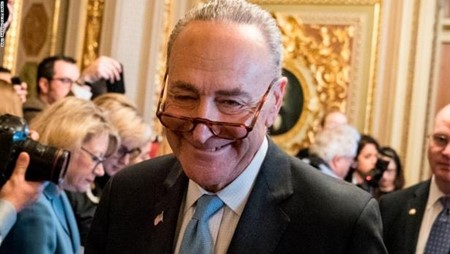
The time seems to be ripe for Democrats in the US Congress to reach out for Republican support in ending the US government’s marijuana prohibition. Yet, this week, Senate Minority Leader Chuck Schumer (D-NY) instead chose to introduce the Marijuana Freedom and Opportunity Act (S 3174), a bill that seeks to remove much of the United States government’s marijuana prohibition and includes a provision that will likely ensure that the bill receives support from few to no Republicans.
The provision directs that a portion of US taxes generated each year from the marijuana industry be placed in a newly created “Marijuana Opportunity Trust Fund” from which the money will be distributed via Small Business Administration loans to marijuana companies owned and controlled by women and “socially and economically disadvantaged individuals.” Looking at US statutes subsection 15 USC 637(d)(3)(C) that explains the meaning of “socially and economically disadvantaged individuals” one finds out that the group is presumed to include “Black Americans, Hispanic Americans, Native Americans, Asian Pacific Americans, and other minorities.”
In short, included in Schumer’s bill is a special race-and-sex-based subsidy for marijuana businesses. This provides clear reason for Republican senators — many of whom already are wary of supporting a significant marijuana prohibition roll-back — to not support the bill. First, race-and-sex-based government preferences tend not to be popular among Republican voters and politicians. Second, the provision converts the bill from legislation that just takes the small government step of eliminating marijuana-related legal restraints to legislation taking the big government approach of subsidizing marijuana businesses. A Republican Senator who cosponsors or votes for the bill would, in general, be endorsing a new government subsidy and, in particular, be helping fund marijuana businesses — something much different than merely tolerating their existence.
CIA Teams Up With Defense Industry To Undermine Korea Negotiations
By William Craddick | Disobedient Media | June 30, 2018
In a new development that will shock no one, factions within the CIA attempted for the second time in just over a month to undermine President Donald Trump’s peace overtures towards North Korea by leaking information calculated to decrease confidence in Kim Jong Un’s willingness to earnestly negotiate.
On June 29, 2018, NBC News released a report quoting anonymous CIA officials who claimed that North Korea was increasing nuclear production at “secret sites” without providing any actual evidence for such claims. The report’s credibility is further weakened by the fact that it also cited reports from a think tank which has strong connections to the defense industry and other private special interests.
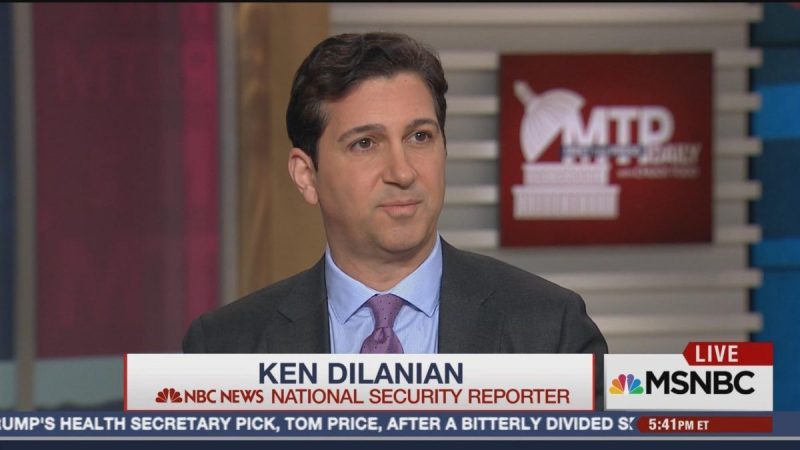
In disseminating their report, the CIA used NBC reporter Ken Dilanian as an outlet for leaks. As Disobedient Media previously reported, Dilanian was outed by the Intercept in 2014 as a CIA asset. In the aftermath of the disclosure, Dilanian’s previous employers at the Tribune Washington and Los Angeles Times disavowed the disgraced journalist. In at least one instance, the CIA’s instructions to Dilanian appears to have led to significant changes in a story that was eventually published in the Los Angeles Times.
Since that time, Dilanian has persisted in pushing articles written by former CIA officials who continue to perpetuate the “Trump-Russia” collusion narrative without any regard to facts, such as Steven Hall’s Washington Post article titled: “I was in the CIA. We wouldn’t trust a country whose leader did what Trump did.”
Perspective | I was in the CIA. We wouldn’t trust a country whose leader did what Trump did. https://t.co/4XG8TmhwKq
— Ken Dilanian (@KenDilanianNBC) May 18, 2017
In the absence of hard evidence from the CIA to back their claims about North Korea, Dilanian cited the opinion of Clinton administration official Joel Wit and reports from 38north.org. 38north is a project run by the Henry L. Stimson Center. The Stimson Center’s Board of Directors includes individuals associated with organizations such as Northrop Grumman, the Boeing Company, Warburg Pincus, the Carnegie Endowment, Mercy Corps, The Council on Foreign Relations, the Department of Defense, the CIA and US Department of the Treasury. Their Partners include the George C. Marshall Foundation, Saudi Arabia’s Gulf Research Center and the Jinnah Institute.
Satellite images circulated by 38north claiming to show improvements to North Korea’s Yongbyon Nuclear Scientific Research Center appear to have been obtained from Airbus Defense and Space SAS, a subsidiary of European multinational conglomerate Airbus Group SE. Airbus was the brainchild of Germany’s DaimlerChrysler Aerospace and British Aerospace. The association of a German connected transnational group in efforts to undermine Korean peace negotiations is interesting given the strong connections they held with the now scandalized South Korean government of Park Geun-hye.
The involvement of a think tank in a website that is centered around undermining US confidence in North Korea is hardly a surprise given their connections to the military-industrial complex and internationalist special interest groups. Both Northrop Grumman and Boeing have seen their stock’s value drop in the aftermath of Trump’s Singapore meeting with Kim Jong Un in what analysts saw as a temporary setback to defense stocks. Seeing such corporations use their ties to institutions such as the Stimson Center to collaborate with the CIA in an effort to scuttle commitments to North Korean denuclearization and a peace accord between the Koreas and United States represents a new low.
Despite the best efforts of the CIA, President Trump has stated that there is no current nuclear threat from North Korea, and that the Singapore Summit represented a positive interaction with the leader of the so-called “hermit kingdom.” Trump has repeatedly highlighted the opportunity for Chairman Kim to engage with the world and begin a new era of “security and prosperity” for North Korea. North Korea destroyed portions of their test site at Punggye-ri before a group of foreign journalist observers in the lead up to the US-North Korea summit on June 12.
There is no limit to what NoKo can achieve when it gives up its nuclear weapons and embraces commerce & engagement w/ the world. Chairman Kim has before him the opportunity to be remembered as the leader who ushered in a glorious new era of security & prosperity for his citizens! pic.twitter.com/Xbup4Zyz33
— Donald J. Trump (@realDonaldTrump) June 13, 2018
Revisiting Litvinenko, What Really Happened?

By Ryan Dawson | ANTI-neocon Report | April 26, 2015
As we all know Alexander Litvinenko was poisoned by polonium, a rare radioactive substance. The main narrative blamed it all on Vladimir Putin of Russia. The rationale rested on little other than because Litvinenko was a Putin critic. This was the quick line in mass media, and it was on all the typical war propaganda channels. Thanks in large part to Alexander Goldfarb, a stooge of exiled oligarch Boris Berezovskiy, having twisted the tale of the poisoning into a ‘Putin did it’ cover up for a botched smuggling operation, by declaring this was Litvinenko’s belief, expressed in a death bed letter that he allegedly signed. Really? And he wanted you, Goldfarb, a biologist who worked for the Oligarch, not a lawyer, to witness this letter and read it to the media? Why were you even there? Akhmed Zakayev thought Goldfarb was CIA.
There are many things wrong with the “Putin did it” story. For one, there is no motive, even with Litvinenko being a critic of Russia, he was no threat whatsoever to Putin. The man worked with Chechen terrorists and the Israeli-Russian oligarchs. But assuming that there was a sufficient motive to kill him, think about this: Why would Russia use a very rare, very expensive, and easily traceable radioactive substance to kill him instead of some cheap poison or just shooting him? Why risk smuggling radioactive material into the UK which is an act of war? And why poison someone on the same day Britain signed an accord to make it easier for Russia to extradite high profile criminals. London has become a central hub for asylum-seeking Russians. The UK has not extradited a single person to face Russian court. Many oligarchs fled to the US and Israel because of their non-extradition status. Israeli-Russian Boris Berezovsky, the former oligarch and media owner, and Ahmed Zakayev, the Chechen leader who was arrested in the UK, got a 50,000GPB bail paid and then got political asylum both landed in Britain.
Yet this murder by radioactive poison scandal is exactly what the UK/US media would have you believe. They want to say that Putin had someone sneak into the UK with polonium and poison Litvinenko with it. It just isn’t plausible. It’s actually absurd. Why would the American media side with the man who worked for terrorists and who worked for one of the exiled oligarchs? Well first off these “Russian” oligarchs are primarily Zionist Israeli-Russians who acquired much of their wealth and techniques from the Israeli Mossad agent Marc Rich. Secondly they have business relationships with the Bush administration. The Israeli-Russian Oligarch Khodorkosky had dealings with Cheney, the Carlyle group, and with UNACOL. Boris Berezovsky is a business partner with none other than President Bush’s brother Neil Bush. Boris invests in Neil’s Ignite! computer software, and Neil Bush met with Boris even after he was a known felon. One of the most wealthy Oligarchs used to be Oligarch Khdorkovsky of Yukos oil. He was worth over 15 billion dollars rivaling Roman Abramovich the richest of them all. Khodorkosky was buying votes in the Duma. Putin cracked down on the oligarchs forcing many to flee and arresting and throwing Khodorkosky in jail. He recently just had further charges placed on him to make his stay in jail all that much longer.
The Khodorkovsky arrest followed an unpublicized meeting earlier that year on July 14, 2003, between Khodorkovsky and Cheney. Following the Cheney meeting, Khodorkovsky began talks with ExxonMobil and ChevronTexaco, Rice’s old firm, about taking a major state in Yukos, said to have been between 25% and 40% –source
 The Washington Post reported “Days before his October 2003 arrest on tax fraud charges, Khodorkovsky had entertained George H W Bush, the representative of the powerful and secretive Washington Carlyle Group in Moscow. They were discussing the final details of the US oil company share buy-in of Yukos…
Yukos had also just made a bid to acquire rival Sibneft from Boris Berezovsky, another Yeltsin-era oligarch. YukosSibneft, with 19.5 billion barrels of oil and gas, would then own the second-largest oil and gas reserves in the world after ExxonMobil.”
YukosSibneft would be the fourth-largest in the world in terms of production, pumping 2.3 million barrels of crude oil a day. The Exxon or Chevron buy-up of YukosSibneft would have been a literal energy coup d’etat. Cheney knew it; Bush knew it; Khodorkovsky knew it. Above all, Putin knew it and moved decisively to block it.- William Engdhal
Sibneft’s Boris Berezovsky just so happens to be the Israeli-Russian oligarch who lives in London who Litvineko worked for. Alexander Litvinenko who was formerly FSB fled to the UK to avoid court prosecution in Russia, worked for a shady Russian oligarch, Boris Berezovsky. Boris Berezovsky just so happens to be the Israeli-Russian oligarch who lived in London after fleeing the Russian judicial system for a multitude of crimes too long to list. He was on Interpol’s most wanted list. Here is the grand prize. After the US and UK press branded Putin with the poisoning despite there being Zero evidence, (something the US is very well known for now) investigators were tracking down the traces of Polonium in the UK. They detected traces of Polonium at Berezovsky’s office and residence! Now I do not know about you, but in my place of work, and certainly in my house, I do not have rare radioactive substances. Polonium is not something you just get at the market or pick up by accident walking through the park.
No experienced mob boss like Berezovsky would be dumb enough to murder an underling in such a manner either. Therefore his death was an accident. It was mostly likely it was a botched smuggling operation. Why was he moving such a dangerous substance? Did he need fast cash? Were they planning to create a dirty bomb? Such a “smoky bomb” would turn the Polonium into powder and kill anyone who ingested it.
Traces of Polonium were found on the planes that Litvinenko had been on. So I think we can deduce what happened. He was a mule. The questions remain, why did he have it?, Where did he get it? What was he going to do with it? Why was it in the offices of Berezovsky and Erinsys Ltd (Britain’s Blackwater)?
The “Putin did it” smear case has never made sense. First of all, the amount of polonium 210 in play would have cost millions of dollars. That amount is too expensive to purchase and too large to go unnoticed if it were stolen. The only way to obtain such a quantity would be on a well organized black market that had a connection to a nuclear facility. It would certainly help organized crime if the nuclear powered supplier they received the Polonium from was not subjected to international inspections or part of the nuclear nonproliferation treaty. Such a country, (Foreign country A) which denied they even built nuclear weapons for decades, would certainly also deny selling their Polonium byproduct as well.
Is it possible to hide that from the press? Yes. The media would ignore this for the same reason the media ignores them stealing nuclear secrets and building hundreds of nuclear weapons in Dimona, then throwing whistle blowers who took pictures of their warheads, in jail.
Litvinenko was in Israel, where he met Leonid Nevzlin the CEO of Yukos shortly before he died. If you wanted to buy/steal radioactive material that would be the place. What was he negotiating with Nevzlin? We learned Alexander had been an informant in a case that led to the arrest of nine Georgina and Russian Mobsters in Spain, including Alexander Gofstein a lawyer for Yukos who apparently was laundering money.
The downfall began when Georgina Mob Boss Zakhar Kalashov was arrested in May 2006. The scam was similar to what the old Five Families of New York had done, when guys like Meyer Lansky took profits from illegal gambling businesses and funneled them into buying up real estate in Florida. In the European case, the mob was taking illegal funds and buying up real estate in Spain as well as making investments into legitimate businesses.
Litivnenko’s associates, Dmitry Kovtun and Andrei Lugovoi, who both had met with him the day of the poisoning, were also both hospitalized. They left traces of Polonium in Hamburg as they had taken the trip to Germany before meeting Litvinenko. It appears all three were involved in a smuggling operation, but for who?
Short answer: Russian Oligarch Boris Berezovsky’s employee Alexander Litvinenko died from over exposure to Polonium in a botched smuggling operation. That is why traces of it were at Boris’s house and on the planes Litvinenko was riding to and from Israel. The smear on Putin/Russia using a highly traceable 10 million dollar poison to kill a critic is about as plausible and rational as saying we have “British Intelligence” about Niger…. This transparent bogus lie was a quick and shamelessly sloppy explanation to cover up how and why this man in the UK had a radioactive poison in his body. Polonium only has a half life of 138 days.
Litvinenko had been in Israel to visit Yukos’s CEO, just shortly before he died. And it’s an open secret that Israel has nuclear weapons, the only place without nuclear safeguard or inspections. Traces of polonium were also on the British Airway planes that Litvinenko took to and from Israel. So it they would have the means, location, and the timing fits, but let’s just blame, Putin “The New Hitler” as Neocons have dubbed him?
Why the fuss about a conspiracy claiming that Putin put Litvinenko on a hitlist and poisoned him? Well as wacky as that story is, it was probably the best they could come up with on short notice. Boris knew once the police found out how Litvinenko died that there would be a lot of explaining to do. He also knew that if the investigation went forward that they could find more of this Polonium on his properties. So they just claimed the KGB was trying to kill them all.
Some History
This is not the first time that Berezovsky tried to pin a murder on someone else and claim that all the damning evidence pointing to him was a frame. There are the notorious cases (in Russia) of Ivan Litskevich and Vlad Listyev.
Ivan Listkevich was the general director of the Omsk oil Refinery easily the best refinery in Russia. Abramovich and Berezovsky planned to take over the refinery and make it part of Berezovsky’s Sibnef (which it now is). Listkevich resisted. Ivan had outside investments from LUKoil (10% of the stock) and CS First Boston. So in no way was he threatened to sink. Omsk was in the best location, had the latest equipment, and was well positioned to continue to soar. They serviced the biggest oil producers in Russia. Naturally Ivan did not want to be swallowed by Sibnef. On August 19, 1995 Ivan was found drowned in the Irtysh River. I doubt he went there to swim. Five days later Sibnef (Gazprom) took over. August 24th 1995, using his good buddy Yeltson, Berezovsky got a Presidential Decree №872, to order a transfer of all the state’s share in Omsk as well as 4 other companies to Sibnef. Then in 1996 Boris and Roman privatized Sibnef through a series of Loans-for-Shares’ auctions which were a complete scam run through front companies and offshore banks. Yeltsin approved of it.
The case may leave doubts in the mind until one learns about the murder of Vlad Listyev. In 1994 Boris attacked one of his rivals over control of a media outlet. Part of the attack was broadcast all over TV and came to be known as “faces in the snow” as Boris’s rival’s bodyguard were forced at gun point to lie face down in the snow. Shortly after a 90mph high speed chase and attacking rival Gusinsky’s MOST guards and pinning Gusinsky in his own building, Berezovsky would take control of ORT (channel 1) through an illegal non-public “auction” and gain a near media monopoly.
For details on that I recommend reading “God Father of the Kremlin” if you can still find it. It was written by the senior editor of Forbes in Russia who holds a Ph.D in Russian history Paul Klebnikov. For the record Paul Klebnikov was killed after publishing his book on the Oligarchs, particularly on Boris, who is on the cover. He was shot four times in Moscow while leaving work and then died in the hospital after getting stuck on an elevator.
After the Gusinsky event, Boris had another problem. Vladislav Listyev. Listyev was probably the most popular talk show host in Russia and a TV producer. He was a business partner with Boris but the problem was he was not crooked. As general director of ORT he decided to fix a multi-million dollar leak in the company and in direct way of Boris paying people off in the Mob to do dirty work, as well as paying himself by spending money for ads in other companies he owned where he also ran the advertising sales. He had an offer from Sergei Lisovsky to buy up the sector. Negotiations never went through and Vlad had a different idea.
On Feb 20th 1995 Vlad announced that he would break the monopoly of Boris and Sergei. He called for a moratorium on ORT advertising until they could work out ethical standards. As you can imagine that did not make Boris or the rest of the mob happy. Eight days later Boris personally met with “Nikolai” a mafia boss, and handed him a hundred thousand dollars in cash. This was witnessed by two police officers who were monitoring the Mob. Prior to that Boris’s lacky Badri offered money to a different gangster but that man was arrested before he could do what was asked of him and he confessed this in jail. On March 1st the day after Berezovsky paid a second Mob Boss, Vlad Listyev was shot in the back at the entrance of his home.
Guilty as sin, with a confession against Badri as well as being personally witnessed by two police, offering another mob boss money, Boris was desperate. He was inches away from being arrested. Boris’s TV network was cut out of government subsidies after the police raided it and it was subject to bankruptcy. Fellow Media giant and friend Ruppert Murdoch promised to invest in the network and bail him out. How nice. And we all know where Murdoch stands. This relationship might also explain why Fox News and Sky News in the UK were so blatantly cheerleading the “Putin killed Litvinenko” conspiracy story.
But here is the real kicker. It is just as outrageous and far fetched as the Litvinenko poisoning. Boris concocted a story for Yeltsin which was recorded on video tape produced by Irina Lesnevskaya a producer at ORT and a friend of Yeltsin’s wife. The tape claimed that it was all a big conspiracy against Berezovsky and that the real culprit (who had no motive other than to frame Boris [apparently able to hire a gun to kill Vlad but not Boris?) was none other than bitter rival Gusinsky of Most Bank who Boris had already tried to kill once.
Yeltsin was paranoid of Gusinsky’s political ambitions and Boris knew this. Boris also blamed X-KGB and said Vlad was killed by the MOST group, and not the mob he was witnessed meeting with a week after Vlad was going to break his monopoly. (Sounds like “Iraq moved the nonexistent WMDs to Syria just to make the US look bad.” give me a break) Boris claimed to be set up because he was loyal to Yeltsin as was his new media outlet.
Yeltsin ever a partner in cover ups, not to mention a drunk and a thief, got Boris out of trouble once again by firing the lead investigators in the case which intimidated others to drop it. There was a huge public outcry. A TV personality had been killed. ORT created a new company called ORT advertising with a monopoly to sell ads on commission no less, and the boss-man chosen was none other than Sergei Lisovsky. Wow how utterly shameless.
If you can speak Russian or if you can find an English copy of the Boris/Lesnevskaya tape transcript sent to Yeltsin, it’s going to make you very angry. It is about as plausible as saying Putin risked an act of war with the UK to kill a critic who worked for both a criminal as well as terrorist.
Who Done It?
So we know what didn’t happen. But there still remains a “who done it.” The quickest way to get to the bottom of this is to see who is lying the most and loudest, because that is usually who has the most to hide.
Remember Anna Politkovskaya? She was killed on Putin’s birthday and the alternative press and the ‘mindlessly accepting any conspiracy’ types who fell for it, tried to use that circumstantial “evidence” to blame the murder on Putin.
These are the same types that claim Russia bombed its own apartment buildings to start a war with Chechnya omitting the fact that the apartment bombing took place five months after the war has already started, and the “sources” trying to blame the FSB were none other than Boris’s lacky Litvinenko and well known plagiarist David Satter, who wrote for the PNAC co-founders’ Weekly Standard, which gave the world all the bogus lies about Iraq’s WMD and connection to the September 11th attacks. Robert Kagan, the paper’s cofounder with William Kristol, wrote an op-ed in the Washington Times calling “Speaking of Iraq” which pushes every erroneous prewar scare tactic there was. His wife Victoria Nuland is the same woman who was recorded on the phone saying “F” the EU and openly talking about who would be a good replacement Prime Minister in Ukraine. She chose Arseniy Yatseniuk, who she called “Yatz” and he did become the prime minister of Ukraine a month later after the coup. Everything out of this faction’s mouth has been blindly anti-Russian.
There is a huge difference between conspiracy and kookspiracy. Getting away from the outlandish unsubstantiated claims about Anna’s death, let’s uncover something factual. Anna Politkovskaya was the journalist who had published three different articles on how SOMEONE was testing Polonium on Chechen children. Gee! Where have we seen THAT scenario before? Anna’s articles were published in the Novaya Gazeta in 2006 and she was killed October of that same year.
The Washington Post then makes this clever claim. “Leonid Nevzlin, a former Yukos oil company shareholder and Russian exile currently living in Israel, told the Associated Press in late November that Litvinenko had given him a document related to a dossier on criminal charges made by Russian prosecutors against people connected to Yukos. Nevzlin, who is charged by Russian prosecutors with having organized killings, fraud and tax evasion, claimed Litvinenko’s inquiries may have provided a motive for his poisoning”
Notice who else is in that Washington Post article (Scaramella) and who was planting the ideas that Putin had killed both Litvinenko and Anna. How crazy is that to use polonium to murder someone… Scaramella is a rotten one. After Anna’s lawyer Stanislav Markelov was murdered in 2009 followed by the murder of one of her key informants in Chechnya, Natalia Estemirova, the same year, there was a retrial in Anna’s case which went to the Supreme Court. Chechen president Ramzan Kadyrov stirred up a public disgust when he said about Anna’s informant Natalia Estemirova on Radio Liberty “She was a woman… who had never possessed any honor, dignity or conscience.”
The prosecution cornered Dmitry Pavliutchenkov a former policeman who in turn confessed Lom-Ali Gaitukayev was who negotiated the contract killing and behind him he suspected Boris Berezovsky. Dmitry was sentenced to 11 years in jail. Five men were found guilty in her murder. Three were the Chechen brothers who had been acquitted in the first trial and they went to prison. Rustam Makhmudov and Lom-Ali Gaitukayev got life sentences in 2014. Berevsovsky had died the year before in March of 2013.
They were already testing the poison on Chechens and killed the journalist uncovering the story. Lit overdosed by accident and the Oligarchs had to quickly create a story to explain how it is possible such a shady character had any contact with this stuff. So they do what they did before, blame it on a conspiracy of Boris’s enemies even when there is no motive, no evidence and not even simple logic to it.
The most troubling thing here is not that the mob did something illegal or that the Western press jumped the gun to do an anti-Russian witch hunt. All of that is pretty run of the mill. It’s not even that Israel secretly has nukes and is involved with organized crime. Again, imagine my lack of shock. It’s not even the multiple murders that are most troubling. The most troubling part of this story is what the ultimate purpose of that much Polonium was and why it was in the UK. The potential for a dirty bomb is enormous. With the current climate of ISIS and disgruntled youth in Europe joining the mercenary forces to fight Israel’s enemies in Syria and Lebanon, a dirty bomb in the UK is not an unimaginable scenario. Just having such a thing could also hold leverage over politicians there too. The source of the Polonium should have been traced and potential sources should also be subject to inspection.
The Two Superpowers: Who Really Controls the Two Countries?
By Paul Craig Roberts | Institute For Political Economy | June 30, 2018
Among the ruling interests in the US, one interest even more powerful than the Israel Lobby—the Deep State of the military/security complex— there is enormous fear that an uncontrollable President Trump at the upcoming Putin/Trump summit will make an agreement that will bring to an end the demonizing of Russia that serves to protect the enormous budget and power of the military-security complex.
You can see the Deep State’s fear in the editorials that the Deep State handed to the Washington Post (June 29) and New York Times (June 29), two of the Deep State’s megaphones, but no longer believed by the vast majority of the American people. The two editorials share the same points and phrases. They repeat the disproved lies about Russia as if blatant, obvious lies are hard facts.
Both accuse President Trump of “kowtowing to the Kremlin.” Kowtowing, of course, is not a Donald Trump characteristic. But once again fact doesn’t get in the way of the propaganda spewed by the WaPo and NYT, two megaphones of Deep State lies.
The Deep State editorial handed to the WaPo reads: “THE REASONS for the tension between the United States and Russia are well-established. Russia seized Crimea from Ukraine, instigated a war in eastern Ukraine, intervened to save the dictatorship of Syrian President Bashar al-Assad, interfered in the U.S. presidential election campaign to harm Hillary Clinton and help Donald Trump, poisoned a former intelligence officer on British soil and continues to meddle in the elections of other democracies.”
The WaPo’s opening paragraph is a collection of all the blatant lies assembled by the Deep State for its Propaganda Ministry. There have been many books written about the CIA’s infiltration of the US media. There is no doubt about it. I remember my orientation as Staff Associate, House Defense Appropriation Subcommittee, when I was informed that the Washington Post is a CIA asset. This was in 1975. Today the Post is owned by a person with government contracts that many believe sustain his front business.
And don’t forget Udo Ulfkotte, an editor of the Frankfurter Allgemeine Zeitung, who wrote in his best seller, Bought Journalism, that there was not a significant journalist in Europe who was not on the CIA’s payroll. The English language edition of Ulfkotte’s book has been suppressed and prevented from publication.
The New York Times, which last told the truth in the 1970s when it published the leaked Pentagon Papers and had the fortitude to stand up for its First Amendment rights, repeats the lies about Putin’s “seizure of Crimea and attack on Ukraine” along with all the totally unsubstantiated BS about Russia interfering in the US president election and electing Trump, who now kowtows to Putin in order to serve Russia instead of the US. The editorial handed to the NYT insinuates that Trump is a threat to the national security of America and its allies (vassals). The problem, the NYT declares, is that Trump is not listening to his advisors.
Shades of President John F. Kennedy, who did not listen to the CIA and Joint Chiefs of Staff about invading Cuba, nuking the Soviet Union, and using the false flag attack on America of the Joint Chiefs’ Northwoods Project (look it up online). Is the New York Times setting up Trump for assassination on the grounds that he is lovey-dovey with Russia and sacrificing US national interests?
I would bet on it.
While the Washington Post and New York Times are telling us that if Trump meets with Putin, Trump will sell out US national security, The Saker says that Putin finds himself in a similar box, only it doesn’t come from the national security interest, but from the Russian Fifth Column, the Atlanticist Integrationists whose front man is the Russian Prime Minister Medvedev, who represents the rich Russian elite whose wealth is based on assets stolen during the Yeltsin years enabled by Washington. These elites, The Saker concludes, impose constraints on Putin that put Russian sovereignty at risk. Economically, it is more important to these elites for financial reasons to be part of Washington’s empire than to be a sovereign country.
I find The Saker’s explanation the best I have read of the constraints on Putin that limit his ability to represent Russian national interests.
I have often wondered why Putin didn’t have the security force round up these Russian traitors and execute them. The answer is that Putin believes in the rule of law, and he knows that Russia’s US financed and supported Fifth Column cannot be eliminated without bloodshed that is inconsistent with the rule of law. For Putin, the rule of law is as important as Russia. So, Russia hangs in the balance. It is my view that the Russian Fifth Column couldn’t care less about the rule of law. They only care about money.
As challenged as Putin might be, Chris Hedges, one of the surviving great American journalists, who is not always right but when he is he is incisive, explains the situation faced by the American people. It is beyond correction. American civil liberties and prosperity appear to be lost.
In my opinion, Hedges’ leftwing leanings caused him to focus on Reagan’s rhetoric rather that on Reagan’s achievements—the two greatest of our time—the end of stagflation, which benefited the American people, and the end of the Cold War, which removed the threat of nuclear war. I think Hedges also does not appreciate Trump’s sincerity about normalizing relations with Russia, relations destroyed by the Clinton, George W. Bush, and Obama regimes, and Trump’s sincerity about bringing offshored jobs home to American workers. Trump’s agenda puts him up against the two most powerful interest groups in the United States. A president willing to take on these powerful groups should be appreciated and supported, as Hedges acknowledges the dispossessed majority do. If I might point out to Chris, whom I admire, it is not like Chris Hedges to align against the choice of the people. How can democracy work if people don’t rule?
Hedges writes, correctly, “The problem is not Trump. It is a political system, dominated by corporate power and the mandarins of the two major political parties, in which we [the American people] don’t count.”
Hedges is absolutely correct.
It is impossible not to admire a journalist like Hedges who can describe our plight with such succinctness:
“We now live in a nation where doctors destroy health, lawyers destroy justice, universities destroy knowlege, the press destroys information, religion destroys morals, and banks destroy the economy.”
Read The Saker’s explanation of Russian politics. Possibly Putin will collapse under pressure from the powerful Fifth Column in his government. Read Chris Hedges analysis of American collapse. There is much truth in it. What happens if the Russian people rise up against the Russian Fifth Column and if the oppressed American people rise up against the extractions of the military/security complex? What happens if neither population rises up?
Who sets off the first nuclear weapon?
Our time on earth is not just limited by our threescore and ten years, but also humanity’s time on earth, and that of every other species, is limited by the use of nuclear weapons.
It is long past the time when governments, and if not them, humanity, should ask why nuclear weapons exist when they cannot be used without destroying life on earth.
Why isn’t this the question of our time, instead of, for example, transgender toilet facilities, and the large variety of fake issues on which the presstitute media focuses?
The articles by The Saker and Chris Hedges, two astute people, report that neither superpower is capable of making good decisions, decisions that are determined by democracy instead of by oligarchs, against whom neither elected government can stand.
If this is the case, humanity is finished.
Here are the Washington Post and New York Times editorials:
Washington Post
June 29, 2018
Editorial
Trump is kowtowing to the Kremlin again. Why?
Ahead of a summit with Putin, Trump is siding with the Russian leader, with dangerous results.THE REASONS for the tension between the United States and Russia are well-established. Russia seized Crimea from Ukraine, instigated a war in eastern Ukraine, intervened to save the dictatorship of Syrian President Bashar al-Assad, interfered in the U.S. presidential election campaign to harm Hillary Clinton and help Donald Trump, poisoned a former intelligence officer on British soil and continues to meddle in the elections of other democracies. Yet on Wednesday in the Kremlin, President Vladimir Putin brushed it all aside and delivered the Russian “maskirovka,” or camouflage, answer that it is all America’s fault.
Meeting with John Bolton, the president’s national security adviser, Mr. Putin declared that the tensions are “in large part the result of an intense domestic political battle inside the U.S.” Then Mr. Putin’s aide Yuri Ushakov insisted that Russia “most certainly did not interfere in the 2016 election” in the United States. On Thursday morning, Mr. Trump echoed them both on Twitter: “Russia continues to say they had nothing to do with Meddling in our Election!”
Why is Mr. Trump kowtowing again? The U.S. intelligence community has concluded that Russia did attempt to tilt the election using multiple campaigns, including cyberintrusions and insidious social media fakery. Would it be so difficult to challenge Mr. Putin about this offensive behavior? A full accounting has yet to be made of the impact on the election, but Mr. Bolton did not mince words last year when he described Russian interference as “a true act of war” and said, “We negotiate with Russia at our peril.” And now?
Summits can be productive, even – maybe especially – when nations are at odds. In theory, a meeting between Mr. Trump and Mr. Putin, now scheduled for next month in Helsinki, could be useful. But a meeting aimed at pleasing Mr. Putin is naive and foolhardy. A meeting aimed at pleasing Mr. Putin at the expense of traditional, democratic U.S. allies would be dangerous and damaging.
Just as Mr. Bolton was flattering Mr. Putin, Russia was engaging in subterfuge on the ground in Syria. The United States, Russia and Jordan last year negotiated cease-fire agreements in southwestern Syria, along the border with Jordan and the Golan Heights. In recent days, the United States has warned Russia and its Syrian allies not to launch an offensive in the area, where the rebel forces hold parts of the city of Daraa and areas along the border. The State Department vowed there would be “serious repercussions” and demanded that Russia restrain its client Syrian forces. Secretary of State Mike Pompeo called the Russian foreign minister, Sergei Lavrov, saying an offensive would be unacceptable. All to no avail; Syria is bombing the area.
This is what happens when Mr. Trump signals, repeatedly, that he is unwilling or unable to stand up to Russian misbehavior. We are on dangerous ground. Either Mr. Trump has lost touch with essential U.S. interests or there is some other explanation for his kowtowing that is yet unknown.
New York Times
June 29, 2018
Editorial
Trump and Putin’s Too-Friendly Summit
It’s good to meet with adversaries. But when Mr. Trump sits down with Mr. Putin, it will be a meeting of kindred spirits. That’s a problem.It’s good for American presidents to meet with adversaries, to clarify differences and resolve disputes. But when President Trump sits down with President Vladimir Putin of Russia in Finland next month, it will be a meeting of kindred spirits, and that’s a problem.
One would think that at a tête-à-tête with the Russian autocrat, the president of the United States would take on some of the major concerns of America and its closest allies. Say, for instance, Mr. Putin’s seizure of Crimea and attack on Ukraine, which led to punishing international sanctions. But at the Group of 7 meeting in Quebec this month, Mr. Trump reportedly told his fellow heads of state that Crimea is Russian because everyone there speaks that language. And, of course, Trump aides talked to Russian officials about lifting some sanctions even before he took office.
One would hope that the president of the United States would let Mr. Putin know that he faces a united front of Mr. Trump and his fellow NATO leaders, with whom he would have met days before the summit in Helsinki. But Axios reported that during the meeting in Quebec, Mr. Trump said, “NATO is as bad as NAFTA,” the North American Free Trade Agreement, which is one of Mr. Trump’s favorite boogeymen.
Certainly the president would mention that even the people he appointed to run America’s intelligence services believe unequivocally that Mr. Putin interfered in the 2016 election to put him in office and is continuing to undermine American democracy. Right? But on Thursday morning, Mr. Trump tweeted, “Russia continues to say they had nothing to do with Meddling in our Election!”
More likely, Mr. Trump will congratulate Mr. Putin, once again, for winning another term in a sham election, as he did in March, even though his aides explicitly warned him not to. And he has already proposed readmitting Russia to the Group of 7, from which it was ousted after the Ukraine invasion.
Summits once tended to be carefully scripted, and presidents were attended by senior advisers and American interpreters. At dinner during a Group of 20 meeting last July, Mr. Trump walked over to Mr. Putin and had a casual conversation with no other American representative present. He later said they discussed adoptions – the same issue that he falsely claimed was the subject of a meeting at Trump Tower in 2016 between his representatives and Russian operatives who said they had dirt on Hillary Clinton.
It’s clear that Mr. Trump isn’t a conventional president, but instead one intent on eroding institutions that undergird democracy and peace. Mr. Trump “doesn’t believe that the U.S. should be part of any alliance at all” and believes that “permanent destabilization creates American advantage,” according to unnamed administration officials quoted by Jeffrey Goldberg in The Atlantic.
Such thinking goes further than most Americans have been led to believe were Mr. Trump’s views on issues central to allied security. He has often given grudging lip service to supporting NATO, even while complaining frequently about allies’ military spending and unfair trade policies.
The tensions Mr. Trump has sharpened with our allies should please Mr. Putin, whose goal is to fracture the West and assert Russian influence in places where the Americans and Europeans have played big roles, like the Middle East, the Balkans and the Baltic States.
Yet despite growing anxieties among European allies, Mr. Trump is relying on his advisers less than ever because, “He now thinks he’s mastered this,” one senior member of Congress said in an interview. That’s a chilling thought given his inability, so far, to show serious progress on any major security issue. Despite Mr. Trump’s talk of quick denuclearization after his headline-grabbing meeting with the North Korean leader, Kim Jong-un, experts say satellite imagery shows the North is actually improving its nuclear capability.
While the White House hasn’t disclosed an agenda for the Putin meeting, there’s a lot the two leaders should be discussing, starting with Russian cyberintrusions. Mr. Trump, though, has implied that Mr. Putin could help the United States guard against election hacking. And although Congress last year mandated sweeping sanctions against Russia to deter such behavior, Mr. Trump has failed to implement many of them.
In a similar vein, should Mr. Trump agree to unilaterally lift sanctions imposed after Moscow invaded Ukraine and started a war, it would further upset alliance members, which joined the United States in imposing sanctions at some cost to themselves. Moreover, what would deter Mr. Putin from pursuing future land grabs?
Mr. Trump could compound that by canceling military exercises, as he did with South Korea after the meeting with Mr. Kim, and by withdrawing American troops that are intended to keep Russia from aggressive action in the Baltics.
Another fraught topic is Syria. Mr. Trump has signaled his desire to withdraw American troops from Syria, a move that would leave the country more firmly in the hands of President Bashar al-Assad and his two allies, Russia and Iran. Russia, in particular, is calling the shots on the battlefield and in drafting a political settlement that could end the fighting, presumably after opposition forces are routed.
What progress could be made at this summit, then? Mr. Trump and Mr. Putin may find it easier to cooperate in preventing a new nuclear arms race by extending New Start, a treaty limiting strategic nuclear weapons that expires in 2021.
Another priority: bringing Russia back into compliance with the I.N.F. treaty, which eliminated all U.S. and Soviet ground-launched ballistic and cruise missiles with ranges between 500 and 5,500 kilometers, until Russia tested and deployed a prohibited cruise missile.
Mr. Trump’s top national security advisers are more cleareyed about the Russian threat than he is. So are the Republicans who control the Senate. They have more responsibility than ever to try to persuade Mr. Trump that the country’s security is at stake when he meets Mr. Putin, and that he should prepare carefully for the encounter.
Featured Video
Anthrax War – CBC The Passionate Eye
or go to
Aletho News Archives – Video-Images
Book Review
Shattered Dreams: The HPV Vaccine Exposed (2019)
By Christina England – 30 Q&As – Book Review & Summary
Lies are Unbekoming | September 4, 2026
… Gardasil received FDA fast-track approval in 2006, Cervarix followed in 2009, and Gardasil 9 was approved in December 2014 with more than double the aluminium adjuvant content of the original. The commercial context is specific. Merck was about to lose patent protection on Zocor and faced $18 billion in Vioxx injury claims from a cardiovascular drug the company had marketed while suppressing its own data showing a five-times increase in heart attacks. Analysts projected the global HPV vaccine market at $4 billion by 2011, contingent on government-funded national programs for teenage girls. The 1986 National Childhood Vaccine Injury Act had already granted manufacturers complete liability immunity. By 2013, Japan had withdrawn its HPV vaccine recommendation after cataloguing severe adverse reactions in hundreds of girls. No Western government followed. The establishment position across the UK, US, Australia, and most of Europe held, and still holds, that the vaccines are safe and effective, that reported injuries are coincidental, and that cervical cancer prevention justifies the program. The book was published into this position, not against a vacuum.
Shattered Dreams sits alongside Mary Holland’s The HPV Vaccine On Trial and Viera Scheibner’s foundational vaccination work as part of the documented record on what has been done to a generation of teenage girls under the banner of cancer prevention. The full summary unpacks three specific findings: that Merck used the aluminium adjuvant itself as the “placebo” control in 92.5% of trial subjects, making it structurally impossible to detect excess reactions from the adjuvant; that Dr. Sin Hang Lee found HPV DNA fragments bound to aluminium in every one of sixteen Gardasil samples tested, and in the blood and spleen of a New Zealand girl six months after her third dose; and that in every country with high vaccination coverage, including Australia, the UK, Norway, and Sweden, cervical cancer rates have stopped declining and started rising specifically in the vaccinated cohort. Martínez-Lavín’s 2017 calculation puts the number needed to seriously harm with Gardasil 9 at 140, and the number needed to vaccinate to prevent one case at 1,757. Thirteen young women are seriously harmed for every one who benefits. The vaccine was approved on the basis of trials that could not detect what the trials were supposed to detect, and it is still being given to twelve-year-olds today. … Read full review
Blog Roll
 Aletho News
- Georgia’s Largest Healthcare System Will Fire Employees Who Refuse Flu Vaccine
- The Five-Year Fuel Crisis: Why the World Economy Is Paying for a War It Thinks Is Ending
- Trump’s Big Bluff on Iran
- Swiss scammed out of millions by Ukraine-linked call centers – media
- Germany facing potential ‘violent conflict’ with Russia – spy chief
- Ukraine’s EU neighbors reject new plea from Kiev – Politico
- British Transport Police Facial Recognition Trial Scanned 926,912 People With Zero Arrests
- House Bill Would Ban Federal Use of Flock ALPR Data
- Can a Spice Rival a Drug? 10 Head-to-Head Trials Put It to the Test.
- The oil routes around Hormuz face their own chokepoints
- If Americans Knew
- “We See Our Homes Now From A Satellite, Like Strangers”
- Watch “Gaza: Doctors Under Attack”, originally censored by BBC
- NAZA: Israeli embassies in UK and US promote rival documentary to challenge Gaza genocide allegations
- David Ellison appoints Israeli to lead merged Paramount-Warner studios
- Turkish Red Crescent helps elderly Gaza man walk again after Israel confiscates his prosthetic limb
- Four Palestinians Killed in Israeli Attacks in Gaza
- Two Palestinian youths killed and village razed as Israeli attacks on West Bank continue
- Two more Christian women victims of Israeli raids on Gaza
- Cruelty, Deprivation, Indignity: A Journalist’s 22 Months in Israeli Prison
- New IDF Website Frames Slain Gaza Journalists as Terrorists
- No Tricks Zone
- Latest European Green Energy Debacle; Portugal’s Largest Flagship Solar Park Insolvent!
- Green Energy Debacle: German Expert Professor Fritz Vahrenholt Warns Of Severe Economic And Social Consequences
- Two More Paleo Reconstructions Affirm Meters-Higher Sea Levels Across Ireland, Brazil 7000-6000 Years Ago
- New Study: Earth And Venus Surface Warmth Largely Explained By Convection And Lapse Rate, Not CO2 Or Radiation
- 2025 Nature Paper Claiming Worsening Global Drought Gets RETRACTED …Heavily Flawed
- New Study: ‘Global Drought Shows No Detectable Recent Acceleration Under Climate Warming’
- Economic Masterminds: German Socialists Suggest Taxing Productivity Gains Stemming From Using AI
- The South China Sea Has Not Been Cooperating With The Climate Change Narrative
- Energy Crisis: Germany Enters Heating Season With Historically Low Gas Reserve Fill Levels
- New Study: The Antarctic Ice Sheet Gained Mass From 2020-2024 Due To Staggering Snow And Ice Accumulation

