The Legacy and Fallacies of Bernard Lewis
By As`ad AbuKhalil | Consortium News | June 29, 2018
There is no question that Bernard Lewis was one of the most politically—not academically—influential Orientalists in modern times.
Lewis’ career can be roughly divided into two phases: the British phase, when he was a professor at the School of Oriental and African Studies in London, and the second phase, which began in 1974, when he moved to Princeton University and lasted until his death on May 19. His first phase was less overtly political, although the Israeli occupation army translated and published one of his books, and Gold Meir assigned articles by Lewis to her cabinet members.
Lewis knew where he stood politically but he only became a political activist in the second phase. His academic production in the first phase was rather historical (dealing with his own specialty and training) and his books were then thoroughly documented. The production of his second phase was political in nature and lacked solid documentation and citations. In the second phase, Lewis wrote about topics (such as the contemporary Arab world) on which he was rather ignorant. The writings of his second phase were motivated by his political advocacy, while the writings of the first phase was a combination of his political biases and his academic interests.
Shortly upon moving into the U.S., Lewis met with Senator Henry “Scoop” Jackson, the dean of ardent Zionists in the U.S. Congress. He thus started his political career and his advocacy, which was often thinly hidden behind the title of superficial books on the modern Arab world. Lewis not only mentored various neoconservatives, but he also elevated the status of Middle East natives that he approved of. For instance, he was behind the promotion of Fouad Ajami (he dedicated one of this books to him), just as he was behind introducing Ahmad Chalabi to the political elite in DC.
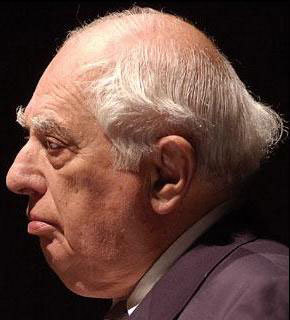
Lewis: A questionable legacy
Furthermore, Lewis was also behind the invitation of Sadiq Al-Azm to Princeton in the early 1990s (as Edward Said told me at the time) because Lewis always relished Al-Azm’s critique of Said’s Orientalism. Sep. 11 only elevated the status of Lewis and brought him close to the centers of power: he advised George W. Bush, Dick Cheney, Donald Rumsfeld and other senior members of the administration.
In the lead-up to the Iraq war, he assured Cheney (relying on the authority of Ajami) that not only Iraqis, but all Arabs, would joyously greet invading American troops. And he argued to Cheney before the war, using the dreaded Zionist and colonial cliché, that Arabs only understand the language of force. (Lewis would later distort his own history and claim that he was not a champion of the Iraq invasion although the record is clear).
Lewis was not only close to the higher echelons of the U.S. government, but in addition to his long-standing ties to Israeli leaders, he was close to Jordanian King Husayn and his brother, Hasan (although Lewis would mock what he considered a Jordanian habit of eating without forks and knives, as he wrote in Notes on a Century: Reflections of a Middle East Historian, on page 217).
Lewis was also close to the Shah’s government, and to the military dictatorship in Turkey in the 1980s. Kenan Evren, the Turkish general who led the 1980 military coup, had a tete-a-tete with Lewis during one of his visits to D.C. Lewis had contacts with the Sadat government, and Sadat’s spokesperson, Tahasin Bashir, in 1971 sent a message through Lewis to the Israeli government regarding Sadat’s interest in peace between the two countries.
Distorted View of Islam
There are many features of Lewis’s works, but foremost is what French historian Maxime Rodinson called “theologocentrism”, or the Western school of thought which attribute all observable phenomena among Muslims to matters of Islamic theology.
For Lewis, Islam is the only tool which can explain the odd political behavior of Arabs and Muslims. Lewis used Islam to refer not only to religion, but also the collection of Muslim people, governments ruling in the name of Islam, Shari`ah, Islamic civilization, languages spoken by Muslims, geographic areas in which Muslims predominate, and Arab governments. A review of his titles show his fixation with Islam. But what does it mean for Lewis to refer to Islam as being “the whole of life” for Muslims, as he does in Islam and the West?
Lewis also began the trendy Islamophobic, Western obsession with Shari`ah when he wrote years ago in the same book that for Muslims religion is “inconceivable without Islamic law.” There are hundreds of millions of Muslims in the world who live under governments which don’t subscribe to Shari`ah. No Muslim, for example, questions the Islamic credentials of Muslims who live in Western countries under secular law. Lewis even notes this fact, but it confuses him. In Islam and the West he states in bewilderment: “There is no [legal] precedent in Islamic history, no previous discussion in Islamic legal literature.”
Lewis could have benefited from reading James Piscatori’s book, Islam in a World of Nation States, which shows that Shari`ah is not the only source of laws even in countries where Islam is supposedly the only source of law. But Lewis was stuck in the past, he could only interpret the present through references to the original works of classical Islam.
His hostility and contempt for Arabs and Muslims was revealed in his writings even during the British phase of his career, when he was politically more restrained. He was influenced by the idea of his mentor, Scottish historian Hamilton Gibb, regarding what they both called “the atomism” of the Arab mind. The evidence for their theory is that the classical Arabic poem of Jahiliyyah and early Islam was not organically and thematically unified, but that each line of poetry was independent of the other. I remember back in 1993 when I discussed the matter with Muhsin Mahdi, a professor of Islamic philosophy at Harvard University, when I was reading the private papers of Gibb at the Widener Library. Mahdi said that their ideas are completely out of date and that recent scholarship about the classical Arabic poem refuted that thesis. (Lewis would resurrect the notion about the “atomism” of the Arab mind in his later Islam and the West).
Other writings of Lewis became obsolete academically. In his The Muslim Discovery of Europe he recycles the view that Muslims had no curiosity about the West because it was the land of infidelity and that they suffered from a superiority complex. A series of new scholarly books have undermined this thesis by Lewis largely by scholars looking into Indian and Iranian archives. The Palestinian academic, Nabil Mater, in his books Britain and the Islamic World, 1558-1713, Europe Through Arab Eyes, 1578-1727, and Turks, Moors and Englishmen in the Age of Discovery, paints a very different—and far more documented—picture of the subject that Lewis spent a career distorting.
Relished in Disparaging Arabs
In addition, the tone of Lewis’ writings on Arabs and Muslims was often sarcastic and contemptuous. Lewis did the work of the Middle East Media Research Institute (MEMRI), which was started in 1998 by a former Israeli intelligence agent and an Israeli political scientist,before MEMRI existed: he relished finding outlandish views of individual Muslims and popularizing them to stereotype all Arabs and all Muslims.
In the early editions of Arabs in History, Lewis remarked that none of the philosophers of the Arab/Islamic civilization were Arab in ethnic extraction (except Al-Kindi). What was Lewis’s point except to denigrate the Arab character and even genetic makeup? In the same book he cites an Ismaili document but then quickly adds that it “is probably not genuine.” But if it is “probably not genuine” why bother to cite it except for his fondness for bizarre tidbits about Arabs and Muslims?
The Orientalism of Lewis was not representative of classical Orientalism with all its flaws and shortcomings and political biases. His harbored more of an ideology of hostility against Arabs and Muslims. This ideology shares features with anti-Semitism, namely that the whole (Muslims in this case) form a monolithic group and that they pose a civilizational danger to the world, or are plotting to take it over, and that the behavior or testimony of one represents the total group (Islamic Ummah).
In writing about contemporary Islam, Lewis spent years recycling his 1976 Commentary magazine article titled, “The Return of Islam.” What he doesn’t answer is, “return” from where? Where was Islam prior? In this article, Lewis exhibits his adherence to the most discredited forms of classical Orientalist dogmas by invoking such terms as “the modern Western mind.” He thereby resurrected the idea of epistemological distinctions between “our” mind and “theirs”, as articulated by the 1976 racist book, The Arab Mind by Israeli anthropologist, Raphael Patai. (This last book would witness a resurrection in U.S. military indoctrination after Sep. 11, as Seymour Hersh reported).
An Obsession with Etymology
For Lewis, the Muslim mind never seems to change. Every Muslim, regardless of geography or time, is representative of any or all Muslims. Thus, a quotation from an obscure medieval source is sufficient to explain present-day behavior. Lewis even traces Yaser Arafat’s nom de guerre (Abu `Ammar) to early Islamic history and to the names of the Prophet Muhammad’s companions, though `Arafat himself had explained that the name derives from the root `amr (a reference to `Arafat’s construction work in Kuwait prior to his ascension to the leadership of the PLO).
Because `Arafat literally embraced Ayatollah Ruhollah Khomeini of Iran when he first met him, Lewis finds evidence of a universal Muslim bond in the picture. But when Lewis revised his book years later, he took note in passing of the deep rift which later developed between `Arafat and Khomeini and said simply: “later they parted company.” So much for the theory of the Islamic bond between them. Lewis must not have heard of wars among Muslims, like the Iran-Iraq war.
Lewis read the book Philosophy of Revolution by the foremost political champion of Arab nationalism, Nasser of Egypt, as containing Islamic themes. He must have been the only reader to come to that conclusion.
Another feature in Lewis’s writings is his obsession with etymology. To compensate for his ignorance of modern Arab reality, Lewis would often return to the etymology of political terms among Muslims. His book, The Political Language of Islam, which is probably his worst book, is an example of his attempt to Islamize and standardize the political behavior of all Muslims. His conclusions from his etymological endeavors are often comical: he assumes that freedom is alien to the Arabs because the historical meaning of the word in an ancient Arabic dictionary merely connoted the absence of slavery. This is like assuming that a Westerner never engaged in sex before the word was popularized. He complains that some of contemporary political terms, like dawlah (state), lost some of their original meanings, as if this is a problem peculiar to the Arabic language.
In his early years, Lewis was close to the classical Orientalists: he wrote in a beautiful style and his erudition and language skills showed through the pages. His early works were fun to read, while his later works were dreary and dull. But Lewis was unlike those few classical Orientalists who managed to mix knowledge about history of the Middle East and Islam with knowledge of the contemporary Arab world (scholars like Rodinson, Philip Hitti and Jacques Berque). Lewis’s ignorance about the contemporary Arab world was especially evident in his production during the U.S. phase of his long career. His book on the The Emergence of Modern Turkey, which was one of the first to rely on the Ottoman archives, was probably one of his best books. There is real scholarship in the book, unlike many of his later observational and impressionable works.
In his later best-selling books, What Went Wrong? and The Crisis of Islam, one reads the same passages and anecdotes twice. Lewis, for example, relishes recounting that syphilis was imported into the Middle East from the new world. His discussion of Napoleon in Egypt appears in both books, almost verbatim. The second book contains calls for (mostly military) action. In The Crisis of Islam, Lewis asserts: “The West must defend itself by whatever means.” The book reveals a lot about his outlook of hostility towards Muslims.
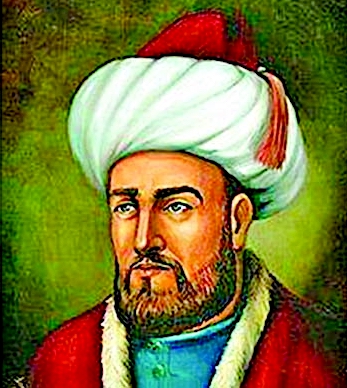
Al-Ghazzali: Lewis thought bin Laden was like him
Misunderstood Bin Laden
One is astonished to read some of his observations on Muslim and Arab sentiments and opinions. He is deeply convinced that Muslims are “pained” by the absence of the caliphate, as if this constitutes a serious demand or goal even for Muslim fundamentalist organizations. One never sees crowds of Muslims in the streets of Cairo or Islamabad calling for the restoration of the caliphate as a pressing need.
But then again: this is the man who treated Usamah Bin Laden as some kind of influential Muslim theologian who is followed by world Muslims. Lewis does not treat Bin Laden as the terrorist fanatic that he is, but as some kind of al-Ghazzali, in the tradition of classical Islamic theologians. Furthermore, Lewis insists that terrorism by individual Muslims should be considered Islamic terrorism, while terrorism by individual Jews or Christians is never considered Jewish or Christian terrorism.
In his retirement years, his disdain for the Palestinian people became unmasked. Although in his book The Crisis of Islam he lists acts of violence by PLO groups—curiously, only ones that are not directed against Israeli occupation soldiers—he lists not one act of Israeli violence against Palestinians and Arabs. To discredit the Palestinian national movement, he finds it necessary to tell yet again the story of Hajj Amin Al-Husayni’s visit to Nazi Germany, apparently seeking to stigmatize all Palestinians.
He is so disdainful of the Palestinians that he finds their opposition to Britain during the mandate period inexplicable because he believes that Britain was, alas, opposed to Zionism. Lewis is so insistent in attributing Arab popular antipathy to the U.S. to Nazi influence and inspiration that he actually maintains that Arabs obtained their hostility to the U.S. from reading the likes of Otto Spengler, Friederich Georg Junger, and Martin Heidegger. But when did the Arabs find time to read those books when all they read were their holy book and Islamic religious texts—as one surmises from reading Lewis?
While he displays deep–albeit selective–knowledge when he talks about the Islamic past (where his documentation is usually thorough), his analysis is quite simplistic and superficial when addressing the present (where he often disregards documentation altogether). For instance, he sometimes produces quotations without endnotes to source them: In Islam and the West he quotes an unnamed Muslim calling for the right of Muslims to “practice polygamy under Christian rule.” In another instance, he debates what he considers to be a common Muslim anti-Orientalist viewpoint, and the endnotes refer only to a letter to the editor in The New York Times.
Lewis once began a discussion by saying: “Recently I came across an article in a Kuwaiti newspaper discussing a Western historian,” without referring the reader to the name of the newspaper or the author. He also tells the story of an anti-Coptic rumor in Egypt in 1973 without telling the reader how he collects his rumors from the region. On another page, he identifies a source thus: “a young man in a shop where I went to make a purchase.”
Lewis was not shy about his biases in the British phase of his career, but be became an unabashed racist in his later years. In Notes on a Century, he did not mind citing approvingly the opinion of a friend who compared Arabs to “neurotic children”, unlike Israelis who are “rational adults.” And his knowledge of Arabs seems to decrease over time: he would frequently tell (unfunny) jokes related to Arabs and then add that jokes are the only indicator of Arab public opinion because he did not seem to know about public opinion surveys of Arabs. He also informs his readers that “chairs are not part of Middle Eastern tradition or culture.” He showers praise on his friend, Teddy Kollek (former occupation mayor of Jerusalem) because he set up a “refreshment counter” for Christians one day.
The political influence of Lewis, who lent Samuel Huntington his term, if not the theme, of “the clash of civilization”, has been significant. But it would be inaccurate to maintain that he was a policy maker. In the East and the West, rulers rely on the opinions and writings of intellectuals when they find that this reliance is useful for their propaganda purposes. Lewis and his books were timely when the U.S. was preparing to invade Muslim countries. But the legacy of Lewis won’t survive future scholarly scrutiny: his writings will increasingly lose their academic relevance and will be cited as examples of Orientalist overreach.
As’ad AbuKhalil is a Lebanese-American professor of political science at California State University, Stanislaus. He is the author of the Historical Dictionary of Lebanon (1998), Bin Laden, Islam & America’s New ‘War on Terrorism’ (2002), and The Battle for Saudi Arabia (2004). He also runs the popular blog The Angry Arab News Service.
Blair and Brown Governments Gory with Torture
By Craig Murray | June 29, 2018
Even I was taken aback by the sheer scale of British active involvement in extraordinary rendition revealed by yesterday’s report of the parliamentary Intelligence and Security Committee. Dominic Grieve and the committee deserve congratulations for their honesty, integrity and above all persistence. It is plain from the report that 10 Downing Street did everything possible to handicap the work of the committee. Most crucially they were allowed only to interview extremely senior civil servants and not allowed to interview those actively engaged in the torture and rendition programme.
Theresa May specifically and deliberately ruled out the Committee from questioning any official who might be placed at risk of criminal proceedings – see para 11 of the report. The determination of the government to protect those who were complicit in torture tells us much more about their future intentions than any fake apology.
In fact it is impossible to read paras 9 to 14 without being astonished at the sheer audacity of Theresa May’s attempts to obstruct the inquiry. They were allowed to interview only 4 out of 23 requested witnesses, and those were not allowed “to talk about the specifics of the operations in which they were involved nor fill in any gaps in the timeline”. If the UK had a genuinely free media, this executive obstruction of the Inquiry would be the lead story. Instead it is not mentioned in any corporate or state media, despite the committee report containing a firm protest:
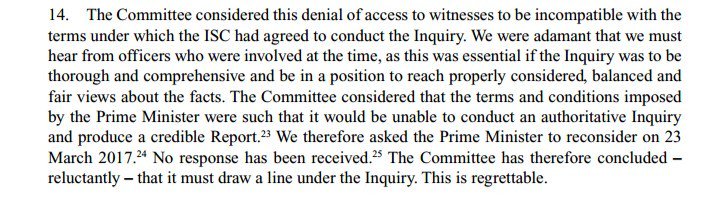
It is worth reflecting that the Tory government has acted time and time again to protect New Labour’s Tony Blair, David Miliband, Jack Straw and Gordon Brown from any punishment for their complicity in torture, and indeed to limit the information on it available to the public. The truth is that the Tories and New Labour (which includes the vast majority of current Labour MPs) are all a part of the same elite interest group, and when under pressure they stick together as a class against the people.
Despite being hamstrung by government, the Committee managed through exhaustive research of classified documents to pull together evidence of British involvement in extraordinary rendition and mistreatment of detainees on a massive scale. The Committee found 596 individual documented incidents of the security services obtaining “intelligence” from detainee interrogations involving torture or severe mistreatment, ranging from 2 incidents of direct involvement, “13 to 15” of actually being in the room, through those where the US or other authorities admitted to the torture, to those where the detainee told the officer they had been tortured. They found three instances where the UK had paid for rendition flights.
My own evidence to the Committee focused on the over-arching policy framework, and specifically the fact that Jack Straw and Richard Dearlove had agreed a deliberate and considered policy of obtaining intelligence through torture. The report includes disappointingly little of my evidence, as the Committee has taken a very narrow view of its remit to oversee the intelligence agencies. This is the only part of my evidence included:
130. This was not unique to the Agencies. Their sponsoring Departments appear to have adopted the same approach. We heard evidence from a former FCO official, Craig Murray, who suggested that “there was a deliberate policy of not committing the discussion on receipt of intelligence through torture to paper in the Foreign Office”.
In July 2004, when he was Ambassador to Tashkent, he raised concerns about the use of Uzbek intelligence derived from torture in a formal exchange of telegrams with the FCO. Mr Murray drew our attention to FCO documents from the same time, which we have seen, one of which referred to “meetings to look at conditions of receipt of intelligence as a general issue”. He told us that the meetings “specifically discuss[ed] the receipt of intelligence under torture from Uzbekistan” and “were absolutely key to the formation of policy on extraordinary rendition and intelligence”.
Mr Murray told us that, when he had given evidence to the Foreign Affairs Select Committee about this, they sought the documents from the FCO which replied that the “meetings were informal meetings and were not minuted ”. He went on to say:
“the idea that you have regular meetings convened at director level, convened by the Director of Security and Intelligence, where you are discussing the receipt of intelligence from torture, and you do not minute those meetings is an impossibility, unless an actual decision or instruction not to minute the meetings has been given.… Were it not for me and my bloody-mindedness, … you would never know those meetings had happened. Nobody would ever know those meetings had happened.”131. We note that we have not seen the minutes of these meetings either: this causes us great concern. Policy discussions on such an important issue should have been minuted. We support
Mr Murray’s own conclusion that were it not for his actions these matters may never have come to light.
Jack Straw to this day denies knowledge and involvement and famously told Parliament that the whole story about rendition and torture was a “conspiracy theory”.
Unless we all start to believe in conspiracy theories and that the officials are lying, that I am lying, that behind this there is some kind of secret state which is in league with some dark forces in the United States, and also let me say, we believe that Secretary Rice is lying, there simply is no truth in the claims that the United Kingdom has been involved in rendition full stop, because we have not been, and so what on earth a judicial inquiry would start to do I have no idea. I do not think it would be justified.”
In fact I strongly recommend you to read the whole Hansard transcript, from Q21 to Q51, in which Jack Straw carries out the most sustained bravura performance of lying to parliament in modern history. The ISC report makes plain he was repeatedly involved in direct authorisations of rendition operations, while denying to parliament the very existence of such operations.
For over a decade now the British government, be it Red Tory or Blue Tory, has been refusing calls for a proper public inquiry into its collusion with torture. The ISC report was meant to stand in place of such an Inquiry, but all it has done is reveal that there is a huge amount of complicity in torture, much more than we had realised, which the ISC itself states it was precluded from properly investigating because of government restrictions on its operations. It also concluded in a separate report on current issues, that it is unable to state categorically that these practices have stopped.
The Blair and Brown governments were deeply immersed in torture, a practice that increased hatred of the UK in the Muslim world and thus increased the threat of terrorism. Their ministers repeatedly lied about it, including to parliament. The British state has since repeatedly acted to ensure impunity for those involved, from Blair and Straw down to individual security service officers, who are not to be held responsible for their criminal complicity. This impunity of agents of the state is a complete guarantee that these evil practices will continue.
OPCW Wins New Powers to Undermine Authority of UN Security Council
By Peter KORZUN | Strategic Culture Foundation | 28.06.2018
The Organization for the Prohibition of Chemical Weapons (OPCW) is the Hague-based enforcement body for the Chemical Weapons Convention (CWC) and has been operating since 1997. It has 193 UN states as members. Its mission is to oversee global compliance with the convention, which prohibits the use of chemical weapons (CW) and requires their destruction. The inspectors have the power to say whether chemical weapons have been used following a fact-finding visit. Until the watchdog’s recent conference, they had not been authorized to identify the group or country suspected of deploying such weapons in any specific incident. The West used pressure to change that.
On June 27, an OPCW special session held in the Hague, the Netherlands, voted to expand the powers of the international chemical weapons watchdog. It was only the fourth conference held by the organization in its 21-year history and the first gathering to address the problem of the non-attribution of responsibility for the use of CW.
A total of 147 countries were accredited to join the session. Forty-six nations did not take part for various reasons. A two-thirds majority, minus any abstentions, was required for the proposal to be approved. The vote was 82-24 — only 106 out of 193 voted, leaving 87 (or 45% of all OPCW members) aside. It passed in accordance with the rules but was far from being very convincing overall! When you add 24 to 87 you get 111 members out of 193 who did not approve the decision. This was no great victory.
UK Foreign Minister Boris Johnson put forward the proposal in order to give the organization some teeth. The UK government thinks the OPCW must adopt a higher profile, which would include the authority to identify the perpetrators, otherwise it will lose its relevance. The powers of attribution that are to be used initially in Syria will be strengthened and expanded at a later special conference in six months.
The proposal submitted by the UK had the backing of the United States, the European Union, and other nations under their influence. From the very beginning the British initiative was supported by the secretariat of the OPCW. It’s no wonder, as it caters to the interests of bureaucrats. Their clout and salaries will grow. A host of countries, including Russia, opposed the move. Moscow believes that the result of the vote places the organization’s future in doubt.
In a nutshell, the approved proposal will turn that body into a political tool to be used to undermine international security, because it encroaches on the exclusive prerogatives of the UN Security Council. The OPCW was not created to carry out the functions of prosecutor and international police. In Syria, the organization has not done its job efficiently, often failing to gather evidence at the site and using untrustworthy sources of information while preparing its reports. For instance, violations of the core principle of Chain of Custody and many provisions of the CWC took place last year during the investigations of the Khan Sheikhoun chemical attack, during which the inspectors did not travel to inspect Syria’s Shayrat air base. The same story was repeated during the 2018 attack in Douma. The investigation was poorly conducted. There were serious disagreements between member states, which prevented that body from reaching definitive conclusions.
The performance of the OPCW has so far not been up to par, so why should its authority be expanded, making it responsible for such a complicated task as assigning blame? The OPCW is not a court. Its inspectors are not trained to be judges. If the OPCW can hand down guilty verdicts, then what do we need international tribunals and other bodies for?
The British proposal did not even offer to reform the organization before assigning it a new mission. No details were provided as to how to ensure transparency and impartiality. If the OPCW is to make final conclusions on guilt, it should have a mechanism to prevent its being politicized and biased. It all goes to show that political motives prevailed when the initiative was put forward. Many nations don’t care much about the Skripal case but they will vote to put the blame on Russia in order to curry favor with the UK and its allies. Many of them see the events in Syria as a far-off problem. They will also vote to please those who hold influence over them. A country can be blamed without hard evidence presented.
Nice words were uttered condemning the use of CW, and highfalutin speeches were given to play on people’s heartstrings, but not all that glitters is gold. Quite often decisions approved by a relative majority are dictated by emotions, not wisdom. Many aspects of the matter had not been clarified, a lot of questions were still unanswered, and some topics that cried out for a thorough discussion had simply been swept under the rug. As a result, a very important international body has been turned into a tool for playing political games instead of doing the job it was initially created for. It may come to conclusions and point its finger at culprits, but will it enjoy a high level of trust? That’s what leaves us with a lot of doubts.
US’ Iran Regime-Change Plan: Hit Economy, Orchestrate Protests, Engage MEK Cult to Chant “Democracy”
By Elliot Gabriel | Mint Press News | June 28, 2018
Iran’s latest wave of protests against the suffering state of the economy and the plunging value of the rial appeared to have come and gone by Wednesday, as crowds dissipated and businesses opened up shop following a two-day strike. While clashes between security forces and protesters during the protests were far from widespread, the very fact that the protests broke out hints at the extreme duress Iran is undergoing thanks to President Donald Trump’s renewed economic war on the country.
Judging by the enthusiastic response to the demonstrations in the U.S., Saudi, and Israeli press, anti-Iranian forces are clearly banking on the possibility that the sanctions that will soon be reimposed in the next several months could dislodge the Islamic Republic, clearing the way for a regime friendly to the West.
Thus we have witnessed anti-Iran publications like the Israeli Jerusalem Post frothing over with excitement over scenes of alleged Iranian citizens chanting “Death to Palestine,” “Let go of Syria – think about us,” and the much-beloved anti-Ayatollah Khamenei mainstay “Death to dictator.”
While videos from Iran depict what could very well be an organic groundswell of social protest against government policies, photos published in papers like the Post show a different story: middle-aged Persian men gripping English-language signs and the flags of the toppled Iranian monarchy, along placards bearing the portrait of an unlikely figure: the mustachioed, mysterious and long-disappeared charismatic cult leader who is considered an outlawed terrorist and traitor to the nation — Massoud Rajavi.
Rajavi was the leader of the group that lies at the center of the anti-Iran alliance’s “regime change” dreams: Mujahedin-e Khalq (MEK), or the People’s Mojahedin Organization of Iran (PMOI). A fanatical militant group whose title translates literally to the “The People’s Holy Warriors,” this eccentric left-nationalist, pseudo-religious cult has been led by Massoud’s wife, Maryam Rajavi, since the 1980s.
Formed in 1965, the group’s tortured history has seen it transformed from a movement of communist-influenced, Islamist-tinged anti-imperialists who carried out attacks on U.S. military officers in Iran into an authoritarian de facto mercenary army serving anyone opposed to the Islamic Republic – be it Saddam Hussein’s Iraq, Israel, or the United States.
The group wields major PR clout and outsized influence in Western capitals through countless front groups like the National Council of Resistance in Iran (NCRI), through which it depicts itself as “a political coalition that represents all of Iran’s religious, ethnic, and political groups proportionately;” stresses feminist, Islamist, free-speech and pro-free-market values; and is firmly “committed to a secular, democratic, non-nuclear republic” in Iran.
The RAND Corporation described the group as “skilled manipulators of public opinion,” but a cursory look at its publications shows a rather ham-fisted and self-celebratory pile of cultish jargon. Throughout the past week, publications like Iran Focus or Iran News Update – the latter of which bills itself as “Insider News & Analysis in Iran” – have pumped out articles boosting NCRI as “the only viable alternative to the Iranian regime” and claiming:
As protests in Iran continue to multiply and intensify, the regime’s claim to power is looking more and more tenuous. If the people were to overthrow their tyrannical government, the only democratic organization in the position to take over governance would be the NCRI … The regime’s reign of terror is at its close.”
The MEK was one of the first groups to be named a Foreign Terrorist Organization by the U.S. State Department, but its extreme opposition to the Islamic Republic of Iran and generous donations to politicians has led to its eventual delisting. The roster of politicians and influential figures tied to the MEK and its fronts spans much of the U.S. political spectrum, from the far right to the left-of-center.
Trump’s White House is a virtual all-star cast of MEK associates – explaining the administration’s frenzied push to scrap the nuclear deal and push to topple Tehran. Among the top supporters of MEK is White House National Security Advisor John Bolton, whose hatred of Iran’s government verges on the pathological.
A congressional foreign-policy aide who attended an Iranian New Year celebration hosted by an MEK front group told Foreign Policy magazine:
Bolton is positively predisposed to the MEK … they will have some access to this White House, [to say] the least.”
From revolutionary anti-imperialists to bizarre mercenary cult
The MEK once enjoyed a decently-sized support base within Iran and even played a role in the 1979 Iranian Revolution that overthrew U.S.-loyal Shah Reza Pahlevi and opened up a new period of national independence for the nation. Following the revolution, the group’s political struggles with the faction led by Ayatollah Ruhollah Khomeini and failure to secure widespread support led it to deploy its Shah-era “armed struggle,” or terrorist tactics, against officials and clergy loyal to Khomeini, claiming the lives of dozens of key figures in the newly-formed government.
The Mojahedin (jihadists), whom the Islamic Revolution’s leader regularly derided as monafeghin (hypocrites) – an allusion to those in the Quran who conspired against the Prophet while feigning loyalty – became the top enemies of the Islamic Republic.
Faced with the full brunt of the Islamic Republic’s retribution, the group fled to Iraq in the 1980s and became a virtual “Iranian Legion” for Saddam Hussein, who equipped the group with heavy armor, uniforms, and artillery so that it could fight alongside Iraqi forces during the Iran-Iraq war. Following the war, the self-styled “national liberation army” launched a series of cross-border raids against Iranian civilian and military targets, sacrificing nearly all of its remaining support among Iranians.
The drop in Iranian support led to a push to replenish MEK ranks by targeting family members, wealthy potential donors, and expatriate Iranians in Turkey and the United Arab Emirates. True to their form as a cult, the group promised to connect prospective recruits with a lifeline of assistance as the trade-off for their enlisting in the group.
According to the RAND Corporation:
Many were enticed not with promises of an opportunity to fight the IRI, but rather through promises of paid employment as translators, assistance in processing asylum requests, free visits to family members, public-health volunteer opportunities, and even marriage. All ‘recruits’ were brought into Iraq illegally and then required to hand over their identity documents for ‘safekeeping,’ effectively trapping them at MeK compounds. These findings suggest that many MeK recruits since 1986 were not true volunteers and have been kept at MeK camps in Iraq under duress.”
Watch | Cult of the Chameleon
Tens of thousands of the group’s members remained under the protection of the Iraqi dictator, even participating in the bloody massacres that followed the Shia Arab and Kurdish uprisings of 1991, until the fall of the Ba’athist regime in 2003 when the U.S.-led coalition bombed the Saddam loyalists’ camps.
Seeing continued use for the MEK for their own anti-Iran efforts, however, the U.S. placed 3,800 members of the group under protective custody at Camp Ashraf, the sprawling city-sized base built for them by Saddam. Those who escaped the group had to undergo cult deprogramming.
Watch | Introducing Camp Ashraf
According to RAND, the group – which claims to uphold women’s equality – ensured that lines were “painted down the middle of hallways separating them into men’s and women’s sides” at the camp, prior to their expulsion by Iraqi forces in 2013. Many were shipped by the U.S. to Albania, the only country willing to accept them.
Yet while a major portion of the group’s membership spent over three decades imprisoned in Ba’athist Iraqi camps near the border with Iran, a significant chunk of the group – such as leader Maryam Rajavi – nestled into the Iranian expatriate communities in Paris, Washington, and other capitals. The group spent decades relentlessly lobbying Western governments and lawmakers to support its attempts to bring “reform” to Iran, and has even furnished intelligence to U.S. and Israeli intelligence agencies in hopes to provide a casus belli for hostile policies and even military actions versus Tehran.
The “Iranian Resistance” wags the dog in Washington
In the U.S. capital, the group was enormously successful in its efforts to recruit an auxiliary brigade of highly influential top politicians to its cause. Even the far-right Washington Times, owned at the time by charismatic cult leader Reverend Sun Myung-Moon, issued glossy “special report” inserts hailing the militaristic group as the bringers of “freedom” to Iran. The publication included words of praise from Rep. John Lewis (D-GA), House Minority Leader Nancy Pelosi (D-CA), the late Saudi Prince Turki bin Faisal al-Saud, and Sen. John McCain (R-AZ), among many, many, others.
A brief list of these MEK supporters in the Republican Party reads like a who’s-who of anti-Iran officials from the neoconservative administrations of Presidents George W. Bush and Donald Trump:
- In 2000, future Bush administration attorney general and Republican then-Senator John Ashcroft intervened on behalf of MKO military commander Mahnaz Samadi, who has been detained by immigration authorities due to her failure to disclose past terrorist ties — hailing the former anti-Iran combatant as a “highly regarded human-rights activist” and a “powerful voice for democracy.”
- Former Pennsylvania Governor and first U.S. Secretary of Homeland Security Tom Ridge praised the National Council of Resistance in Iran as “the single most visible, most credible, and most effective democratic movement with a clear and specific program to bring a democratic Iran to existence,” led by the “steady hand and inspiring leadership” of cult leader Maryam Rajavi.
- Representative Ileana Ros-Lehtinen of Miami, Florida, who served as Chair of the House Foreign Affairs Committee, has been a major leader in legislation calling for regime-change measures against Cuba, Iran, Syria, and Venezuela, and even called for Fidel Castro’s assassination in 2006. In 2003, she came out in defense of MEK as a group that “loves the United States” and is an ally in the “war on terrorism.”
- Tea Party leader, Bush confidante and former House Majority Leader Dick Armey promoted the MEK while working for lobbying firm DLA Piper. Armey also represented Saeid Ghaemi, an Iranian expatriate in the U.S. who paid almost $910,000 to the lobbying firm “for Armey’s services bringing issues relating to Iran to the attention of Congress, the State Department, the Department of Defense, the White House, the National Security Council and the Department of Treasury.”
Watch | Giuliani Leads MEK “Regime Change” Chant
And then we have the top luminaries from President Donald Trump’s circle, including:
- Former New York City Mayor and top White House lawyer Rudy Giuliani, who co-signed a letter along with various bipartisan officials urging a newly-inaugurated Trump to “establish a dialogue” with NCRI, and was revealed to have been a paid advocate for the removal of MEK from the State Department terror group list. Giuliani has been an almost annual guest at MEK functions in Paris and a regular anti-Iranian voice on television. In 2015, Giuliani stood before a crowd of MEK supporters in Paris and shouted:
The ayatollah must go! Gone! Out! No more! I will not support anyone for president of the United States who isn’t clear on that slogan behind me. What does it say? It says regime change!”
- Trump adviser and GOP elder Newt Gingrich, who ripped on former President Obama for bowing to the king of Saudi Arabia, but was caught on camera bowing to Maryam Rajavi – whom the conservative ultra-patriot sees as an Iranian version of U.S. founding father George Washington.
- Transportation Secretary Elaine Chao, the elite Taiwanese-American wife of Senate Majority Leader Mitch McConnell, who has received honoraria in the amounts of $50,000 and $17,500 to speak for MEK front groups like the Iranian-American Cultural Association of Missouri and the NCRI. At the same Paris event attended by Giuliani, Chao sat as guest of honor alongside “president-elect” cult leader Rajavi before delivering a feminist-themed speech slamming Iran’s government.
And then, of course, there’s John Bolton, a ravening ultra-hawk with a nearly obsessive hatred of the Islamic Republic of Iran.
Speaking to Foreign Policy magazine, Carnegie Endowment for International Peace senior fellow Karim Sadjadpour commented:
I suspect Bolton’s interactions with the MEK were above all motivated by financial interests … The MEK may be a backward cult with little to offer, but they are the enemy of his enemy. And they pay handsomely.”
The same can likely be said about the rest of the elected “representatives”-for-hire in Washington, whose belief in the MEK’s ability to lead a post-IRI Iranian state is no doubt on par with their trust in the late Rev. Moon’s claims to be the one and only messiah.
While the hard-hit Iranian economy is likely to continue reeling, driving more protesters into the streets, one shouldn’t mistake their social demands or financial pain for a desire to subject themselves to a totalitarian cult with hardly a fraction of the support enjoyed by the Shia clergy helming the Islamic Republic — no matter the extent to which Washington and the Saudis attempt to foist the Rajavi group on the Iranian nation.
Yet despite the group’s dearth of political legitimacy, the congressional aide who spoke to FP understands why they remain a mainstay in the U.S. Capitol:
They’re useful as provocation … They’re useful as a signal to the Iranian government that we’re coming to get you.”
Elliott Gabriel is a former staff writer for teleSUR English and a MintPress News contributor based in Quito, Ecuador.
Russia’s Nuclear Doctrine Is Being Distorted Once Again
By Vladimir KOZIN | Oriental Review | June 26, 2018
On June 13, 2018, the Washington Post published an original piece by Paul Sonne that describes America’s potential use of the low-yield nuclear warheads that are to be installed on the future US B-61-12 nuclear bombs, as well as on the ballistic missiles carried by the Trident II submarines in the form of W76-2 warheads, in accordance with Washington’s 2018 nuclear doctrine. The article claims that the introduction of low-yield warheads and the idea of their potential use is being justified by the Pentagon as necessary due to the fact that Russia is allegedly prepared to use similar warheads against NATO countries, based on that nation’s current nuclear doctrine and because a purported strategy of “escalate to de-escalate” has apparently been “approved” by Moscow.
It should be kept in mind that the Military Doctrine of the Russian Federation, which has sections covering the potential use of nuclear weapons, says nothing about the power of the nuclear weapons that might be utilized, nor is there any mention of warheads with either high or “low” yields in TNT equivalents. Those sections of the official doctrine do not even categorize Russian nuclear weapons into strategic vs. tactical varieties.
Only one term is specified in Russia’s military and strategic posture: “nuclear weapons.” And only two circumstances are listed as a basis for their potential use: the first — only in response to the use of nuclear or other weapons of mass destruction against the Russian Federation and/or its allies; and the second — in the event of aggression against Russia that employs conventional weapons to the point that “the very existence of the state is threatened.” In other words, only reciprocal actions are permitted in either case.
Nor does the Russian nuclear doctrine list the countries or alliances against which nuclear weapons can be used.
It seems odd that the US still does not understand the basic tenets of Russia’s nuclear posture. And it must be said that this is not the first time that Western analysts have taken such an unprofessional approach. This has become especially glaring in the run-up to the next NATO summit, which will take place July 11-12 in Brussels.
On the other hand, the newest US nuclear doctrine, which was approved last February, specifies 14 justifications for the use of nuclear weapons, including “low-yield” warheads, which is how US arms experts classify nuclear warheads of 5.0-6.5 kilotons and below. These are precisely the sea- and air-launched warheads the Pentagon intends to utilize in accordance with its new concept of “escalating to de-escalate.” Under that theory, low-yield nuclear warheads can be employed by US nuclear forces on an increasing scale in a variety of regional conflicts, with the aim of “de-escalating” them, which might be accomplished with the help of a nuclear first strike.
This practice could cause a chain reaction in the use of nuclear weapons, involving not only “low-yield” warheads, but also more powerful nuclear explosives.
The practice being described — the potential use of low-yield nuclear weapons, which is a real fixation for the current US administration and is being discussed with increasing frequency in the US — suggests that America’s military and political leaders are committed to dramatically lowering the minimum threshold for their use and expanding the list of acceptable reasons to utilize them under real-world conditions. The adage from the past that everyone could relate to — “A nuclear war cannot be unleashed, because there will be no winners” — is now absent from the political statements that are being heard. It is clear that forces have taken the upper hand on Capitol Hill that are still incapable of imagining the consequences of a nuclear Armageddon. Such a path, even if this scenario proves unlikely, will inevitably lead to a potential undermining of the already fragile non-proliferation regime and a breakdown in the negotiations on establishing control over nuclear facilities, which — and this is not news — very few countries are taking part in at the present time.
For all these reasons, a dangerous future practice like this needs to be reexamined by Washington, in the interests of preserving global stability. In order to achieve this goal, the strategic guidelines for inflicting a first “preemptive and preventive” nuclear strike, as well as the continuing premise of “unconditional offensive nuclear deterrence,” which have remained unchanged since 1945, must be completely eliminated from American nuclear strategies.
These are not ultimatums, as someone defending US nuclear policy has already tried to portray them. This is a completely natural, logical, and sensible step, which would no doubt be positively received all over the world.
Ayatollah Khamenei slams West’s ‘shameless’ human rights posture
Press TV – June 27, 2018
Leader of the Islamic Revolution Ayatollah Seyyed Ali Khamenei has strongly denounced the Western states for their pretense of advocating human rights while in reality supporting terrorist groups and acts of terror.
Addressing the staff of Iran’s Judiciary at a meeting in Tehran on Wednesday, Ayatollah Khamenei made reference to human rights violations committed by the United States in various parts of the world as well as France and Britain’s crimes of the past decades which took place in Africa and the Indian subcontinent.
The Leader added that the West’s support over the past years for the Daesh terror group in Syria and the atrocities being committed in Myanmar and elsewhere “is indicative of the repeated lies of the shameless fake human rights advocates.”
Ayatollah Khamenei said when it comes to the issue of human rights, it is actually the Islamic Republic that stands in the position of the true advocate of human rights as opposed to “the criminal Western pretenders.”
The Leader expressed satisfaction with the Judiciary’s work in restoring the Iranian nations’ rights in the face of bullying powers.
Separately, Ayatollah Khamenei advised the judicial officials to work closely with the government towards resolving the country’s economic problems.
‘Systemic corruption a lie’
The Leader criticized certain people who seek to create the impression among the public that there is “systemic corruption” within Iranian state institutions.
Corruption does exist in a number of governmental and commercial enterprises, “but the existence of systemic corruption is not true,” the Leader said. “This wrong impression should not be allowed to affect the public opinion.”
Ayatollah Khamenei further stated that foreign enemies and certain oblivious elements at home have made the Judiciary the target of the most severe propaganda and media pressure.
In order to effectively confront this massive propaganda campaign, the Leader suggested, the judicial system needs to develop a strong and skillful media arm.
Venezuela Criticizes ‘Politicized’ UN Human Rights Report
teleSUR | June 22, 2018
The Venezuelan government has criticized a United Nations human rights report on the Latin American nation as “lacking technical rigour and objectivity.”
“Venezuela categorically rejects the report regarding the alleged human rights situation in the country, published by the Office of United Nations High Commissioner for Human Rights, as a result of a highly questionable methodology that buries the credibility and technical rigor demanded of an office of this nature, and violates the principles of objectivity, impartiality and non-selectivity,” a statement released by the Ministry of Foreign Relations said.
UN High Commissioner for Human Rights and Jordanian prince, Zeid Ra’ad Al Hussein, said Friday that “rule of law is virtually absent in Venezuela,” after a report was published citing “shocking” accounts of alleged extrajudicial killings by state forces.
The Venezuelan government responded that “Mr Zeid Ra’ad Al Hussein confirms his complicity with the multiform aggression that is underway against Venezuela, keeping silent in the face of the negative impact on the enjoyment of economic, social, and cultural rights created by coercive, unilateral measures imposed by the United States of America and its servile allies in the region.”
The statement also pointed out that all official information provided by the Venezuelan government has been excluded from the report, “in order to build a grotesque media farce on this matter.”
The Foreign Ministry “reiterates its inescapable commitment to human rights” and its “willingness to continue cooperating with the organs of the United Nations system on issues of human rights, provided that the sovereignty of the country is respected and that it acts in accordance with rigour and truth.”
UN independent expert and Rapporteur, Alfred de Zayas, who himself was in Venezuela compiling data on human rights last year, described the report as lacking objectivity and neutrality.
“My worry is the credibility of the office when it shows no neutrality nor objectivity,” he stated following the release of the report.
Much of the report referred to the State’s reaction to the 2014 and 2017 right wing violent street protests, and the Operation of People’s Liberation (OLP) crime operatives which were temporarily held during 2017.
Venezuela’s Jose Vicente Rangel, who served as vice president under Hugo Chavez and now has a popular weekly TV show, warned of police abuses back in April, highlighting “operations that police groups are carrying out, operations that involve outrages against citizens and numerous cases of murder in the barrios.”
He alleged that the suspended OLP ops were being continued extra-officially by the FAES special police forces.
American Pravda: the JFK Assassination, Part II – Who Did It?
By Ron Unz • Unz Review • June 25, 2018
A strong dam may hold back an immense quantity of water, but once it breaks the resulting flood may sweep aside everything in its path. I had spent nearly my entire life never doubting that a lone gunman named Lee Harvey Oswald killed President John F. Kennedy nor that a different lone gunman took the life of his younger brother Robert a few years later. Once I came to accept that these were merely fairy tales widely disbelieved by many of the same political elites who publicly maintained them, I began considering other aspects of this important history, the most obvious being who was behind the conspiracy and what were their motives.
On these questions, the passage of a half-century and the deaths, natural or otherwise, of nearly all the contemporary witnesses drastically reduces any hope of coming to a firm conclusion. At best, we can evaluate possibilities and plausibilities rather than high likelihoods let alone near certainties. And given the total absence of any hard evidence, our exploration of the origins of the assassination must necessarily rely upon cautious speculation.
From such a considerable distance in time, a bird’s-eye view may be a reasonable starting point, allowing us to focus on the few elements of the apparent conspiracy that seem reasonably well established. The most basic of these is the background of the individuals who appear to have been associated with the assassination, and the recent books by David Talbot and James W. Douglass effectively summarize much of the evidence accumulated over the decades by an army of diligent assassination researchers. Most of the apparent conspirators seem to have had strong ties to organized crime, the CIA, or various anti-Castro activist groups, with considerable overlap across these categories. Oswald himself certainly fit this same profile although he was very likely the mere “patsy” that he claimed to be, as did Jack Ruby, the man who quickly silenced him and whose ties to the criminal underworld were long and extensive.
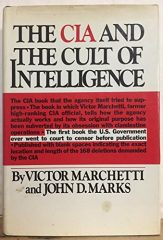
An unusual chain of events provided some of the strongest evidence of CIA involvement. Victor Marchetti, a career CIA officer, had risen to become Special Assistant to the Deputy Director, a position of some importance, before resigning in 1969 over policy differences. Although he fought a long battle with government censors over his book, The CIA and the Cult of Intelligence, he retained close ties with many former agency colleagues.
During the 1970s, the revelations of the Senate Church Committee and the House Select Committee on Assassinations had subjected the CIA to a great deal of negative public scrutiny, and there were growing suspicions of possible CIA links to JFK’s assassination. In 1978 longtime CIA Counter-intelligence chief James Angleton and a colleague provided Marchetti with an explosive leak, stating that the agency might be planning to admit a connection to the assassination, which had involved three shooters, but place the blame upon E. Howard Hunt, a former CIA officer who had become notorious during Watergate, and scapegoat him as a rogue agent, along with a few other equally tarnished colleagues. Marchetti published the resulting story in The Spotlight, a weekly national tabloid newspaper operated by Liberty Lobby, a rightwing populist organization based in DC. Although almost totally shunned by the mainstream media, The Spotlight was then at the peak of its influence, having almost 400,000 subscribers, as large a readership as the combined total of The New Republic, The Nation, and National Review.
Marchetti’s article suggested that Hunt had actually been in Dallas during the assassination, resulting in a libel lawsuit with potential damages large enough to bankrupt the publication. Longtime JFK assassination researcher Mark Lane became aware of the situation and volunteered his services to Liberty Lobby, hoping to use the legal proceedings, including the discovery process and subpoena power, as a means of securing additional evidence on the assassination, and after various court rulings and appeals, the case finally came to trial in 1985.
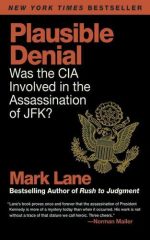
As Lane recounted in his 1991 bestseller, Plausible Denial, his strategy generally proved quite successful, not only allowing him to win the jury verdict against Hunt, but also eliciting sworn testimony from a former CIA operative of her personal involvement in the conspiracy along with the names of several other participants, though she claimed that her role had been strictly peripheral. And although Hunt continued for decades to totally deny any connection with the assassination, near the end of his life he made a series of video-taped interviews in which he admitted that he had indeed been involved in the JFK assassination and named several of the other conspirators, while also maintaining that his own role had been merely peripheral. Hunt’s explosive death-bed confession was recounted in a major 2007 Rolling Stone article and also heavily analyzed in Talbot’s books, especially his second one, but otherwise largely ignored by the media.
Many of these same apparent conspirators, drawn from the same loose alliance of groups, had previously been involved in the various U.S. government-backed attempts to assassinate Castro or overthrow his Communist government, and they had developed a bitter hostility towards President Kennedy for what they considered his betrayal during the Bay of Pigs fiasco and afterward. Therefore, there is a natural tendency to regard such animosity as the central factor behind the assassination, a perspective generally followed by Talbot, Douglass, and numerous other writers. They conclude that Kennedy died at the hands of harder-line anti-Communists, outraged over his perceived weakness regarding Cuba, Russia, and Vietnam, sentiments that were certainly widespread within right-wing political circles at the height of the Cold War.
While this framework for the assassination is certainly possible, it is far from certain. One may easily imagine that most of the lower-level participants in the Dallas events were driven by such considerations but that the central figures who organized the plot and set matters into motion had different motives. So long as all the conspirators were agreed on Kennedy’s elimination, there was no need for an absolute uniformity of motive. Indeed, men who had long been involved in organized crime or clandestine intelligence operations were surely experienced in operational secrecy, and many of them may not have expected to know the identities, let alone the precise motives, of the men at the very top of the remarkable operation they were undertaking.
We must also sharply distinguish between the involvement of particular individuals and the involvement of an organization as an organization. For example, CIA Director John McCone was a Kennedy loyalist who had been appointed to clean house a couple of years before the assassination, and he surely was innocent of his patron’s death. On the other hand, the very considerable evidence that numerous individual CIA intelligence officers and operatives participated in the action has naturally raised suspicions that some among their highest-ranking superiors were involved as well, perhaps even as the principal organizers of the conspiracy.
These reasonable speculations may have been magnified by elements of personal bias. Many of the prominent authors who have investigated the JFK assassination in recent years have been staunch liberals, and may have allowed their ideology to cloud their judgment. They often seek to locate the organizers of Kennedy’s elimination among those rightwing figures whom they most dislike, even when the case is far from entirely plausible.
But consider the supposed motives of hard-line anti-Communists near the top of the national security hierarchy who supposedly may have organized Kennedy’s elimination because he backed away from a full military solution in the Bay of Pigs and Cuban Missile Crisis incidents. Were they really so absolutely sure that a President Johnson would be such an enormous improvement as to risk their lives and public standing to organize a full conspiracy to assassinate an American president?
A new presidential election was less than a year away, and Kennedy’s shifting stance on Civil Rights seemed likely to cost him nearly all the Southern states that had provided his margin of electoral victory in 1960. A series of public declarations or embarrassing leaks might have helped remove him from office by traditional political means, possibly replacing him with a Cold War hard-liner such as Barry Goldwater or some other Republican. Would the militarists or business tycoons often implicated by liberal JFK researchers have really been so desperate as to not wait those extra few months and see what happened?
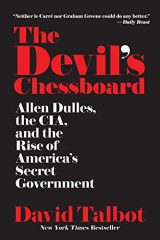
Based on extremely circumstantial evidence, Talbot’s 2015 book The Devil’s Chessboard, something of a sequel to Brothers, suggests that former longtime CIA Director Allan Dulles may have been the likely mastermind, with his motive being a mixture of his extreme Cold Warrior views and his personal anger at his 1961 dismissal from his position.
While his involvement is certainly possible, obvious questions arise. Dulles was a seventy-year-old retiree, with a very long and distinguished career of public service and a brother who had served as Eisenhower’s secretary of state. He had just published The Cult of Intelligence, which was receiving very favorable treatment in the establishment media, and he was embarked on a major book tour. Would he really have risked everything—including his family’s reputation in the history books—to organize the murder of America’s duly-elected president, an unprecedented act utterly different in nature than trying to unseat a Guatemalan leader on behalf of supposed American national interests? Surely, using his extensive media and intelligence contacts to leak embarrassing disclosures about JFK’s notorious sexual escapades during the forthcoming presidential campaign would have been be a much safer means of attempting to achieve an equivalent result. And the same is true for J. Edgar Hoover and many of the other powerful Washington figures who hated Kennedy for similar reasons.
On the other hand, it is very easy to imagine that such individuals had some awareness of the emerging plot or may even have facilitated it or participated to a limited extent. And once it succeeded, and their personal enemy had been replaced, they surely would have been extremely willing to assist in the cover-up and protect the reputation of the new regime, a role that Dulles may have played as the most influential member of the Warren Commission. But such activities are different than acting as the central organizer of a presidential assassination.
Just as with the hard-line national security establishment, many organized crime leaders had grown outraged over the actions of the Kennedy Administration. During the late 1950s, Robert Kennedy had intensely targeted the mob for prosecution as chief counsel to the Senate Labor Rackets Committee. But during the 1960 election, family patriarch Joseph Kennedy used his own longstanding mafia connections to enlist their support for his older son’s presidential campaign, and by all accounts the votes stolen by the corrupt mob-dominated political machines in Chicago and elsewhere helped put JFK in the White House, along with Robert Kennedy as his Attorney General. Frank Sinatra, an enthusiastic Kennedy supporter, had also helped facilitate this arrangement by using his influence with skeptical mob leaders.
However, instead of repaying such crucial election support with political favors, Attorney General Robert Kennedy, perhaps ignorant of any bargain, soon unleashed an all-out war against organized crime, far more serious than anything previously mounted at the federal level, and the crime bosses regarded this as a back-stabbing betrayal by the new administration. Once Joseph Kennedy was felled by an incapacitating stroke in late 1961, they also lost any hope that he would use his influence to enforce the deals he had struck the previous year. FBI wiretaps reveal that mafia leader Sam Giancana decided to have Sinatra killed for his role in this failed bargain, only sparing the singer’s life when he considered how much he personally loved the voice of one of the most famous Italian-Americans of the 20th century.
These organized crime leaders and some of their close associates such as Teamster boss Jimmy Hoffa certainly developed a bitter hatred toward the Kennedys, and this has naturally led some authors to point to the mafia as the likely organizers of the assassination, but I find this quite unlikely. For many decades, American crime bosses had had a complex and varied relationship with political figures, who might sometimes be their allies and at other times their persecutors, and surely there must have been many betrayals over the years. However, I am not aware of a single case in which any even moderately prominent political figure on the national stage was ever targeted for assassination, and it seems quite unlikely that the sole exception would be a popular president, whom they would have likely regarded as being completely out of their league. On the other hand, if individuals who ranked high in Kennedy’s own DC political sphere set in motion a plot to eliminate him, they might have found it easy to enlist the enthusiastic cooperation of various mafia leaders.
Furthermore, the strong evidence that many CIA operatives were involved in the conspiracy very much suggests that they were recruited and organized by some figure high in their own hierarchy of the intelligence or political worlds rather than the less likely possibility that they were brought in solely by leaders of the parallel domain of organized crime. And while crime bosses might possibly have organized the assassination itself, they surely had no means of orchestrated the subsequent cover-up by the Warren Commission, nor would there have been any willingness by America’s political leadership to protect mafia leaders from investigation and proper punishment for such a heinous act.
If a husband or wife is found murdered, with no obvious suspect or motive at hand, the normal response of the police is to carefully investigate the surviving spouse, and quite often this suspicion proves correct. Similarly, if you read in your newspapers that in some obscure Third World country two bitterly hostile leaders, both having unpronounceable names, had been sharing supreme political power until one was suddenly struck down in a mysterious assassination by unknown conspirators, your thoughts would certainly move in an obvious direction. Most Americans in the early 1960s did not perceive their own country’s politics in such a light, but perhaps they were mistaken. As a total newcomer to the enormous, hidden world of JFK conspiracy analysis, I was immediately surprised by the mere sliver of suspicion directed towards Vice President Lyndon B. Johnson, the slain leader’s immediate successor and the most obvious beneficiary.
The two Talbot books and the one by Douglass, totaling some 1500 pages, devote merely a few paragraphs to any suspicions of Johnson’s involvement. Talbot’s first book reports that immediately after the assassination, the vice president had expressed a frantic concern to his personal aides that a military coup might be in progress or a world war breaking out, and suggests that these few casual words demonstrate his obvious innocence, although a more cynical observer might wonder if those remarks had been uttered for exactly that reason. Talbot’s second book actually quotes an apparent low-level conspirator as claiming that Johnson had personally signed off on the plot and admits that Hunt believed the same thing, but treats such unsubstantiated accusations with considerable skepticism, before adding a single sentence acknowledging that Johnson may indeed have been a passive supporter or even an accomplice. Douglass and Peter Dale Scott, author of the influential 1993 book Deep Politics and the Death of JFK, apparently seem never to have even entertained the possibility.
Ideological considerations are probably an important reason for such remarkable reticence. Although liberals had grown to revile LBJ by the late 1960s for his escalation of the unpopular Vietnam War, over the decades those sentiments have faded, while warm memories of his passage of the landmark Civil Rights legislation and his creation of the Great Society programs have elevated his stature in that ideological camp. Furthermore, such legislation had long been blockaded in Congress and only became law because of the 1964 Democratic Congressional landslide following JFK’s martyrdom, and it might be difficult for liberals to admit that their fondest dreams were only realized by an act of political parricide.
Kennedy and Johnson may have been intensively hostile personal rivals, but there seem to have been few deep ideological differences between the two men, and most of the leading figures in JFK’s government continued to serve under his successor, surely another source of enormous embarrassment to any ardent liberals who came to suspect that the former had been murdered by a conspiracy involving the latter. Talbot, Douglass, and many other left-leaning advocates for an assassination conspiracy prefer to point the finger of blame towards far more congenial villains such as hard-line, anti-Communist Cold Warriors and right-wing elements, notably including top CIA officials, such as former director Allan Dulles.
An additional factor helping to explain the extreme unwillingness of Talbot, Douglass, and others to consider Johnson as an obvious suspect may be the realities of the book publishing industry. By the 2000s, JFK assassination conspiracies had long become passé and were treated with disdain in mainstream circles. Talbot’s strong reputation, his 150 original interviews, and the quality of his manuscript broke that barrier, and attracted The Free Press as his very respectable publisher, while later drawing a strongly positive review by a leading academic scholar in the New York Times Sunday Book Review and an hour long television segment broadcast on C-Span Booknotes. But if he had devoted any space to voicing suspicions that our 35th president had been murdered by our 36th, surely the weight of that extra element of “outrageous conspiracy theory” would have ensured that his book sank without a trace.
However, if we cast off these distorting ideological blinders and the practical considerations of American publishing, the prima facie case for Johnson’s involvement seems quite compelling.
Consider a very simple point. If a president is struck down by an unknown group of conspirators, his successor would normally have had the strongest possible incentive to track them down lest he might become their next victim. Yet Johnson did nothing, appointing the Warren Commission that covered up the entire matter, laying the blame upon an erratic “lone gunman” conveniently dead. This would seem remarkably odd behavior for an innocent LBJ. This conclusion does not demand that Johnson was the mastermind, nor even an active participant, but it raises a very strong suspicion that he at least had had some awareness of the plot, and enjoyed a good personal relationship with some of the principals.
A similar conclusion is supported by a converse analysis. If the plot succeeded and Johnson became president, the conspirators must surely have felt reasonably confident that they would be protected rather than tracked down and punished as traitors by the new president. Even a fully successful assassination would entail enormous risks unless the organizers believed that Johnson would do exactly what he did, and the only means of ensuring this would be to sound him out about the plan, at least in some vague manner, and obtain his passive acquiesce.
Based on these considerations, it seems extremely difficult to believe that any JFK assassination conspiracy took place entirely without Johnson’s foreknowledge, or that he was not a central figure in the subsequent cover-up.
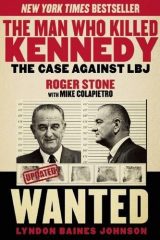
But the specific details of Johnson’s career and his political situation in late 1963 greatly strengthen these entirely generic arguments. A very useful corrective to the “See No Evil” approach to Johnson from liberal JFK writers is Roger Stone’s The Man Who Killed Kennedy: The Case Against LBJ, published in 2013. Stone, a longtime Republican political operative who got his start under Richard Nixon, presents a powerful case that Johnson was the sort of individual who might easily have lent his hand to political murder, and also that he had strong reasons to do so.
Among other things, Stone gathers together an enormous wealth of persuasive information regarding Johnson’s decades of extremely corrupt and criminal practices in Texas, including fairly plausible claims that these may have included several murders. In one bizarre 1961 incident that strangely foreshadows the Warren Commission’s “lone gunman” finding, a federal government inspector investigating a major Texas corruption scheme involving a close LBJ ally was found dead, shot five times in the chest and abdomen by a rifle, but the death was officially ruled a “suicide” by the local authorities, and that conclusion was reported with a straight face in the pages of the Washington Post.
Certainly one remarkable aspect of Johnson’s career is that he was born dirt-poor, held low-paying government jobs throughout his entire life, yet took the oath of office as the wealthiest president in modern American history, having accumulated a personal fortune of over $100 million in present-day dollars, with the financial payoffs from his corporate benefactors having been laundered through his wife’s business. This odd anomaly is so little remembered these days that a prominent political journalist expressed total disbelief when I mentioned it to him a decade ago.
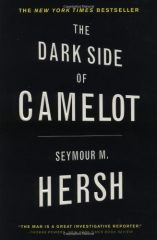
Stone also effectively sketches out the very difficult political situation Johnson faced in late 1963. He had originally entered the 1960 presidential race as one of the most powerful Democrats in the country and the obvious front-runner for his party’s nomination, certainly compared to the much younger Kennedy, whom he greatly outranked in political stature and also somewhat despised. His defeat, involving a great deal of underhanded dealings on both sides, came as a huge personal blow. The means by which he somehow managed to get himself placed on the ticket are not entirely clear, but both Stone and Seymour Hersh in The Dark Side of Camelot strongly suggest that personal blackmail was a greater factor than geographical ticket-balancing. In any event, Kennedy’s paper-thin 1960 victory would have been far more difficult without Texas narrowly falling into the Democratic column, and election fraud there by Johnson’s powerful political machine seems almost certainly to have been an important factor.
Under such circumstances, Johnson naturally expected to play a major role in the new administration, and he even issued grandiose demands for a huge political portfolio, but instead he found himself immediately sidelined and treated with complete disdain, soon becoming a forlorn figure with no authority or influence. As time went by, the Kennedys made plans to get rid of him, and just a few days before the assassination, they were already discussing whom to place on the reelection ticket in his stead. Much of Johnson’s long record of extreme corruption both in Texas and in DC was coming to light following the fall of Bobby Baker, his key political henchman, and with strong Kennedy encouragement, Life Magazine was preparing a huge expose of his sordid and often criminal history, laying the basis for his prosecution and perhaps a lengthy prison sentence. By mid-November 1963, Johnson seemed a desperate political figure at the absolute end of his rope, but a week later he was the president of the United States, and all those swirling scandals were suddenly forgotten. Stone even claims that the huge block of magazine space reserved for the Johnson expose was instead filled by the JFK assassination story.
Aside from effectively documenting Johnson’s sordid personal history and the looming destruction he faced at the hands of the Kennedys in late 1963, Stone also adds numerous fascinating pieces of personal testimony, which may or may not be reliable. According to him, as his mentor Nixon was watching the scene at the Dallas police station where Jack Ruby shot Oswald, Nixon immediately turned as white as a ghost, explaining that he had personally known the gunman under his birth-name of Rubenstein. While working on a House Committee in 1947, Nixon had been advised by a close ally and prominent mob-lawyer to hire Ruby as an investigator, being told that “he was one of Lyndon Johnson’s boys.” Stone also claims that Nixon once emphasized that although he had long sought the presidency, unlike Johnson “I wasn’t willing to kill for it.” He further reports that Vietnam Ambassador Henry Cabot Lodge and numerous other prominent political figures in DC were absolutely convinced of Johnson’s direct involvement in the assassination.
Stone has spent more than a half-century as a ruthless political operative, a position that provided him with unique personal access to individuals who participated in the great events of the past, but one that also carries the less than totally candid reputation of that profession, and individuals must carefully weigh these conflicting factors against each other. Personally, I tend to credit most of the eyewitness stories he provides. But even readers who remain entirely skeptical should find useful the large collection of secondary source references to the sordid details of LBJ’s history that the book provides.
Finally, a seemingly unrelated historical incident had originally raised my own suspicions of Johnson’s involvement.
Just prior to the outbreak of the Six Day War in 1967, Johnson had dispatched the U.S.S. Liberty, our most advanced intelligence-gathering ship, to remain offshore in international waters and closely monitor the military situation. There have been published claims that he had granted Israel a green-light for its preemptive attack, but fearful of risking a nuclear confrontation with the Soviet patrons of Syria and Egypt, had strictly circumscribed the limits of the military operation, sending the Liberty to keep an eye on developments and perhaps also to “show Israel who was boss.”
Whether or not this reconstruction is correct, the Israelis soon launched an all-out attack on the nearly defenseless ship despite the large American flag it was flying, deploying attack jets and torpedo boats to sink the vessel during an assault that lasted several hours, while machine-gunning the lifeboats to ensure that there would be no survivors. The first stage of the attack had targeted the main communications antenna, and its destruction together with heavy Israeli jamming, prevented any communications with other U.S. naval forces in the region.
Despite these very difficult conditions, a member of the crew heroically managed to jerry-rig a replacement antenna during the attempt, and by trying numerous different frequencies, was able to evade the jamming and contact the U.S. Sixth Fleet, informing them of the desperate situation. Yet although carrier jets were twice dispatched to rescue the Liberty and drive off the attackers, each time they were recalled, apparently upon direct orders from the highest authorities of the U.S. government. Once the Israelis learned that word of the situation had reached other U.S. forces, they soon discontinued their attack, and the heavily-damaged Liberty eventually limped into port, with over 200 dead and wounded sailors and NSA signal operators, representing the greatest loss of American servicemen in any naval incident since World War II.
Although numerous medals were issued to the survivors, word of the incident was totally suppressed by a complete blanket of secrecy, and in an unprecedented step, even a Congressional Medal of Honor was awarded only in a private ceremony. The survivors were also harshly threatened with immediate court martial if they discussed what had transpired with the press or anyone else. Despite the overwhelming evidence that the attack had been intentional, a naval court of inquiry presided over by Admiral John S. McCain, Jr., father of the current senator, whitewashed the incident as a tragic accident, and a complete media blackout suppressed the facts. The true story only began to come out years later, when James M. Ennes, Jr., a Liberty survivor, risked severe legal consequences and published Assault on the Liberty in 1979 .
As it happened, NSA intercepts of Israeli communications between the attacking jets and Tel Aviv, translated from the Hebrew, fully confirmed that the attack had been entirely deliberate, and since many of the dead and wounded were NSA employees, the suppression of these facts greatly rankled their colleagues. My old friend Bill Odom, the three-star general who ran the NSA for Ronald Reagan, later shrewdly circumvented the restrictions of his political masters by making those incriminating intercepts part of the standard curriculum of the Sigint training program required for all intelligence officers.
In 2007 an unusual set of circumstances finally broke the thirty year blackout in the mainstream media. Real estate investor Sam Zell, a Jewish billionaire extremely devoted to Israel, had orchestrated a leveraged-buyout of the Tribune Company, parent of the Los Angeles Times and the Chicago Tribune, investing merely a sliver of his own money, with the bulk of the financing coming from the pension funds of the company he was acquiring. Widely heralded as “the grave dancer” for his shrewd financial investments, Zell publicly boasted that the deal gave him nearly all of the upside potential of the company, while he bore relatively little of the risk. Such an approach proved wise since the complex deal quickly collapsed into bankruptcy, and although Zell emerged almost unscathed, the editors and journalists lost decades of their accumulated pension dollars, while massive layoffs soon devastated the newsrooms of what had been two of the country’s largest and most prestigious newspapers. Perhaps coincidentally, just as this business turmoil hit in late 2007, the Tribune ran a massive 5,500 word story on the Liberty attack, representing the first and only time such a comprehensive account of the true facts has ever appeared in the mainstream media.
By all accounts, Johnson was an individual of towering personal ego, and when I read the article, I was struck by the extent of his astonishing subservience to the Jewish state. The influence of campaign donations and favorable media coverage seemed completely insufficient to explain his reaction to an incident that had cost the lives of so many American servicemen. I began to wonder if Israel might have played an extraordinarily powerful political trump-card, thereby showing LBJ “who was really boss,” and once I discovered the reality of the JFK assassination conspiracy a year or two later, I suspected I knew what that trump-card might have been. Over the years, I had become quite friendly with the late Alexander Cockburn, and the next time we had lunch I outlined my ideas. Although he had always casually dismissed JFK conspiracy theories as total nonsense, he found my hypothesis quite intriguing.
Regardless of such speculation, the strange circumstances of the Liberty incident certainly demonstrated the exceptionally close relationship between President Johnson and the government of Israel, as well as the willingness of the mainstream media to spend decades hiding events of the most remarkable nature if they might tread on particular toes.
These important considerations should be kept in mind as we begin exploring the most explosive yet under-reported theory of the JFK assassination. Almost twenty-five years ago the late Michael Collins Piper published Final Judgment presenting a very large body of circumstantial evidence that Israel and its Mossad secret intelligence service, together with their American collaborators, probably played a central role in the conspiracy.
For decades following the 1963 assassination, virtually no suspicions had ever been directed towards Israel, and as a consequence none of the hundreds or thousands of assassination conspiracy books that appeared during the 1960s, 1970s, and 1980s had hinted at any role for the Mossad, though nearly every other possible culprit, ranging from the Vatican to the Illuminati, came under scrutiny. Kennedy had received over 80% of the Jewish vote in his 1960 election, American Jews featured very prominently in his White House, and he was greatly lionized by Jewish media figures, celebrities, and intellectuals ranging from New York City to Hollywood to the Ivy League. Moreover, individuals with a Jewish background such as Mark Lane and Edward Epstein had been among the leading early proponents of an assassination conspiracy, with their controversial theories championed by influential Jewish cultural celebrities such as Mort Sahl and Norman Mailer. Given that the Kennedy Administration was widely perceived as pro-Israel, there seemed no possible motive for any Mossad involvement, and bizarre, totally unsubstantiated accusations of such a monumental nature directed against the Jewish state were hardly likely to gain much traction in an overwhelmingly pro-Israel publishing industry.

However, in the early 1990s highly-regarded journalists and researchers began exposing the circumstances surrounding the development of Israel’s nuclear weapons arsenal. Seymour Hersh’s 1991 book The Samson Option: Israel’s Nuclear Arsenal and American Foreign Policy described the extreme efforts of the Kennedy Administration to force Israel to allow international inspections of its allegedly non-military nuclear reactor at Dimona, and thereby prevent its use in producing nuclear weapons. Dangerous Liaisons: The Inside Story of the U.S.-Israeli Covert Relationship by Andrew and Leslie Cockburn appeared in the same year, and covered similar ground.
Although entirely hidden from public awareness at the time, the early 1960s political conflict between the American and Israeli governments over nuclear weapons development had represented a top foreign policy priority of the Kennedy Administration, which had made nuclear non-proliferation one of its central international initiatives. It is notable that John McCone, Kennedy’s choice as CIA Director, had previously served on the Atomic Energy Commission under Eisenhower, being the individual who leaked the fact that Israel was building a nuclear reactor to produce plutonium.
The pressure and financial aid threats secretly applied to Israel by the Kennedy Administration eventually became so severe that they led to the resignation of Israel’s founding Prime Minister David Ben-Gurion in June 1963. But all these efforts were almost entirely halted or reversed once Kennedy was replaced by Johnson in November of that same year. Piper notes that Stephen Green’s 1984 book Taking Sides: America’s Secret Relations With a Militant Israel had previously documented that U.S. Middle East Policy completely reversed itself following Kennedy’s assassination, but this important finding had attracted little attention at the time.
Skeptics of a plausible institutional basis for a JFK assassination conspiracy have often noted the extreme continuity in both foreign and domestic policies between the Kennedy and Johnson Administrations, arguing that this casts severe doubt on any such possible motive. Although this analysis seems largely correct, America’s behavior towards Israel and its nuclear weapons program stands as a very notable exception to this pattern.
An additional major area of concern for Israeli officials may have involved the efforts of the Kennedy Administration to sharply restrict the activities of pro-Israel political lobbies. During his 1960 presidential campaign, Kennedy had met in New York City with a group of wealthy Israel advocates, led by financier Abraham Feinberg, and they had offered enormous financial support in exchange for a controlling influence in Middle Eastern policy. Kennedy managed to fob them off with vague assurances, but he considered the incident so troubling that the next morning he sought out journalist Charles Bartlett, one of his closest friends, and expressed his outrage that American foreign policy might fall under the control of partisans of a foreign power, promising that if he became president, he would rectify that situation. And indeed, once he had installed his brother Robert as Attorney General, the latter initiated a major legal effort to force pro-Israel groups to register themselves as foreign agents, which would have drastically reduced their power and influence. But after JFK’s death, this project was quickly abandoned, and as part of the settlement, the leading pro-Israel lobby merely agreed to reconstitute itself as AIPAC.
Final Judgment went through a number of a reprintings following its original 1994 appearance, and by the sixth edition released in 2004, had grown to over 650 pages, including numerous long appendices and over 1100 footnotes, the overwhelming majority of these referencing fully mainstream sources. The body of the text was merely serviceable in organization and polish, reflecting the total boycott by all publishers, mainstream or alternative, but I found the contents themselves remarkable and generally quite compelling. Despite the most extreme blackout by all media outlets, the book sold more than 40,000 copies over the years, making it something of an underground bestseller, and surely bringing it to the attention of everyone in the JFK assassination research community, though apparently almost none of them were willing to mention its existence. I suspect these other writers realized that even any mere acknowledgement of the existence of the book, if only to ridicule or dismiss it, might prove fatal to their media and publishing career. Piper himself died in 2015, aged 54, suffering from the health problems and heavy-drinking often associated with grim poverty, and other journalists may have been reluctant to risk that same dismal fate.
As an example of this strange situation, the bibliography of Talbot’s 2005 book contains almost 140 entries, some rather obscure, but has no space for Final Judgment, nor does his very comprehensive index include any entry for “Jews” or “Israel.” Indeed, at one point he very delicately characterizes Sen. Robert Kennedy’s entirely Jewish senior staff by stating “There was not a Catholic among them.” His 2015 sequel is equally circumspect, and although the index does contain numerous entries pertaining to Jews, all these references are in regards to World War II and the Nazis, including his discussion of the alleged Nazi ties of Allen Dulles, his principal bête noire. Stone’s book, while fearlessly convicting President Lyndon Johnson of the JFK assassination, also strangely excludes “Jews” and “Israel” from the long index and Final Judgment from the bibliography, and Douglass’s book follows this same pattern.
Furthermore, the extreme concerns that the Piper Hypothesis seems to have provoked among JFK assassination researchers may explain a strange anomaly. Although Mark Lane was himself of Jewish origins and left-wing roots, after his victory for Liberty Lobby in the Hunt libel trial, he spent many years associated with that organization in a legal capacity, and apparently became quite friendly with Piper, one of its leading writers. According to Piper, Lane told him that Final Judgment made “a solid case” for a major Mossad role in the assassination, and he viewed the theory as fully complementary to his own focus on CIA involvement. I suspect that concerns about these associations may explain why Lane was almost completely airbrushed out of the Douglass and 2007 Talbot books, and discussed in the second Talbot book only when his work was absolutely essential to Talbot’s analysis. By contrast, New York Times staff writers are hardly likely to be as versed in the lesser-known aspects of the JFK assassination research community, and being ignorant of this hidden controversy, they gave Lane the long and glowing obituary that his career fully warranted.
When weighing the possible suspects for a given crime, considering their past pattern of behavior is often a helpful approach. As discussed above, I can think of no historical example in which organized crime initiated a serious assassination attempt against any American political figure even moderately prominent on the national stage. And despite a few suspicions here and there, the same applies to the CIA.
By contrast, the Israeli Mossad and the Zionist groups that preceded the establishment of the Jewish state seem to have a very long track record of assassinations, including those of high-ranking political figures who might normally be regarded as inviolate. Lord Moyne, the British Minister of State for the Middle East, was assassinated in 1944 and Count Folke Bernattote, the UN Peace Negotiator sent to help resolve the first Arab-Israel war suffered the same fate in September 1948. Not even an American president was entirely free of such risks, and Piper notes that the memoirs of Harry Truman’s daughter Bess reveal that Zionist militants had tried to assassinate her father using a letter laced with toxic chemicals in 1947 when they believed he was dragging his heels in supporting Israel, although that failed attempt was never made public. The Zionist faction responsible for all of these incidents was led by Yitzhak Shamir, who later became a leader of Mossad and director of its assassination program during the 1960s, before eventually becoming Prime Minister of Israel in 1986.
If the claims in the 1990s tell-all bestsellers of Mossad defector Victor Ostrovsky can be credited, Israel even considered the assassination of President George H.W. Bush in 1992 for his threats to cut off financial aid to Israel during a conflict over West Bank settlement policies, and I have been informed that the Bush Administration took those reports seriously at the time. And although I have not yet read it, the recent, widely-praised book Rise and Kill First: The Secret History of Israel’s Targeted Assassinations by journalist Ronen Bergman suggests that no other country in the world may have so regularly employed assassination as a standard tool of state policy.
There are other notable elements that tend to support the Piper Hypothesis. Once we accept the existence of a JFK assassination conspiracy, the one individual who is virtually certain to have been a participant was Jack Ruby, and his organized crime ties were almost entirely to the huge but rarely-mentioned Jewish wing of that enterprise, presided over by Meyer Lansky, an extremely fervent supporter of Israel. Ruby himself had particularly strong ties with Lansky lieutenant Mickey Cohen, who dominated the Los Angeles underworld and had been personally involved in gun-running to Israel prior to the 1948 war. Indeed, according to Dallas rabbi Hillel Silverman, Ruby had privately explained his killing of Oswald by saying “I did it for the Jewish people.”
An intriguing aspect to Oliver Stone’s landmark JFK film should also be mentioned. Arnon Milchan, the wealthy Hollywood producer who backed the project, was not only an Israeli citizen, but had also reportedly played a central role in the enormous espionage project to divert American technology and materials to Israel’s nuclear weapons project, the exact undertaking that the Kennedy Administration had made such efforts to block, even sometimes being described as “the Israeli James Bond.” And although the film ran a full three hours in length, JFK scrupulously avoided presenting any of the details that Piper later regarded as initial clues to an Israeli dimension, instead seeming to finger America’s fanatic home-grown anti-Communist movement and the Cold War leadership of the military-industrial complex as the guilty parties.
Summarizing over 300,000 words of Piper’s history and analysis in just a few paragraphs is obviously an impossible undertaking, but the above discussion provides a reasonable taste of the enormous mass of circumstantial evidence mustered in favor of the Piper Hypothesis.
In many respects, JFK Assassination Studies has become its own academic discipline, and my credentials are quite limited. I have read perhaps a dozen books in the subject, and have also tried to approach the issues with the clean slate and fresh eyes of an outsider, but any serious expert would surely have digested scores or even hundreds of the volumes in the field. While the overall analysis of Final Judgment struck me as quite persuasive, a good fraction of the names and references were unfamiliar, and I simply do not have the background to assess their credibility, nor whether the description of the material presented is accurate.
Under normal circumstances, I would turn to the reviews or critiques produced by other authors, and comparing them against Piper’s arguments, decide which argument seemed the stronger. But although Final Judgment was published a quarter-century ago, the near-absolute blanket of silence surrounding the Piper Hypothesis, especially from the more influential and credible researchers, renders this impossible.
However, Piper’s inability to secure any regular publisher and the widespread efforts to smother his theory out of existence, have had an ironic consequence. Since the book went out of print years ago, I had a relatively easy time securing the rights to include it in my collection of controversial HTML Books, and I have now done so, thereby allowing everyone on the Internet to conveniently read the entire text and decide for themselves, while easily checking the multitude of references or searching for particular words or phrases.
The Missing Link in the JFK Assassination Conspiracy
Michael Collins Piper • 2005 • 310,000 Words
This edition actually incorporates several much shorter works, originally published separately. One of these, consisting of an extended Q&A, describes the genesis of the idea and answers numerous questions surrounding it, and for some readers may represent a better starting point.
Questions, Answers & Reflections About the Crime of the Century
Michael Collins Piper • 2005 • 48,000 Words
There are also numerous extended Piper interviews or presentations easily available on YouTube, and when I watched two or three of them a couple of years ago, I thought he effectively summarized many of his main arguments, but I cannot remember which ones they were.
The Kennedy assassination surely ranks as one of the most dramatic and heavily reported events of the twentieth century, yet the overwhelming evidence that our president died at the hands of a conspiracy rather than an eccentric “lone gunman” was almost entirely suppressed by our mainstream media during the decades that followed, with endless ridicule and opprobrium heaped on many of the stubborn truth-tellers. Indeed, the very term “conspiracy theory” soon became a standard slur aimed against all those who sharply questioned establishmentarian narratives, and there is strong evidence that such pejorative use was deliberately promoted by government agencies concerned that so much of the American citizenry was growing skeptical of the implausible cover story presented by the Warren Commission. But despite all these efforts, this period may mark the inflection point at which public trust in our national media began its precipitous decline. Once an individual concludes that the media lied about something as enormous as the JFK assassination, he naturally begins to wonder what other lies may be out there.
Although I now consider the case for an assassination conspiracy overwhelming, I think that the passage of so many decades has removed any real hope of reaching a firm conclusion about the identities of the main organizers or their motives. Those who disagree with this negative assessment are free to continue sifting the enormous mountain of complex historical evidence and debating their conclusions with others having similar interests.
However, among the cast of major suspects, I think that the most likely participant by far was Lyndon Johnson, based on any reasonable assessment of means, motive, and opportunity, as well as the enormous role he obviously must have played in facilitating the subsequent Warren Commission cover-up. Yet although such an obvious suspect must surely have been immediately apparent to any observer, Johnson seems to have received only a rather thin slice of the attention that books regularly directed to other, far less plausible suspects. So the clear dishonesty of the mainstream media in avoiding any recognition of a conspiracy seems matched by a second layer of dishonesty in the alternative media, which has done its best to avoid recognizing the most likely perpetrator.
And the third layer of media dishonesty is the the most extreme of all. A quarter century ago, Final Judgment provided an enormous mass of circumstantial evidence suggesting a major, even dominant, role for the Israeli Mossad in organizing the elimination of both our 33rd president and also his younger brother, a scenario that seems second in likelihood only to that of Johnson’s involvement. Yet Piper’s hundreds of thousands of words of analysis have seemingly vanished into the ether, with very few of the major conspiracy researchers even willing to admit their awareness of a shocking book that sold over 40,000 copies, almost entirely by underground word-of-mouth.
So although committed partisans can continue endless, largely fruitless debates over “Who Killed JFK,” I think that the one firm conclusion we can draw from the remarkable history of this pivotal event of the twentieth century is that all of us have lived for many decades within the synthetic reality of “Our American Pravda.”
Related Reading:
- American Pravda: The JFK Assassination, Part I – What Happened?
- Final Judgment by Michael Collins Piper
- Did Israel Kill the Kennedys? by Laurent Guyénot
- Our American Pravda
Can Universities Lawfully Bully Academics into Silence?
By Jennifer Marohasy | June 19, 2018
Dr Peter Ridd has taken James Cook University to court protesting his sacking for what he says is, primarily, speaking-out about the lack of quality assurance in Great Barrier Reef science.
Dr Ridd spoke out initially about there being no quality assurance of Great Barrier Reef science – science that is arguably misused to secure billions of dollars of tax-payer funding. When the University tried to stop Dr Ridd doing this, Dr Ridd spoke out against University management – making all the documentation public including on his new website.
I would really like the court case to be about academic freedom and the science – to lay bare the evidence. But when I went to the first day of the hearing of an application in the Federal Circuit Court last Monday (11th June – the hearing continued on 12 June 2018) for an order for reinstatement of Dr Ridd’s employment pending determination at trial, it quickly became evident that there would be no testing of the actual scientific evidence relied upon by Dr Ridd to claim that scientific institutions like AIMS and ARC Centre “can no longer be trusted” and “spin their story”.
Yesterday (19th June), Judge Jarrett gave his reasons for making orders declining to reinstate Dr Ridd but allowing him to amend his primary application to include a claim for the university taking “adverse action” against him for exercising a workplace right (i.e. his intellectual/academic freedom pursuant to the enterprise agreement). On hearing the reasons I was concerned to discover that it may all come down to poorly worded clauses in an enterprise agreement. In particular, was Dr Ridd allowed to exercise his academic freedoms free of the constraint of the university’s ‘aspirational’ (according to His Honour) code of conduct, and was he permitted to say anything publicly about what many ordinary Australians would consider a straight-forward case of the university bullying him into silence?
On the first day of the preliminary hearing Barrister Ben Kidston for the applicant (Dr Ridd) argued eloquently about how the case was about ‘academic freedom’. He went-on for over an hour moving from the big picture to the detail with respect to specific clauses in a code of conduct and the enterprise agreement, and back again. All the while His Honour and the audience listened intently – no one interrupted. Again yesterday, His Honour cited the poorly worded specific clause which the university has been relying on to silence Dr Ridd, and observed that it was open to two interpretations.
His Honour didn’t mention the Union. The National Tertiary Education Union has an interest in the enterprise agreement and like Dr Ridd, they say that the relevant clause in the agreement shouldn’t be used to silence the employee but rather, amongst other things, that the obligation of confidentiality only applies to the University’s management of the disciplinary process. Any other interpretation means that university academics would be obliged to suffer any disciplinary action by the University (legitimate or otherwise) in silence – they would never be able to publicly defend themselves in the court of public opinion, court proceedings being the only practical option. One wonders if the Union realises the implications to its members.
Yesterday, when His Honour gave his reasons for declining the application by Dr Ridd for an injunction – for his temporary reinstatement as a Professor at James Cook University pending the trial – he didn’t deal with many of the arguments advanced for Dr Ridd e.g. the effect of the clause of the enterprise agreement which states that the code of conduct is not to “detract” from the intellectual freedoms, the interaction of the express right to disagree with the University‘s decisions and processes pursuant to his intellectual freedom and the purported obligation to keep disciplinary proceedings again him confidential, whether a conflict of interest, apprehended bias or actual bias, exists by reason of the university’s commercial relationship with AIMS, GBRMPA and ARC and the effect that this has on the obligation to afford Dr Ridd procedural fairness and natural justice in the determination of the disciplinary complaint (which concerned comments he made about those bodies).
That is not intended to be critical of His Honour. His Honour took a broad brush approach and did not descend into the detail of the arguments and the evidence, as all His Honour was required to do was to ascertain whether Dr Ridd had a prima facie case, and not to decide the case itself.
Yesterday, His Honour found that Dr Ridd had an arguable prima facie case in relation to the alleged breach of the enterprise agreement by JCU and that it took adverse action against him, but that the balance of convenience did not favour his reinstatement pending trial primarily because:
1. an award of damages would be an adequate remedy if Dr Ridd was successful at trial; and
2. the university paid Dr Ridd the equivalent of six month’s pay upon his termination – so he was not presently without income to support himself and (it seems) that a trial would likely occur before the expiration of that six month period; and
3. Dr Ridd had previously turned down an offer of an undertaking by the university to suspend the disciplinary proceedings pending determination of the proceeding. It is important to note that that undertaking would have required Dr Ridd to remain silent about the disciplinary proceedings that had been taken against him by the university.
Of course, in making this determination the Judge was entirely ignoring (as he was entitled to) the very nature of Dr Ridd – a man of integrity who will not be silenced even if costs him his job, his career and results in vicious bullying.
When Christopher Murdoch QC for the respondent (JCU) argued on the first day of the hearing he explained that the University’s core issue was the breaking of confidentiality, in particular Dr Ridd was not allowed to tell anyone that he had been censured. Never mind that he had been censured for daring to speak out against a culture where scientific integrity is perhaps sacrificed for profit.
So, when I blogged about this issue of Peter Ridd being censured and the need for everyone to contribute to his GoFundMe Campaign back in May, I very deliberately emphasised the importance of being able to speak out. The most important thing, I wrote, is to not be silenced.
I was also thinking of the famous Edmund Burke quote: The only thing necessary for the triumph of evil is for good men to do nothing.
Dr Ridd has done something. First, he detailed the scientific facts as an expert on these issues including in the scientific literature. For example, there is his article published in Marine Geology (Volume 346, pages 392-399) in which he explains that the only reason Glenn De’ath found an apparent decline in coral calcification rates was because he didn’t consider the age effect on coral growth. This is just one of many instances when Dr Ridd has detailed how scientists make spurious claims based on a flawed methodology. More recently Dr Ridd has explained the consequences of this in plain English on television.
None of this has made him popular with his colleagues most of whom rely on perceptions of imminent catastrophe at the Great Barrier Reef for their relevance and certainly their funding. Dr Ridd has done what the average Australian would consider to be the right thing. Most importantly he has not remained silent – surely, he will be vindicated at the final trial when all the evidence is heard and all the arguments made and considered.
Human Rights Group Accuses UK of Secret Arms Sales to Saudis
Sputnik – 24.06.2018
NGOs allege that the UK has been selling weaponry to Saudi Arabia through an obscure system of arms exports licenses. Since 2015, a Saudi-led coalition has been involved in the Yemen war at the request of the country’s internationally recognized government.
Despite the UK has been insisting that it keeps all arms exports under close control, a freedom of information request submitted by Campaign Against Arms Trade, a UK-based NGO, disclosed that Britain has been selling Storm Shadow and Brimstone missiles, as well as Paveway IV laser-guided bombs to Saudi Arabia.
According to The Guardian, the deadly exports have been shipped for the last five years under Open Individual Export Licences (OIELs), which don’t oblige the seller to publish the total value of the license after it expires.
The surprising finding has prompted campaigners to claim that the authorities are trying to hide the real extent of their arms exports to Saudi Arabia.
Lloyd Russell-Moyle, a Labour MP and member of the Commons Committee on Arms Export Controls, said, as quoted by The Guardian, that hundreds of millions of pounds of bombs were shipped to Saudi Arabia under open licenses issued before it launched its Yemen campaign.
“Open licenses remove the need for the seller to obtain prior approval for each export,” said Andrew Smith of Campaign Against Arms Trade.
According to him, the “opaque” system of OIELs is used to hand over “extremely sensitive weaponry to the Saudi regime.”
Yemen is the site of a long-lasting conflict that rapidly escalated in September 2014 following a Houthi takeover of the Yemeni capital of Sana’a. In 2015, Saudi Arabia, the leader of a nine-member, mostly Sunni Arab, coalition, entered the conflict in a bid to restore Hadi’s government, concerned by the rise of Houthis.
The violent clash has destroyed the local economy and caused a humanitarian disaster. The UN estimates that the conflict has displaced around 3 million people and leaving over 22 million people in need of humanitarian assistance or protection.
Featured Video
Anthrax War – CBC The Passionate Eye
or go to
Aletho News Archives – Video-Images
Book Review
Shattered Dreams: The HPV Vaccine Exposed (2019)
By Christina England – 30 Q&As – Book Review & Summary
Lies are Unbekoming | September 4, 2026
… Gardasil received FDA fast-track approval in 2006, Cervarix followed in 2009, and Gardasil 9 was approved in December 2014 with more than double the aluminium adjuvant content of the original. The commercial context is specific. Merck was about to lose patent protection on Zocor and faced $18 billion in Vioxx injury claims from a cardiovascular drug the company had marketed while suppressing its own data showing a five-times increase in heart attacks. Analysts projected the global HPV vaccine market at $4 billion by 2011, contingent on government-funded national programs for teenage girls. The 1986 National Childhood Vaccine Injury Act had already granted manufacturers complete liability immunity. By 2013, Japan had withdrawn its HPV vaccine recommendation after cataloguing severe adverse reactions in hundreds of girls. No Western government followed. The establishment position across the UK, US, Australia, and most of Europe held, and still holds, that the vaccines are safe and effective, that reported injuries are coincidental, and that cervical cancer prevention justifies the program. The book was published into this position, not against a vacuum.
Shattered Dreams sits alongside Mary Holland’s The HPV Vaccine On Trial and Viera Scheibner’s foundational vaccination work as part of the documented record on what has been done to a generation of teenage girls under the banner of cancer prevention. The full summary unpacks three specific findings: that Merck used the aluminium adjuvant itself as the “placebo” control in 92.5% of trial subjects, making it structurally impossible to detect excess reactions from the adjuvant; that Dr. Sin Hang Lee found HPV DNA fragments bound to aluminium in every one of sixteen Gardasil samples tested, and in the blood and spleen of a New Zealand girl six months after her third dose; and that in every country with high vaccination coverage, including Australia, the UK, Norway, and Sweden, cervical cancer rates have stopped declining and started rising specifically in the vaccinated cohort. Martínez-Lavín’s 2017 calculation puts the number needed to seriously harm with Gardasil 9 at 140, and the number needed to vaccinate to prevent one case at 1,757. Thirteen young women are seriously harmed for every one who benefits. The vaccine was approved on the basis of trials that could not detect what the trials were supposed to detect, and it is still being given to twelve-year-olds today. … Read full review
Blog Roll
 Aletho News
- Georgia’s Largest Healthcare System Will Fire Employees Who Refuse Flu Vaccine
- The Five-Year Fuel Crisis: Why the World Economy Is Paying for a War It Thinks Is Ending
- Trump’s Big Bluff on Iran
- Swiss scammed out of millions by Ukraine-linked call centers – media
- Germany facing potential ‘violent conflict’ with Russia – spy chief
- Ukraine’s EU neighbors reject new plea from Kiev – Politico
- British Transport Police Facial Recognition Trial Scanned 926,912 People With Zero Arrests
- House Bill Would Ban Federal Use of Flock ALPR Data
- Can a Spice Rival a Drug? 10 Head-to-Head Trials Put It to the Test.
- The oil routes around Hormuz face their own chokepoints
- If Americans Knew
- “We See Our Homes Now From A Satellite, Like Strangers”
- Watch “Gaza: Doctors Under Attack”, originally censored by BBC
- NAZA: Israeli embassies in UK and US promote rival documentary to challenge Gaza genocide allegations
- David Ellison appoints Israeli to lead merged Paramount-Warner studios
- Turkish Red Crescent helps elderly Gaza man walk again after Israel confiscates his prosthetic limb
- Four Palestinians Killed in Israeli Attacks in Gaza
- Two Palestinian youths killed and village razed as Israeli attacks on West Bank continue
- Two more Christian women victims of Israeli raids on Gaza
- Cruelty, Deprivation, Indignity: A Journalist’s 22 Months in Israeli Prison
- New IDF Website Frames Slain Gaza Journalists as Terrorists
- No Tricks Zone
- Latest European Green Energy Debacle; Portugal’s Largest Flagship Solar Park Insolvent!
- Green Energy Debacle: German Expert Professor Fritz Vahrenholt Warns Of Severe Economic And Social Consequences
- Two More Paleo Reconstructions Affirm Meters-Higher Sea Levels Across Ireland, Brazil 7000-6000 Years Ago
- New Study: Earth And Venus Surface Warmth Largely Explained By Convection And Lapse Rate, Not CO2 Or Radiation
- 2025 Nature Paper Claiming Worsening Global Drought Gets RETRACTED …Heavily Flawed
- New Study: ‘Global Drought Shows No Detectable Recent Acceleration Under Climate Warming’
- Economic Masterminds: German Socialists Suggest Taxing Productivity Gains Stemming From Using AI
- The South China Sea Has Not Been Cooperating With The Climate Change Narrative
- Energy Crisis: Germany Enters Heating Season With Historically Low Gas Reserve Fill Levels
- New Study: The Antarctic Ice Sheet Gained Mass From 2020-2024 Due To Staggering Snow And Ice Accumulation

