Contradictions In Seth Rich Murder Continue To Challenge Hacking Narrative
By Tyler Durden – Zero Hedge – 03/02/2018
As rumors swirl that Special Counsel Robert Mueller is preparing a case against Russians who are alleged to have hacked Democrats during the 2016 election – a conclusion based solely on the analysis of cybersecurity firm Crowdstrike, a Friday op-ed in the Washington Times by retired U.S. Navy admiral James A. Lyons, Jr. asks a simple, yet monumentally significant question: Why haven’t Congressional Investigators or Special Counsel Robert Mueller addressed the murder of DNC staffer Seth Rich – who multiple people have claimed was Wikileaks’ source of emails leaked during the 2016 U.S. presidential election?
Mueller has been incredibly thorough in his ongoing investigations – however he won’t even respond to Kim Dotcom, the New Zealand entrepreneur who clearly knew about the hacked emails long before they were released, claims that Seth Rich obtained them with a memory stick, and has offered to provide proof to the Special Counsel investigation.
Let me assure you, the DNC hack wasn’t even a hack. It was an insider with a memory stick. I know this because I know who did it and why. Special Counsel Mueller is not interested in my evidence. My lawyers wrote to him twice. He never replied. 360 pounds!https://t.co/AGRO0sFx7s https://t.co/epXtv0t1uN
— Kim Dotcom (@KimDotcom) February 18, 2018
#SethRichpic.twitter.com/JjAp0n56JO
— Kim Dotcom (@KimDotcom) March 2, 2018
Reminder: Here’s the first letter my lawyers wrote to Special Counsel Mueller regarding Seth Rich. We never received any reply. It’s astonishing considering my first hand knowledge of the DNC leak. https://t.co/TvpVaLsmzW
— Kim Dotcom (@KimDotcom) March 2, 2018
I knew Seth Rich. I know he was the @Wikileaks source. I was involved. https://t.co/MbGQteHhZM
— Kim Dotcom (@KimDotcom) May 20, 2017
On May 18, 2017, Dotcom proposed that if Congress includes the Seth Rich investigation in their Russia probe, he would provide written testimony with evidence that Seth Rich was WikiLeaks’ source.
In addition to several odd facts surrounding Rich’s still unsolved murder – which officials have deemed a “botched robbery,” forensic technical evidence has emerged which contradicts the Crowdstrike report. The Irvine, CA company partially funded by Google, was the only entity allowed to analyze the DNC servers in relation to claims of election hacking:
Is it true the DNC would not allow the FBI access to check server or other equipment after learning it was hacked? Can that be possible?
— Donald J. Trump (@realDonaldTrump) March 5, 2017
Notably, Crowdstrike has been considered by many to be discredited over their revision and retraction of a report over Russian hacking of Ukrainian military equipment – a report which the government of Ukraine said was fake news.
In connection with the emergence in some media reports which stated that the alleged “80% howitzer D-30 Armed Forces of Ukraine removed through scrapping Russian Ukrainian hackers software gunners,” Land Forces Command of the Armed Forces of Ukraine informs that the said information is incorrect.
Ministry of Defence of Ukraine asks journalists to publish only verified information received from the competent official sources. Spreading false information leads to increased social tension in society and undermines public confidence in the Armed Forces of Ukraine. –mil.gov.ua (translated) (1.6.2017)
CrowdStrike has retracted statements it used to buttress claims of Russian hacking https://t.co/8AZOvoQl0K
— Michael Tracey (@mtracey) March 28, 2017
In fact, several respected journalists have cast serious doubt on CrowdStrike’s report on the DNC servers:
- How To Get To “Reasonable Certainty” on a Russia Finding – Jeffrey Carr, Medium (12.13.2016)
- HERE’S THE PUBLIC EVIDENCE RUSSIA HACKED THE DNC — IT’S NOT ENOUGH – Sam Biddle, The Intercept (12.14.2016)
Pay attention, because Mueller is likely to use the Crowdstrike report to support the rumored upcoming charges against Russian hackers.
Also notable is that Crowdstrike founder and anti-Putin Russian expat Dimitri Alperovitch sits on the Atlantic Council – which is funded by the US State Department, NATO, Latvia, Lithuania, and Ukranian Oligarch Victor Pinchuk. Who else is on the Atlantic Council? Evelyn Farkas – who slipped up during an MSNBC interview with Mika Brzezinski and disclosed that the Obama administration had been spying on the Trump campaign:
The Trump folks, if they found out how we knew what we knew about the Trump staff dealing with Russians, that they would try to compromise those sources and methods, meaning we would not longer have access to that intelligence. –Evelyn Farkas
Odd facts surrounding the murder of Seth Rich
“The facts that we know of in the murder of the DNC staffer, Seth Rich, was that he was gunned down blocks from his home on July 10, 2016. Washington Metro police detectives claim that Mr. Rich was a robbery victim, which is strange since after being shot twice in the back, he was still wearing a $2,000 gold necklace and watch. He still had his wallet, key and phone. Clearly, he was not a victim of robbery,” writes Lyons.
Another unexplained fact muddying the Rich case is that of a 40 caliber Glock 22 handgun stolen from an FBI agent’s car the same day Rich was murdered. D.C. Metro police said that the theft occurred between 5 and 7 a.m., while the FBI said two weeks later that the theft had occurred between Midnight and 2 a.m. – fueling speculation that the FBI gun was used in Rich’s murder.
Furthermore, two men working with the Rich family – private investigator and former D.C. Police detective Rod Wheeler and family acquaintance Ed Butowsky, have previously stated that Rich had contacts with WikiLeaks before his death.
“According to Ed Butowsky, an acquaintance of the family, in his discussions with Joel and Mary Rich, they confirmed that their son transmitted the DNC emails to Wikileaks,” writes Lyons.
While Wheeler initially told TV station Fox5 that proof of Rich’s contact with WikiLeaks lies on the murdered IT staffer’s laptop, he later walked the claim back – though he maintained that there was “some communication between Seth Rich and WikiLeaks.”
Rod Wheeler telling Fox5 his FBI sources linked Seth Rich to Wikileaks. “Absolutely, and that’s confirmed” #RodWheeler #SethRich pic.twitter.com/IGWERgRBkE
— ZeroPointNow (@ZeroPointNow) August 2, 2017
Wheeler also claimed in recently leaked audio that Seth Rich’s brother, Aaron – a Northrup Grumman employee, blocked him from looking at Seth’s computer and stonewalled his investigation.
Wheeler said that brother Aaron Rich tried to block Wheeler from looking at Seth’s computer, even though there could be evidence on it. “He said no, he said I have his computer, meaning him,” Wheeler said. “I said, well can I look at it?…He said, what are you looking for? I said anything that could indicate if Seth was having problems with someone. He said no, I already checked it. Don’t worry about it.”
Aaron also blocked Wheeler from finding out about who was at a party Seth attended the night of the murder.
“All I want you to do is work on the botched robbery theory and that’s it,” Aaron told Wheeler –Big League Politics
Perhaps the most stunning audio evidence, however, comes from leaked audio of a recorded conversation between Ed Butowsky and Pulitzer Prize winning investigative journalist Seymour Hersh, who told him of a “purported FBI report establishing that Seth Rich sent emails to WikiLeaks.”

As transcribed and exclusively reported on by journalist Cassandra Fairbanks last year:
What the report says is that some time in late Spring… he makes contact with WikiLeaks, that’s in his computer,” he says. “Anyway, they found what he had done is that he had submitted a series of documents — of emails, of juicy emails, from the DNC.”
Hersh explains that it was unclear how the negotiations went, but that WikiLeaks did obtain access to a password protected DropBox where Rich had put the files.
“All I know is that he offered a sample, an extensive sample, I’m sure dozens of emails, and said ‘I want money.’ Later, WikiLeaks did get the password, he had a DropBox, a protected DropBox,” he said. They got access to the DropBox.”
Hersh also states that Rich had concerns about something happening to him, and had
“The word was passed, according to the NSA report, he also shared this DropBox with a couple of friends, so that ‘if anything happens to me it’s not going to solve your problems,’” he added. “WikiLeaks got access before he was killed.”
Brennan and Russian disinformation
Hersh also told Butowsky that the DNC made up the Russian hacking story as a disinformation campaign – directly pointing a finger at former CIA director (and now MSNBC/NBC contributor) John Brennan as the architect.
I have a narrative of how that whole f*cking thing began. It’s a Brennan operation, it was an American disinformation, and the fu*kin’ President, at one point, they even started telling the press – they were backfeeding the Press, the head of the NSA was going and telling the press, fu*king c*cksucker Rogers, was telling the press that we even know who in the Russian military intelligence service leaked it.
Listen to Seymour Hersh leaked audio:
(full transcription here and extended audio of the Hersh conversation here)
Hersh denied that he told Butowsky anything before the leaked audio emerged, telling NPR “I hear gossip… [Butowsky] took two and two and made 45 out of it.”
Techincal Evidence
As we mentioned last week, Dotcom’s assertion is backed up by an analysis done last year by a researcher who goes by the name Forensicator, who determined that the DNC files were copied at 22.6 MB/s – a speed virtually impossible to achieve from halfway around the world, much less over a local network – yet a speed typical of file transfers to a memory stick.

The big hint
Last but not least, let’s not forget that Julian Assange heavily implied Seth Rich was a source:
FLASHBACK:@Wikileaks‘ J Assange brought up#SethRich & said “no” whn asked if it was a robbery|Hey media—TAKE A HINT. pic.twitter.com/sxzi8gB55g
— Kyle M Johnson (@McWhorterJ) May 21, 2017
Given that a) the Russian hacking narrative hinges on Crowdstrikes’s questionable reporting, and b) a mountain of evidence pointing to Seth Rich as the source of the leaked emails – it stands to reason that Congressional investigators and Special Counsel Robert Mueller should at minimum explore these leads.
As retired U.S. Navy admiral James A. Lyons, Jr. asks: why aren’t they?
How ‘Operation Merlin’ Poisoned U.S. Intelligence on Iran

Former CIA officer Jeffrey Sterling, left, leaves the Alexandria Federal Courthouse on Jan. 26, 2016 with his wife Holly, center, and attorney Barry Pollack. Photo: Kevin Wolf/AP
By Gareth Porter | Consortium News | March 3, 2018
Jeffrey Sterling, the case officer for the CIA’s covert “Operation Merlin,” who was convicted in May 2015 for allegedly revealing details of that operation to James Risen of the New York Times, was released from prison in January after serving more than two years of a 42-month sentence. He had been tried and convicted on the premise that the revelation of the operation had harmed U.S. security.
The entire case against him assumed a solid intelligence case that Iran had indeed been working on a nuclear weapon that justified that covert operation.
But the accumulated evidence shows that the intelligence not only did not support the need for Operation Merlin, but that the existence of the CIA’s planned covert operation itself had a profound distorting impact on intelligence assessment of the issue. The very first U.S. national intelligence estimate on the subject in 2001 that Iran had a nuclear weapons program was the result of a heavy-handed intervention by Deputy Director for Operations James L. Pavitt that was arguably more serious than the efforts by Vice-President Dick Cheney to influence the CIA’s 2002 estimate on WMD in Iraq.
The full story of the interaction between the CIA operation and intelligence analysis, shows, moreover, that Pavitt had previously fabricated an alarmist intelligence analysis for the Clinton White House on Iran’s nuclear program in late 1999 in order to get Clinton’s approval for Operation Merlin.
Pavitt Plans Operation Merlin
The story of Operation Merlin and the suppression of crucial intelligence on Iran’s nuclear intentions cannot be understood apart from the close friendship between Pavitt and CIA Director George Tenet. Pavitt’s rise in the Operations Directorate had been so closely linked to his friendship with Tenet that the day after Tenet announced his retirement from the CIA on June 3, 2004, Pavitt announced his own retirement.
Soon after he was assigned to the CIA’s Non-Proliferation Center (NPC) in 1993 Pavitt got the idea of creating a new component within the Directorate of Operations to work solely on proliferation, as former CIA officials recounted for Valerie Plame Wilson’s memoir, Fair Game. Pavitt proposed that the new proliferation division would have the authority not only to collect intelligence but also to carry out covert operations related to proliferation, using its own clandestine case officers working under non-official cover.
Immediately after Tenet was named Deputy Director of the CIA in 1995, Pavitt got the new organization within the operations directorate called the Counter-Proliferation Division, or CPD. Pavitt immediately began the planning for a major operation targeting Iran. According to a CIA cable declassified for the Sterling trial, as early as March 1996 CPD’s “Office of Special Projects” had already devised a scheme to convey to the Iranians a copy of the Russian TBA-486 “fireset” – a system for multiple simultaneous high explosive detonations to set off a nuclear explosion. The trick was that it had built-in flaws that would make it unworkable.
A January 1997 declassified cable described a plan for using a Russian émigré’ former Soviet nuclear weapons engineer recruited in 1996 to gain “operational access” to an Iranian “target.” The cable suggested that it would be for the purpose of intelligence on the Iranian nuclear program, in the light of the fact that the agency had not issued a finding that Iran was working on nuclear weapons.
But in mid-March 1997 the language used by CPD to describe its proposed covert operation suddenly changed. Another declassified CPD cable from May 1997 said the ultimate goal was “to plant this substantial piece of deception information on the Iranian nuclear weapons program.” That shift in language apparently reflected Tenet’s realization that the CIA would need to justify the proposed covert operation to the White House, as required by legislation.
With his ambitious plan for a covert operation against Iran in his pocket, Pavitt was promoted to Associate Deputy Director of Operations in July 1997. On February 2, 1998, CPD announced to other CIA offices, according to the declassified cable, that a technical team from one of the national laboratories had finished building the detonation device that would include “multiple nested flaws,” including a “final fatal flaw” ensuring “that it will not detonate a nuclear weapon.”
An official statement from the national lab certifying that fact was a legal requirement for the CIA to obtain the official Presidential “finding” for any covert operation required by legislation passed in the wake of the Iran-Contra affair.
Pavitt obtained the letter from the national laboratory in mid-1999 a few weeks after it was announced he would be named Deputy Director of the CIA for Operations.
But that left a final political obstacle to a presidential finding: the official position of the CIA’ s Intelligence Directorate remained that Iran did not have a nuclear weapons program. The language of the CIA’s report to Congress for the first half of 1999, which was delivered to Congress in early 2000, contained formulations that showed signs of having been negotiated between those who believed Iran just have a nuclear weapons program and those who did not.
The report referred to nuclear-related projects that “will help Iran augment its nuclear technology infrastructure, which in turn would be useful in supporting nuclear weapons research and development.” The shift from “will” to “would” clearly suggested that nuclear weapons work was not yet an established fact.
A second sentence said, “expertise and technology gained, along with the commercial channels and contacts established-even from cooperation that appears strictly civilian in nature-could be used to advance Iran’s nuclear weapons research and developmental program.” That seemed to hint that maybe Iran already had such a nuclear weapons program.
That was not sufficient for Tenet and Pavitt to justify a covert nuclear weapons program involving handing over a fake nuclear detonation device. So the dynamic duo came up with another way around that obstacle. A new intelligence assessment, reported in a front page article by James Risen and Judith Miller in the New York Times on January 17, 2000, said the CIA could no longer rule out the possibility that Iran now had the capability to build a bomb – or even that it may have actually succeeded in building one.
Risen and Miller reported that Tenet had begun briefings for Clinton administration officials on the new CIA assessment in December 1999 shortly after the document was completed, citing “several U.S. officials” familiar with it. The Tenet briefings made no mention of any evidence of a bomb-making program, according to the sources cited by the Times. It was based instead on the alleged inability of U.S. intelligence to track adequately Iran’s acquisition of nuclear technology and materials from the black market.
But the new assessment had evidently not come from the Intelligence Directorate. John McLaughlin, then Deputy Director for Intelligence, said in e-mail response to a query that he did not recall the assessment. And when this writer asked him whether it was possible that he would not remember or would not have known about an intelligence assessment on such a high profile issue, McLaughlin did not respond. Pavitt and Tenet had obviously gone outside the normal procedure for an intelligence assessment in order to get around the problem of lack of support for their thesis from the analysts.
A declassified CIA cable dated November 18, 1999 instructed the Russian émigré to prepare for a possible trip to Vienna in early 2000, indicating that Tenet hoped to get the finding within a few weeks. Clinton apparently did give the necessary finding in early 2000; in the first days of March 2000 the Russian émigré dropped the falsified fireset plans into the mail chute of the Iranian mission to the United Nations in Vienna.
Pavitt Suppresses Unwelcome Iran Nuclear Intelligence
Pavitt’s CPD was also managing a group of covert operatives who recruited spies to provide information on weapons of mass destruction in Iran and Iraq. CPD not only controlled the targeting of the operatives working on those accounts but the distribution of their reports. CPD’s dual role thus represented a serious conflict of interest, because the CPD had a vested interest in an intelligence estimate that showed Iran had an active nuclear weapons program, and it could prevent intelligence analysts from getting information that conflicted with that interest.
That is exactly what happened in 2001. One especially valuable CPD operative, who was fluent in both Farsi and Arabic, had begun recruiting agents to provide intelligence on both Iran and Iraq since 1995. His talents had been recognized by the CPD and by higher levels of the Operations Directorate: by 2001 he had been promised an intelligence medal and a promotion to GS14 – the second highest grade level in the civil service.
But that same year the operative reported very important intelligence on the Iran nuclear issue that would have caused serious problems for Pavitt and CPD and led ultimately to his being taken out of the field and being fired.
In a November 2005 court filing in a lawsuit against Pavitt, the unnamed head of CPD and then CIA Director Porter Goss, the operative, identified only as “Doe” in court records, said that one of his most highly valued “human assets” – the CIA term for recruited spies – had given him very important intelligence in 2001. That information was the subject of three crucial lines of the key paragraph in the operative’s complaint that were redacted at the demand of the CIA. For years “Doe” sought to declassify the language of that had been redacted, but the CIA had fought it.
It was assumed in press accounts at the time that the redacted lines were related to Iraq. But the lawyer who handled the lawsuit for “Doe,” Roy Krieger, revealed to this writer in interviews that the redacted lines revealed that the CIA “human asset” in question was an Iranian, and that he had told “Doe” that the Iranian government had no intention of “weaponizing” the uranium that it was planning to enrich.
It was the first intelligence from a “highly-valued” U.S. spy – one who was known to be in a position to know he claimed to know – on Iran’s intentions regarding nuclear weapons to become available to the U.S. intelligence community. “Doe” reported what the spy had said to his supervisor at CPD, according to the court filing, and the supervisor immediately met with Pavitt and the head of CPD. After that meeting the CPD supervisor ordered “Doe” not to prepare any written report on the matter and assured him that Pavitt and the head of the CPD would personally brief President Bush on the intelligence.
But “Doe” soon learned from his own contacts at CIA headquarters that no such briefing ever took place. And “Doe” was soon instructed to terminate his relationship with the asset. After another incident involving intelligence he had reported on WMD in Iraq that had also conflicted with the line desired by the Bush administration, CIA management took “Doe” out of the field, put him in a headquarters job and denied him the intelligence medal and promotion to GS-14 that he had been promised, according to his court filing. The CIA fired “Doe” without specifying a reason in 2005.
Pavitt did not respond to requests for an interview for this story both at the Scowcroft Group and, after he retired, at his home in McLean, Virginia.
The intervention by Pavitt to prevent the intelligence from Doe’s Iranian asset from circulating within the U.S. government came as the intelligence community was working on the 2001 National Intelligence Estimate (NIE) on the Iranian nuclear program. That NIE concluded that Iran was working on a nuclear weapon, but the finding was far from being clear-cut. Paul Pillar, the CIA’s National Intelligence Officer for the Middle East and North Africa, who was involved in the 2001 NIE, recalled that the intelligence community had no direct evidence of an Iranian nuclear weapons program. “We’re talking about things that are a matter of inference, not direct evidence,” Pillar said in an interview with this writer.
Furthermore he recalls that there was a deep divide in the intelligence community between the technical analysts, who tended to believe that evidence of uranium enrichment was evidence of a weapons program, and the Iran specialists, including Pillar himself, who believed Iran had adopted a “hedging strategy” and had made no decision in favor or a nuclear weapon. The technical analysts at the CIA’s Weapons Intelligence Non-Proliferation and Arms Control (WINPAC), were given the advantage of writing the first draft not only on Iranian technical capabilities but on Iranian intentions – a subject on which it had no real expertise – as well, according to Pillar.
The introduction of the intelligence from a highly credible Iranian intelligence asset indicating no intention to convert its enriched uranium into nuclear weapons would arguably have changed the dynamic of the estimate dramatically. It would have meant that one side could cite hard intelligence from a valued source in support of its position, while the other side could cite only their own predisposition.
Pillar confirmed that no such intelligence report was made available to the analysts for the 2001 NIE. He noted just how rarely the kind of intelligence that had been obtained by “Doe” was available for an intelligence estimate. “Analysts deal with a range of stuff,” he said, “from a tidbit from technical intelligence to the goldmine well-placed source with an absolutely credible account,“ but the latter kind of intelligence “almost never comes up.”
After reading this account of the intelligence obtained by the CPD operative, Pillar said he is not in a position to judge the value of the intelligence from the Iranian asset, but that the information from the CPD Iranian asset “should have been considered by the NIE team in conjunction with other sources of information.”
That lead to a series of estimates that assumed Iran had a nuclear weapons program.
In 2004, a large cache of purported Iranian documents showing alleged Iranian research related to nuclear weapons was turned over to German intelligence, which the Bush administration claimed came from the laptop of an Iranian scientist or engineer. But former senior German Foreign Official Karsten Voigt later revealed to this writer that the whole story was a fabrication, because the documents had been given those documents by the Mujahedin-E Khalq, the Iranian opposition group that was known to have publicized anti-Iran information fed to it by Israel’s Mossad.
Those documents led directly to another CIA estimate in 2005 asserting the existence of an Iranian nuclear weapons program, which in turn paved the way for all the subsequent estimates – all of which were adopted despite the absence of new evidence of such a program. The CIA swallowed the ruse repeatedly, because it had already been manipulated by Pavitt.
Operation Merlin is the perfect example of powerful bureaucratic interests running amok and creating the intelligence necessary to justify their operations. The net result is that Jeffrey Sterling was unjustly imprisoned and that the United States has gone down a path of Iran policy that poses serious – and unnecessary – threats to American security.
Gareth Porter is an independent journalist and winner of the 2012 Gellhorn Prize for journalism. He is the author of numerous books, including Manufactured Crisis: The Untold Story of the Iran Nuclear Scare (Just World Books, 2014).
Welcome to another Western edition of anti-Assad political theater, now in Ghouta
By Robert Bridge | RT | March 2, 2018
Western media is heaping scorn on Syria for using ‘excessive force’ in its effort to liberate Ghouta from militant control. But where was that same concern when Mosul was being pulverized by US-led forces?
The Syrian government’s liberation efforts in the Damascus suburb of Eastern Ghouta have deteriorated into a media circus where truth has taken a back seat in the clown car. As was the case in the liberation of Aleppo, the government of President Bashar Assad – as opposed to the militant groups wreaking havoc in his country – has borne the main brunt of criticism from the Western world.
Due to the conditions on the ground in Ghouta, it is virtually impossible to get a clear picture of the situation there. What we do know, however, is that Damascus is being hit by approximately 70 missiles daily from militant positions inside Ghouta. The Western media would rather ignore that fact, speculating instead that “more than 500 people” have been killed by the Assad “regime” since efforts to retake the city began last month.
So where does the Western media get its information? In the majority of cases, from the Syrian Observatory for Human Rights (SOHR), a one-man operation based out of a humble abode in Coventry, UK. Western reporters also rely on the so-called White Helmets, the very same ‘humanitarian’ group that is suspected of working in tandem with terrorist groups that are carrying out attacks on civilians. Based on these extremely dubious sources, and others, one of the UK’s most respectable newspapers, the Guardian, was bold enough to assert that “Eastern Ghouta is turning into Syria’s Srebrenica.”
“Like the Bosnian Muslim enclave in 1995, eastern Ghouta … has been besieged by regime forces since the early stages of the Syrian war,” Simon Tisdall wrote. “As in Bosnia, nobody attempted to protect the civilian population when a regime offensive began there in December after negotiations failed. The airstrikes and bombardments… are carried out with impunity by Syrian forces and their Russian backers.”
I read that article twice in the hope of finding any mention of the militant forces that have been occupying Eastern Ghouta off and on since late 2012, subjecting the local population to untold horrors, including the threat of chemical attack. Regrettably, I failed; not a single mention of the terrorists. Indeed, to read Tisdall’s article one gets the impression that the citizens of Ghouta are perfectly content with the occupation of their city by fanatical militants.
Examples of such biased attitudes towards the Syrian government have, at the same time, overtaken the social media jungle like the invasive kudzu vine, blocking out the light of truth.
This week, for example, a US-based user who goes by the name of Sami Sharbek posted two photos on his Twitter account – one showing a building consumed by an explosion; the other depicting a man carrying a crying child.
“This is not a movie. This is Syria,” he wrote in the caption.
Sharbek was only 50 percent right.
Although the photos were not taken from a Hollywood blockbuster film, they did feature horrific images from Gaza and Mosul, respectively. In other words, very far from the action in Ghouta. Although Sharbek later admitted to his error, the damage was already done. As of February 28, the Tweet had made a huge impression, generating over 125,000 shares and 154,000 likes (the account is now blocked, open only to “approved followers”), possibly reaching millions of users. It is probably safe to say that very few of those same people will hear that Sharbek’s tweet was for all intents and purposes fake news.
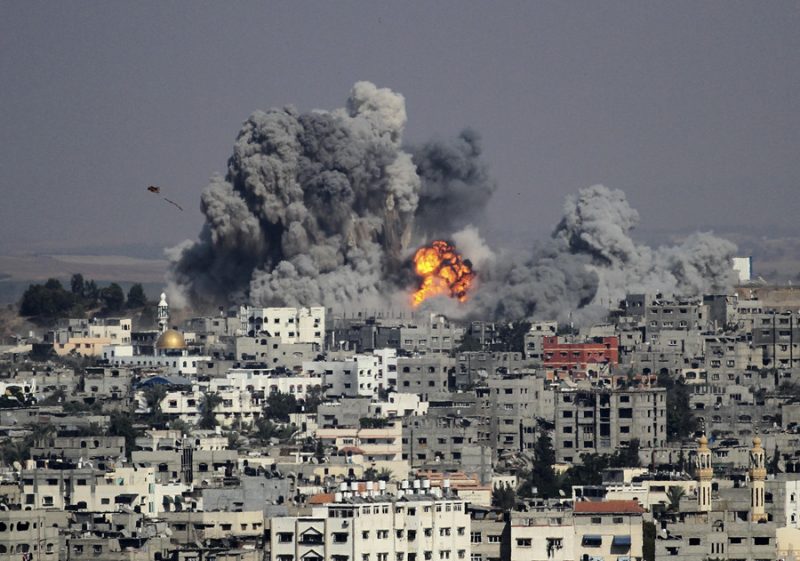
Smoke rises from the Tuffah neighborhood after an Israeli airstrike in eastern Gaza City, July 29, 2014 © Sameh Rahmi / Global Look Press
On February 25, Danny Gold, a writer and correspondent, compared the situation in Ghouta to one of history’s worst human atrocities when he tweeted: “I know how Jews who lived through the holocaust felt 70 years later about the world turning a blind eye, can’t imagine how Syrians in Ghouta will feel about their suffering being so well-documented as it’s happening yet doubted by so many.”
I know how Jews who lived through the holocaust felt 70 years later about the world turning a blind eye, can’t imagine how Syrians in Ghouta will feel about their suffering being so well-documented as it’s happening yet doubted by so many.
— Danny Gold (@DGisSERIOUS) February 25, 2018
Dan Cohen, a correspondent with RT America, responded to Gold: “Ghouta is like the Holocaust but Mosul was ‘a huge journalism event’ in which US-led forces took ‘much care’ in burying at least 3,200 civilians in the rubble.”
Cohen’s comment was a jibe at a tweet Gold had sent on February 1, 2017 in which he embellished the historical record of the US-led Iraqi campaign, remarking: “Mosul was a huge journalism event. Everyone who covers the Middle East was there.”
Ghouta is like the Holocaust but Mosul was “a huge journalism event” in which US-led forces took “much care” in burying at least 3,200 civilians in the rubble. pic.twitter.com/SxQGxFhYlc
— Dan Cohen (@dancohen3000) February 26, 2018
But if Mosul really was one big happy media confab, then how was it possible for the fatality figures to have been so skewed? As AP rather belatedly reported in December 2017, long after the nine-month conflict had ended, “The price Mosul’s residents paid in blood to see their city freed was between 9,000 and 11,000 dead … a civilian casualty rate nearly 10 times higher than what has been previously reported.”
Perhaps if Western reporters had not spent so much of their time reporting on the same type of military operation in Aleppo, which was then the focus of a Russian-backed liberation campaign, they may have more accurately described the situation in Iraq’s second-largest city.
Michael Raddie, co-editor of BSNews, provided a convincing explanation for the discrepancy in the way the Western media reports on war zones, which he said can be reduced to a matter of “worthy victims” and “unworthy victims.”
“The victims of US bombs and British airstrikes are not worthy because we don’t do that kind of thing,” Raddie told RT. “Our killing of civilians is a mistake, collateral damage. The Syrian air force killing of civilians … that is atrocities. And that is the ideology that Western media portray all the time.”
You’re Being Lied To On East Ghouta https://t.co/ciZK6QY9Ko via @YouTube
— vanessa beeley (@VanessaBeeley) February 22, 2018
However, there is another side to this wave of Western cynicism with regards to Syria that could spark a real catastrophe. That involves the threat of a chemical strike, which the West seems to believe is something only the “Assad regime” is capable of committing. After all, who would ever suspect bona-fide terrorists deprived of modern weapons of resorting to such barbaric means of warfare?
Much like Barack Obama’s utterly reckless “red line” warning regarding the use of chemical weapons, which he said would warrant US military action, French President Emmanuel Macron issued the very same foolish warning on February 14.
“On chemical weapons, I set a red line and I reaffirm that red line,” Macron told reporters. “If we have proven evidence that chemical weapons proscribed in treaties are used, we will strike the place where they are made.”
Did it surprise anyone that less than two weeks after Macron’s warning a chemical attack – conveniently supported by photos provided by, yes, the White Helmets – was reported to have occurred in Ghouta? Western media and politicians have actually suggested a Russian connection to the event.
“Whoever conducted the attacks, Russia ultimately bears responsibility for the victims in Eastern Ghouta and countless other Syrians targeted with chemical weapons since Russia became involved in Syria,” US Secretary of State Rex Tillerson said.
Presently, a 30-day ceasefire endorsed by the UN Security Council is in effect across Syria, as well as a daily five-hour “humanitarian pause” in Eastern Ghouta enforced by Russia.
Yet thus far the plan is not producing the desired effect. Militants are preventing civilians from fleeing besieged Eastern Ghouta and are sabotaging the humanitarian operation there, Major General Vladimir Zolotukhin, a spokesman for the Russian Center for Reconciliation in Syria, told journalists on Thursday.
Robert Bridge is an American writer and journalist. He is author of the book, ‘Midnight in the American Empire,’ released in 2013. robertvbridge@yahoo.com
Read more:
‘Fake news’: Foreign Ministry dismisses reports of cocaine smuggler among its ranks

RT | March 2, 2018
Russia’s Federal Security Service jointly with the Argentine National Gendarmerie took measures against members of an international criminal gang implicated in organizing a channel of trafficking large batches of cocaine from Latin America to Russia
The suspected leader of a group of smugglers who were busted trying to send 400kg of cocaine to Russia from Argentina was neither a diplomat nor an employee of any embassy, the Russian Foreign Ministry has said.
“We have sifted through all archives, all of them. We talked to all HR managers, with heads of departments. We have dug out all papers. Kovalchuk has never worked for the Ministry of Foreign Affairs or for the embassy,” Marina Zakharova said in an interview with Ekho Moskvy radio.
The comments came soon after several media outlets published reports claiming that Andrey Kovalchuk, the suspected organizer of the cocaine-smuggling scheme, had allegedly worked for the Russian embassy in Buenos Aires.
On Friday, RIA Novosti quoted Andrey Kovalchuk’s wife as saying that her husband had been detained in Germany on charges of drug trafficking, and that the German authorities were deciding whether to hand the man over to Russia. “They said that they would not extradite him without solid evidence, but would consider this issue,” the woman said, adding that their family were now looking for a Russian-speaking lawyer specializing on extradition issues.
Earlier, Kovalchuk’s lawyer told RIA Novosti that his client insisted that he himself was a victim of a major provocation. He said that the suspect had left some suitcases in the Russian embassy school, but insisted that these bags contained perfectly legal goods, like coffee and cognac, for which he had receipts and purchase details. The lawyer said that he had permission to do this from an embassy staff worker, Ali Abyanov, one of the three suspects detained in Moscow in connection with the case.
In further comments, the lawyer told Ruptly his client was a technical worker for the Russian embassy in Berlin, but had never been put on the official staff list. He added that Kovalchuk’s coffee exports were a small business on the side, which is not forbidden. He also noted that the man lived in Germany under his own name and continued to use his passport, which undermined the theory that he was trying to hide from the law.
The criminal investigation is the result of a joint operation between the Russian and Argentinian special services, which was first revealed to the public in late February. According to reports, Russian embassy workers in Buenos Aires discovered 11 suitcases containing around 400kg of cocaine at a Russian school in the embassy’s complex in December 2016. The Russian ambassador to Argentina personally alerted the Argentinian security services, and a special operation was launched, targeting the suspected smugglers. The drugs in the suitcases were then covertly swapped for flour, and GPS trackers were placed inside.
Eventually, the shipment arrived in Moscow and Russian police detained three people who received it. Two more people were arrested in Argentina, but the suspected ringleader remained at large – until now.
Agents involved in the operation previously told the media that the estimated value of the confiscated drugs was over €50 million ($62 million), and that it was thought to be of Colombian origin.
In Syria, the Real Siege Is by Western Criminal Powers

Strategic Culture Foundation | 02.03.2018
In more than seven years of war in Syria, we have seen many times how Western governments and news media shamelessly invert reality.
The same was seen this week over the grim fighting around Eastern Ghouta, the suburb near the capital, Damascus, where 400,000 people are said to be trapped.
But who is trapping who?
US and European media breathlessly claim that Eastern Ghouta is under siege from Syrian “regime forces” allied with Russia. This description is posing things upside down.
The district was taken over nearly six years ago by foreign-backed extremists, like Jaysh al Islam, Ahrar al Sham, and Al Nusra Front. The latter is an internationally outlawed terror group, but they all share the same murderous ideology, as well as the same Western covert sponsors in the American CIA, British MI6, French DGSE, and lavish Gulf Arab funding. It is these illegally armed insurgents who are holding the civilian population under siege in a reign of terror.
The same situation, and Western inversion of reality, has been seen before, most notably regarding Syria’s second city of Aleppo. The Syrian and Russian forces liberated that city at the end of 2016, and since then life for the residents there has fortunately returned to the normal peaceful, pluralist coexistence which prevailed before the foreign-backed terror goons took over.
Yet, Western media and officials continually confabulate about “rebels” and civilians being besieged by Syrian state forces. This inversion of reality is of course necessary in order to push the Western false narrative that has underpinned the covert Western war for regime change in Syria, including the clandestine support for terror groups as proxies.
Further twisting the situation in Eastern Ghouta this week, the Western media blamed the Syrian “regime” and Russia for not implementing a ceasefire plan to enable evacuation of civilians.
Russia proposed a daily five-hour truce, and the Syrian government established humanitarian corridors exiting from the conflict zone. The proposal from Moscow was a reasonable counter to what the US, Britain and France had wanted, which involved a 30-day cessation of all military operations.
The Western powers had tried the same proposal during the liberation of Aleppo. Syria and its legally mandated Russian ally are within their sovereign right to take back remaining territory that has been illegally occupied by foreign-backed militants.
What the Western powers would like to impose is a No-Fly Zone over parts of Syria to enable their residual proxies time and space to regroup. Why should the Syrian government forfeit its sovereign rights by accommodating foreign enemies?
The reason why the Russian humanitarian relief plan proposed this week for Eastern Ghouta did not gain traction was simply because the militants continually shelled the designated corridors for escaping civilians. Video footage clearly showed buses and aid workers organized by the Syrian government waiting to receive the civilians. But none were permitted from the area because of sniper and mortar fire from the militants.
Evidently, the militants are holding the civilian population as hostages and human shields. The same criminal tactics were deployed in Aleppo and other towns and cities where the terrorist gangs ruled with their death-cult barbarity.
Russian Foreign Minister Sergei Lavrov, addressing the UN Human Rights Council in Geneva this week, rightly pointed out that the humanitarian relief plan for Eastern Ghouta can only be made to work if the militants commit to upholding a ceasefire. But these foreign-backed mercenaries have done nothing of the sort. They have not only cut off evacuation corridors under fire; they continue to launch rockets and mortars at nearby government-controlled Damascus inflicting dozens of civilian deaths in recent weeks.
Reliable figures cited by the Syrian Free Press network, indicate that some 85 per cent of the Syrian population live in areas under the control of President Bashar Assad’s state forces. Only a small minority – 15 per cent – live in areas controlled by insurgents. And many of those people are being held in these dwindling areas against their will in a state of fear imposed by the so-called jihadists.
The brazen Western media propaganda war – misnamed as “news” – reports totally from the minority areas, which are exalted as “rebel bastions”.
In all the so-called “reporting” by France 24, BBC, CNN, and others, the information is either sourced from the CIA-sponsored and terrorist-affiliated White Helmets media operation; or anonymous “residents” and “activists”; or it is sourced from “a UK-based monitor” who is an exiled Syrian furniture salesman who has not been in Syria for 15 years.
This pathetic Western mainstream media “journalism” has been going on for the past seven years in relation to Syria.
Significantly, when do you ever hear a Syrian government official or diplomat being aired directly and at length in these media? Or Russian officials? Never. It’s all a one-way street of lies and fabrication.
The preposterous inversion of reality that the Western governments and media have perpetrated over Syria can only be sustained through systematic distortion.
Russia’s humanitarian relief plan for Eastern Ghouta has so far been sabotaged by terror groups firing on civilians. But Western officials and media have the brass neck to claim that the long-suffering population is under siege from the very forces who are trying to liberate them from terror.
When Eastern Ghouta is eventually liberated one thing is sure. The Western media will never follow-up to ask residents what their lives were really like. Just as these same vile propaganda outlets did not follow-up on liberated Aleppo.
As if the distortion couldn’t get any worse, this week the New York Times and other Western media reported claims that North Korea had secretly supplied materials for chemical weapons to Syria. The reported claims seemed unconvincing, as usual, and the Syrian government denied the latest allegations.
Alongside that, the British government asserted this week that it would order air strikes on the Syrian “regime” if it found proof that chemical weapons were used.
Adding up the Western distortion it is obvious what the objective is: to find a pretext for overt military aggression on Syria. The covert proxy war using terrorist mercenaries has failed. Now the Western terror sponsors need to take the distortion to an even more demonic level.
In truth, there is indeed a siege in Syria. The entire Syrian nation is under siege – by criminal Western regimes and their equally criminal propaganda media, justifying war and aggression.
America’s Illegal Sojourn in Syria
By Philip M. GIRALDI | Strategic Culture Foundation | 01.03.2018
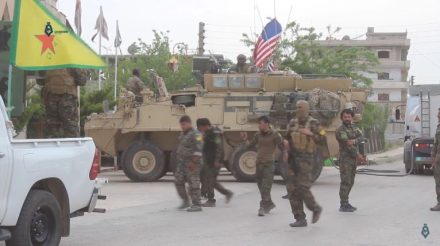
It should come as no surprise to anyone that the Donald Trump administration has recently affirmed that it has a perfect legal right to remain in Syria as long as it wishes because it is fighting terrorism. The argument goes something like this: Congress has approved a bill that permits the US military to seek out and destroy al-Qaeda and associated groups wherever they may be. It is part of what is referred to as the Authorization to Use Military Force or AUMF. According to the White House, an associated group, the Islamic State in Syria (ISIS), remains currently active in Syria and the United States military presence is therefore legal until the group is completely eliminated, requiring no additional legislation or authority to remain in the country.
The Trump legal finding was spelled out in two letters released by the undersecretaries for policy at the State and Defense departments. They were in response to requests made by Senator Time Kaine of Virginia who has for several years been asking the White House under both Barack Obama and Donald Trump to clarify what legal authority has permitted it to base 2,000 American soldiers in Syria without any declaration of war, any United Nations authorization or any invitation by the legitimate government of Bashar al-Assad in Damascus. Kaine has cited the restrictions imposed by the War Powers Act of 1973, which permits a president to use military force in an emergency situation but after 60 days it is necessary to go to Congress for approval.
The State Department letter heightened the ambiguity of the US position with its explanation that “The United States does not seek to fight the government of Syria or Iran or Iranian-supported groups in Iraq or Syria. However, the United States will not hesitate to use necessary and proportionate force to defend US, coalition, or partner forces…”
There are a number of problems with the White House justification to stay in Syria, starting with the fact that al-Qaeda and ISIS are not in any way associated and might best be described as rivals or even enemies, rendering the whole AUMF argument irrelevant. In addition, the reason for American forces being in Syria at all has been variously described by senior administration officials. Secretary of State Rex Tillerson has been busy emphasizing that a prolonged stay is needed to block the resurgence of ISIS and also to prevent the Syrian government from retaking areas currently occupied by American-supported rebel groups. He curiously describes such areas freed from government control as “liberated.” He has also stated that the US will stay in place to put pressure on Bashar al-Assad to step down, i.e. regime change.
Tillerson uses the example of Libya to support his argument, observing that Libya was not occupied and “stabilized” by the nations that combined to overthrow the government of Muammar Ghaddafi. He has also cited President Barack Obama’s decision to withdraw US forces from Iraq as a contributing factor in the rise of ISIS, apparently unaware that American military was forced to leave by the Iraqi government.
But last Friday President Trump sent a different signal, stating during the press conference with the Australian Prime Minister that “We’re there for one reason: to get ISIS and get rid of ISIS, and to go home. We’re not there for any other reason and we’ve largely accomplished our goal.”
There is considerable spin being generated by the Administration to support its claims. Nevertheless, it should be accepted that the Syrian regime of al-Assad is nearly universally recognized to be legitimate and sovereign in its own territory, a fact that is even acknowledged by the United States, which is, at the same time, supporting rebels seeking to overthrow that government. And the US intention to maintain a continued presence minus any viable al-Qaeda threat in the country is completely illegal under both domestic and international law.
In short, the continued United States presence in Syria bears all the hallmarks of yet another US policy wrapped in top level ambiguity that is a failure even before it starts. Not only illegal, it is impractical, with 2,000 US advisers spread thin supporting Kurdish proxies who are already heavily engaged fighting the Turks. Eventually Washington will become weary of the effort and leave. May that day come soon.
Assad, Kim & chemical weapons: NYT ties in all the ‘villains’ in story on leaked UN report
RT | February 28, 2018
What could be better to beat the drum for regime change than tying North Korean missiles to Syria and chemical weapons? Apparently, the New York Times did just that when it wrote about a leaked UN report.
The article, run by the respectable US newspaper on Tuesday, is based on a 200-page report by a group of eight experts who were tasked by the UN Security Council to monitor how sanctions against North Korea are implemented. The country was punished for developing nuclear weapons and rocket technology with serious restrictions on how it can trade with foreign nations and has been finding ways to circumvent those.
The NYT focused on two particular episodes mentioned in the report. One was the interception in January 2017 of two ships carrying acid-resistant tiles from North Korea to Syria, with three other such contracted shipments revealed via paper tracking, although whether or not they were actually made remains unclear. The UN experts said such tiles are “commonly used in the construction of chemical weapons factories.”
Another episode happened in August 2016, when a delegation of “North Korean missile technicians” visited Syria and brought with them “special resistance valves and thermometers known for use in chemical weapons,” according to the report. Both episodes were reported to the UN panel by unidentified UN personnel.
Experts who reviewed the report on behalf of the newspaper said the evidence presented by the UN “did not prove definitively that there was current, continuing collaboration between North Korea and Syria on chemical weapons.” The NYT did not say how or when it obtained the UN document, which is not available to the public.
The publication of the report comes as the Syrian government stands accused of repeatedly using chemical weapons against civilian targets in eastern Ghouta, a neighborhood of Damascus controlled by several jihadist groups. The alleged attacks with chlorine gas – which make little sense from the military point of view – are reported by local sources with ties to the militants. They cannot be verified by independent observers, including those from the countries openly calling for the toppling of the Syrian President Bashar Assad, like the US.
This does not stop the Western mainstream media from bombarding their audiences with reports of intolerable civilian suffering inflicted by the Russia-backed “Assad regime” and “experts” calling for a US-led military intervention against Damascus. With Assad presented as a contender to the title of the world’s top villain, adding Kim Jong-un of North Korea, another figure reviled in the West, would apparently bolster the bellicose narrative.
One may almost suspect that the US media have not learned their collective lesson from the run-up for the Iraqi invasion. Joseph Kahn, the managing editor of the New York Times, assured everyone last month that the coverage of the Iraqi WMDs was “an example of seriously flawed policy for political goal,” and that the paper has since made changes to editorial policy. We can now rest assured that the Syria coverage is a different story altogether.
Read more:
Dems Ignore Trump’s Nuclear Recklessness With Russia, Because Of Course They Fucking Do

By Caitlyn Johnstone | Rogue Journalist | February 26, 2018
Political commentary throughout 2016 was filled with scary sound bytes by partisan opponents of the Republican party warning how dangerous and horrifying it would be if Donald Trump ever gained access to the nuclear codes. Here’s a March 2016 column from USA Today titled “Trump’s nuclear views are terrifying”. Here’s another March 2016 article from CNN titled “President Trump: A 6-year-old with nuclear weapons?” Here’s an August 2016 article from the Chicago Tribune titled “The terrifying prospect of Donald Trump with nuclear weapons”. Here’s an October 2016 article from Business Insider about how former nuclear launch officers had said Trump can’t be trusted with the launch codes. Here’s a November 2016 Bloomberg article titled “Two Words to End All Consideration of Voting for Trump: Nuclear Holocaust”.
I could go on and on, but you get the picture. Over and over and over again I encountered Democrats on social media in 2016 telling me I needed to support Hillary Clinton because Trump was going to get everyone nuked in a fit of stupid impulsiveness if elected, their fears stoked by partisan media reporting like the above day after day. Everyone lost their minds over Joe Scarborough’s claim on MSNBC that he knew someone who’d heard candidate Trump asking a foreign policy expert why nuclear weapons can’t be used, a claim Scarborough never substantiated. Trump’s political opponents made very, very sure that the American people were afraid that they and their loved ones would die in a nuclear holocaust if he was elected.
Isn’t it surprising, then, that these people are all completely ignoring this administration’s insane, world-threatening nuclear escalations against Russia?
Of course it fucking isn’t.
A couple of great articles have come out recently about the Trump administration’s Nuclear Posture Review and other omnicidal cold war escalations with the only other nuclear superpower on the planet. The first is Anti-Media‘s “How Donald Trump’s Policies Have Brought Us to the Brink of World War 3“, and the second is titled “Normalizing Nukes, Pentagon-Style” by Rejan Menon and Tom Engelhart for Antiwar.com. Both provide good insight into the dangers inherent in further blurring the lines between when nuclear weapons use is and is not acceptable, and the completely illogical rationale for doing so. I think it’s wonderful that both of these essays have been written, and I think it’s very telling that such insightful takes on this issue of unparalleled importance are relegated to small alternative media outlets.
How aware would you say the average rank-and-file Democrat is that Trump has controversial views on immigration? How about the fact that he said “shit hole countries”? Or the fact that that he says offensive things on Twitter? I think it’s fair to say that due to the frenetic coverage these issues receive from Democrat-allied mainstream media, a very large percentage of registered Democrats are aware of them.
How about the fact that this administration is imperiling the life of every organism on earth with needless escalations against a nuclear superpower? How often do you see 2018 Joe Scarborough talking about that on MSNBC?
Nuclear holocaust is the worst thing that can possibly happen. There are many, many things to hate and criticize the current president for, but the fact that he has overseen steady escalations which increase the likelihood of nuclear holocaust is far and away the most urgently worthy of condemnation. If you were going to attack this president on one thing, this would be it. But Trump’s ostensible political opponents ignore it, because they ignore all despicable acts of warmongering.
And because Russia.
Democrats have been collaborating with Republicans to inflate the already staggering US military budget and exacerbate the new cold war, as well as expand Trump’s Orwellian spying powers and expand his unconstitutional war powers. Propaganda has been used to keep rank-and-file Democrats fixated on the more cosmetically awful aspects of this administration, as well as entirely fictional aspects like the baseless Russiagate conspiracy theories, while hiding its most horrific aspects from the spotlight. Fear Russia, fear Trump’s tweets, but pay no attention to the steadily mounting nuclear tensions behind the curtain.
The US-centralized empire is making an omnicidal gamble with its Russiagate vanity project as it attempts to maneuver Russia off the world stage to prevent the rise of any rival superpowers, already having killed Russians in Syria, expanded NATO, kept troops along Russia’s border, established a permanent military presence in Syria with the goal of effecting regime change, forced Russian outlets to register as foreign agents, and allowed the sale of arms to Ukraine. Hot proxy conflicts and increasingly unclear lines could lead at any time to an inflammation in Syria, Ukraine or elsewhere which leads to a nuclear warhead being set off in the chaos and confusion, setting mutually assured destruction into motion and killing everything.
But sure, let’s talk about Trump’s fucking tweets instead.
The Democratic party does not resist Trump. Not in any meaningful way. If the most dangerous things about this administration are to be resisted, real resistance is going to have to come from ordinary human beings standing up and demanding change, and the Democratic party exists to prevent that from happening. The Democratic party exists to co-opt grassroots movements and divert their energy back towards the machine.
It is not Democrats versus Republicans. It is humanity versus the machine. Redraw the battle lines and fight the real war.
Featured Video

or go to
Aletho News Archives – Video-Images
Book Review
The Maidan Killings and the False-Flag Case
By Freddie Ponton | 21st Century Wire | September 5, 2026
Before the killings that helped bring down Ukraine’s president in February 2014, American diplomats were discussing who should enter its government. In a leaked telephone call, senior State Department official Victoria Nuland told US ambassador Geoffrey Pyatt, “I think Yats is the guy,” referring to opposition leader Arseniy Yatseniuk. Washington had clear preferences and was working to advance them. Later that month, Yatseniuk became prime minister.
Ivan Katchanovski’s The Maidan Massacre in Ukraine examines the violence that preceded that transfer of power. Drawing on television footage, witness testimony, forensic examinations and Ukrainian court proceedings, he argues that elements of the opposition shot protesters and police in a false-flag operation. His case centres on evidence of protesters being shot from opposition-controlled locations, including Hotel Ukraina, overlooking the killing ground. … continue
Blog Roll
 Aletho News
- Paris bans pro-Palestinian demonstration planned for Oct. 7 over ‘risks of public disorder’
- In August Hanning Treason Case- All Signs Point To Tel Aviv.
- France cleared dozens of military sales to Israel between May and September: Report
- France projects nuclear power as Macron pushes arsenal expansion
- The fallacy of US delusions about Iran’s economic collapse
- What changes with Lula or Flávio?
- Britain leads Western media’s demise through ‘fear porn’ narrative
- The Maidan Killings and the False-Flag Case
- Georgia’s Largest Healthcare System Will Fire Employees Who Refuse Flu Vaccine
- The Five-Year Fuel Crisis: Why the World Economy Is Paying for a War It Thinks Is Ending
- If Americans Knew
- Soldier testimony sheds light on how Israel wages information war
- CIA Report Warns Israel Could Head Toward Civil War, Total Collapse
- Banker Who Exposed Howard Lutnick’s Ties to Epstein Warned of ‘Retaliation’ and ‘Personal Consequences’ in Last Post Before Suicide
- Israeli Attacks Kill Two Palestinians in Gaza
- Gaza genocide at 3: Israeli-U.S. cruelty and the smart, deep resistance to it are changing the world
- As genocide is about to enter 3rd year, little of Gaza remains– Daily Update
- “We See Our Homes Now From A Satellite, Like Strangers”
- Watch “Gaza: Doctors Under Attack”, originally censored by BBC
- NAZA: Israeli embassies in UK and US promote rival documentary to challenge Gaza genocide allegations
- David Ellison appoints Israeli to lead merged Paramount-Warner studios
- No Tricks Zone
- Latest European Green Energy Debacle; Portugal’s Largest Flagship Solar Park Insolvent!
- Green Energy Debacle: German Expert Professor Fritz Vahrenholt Warns Of Severe Economic And Social Consequences
- Two More Paleo Reconstructions Affirm Meters-Higher Sea Levels Across Ireland, Brazil 7000-6000 Years Ago
- New Study: Earth And Venus Surface Warmth Largely Explained By Convection And Lapse Rate, Not CO2 Or Radiation
- 2025 Nature Paper Claiming Worsening Global Drought Gets RETRACTED …Heavily Flawed
- New Study: ‘Global Drought Shows No Detectable Recent Acceleration Under Climate Warming’
- Economic Masterminds: German Socialists Suggest Taxing Productivity Gains Stemming From Using AI
- The South China Sea Has Not Been Cooperating With The Climate Change Narrative
- Energy Crisis: Germany Enters Heating Season With Historically Low Gas Reserve Fill Levels
- New Study: The Antarctic Ice Sheet Gained Mass From 2020-2024 Due To Staggering Snow And Ice Accumulation

