‘US hacks and meddling quite unlike China & Russia’s hacks and meddling’ – ex-Pentagon chief
RT | January 27, 2018
One could almost see the proverbial pots and kettles on Friday, when ex-Pentagon chief Ashton Carter informed us that America’s cyber operations and election meddling are entirely dissimilar to the activities of China and Russia.
The panel, held as part of the World Economic Forum in Davos, was dedicated to state cyberwarfare, the risks of cyber operations spiralling out of control, and ways to rein in the emerging threat – from making better software and incentivizing people to update it, to establishing international rules for states to voluntarily observe.
The ghost of Russia’s alleged interference with 2016 election in the US haunted the event, with supporting roles as cyber menaces given to China, alleged thief of US top secret military technologies, and North Korea, alleged perpetrator of the 2014 Sony hack and last year’s WannaCry ransomware epidemic. The panel were debating how the US and the West in general can respond to such attacks, but barely mentioned the role played by the US in bringing the cyberwarfare situation to its current state.
One noticeable exception came from Carter, Defense Secretary during the last two years of Barack Obama’s presidency, who tried to explain how American actions differed from those of China and Russia.
“We conduct espionage on the Internet. And when we are spied on, I don’t complain. I am unhappy with it because I wish we had not had our secrets stolen. But I put it into a different category. Covert action… is not espionage. It has the effect of harming,” he said.
So… when China steals F-35 blueprints, it harms America; when the US spies on German or Brazilian companies and gets competitive advantage in the market, that’s – no biggie? Sounds plausible. But there is more, because US meddling in foreign elections is not the same thing as somebody meddling in US elections, according to Carter.
He said China and Russia tell the US: “You stick up for democracy. You oppose leaders who are oppressing their people… That’s true, but that’s overt.”
First, being a democratically elected official does not mean the US will not have you overthrown, or worse. Just ask Iranian Prime Minister Mohammad Mosaddegh, or Chilean President Salvador Allende or, if you want someone who is still alive – Ukraine’s Viktor Yanukovich.
Second, by implication if hypothetically President Vladimir Putin were to come out tomorrow and say: “OK, we hacked the DNC to help our buddy Donald,” that would somehow make all fine? Carter repeated the phrase “attack is an attack” explaining his attitude to clandestine state-sponsored cyber operations some half a dozen times during the hour-long discussion, and it didn’t sound like a nation claiming credit for one would make it less of an attack in his opinion.
The former Pentagon chief argued during the panel that the US has to “get doctrinally settled” in its response to harmful actions of other states that cannot be clearly attributed to those states. His examples were Russia’s deployment of troops with no insignia from its naval base in Crimea during the 2014 crisis in Ukraine and what he termed “stirring up minorities” in the Baltic states by Russia. “We need a war plan… We need to make it painful to do that kind of thing to us,” he said.
Frankly, the secret supply of US arms to Syrian anti-government groups, attempts to create a Cuban version of Twitter to foster dissent in the island nation or the reported hacking of the Iranian uranium enrichment facility to blow up centrifuges – arguably the best-known case of a state conducting an act of cyberwarfare on another state, by the way – all fall into the same category. But somehow no war plan for those nations was suggested during the panel.
There were some other things that the panel missed. Like the US intelligence practice of hoarding exploits. The WannaCry attack was based on leaked tools developed by the NSA, not some super-secret North Korean cyber warfare unit. Or the fact that the US public often has to trust its government when it points the finger at another nation and says ‘they did it’. Which is disconcerting, if you take into account the historic record of false claims and the fact that the US cyber warfare experts know how to fake “digital fingerprints” to make an attack look like it came from Russia or China. Or that report that the Obama administration ordered “digital bombs” planted, ready to take out critical Russian infrastructure should Washington chose to do so.
Read more:
Ex-FBI Agent: NSA Unlikely to Be Punished for Illegal Data Destruction
Sputnik – January 27, 2018
WASHINGTON – National Security Agency officials are unlikely to face any punishment or censure for defying a court order and destroying data they had broken the law to collect in the first place, former FBI special agent and whistleblower Colleen Rowley told Sputnik.
The NSA was under court order to hold on to information that was linked to warrantless wiretapping during the George W. Bush administration, but instead the agency got rid of data it had been specifically asked to retain, according to US media reports.
“What should be shocking about this news is that it’s about the illegal deletion of the previously illegally collected data on US citizens in the Presidential Surveillance Program,” Rowley said.
There was no accountability for the government’s prior destruction of evidence, including the CIA’s destruction of the “torture tapes,” Rowley noted.
Consequently, “I don’t think there is much chance of any accountability of NSA officials for any of their official negligence or malfeasance that led to these intercepted communications being destroyed and not preserved for purposes of this court proceeding,” she said.
The data was gathered during the administration of President George W. Bush under an illegal program called the “Presidential Surveillance Program,” Rowley recalled.
However, “When the Pulitzer-prize winning news of the illegal program was finally released by New York Times writers, [President] George Bush misled the US public by downplaying it and calling it his ‘Terrorist Surveillance Program,’” she said.
The illegal surveillance of Americans had been secretly “legalized” just as the CIA’s practice of torture as so-called “enhanced interrogation” techniques had been by Bush’s Office of Legal Counsel (OLC) attorney John Yoo and his senior OLC partner Robert Delahunty, Rowley noted.
Yoo and Rowley justified the secret surveillance program “shortly after 9-11 in dozens of secret memos claiming the President had inherent “Commander in Chief” powers to violate the Bill of Rights, a form of martial law,” she said.
The NSA’s interception of communications was illegal in the first place and was in violation of the Foreign Intelligence Surveillance Act (FISA) statute and the entire program was also possibly unconstitutional, Rowley pointed out.
Rowley also said much of the deleted material might have contained details of secret sexual activities that could have proven highly embarrassing to US military and diplomatic personnel who were involved.
“From some of my prior readings, I also suspect that these previously illegally intercepted communications after 9-11 contained a lot of ‘pillow talk’ between American spouses/girlfriends/boyfriends of military members and State Department personnel stationed abroad,” she said.
Had the secret data not been destroyed, it might have exposed the falsehood of many statements and assurances by President George W. Bush that claimed the surveillance program was responsible and limited in scope, Rowley remarked.
“So this content that apparently no longer exists would have proved very embarrassing if it had ever been made public… contradicting George Bush’s descriptions that his program only targeted ‘terrorists,’” she said.
The destroyed NSA data would have angered the important constituency of US military and Foreign Service members as well as other American travelers whose privacy and rights were violated, Rowley noted.
Rowley sent a May 2002 memo to then-FBI Director Robert Mueller that exposed some of the FBI’s pre- September 11, 2001 failures. She was named one of TIME magazine’s “Persons of the Year” in 2002. Mueller is now the Special Counsel investigating President Donald Trump’s alleged collusion with Russia. Both Trump and Russia have denied colluding during the 2016 US presidential campaign.
US Democrats’ Accusations Against Russia Distract Public From Real Problem
Sputnik – 26.01.2018
US Democrats have asked Facebook and Twitter for evidence of Russia’s involvement in an online campaign to release a politically charged memo.
The move comes as Congressional Republicans have been calling for the public release of a four-page classified memo they claim reveals reported abuses of the Foreign Intelligence Surveillance Act (FISA) by the Obama administration, which approved surveillance against Trump’s team on behalf of the Clinton campaign.
Dr. Jeanne Zaino, American political analyst and professor of Political Science at Iona College told Radio Sputnik in an interview that by asking for an investigation into allegations that Russian bots are behind #releasethememo, US Democrats are drawing the public’s attention away from the real question. That question is whether the memo actually exposes severe surveillance abuses, Zaino said, noting that Republicans claim the explosive content of the memo could upend special counsel Robert Mueller’s ongoing investigation into allegations of Russian meddling in the 2016 US election and collusion with the Trump campaign.
“They are saying that this push to release the memo is being conducted by Russian bots. Whether that is the case or whether it is not the case… it is almost beside the point, because the real question — particularly in a democracy where we value transparency — should be what does the memo contain,” Zaino told Radio Sputnik.
She pointed out that while the FBI and the Justice Department have been blocking the memo’s release saying it would violate national security, whether that is actually the case should be decided in a court of law.
“They simply cannot keep information and materials top secret just because they think it might embarrass them or embarrass the administration, embarrass Congress or whoever this memo might embarrass,” the analyst said. “I really think that the Democrats are trying to have us look left when in fact we should be looking right and saying what in fact does the memo contain and is it really something that we need to protect for national security reasons.”
Zaino stressed that she doesn’t know whether the memo “shows abuse of the government surveillance program by the Obama administration”, as is being claimed, but if the question is raised, the memo should be released if it is not protecting national security.
“You cannot just classify [the memo] that way. We have an overclassification problem in this country where almost everything is classified as top secret,” Zaino said. “The Democrats are asking us to focus on the bots, that’s fascinating and interesting, but it doesn’t get to the heart of the question which is what does this memo show and did we see an abuse of the government surveillance programs under the Obama administration.”
Twitter dismisses Russian interference in Brexit referendum
RT | January 26, 2018
A university study that ‘proved’ Russia’s influence over the 2016 EU referendum has been thrown out by Twitter. The social media giant said one percent of the bots used during the lead up to the Brexit vote were actually Russian.
The data compiled in a City University study, published in October last year, claimed that some 13,000 bots were tweeting about Brexit before and after the referendum, has now been put into question.
In a letter to UK legislators trying to ascertain the extent of Russian interference – if any – in the Brexit referendum, Twitter largely dismissed the study.
Head of policy for Twitter in the UK Nick Pickles said the bots weren’t evidence of direct Russian meddling in the referendum.
In his letter to the Commons digital culture, media, and sport committee, Pickles said: “In reviewing the accounts identified by City University, we found that 1 percent of the accounts in the dataset were registered in Russia.”
“While many of the accounts identified by City University were in violation of the Twitter rules regarding spam, at this time, we do not have sufficiently strong evidence to enable us to conclusively link them with Russia or indeed the Internet Research Agency.”
In aid of an Electoral Commission investigation, last month Facebook announced that a grand total of 70p ($0.97) had been spent by a Russian-based company called ‘Internet Research Agency’.
The paid adverts were found to have reached just 200 Facebook news feeds, pouring cold water on claims that the Kremlin helped swing last year’s EU referendum.
This is the second time that Twitter has had to respond to UK MPs calling on social media companies to investigate the influence of Russian bots on the outcome of the 2016 referendum.
Even though both Facebook and now Twitter have insisted that Moscow-based social media accounts had little if anything to do with the Brexit vote, Chair of the Commons Culture Media and Sport (DCMS) Committee Damian Collins is determined to find proof of Russian meddling.
Responding to Twitter’s chief executive Jack Dorsey, Collins said: “I’m afraid there are outstanding questions from the DCMS committee that Twitter have not yet answered,” demanding to know “how many other accounts were being controlled from [sic] agencies in Russia, even if they were not registered there.”
Continuing, “I’m afraid that the failure to obtain straight answers to these questions, whatever they might be, is simply increasing concerns about these issues, rather than reassuring people.”
Russia has repeatedly denied any involvement in the Brexit vote.
As walls close in on FBI, the bureau lashes out at its antagonists
By Sharyl Attkisson | The Hill | January 25, 2018
What happens when federal agencies accused of possible wrongdoing — also control the alleged evidence against them? What happens when they’re the ones in charge of who inside their agencies — or connected to them — ultimately gets investigated and possibly charged?
Those questions are moving to the forefront as the facts play out in the investigations into our intelligence agencies’ surveillance activities.
There are two overarching issues.
First, there’s the alleged improper use of politically-funded opposition research to justify secret warrants to spy on U.S. citizens for political purposes.
Second, if corruption is ultimately identified at high levels in our intel agencies, it would necessitate a re-examination of every case and issue the officials touched over the past decade — or two — under administrations of both parties.
This is why I think the concerns transcend typical party politics.
It touches everybody. It’s potentially monumental.
This week, the FBI said it was unfair for the House Intelligence Committee not to provide its memo outlining alleged FBI abuses. The committee wrote the summary memo after reviewing classified government documents in the Trump-Russia probe.
The FBI’s complaint carries a note of irony considering that the agency has notoriously stonewalled Congress. Even when finally agreeing to provide requested documents, the Department of Justice uses the documents’ classified nature to severely restrict who can see them — even among members of Congress who possess the appropriate security clearance. Members who wish to view the documents must report to special locations during prescribed hours in the presence of Department of Justice minders who supervise them as they’re permitted to take handwritten notes only (you know, like the 1960s).
What most people don’t know is that the FBI and Department of Justice already know exactly what Congressional investigators have flagged in the documents they’ve reviewed, because three weeks ago the Senate Judiciary Committee sent its own summary memo to FBI Director Christopher Wray and Department of Justice Deputy Attorney General Rod Rosenstein. The committee also referred to the Department of Justice a recommendation for possible charges against the author of the political opposition research file, the so-called “Trump dossier”: Christopher Steele.
The head of the Senate Judiciary Committee, Republican Charles Grassley co-authored the memo with fellow Republican Sen. Lindsey Graham. Grassley says it’s important for the public to see the unclassified portions of the memo. But unlike the House, which can release the memo on its own (and is taking steps to do so), Senate rules require permission from the Department of Justice — the possibly offending agency — approve or declassify the memo. And that’s reached a snag.
According to Grassley, the FBI is blocking the release of the unclassified sections of the Senate memo by falsely claiming that they contain classified information.
“It sure looks like a bureaucratic game of hide the ball, rather than a genuine concern about national security,” said Grassley in a speech on the Senate floor yesterday.
Grassley also pointed out that agencies accused of possible improprieties are the ones controlling the information. It’s the FBI who may have misused the unverified “dossier” opposition research, allegedly presenting it to a secret court as if it were verified intelligence.
“[FBI] Director [James] Comey testified in 2017 that it was ‘salacious and unverified’,” said Grassley. “So, it was a collection of unverified opposition research funded by a political opponent in an election year. Would it be proper for the Obama administration — or any administration — to use something like that to authorize further investigation that intrudes on the privacy of people associated with its political opponents? That should bother civil libertarians of any political stripe.”
Democrats and many in the media are taking the side of the intelligence community, calling the Republican efforts partisan. House Democrats are said to be writing a counter-memo.
“We need to produce our own memo that lays out the actual facts and shows how the majority memo distorts the work of the FBI and the Department of Justice,” said Rep. Adam Schiff, the lead Democrat on the House Intelligence Committee.
Meantime, the Department of Justice has officially warned the House Intelligence Committee not to release its memo. It’s like the possible defendant in a criminal trial threatening prosecutors for having the audacity to reveal alleged evidence to the judge and jury.
This is the first time I can recall open government groups and many reporters joining in the argument to keep the information secret. They are strangely uncurious about alleged improprieties with implications of the worst kind: Stasi-like tactics used against Americans. “Don’t be irresponsible and reveal sources and methods,” they plead.
As for me? I don’t care what political stripes the alleged offenders wear or whose side they’re on. If their sources and methods are inappropriate, they should be fully exposed and stopped.
Sharyl Attkisson (@SharylAttkisson) is an Emmy-award winning investigative journalist, author of The New York Times bestsellers “The Smear” and “Stonewalled,” and host of Sinclair’s Sunday TV program “Full Measure.”
“Too Big To Believe” – Massive Scandal Is Brewing At The FBI
By Tyler Durden | Zero Hedge | January 24, 2018
As the Potemkin Village walls of The Left’s ‘Trump Collusion’ narrative crash and burn along with special counsel Mueller’s credibility, The New York Post’s Michael Goodwin sees far more wide-ranging problems ahead for America’s ‘intelligence’ agencies as the anti-Trump ‘secret society’ and lovers-texts-gate debacles threaten the core of the Deep State.
Goodwin writes that, during the financial crisis, the federal government bailed out banks it declared “too big to fail.” Fearing their bankruptcy might trigger economic Armageddon, the feds propped them up with taxpayer cash.
Something similar is happening now at the FBI, with the Washington wagons circling the agency to protect it from charges of corruption. This time, the appropriate tag line is “too big to believe.”
Yet each day brings credible reports suggesting there is a massive scandal involving the top ranks of America’s premier law enforcement agency. The reports, which feature talk among agents of a “secret society” and suddenly missing text messages, point to the existence both of a cabal dedicated to defeating Donald Trump in 2016 and of a plan to let Hillary Clinton skate free in the classified email probe.
If either one is true — and I believe both probably are — it would mean FBI leaders betrayed the nation by abusing their powers in a bid to pick the president.
More support for this view involves the FBI’s use of the Russian dossier on Trump that was paid for by the Clinton campaign and the Democratic National Committee. It is almost certain that the FBI used the dossier to get FISA court warrants to spy on Trump associates, meaning it used the opposition research of the party in power to convince a court to let it spy on the candidate of the other party — likely without telling the court of the dossier’s political link.
Even worse, there is growing reason to believe someone in President Barack Obama’s administration turned over classified information about Trump to the Clinton campaign.
As one former federal prosecutor put it, “It doesn’t get worse than that.” That prosecutor, Joseph diGenova, believes Trump was correct when he claimed Obama aides wiretapped his phones at Trump Tower.
These and other elements combine to make a toxic brew that smells to high heaven, but most Americans don’t know much about it. Mainstream media coverage has been sparse and dismissive and there’s a blackout from the same Democrats obsessed with Russia, Russia, Russia.
Partisan motives aside, it’s as if a scandal of this magnitude is more than America can bear — so let’s pretend there’s nothing to see and move along.
But, thankfully the disgraceful episode won’t be washed away, thanks to a handful of congressional Republicans, led by California Rep. Devin Nunes, chairman of the House’s Permanent Select Committee on Intelligence. After he accused the FBI of stonewalling in turning over records, the bureau relented, at least partially.
The result was clear evidence of bias against Trump by officials charged with investigating him and Clinton. Those same agents appear to have acted on that bias to tilt the election to Clinton.
In one text message, an agent suggests that Attorney General Loretta Lynch knew while the investigation was still going on that the FBI would not recommend charges against Clinton.
How could she know unless the fix was in?
All roads in the explosive developments lead to James Comey, whose Boy Scout image belied a sinister belief that he, like his infamous predecessor J. Edgar Hoover, was above the law.
It is why I named him J. Edgar Comey last year and wrote that he was “adept at using innuendo and leaks” to let everybody in Washington know they could be the next to be investigated.
It was in the office of Comey’s top deputy, Andrew McCabe, where agents discussed an “insurance policy” in the event that Trump won. Reports indicated that the Russia-collusion probe was that insurance policy.
The text was from Peter Strzok, the top investigator on the Trump case, and was sent to Lisa Page, an FBI lawyer and also his mistress.
“I want to believe the path you threw out for consideration in Andy’s office — that there’s no way he gets elected — but I’m afraid we can’t take that risk. It’s like an insurance policy in the unlikely event you die before you’re 40 . . . ” Strzok wrote.
It is frightening that Strzok, who called Trump “an idiot,” was the lead investigator on both the Clinton and Trump cases.
After these messages surfaced, special counsel Robert Mueller removed Strzok and Page from his probe, though both still work at the FBI.
Strzok, despite his talk of an “insurance policy” in 2016, wrote in May of 2017 that he was skeptical Mueller’s probe would find anything on Trump because “there’s no big there there.”
Talk about irony. While Dems and the left-wing media already found Trump guilty of collusion before Mueller was appointed, the real scandal might be the conduct of the probers themselves.
Suspicions are hardly allayed by the fact that the FBI says it can’t find five months of messages between Strzok and Page, who exchanged an estimated 50,000 messages overall. The missing period — Dec. 14, 2016 through May 17, 2017 — was a crucial time in Washington.
There were numerous leaks of classified material just before and after Trump’s inauguration on Jan. 20.
And the president fired Comey last May 9, provoking an intense lobbying effort for a special counsel, which led to Mueller’s appointment on May 19.
Jeff Sessions, the attorney general, has emerged from his hidey hole to notice that the FBI has run amok, and said Monday he would “leave no stone unturned” to find the five months of missing texts.
Fine, but the House is racing ahead of him. Nunes has prepared a four-page memo, based on classified material that purportedly lays out what the FBI and others did to corrupt the election.
A movement to release the memo is gaining steam, but Congress says it might take weeks. Why wait? Americans can handle the truth, no matter how big it is.
WaPo Editor Blames Lack of US Leadership for Famine Caused by US Leadership
By Adam Johnson | FAIR | January 23, 2018
“American leadership” is one of a long list of vague, seemingly benign pseudo-concepts our media throw around to justify increased spending on soft power and military adventurism. It’s a difficult concept to pin down, but it’s almost always presented as something the United States is “failing” to do when it doesn’t “engage” the world with enough war, sanctions or arbitrarily applied human rights scolding.
Lamenting a “lack of American leadership” is, therefore, a time-honored Serious Person cliche for those operating at major US papers, and one Washington Post deputy editorial page editor Jackson Diehl phoned in Sunday with his op-ed “Genocide, Famine and a Democratic Retreat—All After One Year of US Inaction” (1/21/17).
The piece began with a bizarre inversion of reality:
Maybe it’s just a coincidence, but as the United States has retreated from international leadership in the past decade, several toxic global trends have gained momentum. Democracy is steadily retreating, according to Freedom House, whose annual study documents a decline for the 12th consecutive year. Famine is threatening more people than ever: Tens of millions are at risk of starvation in countries such as Yemen, South Sudan and Somalia.
It’s unclear exactly what “international leadership” is supposed to mean here, besides being inversely correlated with Bad Things happening. The piece is a broadside against both former President Obama and Donald Trump for “steadily retreating,” but the most serious Bad Thing he cites as a result of a lack of American leadership, the famine in Yemen, is a direct result of “American leadership.” Obama and Trump have logistically and politically supported the Saudi-led bombing and blockade of Yemen that caused the famine.
But Diehl’s not honestly engaging with the world as it is; his job is to advance the premise that the US has both the right and the moral duty to dictate the affairs of other countries. Diehl did the same cynical reality-inversion last June (FAIR.org, 6/26/17), when he not only ignored the US’s role in creating the Yemen famine, but painted them as the heroes coming to the rescue.
Similarly, Diehl cites “the tragedy of Syria” in Sunday’s piece as a result of a lack of American leadership, without mentioning the American leadership of the CIA—along with American leadership allies Saudi Arabia, Turkey, and Qatar—helped fund, train and arm groups in that conflict, thus fueling the “tragedy.” Also omitted was the ongoing role of “American Leadership” in bombing seven countries, its deadly drone program that has terrorized thousands of civilians in Yemen and Central Asia, its continued use of offshore penal colonies outside the scope of international law and a number of other bad things that result from the active exertion of “American leadership,” rather than its absence.
The rest of the piece is about the Trump administration’s “inaction” over ethnic cleansing of the Rohingya in Burma, but the setup is very telling. Diehl uses this ethnic catastrophe to browbeat the US for not doing enough, but really what he wants, as evidenced by his years of writing (see, e.g., FAIR.org, 5/2/06, 12/23/14, 5/17/16), is more meddling and intervention and bombing in general; the tragedy in Burma simply serves as a moral lubricant for an assertion of the US’s superiority. To national security boosters like Diehl, “American leadership,” like military spending, is always in a state of inadequacy. There’s never enough, we always need more. The possibility that said “leadership” or military spending may be causing the problems—even the ones he himself cites as the most urgent—rather than being their solution is simply not an option.
Messages can be sent to the Washington Post at letters@washpost.com
Hottest Week Of The Year – All Of Antarctica Below Freezing
By Tony Heller | Real Climate Science | January 24, 2018
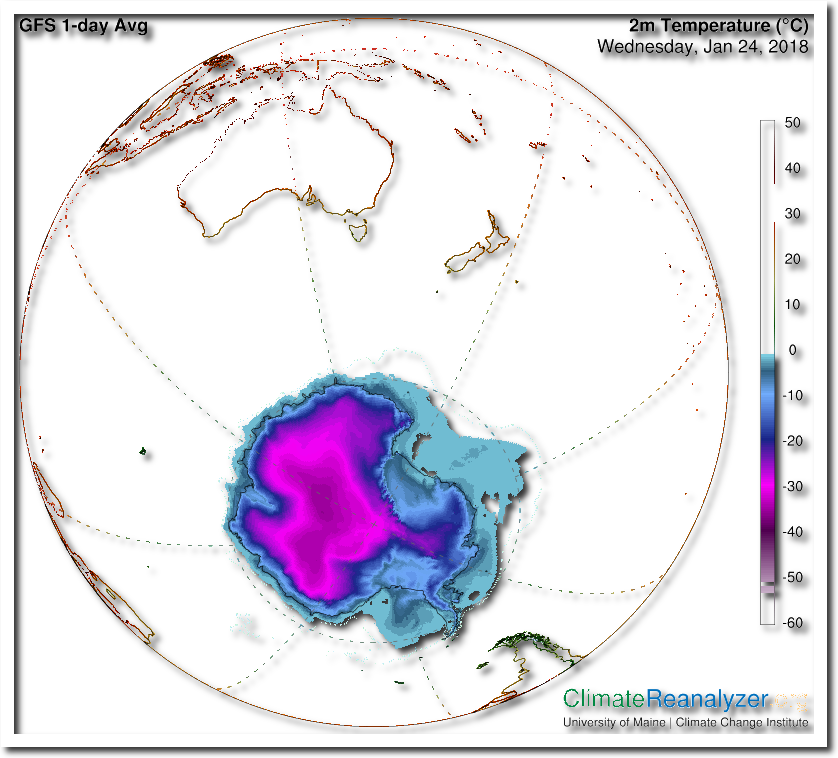
This week is the hottest week of the year in Antarctica, and the entire continent is below freezing. In the map below, I have masked out all above freezing temperatures.
Climate Reanalyzer
Meanwhile, our fake news and fake science organizations tell us Antarctica is melting down, and it is bad news.

A huge part of Antarctica is melting and scientists say that’s bad news – CNN
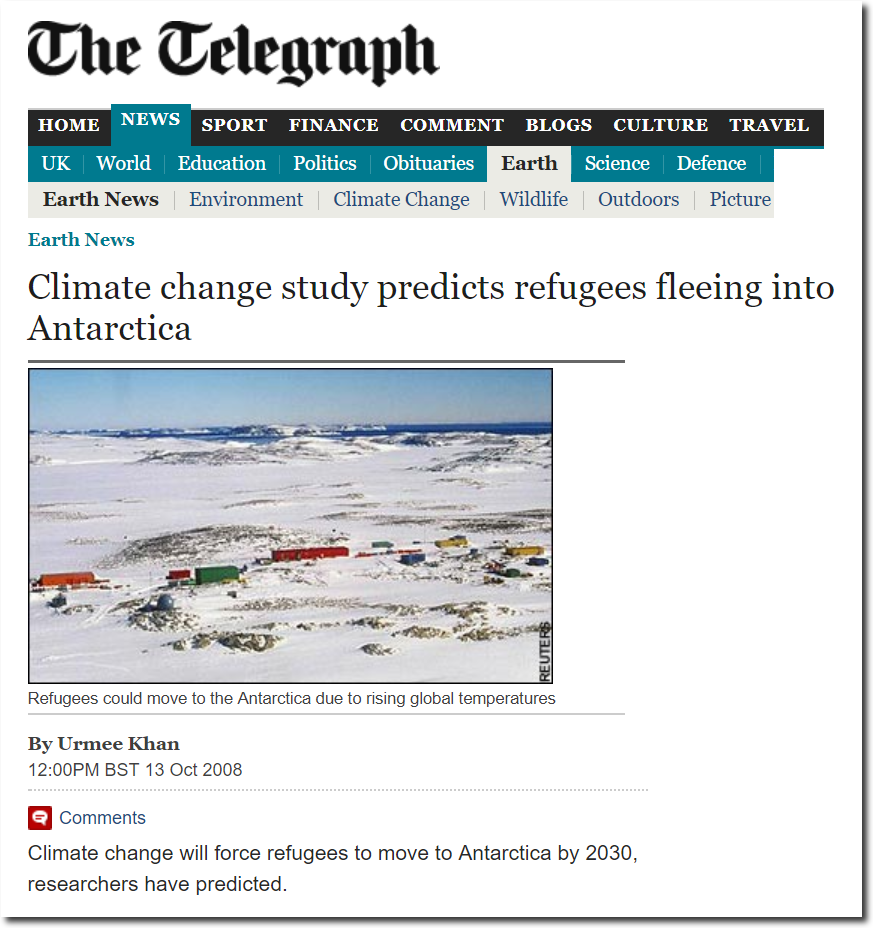
Experts also say refugees will be forced to flee to Antarctica before 2030.
Climate change study predicts refugees fleeing into Antarctica – Telegraph
Featured Video
or go to
Aletho News Archives – Video-Images
Book Review
The Maidan Killings and the False-Flag Case
By Freddie Ponton | 21st Century Wire | September 5, 2026
Before the killings that helped bring down Ukraine’s president in February 2014, American diplomats were discussing who should enter its government. In a leaked telephone call, senior State Department official Victoria Nuland told US ambassador Geoffrey Pyatt, “I think Yats is the guy,” referring to opposition leader Arseniy Yatseniuk. Washington had clear preferences and was working to advance them. Later that month, Yatseniuk became prime minister.
Ivan Katchanovski’s The Maidan Massacre in Ukraine examines the violence that preceded that transfer of power. Drawing on television footage, witness testimony, forensic examinations and Ukrainian court proceedings, he argues that elements of the opposition shot protesters and police in a false-flag operation. His case centres on evidence of protesters being shot from opposition-controlled locations, including Hotel Ukraina, overlooking the killing ground. … continue
Blog Roll
 Aletho News
- Israel expands “incitement” charge to target Palestinian education and memory
- How Israel seeks to reshape Arab classrooms
- Paris bans pro-Palestinian demonstration planned for Oct. 7 over ‘risks of public disorder’
- In August Hanning Treason Case – All Signs Point To Tel Aviv.
- France cleared dozens of military sales to Israel between May and September: Report
- France projects nuclear power as Macron pushes arsenal expansion
- The fallacy of US delusions about Iran’s economic collapse
- What changes with Lula or Flávio?
- Britain leads Western media’s demise through ‘fear porn’ narrative
- The Maidan Killings and the False-Flag Case
- If Americans Knew
- Soldier testimony sheds light on how Israel wages information war
- CIA Report Warns Israel Could Head Toward Civil War, Total Collapse
- Banker Who Exposed Howard Lutnick’s Ties to Epstein Warned of ‘Retaliation’ and ‘Personal Consequences’ in Last Post Before Suicide
- Israeli Attacks Kill Two Palestinians in Gaza
- Gaza genocide at 3: Israeli-U.S. cruelty and the smart, deep resistance to it are changing the world
- As genocide is about to enter 3rd year, little of Gaza remains– Daily Update
- “We See Our Homes Now From A Satellite, Like Strangers”
- Watch “Gaza: Doctors Under Attack”, originally censored by BBC
- NAZA: Israeli embassies in UK and US promote rival documentary to challenge Gaza genocide allegations
- David Ellison appoints Israeli to lead merged Paramount-Warner studios
- No Tricks Zone
- Latest European Green Energy Debacle; Portugal’s Largest Flagship Solar Park Insolvent!
- Green Energy Debacle: German Expert Professor Fritz Vahrenholt Warns Of Severe Economic And Social Consequences
- Two More Paleo Reconstructions Affirm Meters-Higher Sea Levels Across Ireland, Brazil 7000-6000 Years Ago
- New Study: Earth And Venus Surface Warmth Largely Explained By Convection And Lapse Rate, Not CO2 Or Radiation
- 2025 Nature Paper Claiming Worsening Global Drought Gets RETRACTED …Heavily Flawed
- New Study: ‘Global Drought Shows No Detectable Recent Acceleration Under Climate Warming’
- Economic Masterminds: German Socialists Suggest Taxing Productivity Gains Stemming From Using AI
- The South China Sea Has Not Been Cooperating With The Climate Change Narrative
- Energy Crisis: Germany Enters Heating Season With Historically Low Gas Reserve Fill Levels
- New Study: The Antarctic Ice Sheet Gained Mass From 2020-2024 Due To Staggering Snow And Ice Accumulation

