Reagan Documents Shed Light on U.S. ‘Meddling’
By Robert Parry | Consortium News | September 13, 2107
“Secret” documents, recently declassified by the Reagan presidential library, reveal senior White House officials reengaging a former CIA “proprietary,” The Asia Foundation, in “political action,” an intelligence term of art for influencing the actions of foreign governments.
The documents from 1982 came at a turning-point moment when the Reagan administration was revamping how the U.S. government endeavored to manipulate the internal affairs of governments around the world in the wake of scandals in the 1960s and 1970s involving the Central Intelligence Agency’s global covert operations.
Instead of continuing to rely heavily on the CIA, President Reagan and his national security team began offloading many of those “political action” responsibilities to “non-governmental organizations” (NGOs) that operated in a more overt fashion and received funding from other U.S. government agencies.
But secrecy was still required for the involvement of these NGOs in the U.S. government’s strategies to bend the political will of targeted countries. If the “political action” of these NGOs were known, many countries would object to their presence; thus, the “secret” classification of the 1982 White House memos that I recently obtained via a “mandatory declassification review” from the archivists at the Reagan presidential library in Simi Valley, California.
In intelligence circles, “political action” refers to a wide range of activities to influence the policies and behaviors of foreign nations, from slanting their media coverage, to organizing and training opposition activists, even to setting the stage for “regime change.”
The newly declassified memos from the latter half of 1982 marked an ad hoc period of transition between the CIA scandals, which peaked in the 1970s, and the creation of more permanent institutions to carry out these semi-secretive functions, particularly the National Endowment for Democracy (NED), which was created in 1983.
Much of this effort was overseen by a senior CIA official, Walter Raymond Jr., who was moved to Reagan’s National Security Council’s staff where he managed a number of interagency task forces focused on “public diplomacy,” “psychological operations,” and “political action.”
Raymond, who had held top jobs in the CIA’s covert operations shop specializing in propaganda and disinformation, worked from the shadows inside Reagan’s White House, too. Raymond was rarely photographed although his portfolio of responsibilities was expansive. He brought into his orbit emerging “stars,” including Lt. Col. Oliver North (a central figure in the Iran-Contra scandal), State Department propagandist (and now a leading neocon) Robert Kagan, and NED President Carl Gershman (who still heads NED with its $100 million budget).
Despite his camera avoidance, Raymond appears to have grasped his true importance. In his NSC files, I found a doodle of an organizational chart that had Raymond at the top holding what looks like the crossed handles used by puppeteers to control the puppets below them. The drawing fit the reality of Raymond as the behind-the-curtains operative who controlled various high-powered inter-agency task forces.
Earlier declassified documents revealed that Raymond also was the conduit between CIA Director William J. Casey and these so-called “pro-democracy” programs that used sophisticated propaganda strategies to influence not only the thinking of foreign populations but the American people, too.
This history is relevant again now amid the hysteria over alleged Russian “meddling” in last year’s U.S. presidential elections. If those allegations are true – and the U.S. government has still not presented any real proof – the Russian motive would have been, in part, payback for Washington’s long history of playing games with the internal politics of Russia and other countries all across the planet.
A Fight for Money
The newly released memos describe bureaucratic discussions about funding levels for The Asia Foundation (TAF), with the only sensitive topic, to justify the “secret” stamp, being the reference to the U.S. government’s intent to exploit TAF’s programs for “political action” operations inside Asian countries.
Indeed, the opportunity for “political action” under TAF’s cover appeared to be the reason why Reagan’s budget cutters relented and agreed to restore funding to the foundation.
William Schneider Jr. of the Office of Management and Budget wrote in a Sept. 2, 1982 memo that the Budget Review Board (BRB) had axed TAF funding earlier in the year.
“When the BRB last considered this issue on March 29, 1982, it decided not to include funding in the budget for a U.S. Government grant to TAF. The Board’s decision was based on the judgement that given the limited resources available for international affairs programs, funding for the Foundation could not be justified. During that March 29 meeting, the State Department was given the opportunity to fund TAF within its existing budget, but would not agree to do so.”
However, as Schneider noted in the memo to Deputy National Security Advisor Robert McFarlane, “I now understand that a proposal to continue U.S. funding for the Asia Foundation is included in the ‘political action’ initiatives being developed by the State Department and several other agencies.
“We will, of course, work with you to reconsider the relative priority of support for the Foundation as part of these initiatives keeping in mind, however, the need for identifying budget offsets.”
A prime mover behind this change of heart appeared to be Walter Raymond, who surely knew TAF’s earlier status as a CIA “proprietary.” In 1966, Ramparts magazine exposed that relationship and led the Johnson administration to terminate the CIA’s money.
According to an April 12, 1967 memo from the State Department’s historical archives, CIA Director Richard Helms, responding to a White House recommendation, “ordered that covert funding of The Asia Foundation (TAF) shall be terminated at the earliest practicable opportunity.”
In coordination with the CIA’s “disassociation,” TAF’s board released what the memo described as “a carefully limited statement of admission of past CIA support. In so doing the Trustees sought to delimit the effects of an anticipated exposure of Agency support by the American press and, if their statement or some future expose does not seriously impair TAF’s acceptability in Asia, to continue operating in Asia with overt private and official support.”
The CIA memo envisioned future funding from “overt U.S. Government grants” and requested guidance from the White House’s covert action oversight panel, the 303 Committee, for designation of someone “to whom TAF management should look for future guidance and direction with respect to United States Government interests.”
In 1982, with TAF’s funding again in jeopardy, the CIA’s Walter Raymond rallied to its defense from his NSC post. In an undated memo to McFarlane, Raymond recalled that “the Department of State underscored that TAF had made significant contributions to U.S. foreign policies through fostering democratic institutions and, as a private organization, had accomplished things which a government organization cannot do.” [Emphasis in original]
Raymond’s bureaucratic intervention worked. By late 1982, the Reagan administration had arranged for TAF’s fiscal 1984 funding to go through the U.S. Information Agency (USIA) budget, which was being used to finance a range of President Reagan’s “democracy initiatives.” Raymond spelled out the arrangements in a Dec. 15, 1982 memo to National Security Advisor William Clark.
“The issue has been somewhat beclouded in the working levels at State since we have opted to fund all FY 84 democracy initiatives via the USIA budgetary submission,” Raymond wrote. “At the same time, it is essential State maintain its operational and management role with TAF.”
Over the ensuing three and half decades, TAF has continued to be subsidized by U.S. and allied governments. According to its annual report for the year ending Sept. 30, 2016, TAF said it “is funded by an annual appropriation from the U.S. Congress, competitively bid awards from governmental and multilateral development agencies, including the U.S. Agency for International Development, Australian Department of Foreign Affairs and Trade, United Kingdom’s Department for International Development and by private foundations and corporations,” a sum totaling $94.5 million.
TAF, which operates in 18 Asian countries, describes its purpose as “improving lives across a dynamic and developing Asia.” TAF’s press office had no immediate comment regarding the newly released Reagan-era documents.
Far From Alone
But TAF was far from alone as a private organization that functioned with U.S. government money and collaborated with U.S. officials in achieving Washington’s foreign policy goals.
For instance, other documents from the Reagan library revealed that Freedom House, a prominent human rights organization, sought advice and direction from Casey and Raymond while advertising the group’s need for financial help.
In an Aug. 9, 1982 letter to Raymond, Freedom House executive director Leonard R. Sussman wrote that “Leo Cherne [another senior Freedom House official] has asked me to send these copies of Freedom Appeals. He has probably told you we have had to cut back this project to meet financial realities. We would, of course, want to expand the project once again when, as and if the funds become available.”
According to the documents, Freedom House remained near the top of Casey’s and Raymond’s thinking when it came to the most effective ways to deliver the CIA’s hardline foreign policy message to the American people and to the international community.
On Nov. 4, 1982, Raymond wrote to NSC Advisor Clark about the “Democracy Initiative and Information Programs,” stating that “Bill Casey asked me to pass on the following thought concerning your meeting with [right-wing billionaire] Dick Scaife, Dave Abshire [then a member of the President’s Foreign Intelligence Advisory Board], and Co.
“Casey had lunch with them today and discussed the need to get moving in the general area of supporting our friends around the world. By this definition he is including both ‘building democracy’ and helping invigorate international media programs. The DCI [Casey] is also concerned about strengthening public information organizations in the United States such as Freedom House.
“A critical piece of the puzzle is a serious effort to raise private funds to generate momentum. Casey’s talk with Scaife and Co. suggests they would be very willing to cooperate. Suggest that you note White House interest in private support for the Democracy initiative.”
In a Jan. 25, 1983 memo, Raymond wrote, “We will move out immediately in our parallel effort to generate private support” for “public diplomacy” operations. Then, on May 20, 1983, Raymond recounted in another memo that $400,000 had been raised from private donors brought to the White House Situation Room by USIA Director Charles Wick. According to that memo, the money was divided among several organizations, including Freedom House and Accuracy in Media, a right-wing media attack group.
In an Aug. 9, 1983 memo, Raymond outlined plans to arrange private backing for that effort. He said USIA Director Wick “via [Australian publishing magnate Rupert] Murdock [sic], may be able to draw down added funds” to support pro-Reagan initiatives. Raymond recommended “funding via Freedom House or some other structure that has credibility in the political center.”
[For more on the Murdoch connection, see Consortiumnews.com’s “Rupert Murdoch: Propaganda Recruit.”]
Questions of Legality
Raymond remained a CIA officer until April 1983 when he resigned so in his words “there would be no question whatsoever of any contamination of this” propaganda operation to woo the American people into supporting Reagan’s policies.
Raymond fretted, too, about the legality of Casey’s role in the effort to influence U.S. public opinion because of the legal prohibition against the CIA influencing U.S. policies and politics. Raymond confided in one memo that it was important “to get [Casey] out of the loop,” but Casey never backed off and Raymond continued to send progress reports to his old boss well into 1986.
It was “the kind of thing which [Casey] had a broad catholic interest in,” Raymond said during his Iran-Contra deposition in 1987. He then offered the excuse that Casey undertook this apparently illegal interference in domestic affairs “not so much in his CIA hat, but in his adviser to the president hat.”
In 1983, Casey and Raymond focused on creating a permanent funding mechanism to support private organizations that would engage in propaganda and political action that the CIA had historically organized and paid for covertly. The idea emerged for a Congressionally funded entity that would be a conduit for this money.
But Casey recognized the need to hide the strings being pulled by the CIA. In one undated letter to then-White House counselor Edwin Meese III, Casey urged creation of a “National Endowment,” but added: “Obviously we here [at CIA] should not get out front in the development of such an organization, nor should we appear to be a sponsor or advocate.”
A document in Raymond’s files offered examples of what would be funded, including “Grenada — 50 K — To the only organized opposition to the Marxist government of Maurice Bishop (The Seaman and Waterfront Workers Union). A supplemental 50 K to support free TV activity outside Grenada” and “Nicaragua — $750 K to support an array of independent trade union activity, agricultural cooperatives.”
The National Endowment for Democracy took shape in late 1983 as Congress decided to also set aside pots of money — within NED — for the Republican and Democratic parties and for organized labor, creating enough bipartisan largesse that passage was assured.
But some in Congress thought it was important to wall the NED off from any association with the CIA, so a provision was included to bar the participation of any current or former CIA official, according to one congressional aide who helped write the legislation.
This aide told me that one night late in the 1983 session, as the bill was about to go to the House floor, the CIA’s congressional liaison came pounding at the door to the office of Rep. Dante Fascell, a senior Democrat on the House Foreign Affairs Committee and a chief sponsor of the bill.
The frantic CIA official conveyed a single message from CIA Director Casey: the language barring the participation of CIA personnel must be struck from the bill, the aide recalled, noting that Fascell consented to the demand, not fully recognizing its significance.
The aide said Fascell also consented to the Reagan administration’s choice of Carl Gershman to head the National Endowment for Democracy, again not recognizing how this decision would affect the future of the new entity and American foreign policy.
Gershman, who had followed the classic neoconservative path from youthful socialism to fierce anticommunism, became NED’s first (and, to this day, only) president. Though NED is technically independent of U.S. foreign policy, Gershman in the early years coordinated decisions on grants with Raymond at the NSC.
For instance, on Jan. 2, 1985, Raymond wrote to two NSC Asian experts that “Carl Gershman has called concerning a possible grant to the Chinese Alliance for Democracy (CAD). I am concerned about the political dimension to this request. We should not find ourselves in a position where we have to respond to pressure, but this request poses a real problem to Carl.”
Besides clearing aside political obstacles for Gershman, Raymond also urged NED to give money to Freedom House in a June 21, 1985 letter obtained by Professor John Nichols of Pennsylvania State University.
What the documents at the Reagan library make clear is that Raymond and Casey stayed active shaping the decisions of the new funding mechanism throughout its early years. (Casey died in 1987; Raymond died in 2003.)
Lots of Money
Since its founding, NED has ladled out hundreds of millions of dollars to NGOs all over the world, focusing on training activists, building media outlets, and supporting civic organizations. In some geopolitical hotspots, NED may have scores of projects running at once, such as in Ukraine before the 2014 coup that overthrew elected President Viktor Yanukovych and touched off the New Cold War with Russia. Via such methods, NED helped achieve the “political action” envisioned by Casey and Raymond.
From the start, NED also became a major benefactor for Freedom House, beginning with a $200,000 grant in 1984 to build “a network of democratic opinion-makers.” In NED’s first four years, from 1984 and 1988, it lavished $2.6 million on Freedom House, accounting for more than one-third of its total income, according to a study by the liberal Council on Hemispheric Affairs, which was entitled “Freedom House: Portrait of a Pass-Through.”
Over the ensuing decades, Freedom House has become almost an NED subsidiary, often joining NED in holding policy conferences and issuing position papers, both organizations pushing primarily a neoconservative agenda, challenging countries deemed insufficiently “free,” including Syria, Ukraine (before the 2014 coup) and Russia.
NED and Freedom House often work as a kind of tag-team with NED financing NGOs inside targeted countries and Freedom House berating those governments if they try to crack down on U.S.-funded NGOs.
For instance, on Nov. 16, 2012, NED and Freedom House joined together to denounce a law passed by the Russian parliament requiring Russian recipients of foreign political money to register with the government. Or, as NED and Freedom House framed the issue: the Russian Duma sought to “restrict human rights and the activities of civil society organizations and their ability to receive support from abroad. Changes to Russia’s NGO legislation will soon require civil society organizations receiving foreign funds to choose between registering as ‘foreign agents’ or facing significant financial penalties and potential criminal charges.”
Of course, the United States has a nearly identical Foreign Agent Registration Act that likewise requires entities that receive foreign funding and seek to influence U.S. government policy to register with the Justice Department or face possible fines or imprisonment.
But the Russian law would impede NED’s efforts to destabilize the Russian government through funding of political activists, journalists and civic organizations, so it was denounced as an infringement of human rights and helped justify Freedom House’s rating of Russia as “not free.”
The Russian government’s concerns were not entirely paranoid. On Sept. 26, 2013, Gershman, in effect, charted the course for the crisis in Ukraine and the greater neocon goal of regime change in Russia. In a Washington Post op-ed, Gershman called Ukraine “the biggest prize” and explained how pulling it into the Western camp could contribute to the ultimate defeat of Russian President Vladimir Putin.
“Ukraine’s choice to join Europe will accelerate the demise of the ideology of Russian imperialism that Putin represents,” Gershman wrote. “Russians, too, face a choice, and Putin may find himself on the losing end not just in the near abroad but within Russia itself.”
The long history of the U.S. government interfering covertly or semi-covertly in the politics of countries all over the world is the ironic backdrop to the current frenzy over Russia-gate and Russia’s alleged dissemination of emails that undermined Democratic presidential nominee Hillary Clinton’s campaign.
The allegations are denied by both Putin and WikiLeaks editor Julian Assange who published the Democratic emails – and the U.S. government has presented no solid evidence to support the accusations of “Russian meddling” – but if the charges are true, they could be seen as a case of turnabout as fair play.
Except in this case, U.S. officials, who have meddled ceaselessly with their “political action” operations in countries all over the world, don’t like even the chance that they could get a taste of their own medicine.
Investigative reporter Robert Parry broke many of the Iran-Contra stories for The Associated Press and Newsweek in the 1980s.
Kremlin used Facebook to subvert Twin Falls, Idaho – Daily Beast
RT | September 12, 2017
A long-canceled Facebook event in Idaho, attended by only four people, is highlighted by the Daily Beast as an example of the Russian government’s alleged campaign to influence the US 2016 presidential election.
The Kremlin set up Facebook events to organize protests in the US, including the one in August 2016 calling to ban Muslim refugees from the rural town of Twin Falls, Idaho, the outlet alleged in an article referencing Facebook’s hunt for suspected Russian operatives.
The publication said Facebook confirmed that it “shut down several promoted events as part of the takedown” of fake user profiles last week. The social media giant did not specify the events, however.
The Daily Beast writers concluded that the Facebook events “are the first indication that the Kremlin’s attempts to shape America’s political discourse moved beyond fake news and led unwitting Americans into specific real-life action.”
RT has reached out to Facebook for comment on whether the social media giant thought the “Citizens before refugees” event in Idaho was organized by the Kremlin. We also reached out to the Daily Beast, asking how their writers arrived at their conclusion. We have received no response as of yet.
Facebook shows that only four people marked themselves as having attended the Idaho protest in question.
The event was set up by a Facebook community called “Secured Borders,” which has since been shut down amid reports that it was operated from Russia. Facebook has yet to respond to RT’s question on what exactly was the basis for deleting the community’s page.
The events were “the next step” of Russia’s influence campaign, “when you can get people to physically do something,” the Daily Beast cited Clint Watts, founder of the “Alliance for Securing Democracy,” which operates Hamilton 68, the operation that claims to be “tracking Russia’s influence on Twitter.”
Last week, Watts’ group accused Russia of promoting hurricane preparedness websites such as ready.gov, hurricanes.gov and redcross.org.
On September 6, Facebook issued a statement saying it looked into questions on whether Russia purchased ads on the platform to interfere with the 2016 US presidential election.
The social-media giant claimed it “found approximately $100,000 in ad spending from June of 2015 to May of 2017″ connected to “about 470 inauthentic accounts and Pages in violation of our policies. Our analysis suggests these accounts and Pages were affiliated with one another and likely operated out of Russia.”
The ads and accounts “appeared to focus on amplifying divisive social and political messages across the ideological spectrum,” rather than referencing the election or a particular candidate, Facebook said.
The company did not elaborate what its attribution was based on, but added that it also looked for ads “with very weak signals of a connection and not associated with any known organized effort. This was a broad search, including, for instance, ads bought from accounts with US IP addresses but with the language set to Russian — even though they didn’t necessarily violate any policy or law.”
The statement prompted some on social media to question whether political events set up by Russian-Americans, or just Russians in the US, could be viewed as part of a nefarious influence campaign and then be targeted.
Neither Facebook nor the Daily Beast immediately responded to RT’s inquiries on whether they thought activity by someone in Russia, or a Russian speaker, automatically implicated the Kremlin.
Following Facebook’s findings last week, Google said it failed to unearth any facts that would implicate Russia in exploiting its advertising tools to manipulate the US election.
“We’re always monitoring for abuse or violations of our policies and we’ve seen no evidence this type of ad campaign was run on our platforms,” Google said in a statement Thursday, as cited by Reuters.
Facing a Major Attack on Academic Freedom in Canada
By Prof. Tony Hall | American Herald Tribune | September 11, 2017
Sixteen years after the event, 9/11 stands as striking evidence of an insidious assault on science. Officialdom’s dogged adherence to a discredited account of 9/11 stands as a stark illustration of this phenomenon. The subordination of scientific method to the higher imperatives of imperial war propaganda is epitomized by officialdom’s failure to formulate a credible account of the 9/11 debacle. Universities have become important sites of this betrayal. The sabotage of society’s primary platforms of scholarly enterprise forms an essential feature of a more pervasive attack from within. Everywhere, but especially on the Internet, fundamental freedoms to investigate, publish, publicize and discuss interpretations that might undermine or inconvenience power are being menaced.
As a tenured full professor with 27 years of seniority at my home institution, I am currently facing a sharp attack on the remaining protections for academic freedom. In early October of 2016 the President of the University of Lethbridge, Michael J. Mahon, suspended me without pay. He also prohibited me from stepping foot on the University of Lethbridge campus. In explaining his actions Dr. Mahon’s speculated I might have violated a section of the Alberta Human Rights Act.
The vagueness of this assertion exposes the reality that severe punishment was imposed without any proper investigation. Dr. Mahon’s abrupt deviation from the terms of the collective agreement with my faculty association has established precedents and countervailing responses with broad implications. Adversarial proceedings on this matter began this August in the Lethbridge Alberta Court House. As evidenced by the intervention of the 68,000 members of the Canadian Association of University Teachers, the outcome of this case will in all probability significantly affect the future of university governance in Canada and beyond.
Dr. Mahon’ suspension letter detailed that there was a possibility that I might be guilty because of allegations that a) “my Facebook page had been used for virulent anti-semitic comments “and b) “Inferring that Israelis, and hence Jewish individuals, were responsible for the terrorist attacks on the World Trade Center on September 11, 2001.”
Before dealing with the manipulation of my Facebook wall in the prelude to my suspension, allow me to linger on questions concerning the academy and 9/11. Along with government, media and law enforcement agencies, universities are deeply implicated in sabotaging the quest for 9/11 truth and many other varieties of inconvenient truth as well. The punitive measures directed at me can be seen as a warning to scare other professors into compliance with all manner of official stories?
As for my own reading of the available evidence, I am far from alone in positing that Israel First partisans, including the American neocons that dominated the Project for the New American Century, are prominent among the many protagonists of the 9/11 crimes. These crimes extend to orchestrating the media spin, rigging investigations, and sustaining the ongoing 9/11 cover-up. In publications and on False Flag Weekly News, Dr. Kevin Barrett and I have joined others in extending this investigative and interpretation trajectory into many cases of possible false flag terrorism particularly after 2001.
I am astonished that the Administration of my University became so aggressive in attempting to outlaw an evidence-based interpretation of the most transformative event of the twenty-first century. New frontiers of subversion are being pioneered in the U of L’s audacious administrative attempt to criminalize independent academic work.
What are the implications of subordinating the scholarly judgments of academic experts on campus to the executive dictates of administrators? How can the principles of critical thinking be cultivated when adherence to conformity is so aggressively enforced by administrators?
The University Administration extends its claims of academic control several steps further in the complaint it brought forward to the Alberta Human Rights Commission seven months after I was suspended. The complaint begins with six sweeping statements outlining topics that the complainants want removed from the reach of critical academic examination. One of the complainants chief assertions is the Islamophobia-inducing proposition that “acts of terrorism between 2001 to the present… were in fact committed and financed by Islamic terrorists.”
Facebook Machinations
A maliciously-engineered Facebook operation created the original catalyst of the smear and disinformation campaign leading to my suspension. Without the originating momentum set in motion by the Facebook operation the campaign to discredit me could not have unfolded as it did. The most public face of this campaign was presented by the Canadian extension of the Israeli- and US-based Anti-Defamation League of B’nai B’rith. According to B’nai Brith Canada, an abhorrent post appeared and then disappeared on my Facebook wall during a short interval on Aug. 26, 2016. The text of the disgusting digital item proclaimed that the Holocaust didn’t happen and that Jews should be “KILLED, EVERY LAST ONE.”
This heinous assertion goes against everything I have tried to stand for in my life including in my academic work. As soon as I became aware of this blaspheme embedded in the planted Facebook post I publicly condemned it. By mid-September, however, my persecutors were far advanced in pushing forward the manufactured crisis. By then B’nai Brith Canada was mounting a petition campaign demanding that I be investigated, fired and silenced.
Recently the results of a Freedom of Information inquiry have brought to light documents illuminating the elaborate defamation pointed my way in the hours and days immediately following the August 26 Facebook operation. One document was sent to the Office of the University of Lethbridge President and copied to the Premier of Alberta as well as the Alberta Justice Minister. Citing the B’nai Brith, the document’s author characterized me as an “advocate for the murder of Jews.”
Another letter dated 1 Sept. 2016 was signed by the President of the Canadian Jewish Civil Rights Association. This signatory, who has since passed away, cited the complete text of the offending Facebook post. The letter to Dr. Mahon indicated the reprehensible words actually came “from my lips.”
I cannot understand why Dr. Mahon did not at this juncture properly investigate by consulting me directly and conferring with the University of Lethbridge Faculty Association. Instead the President opted to push ahead with drastic action based on incomplete information combined with the intense pressure brought to bear on him by an extremely influential external political lobby
Hate Speech Deceptions
None of my persecutors has yet identified the true source of the offending Facebook item. My own research into the matter, including my email exchange with cartoonist Ben Garrison, has led me to Joshua Goldberg. American Herald Tribune has published my article on this young man. Goldberg is widely reported to be the creator of many Internet personalities, all of whom generate abundant “hate speech deceptions” from various ethnic and ideological perspectives.
Goldberg’s case exposes much about the wholesale manufacturing and misrepresentation of so-called “hate speech” to justify censorship on the Internet. In my case an atrocious digital item was strategically inserted with the aim of ruining me professionally and personally.
The intervention of Internet leviathans like Google and Facebook is especially aggressive when it comes to disappearing material critical of the Israeli government’s treatment of Palestinians. My own experience with the Canadian branch of the Anti-Defamation League of B’nai B’rith points to the strength of this pattern. Why is it that this same Zionist organization is being tasked with the strategic responsibility of censoring and categorizing You Tube videos?
As illustrated by William Pepper’s development of civil litigation to bring to light the US government’s role in the tragedy suffered by the family of Martin Luther King Jr., we rarely get criminal trials pressed against the world’s most powerful interests and operatives. Instances of possible false flag terrorism, but especially 9/11, have been rendered especially immune to any kind of trial that would put before the public evidence garnered from genuine investigations of facts.
Perhaps the reference to 9/11 in a University Administration’s efforts to condemn me for academic thought crimes and speech crimes will force the forbidden topic into some kind of evidence-based juridical procedure. When it comes to understanding the real dynamics of who did what to whom on 9/11, the truth must prevail.
Dr. Hall is editor in chief of American Herald Tribune. He is currently Professor of Globalization Studies at University of Lethbridge in Alberta Canada. He has been a teacher in the Canadian university system since 1982.
September 11, 2001: Questions to Ask if You Still Believe the Official Narrative
By Tony Cartalucci | Land Destroyer | September 11, 2017
The attacks of September 11, 2001 (9/11) left nearly 3,000 dead in NYC, Washington D.C. and over Pennsylvania. The attacks transformed America into a deepening police state at home and a nation perpetually at war abroad.
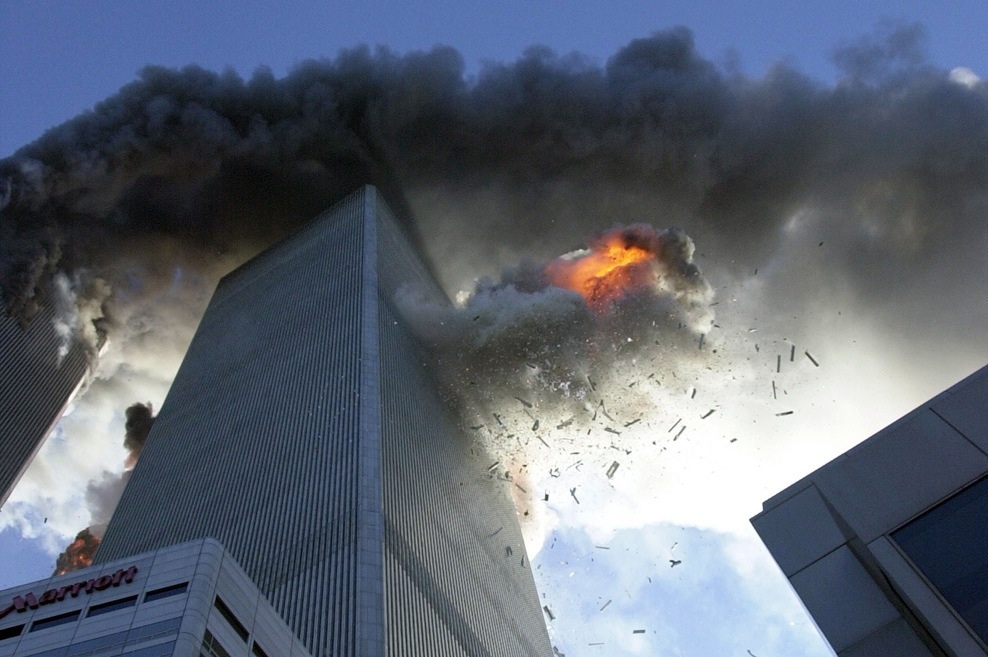
The official narrative claims that 19 hijackers representing Al Qaeda took over 4 commercial aircraft to carry out attacks on New York City’s World Trade Center and the Pentagon in Washington D.C.
The event served as impetus for the invasion and occupation of Afghanistan which continues to present day. It also led directly to the invasion and occupation of Iraq. Attempts to cite the attack to precipitate a war with Iran and other members of the so-called “Axis of Evil” (Libya, Syria, North Korea, and Cuba) have also been made.
And if this is the version of reality one subscribes to, several questions remain worth asking.
1. Can the similarities between 9/11 and plans drawn up by the US Department of Defense (DoD) and Joint Chiefs of Staff (JCS) in 1962 under the code name “Operation Northwoods” be easily dismissed?
The US DoD and JCS wrote a detailed plan almost identical to the 9/11 attacks as early as 1962 called “Operation Northwoods” where the US proposed hijacking commercial airliners, committing terrorist attacks, and blaming Cuba to justify a US military intervention.

Far from a fringe conspiracy theory, mainstream media outlets including ABC News would cover the document in articles like, “U.S. Military Wanted to Provoke War With Cuba,” which would report:
In the early 1960s, America’s top military leaders reportedly drafted plans to kill innocent people and commit acts of terrorism in U.S. cities to create public support for a war against Cuba.
Code named Operation Northwoods, the plans reportedly included the possible assassination of Cuban émigrés, sinking boats of Cuban refugees on the high seas, hijacking planes, blowing up a U.S. ship, and even orchestrating violent terrorism in U.S. cities.
The plans were developed as ways to trick the American public and the international community into supporting a war to oust Cuba’s then new leader, communist Fidel Castro.
A full PDF copy of the document is available via George Washington University’s archives and states specifically regarding the hijacking of commercial aircraft:
An aircraft at Eglin AFB would be painted and numbered as an exact duplicate for a civil registered aircraft belonging to a CIA proprietary organization in the Miami area. At a designated time the duplicate would be substituted for the actual civil aircraft and would be loaded with the selected passengers, all boarded under carefully prepared aliases. The actual registered aircraft would be converted to a drone.
The document also cites the USS Maine in describing the sort of event the DoD-JCS sought to stage, a US warship whose destruction was used to maliciously provoke the Spanish-American War. It should be noted, that unlike the DoD-JCS document’s suggestion that airliner-related casualties be staged, the USS Maine explosion killed 260 sailors. It is likely that DoD and JCS would not risk engineering a provocation that leads to major war but allow low-level operators left alive with the knowledge of what they had participated in.
Considering that the US sought to deceive the public in order to provoke an unjustifiable war that would undoubtedly kill thousands or tens of thousands of innocent people, and that other proposals did include killing innocent people, it is worth considering that US policymakers would also be just as willing to extinguish innocent lives when staging the hijacking of aircraft to provoke such a war.
2. Why did US policymakers draw up extensive plans to reassert US global hegemony – including regime change in Afghanistan, Iraq, Iran, Libya, Somalia, Sudan, and Yemen – without any conceivable pretext until 9/11 conveniently unfolded?
In 2000, US policymakers from the Project for a New American Century (PNAC) sought a sweeping plan to reassert America as a global hegemon. In a 90-page document titled, “Rebuilding America’s Defense: Strategy, Forces and Resources For a New Century” (PDF), a strategy for maintaining what it called “American military preeminence” would be laid out in detail.
It involved global moves the United States – in 2000 – could never justify, including placing US troops in Southeast Asia, building a global missile defense network prohibited by treaties signed during the Cold War, and the containment of developing nations that would eventually end up rolling back US global hegemony in the near future, including Iran, Iraq, China, North Korea, Libya, and Syria.

The report noted the difficulties of proposing and executing the transformations necessary to achieve the objectives laid out in the document. It would be explicitly stated that:
Further, the process of transformation, even if it brings revolutionary change, is likely to be a long one, absent some catastrophic and catalyzing event – like a new Pearl Harbor.
In fact, the entire body of the document is an uncanny description of the post-9/11 “international order,” an order unimaginable had the events of 9/11 not transpired.
It should also be remembered that wars predicated on 9/11 like the invasion and occupation of Afghanistan, were admittedly planned before 9/11 took place.
The Guardian in its 2004 article, “Bush team ‘agreed plan to attack the Taliban the day before September 11’,” would report:
The day before the September 11 attacks, the Bush administration agreed on a plan to oust the Taliban regime in Afghanistan by force if it refused to hand over Osama bin Laden, according to a report by a bipartisan commission of inquiry. The report pointed out that agreement on the plan, which involved a steady escalation of pressure over three years, had been repeatedly put off by the Clinton and Bush administrations, despite the repeated failure of attempts to use diplomatic and economic pressure.
While it seems inconceivable that the American or global public would tolerate the multi-trillion dollar 16 year war that the invasion of Afghanistan has become without the attacks on 9/11, such a war was admittedly in the making – in fact – years before 9/11 unfolded.
Similarly, the invasion of Iraq in 2003 was strongly linked to the aftermath of 9/11, but was likewise decided upon long before 9/11 unfolded.
CNN in its article, “O’Neill: Bush planned Iraq invasion before 9/11,” would report:
The Bush administration began planning to use U.S. troops to invade Iraq within days after the former Texas governor entered the White House three years ago, former Treasury Secretary Paul O’Neill told CBS News’ 60 Minutes.
This echos similar statements made by US Army General Wesley Clark who repeatedly warned that the US sought global-spanning war post-Cold War to assert its hegemony over the planet, and fully sought to use 9/11 as a pretext to do it.
General Clark would list seven nations slated for regime change post 9/11, including Iraq, Iran, Libya, Somalia, Sudan, and Yemen – all nations now either at war or facing war with the United States and its proxies – or in the case of Libya – entirely divided and destroyed in the wake of US military operations.
3. If primarily Saudi hijackers with Saudi money and Saudi organization perpetrated the attacks of 9/11, why has the United States waged war or threatened war with every nation in the Middle East except Saudi Arabia and its allies?
Not only has the United States made no moves against Saudi Arabia for its apparent role in the 9/11 attacks – spanning the administrations of US President George Bush, Barack Obama, and Donald Trump – the United States has sold Saudi Arabia billions in arms, provided military support and protection to Saudi Arabia’s military and government, partnered with Saudi Arabia in its ongoing conflict with Yemen – all while US government documents and leaked e-mails between US politicians reveal Saudi Arabia is still a state sponsor of Al Qaeda – the organization officially blamed for the 9/11 attacks.

Indeed, a 2012 US Defense Intelligence Agency (DIA) report would explicitly admit:
If the situation unravels there is the possibility of establishing a declared or undeclared Salafist principality in eastern Syria (Hasaka and Der Zor), and this is exactly what the supporting powers to the opposition want, in order to isolate the Syrian regime, which is considered the strategic depth of the Shia expansion (Iraq and Iran).
The DIA memo then explains exactly who this “Salafist principality’s” supporters are:
The West, Gulf countries, and Turkey support the opposition; while Russia, China, and Iran support the regime.
This “Salafist principality” is now known as the “Islamic State,” an affiliate of Al Qaeda still operating with significant state sponsorship everywhere from Syria, Iraq, and Libya, to the Philippines and beyond.
Coincidentally, Saudi-armed and funded terrorists in the Philippines has served as a pretext for US military assets to begin expanding their presence in Southeast Asia, just as the aforementioned 2000 PNAC document had sought.
Additionally, in a 2014 e-mail between US Counselor to the President John Podesta and former US Secretary of State Hillary Clinton, it would be admitted that two of America’s closest regional allies – Saudi Arabia and Qatar – were providing financial and logistical support to the Islamic State.

The e-mail, leaked to the public through Wikileaks, stated:
… we need to use our diplomatic and more traditional intelligence assets to bring pressure on the governments of Qatar and Saudi Arabia, which are providing clandestine financial and logistic support to [the Islamic State] and other radical Sunni groups in the region.
While the e-mail portrays the US in a fight against the very “Salafist” (Islamic) “principality” (State) it sought to create and use as a strategic asset in 2012, the fact that Saudi Arabia and Qatar are both acknowledged as state sponsors of the terrorist organization – and are both still enjoying immense military, economic, and political support from the United States and its European allies – indicates just how disingenuous America’s “war on terror” really is.
If the US truly believed Al Qaeda carried out the deadly attacks of 9/11, why does it count among its closest allies two of Al Qaeda’s largest and most prolific state sponsors?
Together – by honestly answering these three questions – we are left considering the very real possibility that 9/11 was not a terrorist attack carried out by foreign terrorists, but rather an attack engineered by special interests within the United States itself.
If we reject that conclusion, we must ask ourselves why the US DoD and JCS would take the time to draft plans for false flag attacks if they did not believe they were viable options US policymakers might seriously consider. At the very least we must ask why those at the DoD and JCS could be caught signing and dating a conspiracy to commit unspeakable terrorism to justify an unjust war and not only avoid criminal charges, but remain employed within the US government.
We must also ask ourselves why US policymakers would draft long-term plans for reasserting American global hegemony without any conceivable pretext to justify such plans. Even in the wake of 9/11, the US government found it difficult to sell the invasion of Iraq to the American public and its allies. Without 9/11, such salesmanship would have been impossible. In Syria – with 9/11 disappearing into the distant past – US regime change efforts have all but stalled.
Finally, we must find adequate explanations as to why those sponsoring the supposed perpetrators of 9/11 have remained recipients of unwavering American support, weapon sales, and both political and military protection. We must attempt to answer why militants fighting in Syria under the banner of Al Qaeda have been able to openly operate out of NATO-member Turkey’s territory for the past 6 years, side-by-side US Central Intelligence Agency (CIA) personnel who are admittedly fueling the conflict with weapons, money, and training “accidentally” ending up in Al Qaeda’s hands.
It is clear – that at the very least – the official narrative in no shape, form, or way adds up. If the official narrative doesn’t add up, what does?
The Economist Peddles Extreme Weather Lies
By Paul Homewood | Not A Lot Of People Know That | September 11, 2017

https://twitter.com/TheEconomist/status/906739904788430848
The Economist has been running this video on Twitter, with the usual fraudulent claims.
The film uses two examples:
- Hurricane Harvey
- Bangladesh flooding.
They forget to mention that Texas has had even more intensive storms in the past, notably 1978 and 1979, and that Bangladesh regularly floods.
But the headline claim is based on this graph:

The first thing to highlight about this, which should really give the whole thing away as an giant fraud, is that there were apparently virtually no extreme weather events in the early 20thC. Nobody with half a brain could seriously believe this, but apparently Economist readers do.
There appears to be no provenance given for this graph, which in itself is utterly damning for a supposedly serious journal. But it seems to be based on a similarly fraudulent claim from the insurance company, Munich Re, which was doing the rounds a year or two ago, again publicised by the Economist :

https://www.economist.com/news/science-and-technology/21656133-climate-change
As I explained a few months ago, these “disasters” are classified in terms of monetary value. Munich Re only count the most expensive events, albeit adjusted for inflation. (Note – the only other obvious classification is the death toll – but as the video reveals, this is massively reduced).
But, of course, as has been thoroughly explained many times, as the world’s GDP increases, so do economic losses.
No serious organisation would attempt to blame these increased losses on climate change, or any other extraneous causes. But Munich Re has a vested interest in blaming increased premiums on the climate.
It is a sad fact of life that, to get to the truth, we have to rely on independent analysts with no vested interests.
For instance, Roger Pielke Jr:

https://twitter.com/RogerPielkeJr/status/684740869707071488
It is self evident that weather related disaster losses are actually reducing as a proportion of global GDP.
But don’t let simple facts get in the way of propaganda.
9/11: The Pentagon’s B-Movie
By Graeme MacQueen | Dissident Voice | September 10, 2017
The events that took place in the United States on September 11, 2001 were real and they were extremely violent. As David Griffin has recently shown in detail, they also had catastrophic real-life consequences for both the United States and the world.1
But these events were also deeply filmic (like a film) and they were presented to us through a narrative we now know to be fictional. This “9/11 movie” reveals itself to careful investigators as scripted, directed and produced by the U.S. national security state. The movie does not represent the real world. It violates the rules operative in the real world, including the laws of physics. Audiences will remain in thrall to the spectacle and violence of the War on Terror only as long as they remain mesmerized by the B-movie of 9/11.
The Filmic Nature of the September 11 Events
Many people caught a whiff of Hollywood on September 11, 2001. According to Lawrence Wright (screenwriter of The Siege): “It was about an hour after the first trade centre came down that I began to make the connection with the movie, this haunting feeling at the beginning this looks like a movie, and then I thought it looks like my movie.”2 Steve De Souza (screenwriter, Die Hard I and II) has said: “Well it did look like a movie. It looked like a movie poster. It looked like one of my movie posters.”3
The 9/11 attacks were filmic in at least the following ways:
- Given the complex and coordinated nature of these attacks, they had been scripted and given a timeline in advance;
- Given the need to make decisions as the attacks progressed (for example, when an aircraft went off course or was delayed), it is clear that there was a director;
- Given the overall vision, the need for funds, resources and international coordination over a period of years, it is obvious that there had been a producer; and,
- Given the numerous roles played in this event (for example, by the “hijackers”), there were undoubtedly actors.
In addition, the event included the key dramatic elements of conflict, violence and spectacle.4 The entire production was filmed from several angles, and the films, sometimes in the rough and sometimes cleverly edited, were shown many, many times all over the world.
Official U.S. sources rapidly acknowledged the remarkably filmic nature of these events. In October, 2001 some two dozen Hollywood writers and directors were assembled “to brainstorm with Pentagon advisers and officials in an anonymous building in L.A.”5 The Army’s Institute for Creative Technologies was the lead organization.6 The assembled group was assumed to have relevant expertise and was asked to brainstorm about what future attacks might look like so that the Pentagon could be prepared. (“We want some left-field, off-the-wall ideas; say the craziest thing that comes into your mind”).7
While the bare fact of this consultation was widely reported by news media, further details about the three-day consultation have been hard to come by. Reporters have had their FOIA requests denied.8
Beneath this consultation lay the “failure of imagination” hypothesis. Although the hypothesis emerged almost immediately after September 11, it was given especially clear expression in a BBC Panorama programme aired on March 24, 2002.9 Steve Bradshaw interviewed representatives of Hollywood and of national security institutions. The Pentagon, we were supposed to believe, is a typical large bureaucracy characterized by inertia. It is unable to imagine, and to rapidly respond to, new and emerging threats. It is stuck in the past. It is also afraid to irritate the general population by appearing to be politically incorrect–by looking, in this case, at Islam as a threat. Fortunately, there are two sets of people with imagination and courage: a small number of people within the national security apparatus who were trying to warn the Pentagon but were ignored, and Hollywood screenwriters and directors, who had imagination, who had some contact with the national security dissidents, and who had the courage to risk being called Islamophobic.3
So the planes of September 11, when they burst on the scene, confirmed the imaginative prescience of Hollywood, supported the courageous faction of the national security apparatus, and embarrassed the national security bureaucracy, which had to lower itself in October, 2001 to meet with the purveyors of fiction in order to stimulate its sclerotic brain.
This failure of imagination hypothesis was supported by statements by George W. Bush10 and, even more famously, by Condoleeza Rice:
I don’t think anybody could have predicted that these people would take an airplane and slam it into the World Trade Center, take another one and slam it into the Pentagon; that they would try to use an airplane as a missile, a hijacked airplane as a missile.11
The hypothesis became more or less official when it was adopted by the 9/11 Commission in its report on the attacks.12
Of course, given the filmic nature of 9/11, it is clear that, according to these official U.S. sources, there was another group — beyond Hollywood and a few national security malcontents — that had imagination, namely al-Qaeda.
Robert Altman (director of MASH, McCabe and Mrs. Miller and many other films) said in 2002 that Hollywood was to blame for the 9/11 events. “The movies set the pattern, and these people have copied the movies… Nobody would have thought to commit an atrocity like that unless they’d seen it in a movie.”13
Presumably, by “these people” Altman meant al-Qaeda. Perhaps it was while munching popcorn and watching a Hollywood movie that Osama bin Laden and his high-level companions got the idea for 9/11? This is possible. But would it not make sense to ask if it is true that the Pentagon has no imagination, and that it was incapable of picturing attacks like those of the fall of 2001?
Collaboration between Hollywood and U.S. government agencies goes back at least as far as WW II. Indeed, a 1943 memo from the OSS (forerunner of the CIA) noted that, “The motion picture is one of the most powerful propaganda weapons at the disposal of the United States.”14 Many Hollywood films and TV programs have, therefore, been supported by the Pentagon, and some have been supported by the CIA. Such support can be crucial for films that require U.S. military assets such as planes and helicopters. But support is not automatic. The script must first be approved, and emendations may be demanded by the national security agency in question. In a recent book on this subject (National Security Cinema: The Shocking New Evidence of Government Control in Hollywood), authors Tom Secker and Matthew Alford list 814 films and 1133 TV titles that received DOD support.3
Since many of these films are highly imaginative constructions, how can it be that the national security agencies that have helped bring them to fruition have remained trapped in their grey, unimaginative world? Presumably, we are to believe that it is the nature of a bureaucracy to restrict these imaginative insights to one part of the organization — say, the Army’s Institute for Creative Technologies — while neglecting to disseminate them to other parts of the national security state. But is this true?
Those familiar with the History Commons research project on 9/11 will know that it is not true at all. Here are 16 titles from that project (selected from a much longer list) that refer to pre-9/11 exercises and simulations by U.S. government agencies:15
November 7, 1982: Port Authority Practices for Plane Crashing into the WTC
(1998-September 10, 2001): NORAD Operations Center Runs Five ‘Hijack Training Events’ Each Month
1998-2001: Secret Service Simulates Planes Crashing into the White House
October 14, 1998: ‘Poised Response’ Exercise Prepares for Bin Laden Attack on Washington
Between 1999 and September 11, 2001: NORAD Practices Live-Fly Mock Shootdown of a Poison-Filled Jet
Between September 1999 and September 10, 2001: NORAD Exercises Simulate Plane Crashes into US Buildings; One of Them Is the World Trade Center
November 6, 1999: NORAD Conducts Exercise Scenario Based around Hijackers Planning to Crash Plane into UN Headquarters in New York
June 5, 2000: NORAD Exercise Simulates Hijackers Planning to Crash Planes into White House and Statue of Liberty
October 16-23, 2000: NORAD Exercise Includes Scenarios of Attempted Suicide Plane Crashes into UN Headquarters in New York<
May 2001: Medics Train for Airplane Hitting Pentagon
June 1-2, 2001: Military Conducts Exercises Based on Scenario in which Cruise Missiles Are Launched against US [“Osama bin Laden is pictured on the cover of the proposal for the exercise”]
July 2001: NORAD Plans a Mock Simultaneous Hijacking Threat from inside the US
Early August 2001: Mass Casualty Exercise at the Pentagon Includes a Plane Hitting the Building
August 4, 2001: Air Defense Exercise Involves the Scenario of Bin Laden Using a Drone Aircraft to Attack Washington
September 6, 2001: NORAD Exercise Includes Terrorist Hijackers Threatening to Blow Up Airliner
September 9, 2001: NEADS Exercise Includes Scenario with Terrorist Hijackers Targeting New York
It is not necessary to find an exercise here that perfectly matches the attacks of the fall of 2001. The point is that there is far too much imagination and far too much similarity to the actual attacks of the fall of 2001 to support the “failure of imagination” hypothesis. Hollywood participants in the October, 2001 brainstorming exercise, who thought they were being tapped for their imagination, were conned.
Who was better prepared, through both imagination and logistical capacity, to carry out the attacks of the fall of 2001–Bin Laden’s group or the U.S. national security state? The latter had been practising steadily, in relevant scripted training operations, for years, and it had the power and resources to bring the imaginative scenarios to reality. Al-Qaeda was not remotely its match.
Not Just Filmic, But Exclusively Filmic
If this business of the filmic nature of the September 11 attacks involved only Hollywood scriptwriters we might be tempted to regard it as nothing but a minor distraction. But what we find is that even members of the Fire Department of New York, risking their lives at the scene, were shocked by the filmic nature of what they witnessed.16
I thought I was at an event at Universal Studios, on the side, watching a movie being taped.
— EMS Chief Walter KowalczykI remembered hearing Lieutenant D’Avila coming over the radio and saying Central be advised, a second plane just went into the second tower. We ran out and we saw the second plane. It was like watching a movie. It really was.
— EMT Peter Cachia)I looked over my shoulder and you could see the whole top of the south tower leaning towards us. It looked like it was coming over. You could see the windows pop out just like in the picture, looked like a movie. I saw one floor of windows pop out, like poof, poof. I saw one and a half floors pop out.
— Chief Steve GrabherThe building started collapsing, the north tower started collapsing. It tipped down first and then the thing fell within itself. It was an amazing sight to see. It was really unbelievable. I thought I was watching a movie with special effects.
— EMT Michael MejiasAs I’m looking up at this stuff that’s going on up there now, I just like — I’m saying to myself I’ve seen this in a movie. My whole recollection is going back to a movie or something I saw. I just saw this before.
— Fire Marshal Steven Mosiello… it looked like a bomb, of course, had gone off, almost like a nuclear bomb. That’s all I could think of. I’ve never been at war. I equated it to being like when I saw something like when I was a kid and I saw Godzilla in the movies or something, when he crushes those buildings and stuff like that, that’s what it looked like to me.
— Firefighter Edward KennedyI’m standing on top of the rig between the bucket and the cab, between the ladder and the cab. People were blessing themselves in this gloominess of going down. It was like out of a movie. I couldn’t believe what was going on.
— Firefighter Tiernach CassidyI just recall that those first — those first minutes from the time that sound started, the rumbling started to occur and the dust started to fall and then stopped to get gear and equipment from the fire truck and then continue down to West Street and getting there and seeing the crushed fire trucks, crushed cars, vehicles on fire. It was like a movie set.
— Firefighter Daniel LynchThen like a Godzilla movie, everybody that had been standing in that little park there across from One Liberty Plaza and had been just looking up and watching the north tower burn just started running eastbound like they were being chased by someone.
— Battalion Chief Brian DixonThen, you started to run, your [sic] helping people, helping them run. You saw it, it was amazing… like out of a movie, you know, the cloud’s just chasing you. As you look back, you see it engulf people.
— EMP Peter Constantine… as I turned on Albany I looked over my shoulder and I saw the big cloud of dust that was already on the ground like just making its way down the block, just like a movie.
— EMS Captain Frank D’AmatoThe first thing came in my mind was the movie Armageddon, and this was reality, with the black smoke 30 floors high, debris falling everywhere…. Because I have never seen anything like that in 21 years of emergency work.
— EMT Russell HarrisThen as soon as we got over there, as soon as we got off of the Brooklyn Bridge, the people were running like it was a Godzilla movie, and we had to stop there for a while. People were overcome, were shaken, were scared…
— EMT Christopher KagenaarBut I ran and ran, and finally I could see the light. When I got to where the tunnel was, I’m looking everywhere. It was just like that movie the day after with the atomic bomb. They drop it and nobody’s left and I’m the only one.
— Paramedic Robert RuizI remember seeing the rubble, seeing the rubble fall and actually start to chase down the street, and, you know, it’s strange because you wouldn’t expect — you wouldn’t expect debris to do that, but it literally traveled, like, you would see these movies with like a tidal wave that flows through the streets and hits down any path it can.
— Rosario Terranova
These comments, selected from a wider set of similar comments, are intriguing, but what is their significance? As we examine them closely we recognize that the September 11 event was not just filmic but exclusively filmic. By this I mean that the narrative presented to us by authorities could not have unfolded outside of a film.
Since at least as early as 1902, when the French film A Trip to the Moon (Le Voyage dans la Lune) took its viewers into space, audiences have been enjoying the ability of movies to deliver dramatic action through special effects, and especially by suspending, fictionally, the laws of physics. This is part of the power of film and there is nothing inherently wrong with it. But it is important to know when we are in the theatre and when we are not.
In the original 1933 film, King Kong, director Merian Cooper was determined to make the appearance of his monster dramatically powerful, and to this end was prepared to change the monster’s size repeatedly to fit particular scenes.
I was a great believer in constantly changing Kong’s height to fit the settings and the illusions. He’s different in almost every shot; sometimes he’s only 18 feet (5.5 m) tall and sometimes 60 feet (18.3 m) or larger… but I felt confident that if the scenes moved with excitement and beauty, the audience would accept any height that fitted into the scene.17
Cooper understood what mattered in a movie. But imagine what would happen if audiences remained convinced by the suspension of the laws of physics after they left the theatre? This, it seems to me, is what has happened with the events of September 11, 2001. Many people are still deceived by the special effects. They are still captured by the movie of 9/11.
Consider two of the most traumatizing elements in the attacks, the disappearance of the Twin Towers and the ensuing debris cloud.
The destruction of the Twin Towers stunned first responders. Their previous experiences, including experiences with high-rise fires, did not lead them to suspect these buildings would come down.
I’ve worked in Manhattan my whole career in high rises and everything else… you looked back, all you see–you know how fast those buildings came down… it just doesn’t click that these buildings can come down… you just couldn’t believe that those buildings could come down… there’s no history of these buildings falling down.
— Lieutenant Warren Smith, 9110223.18Whoever in their right mind would have thought that the World Trade Center would ever fall down… Nobody in the world, nobody ever would ever have thought those buildings were coming down.
— EMS Captain Mark Stone, 9110076.19
Investigations over the last 16 years have demonstrated that the first responders’ surprise was justified. The explanations offered by official U.S. agencies have been shown to violate basic laws of physics.20
Awed by the spectacle of the Twin Towers coming down, and by the later fall of World Trade 7, we are supposed to forget our high school physics. We are not supposed to notice that the official explanations given to us leave these spectacles every bit as peculiar as King Kong’s ever-changing size.
So this central dramatic element, as edited for TV, interpreted by ponderous official voices, and played repeatedly for a world audience, belonged to the 9/11 movie. Behind the scenes the director had ordered that explosive charges be set in the buildings.
Well over one hundred members of the Fire Department of New York witnessed explosions at the beginning of the so-called collapses of the Twin Towers.21 Their testimony fits with the controlled demolition hypothesis and does not fit with the script of the 9/11 movie. Since promotion of the government’s movie would have been difficult if these voices were heard, they were suppressed.
The second deeply impressive event of September 11, which appears repeatedly in the FDNY musings about the filmic nature of what they witnessed, was the cloud of material that rushed through the streets of Manhattan in the wake of the destruction of each of the Towers. Several films are mentioned by name in this connection, including those featuring Godzilla, King of Monsters, created for Japanese films less than ten years after the nuclear bombing of Hiroshima and Nagasaki as a deliberately provocative meditation on the forces of the nuclear age.22
The FDNY World Trade Center Task Force interviews give a lively sense of what it felt like to be trapped in this debris cloud.18
I’m about ten feet in front of it, running, actually sprinting because I’m an athlete and I’m running… Ash came around another building in front of me, and it caught me in front of me and in back of me, and everything was pitch-black. Where it hit me from the front and the back, it actually lifted me off the ground and threw me. It was like someone picked me up and just threw me on the ground.
Everything was pitch-black. You couldn’t see anything. All I saw was big bolts of fire, fire balls. I could feel the heat around me. It was pitch-black. I couldn’t see anything at all. My lungs, my airways, everything filled up with ash. I couldn’t breathe.
— EMT Renae O’CarrollAll of a sudden the noises stopped, the sound of the building falling stopped. We all turned around and it was dark now. We really couldn’t see… The cloud was in there. All eating the cloud, whatever it was like, very thick. I keep saying it was like a 3 dimensional object. It wasn’t smoke. It was like everything. It was like a sand storm.
— Firefighter Timothy BurkeSo I’m running, and people are running in front of me. They stop. They turn around. I think everything’s over with. So I stop, all of a sudden the thing is coming at us. It was like in dark hell, like a nuclear blizzard. I couldn’t explain it. You couldn’t see in front of you. You couldn’t breathe. You’re inhaling. You’re coughing. You’re running. You can’t see anything.
— EMT Mary MercedYou still can’t see it because it’s dark as a mother. You can’t breathe. It’s so heavy with smoke and dust and ash. I can’t breathe. I have, for lack of a better term, dust impaction in my ears, in my nose. I was coughing it out of my mouth. It felt like I had a baseball in my mouth. I was just picking it out with my fingers.
— Paramedic Louis Cook
As is clear from these testimonies, words like “smoke” and “dust” do not do justice to the cloud in which people were trapped. That is because the clouds were the Towers. Each Tower was converted in less than 20 seconds from a powerful, massive structure over 415 metres (1362 feet) high into cut steel and pulverized matter. While the steel lay on the ground, much of the remainder was rapidly propelled through the streets of Manhattan.
Just as the dramatic tale of building destruction involved deception, so did the equally dramatic tale of this engulfing cloud. This cloud was not the result of a gravitational collapse caused by Muslim terrorists flying planes into buildings. It was the result of an explosive building demolition.
That this cloud could not have been caused in the manner claimed by the official narrative has been argued several times, beginning at least as early as 2003.23 The demonstrations are independent of the proofs of explosive destruction of the buildings.
Credible scientists have calculated the amount of potential gravitational energy in the Twin Towers — the only major form of energy available, according to the official narrative, at the time of the “collapse” since the energy contributed at that point by the fires was minimal and indirect — and have compared it to the amount of energy that would have been required to create the pulverized debris cloud.
Professor emeritus of civil engineering, Robert Korol, has recently discussed this issue.24 He has calculated the gravitational potential energy of each of the Towers at 508.4 x 10⁹ joules. He has calculated the energy required to pulverize the concrete of each Tower at 857.5 x 10⁹ joules; the energy to destroy the perimeter columns at 219 x 109 joules; and the energy to destroy the core columns at 178 x 109 joules. The total energy required for the concrete and columns is 1,254.5 x 109 joules.
Simply put, these figures suggest that it would have taken about two and a half times the amount of energy available through gravity to have destroyed the Towers as witnessed.
Professor Korol’s calculations are based on experimental work he has done in the laboratory, the results of which have been published in peer-reviewed journals. He has pulverized concrete. He has buckled and crushed columns. He has measured the force required in each case. His calculations with respect to the Twin Towers are extremely conservative in that they do not attempt to include all forms of destruction attested, such as pulverizing of walls, furniture and human bodies.
If, moreover, we were to add to his calculations the energy required to propel the pulverized buildings in all directions through the streets of Manhattan, as some authors have done, we would find the impossibility of the official narrative even more striking.25 The comment by the FDNY’s Terranova, quoted earlier–“you wouldn’t expect debris to do that–” is an understatement.
We cannot avoid the conclusion that the gravity-caused debris cloud was exclusively filmic just like King Kong’s fluctuating height. Both honoured the rules of dramatic action by violating the laws of physics.
The apparently fanciful references to Godzilla by first responders are actually perceptive. Gravity was aided by an extremely muscular destructive force. But in Godzilla movies the monster is visible, while the monster of the 9/11 movie was invisible and must be made visible through investigation.
Our Challenge
In the 1958 trailer for the B-movie, The Blob, film-goers are shown sitting in a theatre as a horror movie begins.26 They are frightened, but only in the distant way that film audiences allow themselves to feel frightened by fictional representations. Then we notice the monster (“the Blob”) oozing into the theatre itself. As the movie-goers wake up to this reality and sense the real danger, they tear their eyes from the screen and run from the theatre.
As audiences today watch the War on Terror, hypnotized by the extremist evil-doers, a pitiless oligarchy creeps unseen into the room. Our challenge is to break the spell of the B-movie of 9/11. Only when people sense the genuine danger and leave behind fiction and special effects will they be in a position to deal with the real monster that confronts us.
NOTES
- Bush and Cheney: How They Ruined America and the World (Northampton, MA: Olive Branch Press, 2017).
- “September 11: A Warning from Hollywood,” BBC Panorama (BBC, March 24, 2002).
- Spectacle, the visual aspect of dramatic action, was included in Aristotle’s Poetics as an essential element of drama. As for conflict and violence, see Lew Hunter, Lew Hunter’s Screenwriting 434 (New York: Perigee, 1993), pp. 19, 22 ff.
- “Hollywood: The Pentagon’s New Advisor,” BBC Panorama (BBC, 2002); Sharon Weinberger, “Hollywood’s Secret Meet,” Wired, March 16, 2007.
- Weinberger, “Hollywood’s Secret Meet.”
- “Hollywood: The Pentagon’s New Advisor.”
- Weinberger, “Hollywood’s Secret Meet.”
- “September 11: A Warning from Hollywood.”
- September 11: A Warning from Hollywood.”
- “Press Briefing by National Security Advisor Dr. Condoleezza Rice,” U.S. government archives, May 16, 2002.
- Alec Russell, “9/11 Report Condemns ‘failure of Imagination,’” The Telegraph, July 23, 2004.
- Sean Alfano, “Iconic Director Robert Altman Dead At 81,” CBS/AP, November 21, 2006.
- “The Motion Picture As A Weapon of Psychological Warfare.” Matthew Alford, National Security Cinema: The Shocking New Evidence of Government Control in Hollywood (Drum Roll Books, 2017), p. 31. The document itself can be found on the Internet.
- “History Commons: Military Exercises Up to 9/11,” n.d. before_9/11=militaryExercises&timeline=complete_911_timeline.
- The New York Times, having obtained the World Trade Center Task Force interviews from the City of New York through a lawsuit, hosts the documents on its website. The interviews are in the form of separate PDF files. Each file is identified by the interviewee’s name. “World Trade Center Task Force Interviews” (City of New York, 2002 2001).
- From an interview with Cooper quoted in “King Kong,” Wikipedia, accessed August 6, 2017.
- “World Trade Center Task Force Interviews.” See note 18.
- Ibid. (See note 18).
- The best summary in recent years is Ted Walter, BEYOND MISINFORMATION: What Science Says About the Destruction of World Trade Center Buildings 1, 2, and 7 (Berkeley, California: Architects & Engineers for 9/11 Truth, Inc., 2015).
- Graeme MacQueen, “118 Witnesses: The Firefighters’ Testimony to Explosions in the Twin Towers,” Journal of 9/11 Studies, August 2006.
- Tim Martin, “Godzilla: Why the Japanese Original Is No Joke,” The Telegraph, May 15, 2014.
- The earliest attempt I know of is by Jim Hoffman. See “The North Tower’s Dust Cloud: Analysis of Energy Requirements for the Expansion of the Dust Cloud Following the Collapse of 1 World Trade Center, Version 3.1,” 9-11 Research, October 16, 2003.
- Walter, BEYOND MISINFORMATION: What Science Says About the Destruction of World Trade Center Buildings 1, 2, and 7. See Chapter 3, note 13. Full references to Korol’s articles can be found at Adnan Zuberi’s compilation accompanying “9/11 in the Academic Community: Academia’s Treatment of Critical Perspectives on 9/11—Documentary.”
- Hoffman, “The North Tower’s Dust Cloud: Analysis of Energy Requirements for the Expansion of the Dust Cloud Following the Collapse of 1 World Trade Center, Version 3.1”; Reijo Yli-Karjanmaa, “Energetic Examination of the Collapse of the North Tower of the WTC, Version 3.1,” June 18, 2005.
- Trailer, The Blob, 1958.
Graeme MacQueen was the founding director of McMaster University’s Centre for Peace Studies and, since taking retirement, he has written about the War on Terror. He is the author of the book, The 2001 Anthrax Deception.
Fake 9/11 Activism on 9/11. “Saudi Arabia was Behind the Attacks”
By Prof Michel Chossudovsky | Global Research | September 10, 2017
There is an element of confusion which has served to divide the 9/11 Truth movement. Saudi Arabia is said to have supported the alleged 9/11 highjackers.
What are the implications of “the Saudi did it” narrative?
It is very convenient to say that Saudi Arabia was behind the 9/11 terrorists. Why, because it upholds the official narrative of the 9/11 Commission Report and it whitewashes the US Deep State including its military and intelligence apparatus.
The official narrative –which has been amply refuted– states that 19 Al Qaeda hijackers brought down the WTC towers, i.e Muslims were behind the attack on America, –i.e. it was not an “inside job” or a false flag.
And now what is happening is that Saudi Arabia is blamed for having supported the al Qaeda hijackers.
And if Saudi Arabia is held responsible, pari passu the official narrative holds, namely the hijackers did it with the support of the House of Saud.
And now 9/11 truth activists are holding a demonstration on September 11, 2017 in front of the Saudi embassy in Washington which will receive extensive coverage by the US corporate media.
What this means is that many 9/11 truthers have been sucked into the “Saudi Arabia did it” narrative, which serves to divide the 9/11 Truth movement, while upholding the official narrative, i.e “the CIA, the Pentagon et al were not involved”.
And the families of the victims are waging a legal battle against Saudi Arabia.
Why is this a red herring which serves to perpetuate the “Big Lie”.
Yes, Saudi Arabia is a sponsor of al Qaeda. That is amply documented. But it is a sponsor of al Qaeda on behalf of the US. And this also applies to Saudi support of Al Qaeda and ISIS in Syria and Iraq.
Saudi Arabia’s intelligence services work hand in glove with the CIA.
But al Qaeda WAS NOT BEHIND THE COLLAPSE OF THE WTC TOWERS. And going after the House of Saud serves a very useful purpose: it whitewashes the US Deep State including the CIA and the Pentagon of any involvement in the 9/11 attacks.
It is fairly well established that the hijackers did not bring down the towers; they were brought down through controlled demolition.
And the hijackers allegedly led by Osama bin laden did not have the ability to implement the pulling down of the WTC buildings, not to mention WTC Building Seven, which collapsed mysteriously in the afternoon of 9/11, with CNN and BCC reporting the collapse 20 minutes before the actual occurrence.
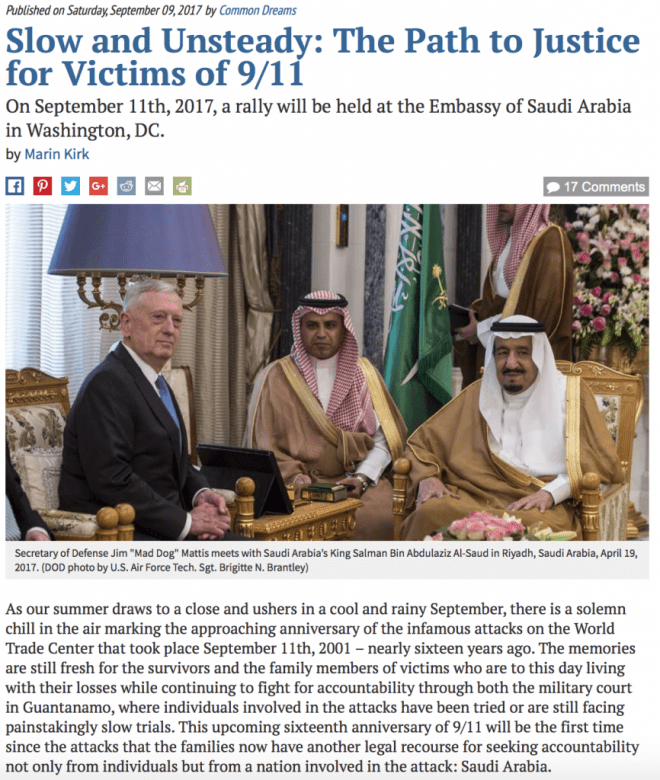
But there is a lot more to the “Saudi did it” saga which serves as a convenient instrument of propaganda.
The two key figures behind this wave of propaganda (initiated in 2014) are former Senator Bob Graham, who led the joint inquiry of the Senate and the House intelligence committees together with Rep. Porter Goss, a career CIA official who was subsequently appointed Director of National Intelligence (DNI) by the Bush administration.
Graham coordinated the drafting and editing of the joint Senate-House report including a 28 classified pages on Saudi Arabia’s alleged role. These 28 pages were eventually declassified.
Framed in a “Tele Novela” style scenario featuring wealthy Saudis in the plush suburban surroundings of Sarasota, Florida two weeks before 9/11, the New York Post described the circumstances of Saudi involvement (quoting the FBI 9/11 Review Commission Report and the 28 pages of the joint inquiry report) in an article entitled How the FBI is whitewashing the Saudi connection to 9/11:
Former Democratic Sen. Bob Graham, who in 2002 chaired the congressional Joint Inquiry into 9/11, maintains the FBI is covering up a Saudi support cell in Sarasota for the hijackers. He says the al-Hijjis “urgent” pre-9/11 exit suggests “someone may have tipped them off” about the coming attacks.
Graham has been working with a 14-member group in Congress to urge President Obama to declassify 28 pages of the final report of his inquiry which were originally redacted, wholesale, by President George W. Bush. ….
Sources who have read the censored Saudi section say it cites CIA and FBI case files that directly implicate officials of the Saudi Embassy in Washington and its consulate in Los Angeles in the attacks — which if true, would make 9/11 not just an act of terrorism, but an act of war by a foreign government. The section allegedly identifies high-level Saudi officials and intelligence agents by name, and details their financial transactions and other dealings with the San Diego hijackers. It zeroes in on the Islamic Affairs Department of the Saudi Embassy, among other Saudi entities.
The [FBI] review commission, however, concludes there is “no evidence” that any Saudi official provided assistance to the hijackers, even though the panel failed to interview Graham or his two key investigators — former Justice Department attorney Dana Lesemann and FBI investigator Michael Jacobson — who ran down FBI leads tying Saudi officials to the San Diego hijackers and documented their findings in the 28 pages. (emphasis added)
While Graham is now heralded by the mainstream media as a 911 Truther, the evidence suggests that immediately in the wake of 9/11, he was involved (together with Porter Goss) in a coverup on behalf of Bush-Cheney.
The 28 pages have nothing to do with 9/11 Truth. This alleged Saudi involvement in the 9/11 attacks has served to precipitate segments of the 9/11 Truth movement into an erroneous and contradictory discourse.
Saudi Arabia may have supported the 9/11 al Qaeda terrorists, but the terrorists did not bring down the WTC towers.
The objective of the Saudi connection propaganda ploy is to ultimately sustain the official narrative which states that Islamic terrorists were behind the 9/11 attacks, which has been disproved by Architects and Engineers for 9/11 Truth.
Even assuming that Al Qaeda were behind the attacks, it is amply documented that al Qaeda, “the Base” was a creation of the CIA and that Osama bin Laden was a CIA intelligence asset. In this regard, Saudi Arabia as well Pakistan were involved in close liaison with the CIA in the recruitment and training of terrorists.
And because Bob Graham accused the FBI and the federal government, the 9/11 Truth movement applauds without realizing that these accusations directed against the FBI are “framed” with a view to sustaining the mainstream 9/11 narrative.
What is at stake is a desperate ploy to uphold the legend that Muslims were behind 9/11 and that Saudi Arabia was behind the terrorists giving them money, with the FBI involved in a coverup, George W. Bush protecting his Saudi cronies because the Bushes and the bin Ladens were “intimo amigos”.
Below is an excerpt of my April 2015 article Saudi Arabia’s Alleged Involvement in the 9/11 Attacks:
Graham’s staged accusations thereby serve to distract the American public’s attention from the real evidence, amply documented that the WTC towers were brought down through controlled demolition and that Islamic terrorists were not behind the 9/11 attacks. The issue of Saudi financial support of al Qaeda is not only known and documented since the heyday of the Soviet Afghan war, it is irrelevant in establishing who was behind the terror attacks. Moreover, the contents of the 28 classified pages are known.
In a bitter irony, Graham’s track record (mentioned above) in supporting the official 9/11 narrative on behalf of Bush-Cheney is not mentioned:
Former Senator Bob Graham (D-Fla.), who co-chaired a congressional inquiry into 9/11 — separate from the 9/11 Commission — stated, as though now it was obvious, “None of the people leading this investigation think it is credible that 19 people — most who could not speak English and did not have previous experience in the United States — could carry out such a complicated task without external assistance.”
Now, Graham says, a breakthrough may finally be around the corner with the upcoming declassification of the 28 pages of the “Joint Inquiry into Intelligence Community Activities Before and After the Terrorist Attacks of September 11, 2001.”
Calling for the official release and publication of the 28 page classified section of the joint inquiry report pertaining to Saudi Arabia is an obvious red-herring. The objective is to confuse matters, create divisions within the 9/11 Truth movement and ultimately dispel the fact that the 9/11 attacks were a carefully organized False Flag event which was used to declare war on Afghanistan as well as usher in sweeping anti-terrorist legislation.
Both the Congressional inquiry as well the 9/11 Commission report are flawed, their objective was to sustain the official narrative that America was under attack on September 11, 2001. And Graham’s role in liaison with the CIA, is “damage control” with a view to protecting those who were behind the demolition of the WTC towers as well sustaining the al Qaeda legend, which constitutes the cornerstone of US military doctrine under the so-called “Global War on Terrorism”.
Without 9/11 and the “Global War on Terrorism”, the warmongers in high office would not have a leg to stand on. In turn, 9/11 Truth is an encroachment which undermines war propaganda and the US-led campaign of Islamophobia, which is sweeping the Western World. (Michel Chossudovsky, Saudi Arabia’s Alleged Involvement in the 9/11 Attacks, Global Research, April 14, 2015)
Copyright © Prof Michel Chossudovsky, Global Research, 2017
Featured Video

When Israel Is Mighty
or go to
Aletho News Archives – Video-Images
From the Archives
US murdering 1 million Iraqis is democracy, Iran giving yogurt to Iraq is “domination”
By Ali Salaam | American Herald Tribune | July 31, 2017
The New York Times, owned by the Zionist Jewish supremacist Ochs-Sulzberger family, has no problem with Iraqi suffering as long as Iran is not the one behind it.
The Iraq War was a genocide of the Iraqi people by Zionist supremacists in the Bush administration. Over 1 million innocent people were killed based on a lie. American soldiers died in an Israeli war and now an average of 22 soldiers commit suicide every day because their consciences cannot cope with the fact they committed crimes in an illegal war that served no purpose other than to benefit Israel, not America.
Benjamin Netanyahu, Prime Minister of the Zionist regime, once said “We are benefiting from one thing, and that is the attack on the Twin Towers and Pentagon, and the American struggle in Iraq.”
Paul Wolfowitz had his sights on Iraq since his time in the first Bush administration. Former Israeli official and Bush administration official Richard Perle had his eyes on Iraq since at least his authorship of the Clean Break white paper. The Zionist regime had their eyes on Iraq since the 1980s when strategist Oded Yinon wrote his white paper in support of dividing the Arab-Muslim world along ethnic and sectarian lines. The global Zionist lobby has had their eyes on Iraq since Theodor Herzl stated that Eretz Israel’s true borders go from the Nile River in Egypt to the Euphrates River in Iraq. … continue
Blog Roll
 Aletho News
- MEP blasts ‘Euro-Gestapo’ for lecturing Russia on democracy
- Syria May Send Troops to Saudi Arabia Amid War with Ansar Allah
- UK whines about losing billions to ‘Putin tax’
- Baghaei to Rubio: Distorted narratives cannot erase US record of broken commitments
- Houthis Don’t Have to Conquer Saudi Arabia to Make It Pay
- MOE: Nearly 22,000 Students and Education Workers Killed
- Guterres in Islamabad: Genocide, cowardice, and the cage of Imran Khan
- Johnson, Marandi say Yemen holds upper hand over Saudi Arabia
- False flags won’t save aggressors, Iran FM spokesman says
- The Makkah Pact Enters Into Force: The End of American Dominance or Its New Form?
- If Americans Knew
- Nearly 2 Million in Gaza Need Urgent Shelter Assistance as Winter Looms: IOM Chief Warns
- Suppressing Palestinian resistance: US charity under fire for AI monitoring of Gaza classrooms
- Thousands Are Held in Israeli Torture Camps. This Is What Happens Inside
- Israel puts Gaza’s sick, injured, newborn in peril – Daily Update
- Report claimed Mark Levin used by Israeli government to influence Trump
- Over 2,000 Gazans have died awaiting medical evacuation amid Israel’s continued siege
- How a U.S. Diplomat Suppressed and Altered Reports Critical of Israel
- 5 Palestinians Die from Israeli Strikes in Gaza as Relentless Attacks Continue
- Report: Ceasefire Slows Killing but Leaves Devastation Intact
- Country Music Singer Zach Bryan Breaks Attendance Record at Robert Kraft’s Gillette Stadium While Wearing ‘Free Palestine’ Shirt for Second Night in a Row
- No Tricks Zone
- New Study: 50 Years Of The Most Aggressive ‘Net Zero’ Policies Can Only Affect The Global Climate By 0.03°C
- US September “Heat” Was No Record…Many Records Set Decades Ago
- Latest European Green Energy Debacle; Portugal’s Largest Flagship Solar Park Insolvent!
- Green Energy Debacle: German Expert Professor Fritz Vahrenholt Warns Of Severe Economic And Social Consequences
- Two More Paleo Reconstructions Affirm Meters-Higher Sea Levels Across Ireland, Brazil 7000-6000 Years Ago
- New Study: Earth And Venus Surface Warmth Largely Explained By Convection And Lapse Rate, Not CO2 Or Radiation
- 2025 Nature Paper Claiming Worsening Global Drought Gets RETRACTED …Heavily Flawed
- New Study: ‘Global Drought Shows No Detectable Recent Acceleration Under Climate Warming’
- Economic Masterminds: German Socialists Suggest Taxing Productivity Gains Stemming From Using AI
- The South China Sea Has Not Been Cooperating With The Climate Change Narrative

