Rwanda’s tragedy used to fool people, slander others
By Yves Engler · June 2, 2017
Rwanda’s tragedy has been exploited for many purposes. Add slandering a pro-Palestinian activist to the list.
Since I wrote this article about the Jewish Defense League last month, Toronto’s Alex Hundert has repeatedly labeled me anti-Semitic. The self-declared “anti-fascist” tweeted at Pacific Free Press, Rabble, the NDP and others to “cut ties” with me.
In response to this article the former Upper Canada College student harangued at least one prominent woman for posting it on her Facebook page. Hundert told her — wait for it — I’m anti-Semitic. Lacking in evidence or maybe sensing diminishing returns with that smear he added that I’m a Rwandan genocide denier.
If he means a researcher and writer on foreign affairs who always questions official government narratives/propaganda then I guess a “no contest” plea would be appropriate. The common portrayal of the Rwandan Genocide in Canada omits important context and is factually incorrect in substantial ways. It is also logically hollow, only believable because of widespread racism and anti-Africanism. (According to the most outlandish aspect of the official story, Hutu extremists murdered the Hutu presidents of Rwanda and Burundi and much of the Hutu-led Rwandan military command, which brought the Hutu to their weakest point in three decades, and then decided to begin a long planned systematic extermination of Tutsi.)
Do I believe hundreds of thousands of Rwandan Tutsi were slaughtered in mid-1994? Yes, definitely.
Was there a long planned high-level effort to wipe out all Tutsi? Probably not.
Were tens, possibly hundreds, of thousands of Hutu also slaughtered in mid-1994? It’s likely.
Was Paul Kagame, the person widely hailed for ending the killing, instead the individual most responsible for the mass slaughter? Probably, since his forces invaded Rwanda from Uganda, engaged in a great deal of killing and blew up the presidential plane that unleashed the genocidal violence.
It’s telling Hundert would seek to smear me as a Rwanda genocide denier, rather than criticize my other controversial views such as that the private automobile should be eliminated, or that former Prime Minister Lester Pearson was a war criminal or that Canadian peacekeeping is often a form of imperialism. Maybe it’s because the label “genocide denier” hints at some type of hatred rather than a political disagreement. Or maybe Hundert hopes to associate me with Nazi Holocaust denial, which we’ll see more about below.
Fundamentally Hundert chose the issue because most Canadians know little about Rwanda and, to the extent they know anything about the country, they’ve heard an extremely one-sided media account of the complex tragedy that engulfed Rwanda and Burundi in the mid-1990s. News consumers are generally familiar with a Rwanda fairy tale focused on a white Canadian saviour. According to serial Kagame-Rwanda propaganda spreader Gerald Caplan, “the personal relationship so many Canadians feel with Rwanda can be explained in two words: Roméo Dallaire.” In a forthcoming book about left Canadian foreign policy I detail how, in their haste to laud a Canadian military “hero”, progressives have echoed a highly simplistic version of Rwanda’s tragedy, which has legitimated Africa’s most blood-stained dictator, Paul Kagame.
Beyond aligning with liberal Canadian foreign policy mythology, Hundert is tapping into the US Empire’s narrative. Washington and London’s support for the Uganda backed Rwandan Patriotic Front (RPF), as well as Kagame’s more than two-decade long rule in Kigali, explains the dominance of the Rwandan Genocide story. According to Edward Herman and David Peterson in Enduring Lies: The Rwandan Genocide in the Propaganda System, 20 Year Later, “[US and British] support, combined with the public’s and the media’s distance from and unfamiliarity with central African affairs, made the construction and dissemination of false propaganda on Rwanda very easy.”
After the Cold War, Washington viewed Kagame’s RPF as an imperial proxy force in a French-dominated region. A trio of authors explain in The Congo: Plunder and Resistance: “The plan expressed clearly by the White House at the time was to use the Rwandan army as an instrument of American interests. One American analyst explained how Rwanda could be as important to the USA in Africa as Israel has been in the Middle East.” Over the past two decades Kagame has repeatedly invaded the Congo, which has as much as $24 trillion in mineral riches.
Alongside his role as a US client, Kagame has drawn close to Israel. Trained at the US Army Command and General Staff College in Fort Leavenworth, Kansas, Kagame visited Israel for the first time in 1996 and Africa’s most bloodstained dictator has been back repeatedly. In March Kagame was the only international head of state and first-ever African leader to speak at the American Israel Public Affairs Committee’s (AIPAC) annual conference. On May 21 Kagame received the Dr. Miriam and Sheldon G. Adelson Prize for Outstanding Friendship with the Jewish People at a New York event with Israeli ambassador Ron Dermer and Alan Dershowitz. In 2013 the “butcher ofAfrica’s Great Lakes” shared a New York stage with staunch Zionists Elie Wiesel, Rabbi Shmuley Boteach and Republican mega-donor Sheldon Adelson.
“He is the only living man to stop a genocide,” said Boteach to the Jewish Forward in 2014. “You need to look at the criticism on Rwanda through the same lens you look at criticism against Israel.” (After National Security Adviser Susan Rice criticized Israeli Prime Minister Benjamin Netanyahu for speaking to Congress about the Iran nuclear agreement without President Obama’s approval, Boteach placed an ad in the New York Times which read “Susan Rice has a blind spot: Genocide … both the Jewish people’s and Rwanda’s”.)
Pro-Israel Jewish groups have bequeathed Kagame the genocide moniker. Author of Rwanda and the New Scramble for Africa: From Tragedy to Useful Imperial Fiction, Robin Philpot explains that long-time director of the Simon Wiesenthal Center in Israel, Efraim Zuro, and former US Holocaust Memorial Museum project director, Michael Berenbaum, were invited to a conference in Kigali a year after the mass slaughter in Rwanda. Philpot notes, “Efraim Zuro then became an advisor to the Rwandan government in its hunt for génocidaires, and from then on Zionists throughout the world were willing to share the use of the term ‘genocide’ with Rwandan Tutsis. Israel has very jealously guarded the use of that term; they have, for example, never agreed to share it with Armenians, largely because of Israel’s strategic alliance with Turkey.”
But, those who draw an analogy between the 6 million killed in the Shoah and the hundreds of thousands slaughtered in Rwanda are partaking in something akin to Nazi Holocaust denial (or extreme minimization). European Jews were targeted because of their religion/ethnicity, the violence was state organized and it mostly flowed from an ideology promoted from above.
The context in Rwanda was different. Speaking the same language, sharing the same culture and practising the same religion, the Tutsi/Hutu divide is historically a caste-type distinction the Belgians racialized. “Prior to colonization,” explains Ann Garrison, “the Tutsi were a cattle owning, feudal ruling class, the Hutu a subservient peasant class. Belgian colonists reified this divide by issuing ID cards that labeled Rwandans and Burundians as Hutu, Tutsi, or Twa [1% of the population].”
The genocidal killings were not a long planned attempt to exterminate all Tutsi, which even the victors’ justice dispensed by the International Criminal Tribunal for Rwanda (ICTR) effectively concluded. Instead, it was the outgrowth of a serious breakdown in social order that saw hundreds of thousands slaughtered by relatively disorganized local commands fearful of a foreign invasion that eventually conquered Rwanda and drove a quarter of the population out of the country. Probably an equal — and possibly a greater — number of Hutu were killed.
Jews didn’t end up in power in European countries after World War II, nor did the Herero in Namibia, Armenians in Turkey, indigenous people in North America, Maya in Guatemala, etc. Rwanda is a peculiar case where the minority — 10% of population — targeted for extermination ended up ruling after the bulk of the violence subsided.
Of course, Hundert doesn’t care about what happened in Rwanda. He’s labeling me a genocide denier because I’ve challenged Canada’s contribution to Palestinian dispossession. Hundert seems particularly bothered by my linking pro-Israel Jewish organizations to fascistic, anti-Muslim groups, which pits his “anti-fascism” against his liberal-Zionism.
The Rwandan tragedy is often invoked in Canada for ulterior purposes. The Romeo Dallaire fairy tale is part of developing a “do-gooder” foreign policy mythology designed to lull Canadians into backing interventionist policies. More generally, a highly simplistic account of the Rwanda Genocide has repeatedly been invoked to justify liberal imperialism, particularly the Responsibility to Protect doctrine.
Maybe I should be honoured that Rwanda is now cited as a reason to suppress my writing.
Hillary Clinton’s Deceptive Blame-Shifting
By Robert Parry | Consortium News | June 1, 2017
Hillary Clinton has grown even more insistent that she was not at fault for her stunning election defeat last November, claiming that 1,000 Russian “agents” and their American collaborators were a decisive factor, a bizarre twist that further locks the Democrats into their evidence-light “Russia-gate” obsession.
In comments at a California technology conference on Wednesday, Clinton also repeated one of her favorite falsehoods – that all 17 U.S. intelligence agencies unanimously concluded that Russia hacked Democratic emails and ran a covert influence campaign against her.
Referring to a report released by President Obama’s Director of National Intelligence (DNI) on Jan. 6, Clinton asserted that “Seventeen agencies, all in agreement, which I know from my experience as a Senator and Secretary of State, is hard to get. They concluded with high confidence that the Russians ran an extensive information war campaign against my campaign, to influence voters in the election. They did it through paid advertising we think; they did it through false news sites; they did it through these thousand agents; they did it through machine learning, which you know, kept spewing out this stuff over and over again. The algorithms that they developed. So that was the conclusion.”
But Clinton’s statement is false regarding the unanimity of the 17 agencies and misleading regarding her other claims. Both former DNI James Clapper and former CIA Director John Brennan acknowledged in sworn testimony last month that the Jan. 6 report alleging Russian “meddling” did not involve all 17 agencies.
Clapper and Brennan stated that the report was actually the work of hand-picked analysts from only three agencies – the Central Intelligence Agency, National Security Agency and Federal Bureau of Investigation – under the oversight of the DNI’s office. In other words, there was no consensus among the 17 agencies, a process that would have involved some form of a National Intelligence Estimate (or NIE), a community-wide effort that would have included footnotes citing any dissenting views.
Instead, as Clapper testified before a Senate Judiciary subcommittee on May 8, the Russia-hacking claim came from a “special intelligence community assessment” (or ICA) produced by selected analysts from the CIA, NSA and FBI, “a coordinated product from three agencies – CIA, NSA, and the FBI – not all 17 components of the intelligence community,” the former DNI said.
And, as Clapper explained, the “ICA” was something of a rush job beginning on President Obama’s instructions “in early December” and completed by Jan. 6. Clapper continued: “The two dozen or so analysts for this task were hand-picked, seasoned experts from each of the contributing agencies.”
However, as any intelligence veteran will tell you, if you hand-pick the analysts, you are really hand-picking the conclusion since the agency chiefs would know who was, say, a hardliner on Russia and who could be trusted to deliver the desired product.
On May 23, in testimony before the House Intelligence Committee, former CIA Director John Brennan confirmed Clapper’s account about the three agencies involved.
“It wasn’t a full inter-agency community assessment that was coordinated among the 17 agencies, and for good reason because of the nature and the sensitivity of the information trying, once again, to keep that tightly compartmented,” Brennan said.
In other words, Clinton’s beloved claim that all 17 intelligence agencies were in agreement on the Russian “hacking” charge – an assertion that the “fact-checking” group Politifact has certified as “true” and that has been repeated endlessly by the mainstream U.S. news media – is not true. It is false. Gee, you might even call it “fake news.”
The Mysterious ‘Agents’
But Clinton’s false claim about the intelligence consensus was not her only dubious assertion. Her reference to the 1,000 Russian “agents” is not contained in the Jan. 6 report, either. It apparently derived from unconfirmed speculation from Sen. Mark Warner, D-Virginia, who mentioned this claim at a news conference on March 30, admitting that he didn’t know if it was true.
Warner, the ranking Democrat on the Senate Intelligence Committee, said: “We know about the hacking, and selective leaks, but what really concerns me as a former tech guy is at least some reports – and we’ve got to get to the bottom of this – that there were upwards of a thousand internet trolls working out of a facility in Russia, in effect taking over a series of computers which are then called botnets, that can then generate news down to specific areas.
“It’s been reported to me, and we’ve got to find this out, whether they were able to affect specific areas in Wisconsin, Michigan, Pennsylvania, where you would not have been receiving off of whoever your vendor might have been, Trump versus Clinton, during the waning days of the election, but instead, ‘Clinton is sick’, or ‘Clinton is taking money from whoever for some source’ … fake news.”
Of course, many stories about Clinton being sick or her taking money from special interests weren’t “fake news.” In late 2012, she suffered from a blood clot and – during the 2016 campaign – she was staggered by a bout of pneumonia. She also was paid hundreds of thousands of dollars for speeches to Wall Street and other groups.
Warner didn’t specify where his information about the “trolls” came from but it paralleled a claim by freelance journalist Adam Chen who asserted in a podcast with Longform that Russian “trolls” began writing favorably about Trump in late 2015. (The CIA/FBI/NSA report also apparently alluded to the same report without mentioning the name of the journalist or specifying the number of alleged “trolls.”)
“I created this list of Russian trolls when I was researching,” Chen said, referring to a 2015 reporting project that he turned into a rather thinly sourced New York Times Magazine article accusing a Russian oligarch of funding a professional “troll” operation in St. Petersburg, Russia. “I check on it once in a while, still. And a lot of them have turned into conservative accounts, like fake conservatives. I don’t know what’s going on, but they’re all tweeting about Donald Trump and stuff.”
Although such “troll” and “hacking” complaints are treated as a one-way street – coming only from the evil Russians – the reality is that U.S. intelligence agencies, their allies and U.S.-government-funded “non-governmental organizations” have mounted similar operations against Russia and other targets.
It is always difficult to nail down precisely where such operations are originating, but the Russians have cited previous cases of malicious hacking aimed at senior officials, including Prime Minister Dmitri Medvedev, whose accounts were hacked in 2013 and 2014 including publication of a false resignation and a confession of wrongdoing.
In 2015, the “Panama Papers,” a vast trove of documents purloined from a Panamanian law firm, became an investigative project that involved a USAID-funded news outlet and led to attacks on President Vladimir Putin for corruption even though his name did not appear in the documents.
So, this high-tech spy-vs.-spy game – if that’s what it is – does not appear to be originating entirely from the Russian side of the street. But the U.S. intelligence community is not going to divulge what it knows about the attacks against Russia, only what it can “assess” about Russia’s possible attacks against Western targets.
No Self-Criticism
Neither, of course, are Hillary Clinton and the Democratic Party eager to engage in a serious self-criticism about how they managed to blow an extremely winnable race against an extraordinarily flawed candidate in Donald Trump. Rather than look at their own missteps and misjudgments, they are presenting themselves as innocent victims.
In Wednesday’s interview – after misrepresenting what the Jan. 6 report actually said – Clinton suggested that the Trump campaign must have colluded with the Russians in “weaponizing” the data.
“How did they know what messages to deliver?” Clinton asked. “Who told them? Who were they coordinating with, or colluding with? … [The Russians] were conveying this weaponized information and the content of it. … So the Russians — in my opinion and based on the intel and the counterintel people I’ve talked to — could not have known how best to weaponize that information unless they had been guided. … Guided by Americans and guided by people who had polling and data information.”
Although Clinton lacked any proof of this convoluted accusation, she cited as her “best example” the fact that “within one hour, one hour of the ‘Access Hollywood’ tapes being leaked [in which Trump was caught boasting about groping women], within one hour, the Russians — let’s say WikiLeaks, something — dumped the John Podesta emails.”
However, if you changed the context of this claim slightly – and made a similar jump in logic – you would surely be labeled a nutty conspiracy theorist, but instead Clinton has drawn nods of agreement for this wholly unsubstantiated speculation.
Yet, besides blaming the Russians and WikiLeaks for her loss, Clinton spread the blame even wider, for instance, to The New York Times for focusing too much on her decision to use a private email server while Secretary of State – “they covered it like it was Pearl Harbor” – and for the Times’ Nate Silver publishing optimistic odds on her chances for victory. “I also think I was the victim of a very broad assumption I was going to win,” she said.
Clinton also placed blame on the Democratic National Committee for lacking money and sophisticated technology. “I get the nomination. So I’m now the nominee of the Democratic Party. I inherit nothing from the Democratic Party,” she said. “I mean it was bankrupt; it was on the verge of insolvency; its data was mediocre to poor, nonexistent, wrong. I had to inject money into it.”
Yet, when Clinton was asked about some of her own “misjudgments,” she slipped back into the defensive posture that contributed to her troubles as a presidential candidate. For instance, regarding why she gave lucrative speeches to Goldman Sachs between her time leaving the State Department and announcing her White House run, she answered coyly, “They paid me.”
When pressed on the point, Clinton retreated behind the sanctity of the 9/11 terror attack and the issue of women’s rights. Reminded that “you’re not somebody who needed that money for the next week’s shopping, and you knew you might run, so why do it?” – she responded:
“The most common thing that I talked about in all those speeches was the hunt for Bin Laden. You know, that was one of the central missions that I felt from the time the towers fell on 9/11 as a Senator from New York.”
Then, Clinton added, “you know, men got paid for the speeches they made. I got paid for the speeches I made. And it [the paid-speech issue] was used, and I thought it was unfairly used.”
Blocking Witnesses
So, while the Democrats dig themselves deeper into the so-far empty pit of blaming Russia for their electoral disaster, the Russia-gate investigation continues to take on other curious aspects, such as an unwillingness to hear from some of Donald Trump’s advisers who have been named in accusations and who have volunteered to testify publicly.

Former Trump foreign policy adviser Carter Page
On Wednesday, Carter Page, a Navy veteran and businessman who had lived in Russia, announced that his plans to defend himself in testimony next week before the House Intelligence Committee had been placed on hold by the Democrats.
Rep. Adam Schiff of California, the ranking Democrat on the committee and a major spark plug powering the investigation, offered a curious denial of Page’s complaint while confirming the truth of it.
The New York Times, which has been another advocate for blaming Russia, phrased the postponement of Page’s testimony as if Page were the unreasonable one, reporting:
“Representative Adam Schiff … dismissed accusations from Carter Page, another Trump adviser who is under scrutiny, that the committee is preventing him from testifying. Mr. Schiff …. said the investigation would first review relevant documents before interviewing witnesses.”
In other words, Page, who has been portrayed via intelligence leaks to the news media as essentially a traitor, won’t be given the opportunity to defend his reputation until Schiff and the other Democrats decide the time is ripe.
Yet, it’s not as if the House Intelligence Committee has not taken public testimony about Russia-gate. For instance, former CIA Director Brennan was allowed to speak indirectly about Page and other possibly treasonous Americans amid media reports naming Page as one of those suspected Russian “agents.”
Normal investigations grant the people under attack at least the opportunity to defend themselves and their reputations in a timely fashion, rather than make them live under the cloud of suspicion without having a chance to state their case.
If their sworn testimony is later undermined by evidence developed by investigators, the witnesses can be called back and called out on possible perjury. So, it’s not as if Schiff and the other Democrats are surrendering prerogatives by letting Page testify now rather than later. Indeed, Page would be putting himself in legal jeopardy if he is caught lying.
Even the Republican-driven “Benghazi investigation,” which also had the look of an over-the-top “witch hunt,” gave Secretary of State Clinton and other Obama administration officials multiple opportunities to explain their response to the Sept. 11, 2012 attack on the U.S. consulate.
But, so far, a similar courtesy has not been extended to the targets of the Russia-gate investigation.
Investigative reporter Robert Parry broke many of the Iran-Contra stories for The Associated Press and Newsweek in the 1980s.
Missing the Real Noriega Story
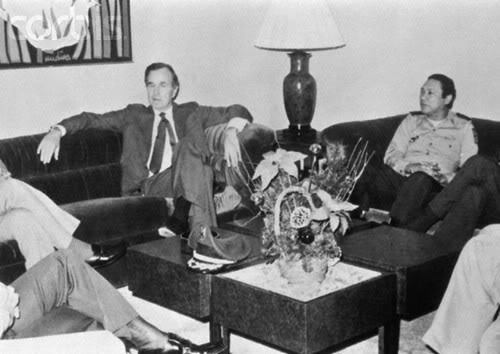
Vice President George H.W. Bush meeting with Panamanian Gen. Manuel Noriega in the mid-1980s when Noriega was considered a key ally in helping the Nicaraguan Contras wage a brutal guerrilla war to overthrow the leftist Sandinista government.
By Jonathan Marshall | Consortium News | June 1, 2017
The death of former Panamanian strongman Manuel Noriega on May 29 elicited few if any tears. But it should have sparked more reflection in the United States on his ugly history of service to the CIA, the hypocrisy of Washington’s sudden discovery of his abuses once Noriega became an unreliable ally against the Nicaraguan Sandinistas, and the George H.W. Bush administration’s bloody and illegal invasion of Panama in December 1989.
In fairness, many progressives and mainstream journalists have called attention to this troublesome history over the years. But few have dared to question the nearly universal condemnation of Noriega as a protector of international drug traffickers. That incendiary claim — first broadcast loudly by the unlikely trio of right-wing Sen. Jesse Helms, R-North Carolina; liberal Sen. John Kerry, D-Massachusetts; and investigative journalist Seymour Hersh — galvanized the American public to support his ouster.
After the U.S. invasion, which killed hundreds of Panamanians and 23 U.S. soldiers, Noriega was arrested on Jan. 3, 1990 by armed U.S. drug agents.
President George H. W. Bush declared that Noriega’s “apprehension and return to the United States should send a clear signal that the United States is serious in its determination that those charged with promoting the distribution of drugs cannot escape the scrutiny of justice.” U.S. Ambassador Deane Hinton called the invasion “the biggest drug bust in history.”
Convicted in 1992 on eight felony counts following what officials called the “trial of the century,” Noriega was sentenced to 40 years in jail. Although released early from U.S. incarceration, he spent the rest of his life in French and Panamanian prisons.
The resulting publicity created lasting myths about Noriega and drugs. Journalists who should know better have described Noriega as “one of the world’s biggest drug kingpins,” to quote Time magazine. In fact, Louis Kellner, the U.S. attorney who oversaw his Miami indictment and trial admitted, “Noriega was never a major player in the drug war.”
Indeed, at worst, he was a small fry compared to the military rulers of Honduras, whose epic protection of the cocaine trade was tolerated by Washington in return for using that country as a staging base for Contra operations against the Sandinista-led government of Nicaragua in the 1980s.
Deeply Flawed Trial
A few close observers of the long, expensive, and controversial trial believe it failed to prove Noriega’s guilt at all.
David Adams, who covered it extensively for the London Independent, said the government’s case was “marred by incompetent witnesses, false testimony, and poor presentation.”
Newsday’s Peter Eisner quoted Judge William Hoeveler, who presided over the trial, as saying “the outcome could have been different” if Noriega had been better represented.
Although the government put more than two dozen people on the stand, their testimony was not always relevant or credible.
Paul Rothstein, Georgetown University law professor and former chairman of the American Bar Association’s criminal evidence committee, said of the government’s witnesses, “What promised to be the trumpeting of elephants turned out to be the whimperings of mice.”
Big-time drug bosses enjoyed great rewards for telling the jury what the government wanted. Observed reporter Glenn Garvin, “To convict Noriega, the strike force had to make a flurry of deals with other accused narcotraffickers, bargaining a collective 1,435 years in prison down to 81.”
The fierce Noriega critic R. M. Kostner declared, “The prosecution was shameless in its bribery of witnesses. What co-defendants got for flipping made me sometimes wish that I had been indicted. The proceedings were almost totally politicized. It was clear long before they opened that, regardless of evidence, Noriega could not possibly be acquitted – a very sad thing for the United States.”
Other witnesses who never took the stand contradicted the government’s case years later. Retired Medellin cocaine lord Juan David Ochoa claimed in an interview with Frontline that “at no moment did [Noriega] protect us. . . . As far as I know he had nothing to do with the drug trade.”
Greg Passic, former head of financial operations for the DEA, said, “The Colombians I talked to in the drug transportation business said they didn’t deal with Noriega at all. To deal with him you would just have to pay him more money. They didn’t need it. It would be expensive.”
In fact, DEA officials repeatedly lauded Noriega’s cooperation with their anti-drug investigations, both in public letters of support and in private. Recalled Duane Clarridge, former head of Latin America operations for the CIA, “The DEA had told us that they were getting great support in Panama, and from Noriega in particular, in interdicting drugs.”
More than a year after the U.S. invasion, when it was absolutely impolitic to voice such sentiments, one “federal drug enforcement source” told a reporter, “Noriega was helping us, not ten percent, not twenty percent of the time, but in every instance we asked him to do so, one-hundred percent of the time. . . . These were key operations . . . that struck at both the Cali and Medellin cartels.”
Even the U.S. ambassador to Panama in the final years of Noriega’s rule, Arthur H. Davis Jr., said in an oral history interview, “all I know is that, all the time I was there, Noriega . . . cooperated one hundred percent with our people. Anytime we had a ship that we wanted to be interdicted on the high seas and we asked permission, they gave permission. . . . Anytime there was some prominent drug man coming up and we knew about it, Noriega would help us with it. And when we found out about things, the [Panamanian Defense Forces] would go over there and round them up and turn them over to us.”
Turning Against Noriega
One of the high points of Noriega’s cooperation was Operation Pisces, a three-year undercover probe that culminated in 1987. Attorney General Edwin Meese called it “nothing less than the largest and most successful undercover investigation in federal drug law enforcement history.”
Among those indicted were Medellin Cartel kingpins Pablo Escobar and Fabio Ochoa. Panama made 40 arrests and seized $12 million from accounts in 18 local banks. Said one U.S. prosecutor who helped direct the case, “The Panamanian officials we were dealing with were sincerely cooperative. . . . They could have breached security, and they didn’t.”
The operation may have pleased the DEA, but it angered the country’s financial elite, who directly profited from money laundering. One local banker warned, “this could end the Panamanian banking system, because people will no longer believe they can count on bank secrecy.”
Within two months, spooked investors withdrew up to $4 billion of the country’s $39 billion in bank deposits, triggering the most serious banking crisis in Panama’s history.
A Western diplomat said of Noriega, “The bankers can bring him down. They are complaining in Washington and they’ve got a lot of clout.” The demonstrations organized that summer by Panama’s business elite — and Noriega’s heavy-handed response to them — triggered his eventual slide from power
The bankers were joined by angry cartel leaders, who viewed Noriega as an “obstacle to the functioning” of their money laundering operations in Panama, in the words of drug policy expert Rensellaer Lee.
A lawyer for the bosses of the Cali Cartel complained that his clients were “frustrated by the problems” Noriega created for them in Panama.
Cali leaders later got their revenge when they paid $1.25 million to bribe a drug trafficker to become a key witness against Noriega in his Miami trial. In exchange for the testimony, eager U.S. prosecutors agreed to cut nine years off the sentence of an unrelated Cali trafficker — brother of one of that cartel’s senior leaders.
When Noriega’s defense team cried foul, a federal appeals court declined to order a new trial, but criticized the government for appearing “to have treaded close to the line of willful blindness” in its eagerness to win a conviction.
Medellin leaders were just as unhappy with Noriega as those in Cali. A pilot for one of the biggest Medellin smugglers described Pablo Escobar’s reaction after Noriega approved a raid on one of his cocaine labs in May 1984: “He was just really out of whack with Noriega. He was like, ‘This guy is dead. No matter what, he is dead.”’
It would be foolish to assert that Noriega, alone among all leaders in Central America, kept his hands clean of drugs. But much of his personal fortune is easily accounted for from other sources, such as the sale of Panamanian passports on the black market.
Whatever Noriega’s involvement with drug traffickers, as I have shown elsewhere, the Bush administration displayed unbelievable cynicism when, even before his capture, it swore in a new president of Panama who had sat on the board of one of the most notorious drug-money-laundering banks in the country. His attorney general, who unfroze the bank accounts of Cali traffickers, later became legal counsel for the Cali Cartel’s top smuggler in Panama.
Following Noriega’s ouster, not surprisingly, cocaine trafficking began surging in the country. A year and a half after his arrest, unnamed “U.S. experts” told Time magazine that “the unexpected result . . . is that the rival Cali cartel established a base in Panama and has since inundated the country, along with Mexico, Guatemala and the Caribbean, with vast quantities of cocaine destined for the U.S. and Europe.”
Today, though, all that is forgotten, along with the questionable course of justice during Noriega’s trial. Noriega, even in death, deserves no eulogies, but he does deserve a more balanced judgment of history.
VIDEO: The Naylor Report – Tories Plan to Sell the NHS
OffGuardian | June 1, 2017
YouTuber Chris Holden’s video on the Naylor Report and Theresa May’s plans for the NHS has gone viral in the last week. Deservedly so, he’s done the hard yards – reading an interminably dull report – so we don’t have to. His summary is concise, revealing, and very worrying.
“In an interview with Andrew Neil, Theresa May slipped out a single line about the NHS; she’s made the 2017 election all about her, strength and stability and Brexit. In half an hour, this was all she had to say about her plans on the NHS – “we support the Naylor Report”. It sounded so tediously dull, it couldn’t possibly be of any interest.”
Manufactured Hysteria Over Russia Requires 24/7 Upkeep
A Black Agenda Radio commentary by executive editor Glen Ford | May 31, 2017
Even at the height of the Cold War and the depths of McCarthyism, the U.S. corporate media was never even remotely as consumed with Russia as they are, today. The obsession with the Kremlin is a manufactured hysteria, a result of the panic that engulfed the U.S. ruling class — and its media — during last year’s election. What scared them witless, was the reaction of so-called “middle Americans” — white conservatives that call themselves Christian and “patriotic” – to Donald Trump’s statements on lessening tensions with Moscow and getting the U.S. out of the regime change business. Trump’s supporters didn’t bat an eye. It soon became clear that Trump’s base was nowhere near as gung-ho for endless war and confrontation as the rulers, and most of the rest of us, had assumed. And, that was very bad news for the War Party, which had gathered together in Hillary Clinton’s big tent. Because, if Donald Trump’s “middle Americans” – or “deplorables,” as Hillary called them — could not be counted on to applaud every war that their rulers chose to launch, then where was the reliable constituency for war? If not Trump’s people — who?
The rulers — from the spy chiefs in Washington to the Lords of Capital on Wall Street — were terror-struck at the sudden realization that the national constituency for war was way short of a majority, and that the middle Americans they depended on to hate whoever they were instructed to hate might have other concerns than Russians and overthrowing Arab governments. The lack of war fever in middle America signaled an existential crisis for the ruling class, whose dreams of world conquest require never-ending war.
The rulers now had to relearn a lesson: that war fever must be fed, throughout the 24-7 news cycle. The demonization must be constant, lies without let-up, so that the sheer weight of the propaganda masquerading as news convinces the public that the targeted nations and leaders are worthy of their hate. This is a retail, volume business, based on accumulation of impressions. After Trump eked out an Electoral College victory, the cascade of lies about Syria and Russia became a Niagara, so loud and incessant that some Democratic operatives lost their minds amid all the crazy noise. Black Los Angeles Congresswoman Maxine Waters, who in the mid-Nineties dared to accuse the CIA of being behind the crack cocaine epidemic, now accepts as the gospel truth every word the so-called “intelligence community” utters sliming Trump and the Russians. The Democrats are now the War Party, based on the polls, harboring about twice as much hatred for Russia as Republicans do. So-called liberal Democrats and phony “progressives” have allowed themselves to be convinced that the jihadist Islamic head cutters that the CIA and the U.S. military trains in Syria are not the same as the jihadist Islamic head cutters that the U.S. claims to have been at war with since at least 9/11.
But, the rulers still have a fundamental problem, because the Democratic base is not reliable as a long term war constituency. That had always been the assumed role of white middle America. But, as it turns out, there is no natural war constituency majority in the U.S. Therefore, the War Party will just have to keep screaming and lying, louder and louder, to keep the fever going.
Who’s funding Britain’s terrorists? ‘Sensitive’ Home Office report may never be published
RT | May 31, 2017
An investigation commissioned by former Prime Minister David Cameron into the revenue streams behind jihadist groups operating in Britain may never be published, the Home Office has admitted.
The inquiry is thought to focus on British ally Saudi Arabia, which has repeatedly been highlighted by European leaders as a funding source for Islamist extremists, and may prove politically and legally sensitive, the Guardian reports.
The UK has close ties with Saudi Arabia. Prime Minister Theresa May visited the country earlier this year.
In January 2016, a specialist Home Office unit was directed by Downing Street to investigate sources of overseas funding of extremist groups in the UK. The findings were to be shown to Cameron’s then-Home Secretary May.
Eighteen months later, however, the Home Office told the Guardian the report had not been completed and would not necessarily be published, calling the contents “very sensitive.”
A decision on the future of the investigation would be taken “after the election by the next government,” a spokesperson said.
Cameron was urged to launch an investigation in December 2015 as part of a deal with the Liberal Democrats in exchange for the party supporting the extension of British airstrikes against Islamic State (IS, formerly ISIS/ISIL) from Iraq into Syria.
According to the Guardian, Tom Brake, the Lib Dem foreign affairs spokesperson, has written to the prime minister asking her to confirm that the investigation will not be shelved.
“As home secretary at the time, your department was one of those reading the report. Eighteen months later, and following two horrific terrorist attacks by British-born citizens, that report still remains incomplete and unpublished,” Brake wrote.
“It is no secret that Saudi Arabia in particular provides funding to hundreds of mosques in the UK, espousing a very hard line Wahhabist interpretation of Islam. It is often in these institutions that British extremism takes root.”
Lib Dem leader Tim Farron said he felt the government had not held up its side of the bargain.
The report must be published when it is completed, he said, even if its contents are sensitive.
“That short-sighted approach needs to change. It is critical that these extreme, hardline views are confronted head on, and that those who fund them are called out publicly.
“If the Conservatives are serious about stopping terrorism on our shores, they must stop stalling and reopen investigation into foreign funding of violent extremism in the UK.”
Once Again, Mainstream Media Does Pharma’s Bidding
By Martha Rosenberg | CounterPunch | May 30, 2017
As CounterPunch has told you, taxpayers are stuck paying for the opioid crisis created by Big Pharma to make more money. Late last year, the Senate approved $1 billion of our money for “opioid prevention and treatment programs” as part of the 21st Century Cures Act.
What’s wrong with this picture?

When Big Tobacco was busted for causing millions of deaths by lying to consumers that its products were neither addictive or deadly it was forced to pay $206 billion in the 1998 Tobacco Master Settlement Agreement. [executives are pictured before Congress in 1994) Provisions include paying states, in perpetuity, for some of the medical costs of people with smoking-related illnesses. Why are taxpayers paying for the similar, Pharma-caused scourge?
This week the New York Times ran another opioid crisis piece that ignores where the crisis came from–– Pharma’s deliberate machinations. The opioid crisis “just happened” say mainstream media (and lawmakers) so taxpayers have to pay.
In naming a new mental health czar, Dr. McCance-Katz, says the Times, the central rift and disagreement is “the medical model of psychiatry, which emphasizes drug and hospital treatment and which Dr. McCance-Katz has promoted, and the so-called psychosocial, which puts more emphasis on community care and support from family and peers.”
No, Times, the rift is actually about nothing but money and the financial role the drug industry plays in recovery. “Addiction medicine,” –treating opioid addiction with more opioid drugs (buprenorphine/Suboxone)–– is big business and surfaced when the opioid/heroin overdoses and deaths could no longer be ignored. It literally makes money off the people Pharma hooked. Ka-ching.
Bain Capital, for example, paid $720 million for CRC Health in 2006 and resold it for $1.18 billion in 2014. The National Alliance of Advocates for Buprenorphine Treatment unashamedly admits it is industry funded to “Educate the public about the disease of opioid addiction and the buprenorphine treatment option; [and] help reduce the stigma and discrimination associated with patients with addiction disorders.”
Insurance companies seldom reimburse rehab facilities anymore unless an expensive drug is used in the addiction treatment. Peers, patients advocates and former addicts, on the other hand, realize that more drugs is not the answer to drugs and the medical model is just a money making scheme. Peer support such as Twelve Step programs, on the other hand, is 100 percent free.
It is not hard to see why mainstream media give Big Pharma a shameless pass. Drug ads are estimated to account for as much as 72 percent of commercials and almost all media companies allow drug company representatives to serve as board members.
The Times cites Dr. McCance-Katz’s support from the the American Psychiatric Association (APA) and the National Alliance on Mental Illness (NAMI) as proof of her appropriateness for office. Both the APA and NAMI were investigated by Congress for Big Pharma financial conflicts of interest.
Why Does the United States Beat Up On Capitalist Russia?
By W. T. Whitney | CounterPunch | May 30, 2017
The Cold War we are familiar with ended with the collapse of the Soviet Union. In his new book “The Plot to Scapegoat Russia,” lawyer and human rights activist Dan Kovalik writes about a new Cold War against Russia – and about the peace that never came. He discusses the role of the Democratic Party and the CIA, but his book centers on explaining why hostilities resumed.
The real motivations of a revived confrontation are hardly the stuff of day-to-day news, and so the author relies upon the historical record for discovering the origins of a new Cold War. And he tells why the old Cold War was waged.
The common explanation was a pretext, he thinks. In Kovalik’s words: “the Cold War, at least from the vantage point of the US, had little to do with fighting ‘Communism,’ and more to do with making the world safe for corporate plunder.” This proposition, implied more than dwelled upon, enables the author to account for other U. S. wars and interventions.
CIA involvement is mentioned but not detailed. For Kovalik, “the CIA is a nefarious, criminal organization which often misleads the American public and government into wars and misadventures.” These two themes – the real reason for why the United States fights wars and the CIA’s role in such wars – are unobtrusively present throughout the history recounted in the book.
Readers hungry to know about the “plot” advertised in the book’s title will need patience. The author conducts a tour over time and across the world that takes in examples of U. S. military interventions and foreign meddling. At the point Kovalik is discussing the current U. S. – Russia confrontation, he has already described patterns of U. S. aggression and thereby has already traced out a scenario where motivations for harassing Russia are clear.
This highly – recommended book offers material so encompassing as to belie its small size. Kovalik’s writing is clear, evocative, and readable. Along the way, he recalls those causes and the outrage that fired up activists who were his contemporaries. That’s a side benefit.
In college Kovalik learned about CIA machinations in Central America. Revelations from former agents Philip Agee, Ray McGovern, and John Stockman astonished him. His first trip to Nicaragua exposed him to a harvest of killings and terror. He learned first-hand about the role of Contra paramilitaries, recruited and paid for by the CIA. At one point he was comforting a father burying his son, killed by the Contras, along with 50,000 other Nicaraguans.
The author recalls the four churchwomen and six Jesuit priests murdered by U. S. – trained soldiers in El Salvador, U. S. support for soldiers and paramilitaries who killed and displaced populations in Colombia, and the CIA’s Operation Condor by which South American client states murdered political enemies. He recounts U. S – instigated coups in Iran, 1953; Guatemala, 1954; and Chile, 1973. Along the way he mentions U.S. war in Vietnam, occupation and war in Korea, nuclear bombs dropped on Japan, nuclear testing and dying in the Marshall Islands, and the CIA’s recruitment of the anti-Soviet Mujahideen in Afghanistan.
This was the justification: keeping “the world safe from the threat of Soviet totalitarianism.” Then the Soviet Union was no more and the search was on for a new pretext. Having turned to “humanitarian intervention,” the Clinton administration soon was assisting the Paul Kagame regime in Ruanda and other African nations as they assaulted the Democratic Republic of the Congo. “US mining interests” were satisfied, Kovalik says, but “nearly six million people” people died.
Clinton’s government intervened in Haiti and participated in the destruction of Yugoslavia, Europe’s last socialist state. Supposed humanitarian motivations were behind the United States role in delivering Libya into chaos. For the author, U. S. pretensions and brutality stand in contrast to the relatively benign nature of Russian misdeeds.
More recently, in Kovalik’s telling, the U. S. government settled upon the rationalization of “American exceptionalism.” This is “the belief that the US is a uniquely benign actor in the world, spreading peace and democracy.” Thus terror was exported to Afghanistan, Iraq, Somalia, and Yemen, where Saudi Arabia acted as a U. S. proxy. The list includes the 2009 military coup in Honduras facilitated by Secretary of State Hillary Clinton.
For the author, “The US’s outsized military exists not only to ensure the US’s quite unjust share of the world’s riches, but also to ensure that those riches are not shared with the poor huddled masses in this country.” Good relations with Russia would be “simply bad for business, in particular the business of war which so profoundly undergirds the US economy … As of 2015, the US had at least 800 military bases in over 70 nations, while Britain, France and Russia had only 30 military bases combined.” And, “under Obama alone, the US had Special Forces deployed in about 138 countries.”
Having surveyed decades worth of U.S. interventions abroad, military and otherwise, Kovalik turns to Russia. In the early 1990s that fledgling capitalist state was in crisis, he reports. Life expectancy had plummeted, the poverty rate was 75 percent, and investments in the economy were down 80 percent. National pride was in the cellar, the more so after the United States backed away from Secretary of State Baker’s 1991 promise that NATO would never move east, after the United States attacked Russia’s ally Serbia, and after the United States attacked Iraq in 2003 and Libya in 2011 without consulting Russia.
He regards Russia’s approach to Ukraine as defensible while reminding readers that Russia offered to cooperate with the United States in ending war in Syria. And U. S. claims about lack of democracy in Russia seem strained, especially when, as Kovalik insists, the United States abuses peoples the world over and itself suffers from a “severe democracy deficit.”
He argues that the Obama administration, particularly Secretary of State Hillary Clinton, was obsessed with Russia and that Democrats currently are fueling hostilities, backed by a compliant media. He discusses WikiLeaks revelations about the Democratic Party and hacking attributed to the Russians. He also suggests, without offering specifics, that the CIA is involved. Kovalik doesn’t comment on possible interaction between Trump campaign personnel and Russian officials.
But prior to his discussion of confrontation with Russia, Kovalik had devoted considerable attention to why and how the United States harasses other countries. The reader, therefore, already knows never to expect U.S. imperialism to give Russia a break and knows why that is so.
Kovalik’s treatment of the Soviet Union is an essential part of his narrative. For one thing, many of the U. S. military interventions he reports on wouldn’t have occurred if the Soviet Union still existed. But basically, “the Soviet Union, did wield sizable political and ideological influence in the world for some time, due to the appeal of its socialist message as well as its critical role in winning [World War] II.”
Kovalik acknowledges “periods of great repression.” He adds, however, that “the Russian Revolution and the USSR … delivered on many of their promises, and against great odds. …. In any case, the goals of the Russian Revolution—equality, worker control of the economy, universal health care and social security— were laudable ones.” And, “One of the reasons that the West continues to dance on the grave of the Soviet Union, and to emphasize the worst parts of that society and downplay its achievements, is to make sure that, as the world-wide economy worsens, and as the suffering of working people around the world deepens, they don’t get any notions in their head to organize some new socialist revolution with such ideals.”
Ultimately, Kovalik sides with Martin Luther King, who remarked that, ‘The US is on the wrong side of the world-wide revolution’ – and with Daniel Ellsberg’s clarification: ‘The US is not on the wrong side; it is the wrong side.’”
W.T. Whitney Jr. is a retired pediatrician and political journalist living in Maine.
Featured Video
The Search for Truth: Charlie Kirk’s Assassination One Year Later
or go to
Aletho News Archives – Video-Images
From the Archives
US murdering 1 million Iraqis is democracy, Iran giving yogurt to Iraq is “domination”
By Ali Salaam | American Herald Tribune | July 31, 2017
The New York Times, owned by the Zionist Jewish supremacist Ochs-Sulzberger family, has no problem with Iraqi suffering as long as Iran is not the one behind it.
The Iraq War was a genocide of the Iraqi people by Zionist supremacists in the Bush administration. Over 1 million innocent people were killed based on a lie. American soldiers died in an Israeli war and now an average of 22 soldiers commit suicide every day because their consciences cannot cope with the fact they committed crimes in an illegal war that served no purpose other than to benefit Israel, not America.
Benjamin Netanyahu, Prime Minister of the Zionist regime, once said “We are benefiting from one thing, and that is the attack on the Twin Towers and Pentagon, and the American struggle in Iraq.”
Paul Wolfowitz had his sights on Iraq since his time in the first Bush administration. Former Israeli official and Bush administration official Richard Perle had his eyes on Iraq since at least his authorship of the Clean Break white paper. The Zionist regime had their eyes on Iraq since the 1980s when strategist Oded Yinon wrote his white paper in support of dividing the Arab-Muslim world along ethnic and sectarian lines. The global Zionist lobby has had their eyes on Iraq since Theodor Herzl stated that Eretz Israel’s true borders go from the Nile River in Egypt to the Euphrates River in Iraq. … continue
Blog Roll
 Aletho News
- The Search for Truth: Charlie Kirk’s Assassination One Year Later
- ‘Harsh reality’: Iran says France seeks monopoly on power and intimidation, not peace for all
- When Will This White House Madness End?
- Huckabee aide goes to ‘unusual lengths’ to portray ‘Israel’ positively
- Trump Announces Diesel Supply Deal With Putin Following Phone Call
- MEP blasts ‘Euro-Gestapo’ for lecturing Russia on democracy
- Syria May Send Troops to Saudi Arabia Amid War with Ansar Allah
- UK whines about losing billions to ‘Putin tax’
- Baghaei to Rubio: Distorted narratives cannot erase US record of broken commitments
- Houthis Don’t Have to Conquer Saudi Arabia to Make It Pay
- If Americans Knew
- Gaza ceasefire exists in name only, say more than 100 organizations
- Nearly 2 Million in Gaza Need Urgent Shelter Assistance as Winter Looms: IOM Chief Warns
- Suppressing Palestinian resistance: US charity under fire for AI monitoring of Gaza classrooms
- Thousands Are Held in Israeli Torture Camps. This Is What Happens Inside
- Israel puts Gaza’s sick, injured, newborn in peril – Daily Update
- Report claimed Mark Levin used by Israeli government to influence Trump
- Over 2,000 Gazans have died awaiting medical evacuation amid Israel’s continued siege
- How a U.S. Diplomat Suppressed and Altered Reports Critical of Israel
- 5 Palestinians Die from Israeli Strikes in Gaza as Relentless Attacks Continue
- Report: Ceasefire Slows Killing but Leaves Devastation Intact
- No Tricks Zone
- New Study: 50 Years Of The Most Aggressive ‘Net Zero’ Policies Can Only Affect The Global Climate By 0.03°C
- US September “Heat” Was No Record…Many Records Set Decades Ago
- Latest European Green Energy Debacle; Portugal’s Largest Flagship Solar Park Insolvent!
- Green Energy Debacle: German Expert Professor Fritz Vahrenholt Warns Of Severe Economic And Social Consequences
- Two More Paleo Reconstructions Affirm Meters-Higher Sea Levels Across Ireland, Brazil 7000-6000 Years Ago
- New Study: Earth And Venus Surface Warmth Largely Explained By Convection And Lapse Rate, Not CO2 Or Radiation
- 2025 Nature Paper Claiming Worsening Global Drought Gets RETRACTED …Heavily Flawed
- New Study: ‘Global Drought Shows No Detectable Recent Acceleration Under Climate Warming’
- Economic Masterminds: German Socialists Suggest Taxing Productivity Gains Stemming From Using AI
- The South China Sea Has Not Been Cooperating With The Climate Change Narrative

