In a fresh embarrassment for The New York Times, a photographic forensic expert has debunked a new amateurish, anti-Russian analysis of satellite photos related to the shoot-down of Malaysia Airlines Flight 17 over eastern Ukraine in 2014, labeling the work “a fraud.”
Last Saturday, on the eve of the second anniversary of the tragedy that claimed 298 lives, the Times touted the amateur analysis asserting that the Russian government had manipulated two satellite photos that revealed Ukrainian anti-aircraft missiles in eastern Ukraine at the time of the shoot-down.
The clear implication of the article by Andrew E. Kramer was that the Russians were covering up their complicity in shooting down the civilian airliner by allegedly doctoring photos to shift the blame to the Ukrainian military. Beyond citing this analysis by armscontrolwonk.com, Kramer noted that the “citizen journalists” at Bellingcat had reached the same conclusion earlier.
But Kramer and the Times left out that the earlier Bellingcat analysis was thoroughly torn apart by photo-forensic experts including Dr. Neal Krawetz, founder of the FotoForensics digital image analytical tool that Bellingcat had used. Over the past week, Bellingcat has been aggressively pushing the new analysis by armscontrolwonk.com, with which Bellingcat has close relationships.
This past week, Krawetz and other forensic specialists began weighing in on the new analysis and concluding that it suffered the same fundamental errors as the previous analysis, albeit using a different analytical tool. Given Bellingcat’s promotion of this second analysis by a group with links to Bellingcat and its founder Eliot Higgins, Krawetz viewed the two analyses as essentially coming from the same place, Bellingcat.
“Jumping to the wrong conclusion one time can be due to ignorance,” Krawetz explained in a blog post. “However, using a different tool on the same data that yields similar results, and still jumping to the same wrong conclusion is intentional misrepresentation and deception. It is fraud.”
A Pattern of Error
Krawetz and other experts found that innocuous changes to the photos, such as adding a word box and saving the images into different formats, would explain the anomalies that Bellingcat and its pals at armscontrolwonk.com detected. That was the key mistake that Krawetz spotted last year in dissecting Bellingcat’s faulty analysis.
Bellingcat founder Eliot Higgins
Krawetz wrote: “Last year, a group called ‘Bellingcat’ came out with a report about flight MH17, which was shot down near the Ukraine/Russia border. In their report, they used FotoForensics to justify their claims. However, as I pointed out in my blog entry, they used it wrong. The big problems in their report:
“–Ignoring quality. They evaluated pictures from questionable sources. These were low quality pictures that had undergone scaling, cropping, and annotations.
“–Seeing things. Even with the output from the analysis tools, they jumped to conclusions that were not supported by the data.
“–Bait and switch. Their report claimed one thing, then tried to justify it with analysis that showed something different.
“Bellingcat recently came out with a second report. The image analysis portion of their report heavily relied on a program called ‘Tungstène’. … With the scientific approach, it does not matter who’s tool you use. A conclusion should be repeatable though multiple tools and multiple algorithms.
“One of the pictures that they ran though Tungstène was the same cloud picture that they used with ELA [error level analysis]. And unsurprisingly, it generated similar results — results that should be interpreted as low quality and multiple resaves. … These results denote a low quality picture and multiple resaves, and not an intentional alteration as Bellingcat concluded.
“Just like last year, Bellingcat claimed that Tungstène highlighted indications of alterations in the same places that they claimed to see alterations in the ELA result. Bellingcat used the same low quality data on different tools and jumped to the same incorrect conclusion.”
Although Krawetz posted his dissection of the new analysis on Thursday, he began expressing his concerns shortly after the Times article appeared. That prompted Higgins and the Bellingcat crew to begin a Twitter campaign to discredit Krawetz and me (for also citing problems with the Times article and the analysis).
When one of Higgins’s allies mentioned my initial story on the problematic photo analysis, Krawetz noted that my observations supported his position that Bellingcat had mishandled the analysis (although at the time I was unaware of Krawetz’s criticism).
Higgins responded to Krawetz, “he [Parry] doesn’t recognize you’re a hack. Probably because he’s a hack too.”
Further insulting Krawetz, Higgins mocked his review of the photo analyses by writing: “all he has is ‘because I say so’, all mouth no trousers.”
Spoiled by Praise
Apparently, Higgins, who operates out of Leicester, England, has grown spoiled by all the praise lavished on him by The New York Times, The Washington Post, The Guardian and other mainstream publications despite the fact that Bellingcat’s record for accuracy is a poor one.
For instance, in his first big splash, Higgins echoed U.S. propaganda in Syria about the Aug. 21, 2013 sarin gas attack — blaming it on President Bashar al-Assad — but was forced to back down from his assessment when aeronautical experts revealed that the sarin-carrying missile had a range of only about two kilometers, much shorter than Higgins had surmised in blaming the attack on Syrian government forces. (Despite that key error, Higgins continued claiming the Syrian government was guilty.)
Higgins also gave the Australian “60 Minutes” program a location in eastern Ukraine where a “getaway” Buk missile battery was supposedly videoed en route back to Russia, except that when the news crew got there the landmarks didn’t match up, causing the program to have to rely on sleight-of-hand editing to deceive its viewers.
When I noted the discrepancies and posted screenshots from the “60 Minutes” program to demonstrate the falsehoods, “60 Minutes” launched a campaign of insults against me and resorted to more video tricks and outright journalistic fraud in defense of Higgins’s faulty information.
This pattern of false claims and even fraud to promote these stories has not stopped the mainstream Western press from showering Higgins and Bellingcat with acclaim. It probably doesn’t hurt that Bellingcat’s “disclosures” always dovetail with the propaganda themes emanating from Western governments.
It also turns out that both Higgins and “armscontrolwonk.com” have crossover in personnel, such as Melissa Hanham, a co-author of the MH-17 report who also writes for Bellingcat, as does Aaron Stein, who joined in promoting Higgins’s work at “armscontrolwonk.com.”
The two groups also have links to the pro-NATO think tank, Atlantic Council, which has been at the forefront of pushing NATO’s new Cold War with Russia. Higgins is now listed as a “nonresident senior fellow at the Atlantic Council’s Future Europe Initiative” and armscontrolwonk.comdescribes Stein as a nonresident fellow at the Atlantic Council’s Rafik Hariri Center for the Middle East.
Armscontrolwonk.com is run by nuclear proliferation specialists from the Middlebury Institute for International Studies at Monterey, but they appear to have no special expertise in photographic forensics.
A Deeper Problem
But the problem goes much deeper than a couple of Web sites and bloggers who find it professionally uplifting to reinforce propaganda themes from NATO and other Western interests. The bigger danger is the role played by the mainstream media in creating an echo chamber to amplify the disinformation coming from these amateurs.
Just as The New York Times, The Washington Post and other major outlets swallowed the bogus stories about Iraq’s WMD in 2002-2003, they have happily dined on similarly dubious fare about Syria, Ukraine and Russia.
And just as with the Iraq disaster, when those of us who challenged the WMD “group think” were dismissed as “Saddam apologists,” now we’re called “Assad apologists” or “Putin apologists” or simply “hacks” who are “all mouth, no trousers” – whatever that means.
For instance, in 2013 regarding Syria, the Times ran a front-page story using a “vector analysis” to trace the sarin attack back to a Syrian military base about nine kilometers away, but the discovery of the sarin missile’s much shorter range forced the Times to recant its story, which had paralleled what Higgins was writing.
Then, in its eagerness to convey anti-Russian propaganda regarding Ukraine in 2014, the Times even returned to a reporter from its Iraq-falsehood days. Michael R. Gordon, who co-authored the infamous “aluminum tubes” article in 2002 that pushed the bogus claim that Iraq was reconstituting a nuclear weapons program, accepted some new disinformation from the State Department that cited photos supposedly showing Russian soldiers in Russia and then reappearing in Ukraine.
Any serious journalist would have recognized the holes in the story since it wasn’t clear where the photos were taken or whether the blurry images were even the same people, but that didn’t give the Times pause. The article led the front page.
However, only two days later, the scoop blew up when it turned out that a key photo supposedly showing a group of soldiers in Russia, who then reappeared in eastern Ukraine, was actually taken in Ukraine, destroying the premise of the entire story.
But these embarrassments have not dampened the Times’ enthusiasm for dishing out anti-Russian propaganda whenever possible. Yet, one new twist is that the Times doesn’t just take false claims directly from the U.S. government; it also draws from hip “citizen journalism” Web sites like Bellingcat.
In a world where no one believes what governments say the smart new way to disseminate propaganda is through such “outsiders.”
So, the Times’ Kramer was surely thrilled to get fed a new story off the Web that claimed the Russians had doctored satellite photographs of Ukrainian Buk anti-aircraft missile batteries in eastern Ukraine just before the MH-17 shoot-down.
Instead of questioning the photo-forensic expertise of these nuclear proliferation specialists at armscontrolwonk.com, Kramer simply laid out their findings as further corroboration of Bellingcat’s earlier claims. Kramer also mocked the Russians for trying to cover their tracks with “conspiracy theories.”
Ignoring Official Evidence
But there was another key piece of evidence that the Times was hiding from its readers: documentary evidence from Western intelligence that the Ukrainian military did have powerful anti-aircraft missile batteries in eastern Ukraine on July 17, 2014, and that the ethnic Russian rebels didn’t.
In a report released last October, the Netherlands’ Military Intelligence and Security Service (MIVD) said that based on “state secret” information, it was known that Ukraine possessed some older but “powerful anti-aircraft systems” and “a number of these systems were located in the eastern part of the country.” MIVD added that the rebels lacked that capacity:
“Prior to the crash, the MIVD knew that, in addition to light aircraft artillery, the Separatists also possessed short-range portable air defence systems (man-portable air-defence systems; MANPADS) and that they possibly possessed short-range vehicle-borne air-defence systems. Both types of systems are considered surface-to-air missiles (SAMs). Due to their limited range they do not constitute a danger to civil aviation at cruising altitude.”
Since Dutch intelligence is part of the NATO intelligence apparatus, this report means that NATO and presumably U.S. intelligence share the same viewpoint. Thus, the Russians would have little reason to fake their satellite photos showing Ukrainian anti-aircraft missile batteries in eastern Ukraine if the West’s satellite photos were showing the same thing.
But there is a reason why the Times and other major mainstream publications have ignored this official Dutch government document – because if it’s correct, then it means that the only people who could have shot down MH-17 belong to the Ukrainian military. That would turn upside-down the desired propaganda narrative blaming the Russians.
Yet, that blackout of the Dutch report means that the Times and other Western outlets have abandoned their journalistic responsibilities to present all relevant evidence on an issue of grave importance – bringing to justice the killers of 298 innocent people. Rather than “all the news that’s fit to print,” the Times is stacking the case by leaving out evidence that goes in the “wrong direction.”
Of course, there may be some explanation for how both NATO and Russian intelligence could come to the same “mistaken” conclusion that only the Ukrainian military could have shot down MH-17, but the Times and the rest of the Western mainstream media can’t ethically just pretend the evidence doesn’t exist.
Unless, of course, your real purpose is to disseminate propaganda, not produce journalism. Then, I suppose the behavior of the Times, other MSM publications and, yes, Bellingcat makes a lot of sense.
Investigative reporter Robert Parry broke many of the Iran-Contra stories for The Associated Press and Newsweek in the 1980s. You can buy his latest book, America’s Stolen Narrative, either in print here or as an e-book (from Amazon and barnesandnoble.com).
Union boss Len McCluskey has accused British intelligence agencies of using agents provocateurs to undermine Labour leader Jeremy Corbyn.
The Unite general secretary said he believed spies were using “dark practices” in an attempt to “stir up trouble” and suggested they could be behind the abuse of MPs on social media.
McCluskey told the Guardian he thought the truth would come out in 30 years, when classified government documents are released into the public domain.
Asked if he believed online abuse of Corbyn’s critics was posted by people trying to discredit his supporters, he said: “Of course, of course. Do people believe for one second that the security forces are not involved in dark practices?
“We found out just a couple of years ago that the chair of my union then, the Transport and General Workers Union, was an MI5 informant at the time that there was a strike taking place that I personally as a worker was involved in. [In] 1972, I was on strike for six weeks. And 30 years later it comes out that the chair of my union at that time was an MI5 informant.”
When asked again if he believed classified documents would reveal the involvement of British intelligence agents in Corbyn’s leadership strife, McCluskey said: “Well I tell you what, anybody who thinks that that isn’t happening doesn’t live in the same world that I live in.
“Do you think that there’s not all kinds of rightwingers who are not secretly able to disguise themselves and stir up trouble? I find it amazing if people think that isn’t happening.”
Labour MP Angela Eagle, who dropped out of the leadership race to back ‘unity candidate’ Owen Smith, dismissed McCluskey’s comments as “over the top.”
“These are serious issues. Rape threats, death threats and organized bullying are not something to be ignored or minimised. We have a democracy and we need Labour politics of solidarity to avoid the kind of anger and hostility that the politics of division inspires,” she said.
There is a historical precedent to provocateurs both in the UK and the US.
In 2009, Liberal Democrat MP Tom Brake accused the police of using undercover agents to incite the crowds at the G20 protests in London.
In the US, the FBI ran a secret program called COINTELPRO from 1956 to 1971 which infiltrated groups such as the Black Panther Party and peace activists such as Martin Luther King Jr.
The FBI conducted systematic plots and surveillance to discredit and harass King, including false allegations he was influenced by communists and a threatening letter sent by agents in 1964 calling him “an evil, abnormal beast,” just one year after he delivered his famous “I Have A Dream” speech.
Ever since Jeremy Corbyn won the leadership of Labour last September in a record-breaking landslide victory, the Blairites have tried every desperate ruse and tactic imaginable to oust or undermine him. First, there were the baseless accusations of misogyny; then came even more baseless accusations of ‘anti-semtism’; and then, after the Brexit referendum, Corbyn was absurdly blamed for the defeat of Remain, prompting his own shadow cabinet to resign en masse and try, unsuccessfully, to oust him. It seems about the only thing the Blairites haven’t tried yet to get rid of Corbyn is a car-bomb! (On second thought, we probably shouldn’t say that out loud; it might give them ideas.)
And all the while, The Guardian (with a few honourable exceptions, such as Gary Younge) has consistently operated as the house organ of the Blairites, eager to spread the latest slander and calumny against Corbyn. Their latest hit-piece on him, like so many others, desperately tries to convince us that night is day and day is night. Bearing the authoritative sounding title, ‘Labour supporters have cooled on Corbyn, Guardian survey finds’, the article spends a considerable amount of time implying that Labour Party members are now turning against him: “Enthusiasm for Jeremy Corbyn has waned since the start of the year among Labour supporters, according to a survey of more than 100 constituencies across the country.” The article later lists a veritable catalogue of calamities—present and future—for which Corbyn, presumably, should be held responsible:
The survey also reveals:
A reluctance to acknowledge that the party might split, though some expressed fear that this is an inevitable outcome of the current divisions.
Fears that Ukip could exploit the chaos, especially in seats where they are the second largest party after Labour.
Complaints that many of the new members were not turning up at constituency party meetings or helping with leafleting.
Reports of intimidation and bullying – widespread across the country.
Little support so far for deselection of MPs.
As usual, there are plenty of catty-sounding quotes from party officials who’d probably never supported him to start with, such as:
Samantha Atkinson, chair of the CLP (constituency Labour party) in Clacton, which is held by Ukip, expressed pessimism about Labour’s chances at the next general election if Corbyn remains in charge. “If Jeremy Corbyn is re-elected, then I think we’ll fail. In a way, I hope that there’s a snap election and we fail. That way we have a chance to build again.”
But after twenty-two paragraphs of trying to convince us that Corbyn is responsible for just about every misfortune on earth—with possible exception of the Ebola virus—we finally come to this little gem:
James Schneider, a Momentum spokesman, said of the survey: “There does appear to be a disparity between the CLP secretaries and executive officers and the membership as a whole. If you look at the YouGov poll, support for Jeremy Corbyn is up.”
That’s right! This Guardian’s survey is only a survey of Labour’s elites—who, we already know, detest Corbyn: “The Guardian interviewed Labour chairs, secretaries and other office-holders, past and present, as well as councillors from 101 of the 632 constituencies in England, Scotland and Wales on Thursday, Friday and Monday.”
The ordinary rank-and-file members love him as much as ever, while new members are still flocking to the party (and Momentum) just to support him. And readers’ comments—not censored for once!—largely reflect this fact:
Events in Turkey just become stranger with each passing day.
We now have Middle Eastern and Persian sources, cited by Russian and German papers, that Russia’s security agencies overheard helicopter radio transmissions by the coup participants, and President Putin warned Erdogan about what was happening, likely saving his skin.
If true, this would help explain the apparent ineptness of the coup forces. My first hypothesis explaining this ineptness plus other peculiarities of the coup was that the plotters were unwittingly working in a dark operation run by Turkish security forces, intended to make them fail while flushing them out and giving Erdogan a free hand.
This possibility of Russian advance warning put together with Erdogan’s own belief that the coup originated in America should yield some serious geopolitical shifts in the region.
We could have an even stronger rapprochement between Turkey and Russia than was already underway, a rapprochement, by the way, which could well have helped tip the United States into giving a wink and a nod (and of course, as always, some cash) to Turkish rebel forces.
But that would not be the only reason for America’s supporting a coup. The truth is, from the American point of view, Erdogan’s erratic behavior – shooting down a Russian war plane, firing artillery into Syria at American Kurdish allies, blackmailing Europe over large numbers of refugees resident in Turkish camps, and still other matters – over the last few years has added uncertainty and potential instability to a strategically important region.
Even if the United States were not involved in the coup, although right now Turkey’s government appears to believe firmly that it was, Putin’s warning would add a powerful positive element to Russian-Turkish relations.
Just as America’s failure to warn Erdogan adds a new negative element to Turkish-American relations. After all, no one is better equipped for international communication interception than the NSA. If the United States were not involved, why didn’t it warn Erdogan? Either way, the outcome is negative for Turkish-American relations.
One of the strongest suggestions for American involvement is the fact that Turkish jets, for bombing and fuel supplies, took off from the İncirlik Airbase during the coup. This airbase is Turkish, but has many Americans resident, including some high-level ones since there is not only a sizable air force stationed there but an estimated fifty thermonuclear bombs. The Turkish commander, Gen. Bekir Ercan Van, was in daily contact with the Americans and sought asylum in the United States before he was arrested by Turkey.
If it is true that Putin warned Erdogan, this would also be the second time Putin has blunted the success of a major American-inspired coup, as he very much did in Ukraine.
Seems as though poor old America, for all its grossly swollen and over-paid security services, just cannot run a good coup anymore.
Putin is disliked by Washington’s establishment precisely because he successfully blunted a huge and costly operation in Ukraine, so disliked that NATO has been pushed dangerously into something resembling the terrifying preparations for Hitler’s Operation Barbarossa in Eastern Europe, 1941.
And, of course, Putin also has thwarted the American effort to overthrow President Assad with paid and supplied proxy forces of mercenaries and religious maniacs. Interestingly, Erdogan has been a key player there. French intelligence has just estimated that even now about a hundred thugs cross the border from Turkey into Syria each week.
If Putin has now also stopped a Turkish adventure, the hissing in Washington will likely become much louder.
A new relationship between Turkey and Russia offers a lot of possibilities, none of them favorable from America’s point of view, the restart of the Turkish Stream natural gas project being just one.
And if Europe speaks up or acts too strongly against Erdogan’s counter-coup measures, there’s always the possibility of a new release of refugees from Turkish camps, something which could genuinely destabilize the EU after so many other recent woes. And smooth control of the EU has been one of America’s chief policy objectives for years.
Of course, we should remember that Churchill’s famous quote originally applied to Russia in the days of Stalin. It does not apply to contemporary Russia, and Putin’s deft moves have made some of America’s clumsy efforts at re-ordering the world rather make it resemble Stalin in international affairs.
Iraq war criminals deserve to be prosecuted. Britain’s Chilcot report is only the most recent example of a worthy cause needing to be addressed. But in 1979, long before false intelligence was used to justify the Iraq war, a heinous war crime was committed against Afghanistan by President’s Carter’s National Security Advisor Zbigniew Brzezinski.
It’s not just Brzezinski who is culpable. It was the Washington bureaucracy that enabled Brzezinski to activate his Machiavellian plot of intentionally drawing the Soviets into his “Afghan Trap.”
How the Washington bureaucracy enabled Brzezinski’s scheme and why it’s still important today
Once the Soviets took Brzezinski’s bait and crossed the border into Afghanistan on December 27, 1979 the fates of both countries were doomed. As if in a trance, a complacent bureaucracy turned a blind eye to the lack of proof of the American claims that the Soviet invasion was a step towards world domination. Within days the beltway became a cheering squad, enabling Brzezinski to fulfill his imperial dream of giving the Soviets their own “Vietnam.” The bureaucracy’s motivation was simple. Brzezinski was winning the only game in town, the Cold War against the “Evil Empire.” The fact that Brzezinski’s deceitful plot could lead to the death of Afghanistan as a sovereign state did not concern Washington’s elites, either from the right or the left. Predictably, Afghans’ lives have been turned into an endless nightmare that festers to this day. Not only is Brzezinski’s scheme continuing to undermine Afghanistan’s sovereignty, his Russophobia also drives NATO’s unjustified aggression towards Russia today!
How Brzezinski activated his Russophobic Imperial Dream that now dominates Washington
In 1977 when Brzezinski stepped into the Oval office as National Security Advisor to President Jimmy Carter, his Russophobia was a well-known fact from Washington to Moscow. It was no surprise that he was not content with the American moderates’ pragmatic Cold War acceptance of coexistence with the Soviet state. The Polish born Brzezinski represented the ascendency of a radical new breed of compulsive xenophobic Eastern European intellectual bent on holding Soviet/American policy hostage to their pre-World War II world view. According to Brzezinski biographer Patrick Vaughan, Brzezinski rejected the very legitimacy of the Soviet Union itself, calling it “a cauldron of conquered nationalities brutally consolidated over centuries of Russian expansion.”
Racism is not a basis for a rational foreign policy
A phobia is defined as an extreme or irrational fear. Therefore it is reasonable to define a Russophobe as one who has an irrational fear of Russians. Simply put, a Russophobe hates Russians for being Russian! That’s called racism, pure and simple, not the basis of creating rational foreign policy. The Beltway should have demanded that a well-known Russophobe like Brzezinski back his claims with proof that the Soviet invasion of Afghanistan was the first step to taking over the world. Instead, the Washington Bureaucracy dined out on his fantasy and we have been living with the consequences ever since.
The Bureaucracy knows Brzezinski has always been a Russophobe
Paul Warnke, President Carter’s SALT II negotiator put Brzezinski’s racial bias this way in an interview we conducted with him in 1993. “It was almost an ethnic thing with Zbig, basically that inbred Polish attitude toward the Russians. And that of course that was what frustrated the Carter Administration. [Secretary of State] Vance felt very much the way that I did. Brzezinski felt the opposite. And Carter couldn’t decide which one of them he was going to follow. So it adds up to a recipe for indecision.” Warnke went on to say that he believed the Soviets would never have invaded Afghanistan in the first place if Carter had not fallen victim to Brzezinski’s irrational attitude toward détente and his undermining of SALT II. In our own research into the causes of the Soviet invasion we did prove Warnke’s assumption that there would have been no invasion without Brzezinski’s willful use of entrapment.
At a conference conducted by the Nobel Institute in 1995, a high-level group of former US and Soviet officials faced off over the question: Why did the Soviets invade Afghanistan? Former National Security Council staff member Dr. Gary Sick established that the US had assigned Afghanistan to the Soviet sphere of influence years before the invasion. So why did the US choose an ideologically-biased position when there were any number of verifiable fact-based explanations for why the Soviets invaded? To former CIA Director Stansfield Turner, responsibility could only be located in the personality of one specific individual. “Brzezinski’s name comes up here every five minutes; but nobody has as yet mentioned that he is a Pole.” Turner said. “[T]he fact that Brzezinski is a Pole, it seems to me was terribly important.” What Turner was suggesting in 1995 was that Brzezinski’s well-known Russophobia led him to take unjustifiable advantage of a Soviet miscalculation.
The conference revealed that “self-fulfilling prophecies,” “a dubious deductive apparatus,” and “decisions that provoked as often as they deterred” provided the operating system for more than a decade of Cold War policy under Presidents Carter and Reagan. Numerous scholars pondered Brzezinski’s decision-making process before, during and after the Soviet invasion. Dr. Carol Saivetz of Harvard University testified, “Whether or not Zbig was from Poland or from someplace else, he had a world view, and he tended to interpret events as they unfolded in light of it. To some extent, his fears became self-fulfilling prophecies… Nobody looked at Afghanistan and what was happening there all by itself.”
But it wasn’t until the 1998 Nouvel Observateur interview that Brzezinski boasted that he had provoked the invasion, by getting Carter to authorize a presidential finding to intentionally suck the Soviets in, six months before Moscow considered invading. Yet, despite Brzezinski’s admission, Washington’s entire political spectrum continued to embrace his original false narrative, that the Soviets were embarked on world conquest.
Brzezinski’s Russophobia is still the basis of U.S. foreign policy towards Russia
For Brzezinski, getting the Soviets to invade Afghanistan was an opportunity to shift Washington toward an unrelenting hard line against the Soviet Union. By using deceit combined with covert action, he created the conditions needed to provoke a Soviet defensive response, which he then used as evidence of Soviet expansion. However, after Brzezinski’s exaggerations and outright lies about Soviet intentions became accepted, they found a home in America’s imagination and never left. US foreign policy, since that time, has operated in a delusion of triumphalism, provoking international incidents and then capitalizing on the chaos.
Brzezinski’s current status as the almost mystical “wise elder” of American foreign policy should be viewed with extreme caution given the means by which he achieved it. Today, the legacy of Brzezinski’s Russophobic ideological agenda continues through many acolytes including his two sons, as they carry on the Brzezinski lineage by aggressively pushing beltway polices towards dangerous confrontations with Russia. Tragically, Brzezinski’s legacy also lives on in the failed state of Afghanistan as the hated Taliban are poised to take over again. While all this horror is happening to the Afghan people, NATO forces are using Brzezinski’s homeland of Poland to push provocatively against Russia’s border.
The role that Brzezinski played, as well as those officials who enabled him to cause the death of Afghanistan while intentionally triggering the rise of Islamic extremism, must be examined. Building to a trial, even in absentia, will begin the desperately needed process of breaking the trance-like hold Brzezinski’s Russophobia still has on Washington’s foreign policy that is denying its core role in creating Islamic extremism and driving America to the brink of nuclear war with Russia.
No matter whom the next president is, if we are to save America, this forty year old crime against Afghanistan must first be made right.
Forensic experts are challenging an amateur report – touted in The New York Times – that claimed Russia faked satellite imagery of Ukrainian anti-aircraft missile batteries in eastern Ukraine on July 17, 2014, the day that Malaysia Airlines Flight 17 was shot out of the sky killing 298 people.
In a Twitter exchange, Dr. Neal Krawetz, founder of the FotoForensics digital image analytical tool, wrote: “‘Bad analysis’ is an understatement. This ‘report’ is outright fraud.”
Another computer imaging expert, Masami Kuramoto, wrote, “This is either amateur hour or supposed to deceive audiences without tech background,” to which Krawetz responded: “Why ‘or’? Amateur hour AND deceptive.”
On Saturday, The New York Times, which usually disdains Internet reports even from qualified experts, chose to highlight the report by arms control researchers at armscontrolwonk.com who appear to have little expertise in the field of forensic photographic analysis.
The Timesarticle suggested that the Russians were falsely claiming that the Ukrainian military had Buk missile systems in eastern Ukraine on the day that MH-17 was shot down. But the presence of Ukrainian anti-aircraft missile batteries in the area has been confirmed by Western intelligence, including a report issued last October on the findings of the Dutch intelligence agency which had access to NATO’s satellite and other data collection.
Indeed, the Netherlands’ Military Intelligence and Security Service (MIVD) concluded that the only anti-aircraft weapons in eastern Ukraine capable of bringing down MH-17 at 33,000 feet belonged to the Ukrainian government, not the ethnic Russian rebels. MIVD made that assessment in the context of explaining why commercial aircraft continued to fly over the eastern Ukrainian battle zone in summer 2014. (The MH-17 flight had originated in Amsterdam and carried many Dutch citizens, explaining why the Netherlands took the lead in the investigation.)
MIVD said that based on “state secret” information, it was known that Ukraine possessed some older but “powerful anti-aircraft systems” and “a number of these systems were located in the eastern part of the country.” MIVD added that the rebels lacked that capacity:
“Prior to the crash, the MIVD knew that, in addition to light aircraft artillery, the Separatists also possessed short-range portable air defence systems (man-portable air-defence systems; MANPADS) and that they possibly possessed short-range vehicle-borne air-defence systems. Both types of systems are considered surface-to-air missiles (SAMs). Due to their limited range they do not constitute a danger to civil aviation at cruising altitude.”
I know that I have cited this section of the Dutch report before but I repeat it because The New York Times, The Washington Post and other leading U.S. news organizations have ignored these findings, presumably because they don’t advance the desired propaganda theme blaming the Russians for the tragedy.
In other words, the Times, the Post and the rest of the mainstream U.S. media want the Russians to be guilty, so they exclude from their articles evidence that suggests that some element of the Ukrainian military might have fired the fateful missile. Such “group think” is, of course, the same journalistic malfeasance that led to the false reporting about Iraq’s WMD. Doubts, even expressed by experts, were systematically filtered out then and the same now.
Dishonest Journalism
Further, it is dishonest journalism to ignore a credible government report that bears directly on an important issue, especially while running dubious Internet analyses and accepting propaganda claims from self-interested U.S. officials seeking to make the case against Russia.
In the article, the Post’s Michael Birnbaum and Karen DeYoung reported from Kiev that an anonymous U.S. official said the U.S. government had “confirmed that Russia supplied sophisticated missile launchers to separatists in eastern Ukraine and that attempts were made to move them back across the Russian border.”
This official told the Post that Russia didn’t just supply one Buk battery, but three. Though this account has never been retracted, there were problems with it from the start, including the fact that a U.S. “government assessment” – released by the Director of National Intelligence on July 22, 2014, (two days later) – listed a variety of weapons allegedly provided by the Russians to the ethnic Russian rebels but not a Buk anti-aircraft missile system.
In other words, two days after the Post cited a U.S. official claiming that the Russians had given the rebels three Buk batteries, the DNI’s “government assessment” made no reference to a delivery of one, let alone three Buk systems. And that absence of evidence came in the context of the DNI larding the “government assessment” with every possible innuendo to implicate the Russians, including “social media” entries. But there was no mention of a Buk delivery.
The significance of this missing link is hard to overstate. At the time eastern Ukraine was the focus of extraordinary U.S. intelligence collection because of the potential for the crisis to spin out of control and start World War III. Plus, a Buk missile battery is large and difficult to conceal. The missiles themselves are 16-feet-long and are usually pulled around by truck.
U.S. spy satellites, which supposedly can let you read a license plate in Moscow, would have picked up these images. And, if for some inexplicable reason a Buk battery was missed before July 17, 2014, it would surely have been spotted during an after-action review of the satellite imagery. But the U.S. government has released nothing of the kind.
In the days after the MH-17 crash, I was told by a source that U.S. intelligence had spotted Buk systems in the area but they appeared to be under Ukrainian government control. The source who had been briefed by U.S. intelligence analysts said the likely missile battery that launched the fateful missile was manned by troops dressed in what looked like Ukrainian uniforms.
At that point, the source said CIA analysts were still not ruling out the possibility that the troops might have been eastern Ukrainian rebels in similar uniforms but the initial assessment was that the troops were Ukrainian soldiers. There also was the suggestion that the soldiers were undisciplined and possibly drunk, since the imagery showed what looked like beer bottles scattered around the site, the source said. [See Consortiumnews.com’s “What Did US Spy Satellites See in Ukraine?”]
Subsequently, the source said, these analysts reviewed other intelligence data, including recorded phone intercepts, and concluded that the shoot-down was carried out by a rogue element of the Ukrainian government, working with a rabidly anti-Russian oligarch, but that senior Ukrainian leaders, such as President Petro Poroshenko and Prime Minister Arseniy Yatsenyuk, were not implicated. However, I have not been able to determine if this assessment was a dissident opinion or a consensus within U.S. intelligence circles.
Another intelligence source told me that CIA analysts did brief Dutch authorities during the preparation of the Dutch Safety Board’s report but that the U.S. information remained classified and unavailable for public release. In the Dutch reports, there is no reference to U.S.-supplied information although they do reflect sensitive details about Russian-made weapons systems, secrets declassified by Moscow for the investigation.
An NYT Pattern?
So, what to make of the Times hyping an amateur analysis of two Russian satellite photos and reporting that they showed manipulation. Though the claim seems to be designed to raise doubts about the presence of Ukrainian Buk missile batteries in eastern Ukraine, the presence of those missiles is really not in doubt.
And it makes sense the Ukrainians would move their anti-aircraft missiles toward the front because of fears that the powerful Ukrainian offensive then underway against ethnic Russian rebels might provoke Russia to launch a full-scale invasion of Ukraine. Shifting anti-aircraft missile batteries toward the border would be a normal military preparation in such a situation.
That’s particularly true because a Ukrainian fighter plane was shot down along the border on July 16, 2014, presumably from an air-to-air missile fired by a Russian plane. Tensions were high at the time and the possibility that an out-of-control Ukrainian crew misidentified MH-17 as a Russian military jet or Putin’s plane cannot be dismissed.
But all this context is missing from the Times article by reporter Andrew E. Kramer, who has been a regular contributor to the Times’ anti-Russian propaganda. He treats the findings by some nuclear arms control researchers at the Middlebury Institute for International Studies as definitive though there’s no reason to believe that these folks have any special expertise in applying this software whose creator says requires careful analysis.
The new report was based on the filtering software Tungstene designed by Roger Cozien, who has warned against rushing to judge “anomalies” in photographs as intentional falsifications when they may result from the normal process of saving an image or making innocent adjustments.
In an interview in Time magazine, Cozien said, “These filters aim at detecting anomalies. They give you any and all specific and particular information which can be found in the photograph file. And these particularities, called ‘singularities’, are sometimes only accidental: this is because the image was not well re-saved or that the camera had specific features, for example.
“The software in itself is neutral: it does not know what is an alteration or a manipulation. So, when it notices an error, the operator needs to consider whether it is an image manipulation, or just an accident.”
In other words, anomalies can be introduced by innocent actions related to saving or modifying an image, such as transferring it to a different format, adjusting the contrast or adding a word box. But it is difficult for a layman to assess the intricacies involved.
To buttress the new report, Kramer cited the work of Bellingcat, a group of “citizen journalists” who have made a solid business out of reaffirming whatever Western propaganda is claiming, whether about Syria, Ukraine or Russia.
Bellingcat’s founder Eliot Higgins also had raised doubts about the Russian photos – using Dr. Krawetz’s FotoForensics software – but those findings were subsequently debunked by Dr. Krawetz himself and other experts. While Kramer cited Higgins’s earlier analysis, the Times reporter left out the fact that those findings were disputed by professional experts.
Dr. Krawetz also found the new photographic analysis both amateurish and deceptive. When I contacted him by email, he declined an interview and noted that Bellingcat fans were already on the offensive, trying to shut down dissent to the new report.
In an email to me, he wrote: “I have already seen the Bellingcat trolls verbally attack me, their ‘reporters’ use intimidation tactics, and their CEO insults me. (Hmmm … First he uses my software, then his team seeks me out as an expert, then he insults me when my opinion differs from his.)”
If it’s true that the first casualty of war is truth, the old saying also seems to apply to a new Cold War.
Investigative reporter Robert Parry broke many of the Iran-Contra stories for The Associated Press and Newsweek in the 1980s. You can buy his latest book, America’s Stolen Narrative, either in print here or as an e-book (from Amazon and barnesandnoble.com).
Five days ago, the United Nations Office of the United Nations High Commissioner for Human Rights (OHCHR) released another in a long line of reports purporting to provide an overview of the human rights situation in Ukraine. This latest report is titled “Accountability for killings in Ukraine from January 2014 to May 2016”.
The report is 20 pages long with 31 additional pages of appendix examining “Cases of violations or abuses of the right to life in Ukraine from January 2014 to May 2016”. A press release by the UN body summarizes the content of the report.
The OHCHR report is another outlandish collection of selected facts making a strong inference that a large part of the “abuses to the right to life” it examines are the fault of the Donetsk and Lugansk people’s republics and their self-defense forces.
As with past reports, the OHCHR makes an equivalency between, on the one hand, the governing regime in Kyiv which is bound by all of the international conventions on human rights which previous Ukrainian governments signed onto and, on the other hand, the people’s republics and armed forces of Donetsk and Lugansk which are not so bound. The Donetsk and Lugansk republics cannot sign on to international human rights conventions because they are shunned and unrecognized by most international bodies… including the OHCHR!
At last check, it is not the republics of the former eastern Ukraine which have invaded Ukraine, but Ukraine that has invaded and imposed an ‘Anti-Terrorist Operation’ against the people there. Yet the UN report describes Kyiv’s civil war as a “separatist conflict”.
Adding insult to injury, the UN press release says, “According to the report, the killings are being “fueled by the inflow of foreign fighters and weapons from the Russian Federation”.
The UN report fails to mention that even if such a patently false description of the conflict as being a “separatist conflict” were true, Ukraine is nonetheless duty bound by international convention to protect its nominal citizens and not wage war against them.
The UN report speaks of shadowy “armed groups” in Donetsk and Lugansk who it says are responsible for extra-judicial killings as well as prisoner abuse, torture and killings. Yet when it comes to the extremist and neo-Nazi paramilitaries who are joined with Ukraine’s armed forces in waging civil war, they are given the polite description of “volunteer battalions”. Sounds downright patriotic and heroic!
When it comes to the Kyiv regime itself, the UN report language is all kid glove. For example, in professing concern about the Odessa Massacre of 48 people on May 2, 2014, UN press release writes:
The report also highlighted the violence that took place on 2 May 2014, in Odesa, during which 48 people died as a result of clashes between “pro-unity” and “pro-federalism” groups. OHCHR “remains concerned that the authorities have still not taken appropriate measures to ensure effective investigations into the 2 May 2014 events, nor to protect the independence of the judiciary,” the report said.
On that day in Odessa, nearly all of the victims were peacefully protesting against the coup in Ukraine in February 2014 which deposed the country’s elected president. They were targeted for killing when the trade union building in the center of the city where they had taken refuge from a right-wing mob was set on fire.
Further in the press release we read:
Furthermore, the report found that the lack of accountability remains widespread in Ukraine, despite efforts by the Government [sic] to bring perpetrators from its own ranks to justice and the pre-trial investigations by the Office of the Chief Military Prosecutor into cases of killing, torture and ill-treatment by members of the armed groups of the self-proclaimed [sic] “Donetsk people’s republic” and self-proclaimed “Luhansk people’s republic.”
While acknowledging the challenges faced by the authorities in ensuring justice, including the lack of access to the territories where many of the alleged acts took place, the report noted “an apparent lack of motivation to investigate some cases … especially when it concerns acts allegedly committed by Ukrainian forces.”
What about the Minsk-2 ceasefire agreement, signed by Ukraine on February 12, 2015 and endorsed by no less that the UN Security Council several days later? Not a word of it in the OHCHR press release. In the 20 pages of the report, one finds several references to the need to implement what is called the “Minsk Agreements”, but no detailed description of the content and import of the agreement is provided.
How bad is the official state of human rights in Ukraine? Two months ago, the UN’s Subcommittee on Prevention of Torture took the unprecedented step of cancelling in mid-visit an official visit looking into reported cases of torture by Ukrainian government forces and by rebel authorities in the east. The reason for the cancellation was that Kyiv refused to live up to its obligations under Optional Protocol to the Convention against Torture, an international convention to which a previous Ukrainian government signed on. It requires signators to provide unfettered access to prisons and other places of detention. The subcommittee was intending to investigate reports of secret prisons operated by Ukraine’s police and military services.
Oh, don’t look for information in this latest UN report on the telling experience of the UN’s Subcommittee on Prevention of Torture two months ago. Blank. Apparently, that would be unrelated to “Cases of violations or abuses of the right to life in Ukraine from January 2014 to May 2016”.
The lie about Erdoğan being refused asylum in Germany appears to have originated (see from 13:50 in the video here) with a tweet from an MSNBC producer called Kyle Griffin, based on information from a ‘senior US military source’. I believe that conclusively refutes any American claims to non-involvement.
The Labour Coup just won’t die. It has become the masked killer from a b-list horror film. Lurching from one unlikely scenario to another, staunchly surviving an endless series of self-inflicted wounds, each one alone capable of felling a lesser being. Most observers knew it was all over the moment Corbyn refused to resign, if it survived that it was only by clinging to faint hope that they could keep him off the ballot. The NEC’s vote effectively put a stake through its heart. It is over.
The frantic struggling, as the traitors in the PLP and their media accomplices refuse to go quietly, is frankly undignified. The weasel-worded insinuations, and laughably obvious attempts to rig the rules, are pathetic. If the vote is anything even vaguely approaching fair, then Corbyn will win. The slimy tactics of his opponents will only drive people to the other side.
That Smith and Eagle have turned on each other demonstrates the values on display here. This isn’t about “saving Labour”, this is about grabbing power, about the basic principle that no real person of principle should ever be allowed influence, and about the preservation of a corrupt parliament where every smiling suit and skirt – from either side – is part of the same club. These are people of such low moral character that they can’t even act to preserve their own way of life, without layering in the need to polish their own gargantuan sense of self-import. Shallow egos that have gutted and cannibalized their own “movement” in its cradle.
The Guardian, or The Observer, are determined not to give up the fight. As of this morning they have an interview with Owen Smith, an article by Peter Walker, a column by Tom Watson, a polemic by Angela Eagle and some kind of… offering from Nick Cohen (I’m not sure what to call it…but reading it made me need to take a shower). They all say the same thing in slightly different words.
The message is same as it has been for 10 months – confused, ephemeral, abusive. There is no discussion of policy. There is narry a mention of political issues at all. There’s certainly no references to the LSE research into media bias against Corbyn.
Eagle’s column is especially disingenuous. She writes:
“… the party is as divided and disunited as I can remember. The current leadership has settled into a sectarian comfort zone – the effect of this has been to provoke personal attacks on MPs, a string of death and rape threats and bricks through windows.”
… neglecting to mention that the “disunity” came when the PLP deliberately plotted to remove the democratically chosen leader of the party, not through a straight leadership challenge, but through emotional blackmail and political leverage. It is the actions of her faction, sideways thinkers and sideways actors, that split the party open.
That she mentions the threats that have never been confirmed, and then proceeds to pluralise the bricks as if it were a campaign as opposed to a single incident, is absurd. There’s nothing to suggest Momentum, or any Corbyn supporter, had anything to do with the brick (singular). For all we know the “rape and death threats” are as real as the “threatening phone calls” that cancelled her Luton event, or the “homophobic abuse” that never happened. It’s perfectly possible these acts, if they are real, are being paid for by rich Labour donors in order to undermine Corbyn. It’s perfectly possible they simply didn’t happen at all.
But let’s say they did. It isn’t Corbyn, or his supporters, who have “provoked personal attacks on MPs”. Neither Corbyn nor McDonnell have collapsed into ad hominem rhetoric as much as the coup-plotters. You know what provokes people? You know what makes people angry? Being ignored. Being insulted. Being told that they don’t matter and have no power. That’s what makes people angry.
Democracy, as its core concept, is about the even distribution of influence. A democratic system cuts power into millions of tiny pieces, and hands one piece out to each person. “Here, this is your voice”, it says “you can make yourself heard”. In this way you put a halt to violence, you cap people’s frustrations by telling them that THEY have the power to change things. If you take away that influence, if you shout down their voices, if you tell people that they are wrong, that they don’t understand, that you know better than them…. then you are attempting to seize their portion of power. You are silencing their voice. You are fuelling their anger.
That’s when bricks start flying.
It is not Corbyn, or McDonnell, or Momentum or Unite that have provoked the public, it is the 172 MPs who brazenly declared war on the democratic process. It is a political class who, for years, have padded their expenses and voted for pay increases and claimed for second homes, and all the while pretended to be working for us… and then ignored our voices.
On top of all that, the idea someone who voted for the Iraq war can claim the moral high-ground because somebody threw a brick into an empty office is pretty appalling. I’m not sure how many windows got broken in Baghdad, but it was probably more than one.
Her article contains no policies except “inclusiveness”, no arguments except “I’m a gay, working class woman”. Vague patriotic slogans, self-pity, justifications and plenty of criticising Corbyn, including this beauty [my emphasis]:
Jeremy appeared to think that by appearing on television and saying he was seven out of 10 in favour of staying in Europe this would appeal to people who were not sure themselves. Instead it just gave them permission to vote Leave.
If we’ve learned anything about Angela Eagle in the last few weeks, it’s that she doesn’t believe in people having permission to vote for things. Not a great quality in an MP. We don’t need Corbyn’s permission to vote for, or against, anything. We don’t need permission at all. That’s kind of the whole point of the system. This phrase demonstrates just how in line with modern political thinking Eagle is, it reveals a core of authoritarian contempt for the electorate. It would not be out-of-place in a speech from another uncharismatic blond, running for office on the other side of the Atlantic. The “progressive left”, it seems, may have named themselves ironically.
All of that may be entirely moot, of course, because it seems Eagle is old news. Too tainted by the Iraq war, too embarrassed by her squib of a campaign launch, and frankly too atrociously poor at pubic relations herself to merit further discussion. She will soon consign herself to the dustbin of history… probably on the promise of being Smith’s Shadow Chancellor should he win the leadership. A sort of Poundland version of the deal done between Obama and Hillary Clinton in 2008. Polly Toynbee, Eagle’s lone cheerleader, has shuffled off to buy more gin and complain about twitter to anybody with the patience to listen.
Owen Smith is now where it’s at. You can tell because, not only does he get a puff-piece interview which tries to make him look ordinary and principled, he then gets an article (by Zoe Williams) about how ordinary and principled he is. Neither of them mention his efforts, while a PR rep for Pfizer, to promote the privatisation of the NHS. Both of them pretend he had no hand in the planning or execution of the coup… despite openly acknowledging this tweet from John Mann MP:
Both articles repeat Smith’s story about John McDonnell saying that he’ll split the Labour party “if that’s what it takes”, without reference to the fact that McDonnell has categorically denied he ever said any such thing. They portray Smith as a reluctant challenger. A decent man, called to action against Corbyn. Despite being an “enthusiastic convert to Corbynism”, he was compelled to run for leader because he “shared the doubts of his colleagues about the person leading them”.
What follows is an avalanche of anecdotes, all from one side, designed to make Corbyn look like a doddering incompetent. They paint a picture of man who can barely function, one wonders how Corbyn manages to dress himself, let alone be an MP for 40 years. Once again, there’s not single piece evidence any of this ever happened. This interesting nugget of information is buried at the end:
A mysterious group called Saving Labour, which declines to comment on its leadership or funding – allegedly for fear of being abused– is organising over a hundred street stalls, paying for content on Facebook and even mounting an advertising campaign in the pages of the Guardian and the Observer in order to collect voters who will oppose Corbyn.
There’s a “mysterious group” backing the anti-Corbyn movement, it has no named leader and no known sources of funding. You would think, then, that a newspaper would investigate further. You would think any journalist worth his salt would delve a little deeper. The subject is never expanded upon.
This is Saving Labour’s website. It claims to be a group of “concerned citizens” interested in “saving democracy”. That’s it. No names. No list of backers. No policies. No candidates. That such an “organisation” can be used as a source by newspapers is astounding – it follows in the recent tradition of Guardian sources on that score. Bellingcat, the “citizen journalist organisation” is actually an unemployed admin assistant with no journalistic or photographic training, and no talent for either. The “Syrian Observatory for Human Rights”, is one man living above a corner-shop in Coventry. Saving Labour? Nobody knows. It is from such sources that our “news” is produced. Why? Because they produce handy soundbites that conform to the pre-written narrative.
Just like Owen Smith.
And so we come to Nick Cohen, and his festering wound of a column, demonstrating everything wrong with a Western political establishment that long ago abandoned truth as an ideal. The Western world, and the media especially, no longer talk of morality as an abstract absolute of black and white, or even a subtle spectrum of shades of grey.
No, in the modern world, Cohen’s world, morality is an absolute in the worst possible sense. He is moral, so everything he does is moral. Morality is a condition of an adherence to the consensus. That’s Nick Cohen’s world. In that universe it’s perfectly possible for a “good person” to be pro-war, to slander people, to lie both actively and by omission.
That is modern political thought – expressed through Blair and Obama and… pretty soon… Hilary Clinton. It is a total reversal of the accepted paradigm, going back thousands of years. Where once a person was defined by their actions, now actions are defined by the people who do them.
We are good, they are bad. Hence, we do right, they do wrong.
That is the premise upon which every Nick Cohen article is based. That is the premise that allows him, here, to admit to campaigning for an illegal war which cost at least a million lives… and yet claim moral authority over anti-war protesters because they went on Iranian television.
He writes about the “insane conspiracy theories against Labour MPs”. A vague accusation, so lacking in specifics that you have to make an assumption in order to offer a refutation. Let’s assume he is referring to the claims that the coup was plotted weeks or months in advance. These are hardly insane considering the Telegraph printed a story about the coup 10 days before it happened, that Angela Eagle’s leadership website was registered 2 days before she resigned, and John Mann was approached about backing Owen Smith for leader 6 months ago. Not forgetting all the ties to Portland Communication.
Again we see the total disregard for truth, or evidence, or reason. The same attitude marks Western coverage of Ukraine, of Syria, and of Brexit. The attitude that you can lie something into existence, and deny a fact until it goes away. It is the attitude of people who believe, as Karl Rove said:
We’re an empire now, and when we act, we create our own reality.”
I have written about the modern media’s struggle to enforce fake reality on a world in which they are increasingly obsolete. It is a struggle, much like the Corbyn coup, which the Guardian refuses to acknowledge is over. Katherine Viner wrote a long article a few days back, in essence a 6000 word plea for money. It was headlined:
How technology disrupted the truth – Social media has swallowed the news, threatening the funding of public-interest reporting and ushering in an era when everyone has their own facts.”
The basic point, aside from “We are struggling PLEASE send us cash!”, was that the world needs “proper journalism”, because social media is unreliable and allows people “pick their own facts”. More honestly she would say social media allows people to get all the facts and make up their own minds. That the media are losing their ability to shape our certitudes.
The coverage of Corbyn is a perfect illustration of this.
This isn’t about the leader of the Labour party, this is about a political establishment panicking in the face of an important realisation: They are not in control. They thought they could control Ukraine. They thought they could control Syria. They thought they could control Corbyn. They thought they could control Brexit. One by one the small plans have twisted and corrupted and become unrecognisable, the grander scheme – if a coherent one ever truly existed – has been scattered to the winds. The world is refusing to cooperate, and all they can do is carry on repeating lines from an increasingly irrelevant script.
What we have here is more than just an attempted, domestic coup. What we have here is microcosm of a political and media establishment that is slowly going insane. What we have here is their last recourse, their attempt to control reality by equal measures of fear, denial, abuse and dishonesty. And what we have here, perhaps reassuringly, is an abject failure.
The Jewish Holocaust occupies a unique position in modern Western society, in that questioning the facts of the Holocaust is suppressed and vilified on a global scale as no other topic of human history. Why is research into the Holocaust so problematic? Why is it that serious research by scientists, historians and other academics is rejected out of hand as immoral? Why is the suppression of research into ANY aspect of history acceptable?
At present there are 14 countries that criminalise ‘Holocaust denial’, i.e. publicly questioning, or disseminating research that questions, any aspect of the approved Holocaust narrative: Canada plus 13 European countries including Germany, Austria and France. In many of these countries legislation was passed decades after the end of WWII, in France only in 1990. As recently as 2015 a German court convicted 87 year old Ursula Haverbeck of ‘Holocaust denial’ and sentenced her to 10 months prison. Other revisionists who have served jail sentences include the German publisher Ernst Zündel and the British historian David Irving, who was arrested, sentenced and imprisoned in Austria in 2005. Academic Robert Faurisson was convicted in France of holocaust denial in 2006 and given a three month suspended sentence. In Germany convictions are rising steadily: in 2000 there were more than 2,666 violations of the Holocaust denial law STGB 130, as compared with 437 in 1987.
Even where Holocaust revision is legal, those who are involved in it or support it in any way are liable to be vilified, persecuted and generally treated as lepers. British academics like Irving and Nicholas Kollerstrom saw their careers destroyed, and every effort is made to deny revisionists any sort of platform; it goes without saying that they are subjected to vindictive trolling on social media. Some, like Faurisson and Zündel, have been physically assaulted on more than one occasion. After pro-Palestine activist Paul Eisen wrote an article ‘The Holocaust Wars’ in which he suggested there were questions to answer about the Holocaust, he experienced an extraordinary campaign of vilification and ostracism, especially from the pro-Palestine movement he had given so much to. That he was Jewish himself was no defence against the charge of antisemitism. As Eisen himself says, ‘I had metamorphosed into that lowest of animal life forms, the maggot at the bottom of the food chain – a Holocaust denier’.
Paul Eisen saw an unexpected rise in his profile during the 2015 campaign for election of the leader of the UK Labour Party. It was discovered that Jeremy Corbyn had had some links with Eisen in the past, including appearing on the same platform as him. The media, who had hardly been supportive of Corbyn’s candidature, had a field day accusing Corbyn of associating with a Holocaust denier. Jeremy Corbyn’s response to accusations of an association with Eisen was unequivocal : ‘had I known he was a Holocaust denier I would have had nothing to do with him […]. Obviously Holocaust denial is vile and wrong’. (From 2.47 mins in the following)
There are two principle assumptions relating to the Holocaust, both implicit in Corbyn’s denial of Paul Eisen:
It is an an indisputable fact that Adolf Hitler planned to exterminate the Jews of Europe, that he did so by gassing them with cyanide in specially constructed gas chambers, and that he was thus responsible for the deaths of 6 million Jews
People who question any of these premises, do so ONLY because they are neo-Nazis and white supremacists, who wish to conceal the crimes of the Nazis while at the same time sharing their ideology. They are ‘Holocaust deniers’, and all Holocaust deniers are of necessity antisemitic.
The immutability of these two premises leads to another, that anyone who questions any aspect of the Holocaust or who supports the right of others to question the Holocaust, is at best morally compromised, and probably downright evil, deserving responses ranging from suspicion, condemnation, vilification, isolation, hate mail, through to arrest and imprisonment, sometimes for many years. Those who accept unreservedly the two premises are automatically morally superior to anyone who smells a rat.
In 2012 Piers Morgan interviewed the Iranian president Mahmoud Ahmadinejad, and asked him about his attitude to the Holocaust. I say ‘asked’, but Morgan puts his own position very clearly.
Morgan states that ‘it is an indisputable fact’ that over 6 million Jews were annihilated by Adolf Hitler and the Nazis. ‘Do you dispute that 6 million Jews died or no.’ Although Ahmadinejad tries to voice his suspicions about the narrative, aroused principally because so much effort goes into suppressing research, Morgan is unmovable: the Holocaust is a fact: either you believe in it or not (subtext: and if you don’t it’s because you choose to, because you are a bad person).
The biologist Richard Dawkins sees Holocaust debate in precisely the same terms as Piers Morgan:
So according to Richard Dawkins, too, the Holocaust’ is an immutable fact, and those who question it are intellectually on a par with people who think the earth is flat, and morally on a par with racists. Again, the Holocaust is presented as just one fact, a single package – you either believe in it or you don’t.
What is particularly interesting about Dawkins’ position is that he is one of the leaders of the New Atheist movement, ostensibly dedicated to pointing out all that’s wrong with religion. One might have thought he would be sensitive to the features of the Holocaust narrative and the protectors of its memory that are evocative of the most intolerant religions, for example Catholicism in medieval times. Criminalising Holocaust denial is like burning Bruno Giordano at the stake for claiming that the earth goes round the sun.
A number of writers have in fact analysed the parallels between the Holocaust and religion, most notably the Israeli writers Yeshayahu Leibowitz, Shraga Elam, Gilad Atzmon, and Yoshua Shalev. Their arguments have been summarised as follows: Most Jews today are either atheists or shun the religion of Judaism. Therefore, the Jewish people had to adopt belief in the ‘Holocaust’ as their new religion. They have spread this religion all over the world. ‘Holocaust’ museums are the new houses of worship and are present in most major cities. The new religion has its commandments, its decrees, its prophets, its high priests, its circle of saints, its rituals and its pilgrimages. It knows neither mercy, nor forgiveness, nor clemency but only the duty of vengeance. The Holocaust religion is coherent enough to define the new ‘antichrists’ (the Deniers) and it is powerful enough to persecute them (Holocaust denial laws).
The ‘Ten Commandments’ of this ‘Holocaust Religion’ have been enunciated as follows:
Remember what Amalek (the Non-Jews) has done to thee.
Thou shalt never compare THE HOLOCAUST with any other Genocide.
Thou shalt never compare the Nazi crimes with those of Israel.
Thou shalt never doubt the number of 6 million Jewish victims.
Thou shalt never doubt that the majority of them died in gas chambers.
Thou shalt not doubt the central role of SATAN Hitler in the extermination of the Jews.
Thou shalt never doubt the right of Israel to exist as the Jewish state.
Thou shalt not criticize the leading Jewish organizations and the Israeli government.
Thou must never criticize Jewish organizations and the Zionist leadership for abandoning the European Jewry in the Nazi era
Thou shalt take these commandments literally and never shew mercy to them that doubt!
So what if you question this Holocaust religion? There is an almost universal assumption that if you don’t believe in the Holocaust it is not because you have an inquiring mind, it’s because you are innately evil. The belief underlying the draconian legislation relating to Holocaust denial would seem to be that the Holocaust is only questioned by neonazis, whose ‘denial’ is motivated by hate and so they should be locked up before they contaminate anyone else.
I have to confess that when I recently learned of the existence of Ursula Haverbeck and her prison sentence for ‘Holocaust denial’, in a European country in the 21st century, for carrying out, as I saw it, serious research into history, I was shocked to the core. I mentioned this to various acquaintances here in Wellington, who were equally horrified, not at the imprisonment of Ursula Haverbeck, but at the thought that I appeared to be questioning the Holocaust narrative. I was quickly made to understand that if I thought there was something worrying, something odd about this punitive response to historical research, it indicated a moral flaw in my makeup.
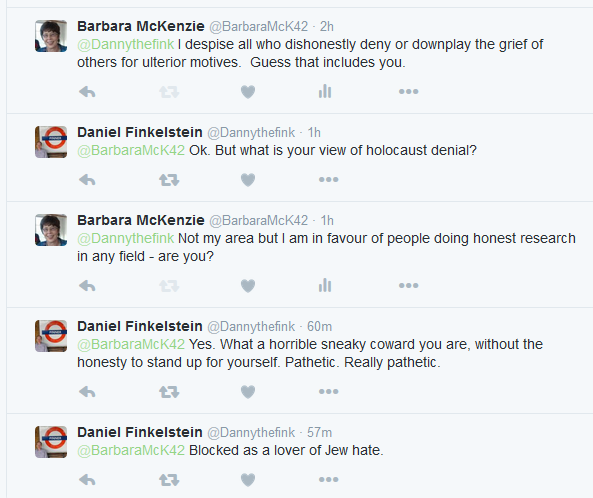
Soon after I had a twitter exchange with one Daniel Finkelstein, peer of the British realm, ex-editor of The Times. I came across his savage indictment of a prolific tweeter, who had defended David Irving, the notorious ‘Holocaust denier’. When I commented that the said person ‘opposes land theft (in Palestine), ethnic cleansing and child abuse – what’s not to like? Finkelstein, twitter handle ‘Dannythefink’, responded by asking me what I thought of the Holocaust. The exchange continued as follows:
It comes as no surprise that Daniel Finkelstein, who is in total support of dispossession, ethnic cleansing and cruelty in Palestine, assumes morally superiority to me, since I have spoken in defense of a man who has spoken in defense of a man who does research into a field of history. And of course I have refused to commit myself to the undeniability of the Holocaust package …
One can assume that all these experts on the Holocaust, who know enough to be confident of the immutable truth of the Holocaust narrative, whether it be Piers Morgan, Dawkins, or Daniel Finkelstein, would also know another immutable truth about the Holocaust, that the Director of Auschwitz, Rudolf Höss was tortured for three days and three nights, and that his testicles were smashed beyond repair,as happened to 137 out of 139 Germans ‘interrogated’ before the Nuremberg trials. One can assume that this makes no difference to their perception of the Holocaust narrative, and they will remain confident of their moral superiority to those of us who are distressed and alarmed by the knowledge that German witness statements at Nuremberg were obtained under the most brutal torture. (From Höss’s confession was derived the figure of 4 million deaths at Auschwitz; the figure was later revised down to 1 million.)
‘Holocaust denial’ is generally conflated with antisemitism, ‘Jew hate’ or racism, and so automatically deserving of vilification. However, even if revisionism is considered to be intrinsically antisemitic, protectors of the Holocaust narrative like to bolster their case by pointing to more general indicators of racism in the culprit.
To the uninitiated the best-known Holocaust revisionist is probably the British historian David Irving, who was convicted of Holocaust denial in an Austrian court and sentenced to three years in prison. Irving was interviewed by Tim Sebastian on the BBC’s Hardtalk in 2000. The programme’s style is intended to be aggressive, but when I watched the programme in 2000, knowing nothing about either Irving or Holocaust denial, I was repelled by Sebastian’s overt hostility to Irving, and I believe that any other impartial person would be too. (Sebastian underlined his antagonism by refraining from shaking Irving’s hand at the end of the interview.)
Sebastian suggests that to deny the gas chambers is hurtful and tasteless (Holocaust denial is immoral per se). But like many others he feels the need to shore up this assumption by showing that there is other evidence that David Irving is a racist, and though he has few examples to work with he is relentless on this point. Irving’s suggestion that he is no more racist than millions of other people is brushed aside with the rather strange claim from the interviewer that there is no evidence for this whatsoever (so only Holocaust deniers are racist). Furthermore, it would appear that honest but naive David Irving confessed in an interview with the Independent that he once called someone a ‘nigger’, something he immediately regretted and remained bitterly ashamed of. As someone put it in the comments below the YouTube video, David Irving is probably the most honest person on the planet.
Another protector of the Holocaust narrative is Max Blumenthal, an American Jew who has a profile as a supporter of the rights of Palestinians. Blumenthal has attracted criticism from some pro-Palestine activists, who see him as an ‘antizionist’ zionist (AZZ), or gatekeeper, due to his attacks on other activists such as Alison Weir and Gilad Atzmon, his opposition to criticism of Jewish power, his prioritising of antisemitism and Holocaust denial, and his peddling of the NATO narrative on Syria; Gilad Atzmon sees him as racist, agressive and supremacist. In 2008 Blumenthal attended a meeting by David Irving when he was touring the States, and created this video:
The video is interesting for several reason. Blumenthal has interspersed his footage with clips from old German propaganda films promoting Germans superiority – of course if you question the Holocaust you must be a Nazi and white supremacist. Like Piers Morgan he presents the question of the Holocaust in bald holistic terms, with no allowance for individual aspects, or degrees of doubt. ‘Are you a Holocaust denier’, he asks, pretty much as one might ask ‘are you a paedophile?’
And as Holocaust denial is such a heinous crime, Blumenthal is justified in first finding out the location of the meeting (given freely to him by David Irving), and then outing Irving to the Vicar of the church hosting the meeting as a ‘Holocaust denier’. The smugness, the self-satisfaction of Blumenthal are palpable; he clearly sees himself as a hero, where others might just see a manipulative sneak. In any case we are left in no doubt that Max Blumenthal, the anti-German racist, the Palestine activist who along with Israel promotes the destruction of Syria, is morally superior to the ‘Holocaust denier’ David Irving, regardless of the latter’s transparent integrity.
The claim that ‘Holocaust denial’ is innately antisemitic was blown out of the water when Netanyahu, prime minister of Israel, took into his head to declare that the Holocaust was the brainchild of the Palestinian grand mufti of Jerusalem Haj Amin Husseini (so not Hitler afterall), that Hitler only wanted to expel the Jews, not exterminate them (thereby breaking Commandment 6, see above). There was anger and ridicule in Israel and amongst Jews abroad and Netanyahu was forced to climb down. Although Netanyahu was in general accused of ‘playing into the hands of Holocaust deniers’, he was actually guilty of Holocaust denial as it is defined, ie questioning an aspect of the Holocaust discourse – any German who made Netanyahu’s claim would be arrested. If one accepts the ruling that says ‘Holocaust denial’ is antisemitic, Netanyahu must be antisemitic. Which is clearly nonsense – Netanyahu’s racism does not lie in antisemitism, but in an overweening belief in Jewish exceptionalism.
Conclusion
It could be that those protecting the approved version of the Holocaust with such intolerance, aggression, and hate are absolutely right, that 6 million Jews died, in gas chambers, according to a plan drawn up by Adolf Hitler. I wouldn’t know – I haven’t done the research necessary for me to form an opinion.
However it is manifestly clear that those who question or deny the Holocaust are not united by a common neo-Nazi philosophy, of a type that on the one hand insists that Hitler was not guilty of the crimes attributed to him and on the other claims ‘Hitler was right’ to commit these crimes. Mainstream Holocaust revisionists are academics, philosophers, German patriots or Palestine activists. They do not necessarily support the far-right – many of them probably vote for left of centre parties. Some of them are notable for their immense compassion, such as Paul Eisen, who has always been a strong advocate of justice for Palestine. All of them have shown great courage and integrity, and are prepared to look for the truth and to speak it as they see it.
Regardless of the facts of the matter, criminalisation of responsible research into the Holocaust, and the vilification and isolation of those who carry it out, or even those who simply support their right to do so, is an outrageous denial of academic endeavour and historiography as a discipline. Anyone who supports such criminalisation, vilification and isolation is NOT morally superior but in fact morally and intellectually compromised. Furthermore, any honourable person with a modicum of intelligence and a modicum of courage will fight for the right of all people to carry out research into any branch of history, without treating one particular aspect as sacred and therefore exempt from scrutiny.
An inquiry published Saturday has revealed that there is virtually no physical evidence to support the Mexican government´s version of the 2014 disappearance of 43 students traveling by bus to Mexico City. Government officials insist that a drug gang kidnapped the students at gunpint, killed them and burned the bodies at a dumpsite near the southwesten town of Iguala, but the report, based on forensic records requested by the Associated Press, revealed no signs of a fire on the night in question.
But the notes of a forensic examination of the Cocula dumpsite in Guerrero state in western Mexico shows that investigators could not confirm a fire on the night that the students vanished on September 26, 2014. The AP obtained the documents under a freedom of information request permissible under Mexican law.
The AP inquiry is the latest in a series of independent investigations that undermines the Mexican government´s version of events. Police say that five suspects have confessed to the crimes but an international panel of experts earlier this year concluded that the confessions were obtained by torture.
Earlier this year the Argentine Forensic Anthropology Team (EAAF) found animal and human remains at the dumpsite but said none of the remains corresponded to the government´s allegation that the bodies were incinerated by members of the Guerreros Unidos cartel. The Attorney General’s Office in April presented evidence of a huge fire and the discovery of the remains of at least 17 adults but the bone fragments were too badly burned to identify, the Argentine team said.
The government´s handling of the case has triggered massive protests that include parents and friends of the students, trade unons and grassroots organizations who believe that law-enforcement authorities are complicit in the slayings of the 43 students, who had effectively stolen a bus, ironically enough, to attend the commemoration of a 1968 police massacre of students.
The case has marred the administration of President Enrique Peña Nieto, who took office promising to reduce violence, curb corruption, and human rights abuses in the country.
Reknowned economist M. Shahid Alamoffers this excellent critique of Noam Chomsky’s defective analysis of the relative influence of Oil versus the Israel lobby over US foreign policy: … continue
This site is provided as a research and reference tool. Although we make every reasonable effort to ensure that the information and data provided at this site are useful, accurate, and current, we cannot guarantee that the information and data provided here will be error-free. By using this site, you assume all responsibility for and risk arising from your use of and reliance upon the contents of this site.
This site and the information available through it do not, and are not intended to constitute legal advice. Should you require legal advice, you should consult your own attorney.
Nothing within this site or linked to by this site constitutes investment advice or medical advice.
Materials accessible from or added to this site by third parties, such as comments posted, are strictly the responsibility of the third party who added such materials or made them accessible and we neither endorse nor undertake to control, monitor, edit or assume responsibility for any such third-party material.
The posting of stories, commentaries, reports, documents and links (embedded or otherwise) on this site does not in any way, shape or form, implied or otherwise, necessarily express or suggest endorsement or support of any of such posted material or parts therein.
The word “alleged” is deemed to occur before the word “fraud.” Since the rule of law still applies. To peasants, at least.
Fair Use
This site contains copyrighted material the use of which has not always been specifically authorized by the copyright owner. We are making such material available in our efforts to advance understanding of environmental, political, human rights, economic, democracy, scientific, and social justice issues, etc. We believe this constitutes a ‘fair use’ of any such copyrighted material as provided for in section 107 of the US Copyright Law. In accordance with Title 17 U.S.C. Section 107, the material on this site is distributed without profit to those who have expressed a prior interest in receiving the included information for research and educational purposes. For more info go to: http://www.law.cornell.edu/uscode/17/107.shtml. If you wish to use copyrighted material from this site for purposes of your own that go beyond ‘fair use’, you must obtain permission from the copyright owner.
DMCA Contact
This is information for anyone that wishes to challenge our “fair use” of copyrighted material.
If you are a legal copyright holder or a designated agent for such and you believe that content residing on or accessible through our website infringes a copyright and falls outside the boundaries of “Fair Use”, please send a notice of infringement by contacting atheonews@gmail.com.
We will respond and take necessary action immediately.
If notice is given of an alleged copyright violation we will act expeditiously to remove or disable access to the material(s) in question.
All 3rd party material posted on this website is copyright the respective owners / authors. Aletho News makes no claim of copyright on such material.