The Arab Spring: Made in the USA
By Stuart Jeanne Bramhall | Dissident Voice | October 25, 2015
Arabesque$: Enquête sur le rôle des États-Unis dans les révoltes arabes (Investigation into the US Role in the Arab Uprisings) is an update of Ahmed Bensaada’s 2011 book L’Arabesque Américaine. It concerns the US government role in instigating, funding and coordinating the Arab Spring “revolutions.” Obviously most of this history has been carefully suppressed by the western media.
The new book devotes much more attention to the personalities leading the 2011 uprisings. Some openly admitted to receiving CIA funding. Others had no idea because it was deliberately concealed from them. A few (in Egypt and Syria) were officially charged with espionage. In Egypt, seven sought refuge in the US embassy in Cairo and had to be evacuated by the State Department.
Democracy: America’s Biggest Export
According to Bensaada, the MENA Arab Spring revolutions have four unique features in common:
- None were spontaneous – all required careful and lengthy (5+ years) planning, by the State Department, CIA pass through foundations, George Soros, and the pro-Israel lobby.1
- All focused exclusively on removing reviled despots without replacing the autocratic power structure that kept them in power.
- No Arab Spring protests made any reference whatsoever to powerful anti-US sentiment over Palestine and Iraq.
- All the instigators of Arab Spring uprisings were middle class, well educated youth who mysteriously vanished after 2011.
Nonviolent Regime Change
Bensaada begins by introducing non-violent guru Gene Sharp (see The CIA and Nonviolence), his links with the Pentagon and US intelligence, and his role, as director of the Albert Einstein Institution, in the “color” revolutions.2 in Eastern Europe and the attempted coup against Hugo Chavez in 2002.))
 The US goal in the Arab Spring revolutions was to replace unpopular despotic dictators while taking care to maintain the autocratic US-friendly infrastructure that had brought them to power. All initially followed the nonviolent precepts Sharp outlines in his 1994 book From Dictatorship to Democracy. In Libya, Syria and Yemen, the US and their allies were clearly prepared to introduce paid mercenaries when their Sharpian “revolutions” failed to produce regime change.
Follow the Money
Relying mainly on Wikileaks cables and the websites of key CIA pass through foundations (which he reproduces in the appendix), Bensaada methodically lists every State Department conference and workshop the Arab Spring heroes attended, the dollar amounts spent on them by the State Department and key “democracy” promoting foundations3, the specific involvement of Google, Facebook, Twitter and Obama’s 2008 Internet campaign team in training Arab Spring cyperactivists in encryption technologies and social media skills, US embassy visits, and direct encounters with Hillary Clinton, Condoleezza Rice, John McCain, Barack Obama and Serbian trainers from CANVAS (the CIA-backed organization that overthrew Slobodan Milosevic in 2000).
Bensaada focuses most heavily on the Tahrir Square uprising in Egypt. The Washington Post has estimated approximately 10,000 Egyptians took part in NED and USAID training in social media and nonviolent organizing techniques. For me the most astonishing information in this chapter concerned the role of an Egyptian exile (a former Egyptian policeman named Omar Afifi Suleiman) in coordinating the Tahrir Square protests from his office in Washington DC. According to Wikileaks, NED paid Suleiman a yearly stipend of $200,000+ between 2008-2011.
When Nonviolence Fails
Arabesques$ devotes far more attention to Libya, Syria and Yemen than Bensaada’s first book.
In the section on Libya, Bensaada zeroes in on eleven key US assets who engineered the overthrow of Gaddafi. Some participated in the same State Department trainings as the Middle East opposition activists and instigated nonviolent Facebook and Twitter protests to coincide with the 2011 uprisings in Tunisian and Egypt. Others, in exile, underwent guerrilla training sponsored by the CIA, Mossad, Chad and Saudi Arabia. A few months after Gaddafi’s assassination, some of these same militants would lead Islamic militias attempting to overthrow Assad in Syria.
Between 2005 and 2010, the State Department funneled $12 million to opposition groups opposed to Assad. The US also financed Syrian exiles in Britain to start an anti-government cable TV channel they beamed into Syria.
In the section on Syria, Bensaada focuses on a handful of Syrian opposition activists who received free US training in cyberactivism and nonviolent resistance beginning in 2006. One, Ausama Monajed, is featured in the 2011 film How to Start a Revolution about a visit with Gene Sharp in 2006. Monajed and others worked closely with the US embassy, funded by the Middle East Partnership Initiative (MEPI). This is a State Department program that operates in countries (such as Libya and Syria) where USAID is banned.
In February 2011, these groups posted a call on Twitter and Facebook for a Day of Rage. Nothing happened. When Sharpian techniques failed to produce a sizable nonviolent uprising, as in Libya, they and their allies (Saudi Arabia, Turkey, Qatar and Jordan) were all set up to introduce Islamic mercenaries (many directly from Libya) to declare war on the Assad regime.
- I was astonished to learn that Forum Fikra, a forum for Arab activists working against authoritarian governments, was mainly funded by the Nathan and Esther K Wagner Family Foundation. The latter also funds numerous pro-Israel groups and projects, as well as the Washington Institute for Near East Policy (a pro-Israel group with close ties to AIPAC).
- The color revolutions were CIA-instigated uprisings that replaced democratically elected pro-Russian governments with equally autocratic governments more friendly to US corporate interests:
Serbia (2000) – Bulldozer Revolution
Georgia (2002) – Rose Revolution
Ukraine (2004) – Orange Revolution
Kyrgyzstan (2005) – Tulip Revolution - Democracy promoting foundations (as used here, “democracy” is synonymous with capitalism, ie favorable to the interests of US investors). Here are seven of the main ones involved in funding and training Arab Spring activists:
• USAID (US Agency for International Development) – State Department agency charged with economic development and humanitarian aid with a long history of financing destabilization activities, especially in Latin America.
• NED (National Endowment for Democracy) – national organization supported by State Department and CIA funding dedicated to the promotion of democratic institutions throughout the world, primary funder of IRI and NDI.
• IRI (International Republican Institute) – democracy promoting organization linked with the Republican Party, currently chaired by Senator John McCain and funded by NED.
• NDI (National Democratic Institute for International Affairs) – democracy promoting organization linked with the Democratic Party, currently chaired by Madeline Albright and funded by NED.
• OSI (Open Society Institute) – founded by George Soros in 1993 to help fund color revolutions in Eastern Europe. Also contributed major funding to Arab Spring revolutions.
• Freedom House – US organization that supports nonviolent citizens initiatives in societies were liberty is denied or threatened, financed by USAID, NED and the Soros Foundation.
• CANVAS (Center for Applied Non Violent Action and Strategies) – center originally founded by the Serbian activists of Otpor who the US funded and trained to over throw Slobodan Milosevic and who were instrumental in training Arab Spring activists. Funded by Freedom House, IRI and George Soros
Dr. Bramhall is a retired American psychiatrist and political refugee in New Zealand. She has published a free, downloadable non-fiction ebook 21st Century Revolution. Her first book The Most Revolutionary Act: Memoir of an American Refugee describes the circumstances that led her to leave the US in 2002. Email her at: stuartbramhall@yahoo.co.nz.
The Importance of the Official 9/11 Myth
By Kevin Ryan | Dig Within | October 26, 2015
People sometimes wonder why is it important to investigate the alleged hijackers and others officially accused of committing the 9/11 crimes. After all, the accused 19 hijackers could not have accomplished most of what happened. The answer is that the official accounts are important because they are part of the crimes. Identifying and examining the people who created the official 9/11 myth helps to reveal the ones who were responsible overall.
The people who actually committed the crimes of September 11th didn’t intend to just hijack planes and take down the buildings—they intended to blame others. To accomplish that plan the real criminals needed to create a false account of what happened and undoubtedly that need was considered well in advance. In this light, the official reports can be seen to provide a link between the “blaming others” part of the crimes and the physical parts.
 Pushing the concept of “Islamic Terrorism” was the beginning of the effort to blame others, although the exact 9/11 plan might not have been worked out at the time. This concept was largely a conversion of the existing Soviet threat, which by 1989 was rapidly losing its ability to frighten the public, into something that would serve more current policy needs. Paul Bremer and Brian Jenkins were at the forefront of this conversion of the Soviet threat into the threat of Islamic terrorism. Both Bremer and Jenkins were also intimately connected to the events at the World Trade Center.
The concerted effort to propagandize about Al Qaeda and Osama bin Laden (OBL) seems to have begun in earnest in 1998. That’s when the African embassy bombings were attributed to OBL and the as-yet unreported group called Al Qaeda. The U.S. government responded with bombings of Sudan and Afghanistan and, with help from the New York Times, began to drum up an intense myth about the new enemy.
“This is, unfortunately, the war of the future,” Secretary of State Madeleine Albright said. “The Osama bin Laden organization has basically declared war on Americans and has made very clear that these are all Americans, anywhere.”
In retrospect, it is surprising that this was the first reference to Al Qaeda in the New York Times, coming only three years before 9/11. More surprising is that The Washington Post did not report on Al Qaeda until June 1999, and its reporting was highly speculative about the power behind this new threat.
“But for all its claims about a worldwide conspiracy to murder Americans, the government’s case is, at present, largely circumstantial. The indictment never explains how bin Laden runs al Qaeda or how he may have masterminded the embassy bombings.”
Despite this skepticism from The Post, the reports about Al Qaeda continued in an odd mixture of propaganda and doubt. For example, The Times reported on the trial of the men accused of the African embassy attacks in May 2001. That article contradicted itself saying that “prosecutors never introduced evidence directly showing that Mr. bin Laden ordered the embassy attacks” and yet that a “former advisor” to Bin Laden, one Ali Mohamed, claimed that Bin Laden “pointed to where a truck could go as a suicide bomber.” The fact that Mohamed had worked for the U.S. Army, the FBI, and the CIA was not mentioned.
Other facts were ignored as well. That OBL had worked with the CIA and that Al Qaeda was basically a creation of CIA programs like Operation Cyclone were realities that began to fade into the background. By the time 9/11 happened, those facts were apparently forgotten by a majority of U.S. leaders and media sources. Also overlooked were the histories of people like Frank Carlucci and Richard Armitage, who played major roles in Operation Cyclone and who remained powerful players at the time of the 9/11 attacks.
In the two years before 9/11, the alleged hijackers were very active within the United States. They traveled extensively and often seemed to be making an effort to be noticed. When they were not trying to be noticed, they engaged in distinctly non-Muslim behavior. Mohamed Atta’s actions were erratic, in ways that were similar to those of Lee Harvey Oswald, and Atta appeared to be protected by U.S. authorities.
Meanwhile, leading U.S. terrorism experts seemed to be facilitating Al Qaeda terrorism. Evidence suggests that U.S. intelligence agency leaders Louis Freeh and George Tenet facilitated and covered-up acts of terrorism in the years before 9/11. Both of their agencies, the CIA and FBI, later took extraordinary measures to hide evidence related to the 9/11 attacks. And both agencies have made a mockery of the trial of those officially accused of helping OBL and the alleged hijackers.
Counter-terrorism leader Richard Clarke inexplicably helped OBL stay out of trouble, protecting him on at least two occasions. Clarke blatantly failed to follow-up on known Al Qaeda cells operating within the United States. After 9/11, Clarke was among those who falsely pointed to Abu Zubaydah as a top leader of Al Qaeda. Zubaydah’s torture testimony was then used as the basis for the 9/11 Commission Report.
Former CIA operative Porter Goss created the first official account of what happened on 9/11, along with his mentor Bob Graham. This was the report of the Joint Congressional Inquiry, produced by the intelligence oversight committees of the U.S. Congress. It was greatly influenced by people who should have been prime suspects. For example, Richard Clarke was the one in charge of the secure video conference at the White House that failed miserably to connect leaders and respond to the attacks. In the Joint Inquiry’s report, Clarke was cited as an authoritative reference 46 times. CIA director George Tenet was cited 77 times, and Louis Freeh was cited 31 times.
Therefore it is imperative that the people who worked to create the background story behind OBL and the accused hijackers be investigated for their roles in the 9/11 crimes. This includes not only those who were figureheads behind the official reports, but more importantly the ones who provided the evidence and testimony upon which those reports were built. The alleged hijackers and their associates should also be of considerable interest to 9/11 investigators. That’s because what we know about them was provided by people who we can assume were connected to the crimes and what we don’t yet know about them can reveal more of the truth.
The Preposterous Green Institute and the IPCC
The man now in charge at the IPCC belongs to a privileged, protected, secretive entity headed by the UN’s former top climate official.
By Donna Laframboise | No Frakking Consensus | October 19, 2015
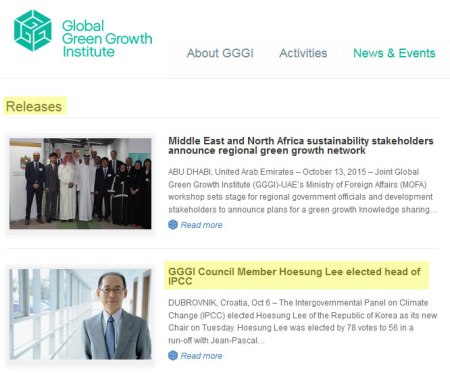
When Hoesung Lee was elected head of the Intergovernmental Panel on Climate Change (IPCC) recently, the Seoul-based Global Green Growth Institute (GGGI) issued a celebratory press release. Lee – who hails from South Korea – has a seat on one of the GGGI’s governing bodies.
But this little-known entity is no mere institute. In fact, it’s another creature of the United Nations. As a headline on the GGGI website makes clear, an international treaty was required to bring it into existence. Membership is restricted to UN-recognized countries. Its stated purpose is “the successful outcome of the United Nations process on sustainable development.” Its Director-General, Yvo de Boer, used to be the UN’s top climate official.
GGGI appears to have begun life in 2010 as a bona fide South Korean non-profit foundation, before throwing itself into the arms of the UN two years later. Documents connected to its 2012 transformation can be downloaded from its website (see this 33-page PDF). The GGGI immodestly claims to be devising “a new model of economic growth,” which it considers “essential for the future of humankind.” Some of the planet’s least developed nations have signed up to act as guinea pigs for projects administered by the GGGI and funded by Australian, Danish, Norwegian, and British taxpayers.
There are plenty of good people working on important issues, some of whom are employed by research institutes. But when it comes to perqs and privileges, the GGGI leaves everyone them in the dust. Calling the GGGI an institute is like calling Unilever – the multinational corporation that owns the Ben & Jerry’s, Lipton, Bertolli, Hellman’s, Becell, Knorr, and Dove brands – a soap company.
In actual fact, the GGGI enjoys a preposterous array of protections and immunities. We’re talking about the kinds of privileges normally reserved for nation states. Korea’s government has signed a document in which it has agreed to treat GGGI headquarters like an embassy. Korean authorities have no jurisdiction on its premises or over its records:
The Headquarters shall be inviolable. No person exercising any public authority within the Republic of Korea shall enter the Headquarters to perform any duties except with the express consent of the Director-General…The archives of the GGGI…shall be inviolable wherever located….The property of the GGGI…shall be immune from search, requisition, confiscation, expropriation and any other form of interference, whether by executive, administrative, judicial or legislative action. [pp. 1, 5, 6]
The GGGI and its staff enjoy “immunity from every form of legal process,” except in rare circumstances. The GGGI is exempt from taxation and customs duties, and may transfer funds in and out of Korea at will. The salaries of the roughly 100 people who comprise the GGGI staff are – drumroll, please – tax free.
People visiting the GGGI from outside Korea don’t need to produce passports as do mere mortals, since Korea’s government has agreed to treat GGGI-issued “travel certificates” as the equivalent of national passports. GGGI staff, their spouses, and their dependents are immune from “immigration restrictions” and baggage inspection “except in doubtful cases.” In the event of an international crisis, Korea will treat GGGI personnel and their families on a par with “diplomatic envoys.”

As if all of the above weren’t sufficiently bizarre, we read that:
The GGGI shall have the right to use codes and to dispatch and receive official communications by courier or in sealed bags, which shall have the same privileges and immunities as are accorded to diplomatic couriers and bags. [bold added, p. 6]
So the police can’t touch you. The courts can’t touch you. Customs officials have been instructed to treat you like royalty. Your pay cheque is tax free, and there’s almost no risk of being caught should you choose to smuggle items in or out of the country.
Pardon me, but I have a few questions:
- What’s really going on here?
- What is so special about these people that they warrant
requiresuch extraordinary protections and immunities? - What
unwholesome activitiesis the UN undertaking via the GGGI that it considers sealed diplomatic pouches remotely necessary?
Circling back to Hoesung Lee, the person now in charge of the IPCC also belongs to a secretive entity headed by the UN’s former top climate official.
Translation #1: Lee is a UN insider. There isn’t a chance in a thousand that he’ll institute meaningful reform.
Translation #2: The IPCC is merely one bauble in the UN’s burgeoning toy box.
White Helmets: War by Way of Deception
By Vanessa Beeley | thewallwillfall | October 23, 2015
“The Ivy League bourgeoisie who sit at the helm of the non-profit industrial complex will one day be known simply as charismatic architects of death. Funded by the ruling class oligarchy, the role they serve for their funders is not unlike that of corporate media. Yet, it appears that global society is paralyzed in a collective hypnosis – rejecting universal social interests, thus rejecting reason, to instead fall in line with the position of the powerful minority that has seized control, a minority that systematically favours corporate interests.” ~ Cory Morningstar
In his recent speech Hezbollah leader, Sayyed Nasrallah, alluded to a multi-phase “soft war” which relies upon the mass media complex to disseminate propaganda and bias, propelling the Middle East into, primarily, a sectarian crisis before descending even further into regionalism and finally a devastating individualism.
Cory Morningstar’s body of work does more than any other to expose the bare bones of the non-profit propaganda industry that governs both our reactions – and inactions, through a network of multi-layered and multi-faceted media manipulation campaigns, of which the end result is mass thought control. She explains:
“The 21st century NGO is becoming, more and more, a key tool serving the imperialist quest of absolute global dominance and exploitation. Global society has been, and continues to be, manipulated to believe that NGOs are representative of “civil society” (a concept promoted by corporations in the first place). This misplaced trust has allowed the “humanitarian industrial complex” to ascend to the highest position: the missionaries of deity – the deity of the empire.”
In a paper entitled, Foreign Aid and Regime Change: A Role for Donor Intent, written just prior to NATO intervention in Libya, Prof. Sarah Blodgett Bormeo describes the “democratization” process for target nations. Unwittingly or wittingly, Bormeo perfectly outlines the role played by NGOs in this process. Bormeo even goes so far as to pinpoint the lack of impartiality rife among NGOs large and small, the majority of whom, receive their funding directly from western government and major corporation sources – all of whom have a vested interest in the outcome of their NGO’s activities and ‘intervention’ in a particular location. Bormeo emphasises the importance of “picking winners” in this scenario, as opposed to respecting and supporting the will of the people in any sovereign nation.
“Thus, it is possible that aid donors, in an effort to avoid further entrenching an “authoritarian” [my edit: this status is decided by donor] regime and perhaps increase the likelihood of democratization, channel funds through NGOs and civil society organizations in authoritarian states.”
In this short video below, we are introduced to the US military’s symbiotic relationship with NGOs in countries [in this instance, Iraq] where the policy is to Induce Pacification & Advance Western Ideologies. NGOs are cynically used to “soften” cultures and render entire communities dependent upon foreign aid in order to facilitate “Democratization”.
In this role, and dependent upon their donor support, NGOs cease to be the neutral, unbiased ‘humanitarian’ organisations they publicly purport to be, and instead become actual covert tools for foreign intervention and regime change. By default, they are assimilated into the Western modus vivendi of “waging war by way of deception” and their purpose is to alter public perception of a conflict via a multitude of media and “marketing” channels.
Following this formula, let’s examine, once more, the role of the Syria Civil Defence aka,’The White Helmets’ currently operating in Syria and take a closer look at their financial sources and mainstream media partners in order to better determine if they are indeed “neutral” as media moguls proclaim these “humanitarians” to be.
White Helmets: Follow the Money
The White Helmets were established in March 2013, in Istanbul, Turkey, and is headed by James Le Mesurier, a British “security” specialist and ‘ex’ British military intelligence officer with an impressive track record in some of the most dubious NATO intervention theatres including Bosnia and Kosovo, as well as Iraq, Lebanon, and Palestine. Le Mesurier is a product of Britain’s elite Royal Military Academy at Sandhurst, and has also been placed in a series of high-profile pasts at the United Nations, European Union, and U.K. Foreign and Commonwealth Office.
The origins of The White Helmet’s initial $300k seed funding is a little hazy, reports are contradictory but subsequent information leads us to conclude that the UK, US and Syrian opposition [Syrian National Council] are connected. Logistical support has been provided by given by Turkish elite natural disaster response team, AKUT.
A further $13 million was poured into the White Helmet coffers during 2013 and this is where it gets interesting. Early reports suggest that these “donations” came from the US, UK and SNC with the previously explored connections to George Soros in the US.
Soros in Syria: ‘Humanitarian’ NGO Deployed For Regime Change, Not Aid
However, subsequent investigations reveal that USAID has been a major shareholder in the White Helmet organisation.
The website for the United States Agency for International Development (USAID) claims that “our work supports long-term and equitable economic growth and advances U.S. foreign policy objectives by supporting: economic growth, agriculture and trade; global health; and, democracy, conflict prevention and humanitarian assistance.”
In a USAID report update in July 2015 it is clearly stated that they have supplied over $ 16m in assistance to the White Helmets.

The USAID track record as a primary US Government/CIA regime change facilitator is extensively documented. From South America to the Ukraine and in the Middle East, USAID serve a malevolent and ultimately destructive role in the dismantling of sovereign nations and their reduction to Western hegemony vassal states, as always, all in the name of freedom and democracy.
“The United States does not lack institutions that continue to conspire, and that’s why I am using this gathering to announce that we have decided to expel USAID from Bolivia” ~ Bolivian President Evo Morales
“USAID and NED are in the business of “Democracy Promotion” which uses public money (from U.S. taxpayers) for secretive operations with the intention to support pro-U.S. governments with the help of political and social movements abroad. The goal is regime change.” ~ Timothy Alexander Guzman
With recent developments in Syria and as a consequence of the Syrian Government requested Russian intervention, we have seen a scramble to justify the shambolic US foreign policy and its clandestine terror operations in Syria. We have previously established the White Helmet connections to this US regime change operation and their undisputed exclusive integration into the Al Nusra and Free Syrian Army [Muslim Brotherhood] and even ISIS networks and strongholds.
Humanitarian’ Propaganda War Against Syria – Led by Avaaz and The White Helmets
After RT and Sott.net among others, exposed the gaping holes in White Helmet propaganda over recycled photographs tweeted even before the alleged Russian bombing had occurred, the propaganda “war” ramped up. The Russian involvement in Syria, did not only betray the US military deception, it also brought some heavyweight media giants of its own into the fray who set about de-constructing the Western media and NGO indoctrination that had, for so long, been largely unchallenged.
At this point the London Telegraph went into damage limitation mode. It published an article expounding the White Helmet humanitarian role in Syria but with admissions of UK Government “majority” funding and that the White Helmets are embedded with ISIS (“in at least one ISIL held area”), claims previously vehemently denied but rendered indisputable after discovery of the photo showing an ISIS mercenary posing directly in front of a White Helmets depot located deep in ISIS held territory south of Yarmouk.

“The Foreign Office is currently the largest single source of funding. It is an irony that if Britain does effectively become an ally of Assad, and starts raids against Isil in Syria, it will be bombing from the air and paying for the bodies to be dug out on the ground. The White Helmets are also operating in at least one Isil-held area.”
Interestingly, the Telegraph stated clearly that the UK Foreign Office is the “largest single source of funding” for the White Helmets which may be perceived as an attempt to draw fire away from the USAID funding which still outstrips official figures released by the British Gov’t who “gifted” £ 3.5 million in equipment to “civil defence teams” in Syria [Report March 2015]. However, the British Government also committed to an additional £ 10m to “increase coordination between the Syrian Interim Government and civil defence teams” to be funded by: UK Government’s Conflict, Security and Stability Fund (CSSF).
It should also be noted here that although cries of ‘regime change!’ from both Washington and London have been muted since Russia entered the Syria conflict, both Washington and London have been supporting their own parallel, hand-picked ‘interim government’ for Syria since at least 2012.
So, with millions in hard cash and equipment being invested into the White Helmets by US & UK donors who have a very clear regime change objective in Syria, it becomes increasingly difficult to perceive their role as anything other than donor-biased propaganda merchants and a ‘humanitarian’ extension of a clandestine terror operation allied to the NATO proxy armies in the region.
White Helmet Leadership
James Le Mesurier: James Le Mesurier has been portrayed as a Humanitarian maverick hero, miraculously in the right place (Istanbul) at the right time, just as the need arose for the formation of a Syria Civil Defence team, perhaps coincidentally, only a few months prior to the now infamous and universally (except for a few diehard propagandists) discredited Ghouta ‘chemical weapon’ attack in August 2013, an event which has already been proven beyond a doubt to be a false flag attack, as well as subsequent accusations levied at the Syrian Government which narrowly failed to precipitate the NATO desired ‘No Fly Zone’.
However, when we delve deeper into the life and times of Le Mesurier we see that it was no happy accident that he was in Istanbul at this juncture. As Sandhurst Military Academy’s top student and recipient of the Queen’s Medal, his chequered career took him from OHR [Office of High Representative] in Bosnia to intelligence co-ordinator in NATO’s newly won prize, Kosovo. We’re told that Le Mesurier left the British Army in 2000 and joined the UN serving as deputy head of the Advisory Unit on ‘Security and Justice’, and Special Representative of the Secretary General’s security policy body within the UN mission in Kosovo. His career then took him to Jerusalem where he worked on implementing the Ramallah Agreement, then to Baghdad as a special advisor to Iraqi Minister of Interior, and to the UAE to train their gas field protection force, and later to Lebanon during the 2006 war. In 2005 he was made Vice President for Special Projects at private mercenary firm Olive Group, and in January 2008 he was appointed as Principal for Good Harbour International, both based in Dubai.
Le Mesurier is also the founder of Mayday Rescue, a “non profit” organisation providing SAR [search & rescue] training to civilians enduring conflict. According to Mesurier’s own biography on the website, Mayday Rescue was founded in 2014, after he had established Syria Civil Defence/White Helmets.

A quick flick through the other Mayday team members reveals some very interesting connections.
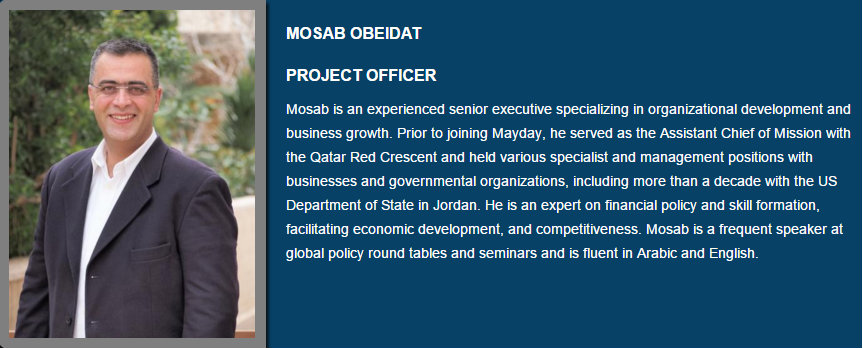
Mosab Obeidat, previous Assistant Chief of Mission with the Qatar Red Crescent, one of whose officials, Khaled Diab was accused of supplying $ 2.2 m to secure arms for the terrorist groups in Syria. Details of this transaction and its exposure can be found in this Al Akhbar article from June 2013.
At least three other members of the team were a part of the Syrian “revolution” including Farouq al Habib, one of the 3 most prominent White Helmet leaders who was also a leader of the Homs uprising against the Syrian government and according to his testimony, was tortured by the Syrian “regime” security forces in 2012 for smuggling a journalist into Syria to “cover” the “peaceful protests”. Habib was a founder member of the ‘Homs Revolutionary Council’ (the CIA have been linked to nearly all ‘Revolutionary Councils in Syria) before fleeing to Turkey in 2013 (A more in-depth analysis of his anti-Syrian government testimony will be presented in Part II of this article).

Le Mesurier is heavily involved in several organisations not mentioned in this article, but for the purposes of demonstrating that the White Helmets should not be considered impartial or neutral as they claim, we will focus on those that best substantiate that argument.
Both Olive Group and Good Harbour International are experts in private “security”. Taken from Sourcewatch on Olive Group:
“Olive Security was founded in 2001 by Harry Legge Burke. Olive lends their quick success to strong relations in the government and military industry. Harry Legge-Burke is an ex-Welsh Guard, and a former aid to chief of defence staff Sir [Charles Guthrie]. He can claim Prince William as a skiing partner and his sister was a nanny to the royal children.
Iraq: Olive were on the ground since the invasion began in 2003, and were able to deploy 38 former SAS employees within two days of the invasion’s completion in 2004
Jonathan Allum, Olive’s former director and co-owner, is also the son of Tony Allum, who is the chairman of the engineering company Halcrow and also the head of the UK government’s Iraq Industry Working Group. It was in the latter position that Tony Allum went to Washington to meet with Bechtel leaders, where he suggested, among other UK companies, Halcrow and Olive as companies worth considering for subcontracted work, all stemming from Bechtel’s $680 million contract with USAID. They were considered and contracts followed, though both Legge-Burke and Allum deny one had anything to do with the other”
In May 2015 Olive Group merged with Constellis Holdings, in whose portfolio we can also find Academi, previously the notorious Blackwater Group [ Nisour Square massacre, Iraq 2007]. Taken from The Atlantic July 2012: Post 9/11, Bush enabled the CIA to subcontract assassinations allegedly targeting Al Qaeda operatives. Blackwater was awarded this contract.
“Running operations through Blackwater gave the CIA the power to have people abducted, or killed, with no one in the government being exactly responsible.”
The CIA can no longer hide its Blackwater/Academi connections, especially after this week’s Wikileaks data dump of CIA director John Brennan’s emails, whose contact list included now spy chief Robert Richer at his Blackwater contact address.
The outsourcing of intelligence operations was in full-swing. What Bush initiated, Obama ran with, awarding Blackwater/Academi a $ 250m contract in 2010 to offer “unspecified” services to the CIA, thus maintaining the apparatus for “unaccountable” covert assassinations.
It is true that James Le Mesurier only joined Olive Group in 2005 and left them in 2008, but his involvement with them and their subsequent merger with Constellis and by default, Blackwater/Academi, gives a degree of valuable insight into the elite intelligence and Pentagon circles that Le Mesurier moved in prior to working for Good Harbour International and creating Syria Civil Defence (not forgetting the USAID funding & influence that underpins both Olive and SCD/White Helmets).
In 2008, Le Mesurier joined Good Harbour International, another private “security” expert organisation, whose CEO is none other than former terror advisor to the Bush administration, the Terror Czar himself, Richard A Clarke.

The jury is still out on whether Clarke was indeed the “whistleblower” he fashioned himself as, post 9/11, or a merely a high-level gatekeeper who aided in preventing a full and detailed investigation into Bush and Rumsfeld’s roles in 9/11.
Patrick Henningsen, a political analyst and writer for 21st Century Wire believes the latter is more likely:
“On first glance, one might buy into the mainstream media’s characterization of him, but it’s more likely that Richard Clarke is not a whistleblower at all. While appearing to oppose the Bush administration from a safe enough distance, I believe his role was inserted into the mix in the period of 2004-2005 in order to VALIDATE the bin Laden mythology and help to portray al Qaeda as an organic, independently run terror organization. He also claimed that Bush and Rumsfeld committed war crimes, but this means nothing because everyone knows that no US official will ever face ‘war crimes’ charges in any court of law anywhere on the planet. It’s effectively a straw man narrative that distracts from the real scandal in the US which is that the entire premise of the war on terror is completely contrived. Clarke’s ‘whistleblower’ status gives him brilliant cover from too much public scrutiny. I remain skeptical of his whole public narrative. He was, is, and always will be an insider.”
What is perhaps even more telling, is Clarke’s reported close ties with Israeli-US operative Rita Katz of the SITE Intelligence Group, another supposedly independent, albeit ‘private’ intelligence firm located in Bethesda, Maryland, a stone’s throw away from CIA headquarters. SITE are said to be responsible for the media release of the harrowing ISIS execution videos, al Qaeda videos, and their credibility has been extensively questioned.
Katz’s long term working relationship with Clarke began before 9/11 when she and her research associate Steve Emerson were commissioned by Clarke to identify Islamic radicals within the US. Over time, Katz’s relationship with Clarke blossomed into a much more extensive one that included regular briefings at both the Clinton and Bush White Houses.
“One of SITE’s founders, Rita Katz, is a government insider with close connections to former terrorism czar Richard Clarke and his staff in the White House, as well as investigators in the Department of Justice, Department of the Treasury, and the Department of Homeland Security, according to SourceWatch. Her father was executed in Iraq as an Israel spy, a fact that suggests a connection to Israeli intelligence.” ~ Mark Taliano
This background on Le Mesurier should at least make us question the media portrayal of an affable, debonair and philanthropic leader of a civilian humanitarian mission. His military & intelligence roots, the fact that despite working for OHR in Bosnia, no visible record of his employment can be found there, his private security-centric career path, his appearance in Istanbul at just the right moment to partner USAID, the UK government & Syrian opposition in creating just the sort of “democratization” enabling NGO as described in our introduction, MUST at least cause us to doubt the transparency and neutrality of the White Helmets in Syria.
In addition, the White Helmet leadership consisting of known Syrian opposition protagonists such as Raed Saleh and Farouq al Habib must make us more cynical about the claims of impartiality and lack of bias and for those who will defend the “peaceful” revolution narrative upheld by Habib and Saleh, please take the time to read Professor Tim Anderson’s in depth analysis of events in Syria pre NATO intervention.
“I have seen from the beginning armed protesters in those demonstrations … they were the first to fire on the police. Very often the violence of the security forces comes in response to the brutal violence of the armed insurgents” – Jesuit priest Father Frans Van der Lugt, January 2012, Homs Syria
“The claim that armed opposition to the government has begun only recently is a complete lie. The killings of soldiers, police and civilians, often in the most brutal circumstances, have been going on virtually since the beginning.” – Professor Jeremy Salt, October 2011, Ankara Turkey
Our presentation of the White Helmets as regime change propagandists & terrorist allies in this article will be further explored and verified in Part II.
“Existing soft power initiatives and agencies, particularly those engaged in development and strategic communications, must be reinvigorated through increased funding, human resources and prioritization. Concurrently, the U.S. government must establish goals, objectives and metrics for soft power initiatives. Furthermore, the U.S. government can better maximize the effectiveness of soft power instruments and efforts through increased partnerships with NGOs. By providing humanitarian and development assistance in areas typically inaccessible to government agencies, NGOs are often able to access potential extremist areas before the government can establish or strengthen diplomatic, developmental or military presence, including intelligence.” — Joseph S. Nye, former US assistant secretary of defence, June 2004
At Guantanamo, Sometimes Even the Judge Is In the Dark
By Dror Ladin | ACLU | October 23, 2015
I’m writing from Guantánamo Bay, where pre-trial proceedings in the military commissions prosecution of the 9/11 defendants have restarted after an 18-month delay. It has been a faltering start, to say the least: Within ten minutes of the first hearing, the agenda was derailed. Again.
One of the defendants, Walid Bin Attash, asked about the procedures that would allow him to represent himself because he could not trust the independence of the military commission, including his lawyers. All the parties then had to grapple with how self-representation would work in this novel context. But lurking behind these dilemmas is the real issue that has so often derailed the military commissions: the government’s use of secrecy in what it presents as a public death penalty trial.
As we have pointed out for years, the military commissions are unfair, unconstitutional, and plagued by excessive secrecy. These challenges make it extraordinarily difficult for the defense attorneys to do their job. And they make it even harder for defendants to exercise the right to represent themselves meaningfully.
There are straightforward logistical impossibilities for defendants if they attempt to represent themselves. They are held virtually incommunicado in “Camp 7” at Guantánamo, a secret prison within a secretive prison holding detainees who were tortured at the CIA’s secret black sites. Defendants cannot file motions, consult a law library, communicate with (or even learn the names of) witnesses, or compile confidential legal documents.
The defendants also face the unique challenge of representing themselves when they have been tortured by the government that seeks to kill them, continue to be subjected to a “controlled chaos strategy of changing the rules all the time” that serves to retraumatize them, and are denied rehabilitation to help them cope with the effects of their torture. Conditions at Camp 7 reportedly exacerbate the continued effects of CIA torture. Bin Attash declared at the beginning of this week’s hearings that “we are still in the black sites” before the judge, Army Col. James Pohl, cut him off.
The results of torture are quite visible at the trial: As an observer, one of the most difficult aspects of these hearings is watching the guards place a particularly frail defendant, Mustafa al-Hawsawi, each morning on a chair equipped with a special pillow. As the Senate Intelligence Committee’s torture report documents, al-Hawsawi was subjected to “rectal exams conducted with ‘excessive force’” while detained at a secret CIA prison. CIA records indicate that the result was “chronic hemorrhoids, an anal fissure, and symptomatic rectal prolapse.” He now weighs less than 100 pounds and sometimes bleeds on his clothing. His medical records, like so much else at Guantánamo, are kept secret even from his counsel.
But perhaps the single biggest obstacle to self-representation is government secrecy. Defendants in the military commissions are not permitted to see classified evidence. That’s the case even if the government tries to use it to put them to death, and even if it could help their case. How can someone defend themselves when they can’t see the evidence? This problem isn’t confined to the self-representation context; even security-cleared defense counsel at Guantánamo are sometimes kept in the dark about relevant evidence.
These difficulties could be left for another day, suggested the judge. Perhaps, if a defendant chooses to represent himself, the military commissions could muddle through whatever problems cropped up along the way. Maybe the most obviously unfair scenarios would never come to pass, he hypothesized. At that point, former Secretary of Defense Rumsfeld entered the frame: Are concerns about the viability of self-representation in the military commissions merely a case of “unknown unknowns”?
So many questions arise when you try to invent justice as you go along.
The government has chosen to sidestep our tried and true federal courts and created a novel death penalty court here at Guantánamo. Without a doubt, there are a great number of unknown unknowns in this unprecedented proceeding. But as counsel for Ammar al-Baluchi observed, “there are huge known unknowns.” Given the government’s repeated and acknowledged efforts to rely on secret evidence and simultaneously hide that same evidence from the accused — and the public — a wide array of problems for a defendant who seeks to represent himself are easily predictable.
As David Nevin, counsel for defendant Khalid Sheik Mohammad, has explained, secrecy is “the live wire of this case.” At some point, Nevin suggested, the court will have to decide if it wants this trial to be a “real case” or merely a fundamentally unfair exercise of government power. And whether it’s a “real case” depends in part on whether the government succeeds in hiding from the American public the details of some of the most important trials in our history.
Perhaps the moment that most perfectly encapsulated the week of hearings so far happened at the end of the second day. Defense counsel had submitted a motion containing information that the government had decided was so secret that special permission was required to read it. But the government had not cleared the judge himself to know the information. After consulting with the court security officer, the judge refused to accept the defense’s submission.
“It’s hard for me to know what it is without knowing what it is,” he said. The same could be said for the military commission itself.
The Ideologue’s Tunnel Vision
By Lawrence Davidson | To The Point Analyses | October 24, 2015
Ideologues
An ideologue is someone who sees the world in the limiting terms of a doctrine or dogma. It is limiting because the human world does not operate or evolve according to any one dogma. Therefore ideologues must wear blinders that result in tunnel vision – a tunnel which, like a Procrustean bed, tries to force the world to fit their chosen ideology.
There are hundreds of ideologies out there, both religious and secular, and in every case the resulting tunnel vision eventually results in absurdities – claims about the world that, seen from outside of the ideology, make little or no sense. So it is with the ideology of Zionism and the doctrinaire interpretations its adherents make about their own behavior and the behavior of others who oppose them.
One such proponent of Zionist ideology is David Harris, the Executive Director of the American Jewish Committee (AJC). The AJC describes its mission as “to enhance the well-being of the Jewish people and Israel.” This is a point of dogma for the Zionists – that the well-being of the Jewish people and Israel are bound together. I am often confronted with Harris’s ideological take on events because, curiously, he has me on his mailing list.
David Harris’s View of Ongoing Violence in Israel
On 11 October 2015 Harris posted an essay on the ongoing violence in Israel-Palestine. It is entitled “Attacks Against Israelis: The World’s Silence Is Deafening” and the entire piece can be found both on the Huffington Post and The Times of Israel. The essay seeks to promote a picture of Israeli victimhood. As such it opens up a clear window on the Zionist’s view of the present situation and therefore is worth taking a look at.
What I am going to do is take representative segments from Harris’s essay and show how the grievances he reserves for Israelis seem somehow wrong when considered from outside the Zionist perspective. Indeed, as Harris’s complaint about the “world’s silence” in the face of violence against Israelis suggests, for many people his picture of Israeli victimhood is quite untenable. Because his ideology will not allow him to consider the possibility of Israel’s responsibility for the present violence, the world’s “silence” leaves him aggrieved and bewildered.
Here then are some representative parts of Mr. Harris’s essay.
Harris starts this way: “For days now, I have been watching in dismay as Israeli citizens face random attacks, some deadly, by Palestinian assailants on the streets of their cities and towns. Children have been orphaned, parents have lost children, and some survivors are doubtless scarred for life.”
It is true that individual Israelis have been hurt or killed in the recent past in apparently random attacks by Palestinians. Unfortunately, this is as far as Harris’s understanding goes. Thus, his tunnel vision renders invisible other perspectives, such as the possibility that dead and injured Israeli Jews, like the Palestinians themselves, are victims of the aggressive Zionist society and culture they live in, the government and laws they obey, and the racist policies they tolerate.
Given this perspective the present Palestinian violence becomes understandable as a product of anger and frustration caused by Israeli occupation and long-standing discrimination against Israeli Arabs. There has been no need for an indoctrination of hate by Hamas or any other religiously inspired group (a favorite red herring of Zionist ideologues) to explain Palestinian actions. Israeli policies and practices in and of themselves are quite sufficient.
Harris cannot perceive, much less understand, this perspective. Yet, in ever greater numbers, the people outside of Israel can see that any portrayal of Israeli victimhood is in conflict with an objective reading of the history of the Israeli-Palestinian struggle.
David Harris continues, “And I’ve been wondering, not for the first time, what it would take for the world to wake up and acknowledge … that Israel, the lone liberal democracy in the Middle East, is facing violence that must be condemned unequivocally, and that it, like any other nation, has the obligation to defend itself.”
This “wondering” is also a product of Mr. Harris’s constricted view. There have never been any Zionist complaints, from Harris in particular, about the world’s silence while the Palestinians experience “liberal” Israel’s ethnic bias and occupation. Nor did he and his fellows take note of the world’s silence when Palestine’s own 2006 democratic election was suppressed by Israel and its American ally. It is exactly this silence in the face of Palestinian suffering that has left Israeli power in place and allowed for its oppressive use. Yet this particular silence has no place in Harris’s ideologically constructed world.
Harris goes on, “It’s striking how … some otherwise intelligent and thoughtful people in government, media, or think tanks, just shut down their critical faculties. Instead, they resort to a Pavlovian response mechanism that essentially rejects any possible legitimacy for the Israeli position and blindly defends whatever Palestinian narrative comes along.”
As noted above, an ideological outlook usually leads to absurdities. The truth is that until recently the Zionist narrative on Israel-Palestine held a monopoly in the West. Now, finally, Israel’s consistent apartheid-like practices are being noticed and as a result that monopoly is crumbling. The best Harris can do is evoke a fictional “Pavlovian mechanism” to explain the responses to Israeli policies. Nonetheless, the weakening of the Zionist narrative is at an early stage, which means that, even now, it is often not the Israeli narrative that has to fight its way into the media, think tanks and government councils. It is the Palestinian one.
There is much more to Harris’s missive, and almost every paragraph is shaped by the doctrinal demands of his ideology. The ersatz victimhood he claims for the Israelis is in fact a measure of the resulting distortion. For he, and his fellow Zionists, have stolen that depiction of suffering from their own victims, the Palestinians. Such is the power of ideological blinders.
Conclusion
To pull off this reversal of roles and posit the Israelis as victims of the Palestinians, Harris’s essay must leave out the seminal fact that for the past 67 years Israel has possessed overwhelming power. With this power Israel has oppressively controlled almost every aspect of Palestinian life. The inevitable result is the violence of resistance. Israelis who suffer from that violence should take this reality into consideration. But, few of them can do this.
The explanation for this inability brings us back to the problem of tunnel vision. Consider the following: many Palestinians can understand Western Jewish history, including the Holocaust, and recognize how it shapes, though ultimately cannot excuse, Zionist behavior. This ability to understand is facilitated by the fact that the Palestinians were not responsible for the suffering of Western Jewry. Unfortunately, the Zionists can’t reciprocate by understanding the history that drives Palestinian behavior. They cannot do so because their ideology precludes the possibility that they are in fact responsible for Palestinian suffering. Ideologues are not known for their skill at self-criticism.
One of the most renowned Jewish journalists, I. F. Stone, once said, referring to his own Jewish brethren, “how we act toward the Arabs will determine what kind of people we become: either oppressors and racists in our turn like those from whom we have suffered, or a nobler race able to transcend the tribal xenophobias that afflict mankind.” Well, the verdict is in, at least for those Jews who adhere to the Zionist ideology. For them “oppression and racism” has won out. And so has denial – just read David Harris.
War of Words: Russian Foreign Ministry calls out MSM reports on hospital strike in Syria
RT | October 23, 2015
The Russian Foreign Ministry has disputed Western media reports accusing Russia of hitting a field hospital in northwestern Syria and killing 13 people. The reports cited “sources” provided by the London-based Syrian Observatory for Human Rights (SOHR).
Foreign Ministry spokesperson, Maria Zakharova, stressed that such reports show tremendous bias towards Russia’s military efforts in Syria.
“There are so-called mass media reports which allege that Russian aircraft bombed a field hospital in the Idlib Governorate in northwestern Syria and reportedly killed 13 people. I cannot say that these reports are written by journalists but their ingenuity delights,” Zakharova, told reporters.
She questioned the credentials of the Syrian Observatory for Human Rights, pointing out that it is based in Britain and has no direct access to the ground in Syria.
“This information appears with reference to the Syrian Observatory for Human Rights based in London. As we all understand, it is very ‘convenient’ to cover and observe what is happening in Syria without leaving London and without the ability to collect information in the field,” Zakharova added.
She said that Russia’s role in the Syrian conflict is aimed “primarily” at “protecting civilians,” while “terrorist groups” continue to receive “reinforcements of people” and “equipment from abroad,” which is a “very dangerous tendency.”
“These facts raise a question as to whether parties involved in the Syrian conflict are really interested in a peaceful settlement and how this goal is reconciled with financial and technical support for anti-government armed groups, including those who directly cooperate with terrorists,” she said during a briefing.
MSM attacks on Russia
Since joining the fight against Islamic State, Russia’s efforts in Syria have been repeatedly attacked by the Western mainstream media, which have published many unconfirmed reports employing scaremongering tactics.
AFP, a French media outlet, was responsible for publishing a piece titled 13 Dead as Russia strike hits Syria field hospital: monitor. The source in the story was identified as the UK-based Syrian Observatory for Human Rights, which is run by one man – Rami Abdulrahman. Just recently, Abdulrahman told RT that the last time he had been in Syria was 15 years ago and that all the information for his reports is taken from “some of the Observatory activists” who he knows “through common friends.”
In the past, Rahman has said he relies on sources on the ground, who are among the US funded Syrian rebels.
Shortly after the report appeared, a video emerged showcasing the exact moment of the alleged Russian hospital strike. The video was uploaded by activists known as White Helmets – a rebel group which has already been caught faking evidence of civilian deaths supposedly caused by Russian strikes.
Meanwhile, Russia said it struck a meeting place of terrorist leaders in northwestern Syria. The Russian Defense Ministry specified that it had used a KAB-500 bomb.
“A Sukhoi Su-34 bomber attacked the installation with a guided KAB-500 air bomb, which wiped the target out with everything that was inside,” MoD’s spokesman, Major General Igor Konashenkov said on Wednesday.
Despite the power of the explosion, a cameraman in the posted video runs through only a small cloud of dust.
Experts have questioned the authenticity of the video posted by the rebels, stating that it is physically impossible to film such a powerful explosion from a few meters away and survive.
“It didn’t look like an aerial bomb dropped from an airplane. It appeared to come from an angle and the angle of the explosion appeared to be more like artillery,” a former policy analyst for the US Defense Department, Michael Maloof, told RT.
This kind of unreliable reporting is just one of the latest examples. Earlier, the Turkish military released a statement saying that it had downed an unidentified drone in Turkish airspace after issuing the aircraft 3 warnings.
It was not long before reports suggested it was Russian and being used to collect information. However, a Russian drone manufacturer denied the reports, calling the photos of the allegedly downed drone part of a poorly-staged “informational provocation.”
Other baseless accusations quickly followed, including British newspapers speculating that Royal Air Force Tornado jets operating in Iraq were to be equipped with air-to-air missiles and that their pilots had been cleared to fire on “Vladimir Putin’s jets” in the case of an imminent threat.
Moscow issued a formal request to the British Foreign Office, demanding an explanation. The answer came in a news blog, when the UK’s MoD’s spokesperson wrote that “There is no truth in this story.”
Another CNN story suggested that several Russian cruise missiles targeting Islamic State positions in Syria had landed in Iran. Citing two unnamed “top US officials,” the American broadcaster reported that four Russian missiles had crashed somewhere in Iran after being launched from vessels in the Caspian Sea.
The Russian Defense Ministry refuted the report, stating that missiles had hit their intended targets. “Unlike CNN, we don’t distribute information citing anonymous sources, but show the very missile launches and the way they hit their targets almost in real time,” Russian Defense Ministry spokesman Igor Konashenkov said.
READ MORE:
Drones in Turkey, missiles in Iran & ground op in Syria: More MSM bombs for Russia amid ISIS fight
EXCLUSIVE: Man who runs SOHR admits to RT he last visited Syria 15 years ago
Secrecy and Hillary Clinton
By Diane Roark | Consortium News | October 21, 2015
The system for classifying intelligence and other national security documents is broken in major respects. Increasingly, it is also manipulated to punish perceived critics or to protect agency reputations and high officials, both from adverse publicity and in the courts. Hillary Clinton’s use of a private rather than State Department email service illustrates many of these issues. Her experience stands in stark contrast to treatment of national security whistleblowers, as illustrated in particular by variance in National Security Agency (NSA) communications intelligence policies.
–Culpability. Former Secretary of State Clinton clearly and knowingly mishandled classified information. As a U.S. senator, security clearances were required for her membership on the Senate Armed Services Committee from 2003 to 2009. Therefore, she knew the rules for handling classified information before she decided, at the outset when she became Secretary of State in early 2009, to use personal rather than secure email.
Hillary and Bill Clinton had suffered many political and public relations crises. She had already run for the presidency and likely would do so again. Rules for handling classified information were ignored, the effect being to hide records that could be used against her in a second presidential run.
It simply could never be argued plausibly that for four years, a person in the highest U.S. foreign policy slot had no classified or sensitive information in any business emails that she wrote or received – over 30,000 of them. This defies the definition of the job.
The State Department is a primary user and a significant generator of classified information that bears on the great majority of issues coming before the Secretary. The State Department is also a profligate designator of “Sensitive But Unclassified” information.
–Overclassification. It is widely admitted that the intelligence classification system suffers from systemic over-classification. President Barack Obama has acknowledged the problem, and one review group even stated that almost every item now labeled Confidential should be Unclassified. There is no penalty for playing it safe – or playing it political – by classifying at too high a level, but there are potentially severe repercussions for an individual who mistakenly classifies at too low a level, or who is known to mishandle or publicly reveal classified information.
It is most unlikely, however, that Hillary Clinton will fall victim to accusations that rely on improper overclassification. The State Department and White House, including President Obama himself, sought to protect her and to minimize the effects of her behavior.
The case is extremely high-profile, Democrats in Congress would attack any borderline classification, and a host of wellpaid lawyers would rise to her defense. Improperly classified items or those deemed Sensitive but Unclassified may be redacted from publicly released documents, but it is hard to imagine that Mrs. Clinton would be falsely accused of felonies.
Whistleblowers suffer a quite different fate. Intelligence agencies easily and repeatedly retaliate for the airing of their dirty laundry by accusing the whistleblower of improperly handling or revealing allegedly classified information. The Obama administration then prosecutes them under the Espionage Act, under which altruistic motivation is irrelevant and may not even be raised in court.
Former CIA official John Kiriakou revealed on television that post 9/11 torture was official U.S. policy, not just attributable to a few rogue agents. The CIA seethed, but the Justice Department would not prosecute. Unfortunately, Kiriakou erred in giving a reporter the business card of a man he thought had retired from CIA but was still an agent under cover. The agent’s name was not published, but CIA got its revenge when Kiriakou was indicted under the Intelligence Identities Protection Act of 1981. Left penniless with over $700,000 in legal bills even before trial, Kiriakou finally accepted a felony plea bargain and went to jail.
Thomas Drake and this author went through proper official channels in 20012002 to protest NSA’s surveillance of U.S. citizens. Along with colleagues Kirk Wiebe, William Binney and Edward Loomis, they also reported to the Defense Department Inspector General the waste of money on NSA modernization.
After domestic surveillance leaked to the New York Times four years later, the five became primary suspects, partly because the IG improperly offered their names to the FBI. All were raided, but no evidence was found because, as the reporter later stated publicly, he had not then met or communicated with any of the five.
Nonetheless, Drake was prosecuted under the Espionage Act for possessing five Unclassified NSA papers that NSA retroactively classified. He was threatened with 35 years in prison unless he pled guilty, but heroically resisted. Pretrial hearings proved all the information in the documents had been declassified by NSA. After a yearsold interview record was orally falsified, this author was asked to plead guilty to felony perjury, but also refused.
Section 1.7 of Executive Order 13526 governing classification stipulates that no information may be classified to conceal violations of law, inefficiency or administrative error; to prevent embarrassment; to restrain competition; or to prevent or delay release of information not requiring protection. This section is observed in the breach, as political considerations dictate.
For all the above proscribed reasons, unclassified parts of the NSA IG audit we requested are still withheld by NSA ten years after the audit was first published. Former NSA contractors Edward Snowden and John Kiriakou showed that illegal and unconstitutional activities were hidden from American citizens and others behind the veil of classification. For revealing material that never should have been classified in the first place, they are paying a very high price.
In Snowden’s case, many revelations about domestic surveillance still are treated as classified to keep them from U.S. voters, although every terrorist and every intelligence agency in the world has access to the documents and almost no ordinary person in any country of interest to the U.S. can function efficiently whilst avoiding NSA surveillance.
–Sensitive but Unclassified Material. Individual agencies claim an unsupervised right to withhold admittedly Unclassified information according to any criteria they see fit and for as long as they choose. In the Clinton email case, it is quite striking that not a word has been breathed about such Unclassified but Sensitive material. Her free pass in this respect is the envy of whistleblowers.
In our case, NSA initially refused to return any materials seized in the raids. When sued, NSA claimed that if a computer contained even one admittedly Unclassified document with material that had not been officially released by NSA, the Agency could retain and destroy the entire computer content. Courts eventually allowed NSA to keep such individual documents in their entirety and at their sole discretion, but required that others be copied and returned.
–With ordinary citizens or lower-level whistleblowers, Sensitive but Unclassified material is wielded as yet another weapon in the Executive’s arsenal of punishments. Even highlevel intelligence officials have had difficulty publishing their memoirs, partly because prepublication review agreements routinely allow an agency to withhold unclassified information.
Since the 1950s, most judges refuse to review allegedly classified or sensitive material even to determine that it does not fall under the commonsense prohibitions of Section 1.7 of the Executive Order on classification. The Executive Branch has also been famously successful in promulgating a “state secrets” doctrine to avoid or indefinitely delay court scrutiny of important civil liberties issues such as domestic surveillance. It is now known, however, that the original state secrets precedent wrongly invoked intelligence sources and methods to cover up Air Force culpability for a plane crash.
In the author’s case, even NSA’s grossly inconsistent classifications got a free pass. A document that was released to Kirk Wiebe as Unclassified was branded Top Secret Compartmented when found on the author’s computer. Confronted with this vast discrepancy, NSA alleged that it could neither confirm nor deny that the document had previously been released. It keeps no records of prior declassifications. Even in a related court case. Nor is it interested in an available system to compile and compare such records. But the judge let the classification stand.
Diane Roark retired in 2002 after 17 years on the professional staff of the House Permanent Select Committee on Intelligence and prior service on the National Security Council Staff, in the Office of the Secretary of Defense, and in the Intelligence section of the International division of the Department of Energy.
Human Rights Center Suing CIA Broken Into, Research Stolen
teleSUR – October 21, 2015
Just over two weeks after the University of Washington’s Center for Human Rights filed a lawsuit in federal court against the CIA for the intelligence agency’s refusal to release declassified documents, the office of the center’s director was broken into, with data and equipment stolen.
Sensitive documents, including personal details about ongoing investigations in El Salvador, pertaining to a lawsuit filed by the University of Washington against the the CIA were stolen from the office of Professor Angelina Godoy, University officials reported on Wednesday.
The robbery has been described by university officials as a “possible act of retaliation” by individuals interested in compromising the university’s case against the CIA due to circumstances that suggest this wasn’t just a common burglary.
“We are concerned because it is also possible this was an act of retaliation for our work. There are a few elements that make this an unusual incident,” the Center for Human Rights said in a statement.
Following the incident, Center for Human Rights Director Dr. Angelina Godoy reported that her desktop computer was stolen along with a hard drive containing about 90 percent of the information relating to the center’s research in El Salvador. However, according to the center, what was peculiar about the circumstances is that her office was the only one targeted and that the stolen hard drive has no real monetary value; what was valuable was the data on the drive.
“Lastly, the timing of this incident — in the wake of the recent publicity around our freedom of information lawsuit against the CIA regarding information on a suspected perpetrator of grave human rights violations in El Salvador — invites doubt as to potential motives,” added the press statement.
On Oct. 2 the center filed a lawsuit under the Freedom of Information Act alleging that the CIA is illegally withholding information on retired Salvadoran Army officer, Col. Sigifredo Ochoa, who is currently under criminal investigation for complicity in the 1981 Santa Cruz massacre in El Salvador.
The lawsuit hopes to support justice-seeking survivors of the U.S-backed counterinsurgency against left-wing rebels that left more than 75,000 people dead and over 30,000 disappeared between 1980 and 1992.
“Access to the documents … could facilitate justice proceedings in these and other cases of grave rights abuses,” the lawsuit claims.
Faulty Analysis and Conclusions on Syria
By Rick Sterling | CounterPunch | October 21, 2015
Recently CounterPunch published an article Obama’s Legacy: An Abyss Gazing Backwards by Muhammad Idrees Ahmad. It exemplifies the faulty analysis and conclusions of those advocating direct U.S. intervention in Syria, from far right wing neoconservatives to liberals and even some self-styled Marxists.
Because of the dangerous consequences of these assumptions and conclusions, it is important that they be critically examined. We can use the above mentioned article as an example.
The same article with different title was published one week earlier in the United Arab Emirates (UAE) paper The National. The title was “Obama’s legacy is tarnished as Putin fills the vacuum in Syria”.
The Syrian “vacuum” is a popular myth promoted by those who want the U.S. to become more aggressive in Syria. In reality the U.S. has very actively aided and abetted the violent opposition in Syria from the start. The Defense Information Agency report from August 2012 confirms that weapons were flowing to the Syrian armed opposition after the overthrow of the Libyan government in Fall 2011. The claim that the U.S. was only supplying communications equipment and other non-lethal supplies in 2012 and 2013 was for public consumption and ‘plausible deniability’. In reality the U.S. was supplying great quantities of weapons. The ‘dark side’ included a huge budget for CIA operations including training and arming the Syrian armed opposition. Saudi Arabia, Turkey, Qatar and UAE were spending billions annually in support of mercenaries and fanatics trying to overthrow the secular Damascus government. Contrary to what Ahmad says, the US-backed rebels were largely a fiction. Apart from the Islamic State in the Levant (ISIL or ISIS), the most effective fighting force was the official Al Qaeda franchise, Jabhat al Nusra. Out of the public view, to the extent it existed, FSA was working closely with Nusra/Al Qaeda.
In a confusing use of terms, Ahmad contrasts “counter-terrorism” with “counter-insurgency”. What he means by “counter-insurgency” is regime change via direct intervention or invasion. What he means by “counter-terrorism” is regime change via coup or proxy army.
Pakistan-born Muhammad Idrees Ahmad suggests that Obama is spineless because he has opted for “counter-terrorism” (proxy armies, drone strikes, etc) instead of “counter-insurgency” (direct U.S. Attacks). This is short-sighted and ahistorical. There is no public desire for another US invasion of another country. This is partly because the Iraq invasion and disaster is still fresh in the public mind. It also follows a pattern from the past: after the defeat of the US invasion of Vietnam, the US reverted to using a proxy army (the Contras) against Nicaragua in the early 1980s.
But warmongers in the media, such as Ahmad, are not the public. More often than not, they reflect the views of their sponsors. It’s no surprise that Ahmad’s article was first published by UAE’s The National. The United Arab Emirates is closely allied with Saudi Arabia and vigorously promotes conflict with Iran. A recent expose on the UAE Ambassador to Washington shows the level of corruption in Washington, how easy it is to win influence throwing money around, and the core policy of the United Arab Emirates. This policy is aligned with Israel and opposed to Iran, Syria, Russia. The celebrity ambassador, Yousef al Otaiba, is vigorously campaigning for the U.S. to intervene or attack Syria directly. The subtitle of the article succinctly describes the UAE Ambassador:
“Yousef Al Otaiba is the most charming man in Washington: He’s slick, he’s savvy and he throws one hell of a party. And if he has his way, our Middle East policy is going to get a lot more aggressive.”
What connects Otaiba and Ahmad is the tiny wealthy monarchy known as the United Arab Emirates and promotion of U.S. aggression against Syria.
Ahmad says “Obama betrayed his hand long ago when he failed to match hot rhetoric with even modest action …. [when] Assad brazenly breached his ‘red line’ by using chemical weapons” . This assertion is standard fare for journalists promoting war. In reality the accusation has been largely disproved. The Human Rights Watch “vector” analysis was dubious from the beginning and then entirely discredited. The most thorough investigation concludes the weapons were launched from territory held by the armed opposition. American investigative reporters Seymour Hersh, Robert Parry and Gareth Porter, plus former CIA officer Ray McGovern, have all concluded the attacks were likely by the armed opposition trying to trap the U.S. into bombing Syria. Muhammad Idrees Ahmad, like nearly all mainstream journalists promoting the war, ignores the contrary evidence.
In tandem with “Obama is weak” goes “Russia is strong” or “Russia looks strong” or “Putin looks strong because Obama is weak”. The media warmongers are like kids on a school playground, trying to egg on a fight. Except in this case it’s not a bloody nose at stake; it’s the lives of tens of thousands of Syrians and potentially millions in World War 3.
Ahmad outdoes himself in the charge for war by claiming “Russian actions in Syria are an act of aggression against the country’s beleaguered people.” In contrast with his fantasy, virtually the entire Syrian population are hugely relieved and happy that Russia has started providing air support, modern laser guided weapons and satellite information to help reverse the tide. An American Syrian friend who lives in Latakia recently reported that people in the city were extremely worried in August through mid September with increasing car bombs and jihadi fired missiles coming into the city. They are now starting to feel safe again. The mood has dramatically changed for the better. Another Syrian friend reported that in his home village near Homs, women were ululating in happiness when Russian jet fighters attacked nearby ISIS and Nusra camps.
Those seeking direct US/NATO intervention in Syria describe the conflict as “weak Obama vs strong Putin”. They are unhappy and critical because the proxy army has failed to overthrow the Syrian government. They want direct invasion even if it risks world war. It’s a very dangerous and deluded mindset. Above all it profoundly ignores or distorts the wishes of the Syrian people who have consistently and increasingly made clear they do not support the violent opposition. Two years ago a poll commissioned by NATO revealed that 70% of the population supports the government.
The conflict in Syria shows what happens when international law is ignored with impunity. Both the UN Charter and customary international law prohibit one country using force, directly or by proxy army, against another.
The Syrian conflict shows what happens when the “rule of the jungle” prevails. The “abyss” is not Syrians getting support from Russia and starting to prevail over mercenaries and sectarian fanatics. The “abyss” is the death and destruction of the cradle of civilization caused by clear aggression. The Obama legacy significantly depends on whether he resists or caves in to warmongers such as Muhammad Idrees Ahmad and the Ambassador from UAE.
Rick Sterling is a co-founder of Syria Solidarity Movement. He can be contacted at rsterling1@gmail.com
9 Israeli claims at the UNSC that are pure fiction
MEMO | October 21, 2015
On 16 October 2015, Israeli Ambassador Roet addressed the UN Security Council in an emergency session on the escalating situation in Israel and Palestine. Below are excerpts of his speech followed by facts disproving them provided by the Palestinian government in a statement released yesterday.
Israeli Ambassador Roet: “Israel is facing an onslaught of terrorism; men, women and children are being stabbed to death on the streets on a daily basis. Yet for them there has been no demand for an emergency session at the Security Council.”
Fact: The Palestinian people are a defenceless and unarmed population suffering gross violations of human rights under Israel’s illegal occupation. It is in fact the Israeli occupation that is the source and context of all of the violence, violence that has been inflicted by Israel with total impunity for over 48 years on the Palestinian people. Yet Israel has the audacity to oppose international action to protect the civilian population.
Israeli Ambassador Roet: “These are just a few of the silent victims of Palestinian terror.”
Fact: Individuals that carried out the alleged stabbings acted alone and without the support of others. On the contrary, Israeli settlers carry out terrorist acts with Israeli state protection – military and political. Nearly 200 acts have been carried out by settlers against Palestinian civilians in the past month. These include stoning and firebombing Palestinian cars, houses and civilians; trespassing on villages and property; setting fire and damaging crops; and attacking, beating and shooting at Palestinians, including children.
Israeli Ambassador Roet: “Over the course of the last month, 24 terror attacks have claimed the lives of eight Israelis, and injured 70.”
Fact: Israel, the occupying power, is not a victim in this situation. Since 1 October 2015, over 1,850 Palestinians have been injured and at least 46 killed, including at least 18 in demonstrations. The Israeli occupying forces (IOF) have greatly intensified their excessive use of force, especially to suppress protests, through the use of rubber bullets, tear gas, sound canisters and live fire.
Israeli Ambassador Roet: “The root cause of this wave of terror is clear.”
Fact: The root cause of the current violence is Israel’s half century illegal occupation of the Palestinian land and its subjugation of the Palestinian people. Palestinians, many of them children, are killed, wounded, arrested and harassed and intimidated every day while their property is seized, demolished, or bombed. This incessant oppression leaves little hope for a peaceful and stable future, deepens despair and encourages the oppressed to resist injustice.
Israeli Ambassador Roet: “Israel is firmly committed to the status quo which protects the right of Muslims to pray in the mosque.”
Fact: The IOF has intensified incursions and attacks at Al-Aqsa Mosque compound by allowing terrorist settlers free reign to storm the holy site in attempts to change the historic status quo. Between 14 January and 15 September, the IOF and settlers under their protection carried out more than 450 attacks against this holy site and Palestinian civilian worshippers.
Israeli Ambassador Roet: “It is inflammatory rhetoric and lies lit the fuse, and incitement that keeps feeding the flames.”
Fact: Israeli leaders have long and recklessly cultivated a culture of hate against Palestinians that’s manifested in the constant and excessive use of violence by the IOF and terrorist settlers. For example:
“We will not provide immunity to any rioter, inciter, or terrorist, not anywhere and under no conditions. Israel’s security forces have no limits when it comes to defending Israelis,” said Benjamin Netanyahu, prime minister of Israel, on 5 October.“Palestinians have to understand they won’t have a state and Israel will rule over them,” said Eli Ben-Dahan, deputy defence minister of Israel, on 10 October. “The entire Palestinian people is the enemy…in wars the enemy is usually an entire people, including its elderly and its women, its cities and its villages, its property and its infrastructure,” said Ayelet Shaked, Israeli justice minister, on 7 July 2014.
“Instead of calming tensions, Palestinian leaders continue to lie and use inflammatory rhetoric.”
Fact: The Palestinian Government has repeatedly affirmed that it supports peaceful and legal means to end the illegal Israeli occupation. President Abbas recently stated: “I support a popular, nonviolent struggle and oppose all violence and use of weapons. I’ve made clear a number of times that I don’t want to return to the cycle of violence.”
Israeli Ambassador Roet: “Such acts of terror do not occur in a vacuum.”
Fact: Indeed, they don’t occur in a vacuum. They occur when there is constant impunity for brutal crimes by the IOF and terrorist settlers. This includes the burning of teenager Mohammed Abu Khdeir, the arson attack of the Dawabsheh family home, and the mounting executions of Palestinian civilians, including children and youths by the IOF with live fire. When the IOF investigates soldiers for suspected criminal activity against Palestinians, it closes 94 per cent of cases without prosecution.
Israeli Ambassador Roet: “Prime Minister Netanyahu stood here in the UN and declared that he is ready for direct negotiations with the Palestinians without any preconditions.”
Fact: The Israeli government tells the UN it’s prepared for negotiations while telling the Israeli public a Palestinian state will never come to be. On 18 October, Justice Minister Shaked avowed: “We are against a Palestinian state. There is not and there will be no Palestinian state.” Direct negotiations are inherently asymmetrical as Palestine is under Israel’s occupation. The international community must present a multilateral and time-bound negotiating process to salvage the prospects of peace, beginning with concrete steps to end this illegal occupation without delay.
MH-17 Case: ‘Old’ Journalism vs. ‘New’
By Robert Parry | Consortium News | October 20, 2015
The first thing any thinking person learns about the Internet is not to trust everything you see there. While you can find much well-researched and reliable material, you’ll also encounter disinformation, spoofs, doctored photographs and crazy conspiracy theories. That would seem to be a basic rule of the Web – caveat emptor and be careful what you do with the information – unless you’re following a preferred neocon narrative. Then, nothing to worry about.
A devil-may-care approach to Internet-sourced material has been particularly striking when it comes to the case of the shoot-down of Malaysia Airlines Flight 17 over eastern Ukraine on July 17, 2014. It has now become de rigueur on the part of the West’s mainstream news outlets to tout the dubious work of a British Internet outlet called Bellingcat, which bases its research on photographs and other stuff pulled off the Internet.
Bellingcat’s founder Eliot Higgins also has made journalistic errors that would have ended the careers of many true professionals, yet he continues to be cited and hailed by the likes of The New York Times and The Washington Post, which have historically turned up their noses about Internet-based journalism.
The secret to Higgins’s success seems to be that he reinforces what the U.S. government’s propagandists want people to believe but lack the credibility to sell. It’s a great business model, marketing yourself as a hip “citizen journalist” who just happens to advance Official Washington’s “group thinks.”
We saw similar opportunism among many wannabe media stars in 2002-03 when U.S. commentators across the political spectrum expressed certitude about Iraq’s hidden stockpiles of WMD. Even the catastrophic consequences of that falsehood did little to dent the career advancements of the Iraq-WMD promoters. There was almost no accountability, proving that there truly is safety in numbers. [See Consortiumnews.com’s “Through the US Media Lens Darkly.”]
New Recruits
But there’s always room for new recruits. Blogger Higgins made his first splash by purporting to prove the accuracy of U.S. government claims about the Syrian government firing rockets carrying sarin gas that killed hundreds of civilians on Aug. 21, 2013, outside Damascus, an incident that came close to precipitating a major U.S. bombing campaign against the Syrian military.
Those of us who noted the startling lack of evidence in the Syria-sarin case – much as we had questioned the Iraq-WMD claims in 2002-03 – were brushed aside by Big Media which rushed to embrace Higgins who claimed to have proved the U.S. government’s charges. Even The New York Times clambered onboard the Higgins bandwagon.
Higgins and others mocked legendary investigative journalist Seymour Hersh when he cited intelligence sources indicating that the attack appeared to be a provocation staged by Sunni extremists to draw the U.S. military into the war, not an attack by the Syrian military.
Despite Hersh’s long record for breaking major stories – including the My Lai massacre from the Vietnam War, the “Family Jewels” secrets of the CIA in the 1970s, and the Abu Ghraib torture during the Iraq War – The New Yorker and The Washington Post refused to run his articles, forcing Hersh to publish in the London Review of Books.
Hersh was then treated like the crazy uncle in the attic, while Higgins – an unemployed British bureaucrat operating from his home in Leicester, England – was the new golden boy. While Higgins was applauded, Hersh was shunned.
But Hersh’s work was buttressed by the findings of top aeronautical scientists who studied the one rocket that carried sarin into the Damascus suburb of Ghouta and concluded that it could have traveled only about two kilometers, far less distance than was assumed by Official Washington’s “group think,” which had traced the firing position to about nine kilometers away at a Syrian military base near the presidential palace of Bashar al-Assad.
“It’s clear and unambiguous this munition could not have come from Syrian government-controlled areas as the White House claimed,” Theodore Postol, a professor in the Science, Technology, and Global Security Working Group at Massachusetts Institute of Technology, told MintPress News.
Postol published “Possible Implications of Faulty US Technical Intelligence in the Damascus Nerve Agent Attack of August 21st, 2013” in January 2014 along with Richard Lloyd, an analyst at the military contractor Tesla Laboratories who was a United Nations weapons inspector and has to his credit two books, 40 patents and more than 75 academic papers on weapons technology.
Postol added in the MintPress interview that Higgins “has done a very nice job collecting information on a website. As far as his analysis, it’s so lacking any analytical foundation it’s clear he has no idea what he’s talking about.”
In the wake of the Postol-Lloyd report, The New York Times ran what amounted to a grudging retraction of its earlier claims. Yet, to this day, the Obama administration has failed to withdraw its rush-to-judgment charges against the Syrian government or present any verifiable evidence to support them.
This unwillingness of the Obama administration to fess up has served Higgins well, in that there is still uncertainty regarding the facts of the case. After all, once a good propaganda club is forged for bludgeoning an adversary, it’s not something Official Washington lays down easily. [See Consortiumnews.com’s “The Collapsing Syria-Sarin Case.“]
The MH-17 Mystery
So, Higgins and Bellingcat moved on to the mystery surrounding MH-17, where again the Obama administration rushed to a judgment, pinning the blame on the Russians and ethnic Russian rebels in eastern Ukraine who were fighting the U.S.-backed regime in Kiev.
Though again hard evidence was lacking – at least publicly – Official Washington and its many minions around the world formed a new “group think” – Russia’s President Vladimir Putin was responsible for the 298 deaths.
On July 20, 2014, just three days after the MH-17 shoot-down in an article with the definitive title “U.S. official: Russia gave systems,” The Washington Post reported that an anonymous U.S. official said the U.S. government had “confirmed that Russia supplied sophisticated missile launchers to separatists in eastern Ukraine and that attempts were made to move them back across the Russian border.”
This official told the Post that there wasn’t just one Buk battery, but three. The supposed existence of these Buk systems in the rebels’ hands was central to the case blaming Putin, who indeed would have been highly irresponsible if he had delivered such powerful weapons – capable of hitting a commercial airliner flying at 33,000 feet as MH-17 was – to a ragtag rebel force of ethnic Russians in eastern Ukraine.
But there were problems with this version, including the fact that – as reflected in a “government assessment” from the Director of National Intelligence released on July 22, 2014, (or five days after the crash) – U.S. intelligence listed other weapons allegedly provided by the Russians to the ethnic Russian rebels but not a Buk anti-aircraft missile system.
In other words, two days after the Post cited a U.S. official claiming that the Russians had given the rebels the Buks, the DNI’s “government assessment” made no reference to a delivery of one, let alone three powerful Buk batteries.
And that absence of evidence came in the context of the DNI larding the report with every possible innuendo to implicate the Russians, including references to “social media” entries. But there was no mention of a Buk delivery.
The significance of this missing link is hard to overstate. At the time eastern Ukraine was the focus of extraordinary U.S. intelligence collection because of the potential for the crisis to spin out of control and start World War III. Plus, a Buk missile battery is large and difficult to conceal. The missiles themselves are 16-feet-long and are usually pulled around by truck.
U.S. spy satellites, which supposedly can let you read a license plate in Moscow, surely would have picked up these images. And, if – for some inexplicable reason – a Buk battery was missed before July 17, 2014, it would surely have been spotted on an after-action review of the satellite imagery. But the U.S. government has released nothing of the kind – not three, not two, not one.
Different Account
Instead, in the days after the MH-17 crash, I was told by a source that U.S. intelligence had spotted Buk systems in the area but they appeared to be under Ukrainian government control. The source who had been briefed by U.S. intelligence analysts said the likely missile battery that launched the fateful missile was manned by troops dressed in what looked like Ukrainian uniforms.
At that point in time, the source said CIA analysts were still not ruling out the possibility that the troops were actually eastern Ukrainian rebels in similar uniforms but the initial assessment was that the troops were Ukrainian soldiers. There also was the suggestion that the soldiers involved were undisciplined and possibly drunk, since the imagery showed what looked like beer bottles scattered around the site, the source said. [See Consortiumnews.com’s “What Did US Spy Satellites See in Ukraine?”]
Subsequently, the source said, these analysts reviewed other intelligence data, including recorded phone intercepts, and concluded that the shoot-down was carried out by a rogue element of the Ukrainian government, working with a rabidly anti-Russian oligarch, but that senior Ukrainian leaders, such as President Petro Poroshenko and Prime Minister Arseniy Yatsenyuk, were not implicated. However, I have not been able to determine if this assessment was a dissident opinion or a consensus within U.S. intelligence circles.
Another intelligence source told me that CIA analysts did brief Dutch authorities during the preparation of the Dutch Safety Board’s report but that the U.S. information remained classified and unavailable for public release. In the Dutch report, there is no reference to U.S.-supplied information although the report reflects sensitive details about Russian-made weapons systems, secrets declassified by Moscow for the investigation.
Into this propaganda-laced controversy stepped Eliot Higgins and Bellingcat with their “citizen journalism” and Internet-based investigation. The core of their project was to scour the Internet for images purportedly of a Buk missile system rumbling through the eastern Ukrainian countryside in the days before the MH-17 crash. After finding several such images, Bellingcat insistently linked the Buk missiles to the Russians and the rebels.
Supposedly, this investigative approach is better than what we traditional journalists do in such cases, which is to find sources with vetted intelligence information and get them to share it with us, while also testing it out against verifiable facts and the views of outside experts. Our approach is far from perfect – and often requires some gutsy whistle-blowing by honest officials – but it is how many important secrets have been revealed.
A central flaw in the Internet-based approach is that it is very easy for a skilled propagandist in a government dirty-tricks office or just some clever jerk with Photoshop software to manufacture realistic-looking images or documents and palm them off either directly to gullible people or through propaganda fronts that appear as non-governmental entities but are really bought-and-paid-for conduits of disinformation.
This idea of filtering propaganda through supposedly disinterested – and thus more credible – outlets has been part of the intelligence community’s playbook for many years. I was once told by Gen. Edward Lansdale, one of the pioneers of CIA psychological operations, that his preference always was to plant propaganda in news agencies that were perceived as objective, that way people were more believing.
Lost Credibility
After the Pentagon Papers and Watergate scandals of the 1970s, when the American people were suspicious of whatever they heard from the U.S. government, the Reagan administration in the 1980s organized inter-agency task forces to apply CIA-style techniques to manage the perceptions of the U.S. public about foreign events. The architect was the CIA’s top propaganda specialist, Walter Raymond Jr., who was transferred to the National Security Council staff to skirt legal prohibitions against the CIA manipulating Americans.
Raymond, who counseled his subordinates in the art of gluing black hats on U.S. adversaries and white hats on U.S. friends, recommended that U.S. propaganda be funneled through organizations that had “credibility in the political center.” Among his favorite outlets were Freedom House, a non-governmental “human rights” group that was discreetly funded by the U.S. government, and the Atlantic Council, a think tank led by former senior U.S. government officials and promoting strong NATO ties. [For more background, see “How Reagan’s Propaganda Succeeded.”]
The same process continues to this day with some of the same trusted outlets, such as Freedom House and Atlantic Council, but requiring some new fronts that have yet to be identified as propaganda conduits. Many receive discreet or backdoor funding from the U.S. government through the National Endowment for Democracy or other U.S. entities.
For instance, the U.S. Agency for International Development (along with billionaire George Soros’s Open Society Institute) funds the Organized Crime and Corruption Reporting Project, which targets governments that have fallen into U.S. disfavor and which are then undermined by reporting that hypes alleged ties to organized crime and corruption. The USAID/Soros-funded OCCRP also collaborates with Bellingcat.
Higgins has become a favorite, too, of the Atlantic Council, which has partnered with him for a report about Russian involvement in the Ukraine conflict, and he wins praise from the Soros-financed Human Rights Watch, which has lobbied for U.S. military intervention against the Assad government in Syria. (Like Higgins, Human Rights Watch pushed discredited theories about where Syrian sarin-gas attack originated.)
Yet, because Higgins’s claims dovetail so neatly with U.S. government propaganda and neoconservative narratives, he is treated like an oracle by credulous journalists, the Oracle of Leicester. For instance, Australia’s “60 Minutes” dispatched a crew to Higgins’s house to get the supposed coordinates for where the so-called “Buk getaway video” was filmed – another curious scene that appeared mysteriously on the Internet.
When “60 Minutes” got to the spot near Luhansk in eastern Ukraine where Higgins sent them, the location did not match up with the video. Although there were some billboards in the video and at the site in Luhansk, they were different shapes and all the other landmarks were off, too. Still, the Australian news crew pretended that it was at the right place, using some video sleight-of-hand to snooker the viewers.
However, when I published screen grabs of the getaway video and the Luhansk location, it was clear to anyone that the scenes didn’t match up.


Yet, instead of simply admitting that they were in error, the “60 Minutes” host did a follow-up insulting me, asserting that he had gone to the place identified by Higgins and claiming that there was a utility pole in the video that looked something like a utility pole in Luhansk.


At this point, the Australian program went from committing an embarrassing error to engaging in journalistic fraud. Beyond the fact that utility poles tend to look alike, nothing else matched up and, indeed, the landmarks around the utility poles were markedly different, too. A house next to the pole in the video didn’t appear in the scene filmed by the Australian crew. [For details, see Consortiumnews.com’s “A Reckless Stand-upper on MH-17.”]
An Enduring Aura
But Higgins’s aura was such that objective reality and logic no longer seemed to matter. That two utility poles looked somewhat alike when nothing else in a video matched up at all somehow proved you were at the right location simply because the Oracle of Leicester had sent you there.
I’ve known many excellent journalists who saw their careers ended because they were accused of minor slip-ups on difficult stories when they were clearly correct on the big picture. Think, for instance, of the harsh treatment meted out to Gary Webb on Nicaraguan Contra drug trafficking and Mary Mapes on George W. Bush’s shirking his National Guard duty. But different rules clearly apply if you make serious errors in line with U.S. propaganda. For example, think of virtually the entire mainstream news media buying into the false Iraq-WMD claims and facing almost no accountability at all.
The second set of rules apparently applies to Higgins and Bellingcat, who have the mainstream U.S. media on bended knee despite a record of journalistic misfeasance or malfeasance. In editorials about the Dutch Safety Board report last week , both The New York Times and The Washington Post hailed Bellingcat – as if they were recognizing that the old mainstream media had to rub shoulders with supposedly “new media” to have any credibility. It was a moment that would have made the CIA’s Lansdale and Raymond smile.
The Post’s neocon editorial writers, who have backed “regime change” in Iraq, Syria and other targeted countries, viewed the Dutch Safety Board report as vindicating the initial rush to judgment blaming the Russians and praised the work of Bellingcat – although the Dutch report pointedly did not say who was responsible or even where the fatal missile was launched.
“More forensic investigation will be necessary to identify precisely where the missile came from, but the safety board identified a 123-square-mile area mostly held by the separatists,” the Post wrote, although a different way of saying the same thing would be to note that the launch area identified by the report could suggest the firing by either Ukrainian forces or the rebels.
The Post did observe what has been one of my repeated complaints — that the Obama administration is withholding the U.S. intelligence evidence that Secretary of State John Kerry claimed three days after the shoot-down had identified the precise location of the launch.
Yet, the subsequent U.S. silence on that point has been the dog not barking. Why would the U.S. government, which has been trying to pin the shoot-down on the Russians, hide such crucial evidence – unless perhaps it doesn’t corroborate the desired anti-Putin propaganda theme?
Yet, the Post sought to turn this otherwise inexplicable U.S. silence into further condemnation of Putin, writing: “A Dutch criminal investigation is underway that may identify the individuals who ordered and carried out the shootdown. We hope the prosecutors will have access to precise data scooped up by U.S. technical means at the time of the shootdown, which made clear the responsibility of Russian-backed forces.”
So, the Post sees nothing suspicious about the U.S. government’s sudden reticence after its initial loud rush-to-judgment. Note also the Post’s lack of skepticism about what these “technical means” had scooped up. Though the U.S. government has refused to release this evidence – in effect, giving those responsible for the shoot-down a 15-month head start to get away and cover their tracks – the Post simply takes the official word that the Russians are responsible.
Then comes the praise for Bellingcat : “Already, outside investigations based on open sources and social media, such as by the citizen journalist group Bellingcat, have shown the Buk launcher was probably wheeled into Ukraine in June from the Russian 53rd Air Defense Brigade, based outside Kursk. The criminal probe should aim to determine whether Russian servicemen were operating the unit when it was fired or helping the separatists fire it.”
No Skepticism
Again, the Post shows little skepticism about this version of events, leaving only the question of whether Russian soldiers fired the missile themselves or helped the rebels fire it. But there are obvious problems with this narrative. If, indeed, the one, two or three Russian Buk batteries were rumbling around eastern Ukraine the month before the shoot-down, why did neither U.S. intelligence nor Ukrainian intelligence notice this?
And, we know from the Dutch report that the Ukrainians were insisting up until the shoot-down that the rebels had no surface-to-air missiles that could threaten commercial airliners at 33,000 feet. However, the Ukrainians did have Buk systems that they were positioning toward the east, presumably to defend against possible Russian air incursions.
On July 16, 2014, one day before MH-17 was hit, a Ukrainian Su-25 fighter-jet was shot down by what Ukrainian authorities said was an air-to-air missile, according to the Dutch report. Presumably the missile was fired by a Russian fighter patrolling the nearby border.
So, if the Ukrainians already believed that Russian warplanes were attacking along the border, it would make sense that Ukrainian air defense units would be on a hair-trigger about shooting down Russian jets entering or leaving Ukrainian airspace.
Even if you don’t want to believe what I was told about U.S. intelligence analysts suspecting that a rogue Ukrainian military operation targeted MH-17, doesn’t it make sense that an undisciplined Ukrainian anti-aircraft battery might have mistakenly identified MH-17 as a Russian military aircraft leaving Ukrainian airspace? The Ukrainians had the means and the opportunity and possibly a motive – after the shoot-down of the SU-25 just one day earlier.
The Dutch Safety Board report is silent, too, on the question raised by Russian officials as to why the Ukrainians had turned on their radar used to guide Buk missiles in the days before MH-17 was shot down. That allegation is neither confirmed nor denied.
Regarding Bellingcat’s reliance on Internet-based photos to support its theories, there is the additional problem of Der Spiegel’s report last October revealing that the German intelligence agency, the BND, challenged some of the images provided by the Ukrainian government as “manipulated.” According to Der Spiegel, the BND blamed the rebels for firing the fateful Buk but said the missile battery came not from the Russians but from Ukrainian government stockpiles. [See Consortiumnews.com’s “Germans Clear Russia in MH-17 Case.”]
However, a European source told me that the BND’s information was not as categorical as Der Spiegel reported. And, according to the Dutch report, the Ukrainian government reported that a Buk system that the rebels captured from a Ukrainian air base was not operational, a point where the rebels are in agreement. They also say they had no working Buks.
Yet, even without the BND’s warning, great caution should be shown when using evidence deposited often anonymously on the Internet. The idea of “crowd-sourcing” these investigations also raises the possibility that a skillful disinformationist could phony up a photograph and then direct an unwitting or collaborating reporter to the image.
Though I am no expert in the art of doctoring photographs, my journalism training has taught me to approach every possible flaw in the evidence skeptically. That’s especially true when some anonymous blogger directs you to an image or article whose bona fides cannot be established.
One of the strengths of old-fashioned journalism was that you could generally count on the professional integrity of the news agencies distributing photographs. Even then, however, there have been infamous cases of misrepresentations and hoaxes. Those possibilities multiply when images of dubious provenance pop up on the Internet.
In the case of MH-17, some photo analysts have raised specific questions about the authenticity of images used by Bellingcat and others among the “Russia-did-it” true-believers. We have already seen in the case of the “Buk-getaway video” how Higgins sent a reporting team from Australia’s “60 Minutes” halfway around the world to end up at the wrong spot (but then to use video fakery to deceive the viewers).
So, the chances of getting duped must be taken into account when dealing with unverifiable sources of information, a risk that rises exponentially when there’s also the possibility of clever intelligence operatives salting the Internet with disinformation. For the likes of psy-ops innovator Lansdale and propaganda specialist Raymond, the Internet would have been a devil’s playground.
Which is one more reason why President Barack Obama should release as much of the intelligence evidence as he can that pinpoints where the fateful MH-17 missile was fired and who fired it. [For more on this topic, see Consortiumnews.com’s “NYT Plays Games with MH-17 Tragedy.”]
Investigative reporter Robert Parry broke many of the Iran-Contra stories for The Associated Press and Newsweek in the 1980s. You can buy his latest book, America’s Stolen Narrative, either in print here or as an e-book (from Amazon and barnesandnoble.com).
Featured Video

Saudi Led Destruction of Yemen’s heritage
or go to
Aletho News Archives – Video-Images
From the Archives
Israel: Strategic Ally or Liability?
By Stephen Sniegoski | My Catbird Seat | June 12, 2010
The claim that Israel serves as a valuable ally for the United States is made by both pro-Zionists and much of the anti-war and anti-Zionist Left that is influenced by Noam Chomsky. As a result of the Gaza flotilla massacre, which has caused a world-wide uproar against Israel, the value of Israel to the United States is being publicly questioned in more mainstream foreign policy forums. … continue
Blog Roll
 Aletho News
- West’s death cult in a theater near you
- How the Yandex ‘Russian bots’ lie fell apart
- Burnham’s ‘Russia did Brexit’ ruse crumbles
- Estonia making movies and games to encourage war against Russia
- Four in five new UK jobs taken by foreigners – report
- Here’s what Trump’s latest U-turn really means for Russia and Ukraine
- The Houthis Are Not an Iranian Proxy
- Europe’s Energy Hypocrisy, Russian LNG Profits and US Dependence
- ICC ignored ‘very well-documented’ NATO crimes – ex-Libyan minister
- SNSC secretary dismisses US response to Iran’s conditions as ‘inadequate’
- If Americans Knew
- Activists Abused By Israel Return to New Freedom Flotilla Mission
- 60 Minutes won’t tell the full truth about Israeli settler violence
- Nearly 50,000 women, girls killed or severely injured in Gaza since October 2023: UN Women
- ADL is working with AI companies to suppress alleged ‘antisemitism’
- Israeli occupation forces using social media surveillance unit to target hundreds of Palestinians in the West Bank
- Israel’s New – and Terrifying – Security Doctrine
- Israeli Attacks Kill Five in Gaza, Including a four-year-old and a woman
- Air Force Major Who Called for Trump’s Impeachment Held in Solitary Confinement
- It’s a Genocide, I’m Into It’: Seinfeld Mocks Protest over Palestinian Children Killed
- Universities fire dozens amid pressure from Zionist billionaires
- No Tricks Zone
- New Study Suggests Large Regions Of The Pacific Ocean Have Been Cooling For The Last 80 Years
- Germany’s Green Energy Debacle: High Energy Costs Force Kahla Porzellan to Close After 182 Years!
- New Study: 50 Years Of The Most Aggressive ‘Net Zero’ Policies Can Only Affect The Global Climate By 0.03°C
- US September “Heat” Was No Record…Many Records Set Decades Ago
- Latest European Green Energy Debacle; Portugal’s Largest Flagship Solar Park Insolvent!
- Green Energy Debacle: German Expert Professor Fritz Vahrenholt Warns Of Severe Economic And Social Consequences
- Two More Paleo Reconstructions Affirm Meters-Higher Sea Levels Across Ireland, Brazil 7000-6000 Years Ago
- New Study: Earth And Venus Surface Warmth Largely Explained By Convection And Lapse Rate, Not CO2 Or Radiation
- 2025 Nature Paper Claiming Worsening Global Drought Gets RETRACTED …Heavily Flawed
- New Study: ‘Global Drought Shows No Detectable Recent Acceleration Under Climate Warming’

