BBC’s shameful film: Children of the Gaza war
By John Hilley | Zen Politics | July 9, 2015
A truly disgraceful piece of distortion from the BBC’s Lyse Doucet.
The title of this film is a clear hint of the propaganda to come, based, as ever, on the fatuous ‘two sides’ narrative. There was no ‘war’, only another orchestrated massacre, a campaign of civil terror, in order to maintain Israel’s wicked, illegal siege. From the first minute of this shoddy film, one just wants to urge Doucet: tell the truth, give the context!
Yes, children suffer and die, but why is this happening? Why have so many Palestinians been murdered? Why have over 500 children been slaughtered? Why are an entire population, notably the children, so deeply traumatised? Tell the truth, provide the context!
Israel is the aggressor force. Gaza is the key target. It lies in ruins. Yet, this truly despicable film affects to argue that Sderot is part of the same ‘war zone’.
Continual reference is made to Israel targeting populated areas from where, it’s claimed, Hamas were launching rockets, just part of the loaded message that Hamas are largely responsible for the carnage.
A key section of the film is given over to Hamas fighters, youth camp training and wielding weaponry. But there’s not a single frame of an Israeli soldier, or the mass military operation engaged in the attempted annihilation of Gaza’s people. There’s no questioning, either, of how Israel has socialised so much of its youth to hate and fear Palestinians.
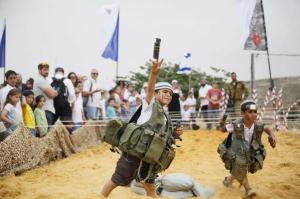 Standing at a Hamas training camp, Doucet laments: “For the outside world it’s hard to comprehend why parents would put children in situations like this.” But there’s no exploration of how Israel as a militarist, occupying state has conditioned so much of its own population to join in the historic oppression and mass murder of Palestinians. Indeed, the word ‘occupation’ is never used.
At one point, Doucet sits with the smiling Gazan kids and asks one of them: ‘Why do you want to be a journalist?’ The child replies in lovely innocence: ‘So I can tell people what’s going on in wars like this one’. If only Doucet could aspire to that same basic aim. One might ask Doucet, in turn: Why do you want to be a stenographer rather than a journalist?
We see more pictures of Gaza’s ruins. Doucet says: “The donors promise a lot. But politics on all sides gets in the way.” This is the extent of her ‘explanation’ of the carnage Israel has caused, the devastation it’s unleashed, its refusal to help rebuild.
Doucet’s grating commentary, over inappropriately lilting music, continues, with affected questions on whether the hate and suspicion can ever be overcome.
A scene of more families coming to settle in Israel’s border locale raises not a word of comment on the nature of Israel’s land appropriation, historic displacement of people and enduring occupation. The indoctrination of Israeli children in defending this is never mentioned, nor is the stark privilege of Israeli kids against the appalling conditions and despair of the children in Gaza. Doucet just smiles and says nothing of the staggering disparities.
I hope the families that Doucet interviewed in Gaza get to see how they’ve been used and exploited in this shabby, deceitful film.
An end credit announces that both Israel and Hamas could be indicted for war crimes, and that: ‘In May and June there were more rounds of rockets fired from Gaza and Israeli airstrikes’, the clear inference, as throughout this deeply-loaded film, that Israel is always ‘responding’ to provocative weaponry.
This is one of the worst examples of ‘two sides’ reportage ever shown. Israel couldn’t have hoped for a greater piece of mitigating hasbara. Doucet’s film is one of the most shameful pieces of ‘war journalism’ ever put out by the BBC.
She doesn’t lack human empathy for the suffering Palestinian kids, such as little Syed, still haunted by the murder of his brother and three cousins on Gaza’s beach. What she lacks, much more profoundly, is a sense of compassionate duty to say why these appalling things happened, and are still happening, to name the principal perpetrators, to be a witness for truth and justice.
Doucet’s film is an abuse of journalism, and, in its pretentious evasions, an abuse of Gaza’s suffering children.
“Blame it on Gaza” say UK Politicians
By Stuart Littlewood | Dissident Voice | July 9, 2015
It has no nukes, no navy, no air–force, no tanks, no phosphor bombs, no subs, no guided missiles, no exits, nowhere to run… its people are terrorised, blockaded and exhausted... their homes are rubble… unemployment is the highest in the world and 73% suffer food insecurity… but suddenly:
Gaza is ‘a recurring threat to peace’!
This blame-it-on-Gaza bombshell came in the middle of a House of Lords debate on the political situation in the Gaza Strip yesterday.
‘Hasbara’ stooges present their propaganda ‘facts’
Lord Davies of Stamford, formerly the MP Quentin Davies, stood up:
My Lords, there are five salient facts that ought to come out of any debate about Gaza…. One is that Gaza is clearly a most unpleasant place to live: it is extremely poor and very violent. It is poor partially because of the blockades that have been imposed by both its neighbours, Egypt and Israel, for reasons that may be very understandable.
The second salient fact that has come out and which is certainly recognised all over the world is that Gaza in its present state is a recurring threat to peace in the region. Rockets are continually fired at Israel. After some years, the Israelis inevitably lose their patience…. and intervene militarily. There is nasty military action, obviously with a lot of fatalities.
Obviously. And the casualties (including over 578 children killed and 1,000 permanently disabled) are all on one side. It would be helpful to say why rockets are fired at Israel. But do carry on with your fascinating analysis, noble Lord.
Those two facts are pretty well known. There are three facts about Gaza that are not so well known and which ought to be better known. One is that it is a very nasty, savage tyranny…. Hamas imposes its power by regular use of torture and execution of political opponents: so-called collaborators with the Israelis and so forth.
By mentioning torture, his Lordship reminds me of the grim reports we keep getting about Israel torturing Palestinian child prisoners.
The fourth point that ought to be much better known is one I tried to bring out a few weeks ago at Questions, when I asked the Minister whether Hamas could bring to an end, any day it wanted, the blockade imposed by Israel, simply by accepting the quartet conditions. These, as the House knows, are: the giving up of violence, the recognition of the state of Israel and the acceptance of existing accords, including the Oslo accord. The answer I got was yes, the Hamas regime could, any day it wants, get rid of these blockades. It chooses not to do so.
Israel too could do all of those things but chooses not to. It could, if it had the sense, end its illegal occupation but chooses not to. And why would Palestinians recognise Israel when Israel has said repeatedly that it opposes a Palestinian state? His Lordship’s mention of the Oslo accord, I imagine, is a reference to the then prime minister Ehud Barak’s “generous” offer to the Palestinians. In an earlier speech Lord Davies said that Yasser Arafat, at the Camp David meeting, refused to consider an offer which would have resulted in 97% of the West Bank being handed over to a Palestinian state.
The offer was not what it seemed and the noble Lord was repeating a hasbara propaganda myth. The West Bank and the Gaza Strip, seized by Israel in 1967 and occupied ever since, comprise just 22% of pre-partition Palestine. When the Palestinians signed the Oslo Agreement in 1993 they agreed to accept the measly 22% and recognise Israel within ‘Green Line’ borders (i.e. the 1949 Armistice Line established after the Arab-Israeli War and recognised internationally as the border). Conceding 78% of the land that was originally theirs was an astonishing compromise but not enough for greedy Barak. He demanded the inclusion of 69 Israeli settlements within Palestine’s 22% remnant.
It was plain to see on the map that these settlement blocs would create impossible obstacles to Palestinian life which was already severely disrupted. Barak also insisted the Palestinian territories be placed under “Temporary Israeli Control”, meaning Israeli military and administrative control indefinitely. His generous offer also gave Israel control over all the border crossings of the new Palestinian State. What nation in the world would accept that? The map was never shown publicly, and propaganda spin concealed how preposterous Barak’s offer was.
The following year, at Taba, Barak produced a revised map but it was withdrawn after his election defeat. The facts are well documented by organisations such as Israel’s Gush Shalom, which his Lordship might find enlightening.
Gaza ‘the most subsidised community on earth’
Lord Davies concluded his amazing insights:
The fifth point, which certainly is not as well known as it ought to be — because it affects the pockets of every taxpayer in this country, apart from anything else — is that this mixture of unpleasantness, tyranny, threat to world peace and denial is being actively subsidised by the international community to the tune of many billions of dollars a year…. this is probably the most subsidised community anywhere on God’s earth. The European Union makes much the biggest contribution to these subsidies, at about €1.6 billion, and the second largest contributor is Qatar, at about $1 billion.
If we are going to go on subsidising the Hamas regime as we do, we have to ask ourselves whether we should introduce an element of conditionality into our relationships with Hamas.
As everyone (except his Lordship) knows, it’s the Israeli occupation that is being subsidised. And Israel is repeatedly destroying infrastructure built with British taxpayers’ money. Left in peace and free to trade with the rest of the world the Palestinians would prosper.
To think that Lord Davies was once a Government defence minister… It’s no surprise to discover that he voted for the Iraq war and travelled to Israel and Palestine in 2008, expenses paid by Labour Friends of Israel and the Israeli Ministry of Foreign Affairs. Or that, as reported in The Mirror, he claimed £10,000 of taxpayers’ money for repairs to window frames at his “second home” – an 18th century mansion.
He had earlier claimed £20,700 expenses (later amended to £5,376) for repairs to a “bell tower”.
You’d think that the human condition in the Holy Land, and especially Gaza after Israel’s horrific 50-day onslaught last summer, would bother our senior holy men. But apparently not. Twenty-six Church of England bishops sit in the House of Lords. Only the Bishop of Chester spoke up, thankfully injecting some much needed common sense:
In Gaza the World Bank estimates the per capita income to be 30% lower today than 20 years ago. The contrast just gets greater over time, which sets up a huge instability. I understand all the arguments for a two-state solution…. but will two states so closely linked geographically and yet on such divergent paths easily exist side by side?
What I cannot understand from the Israeli perspective is the settlement programme. It is acknowledged on practically all sides outside Israel that it is both illegal and ill judged. In a certain way it is a parallel to the political mistakes in South Africa, where the South Africans simply dug themselves in and could not see the misjudgment.
How are we to go forward? We have to work with Hamas…. working with it must be the future, difficult though that may be.
More ministerial wisdom
As if Lord Davies’ contribution wasn’t dreadful enough, Baroness Anelay of St Johns (Minister of State, Foreign and Commonwealth Office) closed the debate with some silly pokes at Hamas.
We have assessed that Hamas is seeking to rebuild militant infrastructure, including the tunnel network, in Gaza, and we are deeply concerned at reports of militant groups rearming.
What does she expect when the international community still fails to act and Israel continues its raids?
We will recognise the state of Palestine, where Palestinians currently live, only if and when Hamas get to the position whereby it can recognise the right of Israel to exist.
Israel has never defined its borders because it is bent on territorial expansion. The 56% of mandate Palestine allocated to Israel by UN Partition in 1947 was immediately expanded to 78% by Israeli military aggression. The rest of Palestine was taken over in 1967 and remains under the Israeli jackboot. So exactly what are Hamas supposed to ‘recognise’? They have already said they’ll accept a Palestinian state on the pre-1967 Green Line borders, which is exactly in accord with international law.
Our policy on Hamas remains clear: it must renounce violence, recognise Israel and accept previously signed agreements. Hamas must make credible movement towards these conditions, which still remain the benchmark against which its intentions should be judged.
Why? There is no parallel requirement on Israel.
The UK is deeply concerned by the terrible human cost to both sides of the ongoing Israeli-Palestinian conflict, as underlined by the findings of the report. We strongly condemn the indiscriminate firing of rockets into Israel by Hamas and other militant groups in the Gaza Strip.
Again, no parallel condemnation of Israel’s murderous bombardment of Palestinian civilians.
We therefore welcome the fact that Israel is conducting its own internal investigations into specific incidents. Where there is evidence of wrongdoing those responsible must be held accountable.
Don’t hold your breath, Baroness.
The United Kingdom has been one of the largest donors to Gaza since last summer, providing more than £17 million in emergency assistance. I assure the noble Lord, Lord Davies of Stamford, that none of our aid goes to Hamas. It goes via the United Nations relief agency and the Gaza Reconstruction Mechanism…. The UK pledged an additional £20 million…. We have now delivered 80% of that pledge, with more to come shortly.
The British taxpayer, yet again, picks up the tab for the wreckage left behind by Israeli war crimes. It’s a paltry sum considering the Israelis caused damage estimated at $6 billion. If it wasn’t for the rotten windows of Lord Davies’ mansion and his crumbling bell tower, we could afford to give more.
NSA leaked Turkish officials false flag war talk: Report
Press TV – July 8, 2015
A 2014 Turkish Foreign Ministry session, which featured high-level Turkish officials discussing how Turkey could start a war with Syria, was reportedly recorded and leaked by the US National Security Agency (NSA).
German weekly magazine Focus attributed the leakage to the NSA, reporting on the security meeting among former Turkish Foreign Minister Ahmet Davutoğlu, National Intelligence Organization (MİT) head Hakan Fidan, Foreign Ministry Undersecretary Feridun Sinirlioğlu and Deputy Chief of General Staff Gen. Yaşar Güler.
President Recep Tayyip Erdogan, who was prime minister at the time, banned the video-sharing website YouTube after the leakage, which caught Fidan saying he would send four men from Syria to attack Turkey to “make up a cause of war.” Güler is heard saying in response, “What you’re going to do is a direct cause of war.”
Currently serving as Turkish prime minister, Davutoğlu said on July 3 that his country would not hesitate to launch a military intervention in Syria in case of what he referred to as a potential threat to Turkey’s “security.”
The Turkish newspaper Hürriyet Daily also reported last Sunday that the Turkish military had called on all troop commanders stationed along its border with Syria to be present at a meeting aimed at discussing a possible intervention in the crisis-hit country.
Erdogan has accused Syrian Kurds of trying to establish a state in Syria’s north, saying Ankara will leave no stone unturned to prevent such an establishment near its borders.
Ankara has long been engaged in a conflict with the Turkish Kurdistan Workers’ Party (PKK), which has been seeking an autonomous Kurdish region inside Turkey since the 1980s.
Turkey has also been one of the main supporters of the militancy against Syrian President Bashar al-Assad, with reports showing that Ankara actively trains and arms militants operating in Syria.
The Warped World of the GMO Lobbyist
By Colin Todhunter | CounterPunch | July 7, 2015
There’s a massive spike in cancer cases in Argentina that is strongly associated with glyphosate-based herbicides. These herbicides are a huge earner for agribusiness. But don’t worry, Patrick Moore says you can drink a whole quart and it won’t harm you. Who needs independent testing? He says people regularly try to commit suicide with it but fail. They survived – just. So what’s the problem? Perfectly safe. Patrick Moore says he is ‘not an idiot’. So he must be right. Right?
Anyway, all that scare mongering about GMOs and glyphosate is a conspiracy by a bunch of whinging lavishly funded green-blob types. Former UK environment minister Owen Paterson said as much. He says those self-serving anti-GMO people are damaging the interests of the poor and are profiting handsomely. They are condemning “billions” to lives of poverty.
He voted for the illegal invasion of Iraq, which has led to the death of almost 1.5 million Iraqis. His government has plunged millions into poverty and food insecurity in the UK. He now wants to help the poor by giving them GM courtesy of self-interested, corporations and their lavishly paid executives. What was that about self-serving, lavishly funded groups? As a staunch believer in doublespeak, hypocrisy and baseless claims by self-appointed humanitarians with awful track records, Paterson’s sound-bite smears and speeches are good enough for me.
So with that cleared up, hopefully we can move on.
Then there’s all that ‘anti-capitalist twaddle’ (another pearl of wisdom from Patrick Moore) about smallholders being driven from their lands and into poverty due to a corporate takeover aimed at expanding (GM) chemical-intensive agriculture. I showed Mr Moore a paper by an economics professor who had studied the devastation caused by the above in Ethiopia. That’s where the ‘anti-capitalist twaddle’ retort came in. As I’m also a staunch believer in the power of baseless, ill-informed abuse, I was once again convinced.
What about all that rubbish about GM not having enhanced the world’s ability to feed itself? You know, all that stuff about the way it has been used has merely led to greater food insecurity. Nonsense. I watched a prime-time BBC programme recently. Some scientist in a white coat in a lab said that GM can feed the world. He’d proved it in his lab. In reality (not in a lab), the fact it hasn’t done anything of the sort over the past 20-odd years doesn’t matter. He wore a white coat and held GM patents, so he definitely knows best!
I once read that industrialised agriculture is less productively efficient than smallholder agriculture that feeds most of the world. And then I read that the world can feed itself without GMOs. According to all of this, it is current policies and the global system of food production that militate against achieving global food security.
That’s just a big old load of rubbish put together by a bunch of conspiracy mongers. Who are these people? Food and trade policy analysts, political scientists, economics professors and the like. A bunch of whining anti-capitalist promoters of twaddle. None of them have studied molecular biology so how can they possibly be qualified to talk on this? I’d rather listen to a man in a lab who says GM can feed the world. He’s much more qualified to speak on politics, trade, the environment or anthropology than a bunch of lefties who don’t know one side of a petri dish from the other.
I happen to believe a profitable techno-fix is the way to go. A techno-fix that comes courtesy of the same companies whose global influence and power are helping to destroy indigenous agriculture across the world. But this is for the good of the traditional smallholder because these companies really, really care about the poor. Okay, okay, I know the top execs over at Monsanto are bringing in a massive annual cheque – but $12.4 million per year helps motivate a CEO to get out of bed in the morning and to develop empathy with the poor – unlike that elitist, self-serving green blob lot who rake in big money – according to hero-of-the-poor, the handsomely rewarded millionaire Owen Paterson… err, let’s swiftly move on.
To divert your attention away from all that scare mongering, conspiracy theory twaddle, I want you to concentrate solely on the science of GM and nothing else. But only on the version of ‘science’ as handed down from the great lawgiver in St Louis which creates it in its own image, not least by dodging any problematic questions that may have prevented GM from going on the market in the first place. Some troublemaker recently wrote a book about that, but someone said it wasn’t worth reading – so I didn’t bother (‘Altered Genes, Twisted…’ something or other – the word escapes me; it doesn’t appear in my lexicon).
So how about joining like-minded humanitarians and the handsomely-paid people over at big bioworld? We believe in mouthing platitudes about freedom and choice while serving interests that eradicate both. And let me add that scientists know that anyone who disagrees with them is just plain dim. C S Prakash recently posted a claim that implied such on Twitter. He’s a molecular biologist, so it must be true. Of course, there are scientists who disagree with us but they are quite clearly wrong – wrong methodology, wrong findings, wrong career turn – we’ll make sure of that!
In finishing, let me make the case for GM clear, based on logic and clear-headed rationality. There are those who are just too dim to understand any of the issues to do with GM so they should put up, shut up or go away and read or write about conspiracy theories on their blogs or in their peer-reviewed non-science journals that aren’t worth the paper they are written on given that the ‘peers’ in question are probably also a bunch of left-leaning wing nuts.
By comparison, unlike those self-serving ideologues, we are totally non-political. Okay, we might be firmly supporting a neoliberalism that is dominated by unaccountable big corporations which have captured policy-making space nationally and internationally, but any discussion of that is to be avoided by labelling those who raise such matters as politically motivated. We get you to focus on ‘the science’ – that is ‘our science’ – and nothing else. The fact that some of us tend to label anyone who disagrees with us as anti-science, anti-capitalist, socialists or enemies of the poor (or even ‘murdering bastards‘) says nothing at all about our political agenda.
And the lavish funds and powerful strategic position of big agribusiness means the pro-GMO lobby can smear, exert huge political influence and also restrict choice by preventing the labelling of GM food. You see, too much choice confuses people. We take the public for fools who will swallow anything – hopefully GMOs and our sound-bite deceptions.
So rests the case for GMOs. Eloquently put? I certainly think so. But I would say that, wouldn’t I? I’m paid to.
Colin Todhunter is an extensively published independent writer and former social policy researcher based in the UK and India.
NYPD destroyed evidence in class action lawsuit against department
RT | July 7, 2015
The New York Police Department (NYPD) has destroyed evidence in an ongoing lawsuit against it, which alleges that police use a secret quota system to make arrests, new documents claim.
The class action suit alleges that NYPD Commissioner Raymond Kelly and former Chief of Department Joseph Esposito were secretly applying pressure to officers to issue more arrests after falling short of quotas for traffic offenses and low-level crime, resulting in up to 850,000 wrongful summonses – or written notifications to a party telling them where and when they need to be in court. Some summons cases leave the recipient with a criminal record.
The allegations that a “quota system” for arrests exists at the NYPD are supported by emails, paperwork and text messages. One text message stated:
“We missed seat belt number by 30 last week unacceptable. if need be u guys will go with me 2 traffic stat 2 explain why u missed [sic].”
However, other such records have been destroyed, despite the city agreeing to surrender the information more than a year ago, the New York Post reports, citing a letter filed in the Manhattan federal court by the plaintiffs’ lawyers.
The lawyers claim that they discovered documents by obtaining them from third-party emails, including one of an NYPD captain writing, “This has to stop” when referring to an officer having only one arrest in over 50 hours of overtime.
But when the emails were requested, the city couldn’t produce them, even after searching.
“The production confirms what plaintiffs feared but defendants have repeatedly denied: Defendants have destroyed evidence that is unquestionably relevant to this matter,” plaintiffs’ lawyer Elinor Sutton wrote in a letter, the Post reported.
The letter continues, “It is simply not tenable that Commissioner Kelly and Chief Esposito did not – in the entire period of 2007 through the present – write or receive emails using terms related to the word ‘summons.’”
“The spoliation of this evidence clearly demonstrates Defendants’ bad-faith, grossly negligent, or at least, negligent destruction of relevant documents.”
She added that documents from meetings about crime statistics may have been shredded due to a policy that NYPD officers testified about previously.
The trial is expected to be held early next year.
Constitutional maneuvering in Ukraine to deny recognition of Donetsk and Lugansk republics and sabotage Minsk-2
New Cold War | July 6, 2015
The Donetsk and Lugansk People’s Republics have announced they will hold local elections on October 18 and November 1, respectively. The two dates surround announced local elections to take place in Ukraine on October 25.
Prime Minister of the Donetsk People’s Republic Aleksandr Zakharchenko made his announcement on July 2. According to UNIAN News, heads of cities and districts will be elected. No decision on the election of members of local councils has been made yet.
Lugansk People’s Republic Prime Minister Igor Plotnitsky announced on July 6 that similar local elections will take place there on November 1.
Interfax reports Zakharchenko as explaining, “In today’s situation, which emerged through Kyiv’s fault, the Donetsk People’s Republic has to independently start to implement the Minsk agreements in order to rescue them.
“We will begin acting immediately, without waiting for Kyiv to come to its senses and return to real, not fake, talks, because any further procrastination and delays will benefit only the Ukrainian party of war.”
Plotnitsky’s statement said, “Recently, we concluded that Ukraine doesn’t intend to abide by its commitments. Kiev either breaks or pretends to execute the provisions of the Minsk Agreement. The Verkhovna Rada issues bills not consistent with our draft documents on matters affecting the Donbass. To date, they’ve refused to define the special status of the LPR, nor have they even begun to write the laws embodying that special status. Besides that, with each passing day, Kiev intensifies its blockade of the LPR.”
“From such a perspective, we decided to begin a unilateral implementation of the Minsk Agreement regarding local elections in the LPR.”
The two prime ministers are referring to the failure of the Kyiv government to respect clauses of the Minsk-2 ceasefire agreement of Feb. 12, 2015 requiring dialogue with the rebel regions of Donetsk and Lugansk as well as a decentralization of powers to them.
The announcements by the two people’s republics administrations are in response to an elaborate scheme by the government of Ukrainian President Petro Poroshenko to dodge the key provisions of Minsk-2 requiring talks and constitutional change.
Back in May, at the eighth Kiev Security Forum, Poroshenko and Ukraine’s prime minister made it clear they will not engage in talks. “We will hold a dialogue with Donbass, but with the other Donbass, a Ukrainian one,” Poroshenko said. He went on, “We must ensure fair elections.”
Prime Minister Arseniy Yatsenyuk said his government would never talk to the current representatives in Donbas. “We will communicate only with the legitimate representatives of this region, we want to hold legitimate elections there.”
Yatsenyuk provocatively said his government would talk to leaders of the Donetsk and Lugansk republics “only when they are behind bars”. He added, “By the way, we have got enough empty prison cells.”
Instead of talks, the Ukraine government convened a Constitutional Commission in April. That body is set to deliver its draft report to the Verkhovna Rada this week. It will propose some cosmetic decentralization changes, but crucially, the changes will deny any present or future recognition of the Donetsk and Lugansk republics. The constitutional changes will be sold to international public opinion as proof of compliance with Minsk-2.
Poroshenko earlier announced local elections for October 25 as part of the scheme. Donetsk and Lugansk republics will, of course, refuse to allow a government in Kyiv waging war on them to conduct elections on their territories. This will be sold as proof of their intransigence and impossibility of dialogue with them.
TASS reports Zakharchenko saying in his July 2 announcement that Kiev’s unilateral actions on adopting amendments to Ukraine’s constitution serve as evidence that “the Kiev regime has de facto exited the Minsk peace process”.
“Under the circumstances,” he said, “the Donetsk People’s Republic has to start implementing the Minsk agreements itself in order to save them.”
The following day, the DPR head responded to an orchestrated statement by U.S. Vice-President Joseph Biden criticizing the Oct. 18 election decision. Zakharchenko said, reports TASS, “The U.S. Vice President has most likely not studied the issue thoroughly. I doubt that he has even read the Minsk package of measures. And Poroshenko is distorting facts as usual.”
He continued, “If Biden is really concerned about the future of the Minsk accords, than he should make Poroshenko and Groysman [Speaker of the Verkhovna Rada] implement them.”
Russian Foreign Minister Sergei Lavrov issued a statement on July 3 saying his government is deeply disappointed with what it calls the failure of the Ukrainian government to respect provisions of Minsk-2. He said, “Russia is deeply concerned about Kiev’s inability and unwillingness to fulfill its commitments to coordinate with Donetsk and Lugansk modalities of conducting local elections and its inability to attract representatives of the self-proclaimed republics to drawing up a new constitution.”
Lavrov said that Poroshenko’s and Yatsenyuk’s government has written a new, draft constitution without participation of Donetsk and Lugansk representatives. This “does not fulfill any of the requirements of the Minsk agreements with regard to this document.”
The draft “does not reflect the tasks of ensuring a special status for these territories on a permanent basis and does not reflect the tasks of decentralization of power,” as envisaged in the peace deal reached in the Belorussian capital in February.
Daraa 2011: Syria’s Islamist Insurrection in Disguise

By Prof. Tim Anderson | Global Research | July 5, 2015
“I have seen from the beginning armed protesters in those demonstrations … they were the first to fire on the police. Very often the violence of the security forces comes in response to the brutal violence of the armed insurgents” – Jesuit priest Father Frans Van der Lugt, January 2012, Homs Syria
“The claim that armed opposition to the government has begun only recently is a complete lie. The killings of soldiers, police and civilians, often in the most brutal circumstances, have been going on virtually since the beginning.” – Professor Jeremy Salt, October 2011, Ankara Turkey
“The protest movement in Syria was overwhelmingly peaceful until September 2011” – Human Rights Watch, March 2012, Washington
A double story began on the Syrian conflict, at the very beginning of the armed violence in 2011, in the southern border town of Daraa. The first story comes from independent witnesses in Syria, such as the late Father Frans Van der Lugt in Homs. They say that armed men infiltrated the early political reform demonstrations to shoot at both police and civilians. This violence came from sectarian Islamists. The second comes from the Islamist groups (‘rebels’) and their western backers, including the Washington-based Human Rights Watch. They claim there was ‘indiscriminate’ violence from Syrian security forces to repress political rallies and that the ‘rebels’ grew out of a secular political reform movement.
Careful study of the independent evidence, however, shows that the Washington-backed ‘rebel’ story, while widespread, was part of a strategy to delegitimise the Syrian Government, with the aim of fomenting ‘regime change’. To understand this it is necessary to study the outbreak of the violence in Daraa, in March 2011. Central to that insurrection were shipments of arms from Saudi Arabia to Islamists at the al Omari mosque.
In early 2011 Syrians were well aware of a piece of history few western observers would remember: a strikingly similar Islamist insurrection took place in the town of Hama, back in 1982. Yet this was crushed within weeks by the Syrian Arab Army. Reviewing this conflict is useful because of the myths that have grown up around both insurrections.
US intelligence (DIA 1982) and the late British author Patrick Seale (1988) give independent accounts of what happened at Hama. After years of violent, sectarian attacks by Syria’s Muslim Brotherhood, by mid-1980 President Hafez al Assad had ‘broken the back’ of their sectarian rebellion, which aimed to impose a Salafi-Islamic state. One final coup plot was exposed and the Brotherhood ‘felt pressured into initiating’ an uprising in their stronghold of Hama. Seale describes the start of that violence in this way:
‘At 2am on the night of 2-3 February 1982 an army unit combing the old city fell into an ambush. Roof top snipers killed perhaps a score of soldiers … [Brotherhood leader] Abu Bakr [Umar Jawwad] gave the order for a general uprising … hundreds of Islamist fighters rose … by the morning some seventy leading Ba’athists had been slaughtered and the triumphant guerrillas declared the city ‘liberated’ (Seale 1988: 332).
However the Army responded with a huge force of about 12,000 and the battle raged for three weeks. It was a foreign-backed civil war, with some defections from the army. Seale continues:
‘As the tide turned slowly in the government’s favour, the guerrillas fell back into the old quarters … after heavy shelling, commandos and party irregulars supported by tanks moved in … many civilians were slaughtered in the prolonged mopping up, whole districts razed’ (Seale 1988: 333).
Two months later a US intelligence report said: ‘The total casualties for the Hama incident probably number about 2,000. This includes an estimated 300 to 400 members of the Muslim Brotherhood’s elite ‘Secret Apparatus’ (DIA 1982: 7). Seale recognises that the Army also suffered heavy losses. At the same time, ‘large numbers died in the hunt for the gunmen … government sympathizers estimating a mere 3,000 and critics as many as 20,000 … a figure of 5,000 to 10,000 could be close to the truth’ He adds:
‘The guerrillas were formidable opponents. They had a fortune in foreign money … [and] no fewer than 15,000 machine guns’ (Seale 1988: 335). Subsequent Muslim Brotherhood accounts have inflated the casualties, reaching up to ‘40,000 civilians’, and attempting to hide the vicious insurrection by claiming that Hafez al Assad had simply carried out a ‘civilian massacre’ (e.g. Nassar 2014). The then Syrian President blamed a large scale foreign conspiracy for the Hama insurrection. Seale observes that Hafez was ‘not paranoical’, as many US weapons were captured and foreign backing had come from several US collaborators: King Hussayn of Jordan, Lebanese Christian militias (the Israeli-aligned ‘Guardians of the Cedar’) and Saddam Hussein in Iraq (Seale 1988: 336-337).
The Hama insurrection helps us understand the Daraa violence because, once again in 2011, we saw armed Islamists using rooftop sniping against police and government officials, drawing in the armed forces, only to cry ‘civilian massacre’ when they and their collaborators came under attack from the Army. Although the US, through its allies, played an important part in the Hama insurrection, when it was all over US intelligence dryly observed that: ‘the Syrians are pragmatists who do not want a Muslim Brotherhood government’ (DIA 1982: vii).
In the case of Daraa, and the attacks that moved to Homs and surrounding areas in April 2011, the clearly stated aim was once again to topple the secular or ‘infidel-Alawi’ regime. The front-line US collaborators were Saudi Arabia, Qatar and Turkey. The head of the Syrian Brotherhood, Muhammad Riyad Al-Shaqfa, issued a statement on 28 March which left no doubt that the group’s aim was sectarian. The enemy was ‘the secular regime’ and Brotherhood members ‘have to make sure that the revolution will be pure Islamic, and with that no other sect would have a share of the credit after its success’ (Al-Shaqfa 2011). While playing down the initial role of the Brotherhood, Sheikho confirms that it ‘went on to punch above its actual weight on the ground during the uprising … [due] to Turkish-Qatari support’, and to its general organisational capacity (Sheikho 2013). By the time there was a ‘Free Syrian Army Supreme Military Council’ in 2012 (more a weapons conduit than any sort of army command), it was two-thirds dominated by the Muslim Brotherhood (Draitser 2012). Other foreign Salafi-Islamist groups quickly joined this ‘Syrian Revolution’. A US intelligence report in August 2012, contrary to Washington’s public statements about ‘moderate rebels’, said:
‘The Salafist, the Muslim Brotherhood and AQI [Al Qaeda in Iraq, later ISIS] are the major forces driving the insurgency in Syria … AQI supported the Syrian Opposition from the beginning, both ideologically and through the media’ (DIA 2012).
In February 2011 there was popular agitation in Syria, to some extent influenced by the events in Egypt and Tunisia. There were anti-government and pro-government demonstrations, and a genuine political reform movement that for several years had agitated against corruption and the Ba’ath Party monopoly. A 2005 report referred to ‘an array of reform movements slowly organizing beneath the surface’ (Ghadry 2005), and indeed the ‘many faces’ of a Syrian opposition, much of it non-Islamist, had been agitating since about that same time (Sayyid Rasas 2013). These political opposition groups deserve attention, in another discussion. However only one section of that opposition was linked to the violence that erupted in Daraa. Large anti-government demonstrations began, to be met with huge pro-government demonstrations. In early March some teenagers in Daraa were arrested for graffiti that had been copied from North Africa ‘the people want to overthrow the regime’. It was reported that they were abused by local police, President Bashar al Assad intervened, the local governor was sacked and the teenagers were released (Abouzeid 2011).
Yet the Islamist insurrection was underway, taking cover under the street demonstrations. On 11 March, several days before the violence broke out in Daraa, there were reports that Syrian forces had seized ‘a large shipment of weapons and explosives and night-vision goggles … in a truck coming from Iraq’. The truck was stopped at the southern Tanaf crossing, close to Jordan. The Syrian Government news agency SANA said the weapons were intended ‘for use in actions that affect Syria’s internal security and spread unrest and chaos.’ Pictures showed ‘dozens of grenades and pistols as well as rifles and ammunition belts’. The driver said the weapons had been loaded in Baghdad and he had been paid $5,000 to deliver them to Syria (Reuters 2011). Despite this interception, arms did reach Daraa, a border town of about 150,000 people. This is where the ‘western-rebel’ and the independent stories diverge, and diverge dramatically. The western media consensus was that protestors burned and trashed government offices, and then ‘provincial security forces opened fire on marchers, killing several’ (Abouzeid 2011). After that, ‘protestors’ staged demonstrations in front of the al-Omari mosque, but were in turn attacked.
The Syrian government, on the other hand, said that armed attacks had begun on security forces, killing police and civilians, along with the burning of government offices. There was foreign corroboration of this account. While its headline blamed security forces for killing ‘protesters’, the British Daily Mail (2011) showed pictures of guns, AK47 rifles and hand grenades that security forces had recovered after storming the al-Omari mosque. The paper noted reports that ‘an armed gang’ had opened fire on an ambulance, killing ‘a doctor, a paramedic and a policeman’. Media channels in neighbouring countries did report on the killing of Syrian police, on 17-18 March. On 21 March a Lebanese news report observed that ‘Seven policemen were killed during clashes between the security forces and protesters in Syria’ (YaLibnan 2011), while an Israel National News report said ‘Seven police officers and at least four demonstrators in Syria have been killed … and the Baath party headquarters and courthouse were torched’ (Queenan 2011). These police had been targeted by rooftop snipers.
Even in these circumstances the Government was urging restraint and attempting to respond to the political reform movement. President Assad’s adviser, Dr Bouthaina Shaaban, told a news conference that the President had ordered ‘that live ammunition should not be fired, even if the police, security forces or officers of the state were being killed’. Assad proposed to address the political demands, such as the registration of political parties, removing emergency rules and allowing greater media freedoms (al-Khalidi 2011). None of that seemed to either interest or deter the Islamist insurrection.
Several reports, including video reports, observed rooftop snipers firing at crowds and police, during funerals of those already killed. It was said to be ‘unclear who was firing at whom’ (Al Jazeera 2011a), as ‘an unknown armed group on rooftops shot at protesters and security forces’ (Maktabi 2011). Yet Al Jazeera (2011b) owned by the Qatari monarchy, soon strongly suggested that that the snipers were pro-government. ‘President Bashar al Assad has sent thousands of Syrian soldiers and their heavy weaponry into Derra for an operation the regime wants nobody in the word to see’. However the Al Jazeera suggestion that secret pro-government snipers were killing ‘soldiers and protestors alike’ was illogical and out of sequence. The armed forces came to Daraa precisely because police had been shot and killed.
Saudi Arabia, a key US regional ally, had armed and funded extremist Salafist Sunni sects to move against the secular government. Saudi official Anwar Al-Eshki later confirmed to BBC television that his country had sent arms to Daraa and to the al-Omari mosque (Truth Syria 2012). From exile in Saudi Arabia, Salafi Sheikh Adnan Arour called for a holy war against the liberal Alawi Muslims, who were said to dominate the Syrian government. The Salafist aim was a theocratic state or caliphate. The genocidal slogan ‘Christians to Beirut, Alawites to the grave’ became widespread, a fact reported by the North American media as early as May 2011 (e.g. Blanford 2011). Islamists from the FSA Farouq brigade would soon act on these threats (Crimi 2012). Canadian analyst Michel Chossudovsky (2011) concluded:
‘The deployment of armed forces including tanks in Daraa [was] directed against an organised armed insurrection, which has been active in the border city since March 17-18.’
After those first few days in Daraa the killing of Syrian security forces continued, but went largely unreported outside Syria. Nevertheless, independent analyst Sharmine Narwani wrote about the scale of this killing in early 2012 and again in mid-2014. An ambush and massacre of soldiers took place near Daraa in late March or early April. An army convoy was stopped by an oil slick on a valley road between Daraa al-Mahata and Daraa al-Balad and the trucks were machine gunned. Estimates of soldier deaths, from government and opposition sources ranged from 18 to 60. A Daraa resident said these killings were not reported because: ‘At that time, the government did not want to show they are weak and the opposition did not want to show they are armed’. Anti-Syrian blogger, Nizar Nayouf, records this massacre as taking place in the last week of March. Another anti-Government writer, Rami Abdul Rahman (based in England, and calling himself the ‘Syrian Observatory of Human Rights’) says:
‘It was on the first of April and about 18 or 19 security forces … were killed’ (Narwani 2014). Deputy Foreign Minister Faisal Mikdad, himself a resident of Daraa, confirmed that: ‘this incident was hidden by the government … as an attempt not to antagonize or not to raise emotions and to calm things down – not to encourage any attempt to inflame emotions which may lead to escalation of the situation’ (Narwani 2014).
Yet the significance of denying armed anti-Government killings was that, in the western media, all deaths were reported as (a) victims of the Army and (b) civilians. For well over six months, when a body count was mentioned in the international media, it was usually considered acceptable to suggest these were all ‘protestors’ killed by the Syrian Army. For example, a Reuters report on 24 March said Daraa’s main hospital had received ‘the bodies of at least 37 protestors killed on Wednesday’ (Khalidi 2011). Notice that all the dead had become ‘protestors’, despite earlier reports on the killing of a number of police and health workers.
Another nineteen soldiers were gunned down on 25 April, also near Daraa. Narwani obtained their names and details from Syria’s Defence Ministry, and corroborated these details from another document from a non-government source. Throughout April 2011 she calculates that eighty-eight Syrian soldiers were killed ‘by unknown shooters in different areas across Syria’ (Narwani 2014). She went on to refute claims that the soldiers killed were ‘defectors’, shot by the Syrian army for refusing to fire on civilians. The Washington based group Human Rights Watch, referring to interviews with 50 unnamed ‘activists’, claimed that soldiers killed at this time were all ‘defectors’, murdered by the Army (HRW 2011b). Yet the funerals of loyal officers, shown on the internet at that time, were distinct. Even Rami Abdul Rahman, keen to blame the Army for killing civilians, said ‘this game of saying the Army is killing defectors for leaving – I never accepted this’ (Narwani 2014). Nevertheless the highly charged reports were confusing, in Syria as well as outside.
The violence spread north, with the assistance of Islamist fighters from Lebanon, reaching Baniyas and areas around Homs. On 10 April nine soldiers were shot in a bus ambush in Baniyas. In Homs, on April 17, General Abdo Khodr al-Tallawi was killed with his two sons and a nephew, and Syrian commander Iyad Kamel Harfoush was gunned down near his home. Two days later, off-duty Colonel Mohammad Abdo Khadour was killed in his car (Narwani 2014). North American commentator Joshua Landis (2011a) reported the death of his wife’s cousin, one of the soldiers in Baniyas.
Al Jazeera, the principal Middle East media channel backing the Muslim Brotherhood, blacked out these attacks, as also the reinforcement provided by armed foreigners. Former Al Jazeera journalist Ali Hashem was one of many who resigned from the Qatar-owned station (RT 2012), complaining of deep bias over their presentation of the violence in Syria. Hashem had footage of armed men arriving from Lebanon, but this was censored by his Qatari managers. ‘In a resignation letter I was telling the executive … it was like nothing was happening in Syria.’ He thought the ‘Libyan revolution’ was the turning point for Al Jazeera, the end of its standing as a credible media group (Hashem 2012).
Provocateurs were at work. Tunisian jihadist ‘Abu Qusay’ later admitted he had been a prominent ‘Syrian rebel’ charged with ‘destroying and desecrating Sunni mosques’, including by scrawling the graffiti ‘There is no God but Bashar’, a blasphemy to devout Muslims. This was then blamed on the Syrian Army, with the aim of creating Sunni defections from the Army. ‘Abu Qusay’ had been interviewed by foreign journalists who did not notice he was not Syrian (Eretz Zen 2014).
Journalist Nir Rosen, whose reports were generally against the Syrian Government, also criticised the western consensus over the early violence:
‘The issue of defectors is a distraction. Armed resistance began long before defections started … Every day the opposition gives a death toll, usually without any explanation … Many of those reported killed are in fact dead opposition fighters but … described in reports as innocent civilians killed by security forces … and every day members of the Syrian Army, security agencies … are also killed by anti-regime fighters’ (Rosen 2012).
A numbers game was being played to delegitimise the Syrian Government (‘The Regime’) and the Syrian Army (‘Assad loyalists’), suggesting they were responsible for all the violence. Just as NATO forces were about to bomb Libya and overthrow the Libyan Government, US voices began to demand that President Assad step down. The Brookings Institution (Shaikh 2011) claimed the President had ‘lost the legitimacy to remain in power in Syria’. US Senators John McCain, Lindsay Graham and Joe Lieberman said it was time ‘to align ourselves unequivocally with the Syrian people in their peaceful demand for a democratic government’ (FOX News 2011). The big powers began to demand yet another ‘regime change’.
In June, US Secretary of State Hilary Clinton dismissed the idea that ‘foreign instigators’ had been at work, saying that ‘the vast majority of casualties have been unarmed civilians’ (Clinton 2011). In fact, as Clinton knew very well, her Saudi Arabian allies had armed extremists from the very beginning. Her casualty assertion was also wrong. The United Nations (which would later abandon its body count) estimated from several sources that, by early 2012, there were more than 5,000 casualties, and that deaths in the first year of conflict included 478 police and 2,091 from the military and security forces (OHCHR 2012: 2; Narwani 2014). That is, more than half the casualties in the first year were those of the Syrian security forces. That independent calculation was not reflected in western media reports. ‘Watchdog’ NGOs such as Human Rights Watch, along with US columnists (e.g. Allaf 2012), continued to claim, well into 2012, that Syrian security forces had been massacring ‘unarmed protestors’, that the Syrian people ‘had no choice’ but to take up arms, and that this ‘protest movement’ had been ‘overwhelmingly peaceful until September 2011’ (HRW 2011a, HRW 2012). In fact, the political reform movement had been driven off the streets by Salafi-Islamist gunmen, over the course of March and April.
In June reporter Hala Jaber (2011) observed that about five thousand people turned up for a demonstration at Ma’arrat al-Numan, a small town in north-west Syria, between Aleppo and Hama. She says several ‘protestors’ had been shot the week before, while trying to block the road between Damascus and Aleppo. After some negotiations which reduced the security forces in the town, ‘men with heavy beards in cars and pick-ups with no registration plates’ with ‘rifles and rocket-propelled grenades’ began shooting at the reduced numbers of security forces. A military helicopter was sent to support the security forces. After this clash ‘four policemen and 12 of their attackers were dead or dying. Another 20 policemen were wounded’. Officers who escaped the fight were hidden by some of the tribal elders who had participated in the original demonstration. When the next ‘demonstration for democracy’ took place, the following Friday, ‘only 350 people turned up’, mostly young men and some bearded militants (Jaber 2011). Five thousand protestors had been reduced to 350, after the Salafist attacks.
After months of media manipulations, disguising the Islamist insurrection, Syrians such as Samer al Akhras, a young man from a Sunni family, who used to watch Al Jazeera because he preferred it to state TV, became convinced to back the Syrian government. He saw first-hand the fabrication of reports on Al Jazeera and wrote, in late June 2011:
‘I am a Syrian citizen and I am a human. After 4 months of your fake freedom … You say peaceful demonstration and you shoot our citizen. From today … I am [now] a Sergeant in the Reserve Army. If I catch anyone … in any terrorist organization working on the field in Syria I am gonna shoot you as you are shooting us. This is our land not yours, the slaves of American fake freedom’ (al Akhras 2011).
Notes:
Abouzeid, Rania (2011) ‘Syria’s Revolt, how graffiti stirred an uprising’,Time, 22 March
Al Akhras, Samer (2011) ‘Syrian Citizen’, Facebook, 25 June, online:https://www.facebook.com/notes/sam-al-akhras/syrian-citizen/241770845834062?pnref=story
Al Jazeera (2011a) ‘Nine killed at Syria funeral processions’, 23 April, online:http://www.aljazeera.com/news/middleeast/2011/04/20114231169587270.html
Al Jazeera (2011b) ‘Deraa: A city under a dark siege’, 28 April, online:http://www.aljazeera.com/indepth/features/2011/04/2011427215943692865.html
Al-Shaqfa, Muhammad Riyad (2011) ‘Muslim Brotherhood Statement about the so-called ‘Syrian Revolution’’, General supervisor for the Syrian Muslim Brotherhood, statement of 28 March, online at: http://truthsyria.wordpress.com/2012/02/12/muslim-brotherhood-statement-about-the-so-called-syrian-revolution/
Allaf, Rime (2012) ‘This Time, Assad Has Overreached’, NYT, 5 Dec, online:http://www.nytimes.com/roomfordebate/2012/02/06/is-assads-time-running-out/this-time-assad-has-overreached
Blanford, Nicholas (2011) ‘Assad regime may be gaining upper hand in Syria’, Christina Science Monitor, 13 may, online:http://www.csmonitor.com/World/Middle-East/2011/0513/Assad-regime-may-be-gaining-upper-hand-in-Syria
Chossudovsky, Michel (2011) ‘Syria: who is behind the protest movement? Fabricating a pretext for US-NATO ‘Humanitarian Intervention’’, Global Research, 3 May, online: http://www.globalresearch.ca/syria-who-is-behind-the-protest-movement-fabricating-a-pretext-for-a-us-nato-humanitarian-intervention/24591
Clinton, Hilary (2011) ‘There is No Going Back in Syria’, US Department of State, 17 June, online: http://www.state.gov/secretary/20092013clinton/rm/2011/06/166495.htm
Maktabi, Rima (2011) ‘Reports of funeral, police shootings raise tensions in Syria’, CNN, 5 April, online: http://edition.cnn.com/2011/WORLD/meast/04/05/syria.unrest/
Crimi, Frank (2012) ‘Ethnic Cleansing of Syrian Christians’, Frontpagemag,29 March, online: http://www.frontpagemag.com/2012/frank-crimi/ethnic-cleansing-of-syrian-christians/
Daily Mail (2011) ‘Nine protesters killed after security forces open fire by Syrian mosque’, 24 March
DIA (1982) ‘Syria: Muslim Brotherhood Pressure Intensifies’, Defence Intelligence Agency (USA), May, online: https://syria360.files.wordpress.com/2013/11/dia-syria-muslimbrotherhoodpressureintensifies-2.pdf
DIA (2012) ‘Department of Defence Information Report, Not Finally Evaluated Intelligence, Country: Iraq’, Defence Intelligence Agency, August, 14-L-0552/DIA/297-293, Levant report, online at:http://levantreport.com/2015/05/19/2012-defense-intelligence-agency-document-west-will-facilitate-rise-of-islamic-state-in-order-to-isolate-the-syrian-regime/
Draitser, Eric (2012) ‘Unmasking the Muslim Brotherhood: Syria, Egypt and beyond’, Global Research, 12 December, online:http://www.globalresearch.ca/unmasking-the-muslim-brotherhood-syria-egypt-and-beyond/5315406
Eretz Zen (2014) ‘Tunisian Jihadist Admits: We Destroyed & Desecrated Mosques in Syria to Cause Defections in Army’, Youtube Interview, 16 March, online: https://www.youtube.com/watch?v=fQ8awN8GLAk
FOX News (2011) ‘Obama Under Pressure to Call for Syrian Leader’s Ouster’,29 April, online: http://www.foxnews.com/politics/2011/04/29/obama-pressure-syrian-leaders-ouster/
Ghadry, Farid N. (2005) ‘Syrian Reform: What Lies Beneath’, Middle East Quarterly, Vol 12 No 1, Winter, online: http://www.meforum.org/683/syrian-reform-what-lies-beneath
Haidar, Ali (2013) interview with this writer, Damascus 28 December. Ali Haidar was President of the Syrian Social National Party (SS NP), a secular rival to the Ba’ath Party. In 2012 President Bashar al Assad incorporated him into the Syrian government as Minister for Reconciliation.
Hashem, Ali (2012) ‘Al Jazeera Journalist Explains Resignation over Syria and Bahrain Coverage’, The Real News, 20 March, online:http://therealnews.com/t2/index.php?option=com_content&task=view&id=31&Itemid=74&jumival=8106
HRW (2011a) ‘We’ve never seen such horror: crimes against humanity by Syrian Security Forces’, Human Rights Watch, June, online:http://www.hrw.org/reports/2011/06/01/we-ve-never-seen-such-horror-0
HRW (2011b) Syria: Defectors Describe Orders to Shoot Unarmed Protesters’, Human Rights watch, Washington, 9 July, online:http://www.hrw.org/news/2011/07/09/syria-defectors-describe-orders-shoot-unarmed-protesters
HRW (2012) ‘Open Letter to the Leaders of the Syrian Opposition, Human Rights Watch, Washington, 20 March, online:http://www.hrw.org/news/2012/03/20/open-letter-leaders-syrian-opposition
Jaber, Hala (2011) ‘Syria caught in crossfire of extremists’, Sunday Times, 26 June, online: http://www.thesundaytimes.co.uk/sto/news/world_news/Middle_East/article657138.ece
Khalidi, Suleiman (2011) ‘Thousands chant ‘freedom’ despite Assad reform offer’, Reuters, 24 March, online: http://www.reuters.com/article/2011/03/24/us-syria-idUSTRE72N2MC20110324
Landis, Joshua (2011a) ‘The Revolution Strikes Home: Yasir Qash`ur, my wife’s cousin, killed in Banyas’, Syria Comment, 11 April, online:http://www.joshualandis.com/blog/the-revolution-strikes-home-yasir-qashur-my-wifes-cousin-killed-in-banyas/
Landis, Joshua (2011b) ‘Syria’s Opposition Faces an Uncertain Future’, Syria Comment, 26 June, online: http://www.joshualandis.com/blog/syrias-opposition-faces-an-uncertain-future/
MEMRITV (2011) ‘Syrian Sunni Cleric Threatens: “We Shall Mince [The Alawites] in Meat Grinders”’, YouTube, 13 July, online:https://www.youtube.com/watch?v=Bwz8i3osHww
Nassar, Jessy (2014) ‘Hama: A rebirth from the ashes?’ Middle East Monitor,11 July, online: https://www.middleeastmonitor.com/articles/middle-east/12703-hama-a-rebirth-from-the-ashes
Narwani, Sharmine (2012) ‘Questioning the Syrian “Casualty List”, 28 Feb, online: http://english.al-akhbar.com/content/questioning-syrian-%E2%80%9Ccasualty-list%E2%80%9D
Narwani, Sharmine (2014) Syria: The hidden massacre, RT, 7 May, online:http://rt.com/op-edge/157412-syria-hidden-massacre-2011/
OHCHR (2012) ‘Periodic Update’, Independent International Commission of Inquiry established pursuant to resolution A/HRC/S – 17/1 and extended through resolution A/HRC/Res/19/22, 24 may, online:
http://www.ohchr.org/Documents/HRBodies/HRCouncil/CoISyria/PeriodicUpdate24May2012.pdf
Queenan, Gavriel (2011) ‘Syria: Seven Police Killed, Buildings torched in protests’, Israel National News, Arutz Sheva, March 21
Reuters (2011) ‘Syria says seizes weapons smuggled from Iraq’, 11 March, online: http://www.reuters.com/article/2011/03/11/us-syria-iraq-idUSTRE72A3MI20110311?hc_location=ufi
Rosen, Nir (2012) ‘Q&A: Nir Rosen on Syria’s armed opposition’, Al Jazeera,13 Feb, online: http://www.aljazeera.com/indepth/features/2012/02/201221315020166516.html
RT (2012) ‘Al Jazeera exodus: Channel losing staff over ‘bias’’, 12 March, online: http://rt.com/news/al-jazeera-loses-staff-335/
Salt, Jeremy (2011) Truth and Falsehood in Syria, The Palestine Chronicle, 5 October, online: http://palestinechronicle.com/view_article_details.php?id=17159
Sayyid Rasas, Mohammed (2013) ‘From 2005 to 2013: The Syrian Opposition’s Many Faces’, Al Akhbar, 19 March, online: http://english.al-akhbar.com/node/15287
Shaikh, Salman (2011) ‘In Syria, Assad Must Exit the Stage’, Brookings Institution, 27 April, online: http://www.brookings.edu/research/opinions/2011/04/27-syria-shaikh
Sheikho, Youssef (2013) ‘The Syrian Opposition’s Muslim Brotherhood Problem’, Al Akhbar English, April 10, online: http://english.al-akhbar.com/node/15492
Truth Syria (2012) ‘Syria – Daraa revolution was armed to the teeth from the very beginning’, BBC interview with Anwar Al-Eshki, YouTube interview, video originally uploaded 10 April, latest version 7 November, online:https://www.youtube.com/watch?v=FoGmrWWJ77w
Seale, Patrick (1988) Asad: the struggle for the Middle East, University of California Press, Berkeley CA
van der Lugt, Frans (2012) ‘Bij defaitisme is niemand gebaat’, from Homs,13 January, online: https://mediawerkgroepsyrie.wordpress.com/2012/01/13/bij-defaitisme-is-niemand-gebaat/
Wikstrom, Cajsa (2011) Syria: ‘A kingdom of silence’, Al Jazeera, 9 Feb, online: http://www.aljazeera.com/indepth/features/2011/02/201129103121562395.html
YaLibnan (2011) ‘7 Syrian policemen killed in Sunday clashes’, 21 March, online: http://yalibnan.com/2011/03/21/7-syrian-policemen-killed-in-sunday-clashes-report/
Samantha Power Lies to Congress About Civilian Shelling in Ukraine, Commits Felony
Russia Insider | July 3, 2015
- The US Ambassador to the UN, she claims she believes majority of civilian shelling casualties are victims of the separatists.
- The penalty for lying to Congress is up to 8 years of imprisonment.
 Ambassador Power’s testimony was the subject of a story we ran on Monday of this week, and a helpful reader got back to us and pointed out that we had missed the most important part of it.
Apparently, Ambassador Power lied to the committee she was testifying before, thereby committing a felony.
Congressman Rohrabacher, one of the loudest critics of Obama’s Russia policy, asked her if she thought it might be possible that the majority of the civilian casualties killed in Ukraine were victims of the Ukrainian army.
It was a “gotcha” question, because this is a universally acknowledged fact.
Here is what the ambassador answered:
“I think it is highly unlikely on the basis of reports we have received from the United Nations and the OSCE.”
See 1.50 in the video:
This statement is demonstrably not true. Reports from the UN and the OSCE conclusively demonstrate what it obvious to everyone even halfway paying attention – that the victims are almost universally victims of Ukrainian army shelling.
It is starkly preposterous to suggest otherwise, because even a dimwit could grasp that the separatists are unlikely to bomb their own people.
It is simply not plausible that the ambassador believes this, and is not aware of the facts.
Ironically, Power is the author of a book which studies US foreign policy responses to genocide, so she has more than a passing interest in these issues. The book’s title is A Problem from Hell: America and the Age of Genocide,
She has made protection of human rights a hallmark of her career, yet she is one of the most energetic and committed boosters of the aggressive Ukrainian military campaigns in the East, which have featured the most barbaric human rights violations imaginable – shelling defenseless civilians – children and elderly, with horrific, blood-curdling casualties, visible for all to see in gory detail on Youtube.
The shelling serves no military purpose and is done only to terrorize the local population in the hopes of triggering a Russian response.
Here is what the law says:

On Iran’s Nuclear Program, Ghosh’s “Gotcha” is Nothing But Smoke
“Whoever is careless with the truth in small matters cannot be trusted in important affairs.” – Albert Einstein
By Nima Shirazi | Wide Asleep in America | July 3, 2015
Bobby Ghosh, former TIME contributor and currently managing editor at Quartz, decided on Tuesday to produce some absurd, mouth-breathing click-bait – the kind of deliberately sloppy disinformation that serves only to further chum the waters of public opinion with the false narratives and grotesque stereotypes that have long been the stock-in-trade of agenda-driven, attention-seeking commentators about Iran and its nuclear program.
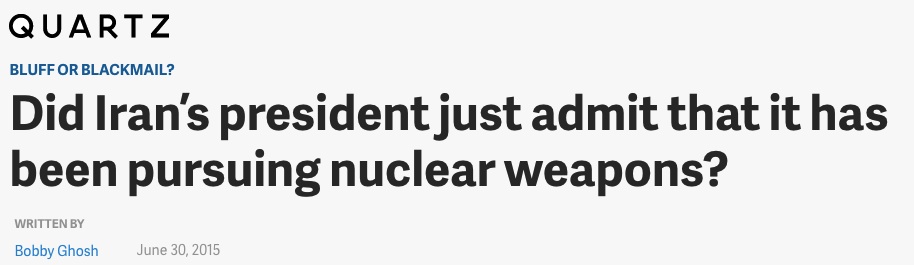
There’s a quick answer to this leading – and deceiving – question: No, no he did not.
There’s a longer answer, too, which we’ll get to in a minute.
Ghosh, in his desire to expose what he thinks is a “gotcha” moment from a recent Iranian media interview with Iranian President Hassan Rouhani, eagerly and disingenuously conflates uranium enrichment with nuclear weapons development. In doing so, he reveals himself to be more interested in delivering page views to his website and dishing out conventional wisdom than in reporting truthfully and critically about an important international issue.
Ghosh notes that, during a interview with Iranian media about the pending nuclear deal with six world powers, Rouhani said that “if the other side breaches the deal, we will go back to the old path, stronger than what they can imagine.” Ghosh omitted Rouhani’s initial comment, “If we reach a deal, both sides should be committed to it.”
What gets Ghosh’s goat is Rouhani’s reference to “the old path,” that is, the allusion to Iran’s previous state of nuclear development, as opposed to its current restricted program under the interim deal and what results from a potential negotiated multilateral agreement.
Conceding that Iranian officials have long “sworn, over and over again, that [Iran] has never pursued nuclear weapons,” Ghosh then gets to the crux of his claim:
If we’re to believe the regime’s claim, then Rouhani’s threat makes no sense. The “old path” would simply be more “peaceful” nuclear research, allowing the sanctions to continue devastating the Iranian economy. That’s not so much a threat as a flagellant’s cry for help: “If you go back on your word, I’ll hurt myself.”
To jump to such a conclusion requires a remarkably mistaken understanding of both the history of Iran’s nuclear program and either the ignorance or dismissal of the massive concessions it has already made during ongoing international talks. Ghosh apparently suffers from both.
In an emblematically Ghoshian column on why the Iranian government is eviler than the Cuban government, Ghosh wrote on December 18, 2014, that Iran “was caught trying to build nuclear-weapons technology as recently as 2002, when its secret facilities at Arak and Nataz [sic] were discovered. Thereafter, under pressure from the US and the international community, the Tehran regime backed down from its policy of developing dual-use nuclear technology (for energy and weapons) and promised not to build bombs.”
There’s a lot wrong here, but I’ll try to be quick (not my strong suit).
The facilities at Arak and Natanz were never “secret” nor do they “build nuclear-weapons technology.” In 2002, they were both under construction and non-operational. Iran was, at that point, not obligated to declare their existence to the IAEA. Arak was designed as a power plant, Natanz is an enrichment site. Upon declaration, both have been subject to IAEA safeguards for over a decade. Iran’s interest in developing an uranium enrichment industry has been open knowledge (and publicly acknowledged) since shortly after the Iranian Revolution in 1979.
The Iranian government never “backed down” from a “policy of developing dual-use technology” and “promised not to build bombs” as Ghosh claims. Such a claim is bizarre. Beyond the fact that, as an original signatory to the Nuclear Nonproliferation Treaty, Iran has in effect “promised not to build [nuclear] bombs” since 1968 and Iranian officials have – since at least the early 1990s – constantly and consistently condemned and prohibited any domestic development of nuclear weapons (not only after 2002), it is literally impossible for any nation with an ongoing enrichment program to stop the acquisition of “dual-use” nuclear infrastructure since every single enrichment program on Earth is inherently dual-use: enriched uranium can be used for both energy or weaponry.
With this false narrative, Ghosh has, however, set up a convenient straw man with which to bandy about his erroneous assumptions of Iran’s nuclear past. This brings us back to his recent article.
In trying to hash out what Rouhani’s “old path” statement means, Ghosh establishes two options – the bluff or the blackmail – one of which, he claims, must be true. The bluff is that, in Ghosh’s words, “There’s no “old path,” and Tehran is simply trying to frighten the P5+1 into relenting on the remaining sticking points at the negotiating table in Vienna.”
The blackmail, on the other hand, is a damning admission by the Iranian leader of a clandestine nuclear weapons program Iran has long denied having. “The alternative,” Ghosh writes, “is that Rouhani has unwittingly revealed that Iran was indeed pursuing nukes. That would be a real threat, especially if he is also sincere in pursuing this path ‘stronger than what they can imagine.'”
But there is a third option, unacknowledged by Ghosh, which is the most obvious and most accurate: Rouhani is not talking about a nuclear weapons program to return to, but rather the reestablishment of full-scale uranium enrichment, which has been curtailed by Iran’s obligations under the terms of its diplomatic agreements since January 2014.
Ghosh doesn’t tell his readers that, in the same interview he cites as “fascinating” and “belligerent,” Rouhani said of his international interlocutors, “If they claim that they want to prevent the development of nuclear weapons in Iran, they should know that Iran has never sought to build nuclear weapons.” Obviously, such a statement – in the very same interview – severely undermines the credibility of Ghosh’s blackmail or blunder claim that Rouhani has either purposely or accidentally revealed something alarming about its nuclear work.
Under the terms of the November 2013 Joint Plan of Action, agreed to by Iran and the six powers – Britain, China, France, Germany, Russia, and the United States – known as the P5+1, Iran has halted all enrichment above 5%, diluted or disposed of its entire stockpile of 19.75% low-enriched uranium (LEU), converted the vast majority of its remaining stockpile of LEU to a form incapable of being weaponized, suspended upgrades and construction on its safeguarded nuclear facilities at Natanz, Fordow, and Arak, and allowed unprecedented access to its program by IAEA inspectors.
At every single juncture, Iran has complied fully with the demands of the plan.
All Rouhani was saying, therefore, is that these commitments – which were negotiated and agreed to by Iran, not imposed forcibly by foreign countries – would no longer be binding and Iran would resume its previous course of action, or “the old path.” This previous course of action, still, was anything but a mysterious, opaque, nefarious development of dubious and deadly technology. Rather, even before current talks began, Iran’s was the most heavily-scrutinized nuclear program on the planet and had been for years.
Rouhani’s statement, therefore, was actually a fairly innocuous clarification of the fact that, if the P5+1 reneges on its own negotiated commitments, Iran will no longer abide by the deal either. That’s hardly cause for Ghosh to collapse on his fainting couch.
What Ghosh also doesn’t point out is that there is clear historical precedent for Rouhani’s statement.
A dozen years ago, Iran’s then-nascent uranium enrichment program was the subject of intensive diplomacy between Iran and the EU-3, shorthand for Britain, France and Germany. It was on Rouhani’s watch – he was secretary of Iran’s Supreme National Security Council and lead negotiator at the talks – that Iran voluntarily suspended uranium enrichment in 2003 and accepted intrusive inspections above and beyond what was legally required by its safeguards agreement as talks progressed. During this period, the IAEA affirmed the peaceful nature of the program.
In mid-2004, with Iran fully complying with its obligations under Saadabad Agreement of October 2013, the negotiations were strained by the prospect of a new European-drafted IAEA resolution against Iran. President Mohammad Khatami told the press, in terms strikingly similar to Rouhani’s recent statement, that Iran’s voluntary suspension of enrichment would thus be endangered if the resolution passed.
“If the draft resolution proposed by the European countries is approved by the IAEA, Iran will reject it,” Khatami said on June 18, 2004. “If Europe has no commitment toward Iran, then Iran will not have a commitment toward Europe.”
A month later, Khatami insisted that “nothing stands in the way” of Iran “building and assembling centrifuges designed for uranium enrichment,” reported the Associated Press.
Throughout the first half of 2005, Iranian officials were still intent on resolving the nuclear impasse through diplomacy with Europe, but explained that the resumption of “full-scale enrichment” was the ultimate goal of the talks, along with assurances that the program would remain forever peaceful.
Following the election of Mahmoud Ahmadinejad in June 2005, outgoing president Khatami made the Iranian position clear. “We will never overlook our legal and national right for possessing nuclear technology and fuel cycle to generate electricity. Iran will never change its national policy in this respect,” he said, adding, “We have made it clear that suspension of uranium enrichment will not be forever. We have displayed our good faith. Now, it is the turn of the European friends to do in line with the commitments they have made about the matter.”
Regardless of the offer soon to be put forward by the EU-3, Khatami reiterated that Iran would resume its conversion activities and eventually enrichment as well, in line with its inalienable rights to development domestic, civilian nuclear technology. “I hope that the Europeans’ proposals will, as agreed, allow for the resumption of [nuclear activities],” Khatami told reporters in late July 2005. “But if they do not agree, the system has already made its decision to resume [uranium conversion] at Isfahan.”
Uranium conversion restarted in early August 2005.
It was only after Iran’s European negotiating partners, at the behest of the Americans, reneged on their promise to offer substantive commitments and respect Iran’s inalienable right to a domestic nuclear infrastructure that talks dissolved and Iran resumed enrichment. The proposal eventually brought to Iran by Western negotiators on August 5, 2005 has been described as “vague on incentives and heavy on demands,” and even dismissed by one EU diplomat as “a lot of gift wrapping around an empty box.”
The resumption of full-scale enrichment by Iran had nothing to do with nuclear weapons, as the IAEA has affirmed consistently in quarterly reports over the past decade that no fissile material has ever been diverted to military purposes. Lingering questions about Iran’s past work have long been debunked as unfounded allegations for which no credible evidence actually exists.
Rouhani’s statement about “the old path” – that is, the legal and inalienable right of Iran to enrich uranium under international safeguards and supervision – therefore reveals nothing not previously known.
On the other hand, Ghosh’s reaction to Rouhani’s statement reveals the extent to which Ghosh himself will go to demonize and propagandize about Iran and its nuclear program. If he can’t get the small stuff like this right, why are we listening to him about anything at all?
*****
Disclosure: I am an (often erstwhile) editor for the online magazine Muftah, which has recently announced a new partnership with Quartz, where Mr. Ghosh is managing editor.
No, Obama Hasn’t Ended the War in Afghanistan
By Claire Bernish | ANTIMEDIA | July 2, 2015
Protests erupted north of Kabul on Monday after U.S. forces raided a local residence in search of a weapons cache—revealing that U.S. troops might not play as “limited” a role in Afghanistan as the Pentagon claims.
It’s been months since President Obama declared an official end to the combat mission in Afghanistan. At present, the U.S. mission is ostensibly limited to advising Afghan forces and counterterrorism strikes targeting the Taliban—at least, according to the military’s stated role. However, troops descending from a helicopter in the pre-dawn hours to raid the house of a local commander who has no connection to al-Qaeda—or even the Taliban—certainly muddies the definition of “adviser.”
In fact, Jan Ahmad, who was targeted in the raid, fought against the Taliban in the past and the Soviets before that. Charikar locals, who felt the matter should not have involved foreign forces, hastily closed shops and took to the streets in outrage, shouting, “Death to America!”
“The protesters burned a lot of tires to show their rage,” said local resident Mahmood Hamidy, according to the New York Times, “and that, if the issue is not taken seriously, they are ready for violence.”
Colonel Brian Tribus, spokesperson for General John Campbell, who commands U.S. forces in Afghanistan, said the purpose of the raid was “to destroy a cache of munitions that could be used to conduct attacks against Afghans and coalition forces.” After a thorough search, the cache was blown up.
With hundreds of millions of dollars spent to disarm the numerous militias that lack ties to either al-Qaeda or the Taliban, the motivations of the U.S. military seem somewhat questionable. Elders and other former commanders suspected the raid was political retribution for Ahmad’s support of Abdullah Abdullah in the last presidential election.
A similar raid in March comprised of U.S. drones and troops cooperating with Afghan forces left three people dead—but not the person targeted, who suffered only minor injuries.
Questions further surround the U.S.’ role in Afghanistan—including yet another example in a seemingly endless supply of official statements that lack credibility.
Featured Video

Why Hamas Really Attacked Israel on Oct. 7
or go to
Aletho News Archives – Video-Images
From the Archives
Confronting the Threat of Ethnic Bioweapons
By Tony Cartalucci – New Eastern Outlook – 29.11.2017
The United States Air Force’s 59th Medical Wing’s molecular biology branch recently was revealed to have been collecting specifically Russian RNA and synovial (connective) tissue samples, prompting fears in Russia of a possible US directed ethnic-specific bioweapons program. … continue
Blog Roll
 Aletho News
- Meet the US generals and admirals advancing Israeli policy
- Israel’s Straw Widow Protocol: The Kill Zones Where Civilians Were Labelled ‘Terrorists’
- Leading Israeli Think Tank Publishes Psychotic Israeli ‘National Security’ Doctrine
- Are the United States and Israel in Decline-and-Fall Mode?
- Why Hamas Really Attacked Israel on Oct. 7
- Declassified UK exposes British man who fought for ‘Israel’ in Gaza
- West’s death cult in a theater near you
- How the Yandex ‘Russian bots’ lie fell apart
- Burnham’s ‘Russia did Brexit’ ruse crumbles
- Estonia making movies and games to encourage war against Russia
- If Americans Knew
- Gaza’s “ceasefire” death toll passes 1,500 – Daily Update
- Activists Abused By Israel Return to New Freedom Flotilla Mission
- 60 Minutes won’t tell the full truth about Israeli settler violence
- Nearly 50,000 women, girls killed or severely injured in Gaza since October 2023: UN Women
- ADL is working with AI companies to suppress alleged ‘antisemitism’
- Israeli occupation forces using social media surveillance unit to target hundreds of Palestinians in the West Bank
- Israel’s New – and Terrifying – Security Doctrine
- Israeli Attacks Kill Five in Gaza, Including a four-year-old and a woman
- Air Force Major Who Called for Trump’s Impeachment Held in Solitary Confinement
- It’s a Genocide, I’m Into It’: Seinfeld Mocks Protest over Palestinian Children Killed
- No Tricks Zone
- New Study Suggests Large Regions Of The Pacific Ocean Have Been Cooling For The Last 80 Years
- Germany’s Green Energy Debacle: High Energy Costs Force Kahla Porzellan to Close After 182 Years!
- New Study: 50 Years Of The Most Aggressive ‘Net Zero’ Policies Can Only Affect The Global Climate By 0.03°C
- US September “Heat” Was No Record…Many Records Set Decades Ago
- Latest European Green Energy Debacle; Portugal’s Largest Flagship Solar Park Insolvent!
- Green Energy Debacle: German Expert Professor Fritz Vahrenholt Warns Of Severe Economic And Social Consequences
- Two More Paleo Reconstructions Affirm Meters-Higher Sea Levels Across Ireland, Brazil 7000-6000 Years Ago
- New Study: Earth And Venus Surface Warmth Largely Explained By Convection And Lapse Rate, Not CO2 Or Radiation
- 2025 Nature Paper Claiming Worsening Global Drought Gets RETRACTED …Heavily Flawed
- New Study: ‘Global Drought Shows No Detectable Recent Acceleration Under Climate Warming’

