Former Colombian Commander Investigated for Extrajudicial Killings
teleSUR | June 23, 2015
The former commander of Colombia’s National Army, General Mario Montoya, was called in for interrogation on Tuesday over his alleged role in thousands of extrajudicial killings that were carried by the country’s security forces to be presented as guerrilla fighters killed during clashes.
His interrogation is set for July 16. The scandal, dubbed False Positives, began in 2008 and is still being investigated by the Colombian authorities. But already more than 400 army commanders, 800 unit commanders and almost 3,000 soldiers have been formally indicted.
According to the Prosecutor’s Office, Montoya would be questioned given that the killings occurred under his authority, and could be charged for failing to effectively overview the actions that led to the killings. Another three retired commanders were also called for questioning by the Prosecutor’s Office.
Montoya has still pending charges, regarding his links to the now defunct paramilitary group Colombian Self-Defense Force (AUC), a group that killed tens of thousands of civilians throughout its existence. The false positives became such a common practice during the administration of former President Alvaro Uribe that by 2007, more than 40 percent of registered combat kills were in fact murdered civilians dressed in fatigue.
In exchange for the killings, generals were awarded vacations and cash prices. Uribe vowed to destroy the FARC guerrilla using military strength, instead of trying to negotiate with the group through peace talks as other presidents had done in the past.
It is estimated that around 3,000 civilians were extra-judicially murdered by the Colombian army.
Venezuela Rejects “Media Manipulation” of Brazilian Senator Visit
Ministry of Popular Power for Foreign Relations, Bolivarian Republic of Venezuela | June 19, 2015
Communique
Caracas – The government of the Bolivarian Republic of Venezuela publicly rejects the attempts made by the national and international rightwing to pull a political media manoeuvre based on lies propagated about the visit of a group of Brazilian senators who arrived in the country with the singular aim of destabilising Venezuelan democracy and of generating confusion and conflict between brother countries.
The first substantial lie reported in the media was to falsely claim that the Venezuelan government had denied airplane landing permission to this committee, when it had not, in fact, received any such request.
The second substantial lie was to blame the national government for blocking the main road which connects the (national) airport to the country’s capital city. In reality, a truck containing flammable material had overturned which prevented free transit on this freeway. This even delayed the transfer of an high security prisoner extradited by the Colombian government for his responsibility in the murder of a journalist during the terrorist acts which took place in the barricades last year.
The third substantial lie was to state that the security and physical wellbeing of these rightwing Brazilian senators was compromised. There is audiovisual and photographic material which shows the senators interacting with political activists in relation to the upcoming elections that will take place this year in Venezuela. In the same way, the national government assigned a special security dispatch made up of more than 30 officials on motorbikes, patrols and security bodies who accompanied this group the whole time. Likewise, it also coordinated with the embassy of the Federal Republic of Brazil.
It is notable that figures of the extreme rightwing, who took part in state coups in Venezuela, participated in the entire agenda of these representatives of the international opposition, who are the authors and promoters of these fairytales in the media and which attempt to bring the Bolivarian Republic of Venezuela’s long recognised democratic tradition into disrepute.
The Venezuelan Bolivarian Republic of Venezuela reiterates its friendly and co-operative ties based on mutual respect, non-interference in internal State matters and the self-determination of the people with its sister federal Republic of Brazil. As well as its unshakable commitment to maintaining these ties in spite of any divisive scheme against our countries.
Translated by Venezuelanalysis
NYT’s Orwellian View of Ukraine
By Robert Parry | Consortium News | June 22, 2015
In George Orwell’s 1984, the leaders of Oceania presented “Two Minutes Hate” in which the image of an enemy was put on display and loyal Oceanianians expressed their rage, all the better to prepare them for the country’s endless wars and their own surrender of freedom. And, now, in America, you have The New York Times.
Surely the Times is a bit more subtle than the powers-that-be in Orwell’s Oceania, but the point is the same. The “paper of record” decides who our rotating foreign enemy is and depicts its leader as a demon corrupting whatever he touches. The rest of us aren’t supposed to think for ourselves. We’re just supposed to hate.
As the Times has degenerated from a relatively decent newspaper into a fount of neocon propaganda, its editors also have descended into the practice of simply inventing a narrative of events that serves an ideological purpose, its own version of “Two Minutes Hate.” Like the leaders of Orwell’s Oceania, the Times has become increasingly heavy-handed in its propaganda.
Excluding alternate explanations of events, even if supported by solid evidence, the Times arrogantly creates its own reality and tells us who to hate.
In assessing the Times’s downward spiral into this unethical journalism, one could look back on its false reporting regarding Iraq, Iran, Syria or other Middle East hotspots. But now the Times is putting the lives of ourselves, our children and our grandchildren at risk with its reckless reporting on the Ukraine crisis – by setting up an unnecessary confrontation between nuclear-armed powers, the United States and Russia.
At the center of the Times’ propaganda on Ukraine has been its uncritical – indeed its anti-journalistic – embrace of the Ukrainians coup-makers in late 2013 and early 2014 as they collaborated with neo-Nazi militias to violently overthrow elected President Viktor Yanukovych and hurl Ukraine into a bloody civil war.
Rather than display journalistic professionalism, the Times’ propagandists ignored the evidence of a coup – including an intercepted phone call in which U.S. Assistant Secretary of State for European Affairs Victoria Nuland and U.S. Ambassador Geoffrey Pyatt discussed how to “mid-wife” the regime change and handpick the new leaders.
The Times even ignored a national security expert, Statfor founder George Friedman, when he termed the ouster of Ukraine’s elected president “the most blatant coup in history.” The Times just waved a magic wand and pronounced that there was no coup – and anyone who thought so must reside inside “the Russian propaganda bubble.”[See Consortiumnews.com’s “NYT Still Pretends No Coup in Ukraine.”]
Perhaps even more egregiously, the Times has pretended that there were no neo-Nazi militias spearheading the Feb. 22, 2014 coup and then leading the bloody “anti-terrorist operation” against ethnic Russians in the south and east who resisted the coup. The Times explained all this bloodshed as simply “Russian aggression.”
It didn’t even matter when the U.S. House of Representatives – of all groups – unanimously acknowledged the neo-Nazi problem when it prohibited U.S. collaboration in military training of Ukrainian Nazis. The Times simply expunged the vote from its “official history” of the crisis. [See Consortiumnews.com’s “US House Admits Nazi Role in Ukraine.”]
Orwell’s Putin
Yet, for an Orwellian “Two Minute Hate” to work properly, you need to have a villain whose face you can put on display. And, in the case of Ukraine – at least after Yanukovych was driven from the scene – that villain has been Russian President Vladimir Putin, who embodies all evil in the intense hatred sold to the American public.
So, when Putin presents a narrative of the Ukraine crisis, which notes the history of the U.S.-driven expansion of NATO up to Russia’s borders and the evidence of the U.S.-directed Ukrainian coup, the Times editors must dismiss it all as “mythology,” as they did in Monday’s editorial regarding Putin’s remarks to an international economic conference in St. Petersburg.
“President Vladimir Putin of Russia is not veering from the mythology he created to explain away the crisis over Ukraine,” the Times’ editors wrote. “It is one that wholly blames the West for provoking a new Cold War and insists that international sanctions have not grievously wounded his country’s flagging economy.”
Without acknowledging any Western guilt in the coup that overthrew the elected Ukrainian government in 2014, the Times’ editors simply reveled in the harm that the Obama administration and the European Union have inflicted on Russia’s economy for its support of the previously elected government and its continued backers in eastern and southern Ukraine.
For nearly a year and a half, the New York Times and other major U.S. news organizations have simply refused to acknowledge the reality of what happened in Ukraine. In the Western fantasy, the elected Yanukovych government simply disappeared and was replaced by a U.S.-backed regime that then treated any resistance to its rule as “terrorism.” The new regime even dispatched neo-Nazi militias to kill ethnic Russians and other Ukrainians who resisted and thus were deemed “terrorists.”
The upside-down narrative of what happened in Ukraine has become the conventional wisdom in Official Washington and has been imposed on America’s European allies as well. According to The New York Times’ Orwellian storyline, anyone who notes the reality of a U.S.-backed coup in Ukraine is engaging in “fantasy” and must be some kind of Putin pawn.
To the Times’ editors, all the justice is on their side, even as Ukraine’s new regime has deployed neo-Nazi militias to kill eastern Ukrainians who resisted the anti-Yanukovych coup. To the Times’ editors, the only possible reason to object to Ukraine’s new order is that the Russians must be bribing European dissidents to resist the U.S. version of events. The Times wrote:
The Europeans are indeed divided over the extent to which Russia, with its huge oil and gas resources, should be isolated, but Mr. Putin’s aggression so far has ensured their unity when it counts. In addition to extending existing sanctions, the allies have prepared a new round of sanctions that could be imposed if Russian-backed separatists seized more territory in Ukraine. …
Although Mr. Putin insisted on Friday that Russia had found the ‘inner strength’ to weather sanctions and a drop in oil prices, investment has slowed, capital has fled the country and the economy has been sliding into recession. Even the business forum was not all that it seemed: The heads of many Western companies stayed away for a second year.
An Orwellian World
In the up-is-down world that has become the New York Times’ editorial page, the Western coup-making on Russia’s border with the implicit threat of U.S. and NATO nuclear weapons within easy range of Moscow is transformed into a case of Russian aggression. The Times’ editors wrote: “One of the most alarming aspects of the crisis has been Mr. Putin’s willingness to brandish nuclear weapons.”
Though it would appear objectively that the United States was engaged in serious mischief-making on Russia’s border, the Times editors flip it around to make Russian military maneuvers – inside Russia – a sign of aggression against the West.
Given Mr. Putin’s aggressive behavior, including pouring troops and weapons into Kaliningrad, a Russian city located between NATO members Lithuania and Poland, the allies have begun taking their own military steps. In recent months, NATO approved a rapid-reaction force in case an ally needs to be defended. It also pre-positioned some weapons in front-line countries, is rotating troops there and is conducting many more exercises. There are also plans to store battle tanks and other heavy weapons in several Baltic and Eastern European countries.
If he is not careful, Mr. Putin may end up facing exactly what he has railed against — a NATO more firmly parked on Russia’s borders — not because the alliance wanted to go in that direction, but because Russian behavior left it little choice. That is neither in Russia’s interest, nor the West’s.
There is something truly 1984-ish about reading that kind of propagandistic writing in The New York Times and other Western publications. But it has become the pattern, not the exception.
The Words of the ‘Demon’
Though the Times and the rest of the Western media insist on demonizing Putin, we still should hear the Russian president’s version of events, as simply a matter of journalistic fairness. Here is how Putin explained the situation to American TV talk show host Charlie Rose on June 19:
Why did we arrive at the crisis in Ukraine? I am convinced that after the so-called bipolar system ceased to exist, after the Soviet Union was gone from the political map of the world, some of our partners in the West, including and primarily the United States, of course, were in a state of euphoria of sorts. Instead of developing good neighborly relations and partnerships, they began to develop the new geopolitical space that they thought was unoccupied. This, for instance, is what caused the North Atlantic bloc, NATO, to go east, along with many other developments.
I have been thinking a lot about why this is happening and eventually came to the conclusion that some of our partners [Putin’s way of describing Americans] seem to have gotten the illusion that the world order that was created after World War II, with such a global center as the Soviet Union, does not exist anymore, that a vacuum of sorts has developed that needs to be filled quickly.
I think such an approach is a mistake. This is how we got Iraq, and we know that even today there are people in the United States who think that mistakes were made in Iraq. Many admit that there were mistakes in Iraq, and nevertheless they repeat it all in Libya. Now they got to Ukraine. We did not bring about the crisis in Ukraine. There was no need to support, as I have said many times, the anti-state, anti-constitutional takeover that eventually led to a sharp resistance on the territory of Ukraine, to a civil war in fact.
Where do we go from here?” Putin asked. “Today we primarily need to comply with all the agreements reached in Minsk, the capital of Belarus. … At the same time, I would like to draw your attention and the attention of all our partners to the fact that we cannot do it unilaterally. We keep hearing the same thing, repeated like a mantra – that Russia should influence the southeast of Ukraine. We are. However, it is impossible to resolve the problem through our influence on the southeast alone.
There has to be influence on the current official authorities in Kiev, which is something we cannot do. This is a road our Western partners have to take – those in Europe and America. Let us work together. … We believe that to resolve the situation we need to implement the Minsk agreements, as I said. The elements of a political settlement are key here. There are several. […]
The first one is constitutional reform, and the Minsk agreements say clearly: to provide autonomy or, as they say decentralization of power, let it be decentralization. This is quite clear, our European partners, France and Germany have spelled it out and we are quite satisfied with it, just as the representatives of Donbass [eastern Ukraine where ethnic Russians who had supported Yanukovych have declared independence] are. This is one component.
The second thing that has to be done – the law passed earlier on the special status of these territories – Luhansk and Donetsk, the unrecognized republics, should be enacted. It was passed, but still not acted upon. This requires a resolution of the Supreme Rada – the Ukrainian Parliament – which is also covered in the Minsk agreements. Our friends in Kiev have formally complied with this decision, but simultaneously with the passing by the Rada of the resolution to enact the law they amended the law itself … which practically renders the action null and void. This is a mere manipulation, and they have to move from manipulations to real action.
The third thing is a law on amnesty. It is impossible to have a political dialogue with people who are threatened with criminal persecution. And finally, they need to pass a law on municipal elections on these territories and to have the elections themselves. All this is spelled out in the Minsk agreements, this is something I would like to draw your attention to, and all this should be done with the agreement of Donetsk and Luhansk.
Unfortunately, we still see no direct dialogue, only some signs of it, but too much time has passed after the Minsk agreements were signed. I repeat, it is important now to have a direct dialogue between Luhansk, Donetsk and Kiev – this is missing.
Also missing is any objective and professional explanation of this crisis in the mainstream American press. Instead, The New York Times and other major U.S. news organizations have continued with their pattern of 1984-ish propaganda.
~
Investigative reporter Robert Parry broke many of the Iran-Contra stories for The Associated Press and Newsweek in the 1980s. You can buy his latest book, America’s Stolen Narrative, either in print here or as an e-book (from Amazon and barnesandnoble.com).
The CIA Can’t Keep Its Drone Propaganda Straight
By Jameel Jaffer and Brett Max Kaufman | Just Security | June 20, 2015
This week, one government intelligence agency, after patiently and methodically tracking a terrorist leader for months through precise electronic surveillance, successfully targeted him for death by drone. Also this week, a government intelligence agency eliminated a terrorist leader through a drone strike without even knowing the leader was present, basing its decision to use lethal force on sophisticated analysis of militants’ patterns of life.
Bizarrely, this was the same agency, and this was the same terrorist leader.
On Tuesday, hardly before the dust in Yemen had settled, Bloomberg’s Eli Lake and Josh Rogin, relying on information provided by anonymous sources, supplied the public with the first narrative. In this version, the CIA killed Nasir al-Wuhayshi, “general manager” of al-Qaeda in the Arabian Peninsula, “by building a methodical case on his whereabouts over months from information collected through technical means.”
On Thursday, the Washington Post’s Greg Miller, also relying on information provided by anonymous officials, supplied the second narrative. In this version, al-Wuhayshi was dead not because the CIA had tracked him down but because the Obama administration had “eased” certain drone-strike guidelines in Yemen and permitted the CIA to carry out “signature strikes” — strikes that take place without the agency’s specific knowledge of the identities of the individuals marked for death.
Rarely do the rival motives of anonymous officials come so nakedly into view, and conflict, around a single event. One faction immediately tries to capitalize on the al-Wuhayshi strike as evidence of the CIA’s other-worldly tracking abilities, even in the fog of a confusing and fraught war in Yemen. At the same time, another faction exploits the same strike to make a public case for expanding the use of a controversial targeting technique that the Obama administration earlier said, in an effort to assuage public concerns about the lawfulness of the drone program, it would retire.
F. Scott Fitzgerald famously wrote that “the ability to hold two opposed ideas in the mind at the same time, and still retain the ability to function,” is the “test of a first-rate intelligence.” Here, though, the government’s conflicting stories seem something less than first-rate or intelligent — they seem amateurish and ham-handed. They also seem to suggest a total lack of concern for the possibility that anyone will ever hold officials accountable for their statements.
Lake, Rogin, and Miller work in a field in which reliance on anonymous sources is probably unavoidable and sometimes even illuminating. In this instance, though, they can’t all be right, and their competing stories serve as another reminder — in case any were needed — that the statements of anonymous intelligence officials are often efforts to mislead and manipulate, and that much of the “information” the government has provided the public about the drone program is merely propaganda.
Regrettably, this is unlikely to change anytime soon. A federal district court judge — the same judge who earlier dismissed a constitutional case relating to the government’s killing of four Americans in Yemen — ruled on Thursday that the CIA isn’t legally obliged to release any information about the drone program it hasn’t already released. For the time being at least, the CIA will continue to decide what the public knows about the CIA’s activities — even if it can’t keep its own story straight.
About the Authors
Jameel Jaffer is Deputy Legal Director at the American Civil Liberties Union and Director of the ACLU’s Center for Democracy. Follow him on Twitter (@JameelJaffer).
Brett Max Kaufman is a teaching fellow and supervising attorney in the Technology Law & Policy Clinic at NYU School of Law. Follow him on Twitter (@brettmaxkaufman).
There is no renewables revolution in China. Here are the numbers that show this
By Robert Wilson | Carbon Counter | June 17, 2015
Last year China installed more new wind and solar capacity than any country in history. This is a fact, and it has led some to talk of China being a “renewables powerhouse” and of there being a “renewables revolution”.
But out of context this fact can be much less impressive than it really is.
Let me put it into context using the most recent data from BP’s Statistical Review of World Energy.
Over the last decade China’s primary energy consumption grew by 1398 million tonnes of equivalent (Mtoe). Though, if history is a guide this figure will eventually be revised upwards.
The annual average increase then was 140 Mtoe. For a comparison, Britain’s annual primary energy consumption was 188 Mtoe last year.
China’s growth rate was actually higher in the early 2010s, but has slowed recently (probably due to a worsening economic situation.
But that’s the context for judging the growth of wind and solar in China: 140 Mtoe of (mostly coal) energy added per year for the last decade.
How does China’s world leading wind and solar build out compare with this?
In total, China got 42.4 Mtoe from wind and solar in 2014. In other words, the total production of energy from wind and solar energy is less than one third of a year’s of growth in primary energy consumption.
When you look at annual growth things are even clearer. Wind and solar grew by 6.97 Mtoe last year. This is a mere 5% of the average total growth in primary energy.

There is no renewables revolution in China. So, as always, I recommend that people spend some time with data sources such as the BP Statistical Review of World Energy and less time reading pundits and the instant experts of Twitter.
US fails to name Turkey as sponsor of terrorism
Press TV – June 21, 2015
The United States has admitted that it has been fully aware of Turkey’s role in the transit of terrorists into Syria, but has failed to name it as a sponsor of terrorism.
Throughout 2014, Turkey served as a source and transit country for foreign terrorists seeking to enter Syria, the United States said in its annual report on terrorism.
However, the State Department report released on Friday failed to condemn Ankara or declare it as a sponsor of terrorism.
Surprisingly enough, the report leveled accusations against Iran which has supported the fight against the ISIL terrorist group in Iraq and Syria.
Syria has been gripped by deadly violence since 2011. The United States and some of its regional allies — especially Qatar, Saudi Arabia, and Turkey — have been supporting the militants operating in Syria.
According to the United Nations, more than 220,000 people have been killed and millions displaced due to the turmoil that has gripped Syria for nearly four years.
The ISIL terrorists, who were initially trained by the CIA in Jordan in 2012 to destabilize the Syrian government, are engaged in crimes against humanity in the areas under their control.
They have been carrying out horrific acts of violence such as public decapitations and crucifixions against all communities, including Shias, Sunnis, Kurds, and Christians.
How EPA Faked the Entire Science of Sewage Sludge Safety: A Whistleblower’s Story
Independent Science News | June 9, 2014
US EPA’s 503 sludge rule (1993) allows treated sewage sludges, aka biosolids, to be land-applied to farms, forests, parks, school playgrounds, home gardens and other private and public lands. According to a recent EPA survey, biosolids contain a wide range of mutagenic and neurotoxic chemicals, which are present at a million-fold higher concentrations (ppm versus ppt) compared with their levels in polluted air and water (1). Biosolids contain all of the lipophilic (fat-soluble) chemical wastes that once polluted our rivers and lakes, but which now settle out at sewage treatment plants and become concentrated in sewage sludges. Most biosolids contain ppm concentrations of heavy metals, including chromium, lead, and mercury. They contain similarly high levels of polycyclic aromatic hydrocarbons (PAHs) and semi-volatiles, such as bis (2-Ethylhexyl) phthalate, Benzo(a)pyrene), and polybrominated diphenyl ether congeners (PBDE flame retardants). Most biosolids also contain pathogenic agents and ppm levels of many common drugs, including ciprofloxacin (Cipro), carbamazepine (Tegretol, Equetro), and fluoxetine (Prozac).
While working at EPA Dr David Lewis published evidence that teenager Shayne Conner (of New Hampshire) died and other neighbors were harmed from living near land applied with sewage sludge (Lewis et al 2002). He furthermore became involved after dairy herds of two Georgia farms (McElmurray and Boyce) were poisoned after grazing on sludged land. He testified in lawsuits following each incident, against his employer (EPA), which is where many of the following depositions were obtained. The following article is an excerpt from Chapter 4 (Sludge Magic) of his new book (Science for Sale: How the US Government Uses Powerful Corporations and Leading Universities to Support Government Policies, Silence Top Scientists, Jeopardize Our Health, and Protect Corporate Profits). The lawsuits referred to are Lewis v. EPA 1999; Lewis v. EPA 2003; and USA, ex rel. Lewis, McElmurray and Boyce v. Walker et al. 2009. The depositions below piece together an unprecedented and coordinated multi-agency scientific scheme involving EPA, USDA, local and city municipalities, Synagro Technologies (a waste management company), various universities, and the National Academies of Science.
The effort was intended to misleadingly present sewage sludge as scientifically safe, to hide the evidence that it was not, to deliberately misreport the contents of municipal sludges, and smear David Lewis with a scientific misconduct charge after he blew the whistle.
From “Sludge Magic” by Dr David Lewis:
The Men Behind the Curtain
1) Alan Rubin – EPA
Alan Rubin, who was a career chemist at EPA’s Office of Water, is considered the primary author of EPA’s 503 sludge rule. He was one of a number of office scientists at EPA headquarters involved in retaliations against scientists and private citizens who reported adverse health effects associated with biosolids. Time magazine (September 27, 1999) ran a short article about Rubin mailing “death threats” on EPA and Water Environment Federation (WEF) letterhead to private citizens concerned about biosolids, saying, “Ask not for whom the bell tolls; it tolls for thee!”
When deposed in my U.S Department of Labor cases, Dr. Rubin explained what motivated these attacks:
RUBIN QUESTIONED BY ATTORNEY STEPHEN KOHN (1999) (2)
Q. Are you proud of the work you did?… Do you feel, in any
way, hurt or upset to have someone like Dr. Lewis criticizing
it?… Professionally hurt, a little?
A. Somewhat.
Q. How so?…
A. Well, I think my professional reputation, to a large extent, is
based on my association with biosolids, 503 and its technical basis.
So I feel my reputation would be somewhat disparaged if the basis
of the rule, and the scientific findings were shown to be in error.
Rubin coined the term “sludge magic” when EPA’s proposed 503 sludge rule was undergoing internal peer review at EPA’s Office of Research & Development in 1992. Dr. Robert Swank, the research director at the EPA lab in Athens, Georgia, where I worked, called Dr. Rubin. When Swank asked him to explain how sewage sludge renders pollutants non-bioavailable, Rubin replied, “It’s magic.” During his deposition, Rubin deferred to USDA agronomist Rufus Chaney when questioned about scientific studies supporting sludge magic:
RUBIN QUESTIONED BY MR. KOHN (1999) (3)
Q. You called it sludge magic?
A. Yes, that is my term. “sludge magic” [means] there are unique
properties in the biosolids matrix that sequester metals, that
sequester organics. By sequester I mean significantly reduce the
mobility to move from the biosolids out to the environment,
and the matrix is really complex, and has organic material in
it, organic pollutants, I’m talking about organic materials, like
unit type materials, and carbohydrates, and manganese, and
iron, and phosphorus, and all of these work together with the
soil in a matrix to significantly reduce, if not eliminate movement
of pollutants from the biosolids out to the environment.
The processes, some of them are understood, some of them are not
that well understood, but the whole thing taken together is called
magic. So I coined the term magic.
Q. And the “sludge magic” which prevents harmful stuff that is
in the sludge escaping the sludge?
A. Moving at any significant flux or rate out to the environment
to create doses of pollutants that would harm plants, animals or
humans.
Q. … these studies [are] kept somewhere?
A. No, they are actually—well, Chaney is probably the one that
has them all, he is like a walking encyclopedia.
So, after working in EPA’s biosolids program for over thirty years, the primary author of EPA’s 503 sludge rule still couldn’t explain how biosolids prevent potentially harmful levels of pollutants from being taken up by plants, animals and humans.
2) Rufus Chaney-USDA
My attorney, Ed Hallman, deposed Dr. Rufus Chaney at USDA’s Animal Manure and By-Products Laboratory in Beltsville, Maryland. His position reflects the importance that the USDA places on protecting biosolids:
CHANEY ANSWERING MR. HALLMAN (2009) (4)
I’ve been appointed in a category which is above GS-18 called
senior scientific research service. Within that, there are no subgrades.
There is a group —there is only about ten of us in all of
my agency that have reached that level.… I would say I’m the
US Department of Agriculture’s most knowledgeable scientist
about biosolids.
Chaney further testified that EPA scientists have never understood the science he developed, which proves heavy metals and toxic organic pollutants in biosolids cannot harm public health or the environment.
CHANEY ANSWERING MR. HALLMAN (2009) (5)
EPA withdrew the original proposed rule and completely
rewrote it. Actually I played a very significant role in what
the rule became. It’s evident in the record. And even at the
end I provided comments through USDA, approved at higher
levels, saying that the rule needed a few more revisions before
it was issued. But, yes, I was heavily involved in bringing to
fore the science about biosolids that needed to be the basis for
the rule.
Chaney explained that the unique properties of sewage sludge prevent pollutants from becoming bioavailable. In other words, they can’t be taken up or absorbed by plants and animals’ and they pose little or no risk to public health or the environment no matter which pollutants are present, or what their concentrations are.
One of Rufus Chaney’s primary collaborators, Jay Scott Angle, replaced Gale Buchanan as the agricultural dean at University of Georgia (UGA) in 2005, the year we filed a qui tam lawsuit over “the Gaskin study” (Gaskin et al 2003)(6). After EPA funded this study, one of its employees, Robert Brobst, who is charged with investigating reports of biosolids-related adverse health effects, provided UGA with data fabricated by the City of Augusta, Georgia (see Figure 1.). This fabricated data was used in the Gaskin study which EPA then used to discredit any links between biosolids and cattle deaths on two Georgia dairy farms owned by local farmers, the McElmurray and Boyce families (4). President Bush appointed Buchanan under secretary of agriculture for research, education and economics the following year (7).
Two years earlier, the director of UGA’s School of Marine Programs was advised not to hire me as a faculty member “because we’re dependent on this money… grant and contract money… money either from possible future EPA grants or [from] connections there might be between the waste disposal community [and] members of faculty at the university.” (8)
Many wastewater treatment plants throughout the United States aren’t working properly, and are constantly in need of being repaired or upgraded to keep up with population growth. To help with this problem, EPA created a revolving loan program under the Clean Water Act to pump billions of dollars into the states to keep their wastewater treatments plants pumping properly. Chaney reasons that because the system as a whole is in constant need of repair, and there are still no documented cases of adverse health effects in the peer-reviewed scientific literature, “sludge magic,” as Rubin calls it, works even when waste treatment plants don’t.
Chaney further reasoned that any peer-reviewed scientific articles claiming that land application of biosolids poses a risk to public health or the environment must be false because no scientists funded by the US government and other reputable institutions have documented adverse effects from biosolids since the 503 sludge rule was passed in 1993.
In 1992, EPA’s sludge rule failed to pass a scientific peer review in EPA’s Office of Research & Development. Chaney blamed scientists in EPA’s Office of Water for this failure:
CHANEY ANSWERING MR. HALLMAN (2009) (9)
They originally proposed a rule where they even had the data
screwed up. I don’t know how much you know about that. But
the original rule would have essentially prohibited all land
application…. So there were lots of errors the first time around,
stupid errors. They didn’t—they didn’t review it with USDA or Food
and Drug Administration before they put it on the street and they
suffered and had to withdraw it and start over.
In his deposition, Chaney stated that adverse health effects from biosolids were documented in the scientific literature before 1992, and that he himself authored many of those studies.
CHANEY QUESTIONED BY MR. HALLMAN (2009) (10)
Q. And you believe that all the studies you’ve seen, including
the ones that you have coauthored and worked on, indicate that
the land application of sewage sludge in accordance with 503 is
safe… and is not a danger to human health and welfare, is that
correct, if it’s applied in accordance with those regulations?
A. I won’t disagree with that. I had advised EPA that I wanted
a lower cadmium limit…. I won the battle because pretreatment
and the universal understanding of the unacceptability of cadmium
in biosolids has led to biosolids declining to 1 to 2 ppm in
most cities in the United States. Biosolids has become remarkably
less contaminated because of what we’ve done with the 503 and
because of the publications, such as mine, which showed adverse
effects of previous practices.
The phenomenon by which biosolids have become far less contaminated with cadmium is clearly evident in the data that the City of Augusta reported to EPA and the State of Georgia. These are the same (Gaskin) data that EPA and UGA published and later used by the National Academy of Sciences to conclude that Augusta’s biosolids were not responsible for hundreds of cattle that died on two dairy farms (McElmurray and Boyce) where it was applied. The data purportedly show (Fig. 1 pdf here) that monthly cadmium levels in the city’s sewage sludge fluctuated wildly up to 1, 200 ppm from January 1980 to February 1993, the very month that EPA promulgated the 503 rule.

Chaney wants everyone to believe that cadmium, which was making people and animals sick, dropped to safe levels all across the country the moment EPA passed its sludge regulation in February 1993. No regulatory agency at the state or federal level, however, ever monitors levels of cadmium, or anything else, in biosolids (11). They simply accept whatever data the cities provide.
In Augusta’s case, we know that the city’s “sludge magic” was faked. The city’s former plant manager, Allen Saxon, confessed when deposed by Mr. Hallman.
Judge Anthony Alaimo, who ruled on a lawsuit against the USDA filed by the McElmurray family, ordered the USDA to pay for crops the family couldn’t plant because their land was too contaminated with cadmium and other hazardous wastes from Augusta’s biosolids. Judge Alaimo wrote, “In January 1999, the City rehired Saxon to create a record of sludge applications that did not exist previously.” (12)
That same year, EPA gave UGA a federal grant to publish Augusta’s data as part of the Gaskin study (Gaskin et al 2003). As soon as Mr. Saxon finished making “sludge magic” happen, all of the original data Augusta reported to the Georgia Environmental Protection Division (EPD) between 1993 and 1999 magically disappeared, and not just in Augusta. They turned up missing from the EPD records in Atlanta as well. EPA doesn’t know what happened to the data, nor does the EPD, nor the City of Augusta, nor UGA. All of the data just magically disappeared from city and state records at the same time cadmium purportedly disappeared from Augusta’s sewage sludge.
According to Rufus Chaney, it just doesn’t matter whether the data are fake or real. He explained in his deposition: (13)
CHANEY QUESTIONED BY MR. HALLMAN (2009)
Q. Ms. Gaskin could have totally made up all that data and you
would still rely on it because it was in a peer-reviewed study; is
that accurate?
A As long as it—as long as it was in general agreement with
general patterns established in hundreds of papers….
To sum up Chaney’s position, because Gaskin’s paper concluded that Augusta’s sludge did not pose a health risk, it’s valid research even if the data were fabricated. On the other hand, people should disregard scientists who report problems with biosolids, even if their work is published in the peer-reviewed scientific literature. That’s because researchers at universities funded by government and have published hundreds of papers concluding that biosolids don’t put public health or the environment at risk.
In 2004, Chaney commented on the US Composting Council’s (USCC’s) list serve about my termination by EPA acting assistant administrator Henry Longest, who developed EPA’s sludge policies in the late 1970s (14). USCC is headed by Lorrie Loder, Synagro’s product marketing director. Chaney, of course, supported Longest’s decision to end my career for publishing research that raised public concerns over biosolids (Lewis et al. 2002). He contrasted our BMC study with the Gaskin study:
CHANEY USCC (2004) (15)
The paper by Gaskin et al. [Gaskin, J. W., R. B. Brobst, W. P.
Miller, and E. W. Tollner. 2003. Long-term biosolids application
effects on metal concentrations in soil and bermudagrass
forage J. Env. Qual. 32:146-152.] reports objective measurements
on the soil metal concentrations, and metals in forages
growing on the soils….[Lewis’s] publication [Lewis D. L., D. K.
Gattie, M. E. Novak, S. Sanchez, and C. Pumphrey. 2002.
Interactions of pathogens and irritant chemicals in land-applied
sewage sludges (biosolids). BMC Public Health 2:11.] contains none
of the data from examination of biosolids exposed subjects, and lacks the
comparison with randomly selected individuals from the general
populations. It is not valid epidemiological science….
I support the whistle-blower rule and process as strongly as any
other citizen or government employee. I happen to believe that
Dr. Lewis has been treated fairly. Claims and opinions about
public health are not peer-reviewed scientific evidence. EPA and
other agencies have to base rules on the peer-reviewed papers,
and to consider the weight of evidence. Some papers are more
complete in proof of the issue tested, as I noted above regarding
proof that some source caused a specific human infection.
Our study published in BMC-Public Health had documented several cases linking Synagro’s biosolids to illnesses and deaths, including the death of Shayne Conner in New Hampshire (Lewis et al. 2002). Chaney’s statements about our study are drawn from a white paper Synagro published in 2001, which contains false allegations of research misconduct against me and my coauthors. In 2004, Synagro withdrew its allegations after EPA dismissed the allegations as meritless and not based in any facts (16). Synagro’s white paper, which Chaney parroted, states, for example:
SYNAGRO WHITE PAPER (2001) (17)
[Steps Lewis should have taken] include analysis of biosolids
composition, fate and transport of chemicals and pathogens,
determination of dose-response relationships, and methodology
for and identification of the cause of health ailments purportedly
associated with an environmental contaminant….
Such studies should involve a comparison of outcomes for subjects
who are exposed to biosolids (treatment groups) and other subjects
who are not exposed (control groups)…. The leading study,
a comprehensive multi-year study of Ohio farm families living
near land-applied fields, reported “no adverse health effects…in
either people or animals.” (Cit. 38.) While Dr. Lewis admitted
that this study was based on sound epidemiology, he refuses to
apply its techniques….
Our BMC paper does, in fact, contain this information. It includes, for example, data we obtained from the patients’ medical records, and a dose-response analysis of exposed and unexposed individuals in an area near a field treated with biosolids (Figure 2)(18). This field lay approximately 300 feet from a house where Shayne Conner suddenly died from respiratory failure. Conner’s parents, Tom and Joanne Marshall, sued Synagro, which bought out the company that applied the biosolids. EPA ethics officials approved of my serving as an expert witness for plaintiffs, and required that I donate any expert witness fees to EPA or other governmental or nonprofit organizations. By serving as an expert witness, I was able to obtain access to medical records and other critically important information tied up in Marshall v. Synagro.
In Conner’s neighborhood, we were able to gather information on symptoms from all but one family, including family members who reported no symptoms. We found:
LEWIS ET AL. BMC PUBLIC HEALTH (2002) (19)
Based on a least-squares analysis, proportions of individuals
with symptoms increased linearly from 40 to 80 h (r2 0.98) with
time exposed to wind blowing from the field; all occupants in
households with exposure ≥ 80 h reported symptoms (Fig. 2).
Proportions of individuals with symptoms also decreased linearly
with distance from the field from 130 to 320 m (r2 0.95); all
occupants in households living ≤ 130 m from the field reported
symptoms.
As reported in our BMC article, we mainly investigated the most common form of treated sewage sludges, called Class B biosolids:
LEWIS ET AL. BMC PUBLIC HEALTH (2002) (20)
County records indicated that biosolids-related complaints for
individual patients described in this study were concurrent with
land application of Class B biosolids.
As mentioned earlier, most bacterial populations that are killed back can re-establish themselves within a few days after biosolids are stockpiled, or spread on land (21). It’s like cooking the Thanksgiving turkey. Eating it fresh out of the oven is one thing, but after it’s been sitting out for a few days is a different matter. Biosolids are rich in proteins, which allow staphylococci to proliferate just as they do with turkey dinners (22).
We discovered that one out of four residents who reported irritation of the skin, eyes, or respiratory tract from exposure to biosolids had staphylococcal infections involving S. aureus or S. epidermitis. Two of the three deaths linked to biosolids were caused by S. aureus infections. Because multi-antibiotic resistant bacteria are common at wastewater treatment plants, biosolids-related infections are of particular concern (23).
During her depositions, Julia Gaskin testified that she believed Augusta’s biosolids harmed the McElmurray and Boyce dairy farms; and she pointed out that her study included ample data supporting the dairy farmers’ lawsuits.
GASKIN ANSWERING MR. HALLMAN (2009) (24)
A. Now, you have characterized that the EPA has used this
against them. There is certainly data in here that could have been
used to support them as well.
Q. What data?
A. The fact that we had high cadmium and molybdenum in three
fields that had been—and forages in three fields that had been
greater than six years. The fact we saw a reduction in copper and
molybdenum ratios with long-term biosolids application.
3) Thomas Burke – EPA
Responding to congressional hearings into EPA retaliations against me, my EPA laboratory director, and others who have questioned the science EPA uses to support its sludge rule, EPA called upon the National Academy of Sciences National Research Council (NRC) to reevaluate its scientific basis. Ellen Harrison, an NRC panel member from Cornell University, provided the panel with copies of my unpublished manuscripts and two in-press, peer-reviewed journal articles (BMC Public Health, 2002; ES&T, 2002) (25). Harrison, director of the Cornell Waste Management Institute, and her coauthors published a well-documented, peer-reviewed article concluding that EPA’s current sewage sludge regulation does not protect human health, agriculture, or the environment (26). She was also part of a group of NRC panel members selected to brief EPA on the academy’s findings when their report was electronically released on July 2, 2002. She testified in my labor case: (27)
HARRISON QUESTIONED BY MR. KOHN (2003)
Q. I’m looking for a larger-picture question here, what would
you state would be Dr. Lewis’ major contribution in terms of the
concerns he was raising to the National Academy review process?
A. David is the only scientist that to that time had raised the
scientific issues that might lead to exposure and disease and so
David’s ideas in that regard, I think, were important to sort of
framing the National Academy panel’s in recognizing that…
there are a lot of gaps here, there are plausible routes of exposures
that we haven’t assessed. So David’s role was—I mean
in my book David was a hero in this regard basically. Despite
the incredible flack he was getting, [he] put forward reasonable
scientific theories, backed by some research to suggest that
there were plausible routes of exposure and that in fact illness
might be resulting. He, I mean as far as I’m concerned, he kind
of turned the whole thing around… I think without David’s
involvement we wouldn’t be at all where we are today in terms
of looking at the safety issues anew. David raised-David gave a
legitimacy to the allegations that has made it impossible to ignore
the alleged health issues…. So I think David has probably been
the most important player in all this.
Although the report drew heavily upon my unpublished manuscripts, the electronic version only cited one paper, an ES&T article. Susan Martel, an NRC staff member, explained to Harrison that all but one reference to my work were removed from draft versions of the NRC report based on input from panel members. Then, according to Martel, the panel chair, Thomas Burke, removed the one remaining reference to my ES&T article from the final copy of the report, which is posted on the NRC’s website (28). Burke, who was Dean of Johns-Hopkins School of Public Health at the time, was recently appointed head of EPA’s Office of Research & Development by President Obama.
Burke removed the one remaining reference to our research after he and Martel received the following email from panel member Greg Kester, who was the biosolids coordinator for the State of Wisconsin: (29)
Hi Tom and Susan—In contrast to your message that the briefings
went well, I am quite disturbed by what I have heard transpired
at the EPA briefing this morning. Among other items, I
heard that EPA staff in the biosolids program were referred to
as “the usual suspects” and basically denigrated for their work in
the program. The message was also taken that their work should
be devalued and the work of David Lewis should be elevated. I
did not agree to such representation nor do I believe much of the
committee did. We specifically noted that EPA should not be criticized
for the work they did.… While EPA may not have been
moved by the criticism, there are those on the Hill who would
love nothing more than to criticize EPA.
One year earlier, Synagro VP Robert O’Dette had emailed Kester a copy of his white paper accusing me of research misconduct. Kester, in turn, forwarded it to senior officials at EPA headquarters and other EPA offices throughout the country (30). In his email, Kester stated: (31)
This paper presents many of the issues raised by Dr. Lewis in the
New Hampshire case and provides compelling refutation. It was written
by Bob O’Dette of Synagro.
The NRC panel used Synagro’s white paper in its deliberations over my research, and rewarded O’Dette by using a photo he submitted for the cover of the NRC report. Although the panel liberally borrowed from my unpublished and in-press papers without citing the source, it was careful to credit O’Dette as the source of its cover photo. Then, after removing my in- press, peer-reviewed articles documenting scores of cases of adverse health effects across the country, the NRC panel falsely reported: “There is no documented scientific evidence that the Part 503 rule has failed to protect public health.” (32)
But the fallout from what the NRC panel did wasn’t over yet. In 2008, a Nature reporter called me wanting my response to a federal judge, Anthony Alaimo, ruling that data in the Gaskin study were fabricated to cover up cattle deaths linked to hazardous wastes in Augusta’s sewage sludge. Nature, as it turned out, was putting together a two-page news article and editorial about our research at UGA, pointing out that a multi-university study in Ohio had independently confirmed our findings:
NATURE EDITORS (2008) (35)
In what can only be called an institutional failure spanning
more than three decades—and presidential administrations
of both parties—there has been no systematic monitoring programme
to test what is in the sludge. Nor has there been much
analysis of the potential health effects among local residents—
even though anecdotal evidence suggests ample cause for concern.
In fact, one of the studies used to refute potential dangers,
published in the Journal of Environmental Quality in 2003
by researchers at the University of Georgia in Athens, has been
called into question ….
Even the National Academy of Sciences seems to have been
taken in. A 2002 report from the academy cited the then unpublished
Georgia work as evidence that the EPA had investigated
and dismissed claims that sewage sludge had killed cattle, but
the study had not looked at the dairy farms in question. And
although it may be technically true that there was no documented
evidence of sludge applications causing human illness or death,
the academy also cited work by an EPA whistleblower, David
Lewis, suggesting at least an association between these factors.
If anything, recent research underscores those findings. The
Georgia citation notwithstanding, the academy did outline a
sound plan for moving forward. It recommended among other
things that the EPA improve its risk-analysis techniques; survey
the sludges for potential contaminants; begin tracking health
complaints; and conduct some epidemiological analyses to determine
whether these reports merit concern.
To read the NRC report, the Nature reporter located it on EPA’s website rather than the NRC’s website. After I filled the reporter in on what happened, Nature ran the following correction, which contained even more misinformation from the NRC in an attempt to explain why it removed the last remaining reference to our work in the final version of its report.
NATURE EDITORS (2008) (36)
Correction: The 2002 biosolids study from the National Academy
of Sciences (NAS) did not reference research into health impacts
by Environmental Protection Agency (EPA) whistleblower
David Lewis, as reported in our News story “Raking through
sludge exposes a stink” (Nature 453, 262–263; 2008). The citation
was included in a prepublication draft that is still posted on
the EPA’s internet site, but the NAS panel voted to remove the
reference before final publication. An NAS spokesman said the
panel decided the information was not relevant as the panel was
not charged with evaluating health impacts.
At least panel member Ellen Harrison got in the last word about the National Academy of Sciences removing the last remaining reference to our work:
HARRISON TO NATURE EDITORS (2008) (37)
The NAS made this change to the report without permission from
the panel. This is a violation of the NAS procedures requiring full
committee consensus on reports. I would not have approved the
removal of this reference since it was clearly relevant to the work
of the committee…. the unilateral action of NAS to remove the
reference was highly inappropriate.
4) Robert O’Dette – Synagro Technologies Inc.
EPA and Water Environment Federation (WEF) officials involved in the National Biosolids Public Acceptance Campaign systematically funded scientists who supported the 503 sludge rule while eliminating those who did not. In 2002, a Texas county commissioner invited me to speak at a public hearing about a growing number of illnesses linked to Synagro’s biosolids in his area. I agreed on the condition that he invite Synagro to have its own expert rebut my arguments. So, the commissioner wrote a letter to the company’s VP for government relations, Robert O’Dette, who had authored Synagro’s white paper containing allegations of research misconduct against me and my coauthors at UGA. In his reply, O’Dette explained how the system works: (38)
What we don’t need are more so-called scientists whose research
findings are predetermined by scientific or personal bias. These
people will find their work rightly discredited and their funding
will disappear while credible researchers continue to have
funding.
Synagro sent its own expert, Ian Pepper from the University of Arizona, to give a presentation at our conference, and it held its own conference across the street with others speaking on its behalf.
5) Tracy Mehan, III – EPA
On December 24, 2003, Tracy Mehan, Asst. Administrator for EPA’s Office of Water, issued a letter in which he used the Gaskin study to dispel any link between biosolids and cattle deaths on the two dairy farms (39) Attorney Ed Hallman read Brobst’s testimony, then questioned Gaskin:
BROBST, GASKIN QUESTIONED BY MR. HALLMAN (2009) (40, 41)
[Brobst]
We, the authors, at least Julia and I, will stand by that the study
had nothing to do with the dairy farms. I mean, we both said
that on several occasions, and I believe we will both stand by
that. And I have conveyed that to headquarters. If they choose to
not listen or choose to listen, that’s up to them. I don’t have any
say in how they make these paragraphs and how they form things
and form their conclusions. I wouldn’t have done it that way.
[Gaskin]
Q. Do you recall any conversations that you’ve had with
Mr. Brobst about the study had nothing to do with the Boyce
and McElmurray farms?
A. Yes.
Q. Tell me the substance of those conversations.
A. I, the substance of the conversations were concerns that our
study was being used, that people were citing our study as if the
dairy farms were part of what we had sampled, and they were
not. And I had concerns about that, that even though the JEQ
article clearly said beef cattle farms, that some people were not
being clear about that fact.
Q. Did you ever voice those concerns to anyone besides
Mr. Brobst?
A. I voiced those concerns to Mr. Brobst and also at one point
Ned Beecher.
Q. Who is that?
A. He is the director of the Northeast Biosolids Association.
Q. What did you tell him?
A. I told him that I was concerned that the JEQ article was
being conflated with the dairy and that our study did indicate
that there was not a widespread problem, but it did not specifically
address the dairy concerns.
5) Henry Longest, II – EPA
When Speaker of the House Newt Gingrich greeted me in his office overlooking the National Mall in 1996, he looked at me and said, “You know you’re going to be fired for this, don’t you?” “I know,” I replied, “I just hope to stay out of prison.” The speaker had just read my commentary in Nature, titled “EPA Science: Casualty of Election Politics.” It reflected the proverbial crossroads in my life. Since I was five years old, I wanted to become a scientist and have my own laboratory. Giving up my research career was not something I took lightly. It reflected my conclusion that EPA’s commitment to removing pollutants from water and concentrating them on land will eventually cause as much, if not more, harm to public health and the environment than these same pollutants caused in rivers and other aquatic systems. As soon as I turned age 55 in 2003, EPA’s Acting Administrator for EPA’s Office of Research & Development, Henry Longest, terminated me ─ the Agency’s only research scientist to ever publish first-authored research articles in Nature, Lancet and Nature Medicine. As acting deputy assistant administrator for the Office of Water in the late 1970s, Longest was the first high-ranking EPA administrator to promote land application of sewage sludges.
Science for Sale: How the US Government Uses Powerful Corporations and Leading Universities to Support Government Policies, Silence Top Scientists, Jeopardize Our Health, and Protect Corporate Profits by David Lewis can be obtained here.
References
1. U.S. Environmental Protection Agency. Biosolids: Targeted National Sewage Sludge Survey Report —Overview, January 2009, EPA 822-R-08-014. http://www.epa.gov/waterscience/biosolids/tnsss-tech.pdf
2. US Dept. Labor, Office of Administrative Law Judges. Case No.99- CAA-12, Deposition transcript of Dr. Alan Rubin, p. 149. Lewis v. EPA, Apr. 27, 1999.
3. Ibid, pp. 168-172.
4. USA, ex rel. Lewis, McElmurray and Boyce v. Walker et al. United States District Court, Middle District of Georgia, Athens Division. Case No. 3:06-CV-16-CDL. Deposition transcript of Dr. Rufus Chaney, Jun. 26, 2009.
5. Ibid.
6. Dendy LB, U. of Maryland administrator named dean of UGA College of Agricultural and Environmental Sciences. University of Georgia, June 3, 2005.
7. University of Georgia, Bush taps former UGA dean for REE under secretary. Jan. 19, 2006.
8. Lewis v. EPA, U.S. Department of Labor, CA 2003-CAA-00005, 00006. Deposition of Robert E. Hodson, Ph.D. Jan. 31, 2003.
9. Ibid, USA, ex rel. Lewis,et al. R Chaney Deposition, p. 21.
10. Ibid, USA, ex rel. Lewis,et al. R Chaney Deposition, p.53-54.
11. U.S. Environmental Protection Agency. 2002. Land Application of Biosolids Status Report; Report 2002-S-000004; Office of Inspector General. Washington, DC.
12. McElmurray v. United States Department of Agriculture, United States District Court, Southern District of Georgia. Case No. CV105-159. Order issued Feb. 25, 2008.
13. Ibid, USA, ex rel. Lewis,et al. R Chaney Deposition, p. 157.
14. Chaney R, USCC Listserve, October 5, 2004.
15. Ibid, USA, ex rel. Lewis,et al. R Chaney Deposition, p. 13-17.
16. Lewis v. EPA, U.S. Department of Labor, Case Nos. 2003-CAA-6, 2003-CAA-5, Joint stipulations, March 4, 2003; USEPA, Stancil F, Branch Chief, ESD, to Russo R, Director, ERD, Apr. 22, 2003; Thomas AL, Synagro, to Adams M, President, University of Georgia, Dec. 21, 2004.
17. Synagro Technologies, Inc. Analysis of David Lewis’ Theories Regarding Biosolids, p. 4, 6, Sept. 20, 2001.
18. Lewis DL, Gattie DK, Novak ME, Sanchez S, Pumphrey C. (2002) Interactions of pathogens and irritant chemicals in land-applied sewage sludges (biosolids). BMC Public Health 2:11. www.biomedcentral.com/1471-2458/2/11.
19. Ibid, Lewis et al., BMC-Public Health, 2001. Results, Environmental Assessment.
20. Ibid, Lewis et al., BMC-Public Health, 2001. Methods, Assessing environmental conditions.
21. Gattie DK and Lewis DL. 2004. A high-level disinfection standard for land-applied sewage sludge (biosolids). Environ. Health Perspect. 112:126-31.
22. Khuder S, Milz SA, Bisesi M, Vincent R, McNulty W, Czajkowski K. Health survey of residents living near farm fields permitted to receive biosolids. Arch. Environ. Occup. Health 62, 5–11 (2007).
23. Reinthaler FF, Posch J, Feierl G, Wüst G, Haas D, Ruckenbauer G, Mascher F, Marth E. Antibiotic resistance of E. coli in sewage and sludge. Water Res. 2003 Apr; 37(8):1685-90; Sahlström L, Rehbinder V, Albihn A, Aspan A, Bengtsson B. Vancomycin resistant enterococci (VRE) in Swedish sewage sludge. Acta Veterinaria Scandinavica, 2009.
24. USA, ex rel. Lewis, McElmurray and Boyce v. Walker et al. United States District Court, Middle District of Georgia, Athens Division. Case No. 3:06-CV-16-CDL. Deposition transcript of J. Gaskin, p. 293-4, Jun. 20, 2009.
25. Martel S, National Academy of Sciences, to Harrison E, Mar. 27, 2002 [Email].
26. Harrison, EZ, McBride MB and Bouldin DR. Land application of sewage sludges: An appraisal of the US regulations. Int. J. Environ. and Pollution, Vol.11, No.1. 1-36. Case for Caution Revisited 2009.
27. Lewis v. EPA, U.S. Department of Labor, Office of Administrative Law Judges, Case No. 98-CAA-13, Deposition of Ellen Harrison, p. 34-35, 76, Mar. 21, 2003.
28. Harrison E, Cornell Waste Management Institute, to Lewis D, Mar. 5, 2003 [Email].
29. Ibid.
30. Kester G to EPA officials Rubin A, Hais A, Roufael A, Carkuff A, Sajjad A, Bastian R, Brobst R, Sans C, Hamilton D, Hetherington D, Gross C, Lindsey A, Home J, Ryan J, Smith J, Colletti J, Dombrowski J, Dunn J, Walker J, Fondahl L, Dominy M, Meckes M, Murphy T. Subject: FW: Dr. David Lewis, 09/24/01 [Email].
31. Ibid.
32. National Research Council. Biosolids Applied to Land: Advancing Standards and Practice, Overarching Findings, p. 4. National Academy Press. Washington, DC, 2002.
33. Burkhart J (NIH/NIEHS) to Lewis D, copied to Burleigh K (NIH/NIEHS), Subject: EHP ms 6207. May 07, 2003 [Email].
34. Ibid, Gattie, Lewis, 2004.
35. Stuck in the mud—The Environmental Protection Agency must gather data on the toxicity of spreading sewage sludge [Editorial]; Tollefson J. Raking through sludge exposes a stink. Nature, 2008, Vol. 453, p. 258, 262-3, May 15, 2008.
36. Nature editors. Correction. Nature 453; 577, May 28, 2008 doi:10.1038/453577d http://www.nature.com/news/2008/080528/full/453577d.html
37. Harrison E. Correspondence at Nature.com. June 17, 2008.
38. O’Dette R, Synagro Technologies, Inc., to Stavinoha TD, Commissioner Precinct 1, Fort Bend County, TX. Nov.18, 2002.
39. Mehan GT III. USEPA, Assistant Administrator, Office of Water, to Mendelson J III. Dec. 24, 2003 [Letter].
40. Ibid, Gaskin deposition p. 269, Jun. 22, 2009.
41. Ibid, Gaskin deposition p. 372-4, Jun. 22, 2009.
For more information go to the Bioscience Resource Project webpage on Sewage Sludge.
A Tale of Two Killings: The NY Times Reveals Its Pro-Israel Bias
By Barbara Erickson | TimesWarp | June 20, 2015
When a 22-year-old man died under an Israeli army jeep recently, The New York Times virtually ignored the incident. Now come reports of another death in the West Bank, and the newspaper has given notice with an article appearing both online and in print.
The difference is all in the ethnicity: The first man was Palestinian and his attackers were Israeli soldiers. The second was Israeli and died at the hands of a Palestinian gunman.
When Abdallah Ghuneimat died on Sunday, eyewitnesses reported that he had been shot and then deliberately run down by soldiers in a jeep; the army, however, claimed the vehicle had fallen on him by accident. The Times made fleeting mention of the incident in a wire service story that appeared only online. (See TimesWarp 6-17-15.)
The newspaper has continued to turn its back on the story even as new eyewitnesses have come forth to say that Ghuneimat “was left bleeding under the jeep for hours while Israeli soldiers were jubilantly cheering.” Witnesses also said that troops fired tear gas, stun grenades and live ammunition to prevent villagers from approaching the victim.
Now, with the death of an Israeli four days later, we find a different approach from the Times. Editors were not content with a wire service report in this case; they assigned a reporter to cover the incident and published a story replete with quotes from Israeli president Reuven Rivlin, education minister Naftali Bennett and a United Nations coordinator.
The Israeli victim, Danny Gonen, 25, had come to the West Bank with a friend to visit a spring near the illegal Israeli settlement of Dolev, according to the account. As they were leaving the area, a man flagged down the car and asked if there was water in the spring. He then pulled out a gun and shot both men. The friend was slightly wounded, but Gonen was pronounced dead at a nearby hospital.
The author of the Times story, Diaa Hadid, writes in the second paragraph that the timing of shooting was a “grim reminder of the kidnapping and killing of three Jewish teenagers” last year, “which unleashed tensions that culminated in a seven-week war between Israel and Hamas.”
Missing from her article is the context of Israeli attacks on Palestinians, including the deaths of two Palestinian men so far in June. According to United Nations data, Israeli forces injure an average of 39 Palestinians each week, and they have killed 13 so far this year. These numbers do not include injuries inflicted by settlers.
The same UN report notes that Palestinians have injured an average of two Israeli civilians each week. Two, including Gonen, have died this year.
In spite of these facts, Hadid has chosen to emphasize Palestinian violence and ignore Israeli attacks, which have injured and killed at a significantly higher rate.
Her story also glosses over another unsavory fact of life in the West Bank by noting that the territory “is dotted with springs” used by Israelis and Palestinians, but some have been made off limits to Palestinians. In her brief treatment of the issue, she fails to describe the full injustice here.
Settler takeovers of springs on private Palestinian land have become so flagrant that the United Nations issued a report specifically addressing the problem. The report states that settlers use threats, intimidation and barriers to prevent villagers from accessing their traditional water sources, at great cost to farmers and herders. The Israeli government acquiesces in these crimes and sometimes actively supports them, the UN says, often allowing the settlers to turn the springs into revenue generating tourist attractions.
But readers learn none of this—neither the casualty rates nor the extent of water theft in Palestinian territory. Although this tragic incident provided an opportunity to inform the public of facts on the ground in the West Bank, the Times has little interest in reporting these details. It glosses over Palestinian deaths, dwells on Israeli casualties and turns its back on the brutality of the Israeli occupation.
Whistle blower reveals secret U.S. program to recruit, train, and provide visas to ‘terrorists’
By Barrie Zwicker | Truth and Shadows | June 19, 2015
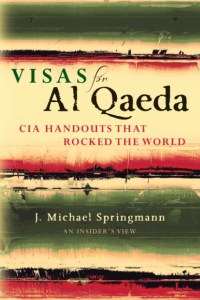 IF YOU DON’T WANT TO KNOW how sausages are made, don’t start reading Visas for Al Qaeda: CIA Handouts That Rocked the World by Michael Springmann. The sausages in this case: the string of too-easily-swallowed accounts of bloody events in the “global war on terror,” served up daily with relish by the mainstream media. In reality these sausages are filled with tainted meat that’s making everyone sick.
Springmann is a brave whistle blower living in Washington, D.C. He’s written an accessible book, safe to digest, highlighting details of the corruption of the American Empire (and its accomplices, including Canada) as he experienced them from the inside during his years with the U.S. State Department.
While he served as a visa officer in the U.S. consulate in Jeddah, Saudi Arabia, for instance, he was obliged under threat of dismissal to issue visas to persons hired clandestinely by the CIA to become trained-in-the-USA terrorists. Most of these psychopathic thugs were clearly and legally unqualified to be issued visas. There is every reason to believe the “Visas for Terrorists” program remains fully operative today. It takes a lot of expendable terrorists to run a global terrorism op.
Springmann places his experiences both within the context of the historical roots of the U.S. Empire and within its current ongoing global destabilization project.
“This tale,” the author states near the beginning, “is a sordid sketch of backstabbing, disloyalty, double crosses, faithlessness, falsity, perfidy, sellouts, treachery, and betrayal.”
And that only covers the bureaucratic aspect. Even more sobering is his sketch of human rights violations: torture, assassinations, massacres including bombings of markets, invasions and occupations of countries, destabilization of nations and regions.
Then there’s the financial side: widespread criminality, resource theft, bribery, diversion of funds, illicit drug dealing and more.
Not to mention the flouting of international laws. This dimension includes gross infringements on national sovereignty, the casual violation of treaties and ho-hum everyday general lawlessness, risking even the threat of nuclear annihilation.
All this before taking into account the moral dimension, in which trashing the Ten Commandments is just an opening trifle.
“My story shows how things really work,” Springmann writes, correctly. In the book’s 250 pages he names names, dates, times and places – presumably opening himself up to lawsuits, should there be anything here that the individuals named deem libelous. They might think twice, however, since Springmann is a lawyer by profession and knows his way around the Empire’s capital – as well as some of its outlying ramparts such as Stuttgart, New Delhi and especially Jeddah.
Stinging in itself, Springmann’s book also can be read as an authenticating companion to Michel Chossudovsky’s Towards a World War III Scenario (2012) and The Globalization of War: America’s “Long War” Against Humanity (2015). Along the way, both authors deal, to one extent or another, with the ideological, hubristic and increasingly bellicose role of the Harper government as handmaiden to the American Empire, including military involvements in Libya, Serbia and the Ukraine. Springmann necessarily refers very little to Canada, but to read his account of the cowardly and unnecessary rain of death inflicted on Libya, for instance, is to be obliged as a Canadian to think of Harper’s enthusiasm and pride in having this country share in the slaughter and destabilization carried out under the Orwellian “responsibility to protect” notion.
Springmann quotes Maximilian C. Forte who notes that before the attack Libya enjoyed the highest Human Development Index (a UN measurement of well-being) in all Africa. “After Western military forces destroyed the country the Index only records the steep collapse of all indicators of well-being. More Libyans were killed with intervention than without. It was about control, about militarizing Africa,” Forte argues.
What Springmann brings uniquely to the table is his firsthand knowledge of precisely how the USA recruits terrorists (no quotation marks needed), sends them to the USA for training and then deploys them to carry out murders, torture, bombings and more. The bloody mayhem carried out by these thousands of paid mercenaries – ostensibly beheading-habituated “jihadists” fighting against democracy, decency and the USA and its “allies – is planned, organized and funded by none other than the same USA and its allies. It’s a global false flag operation – the largest by far in history.
As Springmann on page 65 writes of the “Visas for Terrorists Program:”
This was not an ad hoc operation, conceived and carried out in response to a specific foreign policy issue. Rather, it was another of too many CIA efforts to destroy governments, countries, and politicians disfavored by the American “establishment” in its “bipartisan” approach to matters abroad. Whether it was opposing the imaginary evils of communism, the fictitious malevolence of Islam, or the invented wickedness of Iran, America and its intelligence services, brave defenders of “The City Upon A Hill,” sought out and created fear and loathing of peoples and countries essentially engaged in efforts to better their lives and improve their political world. Along the way, Agency-sponsored murders, war crimes, and human rights violations proved to be good business. Jobs for the Clandestine Service (people who recruit and run spies), sales of weapons and aircraft, as well as the myriad items needed to control banks, countries and peoples all provided income for and benefits to American companies.
That the American Empire has been able to carry out such a massive illegal program for so long is the saddest of commentaries on how deep the rot is, how effective the secrecy, how complicit the media.
As to the span of dangerous widespread deception, Springmann notes that Rahul Bedi wrote in Jane’s Defence Weekly on September 14, 2001 that beginning in 1980 “thousands [of mujahideen] were … brought to America and made competent in terrorism by Green Berets and SEALS at US government East Coast facilities, trained in guerilla warfare and armed with sophisticated weapons.”
The point is made repeatedly that Al Qaeda and now ISIS/ISIL/the Islamic State are essentially “Made in USA” entities, brought into being and organized for the Empire’s purposes. Among the elements that make possible such a vast fraud are deception, compartmentalization and secrecy. Springmann quotes attorney Pat Frascogna, “a man with FOIA expertise,” about secrecy and its purpose:
Thus whether it be learning the dirty and unethical business practices of a company or the secrets of our government, the same deployment of denials and feigning ignorance about what is really going on are the all-too-common methods used to keep the truth from the light of day.
Langley recruited the Arab-Afghans so clandestinely that the terrorists didn’t know they had been recruited. They thought that they had found a battlefield on their own, or through the Internet or through Twitter or through television…
Frascogna’s observation intersects with Springmann’s on-the-job experiences as a visa officer in Jeddah starting in 1987. Springmann was repeatedly overruled when he turned down disqualified applicants for U.S. visas. He writes:
As I later learned to my dismay, the visa applicants were recruits for the war in Afghanistan against the Soviet Union’s armed forces. Further, as time went by, the fighters, trained in the United States, went on to other battlefields: Yugoslavia, Iraq, Libya, and Syria. They worked with the American intelligence services and the State Department to destabilize governments the United States opposed. While it’s no secret, most knowledgeable people still refuse to talk about this agenda.
As Springmann learned, “the average percentage of intelligence officers to real diplomats at a given Foreign Service post is about one in three. My experience in Jeddah, Stuttgart, and New Delhi might place it higher—at least 50 percent, if not more.” According to the Anti-CIA Club of Diplomats: Spooks in U.S. Foreign Service [sic], a twelve-page, 1983 Canadian publication (see namebase.org), the percentage is 60 percent.
“At Jeddah,” Springmann writes, “to the best of my knowledge, out of some twenty US citizens assigned to the consulate, only three people, including myself, worked for the Department of State. The rest were CIA or NSA officials or their spouses.” Elsewhere Springmann suggests that essentially the CIA runs the State Department, and that this is true of many other U.S. government departments and agencies as well. It seems that it’s almost impossible to over-estimate the reach of the CIA’s tentacles or the overweening treason of its nonstop black ops and unconstitutional operations domestically.
Springmann toward the end of the book refers to the beginnings of the CIA. It’s interesting for this reviewer to think that he was 13 years of age in 1947 when U.S. president Harry Truman agreed with the National Security Council (NSC) to secretly create the CIA and NSA. I remember that in my teenage years a few of my peers said there “was something” called “the CIA.” This was around the time a few people also said there “was something” called “the Mafia.” The consensus was that both ideas were very far-fetched.
In 1948 Truman approved yet another NSC initiative, providing for “propaganda, economic warfare; preventive direct action, including sabotage, antisabotage,
demolition and evacuation measures; subversion against hostile states, including assistance to underground resistance movements, guerillas, and refugee liberation groups, and support of indigenous anti-Communist elements in threatened countries of the free world.” That’s a tabula rasa if there ever was one: a license for lawlessness.
The CIA’s twisted hits have just kept coming. It’s worth noting that Truman didn’t singlehandedly initiate this monstrosity. The dark recesses of the Deep State, as Peter Dale Scott calls it, are where the demonic entity was spawned. Ever since, Frankenstein’s monster has been a harmless schoolboy by comparison.
To read of the rape of Libya with active Canadian military complicity makes for difficult reading. The lies are piled as high as the bodies, and these two categories are insuperably paired.
Equally sordid, especially in light of Stephen Harper’s enthusiasm for expanding the war on Russia (the economic sanctions and the diplomatic exclusion of Russia from the G8 are forms of warfare, not to mention decades of covert* military incursion by the West onto the territory of the former USSR and now the Russian Federation, as described in Visas for Al Qaeda) is to read some of the history of the Ukraine. “The West’s” meddling in the Ukraine has a long illicit pedigree. As Springmann writes:
It seems that the CIA had problems [in the immediate post World War II period] distinguishing between underground groups and above-ground armies. Langley used Marshall Plan money to support a guerrilla force in the Ukraine, called “Nightingale.” Originally established in 1941 by Nazi Germany’s occupation forces, and working on their behalf, “Nightingale” and its terrorist arm (made up of ultranationalist Ukrainians as well as Nazi collaborators) murdered thousands of Jews, Soviet Union supporters, and Poles.
Even relatively recently, since the so-called Orange revolution in the Ukraine made events there eminently newsworthy, I can’t remember seeing in the mainstream media a single substantial article dealing with the historical relationships between the Ukraine and Russia going back to World War II, nor such an article laying out the history of the involvement –overt or covert – of “the West” in the Ukraine.
Instead, we see the surreal ahistorical likes of the top headline in The New York Times International Weekly for June 13-14, “Russia is Sowing Disunity,” by Peter Baker and Steven Erlanger. They report breathlessly in the lead paragraph: “Moscow is leveraging its economic power, financing European political parties and movements, and spreading alternative accounts of the Ukraine conflict, according the American and European officials.
True to the narrative of “the West” as a pitiful giant facing a powerful and expansionist Russia, the writers posit that the “consensus against Russian aggression” is “fragile.
The drift of this NYT yarn, typical of Western propaganda across the board, is that there remains in effect a behemoth “Soviet empire” surreptitiously shipping “Moscow gold” to dupes in “green movements” and so on. Even a former American national intelligence officer on Russia, Fiona Hill, now at the Brookings Institution, told the writers: “The question is how much hard evidence does anyone have?
Maybe this NYT propaganda, like its clones across the mainstream media, is not ahistorical after all. The story comes across rather as an historical relic of the Cold War – found in a time capsule in a fallout shelter – that the NYT editors decided to publish as a prank. A sausage.
* Military action by “the West” has not always been covert. Springmann notes that American and Japanese soldiers were dispatched to Russia in 1917 to squelch the fledgling Russian revolution. The soldiers were part of what was called the Allied Expeditionary Force. Winston Churchill for his part said: “We must strangle the Bolshevik baby in its crib.” Springmann might have noted that Canadian soldiers were part of the AEF.
US State Department accuses Iran of supporting terrorism
Press TV – June 20, 2015
The US State Department has accused Iran of supporting international terrorist groups, claiming the country’s terrorist activities continue.
The department said in its annual report on Friday that Iran is supporting those militant groups fighting against the ISIL terrorist group in Iraq and Syria.
The report also said the Islamic Republic increased its military aid to the Syrian government of President Bashar al-Assad and Shia fighters in Iraq last year.
Washington alleges that Tehran is increasing its support for Lebanon’s resistance movement Hezbollah and Palestinian resistance movements.
This is while the report makes almost no mention of Saudi Arabia, Qatar and Turkey, which are widely believed to be the main supporters of terrorists in the Middle East. The US itself stands accused of financing and arming militants in the region.
In an interview with Press TV on Friday, American political commentator Dr. Kevin Barrett said that the United States is the primary sponsor of the ISIL terrorists.
“It seems that they’re using a very self-serving definition of terrorism here and elsewhere,” he said.
“It’s ironic though that Iran has been bashed primarily for fighting against the people that this very report says are the world’s biggest terrorist threat and that would be ISIL and Takfiri terrorists,” Dr. Barrett added.
He also noted that Iran “has been the biggest single force fighting against that particular brand of terrorism that this report says it’s getting out of control.”
How Palestinians Die in The NY Times
By Barbara Erickson | TimesWarp | June 17, 2015
Abdullah Iyad Ghanayim, 22, died under an Israeli army jeep last Sunday in the West Bank village of Kafr Malik. The New York Times barely took notice. Other news media inform us that there is a story here and one that is in dispute.
Eyewitnesses in the village east of Ramallah say soldiers shot Ghanayim in the back and then ran him down with a jeep, crushing him against a wall, which collapsed on the vehicle and knocked it over. The soldiers got out, observers say, left the man pinned under the jeep and prevented medics from attending to him.
According to witnesses, Ghanayim was throwing stones when he was shot and bled to death after being left unattended for more than an hour. The mayor of Ramallah, Laila Ghannam, told reporters that soldiers killed Ghanayim “in cold blood.”
The Israeli army had a different story: Ghanayim was throwing a Molotov cocktail at the jeep, and this caused it to swerve and crash. After the vehicle turned over on the victim, the army claimed, “forces later entered the village to try and provide medical assistance,” but the man had already died.
In spite of the army’s failure to explain why “forces” had to enter the village to provide aid when soldiers were already present, The New York Times goes with the army account. This appears in the form of a three-paragraph Associated Press story, which made an obscure and fleeting appearance online and none at all in print. The article gives a brief nod to the eyewitness accounts, saying the mayor of the village claimed the man was shot first.
It’s possible the Times was unable to assign one of its three reporters in Israel to get a firsthand account, but the paper also omitted the story from its World Briefing section, where it frequently runs AP and Reuters news.
The Times had a choice. It could have run a Reuters story by Ali Sawafta and Dan Williams, which states in the lead that “military and locals gave conflicting accounts” and also quotes witnesses who said the man was “run down and then crushed.” Instead it chose the AP version, which relies almost entirely on the Israeli army.
We find fuller reports elsewhere, such as in The National, Agence France-Presse, and Maan, but the Times treatment falls short. It has chosen a biased wire service piece over a more complete and honest report. Thus it avoids revealing unsavory charges against the Israeli army and allows one more Palestinian death to pass unnoticed.
Featured Video

Why Hamas Really Attacked Israel on Oct. 7
or go to
Aletho News Archives – Video-Images
From the Archives
Confronting the Threat of Ethnic Bioweapons
By Tony Cartalucci – New Eastern Outlook – 29.11.2017
The United States Air Force’s 59th Medical Wing’s molecular biology branch recently was revealed to have been collecting specifically Russian RNA and synovial (connective) tissue samples, prompting fears in Russia of a possible US directed ethnic-specific bioweapons program. … continue
Blog Roll
 Aletho News
- Oct. 7 Forever Marks The Big Reveal: ‘We See You, Israel, We Revile You, We Reject You!’
- Meet the US generals and admirals advancing Israeli policy
- Israel’s Straw Widow Protocol: The Kill Zones Where Civilians Were Labelled ‘Terrorists’
- Leading Israeli Think Tank Publishes Psychotic Israeli ‘National Security’ Doctrine
- Are the United States and Israel in Decline-and-Fall Mode?
- Why Hamas Really Attacked Israel on Oct. 7
- Declassified UK exposes British man who fought for ‘Israel’ in Gaza
- West’s death cult in a theater near you
- How the Yandex ‘Russian bots’ lie fell apart
- Burnham’s ‘Russia did Brexit’ ruse crumbles
- If Americans Knew
- Israeli settlers attack West Bank center for disabled children, church leader calls for int’l action
- Pulling Out Teeth Just to Live: How Israel Has Devastated Dental Care in Gaza
- Gaza’s “ceasefire” death toll passes 1,500 – Daily Update
- Activists Abused By Israel Return to New Freedom Flotilla Mission
- 60 Minutes won’t tell the full truth about Israeli settler violence
- Nearly 50,000 women, girls killed or severely injured in Gaza since October 2023: UN Women
- ADL is working with AI companies to suppress alleged ‘antisemitism’
- Israeli occupation forces using social media surveillance unit to target hundreds of Palestinians in the West Bank
- Israel’s New – and Terrifying – Security Doctrine
- Israeli Attacks Kill Five in Gaza, Including a four-year-old and a woman
- No Tricks Zone
- New Study Suggests Large Regions Of The Pacific Ocean Have Been Cooling For The Last 80 Years
- Germany’s Green Energy Debacle: High Energy Costs Force Kahla Porzellan to Close After 182 Years!
- New Study: 50 Years Of The Most Aggressive ‘Net Zero’ Policies Can Only Affect The Global Climate By 0.03°C
- US September “Heat” Was No Record…Many Records Set Decades Ago
- Latest European Green Energy Debacle; Portugal’s Largest Flagship Solar Park Insolvent!
- Green Energy Debacle: German Expert Professor Fritz Vahrenholt Warns Of Severe Economic And Social Consequences
- Two More Paleo Reconstructions Affirm Meters-Higher Sea Levels Across Ireland, Brazil 7000-6000 Years Ago
- New Study: Earth And Venus Surface Warmth Largely Explained By Convection And Lapse Rate, Not CO2 Or Radiation
- 2025 Nature Paper Claiming Worsening Global Drought Gets RETRACTED …Heavily Flawed
- New Study: ‘Global Drought Shows No Detectable Recent Acceleration Under Climate Warming’

