The cyberattack on Sony Pictures unleashed a torrent of alarmist media reports, evoking the image of North Korean perfidy. Within a month, the FBI issued a statement declaring the North Korean government “responsible for these actions.” Amid the media frenzy, several senators and congresspersons called for tough action. Arizona Senator John McCain blustered, “It’s a new form of warfare that we’re involved in, and we need to react and react vigorously.” President Barack Obama announced his administration planned to review the possibility of placing North Korea on the list of states sponsoring terrorism, a move that would further tighten the already harsh sanctions on North Korea. “They caused a lot of damage, and we will respond,” Obama warned darkly. “We will respond proportionally, and we’ll respond in a place and time and manner that we choose.”
In the rush to judgment, few were asking for evidence, and none was provided. Computer security analysts, however, were vocal in their skepticism.
In its statement, the FBI offered only a few comments to back its attribution of North Korean responsibility. “Technical analysis of the data deletion malware used in the attack revealed links to other malware that the FBI knows North Korean actors previously developed,” it reported, including “similarities in specific lines of code, encryption algorithms, data deletion methods, and compromised networks.” The FBI went on to mention that the IP addresses used in the Sony hack were associated with “known North Korean infrastructure.” Tools used in the attack “have similarities to a cyberattack in March of last year against South Korean banks and media outlets, which was carried out by North Korea.”
The major problem with the evidence offered by the FBI is that it is self-referential, all of it pointing back to the 2013 attack on South Korean banks and media that was carried out by the DarkSeoul gang. At that time, without supplying any supporting evidence, the United States accused North Korea of being behind DarkSeoul. In effect, the FBI argues that because the U.S. spread the rumor of North Korean involvement in the earlier attack, and some of the code is related, this proves that North Korea is also responsible for the Sony hack. One rumor points to another rumor as ‘proof,’ rendering the argument meaningless.
The logical fallacies are many. To date, no investigation has uncovered the identity of DarkSeoul, and nothing is known about the group. The linking of DarkSeoul to North Korea is purely speculative. “One point that can’t be said enough,” emphasizes Risk Based Security, “is that ‘attribution is hard’ given the nature of computer intrusions and how hard it is to ultimately trace an attack back to a given individual or group. Past attacks on Sony have not been solved, even years later. The idea that a mere two weeks into the investigation and there is positive attribution, enough to call this an act of war, seems dangerous and questionable.”
Consider some of the other flaws in the FBI’s statement. The IP addresses that were hard-coded in the malware used in the Sony hack belonged to servers located in Thailand, Poland, Italy, Bolivia, Singapore, Cypress, and the United States. The FBI implies that only the Democratic People’s Republic of Korea (DPRK – the formal name for North Korea) could have used these servers. The Thai port is a proxy that is commonly used in sending spam and malware. The same is true of the Polish and Italian servers. All of the servers used in the Sony attack have been previously compromised and are among the many computers that are widely known and used by hackers and spam distributors. Anyone with the knowhow can use them.
Whether or not these machines were used is another matter. Hackers often use proxy machines with phony IP addresses to mislead investigators. No hackers use their own computers to launch an attack. Vulnerable systems are hijacked in order to route traffic. For the FBI to point to IP addresses either reveals a fundamental misunderstanding of cybersecurity or a cynical attempt to deliberately mislead the public.
The Sony hack also bears similarities with the 2012 Shamoon cyberattack on computers belonging to Saudi Aramco. Those responsible for that attack have never been identified either, although the United States accused Iran without providing any evidence. Using the FBI’s logic, one could just as easily argue that the Sony hack was the work of Iran. One groundless accusation is used to buttress another. As evidentiary matter, it is worthless. It should also be recalled that in 1998, the United States blamed Iraq for the Solar Sunrise hack into Defense Department computers, only for it be ultimately revealed that it was the act of a few teenagers.
Nor do the similarities in code between the Sony hack and the earlier Shamoon and DarkSeoul attacks indicate a shared responsibility. Malware is freely available on the black market. Hackers operate by purchasing or borrowing, and then tweaking commonly available software, including both illegal and legal components. Code is shared among hackers on forums, and malware is assembled by linking various elements together.
One of the components used in the Sony cyberattack was the RawDisk library from EldoS, a commercial application that allows direct access to Windows hardware bypassing security. Anyone can legally purchase this software. There is nothing to tie it to the DPRK.
“There’s a lot of malware that’s shared between different groups, and all malware is built on top of older malware,” reports Brian Martin of Risk Based Security. “They’re also built on top of hacking tools. For example, you’ll find lots of malware that uses pieces of code from popular tools like Nmap. Does that mean that the guy who wrote Nmap is a malware author? No. Does it mean he works for North Korea? No.”
Robert Graham of Errata Security regards the evidence offered by the FBI as “complete nonsense. It sounds like they’ve decided on a conclusion and are trying to make the evidence fit.” Graham adds: “There is nothing unique in the software. We know that hackers share malware on forums. Every hacker in the world has all the source code available.”
Trojan-Destover, the malware used in the Sony cyberattack, included at least six components utilized earlier by Shamoon and DarkSeoul. “Even in such damaging scenarios, the cyber attacker’s tools are reused,” points out Sariel Moshe of CyActive. “For them, if it worked once, tweak it a bit and it will work again. The attack on Sony demonstrates quite clearly that this method works quite well.” Indeed, while Shamoon and DarkSeoul are the most commonly mentioned predecessors to the Sony hack, it is thought that this software has been used on several occasions in the past against multiple targets.
The software utilized in the Sony cyberattack is atypical for a nation state. “It’s a night and day difference in quality,” says Craig Williams of Cisco’s Talos Security Intelligence and Research Group. “The code is simplistic, not very complex, and not very obfuscated.”
Four files used in the attack were compiled on a machine set to the Korean language. That fact proves nothing, notes computer security analyst Chris Davis. “That is pretty weak evidence. I could compile malware code that used Afrikaans and where the timestamp matched JoBerg in about five seconds.” Any reasonably competent hacker would change the language setting in order to misdirect investigators. Had North Korean conducted this attack, it certainly would have taken the basic step of changing the language setting on the machine used to compile code.
What about North Korean resentment over Sony Picture’s tasteless lowbrow comedy, The Interview, which portrays the assassination of DPRK leader Kim Jong-un? It is doubtful that Americans would find themselves any more amused by a foreign comedy on the subject of killing a U.S. president than the North Koreans are by The Interview.
Among the emails leaked by the cyberattack on Sony was a message from Bruce Bennett of the Rand Corporation. Bennett was a consultant on the film and opposed toning down the film’s ending. “I have been clear that the assassination of Kim Jong-un is the most likely path to a collapse of the North Korean government,” he wrote, adding that DVD leaks of the film into North Korea “will start some real thinking.” In another message, Sony CEO Michael Lynton responded: “Bruce – Spoke to someone very senior in State (confidentially). He agreed with everything you have been saying. Everything.” Lynton was also communicating with Robert King, U.S. Special Envoy for North Korean Human Rights Issues in regard to the film.
The Western media portray North Korean reaction to The Interview as overly sensitive and irrational, while U.S. officials and a Rand Corporation consultant saw the film as having the potential to inspire the real-life assassination of Kim Jong-un. The scene of Kim’s assassination was not intended merely for so-called ‘entertainment.’
The mass media raced to attribute the Sony hack to the DPRK, based on its reaction to the Sony film. A closer look at the cyberattack reveals a more likely culprit, however. The group taking responsibility for the hack calls itself ‘Guardians of Peace’, and in one of the malware files the alternate name of ‘God’sApstls’ is also used. In the initial attack, no reference was made to the film, nor was it mentioned in subsequent emails the attackers sent to Sony. Instead, the hackers attempted to extort money: “Monetary compensation we want. Pay the damage, or Sony Pictures will be bombarded as whole.”
In an interview with CSO Online, a person represented as belonging to Guardians of Peace said the group is “an international organization…not under the direction of any state,” and included members from several nations. “Our aim is not at the film The Interview as Sony Pictures suggests,” the hacker wrote, but mentioned that the release of a film that had the potential of threatening peace was an example of the “greed of Sony Pictures.”
For two weeks following the cyberattack, the media harped on the subject of North Korean culpability. Only after that point did the Guardians of Peace (GOP) make its first public reference to The Interview, denying any connection with the DPRK. Yet another week passed before the GOP denounced the movie and threatened to attack theaters showing the film.
It appears that the narrative of North Korean involvement repeated ad nauseam by the media and the U.S. government presented a gift to the hackers too tempting to pass up. The GOP played to the dominant theme and succeeded in solidifying the tendency to blame the DPRK, with the effect of ensuring that no investigation would pursue the group.
For its part, the Obama Administration chose to seize the opportunity to bolster its anti-North Korea policy in preference over tracking down the culprits.
There are strong indications that the cyberattack involved one or more disgruntled Sony employees or ex-employees, probably working together with experienced hackers. The malware used against Sony had been modified to include hard-coded file paths and server names. System administrator user names and passwords were also hard-coded. Only someone having full access with system administrator privileges to Sony’s computer network could have obtained this information.
The GOP could have hacked into the Sony system months beforehand in order to gather that data. But it is more likely that someone with knowledge of Sony’s network configuration provided the information. Arguing against the possibility that critical information had been siphoned beforehand through a hack, cybersecurity expert Hemanshu Nigam observes, “If terabytes of data left the Sony networks, their network detection systems would have noticed easily. It would also take months for a hacker to figure out the topography of the Sony networks to know where critical assets are stored and to have access to the decryption keys needed to open up the screeners that have been leaked.”
The most likely motivation for the attack was revenge on the part of current or former Sony employees. “My money is on a disgruntled (possibly ex) employee of Sony,” Marc Rogers of CloudFlare wrote. “Whoever did this is in it for the revenge. The info and access they had could have easily been used to cash out, yet, instead, they are making every effort to burn Sony down. Just think what they could have done with passwords to all of Sony’s financial accounts.”
Nation states never conduct such noisy hacking operations. Their goal is to quietly infiltrate a system and obtain information without detection. Sony had no data that would have been of interest to a nation state. Computer security blogger The Grugq wrote, “I can’t see the DPRK putting this sort of valuable resource onto what is essentially a petty attack against a company that has no strategic value.”
It would have been reckless for a North Korean team to draw attention to itself. Cybersecurity specialist Chris Davis says, “All the activity that was reported screams Script Kiddie to me. Not advanced state-sponsored attack.” Davis adds, “Well, the stupid skeleton pic they splashed on all the screens on the workstations inside Sony…is not something a state-sponsored attack would do…Would ANY self-respecting state-sponsored actor use something as dumb as that?” The consensus among cybersecurity experts is clear, Davis argues. “The prevalent theory I am seeing in the closed security mailing lists is an internet group of laid off Sony employees.”
Following his cybersecurity firm’s investigation, Kurt Stammberger of Norse echoes that view. “Sony was not just hacked. This is a company that was essentially nuked from the inside. We are very confident that this was not an attack master-minded by North Korea and that insiders were key to the implementation of one of the most devastating attacks in history.”
“What is striking here is how well they knew to exploit Sony’s vulnerabilities,” reports Nimrod Kozlovski of JVP Labs. “The malware itself is not creative or new; there are plenty of actors that could have manifested this particular attack.” The hackers “knew more about the company, Sony, and its vulnerabilities than they knew, or needed to know, about hacking.”
As an indication of the hacker’s real motivation, it should be noted that the first communications focused on a different issue than the Sony film. The content of an email sent by the GOP to the IDG News Service refers to Sony’s restructuring, in which thousands of employees lost their jobs: “Sony and Sony Pictures have made terrible racial discrimination and human rights violation, indiscriminate tyranny and restructuring in recent years. It has brought damage to a lot of people, some of whom are among us. Nowadays, Sony Pictures is about to prey on the weak with a plan of another indiscriminate restructuring for their own benefits. This became a decisive motive for our action.” In an email to The Verge, the GOP wrote, “We want equality. Sony doesn’t… We worked with other staff with similar interests to get in.”
Seeking to diffuse tensions, North Korea proposed to conduct a joint investigation with the United States into the Sony cyberattack. Predictably, the United States quickly rebuffed the offer. National Security Council spokesman Mark Stroh arrogantly responded, “If the North Korean government wants to help, they can admit their culpability and compensate Sony for the damages this attack caused.” North Korea can hardly be expected to accept blame for an act it did not commit. But getting to the truth of the matter was the farthest thing from the Obama Administration’s mind. Similarly, U.S. officials are ignoring requests from cybersecurity experts to be allowed to analyze the Destover code. “They’re worried we’ll prove them wrong,” Robert Graham concludes.
The Obama Administration’s outrage over the Sony attack contains more than a small measure of hypocrisy. It was the United States that launched the Stuxnet attack that destroyed many of Iran’s nuclear centrifuges. According to a Washington Post article published in 2013, the United States conducted 231 cyber operations throughout the world two years before. The National Security Agency, as is now well known, regularly hacks into computer networks, scooping up vast amounts of data. The GENIE program, the Post reported, was projected to have broken into and installed implants in 85,000 computers by the end of 2013. It was reported that GENIE’s next phase would implement an automated system that could install “potentially millions of implants” for gathering data “and active attack.” According to former deputy of defense secretary William J. Lynn III, “The policy debate has moved so that offensive options are more prominent now.”
Contrast the mild treatment the media gave to the recent large-scale hacks into Target, Home Depot and JP Morgan, in which millions of credit cards and personal information were stolen, with the coverage of the cyberattack on Sony Pictures. It is impossible to avoid the conclusion that political considerations are driving the media furor over the latter case.
After six years in office, the Obama Administration has yet to engage in dialogue or diplomacy with North Korea. It prefers to maintain a wall of hostility, blocking any prospect of progress or understanding between the two nations.
Already, North Korean websites have been targeted by persistent denial of service operations. Whether the attacks were launched by a U.S. government cyber team or independent hackers inspired by media reports is not known. In any case, President Obama has already promised to take unspecified action against the DPRK. Actual responsibility for the Sony attack is irrelevant. Backed by media cheerleading, U.S officials are using the cyberattack as a pretext to ratchet up pressure on North Korea. Any action the Obama Administration takes is likely to trigger a response, and we could enter a dangerous feedback loop of action/counteraction.
Gregory Elich is on the Board of Directors of the Jasenovac Research Institute and the Advisory Board of the Korea Policy Institute. He is a member of the Committee to Defend Democracy in South Korea and a columnist for Voice of the People. He is also one of the co-authors of Killing Democracy: CIA and Pentagon Operations in the Post-Soviet Period, published in the Russian language.
The year 2014 was another year of futility in the fight against climate change. Climatists redoubled efforts to convince citizens that urgent action is needed to stop dangerous global warming. But the gap between public warnings and actual events produced an endless stream of climate irony.
January began with a frosty bang as an arctic air mass descended on the central United States, following a similar event in December. What was once called a cold snap is now ominously christened a “polar vortex.” Record-low daily temperatures were recorded from Minnesota to Boston, along with all-time seasonal snowfalls in many cities.
In a White House video released on January 8, John Holdren, chief science advisor to President Obama, made the paradoxical statement, “But a growing body of evidence suggests that the kind of extreme cold being experienced by much of the United States as we speak is a pattern that we can expect to see with increasing frequency as global warming continues.”
Also in January, passengers of the research ship Akademik Shokalskiy were rescued after the ship was locked in ice for 10 days near the antarctic coast. The expedition lead by professor Chris Turney had intended to study how weather patterns near Antarctica were changing due to man-made global warming.
On February 16, during a presentation in Indonesia, Secretary of State John Kerry stated that climate change was “perhaps the world’s most fearsome weapon of mass destruction.” Only two days later, protestors set fire to Kiev, the capital of Ukraine, leading to the resignation of President Viktor Yanukovych. In March, Russia seized the Crimea. In July, Malaysia Airlines Flight 17 was shot down over eastern Ukraine, and political unrest continues today. In the Middle East, slaughter of innocent civilians and beheading of western captives became a growing trend. Man-made climate casualties seem remarkably scarce in comparison.
In March, the Intergovernmental Panel on Climate Change of the United Nations releasedClimate Change 2014: Impacts, Adaptation, and Vulnerability, part of its Fifth Assessment Report. The report said that man-made climate change would reduce world agricultural output. Lead author Dr. Mark Howden stated, “There’s increasing evidence that climate change is also impacting on agriculture, particularly on some of the cereal crops such as wheat and maize. The negative impacts are greater and quicker than we previously thought.”
Meanwhile, farmers continued to ignore the warnings of the IPCC. According to the US Department of Agriculture, world agricultural production set all-time records for all three major cereal crops in 2014, with rice output up 1.1 percent, wheat up 11.2 percent, and corn up a whopping 14.0 percent over 2013.
The Obama administration continued its attack on coal-fired power plants, which provide about 40 percent of US electricity. In June, the EPA proposed new restrictions on carbon emissions that would make it virtually impossible to build a new coal-fired plant in the US. At the same time, more than 1,200 new coal-fired plants are planned across the world, with two-thirds to be built in India and China.
In his 2007 Noble Prize acceptance speech, former Vice President Al Gore warned that the arctic ice could be gone in “as little as seven years.” But arctic sea ice rebounded in 2014 and antarctic sea ice has been growing for decades. According to the University of Illinois, satellites measured global sea ice area at above the 30-year average at the end of 2014.
In September, the United Nations held a climate summit in New York City to urge the world to conserve energy and reduce emissions. Spokesman Leonardo DiCaprio stated, “This disaster has grown beyond the choices that individuals make.” Mr. DiCaprio neglected to mention his frequent flights on carbon-emitting private jets or his ownership of the world’s fifth largest yacht, purchased from a Middle East oil tycoon.
In October, climate skeptics reported the eighteenth straight year of flat global temperatures. Satellite data shows no temperature increase since 1997. The “pause” in global warming is now old enough to vote or to serve in the military.
Hurricanes and tornadoes are favored events for generating alarming climate headlines, but US weather events were few in 2014. US tornadic activity was below average and the lack of strong hurricanes continued. No Category 3 or stronger hurricane has made US landfall for more than eight years, the longest period since records began in 1900.
The last half of 2014 witnessed a steep drop in world petroleum prices from over $100 per barrel to under $60 per barrel. Hydraulic fracturing and horizontal drilling, technologies perfected by US geologists and petroleum engineers over the last two decades, produced an explosion in US oil production and triggered the fall in world prices.
But the concurrent drop in US gasoline prices to two dollars per gallon is not welcomed by man-made global warming believers. Former Energy Secretary Stephen Chu said in 2008, “So we have to figure out how to boost the price of gasoline to the levels in Europe.” English journalist George Monbiot has lamented, “We were wrong about peak oil: there’s enough in the ground to deep-fry the planet.”
With all the climate fun in 2014, what will 2015 hold?
The coming conflicts in North Korea and Russia are no exception.
Mass public hysteria is being manufactured to justify aggression against Moscow and Pyongyang, in retaliation for acts attributed to the North Korean and Russian governments, but orchestrated and carried out by the CIA and the Pentagon.
The false flagging of North Korea: CIA weaponizes Hollywood
The campaign of aggression against North Korea, from the hacking of Sony and the crescendo of noise over the film, The Interview, bears all the markings of a CIA false flag operation.
The hacking and alleged threats to moviegoers has been blamed entirely on North Korea, without a shred of credible evidence beyond unsubstantiated accusations by the FBI. Pyongyang’s responsibility has not been proven. But it has already been officially endorsed, and publicly embraced as fact.
The idea of “America under attack by North Korea” is a lie.
The actual individuals of the mysterious group responsible for the hacking remain conveniently unidentified. A multitude of possibilities—Sony insiders, hackers-for-hire, generic Internet vandalism—have not been explored in earnest. The more plausible involvement of US spying agencies—the CIA, the NSA, etc. , their overwhelming technological capability and their peerless hacking and surveillance powers—remains studiously ignored.
Who benefits? It is illogical for Pyongyang to have done it. Isolated, impoverished North Korea, which has wanted improved relations with the United States for years (to no avail), gains nothing by cyber-attacking the United States with its relatively weak capabilities, and facing the certainty of overwhelming cyber and military response. On the other hand, Washington benefits greatly from any action that leads to regime change in North Korea.
But discussion about Pyongyang’s involvement—or lack of—risks missing the larger point.
This project, from the creation of The Interview to the well-orchestrated international incident, has been guided by the CIA, the Pentagon, and the State Department from the start. It is propaganda. It is a weapon of psychological warfare. It is an especially perverted example of military-intelligence manipulation of popular culture for the purpose of war.
There is nothing funny about any of it.
The Interview was made with the direct and open involvement of CIA and Rand Corporation operatives for the express purpose of destabilizing North Korea. Star and co-director Seth Rogen has admitted that he worked “directly with people who work in the government as consultants, who I’m convinced are in the CIA”. Originally conceived to be a plot taking place in an “unnamed country”, Sony Pictures co-chairman Michael Lynton, who also sits on the board of the Rand Corporation, encouraged the film makers to make the movie overtly about murdering Kim Jong-Un. Bruce Bennett, the Rand Corporation’s North Korean specialist, also had an active role, expressing enthusiasm that the film would assist regime change and spark South Korean action against Pyongyang. Other government figures from the State Department, even operatives connected to Hillary Clinton, read the script.
The infantile, imbecilic, tasteless, reckless idiots involved with The Interview, including the tasteless Rogen and co-director Evan Goldberg, worked with these military-intelligence thugs for months. “Hung out” with them. They do not seem to have had any problem being the political whores for these Langley death merchants. In fact, they had fun doing it. They seem not to give a damn, or even half a damn, that the CIA and the Pentagon have used them, and co-opted the film for an agenda far bigger than the stupid movie itself. All they seem to care about was that they are getting publicity, and more publicity, and got to make a stupid movie. Idiots.
The CIA has now succeeded in setting off a wave of anti-North Korea war hysteria across America. Witness the ignorant squeals and cries from ignorant Americans about how “we can’t let North Korea blackmail us”, “we can’t let Kim take away our free speech”. Listen to the ridiculous debate over whether Sony has the “courage” to release the film to “stand up to the evil North Koreans” who would “blackmail America” and “violate the rights” of idiot filmgoers, who now see it as a “patriotic duty” to see the film.
These mental midgets—their worldviews shaped by the CIA culture ministry with its endorsed pro-war entertainment, violent video games, and gung-ho shoot ‘em ups—are hopelessly brain-curdled, irretrievably lost. Nihilistic and soulless, as well as stupid, most Americans have no problem seeing Kim Jong-Un killed, on screen or in reality. This slice of ugly America is the CIA’s finest post-9/11 army: violent, hate-filled, easily manipulated, eager to obey sheeple who march to whatever drumbeat they set.
And then there are the truly dumb, fools who are oblivious to most of reality, who would say “hey lighten up, it’s only a comedy” and “it’s only a movie”. Naïve, entitled, exceptionalist Americans think the business of the war—the murderous agenda they and their movie are helping the CIA carry out —is all just a game.
The CIA’s business is death, and that there are actual assassination plans in the files of the CIA, targeting heads of state. Kim Jong-Un is undoubtedly on a real assassination list. This is not funny, either.
The real act of war
The provocative, hostile diplomatic stance of the Obama administration speaks for itself. Washington wanted to spark an international incident. It wants regime change in Pyongyang, does not care what North Korea or China think, and does not fear anything North Korea will do about it.
On the other hand, imagine if a film were about the assassination of Benjamin Netanyahu and the toppling of the government in Tel Aviv. Such a film, if it would ever be permitted even in script form, would be stopped cold. If it made it through censors that “magically” never slowed down The Interview (and yes, there is censorship in America, a lot of it) Obama would personally fly to Tel Aviv to apologize. At the very least, Washington would issue statements distancing themselves from the film and its content.
Not so in the case of The Interview. Because American elites actually want the Kim family murdered.
Despite providing no proof of North Korean involvement, President Barack Obama promised a “proportional response”. Promptly, North Korea’s Internet was mysteriously shut down for a day.
Unless one is naïve to believe in this coincidence, all signs point to US spy agencies (CIA, NSA, etc.) or hackers working on behalf of Washington and Langley.
Given the likelihood that North Korea had nothing to do with either the hacking of Sony, the initial pulling of the movie (a big part of the publicity stunt, that was not surprisingly reversed) or the “blackmailing” of moviegoers, the shutting down of North Korea’s Internet was therefore a unilateral, unprovoked act of war. Washington has not officially taken responsibility. For reasons of plausible denial, it never will.
Perhaps it was a dry run. A message. The US got to test how easily it can take down North Korea’s grid. As we witnessed, given overwhelming technological advantage, it was very easy. And when a war against Pyongyang begins in earnest, American forces will know exactly what they will do.
The US is flexing its Asia-Pacific muscles, sending a message not only to Pyongyang, but to China, a big future target. Some of the other muscle-flexing in recent months included the anti-Beijing protests in Hong Kong (assisted by the CIA and the US State Department), ongoing provocations in the South China Sea over disputed oil, and new defense agreements that place new anti-missile systems and missile-guided naval vessels to the region.
The bottom line is that America has once again been mobilized into supporting a new war that could take place soon. The CIA and Sony have successfully weaponized a stupid movie, making it into a cause and a battle cry.
If and when bombs fall on North Korea, blood will be on the hands of the makers of The Interview, every single executive who allowed it to be made, and the hordes who paid to see it.
If America were a decent, sane society, The Interview would be exposed, roundly denounced, boycotted and shunned. Instead it is celebrated.
The CIA should be condemned. Instead, Seth Rogen hangs out with them. America, increasingly dysfunctional, loves them. Obeys them.
The false flagging of Russia
Regarding The Interview, Russian Foreign Ministry spokesman Alexander Lukashevich issued a statement in sympathy with North Korea, correctly calling the film’s concept aggressive and scandalous, and decried the US retaliatory response as counterproductive and dangerous to international relations.
Of course. Washington has no interest in improved international relations.
The Russians should know.
Like Kim Jong-Un, Vladimir Putin has been vilified, demonized and false-flagged, incessantly. If Kim is today’s object of ridicule, Putin is Evil Incarnate.
Consider the hysterical, desperate provocations by Washington in recent months.
A US-NATO coup, engineered by the CIA, toppled the government of Ukraine, planting a pro-US neo-Nazi criminal apparatus on Russia’s doorstep. The CIA and its worldwide network of propagandists pinned the blame on Putin and Russia for aggression, and for obstructing “democracy”.
The MH-17 jetliner is downed by Ukrainian operatives, with the support of the CIA, Mi-6, etc. etc. This false flag operation was blamed on Russia— “Putin’s Missile”. The US and NATO are still trying to pin these murders on Putin.
The war against the Islamic State—a massive CIA false flag operation—seeks to topple the Assad government as well as to militarily counter Russia. The ongoing Anglo-American conquest of regional oil and gas supplies, and energy transport routes is also aimed at checkmating Russia and China across the region.
The US and NATO have attacked the Russian federation with sanctions. The US and Saudi Arabia have collapsed oil prices, to further destroy the Russian economy. Full-scale military escalations are being planned. The US Congress is pushing new legislation tantamount to an open declaration of war against Russia.
What next? Perhaps it is time for the CIA to produce a Seth Rogen-James Franco movie about assassinating Putin. Another “parody”. Or how about a movie about killing Assad, or anyone else the United States wants to make into a Public Enemy? Don’t think Langley isn’t working on it.
The return of the Bushes (who were never gone)
In the midst of all escalating war hysteria comes news that Jeb Bush is “actively exploring” running for president in 2016. The long predicted return of the Bush family, the kings of terrorism, the emperors of the false flag operation, back to the White House appears imminent.
The CIA will have its favorite family back in the Oval Office, with a true CIA scion to manage the apocalyptic wars likely to be launched in earnest in the next two years: Russia/Ukraine, North Korea, the Middle East.
Jeb Bush will “finish the job”
The 2016 presidential “contest” will be a charade. It is likely to put forth two corrupt establishment political “friends” posing as adversaries, when in fact, they are longtime comrades and conspirators. On one side, Hillary (and Bill) Clinton. On the other side, Jeb Bush, with George H.W., George W. and all of the Bush cronies crawling back out of the rotten woodwork. The fact is that the Clintons and Bushes, and their intertwined networks, have run the country since the 1980s, their respective camps taking turns in power, with Obama as transitional figurehead (his administration has always been run by neoliberal elites connected to the Clintonistas, including Hillary Clinton herself).
The collective history of the Bushes stretches back to the very founding of the American intelligence state. It is the very history of modern war criminality. The resume is George H.W. Bush—the CIA operative and CIA Director—is long and bloody, and littered with cocaine dust. The entire Bush family ran the Iran-Contra/CIA drug apparatus, with the Clintons among the Bush network’s full partners in the massive drug/weapons/banking frauds of that era, the effects of which still resonate today. And we need not remind that the Bush clan and 9/11 are responsible for the world of terror and false flag foreign policy and deception that we suffer today.
While it remains too early to know which way the Establishment will go with their selection (and it depends on how world war shakes out between now and 2016), it is highly likely that Jeb Bush would be the pick.
Hillary Clinton has already been scandalized—“Benghazi-ed”. Jeb Bush, on the other hand, has ideal Establishment/CIA pedigree. He has waited years for the stupid American public to forget the horrors that his family—Georges H.W. and W.— brought humanity. And now Americans , with their ultra-short memories, have indeed forgotten, if they had ever understood it in the first place.
And the American public does not know who Jeb Bush is, beyond the last name. Jeb Bush, whom Barbara Bush always said was the “smart one”, has been involved in Bush narco-criminal business since Iran-Contra. His criminal activities in Florida, his connection with anti-Castro Cuban terrorists and other connections are there, for those who bother to investigate them. His Latin American connections—including his ability to speak fluent Spanish, a Latin wife and a half-Latin son (George P. Bush, the next up and coming political Bush)—conveniently appeals to the fastest-growing demographic, as well as those in the southern hemisphere drug trade. Recent Obama overtures towards the Latino demographic—immigration, Cuba—appear to be a Democratic Party move to counter Jeb Bush’s known strengths in the same demographic.
Today, in the collective American mind, Kim Jong-Un and Vladimir Putin are “the bad guys”. But the mass murdering war criminal Bushes are saints. “Nice guys”.
A Jeb Bush presidency will be a pure war presidency, one that promises terror, more unspeakable than we are experiencing now, lording it over a world engulfed in holocaust.
Previously secret documents obtained by Der Speigel – including a ‘Kill List’ that included both Pakistani and Afghan targets – have raised new concerns about British complicity in the US’s covert drone war in Pakistan.
The documents, detailed in an article published yesterday evening, show that NATO and British forces in Afghanistan planned to target and kill individuals that were located across the border in Pakistan. The UK government has consistently denied that it has taken strikes outside of Afghanistan and has refused to confirm whether and to what extent it is involved in the CIA’s covert drone war in Pakistan.
Other documents reportedly show that those included on the ‘kill list’ were limited not just to key Al Qaeda leaders, but extended to hundreds of other individuals. In some instances, nothing more than a cell phone intercept was need to initiate a strike. The list also targeted alleged drug dealers, the inclusion of whom potentially constitutes a violation of international law.
Commenting, Jennifer Gibson, Staff Attorney at human rights NGO Reprieve, said: ‘Today’s revelations offer the most damning evidence to date of UK complicity in the covert drone war in Pakistan. The UK can no longer dodge questions by claiming the drone wars in Pakistan are a ‘matter for the states involved.’ These documents clearly show the UK is one of those states. The UK now needs to come clean about its role in executing a ‘kill list’ that goes far beyond targeting only militant leaders.”
An aide to the German chancellor has become the victim of a cyber-attack, according to media. The highly-sophisticated Regin virus that was found on her infected USB stick is reported to be a product of British and US spy agencies.
Having written a draft of a speech at work, one of Angela Merkel’s senior staff members decided to take it home to polish it on her private laptop in the evening. When the head of the Department of European Policy brought the USB stick with the document back to her work computer, virus scanning software revealed that it was infected, according to Monday’s report of Bild newspaper.
The USB stick was infected with the Regin spying software, but additional checks revealed no other infections on any of the 200 other high-security laptops in the Chancellery, sources from German security services said.
Regin was first warned of at the end of November by cyber-security company Symantec. A back door-type Trojan is able to “provide its controllers with a powerful framework for mass surveillance.”
According to the report, the virus demonstrates such a “rare degree of technical competence” that indicates it has probably been developed by a nation state – and it could have taken years. Regin is able to fulfill a range of customizable tasks, such as making screenshots, controlling the mouse cursor and stealing passwords, depending on the target of a spying operation.
Media reports associated Regin with the US National Security Agency (NSA) and its British counterpart Government Communications Headquarters (GCHQ). The virus is believed to begin operating in 2008, targeting governments, infrastructure operators, researchers, as well as private individuals and businesses.
“War is peace” double-speak has become commonplace these days. And, the more astute foreign policy journalists and commentators are beginning to realize the extent of how “liberal interventionists” work in sync with neocon warhawks to produce and sustain a perpetual state of U.S. war.
More and more “peace and social justice” groups are even being twisted into “democracy promotion,” U.S. militarism style. But rarely do we get a window to see as clearly into how this Orwellian transformation occurs as with the “Committee in Solidarity with the People of Syria” (CISPOS) based in Minnesota’s Twin Cities, a spin-off of “Friends for a Nonviolent World” (FNVW), steering its Quaker-inspired founding in nonviolence to promote speakers and essayists with strong ties to the violent uprising to topple the Syrian government of President Bashar al-Assad, resulting in a war that has already taken some 200,000 lives.
Do the real pacifist members approve? Or even know?
Middle Eastern expats who support U.S. intervention in their countries are especially effective in promoting their message to Western audiences because they provide “proof” of the demonization of governments that the U.S. plans to invade and dominate, and often peace groups include these expats in presentations believing them to be representatives of an entire country.
In Minneapolis, FNVW and its spin-off CISPOS hosted several events with Syrian expats who were on record as supporting the U.S. bombing of their country. (This isn’t only happening in the U.S. In April 2011, a Vancouver peace group documented its objection to the fact that other Canadian “peace” groups were sponsoring speakers who justified and advocated “in favour of the NATO bombing of Libya.”)
Often Syrian “experts” speaking to peace groups, such as FNVW/CISPOS’s upcoming speaker, Mohja Kahf, have ties to the early destabilization of Syria. This American Prospect article documents how Najib Ghadbian, Kahf’s husband of over 20 years (apparently up to last year when they divorced) was one of the Syrian dissidents who attended the early 2006 meeting with Liz Cheney (then-Vice President Dick Cheney’s daughter), along with other Syrian dissidents to plan how to destabilize Syria and topple its government. Like some Syrian version of Ahmed Chalabi, the neocons’ choice to run post-invasion Iraq, Kahf’s husband apparently got himself invited to Liz Cheney’s “Iran-Syria Operations Group” by having signed the “Damascus Declaration” in 2005, the year before.
When Najib and Mohja sat down for a long 2011 interview with The Arkansas Traveler, they discussed their involvement with the Syrian Revolution, even joking about Ghadbian becoming the next Prime Minister. Kahf and Ghadbian reportedly divorced in 2013 but when CISPOS-FNVW first published her long essays, they were still appearing together at Syrian revolutionary meetings and speaking forums. Additionally, CISPOS’s latest handout (December 2014) lists Ghadbian’s organization, www.etilaf.us (The National Coalition of Syrian Revolutionary Forces) as a resource “For More Information on Syria and How to Help.”
Resources for information on Syria often come from “citizen journalists” with deep ties to neocons and U.S. government sources. From the State Department’s website , the $330 million in support for the Syrian opposition includes training for networks of citizen journalists, bloggers and cyber-activists to support their documentation and dissemination of information on developments in Syria.
Syrian dissidents received funding from the Los Angeles-based Democracy Council, which ran a Syria-related program called the “Civil Society Strengthening Initiative” funded with $6.3 million from the State Department. The program is described as “a discrete collaborative effort between the Democracy Council and local partners” to produce, among other things, “various broadcast concepts.”
James Prince, the founder and President of the Democracy Council, is also an adviser to CyberDissidents.org , a project created in 2008 by the Jerusalem-based Adelson Institute for Strategic Studies, founded and funded by Sheldon Adelson, a patron and confidant of Benjamin Netanyahu.
Other resources include postings on social media and alternative websites with sensational stories such as the anti-Assad activist “Gay Girl in Damascus” who turned out to be a middle-aged American man in Scotland or Syrian Danny Abdul Dayem, who was frequently interviewed using fake gun fire and flames in his interviews.
With all of the information about Syria, what are we to believe as true? We know the facts about recent U.S. interventions in Middle Eastern countries. Why would Syria be any different?
Afghanistan is still in shambles with the majority of the people living in extreme poverty; Libya, which had the highest GDP per capita and life expectancy on the continent, is now a failed state; Western intervention transformed Iraq from an emerging country with moderate prosperity into an impoverished country with a starving population. In the lead-up to each intervention, “experts” emerged to explain that while anti-imperialism is good in general and in past scenarios, this time is different. Is it?
Isn’t it time for war-weary Americans to wise up and stop falling for these pretexts of bringing democracy and human rights to foreign countries through training and funding of “color (and umbrella) revolutions,” inciting of coups and regime changes and eventually, through U.S.-NATO military might?
Liberal interventionists clearly assist neocon warhawks towards their mutual goal of “full spectrum dominance” under the euphemistic guise of Pax Americana. Only the “Pax” always turns out to be endless war and occupation.
Margaret Sarfehjooy is an anti-war activist and registered nurse in Minnesota. Coleen Rowley is a retired FBI agent and former Minneapolis Division legal counsel.
When they can’t explain it, they do the next best thing.
They ignore it.
The U.S. government, the 9/11 Commission, the National Institute of Standards and Technology, FEMA and the mainstream media all do the same thing. When they can’t explain something that contradicts the official version of events on 9/11, they simply pretend the questions don’t exist.
Among the most crucial examples of this are the large pools of molten metal found under the rubble of the two twin towers of the World Trade Center and Building 7. The molten metal burned under the rubble for weeks, with the final fires not being extinguished until December of 2001, three months after the disaster.
The official story can’t explain this; it doesn’t even try. That’s because the molten metal points to a controlled demolition – explosive charges combined with a material that causes a chemical reaction creating extreme heat to cut through steel beams.
According to Brigham Young University physics professor Steven Jones, who has questioned the science of the official story, the most likely material to have been used to melt through the beams is thermite.
Thermite devices could have been wrapped around the steel girders diagonally to cut through them. They could have contributed, along with the explosives, to bringing the structure down. When ignited, thermite can reach temperatures of 4,500F in less than two seconds.
One of the by-products of the use of thermite is molten steel. Another is aluminum oxide, which shows itself as a fine white smoke. What did we have in the wake of the towers’ collapse? Molten steel and fine white “smoke.” There was so much of this smoke that it could be seen from the International Space Station.
FEMA, the Federal Emergency Management Agency, stated in its report that most of the jet fuel from the planes would have burned up in the initial impact or in the first minutes after impact.
So what was all that smoke coming from the towers and later the wreckage of the towers? Smoke poured out of the rubble for weeks as emergency workers attempted to extinguish the molten metal fires underneath.
The melting point for steel is about 2,800F while the maximum temperature that jet fuel can burn at is about 1,800F. Experts like Jones have pointed out that the black smoke coming from the towers indicates that the fire was oxygen starved and therefore was burning at a much lower temperature even than 1,800F.
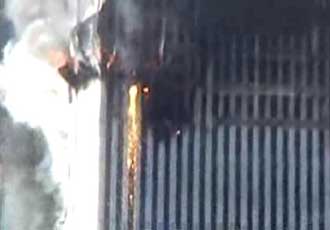
How do we know the molten metal didn’t come from some underground source? We know this because there are photographs that clearly show molten metal flowing from the 81st floor of the South Tower BEFORE collapse. Some have tried to explain this by saying that it is molten aluminum from the planes.
Aluminum may glow at a high enough temperature but it’s ridiculous to suggest that aluminum burned underground for three months. Molten metal was found under Building 7, which was not hit by a plane. Those of you who refuse to consider the “demolition” possibility might want to try and explain where this molten metal came from.
By the way, the existence of these “hot spots” under all three buildings was confirmed by aerial thermal images taken by NASA in the first two weeks after 9/11.
As for proving that the molten steel was actually there, photographs show it, and even then New York Mayor Rudy Giuliani talked about it publicly. He talked about how the boots of emergency workers would melt after a few hours of clearing rubble.
Many other witnesses reported the presence of the molten pools under the building rubble. Leslie Robertson, one of the designers of the World Trade Center, reported molten metal running under the buildings 21 days after 9/11.
Public health adviser Ron Burger likened the pools to a volcano. Other workers say it looked like a foundry or that the metal “looked like lava.” Witnesses say they saw molten steel “dripping from beams and walls” in the basement of the towers. New York firefighters referred to “rivers of molten metal” under the rubble.
SOMEONE NEEDS TO EXPLAIN THIS.
The FEMA report also mentions sulfur residue on the steel beams of the towers after collapse. This also supports the controlled demolition theory because sulfur is used to lower the melting point of the steel. Sulfur combined with thermite creates thermate. This dramatically speeds up the melting of the steel.
If there’s a reasonable explanation for all of this, why haven’t we heard it? And if you’re wondering if the whole controlled demolition case might all rest on this, you can be assured it does not.
Despite claims by the FBI that North Korea was behind the massive hack against Sony, several cybersecurity experts have come forward to raise questions about the allegation, with some suggesting that insiders at the company could be to blame.
One such expert, Kurt Stammberger from the Norse cybersecuirty firm, told CBS News that his team believes a woman identified only as “Lena” was heavily involved in the hack – not North Korea.
“We are very confident that this was not an attack master-minded by North Korea and that insiders were key to the implementation of one of the most devastating attacks in history,” he told the news outlet.
“Sony was not just hacked, this is a company that was essentially nuked from the inside,” Stammberger added.
Little is known about Lena, but Norse believes the woman is somehow linked with the hacking group behind the attack, known as the ‘Guardians of Peace.’ The firm also suspects the woman was a former employee of Sony who worked there for 10 years before leaving in May 2014.
According to Stammberger, Lena’s position in the company would have given her the access and knowledge needed to identify the servers that hackers ultimately stole troves of data from.
Stammberger didn’t completely rule out North Korea’s role in the cyber attack, but he told CBS that evidence pointing to the country could actually be a case of misdirection.
“There are certainly North Korean fingerprints on this but when we run all those leads to ground they turn out to be decoys or red herrings,” he said.
Last week, the FBI officially pinned the hack on North Korea, saying the breach involved lines of code, methods, and encryption algorithms previously developed by the country.
“Technical analysis of the data deletion malware used in this attack revealed links to other malware that the FBI knows North Korea actors previously developed,” the FBI said in its statement. “The FBI also observed significant overlap between the infrastructure used in this attack and other malicious cyber activity the US government has previously linked directly to North Korea.”
“Separately, the tools used in the SPE attack have similarities to a cyberattack in March of last year against South Korean banks and media outlets, which was carried out by North Korea.”
Still, some remain unconvinced. Cybersecurity expert Bruce Schneier wrote that the code used by the hackers seems “to point in all directions at once.” Looking at the evidence cited by the FBI, Schneier said it’s the kind that is “easy to fake, and it’s even easier to interpret it incorrectly.” He also cast doubt on the “insider threat” theory, arguing that such an individual wouldn’t need the hacking tools used to breach Sony’s servers.
Schneier noted that the FBI has not revealed all the reasons for its claim, though, and acknowledged that classified evidence could clearly point the finger at North Korea. Unless that evidence is known, it’s hard to say with any certainty.
Other possibilities include the idea that North Korea “co-opted” the initial attack after an embarrassing glut of information was made public, using that as an opportunity to strike Sony, as it was reeling and facing pressure to cancel ‘The Interview’ movie.
While Sony did cancel the premiere and release of ‘The Interview’ – a comedy which tells the story of a CIA plot to assassinate North Korean leader Kim Jong-un – it has since relented in the face of public criticism, which included harsh words from President Barack Obama. The movie is now available on streaming services and will be in theaters in limited release on Christmas Day.
Regarding the film’s release, a North Korean envoy to the United Nations said the country will condemn the decision but will not have any “physical reaction.” He added that the movie is an “unpardonable mockery of our sovereignty and dignity of our supreme leader.”
The diplomat also told the Associated Press that his country was not involved in the hack.
“…startling data omission that he told me: “eclipses even the so-called climategate event.””
Willis Eschenbach tips me to a story by Marita Noon, titled:
What if Obama’s climate change policies are based on pHraud?
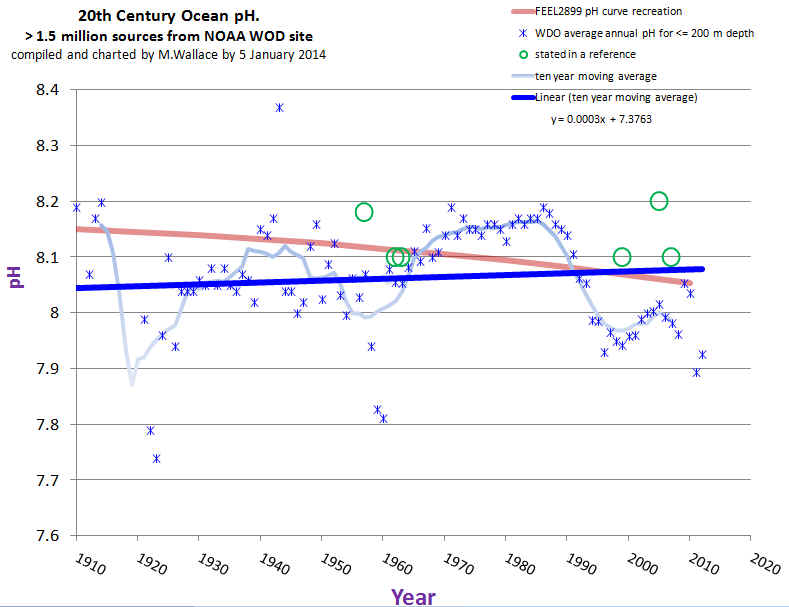
I’ve reproduced portions of it here, with a link to the full article. The graph with ALL the data is compelling.
“Ocean acidification” (OA) is receiving growing attention. While someone who doesn’t follow climate change science might think OA is a stomach condition resulting from eating bad seafood, OA is claimed to be a phenomenon that will destroy ocean life—all due to mankind’s use of fossil fuels. It is a foundational theory upon which the global warming/climate change narrative is built.
The science and engineering website Quest, recently posted: “Since the Industrial Revolution in the late 1700s, we have been mining and burning coal, oil and natural gas for energy and transportation. These processes release carbon dioxide (CO2) into the atmosphere. It is well established that the rising level of CO2 in our atmosphere is a major cause of global warming. However, the increase in CO2 is also causing changes to the chemistry of the ocean. The ocean absorbs some of the excess atmospheric CO2, which causes what scientists call ocean acidification. And ocean acidification could have major impacts on marine life.”
Within the Quest text is a link to a chart by Dr. Richard A. Feely, who is a senior scientist with the Pacific Marine Environmental Laboratory (PMEL)—which is part of the National Oceanic and Atmospheric Administration (NOAA). Feely’s climate-crisis views are widely used to support the narrative.
Feely’s four-page report: Carbon Dioxide and Our Ocean Legacy, offered on the NOAA website, contains a similar chart. This chart, titled “Historical & Projected pH & Dissolved Co2,” begins at 1850. Feely testified before Congress in 2010—using the same data that shows a decline in seawater pH (making it more acidic) that appears to coincide with increasing atmospheric carbon dioxide.
…
The December edition of the scientific journal Nature Climate Change features commentary titled: “Lessons learned from ocean acidification research.”
However, an inquisitive graduate student presented me with a very different “lesson” on OA research.
Mike Wallace is a hydrologist with nearly 30 years’ experience, who is now working on his Ph.D. in nanogeosciences at the University of New Mexico. In the course of his studies, he uncovered a startling data omission that he told me: “eclipses even the so-called climategate event.” Feely’s work is based on computer models that don’t line up with real-world data—which Feely acknowledged in email communications with Wallace (which I have read). And, as Wallace determined, there is real world data. Feely, and his coauthor Dr. Christopher L. Sabine, PMEL Director, omitted 80 years of data, which incorporate more than 2 million records of ocean pH levels.
Feely’s chart, first mentioned, begins in 1988—which is surprising as instrumental ocean pH data has been measured for more than 100 years since the invention of the glass electrode pH (GEPH) meter. As a hydrologist, Wallace was aware of GEPH’s history and found it odd that the Feely/Sabine work omitted it. He went to the source. The NOAA paper with the chart beginning in 1850 lists Dave Bard, with Pew Charitable Trust, as the contact.
Wallace sent Bard an email: “I’m looking in fact for the source references for the red curve in their plot which was labeled ‘Historical & Projected pH & Dissolved Co2.’ This plot is at the top of the second page. It covers the period of my interest.” Bard responded and suggested that Wallace communicate with Feely and Sabine—which he did over a period of several months. Wallace asked again for the “time series data (NOT MODELING) of ocean pH for 20th century.” Sabine responded by saying that it was inappropriate for Wallace to question their “motives or quality of our science,” adding that if he continued in this manner, “you will not last long in your career.” He then included a few links to websites that Wallace, after spending hours reviewing them, called “blind alleys.” Sabine concludes the email with: “I hope you will refrain from contacting me again.” But communications did continue for several more exchanges.
In an effort to obtain access to the records Feely/Sabine didn’t want to provide, Wallace filed a Freedom of Information Act (FOIA) request.
In a May 25, 2013 email, Wallace offers some statements, which he asks Feely/Sabine to confirm:
“…it is possible that Dr. Sabine WAS partially responsive to my request. That could only be possible however, if only data from 1989 and later was used to develop the 20th century portion of the subject curve.”
“…it’s possible that Dr. Feely also WAS partially responsive to my request. Yet again, this could not be possible unless the measurement data used to define 20th century ocean pH for their curve, came exclusively from 1989 and later (thereby omitting 80 previous years of ocean pH 20th century measurement data, which is the very data I’m hoping to find).”
Sabine writes: “Your statements in italics are essentially correct.” He adds: “The rest of the curve you are trying to reproduce is from a modeling study that Dr. Feely has already provided and referenced in the publication.”
In his last email exchange, Wallace offers to close out the FOIA because the email string “clarified that your subject paper (and especially the ‘History’ segment of the associated time series pH curve) did not rely upon either data or other contemporary representations for global ocean pH over the period of time between the first decade of 1900 (when the pH metric was first devised, and ocean pH values likely were first instrumentally measured and recorded) through and up to just before 1988.” Wallace received no reply, but the FOIA was closed in July 2013 with a “no document found” response.
Interestingly, in this same general timeframe, NOAA reissued its World Ocean Database. Wallace was then able to extract the instrumental records he sought and turned the GEPH data into a meaningful time series chart, which reveals that the oceans are not acidifying. (For another day, Wallace found that the levels coincide with the Pacific Decadal Oscillation.) As Wallace emphasized: “there is no global acidification trend.”
Regarding the chart in question, Wallace concludes: “Ocean acidification may seem like a minor issue to some, but besides being wrong, it is a crucial leg to the entire narrative of ‘human-influenced climate change.’ By urging our leaders in science and policy to finally disclose and correct these omissions, you will be helping to bring honesty, transparency, and accountability back where it is most sorely needed.”
“In whose professional world,” Wallace asks, “is it acceptable to omit the majority of the data and also to not disclose the omission to any other soul or Congressional body?”
As a taxpayer who is helping to pay your salary I’d like to know why you are refusing to include all the data on ocean acidification that is available.
Sabine’s response:
Chris Sabine – NOAA Federal
12:31 AM (11 hours ago)
As a public servant that must stick to the rigor of the scientific method and only present data that is of sufficient quality to address the question, I am obliged to report the best evaluation of ocean chemistry changes available. This is what you pay me to do and I am working very hard to give you the best value for your tax dollar every day. I hope you are having a good holiday season.
The question that immediately comes to mind is:
Who determined that the directly measured ocean pH data was not of “sufficient quality” and if it wasn’t, why then did NOAA make the data available on their website as part of other ocean data in their World Ocean Database without a caveat?
My search on NOAA’s NODC database for ocean pH data showed plenty of data and no caveats on use… continue
An inconvenient truth encountered by global warming alarmists is voter indifference. Poll after poll suggests that Americans lend ultra-low priority to climate change (rightlyso). This is why candidate Obama ran to the right of Romney on energy/environment policy during the 2012 campaign.
Indeed, voter apathy in the face of climate change drives AGW activists batty with frustration, so much so that they refuse to acknowledge the phenomenon. Instead of accepting the truth at hand—that everyday Americans simply don’t care about global warming in a lifetime filled with more pressing matters—climate worry warts, especially those in academia, are given to grand conspiracy theories about how nefarious fossil fuel industries spend untold billions to manipulate the American polity into its current ambivalence regarding the imperative to “do something” about global warming.
Of course, this thesis is belied by a cursory Google News search of the term “climate change,” which reliably engenders a parade of horribles on the impending catastrophic impacts in store for civilization. To wit, here is a representative sampling of first-page headlines from just such a search, conducted this morning:
“Risk of dengue fever increases due to climate change” (Fox News);
“Climate change could cost US coasts $1 trillion by 2100” (Science Now);
“Another threat from climate change: bad-tasting shrimp” (LA Times);
“Will global climate change ground commercial airlines?” (Top Secret Writers).
As usual, there weren’t any “denier” headlines. Which raises an obvious question: How is climate messaging almost always alarming, if industry is pulling all the strings?
Yesterday, I came across a new variant of the idea that fossil fuel companies are brainwashing us, and it’s a doozie. According to Professor Robert Proctor, a historian of science at Stanford University, industry has engineered the false impression that individuals are responsible for greenhouse gas emissions, when in fact the real culprit is a handful of businesses in energy and cement production. Here’s how Proctor’s argument, presented at this month’s American Geophysical Union conference, was described in Monday’s edition of ClimateWire ($):
A prevailing belief about climate change is that all of humanity — all 7 billion of us — is collectively responsible for industrial greenhouse gas emissions. But that is not strictly true. About 63 percent of all industrial emissions since 1854 have come from 90 companies, many of them coal and oil and gas producers, according to a report by the Union of Concerned Scientists.
Proctor said that industry’s idea for hoisting responsibility for the climate problem onto individual shoulders was derived from the tobacco industry. In the ’90s, tobacco companies ran media campaigns that equated smoking with freedom of choice. This placed responsibility for their addiction on individuals rather than on industry.
This perception can be flipped, and industry can be denormalized and shown to be dishonest, Proctor said.
This is wacky stuff, akin to suggesting that the alphabet is responsible for Prof. Proctor’s doctoral thesis. As reported, he claims that individuals don’t cause climate change, because most greenhouse gases have been emitted by a relatively small set of industries. Left unsaid (at least as reported) is the fact that industry’s emissions are the direct byproduct of meeting consumer demand—i.e., that of the individual. Moreover, the happy consequence of this process (i.e., meeting consumer demand) has been the unprecedented acceleration in quality of life enjoyed by *individuals* since the industrial revolution.
By Tony Cartalucci – New Eastern Outlook – 29.11.2017
The United States Air Force’s 59th Medical Wing’s molecular biology branch recently was revealed to have been collecting specifically Russian RNA and synovial (connective) tissue samples, prompting fears in Russia of a possible US directed ethnic-specific bioweapons program. … continue
This site is provided as a research and reference tool. Although we make every reasonable effort to ensure that the information and data provided at this site are useful, accurate, and current, we cannot guarantee that the information and data provided here will be error-free. By using this site, you assume all responsibility for and risk arising from your use of and reliance upon the contents of this site.
This site and the information available through it do not, and are not intended to constitute legal advice. Should you require legal advice, you should consult your own attorney.
Nothing within this site or linked to by this site constitutes investment advice or medical advice.
Materials accessible from or added to this site by third parties, such as comments posted, are strictly the responsibility of the third party who added such materials or made them accessible and we neither endorse nor undertake to control, monitor, edit or assume responsibility for any such third-party material.
The posting of stories, commentaries, reports, documents and links (embedded or otherwise) on this site does not in any way, shape or form, implied or otherwise, necessarily express or suggest endorsement or support of any of such posted material or parts therein.
The word “alleged” is deemed to occur before the word “fraud.” Since the rule of law still applies. To peasants, at least.
Fair Use
This site contains copyrighted material the use of which has not always been specifically authorized by the copyright owner. We are making such material available in our efforts to advance understanding of environmental, political, human rights, economic, democracy, scientific, and social justice issues, etc. We believe this constitutes a ‘fair use’ of any such copyrighted material as provided for in section 107 of the US Copyright Law. In accordance with Title 17 U.S.C. Section 107, the material on this site is distributed without profit to those who have expressed a prior interest in receiving the included information for research and educational purposes. For more info go to: http://www.law.cornell.edu/uscode/17/107.shtml. If you wish to use copyrighted material from this site for purposes of your own that go beyond ‘fair use’, you must obtain permission from the copyright owner.
DMCA Contact
This is information for anyone that wishes to challenge our “fair use” of copyrighted material.
If you are a legal copyright holder or a designated agent for such and you believe that content residing on or accessible through our website infringes a copyright and falls outside the boundaries of “Fair Use”, please send a notice of infringement by contacting atheonews@gmail.com.
We will respond and take necessary action immediately.
If notice is given of an alleged copyright violation we will act expeditiously to remove or disable access to the material(s) in question.
All 3rd party material posted on this website is copyright the respective owners / authors. Aletho News makes no claim of copyright on such material.