Prisoner swaps on shaky ground in Ukraine as Kiev accused of foul play
RT | September 29, 2014
Prisoner swaps in Ukraine are in danger of stalling as rebels say they will no longer tolerate Kiev’s practice of producing random people for exchange instead of actual members of militia and political prisoners.
Prisoner exchanges are a crucial part for consolidating the shaky truce in eastern Ukraine. The peace deal signed in Minsk, Belarus, on September 5 states that all captives must be eventually set free. So far the OSCE-monitored swaps had been done on a one-for-one basis, and Kiev is apparently lacking genuine rebel captives to offer and is substituting them with whoever it can procure.
But the rebels say they won’t have it anymore.
“We don’t reject further trade, but the rules of the game have changed now. The Ukrainian side will have to deliver lists and IDs of our supporters they offer in advance,” prime minister of the self-proclaimed Donetsk People’s Republic, Aleksandr Zakharchenko, told Interfax. “We will be checking the people brought for exchange against those lists. If they try to send us wrong people, we would reject them and would hold a corresponding number of their military.”
On Friday last week the rebels said they would suspend all exchanges unless Kiev stops sending them people who have nothing to do with the militias. Despite the threat, a new trade did happen on Sunday, as Kiev offered 60 prisoners in exchange for 30 army soldiers captured by the rebels. The willingness to double the number of released captives may indicate that Kiev is trying to make concessions.
But the Sunday trade may have been the reason for the latest demand, as some of those released by the Ukrainian government insisted that they had never been combatants, RIA Novosti reported.
One of the prisoners, who introduced himself as Aleksandr from the city of Kharkov, said he was just snatched from the street near his home.
“I came out for a smoke. Gunmen in a police car drove by, dragged me in took to a police station,” he told the Russian news agency. “They beat me and made me confess of murdering several people. Told me that I was a terrorist. I could barely comprehend what was happening.”
He added he wouldn’t go home because he fears he would be arrested again.
Another ex-prisoner said he was a music teacher and that he was arrested for telling a family member on the phone that he could see Ukrainian military vehicles from his window. Apparently he was suspected of giving intelligence to the rebels, but he denies any ties with the militias.
Yet another said he was arrested in Nikolayev, a city far from the conflict zone, for taking part in a peaceful anti-government protest.
“Ukraine is passing off the wrong people all the time. Of the 60 people they offered for the latest trade, 45 were just random folk,” Andrey Purgin, a senior DPR official told the news agency.
The allegations of foul play were corroborated last week by the New York Times, which covered a prisoner swap on September 21. The newspaper cited the prisoners released by Kiev as saying that only seven of the 28 were rebel fighters. Those released by the rebels all looked like military.
The problem is aggravated by a concern among the rebels that their fighters may have been killed in captivity. In preparation for the latest exchange the rebels made a list of 100 captive militiamen, but Kiev could find only 29 of them, said Darya Morozova, who heads the exchange committee for the DPR.
There has long been reluctance among Ukrainian officials over prisoner exchanges. For months the bulk of the work to release captives was shouldered by civilian activists rather than officials, and ensuring that the agreed terms of prisoners swaps were upheld by Kiev was always a major issue, according to Vladimir Ruban, a retired Ukrainian general who found himself in the position of a key negotiator once the conflict in the east escalated.
“Everything can be settled, a compromise can be found in any situation. But relying on the Ukrainian side to hold to the terms – that’s an issue,” he said in an interview to Vesti newspaper in early September. “The Donetsk side understands that the Ukrainian side may not deliver, and still they agree to big concessions because they realize the peculiarity of the state and its officials. We still make deals. This is both great and awful.”
Cameron vows to ‘hunt down’ non-violent conspiracy theorists, demands international coordinated action
Cameron announces joint bombing plan after insisting on restriction of speech in universities. Intellectual enquiry to be banned as “incitement”.
Full transcript
~
“Lies”, says Cameron, as he launches another war
Ian Fantom | RINF Alternative News
Britain is again on the verge of war. Every time they say it’s different this time, and it never is. They say the first casualty of war is truth, but it’s not true; the truth is dead before the war even begins. War is the result of lies, and this war is no exception.
A 93-year-old said to me: “I’m getting confused on who’s fighting who”. I replied, “We’re all confused. It’s ludicrous”. Who is ISIS? No-one seems to know. Has a war ever been won by bombing alone? No-one seems to know. “What could be the purpose of posting videos of beheadings?” No-one seems to know. What is the long-term strategy for winning this war? No-one seems to know. It’s as if the political establishment together with mainstream political journalists have gone into premature dementure.
Clearly, the purpose of the public beheadings can only be to enrage public opinion in the West to such an extent that they will allow their governments to send in their armed forces into the areas said to be controlled by ISIS. Who would want to do that? Would Middle-Eastern Islamicists intent on setting up an Islamic State in Syria and Iraq want to provoke and enable the mightiest military force the world has ever known to move in and obliterate them? Of course not.
Many people now think that ISIS is in all probability a creation of the US, or at least of the Neoconservative-Likud-CIA-MI6 alliance that seems to be running the Military Industrial Complex. It is said to be an offshoot of Al Qaeda, which originated as a US database of fighters opposing the Soviet occupation of Afghanistan. The case for war is being fabricated, and David Cameron is every bit as bad as Tony Blair, when he fabricated the myth of Weapons of Mass Destruction in order to give a pretext to invade Iraq. He is every bit as bad as Tony Blair when he told the House of Commons that he had proof that Osama bin Laden was responsible for 9/11, but that he wasn’t going to tell them what that proof was, but would deposit it in the House of Commons Library; he didn’t. David Cameron is every bit as bad as Adolf Hitler when his men burned down the Reichstag and blamed it on the Communists. Mercifully we haven’t yet had a Kristallnacht in the UK, but I fear that’s where we’re heading.
On 24 September David Cameron made a speech to the UN Security Council, which was posted on the Prime Minister’s website under the title: “Only a coherent, coordinated response can tackle what is a truly global and indiscriminate threat”. It’s a rehash of the Policy Exchange stuff, in which he links Islam with terrorism through constant use of the word “extremism”. What, I wonder, is the “poisonous ideology of extremism” he refers to? Is it not extremist to go to war? Then he spews out the Policy Exchange stuff about non-violent extremism: “But as the evidence emerges about the backgrounds of those convicted of terrorist of offences, it is clear that many of them were initially influenced by preachers who claim not to encourage violence, but whose world view can be used as a justification for it”. What evidence? After his Munich speech, saying that multiculturalism had failed, I gave a talk to our Keep Talking group in London, tracing his speech to Policy Exchange. I listed all those convicted of terrorist offences. I could see no evidence of these people being influenced by preachers. Look at the wording, “convicted of terrorist offences”. That has to exclude all alleged suicide bombers, the most notorious of which would be the four alleged Muslim terrorists behind 7/7 – the terrorist attacks on the London transport system of 7 July 2005. They were just declared guilty by the coroner before the inquest opened, and because they were guilty they were excluded from the inquest. Were they fanatical Muslim extremists? Well, no. This is pure deception on David Cameron’s part.
But then he accuses the truth movement of telling lies: “And we know what this worldview is–the peddling of lies: that 9/11 was a Jewish plot or the 7/7 London attacks were staged; the idea that Muslims are persecuted all over the world as a deliberate act of Western policy; the concept of an inevitable clash of civilisations. We must be clear: to defeat the ideology of extremism we need to deal with all forms of extremism – not just violent extremism. That means banning preachers of hate from coming to our countries. It means proscribing organisations that incite terrorism against people at home and abroad. It means stopping extremists whether violent or non-violent from inciting hatred and intolerance in our schools, in our universities and even sometimes in our prisons. In other words, firm, decisive action – to protect and uphold the values of our free and democratic societies”.
Who is making the allegation that 9/11 was a Jewish plot? Certainly evidence has been appearing that extremist Israeli nationalists were involved, but I have been at pains to point out in my newsletters, that it’s not “the Jews”; most British Jews were against the setting up of a Jewish state in Palestine, and many have been protesting more recently about the genocide in Gaza. David Cameron is putting out a straw man argument, in order to deflect from the blatent lies in the 9/11 cover-up. He is now maliciously using 9/11 in order to justify yet another post-9/11 war.
He accuses us of telling lies about 7/7. How could 7/7 not have been staged? Note the careful use of language here. The plain fact is that the government’s version of events just does not tie up. They even took a year to acknowledge that the train from Luton to London by which MI5 claimed the terrorists had travelled had in fact been cancelled that day. Are MI5 seriously incompetent, or was that blatent deception? How could the government simply dismiss that as a mistake, with no consequences?
Having gone to the UN Security Council to tell them that some of his own citizens are liars, when all they want is to know the truth about 9/11 and 7/7, he is now recalling Parliament on Friday 27 September, in order to get the go-ahead for war – or at least to pacify Parliament, because he doesn’t formally need Parliament’s approval; in the case of 9/11 there was just an adjournment debate, in which there was no substantive motion. Only the Prime Minister and the Queen can decide to take Britain into war. On the Prime Minister’s website there is no motion, but just a statement that the purpose of the recall is “to debate the UK’s response to the request from the Iraqi government for air strikes to support operations against ISIL in Iraq”.
I should have thought that any political journalist in the UK would be able to understand such elementary points. One has to wonder who their paymasters are.
Obama Unleashes Plan to Support ‘Civil Society’ Groups Across the Globe
teleSUR | September 25, 2014
President Barack Obama announced in a speech on Tuesday that the United States would be aggressively funding and supporting “civil society” groups around the globe, calling it a “national security” issue.
“It is precisely because citizens and civil society can be so powerful — their ability to harness technology and connect and mobilize at this moment so unprecedented — that more and more governments are doing everything in their power to silence them,” said Obama at the Clinton Global Initiative’s annual conference in New York.
Obama singled out Venezuela for allegedly “vilifying legitimate dissent” and said that Latin America would host one of the six Regional Civil Society Innovation Centers, a new initiative that seeks to create a global network to create cross-border partnerships. Other regions targeted for these new centers include Sub-Saharan Africa, the Middle East and Asia.
However, U.S. assistance to so-called civil society groups, especially in Latin America, has been marred in controversy, especially with regards to leftist governments.
The United States Agency for International Development (USAID), one of the U.S. bodies that funds and supports “civil society” organizations abroad, funded Venezuelan opposition groups responsible for the 2002 coup attempt against the democratically-elected former president Hugo Chavez.
In 2009, according to USAID documents obtained through the U.S. Freedom of Information Act, the group had also funded local regional governments and municipalities in Bolivia at a time when the government of Evo Morales was dealing with right-wing separatist movements in the eastern part of the country. Morales eventually expelled the agency from the country in 2013, a move followed by Ecuador’s President Rafael Correa later that year. Correa announced in November 2013 that USAID is required to leave the country by the end of this month.
“Partnering and protecting civil society groups around the world is now a mission across the U.S. government,” said Obama.
He ordered, via a presidential memorandum, agencies such as USAID, the Department of State, and Homeland Security, to work more regularly with civil society groups across the globe. … Full article
Colorado students stage mass walk-out over US history ‘censorship’
RT | September 25, 2014
Hundreds of Denver-area high school students walked out their classrooms in a mass protest against what they call an attempt to censor their history curriculum by refocusing it on topics that promote citizenship, patriotism and obedience.
Students at six Denver-area highs schools walked out their classrooms en masse, protesting a plan by the conservative-majority Jefferson County school board to push for curriculum changes to Advanced Placement history courses to promote patriotism and deference to authority. The proposed changes would include the removal of topics that could ‘encourage’ civil disobedience from textbooks and materials.
The protest was organized through social media, encouraging students to stand outside the Jefferson County School Administrative Building with placards which read “People didn’t die so we erase them,” “Educate free thinkers,” “There is nothing more patriotic than protest,” and “History is History.”
The student protest comes after teachers at two schools caused a shutdown the week before when they staged a sick-out over the curriculum changes, which the school board says provides a balanced view of American history.
“I understand that they want to take out our very important history of slavery and dropping the atomic bombs on Hiroshima and Nagasaki because it portrays the US in a negative light,” a high school senior, Casey McAndrew, told CNN.
The proposal calls for establishing a committee that would regularly review texts and course plans, starting with Advanced Placement history to make sure materials “promote citizenship, patriotism, essentials and benefits of the free market system, respect for authority and respect for individual rights,” and don’t “encourage or condone civil disorder, social strike or disregard of the law.”
“The nation’s foundation was built on civil protests,” Tyrone G. Parks, a senior student told the Associated Press. “And everything that we’ve done is what allowed us to be at this point today. And if you take that from us, you take away everything that America was built of.”
Those students participating in the protest will not be punished but will receive unexcused absences unless their parents request permissions for missed classes, according to school district spokeswoman Lynn Setzer said.
Meanwhile, Jefferson County Superintendent Dan McMinimee tried to calm the tensions saying that no changes in the curriculum have been finalized and renewing his offer to continue discussions on the issue.
READ MORE: Journalism groups blast Obama admin for ‘politically driven suppression of news’
ISIS is not ‘Blowback’ from Western Foreign Policy; They ARE Western Foreign Policy
Empire Strikes Black | September 24, 2014
 Notice that ISIS are sworn enemies of Syria, Hizbu’llah, and Iran. This in itself gives a most obvious clue as to the identity of the group’s benefactors.
A prevalent liberal cliché is the “blowback” theory – the theory that ISIS terror attacks, and indeed the group’s very existence, are somehow in retaliation to US/Western/”Israeli” foreign policy actions.
This is a disingenuous theory that is disseminated in order to keep the empire’s citizens on side. Crucially, it distracts from a key truth.
Western and “Israeli” intelligence has historically effected deep infiltration of ‘jihadist’ terror cells throughout the Arab world and the West; these groups are used literally as footsoldiers (see Afghanistan throughout the 1980s) to achieve Western and “Israeli” military and strategic objectives. The “blowback” theory distracts from this key fact.
ISIS aren’t retaliating against Western foreign policy; they are Western foreign policy. These very people were mobilised against Muammar Gaddafi in Libya’s bogus ‘revolution’ of 2011, as with Syria in the same year.
In moving across the Syrian-Iraqi border, ISIS – Zionism’s footsoldiers – underwent a magical media transformation into the ‘bad guys’. The ‘war against ISIS’ is a con, a total scam. It is a pretext for a war against the resistance axis: chiefly Syria, Hizbu’llah, Iran, and the Palestinian resistance. It is a pretext to kick the ‘Yinon plan’ – the plan to balkanise the Arab world to ensure “Israeli” hegemony – into high gear
The WMD lies of 2003 never went away; they simply got re-packaged for the liberal crowd in the post-Bush era.
‘Made in Palestine’: New sales pitch for marketing Israeli products
MEMO | September 23, 2014
Along one of the roads in the city of Ariha in the north of the occupied West Bank, merchants Khaldoun and Hassan regularly receive 30 tons of dates produced in the neighbouring Israeli agricultural settlements, in preparation for their transfer to one of the packaging factories built on the outskirts of the city, Anadolu news agency reported.
Inside the factory, about 13 minors are working on “screening” the dates and repackaging them in bags that read “dates of the Holy Land” in both Arabic and English and “Made in Palestine” in order to market them locally, in the Arab states and in Europe.
This is what one of the farms that is owned by Israeli settlers does in order to market its produce of dates to customers of European Union countries after the enforcement of a decision earlier this year to boycott any products of settlements in the West Bank.
Anadolu cited a statement issued by the Palestinian national economy minister saying that members of the ministry have found dozens of tons of produce coming from the settlements in this way, on its way to either the local market or to the packaging factories in the city of Ariha and the neighbouring villages.
Merchant Khaldoun, 45 years, told Anadolu’s reporter, “We do trade in dates of the settlements, which we buy at prices that are 40 per cent lower than the market price. And in order to be able to market the dates, we clean and re-package them and choose the best in preparation for selling them in the local market, as well as the Arab and European markets.”
He added that the annual volume of his seasonal sales of dates is nearly 350 tons, pointing out that other merchants who work in this field and in other varieties of vegetables and fruits, such as citrus fruits, nuts, and medical herbs have similar practices.
His fellow trader Hassan said that he has a licensed company that is registered officially. The export process takes place after the official bodies check the quality and specifications of the product, ensuring the product’s conformity with European specifications and international standards. It is then exported under the “Made in Palestine” label.
The minister of economy said in its statement that any truck carrying dates must also be carrying a transfer permit to move the dates from inside the farm of production to the factory that will process the packaging, noting that it has begun to take stricter steps over the trade of dates through listing the names of the farmers who grow dates, the number of trees they own and their annual average production.
Palestine enjoys customs exemptions and export-related facilities in trade with the countries of the European Union, so the Israeli companies cooperate with Palestinian merchants to export the dates produced in the settlements illegally established in the West Bank to the European Union, while benefiting from such exemptions.
In the beginning of 2014, the European Union announced its decision to boycott economic, scientific and academic relations with institutions, factories and farms that have any investments or presence in the Israeli settlements established in the occupied Palestinian territories.
Earlier, the ministry of economy confiscated more than 20 tons of corrupt and damaged dates coming from the Israeli settlements while on their way to one of the factories for repackaging to later sell them as a product of Palestine.
A scramble for lands
GRAIN | September 22, 2014
With all this money pouring into palm oil companies, lands for oil palm plantations are at an all time premium, wherever they can be found.
Oil palm plantations can, however, only be established on a narrow band of lands in tropical areas that are roughly 7 degrees North or South of the equator and that have abundant and evenly spread rainfall. This makes the potential area for new oil palm plantations rather limited. Plus, most of these lands are composed of forests and farmlands that are occupied by indigenous peoples and peasants, some of whom are already growing oil palms for local markets.
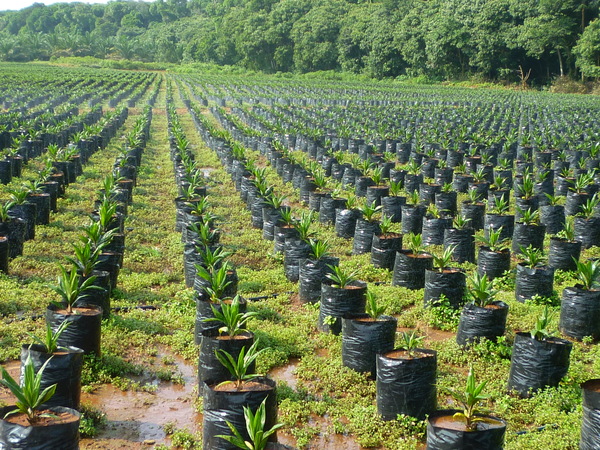
The expansion of oil palm plantations, therefore, depends upon companies getting these people to give up their lands. This is not an easy sell, given the meagre jobs and other benefits that an oil palm plantation generates in comparison with the destruction that it causes and the value that the lands already hold for the people. A typical oil palm plantation requires only one poorly paid worker for every 2.3 hectares, while the surrounding communities pay a high price for the deforestation, water use, soil erosion and chemical fertiliser and pesticide contamination that it causes.1 Companies trying to acquire lands from communities also run into customary forms of land governance that do not allow for a company to buy up land one parcel at a time.
The easy way for companies to get around these hurdles is to ensure that the communities do not even know that their lands have been signed away. It is very common in Africa, for instance, for companies to sign land deals directly with the national government without the knowledge of the affected communities. In many cases, the companies signing the deals are obscure companies registered in tax havens with their beneficial owners hidden from view. The managers of these companies tend to come from the mining sector or other extractive industries with long histories of shady deals in Africa. In Papua New Guinea and Indonesia, land deals are typically brokered between local elites and foreign investors, also often with obscure ownership structures registered in tax havens.
Such small shell companies are not in the business of developing plantations. Once the land contracts are signed, they immediately look to sell out to larger companies with the technical capacity and financial resources to build the plantations. And it is usually at this point that the communities come to understand that their lands have been sold.
Most of these cases eventually lead to a situation where a large multinational plantation company, backed by a national government and a multimillion dollar contract, faces off against a poor community trying desperately to hold onto to the lands and forests it needs to survive. It is incredibly difficult for communities to defend themselves against such powerful forces, and those that do risk the threat of violence, whether by paramilitaries in Colombia, police in Sierra Leone, or the army in Indonesia.
Tax havens and land grabs for palm oil in Africa
The case of Atama Resources Inc
In 2010, the Government of the Republic of the Congo signed away more than 400,000 ha to a Congolese registered company called Atama Plantation whose owners remain unknown.2 In return, this mysterious company promised to develop the Congo Basin’s largest ever oil palm plantation, converting 180,000 ha of mostly forested land in the provinces of Cuvette and Sangha while paying the government a token annual fee of $5 per hectare of planted land. The company was under no obligation to conduct environmental or social impact assessments or to consult with affected populations.
When the contract was signed, Atama Plantation was wholly owned by Silvermark Resources Inc, a company registered in the offshore fiscal paradise of the British Virgin Islands.3 The only publicly available information on Silvermark is that it is owned and directed by two shell companies registered in Brunei. Because of the rules of secrecy governing companies registered in Brunei and the British Virgin Islands, it is impossible to know who the actual owners of these companies are.
In 2011, ownership of Atama Plantation was transferred to a holding company in Mauritius, another fiscal paradise, before finally being sold, in 2012, to Malaysia’s Wah Seong Corporation, a “pipe-coating specialist” company with no history in the palm oil sector that is controlled by Malaysian businessman Robert Tan.4
Whoever the owners of Silvermark are, they pocketed an estimated $25 million, without doing anything more than orchestrate the contract with the Congolese government. And, under the deal with Wah Seong, they still hold 39% of the shares with yet another British Virgin Islands registered company with unknown owners holding the remaining 10%.
The case of Liberian Forest Products Inc. (LFPI)
On August 21, 2006 a little known London minerals exploration company announced to the world that it had taken control of 700,000 ha of land in Liberia– equal to about 7% of the country’s entire land area. The owners of Nardina Resources PLC claimed they had acquired rights over this massive chunk of land through a take over of a Liberian company called Liberian Forest Products Inc. (LFPI). Nardina then changed its name to Equatorial Biofuels PLC and then again to Equatorial Palm Oil Ltd (EPO) to reflect its new mandate as a palm oil company. Meanwhile, the original owners of LFPI walked away with £1,555,000 in shares and cash.
But how did the owners of LFPI get hold of such an obscene amount of territory in a country just emerging from over a decade of civil war? And who were these owners anyway?
EPO’s disclosure documents from its listing on the London AIM stock exchange in 2010 show that the money it paid for LFPI went to two offshore companies, Kamina Global Ltd of the British Virgin Islands and Subsea BV of Liberia, which each had 50% shares of LFPI.
Searches conducted in December 2013 through the company registry in Liberia found no record of registration for a company called Subsea BV. However, the articles for registration for LFPI of November 2006 indicate that LFPI is a Liberian company owned by Tony Smith (50%) and A. Kanie Wesso (50%), who are both trustees for a new company to be formed, called Subsea BV. The sole LFPI director named in the document is Mark Slowen, a British businessman operating from Liberia whose name also turns up as the CEO of SubSea Resources DMCC (Dubai Multi Commodities Centre), a company that acquired mineral rights in Liberia at around the same time.
A second business registry document for LFPI from August 2007 refers to LFPI as a British owned company– with ownership split between Mark Slowen (50%) and Kanie Wesso (50%). Both documents describe LFPI as a company whose sole business is logging.
Subsea BV also turns up in the UK business directory as a director of the G4 Group, which has several business interests in Liberia and is controlled by the notorious financial fraudster Lincoln Fraser.5 The G4 Group’s Liberian subsidiary, G4 WAO Inc., exports rubber tree logs and holds a phosphate exploration concession covering 36,000 ha in Bopolu. According to the company website, G4 WAO “manages in excess of one million acres of the best crop growing conditions in the world” and has partnered with the International Crops Research Institute for the Semi-Arid-Tropics (ICRISAT) “to establish trial sites on various G4 farming enterprises in Liberia, Ghana and Kenya.”6
Kamina Global Ltd, the other company that was paid by EPO for the acquisition of LFPI, is even more opaque. Legislation in the British Virgin Islands does not require companies to disclose their directors or shareholders, so it was not possible to identify the people behind Kamina Global through company records.7
When EPO acquired LFPI, the contract was under examination by Liberia’s Public Procurement and Concession Commission. It would conclude that the agreement contained “gross irregularities and non-compliance with the law” and EPO was forced to renegotiate. LFPI, now under the ownership of EPO, signed a new contract with the government in 2008, this time covering a much reduced but still valuable 55,000 ha area of land in Butaw. With this concession and another of a similar size in Liberia, EPO went public on the London AIM stock exchange, eventually attracting significant investment from the Siva Group, a Singapore-based holding company of Indian billionaire Chinnakannan Sivasankaran, who has quietly amassed one of the world’s largest land banks for oil palm in just a few years. The Siva Group started buying shares of EPO in 2010 and by 2013 it controlled 36.7% of the company and had formed a 50:50 joint venture with EPO based in Mauritius, called Liberian Palm Developments Ltd, that took control of all of EPO’s Liberian land concessions.8
In 2013, the Siva Group would sell its shares in EPO and its Mauritian joint venture to KL Kepong of Malaysia, one of the world’s largest palm oil companies.
Are Chinese companies grabbing land for palm oil?
China runs neck and neck with India for the world’s number 1 palm oil importer. So it would only make sense that Chinese companies would be involved in the current rush for lands for oil palm plantations. But while there have been several reports of massive land grabs for palm oil by Chinese companies, few of these have materialised.
China’s telecom giant ZTE, which has a biofuels division, was said to have signed an agreement with the Democratic Republic of the Congo to develop 2 million hectares of oil palm plantations. The numbers were later scaled down to 100,000 ha and it now seems like the project has been scrapped entirely.
In 2005, Indonesia’s President Yudhoyono announced a plan to develop 1.8 million hectares of land along the Kalimantan border into oil palm plantations. Several Chinese companies including state-owned investment company CITIC Group were offered one third of the area in return for building roads and railways and details were released of a $600 million project between CITIC and Indonesian palm oil giant Sinar Mas to develop a 100,000 ha plantation in the area, with a $380 million dollar loan from the China Development Bank.9 Sinar Mas’ subsidiary Golden Agri Resources is one of the main suppliers of palm oil to China. The plans, however, were never put into operation.
In 2012, Sinar Mas, which is controlled by Indonesia’s Widjaja family, announced a new partnership for oil palm development with China, this time with state-owned China National Offshore Oil Corp. and another Widjaja controlled company, HKC Holdings of Hong Kong. Wang Jun, the former chairman of CITIC Group, is the honorary chairman and a director of HKC. The companies said the project would be rolled out over eight years in Papua and Kalimantan, “where regional governments had reserved about one million hectares of land for it.”
Less than a year later, the Widjajas cemented another major palm oil deal with China. This time in Africa. In March 2013, Golden Agri Resources’ wholly-owned subsidiary Golden Veroleum Limited procured a $500 million term loan facility from the China Development Bank to support the construction of its 220,000 ha oil palm plantation project in LIberia. Typically the CDB only loans to overseas companies or projects when Chinese companies are directly involved.10
For now, China appears to be channeling most of its investments in palm oil through Asian palm oil companies, such as Sinar Mas, that dominate the global palm oil trade. The only Chinese company making significant direct investments in oil palm plantations has so far been China’s state-owned oil company Sinochem. In April 2012, Sinochem paid 193 million euros to acquire 35% of the Belgian plantations company SIAT, which has oil palm plantations in Gabon, Ghana and Nigeria. It also announced that its rubber company in Cameroon would be expanding its plantations and starting to move into palm oil production.
Cash crop | Communities lose out to oil palm plantations
Notes
1 UNEP, “Oil palm plantations: threats and opportunities for tropical ecosystems,” December 2011
2 See the excellent report, “Seeds of Destruction“, Rainforest Foundation UK, 2013
3 Silvermark is owned by Tinaldi Ltd and the Director is Greenland Ltd. Greenland Ltd is reported to be controlled by Benny Lum (who may just be a proxy). It controls Lamington Capital Inc (maybe Singapore) which is also a shareholder in African Petroleum Corporation Limited. It was also used to direct a transfer of funds to a Thai company that is linked to Thaksin. Both Tanaldi Ltd and Greenland Ltd (Brunei) are registered in Brunei to the address of HMR Trust Ltd (which is involved in offshore financial services). Other documents indicate that Tanaldi Limited is owned by Tan Sri Barry Goh Ming Choon of Malaysia and the company acts as a trust for other Malaysian businessmen. Barry Goh controls B&G Capital Resources Berhad (“BCGR”) which he started in 1994. BGCR has served as the principal contractor to Tenaga Nasional Berhad (TNB), one of the largest government link companies in Malaysia
4 Atama Resources Inc was registered in Mauritius in July 2011, as 100% owned by Silvermark. In 2012, Wah Seong purchases 51% of Atama Resources Inc. through its 100% owned subsidiary WS Agro Ind Pte Ltd (Singapore). 39% remains with Silvermark. 10% is taken by Giant Dragon Group (BVI), which is 100% owned by Marston International Ltd. (BVI), who’s director is Eastern Sky Ltd. (Hong Kong). Eastern Sky is a nominee director for several other companies. The Wah Seong Corporation is largely controlled by Malaysian businessman Robert Tan. Marston International Ltd. is the owner of Pergenia International Limited (PIL) incorporated in British Virgin Island on 10 January 2007 and Netstar Holdings Limited registered in BVI in 2003. Marston International Ltd is also the controlling shareholder of PT Jaya Pari Steel Tbk. (Indonesia). Reports from PT Jaya Pari Steel Tbk say that Marston International Ltd is owned by John Matthew Ashwood (50%) and Brian Whiteman and Robinson McKinstry (50%), who seem only to be proxies and John Ashwood likely works for Vistra, an offshore financial company based in Hong Kong. PT Jaya Pari Steel is a company of the Gunawan family of Indonesia, which is involved in finance and steel. The family controls 46 percent of Indonesia’s PT Bank Panin. Marston International Limited is also a major shareholder in another Gunawan steel company, Betonjaya Manunggal Tbk PT, through its ownership of Profit Add Limited (Samoa). Marston International is listed as a shareholder of Best Dragon Enterprises Limited, alongside Tito Sulistio, who is connected to the Suharto family.
5 Fraser is described by Offshore Alert as a “British conman who masterminded the $400 million Imperial Consolidated fraud” which robbed thousands of pensioners and others of their savings when it went bankrupt in 2002.
7 Kamina’s company registration information indicates that it was registered on 17 March 2006 and struck off on 2 November 2009. It’s registered agent is TMF (BVI) Ltd, a company which manages numerous shell companies on behalf of clients around the world. As written on the same document: “Under the BVI Business Companies Act, 2004 companies are not required to file information on Directors and Shareholders of a company.”
8 Siva Group’s 36.7% share of EPO is held by way of several subsidiaries: Biopalm Energy Limited (16.62%), The Siva Group (16.62%) and Broadcourt Investments Ltd (3.46%).(The joint venture is between EPO’s wholly-owned subsidiary Equatorial Biofuels (Guernsey) Limited and Biopalm Energy Limited, a wholly owned subsidiary of Geoff Palm Ltd based in the offshore city of Labuan, Malaysia, and which is owned by Broadcourt Investments Ltd, a British Virgin Islands registered holding company with Chinnakannan Sivasankaran, the Siva Group’s founder and owner, listed as its only director and shareholder since January 2007.
9 “The Kalimantan border oil palm project,” Milieudefensie – Friends of the Earth Netherlands and the Swedish Society for Nature Conservation, 2006; “China’s investment foray into Indonesia,” Asia Sentinel, 6 June 2013
Featured Video

Matt Bracken: US Plans Massive MOAB Strike on Iran?
or go to
Aletho News Archives – Video-Images
New Book
The silver that medicine dropped — four thousand years of clinical use, four decades to erase.
Colloidal Silver — First Edition, 2026, Paperback
Lies are Unbekoming | October 16, 2026
Silver was medicine. Not alternative medicine. Not folk medicine. Medicine. In surgery. In obstetrics. In the burn ward. In water treatment. In the household medicine chest. Every physician before 1938 knew this.
By the 1870s, silver nitrate was standard in surgical wound care across the leading hospitals of Britain, Germany, and the United States. Colloidal silver preparations — Collargol, Argyrol, Protargol — entered European and American practice through the 1890s and early 1900s and became standard antiseptics in military field medicine. By the time Fleming grew his first penicillin mould in 1928, silver was the first-line antimicrobial of the Western pharmacopoeia. The Lancet and the British Medical Journal carried the clinical reports in volume. The practice ran continuously through the Victorian era, the Edwardian era, the First World War, the interwar period. By 1980, almost all of it was gone.
What has not been treated at book length, until now, is how a four-thousand-year clinical record disappeared from mainstream medicine within four decades of the Flexner Report — and what the honest account of silver looks like once that record is reassembled.
Colloidal Silver reconstructs the pre-1938 record from The Lancet, the British Medical Journal, and the primary literature of the era; recovers Robert Becker’s bioelectric framework from the regeneration research the pharmaceutical model buried; and places silver inside a practical terrain-paradigm guide to its current place — in water, on the body, inside the body, and in the chronic conditions where antibiotics have failed. … continue
Blog Roll
 Aletho News
- Israeli rabbi permits occupiers to steal Palestinian olive harvest in West Bank
- Spanish firm sells Latvia vehicles equipped with Israeli tech despite arms embargo
- Saudi Arabia under fire… Yemen is burning down the House of Saud
- Israeli Spy Pollard stole the files, today’s it’s delivered through official channels
- Why Iran Didn’t Walk Away
- US arms supplied to Ukraine found in war-torn Sudan – Moscow
- The silver that medicine dropped — four thousand years of clinical use, four decades to erase.
- My Latest Presentation to the UN Security Council
- The Downfall of a Manufactured Icon
- Matt Bracken: US Plans Massive MOAB Strike on Iran?
- If Americans Knew
- NPR investigation finds evidence of widespread fraud at mall kiosks tied to Israeli skincare brand
- Tucker Carlson exposes Israeli Lies about the Oct 7th attack, Charlie Kirk, and the U.S.
- Israel has detained thousands of Palestinian children since Oct 7th – over half spent time in solitary, many uncharged
- Israeli Analysis: Is Netanyahu Planning an ‘October Surprise’ Attack Before Israel’s Election?
- Israeli settlers brutally attack Palestinians and Washington Post female photographer, 65
- Words Have Changed, Occupation Continues: The Reality of the Gaza Ceasefire
- Gaza’s child amputees are growing faster than their prosthetics allow
- Israel keeps Palestinians struggling just to survive–Daily Update
- Israeli firm used online ads to run vast spy operation, researchers say
- No, the world zionist movement is not an antisemitic conspiracy theory
- No Tricks Zone
- New Study Suggests Large Regions Of The Pacific Ocean Have Been Cooling For The Last 80 Years
- Germany’s Green Energy Debacle: High Energy Costs Force Kahla Porzellan to Close After 182 Years!
- New Study: 50 Years Of The Most Aggressive ‘Net Zero’ Policies Can Only Affect The Global Climate By 0.03°C
- US September “Heat” Was No Record…Many Records Set Decades Ago
- Latest European Green Energy Debacle; Portugal’s Largest Flagship Solar Park Insolvent!
- Green Energy Debacle: German Expert Professor Fritz Vahrenholt Warns Of Severe Economic And Social Consequences
- Two More Paleo Reconstructions Affirm Meters-Higher Sea Levels Across Ireland, Brazil 7000-6000 Years Ago
- New Study: Earth And Venus Surface Warmth Largely Explained By Convection And Lapse Rate, Not CO2 Or Radiation
- 2025 Nature Paper Claiming Worsening Global Drought Gets RETRACTED …Heavily Flawed
- New Study: ‘Global Drought Shows No Detectable Recent Acceleration Under Climate Warming’

