Court Rejects Request That Secret NSA Evidence Used Against Terrorism Suspect Be Shared With Suspect’s Lawyers
By Mike Masnick | Techdirt | June 17, 2014
We’ve been following the case of Adel Daoud, an American citizen charged with terrorism. He’s one of the many, many folks that was arrested following one of the FBI’s infamous home grown plots (i.e. he was never actually involved in any terrorism, as all of his “co-conspirators” were actually FBI agents or informants, and there was never any actual threat or chance that he’d pull off an actual terrorist attack). Back during the (pre-Snowden) debates on renewing Section 702 of the FISA Amendments Act, Senator Dianne Feinstein used Daoud’s case as a specific example of when the program had been useful in stopping terrorism.
That caught the attention of Daoud’s lawyers, who noted that this was the first they’d heard of this, and it seemed pretty clear that the government had withheld the evidence that was used to bring Daoud to trial in the first place (which is, as you know, not really allowed). After asking for the evidence, the district court first said no, but then ordered that some of the documents being filed actually be shared with Daoud’s attorneys (who have the necessary security clearances). The DOJ, of course, flipped out at this idea that the lawyers for someone they’re trying to lock up forever should actually be able to see the evidence used against him and how it was collected.
This resulted in an appeals court hearing, which bizarrely had to happen twice after the FBI so scared court staff that they failed to record the public portion of the oral hearings. The hearings were also odd in that, at one point, everybody but DOJ folks and the judges were kicked out of the courtroom, raising serious questions about basic due process.
Unfortunately, Judge Richard Posner’s ruling (right after coming out with his good ruling on the public domain) has found that the evidence does not need to be shared with Daoud’s lawyers. He slams the district court judge for overreacting and over-valuing the concept of the “adversarial process” in the court room. Seriously.
The judge appears to have believed that adversary procedure is always essential to resolve contested issues of fact. That is an incomplete description of the American judicial system in general and the federal judicial system in particular. There are ex parte or in camera hearings in the federal courts as well as hearings that are neither or both. And there are federal judicial proceedings that though entirely public are nonadversarial, either partly or entirely.
Posner basically says that the district court judge herself should have looked over the materials first, to determine if it makes sense to pass them on, rather than defaulting to saying that they should be shared with the lawyers. As such, he basically reveals that the “secret hearing” that was held was to go over the material with the appeals court judges, and they’re satisfied that nothing needs to be revealed to Daoud’s attorneys.
… our study of the materials convinces us that the investigation did not violate FISA. We shall issue a classified opinion explaining (as we are forbidden to do in a public document) these conclusions, and why therefore a remand to the district court is neither necessary nor appropriate.
Posner also, not surprisingly, rejects the objection by Daoud’s lawyers to that secret hearing, noting that it was necessary to determine if the DOJ lawyers were being fully honeset with the court:
Their objecting to the classified hearing was ironic. The purpose of the hearing was to explore, by questioning the government’s lawyer on the basis of the classified materials, the need for defense access to those materials (which the judges and their cleared staffs had read). In effect this was cross-examination of the government, and could only help the defendant.
Defense counsel’s written motion cites no authority for forbidding classified hearings, including classified oral arguments in courts of appeals, when classified materials are to be discussed. We don’t think there’s any authority it could cite.
And, voila, the secret law and secret courts and secret evidence continue unabated…
For a very good analysis of this ruling, I recommend Steve Vladeck’s take, in which he notes that Posner seems to (somewhat bizarrely) confuse sharing details with Daoud’s lawyers in secret, with “openness” to the public. As Vladeck notes, the district court judge recognized that not everything had to happen publicly, but was (reasonably) concerned that just having a judge look over the secret FISA court ruling would not be sufficient, since the judge would not have the same view as the defense attorneys. Posner seems to ignore or misinterpret all of that.
The problem, from Judge Coleman’s perspective, is that it may not always be possible for a district judge to determine whether disclosure is necessary (as opposed to whether it “may be necessary”) without the benefit of adversarial presentation. That is to say, § 1806(f) conditions the disclosure of classified FISA materials to a defendant (or, at least, his security-cleared counsel) upon a finding by the district judge that may, in some cases, only be possible with defense counsel’s participation. This is why, in her order mandating disclosure, Judge Coleman devoted so much of her energy to the importance of adversarial proceedings, especially in criminal cases—not because all proceedings in U.S. courts are adversarial (they’re not), but because, in this context specifically, adverse-ness makes it easier for a judge to have faith that she is comporting with her statutory and constitutional obligations.
But rather than accept—or at least sympathize with—Judge Coleman’s efforts to square a circle, Judge Posner derided them by suggesting that the government has a right to keep these materials secret, repeatedly criticizing calls (one is left to wonder from where) for “openness.” “Not only is federal judicial procedure not always adversarial,” Posner wrote; “it is not always fully public.” This is true, but entirely beside the point; Judge Coleman wasn’t seeking to open the proceedings; she was seeking to provide security-cleared defense counsel (who, just like everyone else, are subject to the Espionage Act) with access to classified information.
Now it is official: Israeli campaign to control Wikipedia content
By Brenda Heard | Friends of Lebanon | June 16, 2014
Wikimedia has struck a deal with Israeli officials to promote students’ multi-lingual writing and re-writing of history, geography and science topics in Wikipedia. Unwitting readers of Wikipedia likely take accounts of Middle Eastern history at face value, not realising the extent of manipulation occurring behind the seemingly authoritative guise of an encyclopaedia. From word choice, to basic information given or omitted, to biased sources cited, Wikipedia is devolving into a completely untrustworthy source.
Of course there has been an Annual Wikipedia Academy Conference since 2009, where Israelis receive Wikipedia training and encouragement. And of course groups such as CAMERA, a pro-Zionist Israel public relations organisation, have been actively editing Wikipedia since at least 2008. And of course Israel has been actively funding hasbara on the internet for years and isn’t shy about its “digital diplomacy.” There’s even a “Jewish Internet Defense League” that claims to be the “cutting edge of pro-Israel digital online advocacy.” After all, the professed need for incessant national promotion campaigns fits into the “we are the ones under attack” theme.
Wikipedia founder Jimmy Wales has twice participated in the Israeli Presidential Conference. As he said at the 2011 Wikimania conference held in Haifa, “I love coming to Israel.” But it is Wales’ exchange with a Lebanese blogger that strongly calls into question Wikipedia’s public goal of offering a credible, neutral “sum of all human knowledge.” When the blogger asked Wales about his participation in the 2011 Israeli Presidential Conference, Wales snubbed the inquiry outright. Wales responded with trite, vacuous remarks in defence of Israel and then refused to communicate further. (An unripened e-conversation that amused several pro-Zionists.)
Surely Wikipedia management is aware that Israel is one of the most controversial topics in Wikipedia. One academic study determined that the “Israel” page was rivalled only by the “Adolf Hitler” page as being the most highly contested page contained in all of the study’s three language sets. From a researcher’s point of view, then, it is illogical to encourage additional bias in the most contentious topic. Yet that is precisely what Jimmy Wales has done and what this newly announced partnership does.
It can be very valuable to research Israeli sources—from newspapers to government agencies. But we should assess these sources with the knowledge that the information provided is filtered by an Israeli perspective, most likely Zionist. We should balance those sources with a variety of views from numerous perspectives. The key problem with anonymous, reference style sources like Wikipedia is that we might assume the neutrality they claim. Has Wikipedia offered similar partnerships with countries worldwide? Why not involve students in China, Peru, India, Russia, Germany, Sweden, Ethiopia, Vietnam, or the many other countries who might like a say in how the world is depicted? We have to wonder why favourtism has been allowed by Wikipedia and whether it will be openly revealed in its pages. Naturally, non-governmental Israelis should participate in building Wikipedia, but on equal terms with any other Wikipedian. Otherwise, Wikipedia is not what it pretends to be.

Additional Resources:
“The most controversial topics in Wikipedia: A multilingual and geographical analysis” (Yasseri T., Spoerri A., Graham M., and Kertész J., 2014)
Israel’s Ministry of Education & Wikimedia Israel Agree On New, Unique Initiative (Wikimedia Foundation, 10 June 2014)
“Initiative: Teachers, Students to Write for Wikipedia” (Israeli National News, 10 June 2014)
“Public schools to integrate Wikipedia into curriculum” (Israel Hayom News, 10 June 2014)
“Education Ministry and Wikipedia collaborate to write content for the internet site” (Jerusalem Post, 10 June 2014)
“EI exclusive: a pro-Israel group’s plan to rewrite history on Wikipedia” (The Electronic Intifada, 21 April 2008)
“The Mideast Editing Wars” (Gershom Gorenberg, 1 May 2008)
“Israel’s cyber warriors” (Lucy Tobin, 12 February 2009)
“Israel deploys cyber team to spread positive spin” (Jonathan Cook, 21 July 2009)
“Positive Views of Israel, Brought to You by Israelis” (Ethan Bronner, 17 February 2010)
“Israeli students to get $2,000 to spread state propaganda on Facebook” (Ali Abunimah, 1 April 2012)
“Jimmy Wales and Palestine” (Joey Ayoub, 12 January 2012)
“Israel to pay students to defend it online” (AP, 14 August 2013)
“Haifa University launches course in pro-Israel propaganda” (Ben White, 15 April 2014)
“University of Haifa’s ‘Cyber Warriors’ will help fight the delegitimization of Israel using new media” (U of Haifa, 30 March 2014)
Zvezda TV crew freed after harsh interrogation, ransom demands by Ukraine radicals
RT | June 17, 2014

Zvezda TV channel correspondent Evgeny Davydov, left, and sound engineer Nikita Konashenkov who were detained in Dnepropetrovsk are welcomed on their arrival at Moscow’s Sheremetyevo airport after their release. (RIA Novosti/Alexey Kudenko)
Reporters from Russia’s Zvezda TV channel have been freed from captivity in Ukraine, where Right Sector fighters detained, interrogated, and beat them for ransom. Risking their lives, they didn’t turn off their phones, which was crucial for their release.
A plane carrying Evgeny Davydov and Nikita Konashenkov landed at Moscow’s Sheremetyevo Airport at 15:44 GMT on Monday. A few hours before their arrival in the Russian capital, the two journalists were handed over to Russian naval attaché Eduard Belashev in the city of Dnepropetrovsk.
The journalists spent two days in captivity, and were subjected to long questioning, intimidation, and beatings.
Recent images of the two men show the areas around their eyes covered in bruises. Their colleagues say that Davydov has complained of pain in his ear and partial hearing loss.
Zvezda TV channel has shared details of the reporters’ detention and release. The channel’s head, Aleksey Pimanov, said that Davydov and Konashenkov were freed due to “diplomatic efforts.” The station’s management sent pleas to new Ukrainian President Petro Poroshenko, the Security Service of Ukraine (SBU), and the Ukrainian judiciary demanding the journalists’ immediate release.
The Russian Foreign Ministry called the release “good news” and the “result of persistent work of all of our structures with the active participation and support of the Russian media.” Moscow says the “illegal practice of detaining journalists in Ukraine” must stop, and that the right to peaceful and objective press coverage of events in Ukraine must be safeguarded.

Zvezda TV channel correspondent Evgeny Davydov, center, with his family and sound engineer Nikita Konashenkov on their arrival at Moscow’s Sheremetyevo airport. (RIA Novosti/Alexey Kudenko)
The reporters were detained on June 14 while on their way to the airport. Saturday was meant to be the last day of their business trip in turbulent Ukraine and they were expected to fly home. They had been in Ukraine for over a month.
Constantly on the phone with Zvezda TV channel’s editors, Evgeny and Nikita successfully passed several checkpoints. However, they were stopped and detained at a post of the Ukrainian National Guard near Pokrovskoye, and the connection with the reporters was temporarily lost.
Zvezda journalists in Moscow launched a massive operation trying to find their colleagues. Both the Right Sector and the Ukrainian Security Service (SBU) refused to comment on the detentions.
Eventually, the channel managed to determine the address of where Evgeny and Nikita were being held. This finding showed that Right Sector fighters were behind the detention – the building is shared by the SBU and the radical group. As Zvezda journalists found out later, the man who interrogated their detained colleagues was Maksim Miroshnichenko, the Right Sector’s press secretary in Dnepropetrovsk.
During the interrogation process, the journalists kept one of their phones constantly connected to the channel’s headquarters. The recording will now be transferred to authorities, who will launch a torture case. The use of force against the reporters can be heard on the recording.
Throughout the questioning, which was full of cursing, Miroshnichenko reportedly tried to force the journalists to admit they lied about the true purpose of their visit. Under pressure, the interrogators forced the Russian crew to denounce their reporting on the use of white phosphorus by the Ukrainian military in an aerial assault on the outskirts of Slavyansk on Thursday.
After the channel managed to determine the journalists’ whereabouts, representatives of the Right Sector contacted Zvezda demanding a US$200,000 ransom for the reporters, who they called “scum.” Failure to provide the money would result in consequences, with the captors sending a message to family members that the journalists would be “kept for some 10 years.”
On Monday, a YouTube video surfaced showing Davydov and Konashenkov with bruises on their faces. In the footage, the two are seemingly being forced to say they have “no complaints” about their treatment by the Right Sector, and that the visible hemorrhages on their bodies were caused by a fight with a colleague.
Their documents also surfaced on the internet, showing they were accredited by the Central Election Commission of Ukraine. But, in violation of all norms of international law and the Geneva Convention, the reporters were forced to sign statements which falsely declared their lack of professional ethics.
“Everything is done on the orders of the Kremlin in order to use this information in international politics to the detriment of Ukraine,” Davydov’s forced statement allegedly read.
Konashenkov’s written testament apparently claimed that they covered Ukrainian roadblocks, “also on Moscow’s orders,” in order to make “untrue photographs.”
Upon their safe return to Russia, the journalists were taken to hospital for treatment. Before they boarded the ambulance, they gave a few comments to the press crew that greeted them at the airport. They thanked the Russian authorities and media channels for helping secure their release. They also briefly shared the details of their abduction.
“We were traveling from Donetsk to Dnepropetrovsk. We had a direct return flight from Dnepropetrovsk to Moscow on Saturday. About 120 km from Dnepropetrovsk, we were stopped at a roadblock. This was the National Guard’s checkpoint. They stopped us, asked us for our documents, checked all our personal possessions, examining everything,” the duo told journalists.
“Seeing our Russian passports and that we are Zvezda TV staff, their face expressions changed. They smirked and said that they have a jackpot in their hands. They abducted us, blindfolded us, and placed us in a car, before driving us somewhere to a field, then to some base. They threw us in a cellar.”
A press conference with Konashenkov and Davydov is scheduled to take place later on Tuesday.
Russian journalists from a range of media outlets have been repeatedly detained during the conflict in eastern Ukraine. Another set of Zvezda crew members were abducted two weeks ago and released after several days of interrogation on accusations of espionage. RT contributor and UK national Graham Phillips was detained for over 36 hours by Kiev military forces back in May. Earlier, two Russian journalists working for LifeNews TV channel were also captured by Kiev forces, forced on their knees at gunpoint and taken to Kiev for interrogations which lasted almost one week.
No Iran-US talks over Iraq crisis: Diplomat
Press TV – June 16, 2014
A senior Iranian diplomat has rejected reports about negotiations between Iran and the US over the ongoing crisis in Iraq.
“The Islamic Republic of Iran has had no negotiations with the Americans over mutual cooperation in Iraq,” Iran’s Deputy Foreign Minister for Arab and African Affairs Hossein Amir-Abdollahian said on Monday.
We believe that the Iraqi people and armed forces are capable of handling the crisis in their country on their own, he added.
The Iranian diplomat also dismissed the likelihood of the spillover of the crisis into Iran, saying, “There is no threat against the geographical borders of the Islamic Republic of Iran, but necessary precautions have been taken in this regard.”
Commenting on the quality of Iran’s cooperation with Iraq in fighting terrorism, Amir-Abdollahian rejected any direct military intervention, but noted that the Islamic Republic will assist Iraq through consultations or any other measures which can enable the Iraqi army in its counter-terrorism campaign.
On Sunday, a senior US official said the administration of President Barack Obama is considering the situation to hold talks with Iran over the Iraqi crisis.
Takfiri militants from the so-called Islamic State of Iraq and the Levant (ISIL) have recently been carrying out acts of terror in Iraq, taking over a number of cities and committing atrocities against the people.
IRS Claims Two Years Of Emails Were Destroyed In A ‘Computer Crash;’ Congressman Asks The NSA To Supply ‘Missing’ Email Metadata
By Tim Cushing | Techdirt | June 16, 2014
The IRS is currently being investigated by Congress for some possibly politically-motivated “attention” it directed towards “Tea Party” and other conservative groups that operated as tax-exempt entities. Along the way, IRS official Lois Lerner, who was the first to publicly disclose the inappropriate targeting, was also one of the first government officials to plead the Fifth (twice) in government hearings.
The Congressional investigation demanded copies of Lois Lerner’s emails from the IRS. Some were turned over to the House Ways and Means Committee, but not everything it sought. Now, the IRS is telling the committee that it’s not going to get everything it asked for.
The IRS has told Congress that it lost more than two years’ worth of emails involving former IRS official Lois Lerner, due to a computer crash.
House Ways and Means Committee Chairman Dave Camp (R-Mich.) on Friday said it was “unacceptable” that he was just learning of this problem now, after a lengthy investigation into Lerner’s involvement in the IRS targeting scandal.
Camp points out that the IRS withheld these emails for over a year before suddenly “discovering” they were unavailable. The IRS says it can find everything Lerner sent to and received from other IRS employees but nothing containing correspondence with those outside the agency.
Obviously, this convenient “computer crash” has generated a lot of skepticism. For one thing, a “computer crash” doesn’t really have the power to destroy electronic communications. Email is almost always stored somewhere else other than the local user’s computer. And even if the IRS meant a “server crash” instead of a “computer crash,” any decent server system contains multiple levels of redundancy.
The Blaze sought input from Norman Cillo, a former Microsoft project manager, who presented six reasons why he believes the IRS is lying about its inability to recover these emails. Number one on the list seems to be the most applicable.
I believe the government uses Microsoft Exchange for their email servers. They have built-in exchange mail database redundancy. So, unless they did not follow Microsoft’s recommendations they are telling a falsehood.
The IRS’s own policies on email state that its employees use both Microsoft Outlook and Exchange, which means it should have some form of backup available.
Secure Messaging enrollment is an automated process for all LAN accounts with an Exchange mailbox in IRS. You can find the instructions for configuring the Outlook client to use the certificates at the Secure Enterprise Messaging Systems (SEMS) web site: http://documentation.sems.enterprise.irs.gov/.
According to Cillo, the only other explanation for the IRS’s inability to recover these emails is that the agency is “totally mismanaged and has the worst IT department ever.” Unfortunately, the government seems to have a lot of mismanaged and terrible IT departments, so this may be closer to the truth than anyone would really like to admit. Perhaps the general ineptitude of large government agencies is behind the Treasury Department’s policy that all email sent to or from IRS employees be “archived” via hard copy printouts.
If you create or receive email messages during the course of your daily work, you are responsible for ensuring that you manage them properly. The Treasury Department’s current email policy requires emails and attachments that meet the definition of a federal record be added to the organization’s files by printing them (including the essential transmission data) and filing them with related paper records. If transmission and receipt data are not printed by the email system, annotate the paper copy.
There’s more information here, citing the IRS’s own internal guidelines on tape backups, etc., that suggest further levels of redundancy, as well as the commissioner of the IRS testifying that the agency stores its emails on servers.
Critics believe the IRS has simply “vanished” the crucial emails in order to cut Lerner adrift and make it appear she acted alone. Any evidence that would tie outside government agencies (including the administration itself) into this situation has been deemed unrecoverable. Supposedly, there should be paper copies of the missing emails, but no one in Congress has requested these and the IRS certainly isn’t offering to look.
But one Congressman thinks he has a solution to the missing email dilemma. Steve Stockman (last seen here threatening to bring a defamation lawsuit against someone who uttered true facts about his criminal past) knows some people who have a whole lot of email data just laying around.
“I have asked NSA Director Rogers to send me all metadata his agency has collected on Lois Lerner’s email accounts for the period which the House sought records,” said Stockman. “The metadata will establish who Lerner contacted and when, which helps investigators determine the extent of illegal activity by the IRS.”
Yeah, let me know how that works out for you, Steve. The NSA can’t even confirm or deny its monthly water usage at its Utah data site, much less that it has metadata pertaining to Americans’ communications.
[Sidebar: I do really love the fact that this sort of thing is becoming increasingly common — the use of the NSA as the backup-of-last-resort for phone/email/internet communications data. If anyone claims it can’t find email X or phone record Y, someone’s going to say, “Hey, I’ll bet the NSA has a copy!” Hilarious. The NSA will never again be allowed to pretend it doesn’t harvest data on American citizens.]
The whole letter, which begins with some light ass-kissing of new NSA director Michael Rogers (“thank you for your 33 years of, and continued service to, our country...”) and closes with a bit of grandstanding, surreally asking “the Agency” to send all relevant metadata on the missing Lerner emails to “Donny@mail.house.gov.” All in all, probably one of the most incongruous demands the NSA has ever received, a letter which conjures up the image of a late-night meeting in an underground parking garage, with sunglassed NSA liaisons handing over a briefcase full of metadata to a 19-year-old intern dressed in his dad’s suit.
It’s pretty hard to shake the impression that this is a coverup. As always, the specter of pure ineptitude lurks in the background, as it often does when large bureaucracies tangle with technology. But until the IRS presents further evidence detailing how exactly these emails went missing, it’s safe to assume there’s been an active effort made to cover up government impropriety.
The Assault on Teachers Unions
By David Macaray | CounterPunch | June 13, 2014
Although I can understand the relentless anti-union crusade being waged by free market fundamentalists who wish to: (1) weaken the American labor movement, and (2) do away with the public school system (because there are hundreds of millions of dollars to be made by “privatizing” education), I am stunned by the public’s willingness to accept what is, on its face, a monumentally stupid argument.
While no one ever hears of American colleges and universities being accused of producing consistently “bad” accountants or bad pharmacists or bad historians or bad computer programmers or bad anthropologists, apparently, those same colleges and universities have turned out a disproportionately high number of “bad” teachers.
Even though these idealistic men and women busted their humps earning their college degrees and teaching credentials (which, by law, are required to teach in a public school, but are not required by private schools), once they entered the classroom and began plying their trade, they turned out to be a bunch of incompetents and slackers.
Of course, the explanation given by the anti-labor, privatization propagandists is that these teachers came out of their colleges and universities in satisfactory shape, but turned “bad” as soon as they became union members, because the teachers’ union, as we all know, was put on earth to protect bad teachers. Yep, as a former union president myself, I can attest that there’s nothing we union honchos admire more than a shitty worker.
Here’s something to think about: Airline pilots, flight attendants, mechanics, firefighters, nurses, actors, writers, directors, coal miners, and that woman who plays oboe in the symphony orchestra are union members. They are good at their jobs. Being represented by a union didn’t turn them into bad workers.
Southwest Airlines is the most unionized carrier in the industry and, last time I checked, it was among the most profitable. If you want to accept the outrageous falsehood—the outright lie—that union members are bad workers, that’s your privilege, but unless you have a death wish, I suggest you stay off airplanes.
Here’s something else: Some of the best school districts in the country are heavily unionized. Something else: Demonstrating that the whole thing is mainly socio-economic, schools in stable areas perform better than schools in poor, distressed areas, and unions have nothing to do with it. And something else: Non-union teachers across the country get fired at about the same rate as union teachers. It’s true. Why don’t more non-union teachers get fired? Because they don’t deserve be fired.
Has anyone who did poorly in school ever blamed the teacher for their lack of success? Has anyone ever said, “Man, I would’ve been a kick-ass student if only my teachers had been capable of teaching me”? I’ve never heard one person say that. Instead, they either blame their parents for not having assisted or “pushed” them enough, or blame themselves for simply not having put in the necessary work.
Again, this whole assault on the teaching profession is a hoax. It’s designed to beat down the unions and convince people that “private education” is the way to go. And in order to win, they need to convince a critical mass of parents that the only reason their little Johnny or Judy isn’t performing like a budding genius is because of “bad” teachers. That people believe it is a shame.
David Macaray is a labor columnist and author (“It’s Never Been Easy: Essays on Modern Labor, 2nd Edition). Dmacaray@earthlink.net
GAO Audit Accuses Obama Administration of Lowballing Cost of Maintaining Nuclear Arsenal
By Noel Brinkerhoff | AllGov | June 13, 2014
For the second time this year, government auditors have issued a report critical of the Obama administration’s projections for preserving the nation’s stockpile of nuclear weapons.
In both instances, the cost estimates put forth by the departments of Defense and Energy have been described as far too low, in part because key expenses were not budgeted. The latest audit, performed by the Government Accountability Office (GAO), supported some of the findings of the Congressional Budget Office (CBO), which concluded six months ago that the administration was off—by hundreds of billions of dollars—in estimating the future needs of maintaining the arsenal.
The Pentagon has claimed outlays will be about $264 billion. But the CBO put the figure closer to $570 billion and perhaps as much as $1 trillion over the next 30 years.
The GAO did not offer its own estimate for maintaining the weapons. But it did question the Defense Department’s claim that modernizing all ballistic missiles and bombers would require only $64 billion over the next 10 years.
In the case of the Minuteman III missile, which has served as the backbone of the nation’s land-based nuclear deterrent since the 1970s, GAO auditors found the administration left out all future funding for replacing these weapons, saying the program was “not yet defined.” As for a new bomber, the Air Force said those costs were “too sensitive” to include in the report.
At the Energy Department (DOE), which oversees all nuclear weapons research, the GAO found that officials had low-balled the cost of modernizing certain warheads for ballistic and cruise missiles.
The agency also reported that DOE had assumed billions of dollars in cost savings from efficiency efforts without determining where the savings would come from, and that Energy officials had left out the cost of revamping or replacing several nuclear-weapons laboratories.
To Learn More:
Federal Auditors Say Obama Administration Underestimates Nuclear Weapons Costs (by R. Jeffrey Smith, Center for Public Integrity)
Ten-Year Budget Estimates for Modernization Omit Key Efforts, and Assumptions and Limitations Are Not Fully Transparent (Government Accountability Office)
Obama Administration Underestimated Cost of Maintaining Nuclear Weapons by $140 Billion (by Noel Brinkerhoff and Danny Biederman, AllGov)
China rejects latest US hacking accusation
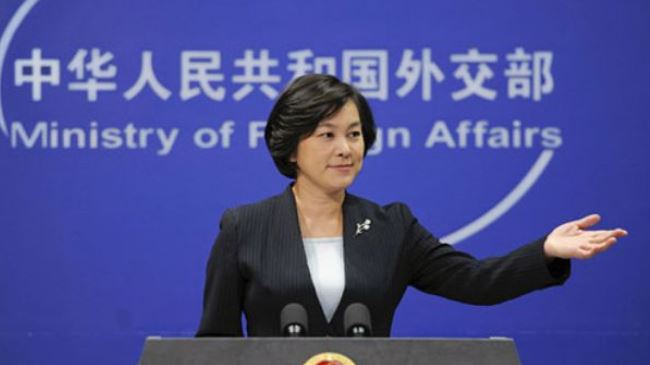
China’s Foreign Ministry Spokeswoman Hua Chunying
China has dismissed the recent allegation by the US that the Chinese military has been involved in hacking a US security firm, describing Washington’s approach on the issue as unconstructive.
A private US cyber security firm accused a unit of China’s military on Monday of hacking attempts to access information on US satellite and aerospace programs, Xinhua reported.
China’s Foreign Ministry Spokeswoman Hua Chunying rejected the allegation at a press briefing on Tuesday.
“I have noticed the report you mentioned, its wording and style looks familiar, citing the names of the hackers and their claims of their military identity,” she said, responding to a question about US reports alleging Chinese hacking attempts. “Have you ever seen thieves bearing a name tag saying ‘thieves?’” she said.
Washington had issued an indictment against five Chinese military officers on charges of cyber theft earlier on May 19.
The Chinese Foreign Ministry spokeswoman further challenged the integrity of the US allegations against her country, referring to the massive American espionage efforts across the globe as part of its PRISM program under the US National Security Agency (NSA).
The program, which was revealed by former NSA contract employee Edward Snowden in 2013, showed that the US was spying on the phone and email communications of top world leaders, including those of Washington’s allied countries as well as China.
“The US is a hacking empire,” Hua said. “It is not constructive for the US to attack others instead of repenting and correcting its own mistakes.”
The Chinese official further pointed out that cyber attacks are a global challenge – transnational and anonymous in nature – requiring cooperation among all countries to be countered.
Featured Video

John Mearsheimer Talking Iran with Iran
or go to
Aletho News Archives – Video-Images
New Book
The silver that medicine dropped — four thousand years of clinical use, four decades to erase.
Colloidal Silver — First Edition, 2026, Paperback
Lies are Unbekoming | October 16, 2026
Silver was medicine. Not alternative medicine. Not folk medicine. Medicine. In surgery. In obstetrics. In the burn ward. In water treatment. In the household medicine chest. Every physician before 1938 knew this.
By the 1870s, silver nitrate was standard in surgical wound care across the leading hospitals of Britain, Germany, and the United States. Colloidal silver preparations — Collargol, Argyrol, Protargol — entered European and American practice through the 1890s and early 1900s and became standard antiseptics in military field medicine. By the time Fleming grew his first penicillin mould in 1928, silver was the first-line antimicrobial of the Western pharmacopoeia. The Lancet and the British Medical Journal carried the clinical reports in volume. The practice ran continuously through the Victorian era, the Edwardian era, the First World War, the interwar period. By 1980, almost all of it was gone.
What has not been treated at book length, until now, is how a four-thousand-year clinical record disappeared from mainstream medicine within four decades of the Flexner Report — and what the honest account of silver looks like once that record is reassembled.
Colloidal Silver reconstructs the pre-1938 record from The Lancet, the British Medical Journal, and the primary literature of the era; recovers Robert Becker’s bioelectric framework from the regeneration research the pharmaceutical model buried; and places silver inside a practical terrain-paradigm guide to its current place — in water, on the body, inside the body, and in the chronic conditions where antibiotics have failed. … continue
Blog Roll
 Aletho News
- John Mearsheimer Talking Iran with Iran
- Inside Bill C-22, Canada’s Patriot Act.
- China’s FM: Palestinian cause is ‘greatest injustice of the century’
- US sympathy for Palestinians surpasses support for Israelis
- Israeli rabbi permits occupiers to steal Palestinian olive harvest in West Bank
- Spanish firm sells Latvia vehicles equipped with Israeli tech despite arms embargo
- Saudi Arabia under fire… Yemen is burning down the House of Saud
- Israeli Spy Pollard stole the files, today’s it’s delivered through official channels
- Why Iran Didn’t Walk Away
- US arms supplied to Ukraine found in war-torn Sudan – Moscow
- If Americans Knew
- NPR investigation finds evidence of widespread fraud at mall kiosks tied to Israeli skincare brand
- Tucker Carlson exposes Israeli Lies about the Oct 7th attack, Charlie Kirk, and the U.S.
- Israel has detained thousands of Palestinian children since Oct 7th – over half spent time in solitary, many uncharged
- Israeli Analysis: Is Netanyahu Planning an ‘October Surprise’ Attack Before Israel’s Election?
- Israeli settlers brutally attack Palestinians and Washington Post female photographer, 65
- Words Have Changed, Occupation Continues: The Reality of the Gaza Ceasefire
- Gaza’s child amputees are growing faster than their prosthetics allow
- Israel keeps Palestinians struggling just to survive–Daily Update
- Israeli firm used online ads to run vast spy operation, researchers say
- No, the world zionist movement is not an antisemitic conspiracy theory
- No Tricks Zone
- New Study Suggests Large Regions Of The Pacific Ocean Have Been Cooling For The Last 80 Years
- Germany’s Green Energy Debacle: High Energy Costs Force Kahla Porzellan to Close After 182 Years!
- New Study: 50 Years Of The Most Aggressive ‘Net Zero’ Policies Can Only Affect The Global Climate By 0.03°C
- US September “Heat” Was No Record…Many Records Set Decades Ago
- Latest European Green Energy Debacle; Portugal’s Largest Flagship Solar Park Insolvent!
- Green Energy Debacle: German Expert Professor Fritz Vahrenholt Warns Of Severe Economic And Social Consequences
- Two More Paleo Reconstructions Affirm Meters-Higher Sea Levels Across Ireland, Brazil 7000-6000 Years Ago
- New Study: Earth And Venus Surface Warmth Largely Explained By Convection And Lapse Rate, Not CO2 Or Radiation
- 2025 Nature Paper Claiming Worsening Global Drought Gets RETRACTED …Heavily Flawed
- New Study: ‘Global Drought Shows No Detectable Recent Acceleration Under Climate Warming’

