The campaign against me and my work fell apart a while ago. I assume that my Jewish detractors came to realise that I enjoy their attention and use it to affirm my criticism of their tribal and exclusivist identity politics.
But yesterday I had a nostalgic moment reading Max Blumenthal dissing me publicly. When Blumenthal was asked about Israeli critics he ended up talking about the vile ‘anti Semites’, ‘neo Fascists’ and the ‘racists’ in the movements. Interestingly enough, he failed to remember any name but one – Gilad Atzmon.
Atzmon is a “pure anti Semite who believes that all of the problems of Israel flow not from colonialism but from Judaism.” said Blumenthal.
Apparently, not buying into the clumsy ‘colonial paradigm’ makes me into a ‘neo Fascist’, ‘anti Semite’ and a ‘racist’.
It is obviously clear that Blumenthal didn’t read a single word by me. I naively believe that if someone insists to criticise my work, he or she better spend some time to read me first. It is an established fact that Palestinian activist Ali Abunimah also called for my disavowal while admitting to Prof. Norton Mezvinsky that he has never read a single word by me. Tragically enough, the fear of intellectual exchange and open discourse is endemic within the Jewish progressive ghetto but also within some quarters of the solidarity movement.
However, those who are even mildly familiar with my thoughts know that Blumenthal reacts out of hysteria rather than knowledge. My scholarship is not concerned with Judaism (the religion) nor am I referring to Jews (the people). I am critical of Jewish Identity politics and Jewish ideology. I elaborate on Jewish-ness and Jewish culture as opposed to Judaism. Race, genetics or biology have never been part of my study. If anything, I am critical largely of Jewish secular politics and culture rather than the Jewish religion.
I am indeed critical of the ‘colonial paradigm’ which Blumenthal adheres to. Colonialism is defined traditionally as a material exchange between a settler state and a mother state. Israel is clearly a settler state, however, it is far from being clear what is its ‘mother state’. Is it the USA, Britain or actually the Jewish people? In fact I argue adamantly that the colonial paradigm is there to divert the attention from the embarrassing fact that the Jewish State being racially driven, nationalist and expansionist is actually closer in its political nature to Nazi Germany rather than to South Africa. I guess that Max Blumenthal, who operates within Jews-only political cells doesn’t like this equation. Yet, such an argument doesn’t make me into a neo Fascist or an anti-Semite. If anything, it secures my status as an out-spoken observant mind.
Unlike Blumenthal and his comrades, I also believe that if Israel defines itself as the Jewish State, we are more than entitled to verify what its Jewishness stands for. Does this make me into a racist? I guess that the huge lists of scholars and humanists who decided to endorse my work didn’t think so.
But I also believe that since Max Blumenthal identifies politically as a secular Jew who operates within Jews-only political cells (and even signs on ‘Jewish letters’, as he himself admits), is actually a legitimate case study of Jewish tribal political operation.
Sooner or later Blumenthal and his comrades will have to make an effort and tell us what their ‘Jewishness’ stands for. Is it a love of chicken soup they share, or is it something more profound?
Being an expert on the matter and an avid reader of Jewish history, I know pretty well why Blumenthal is tormented by my work. Jewish hegemony within radical movements always backfired. My work indeed exposes an intrinsic dishonest element within the Jewish Left in general and Jewish anti Zionism in particular. I guess that the vastly growing popularity of the descriptive abbreviation AZZ (Anti Zionist Zionists), only suggests that Blumenthal & Co have a good reason to panic. In The Wandering Who I give this very panic a name – Pre Traumatic Stress Disorder (Pre – TSD).
I would like to take this opportunity and advise Blumenthal that killing the messenger is not going to rescue his cause: it would only attribute him the characteristics of just another Judas and he has himself to blame for it.
There has been an ongoing information war being fought for hearts and minds inside and outside of the Middle East. The war has mostly been tied to Syria. As the US and its allies begin to focus their attention on Hezbollah in Lebanon, the media war now includes the events in Lebanon. This, however, has not stopped the media attempts to depict the fighting in Syria in sectarian terms as a regional war between Shias and Sunnis or to demonize Syria’s allies…
In regards to Syria, the Israeli media, the Saudi media, and Lebanon’s Hariri-owned media — which belongs to Hezbollah’s US/Saudi-supported rivals — have all carried the same August 2013 AFP story or some derivative of it that deceitfully reports that Iran and Hezbollah are now running Syria. The Jerusalem Post, Arutz Sheva, the Daily Star, Ya Libnan, Al-Arabiya, the Saudi Gazette, Hürriyet, Naharnet, France 24, Fox News, and the Dubai-based Gulf News are examples of the type of media that carried this so-called news. Here is an extract of the text which sums up the entire image that the article is trying to engrain into the minds of its readers: “Assad ‘no longer runs Syria. The real rulers of Syria are the Iranian (elite) Revolutionary Guard… with the participation of Hezbollah fighters,’ Jarba said.” The entire report is built around a quote by Ahmad Al-Jarba, the leader of the foreign-controlled and funded Syrian National Coalition.
How the Mainstream Media Legitimizes Terrorism Against Lebanese Civilians
Next the same media outlets finessed the news about the terrorist bombs planted in Beirut’s southern suburb of Dahiyeh. The August 15, 2013 terrorist bombings in the neighbourhood of Al-Rouweiss (Al-Rweiss) were downplayed and, in a manner of speaking, legitimized by the media through their selective use of language. The attack on Al-Rouweiss come about a month after the July 9, 2013 terrorist attack on the neighbourhood of Bir Al-Abed. Both are densely populated neighbourhoods in Dahiyeh. The Institute for Public Accuracy (IPA) in the United States took quick notice of the biased media framing. IPA asked the following, on August 16, 2013, through the title of report: “Why Isn’t Beirut Bombing Called ‘Terrorist’? What’s Behind It?”
The Lebanese newspaper Al-Akbar is worth looking at to get a grasp of the biased media reporting that has been used to reframe the events as legitimate. It commented thus on August 17, 2013: “The Western media have double standards when it comes to ‘terrorism.’ Within hours after two bombs were detonated at the Boston Marathon last April, many in the media had christened it a ‘terrorist attack.’ Meanwhile, the August 15 bombing in Rouweiss that killed at least two dozen is a ‘blast’ that occurred in a ‘Hezbollah stronghold.’” As Al-Akhbar observes, the phrase “Hezbollah stronghold” plays a prominent role in giving the impression that the civilian neighbourhoods bombed in Beirut were armed barracks. Al-Akhbar even nicely sums up some of the biased titles used to describe the terrorist attacks:
Wall Street Journal: «Car Bomb Blasts Hezbollah Stronghold in Lebanon»
BBC: «Deadly Lebanon Blast in Beirut Stronghold of Hezbollah»
LA Times: «Massive Explosion in Beirut Rocks Hezbollah Stronghold»
Washington Post: «Bomb Explodes in Hezbollah Stronghold in Beirut, Injuring Dozens»
Reuters: «Over 50 Hurt as Car Bomb Hits Hezbollah Beirut Stronghold»
Associated Press: «Car Bomb Rocks Hezbollah Stronghold in Lebanon»
France24: «Car Bomb Rocks Hezbollah Stronghold in Beirut»
Mixed with the other narratives that the same media outlets are painting, the terrorist attacks are being tacitly portrayed as some type of legitimate retaliation. Readers are basically led to think that that the terrorist attacks in Dahiyeh were a military act against some type of Hezbollah base.
How the Mainstream Media Lies and Deliberately Places the Blame on Sunni Muslims
Sheikh Hassan Nasrallah, the secretary-general of Hezbollah, responded to the terrorist attack on Al-Rouweiss by categorically saying that the attacks were not the work of Sunni Muslims. He gave a speech saying that there were going to be those groups and individuals that would try to blame the terrorist attacks in Beirut on the Sunnis and said that these groups and individuals should be outright dismissed. In fact, he said that anyone that used this divisive logic was an “Israeli” and a partner in the goal of creating massacres. He made it clear that the individuals who planted the bomb did not represent the Sunni Muslims or the Arabs or the Syrians or the Palestinians. In a message to the US and its allies, he also said clearly stated that Hezbollah was aware that the intelligence services of the US and its allies had infiltrated various terrorist groups and manipulate them as tools.
Despite Nasrallah’s clarity, his words were totally changed by the same media outlets that were legitimizing the terrorist attacks in Beirut. The Israeli media, the state-run British Broadcasting Corporation (BBC), Al Jazeera, and Al Arabiya would blatantly fabricate the news and claim that Nasrallah “blamed the Sunnis” or try to manipulate readers into getting the impression that he did. The New York Times titled an August 16, 2003 article on the terrorist attacks as the following: “Hezbollah Makes Vow to Step Up Sunni Fight”. It never even mentioned that Nasrallah went out of his way to say that the people involved in the terrorist attacks were the tools of the US and Israeli government and not really Sunni Muslims. Instead Ben Hubbard focused on sectarianism in Lebanon and wrote: “In short, Hezbollah has more enemies than it used to have.”
The BBC wrote a similar article on August 16. It also used a grossly misleading title. The title being “Hezbollah blames Sunnis for bomb”. After a large number of people caught it, the BBC changed the title to “Beirut bomb: Hezbollah’s Nasrallah blames Sunni radicals”.
Exposing the Yellow Journalism at Work as a Tool of War
Aside from their direct or indirect links to these media outlets, even the political actors involved show that the way the news is reported is not isolated. Saad Hariri, the leader of the Future Party and a Saudi client, even responded to Hassan Nasrallah’s speech by saying that he had no right to designate what groups are terrorists. Hariri’s overlords in Saudi Arabia, on the other hand, refused to even condemn the terrorist attacks. This again is tied to the attempts to reframe the terrorist attacks in Beirut as a legitimate military act.
This type of yellow journalism that relies on misleading headlines that essentially say everything while the hollow articles carry and have little or no newsworthy material is not politically neutral. It is a weapon of war. All these articles are agitating for bloodletting in the Middle East, specifically between Shias and Sunnis. This type of journalism either directly or indirectly stokes the fires of sectarianism in Lebanon and the Middle East with the intentions of spreading sectarian animosity. This is why it deliberately ignores and refuses to even acknowledge the main points of Nasrallah’s speech that clearly pointed the finger at Israel and the US and said that the terrorist attacks had nothing to do with Sunni Muslims.
While the terrible events in Egypt have delayed my plans to reply to ProPublica’s response to my critique of Sebastian Rotella’s report on the alleged build-up of Iran’s terrorist infrastructure in the Americas, Gareth Porter has written the following essay on a 2009 article by Rotella for the Los Angeles Times about an alleged bomb plot to blow up the Israeli Embassy in Baku, Azerbaijan, in 2008. It offers a very good illustration of some of the problems raised in my original critique of Rotella’s most recent work, notably the virtually exclusive reliance on sources that are clearly hostile to Iran with an interest in depicting it in the most negative light possible. But you be the judge.
It happened in Baku, transforming the capital of Azerbaijan into a battleground in a global shadow war.
Police intercepted a fleeing car and captured two suspected Hezbollah militants from Lebanon. The car contained explosives, binoculars, cameras, pistols with silencers and reconnaissance photos. Raiding alleged safe houses, police foiled what authorities say was a plot to blow up the Israeli Embassy in Azerbaijan, a former Soviet republic that borders Iran.
Thus begins the only detailed English-language press account of an alleged Iranian terror plot in Azerbaijan in 2008: a May 2009 article, written with a Paris dateline, by Sebastian Rotella for the Los Angeles Times.
But despite the sense of immediacy conveyed by his lede, Rotella’s sources for his account were not Azerbaijanis. Rather, the sources Rotella quoted on the details of the alleged plot, the investigation and apprehension of the suspects consisted of an unnamed “Israeli security official”, and Matthew Levitt, a senior fellow at the pro-Israel Washington Institute for Near East Policy (WINEP) and the author of a constant stream of articles, op-eds, and Congressional testimony reflecting the Israeli government’s interest in promoting the perception of a growing Iranian terrorist threat around the world.[1]
It was Levitt who described the alleged plot in Baku to Rotella as having been “in the advanced stages” when it was supposedly broken up by Azerbaijani security forces, an assertion echoed by the anonymous Israeli security official cited in the article:
”[Iran] had reached the stage where they had a network in place to do an operation,” said an Israeli security official, who requested anonymity for safety reasons. “We are seeing it all over the world. They are working very hard at it.”
So readers of the LA Times received a version of the plot that was filtered primarily, if not exclusively, through an Israeli lens.[2] Relying on Israeli officials and a close ally at a pro-Israel US think tank for a story on an alleged Iranian bomb plot against an Israeli Embassy is bound to produce a predictable story line where the accuracy can hardly be assumed at face value. Indeed, in this case, there were and remain many reasons for skepticism.
Yet, three years later, in a July 2012 article for ProPublica, he referred to the plot as though it was established fact.
Had Rotella sought an independent source in Azerbaijan, he would have learned, for example, that such alleged plots had been a virtual perennial in Baku for years. That is what a leading scholar of Azerbaijan’s external relations, Anar Valiyev, told me in an interview last November. “It’s always the same plot year after year,” said Valiyev, Dean of the School of International Affairs of the Azerbaijan Diplomatic Academy in Baku.
In fact, security officials in Azerbaijan had claimed the existence of a similar plot in October 2007 and January 2012 and only two months later, authorities arrested Azerbaijani suspects in two different allegedly Iranian-initiated plots to carry out terrorist actions against Western embassies, the Israeli Embassy and/or Jewish targets. In early 2013, prison sentences were announced in yet another alleged terrorist plot to attack the Eurovision song contest in Baku in 2012. Valiyev told me that those detained by Azerbaijani security officials are always charged with wanting to kill Israeli or US officials and subsequently tried for plots to overthrow the government, which carries the maximum sentence of 15 years in prison.
In a 2007 article in Jamestown Foundation’s Terrorism Focus, Valiyev observed that plots, assassination and coup-attempts were “thwarted” with regularity in Azerbaijan. “Periodically the government finds a scapegoat,” he wrote, to justify attacks on domestic critics, including “Wahabbis”, followers of Kurdish-Sunni scholar Said Nursi and/or Shiite radicals. Valiyev suggested that security officials might be “trying to show that radical Islamists could come to power… should the incumbent government lose the election.”
The Azerbaijani government and its security forces are not known for their devotion to the rule of law. The current president, Ilham Aliyev, is the son of Azerbaijan’s first president, Heydar Aliyev, who, in turn, was the head of the Soviet KGB before Azerbaijan’s independence. According to Jim Lobe, who visited Baku last year, dissidents regard the first Aliyev’s tenure as relatively liberal compared that of his son. A 2009 State Department cable described Ilham Aliyev as a “mafia-like” figure, likening him to a combination of Michael and Sonny Corleone in the “The Godfather”.
Valiyev observed that virtually nothing about the alleged plot made sense, beginning with the targets. According to Rotella’s story, the alleged Hezbollah operatives and their Azerbaijani confederates had planned to set off three or four car bombs at the Israeli Embassy simultaneously, using explosives they “intended to accumulate” in addition to the “hundreds of pounds of explosives” they had allegedly already acquired from “Iranian spies.”
But the Israeli Embassy is located in the seven-story Hyatt Tower office complex along with other foreign embassies, and no automobiles are allowed to park in close proximity to the complex, according to Valiyev. So the alleged plotters would have needed a prodigious amount of explosives to accomplish such a plan.
For example, the bomb that destroyed the eight-story US Air Force barracks at the Khobar Towers in Saudi Arabia in 1996 was estimated at 23,000 pounds of explosives detonated less than 100 feet away from the building. Valiyev told me that it is “practically impossible to find such components in Azerbaijan” because “Even a few kilograms of explosives would be tracked down by the ministry of national security.”
In his article, Rotella also referred — though only in passing — to the prosecutor’s charge that the alleged conspirators were planning to attack a Russian radar installation at Gabala (sometimes spelled Qabala) in northern Azerbaijan. But that part of the plot was also highly suspect, according to Valiyev. No reason was ever given for such a target, and it would have made no sense for either Hezbollah’s or Iran’s interests.
Built in 1984, the Gabala radar station was leased to the Russians until 2012, and 900 troops from the Russian Space Forces were stationed there. An attack on the station by Hezbollah or its supposed proxies in Azerbaijan would have represented a major provocation against Russia by Iran and Hezbollah, and was therefore hard to believe, as Valiyev pointed out in a July 2009 report for the Jamestown Foundation. Valiyev said it was far more plausible that the alleged plotters were simply carrying out surveillance on the station which, according to some reports, was being considered for possible integration into a regional US missile defense system.
Rotella failed to mention yet another aspect of the prosecution’s case that should arouse additional skepticism. The indictment included the charge that the leader of the alleged terrorist cell plotting these attacks was working simultaneously for Hezbollah and al-Qaeda. Even though it has been long been discredited, the idea of an Iran-al-Qaeda collaboration on terrorism has been a favorite Israeli theme for some time and one that continues to be propagated by Levitt.
Rotella’s account of how the suspects were apprehended also appears implausible. In May 2008, when the bombings were supposedly still weeks away, according to his story, the suspects realized they were under surveillance and tried to flee.
But instead of hiding or destroying incriminating evidence of their terrorist plot — such as the reconnaissance photos, the explosives, the cameras and the pistols with silencers — as might be expected under those circumstances, the two suspects allegedly packed all that equipment in their car and fled toward the border with Iran, whereupon they were intercepted, according to the official line reported by Rotella.
Somehow, despite the surveillance, according to anonymous “anti-terrorist officials” cited by Rotella, “a number of Lebanese, Iranian and Azerbaijani suspects escaped by car into Iran.” Only those with the incriminating evidence — including, most implausibly, hundreds of pounds of explosives — in their car were caught, according to the account given to Rotella.
Even Rotella’s description of the two Lebanese suspects, Ali Karaki and Ali Najem Aladine, as a veteran Hezbollah external operations officer and an explosives expert, respectively, should not be taken at face value, according to Valiyev. It is more likely, he said, that the two were simply spies working for Iranian intelligence.
Even the US Embassy report on the trial of the suspects suggested it also had doubts about the alleged plot. “In early October after a closed trial,” the reporting cable said, “an Azerbaijani court sentenced a group of alleged terrorists arrested the previous Spring and supposedly connected to Lebanese Hezbollah plot to bomb the Israeli Embassy in Baku AND the Qabala radar station in northern Azerbaijan” (emphasis in the original). It added, “In a public statement the state prosecutor repeated earlier claims that the entire plot was an operation of the Iranian Revolutionary Guard.”
Yet another striking anomaly about the alleged plot was the fact that nothing was published about it for an entire year. No explanation for the silence was ever made public. This silence is all the more significant because during 2009 and 2010, the Israeli government either publicly alleged or leaked stories of Iranian or Hezbollah plots in Turkey and Jordan about which the host country authorities either did not comment on or offered a different explanation. But despite the extremely close relationship between Azebaijani and Israeli intelligence services (confirmed by this US Embassy cable), neither the Israeli media nor foreign journalists were tipped off to the plot until the Israelis leaked the story to Rotella a year later.[3]
The complete absence of any leak by the Israelis for an entire year about an alleged Iranian plot to bomb the Israeli Embassy in Baku casts some circumstantial doubt on whether such a plot had indeed been uncovered in 2008, as claimed in the article.
Despite the multiple anomalies surrounding this story — the complete lack of any publicly available corroborating evidence; the well-established penchant for the Aliyev government for using such alleged plots to justify rounding up domestic critics; the US Embassy’s apparent skepticism, his failure to consult independent sources; and the 2009 publication by the Jamestown Foundation of Valiyev’s own critique of the “official” version of the case — Rotella has shown no interest in clarifying what actually happened. In fact, as noted above, he referred to the plot again in a July 2012 article for ProPublica as if there was not the slightest doubt with regard to its actual occurrence, identifying it, as he did in the original article, as an attempted retaliation for the assassination of a senior Hezbollah operative three months before:
Conflict with Israel intensified in February 2008 after a car bomb in the heart of Damascus killed Imad Mughniyah, a notorious Hezbollah military leader and ally of Iranian intelligence. Iranian Hezbollah publicly accused Israel and vowed revenge.
Within weeks, a plot was under way against the Israeli Embassy in Azerbaijan. Police broke up the cell in May 2008. The suspects included Azeri accomplices, a senior Hezbollah field operative and a Hezbollah explosives expert. Police also arrested two Iranian spies, but they were released within weeks because of pressure from Tehran, Western anti-terror officials say.[4] The other suspects were convicted.
As narrowly sourced as it was, Rotella’s original 2009 story thus helped make a dubious tale of a bomb plot in Baku part of the media narrative. More recently, he continued that pattern by promoting the unsubstantiated charge by Argentine prosecutor Alberto Nisman and various pro-Israel groups and right-wing members of Congress, such as Florida Rep. Ileana Ros-Lehtinen, that Iran poses a growing terrorist threat to the US in the Americas. While Jim has helped deconstruct that story line, I have recently marshaled evidence showing that Nisman’s charges about alleged Iranian involvement in the 1994 AMIA bombing and the 2007 JFK airport plot were tendentious and highly questionable.
[1] In one illustration of Rotella’s and Levitt’s long-time symbiosis, Levitt cited Rotella’s account of the alleged Baku plot as his main source about the incident in a 2013 article on alleged Hezbollah terrorism published by West Point’s Combating Terrorism Center (CTC).
[2] Rotella referred twice to “anti-terrorism officials” as sources for describing the surveillance of the alleged perpetrators that preceded their arrest and past work for Hezbollah. Of course, the phrase “anti-terrorism officials” does not exclude the possibility that they, too, were Israeli.)
[3] The first time the alleged plot’s details appeared in the Anglophone Israeli press was when Haaretz published a several hundred-word piece based virtually exclusively on Rotella’s account with the added detail, citing “Israeli sources,” that the “plotters also planned to kidnap the Israeli ambassador in Baku…”
[4] This account, incidentally, was the first to report the arrest in the case of “two Iranian spies”, another anomaly that may be explained by a flurry of media reports in 2010 that it was the two Lebanese who were released as part of a larger prisoner exchange that also included an Azerbaijani nuclear scientist arrested as a spy by Iran.
On Wednesday – just hours after the massacre of hundreds of Syrians with chemical weapons – Israeli Minister of Military Affairs Moshe Yaalon claimed he knew who did it: The Syrian government.
Other world leaders, including US President Barack Obama, did not rush to judgment. Instead, they called for a United Nations investigation. Many experts, including the BBC’s Frank Gardner, former UN weapons inspector Rolf Ekeus, and Swedish chemical weapons expert, Ake Sellstrom, ridiculed or cast doubt on the notion that Syrian President Assad would launch a chemical attack at the exact moment weapons inspectors arrived in Syria. The Russian Foreign Ministry came right out and called the chemical attack “a provocation planned in advance.”
But planned by whom?
To answer that question, we must ask: How could Israel immediately know who was behind the Syrian chemical attack?
Israeli leaders have amazing powers of clairvoyance. Whenever a huge, history-steering terror attack happens, the Israelis immediately know who did it. Before the dust settles, they stand up and tell the world exactly what it all means – and provide the script for the way they want the world to react.
Christopher Bollyn reminds us: “Within minutes of the airplane crashes on 9/11, Ehud Barak (the founder and master of the Israeli military’s covert operation force, the Sayeret Matkal) was in the London studio of the BBC World ready to provide a plausible (and political) explanation to the world. Barak, the real mastermind of 9/11, was the first person to call for a ‘War on Terror’ – and US intervention in Afghanistan and the Middle East.”
Like Ehud Barak minutes after 9/11, Moshe Yaalon stood up just hours after the Syrian chemical weapons tragedy and provided an apparently pre-scripted narrative.
Fox News transmitted the Israeli script:
“‘In Syria, the regime has used chemical weapons and it’s not the first time,’ (Minister of Military Affairs) Yaalon told Israeli defense correspondents. ‘It’s a life and death struggle between a regime based on the Alawite minority and a disparate opposition composed of Sunni Muslims, some Muslim Brotherhood members, others linked to al-Qaeda. We don’t see any end to the fighting – even the fall of (President Bashar) al-Assad won’t bring it to a halt, there will a bloody settling of accounts over a long period,’ the minister added. ‘We could see the implosion of Syria with the Alawites controlling the western part – the coastal region and a corridor to Damascus – and the Kurds and Sunnis controlling the east and north.'”
Yaalon’s tirade is not an analysis. It is a program of action. It is what the Israelis want to happen.
First, the Israelis want the world to swallow the unlikely notion that the Syrian government is crazy enough to launch a massive chemical weapons strike at the exact moment weapons inspectors are entering the country. They want the world to believe that the Assad government would risk all of the huge gains it has made in recent months by launching a poison gas attack designed to provoke massive Western intervention against it.
The Israelis want the world to see the conflict as an intractable, endless struggle between Sunni and Alawite Muslims. The Israelis “don’t see any end to the fighting” meaning they do not want the fighting to end – in fact, they will do whatever it takes to keep the fighting going, including launching false-flag attacks like the recent chemical weapons massacre. Israel’s goal, as Yaalon admits, is the destruction of Syria: “We could see the implosion of Syria with the Alawites controlling the western part – the coastal region and a corridor to Damascus – and the Kurds and Sunnis controlling the east and north.”
The destruction of Syria would be the culmination of a decades-long Israeli project: The Oded Yinon plan for the Balkanization of the Middle East. Since at least the 1970s, Israeli strategists have planned to smash neighboring Middle Eastern countries into tiny ethnic and sectarian Bantustans.
The Oded Yinon plan to break up the Middle East became Netanyahu’s 1996 “Clean Break” plan. To achieve the destruction of Israel’s neighbors, Netanyahu’s neocons – led by Richard Perle, the self-styled “Prince of Darkness” – schemed to trick the US into doing Israel’s dirty work. In September 2000, Perle, Wolfowitz, and the other Zionists at Project for a New American Century (PNAC) called for a “new Pearl Harbor.” Their goal: A long-term US war against Israel’s enemies. One year later, on September 11th, 2001, their New Pearl Harbor became a reality.
The Israelis and their American proxies have already smashed Iraq, Libya, and Sudan into pieces. Now they are targeting Syria and Egypt – two countries whose land they plan to steal to create a “Greater Israel” stretching from the Nile to the Euphrates.
Shortly before the false-flag chemical attack against Syria, the Israelis orchestrated a fascist coup d’état in Egypt. General al-Sisi, an Israeli pawn throughout his career, spent the days before and during the coup on the phone with his Israeli handlers.
As in Syria, the Israeli goal in Egypt is to “not see any end to the fighting.” That is why the Israelis have convinced al-Sisi and the Zionist-controlled Egyptian deep state to release criminal ex-dictator, Hosni Mubarak. The move is calculated to outrage the Egyptian masses, and to accelerate the ongoing slaughter of thousands by the al-Sisi regime.
The people of Syria and Egypt must stop falling for Israel’s tricks.
And the world must recognize that all of the biggest and most spectacular “terror attacks” attributed to Israel’s Arab and Muslim enemies – from the Lavon Affair, to the USS Liberty massacre, to the Achille Lauro and Entebbe hijacking incidents, to the bombings of Jewish targets in London and Buenos Aires, to 9/11 and its follow-up operations in Bali, Madrid, London, Mumbai and elsewhere – have been Israeli-sponsored false-flag operations.
Moshe Yaalon’s clumsy attempt to steer the world’s reaction to the Syrian chemical weapons massacre suggests that the attack was yet another Israeli false-flag operation.
For over a year, EFF has been fighting the government in federal court to force the public release of an 86-page opinion of the secret Foreign Intelligence Surveillance Court (FISC). Issued in October 2011, the secret court’s opinion found that surveillance conducted by the NSA under the FISA Amendments Act was unconstitutional and violated “the spirit of” federal law.
Beyond the many instances of NSA malfeasance, the most damning aspect of the opinion is its lack of effect on future behavior. What does make it past the redaction details repeated wrongdoing that even the FISA Court, long perceived to be the NSA’s rubber stamp, found egregious.
A footnote on page 16 points out that the agency had “substantially misrepresented” the extent of its “major collection program” (including the harvesting of “internet transactions”) for the third time in less than three years. The same set of footnotes attacks the so-called “big business records” collection, accusing the agency of using a “flawed depiction” of how it used the data to basically fleece the FISA court since the program’s inception in 2006.
Then there’s this pair of concluding sentences, which severely undercut anyone’s arguments that the FISA Court is a reliable form of oversight.
Contrary to the government’s repeated assurances, NSA has been repeatedly running queries of the metadata using querying terms that did not meet the standard for querying. The Court concluded that this requirement had been “so frequently and systemically violated that it can fairly be said that this critical element of the overall… regime has never functioned effectively.”
Other pages detail more concerns, including misrepresentation of the methods used in 702 collections, which the opinion claims “fundamentally alters the Court’s understanding of the scope of the collection.”
As the Washington Post points out, this opinion, which details many instances in which the NSA flat out lied to the court, lends some credence to statements made by presiding judge Reggie Walton, who claimed the court was limited to making decisions based on information the NSA provided. This opinion appears to detail the NSA setting up its own complicit court system, intentionally misleading it in order to continue its surveillance programs unabated.
The only problem with accepting Walton’s narrative completely is the fact that, despite this opinion, the court granted every request that year (2011) and then proceeded to do the same the following year. The court was lied to but still kept giving the agency the thumbs-up on each new court order.
The leaks keep coming and keep pointing to the same conclusion: the NSA has acted as a law unto itself. And all the while it continues to point at its “overseers,” which include Congress (which has been lied to directly by the agency when not having information withheld from it by the leaders of the House Intelligence Committee) and the FISA Court (which has been lied to directly and is hampered by its reliance on the NSA’s data and narratives — which pretty much just means more lying).
And despite all this evidence that the NSA’s “oversight” is nearly completely compromised, the defenders, including those within the agency, continue to insist the system is working the way it should. In their eyes, maybe it is.
Newly unveiled National Security Agency programs detail how the US government has the ability to monitor approximately 75 per cent of American internet traffic, and further discloses how telecommunications companies are compelled to provide such data.
The programs – known as Blarney, Fairview, Oakstar, Lithium, and Stormbrew – are able to monitor the writing of emails, not just a message’s metadata, according to The Wall Street Journal. The programs also affect digital phone calls placed inside the US.
Among other capabilities, the systems can “reach roughly 75 per cent of all US internet traffic, including a wide array of communications by foreigners and Americans.”
The NSA commands internet service providers (ISPs) to send “various stream internet traffic it believes most likely to contain foreign intelligence,” then copies that data and searches through it.
NSA officials have claimed in recent weeks that the intelligence agency “touches” a mere 1.6 percent of internet traffic, although TechCrunch speculated that rhetoric refers to information that has been sent to the NSA and “culled to their liking.”
Perhaps the most disturbing news is that the NSA worked in conjunction with the FBI to monitor all email and text messages for the six month period surrounding the 2002 Olympic Games in Salt Lake City, Utah.
One NSA official, who wished to remain anonymous, told The Wall Street Journal that the NSA is “not wallowing willy-nilly” through Americans’ communications. “We want high-grade ore.”
The WSJ report is based on interviews with current and former government officials familiar with the NSA’s tactics. They claim the filtering was designed to identify communications that either begin or end outside the US, although the “broad reach makes it more likely that purely domestic communications will be incidentally intercepted and collected,” not foreign ones.
NSA spokeswoman Vanee Vines said that oversight is in place in the event that domestic communication is inadvertently recorded, including “minimization procedures that are approved by the US attorney general and designed to protect the privacy of United States persons.”
While lawmakers have asserted that NSA surveillance is necessary to protect national security, Blarney is known to have been in use since before the September 11, 2001 terrorist attacks. The program was operating near important fiber-optic landing points, including one in San Francisco, California and another in New Jersey, with the intention of intercepting foreign communications entering and exiting the US.
Such laws are permitted under Section 702 of the Foreign Intelligence Surveillance Act (FISA), which was expanded in 2008. Section 702 grants the NSA and the FBI the ability to monitor people who are “reasonably believed” to be located outside the US. Before FISA was expanded, it allowed the government to track targets if there was “probable cause” that they were an “agent of a foreign power.”
The PRISM surveillance program is also permitted under Section 702. One of the first Edward Snowden leaks to be published, an internal NSA document described PRISM’s method of collecting stored internet communications as “the number one source of raw intelligence used for NSA analytic reports.”
Multiple telecommunications companies have denied that PRISM requests administered by the government require bulk data turnovers – an indication that they are more precise than the internet filtration systems under Barney and other newly disclosed programs.
As we’ve noted, one of the key claims by NSA surveillance defenders was that the program had strong oversight from Congress. However, with the revelations last week about thousands of abuses, it’s become quite clear that this isn’t true. Late on Friday, Rep. Jim Himes, who is on the House Intelligence Committee, claimed that he was unaware of those violations, was told that there were “no abuses” and that these kinds of abuses are unacceptable:
Remember, this isn’t just a Congressional Rep, but a member of the Intelligence Committee, who is in charge of overseeing the NSA surveillance program. Hell, he’s even on the oversight subcommittee, and no one told him about any abuses, despite thousands happening per year. That’s astounding, and highlights how the claims of Congressional oversight are clearly bogus. Furthermore, it makes a mockery of the statement that House Intelligence Committee chair Mike Rogers put out on Friday, claiming that “The Committee has been apprised of previous incidents.” Himes says that’s completely untrue.
How is this happening? Marc Ambinder explains the “loophole” that the NSA has used to avoid telling Congress about these abuses. It’s a bit convoluted, but basically, the NSA believes that Congressional oversight only covers spying done under FISA — the law that covers any spying done on Americans, for which a court order is needed. FISA doesn’t cover spying on non-US persons (i.e., foreigners who are outside the country at the time of surveillance). And that’s where some of the abuses came in, and the NSA believes that since those aren’t “FISA” related, and Congress is only overseeing “FISA,” they don’t have to report those mistakes.
Since the focus of oversight efforts has been on FISA compliance, NSA gives Congress detailed narratives of violations of the FISA-authorized data sets, like when metadata about American phone records was stored too long, when a wrong set of records was searched by an analyst or when names or “selectors” not previously cleared by FISA were used to acquire information from the databases. In these cases, the NSA’s compliance staff sends incident reports to the Senate Select Committee on Intelligence and the House Permanent Select Committee on Intelligence for each “significant” FISA violation, and those reports include “significant details,” the official said.
But privacy violations of this sort comprise just one third of those analyzed by the inspector general. Of the 2,776 violations reported by the NSA from May 2011 to May 2012, more than two-thirds were counted as E.O. 12333 incidents. And the agency doesn’t provide Congress detailed reports on E.O. 12333 violations.
Now, you can argue these are very different circumstances, but Ambinder points out that’s not really true in many cases:
In some ways, it’s a distinction without a difference: it does not matter to U.S. citizens whether their phone call was accidentally intercepted by an analyst focusing on U.S.-based activities or those involving a foreign country. But the difference is relevant as it keeps Congress uninformed and unable to perform its oversight duties because the NSA doesn’t provide the intelligence committees with a detailed narrative about the latter type of transgressions.
For example, if someone’s e-mails were inadvertently obtained by the NSA’s International Transit Switch Collection programs, it would count as 12333 error and not a FISA error, even though the data was taken from U.S. communication gateways, and NSA would not notify Congress.
So, basically, any “error” that involves spying on Americans doesn’t “count” as an abuse, as far as the NSA tells Congress (who keep claiming they’re in charge of oversight), because they “obtained” it outside the US, and the “error” is considered outside of FISA. That’s a pretty massive loophole through which the NSA can hide its abuse of programs from Congress.
As Al Jazeera geared up for the August 20th launch of its new channel Al Jazeera America (AJAM), excitement was in the air, judging by its Twitter feed. CNN veteran Joie Chen expressed on her Twitter profile that she was “thrilled” to anchor AJAM’s flagship nightly news program America Tonight, and would engage in “fierce journalism.” According to AJAM’s official account, Chen “can’t wait to bring you the news.”
Bringing U.S. viewers “fierce journalism”—or even simply “the news”—promises to be a welcome change from her previous work as the host of a public-relations video masquerading as an investigative report, all paid for by gun manufacturer Remington to defend its Model 700 rifle from reports of its defectiveness. (In her defense, Chen’s presentation was not done in her capacity as a journalist, but rather as Executive Vice President of Branded News Worldwide, a firm that “creates online platforms for organizations and industries to deliver news and programming models for niche audiences.”)
In anticipation of her special reports for AJAM, Soledad O’Brien of CNN fame casually tweeted about “[getting] a chance to chat with Jean Claude Duvalier”—the one-time Haitian dictator who, despite being responsible for crimes against humanity, remains a free man. The excitement continued as AJAM offered tours of its Washington, D.C. and New York studios for reporters, and promoted a Varietypiece consisting of little more than quotes from a conference call hosted by “interim CEO and prez” Ehab Al Shihabi, former senior management consultant at Arthur Andersen, Andersen Consulting and Deloitte.
In preparation for AJAM’s launch, Al Shihabi met with “members of the business community” as well as political figures such as Chicago mayor Rahm Emanuel and Senator Carl Levin (D-MI), and promised that AJAM would be “the voice of Main Street”; another Variety article reported that “Al Jazeera has also spent time making its case to advertisers, reaching out to ad-buying concerns to dispel any notions that the network may be biased or have an anti-American lens.”
This message was further reinforced when America Tonight’s senior executive producer, Kim Bondy (formerly of CNN) said the show will have “some of the sensibilities of CBS Sunday Morning; it should also look a little bit, probably, like [NBC’s] Rock Center, and we’re stealing a couple pages out of [HBO’s] Real Sports with Bryant Gumbel.” AJAM president Kate O’Brian—a 30-year veteran of ABC News—confirmed a trend: “The formats, the talent, the producers will be American.”
*
The authors of this article have appeared as frequent guest commentators to discuss U.S.-Latin America relations on Al Jazeera America’s predecessor, Al Jazeera English (AJE), which will soon be redirected exclusively toward international audiences and rendered inaccessible to most U.S. viewers, even online. With regard to much of AJE’s coverage of the Americas, we have been impressed with the rigor and dedication of AJE reporters, anchors, presenters and producers. The channel often delved into crucial yet often under-reported developments throughout the region, and proved itself an indispensible English-language source for regular, in-depth news and analysis on Latin America and the Caribbean.
But Al Jazeera’s new direction raises serious questions about AJAM. The channel now boasts a new, advertiser-revenue-driven dynamic; it has apparently taken compromising stances in its courtship of U.S. cable distributors; its recruitment of management and on-air personnel demonstrates caution and conservatism; and it has paid top dollar for close consultation with lobbying firms possessing deep rightwing ties. All of these factors may threaten to weaken Al Jazeera’s strengths and guide it toward the most insipid and insular tendencies of U.S. cable news.
A month ago The Guardian’s journalist Glenn Greenwald reported on the internal strife over Al Jazeera America, highlighting serious concerns raised in a leaked email by the host of Al Jazeera English’s program Empire, Marwan Bishara. The email excoriated management for capitulating to the “fear of contractual obligations with carriers” in attempting to expel any traces of what might appear as “anti-American,” including the “diversity, plurality and even accents of its journalists.”
Greenwald revealed highly paid consulting and lobbying firms like Qorvis Communications, ASGK Public Strategies and DLA Piper were influencing many of the channel’s questionable decisions; the temporary removal of an opinion article by Columbia Professor Joseph Massad from Al Jazeera’s website, for example, was done at the insistence of a DLA Piper consultant, according to an anonymous Al Jazeera insider.
*
One of the primary functions of public relations firms is shaping news to favor their corporate clients. While this approach is a reality in today’s corporate media environment, news organizations such as AJAM naturally sow doubt regarding their own professed commitment to hard-hitting journalism when they rely upon such firms. ASGK, one of the agencies AJAM has hired, explains its techniques of “Crisis Management,” which create clear conflicts of interest for the news agency:
From the halls of Congress, offices of the Executive Branch and Fortune 500 board rooms to the busiest newsrooms, our team knows the media inside and out. At ASGK, we have a wealth of experience in every facet of running a successful media relations campaign. We have established relationships with print, broadcast and online media outlets in local markets and on the national level. We hone messages based on our knowledge of specific reporters. From developing creative events that grab media attention and arranging reporter briefings or meetings with editorial boards, to writing powerfully and persuasively, ASGK is skilled at using media to reach key audiences.
While Al Jazeera’s business model—receiving continuous funding from the government of Qatar—has meant that reporting in some areas of the world has been decidedly biased toward that government’s interests (e.g., Syria, Libya), thus far the network has eschewed a model in which specific reporters repeat messages honed especially for them by corporate advertisers.
But the consultants AJAM has hired go beyond just converting day-to-day corporate talking points into news. On its “Crisis Communications” webpage, ASGK brags, “We have significant experience helping companies and institutions navigate through negative situations with effective communications strategies.” Examples include working “with multiple telecommunications companies on regulatory issues at the FCC” and representing “one of the largest entertainment companies with issues at the Department of Justice in the face of its merger.” Reading not too far between the lines, it is clear that ASGK is actively involved in promoting the kind of corporate media consolidation that has systematically undermined journalistic integrity within the confines of major news outlets over recent decades.
For its part, AJAM consultant Qorvis Communications has engaged in the production of what some would consider outrageously unethical news production. Before hiring Qorvis, Al Jazeera published an article titled “Suppressing the narrative in Bahrain,” detailing Qorvis’s efforts to suppress reporting on the ongoing deadly crackdown against opponents to the U.S-backed monarchy in that country:
Qorvis, which disclosed in a US Foreign Agents Registration Act a $40,000/month contract with the government of Bahrain from April to September last year, is one of a number of western PR firms that have been hired by the government. Matt Lauer, a partner at Qorvis, wrote in an email to PRNewser in August: “We help communicate the positive work the government [in Bahrain] is undertaking.”
Law and lobbying firm DLA Piper, in a flier titled “Dispute Resolution: Our Latin American Practice,” promotes its work on behalf of telecom consolidation. According to the document, it “[a]dvised a major Venezuelan telecommunications operator before Venezuelan telecommunications regulatory authorities in a dispute over interconnection rates” and “[r]epresented Spanish purchasers of Latin American telecommunications infrastructure interests in multi-jurisdictional parallel litigation proceedings against the sellers.”
Al Jazeera paid DLA $220,000 over the course of three months this year. Although the firm’s representation of the clients below does not in any way imply unethical behavior on the part of Al Jazeera, it is remarkable that the following list begs for the kind of investigative journalism that AJAM promises to provide:
PR firm Burson-Marsteller paid DLA $140,000 for its services in 2003-4; It is infamous for its own work representing clients like the Argentine military junta government of General Jorge Videla (1976-1983), whose security forces murdered or disappeared at least 15,000 people.
Venezuelan banker Nelson Mezerhane paid DLA at least $60,000 in 2012. He is the former co-owner of Venezuela’s Globovisión television station, which supported the short-lived overthrow of elected president Hugo Chávez in 2002.
The Drummond Company (which paid DLA $100,000 from 2003-7) was reported to have hired private security forces to murder opponents of its open-pit mining operations in Colombia.
Great Lakes Chemical ($100,000 from 2003-4), is the largest U.S. methyl bromide supplier in the U.S. The toxin is responsible for serious health problems to vulnerable agricultural workers, many of whom are migrants from Latin America.
Triple Canopy ($640,000 between 2010-2012), is a private military corporation that works extensively in Latin America. In 2005, a Triple Canopy subsidiary was expelled from Honduras for illegally training Honduran and Chilean mercenaries to be sent to fight in Iraq. The company was condemned by the United Nations Human Rights Council’s Working Group on the use of mercenaries as a means of violating human rights and impeding the exercise of the right of peoples to self-determination.
Earlier this year, DLA announced that Spain’s former Prime Minister José María Aznar (who had previously paid DLA Piper’s predecessor firm Piper Rudnick $2 million of Spanish taxpayer money in a failed attempt to secure the prestigious Congressional Gold Medal) had been named to the firm’s board as Senior Advisor on Latin America. Aznar is also a member of the Board of Directors at Rupert Murdoch’s News Corp. To call Aznar a major player in Latin American politics would be an understatement. From his 2002 support as Spanish Prime Minister of the 48-hour coup against Venezuela’s Chávez to his work at the powerful, rightwing Latin American Board at Georgetown University, Aznar, now at Johns Hopkins, has used his considerable political and economic clout to promote reactionary policies throughout the hemisphere.
An Al Jazeera America spokesperson responded by phone to a request for comment, asserting that there was a “misconception about the role of consulting firms such as ASGK and Qorvis” with relation to AJAM’s efforts to launch its cable channel. “They are not at all involved in any editorial decisions,” he added. Regarding the reduced role that is anticipated for AJAM’s international reporting, he said, “As far as coverage of Latin America, Al Jazeera International will continue to cover the region as strongly as Al Jazeera English did.” He conceded that this content would be unavailable to U.S. viewers, but especially given “America’s substantial Latino community,” he stated that AJAM will provide news that’s “relevant to Americans” from across the region.
*
It appears, based on several news reports, that AJAM has in fact made a decision, responding to advertisers and cable providers, to reduce the scope of its predecessor’s international coverage in favor of a U.S.-centric orientation. What remains of its coverage toward the Americas—while perhaps not directly influenced by consulting firms—seems unlikely to avoid being mediated by the considerations of agencies that have publicly touted their ability to circumvent and downplay the kind of fearless, confrontational reporting that Al Jazeera English has done to expose the unsavory activities of multinational corporations and the U.S. government throughout Latin America. This tendency seems to be the principal factor behind the transformation of its flagship nightly news program Inside Story Americas.
Shihab Rattansi, the host of AJE’s Inside Story Americas, has consistently shed light on crucial if neglected issues on both continents, often by inviting on to his program human-rights activists, social critics, and grassroots and community organizers. His program also routinely probed the structural defects of the mainstream media and the Washington establishment.* In its AJAM incarnation however, Inside Story Americas has been stripped of the plural noun “Americas” and Rattansi has been replaced. In contrast, the program’s new host, Libby Casey (formerly of C-SPAN), touts her ability to connect “Americans with top leaders in Washington including former Secretary of State Madeleine Albright, members of Congress, governors, journalists and think tank experts.” (Rattansi declined to comment about the nature of his departure.)
Rattansi and his colleagues at Inside Story Americas were exemplars of the most commendable aspects of Al Jazeera, as they provided viewers with a range of news that could be found on no other television network. Rattansi’s team doggedly pursued the case of a lethal 2012 U.S. Drug Enforcement Administration raid in Ahuas, Honduras; they offered some of the earliest and most consistent coverage of detainees’ hunger strikes at Guantánamo Bay; and for years the program invited experts to discuss the UN’s negligent introduction of cholera into Haiti, which has killed over 8,000 so far. Climate activists conveyed the high stakes of the Keystone XL pipeline proposal; human rights lawyers elaborated on the illegality of U.S. drone strikes; and a heterodox economist and independent journalist questioned the durability of capitalism—all on Inside Story Americas.* As Bishara wrote, such critical coverage is an “essential element of [U.S.] democracy and freedom of speech, not to speak of the role of global media,” despite the predictable accusations of “anti-Americanism” that are surely hurled in response.
AJAM management has expended great energy to avoid the dreaded “anti-American” label; instead, they appear to have insinuated the network into the stratum of the most powerful economic and political actors within the United States. Not only does this jeopardize Al Jazeera’s most unique and socially valuable aspects, but in the process, Bishara writes, AJAM is “insulting” the intelligence of its U.S. audience “through empty gimmicks and poor marketing theatrics.”
As recurring contributors to Al Jazeera’s programming, we also worry that AJAM—now clearly embedded within a nexus of corporate, state and mainstream-media norms and behaviors—will fail to live up to its immense potential. The network has the opportunity to offer tens of millions of people in the United States a desperately needed worldview—one that is more independent and more challenging than the deeply compromised perspective that corporate television already provides.
* The videos of the examples cited can no longer be accessed online by U.S. readers due to Al Jazeera English’s content restrictions.
Adrienne Pine is Assistant Professor of Anthropology at American University in Washington, D.C. Her latest book is Working Hard, Drinking Hard: On Violence and Survival in Honduras (UC Press 2008). She regularly writes about Honduras and U.S. foreign policy at her blog, Quotha.net.
Keane Bhatt is an activist in Washington, D.C. He has worked in the United States and Latin America on a variety of campaigns related to community development and social justice. His analyses and opinions have appeared in a range of outlets, including NPR.org, The Nation, The St. Petersburg Times, and CNN En Español. He is the author of the NACLA blog “Manufacturing Contempt,” which critically analyzes the U.S. press and its portrayal of the hemisphere. Connect with his blog on Twitter: @KeaneBhatt
I recently pointed out, this operation has to go on forever – a long sickness, but at least not a sudden death. However, this week begins a new development in the potential sudden death department.
There is a curious and bizarre reversal of the natural at Fukushima: a looking-glass world inversion. Unlike the standard marine catastrophe, for example the Titanic, where the need is to manically pump water out of the ship to stop it sinking, at Fukushima the game is to madly pump water in, in order to stop it melting down and exploding.
Probably because it is now clear that the saturation of the ground from all the pumping water for cooling the several reactors and spent fuel pools has destabilized the foundations of the buildings, TEPCO is bringing forward its operation to try and deal with what is perhaps the most dangerous of the four sites, the spent fuel pond of Reactor 4. For this pond contains a truly enormous amount of radioactive material: 1,331 spent fuel grids amounting to 228.3 tons of Uranium and Plutonium buried inside a swimming pool which has already dried out once and exploded. That explosion blasted a significant, but unknown, quantity of lethally radioactive bits and pieces of fuel element around the site (where I heard they were bulldozed into the ground – who knows?), but it also blew the top off the building, covered the fuel elements under the water with rubble and pieces of crane machinery, and no doubt twisted and melted a large proportion of the remaining spent fuel.
The operation involves the kind of game that we are all familiar with in those machines in penny arcades. You know the ones. You stick in some coins. You have levers which manipulate a claw which you position over a teddy bear or a doll and then you let this down, pick the item up and drop it down a chute to win it. In the TEPCO version of this game, you build a crane over the spent fuel tank (or what’s left of it) and manoeuver a grab down into the rubble to deftly pick out a spent fuel assembly, like a 4.5meter long and 24cm square birdcage containing the zirconium metal clad fuel elements, each unit weighing about one third of a ton.
Of course, to make the game more interesting, they are not just sitting there like they were when the tank was being used. They are under water (sea water), covered in debris, corroded, busted, twisted, intertwined and generally impossible to deal with. And here is the really scary thing: if you manage to bust a fuel element, the best outcome is that huge amounts of radioactivity escape into the air and blow over Japan, just like before. The worst outcome is when two of these things get too close, perhaps because in pulling one out it breaks and falls against another one in the tank. Because then you suddenly have lots of fission, a lot of heat, a meltdown, possibly a big blast like before, and the destruction of the entire cooling pond. Or else the water boils off and the whole thing catches fire.
Then what happens? Not quite Armageddon, but as far as Japan is concerned, almost. I bet they have contingency plans to evacuate the northern island to Korea, China, anywhere. A lot of this radiation will end up in the USA, a long way downwind, admittedly, but then there is an awful lot of radioactivity involved.
Let me lead you through what the spent fuel pond of Reactor 4 contains in the way of radionuclides. I was taken to task after my last article for not listing enough of the radionuclide contaminants. So for the record, though some may find it boring, let me remedy that. It is an impressive list of lethal material:
Strontium-89, Strontium-90, Yttrium-90, Zirconium-95, Niobium-95, Ruthenium-106, Rhodium-106, Antimony-125, Iodine-131, Xenon-133, Caesium-137, Caesium-134, Cerium-144 (loads of this), Protoactinium-147, Europium-154, Plutonium-238, 239, 240, 241, Americium (Yes)-241 and 243, Curium-242,243,244, and of course Uranium 238,235 and 234.
These are the main ones. There are a lot more, and decay daughters of these also. It is a scary amount of invisible death. The total quantity of all these in the spent fuel pool of reactor 4 is about 1021 Becquerels, if we leave out the noble gases and iodines maybe 1020 (that is, 1 with 20 zeroes). Maybe 50 to 100 Chernobyl accidents worth, or more depending on what you believe came out of Chernobyl.
I list these because it should be made quite clear that the concentration of the media on the radio-caesiums and plutoniums and iodines is a very partial story. More discourse manipulation.
What lies within
Which brings me to another aspect of this grim piece of contemporary history. My expertise is in the health effects of internal radionuclides: what happens when these substances I list above get into human beings. Just after the Fukushima catastrophe I made a calculation and a prediction based on the scientific model of the European Committee on Radiation Risk (ECRR). I presented it at the German Society for Radioprotection/ ECRR conference in Berlin in May 2011.
This showed that there would be some 200,000 extra cancers in roughly 10 million population in the 200km radius of the site in the next 10 years, and 400,000 over 50 years. The current risk model adhered to and employed by the Japanese government is that of the International Commission of Radiological Protection, the ICRP. This predicts that no detectable cancers will be seen as a result of the “very low doses” received by the population.
It is this nonsense that allows them to say it is safe to live in contaminated areas so long as the annual “dose” is lower than about 20mSv and to refuse to evacuate the children from such places. The ECRR has predicted and explained all the increased rates of illness seen after the Chernobyl accident in the contaminated territories and of course predicts that the first effects will be increases in thyroid cancer in children, just like Chernobyl. But the ICRP and those employing its model deny there are such effects in Chernobyl: the problems there are due to vodka, radiophobia etc. Or that the children in Belarus who did develop thyroid cancer were iodine deficient. So in effect, Fukushima is a test of the two models. A test which has now begun.
It was reported recently that a survey of thyroid conditions in young people age 0-18 by Fukushima Medical University found 12 confirmed cases and 15 suspected cases of thyroid cancer in 178,000 individuals screened. This is in a two-year period. The 2005 Japanese national incidence rate for thyroid cancer aged 0-18 is given in a recent peer reviewed report as 0.0 per 100,000. That is to say there are no cases. Let me be generous and say that the annual rate per 100,000 is 0.05. That means in the last two years we would expect 0.18 cases: we actually see at minimum 12 cases but most likely 27 cases.
In epidemiology we calculate the excess risk as 27/0.18 which is 150 times the expected rate. Japan Times tells us “Researchers at Fukushima Medical University, which has been taking the leading role in the study, have said they do not believe the most recent cases are related to the nuclear crisis.” Right, that’s OK then. This must have been a random cluster, unluckily, but coincidentally near Fukushima, a source of radioiodine which is a known cause of thyroid cancer.
The risk model
The United Nations Scientific Committee on the Effects of Atomic Radiation, UNSCEAR would agree. Also the World Health Organization (since 1959 part of the International Atomic Energy Agency [IAEA] as far as research into radiation and health is concerned). In its preliminary report on Fukushima Health effects, issued in 2012, it states that the maximum thyroid dose was 35mSv and that most received a lot less. On the basis of the ICRP model you would not expect (says radiation and health supremo Dr. Wolfgang Weiss) to see what is clearly happening: an accelerating thyroid cancer epidemic, worse than and earlier than the Chernobyl thyroid cancer epidemic.
It is one more piece of evidence that the current ICRP risk model, employed by the Japanese (and all other world governments) is totally wrong and unsafe and must urgently be abandoned. Internal radiation exposure, as the ECRR approach shows, cannot be assessed by the simple concept of ‘Absorbed Dose’. For those who want a more technical explanation you can see my recent article.
I met Weiss in 2011 at a conference of radiation research in Paris which he was running. At this MELODI conference I took the microphone and told the 650 delegates that the ICRP model was dead in the water and its use continued to kill the people it was intended to protect. I was pursued up the aisle by the Chair, Dr. Sisko Salomaa (of the Finnish Radiation Protection organization STUK), to wrestle the microphone away from the dangerous lunatic Busby.
But Weiss, Salomaa, and the other radiation agency apparatchiks well know that the ICRP and the other global radiation protection agencies UNSCEAR, IAEA and WHO are run by people (like themselves) who are not experts on internal radiation pollution and health, and rarely have any real hands-on research expertise. They rely exclusively on the Hiroshima bomb studies which ignored internal radiation, the black rain of uranium that affected the controls outside the city and the control entrants after the bomb.
I have checked out their research publications: it is just the case. Ask them. Their job has been – and still is – to protect, not the public, but the nuclear industry and the military. After Chernobyl, some of them turned up in Kiev when I was there in 2000 and talked down the effects of the radiation. Watch them in action here. By 2005, these Chernobyl cancer effects were turning up in Europe. One study in Sweden by Martin Tondel found an 11 percent excess cancer risk for every 100kBq/sq metre of caesium-137 contamination. Tondel was swiftly dealt with by his boss, Lars Erik Holm, one-time head of ICRP and now Medical Officer of Health of Sweden (Yes).
Again and again, these agencies and their spokespersons have denied what was in front of their very eyes. Billions of dollars are poured into cancer research, research on radiation, but any attempt to carry out epidemiological studies of those exposed to internal radiation, from depleted uranium in Iraq, to Chernobyl contamination, to the shores of the massively-contaminated Baltic Sea have been turned down for funding. I know. I applied with colleagues from Latvia Technical University and from the Karolinska Institute to look at cancer on the shores of the Baltic; no way were we going to be allowed to even get the data, let alone be funded.
As more evidence emerges from this ghastly inadvertent Fukushima experiment, we will see more and more that we have governments and radiation agencies who are wielding unsafe and incorrect scientific assessments of reality. Additionally, we have what might become one of the most serious global public health events of human history being overseen by a private profit-making company, TEPCO, with no good track record of competence or believability.
And appropriately, in this looking-glass world, in a bizarre echo of these two inversions of justice and democracy, we have a sinking ship that can only be saved by pumping water into it.
What are we going to do with these people who have let us down, who are letting us down? They all should be put into a court and tried and sent to jail for what are effectively war crimes, in this new war, the invisible genetic poisoning of the planet and its innocent inhabitants.
Last week news came out regarding a program in Israel under which students, enticed by scholarships, would be recruited into “covert units” whose mission would be to sit at computers and post comments favorable to Israel on the Internet. What most of the stories failed to mention, however, is that this is nothing new for Israel.
The practice of recruiting “explainers” to push the “Israeli message” has been going on for at least the past six or seven years, and truth be told most of us have probably encountered these people in the comments sections of various websites we visit. Abnormal constructs regarding cause and effect, avoidance of substance in favor of character assassination—these are often indicators you’ve stumbled upon one.
But just for the record—and so that we might place this latest news into its proper context—let’s go back and review what has come out on this subject over the past several years or so, because it does make for some interesting reading and/or viewing.
Back in 2006, during the July war in Lebanon, Israeli students were rallied to participate in a program entitled “Take Three Minutes,” an effort designed to influence public thinking about the war then in progress. As with this latest scheme, the participants were advised to go to websites and post comments. The following comes from Ynet:
In an international effort they launched a campaign called “Take three minutes.” Starting Friday, some 500 students and activists of the Israel at Heart organization will start different type of war: The talkback offensive.
The students are set to log onto different websites considered hostile to Israel, with the goal of visiting few sites every day and flooding the different polls on the legitimacy of Israel’s operation with pro-Israel answers and points of views.
Each student sends the poll to his/her email list with a request to take three minutes and send the link to that poll to each person’s own email list, thereby hopefully creating a positive public opinion regarding Israel in the world.
The Israel at Heart organization was established by the American-Jewish businessman Joey Lowe.
According to Lowe, “along with the work done by the Foreign Ministry and the IDF’s Israeli spokespersons on international television networks we must not abandon the arena of the leading news sites. Those news sites allow surfers to respond to articles and participate in polls that they publish daily in response to the situation.
The article goes on to mention that the National Union of Israeli Students had lent its support to the cause. The program’s overall effectiveness is probably difficult to gauge, but perhaps worth noting is that even if the shooting war in Lebanon didn’t go so well for Israel, Israeli leaders were pleased generally with how the war for public opinion turned out:
“We have never had it so good,” said Gideon Meir, the Foreign Ministry’s then-deputy-director general for media and public affairs. “The hasbara effort is a well-oiled machine.”
Hasbara is a Hebrew word meaning literally “explanation”; it is viewed generally either as “public relations” or “propaganda,” depending upon one’s point of view.
The “well-oiled machine” continued receiving its periodic doses of lubrication in the years to come. In 2009 blogger Richard Silverstein published an article on a 116-page “hasbara handbook” written for The Israel Project (TIP) by Republican Party strategist Frank Luntz. Silverstein comments:
The first thing to say is that the entire document is a pathetic piece of propaganda. While it ostensibly is addressed to TIP’s leaders and advises them how to shape a pro-Israel message when they lobby Congress, the media and other critical power brokers, the entire thing reeks of desperation and a lost cause.
It goes without saying that the arguments offered are not only devoid of truth, they’re devoid of rigor or credibility. There is literally no substance to the claims offered on Israel’s behalf. It’s an empty exercise in every sense of the word. Reading this makes you realize that the entire Israel lobby edifice is a house of cards.
Well, maybe. But at any rate, Silverstein gives us a few sample quotes from the book. One is from a chapter entitled “25 Rules for Effective Communication”:
The first step to winning trust and friends for Israel is showing that you care about peace for BOTH Israelis and Palestinians and, in particular, a better future for every child. Indeed, the sequence of your conversation is critical and you must start with empathy for BOTH sides first. Open your conversation with strong proven messages such as:
“Israel is committed to a better future for everyone – Israelis and Palestinians alike. Israel wants the pain and suffering to end, and is committed to working with the Palestinians toward a peaceful, diplomatic solution where both sides can have a better future. Let this be a time of hope and opportunity for both the Israeli and the Palestinian people.
Silverstein goes on to describe the passage as “empty meaningless drivel,” and in that he is certainly correct; one who has to be coached to express empathy or humanity toward children living under an occupation probably doesn’t possess abundant amounts of either.
If you’ve come across a hasbarat, on-line or otherwise, you have learned that no amount of reasoned argument or intellectual maturity has any effect. That’s because hasbarats don’t care if they come across as ignorant, obnoxious, nasty or inane. All that matters for them is sabotaging criticism of Israel and support for Muslims. They’re like anti-intellectual stink bombs: designed to cause maximum discomfort but have little if any real power.
This deliberate proliferation of on-line hasbarats raises two points. The first concerns why anyone would spend hours a day to prostitute themselves for Israel. Money, of course. Ilan Shturman, deputy director of the Israeli foreign ministry’s hasbara department (!), told an Israeli business newspaper in July that US $150,000 had been allocated for the first stage of a campaign to seed the Internet with hasbarats:
“Our people will not say: ‘Hello, I am from the hasbara department of the Israeli foreign ministry and I want to tell you the following.’ Nor will they necessarily identify themselves as Israelis. They will speak as net-surfers and as citizens, and will write responses that will look personal but will be based on a prepared list of messages that the foreign ministry developed.”
The second point is why Israel felt it had to resort to intellectual fraud on an international scale. The Internet has shown that Israel is a failed oppressor state that commits crimes against humanity as a matter of policy. The last straw for many was “Operation Cast Lead,” an act of such unspeakable unapologetic sadism that allusions to Nazi Germany are entirely appropriate.
Much of what we are seeing now does in fact seem to have gotten started with Operation Cast Lead. This was commented upon as well by Jonathan Cook in an article entitled Israel’s Internet War:
Elon Gilad, who heads the internet team, told Calcalist [an Israeli business publication] that many people had contacted the ministry offering their services during the Gaza attack. “People just asked for information, and afterwards we saw that the information was distributed all over the internet.”
He suggested that there had been widespread government cooperation, with the ministry of absorption handing over contact details for hundreds of recent immigrants to Israel, who wrote pro-Israel material for websites in their native languages.
The new team is expected to increase the ministry’s close coordination with a private advocacy group, giyus.org (Give Israel Your United Support). About 50,000 activists are reported to have downloaded a programme called Megaphone that sends an alert to their computers when an article critical of Israel is published. They are then supposed to bombard the site with comments supporting Israel.
Interestingly, Cook goes on to mention a “Brand Israel” campaign launched as far back as 2005, in which the Jewish state would “seek to use websites” to promote Israeli business successes and scientific and medical advances, and he also informs us that present-day Israeli leaders are “particularly concerned” over ebbing support among younger generations of Jews in the US and Europe.
In 2010, Haaretzreported on a new campaign to add pro-Israel slants to Wikipedia articles. It seems the effort was especially spearheaded by settlers, and who knows? It may still be going on to this day. I have never heard Wikipedia comment publicly as to what steps, if any, they have taken to insulate their content from Zionist hasbara tampering. At any rate, here’s an excerpt from the Haaretz article:
Now the Yesha Council of settlements and another right-wing group, Israel Sheli, are embarking on a Wikipedia battle: Zionist editing on the Web-based encyclopedia. The first course was held yesterday in Jerusalem.
“The idea is not to make Wikipedia rightist but for it to include our point of view,” said Naftali Bennett, the director of the Yesha Council.
“The Internet is not managed well enough, and Israel’s position there is appalling. Take for example the Turkish flotilla [to Gaza]. During the first hours we were nowhere to be found. In those first hours millions of people typed the words Gaza-bound flotilla and read what was written on Wikipedia.”
The course was designed to teach how to register for, contribute to and edit for Wikipedia.
The organizers’ aim was twofold: to affect Israeli public opinion by having people who share their ideological viewpoint take part in writing and editing for the Hebrew version, and to write in English so Israel’s image can be bolstered abroad.
Note Bennett’s comment about desiring to see better “management” of the Internet. This would of course be the same Naftali Bennett who recently said, “I’ve killed lots of Arabs in my life—and there’s no problem with that.” It seems Bennett may be invested, on the one hand, with improving Israel’s image on the Internet, while on the other expressing (in his perhaps more unguarded moments) pride in how many Arabs he’s killed. Bennett, who today heads up Israel’s Ministry of Industry, Trade, and Labor, can also be seen in the video below—apparently shot at the same training session as that mentioned in the Haaretz piece:
While the above didn’t take place until 2010, apparently at least the idea of influencing Wikpedia content germinated as far back as 2008. That was when the Electronic Intifada published an article accusing the Zionist organization CAMERA of planning “to rewrite history on Wikpedia”:
A pro-Israel pressure group is orchestrating a secret, long-term campaign to infiltrate the popular online encyclopedia Wikipedia to rewrite Palestinian history, pass off crude propaganda as fact, and take over Wikipedia administrative structures to ensure these changes go either undetected or unchallenged.
A series of emails by members and associates of the pro-Israel group CAMERA (Committee for Accuracy in Middle East Reporting in America), provided to The Electronic Intifada (EI), indicate the group is engaged in what one activist termed a “war” on Wikipedia.
A 13 March action alert signed by Gilead Ini, a “Senior Research Analyst” at CAMERA, calls for “volunteers who can work as ‘editors’ to ensure” that Israel-related articles on Wikipedia are “free of bias and error, and include necessary facts and context.” However, subsequent communications indicate that the group not only wanted to keep the effort secret from the media, the public, and Wikipedia administrators, but that the material they intended to introduce included discredited claims that could smear Palestinians and Muslims and conceal Israel’s true history.
As in the other cases previously discussed, the plan by CAMERA seems to have entailed a certain clandestine element. “Throughout the documents EI obtained, CAMERA operatives stress the need for stealth and secrecy,” the writer states.
Israel is set to recruit students to work undercover in “covert units” at universities. The students will post messages on Facebook, Twitter and YouTube on the Israeli government’s behalf – without identifying themselves as government agents.
The students participating in the project will be part of the public diplomacy arm of Prime Minister Benyamin Netanyahu’s office. Leaders of the “covert units” will receive full scholarships in return for their online public diplomacy (hasbara).
The Prime Minister’s Office is looking to invest up to 3 million shekels ($840,000) to recruit, organize and fund the activities of hundreds of university students, Haaretz reported.
The amount mentioned is of course considerably greater than the $150,000 appropriated back in 2009, but I suppose one must make allowances for inflation.
“We will get authoritative information out and make sure it goes viral,” commented one unnamed Israeli official. “We won’t leave negative stories out there online without a response, and we will spread positive messages. What we are doing is revolutionary. We are putting public diplomacy in the hands of the public.”
Arab-killer Bennett would doubtless be pleased at this efficient “management” of the Internet, and who knows? Maybe Bennett himself is the unnamed official quoted.
By the way, it seems Netanyahu picked a fine and upstanding Israeli gentleman to head up the new program. Daniel Seaman, who previously served with Israel’s Public Diplomacy and Diaspora Affairs Ministry, apparently has a natural, innate fondness for posting racist comments on Facebook—something which seems to be sort of a national pastime in Israel (see my article on Sacha Dratwa, the Israeli Army’s “social media guru,” who last year posted a photo of himself in blackface along with the words “Obama style.”)
Seaman reportedly posted a comment in which he referred to Palestinians as “stupid,” and at the beginning of Ramadan last month he publicly wondered whether the month-long observance would mean “that Muslims will stop eating each other during the daytime?” Seaman also created a diplomatic row with Japan by expressing dislike toward the annual remembrance of the victims of Hiroshima and Nagasaki, commenting that the atomic bombs dropped there were “the consequence of Japanese aggression,” and that “you reap what you sow.”
After these and other comments came to light, it was rumored that Seaman’s name had been withdrawn from consideration, but according to the Times of Israel, he is, for now, still in the running:
Over the weekend, Seaman, who had been told weeks ago to stop posting inappropriate statements, deleted the Facebook profile on which he had posted the offensive posts.
As of Sunday, Seaman’s professional future was unclear, according to sources familiar with the case, since an internal investigation into his behavior is ongoing and a decision is forthcoming. As a tenured civil servant with seniority, it is difficult to fire Seaman from government service, but it is possible to rescind his recent appointment, they said.
Finally one other thing worth mentioning. The Jewish Daily Forward published a story last Thursday that has no connection, or at least no apparent connection, to the brigades of Internet trolls being formed, but which does nonetheless underscore the Jewish state’s seemingly unbending obsession with public relations and perception management.
A Jewish Agency for Israel plan currently in development would combine donor dollars from the United States with Israeli government funds to create what is likely the most expensive pro-Israel campaign ever.
If brought to fruition, the initiative would eventually spend $300 million a year on pro-Israel efforts in the United States and other parts of the Diaspora.
Underscoring perhaps what Cook said above regarding ebbing support for Israel among younger generations of Jews, the plan does seem to be targeted, at least for the most part, toward diaspora Jews, particularly the younger set.
Under the proposed plan, some funds would be spent on Birthright and other Israel trips for Diaspora Jews. Another pool of funds would be used to bolster immigration to Israel among young Jewish professionals. Other money would be used to support Israel education in Diaspora Jewish communities and to send Israelis to Jewish institutions outside Israel. Finally, some funds would be used for pro-Israel programming on campuses.
And as with the “covert units,” this initiative, too, seems to have sprung from the prime minister’s office.
It is said that the definition of insanity is doing the same thing over and over and expecting different results. None of Israel’s previous efforts over the years seem to have reversed its plummeting national image. Is there any reason to believe these latest endeavors will be any different? Hard to say for sure, and it’s not impossible the Israelis have something up their sleeve this time, a new false-flag attack, or something of that nature. All I can tell you for sure, is there seems to be a considerable level of optimism that this new effort is going to be a roaring success.
“It’s about having a table where the government of Israel and a strong, upstanding agency and Diaspora Jewry… can sit to really have a discussion about the Jewish future,” said one Jewish agency official quoted in the story.
Rather than engage in speculation, I’ll simply leave up to the reader to judge, for himself, or herself, the level or degree of insanity bell-towered in such a statement.
Of course, there is one thing Israel could do to boost its image worldwide, something that could be done relatively quickly and that would work rather almost like magic: dismantle its illegal settlements and give the land to the Palestinians for a state. One would think this would be a far easier undertaking than spending enormous amounts of time, effort, and money engaging in relentless hasbara deceits, but unfortunately that doesn’t seem to be part of the game plan.
A foreign affairs blogger for The Washington Post recently posted “40 Maps that explain the world.” Some of the maps are important (“Economic inequality around the world”), some are interesting (“Meet the world’s 26 remaining monarchies”), but others grossly distort the reality they purportedly represent. Chief among this latter category is “How far Hamas’s rockets can reach into Israel” .
All about Hamas’s rockets
There are two principal problems with this map. First, the map attempts to “explain” the Israeli-Palestinian conflict by pointing exclusively to the capacity of Hamas’s rockets to reach ever-extensive points within Israel. Four color-coded, concentric semi-circles spread out from the Gaza Strip, each showing the distance different rockets could travel, the furthest making it all the way to the Dead Sea. Max Fisher, the Post’s chief foreign affairs blogger, writes in a caption to the map, “This helps drive home why Israel is so concerned about Hamas, the Gaza-based Islamist group, and in particular about its access to Iranian-made Fajr-5 rockets. Those are the ones that can reach into the light-yellow region.”
Erasing Palestine from the Map
The second major problem with this map is that Palestine—both historic and contemporary—is erased from it. A white dotted line traces the border between the West Bank and Israel but the line is barely visible beneath the yellow-shaded ring. Moreover, “West Bank” (not “occupied West Bank,” or “occupied Palestinian territory,” or “Palestinian West Bank” or “Palestine,” mind you) appears in font so small that it seems to designate some tiny city northeast of Jerusalem, not the Palestinian territory occupied by Israel since 1967. And while Israeli municipalities such as Arad, Ashdod, Holan, and Hrzliya, among others, are included, nowhere can one find the Palestinian cities of Ramallah, Nablus, Bethlehem, or Jericho, much less al-Bira, Jenin, or Qalqilia. Only Jerusalem and Hebron, West Bank cities that are significant to both Israelis and Palestinians, are featured. Even Jaffa, the coastal Palestinian city north of Tel Aviv, has been replaced by the Israeli-Hebrew version, “Yafo.”
So what does this map tell us about the Israel-Palestine conflict? It’s not apparent what or where Palestine is, or that it even exists, but the map suggests that an ever-menacing, Iranian-supported Islamist group threatens more than half of Israel. And therefore, Israel is “concerned.” Presumably, the reader might conclude, that “concern” forces Israel to periodically defend itself, launching its own counter-attacks into the Gaza Strip. The West Bank, meanwhile, appears for all intents and purposes, part of Israel and in no way related to the Gaza Strip or the cartographically cleansed “Palestine.” So Israel’s geography is simplified into a need to defend itself and Palestine is wiped off the map.
Concealing more than it reveals
The Washington Post’s map (which is actually just a simple google map lifted from someone named “Gene,” whose cartographic resume also includes google maps of “Richmond Bars/Restaurants” and “Jane Austin’s England”) doesn’t reveal how and to what extent Israel has “defended” itself against the perceived threat of Hamas’s rockets. The threat is all that is deemed important; a map showing where and with what deadly ramifications Israel’s responses have taken place, such as this one produced by the Alliance for Justice in the Middle East at Harvard University and the MIT Center for Future Civic Media, didn’t make the Post’s list.
Any attempt to cartographically represent the context within which Hamas’s rockets and Israel’s “response” may have been launched, such as this UN map, is also entirely missing from the Post’s compilation.
In addition to nearly erasing the Palestinian West Bank altogether, the Post’s map reveals nothing about the multiple ways in which the territory is occupied by Israel. Maps of Israeli-only roads, checkpoints, the separation barrier, settlements, and the ethnically-based divisions of the West Bank (such as these from Btselem, the Israeli Committee Against Home Demolitions, and The Applied Institute for Research – Jerusalem) don’t, according to the Washington Post, help explain this part of the world as much as Gene’s map of Hamas’s rocket-firing potential.
In sum, The Washington Post’s map explains very little about this part of the world. But what the map does reveal is The Washington Post’s myopic view of Israel and Palestine. The ongoing colonization of Palestine by Israel is reduced and reversed, in this map’s representation, to a normal country that must fend off existential threats from its shadowy neighbors. The effects of this distorted cartography are dangerous—erasing the geographies of Palestine is yet another step in the ongoing occupation and ethnic cleansing of Palestine.
Robert Ross is an Assistant Professor of Global Cultural Studies at Point Park University, in Pittsburgh, Pennsylvania. His research and teaching focus upon the political-economic geographies of Israel, Palestine, Lebanon and the United States. He is also a member of the Pittsburgh Palestine Solidarity Committee and the Israel-Palestine Mission Network of the Presbyterian Church (USA).
In a recent New York Times op-ed, Who Will Stand Up for Responsibility to Protect? (August 1, 2013), Mike Abramowitz makes the case for coercive humanitarian intervention under the mantra Responsibility to Protect, or R2P. Mr. Abramowitz is a member of the Council of Foreign Relations and the U.S. Holocaust Memorial Museum where he currently holds the position of Director for Center for the Prevention of Genocide. He works in promoting R2P with former Secretary of State Madeleine Albright, who as Secretary promoted the un-humanitarian sanctions on Iraq which—according to the U.N. Food and Agriculture Organization—provoked the deaths of 567,000 Iraqi children (Mahajan, 2001).
Abramowitz writes in reaction to the Obama Administration’s appointment of Samantha Power to the U.S. ambassadorship and her confirmation hearing by the Senate on August 1. In the article, Abramowitz quotes Power as saying when asked about R2P that “there is no one size fits all solution, no algorithm, nor should there be. If confirmed to this position, I will act in the interests of the American people and in accordance with our values”. He understands Power’s ambiguity and the politics behind it, but suggests that since every country in the world has agreed to the principles of R2P, it is “our” job to hold them up to that promise; by “our” I assume he means the American people. Abramowitz forgets that Samantha Power is a liberal interventionist who, along with former U.S. Ambassador to the U.N. Susan Rice and former Secretary of State Hilary Clinton, was instrumental in pushing the U.S. to intervene in Libya, resulting in the overthrow of the government, killing many people in the process, including the assassination of the country’s leader, Colonel Muammar Gaddafi (Cooper & Myers, 2011).
R2P is the “newest” and “coolest” addition to international relations. This is not a new concept, however, but a rebranding of an old concept named humanitarian intervention, kin to an even older concept in international affairs referred to as Jus ad bellum. Yet, the way in which R2P is being interpreted and applied by Western powers implies that there is an overt attempt by Western powers to overrule state sovereignty as understood in international affairs since the Peace of Westphalia of 1648. Furthermore, it undermines the Kellogg-Briand pact of 1928, which practically outlawed war, and it ignores the U.N. Charter’s insistence that only the United Nations can sanction war, via Security Council resolution. Libya was the first test for R2P. It has left an unsavory legacy in the eyes of many U.N. member states, however. Many wanted to believe that the new doctrine was indeed genuine and not just another fancy term to justify military intervention.
When the U.N. authorized R2P to protect the people of Benghazi against a hypothetical bloodbath, it sanctioned intervention because Gaddafi’s forces were quickly regaining territory lost to the armed insurgents and marching fast to the rebel held coastal city (Rieff, 2011). Sanguinary statements made by Gaddafi about going from house to house showing no mercy to the Benghazi rebels made the case too easy for the U.N. to approve intervention and NATO to execute.
The U.N. authorization for intervention was only to protect the people of Benghazi and to coerce the government to cease fire and sit with the rebels for negotiations, which the African Union was already negotiating, to the annoyance of the West. The authorization was not to overthrow the regime, recognize a de facto government and facilitate the assassination of the Libyan head of state (Dewaal, 2012). That was a Western initiative. Today, the people in Libya are worse off than they were before the uprising, and what’s worse, the destabilizing situation in Libya is no longer an urgent matter to the intervening powers the way it was when Gaddafi was in power (Smirnov, 2013).
Abramowitz mentions the civil war in Syria as justification for R2P, but fails to point to Bahrain (a U.S. client) and the government’s brutal crackdown on protestors. He also mentions the 1999 Kosovo War—implying that humanitarian intervention helped stop genocide, but fails to acknowledge that most of the ethnic cleansing took place during the 78-day NATO bombing (Chomsky, 2001); that most of the cleansing was done by the Kosovo Liberation Army, the group that NATO was backing; and that shortly after the war ended reports revealed that the war’s death toll was largely exaggerated (Marden, 1999). He fails to bring up how humanitarian intervention didn’t get to the people of East Timor, who in 1999 were invaded and slaughtered by the Western-friendly Indonesian military, along with their paramilitary proxies at a rate higher than the killings that took place in Kosovo (Powell, 2006). Apparently, the friendly nation of Indonesia was not a state targeted by the West; it seems that the Federal Republic of Yugoslavia was.
The stated purpose of the R2P doctrine is to “adequately respond to the most heinous crimes known to humankind” (International Coalition for the Responsibility to Protect, n.d. ) such as the mass murder of civilians, gross human rights violations, war crimes, genocide and ethnic cleansing.Proponents of R2P see the doctrine as altruistic—a tool to commit all states to the effort of stopping atrocities, war crimes, and human rights violations. Detractors see it as opportunistic, inconsistent and hypocritical—an excuse for the West to project power in order to pursue its political interest. It is not that critics of R2P do not think that stopping war crimes and genocide is undesirable, it’s just that in practice R2P is applied arbitrarily on a weaker state by the powerful who are then never held accountable for their own crimes during the intervention. These same critics often claim that those in government who are most gung-ho about R2P and humanitarian intervention, often forget history and do not consider past policies imposed by their own countries and their undesirable effects leading to the present situation (Fenton, 2009).
One of the stated principles of R2P is to find the root cause of a conflict and engage in conflict resolution to resolve it and avoid further conflict. R2P as it is applied has been an entirely Western enterprise, a tool to project power and advance goals and policies, only to forget their own political meddling and its aftermath. In the interest of accuracy, the Responsibility to Protect should be renamed the Right to Intervene. There are many people who are genuine humanitarians in the West, and who truly want to see an end to armed conflict and atrocities. Unfortunately, none of them make policies.
Jovanni Reyes is a member of Iraq Veterans Against War, holds a Master’s in International Relations, and is currently pursuing a Master’s in Instructional Technology.
International Coalition for the Responsibility to Protect. (n.d. ). An Introduction to the Responsibility to Protect. Retrieved from International Coalition for the Responsibility to Protect: http://www.responsibilitytoprotect.org/index.php/about-rtop
Dr. Anthony Fauci’s private diary reveals a “mind-numbing” contradiction between what the former top U.S. infectious disease official knew about COVID-19 and what he told the public, senior White House adviser Peter Navarro, Ph.D., said last week on “American Thought Leaders.”
“I show, actually, how a prosecution can and should happen … at the state level, most likely,” Navarro said. “He should wind up in prison, and we’ve got the receipts in this book to put him there.”
Navarro said Fauci repeatedly acknowledged important facts in private, then publicly pursued policies that contradicted those facts — with devastating consequences.
“What he says many times privately in his diary is so at odds with both his public behavior and public statements that it’s mind-numbing,” Navarro said.
Navarro examines the lasting damage caused by lockdowns and other pandemic policies, and the ongoing toll of long COVID.
His book also addresses questions about vaccine safety, including why healthy young people faced COVID-19 vaccination mandates despite concerns about myocarditis, and why women were not warned about miscarriage risks linked to the shots. … continue
This site is provided as a research and reference tool. Although we make every reasonable effort to ensure that the information and data provided at this site are useful, accurate, and current, we cannot guarantee that the information and data provided here will be error-free. By using this site, you assume all responsibility for and risk arising from your use of and reliance upon the contents of this site.
This site and the information available through it do not, and are not intended to constitute legal advice. Should you require legal advice, you should consult your own attorney.
Nothing within this site or linked to by this site constitutes investment advice or medical advice.
Materials accessible from or added to this site by third parties, such as comments posted, are strictly the responsibility of the third party who added such materials or made them accessible and we neither endorse nor undertake to control, monitor, edit or assume responsibility for any such third-party material.
The posting of stories, commentaries, reports, documents and links (embedded or otherwise) on this site does not in any way, shape or form, implied or otherwise, necessarily express or suggest endorsement or support of any of such posted material or parts therein.
The word “alleged” is deemed to occur before the word “fraud.” Since the rule of law still applies. To peasants, at least.
Fair Use
This site contains copyrighted material the use of which has not always been specifically authorized by the copyright owner. We are making such material available in our efforts to advance understanding of environmental, political, human rights, economic, democracy, scientific, and social justice issues, etc. We believe this constitutes a ‘fair use’ of any such copyrighted material as provided for in section 107 of the US Copyright Law. In accordance with Title 17 U.S.C. Section 107, the material on this site is distributed without profit to those who have expressed a prior interest in receiving the included information for research and educational purposes. For more info go to: http://www.law.cornell.edu/uscode/17/107.shtml. If you wish to use copyrighted material from this site for purposes of your own that go beyond ‘fair use’, you must obtain permission from the copyright owner.
DMCA Contact
This is information for anyone that wishes to challenge our “fair use” of copyrighted material.
If you are a legal copyright holder or a designated agent for such and you believe that content residing on or accessible through our website infringes a copyright and falls outside the boundaries of “Fair Use”, please send a notice of infringement by contacting atheonews@gmail.com.
We will respond and take necessary action immediately.
If notice is given of an alleged copyright violation we will act expeditiously to remove or disable access to the material(s) in question.
All 3rd party material posted on this website is copyright the respective owners / authors. Aletho News makes no claim of copyright on such material.
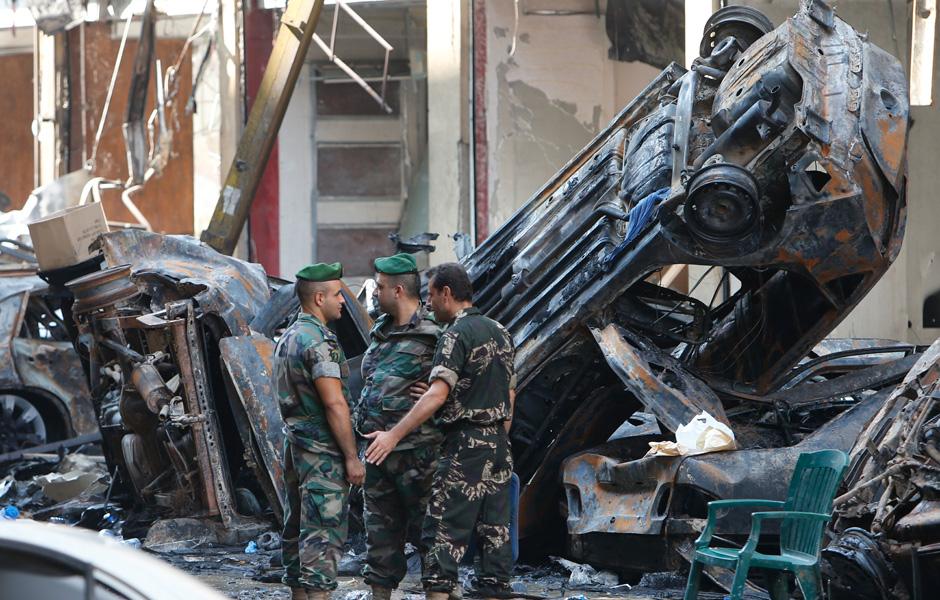 Next the same media outlets finessed the news about the terrorist bombs planted in Beirut’s southern suburb of Dahiyeh. The August 15, 2013 terrorist bombings in the neighbourhood of Al-Rouweiss (Al-Rweiss) were downplayed and, in a manner of speaking, legitimized by the media through their selective use of language. The attack on Al-Rouweiss come about a month after the July 9, 2013 terrorist attack on the neighbourhood of Bir Al-Abed. Both are densely populated neighbourhoods in Dahiyeh. The Institute for Public Accuracy (IPA) in the United States took quick notice of the biased media framing. IPA asked the following, on August 16, 2013, through the title of report: “Why Isn’t Beirut Bombing Called ‘Terrorist’? What’s Behind It?”
 I have checked out their research publications: it is just the case. Ask them. Their job has been – and still is – to protect, not the public, but the nuclear industry and the military. After Chernobyl, some of them turned up in Kiev when I was there in 2000 and talked down the effects of the radiation. Watch them in action here. By 2005, these Chernobyl cancer effects were turning up in Europe. One study in Sweden by Martin Tondel found an 11 percent excess cancer risk for every 100kBq/sq metre of caesium-137 contamination. Tondel was swiftly dealt with by his boss, Lars Erik Holm, one-time head of ICRP and now Medical Officer of Health of Sweden (Yes).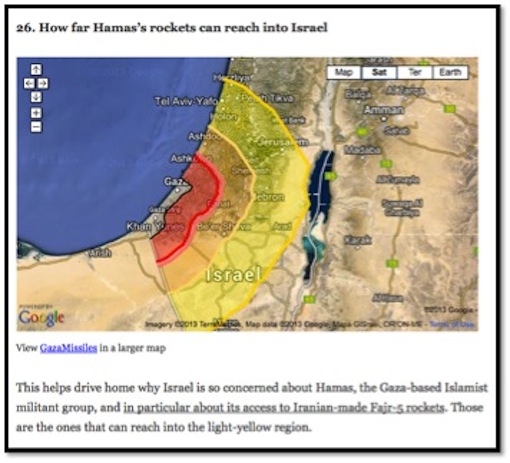

 Aletho News


