Russia’s economy recovers while dozens of US banks face collapse
By Ahmed Adel | March 23, 2023
Although Western media were boasting about Sberbank’s 78% plunge in profit in 2022 due to US-led sanctions, with CEO German Gref acknowledging a “most difficult year”, it appears that the US economic system is the one actually on the brink as four banks have already collapsed, with dozens more expected to follow.
CNN described the Russian bank’s drop in profit as a “collapse” in its headline, but then had to admit in the article that “Sberbank’s resilience in the face of sanctions helped Russia’s banking sector recover from a loss-making first half in 2022.”
This is in line with Gref’s belief that this year’s profits should be close to the record 1.25 trillion rubles ($16.5 billion) earned in the “pre-crisis year.” “Our business model passed another strength test,” he added.
It is recalled that Russian Presidential spokesperson Dmitry Peskov said on March 14 that there is “practically” no risk of Russia facing a fallout from the SVB collapse, adding that: “Our banking system has certain connections with some segments of the international financial system, but it is mostly under illegal restrictions.”
Despite alarmist headlines from US media and experts, Peskov was proven correct as no Russian bank has collapsed despite Western sanctions. Meanwhile, the full repercussions of SVB’s downfall are yet to be felt, with former Lehman Brothers executive Lawrence McDonald believing that up to another 50 American banks could collapse if structural problems are not fixed.
“So Lehman failed and then it forced this too-big-to-fail system, and then, now this interest rate shock to the regional banks is moving hundreds of billions of dollars out of regional banks into the big banks… So you could have another 50 bank failures… unless they fix the structural problem,” said McDonald on March 22.
“There’s going to be further damage. They have to cut rates and then they have to have a deposit guarantee, a larger one, that’s what they’re going to come up with… That’s a bailout. That’s basically the federal government taking on bank deposit risk,” he added.
By being cut-off from the Western banking system, Russia is effectively protected from the series of bank collapses that are expected to follow. Russia faced a credit crunch due to the fallout from the US subprime mortgage crisis in 2008, which ultimately led to the Global Financial Crisis, a demonstration of how it too was exposed to weaknesses in the US economy.
Although Russia was cut-off from SWIFT only two-days after the special military operation began, in addition to many other Western restrictions, including a $60 per barrel oil price cap, President Vladimir Putin boasted about the resilience of the Russian economy.
The IMF reported that Russia’s economy contracted by 2.2% in 2022 and will start growing again in 2023, expanding by 0.3%, and then 2.1% in 2024. This is impressive when considering that fellow European countries, which are not sanctioned, will be struggling immensely. The UK is expected to contract by 0.6% and Germany will have a growth of only 0.1%.
At the same time, the OECD forecasts that US economic growth would slow from 1.5% this year to 0.9% next year. This is due to higher interest rates slowing down demand. Bloomberg on March 21, citing sources, reported that the US Treasury Department is studying the possibility of guaranteeing all bank deposits in the event of a recession in the banking sector.
The current banking crisis has forced economists, including from the esteemed JPMorgan Chase, to make new recession forecasts after any hopes of recovery were snuffed away.
“The Fed is facing a difficult task on Wednesday, but it is likely already past the point of no return,” JPMorgan strategists wrote in a note to clients on March 22. “A soft landing now looks unlikely, with the airplane in a tailspin (lack of market confidence) and engines about to turn off (bank lending).”
Goldman Sachs also echoed JPMorgan and said in mid-March that the banking crisis could deliver a severe blow to economic growth.
For his part, former Treasury Secretary Larry Summers has warned multiple times, including as recently as March 9 but even from before the banking crisis, that the economy could be heading for a “Wile E. Coyote moment,” referencing a Looney Tunes character who was always blissfully unaware that he was about to hit the ground after running off the edge of a cliff.
However, the expected collapse of many banks in the US and the impending economic crisis has not deterred the determination of the Biden administration to fanatically arm, fund and train the Ukrainian military and regime. With millions of Americans on the verge of dropping out of the Middle Class, Washington continues to send tens of billions of dollars to Ukraine, and all the while Western sanctions are now beginning to have a minimum effect on the Russian economy, thus effectively rendering them nearly useless.
Ahmed Adel is a Cairo-based geopolitics and political economy researcher.
Sino-Russian technological and military cooperation exponentially strengthens both superpowers’ capabilities

By Drago Bosnic | March 22, 2023
After the end of the (First) Cold War and the start of what Francis Fukuyama dubbed the “End of History”, the world seemed firmly in the hands of the political West. For the next two to three decades, this resulted in one of the most disastrous and unstable periods in recent human history, with the political West ravaging much of the world, while most of the rest was held under near-constant self-defeating subservience.
The US-led power pole engaged in what can only be described as war hopping, starting one aggression after another, or worse yet, several consecutive invasions against countries on multiple continents, with its numerous vassals and satellite states sending auxiliary forces or at the very least providing support in logistics and financing. America’s superiority was both quantitative and qualitative, leaving nearly everyone else far behind. The only exception was Russia, whose only advantage was its massive strategic arsenal, the last vestige of the (First) Cold War that kept the US from exerting absolute dominance.
Moscow’s main trump card was also the world’s trump card, providing precious several decades of peace to other sovereign-minded powers, primarily China. Beijing’s meteoric rise to superpower status would have been all but impossible without it and the Asian giant’s leadership is well aware of this. It could be said that both Russia and China “have each other’s backs”, with the cooperation reaching unprecedented levels, not seen in approximately 60 years.
Not counting the purely ideological “cold war” in the aftermath of the Sino-Soviet split, the relationship between Moscow and Beijing has been cordial at worst. However, in the last 30 years, particularly since President Putin consolidated Russia’s geopolitical standing, this relationship has transformed into a fully-fledged strategic alliance in virtually every aspect, truly limitless, as Putin and Xi Jinping recently described. Since the early 1990s, Russia has transferred copious amounts of its massive technological know-how, particularly in military tech, helping push China’s defense capabilities nearly half a century ahead in less than a decade.
The result was quite positive for Beijing, but was seen with contempt in Washington DC, which loathes the idea of having to deal with “another Soviet Union”, especially after investing nearly half a century into dismantling the original and after the Clinton administration announced the US will “never let the rise of another superpower” with the equivalent or close to the power of the USSR. However, despite US attempts to prevent it, exactly this happened. Russia, at first a mere shadow of its former glory and essentially dismissed as a “done deal” by the political West, started regaining its strength, but this time not as a socialist empire, but perhaps the world’s premier realpolitik superpower. With such an approach, Moscow kept most of its historic geopolitical partnerships and was also able to expand them, including with China. President Xi Jinping’s latest visit, the first foreign trip he went on after being reelected for his third term, serves as a testament to this growing alliance.
The superpowers signed over a dozen key strategic agreements laying out the prospects of their unprecedented cooperation by the end of this decade and beyond. Apart from the growing trade exchange, which is racing towards $200 billion annually, one of the key aspects of this is a technological and military partnership. China and Russia will further expand their cooperation in areas such as information technologies and advanced AI, involving approximately 80 new projects assessed at over $165 billion. This includes aircraft and machine tools manufacturing, space research and strengthening of military cooperation, including further unification of Moscow’s and Beijing’s know-how.
In a joint statement, the (Eur)Asian giants reiterated their commitment to regularly conduct bilateral naval and aerial patrols, as well as regular military exercises, expand cooperation within and beyond the framework of existing bilateral agreements and deepen mutual trust and interoperability between their armed forces.
One particularly important segment of this growing alliance is the exchange of military technologies in which both countries excel. China’s impressive strides in microelectronics and semiconductors are of great interest to Russia, while Moscow’s traditionally world-class expertise in rocket/missile and space technologies is greatly appreciated in Beijing. This includes the latest Chinese developments in new network-centric capabilities, with drone swarms being of particular interest for Russia, which could provide key tactical advantages on the battlefield.
Moscow has certainly developed a plethora of its own similar capabilities, but getting Beijing to participate in these efforts will help expand the said capabilities even further. On the other hand, China is greatly interested in Russia’s unrivaled hypersonic technologies, especially naval, as the primary threat to its security and development comes from the belligerent thalassocratic powers of the political West and their regional vassals.
Russian military expert Andrei Martyanov outlined the virtually unknown (to the vast majority of mainstream media) aspects of this cooperation, including the immediate threat that the AUKUS represents for Beijing. With virtually all of China’s Tier 1 cities and provinces being exposed to naval aggression from the US, the Asian giant is seeking ways to nullify this possibility or at the very least push it to a minimum. Of particular concern is the US Navy’s AGM-158 JASSM (Joint Air-to-Surface Standoff Missile), a stealthy air-launched cruise missile deployed by American CBG (carrier battle groups), including the 2000-km range JASSM-XR variant. And while such missiles can hardly be considered comparable to the latest Chinese weapons, they are relatively cheap (by US standards) and numerous (at least 2000 procured by USAF and USN), providing a strong first-strike capability for Washington DC. According to Martyanov, precisely this was very likely one of the key topics of the behind-closed-doors talks between Russian and Chinese delegations.
Drago Bosnic is an independent geopolitical and military analyst.
Indonesia to ditch Visa and Mastercard
RT | March 21, 2023
The Bank of Indonesia is preparing to phase out Visa and Mastercard while introducing its own domestic payment system, Antara news agency reported on Monday, citing the regulator.
Last week, Indonesian President Joko Widodo urged regional authorities to wean themselves away from foreign payment systems and start using cards issued by local banks. He argued that Indonesia needed to shield itself from geopolitical disruptions, citing the sanctions targeting Russia’s financial sector from the US, EU, and their allies over the conflict in Ukraine.
“Be very careful. We must remember the sanctions imposed by the US on Russia. Visa and Mastercard could be a problem,” he said.
Commenting on the initiative, the central bank’s spokesperson, Erwin Haryono, said that the regulator was in talks with local businesses “and the progress is about 90%,” adding that domestic cards will have many advantages, including lower fees. Also, according to him, “offshore settlements and dependence on foreign payment networks such as US Visa or Mastercard will no longer be necessary.”
Board member of the Indonesian Credit Cards Association (AKKI), Dodit Proboyakti, told RIA Novosti that Indonesia would apply the experience of Russia and its Mir payment system to promote the domestic financial network.
Indonesia’s interbank system, GPN, currently supports only local debit cards and requires some adjustments to properly serve credit cards and international transactions, according to AKKI executive director Steve Marta.
Moscow rolled out its own national card system, Mir, soon after the US first targeted the country with sanctions in 2014, and created the domestic National Payment Card System (NSPK) to smoothly take over all Visa and Mastercard transactions should the US-based companies pull the plug.
China’s success in reconciling Saudi Arabia and Iran is a huge blow to US hegemony
By Ahmed Adel | March 20, 2023
After agreeing with Saudi Arabia in December to buy its oil for Chinese yuan instead of just US dollars, while at the same time Russia is successfully cooperating with Saudi Arabia and Iran in the oil sector, Beijing is helping a historic reconciliation between the two major Muslim countries. Chinese efforts are all the more impressive when considering the persistent efforts of the US to cause conflict between the two countries instead of reconciliation.
It is hoped that reconciliation will lead to a huge blow to the hegemony of the US dollar. In Beijing on March 17, following negotiations in Iraq and Oman during the previous two years, China, Iran, and Saudi Arabia announced an agreement which includes the restoration of diplomatic relations, a confirmation of respect for the sovereignty of states and non-interference in their internal affairs, and agreements on security, economy, trade, investment, science and culture.
In short, with the mediation of China, the two regional powers, often framed as having a Sunni-Shi’a rivalry, made it official that they are embarking on a new path of improving relations instead of further spoiling them for the sake of serving Western interests that are contrary to the interests of the Islamic World.
Therefore, it is quite clear who the Chinese Ministry of Foreign Affairs had in mind when it announced that overcoming differences between Iran and Saudi Arabia will have a “beneficial effect on freeing the countries of the region from external interference” – evidently this is in reference to the US. As Beijing highlighted, these two countries have now “taken their own destiny into their own hands,” adding that their agreement “corresponds to epochal development trends.”
Chinese Foreign Minister Wang Yi, who was recently in Moscow and confirmed that Russia-China relations are reaching new frontiers in building a multipolar world, emphasised that the agreement between Riyadh and Tehran represents “a victory for dialogue and peace.”
In a China Global Television Network (CGTN) article published on March 13 and titled: “Why Iran and Saudi Arabia trust China?”, the author highlights that “dialogue between Tehran and Riyadh has unfolded as negotiations took place in Iraq, where the two countries reached an important consensus. Meanwhile, the main regional allies of Iran and Saudi Arabia, such as the United Arab Emirates and Kuwait, have restored diplomatic relations in 2022. Hence, the resumption of diplomatic relations between Iran and Saudi Arabia also is only a matter of time.”
The author’s belief in the resumption of diplomatic relations proved to be true only days after the article’s publication. The resumption signifies that a new era has dawned in the Middle East, and even more broadly when we consider the effects this could have on the hegemony of the US dollar.
The US has been the dominant force in the Middle East since the end of British and French colonialism in the 1940’s. The region has been in a constant state of war since then, with the US now maintaining 30 military bases in the Middle East – five of them in Saudi Arabia.
For the US that relies on its global network of military bases to maintain hegemony, Beijing is showing non-Western countries how a multipolar world can function with great power diplomacy based on agreements and reconciliation, and not rooted in the idea that “might is right,” like Washington adopts.
It is noted that the day before the reconciliation in Beijing, the head of Saudi diplomacy, Prince Faisal bin Farhan al Saud, visited Moscow unannounced. And a week earlier, on March 6, Russian President Vladimir Putin spoke by phone with his Iranian counterpart Ebrahim Raisi, who visited Beijing in mid-February. After that, Wang Yi was in Moscow. This suggests that although China was the main broker of peace between Saudi Arabia and Iran, Russia certainly played a role in reconciliation efforts.
Russia, Iran, and Saudi Arabia are three leading oil and gas producers and are accelerating their search for payment mechanisms to bypass the US dollar. China, for their part, is already discussing such arrangements with Saudi Arabia and Iran.
The decline of the US dollar as a world currency will weaken the American economy and military power. This in turn will cripple the US’ ability to wage perpetual wars abroad and impose its global hegemony.
Just as importantly, reconciliation between Saudi Arabia and Iran can be seen as a precursor to eventually joining BRICS in the near future. It is recalled that BRICS plans to decide this year whether to admit new members and under what conditions.
Although BRICS collectively accounts for 42% of the world’s population and 24% of the world’s gross domestic product (GDP), they collectively hold less than 15% of voting rights in both the World Bank and the International Monetary Fund, which are Western dominated. By admitting Saudi Arabia and Iran, BRICS’s global status will be elevated even higher as a symbol of not only peace and reconciliation, but also a path to prosperity independent of Western domination.
Ahmed Adel is an Cairo-based geopolitics and political economy researcher.
President Xi’s Trip To Moscow Solidifies The Sino-Russo Entente
By Andrew Korybko | March 20, 2023
The impending trifurcation of International Relations will result in the formation of three de facto New Cold War blocs: The US-led West’s Golden Billion, the Sino-Russo Entente, and the informally Indian–led Global South. Intrepid readers can review the preceding hyperlinked analysis to learn more about the grand strategic dynamics behind this latest phase of the global systemic transition, while the present one will elaborate on those connected to the Russian-Chinese Strategic Partnership in particular.
These two Eurasian Great Powers had already closely aligned their foreign and economic policies far before Russia was forced to commence its special operation in Ukraine last year after NATO clandestinely crossed its red lines there and refused to diplomatically resolve their security dilemma. This was due to their shared multipolar vision, which in turn resulted in Moscow synchronizing its Greater Eurasian Partnership (GEP) with Beijing’s Belt & Road Initiative (BRI).
The purpose behind doing so was to supercharge multipolar processes across the supercontinent with a view towards making International Relations more democratic, equal, just, and predictable a lot sooner than even the most optimistic observers could have expected. None of this was driven by anti-Western animosity either since both of them envisaged the EU and US playing pragmatic roles in this emerging world order, which is proven by their proactive engagement of each over the years.
Russia expected that it could diplomatically resolve its security dilemma with the US over NATO’s expansion simultaneously with encouraging it and the EU to get Kiev to implement the Minsk Accords, thus ending the then-Ukrainian Civil War and optimizing trans-Eurasian trade. Meanwhile, many EU countries joined BRI and China even clinched an investment pact with the bloc, all while seeking to diplomatically resolve its own security dilemma with the US and work out a new trade deal with it.
Had the US formulated its grand strategy with mutually beneficial economically driven outcomes in mind instead of remaining under the influence of Brzezinski’s zero-sum divide-and-rule teachings, then everything could have been much different. That declining unipolar hegemon could have responsibly carved out a comfortable niche in the new era of globalization that Russia and China were jointly seeking to pioneer, thus ensuring that the global systemic transition smoothly moved towards multipolarity.
Regrettably, liberal–globalist members of the US’ military, intelligence, and diplomatic bureaucracies (“deep state”) continued to believe that Brzezinski’s geostrategic schemes could successfully reverse the aforesaid transition and thus indefinitely retain their country’s dominant position in International Relations. This explains why they subsequently sought to “contain” Russia and China at the same time by worsening regional disputes instead of reciprocating those two’s efforts to peacefully resolve them.
The decision was eventually made to prioritize Russia’s “containment” over China’s with the expectation that the first would either strategically capitulate to NATO’s blackmail campaign or quickly collapse due to sanctions if it resorted to military force for defending its red lines in Ukraine, thus making China’s successful “containment” a fait accompli in that scenario and therefore preserving the US’ hegemony. Where everything went wrong was that the West never prepared for a protracted conflict in Ukraine.
Russia proved much more resilient in all respects than the Golden Billion expected, ergo why they’re panicking that the over $100 billion that they’ve already given to their proxies in Kiev isn’t anywhere near enough for defeating that Eurasian Great Power. The New York Times admitted last month that the sanctions failed just like their “isolation” campaign did, while the NATO chief recently declared a “race of logistics” and the Washington Post finally told the truth about just how poorly Kiev’s forces are faring.
Amidst the past year of international proxy hostilities that the West itself provoked, the globalized system upon which China’s grand strategy depended was unprecedentedly destabilized by their unilateral sanctions regime that’s responsible for the food and fuel crises across the Global South. This influenced President Xi to seriously consider a “New Détente” with the US, which he initiated during last November’s G20 Summit in Bali after he met with Biden and a bunch of other Western leaders.
To be absolutely clear, this well-intended effort wasn’t meant to reverse any of the multipolar progress that China was responsible for over the past decade but purely to pursue a series of mutual compromises aimed at establishing a “new normal” in their ties so as to restore stability to globalization. In other words, it was about buying time for the world’s top two economies to recalibrate their grand strategies, ideally in the direction of working more closely together for everyone’s sake.
Their talks unexpectedly ended in early February, however, after the black swan event that’s known as the balloon incident. This saw anti-Chinese hardliners in the US suddenly ascend to policymaking prominence, thus dooming the “New Détente”, which resulted in China recalibrating its approach to the NATO-Russian proxy war to the point where President Xi, Foreign Minister Qin, and Ambassador to the EU Fu all concluded that it’s part of the US’ anti-Chinese “containment” strategy.
Under these newfound circumstances, the US consolidated its successfully reasserted hegemony over the EU by getting Germany to go along with Washington’s very strongly implied threats that the Golden Billion will sanction China if it decides to arm Russia should Moscow require such aid as a last resort. In response, China felt compelled to consolidate its strategic partnership with Russia to the point of turning it into an entente, hence the purpose of President Xi’s trip to work out the finer details of this.
Just like these two Great Powers earlier synchronized Russia’s GEP and China’s BRI, so too are they now poised to synchronize the first’s Global Revolutionary Manifesto with the second’s global initiatives on development, security, and civilization. This prediction is predicated on the articles that Presidents Putin and Xi published in one another’s national media on the eve of the latter’s trip to Moscow, which confirms that they intend to cooperate more closely than ever before.
Observers can therefore expect the Sino-Russo Entente to solidify into one of the world’s three premier poles of influence as a result of the Chinese leader’s visit, thus making it a milestone in the New Cold War over the direction of the global systemic transition. The worldwide struggle between this pole and the Golden Billion will intensify, especially in the Global South, which will reinforce India’s importance in helping fellow developing states balance between both and thus bring about true tripolarity.
Bureaucracies Utterly Incapable Of Making Reasonable Tradeoffs
By Francis Menton | Manhattan Contrarian | March 7, 2023
Often I focus on bureaucratic regulation of energy because the ability to restrict use of energy is the ultimate societal control. Once they have obtained the ability to restrict use of energy, bureaucrats could, if they choose, take away most of our freedom to enjoy life and return us to the income levels of the Stone Age. Will they stop before going that far, making reasonable tradeoffs to enable the people to flourish economically? Or will they instead pursue environmental purity without concern for the well-being of the populace?
So far all indications are that bureaucracies — and environmental bureaucracies in particular — are utterly incapable of making reasonable tradeoffs. You don’t go into a career as an environmental bureaucrat if you think that your concern for the environment is something that can or should be compromised.
In the U.S., battle is currently joined on multiple fronts as to whether unaccountable bureaucracies get to declare the non-toxic beneficial gas CO2 a “danger” to human health and welfare and thereby claim the ability to shut down the entire fossil fuel energy economy and force a multi-trillion dollar (and probably impossible and impoverishing) energy transition on the people. (One such front is the litigation where I am one of the lawyers, CHECC v. EPA, pending in the DC Circuit Court of Appeals.). Also in the U.S., the Supreme Court, in the recent case of West Virginia v. EPA, has announced what they call the “major questions doctrine,” where bureaucrats, at least in areas of “major” economic impact, are to some degree constrained in their exercise of power by the explicit delegations of authority granted them by Congress. To the extent that restrictions on human activity in the name of the environment must gain approval from the Congress, there is at least a forum for competing interests to be heard, for tradeoffs to be considered, and for big mistakes to get corrected before enormous economic damage can be done.
But consider for a moment how it works in the different governance model of the EU, where bureaucrats answer to no one and are virtually unconstrained. This consideration is relevant to the U.S. situation, because the EU governance model of the unconstrained bureaucratic state, at least as to environmental issues, is the one favored by Democrats in our Congress and by the “liberal” justices on the Supreme Court.
Over in the EU, they have decided that nitrogen — or maybe it is “reactive nitrogen” — is a pollutant. And pollutants are bad, and therefore they should be reduced or, better, eliminated. And the bureaucracies have been empowered toward this goal.
Well, here’s the problem. Nitrogen is an essential building block of life, including human life, without which we all starve to death. Every protein is made up of amino acids, and every amino acid has at least one atom of nitrogen in it. Here is a table of the chemical formulas of the main amino acids:
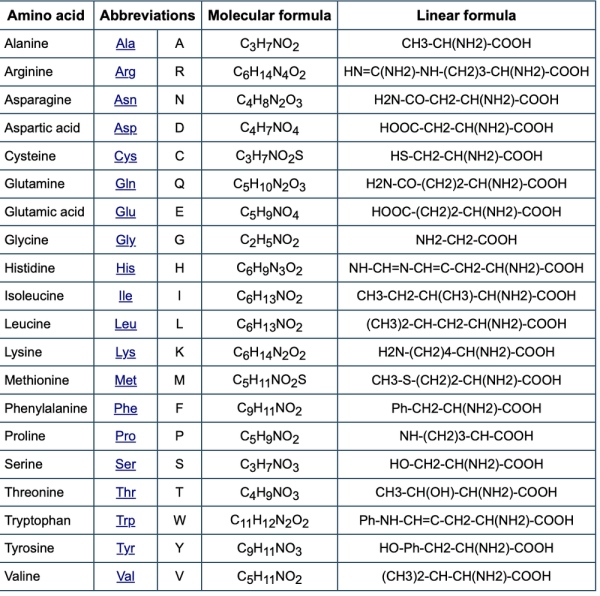
So no nitrogen, no proteins. And no proteins, no people. So where are we going to get the nitrogen to make up our proteins? The air is about 78% nitrogen — how about just take it from there? But it turns out that neither plants nor animals have the ability to make direct use of the nitrogen in the air. Instead, the nitrogen needs to be “fixed” into the soil in some “reactive” form for plants to be able to use it; and then, animals get the nitrogen for their proteins from the plants. Throughout history, humans depended on the luck of the level of the nitrogen-fixing bacteria in the soil to grow edible plants to make their proteins. But often the soil quality would be low. One way to up the nitrogen content of soil was animal manure. And then came along the technological advance of figuring out how to combine nitrogen from the air with hydrogen, generally from natural gas, to make ammonia (NH3) for fertilizer that could be spread on the ground. Between widespread use of manure and increase in manufactured ammonia fertilizers, suddenly lack of usable nitrogen in the soil was no longer a limiting factor on ability to grow crops. Over the twentieth century, and particularly the later decades, yields soared.
Here is a stock photo of crops on the same field, with and without nitrogen fertilizer:

But meanwhile over in the EU (and not just there), the battle of the bureaucrats to eliminate nitrogen pollution is in full swing. You probably recall the protests of the Dutch farmers from last summer. From Reuters, June 22, 2022:
Thousands of farmers were gathering in a village near the centre of the Netherlands on Wednesday to protest a government plan to curb nitrogen pollution. . . . The protest in Stroe, 70 kilometres east of Amsterdam, follows the introduction last week of targets for reducing pollution by harmful nitrogen compounds in some areas by up to 70% by 2030. . . . Reductions are necessary in emissions of nitrogen oxides from farm animal manure and use of ammonia for fertilisation, the government says. Nitrogen oxides in the atmosphere help form acid rain, while fertiliser washed into lakes can cause algal blooms that kill marine life.
But how about the need for nitrogen for proteins to keep the human population alive? They seem to have completely lost track of that. This is an area where the absolute goal of “no nitrogen” is completely insane. Sure, too much nitrogen in the wrong form and in the wrong place at the wrong time can be a problem. But nitrogen in sufficient amounts in a form usable in the soil is completely essential to feeding the human population here on earth. Tradeoffs must be made. Yet the bureacuracies, in their zealotry, appear completely incapable of even considering such heritical ideas.
This week the farmer protests have moved on to Belgium, which has joined the war against nitrogen-emitting agriculture. From Reuters, March 3:
Farmers from Belgium’s northern region of Flanders drove thousands of tractors into Brussels on Friday in a protest against a new regional government plan to limit nitrogen emissions. . . . Agricultural organisations said in a joint statement that the nitrogen agreement as it now stands “will cause a socio-economic carnage”.
I’ve got news for the EU bureaucrats: you can put all your farmers out of business, but unless you are planning to starve your own people the food will have to be produced somewhere, and the nitrogen “emissions” will be essentially the same. They’ll just be moved somewhere else. I’m old enough to remember when being self-sufficient in food production and not dependent on food imports was considered a positive good for a country. But that was before environmental zealotry went to the extremes that we see today.
Putting Europe’s Energy Crisis into Perspective
By Noah Carl | The Daily Sceptic | March 6, 2023
Europe has made it through the winter largely without incident: there were no major blackouts or power outages, and fears of large-scale civil unrest did not come to pass. What’s more, the price of natural gas – which in August was more than 18 times higher than its recent historical average – is now a mere 2.5 times higher.
That’s the good news.
Here’s the bad. We didn’t avoid catastrophe thanks to wise and far-sighted choices on the part of our leaders. We basically got lucky. The winter of 2022/23 was one of the warmest in recorded history, dramatically reducing the demand for natural gas. Had the temperature been normal, things could have gotten fairly dicey.
There’s more bad news. Keeping the lights on and the gas burning didn’t come cheap. As of September last year, European countries had earmarked €768 billion for energy subsidies. OECD countries (of which Europe comprises the lion’s share) spent about 18% of GDP on energy in 2022, compared to only 10% the year before.
As an apocryphal quote has it, “A billion here, a billion there, and pretty soon you’re talking about real money.” Just how much is €768 billion?
One potential yardstick is the cost of reconstruction for Ukraine, which in December was estimated at €500 billion and may now be as high as €600 or €700 billion. To be clear: this isn’t some estimate of the ‘total cost of the war’ – which would be far, far higher. It’s just the cost of reconstruction.
Nonetheless, it implies that the amount European countries have earmarked for energy subsidies would be enough to repair all the damage to Ukraine’s buildings and infrastructure that’s been sustained since the start of the war – a war that has seen whole towns reduced to rubble.
As the analyst Ralph Schoellhammer notes, European countries imported more LNG last year than Japan, South Korea and China combined. Yet this is set to change as China’s economy comes roaring back after the lockdown hiatus.
While the creeping global recession may temper demand for LNG, rising industrial activity in China will have the opposite effect. Keeping a lid on European gas prices thus requires ongoing ‘demand destruction’ – a fancy way of saying that factories will have to make do with less. (As of December, industrial gas demand is about 25% below the 2013–2019 average.)
Europe’s energy crisis still isn’t over. But we’re admittedly in a better position than I’d thought we’d be – owing mainly to warmer weather.
Berlin’s March 26th Climate Referendum… Unelected Council Could Have Immediate Dictatorial Powers
The road to tyranny begins in Berlin as climate gets framed as a state of emergency
By P Gosselin | No Tricks Zone | March 12, 2023
If Berliners think protesters obstructing traffic by gluing themselves to the streets are a nuisance, just wait until what could be the case after March 26, when Berliners vote on climate referendum.
If the climate referendum is successful, a radical amendment to the current climate protection and energy transition law will be enacted. The online German Pleiteticker.de exclusively has an internal paper and reports of an “empowerment paragraph” in the proposed amended law.
The aim of the referendum is to amend the existing Climate Protection and Energy Transition Act (EWG Bln) in order to force the city of Berlin to achieve climate neutrality by 2030 instead of 2045.
The vote will be binding, which means that if the referendum is successful, the amendment will be enacted into law. The amendment is being pushed by the Green Party and radical groups like Fridays for Future and Extinction Rebellion.
Targets would become legal obligations
The amendment would be so radical that even Berlin SPD socialists consider it dangerous and speak of an “empowerment paragraph” in the law that would transfer immense power to a small group of unelected people, namely a Climate Protection Council appointed by the Berlin Senate.
Concerning paragraph 6 of the new amendment, “Immediate program in the event of non-fulfillment of obligations”, the SPD explicitly warns that climate targets have been changed to “obligations”, which would mean the Berlin Senate probably would have to implement immediate radical measures to achieve the obligations, even by court order.
Paragraph 14 provides for a “Climate Protection Council” to monitor compliance. It would be appointed by the Berlin Senate and not made up by democratically elected officials.
Good bye to cars in Berlin?
“There is a danger that the possibility of immediate measures – which, according to the SPD, are not democratically legitimized – will be used excessively”, Pleiteticker warns. “If the climate referendum is successfully implemented, it will therefore not only be expensive for Berliners, but there will be many more restrictions on freedom than under the previous the Socialist-Green Senate – Berliners may then have to say goodbye to their cars completely.”
Reducing flights at Berlin’s BER airport?
According to paragraph 3 on “Climate Protection Obligations”, CO2 reduction should be 70 percent by 2025 and 95 percent by 2030 compared to 1990 levels! “The previous regulation has been changed so that the time periods are dramatically shortened,”
According to Clause 2, even the Berlin airport would be a part of the climate budget. Pleiteticker warns: “So there is a risk that an immediate measure for emissions reduction could be to reduce the number of flights.”
Property owners would be forced to make major renovations
The amendment also calls on the mandatory energy refurbishment of all public buildings by 2030 and the entire state administration would have to be CO2-neutral by 2030.
“Where the money is to come from remains a mystery once again,” Pleiteticker comments.
Paragraph 19, “Use of Renewable Energy”, could also mean the mandatory installation of solar panels for all homeowners. Again, no one knows how all of this would be paid for. Owning a home and property would certainly become unaffordable for many private owners.
Looking at it from a different angle, Berlin could serve as a pilot that would in all likelihood expose the shear folly of rapid climate neutrality once and for all. Maybe a “successful” referendum would be a good lesson for the rest of the world.
Pakistan’s Fascist Post-Modern Coup Regime Risks Replicating The East Pakistan Tragedy
By Andrew Korybko | March 15, 2023
The fascist authorities who were installed in Pakistan following last April’s US-orchestrated but superficially “democratic” post-modern coup against former Prime Minister Imran Khan risk replicating the East Pakistan tragedy if they don’t immediately stop shooting at their own people. The ousted leader’s supporters are rallying around his residence to prevent the local police from serving him an arrest warrant on a trumped-up graft charge that was concocted against him as “lawfare”.
Instead of reconsidering the wisdom of clashing with unarmed and purely peaceful civilians, the fascist authorities ordered their goons to assault them all with tear gas, rubber bullets, and reportedly even live ammunition that was shot into the air according to some accounts. This de facto declaration of war by the fascist post-modern coup regime on its own people could dangerously place the country’s political-security trajectory on the irreversible path towards civil war.
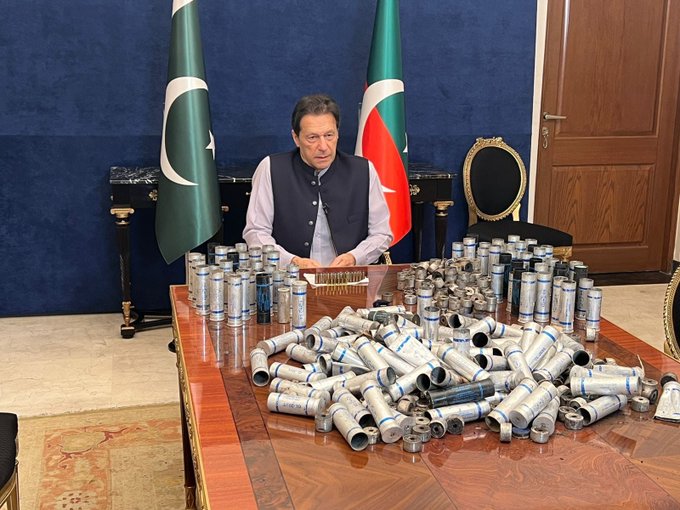
Former Prime Minister Khan warned as much in a tweet on Wednesday that he shared alongside a photo of himself sitting down in front of a pile of tear gas canisters that were shot at his home the other day. He wrote that “My house has been under heavy attack since yesterday afternoon. Latest attack by Rangers, pitting the largest pol party against the army. This is what PDM and the enemies of Pakistan want. No lessons learnt from the East Pakistan tragedy.”
The military-intelligence establishment must urgently rescind their de facto declaration of war on the Pakistani people, do whatever’s required behind the scenes to have the fascist post-modern coup’s leading figures resign as the first step towards national reconciliation, and then hold early elections. It’s only through this three-step process that the worst-case scenario of replicating the East Pakistan tragedy can potentially be avoided since anything less than that makes this more likely by the hour.
One of the most populous countries in the world is being pushed towards civil conflict by those conspirators who illegally usurped power with the US’ help last April and subsequently crashed the economy. This factual framing of Pakistan’s latest political-security dynamics proves that the increasingly violent clashes provoked by the fascist post-modern coup regime against its own people could lead to a global crisis in the event that they soon spiral even further out of control.
If the military-intelligence establishment continues waging war on the Pakistani people, then their victims should consider publicly calling on their iron brothers in China to urgently rein them in as a last resort to avert the worst-case scenario that former Prime Minister Khan just warned about. China’s diplomatic miracle in brokering the Iranian–Saudi rapprochement last week proves that it has the political capabilities to peacefully resolve the Pakistani Crisis if the people request for it to do so.
After all, the People’s Republic also stands to geostrategically lose if that neighboring nation descends into civil war. The China-Pakistan Economic Corridor (CPEC), which is the flagship project of Beijing’s Belt & Road Initiative (BRI) that’s aimed at creating a Community of Common Destiny for Mankind, would practically become inoperable should that happen. Not only could that block off China’s shortcut to the Indian Ocean, but it would deal an immense blow to its soft power and BRI’s reputation as well.
Without intending to come off as “conspiratorial”, observers can’t preclude the possibility that the fascist post-modern coup regime’s US backers encouraged them to provoke a civil war partially for the purpose of advancing America’s anti-Chinese “containment” strategy via unconventional means. At the very least, its military-intelligence establishment wouldn’t so publicly violate its people’s human rights and possibly even countenance war crimes against them without the US’ advance approval.
This means that the latest escalation of the nearly year-long Pakistani Crisis is connected to the US just like its origin is, thus extending credence to the preceding concerns that the events which Washington set into motion last April are actually part of its larger Hybrid War on China. This South Asian state was knocked out of the geostrategic game at the most sensitive moment in the global systemic transition shortly after this process accelerated following the start of Russia’s special operation.
That outcome hasn’t just proven disastrous for the Pakistani people who’ve suffered as a result of the crippling economic crisis that followed, but it also unexpectedly offset a key pillar of China’s grand strategy related to its reliance on CPEC as a non-US-controlled shortcut to the Indian Ocean. Furthermore, both the political and especially economic dimensions of the US-provoked Pakistani Crisis also raised serious doubts about CPEC’s future as well as that of BRI more broadly.
Nobody can therefore deny that the US’ regime change in Pakistan last year had very serious consequences for China that are becoming worse by the hour as that country’s fascist post-modern regime risks pushing it into civil war after de facto declaring war on its own people. China might already be working behind the scenes to try and de-escalate the latest and thus far most dangerous phase of this nearly year-long crisis on its borders, but it would still help a lot if Pakistanis publicly requested this.
That’s because this could compel China into taking urgent action behind close doors if it hasn’t already done so, not to mention creating the optics of Pakistan’s US-backed fascist post-modern coup regime literally shooting at Chinese-friendly peaceful protesters, which would force China to get involved. No other party apart from the US has the influence to peacefully resolve this crisis, and seeing as how Washington’s interests are perversely advanced by exacerbating it, the onus thus falls on Beijing.
Practically speaking, China has a credible chance of brokering peace and thus averting another Pakistani Civil War, but this best-case scenario can only happen if the fascist post-modern coup regime has the political will to save their country from this US-engineered collapse. If they do, then China can simply propose the previously suggested three-step peace plan related to immediately ceasing fire against unarmed peaceful protesters, creating a caretake government, and holding early elections.
The coup regime might agree to this in exchange for a Chinese bailout that could replace the IMF’s continually delayed one that’s full of strings and has thus far been withheld by that body’s US leader for the purpose of keeping its proxies in check in case they consider “defecting”. That last-mentioned observation is precisely what China would be tempting them to do, basically “defect” from the US in exchange for much-needed aid and thus averting the seemingly impending civil war.
The latest and thus far most dangerous phase of the nearly year-long Pakistani Crisis is rife with unpredictability since everything is moving so rapidly right now so it’s difficult to predict what might come next. In any case, it would greatly help the cause of peace and preventing a replication of the East Pakistani tragedy that former Prime Minister Khan just warned about if his unarmed peaceful protesters publicly called on China to diplomatically intervene and prevent this from becoming a global crisis.
Is France going to be able to maintain its position in Africa?
By Pogos Anastasov – New Eastern Outlook – 15.03.2023
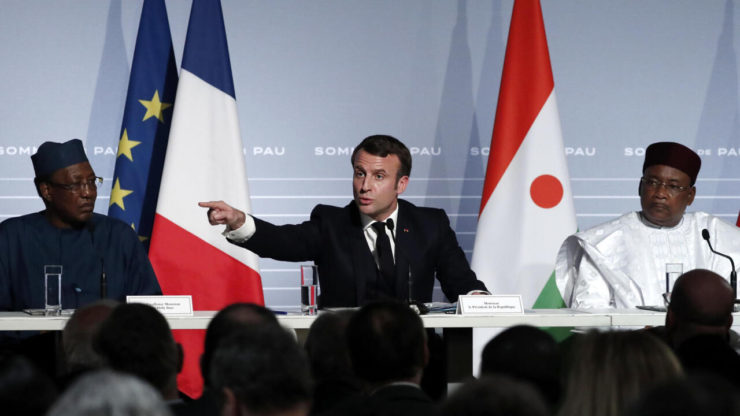
On March 1-5, French President Macron visited a number of African countries, leaving observers with a bitter taste in their mouths. Conceived with great fanfare as a presentation of Paris’ ostensibly new course aimed at “equal cooperation” with the African continent, it was remembered only for scandals, public spats with African presidents, and taunts from them that reflected the obvious disadvantage in bilateral relations.
Overall, the visit did not boost Paris’ credibility or strengthen its ties with Africa. Following the significant losses that France has suffered in Africa in recent years, the Elysée Palace should focus on preserving the African diamonds that remain in its crown rather than expanding its influence. And there aren’t many of them anymore. After Mali and Burkina Faso defected from Paris, Morocco is now gradually but steadily shifting from the French to the American camp, further narrowing the maneuvering field for Paris, which must look around and consider how to save what is left. What does it have in its piggy bank?
The richest “chest” in which the French keep the wealth looted from Africans is … the French treasury itself. The scheme of collecting money through the sub-regional economic cooperation organization of West Africa, ECOWAS (almost all its 15 members are former French colonies) is well established and allows almost half their economic potential to be at the service of the French economy.
ECOWAS itself was founded in 1975 on the basis of the Lagos Treaty and initially included 16 countries, but later the only Arab country in its composition, Mauritania, withdrew from it, remaining an associate member. When the organization was founded, the most noble goals were declared – the economic integration of the region, its self-sufficiency with the subsequent transition to a federation, a single citizenship and a single currency. But somehow it so happened that the most advanced element of integration was the creation of its own single currency – the West African CFA franc, which combines the currencies of the eight countries of this association, members of the West African Economic and Monetary Union, formed in 1994 (a number of other countries also use this currency). And “quite by chance” this currency is pegged to the euro, and 50% of foreign exchange reserves of these countries are stored in the French Central Bank, which completely deprives these countries of economic independence. Moreover, attempts by some of these countries to transfer their gold reserves to other jurisdictions are repeatedly unsuccessful, which naturally causes discontent among member countries.
Paris is forced to respond to this and in 2020 proposed a bill to this effect in the French National Assembly, according to which the CFA franc should be replaced by the “eco” already without being tied to the mandatory deposit in France. The draft was approved and ratified. However, it turned out that the pandemic buried it for a long time. In June 2021, ECOWAS revisited it, and a summit of member countries agreed on a five-year “currency convergence” pact, as well as a road map to launch a new monetary unit, now a region-wide one, by 2027.
More recently, on 24 January 2023, the President of Guinea-Bissau, who as of June 2022 is the current President of ECOWAS, pledged to revive the project, while also strengthening internal trade among ECOWAS countries, which currently represents less than 10% of total trade. To what extent this will work is not yet clear. Many suspect Paris that the reform of the CFA franc will be cosmetic and will not change the essence of economic relations between the member countries of the association and France, which actively uses the West African currency in the interests of French and multinational corporations based in its territory, which hold the markets of these states under their control and pump them for profit, including natural resources. Paris’ “Trojan horse” in ECOWAS is Côte d’Ivoire and the puppet regime put there by Paris, which implements French interests in the organization under the guise of African interests.
Whether or not Paris can pull off another trick with currency “reform” is not yet clear. Again, at the instigation of Paris, the membership of ECOWAS member countries where there have been recent coups, such as Guinea, Mali and Burkina Faso, is suspended, and important reforms that affect their core national interests can be carried out by regional organizations without their participation and taking their position into account by allies or, rather, satellites of France, such as Côte d’Ivoire. We can hardly believe that the Elysée Palace will not take advantage of these opportunities.
The other two countries where Paris will try by all means to maintain its influence are Chad and Niger, where strategic reserves of uranium, gold and other minerals are concentrated. In addition, Chad occupies an important strategic position, bordering Libya in the north and Sudan in the east, which makes it an important transit zone involved in both arms and migrant traffic. Chad, too, has a leadership that is questionable in terms of Western democracy — the son of President Idriss Déby, killed two years ago, Mahamat Déby, who heads the Transitional Military Council. But Paris, so sensitive to the issue in Mali and Burkina Faso, pays little attention in this case, because it is “our son of a bitch.”
Even more important for Paris is Niger, where uranium reserves, critical for the French nuclear industry, are being actively exploited. Paris is covered there by Washington, which has a chain of military bases, airfields and reconnaissance centers with UAVs. Of course, Paris will fight for this strategic region of Africa to the end, which, however, does not guarantee success.
In fact, Paris now has only one direction to go in Africa – to further lose its weight and influence. There are more and more reasons for this. France is increasingly uninterested in African states. Its military capabilities are shrinking, the effectiveness of its participation in solving the security problems of the continent is extremely low, which leads more and more states to refuse its assistance. France’s socio-political model is also losing its attractiveness against the background of increasing economic problems of the country, and with them the protests against the internal political and economic line of the Rothschild-appointed Macron. Constant arrogant lectures about the need to comply with democratic norms on the background of the suppression of citizens’ rights and the increasingly police nature of the French state, hits the eyes of Africans, as well as the growing propaganda of LGBT values. In this light, the storage of West African reserves in the Paris treasury looks increasingly anachronistic.
In Africa, they cannot fail to see Paris’s almost complete loss of sovereignty in European affairs, where it has demonstrated its absolute servility and dependence on the course of Washington, in particular with regard to the conflict in Ukraine. In this context, the attempts of Paris to fix the situation by loud slogans about “change of course”, belated repentance for the sins of the times of colonialism, as well as blaming the Wagner PMC for its problems look rather pathetic. The day is not far when France, like other colonialists, will be kicked off the continent as unable to cope with the challenges of the new era. In their place will come other forces that advocate real equal cooperation and its mutually beneficial nature based on the principles of a multipolar world, as well as unambiguously interpreted norms of international law.
Germans’ Support for Kiev May Wane Amid ‘Contrived’ Nord Stream Reports, Ex-US Official Says
Sputnik – 15.03.2023
Chancellor Olaf Scholz may fail to maintain public support in Germany for arming Kiev amid hardly credible reports blaming Ukraine for the Nord Stream attack, former Pentagon analyst Karen Kwiatkowski told Sputnik.
In early February, Pulitzer Prize-winning journalist Seymour Hersh reported that US navy divers planted explosives on the Nord Stream pipelines. Just a few days after Scholz held talks with President Joe Biden at the White House on March 3, American and German media reports surfaced placing the blame for the attack on a pro-Ukraine group.
In an interview aired earlier on Monday, Russian President Vladimir Putin called the version of the involvement of Ukrainian activists in the explosion at Nord Stream “complete nonsense.” Putin told the Rossiya 1 broadcaster that the explosion was carried out by specialists supported by all the might of a state with certain technologies.
Kwiatkowski suggested Germans opposed to continued war aid could use the stories to blame Ukraine for Germany’s economic challenges, or they could use the “contrived” story as another example of US and NATO lies.
“Overall, the ‘story’ is an insult to the intelligence of the average German, and as such it will both weaken German support for [Ukrainian President Volodymyr] Zelensky, and increasingly show German voters that Scholz himself is a tool of Washington, DC, putting US desires for war on the continent above the needs and the sovereignty of actual Germans,” Kwiatkowski said.
“That support has been declining due to cost, economic turmoil in Germany, and the pressure and stress of hosting and supporting over a million Ukrainians, most of whom intend to stay there.”
The amateur statesmen and spymasters in Washington, Kwiatkowski added, barely conceived of this story in time for Scholz’s visit, she said.
“And it appears they may have needed the German Chancellor’s advice and consent, before providing the unsubstantiated and vague storyline to friendly media,” the former Pentagon analyst said.
If the report itself were more believable, Kwiatkowski explained, or was accompanied by arrests, actual evidence and data, it perhaps would not be as damaging.
Kwiatkowski said it is unlikely that German intelligence has not known the basic facts of the pipeline attacks for many months, but until Hersh’s reporting Scholz and his party could simply remain silent, “as they did.”
The pipeline sabotage was an act of war by the United States, Kwiatkowski argued, as documented by Hersh, but it remains to be seen whether this was an act of war against Russia, against Germany, “or horrifyingly, both.”
“It is most certainly a ploy to shift the focus, because if an act of war were to be committed by the dominant NATO member against the next strongest NATO member, the entire NATO construct would collapse,” she added. “This possibility must not only be denied, it must be suppressed and eliminated.”
Former CIA station chief and analyst Phil Giraldi told Sputnik the new reports do not seem credible versus what Hersh revealed from sources involved in the actual destruction of Nord Stream. He also said the timing of the new narrative is suspicious coming after the “nothing-happened” meeting between Biden and Scholz.
Eurasia Group Vice President Earl Rasmussen said the stories emerging in the wake of Scholz’s visit to Washington are obviously no coincidence and the entire embarrassing affair will diminish Germany’s respect world-wide.
Germany is not a sovereign nation – Moscow
RT | March 14, 2023
Germany is facing an inevitable economic decline after losing its access to Russian energy, but cannot do anything about it because it is not a sovereign nation, the secretary of the Russian National Security Council has claimed.
“Germany tried for many years to build its economy on a combination of cheap Russian energy and advanced German technologies. Like no one else, it realizes that the terrorist attack against the [Nord Stream pipelines] will definitely cause the German economy to decline further,” Nikolay Patrushev said in an interview published in Argumenti i Fakti newspaper on Monday.
The advantages that German businesses enjoyed by getting access to Russian fuel has long irritated the governments of the US and the UK, he continued. But Berlin is not at liberty to continue cooperating with Moscow, “because the German nation is not independent.”
“Washington imposes on Berlin its economic and environmental agenda and keeps a 35,000-strong military force on its soil. For years, the White House controlled [former chancellor] Angela Merkel, and now it forces the German leadership to side with the version of the pipeline sabotage that is advantageous to the US authorities,” Patrushev said, describing America’s treatment of Germany as “humiliating.”
The remarks were part of Patrushev’s comments on the sabotage of the undersea pipelines, which were built to supply Germany with Russian natural gas. The Nord Stream links were ruptured by powerful explosions last September in what Russia has called a blatant terrorist attack.
A series of articles published by Western media this month claimed that Western intelligence services believe that a “pro-Ukrainian group” not associated with any government was behind the attack. Patrushev argued that, considering the training and equipment that such a complicated operation required, this scenario would seem plausible only to people who “cannot think logically.”
Investigative journalist Seymour Hersh had previously reported that the operation was ordered by US President Joe Biden and conducted by a US-Norwegian team of saboteurs. Both nations deny this allegation.
Hersh said Washington wanted to prevent Berlin from making a U-turn on its decision to phase out Russian gas supplies in response to the Ukrainian crisis. Liquified natural gas, which is produced by American companies and costs significantly more, took over a large portion of the European energy market previously held by Russian fuel.
Featured Video

ARE PATIENTS BEING PROPERLY INFORMED ABOUT OZEMPIC?
or go to
Aletho News Archives – Video-Images
New Book
Breast Cancer: Before You Consent
A new Unbekoming paperback
Lies are Unbekoming | September 18, 2026
Peter Gøtzsche reviewed every randomised mammography screening trial ever conducted for the Cochrane Collaboration. Cochrane’s headline is that, assuming a 15% mortality reduction, one woman in 2000 avoids dying of breast cancer over ten years. Ten are overdiagnosed and treated. Two hundred experience false alarms.
But that headline assumes the reduction. When Gøtzsche looked only at the trials with adequate randomisation — the higher-quality ones — the reduction disappeared. No effect on breast cancer mortality. No effect on all-cause mortality.
This is the Cochrane finding, published in the establishment’s own database of systematic reviews.
No woman being asked to consent to a mammogram this week knows it.
That is why the new Unbekoming paperback exists. … continue
Blog Roll
 Aletho News
- The Truth About the Trump Shootings with Ken Silva
- ARE PATIENTS BEING PROPERLY INFORMED ABOUT OZEMPIC?
- US lawmaker blocks $2.8 billion weapons sale to Israel: Report
- Yemeni army claims responsibility for strikes on sensitive sites in Saudi capital, Aramco facilities in Yanbu
- Iran Judiciary issues indictments against 159 US, Israeli officials for assassination of Leader, commanders
- Turkiye revokes Iranian bank license under US sanctions campaign
- US-Denmark Agreement on Greenland Is ‘PR Stunt’ Ahead of Midterms
- Araghchi: Military intervention cannot create security; coercion cannot bring peace
- Fraud Squared
- Breast Cancer: Before You Consent
- If Americans Knew
- Inside Gaza’s death trap of collapsing, bombed-out buildings
- The everyday items Israel bans from Gaza every day
- Inside the siege, the ruined buildings of Gaza – Daily Update
- Debunking The Claim That Macklemore Has A “History Of Antisemitism”
- CPJ demands release of arrested Palestinian-US journalist near Bethlehem
- Robert Kraft: The Billionaire Friend of Netanyahu Pulling The Strings Behind the Macklemore/Ed Sheeran Blow Up
- Columbia Administered Fund Gives Big Money to Pro-Israel Groups
- Deportation Case of Palestinian Activist Salah Sarsour Tests First Amendment
- ‘We Will Not Forget’: Palestinians Mark 44 Years since Sabra and Shatila
- Why do we let Zionists decide what we can and can’t say?
- No Tricks Zone
- New Study: ‘Global Drought Shows No Detectable Recent Acceleration Under Climate Warming’
- Economic Masterminds: German Socialists Suggest Taxing Productivity Gains Stemming From Using AI
- The South China Sea Has Not Been Cooperating With The Climate Change Narrative
- Energy Crisis: Germany Enters Heating Season With Historically Low Gas Reserve Fill Levels
- New Study: The Antarctic Ice Sheet Gained Mass From 2020-2024 Due To Staggering Snow And Ice Accumulation
- Study: Ocean Heating Rates From Thousands Of Years Ago ‘Dwarf’ Modern Ocean Heating Rates
- Climate Extremists Target, Attack Large-Scale Power Grid Infrastructure In Germany!
- New Study: Antarctic Ice Melt Has Contributed Less Than 1 Centimeter To Sea Level Rise In The Last 30 Years
- Fear Of Debate: Alarmist German Climate Scientist Calls On Mainstream Media To Discredit Skeptic Voices
- End-Of-August Arctic Sea Ice Extent Hasn’t Fallen In 20 Years, Official Data Show!
 Aletho News