Where Is Occupy Silicon Valley?
By Craig Pirrong | Brownstone Institute | March 13, 2023
Bank failures tend to come in waves, and we are experiencing at least a mini-wave now.
Banks fail for three basic reasons: 1. Credit transformation: deterioration in borrower creditworthiness, usually due to an adverse economic shock (e.g., a real estate bust). 2. Maturity transformation: borrowing short, lending long, and then getting hammered when interest rates rise. 3. Liquidity transformation combined with an exogenous liquidity shock, a la Diamond-Dybvig, where idiosyncratic depositor needs for cash lead to withdrawals that exceed liquid assets and therefore trigger fire sales of illiquid assets.
The two most notable failures of late–Silicon Valley Bank and Silvergate–are examples of 2 and 3 respectively.
In some respects, SVB is the most astounding. Not because a bank failed in the old-fashioned way, but because it was funded primarily by the deposits of supposed financial sophisticates–and because of the disgusting policy response of the Treasury and the Fed.
SVB took in oodles of cash, especially in the past couple of years. The cashcade was so immense that SVB could not find enough traditional banking business (loans) to soak it up, so they bought lots of Treasuries. And long duration Treasuries to boot.
And then Powell and the Fed applied the boot, jacking up rates. Bonds have cratered in the last year, and took SVB’s balance sheet with it.
Again, an old story. And hardly a harbinger of systemic risk–unless such reckless maturity mismatches are systemic.
SVB was the Banker to the Silicon Valley Stars, notably VCs and tech firms. These firms are the ones that deposited immense sums in exchange for a pittance of return. Case in point, Roku, put almost $500 million–yes, you read that right, 9 figures led with a 5–into SVB!!!
I mean: what the eff? Was the Treasurer a moron? For who other than a moron would hold that much in cash in a single institution? (Roku claims its devices “make your home a smarter.” Maybe they should have hired a smarter treasurer and CFO, or replaced them with one of its devices). Hell, why is a company holding that much in cash period?
A few of these alleged masters of the universe (like Palantir) saw the writing on the wall and yanked their deposits: deposits fell by a quarter on Friday alone, sealing the bank’s doom. Those who were slow to run howled to the high heavens over the weekend that if there was not a bailout there would be a holocaust in the tech sector.
Even though the systemic risk posed by SVB’s failure is nil (or if not, then every bank is systemically important), the Treasury Department and the Fed responded to these howls and guaranteed all the deposits–even though the FDIC’s formal deposit insurance limit is $250,000. You know, .05 percent of Roku’s deposit.
When evaluating this, one cannot ignore the reality that the Democratic Party is completely beholden to Silicon Valley. This is beyond scandalous.
Occupy Silicon Valley, anyone?
Treasury Secretary Janet Yellen insulted our intelligence by assuring us this is not a bailout. Well, it’s not a taxpayer bailout, strictly speaking, because the Treasury is not providing the backstop. Instead, it is being funded by a “special assessment” on solvent banks. Which are owned and funded by people who also pay taxes. And such an “assessment” is a tax in everything but name–because it is a contribution by private entities compelled by the government.
The policy implications of this are disastrous. The whole problem with such bailouts is moral hazard. What is to stop banks from engaging in such reckless behavior as SVB did if they can obtain seemingly unlimited funding from those who know that they will be bailed out if things go pear-shaped?
And the regulatory failure here demonstrates that bank regulation–despite the supposed “reforms” of Frankendodd–can’t even catch or constrain the oldest bet-the-bank strategy in the book. Free banking–no deposit insurance, no bailing out of depositors–couldn’t do worse, and would likely do better.
No, the failure of SVB is not the scandal here. The scandal is the political response to it. This reveals yet again how captured the government is. This time not by Wall Street, but by tech companies and oligarchs that are currently the primary source of Democratic political funding.
A couple of weeks ago the Silvergate story looked juicy, but SVB has put it in the shade. Silvergate also grew dramatically, but on the back of crypto rather than SV tech. It became the main banker for many crypto firms and entrepreneurs. The crypto meltdown did not affect Silvergate directly, but it did crush its depositors, the aforesaid crypto firms and entrepreneurs. They withdrew a lot of funding, and an old-fashioned liquidity mismatch did it in.
In traditional banks, deposit funding is “sticky.” Banks that rely on wholesale funding (“hot money”) are more vulnerable to runs. Silvergate’s funding was not traditional sticky deposit funding, nor was it hot money per se. It was money that was pretty cool as long as crypto was cool, and became hot once crypto melted down.
A run started, but the run was precipitated by a liquidity shock. Simple story, really.
Silvergate’s failure was not a scandal. SVB’s failure per se was not a scandal (except to the extent that our vaunted banking regulators failed to prevent the most prosaic type of failure).
Again–the scandal is the politically tainted response that will have baleful consequences in the future, as the response virtually guarantees that there will be more SVBs in the future.
The Deception Over Climate is Even Worse Than the Deception Over Covid

BY ANDREW MONTFORD | THE DAILY SCEPTIC | MARCH 11, 2023
In the aftermath of the release of the Lockdown Files, the public is slowly coming to terms with some fairly shocking facts: that the Government was willing to lie and mislead, and to scaremonger and manipulate the media, in order to achieve its Covid policy objectives (or even just to garner a few headlines). The news is still sinking in, but a day of reckoning for those involved looks likely.
For those of us bearing the scars of long engagement in the climate and energy wars, however, none of this was a surprise. It has long been clear that the inhabitants of the Westminster village were happy to hype up fears of climate purgatory and to fib about the road to redemption – renewables – and the cost of taking it. Once the public understand the depth and extent of the deception, and the damage done to the economy and the prospects for our children, the trickery over Covid is going to look decidedly peripheral.
The latest report from the Climate Change Committee (CCC) is a case in point. On the surface it’s a roadmap to a decarbonised electricity grid, but in reality it’s merely a sales document, full of tricks, evasions and outright falsehoods that would make even the most cynical used car salesman blush.
For example, in a number of places, it says that decarbonisation of the grid will be ‘cost-effective’, but you will find next to no information on what it will cost. The game that is being played becomes a bit clearer when you read the reference to ‘carbon prices’. In normal usage, the carbon price is the estimate of the damage done by a ton of carbon dioxide, but in the CCC’s parlance it is an estimate of what it will cost to decarbonise. So, while it gives you the impression it has done a cost-benefit analysis and is going to be saving you money, in reality it is only saying that the bill to be paid will be the same as previously advised. It’s a trick.
Another trick is to assume that wind power costs will be only a quarter of what they actually are. For years, the industry has been pushing claims that they have brought about a cost-reduction revolution. The problem is that windfarms’ own financial accounts show that it isn’t true. And with new windfarms now saying they will not come on stream without further subsidies, the deception has been exposed.
I’m picking on the CCC here, simply because it is in the news today. But it’s not just the CCC. None of the bodies whom the public expect to tell the truth about the Net Zero project will do so: the Royal Academy of Engineering is silent. The Royal Society likewise. National Grid pretends the task is a cinch. The National Infrastructure Commission just repeats the Government line verbatim. Parliament asks how soon the job can be done, not whether it can be done or how much it will cost. Everywhere the tricks go unchallenged and the lies are swept under the carpet.
Such deceptions mean that we are storing up catastrophic harms for our economy, and for our children and grandchildren. Energy that was said to be as cheap as gas is actually going to cost three or four times as much. The costs of ensuring supply when the wind doesn’t blow are an order of magnitude larger.
And whether it was delivered on the back of a lie or not, you are going to have to pay for it. A huge pipeline of wind projects is in place already, each eligible for an astonishing array of hidden subsidies – the list is too long to give here. Once built, they will suck wealth from our economy and hope from our society. They will be hard, if not impossible, to close down – they have been made exempt from windfall taxes and the Government cannot simply switch them off without destroying investor confidence in the economy as a whole. If we do not reverse course soon, our children will never know the wealth we have enjoyed until now, just poverty and rationing and hardship. And all because everyone is too scared to challenge the lies. Just like Covid.
Over $250 billion swindled from US pandemic fund – report
RT | March 11, 2023
More than $250 billion in Covid-19 relief funds were lost to “fraud” and “waste,” the directors of three US government agencies testified before the House Oversight and Accountability subcommittee on Thursday.
Compounding what Deputy Inspector General Sheldon Shoemaker of the Small Business Administration (SBA) called “the biggest fraud in a generation,” the officials stressed that the figures they gave represented an extremely conservative estimate of the total amount lost as they did not include the amount defrauded from the Pandemic Unemployment Assistance program.
According to a statement submitted by Shoemaker ahead of the hearing, the SBA has already uncovered $190.7 billion in potential fraud across relief programs under its jurisdiction. Specifically, it expects to find upwards of $100 billion within the scandal-plagued Paycheck Protection Program. Acting Treasury Inspector General Richard Delmar admitted to just $2.6 billion in dubious charges confirmed at his agency, pleading that ongoing audits precluded making an estimate of the full cost.
Larry Turner, inspector general of the Department of Labor, blamed the massive losses on a lack of preparation, insufficient oversight, and even the government’s generosity, making a “highly conservative” estimate of $76 billion in fraudulent spending. With no functioning system in place to verify applicants’ qualifying details in a reasonable time frame, the “unprecedented infusion of federal funds” into the program made it irresistible to fraudsters, he told the subcommittee.
Rep. Keith Mfume (D-Maryland) expressed shock that no one had predicted that requiring only “self-certification” to access such a prodigious cash hoard would lead to “a lot of hanky-panky,” while Rep. Byron Donalds (R-Florida) pointed out that the agencies did not even use existing checks and balances to vet applicants, and Rep. Maxwell Frost (D-Florida) highlighted that state unemployment systems were hopelessly outdated even before the pandemic placed them under unprecedented stress. Of $45.6 billion in potential fraud lent out in association with one Labor Department program, Turner acknowledged upon questioning that $267 million had gone to dead people.
Asked about the possibility of recovering the money, Turner said that hunting down the perpetrators was financially unrewarding, as “once money goes out the door, it is hard to get it back.” Even in cases where the government has been able to track down Covid-19 benefit fraudsters and claw back some of the funds, the inspectors general were unable to tell subcommittee members what had become of some of the money.
More than $5 trillion in pandemic relief funds have been distributed since 2020. By some estimates, as much as $400 billion was stolen from the unemployment relief program alone.
Will Pakistan defy US sanctions to complete ‘Peace Pipeline’ with Iran?
By F.M. Shakil | The Cradle | March 7, 2023
Islamabad has formed a diplomatic channel to convince Washington to ease sanctions on Iran, which would finally allow for the completion of a crucial pipeline project to bring cheap Iranian natural gas to Pakistan.
Iran has vowed to take the matter to arbitration if Pakistan does not complete its portion of the pipeline by March 2024, as stipulated in an agreement between the two West Asian countries.
Discussions on constructing the massive pipeline project began almost 29 years ago, in 1994 – then called the Iran-India-Pakistan pipeline – which originally envisioned moving Iranian gas to Pakistan, Bangladesh, and China. The focus later shifted to constructing a pipeline between Pakistan and Iran only, but the project has never been completed.

According to the terms of the IP-GSPA (Gas Sales Purchase Agreement) signed between Iran and Pakistan, each country was obligated to construct the portion of the pipeline on its own territory, and the first flow of Iranian gas to Pakistan was to start January 1, 2015. The agreement stipulated Pakistan would pay Iran $1 million per day in exchange for 750 million cubic feet of gas daily, with a contract lasting 25 years.
Iran completed its portion of the pipeline in 2011, however, Pakistan has failed to construct its portion, largely due to difficulties caused by US economic sanctions imposed on Iran for the country’s alleged nuclear weapons program. US sanctions block Pakistan from purchasing Iranian gas, and this geopolitical risk has made Pakistani banks unwilling to finance the project.
Because of US foreign policy pritiorites, therefore, Pakistan continues to rely on more expensive liquified natural gas (LNG) to meet its burgeoning energy needs, which has greatly limited Pakistani economic growth and exposed the country to crises during periods of volatile LNG price spikes.
Due to these difficulties, Pakistan’s Inter-State Gas Systems (ISGS) and the National Iranian Gas Company (NIGC) signed a revised agreement in 2019 to allow Pakistan more time to complete its segment of the pipeline. The agreement stipulated that neither Iran nor Pakistan will take the other to court for delays or impose fines until 2024.
But US sanctions have continued to make Pakistan’s completion of the project difficult, and Iran is now threatening to sue Islamabad for $18 billion in fines if it breaks the agreement and fails to complete construction by the 2024 cutoff date.
Financial straits or US pressure
As Asif Durrani, a former Pakistan ambassador to Iran, tells The Cradle:
“Pakistan needs roughly $3 billion to lay a pipeline stretching over a radius of 781 kilometers inside the country. The question is who will finance this project, and secondly, the US sanctions on Iran, which took the air out of this project as far as Pakistan is concerned, need a revisit by the US authorities to protect the faltering economies of the region.”
The sanctions, he adds, were primarily focused on the energy sector of Iran and set a cap of $10 million on investments in the Iranian oil and gas sector.
Durrani is not convinced that US sanctions make completion of the pipeline impossible, however.
“These are lousy arguments because, despite these restrictions, Iran supplies Turkiye with almost $10 billion annually in natural gas,” he argues, adding that India and China have also resisted US sanctions.
Durrani contends that Pakistan and Iran are neighboring nations and that neighbors must always conduct business with one another. He urges private sector participation in the IP gas project to accelerate the development phase of this huge project.
Now a senior fellow at the Islamabad Policy Research Institute (IPRI), the former Pakistani envoy to Tehran had in 2021 criticized the US for sabotaging the Iranian nuclear deal, claiming that Iran, as a Non-Proliferation Treaty (NPT) member, had the legal right to use nuclear energy for peaceful purposes.
Dr. Muhammad Abdul Muqtedar Khan, an Indian-American academic and a professor in the Department of Political Science and International Relations at the University of Delaware concurs with Durrani’s logic, telling The Cradle that too many countries in this region tend to yield to US pressure unnecessarily.
India, he says, disregarded US outrage over the Russian oil issue and refused to capitulate, unlike Pakistan which is still in a state of vacillation. In the same way, Pakistan could proceed with the Iran gas pipeline project, citing its energy and resource constraints in the face of pressure from Washington.
“In 1990, India, China, and even Bangladesh showed interest in the peace pipeline – but, in 2008, as a result of the Indian nuclear accord with the US, New Delhi decided to withdraw. As the thing unfolded, Iran has already installed the pipeline on their side of the border, but Pakistan is still dilly-dallying about it because of the US pressure and lack of the financial means to begin construction,” Khan adds.
He says Iran has spent a considerable amount of money constructing its section of the pipeline and would want compensation for the resulting commercial loss. “Iran has granted sufficient time for the pipeline’s development, and if Pakistan begins building its gas infrastructure, it could gain some cushion to reduce its import bill.
Pakistan is hedging its bets
Pakistan’s Secretary of Petroleum, Ali Raza Bhutta, disclosed in a meeting of the country’s Public Accounts Committee (PAC) that Pakistan has spoken to the US about the gas project, seeking relief in sanctions on Iran to press ahead with the construction of the pipeline.
Islamabad’s top energy official went on to add that since there was a ban on importing gas from Iran, the government has conveyed to the US ambassador to either grant Islamabad permission to go ahead with the project, or compensate Iran for the penalty imposed for opting out of the project.
As Noor Alam Khan, Chairman of the Public Accounts Committee, tells The Cradle:
“I did not convene this meeting specifically for the IP gas project, the focus was only on the audit paras of the petroleum ministry, and I suggested during the meeting – not the secretary – that the Ministry of Foreign Affairs should approach the US to let them know how serious the situation is.”
When informed that the secretary of petroleum had briefed the committee on the IP gas project and that media had quoted him saying that either the US should pay the damages or permit the country to continue with the IP gas project under the terms of the Iran agreement, Khan, a member of a breakaway faction of former president Imran Khan’s Pakistan Tehrik-e-Insaf party, became irritated, said it was nonsense, and hung up the phone.
The Pakistan National Assembly’s Foreign Affairs Committee also discussed this matter last week. The committee’s chairman, Mohsin Dawar, raised fears about the fact that several nations in the region have received waivers for importing Iranian oil even though Iran is under sanctions.
Pakistan, however, was unable to secure such a waiver to conduct such lucrative oil and gas business with Iran. He pressed the appropriate ministries to examine opportunities for receiving exemptions for the IP gas pipeline with Iran, much as India and China had done for Iranian oil imports.
IP Gas Pipeline in perspective
The plan for the IP Gas Pipeline, which is also called the “Peace Pipeline,” dates back to 1994, when India was also part of the project.
The 1,700-mile (2,735 km), $7.5 billion project planned to move gas from the South Pars Gas Fields to India through the western part of Pakistan, Balochistan. Since its inception, the project has encountered numerous obstacles that have caused repeated delays in the execution of a natural gas project that was badly needed by energy-starved Pakistan.
In 2008, the three nations were close to reaching an agreement before India opted to pursue an alternative project, the Turkmenistan-Afghanistan-Pakistan-India pipeline (TAPI). The US pressure and sanctions on Iran appear to have impacted India’s decision to withdraw from the IP gas pipeline agreement and pursue an alternative that excluded Iran.
Then, in 2010, a 25-year-long Gas Sale and Purchase Agreement (GSPA) was signed, to construct a pipeline stretching across Pakistani territory from the Iranian border to Nawabshah, a distance of 781 kilometers.
Approximately 665 kilometers will travel through Balochistan while 115 kilometers will run through Pakistan’s Sindh province. The length of the Iranian portion of the pipeline is 1,100 kilometers. It begins in the energy economic zone of Pars and goes to Iranshahr and Bushehr. The route then continues through Fars, Kerman, Hormozghan, and Sistan-Baluchistan.
From the Pakistani border to Nawabshah, the pipeline will stretch around 781 kilometers. After completion, the IP gas pipeline was projected to supply 750 million cubic feet of gas per day to Islamabad from Iran. According to the deal, gas supplies from Iran would start in 2014. But, this assumption turned out to be a pipe dream and has not been realized during the past nine years.
A panacea for Pakistan’s economic woes
“Pakistan’s issue with foreign reserves would progressively get worse if it were unable to achieve a deal with Iran because years were spent in negotiations between Pakistan, Iran, and Turkey to create a close economic relationship for significant infrastructure projects, but the US sanctions and pressure shattered all these dreams,” Muqtedar Khan maintains.
He believes that Pakistan is currently dealing with a protracted foreign exchange problem that cannot be remedied by borrowing money from China, Saudi Arabia, or the International Monetary Fund (IMF) because Pakistan would still have to pay back the initial debt.
“Strangely, Pakistan and Iran have failed to create a mutual understanding despite their common Islamic background. As an alternative to US dollars, they may conduct business in their own currencies. Even though they are neighbors, it would be a diplomatic failure if they did not restore a reciprocal trade relationship,” Muqtedar Khan concludes.
Silence is not an option, and sending weapons to Ukraine perpetuates the war
By Ramzy Baroud | MEMO | March 6, 2023
As is usually the case in long wars, the warring parties and their affiliated media in the Russia-Ukraine conflict have painted each other using uncompromising language, making it nearly impossible to offer an unbiased view of the ongoing tragedy that has killed, wounded and displaced millions of people.
While it is understandable that wars of such horror and near complete disregard for the most basic human rights often heighten our sense of what we consider to be moral and just, parties involved and invested in such conflicts often manipulate morality for political and geopolitical reasons. This logic is underway in Ukraine. Both sides are adamant that nothing less than a comprehensive victory is acceptable. The Ukrainian view is fully supported by western countries in word and deed, sending billions of dollars’ worth of modern weapons that have done little except make an already bloody conflict worse. They perpetuate the war, not end it.
The Russians hardly see their war in Ukraine as a war against Ukraine itself. In his speech on the first anniversary of the war, Russian President Vladimir Putin presented the war as an act of self-defence. “They are the ones who started this war, and we are using our forces to put a stop to it,” said Putin in a joint session of the Russian Parliament and Kremlin officials.
NATO members have also characterised the war using similar language. “We are fighting Russia,” said Germany’s Foreign Minister Annalena Baerbock. Although her statement was withdrawn later on, Baerbock was actually being honest: NATO and Russia are, indeed, at war.
The narratives of both sides, however, are both complex and polarised. To even attempt to offer a third view on the war, or to even approach the subject in a purely analytical manner, immediately qualifies one to be accused of being “biased” one way or the other. Each side believes that its version of the truth is moral, historically defensible and consistent with international law. As a result, many reasonable people find themselves retreating in silence.
Silence is an immoral position, especially during times of war and human suffering. Anyone who thinks otherwise should think again. In Islamic theology, it is accepted that, “Anyone who refrains himself from speaking the truth is a mute devil.” This maxim is shared by most modern philosophies and political ideologies. Among many such statements addressing the matter, one of the most powerful assertions by Dr Martin Luther King Jr. was, “The day we see truth and cease to speak is the day we begin to die.”
Yet, there is no single truth on the Ukraine war that can remain fully truthful after being placed within a larger context. The war on Ukraine is indeed illegal; but the preceding civil war in Donbas and the violated Minsk agreements at the behest of Western powers — as admitted by former German Chancellor Angela Merkel — were also immoral and illegal. In fact, none of these acts can be analysed accurately or understood fairly, without considering the others.
A year after the war started, more fuel has been added to the fire, as if the main goal behind the war is prolonging it. Concurrently, very few proposals for peace talks have been advanced or considered. Even a proposal made by former US Secretary of State Henry Kissinger, hardly a peacenik, was dismissed almost immediately by the pro-Ukraine camp. When someone like Kissinger is accused of being a compromiser, we can be certain that the political discourse on the war has reached a degree of extremism unprecedented in decades.
Aside from the morality of speaking out against the continued war, and the immorality of silence, there is another matter deserving of our attention. It is not simply a dispute between Russia and its allies on one hand, and Ukraine and NATO on the other. It is affecting all of us.
A comprehensive study conducted by researchers from the Universities of Birmingham, Groningen and Maryland examined the possible effect of the war on household incomes in 116 different countries. The study created a model for the future, based on what millions of people around the world, especially in the Global South, are already experiencing. It looks bleak. Just the fact that energy prices could force an individual household to spend anywhere between 2.7 to 4.8 per cent more is enough to push 78 to 114 million people into extreme poverty. Since hundreds of millions already live in extreme poverty, a massive section of the human race will no longer be able to afford proper food, drinkable water, education, healthcare or shelter.
Hence, our silence on the inhumanity and futility of the war in Ukraine is not only immoral, but also constitutes a betrayal of the fate of hundreds of millions of people around the world. This is why the war in Ukraine must end, even if one party is not fully and comprehensively defeated; even if NATO’s geopolitical interests are not served; and even if not all of Russia’s goals, whatever they are, are achieved.
The war should end because, regardless of the outcome, long-term instability in that region will not cease completely any time soon; and because millions of innocent people are suffering and will continue to suffer, in Ukraine and around the world as a direct result of the conflict. And because only political compromises through peace negotiations can put an end to this horror.
Russia to maintain high oil output – JPMorgan
RT | March 5, 2023
Russian oil drillers can maintain high production despite numerous rounds of Western sanctions, JPMorgan projected this week, according to Reuters.
The Wall Street bank pointed to growing demand for crude oil from China and India which is expected to increase collectively by 1 million barrels per day (mbd) this year.
“We believe Russia will be able to maintain its oil production at pre-war levels of 10.8 mbd but will have difficulties getting back to peak pre-Covid volumes of 11.3 mbd,” JPMorgan reportedly stated.
The US bank suggested that Moscow could struggle to reroute part of its oil product exports away from the EU, following the bloc’s embargo on imports of Russian fuels. Seaborne oil product shipments from Russia are set to decline by around 300,000 barrels per day to “lows last seen in May 2022,” it projected.
Meanwhile, business daily Kommersant reported this week, citing industry sources, that Russian oil output in February reached pre-sanctions levels for the first time, and may exceed the February 2022 figure.
According to Kpler, Russian crude oil and petroleum product exports also held strong last month, with energy producers managing to ship 7.32 million barrels per day of crude oil and oil products.
While the EU and G7 nations have introduced price caps and restrictions on Russian fuel imports, China, India, Türkiye, and some other countries have boosted purchases from Moscow. Last month, Russia unveiled plans to curb oil production in March by 500,000 barrels a day, or about 5%, in retaliation to Western sanctions.
EU must shift to wartime economy – industry commissioner
RT | March 4, 2023
The European Union’s industry chief has said the bloc will have to shift to a “wartime” economic model if it hopes to meet Kiev’s battlefield needs, with senior Ukrainian officials voicing hopes for a massive influx of shells from their foreign sponsors.
Commissioner for Internal Market Thierry Breton discussed plans to bolster arms and ammo shipments to Ukraine during a sit-down with the Financial Times, saying he is working with the EU’s foreign policy head Josep Borrell to expand industrial capacity in Europe, slash supply bottlenecks and pressure banks to boost their lending to facilitate military transfers to Kiev.
“I believe it is time that the European defense industry moves to a wartime economy model to cater for our defense production needs,” he told the outlet on Friday, adding that he and Borrell are “fully determined to support the production ramp-up of the European defense industry to face the realities of a high-intensity conflict – starting with the question of ammunition.”
Though unnamed diplomats voiced their doubts to FT – with one asking “How are we going to pay for this?” – the efforts to speed deliveries to Kiev and replenish Europe’s own domestic stocks come after Ukrainian Defense Minister Aleksey Reznikov pleaded with the bloc for 250,000 artillery shells per month, vastly outpacing any existing EU plan.
In a letter to European defense chiefs on Friday, Reznikov spoke of the “crucial role” played by artillery on the battlefield, claiming Ukrainian troops burn through 110,000 155mm shells every few weeks.
Ukrainian troops are “limited by the amount of available artillery shells” and need at least 356,400 rounds per month to “successfully execute” their tasks – or a whopping 594,000 shells monthly to use their artillery power to full capacity, Reznikov claimed.
According to the Times, Borrell is aiming at a “less ambitious” scheme, instead hoping to disperse €1 billion over “the next few months” to partially cover the bill for donated shells from allies.
With costs soaring amid growing shortages on the continent, 155mm shells produced in Europe could run as much as €3,300 for a single round, a recent weapons contract inked between EU members suggests. Based on that estimate, the ammunition sought by Kiev could cost the bloc some €825,000,000 for just one month, though officials have yet to confirm any specific figures.
It is hard to trace how many shells Ukraine has been getting from the armories of its European backers, but over the past year the United States alone sent “over 1,000,000 155mm artillery rounds,” according to the Pentagon’s latest data.
Russian airlines surviving sanctions – Bloomberg
RT | March 1, 2023
Sanctions against Russian aviation have led to mixed results but have failed to cause the significant pain to the sector that was expected by Western countries, Bloomberg reported on Wednesday, citing industry analysts.
The Ukraine-related sanctions forced two of the world’s largest aircraft manufacturers, Boeing and Airbus, to stop doing business in Russia. Meanwhile, over 40% of the aircraft operating in Russia were owned by foreign lessors that demanded their property back shortly after the restrictions were introduced.
However, Russian air carriers are still operating 467 Airbus and Boeing jets versus the 544 a year ago, according to data from researcher Cirium, as cited by the news agency.
The country’s airlines reportedly keep flying the jets without software updates and other forms of support from Boeing and Airbus. Both manufacturers told the agency that they had stopped providing parts, maintenance or technical support to airlines or maintenance companies in Russia.
In February, Russian Federal Air Transport Agency head Alexander Neradko said that Boeing and Airbus planes operated by Russian airlines will be able to fly safely until 2030 if properly maintained.
In an attempt to isolate Russia, the US, EU, and a number of other countries closed their airspace to Russian airlines. However, despite losing many destinations, Russian carriers have reportedly increased the number of flights to Thailand, Türkiye, the United Arab Emirates, Armenia, Kyrgyzstan, and Tajikistan.
According to Cirium estimates, Russian airports are now served by some 270 international flights daily compared to 300 a year ago.
At the same time, Russia’s retaliatory measures forced EU and US carriers to make long and expensive detours on flights to Asia. Russian airspace is still open to airlines from nations that opted not to support the sanctions, such as the UAE, which has ramped up service.
“Clearly the sanctions didn’t work as the West thought they would, and the global aviation industry is a lot leakier than anyone thought,” industry consultant Richard Aboulafia told Bloomberg. “Yes, safety will deteriorate the longer these sanctions go on, but it’s clearly not going to bring connectivity within Russia and from Russia to a grinding halt.”
Turkish FM speaks out on sanctioning Russia over Ukraine
RT | March 1, 2023
Türkiye will not be joining unilateral sanctions imposed on Russia by the West over the conflict in Ukraine, Turkish Foreign Minister Mevlut Cavusoglu said on Wednesday.
Cavusoglu was asked how long Ankara would be able to resist pressure from the US and its allies to put restrictions on Moscow ahead of talks with his Russian counterpart Sergey Lavrov on the sidelines of the G20 Foreign Ministers Meeting in India’s capital New Delhi.
“We don’t need to resist anyone, we make our own decisions as a sovereign state. We don’t join any unilateral sanctions. We support only those [restrictions that are] introduced with the backing of the UN,” the foreign minister replied, as cited by the media.
“It’s not just about Russia, but we also don’t support sanctions against Iran or any other country,” Cavusoglu pointed out, adding that “no one can put pressure” on Türkiye.
India, which chairs the G20 this year, is hosting the summit of foreign ministers on Wednesday and Thursday.
An Indian foreign ministry official told Reuters on Wednesday that New Delhi didn’t want the conflict in Ukraine to dominate the discussions at the event, but acknowledged that it would likely be among the top issues on the agenda. The host nation’s “intention [is] to continue playing the voice of the Global South [Latin America, Africa, Asia and Oceania] and raising issues pertinent to the region,” the official said.
High-ranking Indian diplomat Vinay Kwatra told reporters that “questions relating to food, energy and fertilizer security, [and] the impact that the conflict has on these economic challenges that we face” will be among those to receive “due focus” in New Delhi.
However, EU foreign policy chief Josep Borrell, who is a stalwart supporter of Kiev, insisted that India should use the G20 gathering to “make Russia understand that this war has to finish.” According to Borrell, the “success” of the whole meeting “will be measured in respect to what we will be able to do on that.”
An EU source said separately the EU delegation in New Delhi won’t support the final statement as a result of the summit if it doesn’t include condemnation of Russia’s conduct in Ukraine, Reuters reported.
Korybko: There’s No Reason For India To Decouple Itself From Russia
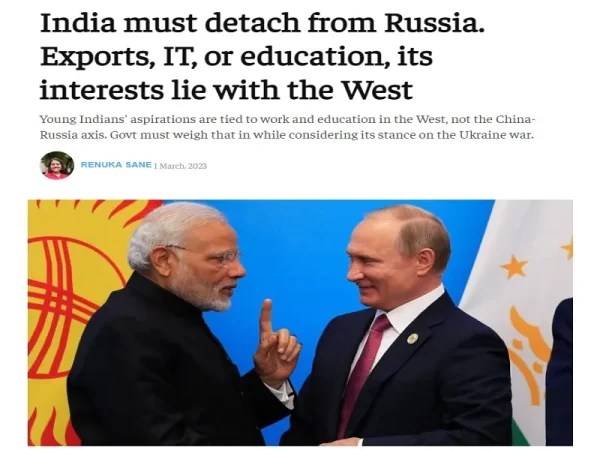
By Andrew Korybko | March 1, 2023
As an economic expert, Renuka Sane’s heart might presumably be in the right place, but her suggestion to decouple from Russia is counterproductive from the perspective of India’s grand strategic interests. By following her well-intended advice, India would be abandoning its masterful balancing act between key players in the New Cold War that’s responsible for its rapid rise as a globally significant Great Power over the past year. It would also be voluntarily submitting itself to vassal status vis-à-vis the US-led West’s Golden Billion.
The Print, a popular Indian online media outlet, published an op-ed by Renuka Sane on Wednesday urging her country to decouple from Russia in order to please its Western partners. Titled “India must detach from Russia. Exports, IT, or education, its interests lie with the West”, the research director at Trustbridge, which works on improving the rule of law for better economic outcomes for India, shared plenty of details about Indian-Western economic, financial, and tech ties in order to make her case.
There’s no disputing the fact that these abovementioned relationships are incredibly important for India and far outweigh related ties with Russia. The problem, however, is the innuendo that pervades her text whereby she appears to regularly hint that her country’s Western partners might employ “state coercion” against it in response to Delhi’s defiance of their demand to distance itself from Moscow. The first such example of this is present in the second paragraph of her piece.
Sane writes that “State coercion limits engagement between individuals in two countries. Governments make such decisions based on a balance of economic interests and foreign policy. One arena where this plays out is visa diplomacy. Denial of visas is a lever of international relations and often used as a tool to influence actions by another State.” She then adds near the end of that paragraph that “Trade agreements may sometimes be driven primarily by geopolitical and strategic reasons.”
Sane continues this trend into the third paragraph where she opines that “The energy, support, and prioritisation for all these [Indian-US tech initiatives] on the part of the two governments are shaped by their security environment.” This part can be interpreted as her hinting that the US’ displeasure with the Russian dimension of India’s foreign policy could have consequences for bilateral cooperation, especially in the tech sphere.
Reinforcing this point, the fourth paragraph includes the following insight: “Information Technology is now India’s biggest industry, and the future of the Indian economy is tied to success in this sector. For further doubling of services exports, support and cooperation from Western governments is important.” Sane then adds at the end of the sixth paragraph that “India’s approach to the Ukraine war will shape the extent to which Western governments choose to support India’s services exports growth targets.”
The last two paragraphs more directly convey the implied purpose behind her latest op-ed. This is evidenced by her warning that “If global firms want to exit China on the grounds that it is an authoritarian country hostile to the West, then it is in India’s interest to look ‘un-China’ in the eyes of the world. Our equation and policies vis-a-vis Russia may shape the attitude of these global corporate players.”
Sane then ends her piece on the following ominous note: “India’s economic interests lie with the West, and the latter is extremely worried about Russia’s invasion of Ukraine.” Putting everything together and keeping in mind the excerpts that were shared, there’s little doubt that she’s concerned that the West – particularly the US – might punish India for its independent foreign policy towards Russia through economic, financial, and/or tech means, ergo her innuendo that it should ditch Moscow.
As an economic expert, her heart might presumably be in the right place, but her suggestion is counterproductive from the perspective of India’s grand strategic interests. By following her well-intended advice, India would be abandoning its masterful balancing act between key players in the New Cold War that’s responsible for its rapid rise as a globally significant Great Power over the past year. It would also be voluntarily submitting itself to vassal status vis-à-vis the US-led West’s Golden Billion.
India’s hard-earned strategic autonomy would be surrendered in exchange for literally nothing at all since it’s highly unlikely that her implied scenario of that de facto New Cold War bloc punishing her country through the related means that she warned about will ever come to pass. This South Asian Great Power is simply much too important to the Golden Billion for the latter to unilaterally decouple itself from the former for five reasons that will now be summarized.
First, India’s labor and market potentials are too large for the West to ignore, which directly segues into the second point of them envisaging that country functioning as a reliable re-shoring location for gradually reducing their presently disproportionate dependence on Chinese-based supply chains. Third, their support for India’s continued economic growth enhances its comprehensive capabilities to manage China’s rise, which aligns with their de facto New Cold War bloc’s geostrategic interests.
Fourth, no other country has anywhere near the previously mentioned characteristics that India has, meaning that there’s no viable alternative for the West with respect to those related opportunities in the event that they decide to decouple themselves from it as punishment for its foreign policy. And finally, the worst-case scenario that they want to avoid at all costs is pushing India into considering the “Chindia” scenario of combining its potential with China and jointly challenging the West.
That last-mentioned scenario is only foreseeable in the event that the West’s liberal–globalist elite succeed in punishing India for its foreign policy through economic and other means of the sort that Color Revolution mastermind George Soros implied last month are credibly in the cards. His de facto declaration of Hybrid War against India during the Munich Security Conference was alarming, but his more pragmatic and non-ideological peers might still rein him in and prevent this from materializing.
If they can’t, then they risk pushing India into seriously considering synergizing its economic, financial, and tech potential with China, which would deal a deathblow to Western dominance. In any case, this is a choice for the West itself to make and India shouldn’t voluntarily subjugate itself to the Golden Billion’s foreign policy demands out of desperation to avert the scenario of it being punished by them like Sane appears to be strongly suggesting throughout her piece.
Rather, India should maintain its multi-alignment between all key players, but never shy away from signaling to everyone that it always has backup plans in the event that any of them unilaterally decides to worsen their relations for purely zero-sum political reasons. There’s no indication that the West as a whole is seriously considering punishing India for its ties with Russia, Soros’ de facto declaration of Hybrid War against it notwithstanding, but they should still know what would happen if they do.
Featured Video

ARE PATIENTS BEING PROPERLY INFORMED ABOUT OZEMPIC?
or go to
Aletho News Archives – Video-Images
New Book
Breast Cancer: Before You Consent
A new Unbekoming paperback
Lies are Unbekoming | September 18, 2026
Peter Gøtzsche reviewed every randomised mammography screening trial ever conducted for the Cochrane Collaboration. Cochrane’s headline is that, assuming a 15% mortality reduction, one woman in 2000 avoids dying of breast cancer over ten years. Ten are overdiagnosed and treated. Two hundred experience false alarms.
But that headline assumes the reduction. When Gøtzsche looked only at the trials with adequate randomisation — the higher-quality ones — the reduction disappeared. No effect on breast cancer mortality. No effect on all-cause mortality.
This is the Cochrane finding, published in the establishment’s own database of systematic reviews.
No woman being asked to consent to a mammogram this week knows it.
That is why the new Unbekoming paperback exists. … continue
Blog Roll
 Aletho News
- The Truth About the Trump Shootings with Ken Silva
- ARE PATIENTS BEING PROPERLY INFORMED ABOUT OZEMPIC?
- US lawmaker blocks $2.8 billion weapons sale to Israel: Report
- Yemeni army claims responsibility for strikes on sensitive sites in Saudi capital, Aramco facilities in Yanbu
- Iran Judiciary issues indictments against 159 US, Israeli officials for assassination of Leader, commanders
- Turkiye revokes Iranian bank license under US sanctions campaign
- US-Denmark Agreement on Greenland Is ‘PR Stunt’ Ahead of Midterms
- Araghchi: Military intervention cannot create security; coercion cannot bring peace
- Fraud Squared
- Breast Cancer: Before You Consent
- If Americans Knew
- Inside Gaza’s death trap of collapsing, bombed-out buildings
- The everyday items Israel bans from Gaza every day
- Inside the siege, the ruined buildings of Gaza – Daily Update
- Debunking The Claim That Macklemore Has A “History Of Antisemitism”
- CPJ demands release of arrested Palestinian-US journalist near Bethlehem
- Robert Kraft: The Billionaire Friend of Netanyahu Pulling The Strings Behind the Macklemore/Ed Sheeran Blow Up
- Columbia Administered Fund Gives Big Money to Pro-Israel Groups
- Deportation Case of Palestinian Activist Salah Sarsour Tests First Amendment
- ‘We Will Not Forget’: Palestinians Mark 44 Years since Sabra and Shatila
- Why do we let Zionists decide what we can and can’t say?
- No Tricks Zone
- New Study: ‘Global Drought Shows No Detectable Recent Acceleration Under Climate Warming’
- Economic Masterminds: German Socialists Suggest Taxing Productivity Gains Stemming From Using AI
- The South China Sea Has Not Been Cooperating With The Climate Change Narrative
- Energy Crisis: Germany Enters Heating Season With Historically Low Gas Reserve Fill Levels
- New Study: The Antarctic Ice Sheet Gained Mass From 2020-2024 Due To Staggering Snow And Ice Accumulation
- Study: Ocean Heating Rates From Thousands Of Years Ago ‘Dwarf’ Modern Ocean Heating Rates
- Climate Extremists Target, Attack Large-Scale Power Grid Infrastructure In Germany!
- New Study: Antarctic Ice Melt Has Contributed Less Than 1 Centimeter To Sea Level Rise In The Last 30 Years
- Fear Of Debate: Alarmist German Climate Scientist Calls On Mainstream Media To Discredit Skeptic Voices
- End-Of-August Arctic Sea Ice Extent Hasn’t Fallen In 20 Years, Official Data Show!
 Aletho News