Russia Will Keep Up The Pace Of Oil Exports To India Despite Increased Chinese Demand
By Andrew Korybko | March 1, 2023
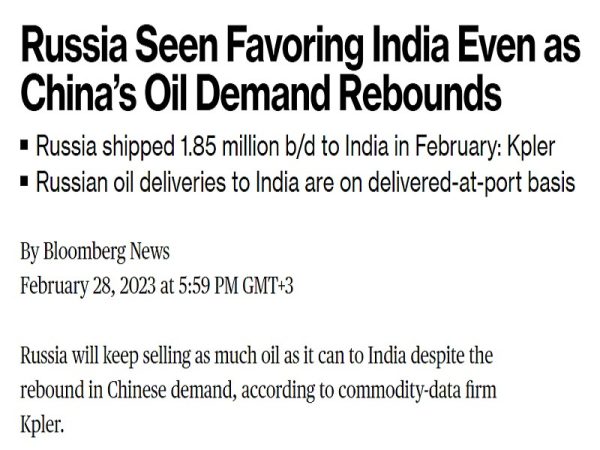
Bloomberg’s points in support of this observation are purely economic and overlook the strategic dimension of Russia’s discounted oil exports to India, which will be explained in the present piece.
Bloomberg published a piece on Tuesday about how “Russia Seen Favoring India Even as China’s Oil Demand Rebounds”, which cites lead crude analyst Viktor Katona from commodity-data firm Kpler. According to him, “While China could ‘buy literally the entire Russian oil exports’ as it abandons Covid-zero policies, Russia will want to keep the Indian market because it is more lucrative and gives its crude sellers greater control.”
Katona is also quoted as adding that “Chinese refiners may want to buy more Russian crude this year, but they also have the capacity to do their own shipping. That would deprive Moscow of income from the ‘parallel gray fleet’ of tankers it has established to deliver crude to India.” While these are all valid points in support of his prediction, they’re purely economic and overlook the strategic dimension of Russia’s discounted oil exports to India, which will now be explained.
First, India’s unprecedentd scaling of Russian oil imports over the past year since the start of the latter’s special operation preemptively averted Moscow’s potentially disproportionate dependence on China and continues to do so into the present.
Second, the Kremlin will never forget the aforementioned strategic favor that India did for Russia at its most sensitive moment in decades, hence why it’s inclined to keep up the pace of its discounted exports to that country as a way of thanking it for this.
Third, the Kremlin is cognizant of the fact that there must be tangible benefits for India in continuing to defy Western pressure upon it to dump Russia, so keeping up the pace of oil exports to it incentivizes India to continue its pragmatic policy of principled neutrality towards the Ukrainian Conflict.
Fourth, their newfound energy relations also served Russia’s grand strategic goal of accelerating India’s rise as a globally significant Great Power.
That last-mentioned outcome advances the global systemic transition’s ongoing evolution towards tripolarity ahead of its final form of more complex multipolarity (“multiplexity”), which serves both of their interests. And finally, the larger dynamics connected to the aforesaid development is that it helps break the Sino-American bi-multipolar superpower duopoly that previously characterized International Relations, thus greatly enhancing Russia and India’s strategic autonomy in the New Cold War.
Altogether, these strategic motivations ensure that Russia won’t increase oil exports to China at the expense of the level at which it’s presently supplying India. Observers should always keep them in mind since they prove that the Russian-Indian Strategic Partnership is premised on their shared goal of accelerating the global systemic transition and not on deriving opportunistic economic benefits like Bloomberg implied is supposedly the case when it comes to their current energy ties.
China reboots ‘no limit’ partnership with Russia
BY M. K. BHADRAKUMAR | INDIAN PUNCHLINE | FEBRUARY 28, 2023
The ‘butterfly effect’ of the visit by the Member of the Political Bureau of the Central Committee of the Communist Party of the People’s Republic of China and Director of the Office of the Foreign Affairs Commission of the CPC Central Committee Wang Yi to Moscow on February 21-22 is already discernible. It can influence a much larger complex system still.
The two sides agreed to consolidate and develop the Russia-China comprehensive strategic partnership of coordination for a new era and to continue to closely coordinate their foreign policy efforts; the Ukraine crisis situation, which is at a tipping point, has further tilted in Russia’s favour; and, Chinese diplomacy on the post-pandemic rebound is signalling aperiodic long-term behaviour that can generate ‘deterministic chaos’ in Eurasia and Asia-Pacific.
Wang Yi had meetings with the Secretary of Russia’s Security Council Nikolai Patrushev — as coordinators of the mechanism of China-Russia Strategic Security Consultation — and with Foreign Minister Sergey Lavrov and President Vladimir Putin.
The Russian readout said that “The parties praised the current state of Russian-Chinese relations, which continue to expand dynamically in the context of sharp changes in the international arena… They underscored the importance of further strengthening close foreign policy coordination… They also reiterated the futility of attempts by third countries to impede the healthy, dynamic progress of Russian-Chinese relations, to restrain the development of our countries through sanctions and other illegitimate means.”
Wang Yi conveyed to Putin that the “Russia-China relationship has stood the test of the drastic changes in the world landscape and become mature and tenacious, standing as firm as Mount Tai… Although crises and chaos often emerge, challenges and opportunities exist at the same time, and this is the dialectics of history.”
He said China is ready to work with Russia “to maintain strategic resolve, deepen political mutual trust, strengthen strategic coordination, expand practical cooperation and defend the legitimate interests of both countries, to play a constructive role in promoting world peace and development.”
Putin expressed “the warmest words of gratitude” to Wang Yi for the booming bilateral trade (which reached US$185 billion last year.) In the conditions under sanctions, for Russia, this is a crucial lifeline. Putin mentioned cooperation in the international arena as particularly important “for stabilising the international situation” and stressed that the Russian side is expecting a visit by President Xi Jinping.
The Ukraine situation figured prominently in Wang Yi’s meting with Lavrov where he dwelt on China’s “vision of the root causes of the Ukraine crisis” and China’s approaches to a political settlement. The Russian readout said Lavrov “commended Beijing’s constructive policy and reaffirmed the high level of proximity of our assessments of this agenda.”
The Chinese readout said Putin and Wang Yi “exchanged in-depth views on the Ukraine issue. Wang Yi appreciated Russia’s reaffirmation of its readiness to solve problems through dialogue and negotiations. China will, as always, uphold an objective and just position and play a constructive role in the political settlement.”
Significantly, a day after Wang Yi returned to Beijing from Moscow, the Foreign Ministry issued a statement titled ‘China’s Position on the Political Settlement of the Ukraine Crisis’. Presumably, Wang Yi sensitised the Russian side beforehand, as the foreign ministry in Moscow lost no time on the same day to effusively compliment “our Chinese friends.”
The Chinese statement, couched in principles of neutrality, distinctly tilted in Russia’s favour. The core issues highlighted by Moscow in its December 2021 proposal for dialogue with the NATO and the US (which the latter ignored) find mention in the Chinese statement.
Significantly, the Chinese statement strongly rejected the unilateral sanctions and maximum pressure by the US and EU against Russia and the West’s “long-arm jurisdiction” against other countries. No wonder, the western capitals have taken a dim view of the Chinese statement and see it as loaded in favour of Russia.
The Chinese statement, issued on the first anniversary of the Russian operations in Ukraine, has factored in that the conflict has existential overtones for Moscow and Russia’s defeat is simply unthinkable as that would fundamentally shift the global strategic balance against China. Interestingly, there is a pointed reference in the Chinese readout on Wang Yi’s talks with Patrushev (Russia’s highest-ranking security official) to the effect that “Both sides believed that peace and stability in the Asia-Pacific region should be firmly defended and that the introduction of the Cold War mentality, bloc antagonism and ideological confrontation should be opposed.”
The Chinese statement on Ukraine followed the release of two major foreign policy documents in Beijing on successive days. The first one dated February 20 is a frontal attack on the US foreign policies, titled ‘US Hegemony and Its Perils’.
The 4,080-word document is a veritable iteration of thoughts and perspectives that are frequently articulated in Putin’s speeches and writings through the past 15-year period since his famous speech at the 2007 Munich Security Conference where the Russian leader spoke on international security problems in a unipolar world characterised by “one type of situation, namely one centre of authority, one centre of force, one centre of decision-making,” a world in which there is “one master, one sovereign.”
The second document issued in Beijing on February 21 is titled ‘The Global Security Initiative Concept Paper’. In 3,580 words, it lays out the guardrails and guiding principles of Chinese foreign policy and stresses the priorities of cooperation in the world community.
Chinese foreign policy is shifting gear. Although the Ukraine crisis and the Taiwan problem cannot be compared, Beijing senses that the weakening of Russia is a vital segment of the US strategy to isolate and confront China, and therefore, the outcome of the conflict in Ukraine is going to be profoundly consequential for China. Indeed, a Russian defeat in Ukraine will constitute a severe setback for China too.
Wang Yi’s visit testifies that China is willing to step up solidarity with Russia at a juncture when any residual hopes of improving ties with the US have been dashed and that relationship is in free fall. Wang Yi’s meeting with Biden last week on the sidelines of the Munich Security Conference did not go well. Meanwhile, the US officials are reportedly confabulating with Taiwan’s foreign minister and National Security Advisor.
President Biden has rejected any mediatory role for China in Ukraine. All things taken into account, the probability is that China may step up its support for Russia. The big question is whether this would take the form of military help. The CIA director William Burns stated last week that “we’re confident that the Chinese leadership is considering the provision of lethal equipment. We also don’t see that a final decision has been made yet, and we don’t see evidence of actual shipments of lethal equipment.”
Yesterday, when asked about US National Security Advisor Jake Sullivan’s warning Sunday that there would be ‘real costs’ for China if it went forward with providing lethal aid to Russia, Foreign Ministry spokesperson Mao Ning did not give a direct answer. “The US is in no position to point fingers at China-Russia relations. We do not accept coercion or pressure from the US,” she said.
Interestingly, the Kremlin spokesman Dmitry Peskov also chose not to answer a related question as to whether Russia had asked China to provide any equipment for its special military operation.
The forthcoming visit by Xi Jinping to Moscow, likely to take place next month, will be a defining moment. There is a palpable sense of disquiet in the West, as China’s manufacturing capability exceeds that of the US and Europe combined. Russia is deferring the big offensive in Ukraine, pending Xi’s visit.
German lawmakers demand Nord Stream explosion investigation
By Uriel Araujo | February 28, 2023
German Chancellor Olaf Scholz will fly to the US to meet President Joe Biden on March 3. According to the White House’s press secretary Karine Jean-Pierre, the visit is an opportunity to “reaffirm the deep bonds of friendship” between the two NATO allies. One could, however, describe such a friendship as quite a peculiar one. In fact, more often than not, it looks much more like a veiled enmity.
For one thing, Pulitzer Prize-winning journalist Seymour Hersh’s 8 February piece has denounced the Nord Stream pipelines’ explosion as a sabotage act clandestinely carried out by Washington. In fact, on February 7, Biden himself, during a press briefing, promised: “If Russia invades (…) there will be no longer a Nord Stream 2. We will bring an end to it.” When asked just how, his reply, with a smile, was: “I promise we will be able to do it.” Scholz was right next to him. This astonishing statement echoed Undersecretary of State for Policy Victoria Nuland’s own remarks just two days earlier – it is no wonder that many suspected American involvement in the still unexplained explosion.
In the aforementioned piece, respected journalist Hersh quotes unnamed intelligent sources who claim the US did fulfill its promise/threat by planting the explosives while using the June 2022 Baltic Operations (BALTOPS 22) exercise as a cover. So far, Hungary’s Minister of Foreign Relations Peter Szijjarto has been a lone voice in calling the episode a terrorist attack and calling for an investigation.
Nord Stream 1, as two of the pipelines were collectively known, had been providing cheap gas to Germany for over a decade, something which Washington always opposed; Nord Stream 2 pipelines in turn could double the amount of such cheap gas provided. The explosion harmed all of Europe and the UK, bringing back the ghost of a new depression – but mainly Germany. I have written on how the European energy crisis has served US interests well and hurt European industry as well as on how economic nationalism is once again on the rise, especially today when Europe and, particularly Germany, is facing de-industrialization. I have also written on how American aggressive subsidy war against Europe, in the form of the Inflation Reduction Act, only adds fuel to the fire and risks dividing the political West. In post-Nord Stream Europe, gas prices are to remain high, condemning the continent to inflation, while American interests profit from making the conflict in Ukraine perpetual.
When it comes to Russia, Ukraine and Europe, Washington’s geopolitical and geoeconomic interests are intertwined. The tragedy of the European continent lies in the paradox that it is still heavily dependent on Washington for security, while it would benefit from energy cooperation with neighboring giant Russia. Washington has been consistently betraying European interests to its own benefit, and Germany is the clearest instance of that contradiction.
Berlin could be an industrial power, but Washington’s long campaign against Nord Stream, among other things, has hampered its potential and now its auto industry is particularly vulnerable to the US IRA legislation, which has created new barriers for European electric vehicles. On top of that, Washington has been pressuring Germany to further spend on Ukraine, while German Armed Forces face shortages.
Despite Berlin’s silence regarding the attack on its strategic infrastructure, in the wake of the explosion, both far-left and far-right lawmakers from the Die Linke and the Alternative für Deutschland (AfD) political parties, respectively, were calling for the setting up of investigative committees. AfD’s Co-Chairman Tino Chrupalla has demanded the government coalition clarify the matter. In his speech he rhetorically asked whether the NATO alliance “guarantees security in Europe or rather endangers it”. In an interesting development, the leftist Die Linke expressed its solidarity with the rightist AfD on this matter.
European “populists” and the far-right have been capitalizing the growing popular discontent with NATO and the EU itself. In April 2022, defeated French Presidential candidate Marine Le Pen promised to pull France out of NATO, following Charles de Gaulle steps. Regarding the disastrous anti-Russian sanctions (which have backfired against Europe), Viktor Orban’s Hungary has been a kind of lone voice. One should however expect to see a multiplication of such voices, be it from the far-left or from the far-right.
Although often described as an “extreme” and marginal party, the AfD has been growing in popularity in Germany, reaching 17% in a poll for the first time in years, according to a YouGov February poll. It is about time for Europe to assert its sovereignty, and Berlin and France could lead the way in this regard. Calls for investigation regarding the Nord Stream’s sabotage in fact might be gaining traction among wider portions of German society.
In his 2020 book, Udo Ulfkotte, a former editor for German mass daily newspaper Frankfurter Allgemeine Zeitung, denounced how the German Federal Intelligence Agency (BND) has cooperated with the US Central Intelligence Agency (CIA) to recruit German journalists and shape public opinion. This could partly explain the overall silence amongst German media on the Nord Stream issue.
As long as the traditional media keeps covering up the topic, one should expect trust in the press to decrease and support for far-right and far-left parties to grow, with potential electoral results in the near future. Such a political wave can increase skepticism about NATO, but before it could advance any rethinking of the European relationship with the Atlantic Alliance (as proposed by Le Pen), it may first cause instability and turmoil in a continent already isolated and deindustrialized. In Germany, right now only Die Linke has supported AfD calls for an investigation, but more voices within the German broader political spectrum are expected to join them.
How Scotland pays back for Malawi (non existent) climate damage
By Paul Homewood | Not A Lot Of People Know That | February 26, 2023
Today’s climate disinformation from the BBC:

Scotland is one of the first countries in the world to stump up cash for “loss and damage” caused by climate change in poorer countries.
When torrential rains came to the village of Mambundungu in Malawi, people’s homes were washed away but that was not the worst of it.
The flood waters were infested with crocodiles. Children were carried away by them. It was terrifying.
Eventually, in 2015, the villagers couldn’t take any more and moved their entire community to higher ground.
Then the new village began to flood too.
Malawi in southern Africa has been hard hit by the effects of climate change
But it is one of the poorest countries in the world and struggles to pay for the measures needed repair the damage.
That’s where the Scottish government has stepped in, promoting the notion that rich nations should help pay for the damage from climate change in less developed countries.
https://www.bbc.co.uk/news/uk-scotland-64501975
There is naturally no evidence provided of just how these floods are caused by climate change. (Well this is the BBC – what do you expect?)
And if you look at the three long running weather stations in Malawi, no evidence exists that daily rainfall extremes are increasing:


https://climexp.knmi.nl/getstations.cgi
So why do these floods appear to be getting worse? There is a very simple reason – deforestation.
According to the BBC themselves:

https://www.bbc.com/future/article/20210420-the-underappreciated-power-of-human-poo
As we know, deforestation leads to increased rainfall runoff, siltation and floods down valley.
The World Resources Institute studied the problem in 2017, writing:
Nearly a year ago, the New York Times ran a devastating story about the deforestation crisis in Malawi and its impact on residents of Lilongwe, Malawi’s capital city. Illegal cutting of nearby forests was causing water shortages and disrupting the city’s hydroelectric power supply, forcing the government to deploy soldiers to protect the forests. The root of this problem was Malawi’s dependence on wood for meeting energy needs―more specifically, charcoal. Nearly 97 percent of Malawian households depend on wood or charcoal for cooking or heating. Even in urban areas, 54 percent of households use charcoal (a product of wood) for cooking. But there are only so many trees.
Malawi is one of the poorest countries in Africa, where electricity is an uncommon luxury and subsistence farming is the norm. With seemingly few options and climate change adding uncertainty, the situation depicted in the New York Times article seemed hopeless.
https://www.wri.org/insights/malawi-turns-corner-solving-its-deforestation-crisis
Instead of blubbering on about climate change, maybe the Scottish government should be helping Malawi to build a reliable electricity grid, based on fossil fuels.
African Nations Reportedly Boost Russian Oil Imports Amid EU Sanctions
By Maria Konokhova – Sputnik – 27.02.2023
Following the onset of Russia’s special military operation in Ukraine, the US-led West embarked on a crusade aimed at isolating the country by sanctioning its economy and political establishment. Among other things, Western sanctions have targeted Russian hydrocarbons.
In recent months, North African countries have ratcheted up imports of diesel and other refined petroleum products from Russia, as the latter is now cut off from the European market, the Wall Street Journal has reported.
The European Union bloc has imposed a ban on the purchase and import of seaborne Russian crude oil starting from December. Moreover, EU member states, which accounted for about 60% of Russian exports of refined petroleum products before the start of the hostilities in Ukraine, have recently reduced these flows.
This month, a EU ban on imports of refined petroleum products from Russia, including diesel and jet fuel, came into effect.
African Countries Step Up to the Plate
According to the newspaper, the barrage of sanctions has forced Moscow to pursue new partnerships and redirect exports away from Europe to alternative markets. It was noted that against this backdrop, North African countries “picked up the slack,” increasing imports from Russia.
The report drew several examples that advocate this notion, citing data from Kpler, a data and analytics company.
First, Tunisia, which had imported almost no Russian petroleum products in 2021, has recently started to receive supplies of diesel, gasoil, gasoline and naphtha from Russia. In January, the country acquired 2.8 million barrels of Russian oil products. This month, it was emphasized that Tunisia was going to import another 3.1 million barrels from Russia.
Along with Tunisia, another North African country, mentioned by the newspaper, significantly enhanced cooperation with Moscow in this field. In 2021, Moroccan imports of Russian diesel stood at around 600,000 barrels. However, this figure swelled to 2 million barrels last month. In February, Morocco is expected to import 1.2 million barrels. It was also noted with no specific details that Algeria and Egypt boosted their imports of Russian oil products as well.
Frustrating Western Efforts to Shun Russian Oil
The newspaper noted that the increase in Tunisia’s and Morocco’s imports from Russia coincided with that of their own exports of refined products to the global market. Therefore, it was assumed, Russian hydrocarbons could be mixed with other petroleum products and re-exported to other countries, including European ones.
The US-based paper stated that this process disguises the ultimate origin of the products and, therefore, undermines Western efforts aimed at cutting off Russian fossil fuels from their economies, and frustrates efforts to end their energy dependence on Russia and limit Moscow’s sources of funds. The newspaper concluded, citing analysts, that if this trend continues, depriving Moscow of revenue would be difficult.
According to the International Energy Agency, Russian oil exports increased to 8.2 mb/d last month ahead of the EU embargo and the G7 price cap on refined products taking effect. The refined-product exports “held steady.” Meanwhile, Moscow’s export revenues were estimated at $13 billiion.
Showdown in Ukraine
Hobbled US Turns to War to Preserve its Waning Primacy
BY MIKE WHITNEY • UNZ REVIEW • FEBRUARY 26, 2023
The future of humanity will be decided on a battlefield in Ukraine. That’s no exaggeration. The conflict between the United States and Russia will determine whether global economic integration will expand within an evolving multi-polar system or if the “rules-based order” will succeed in crushing any opponent to its Western-centric model. This is what’s taking place in Ukraine today, in fact, all of the recent government-prepared documents related to national security identify Russia and China as the greatest threats to US hegemony. For example, take a look at this brief clip from the 2021 Congressional Research Service Report titled Renewed Great Power Competition: Implications for Defense—Issues for Congress:
The U.S. goal of preventing the emergence of regional hegemons in Eurasia… is a policy choice reflecting two judgments: (1) that given the amount of people, resources, and economic activity in Eurasia, a regional hegemon in Eurasia would represent a concentration of power large enough to be able to threaten vital U.S. interests….
From a U.S. perspective on grand strategy and geopolitics, it can be noted that most of the world’s people, resources, and economic activity are located not in the Western Hemisphere, but in the other hemisphere, particularly Eurasia. In response to this basic feature of world geography, U.S. policymakers for the last several decades have chosen to pursue, as a key element of U.S. national strategy, a goal of preventing the emergence of regional hegemons in Eurasia.” (“Renewed Great Power Competition: Implications for Defense—Issues for Congress”, US Congress)
That sums up US foreign policy in a nutshell; “prevent the emergence of a regional hegemon” at all cost. Now check out this summary of the 2022 US National Defense Strategy by Andre Damon at the World Socialist Web Site :
These documents, which were not seriously discussed in the US media, make clear the fundamental falsehood that the massive US military buildup this year is a response to “Russian aggression.” In reality, in the thinking of the White House and Pentagon war planners, the massive increases in military spending and plans for war with China are created by “dramatic changes in geopolitics, technology, economics, and our environment.”
These documents make clear that the United States sees the economic rise of China as an existential threat, to be responded to with the threat of military force. The United States sees the subjugation of Russia as a critical stepping stone toward the conflict with China.” (“Pentagon national strategy document targets China”, Andre Damon, World Socialist Web Site )
These two excerpts are by no means a comprehensive summary of US foreign policy objectives, but they are a pretty effective thumbnail sketch. Bottom line: The war in Ukraine is not about Ukraine. America’s clearly articulated strategic objectives are as follows: To weaken Russia, topple its leader, take control of its vast natural resources and move on to containing China. Simply put, Washington’s escalating aggression in Ukraine is a Hail Mary pass aimed at containing emerging centers of economic power in order to preserve its waning position in the global order.
This is the geopolitical chess match that is being played behind the cover of “a war against Russia’s unprovoked aggression.” People should not be hoodwinked by that absurd deception. This war was concocted as a desperate attempt for the United States to defend its flickering global hegemony. That’s what Ukraine is really all about. It’s a clash between the warmongering western oligarchs who have a stranglehold on the US media and political establishment and the emerging economies that are using the market system to link their resources and manufactured goods to countries around the world through “high-speed” infrastructure and cooperative development.
So, the question everyone must ask themselves is this: Do you want to see more economic integration, lower prices, more shared prosperity and less war or another 80 years of onerous and arbitrary sanctions, color-coded revolutions, regime change operations, genocidal interventions and bioweapon warfare (Covid-19)? Which do you want?
Perhaps, you are one of the millions of Americans who believe that China is an enemy of the United States. Perhaps, you are also unaware of the role the US played in creating modern China. Here’s a question for you: Did the US and western corporations move their operations en masse to China to escape the high costs of production in the US?
answer– Yes, they did.
And, did they betray US workers because they didn’t want a fair wage to interfere with their excessive profit-making?
answer– Yep.
And, did they offshore their businesses, outsource their product manufacturing and do everything in their power to make themselves winners while robbing American workers of the opportunity of making a decent wage so they could put food on the table?
answer– They sure did.
Then who is actually responsible for the rise of China?
answer– Western corporations are responsible. If Americans want to blame someone, blame them!
But now the corporate mandarins and other elites are unhappy with China because China will not allow them to take control over their markets, financial system and currency as they have in America. So now these same cutthroat corporations want us to fight a war with the monster that they created?
Can you see that? Can you see that the relentless provocations against China have nothing to do with US national security or US interests. We are being led by the nose to fight and die for the cadres of voracious western oligarchs who have settled on China as the next target of their grand looting operation.
But let’s forget the past for a minute and focus on the future, after all, that’s what really matters, right?
Well then, which country has a more “positive vision” for the future: China or the United States?
Have you ever heard of China’s Belt and Road Initiative, the massive, multi trillion-dollar infrastructure plan that is the centerpiece of China’s foreign policy? It is the biggest infrastructure program in history and more 150 countries have invested in the plan already. It is a development-oriented project aimed at increasing connectivity through high-speed rail, shipping lanes and ports, skyscrapers, railroads, roads, bridges, airports, dams, power stations, and railroad tunnels. By increasing the speed of travel, China’s products and merchandise will get to markets faster generating greater prosperity for itself and for the other countries involved. And, keep in mind, the BRI will link countries around the world in a high-speed system that will not require its participants to follow a specific economic model dictated by Beijing. In other words, the Belt and Road Initiative is free market economics without the politics. It’s a “win-win” situation for everyone, a guarantee of mutual prosperity absent political manipulation, coercion or exploitation.

The venal oligarchs that run the US can’t even imagine a project of this scale or potential. In fact, they can’t even pony-up enough money to keep the trains on the rails in America. The profits these billionaire parasites extract from their activities invariably come from stock buybacks, tax evasion, and other sleight-of-hand, debt-layering ponzi-scams that benefit no one and merely shift more of the nation’s wealth into their own bulging bank accounts. Of course, ripping off the country would be bad enough, but now we see how this same class of miscreants have settled on public health as a means for amplifying their political power so they can impose repressive, police-state measures that greatly curtail the freedom of the entire population. In short, they want absolute social control and they aren’t going to let-up until they get it.
Where is the “positive vision” in this behavior?
There isn’t one. America used to be a country of ideas, ideals and vision. Now it is an oligarch-run detension center in which all hope for the future has been ruthlessly extinguished by a handful of mercenary billionaires.
At least, in the case of China, we can imagine a better, more prosperous world that is interconnected and more accessible to everyone. But what about the United States? Are we supposed to believe that fighting a war in eastern Europe is going to improve our lives? Are we supposed to believe that the only way “we can stay on top” is by pushing everyone else down? Are we expected to hate China and Russia even while our own government demonizes 80 million of us for voting for the wrong presidential candidate or for not supporting the terrorists who burn and loot our cities or for believing that the people in East Palestine are more deserving of our support and assistance than the Nazi stormtroopers in Kiev?
The fact is, our leaders cannot imagine devoting public resources to a giant interconnected infrastructure project like BRI, because that would mean less lucre for themselves. So, they’ve decided to destroy it just like they destroyed Nord Stream. Just read the press reviews on this groundbreaking project. Western journalists can’t find a ‘good word’ to say about it. A vast area in the center of America was fiendishly nuked with vinyl chloride, butyl acrylate and isobutylene, but the western media would rather criticize China’s ambitious BRI project than hold their paymasters accountable. Go figure.
The same rule applies to Russia. The Biden team and their wealthy allies don’t want closer relations between Germany and Russia because closer relations mean more prosperity for both countries, and Washington can’t have that, which is why they blew up the pipeline that was Germany’s lifeline to cheap fuel. That’s how Washington solved the problem. It pushed Germany and Russia down so the US could remain on top. Who doesn’t see this?
In contrast, the Belt and Road Initiative provides a positive vision for the future, which is an idea that the majority of the world supports. It puts us on a path to an interconnected world in which people can raise their standards of living, make a meaningful contribution to their communities, and enjoy their own culture and traditions without fear of being sanctioned, incarcerated or bombed to death. This is an excerpt from China’s Global Times :
The China-proposed Belt and Road Initiative (BRI) has already become a well-received international public good and an important platform for international cooperation…
“BRI transcends the outdated mentality of geopolitical games, and created a new model of international cooperation. It is not an exclusive group that excludes other participants but an open and inclusive cooperation platform. It is not just China’s solo effort, but a symphony performed by all participating countries….
Since the Belt and Road Initiative (BRI) was proposed in 2013, the initiative has always been development-oriented, and consistent efforts have been made to ensure that it is high-standard, sustainable and people-centered….
By August, China’s goods trade with countries participating in the BRI had reached around $12 trillion and the country’s non-financial direct investment in those countries surpassed $140 billion. … By the end of 2021, Chinese enterprises had invested $43 billion in the construction of economic and trade cooperation zones in BRI countries, creating more than 340,000 local jobs, official data showed…
China is open to other countries’ and regions’ participation in the BRI and is considering connecting with infrastructure initiatives proposed by other nations to provide more good-quality public goods for the world…. China hopes to join hands with all partners to advance the high-quality development … stressing that China aims to strive for global connection rather than fragmentation, for mutual opening-up rather than shutting doors, for mutual integration rather than zero-sum games. (“BRI remains open, inclusive for all, transcends the outdated mentality of geopolitical games“, Global Times )
What is the American-led project that rivals the Belt and Road Initiative?
There isn’t one. The US allocates over $1 trillion per year for lethal weaponry and war-making, and trillions more to bail out the Wall Street banksters, and trillions more to shut down all the businesses across the country that were forced to comply with the diktats of billionaire elites who wanted to inject the population with their toxic slurry, but zero for any global infrastructure project that would peacefully bring the world’s people closer together through commerce and recreation.
No one is saying that China is perfect, at least, I’m not. Nor do I want to live in China. I don’t. I’m an American and I plan to die here.
But I’m not blind. It’s easy to see that this war with Russia has nothing to do with “unprovoked aggression.” That is merely a smokescreen that’s being used to conceal the real objective, which is to preserve America’s global hegemony. What we need to do now, is honestly analyze ‘what is happening’; try to understand ‘why it is happening’, and, then, figure out what the outcome will be if the United States prevails. In other words, do we want to perpetuate an oligarch-controlled system that crushes Russia, contains China, starves Europe of the energy it needs, sabotages the Belt and Road infrastructure plan and reinforces the same failed policies that brought us Afghanistan, Libya, Syria and Iraq?
Do we want that? Do YOU want that?
The American people want their government to cooperate with other nations in order to create a more prosperous and peaceful world. They don’t want a new world order and they certainly don’t want a Third World War.
Putin reveals Moscow’s main issue with US
RT | February 26, 2023
Moscow is striving to create a multipolar world rather than one that is centered around the US, Russian President Vladimir Putin has said. In an interview with Rossiya-1 TV channel on Sunday, he argued that Washington was trying to mold the world exclusively to fit its own agenda.
Putin suggested that America’s “satellite states” are also well aware of these “egoistic” intentions. However, for the time being, they have chosen to turn a blind eye to this due to “various reasons connected first and foremost with huge dependence in the economic sphere and defense,” the Russian leader said.
Some of Washington’s allies also see confrontation with Russia as a unifying cause, eclipsing any differences between them and the US, he added.
As an example, Putin cited the US government’s efforts to attract European businesses to American soil, as well as a submarine deal last summer, which saw Canberra abruptly exit a contract with a French manufacturer in favor of a US competitor. That incident was humiliating for Paris, the president said.
Putin emphasized that Moscow “cannot and will not behave like this.”
“In the end, such a stance – the fight for a multipolar world, for respect for each and everyone in the international arena, for taking into account everyone’s interests – I don’t have the slightest doubt, will prevail.”
Putin also claimed that Western elites will only be satisfied and prepared to “admit us into the so-called family of civilized nations” if Russia disintegrates into several independent states. In such a scenario, he said, the West would “place [the resulting countries] under its control.” He added that the disintegration of Russia in such circumstances would call into question the existence of the Russian people in its current form.
Commenting on his decision earlier this week to suspend Russia’s participation in the New START Treaty – the last remaining nuclear accord between Moscow and Washington – Putin argued that the move was required to safeguard Russia’s security as well as its “strategic stability.”
According to the Russian president, he opted for this course of action in light of a more aggressive NATO, which “has announced as its prime goal” Russia’s strategic defeat.
In a US-China confrontation, West Asia will bow out
By F.M. Shakil | The Cradle | February 24 2023
The prospect of a US-China war has entered the realm of reality. Increased provocations from US military and political officials regarding the status of Taiwan – which China considers to be part of its historic territory – have heightened the possibility of confrontation in recent years.
With only 13 out of 193 UN member states recognizing the government in Taipei as a separate entity, the global community’s reaction to a Washington-led assault over Taiwan’s status remains highly uncertain.
Today, the reaction of strategic West Asia to a hypothetical conflict between the two superpowers is up for grabs. However, given the region’s reluctance to take sides in the Russian-US stand off, it is likely to be equally hesitant to do so in the event of a US-China conflict.
In a memo released on 27 January, US General Mike Minihan, chief of the Air Mobility Command, wrote: “My instinct tells me we will fight in 2025.” General Minihan’s views align with Taiwanese Minister of National Defense Chiu Kuo-cheng’s statement in 2021 that China will be capable of launching a full-scale invasion of Taiwan by the same year.
In response to General Minihan’s remarks, Mike McCaul, chairman of the US House Representatives’ Foreign Affairs Committee, told Fox News: “I hope he is mistaken but I believe he is correct.” Adding fuel to the fire, US Senate Majority Leader Mitch McConnell said on 29 January, “The chances of conflict in the relationship with China over Taiwan are very high.”
A lot of hot air
Days after the US general issued a warning that Washington may engage in combat with Beijing in the next two years, tensions between the two countries were further exacerbated by the spoof-worthy Chinese spy balloon incident.
According to some senior Republicans and US military leaders, there is a growing concern that a full-scale conflict between the two superpowers is imminent, with the Asia-Pacific (AP) and South Asia (SA) regions likely to be the primary theaters of the conflict.
Jan Achakzai, a geopolitical analyst and former adviser to Pakistan’s Balochistan government, tells The Cradle that:
“The possibility of a war between the United States and China puts everyone on edge, especially the regions that are intricately linked with the US or China. Some nations will be compelled to choose between allying with the US in the case of war or keeping the status quo to lessen the possibility of hostilities.”
Russian involvement in West Asia
Despite nominal trade and geopolitical relations with Moscow, West Asian countries did not support Washington’s position in the conflict between Russia and Ukraine. However, Russia’s veto power at the UN Security Council does have a positive impact on its relationship with regional states, particularly for its ability to prevent expansionist and anti-Arab policies by other permanent council members.
Security and trade remain the two primary pillars of the relationship between Moscow and West Asia, and Russian President Vladimir Putin’s image has played a significant role in shaping these ties.
The UAE serves as a major financial hub for Russia, and Moscow may attempt to leverage its influence in the region to urge the UAE to reconsider US-imposed banking restrictions, if it feels that its interests are being compromised.
In addition, Algeria, Tunisia, Libya, Lebanon, and Egypt are among the countries that purchase wheat from Russia, which further solidifies economic ties between Russia and the Arab world.
Moreover, since joining the expanded Organization of the Petroleum Exporting Countries (OPEC+) in 2016, Russia and Saudi Arabia have worked closely to regulate oil output and price adjustments as part of OPEC+ agreements.
Putin’s public image has, in part, contributed to a surge in support for Russia in the kingdom. In 2018, when Riyadh faced international criticism over the Saudi-orchestrated murder of journalist Jamal Khashoggi, the Russian president made headlines by high-fiving and grinning at the then-isolated Saudi Crown Prince Mohammed bin Salman (MbS) during the G20 summit in Argentina.
Likewise, his prominent role in thwarting the NATO proxy war in Syria – a geopolitical game changer that, arguably, ushered in global multipolarity – has gained Putin fans across a region that has long suffered from western imperialist designs.
Where will West Asia stand?
Although still a hypothetical scenario, it is worth considering how West Asia would respond to a direct US-China conflict. Many prominent geopolitical analysts have speculated that if West Asia, and particularly the traditionally pro-US Arab states of the Persian Gulf, did not toe the US line against Russia – a significantly smaller regional trading partner than China – its loyalties to Washington in a potential US-China confrontation could be further strained.
Compared to Russia, China has significantly larger investments throughout West Asia. In 2021, bilateral trade between Beijing and the region amounted to $330 billion, with approximately 50 percent of China’s energy supply coming from the energy-abundant Persian Gulf.
China has conducted over $200 billion in trade alone with Saudi Arabia and the UAE. From 2005 to 2021, Beijing invested $43.47 billion in Saudi Arabia, $36.16 billion in the UAE, $30.05 billion in Iraq, $11.75 billion in Kuwait, $7.8 billion in Qatar, $6.62 billion in Oman, and $1.4 billion in Bahrain.
In addition to its investments in trade and energy, China has also invested enormous sums of money in West Asian and North African infrastructure and high-tech development projects via its multi-trillion dollar Belt and Road Initiative (BRI).
Beijing has entered into strategic cooperation agreements with Saudi Arabia, the UAE, Algeria, Egypt, and Iran, and has enlisted a total of 21 Arab nations in its ambitious, decade-long effort to revive the historic Silk Road and export its goods to markets throughout Europe and Africa. Currently, infrastructure developed by Persian Gulf nations serves as a transit point for two-thirds of Chinese exports to these continents.
Egypt is a crucial hub for the BRI, with the Economic-Technological Development Area in Egypt’s Suez Canal Economic Zone, near Ain Sokhna, representing one of the major projects for which the two nations signed contracts totaling $18 billion in 2018.
Iraq, the third-largest oil supplier to China after Saudi Arabia and Russia, has also received $10.5 billion from Beijing for BRI-related energy projects, and just this week, agreed to replace its dollar trade with Beijing for the Chinese yuan.
In West Asia, the US plays second fiddle to Beijing
Chinese collaboration with West Asia and North Africa is not confined to trade and economy; Beijing also provides defense equipment to several Arab nations. Since 2019, China and Saudi Arabia have reportedly collaborated on the production of ballistic missiles, and China also sells Saudi Arabia its HQ-17AE air defense system.
Chinese Wing Loong drones have been purchased by the UAE, and Iraq has placed an order for CH-4B drones. Jordan purchased CH-4Bs in 2016, while Algeria acquired CH-5s – the next generation of the CH-4B type – to expand its aviation capabilities in 2022. In addition, Saudi Advanced Communications and Electronics Systems Co. and China Electronics Technology Group are partnering to build a drone factory for local UAV production.
While US President Joe Biden’s administration’s relationship with Riyadh has been strained due to disagreements over human rights and energy policy, China is making significant strides in strengthening its ties with the country.
As Beijing draws closer to Saudi Arabia, the message to Washington from Riyadh is unambiguous: “The people in the Middle East [West Asia] are tired of other countries’ interference because they always come with troubles.”
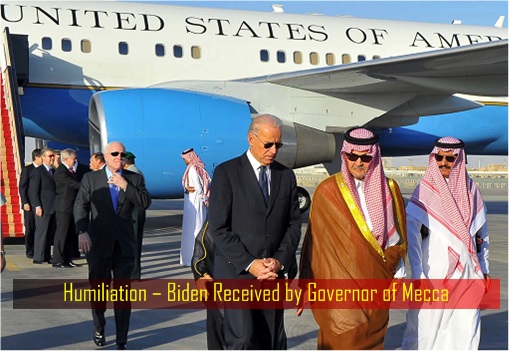
Chinese President Xi Jinping received a royal welcome in Riyadh last December, marking a seismic shift in Sino-Arab relations and boosting China’s image throughout the Arab world. In contrast, US President Joe Biden’s visit to Jeddah in the summer of 2022 received a lukewarm reception. This may suggest that a recalibration of West Asian geopolitical alliances may be on the horizon.
Despite these trends, analyst Achakzai tells The Cradle that West Asia will behave similarly to the way it did during the Russian-Ukrainian conflict – even given China’s increasing business and military presence in the region and the US’s declining control over the oil-rich Arab monarchies.
“Depending on the current situation, the motives of the various states in the region may change and divide into two distinct groups: those who would support the US and those who would support a neutral position.”
China values economy over war
In the Asia-Pacific region, the US and its allies are engaged in a contentious relationship with China regarding maritime boundaries, international trade, human rights, and strategic security issues. Despite signing numerous security pacts with regional players, China appears to prioritize building and strengthening economic ties over military cooperation with Asian-Pacific states.
Due to a history of hostile confrontations and divergent geopolitical objectives, both the US and China seek to increase their military presence in the region. In response to China’s territorial claims in the South China Sea, the US has expanded its military footprint by signing commercial and defense agreements with the Asia-Pacific region.
The two nations have also been at odds over the Trans-Pacific Partnership (TPP), which many viewed as an effort to contain China’s economic and strategic influence in its own backyard. Additionally, tensions have escalated between Beijing and its neighbors, particularly over territorial disputes in the East and South China Seas.
These efforts have been emboldened by the 5-member Quadrilateral Security Dialogue (Quad), which is an informal strategic dialogue between the US, India, Japan, and Australia that seeks “to promote a free, open, and prosperous Indo-Pacific region.” According to Achakzai:
“Countries that have extensive defense agreements with the US, such as Japan, South Korea, and Australia, are most likely to help America. These nations, which have long benefited from their close connections to the US, must now contend with Chinese territorial ambitions in the region and the South China Sea. The nations having an informal security partnership with the US, such as the Philippines, are likely to back the United States in a confrontation.”
The analyst explained that Singapore, Thailand, and Malaysia are expected to remain neutral during the conflict due to their strong business and investment ties with China.
“Other countries in the Asia-Pacific region may feel obligated to support the US if China initiates the conflict. This may apply to countries like Indonesia and Vietnam, which have recently been under Chinese pressure and may need to choose a side to protect their own security,” he noted.
Why Western Sanctions Against Russia Failed
By Simes Dimitri – Sputnik – February 24, 2023
Sanctions were meant to deliver a swift and devastating blow to the Russian economy, one that would take years to recover from. Much to the dismay of Western politicians, however, not only did Russia survive the sanctions storm, but it has the potential to emerge even stronger than before.
During a speech in Poland last year, US President Joe Biden boasted that sanctions had reduced the Russian ruble to “rubble” and confidently predicted that the Russian economy was on “track to be cut in half.” French Finance Minister Bruno Le Maire went even further, declaring that the West would bring about Russia’s economic “collapse.”
“We are waging total economic and financial war on Russia,” he told a French broadcaster last March. “The economic and financial balance of power is totally in favor of the European Union, which is in the process of discovering its own economic power.”
Despite these loud promises, the Russian economy contracted by a mere 2.5 % last year – a decline considerably smaller than those experienced during the 1998 financial crisis (5.3%) and the 2008 Great Recession (7.9%). In a report published last month, the International Monetary Fund forecast that Russian economic growth would outpace that of Germany and the United Kingdom in 2023.
Nor did sanctions succeed in turning Russia into a global pariah. A recent report by the University of St.Gallen in Switzerland found that only 8.5% of European and G7 companies had divested from Russia between February and November 2022. At the same time, Russia’s trade turnover with non-Western economic powers such as China, India, Turkey, and Indonesia soared.
Earlier this month, EU foreign policy chief Josep Borrell was forced to admit that the West’s sanctions strategy was not going according to plan. “It is true that the Russian economy has not collapsed and that the GDP is not what has been forecast, and it is true that last year it got extraordinarily high revenues that came from oil and gas,” he said during a speech at the European Parliament plenary session.
How was Russia able to overcome an unprecedented sanctions blitzkrieg? To answer that question, Sputnik News spoke with economists and Russian businesspeople in industries ranging from agriculture to information technologies. They told us that Western sanctions were headed for failure from the very beginning because they were built on a distorted view of the Russian economy.
Our interlocutors emphasized that although sanctions undoubtedly created economic challenges for Russia in the short and medium term, they also presented a powerful opportunity to revive domestic industry and scientific potential, as well as establish new partnerships with Asian, Middle Eastern, Latin American, and African economies.
Failed Strategy
In the weeks and months following the start of Russia’s special military operation in Ukraine, the US and the EU rolled out some of the most expansive sanctions packages in recent memory. Western governments pressured the SWIFT global payment system into expelling several of Russia’s largest banks, barred Russian ships and airplanes from entering their ports and airspace, and imposed export controls aimed at restricting Russia’s access to various advanced technologies and key production components.
Although this sanctions barrage initially caused the Russian ruble to dip in value and inflation to spike, the shock-effect proved to be short lived. Within weeks, the ruble recovered all of its pre-conflict value and then some. Likewise, inflation reached a peak rate of 17.8% in April 2022 and then began to steadily decline, hitting 11.8% in January 2023 (a rate less than many countries in central and eastern Europe). Contrary to the expectations of many Western economists, Russia’s unemployment rate not only did not increase, but actually hit a post-Soviet record low of 3.7% in December 2022.
Despite the new financial and logistical restrictions against Russian exporters, foreign trade contacts also remained strong. Russia’s current account surplus – which measures the difference between a country’s trade outflows and inflows – reached a record high of $227.4 billion last year, an 86% increase from 2021.
Why did such unprecedented sanctions deliver such unimpressive results? Jacques Sapir, an economist at the Paris-based School for Advanced Studies in the Social Sciences, told Sputnik that the main reason was because they were based on false premises about the size and resilience of the Russian economy. A large part of the problem, he explained, was that American and European policymakers were looking at the wrong statistics.
The main metric used in the West to measure the Russian economy is nominal gross domestic product (GDP), which is calculated by simply converting its value in rubles into US dollars. Sapir argued that nominal GDP underestimated the strength of the Russian economy because it failed to account for purchasing power parity (PPP), which adjusts for differences in costs across countries. He noted that whereas Russia’s nominal GDP was comparable to Spain’s, its GDP based on PPP was roughly the same level as Germany’s.
Another key factor was the fact that the Russian economy was far less based on services than its Western counterparts. Sapir explained that although services could serve as an important source of economic growth during peacetime, they inevitably took a backseat to the manufacturing and commodities sectors during times of geopolitical turmoil. He noted that Russia still maintained a sizable industrial base and was a leading global supplier of natural gas, oil, rare earth metals, and agricultural products.
“Russia has a very specific place in the world markets and, therefore, attempting to isolate such a country would inevitably lead to an international economic catastrophe,” he said. “Unsurprisingly, a lot of countries would never agree to join efforts aimed at isolating Russia because they need trade with Russia.”
Sapir also said that the West underestimated Russia’s ability to find alternative suppliers for various types of machinery and key components used in production. He noted that although Russian imports fell substantially during the second quarter of 2022, they rebounded during the third and fourth quarters. “Russia is now importing more or less the same quantity of products that it was importing by the end of 2021,” he said.
This relatively quick recovery was due to Russia reorienting its trade flows from Europe to Asia, especially China, Sapir explained. Another important factor was that Russian companies had become fairly adept at circumventing Western sanctions with the help of counterparts in third-party countries. As a result, many European and American goods were still finding their way into the Russian market.
Rebirth of Industry
Sanctions have the potential to become a blessing in disguise for Russia, according to Konstantin Babkin, president of the Rostelmash, one of Russia’s largest agricultural equipment manufacturers.
Decades of economic integration with the West had caused Russia to sacrifice some of the industrial potential it inherited from the Soviet Union, Babkin argued. Instead of manufacturing airplanes and trucks from start to finish as it once did, Russia began to import such complex machinery from the West.
The Western sanctions imposed last year have created an urgent need for Russia to rebuild its industrial base. During a speech before the Federal Assembly on Tuesday, President Vladimir Putin declared that Russia needed to reorient its economy from selling raw materials to the West to developing its own advanced technologies and equipment.
Babkin told Sputnik that Russia possessed all the necessary conditions to support an industrial revival — immense natural resource wealth, vast swathes of available land, a market of 150 million people, and strong scientific institutions capable of training the next generation of innovators.
The main thing needed to translate Russia’s economic potential into reality is strong government support for domestic manufacturers, he said. Some of the policy measures Babkin recommended include lower interest rates and taxes, as well as new tariffs.
“Many countries have already reached the physical or spatial limits of their development – there are no more markets left to conquer, no more fields left to sow, no more opportunities for expansion. That’s why much of the modern world is experiencing such a crisis” he said. “Russia is one of the few countries, perhaps even the only country, that has plenty of room to develop further. We can grow many times over if we rely on our resources, ourselves, and our civilization.”

Sources: Public data, vedomosti.ru, forbes.ru, cbr.ru
Some Russian companies are already moving to fill newly-created niches in the domestic market. Last November, the Russian manufacturing sector experienced its largest expansion in over five years, according to a business survey by the S&P Global financial analytics firm. A surge in domestic demand was the primary driving force behind the increased output and employment.
Babkin noted that after the West imposed sanctions against Russia in 2014 over the reunification of Crimea, the share of Russian-made agricultural equipment on the domestic market jumped from 25% to 65%. He argued that the current round of sanctions could provide a similar impetus to resurrect Russian aircraft and automobile production.
“Today, the priority task in civil aviation is to launch the serial production of fully Russian-made passenger aircraft, without any foreign components, as quickly as possible” the United Air Corporation, a Russian aerospace company that is part of the Rostec state corporation, told Sputnik. The company explained that the decision of Western airliner giants Boeing and Airbus to exit the Russian market last year was forcing domestic manufacturers to not only step up aircraft production, but also start making their own engines and other key components.
For its part, the United Air Corporation plans on manufacturing 500 aircraft by 2030 to help replace Russia’s existing fleet of foreign planes, which will be gradually retired. One of its most promising projects is the MC-21, a next-generation passenger aircraft that is already in production. The main advantage of the MC-21 is its cutting-edge composite wing, which provides the plane with superior aerodynamics.
Technological Sovereignty
One of the central objectives of Western sanctions is to suffocate Russian technological innovation. When Biden unveiled the first Ukraine-related sanctions package last year, he promised that the US and its allies would impair Russia’s “ability to compete in a high-tech 21st century economy.” The technological aspect of sanctions has only become more important since then. Although Western politicians now admit that sanctions have failed to collapse the Russian economy, they still express hope that technological restrictions will stunt Russia’s progress in the long run.
That is an assumption challenged by many Russian scientists and entrepreneurs. Evgeny Nikolaev is a project manager at Health Test, a Russian company that is working to develop a machine-learning program that will help doctors to diagnose Alzheimer’s Disease in patients during the earliest stages of its development. The technology, which has no foreign analogues, is currently undergoing clinical tests at a Moscow hospital, after which it will be distributed to other medical institutions in the Russian capital.
Nikolaev said that Western sanctions have not had any meaningful impact on the project’s development, noting that all the “necessary reagents and consumables could be replaced with domestic ones or obtained through parallel importation.” At the same time, he emphasized that Russian scientists did not need foreign sponsorships in order to make breakthroughs. He noted that government institutions such as the Moscow Department of Health and the Moscow Innovation Cluster were offering the project significant support in terms of product development and practical application.
A similar argument was advanced by Valentin Makarov, president of the Russian Software Developers Association (RUSSOFT). He told Sputnik that Russia had two advantages it could rely on to keep innovating despite Western sanctions. The first was Russia’s strong scientific education, which has a legacy of excellence dating back to the Czarist-period. Additionally, Makarov argued that Russia was well positioned to build new technological partnerships with non-Western economies such as China and India.
Ironically enough, sanctions had provided Russian software and cybersecurity systems with an opportunity to show their resilience in the face of unprecedented external pressure.
“Following the start of the special military operation, we saw a manifold increase in cyber attacks against Russian systems, a ban on the use of foreign software, and the termination of support licenses for this software,“ he said. “Despite everything that happened, Russian systems continued to work as before. It turned out that giant American corporations, which dominate the global information technologies, cannot destroy the operation of these Russian systems. This showed everybody that Russia has the capacity for technological sovereignty.”
According to Makarov, the world was on the brink of a new technological order – one centered on artificial intelligence and cyber-physical systems. Instead of remaining a junior partner in the Western-led technological ecosystem, Russia needed to seize the initiative and develop its own ambitious, revolutionary projects in coordination with its allies.
One promising idea, Makarov said, was for Russia to spearhead the creation of a new Eurasian digital financial payment system. Such an initiative would not only facilitate greater regional trade, but also shield its members from Western sanctions and other forms of economic pressure.
“We cannot become leaders in the new technological order by continuing to sell oil and gas to the world market and then using those profits to buy technological systems developed by other countries,” he said. “If we do not focus on developing our own systems, in cooperation with partners from friendly countries of course, then that means we will again be dependent on someone else. Russia has a huge number of specialists capable of creating new technologies that will change the world, so we must take advantage of that.”
The West severely miscalculated the geopolitical ramifications of the war in Ukraine
The EU, and not Russia, has weakened since the start of the special military operation
By Ahmed Adel | February 24, 2023
Although many remember February 24 as the first anniversary of the war in Ukraine, Russia’s special military operation is actually the next phase of a wider conflict that began in 2014. This is a key point often overlooked because the narrative built in the West is that Russia’s intervention was an unprovoked invasion with the sole purpose of territorial expansionism. The international community, which the West incorrectly refers to itself as, has rejected this narrative. To the disappointment of Western leaders, most of the world has instead deepened their ties with Russia.
However, the “unprovoked invasion” narrative has been exposed in the West also as a fallacy. It is recalled that former German Chancellor Angela Merkel admitted in December 2022 that “the 2014 Minsk agreement was an attempt to give time to Ukraine.”
“It also used this time to become stronger as can be seen today. The Ukraine of 2014-2015 is not the modern Ukraine,” she said, adding that “it was clear to everyone” that the conflict had been put on hold, “yet this was what gave Ukraine invaluable time.”
Merkel’s statement confirmed that the Minsk Accords, a series of agreements which sought to end the Donbass war, was only intended to give the Ukrainian state more time to militarily strengthen. It also proves that the Western party of the Minsk Accords never intended to use this mechanism to find peace and address the concerns of local residents.
Therefore, the Russian intervention was not necessarily a surprise, and perhaps the West were even expecting it.
However, what was an absolute surprise for the West was the geopolitical and economic ramifications – all to the detriment of the West and to the advancement of Moscow.
It cannot be denied that sanctions had an impact on the Russian economy, but the European Union has demonstrated that it is nothing more than a political dwarf that has no autonomy from Washington. Sanctions have a limited effect on Russia given that it is a completely self-sustainable country, unlike Syria and Iran (which are also heavily sanctioned but without the capacity for self-sustainability).
Rather, the sanctions have actually accelerated the de-Dollorisation of the global economy and deepened the economic crisis in Europe.
Evidently, there was naivety in the West, as there was a false belief that Russia would capitulate to sanctions pressure. Instead, Europe is experiencing an economic crisis that has crushed the Middle Class through a cost-of-living crisis. Meanwhile, Russia has greater prospects for recovery compared to Germany and the UK.
According to a January forecast by the International Monetary Fund, Russia’s economy will grow faster than Germany’s while Britain’s will contract. This is a far cry from the eminent collapse of the Russian economy that was predicted when hundreds of international companies, such as McDonald’s and Boeing, withdrew from Russia and Russians were blocked from using Western financial institutions.
It is recalled that in March 2022, US Treasury Secretary Janet Yellen boasted that “the Russian economy will be devastated.” Eleven months after Yellen’s statement, the IMF predicts that the Russian economy will start growing again in 2023, expanding by 0.3% and then 2.1% in 2024. Although 0.3% growth is paltry, it is still surprisingly higher than Germany’s 0.1%, a phenomenal situation considering that it is Berlin imposing the sanctions, not Russia on Germany.
The UK is in an even worse situation. Its economy is expected to contract by 0.6%.
India and China are helping Russia alleviate the stress of decoupling from Western financial institutions and trade exchanges. Many experts believe that the 21st century is the “Asian Century” and expect the world’s major financial centres to shift from the West to the East. In this light, Russia’s exclusion from the West has left it with no choice but to strongly project to the East, something that India, China and other countries have enthusiastically taken advantage of.
The 20th century was dominated by the bipolar system and a short-lived unipolar system. Although the 21st century is multipolar in nature, the overwhelmingly dominant economic and military powers are expected to be the US and China, with a host of other Great Powers, such as Russia and India, fully capable of defending their own interests.
What the West does not realise is that in such a global system, it is Russia that hugely influences whether the US or China will triumph. Russia has effectively been given no choice but to pivot towards China. Future generations in the West will learn that this was a strategic blunder – and all for the illiberal sake of defending a neo-Nazi regime in Kiev.
The war in Ukraine was expected to be another advancement of “liberalism” and Western internationalism. However, what has transpired instead is the weakening of Western hegemony. The US expected most countries to fall in line and impose sanctions against Russia, however, this did not trend in Asia, the Islamic World, Africa, or Latin America.
Although the West is persistently and arrogantly defending the Kiev regime against the reality that Russia will triumph in the war, it continues to ruin its own reputation in the eyes of the actual international community by lambasting countries, such as India, for not following their orders. This will have long-term negative ramifications for the West as its influence is weakening and mistrust is deepening.
Ahmed Adel is a Cairo-based geopolitics and political economy researcher.
Featured Video

ARE PATIENTS BEING PROPERLY INFORMED ABOUT OZEMPIC?
or go to
Aletho News Archives – Video-Images
New Book
Breast Cancer: Before You Consent
A new Unbekoming paperback
Lies are Unbekoming | September 18, 2026
Peter Gøtzsche reviewed every randomised mammography screening trial ever conducted for the Cochrane Collaboration. Cochrane’s headline is that, assuming a 15% mortality reduction, one woman in 2000 avoids dying of breast cancer over ten years. Ten are overdiagnosed and treated. Two hundred experience false alarms.
But that headline assumes the reduction. When Gøtzsche looked only at the trials with adequate randomisation — the higher-quality ones — the reduction disappeared. No effect on breast cancer mortality. No effect on all-cause mortality.
This is the Cochrane finding, published in the establishment’s own database of systematic reviews.
No woman being asked to consent to a mammogram this week knows it.
That is why the new Unbekoming paperback exists. … continue
Blog Roll
 Aletho News
- The Truth About the Trump Shootings with Ken Silva
- ARE PATIENTS BEING PROPERLY INFORMED ABOUT OZEMPIC?
- US lawmaker blocks $2.8 billion weapons sale to Israel: Report
- Yemeni army claims responsibility for strikes on sensitive sites in Saudi capital, Aramco facilities in Yanbu
- Iran Judiciary issues indictments against 159 US, Israeli officials for assassination of Leader, commanders
- Turkiye revokes Iranian bank license under US sanctions campaign
- US-Denmark Agreement on Greenland Is ‘PR Stunt’ Ahead of Midterms
- Araghchi: Military intervention cannot create security; coercion cannot bring peace
- Fraud Squared
- Breast Cancer: Before You Consent
- If Americans Knew
- Inside Gaza’s death trap of collapsing, bombed-out buildings
- The everyday items Israel bans from Gaza every day
- Inside the siege, the ruined buildings of Gaza – Daily Update
- Debunking The Claim That Macklemore Has A “History Of Antisemitism”
- CPJ demands release of arrested Palestinian-US journalist near Bethlehem
- Robert Kraft: The Billionaire Friend of Netanyahu Pulling The Strings Behind the Macklemore/Ed Sheeran Blow Up
- Columbia Administered Fund Gives Big Money to Pro-Israel Groups
- Deportation Case of Palestinian Activist Salah Sarsour Tests First Amendment
- ‘We Will Not Forget’: Palestinians Mark 44 Years since Sabra and Shatila
- Why do we let Zionists decide what we can and can’t say?
- No Tricks Zone
- New Study: ‘Global Drought Shows No Detectable Recent Acceleration Under Climate Warming’
- Economic Masterminds: German Socialists Suggest Taxing Productivity Gains Stemming From Using AI
- The South China Sea Has Not Been Cooperating With The Climate Change Narrative
- Energy Crisis: Germany Enters Heating Season With Historically Low Gas Reserve Fill Levels
- New Study: The Antarctic Ice Sheet Gained Mass From 2020-2024 Due To Staggering Snow And Ice Accumulation
- Study: Ocean Heating Rates From Thousands Of Years Ago ‘Dwarf’ Modern Ocean Heating Rates
- Climate Extremists Target, Attack Large-Scale Power Grid Infrastructure In Germany!
- New Study: Antarctic Ice Melt Has Contributed Less Than 1 Centimeter To Sea Level Rise In The Last 30 Years
- Fear Of Debate: Alarmist German Climate Scientist Calls On Mainstream Media To Discredit Skeptic Voices
- End-Of-August Arctic Sea Ice Extent Hasn’t Fallen In 20 Years, Official Data Show!
 Aletho News