The Plan to Wreck America
BY MIKE WHITNEY • UNZ REVIEW • FEBRUARY 23, 2023
In America, we have an oligarch problem, and it’s much bigger than the oligarch problem that Putin faced when he became president in 2000. The entire West is now in the grips of billionaire elites who have a stranglehold on the media, the political establishment and all of our important institutions. In recent years we have seen these oligarchs expand their influence from markets, finance and trade to politics, social issues and even public health. The impact this group has had on these other areas of interest, has been nothing short of breathtaking. Establishment elites and their media not only stood foursquare behind Russiagate, the Trump impeachment, the BLM riots and the January 6 fiasco, they also had a hand in the Covid hysteria and the host of repressive measures that were imposed in the name of public health. What we’d like to know is to what extent this group is actively involved in the shaping of other events that are aimed at transforming the American Republic into a more authoritarian system?
In other words, are the mandated injections, the forced lockdowns, the aggressive government-implemented censorship, the dubious presidential elections, the burning of food processing plants, the derailing of trains, the attacks on the power grid, the BLM-Antifa riots, the drag queen shows for schoolchildren, the maniacal focus on gender issues, and glitzy public show-trials merely random incidents occurring spontaneously during a period of great social change or are they, in fact, evidence of a stealthily orchestrated operation conducted by agents of the state acting on behalf of their elite benefactors? We already know that the FBI, the DOJ and the intel agencies were directly involved in Russiagate –which was a covert attack on the sitting president of the United States. So, the question is not “whether” these agencies are actively involved in other acts of treachery but, rather, to what extent these acts impact the lives or ordinary Americans, our politics and the country? But before we answer that question, take a look at this quote from from a recent interview by Colonel Douglas MacGregor:
I was reading a document that was authored by George Soros over 10 years ago in which he talks specifically about this all-out war that would ultimately come against Russia because he said this ‘was the last nationalist state that rests on a foundation of orthodox christian culture with Russian identity at its core. That has to be removed. So I think that the people who are in charge in the west and the people in charge in Washington think they have successfully destroyed the identities of the European and American peoples, that we have no sense of ourselves, our borders are undefended, we present no resistance to the incoming migrants from the developing world who essentially roll over us as though we owe them a living and that our laws do not count. Thus, far I would say that is an accurate evaluation of what we’ve been doing. And I think that’s a great victory for George Soros and the globalists, the anti-nationalists; those who want open borders what they call it an “Open Society” because you end up with nothing, an amorphous mass of people struggling to survive who are reduced to the lowest levels of subsistence … (Soros) even goes so far as to talk about how useful it would be if it was east Europeans whose lives were expended in this process and not west Europeans who simply won’t take the casualties. This is not a minor matter. This is the kind of thinking that is so destructive and so evil, in my judgement, that that’s what we’re really dealing with in our own countries and I think Putin recognizes that.” (Douglas Macgregor – A Huge Offensive”, You Tube, 11:20 minute)
The reason I transcribed this comment from MacGregor was because it sums up the perceptions of a great many people who see things the same way. It expresses the hatred that globalist billionaires have toward Christians and patriots, both of which they see as obstacles to their goal of a borderless one-world government. MacGregor discusses this phenom in relation to Russia which Soros sees as “the last nationalist state that rests on a foundation of orthodox Christian culture with Russian identity at its core.” But the same rule could be applied to the January 6 protestors, could it not? Isn’t that the real reason the protestors were rounded up and thrown into the Washington gulag. After all, everyone knows there was no “insurrection” nor were there any “white supremacists”. The protestors were locked up because they’re nationalists (patriots) which are the natural enemy of the globalists. The MacGregor quote lays it out in black and white. Elites don’t believe that nationalists can be persuaded by propaganda. They must be eradicated through incarceration or worse. Isn’t that the underlying message of January 6?
The other underlying message of January 6, is that ordinary people are no longer allowed to challenge the authority of the people in power. Again, political legitimacy in the US has always been determined by elections. What January 6 indicates, is that legitimacy no longer matters. What matters is power, and the person who can have you arrested for questioning his authority, has all the power he needs. Check out this excerpt from a post on Substack by political analyst Kurt Nimmo:
“Klaus Schwab, a student of the war criminal Henry Kissinger, is a mentor to power-hungry and narcissistic sociopaths. The WEF “Great Reset” is designed to turn the world into an impoverished social concentration camp, where destitute serfs “own nothing” and this, in true Orwellian fashion, will set them free…
I challenge people to investigate the WEF’s Global Redesign Initiative. According to the Transnational Institute in the Netherlands, this “initiative” proposes
a transition away from intergovernmental decision-making towards a system of multi-stakeholder governance. In other words, by stealth, they are marginalizing a recognized model where we vote in governments who then negotiate treaties which are then ratified by our elected representatives with a model where a self-selected group of ‘stakeholders’ make decisions on our behalf. (Emphasis added.)
In other words, large transnational corporate “stakeholders” will be deciding where you live, what you eat (insects and weeds), how you reproduce (or not reproduce; children produce carbon emissions), and what you can “rent” from them, or not be allowed to rent if you complain about an unelected globalist “economic” cartel driving humanity into serfdom, worldwide poverty, and depopulation.” (“WEF Calls for Destruction of America’s Middle Class“, Kurt Nimmo on Geopolitics)
What Nimmo is saying is that these billionaire elites are now so powerful, that they can openly say they’re going to “transition away from intergovernmental decision-making” (ie– representative government”) to a system of “multi-stakeholder governance.” If I’m not mistaken, that is a pretty unambiguous declaration of a new form of supra-national government, in which only the billionaire stakeholders have a vote in what policies are implemented. But isn’t that the way things work already? On any number of topics from ESG, to digital currencies, to vaccine passports, to AI, to gain-of-function research, to 15-minute cities, to transhumanism, to war with Russia; the decisions are all being made by a handful of people of whom we know every little and who were never voted into office.

And that brings us back to our original question: How many of these oddball events (in recent years) were conjured up and implemented by agents of the deep state to advance the elitist agenda?
This seems like an impossible question since it’s hard to find a link between these dramatically diverse events. For example, what is the link between a Drag Queen Children’s Hour and, let’s say, firebombing a food processing plant in Oklahoma? Or the relentless political exploitation of gender issues and the January 6 public show trials? If there was a connection, we’d see it, right?
Not necessarily, because the link might not have anything to do with the incident itself, but instead, with its impact on the people who experience it. In other words, all of these events could be aimed at generating fear, uncertainty, anxiety, alienation and even terror. Have the intelligence agencies launched such destabilizing operations before?
Indeed, they have, many times. Here’s an excerpt from an article that will help you to see where I’m going with this. It’s from a piece at The Saker titled “Operation Gladio: NATO’s Secret War for International Fascism.” See if you notice any similarities with the way things have been unfolding in America for the last few years:
Yves Guerin-Serac: the Black Ops Grandmaster behind Operation Gladio… wrote the basic training and propaganda manuals which can be fairly described as the Gladio order of battle.”…
Guerin-Serac was a war hero, agent provocateur, assassin, bomber, intelligence agent, Messianic Catholic, and the intellectual grandmaster behind the ‘Strategy of Tension’ essential to the success of Operation Gladio. Guerin-Serac published via Aginter Press the Gladio manual, including Our Political Activity in what can aptly be described as Gladio’s First Commandment:
“Our belief is that the first phase of political activity ought to be to create the conditions favoring the installation of chaos in all of the regime’s structures…In our view the first move we should make is to destroy the structure of the democratic state under the cover of Communist and pro-Soviet activities…Moreover, we have people who have infiltrated these groups.”
Guerin-Serac continues:
“Two forms of terrorism can provoke such a situation [breakdown of the state]: blind terrorism (committing massacres indiscriminately which cause a large number of victims), and selective terrorism (eliminate chosen persons)…
This destruction of the state must be carried out under the cover of ‘communist activities.’ After that, we must intervene at the heart of the military, the juridical power and the church, in order to influence popular opinion, suggest a solution, and clearly demonstrate the weakness of the present legal apparatus. Popular opinion must be polarized in such a way, that we are being presented as the only instrument capable of saving the nation.”
Anarchic random violence was to be the solution to bring about such a state of instability thus allowing for a completely new system, a global authoritarian order. Yves Guerin-Serac, who was an open fascist, would not be the first to use false-flag tactics that were blamed on communists and used to justify more stringent police and military control from the state….” (“Operation Gladio: NATO’s Secret War for International Facism”, The Saker)
Repeat: the first phase of political activity ought to be to create the conditions favoring the installation of chaos in all of the regime’s structures… This destruction of the state must be carried out under the cover of (communist) activities… Popular opinion must be polarized in such a way, that we are being presented as the only instrument capable of saving the nation.”
In other words, the objective of the operation is to completely disrupt all social relations and interaction, cultivate feelings of uncertainty, polarization and terror, find a group that can be scapegoated for the wide societal collapse, and, then, present yourself (elites) as the best choice for restoring order.


Is this what’s going on?
It’s very possible. It could all be part of a Grand Strategy aimed at “wiping the slate clean” in order to “transition away from intergovernmental decision-making” to a system of “multi-stakeholder governance.”
That could explain why there has been such a vicious and sustained attack on our history, culture, traditions, religious beliefs, monuments, heroes, and founders. They want to replace our idealism with feelings of shame, humiliation and guilt. They want to erase our past, our collective values, our heritage, our commitment to personal freedom, and the very idea of America itself. They want to raze everything to the ground and start over. That is their basic Gameplan writ large.
The destruction of the state is being carried out behind the cover of seemingly random events that are spreading chaos, exacerbating political divisions, increasing the incidents of public mayhem, and clearing the way for a violent restructuring of the government.
They can’t build a new world order until the old one is destroyed.

Green Energy: Greatest Wealth Transfer to the Rich in History
By Steve Goreham | MasterResource | February 21, 2023
We are in the midst of history’s greatest wealth transfer. Government subsidized wind systems, solar arrays, and electric vehicles overwhelmingly benefit the wealthy members of society and rich nations. The poor and middle class pay for green energy programs with higher taxes and higher electricity and energy costs. Developing nations suffer environmental damage to deliver mined materials needed for renewables in rich nations.
Since 2000, the world has spent more than $5 trillion on green energy. More than 300,000 wind turbines have been erected, millions of solar arrays were installed, more than 25 million electric vehicles (EVs) have been sold, hundreds of thousands of acres of forest were cut down to produce biomass fuel, and about three percent of agricultural land is now used to produce biofuel for vehicles. The world spends about $1 trillion per year on green energy. Government subsidies run about $200 billion annually, with more than $1 trillion in subsidies spent over the last 20 years.
World leaders obsess over the need for a renewable energy transition to save the planet from human-caused global warming. Governments deliver an endless river of cash to promote adoption of green energy. The Inflation Reduction Act of 2022 provided $370 billion in subsidies and loans for renewables and EVs. But renewable subsidies and mandates overwhelmingly favor the rich members of society at the expense of the poor.
Wind systems receive production tax credits, property tax exemptions, and sometimes receive payments even when not generating electricity. Landowners receive as much as $8,000 per turbine each year from leases for wind systems on their land. Lease income can be quite high for a landowner with many turbines. In England, ordinary taxpayers pay hundreds of millions of pounds per year in taxes that are funneled as subsidies to wind companies and wealthy land owners.
In the US, 39 states currently have net metering laws. Net metering provides a credit for electricity generated by rooftop solar systems that is fed back into the grid. Solar generators typically get credits at the retail electricity rate, about 14 cents per kilowatt-hour. This is a subsidized rate, which is more than double the roughly five cents per kilowatt-hour earned by power plants. Apartment residents and homeowners that cannot afford to install rooftop solar pay higher electricity bills to subsidize homes that receive net metering credits. Rooftop solar owners also receive federal and state tax incentives, another wealth transfer from ordinary citizens.
US federal subsidies of up to $7,500 for each electric car purchased, along with additional state subsidies, directly benefit EV buyers. The average price of an EV in the US last year was $66,000, which is out of reach for most drivers. A 2021 University of Chicago study found that California EV owners only drive 5,300 miles per year, less than half the mileage for a typical car. Most electric cars in the US are second cars for the rich.
A mid-size electric car needs a battery that weighs about a 1,000 pounds to provide acceptable driving range. Because of battery weight, EVs tend to be about 50 percent heavier than gasoline cars, which causes increased road damage. But EVs don’t pay the road tax included in the price of every gallon of gasoline. EVs should pay higher road taxes than traditional cars, but today this cost is borne by everyday gasoline car drivers.
Renewable systems require huge amounts of special metals. Electric car batteries need cobalt, nickel, and lithium to achieve high energy density and performance. Magnets in wind turbines require rare earth metals, such as neodymium and dysprosium. Large quantities of copper are essential for EV engines, batteries, wind and solar arrays, and electricity transmission systems to connect to remote wind and solar sites. According to the International Energy Agency, an EV requires about six times the special metals of a gasoline or diesel car. A wind array requires more than ten times the metals of a natural gas power plant on a delivered-electricity basis. The majority of these metals are mined in developing countries.
Almost 70 percent of cobalt is mined in the Democratic Republic of the Congo. Indonesia produces more than 30 percent of the world’s nickel. Chile produces 28 percent of the copper. China produces 60 percent of the rare earth metals. These nations struggle with serious air and water pollution from mining operations. Workers in mines also suffer from poor working conditions and the use of forced labor and child labor practices. But apparently no cost is too great so that rich people in developed nations can drive a Tesla.
To top it off, the European Union recently approved a Carbon Border Adjustment Mechanism (CBAM). The CBAM will tax goods coming from poor nations which aren’t manufactured using low-carbon processes. CBAM revenues will be a great source of funds for Europe’s green energy programs that benefit the wealthy.
In January, California, Connecticut, Hawaii, Illinois, Maryland, New York, and Washington proposed a wealth tax on billionaires. It’s interesting to note that all seven of these states mandate and heavily subsidize wind and solar arrays and electric vehicles, which transfer wealth from poor and middle-class residents to those same billionaires.
Hungary blames US for European decline
RT | February 23, 2023
The policies of the administration of US President Joe Biden have become a key factor in Europe’s decline amid the Ukraine conflict, Hungarian Prime Minister Viktor Orban has claimed, as reported by local media.
According to the newspaper Magyar Nemzet, Orban made the remarks at a closed meeting with members of the ruling right-wing Fidesz-KDNP coalition on Wednesday. During the session, he reportedly identified the main opponents of the alliance, which include “pro-war international interest groups, which consist of the Biden administration, pro-war Brussels bureaucrats, and pro-war politicians.”
The report says Orban claimed that “Europe has weakened over the past year because the Biden administration is asserting its interests in Brussels without limits at the expense of European interests.”
The Hungarian prime minister is said to have added that the response to the Ukraine conflict and “the tsunami of sanctions” have taken a toll on Europe’s economy, while the US, which has enough cheap energy, has steered clear of these challenges.
Orban went on to say that Europe has lost its independence, and economic and military power in just one year, insisting that Hungary must protect its own interests to weather the storm, as quoted by the newspaper.
To achieve this, Budapest must “defend the pro-peace position against the Biden administration and Brussels,” protect the Hungarian economy by fighting inflation, and strengthen its military, he reportedly said.
The prime minister is also said to have stated that Budapest does not support anyone in the Ukraine conflict, because “there can be no winner in this war.” Moscow cannot win because of the assistance the West is providing to Kiev, while Russia is a nuclear power, and “a nuclear power cannot be cornered,” he reportedly explained.
Hungary has on numerous occasions urged Russia and Ukraine to immediately agree to a ceasefire, while repeatedly expressing opposition to the sanctions the West has imposed on Moscow. On Sunday, Orban claimed that the restrictions have failed to end the hostilities, but have instead damaged Europe’s economy.
German inflation pushes higher
RT | February 23, 2023
Germany’s inflation rate rose 8.7% on the year in January and 1% on the month, the Federal Statistical Office (Destatis) reported on Wednesday.
According to data that confirmed provisional results, consumer prices, harmonized to compare with other European Union countries, jumped by 9.2% year-on-year. Compared with December, prices increased by 0.5%.
“Following a slowdown at the end of last year, the inflation rate thus remains at a high level,” said Destatis President Ruth Brand. “We are observing price rises for many goods and, to an increasing degree, also for services. Households paid higher prices in particular for energy and food also in January,” she added.
The report indicated that prices for energy products in January were 23.1% higher in annual terms despite relief measures. A particularly large increase was again recorded for household energy prices, which were up 36.5% on the year, Destatis said.
Food prices soared 20.2% in January from a year ago. “The rate of food price increase thus was more than twice the overall inflation rate again,” according to the report.
Service prices were up 4.5% in January 2023 on the same month of the previous year. Above-average price increases were recorded for the maintenance and repair of dwellings (+16.9%), and catering services in restaurants, cafes, and the like (+10.9%).
The EU’s largest economy suffered record inflation last year due to a surge in energy prices brought about by a drop in natural gas deliveries from Russia amid Ukraine-related sanctions. Issues with pipeline maintenance and the sabotage of the Nord Stream pipelines further exacerbated tight supplies. Economy Minister Robert Habeck said Germany would avoid a sharp economic decline but is set to enter a technical recession.
Chinese report decries US hegemony
RT | February 20, 2023
The US has been abusing its hegemonic position in the world for decades to reap benefits for itself and sow rivalry and instability in other nations, a report published on Monday on the Chinese Foreign Ministry’s official website claims.
The document seeks to draw international attention “to the perils of the US practices to world peace and stability and the well-being of all peoples.” It offers examples of Washington’s purported selfishness in the areas of politics, the military, the economy, technology and culture.
For a century, the US has treated Latin America as its backyard, where those who resist the US face “political interference, military intervention and regime subversion,” the text claims. Elsewhere, it creates divisive blocs under its influence, and fosters “color revolutions” against opponents. Lately Washington has posited the false dichotomy of “democracies vs. autocracies” and arbitrarily labels nations as members of one of the camps.
The use of force has been a feature of US expansionism since its independence, the document says. Since 2001 alone, wars launched by Washington “in the name of fighting terrorism have claimed over 900,000 lives with some 335,000 of them civilians.”
The Pentagon has used an array of “appalling methods” of war, from biological weapons in Korea to depleted uranium munitions in more recent times, “causing… countless civilian casualties and lasting environmental pollution,” the piece notes.
The US government has used the dollar’s status as the global reserve currency, and its influence on the international financial system, to quash competition and slap unilateral sanctions against opponents. Washington “is basically collecting ‘seigniorage’ from around the world,” and during the Covid-19 pandemic, disrupted the global economy by injecting trillions of dollars into it, the report says.
The report accuses the US of using its status as a leading technological power to conduct electronic surveillance and espionage, including against its closest allies, as well as cyberwarfare, noting that having the leverage of big tech companies allows the US government to censor speech online and push its narratives on a global scale, while silencing critics.
The document concludes that the US should do some “soul-searching” and change its approach, as “the historical trends of peace, development, cooperation, and mutual benefit are unstoppable.”
Australia’s Biggest Renewable Energy Project, Snowy 2.0, grinds to a halt, with a stuck bore
By Jo Nova | February 14, 2023
Complexity has a price, and a renewables grid is a bit like a 240 volt moving Rubiks cube. Here we see an unnecessary project hit by a random factor that in turn will affect all the others, blowing out other costs and schedules.
Australia’s breakneck energy transition, driven like a crash test dummy by government subsidies, depends on finishing the massive pumped hydro scheme called Snowy 2.0. However it has hit another delay no one apparently saw coming.
“Australia’s biggest renewable energy project” is the $6 – 10 billion plan to pump water uphill so it can run back down again to generate electricity every time the windmills and solar panels suffer a catastrophic failure, which is nearly every day. The entire project is superfluous in a grid with coal power — as we know from the last fifty years when we didn’t need it.
Unfortunately a 2,400 ton Tunnel Boring Machine called Florence is quite stuck under a cave-in. According to the ABC she started ten months ago, and is supposed to be digging her way through 15 kilometres (10 miles) of mountain. The stuck bore can’t go forwards, but she can’t go back the way she came in either. The team has installed concrete reinforcing behind Florence as she moved and the concrete reinforcing effectively locks her in. It’s meant to be a one way trip.
So we have the irony of a machine designed to carve through miles of rock trapped inside a pile of sand. But it gets worse.
Last month, the Snowy Hydro Corporation said it was monitoring a “surface depression” above the boring machine. So a local man decided to go looking for the hole. As he says “technically, [Florence] should be 9 kilometers in but I thought I’d start about 3 kilometers out and start walking my way back in,” Mr Anderson said.
He spent four days looking for the hole only to find it, wow, barely 150 meters from the entrance.
His big shock was not the hole, but that the tunnel borer had barely achieved anything at all. These machines are designed to travel 30 to 50 meters a day, so this short tunnel is effectively one week’s work. The Snowy 2.0 scheme is supposed to be finished by December 2026, (just revised a week ago to Dec 2027) but at the current rate of 60 centimeters (2ft) a day it will take about 70 years to finish.
Looks like we will need those old coal plants for a bit longer. This delay could affect the rollout of new renewables.
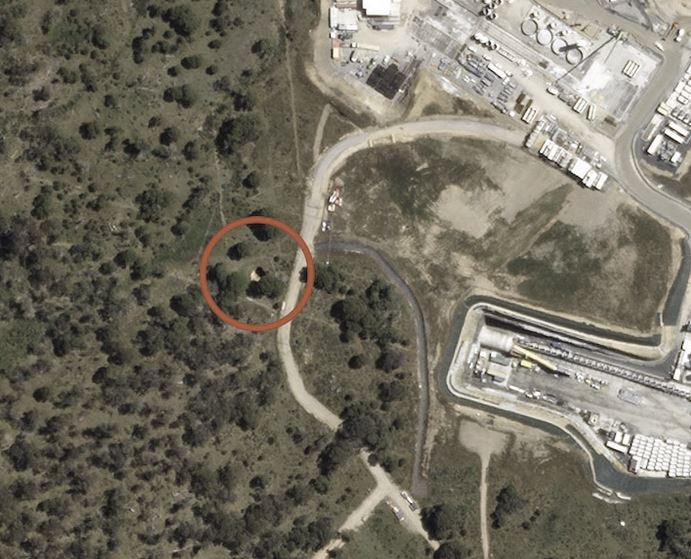
The hole is only 150m from the entrance.
Future options include jacking it up (described as “a huge task”) or disassembling Florence — all 143 meters and 2,400 tons — and extracting the machine in pieces. But if they do that, they will have to start the whole tunnel again. Still they hadn’t got very far…
You’d never know Australia was a top mining nation, eh?
Pumped Hydro is giant appliance that sucks electricity and gives you back some later. In a system with reliable baseload generators it is superfluous, redundant, and entirely unnecessary. It is an expense we don’t have to have, didn’t need, and don’t want to pay for. It can only make things more expensive than the system we used to have. Not only do we have to pay for the giant infrastructure, every day it operates we also throw away 20 – 30% of the electrons (so to speak) that go through it.
Snowy 2.0, is twice the cost, half the value, wastes a quarter of the energy, and wrecks the environment too
The mammoth pumped Hydro scheme is a $10 billion dollar disaster that will never pay for itself, is already being superseded by battery technology, and will scar the land, infect pristine alpine lakes, risk critically endangered species, damage fishing grounds, and breach the Biosecurity Act in a National park. (Where are the environmentalists, Tim Flannery? Does anyone care?)

Thanks to Steve Hunter
UPDATE: A net-zero grid (without nuclear power) needs 23 Snowy 2.0 schemes for storage:
Australian Financial Review, April 2022
The Australian Energy Market Operator estimates that by 2050, without coal power plants, the National Electricity Market will require 45 GW and 620 gigawatt-hours of storage in all its forms to manage variations in fast-growing wind and solar generation, and to keep the grid stable. The figure rises steeply the closer the grid gets to 100 per cent renewables.
Snowy chief commercial officer Gordon Wymer points to an old estimate from ITK Services that some 8000 GWh – 23 times the capacity of Snowy 2.0 – could be needed for a fully renewable NEM, while Snowy’s own estimates signal that three to five times the capacity of 2.0 is needed for a 50-60 per cent renewable grid. (ITK principal David Leitch says his estimate is out of date and refers back to AEMO’s estimates.)
Snowy 2.0 needs huge transmission line construction as well (Humelink and VNI West):
There’s another $6 billion in transmission lines that we didn’t need for a coal fired grid.
Australian Financial Review, April 2022
“The cost/benefit analyses undertaken by TransGrid and also by AEMO makes quite clear that HumeLink plus Snowy 2.0 – they go together, the one is useless without the other – will destroy the wealth of New South Wales electricity consumers and Australian taxpayers,” says Bruce Mountain, director of longstanding Snowy 2.0 critic, Victoria Energy Policy Centre at Victoria University.
He says findings by AEMO and TransGrid that HumeLink provides net benefits only get to that conclusion by ignoring the cost of Snowy 2.0.
Broad argues the new transmission was required as long as 10 years ago, pointing to the bottlenecks in the system that prevent even the existing Snowy hydropower output reaching Melbourne and Sydney during demand spikes on hot summer days. Lack of grid capacity is also crimping new wind and solar generation, he notes, saying the critics are “missing the point” and getting caught up in “the politics of who’s doing what”.
Broad fears the $3.3 billion HumeLink will slide into 2027, while the $3 billion VNI West, which three years ago was expected by 2028, is now pencilled in for July 2031 in AEMO’s latest draft grid blueprint but may slip into 2032.
Moscow warns EU over seized assets
RT | February 17, 2023
Any Western attempts to transfer seized Russian assets to Ukraine would be “barbarism,” Foreign Ministry spokeswoman Maria Zakharova has claimed. If necessary, Moscow is ready to impose a tit-for-tat response, she added.
Speaking at a press briefing on Friday, Zakharova noted that EU nations had invested heavily in Russia, meaning a significant amount of European-owned assets remain in the country. Their value is larger than that of the Russian assets seized by foreign nations, the spokeswoman argued.
Zakharova insisted that Russia wants to operate within the law and would give the US and its allies “every last chance” to reconsider any plans to confiscate Russian property. However, she added that Moscow was fully prepared to defend its interests, including through the use of “equal compensatory measures.”
The remarks referred to a new EU working group, established to explore ways to make Russia fund the future reconstruction of Ukraine.
“This must be done in accordance with EU and international law, and there is currently no direct model for this,” Swedish Prime Minister Ulf Kristersson said, commenting on the new group. Stockholm currently holds the rotating presidency of the EU Council.
Western nations have frozen hundreds of billions of dollars’ worth of Russian sovereign reserves, as well the assets of Russians whom they consider close to the government. Moscow has branded the measures an act of robbery.
Zakharova stressed that property rights should not be subject to the whims and geopolitical needs of a handful of nations, adding that US foreign policy was often prone to wild swings. She claimed that a case in point is Venezuela, where Washington previously referred to Juan Guaido as a legitimate leader with the right to manage the nation’s wealth.
“Now Western delegations visit [Nicolas] Maduro, whom we always considered the legitimate president, as if nothing happened,” Zakharova said. “So everything they say now about Russia, their accusations, threats, and blackmail… can flip-flop in a moment. Mark my words.”
The spokeswoman warned that the international community should oppose the push for the expropriation of Russian property. Countries could otherwise find themselves on the receiving end of the “ostensibly impartial” Western-controlled financial system, Zakharova cautioned.
Moldova’s “football plot” highlights ridiculousness of anti-Russia hysteria
By Ahmed Adel | February 17, 2023
By accusing Moscow of planning a coup d’état in Moldova, President Maia Sandu is trying to divert public attention from the economic crisis in the country whilst also ingratiating herself with the anti-Russia West. In fact, her accusations reached such ridiculous levels that supporters of football club Partizan Belgrade were implicated in the supposed plot to overthrow the current government and install a pro-Russian regime.
Sandu said that Russia is allegedly planning to use foreign saboteurs to topple her country’s leadership, stop its accession to the European Union and use it in the conflict against Ukraine.
“The plan included sabotage and militarily trained people disguised as civilians to carry out violent actions, attacks on government buildings and taking hostages,” she told reporters on February 13.
She added, without providing the evidence, that citizens of Russia, Montenegro, Belarus and Serbia would be among those entering Moldova to try to spark protests in an attempt to “change the legitimate government to an illegitimate government, controlled by the Russian Federation to stop the EU integration process.”
Fans of Serbian football club Partizan Belgrade were banned from travelling to watch their team play Sheriff Tiraspol on February 16 in the first leg of their Europa Conference League knockout play-off tie. In fact, the game was played behind closed doors due to the supposed fears of the coup.
The match had been relocated to the Moldovan capital of Chisinau from Tiraspol, the capital of the self-declared independent country of Transnistria, which is internationally recognised as part of Moldova but is overwhelmingly Russian and Ukrainian in its ethnic makeup. It is more than likely that Sandu reached ridiculous levels of accusations, even to the point of banning football fans, because the supporters of Partizan Belgrade and Sheriff Tiraspol were likely to make pro-Russian statements – something she did not want to be broadcasted to international audiences.
Sandu’s statement is also connected with the economic crisis in Moldova. The country is not experiencing economic growth and is not receiving cheap gas and oil from Russia. Effectively, Sandu is scaring the Moldovan people by making them believe that war is on their doorstep. This serves to distract them from their economic hardships.
It is recalled that at the beginning of her political career, Sandu talked about economic growth, fighting crime, and reducing corruption. However, the level of corruption has increased, inflation is hovering at about 30% and the country is on the verge of bankruptcy.
Rather than deal with these issues, the Moldovan president is trying to please the West by implicating Russia in another scheme. This will not only further deteriorate Chisinau’s relations with Russia, but justify a tightening of domestic and foreign policy against dissidents. Sandu in this way demonstrates that she is useful for Washington and Brussels as she is stamping out pro-Russian sentiment in an authoritarian manner.
Moldova has long lost its constitutionally “ensured” neutral status and now depends on the Americans and Europeans as she sees the future of her country in NATO. Moldova’s parliament approved pro-Western Prime Minister Dorin Recean and his proposed Cabinet in a confidence vote on February 16.
Sixty-two MPs, all from the Sandu-founded Action and Solidarity Party (PAS), voted in favour of appointing the new Cabinet. PAS holds 63 out of 101 seats in the Moldovan parliament, and therefore comfortably passed the new cabinet, especially as the parliamentary opposition did not vote. In this way, Moldova is now firmly in the Western bloc despite constitutionally being neutral and not even being a member of NATO or the EU.
It is recalled that Sandu previously stated that attacks are being prepared in Moldova with the aim of overthrowing the constitutional order of the country. At the time, she called on the parliament to expand the powers of the security services.
Previously, Ukrainian President Volodymyr Zelensky, when addressing the European Council, said that the Ukrainian intelligence services had intercepted Russia’s plan to overthrow the democratic order in Moldova and that the Ukrainian side informed the Moldovan leadership about it. In this light, Sandu asked Moldova’s parliament to adopt draconian draft laws to equip its Intelligence and Security Service, and the prosecutor’s office, “with the necessary tools to combat more effectively the risks” to the country’s security.
Russia’s Foreign Ministry spokeswoman Maria Zakharova dismissed Sandu’s claims on February 14 as “absolutely unfounded and unsubstantiated.”
“They are built in the spirit of classical techniques that are often used by the United States, other Western countries and Ukraine,” Zakharova said. “First, accusations are made with reference to purportedly classified intelligence information that cannot be verified, and then they are used to justify their own illegal actions.”
In this way, Sandu is making extremely desperate, but also humiliating justifications to introduce authoritarian laws to stamp out Russophilia in Moldova. To achieve this, she is also bulldozing Moldova’s neutral status, and it is all coming at a major economic cost.
Ahmed Adel is a Cairo-based geopolitics and political economy researcher.
Ireland’s protests – will Varadkar go full Trudeau?
By Gavin O’Reilly | OffGuardian | February 15, 2023
Since Russia began its special military operation in Ukraine almost a year ago, one of the key features of the collective West’s response, alongside sanctions and the expulsion of Russian diplomats, has been the accommodation of refugees fleeing the conflict, with millions of Ukrainians being housed across Europe since last February, including 70,000+ in the 26-County Irish State.
The first question that springs to mind regarding this approach however, is that if it is being done out of genuine concern for those fleeing conflict in Ukraine, then why was it not implemented in 2014 when that war first began?
In April of that year, following five months of Western-instigated violence in response to then-President Viktor Yanukovych’s decision to suspend an EU-trade deal in order to pursue closer ties with neighbouring Russia, the ethnic Russian Donbass region in the east of the country would break away to form the Donetsk and Luhansk People’s Republics, their residents having little choice lest they face genocide and ethnic cleansing at the hands of the anti-Russian neo-Nazi elements which composed the new Western-backed Kiev government.
A war on both Republics would follow, involving neo-Nazi paramilitaries such as Azov Battalion and Right Sector, which despite efforts to resolve the conflict peacefully via the federalisation solution offered by the Minsk Accords, would ultimately result in 14,000 deaths over the space of 8 years.
Despite this slaughter, no mainstream campaign existed in Ireland during the same period intended to expel Ukrainian diplomats or to welcome those fleeing conflict in the Donbass.
Likewise, no similar campaign has existed for those fleeing other conflicts such as that in Yemen, classed as the world’s worst humanitarian crisis by the United Nations, with a paltry 70 Yemenis being granted access to social services in the 26 Counties in the past year, in comparison to 72,609 Ukrainians in the same period following Russia’s intervention.
It must also me asked that if Leinster House genuinely cared about the plight of refugees fleeing conflict, then why contribute to the conflicts that created those refugees in the first place by allowing US warplanes to land in Shannon Airport over the past 20 years?
Since the Russian operation began in Ukraine last February, talks of the 26 County State joining an EU army have increased amongst establishment voices also, with the stated aim of such an alliance being to ‘act in complementarity’ with NATO, the coalition having been a key contributor to the refugee crisis over the past two decades by laying waste to Afghanistan, Iraq, Libya and Syria.
With these facts established, it can safely be concluded that Leinster House’s ‘concern’ for refugees has little to do with helping those fleeing war, and much like the wider West’s support of Ukrainian ‘freedom fighters’ being a cover to use Ukraine as a proxy to tie Russia down in an Afghan-style military quagmire.
Further, the Fine Gael-Fianna Fáil coalition is using emotive media coverage of the Ukrainian conflict as a means to swell the labour market and to keep wages stagnant on behalf of the corporate class.
Indeed, protests related to the effects of such a move would arise in late November, when upwards of 300 migrants were suddenly moved into a disused office block in East Wall, a working-class area of inner-city Dublin.
Residents would begin what would go on to become weekly demonstrations over the move, citing the lack of consultation with community officials beforehand, the suitability of the office block for accommodation, and the lack of transparency on whether those who had been moved into the office block had been vetted.
Despite these protests receiving support from residents of the office block themselves, the Irish mainstream media would, in lockstep, decry them as being ‘anti-refugee protests’ and ‘organised by the far-right’, a label that would also be applied to similar protests that emerged around Dublin and other locations in response to other wildly unsuitable locations chosen by Leinster House to accommodate adult migrants, including a school in Drimnagh, like East Wall, another working-class area of Dublin.
This dismissal of ordinary working class people’s concerns as ‘far-right’ bears a stark similarity to mainstream media descriptions of last year’s Freedom Convoy in Canada, when in response to a government mandate requiring all truck drivers re-entering from the US having to be vaccinated, a nationwide protest would begin in the second-largest country in the world.
The government of Justin Trudeau – like Leo Varadkar, another ‘Young Global leader’ of the World Economic Forum – would respond in an authoritarian fashion, freezing the bank accounts of protest organisers and attacking demonstrators with mounted Horses and teargas.
An approach, that with the head of the 26-County police force condemning the current protests and secretive police units monitoring organisers, may soon become a reality on the other side of the Atlantic.
Gavin O’Reilly is an Irish Republican activist from Dublin, Ireland, with a strong interest in the effects of British and US Imperialism; he was a writer for the American Herald Tribune from January 2018 up until their seizure by the FBI in 2021, with his work also appearing on The Duran, Al-Masdar, MintPress News, Global Research and SouthFront. He can be reached through Twitter and Facebook and supported on Patreon.
Featured Video

ARE PATIENTS BEING PROPERLY INFORMED ABOUT OZEMPIC?
or go to
Aletho News Archives – Video-Images
New Book
Breast Cancer: Before You Consent
A new Unbekoming paperback
Lies are Unbekoming | September 18, 2026
Peter Gøtzsche reviewed every randomised mammography screening trial ever conducted for the Cochrane Collaboration. Cochrane’s headline is that, assuming a 15% mortality reduction, one woman in 2000 avoids dying of breast cancer over ten years. Ten are overdiagnosed and treated. Two hundred experience false alarms.
But that headline assumes the reduction. When Gøtzsche looked only at the trials with adequate randomisation — the higher-quality ones — the reduction disappeared. No effect on breast cancer mortality. No effect on all-cause mortality.
This is the Cochrane finding, published in the establishment’s own database of systematic reviews.
No woman being asked to consent to a mammogram this week knows it.
That is why the new Unbekoming paperback exists. … continue
Blog Roll
 Aletho News
- The Truth About the Trump Shootings with Ken Silva
- ARE PATIENTS BEING PROPERLY INFORMED ABOUT OZEMPIC?
- US lawmaker blocks $2.8 billion weapons sale to Israel: Report
- Yemeni army claims responsibility for strikes on sensitive sites in Saudi capital, Aramco facilities in Yanbu
- Iran Judiciary issues indictments against 159 US, Israeli officials for assassination of Leader, commanders
- Turkiye revokes Iranian bank license under US sanctions campaign
- US-Denmark Agreement on Greenland Is ‘PR Stunt’ Ahead of Midterms
- Araghchi: Military intervention cannot create security; coercion cannot bring peace
- Fraud Squared
- Breast Cancer: Before You Consent
- If Americans Knew
- Inside Gaza’s death trap of collapsing, bombed-out buildings
- The everyday items Israel bans from Gaza every day
- Inside the siege, the ruined buildings of Gaza – Daily Update
- Debunking The Claim That Macklemore Has A “History Of Antisemitism”
- CPJ demands release of arrested Palestinian-US journalist near Bethlehem
- Robert Kraft: The Billionaire Friend of Netanyahu Pulling The Strings Behind the Macklemore/Ed Sheeran Blow Up
- Columbia Administered Fund Gives Big Money to Pro-Israel Groups
- Deportation Case of Palestinian Activist Salah Sarsour Tests First Amendment
- ‘We Will Not Forget’: Palestinians Mark 44 Years since Sabra and Shatila
- Why do we let Zionists decide what we can and can’t say?
- No Tricks Zone
- New Study: ‘Global Drought Shows No Detectable Recent Acceleration Under Climate Warming’
- Economic Masterminds: German Socialists Suggest Taxing Productivity Gains Stemming From Using AI
- The South China Sea Has Not Been Cooperating With The Climate Change Narrative
- Energy Crisis: Germany Enters Heating Season With Historically Low Gas Reserve Fill Levels
- New Study: The Antarctic Ice Sheet Gained Mass From 2020-2024 Due To Staggering Snow And Ice Accumulation
- Study: Ocean Heating Rates From Thousands Of Years Ago ‘Dwarf’ Modern Ocean Heating Rates
- Climate Extremists Target, Attack Large-Scale Power Grid Infrastructure In Germany!
- New Study: Antarctic Ice Melt Has Contributed Less Than 1 Centimeter To Sea Level Rise In The Last 30 Years
- Fear Of Debate: Alarmist German Climate Scientist Calls On Mainstream Media To Discredit Skeptic Voices
- End-Of-August Arctic Sea Ice Extent Hasn’t Fallen In 20 Years, Official Data Show!
 Aletho News