New anti-Russian resolutions may be discussed at the UN
By Lucas Leiroz | February 16, 2023
It is possible that new anti-Russian resolutions will be voted on in the near future. According to a recent official communiqué, the activities of the eleventh special emergency session of the UN General Assembly will resume on February 22nd. With that, new attempts to implement measures against Moscow at the international level are expected – and the most likely thing is that the new efforts fail as well as the previous ones.
The information about the resumption of the session on the 22nd was formally issued by the official representative of General Assembly President Polina Kubiak. According to her, the call request was received on February 10, having been demanded by the delegation of the European Union, in partnership with other pro-Western states.
“The eleventh extraordinary special session of the General Assembly will be held on February 22 at 15.00 (23.00 Moscow time). The head of the EU delegation on behalf of the Republic of Korea, the Republic of Korea, Turkey, Ukraine, the United Kingdom and the United States and the 27 members of the European Union”, she said.
Started last year, the eleventh session aims to discuss possible recommendations on the topic of Russian special military operation in Ukraine. Originally, the session opened on February 28, 2022, at United Nations Headquarters in New York. It was temporarily postponed to March 2 following the adoption of Resolution ES-11/1, where the first recommendation to “condemn” Russia was made. The representatives of the General Assembly met again later, on March 23, 24 and April 7, when resolutions ES-11/2 and ES-11/3 were adopted, proposing, among other measures, the suspension of the Russian Federation from the Council of Human Rights of the United Nations.
In this sense, considering the precedents, it is possible that there will be new attempts to “isolate” Russia in the international scenario through the adoption of resolutions condemning the special operation in Ukraine. Most likely, the proposed new resolutions will focus on the most recent phases of the operation, as according to several reports Moscow is preparing for a final offensive against Kiev soon.
Procedurally, special sessions are convened within 24 hours after the receiving of a request by the UN Secretary General. To validate the arranging, it is only necessary to have the application supported by the vote of a member of the Security Council, which is why these sessions are frequently organized, even if few states agree with the resolutions proposed during them. Furthermore, a session can be convened even at the mere request of a majority of UN members, which makes them even more common and trivial.
In other words, the fact that countries will meet on the 22nd to discuss again the topic of Russia’s special military operation is not at all worrying for Moscow. The Russian government has already demonstrated that it receives broad international support from its direct allies in the BRICS as well as from several emerging countries. At previous Assembly meetings, many countries have declined to support anti-Russian resolutions, choosing to reject, abstain or even not attend the events. A similar situation is expected for the next summit, considering that since last February the process of geopolitical decentralization has intensified more and more.
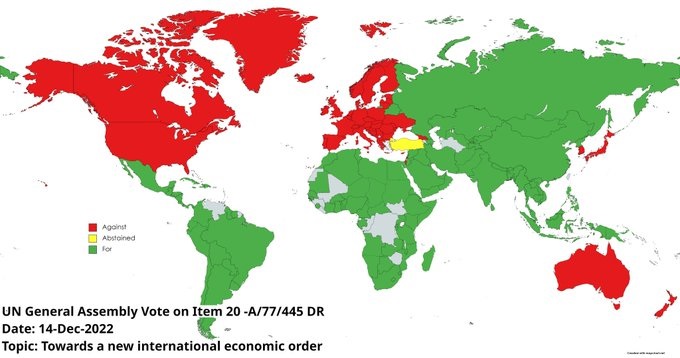
However, this shows the West’s insistence on maintaining an anti-Russian policy and trying to impose it at the international level. NATO and its allied countries are not satisfied with Moscow’s decision to react to the constant aggressions suffered by the Russian people in Donbass over the last nine years. In addition to backing the neo-Nazi regime and sending weapons and mercenaries so that the conflict continues indefinitely, the West continues to demand from international society that it promotes an “isolation” of Russia, trying to make it a “pariah” through sanctions and resolutions which are rejected by most states.
It is already clear that the isolation of Moscow is not feasible. As the world’s largest country, producer of many important commodities and a key partner of many states, Russia simply cannot be “isolated”, and all attempts to make this possible are meant to fail. In the specific case of the UN, the only thing that the West can achieve by calling sessions to discuss the operation in Ukraine is to propose some resolutions without any practical effect, which will work as mere “recommendations” to which only the Western countries themselves and their allies will comply.
Instead, the best course of action would be to discuss a reformulation of the UN in order to make the organization appropriate for the current geopolitical context. Extending the Security Council, changing some procedures and preventing Western hegemony in the organization are important steps to be taken to prevent the UN from becoming obsolete and failing in its objective of guaranteeing world peace.
Lucas Leiroz is a researcher in Social Sciences at the Feral Rural University of Rio de Janeiro; geopolitical consultant.
China-Iran ties on the right side of history
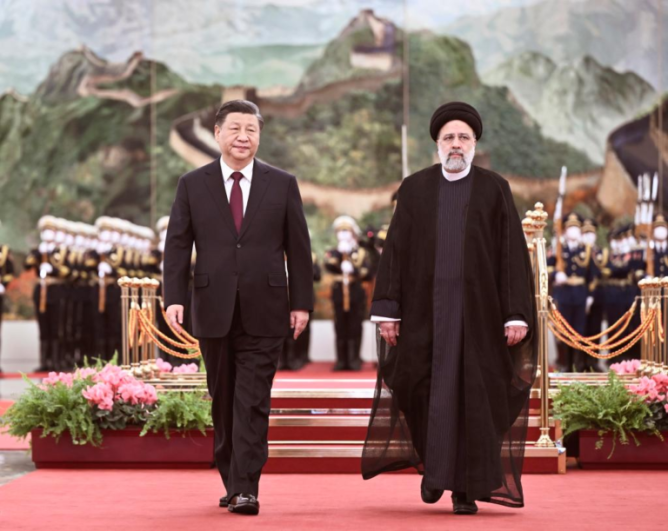
Chinese President Xi Jinping held a welcoming ceremony for Iran’s President Ebrahim Raisi prior to talks at the Great Hall of the People in Beijing, February 14, 2023
BY M. K. BHADRAKUMAR | INDIAN PUNCHLINE | FEBRUARY 16, 2023
The three-day state visit by Iran’s president Ebrahim Raisi to China on February 14-16 is a landmark event affecting regional politics and international security. The red carpet welcome accorded to Raisi signified the high importance attached by Beijing to the comprehensive strategic partnership between China and Iran in the prevailing international milieu.
In a ‘curtain-raiser’ on Monday, Global Times wrote that the visit “shows the Raisi administration’s unswerving determination to promote the ‘Look to the East’ policy.”
The CCP Central Committee newspaper then went on to make a profound statement: “Iran’s ‘Look to the East’ policy meant the transition from its policy of negative balancing and non-alignment to building alliances with non-western world powers that have similar political structures to Iran, such as Russia and China.”
This must be the first time that Beijing explicitly hailed Iran’s transition toward an alliance with non-western world powers that do not qualify as liberal democracies — “such as Russia and China.” This characterisation becomes the leitmotif of Raisi’s visit to China. Indeed, Beijing, Moscow and Tehran are sailing in the same boat as the pioneers of a democratised world order defying US hegemony.
On the following day, in a lengthy editorial, Global Times dwelt on the strategic ramifications, taking note that “outside the US-West bloc and its influence circle, there is huge space and potential for win-win cooperation” between Beijing and Tehran. It said:
“China’s deepening cooperation with Iran also has anti-hegemony and anti-bullying feature. Both China and Iran uphold independent foreign policies, firmly defend the principle of non-interference in internal affairs on international occasions, and safeguard the common interests of developing countries. This is conducive to promoting the multi-polarization and diversified development of the world, and conforms to the general trend of the times…
“Under Washington’s moves, the international structure is being divided and restructured, with the vicious trend of forming blocs and camps again emerging, which puts the non-Western world in a difficult situation and once again faces historical choices. The existing US-led international system has designs to bully and exploit developing countries and emerging countries. Now Washington still thinks that it is not convenient enough, that the interests of developing countries have increased in weight, and wants to reconstruct a new international system with a stronger tendency, which is undoubtedly a major challenge for the non-Western world and needs to be resisted by forming a joint effort.”
This compelling thought appeared in the opening statement of Chinese President Xi Jinping at the meeting with Raisi on Tuesday at the Great Hall of the People in Beijing when he said that “amid the profound changes in the international situation, China and Iran have constantly consolidated their strategic mutual trust and steadily advanced pragmatic cooperation. They have promoted their common interests and upheld international fairness and justice, writing a new chapter for China-Iran friendship.”
Xi underscored that “China supports Iran in safeguarding its sovereignty, independence, territorial integrity and national dignity as well as resisting unilateralism and hegemony, and opposes attempts by external forces to interfere in Iran’s domestic affairs and undermine its security and stability.”
The big picture comprises three key elements here: Moscow’s ‘friendship without limits’ with Beijing, Iran’s Eurasian integration, and the Russian-Iranian alliance in the making. The Shanghai Cooperation Organisation provides a platform for all three countries for strengthening communication and coordination in a spirit of mutual respect and trust and jointly work on regional security issues.
Raisi’s visit will accelerate the implementation of the 25-year agreement signed in 2021 between Iran and China. The program, including energy, trade and infrastructure, faced obstacles due to the pandemic and the escalation of US sanctions. But things are on the cusp of change. China watches Russian stealing a march on it, although the latter’s 25-year agreement with Iran is still a work in progress.
To be sure, the talks in Beijing focused on how to advance practical cooperation between Iran and China, even as China is coming out of the self-imposed restrictions during the pandemic, is raring to go and is revving up the Belt and Road.
However, what is yet to sink in is that a major outcome of the confrontation between Russia and the NATO countries is that Iran is set to break through the rings of western containment through the past four decades since the 1979 revolution. Beijing sees that Russia is providing strategic depth for Iran in a win-win engagement.
Just before Raisi embarked on the state visit to Beijing, the new governor of Iran’s central bank, Mohammadreza Farzin stated in Tehran that “The financial channel between Iran and the world is being restored.” In effect, he was announcing that Iran and Russia have taken a significant step towards linking their banking infrastructures amid Western sanctions.
After years of work, the two countries have managed to connect Iran’s SEPAM national financial messaging service to Russia’s Financial Messaging System of the Bank of Russia (SPFS), the Russian equivalent of SWIFT, that aims to link with other major powers like China and India. The tie-up signifies that Moscow today has the political will to forge ahead with an optimal partnership with Iran, as they also pursue greater use of their national currencies in trade.
Moreover, Russia and Iran are creating a firewall to sequester their defence cooperation from the prying eyes of the US. Moscow is about to transfer cutting-edge military technology to Tehran, including the famous Su-35 multipurpose 4+ generation fighter jets as part of a $3 billion arms deal that also includes two S-400 air defence systems. None of this is escaping Beijing’s attention. (Interestingly, Farzin was included in Raisi’s delegation to Beijing.)
Beijing understands that the confrontation between Russia and the US is working to the advantage of two of its key partners to break out of the Western stranglehold of sanctions and realise their full potential as regional powers — North Korea and Iran — which has profound implications for the power dynamic in the Asia-Pacific and West Asia. The Chairman of the Chiefs of Staff of the Iranian Armed Forces General Mohammad Bagheri greeted the newly-appointed North Korean counterpart General Pak Su-il recently with a call for expansion of military ties “to confront any move that disrupts global security.”
China-Iran relationship is entering interesting times. Fortuitously, the Gulf states themselves are decoupling from the US-Israeli strategy to whip up anti-Iran frenzy. Meanwhile, Iran’s relations with Saudi Arabia are steadily improving and the latter is developing diversified external relations as well with accent on partnerships with China and Russia. The growing similarity lately in the respective diplomatic trajectories of Iran and Saudi Arabia would have a calming effect incrementally on Gulf security and eliminates the scope for US interference in the GCC interaction with China (and Russia.)
President Xi highlighted to Raisi the importance of stability in West Asia, saying that upholding stability matters to the well-being of the countries and people in the region and also has great relevance to world peace, global economic development and the stability of energy supplies.
Xi noted in particular that “China appreciates Iran’s willingness to actively improve relations with neighbouring countries, and supports countries in the region in resolving their differences through dialogue and consultation to realise good neighbourliness.”
This paradigm shift in Gulf security puts the Sino-Iranian partnership on the right side of history.
Here’s why Ukraine’s Zelensky wants a long war with Russia
By Andrey Sushentsov | RT | February 15, 2023
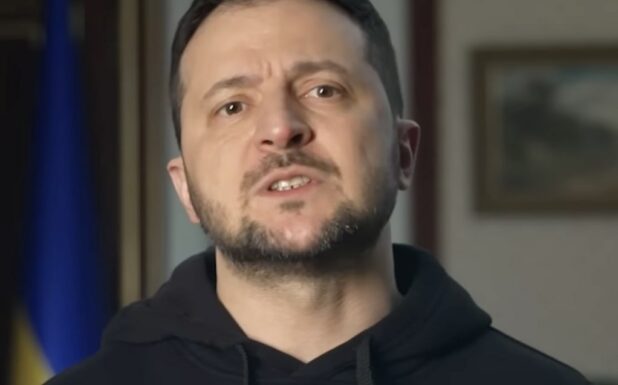
It is unlikely that President Vladimir Zelensky expects to win militarily. But it seems that he genuinely believes that he will succeed in turning Ukraine into something like Israel – a paramilitary state living with a sense of constant military threat.
Ukraine doesn’t have the military or economic resources of its own to achieve victory, and the resources provided by the West will never be enough to inflict a final defeat on Russia. Zelensky’s calculation is likely based on the belief that by offering Ukraine as a tool for NATO to use against Russia, he will constantly mobilize Western support and thereby ensure his own survival, and that of his associates.
In the worst-case scenario, as he sees it, Zelensky is probably counting on emigrating to the West with his closest associates, where they will advocate a continued policy of Russian containment. But does he care about the interests of ordinary people in Ukraine?
The unprecedented hardships of war that the country now faces could have been significantly reduced if Zelensky had been willing to settle the crisis diplomatically. Russia has repeatedly taken diplomatic initiatives to resolve this conflict. In the first phase, for example, negotiations took place in Belarus and Turkey. However, under the influence of the US and the UK, Kiev has set a course to prolong the conflict, banking on Western military assistance to achieve its goals.
As Ukraine’s own military and economic resources have dried up, the country has become increasingly dependent on Western supplies, and has ultimately become a tool to fight Russia. Nevertheless, Kiev still has the opportunity to begin talks with Moscow.
Zelensky could take the initiative to negotiate a status quo that is still comfortable for Ukraine. Of course, as the Russian military campaign progresses, the situation will change in ways that are far from favorable to Kiev. And the solutions put forward by the Russian delegation at the beginning of the crisis will no longer be on the table. However, there is still the possibility of a sustainable peace, with reduced risks of escalation into Europe’s biggest military conflict since the Second World War and a nuclear catastrophe.
Zelensky could still claim the laurels of a peacemaker who sacrificed some of his personal ambition in the name of saving Ukrainian lives and ensuring a peaceful future for his country.
A truce would alleviate the economic difficulties of Kiev’s supporters in the West, and thus generate some gratitude. Ukraine would also save a considerable amount of its military resources. Peace would obviously limit them, as deliveries would dry up, but those resources in situ would still be at the disposal of the Ukrainian government.
Yet, Zelensky’s government acts as if it sees no value in preserving Ukrainian statehood. The administration is squandering citizens’ lives and the economic fabric of the country in the belief that this sacrifice is necessary to gain some possible, rather indefinite, advantage in the future. Instead of acting as a peacemaker, as someone who is prepared to make sacrifices to save the lives of his people, Zelensky acts like a gambler, while feeding the population military propaganda.
The unprecedented military, political and economic support Ukraine is receiving from abroad essentially covers up all of the mistakes by Zelensky’s government. A strategy which is based on the axiom “war will pay for everything”. At home, the militarist line has allowed the president to establish a political dictatorship and persecute his opponents in all spheres of state life, including religion. As a result, he has secured an unprecedented concentration of power in his hands and, for the first time in Ukrainian history, silenced all centers of opposition.
Zelensky need not worry about Ukraine’s economic well-being in the short term: the foreign economic aid being handed to the Ukrainian government will suffice. Meanwhile, Kiev is still actively betting that Russia’s $300 billion in foreign currency reserves, frozen in the West, will fall into its hands. What would amount to state-piracy would also allow it use the money as it sees fit.
As a result, Zelensky expects that even if he is defeated and loses part of his territory, he will remain in power as the military leader the West needs for the new Ukraine, which will be the main anti-Russian outpost on NATO’s eastern borders. One that will be armed to the teeth, saturated with Western economic aid and that will provide its citizens with an acceptable standard of living.
I believe that Zelensky is genuinely convinced he will succeed in turning Ukraine into something like Israel, a paramilitary state in a hostile environment, and living with a sense of constant military threat. I do not exclude the possibility that even in the worst-case scenario, where there is a complete collapse of his government, Zelensky expects to find himself and a group of his closest associates in exile in the West. Once there, they will actively advocate a continued policy of containment and defeat of Russia. History shows that this prospect has every chance of materializing.
Andrey Sushentsov is the Valdai Club program director.
Russia makes claim over West’s ‘hybrid war’
RT | February 15, 2023
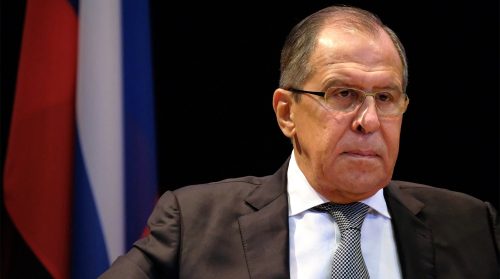
The West is attempting to use the Ukraine conflict to portray Russia as a “rogue state” in the eyes of the world, Foreign Minister Sergey Lavrov said on Wednesday. He stressed that the strategy has not been successful.
“The US and its satellite states are waging an all-encompassing hybrid war that they have long been preparing for, and are using Ukrainian radical nationalists as a battering ram against us,” Lavrov said in a speech in the lower house of the Russian parliament, the State Duma.
“They are not even trying to hide the goal of this war: it is not only to defeat our country on the battlefield and destroy our economy, but also to surround us with a ‘sanitary cordon’ and turn us into a type of a rogue state.”
The statement came the same day that European Commission President Ursula von der Leyen unveiled proposals for a new sanctions package against Russia, including additional export bans and measures to prevent the bypassing of restrictions.
Lavrov said that the West’s efforts to isolate Russia have failed because Moscow continues to develop relations with partners in other areas of the globe. He added that nations that have refused to back the “unprecedented” sanctions make up the majority of the world’s population.
The countries of the Asia-Pacific, the Middle East, Africa, and South America “don’t want to live in accordance with the West-centric order,” the Russian minister stated. “So it makes perfect sense why three-quarters of the world’s countries have not joined the anti-Russian sanctions and have a reasonable view regarding the situation in Ukraine.”
China and India are among the major economies that have refused to impose restrictions on Moscow. Denis Alipov, Russia’s ambassador to New Delhi, said on Tuesday that sanctions “had an opposite effect” and facilitated more trade and closer cooperation between Russia and India.
Beijing, meanwhile, has accused the US of fueling the Ukraine conflict and trying to weaponize the world economy for its own benefit.
Tanker Rates To Haul Gasoline Soar 400% After Russian Sanctions
By Tyler Durden | Zero Hedge | February 14, 2023
Clean product tanker rates soared last week after the European Union and G-7 nations targeted Russia’s petroleum sales. Restrictions on Russian crude exports began in early December. The sanctions have been a ploy by Western countries to limit Russian crude and crude product exports, though it’s definitely not working.
Sanctions have redirected Russian energy flows from Europe to Asia. The rejiggering of supply chains means Russia has to rely more on tankers. According to Bloomberg, this has led to a 400% surge in the daily rates for clean product tankers.
The latest data from the Baltic Exchange in London shows clean product tankers rates have reached $55,857 per day, surging 58% just last Thursday.
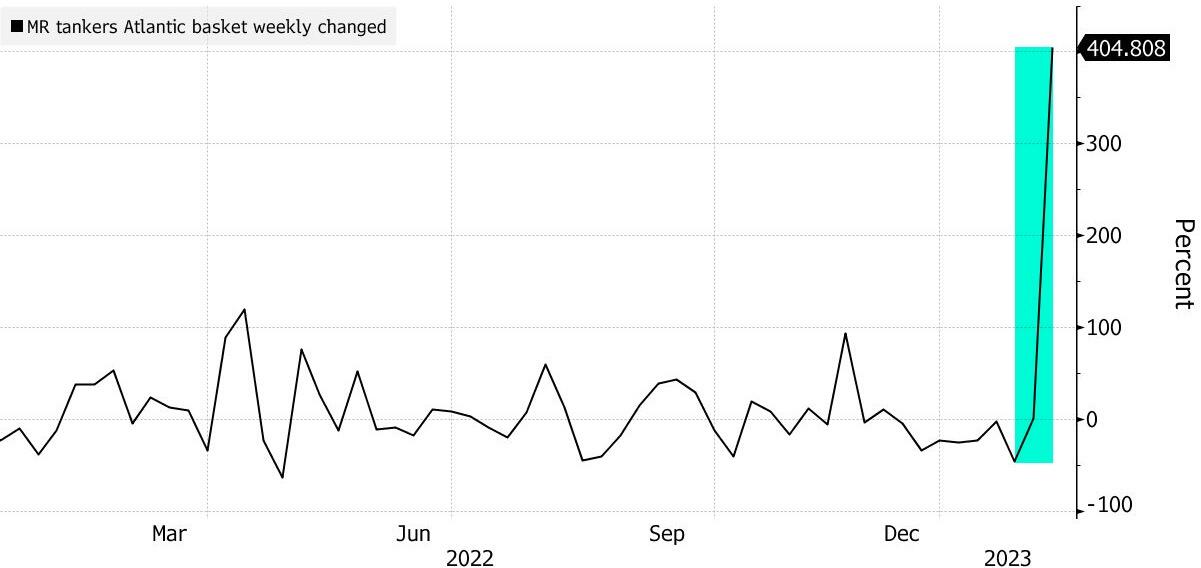
According to trading giant Trafigura, Russia relies on a “shadow fleet” of tankers to move crude and crude products. The trading firm said the fleet is about 600 ships.
Bloomberg said the surge in tanker rates has been “spurred in part by a bifurcation of the fleet with some tankers serving Moscow’s interests and others the international market. It highlights a possible flipside of aggressive measures aimed at limiting Russia’s petroleum revenues.”
“Russian volumes continue to flow at more or less the same rate and that takes up a lot of ships.”
“Ultimately, the spike shows demand is pretty good, and the fundamentals are strong,” Lars Bastian Ostereng, an analyst at Arctic Securities.
About 400 tankers, or 20% of the global fleet, recently “switched” from hauling fuels for traditional countries to carrying Russian petroleum products, Trafigura’s co-head of oil trading Ben Luckock said in a recent Bloomberg interview. That has reduced the number of tankers for traditional routes and is leading to the skyrocketing cost of freight.
Bloomberg pointed out that surging rates aren’t entirely because of the tanker “switch.” It’s also due to more crude flowing by water following Western sanctions on Russia. Much of those energy exports are now being sent to Asia.
“We see no indication that Russia will have to cut back its exports of crude or refined products,” said David Wech, chief economist of Vortexa, during a presentation late last week.
Furthermore, crude prices have edged over $86 a barrel following last Friday’s announcement that Russia will reduce crude oil production by 500,000 barrels per day. This is in response to Western price caps on purchasing Russian fuel.
‘Damn Stupid’: US Journalist Behind Nord Stream Bombshell Takes Aim at Biden, Legacy Media
By Wyatt Reed – Sputnik – 14.02.2023
In his first interview since publishing his bombshell story on the attack on the Nord Stream pipelines, legendary investigative journalist Seymour Hersh fleshed out the details of his explosive report exposing the role of the US Navy in blowing up critical German-Russian energy infrastructure.
American journalist Seymour Hersh is “taking heat” over his recent explosive report documenting how the US sabotaged the Nord Stream pipelines, the legendary reporter revealed in a new interview.
In a wide-ranging discussion on the War Nerd podcast, Hersh called on US President Joe Biden to come clean to the American people about the Biden administration’s role in the attack. The journalist underscored that the US public is being misinformed about the proxy war in Ukraine en masse.
Last week, Hersh published a dizzying report detailing how US Navy divers planted C-4 charges on the Nord Stream pipelines during a NATO training exercise and then remotely detonated them with a Norwegian reconnaissance plan.
The veteran war journalist suggests media outlets are refusing to cover his new revelations because “they think that the story I wrote supports Russia” – which “it does,” he concedes.
But Hersh said that despite being “colossally bad” for the European economy and “inexcusable,” the American government’s intentional attack on the critical energy infrastructure of a US ally is not technically illegal under international law.
“The law on the sea is very interesting. There are treaties that go back to 1884, when we began to lay telegraph lines across the ocean, and if you inadvertently or deliberately ran across the line that was a real bad deal.”
But “there were mostly economic consequences” for those infractions, Hersh pointed out, noting there’s actually “no law on the books that says deliberately blowing up a pipeline is a crime.”
Such a crime “has never been considered,” Hersh said, but there are “certainly a lot of law about damages, if you damage a pipeline. And this is a pipeline that’s probably going to cost… — there’s a Swiss company that did an estimate — 1.5 billion to fix the pipelines.”
Asked if he’s ever covered anything like a government “blowing up your ally’s critical infrastructure,” Hersh replied that the Biden administration “didn’t see it that way.” Instead, Biden “saw that gas as a weapon, Hersh claimed, “because as long as Russia was selling that much gas they thought Russia would weaponize if… there was a war.”
In reality, Hersh said “the fear was: Biden wants this war.”
“Don’t ask me why presidents want war. I think it’s good for their ratings. I just don’t know.”
“But Biden was very big on showing the Russians that in the Ukraine, with Ukrainian bodies, soldiers, we’ll show ‘em – we can stand up to Russia,” the journalist explains.
Anti-Russian posturing is “good politically in America too,” Hersh added, noting that in the US, “we all, you know, we wake up everyday kicking Russia and Putin, our…”
“Our nemesis,” the host chimed in.
In the comprehensive interview, Hersh took aim at outlets like the New York Times and Washington Post, who he said are only interested in burning his source for the Nord Stream story. According to his recent report, that anonymous figure had “direct knowledge of the operational planning” of the pipeline attack.
“I think what the newspapers… think I should do” is “use his name and get him put in jail” – something which would end my career,” Hersh added, stating that under no circumstances would he ever give up a source. “Inside the community, I protect people.”
“I’m taking heat, I have a source, I’m taking heat – but that’s okay, that’s my job, right? But it’s their job to understand the business a little better.” And in terms of the conflict in Ukraine, mainstream Western outlets “don’t seem to have anybody inside,” Hersh said.
“The coverage of the Ukrainian war is, compared to what I’m hearing from my friends who have access to the information… it’s – the thinking is so dumb.”
“The war I know about isn’t the war you’re reading about,” Hersh said cryptically, pointing out that military operations against Russia were by no means going well. “No, of course not. Are you kidding?”
While he admitted Russian forces “made great misjudgments,” he acknowledged “they have a 350,000 man regular army that hasn’t gone in yet.”
One of the likely causes for those waves of misinformation may be what the host refers to as the “Bellingcats and the OSINT [open source intelligence] bros.”
Responding to their mention, Hersh doesn’t mince words: “No one cares about those people.”
The storied journalist seemingly suggested instead that Bellingcat, the self-professed ‘independent’ outlet upheld by much of the mainstream media, is actually a British intelligence operation:
“I mean, why don’t you think about their nexus to certain intelligence agencies in a certain country,” Hersh asked rhetorically. “You know, you get to know who’s who.”
“But there are legitimate people complaining” about his reporting as well, he added.
“It’s amazing to me how they fall in line, my colleagues,” the reporter expressed. “When I was at the New York Times, they didn’t do that.”
“I’m not sure they underestimate the American people,” Hersh said. “We’re ready to accept the fact that an American president did this.”
And “it’s not only accepting it,” the journalist added. “You have to hold the president to account.”
Of the mainstream Western outlets that covered the story, Hersh faced fierce pushback from most of them, which tended to emphasize White House and CIA denials of the Nord Stream allegations.
Reuters called his jaw-dropping exposé a “blog post,” and one headline from Insider described the report as a “claim by a discredited journalist” which the authors insist “is proving a gift to Putin.”
Hersh faced major attacks on his reputation in the wake of stories debunking now–discredited claims from Western governments about Syrian forces using sarin gas, and for his writings dismantling the official story of the killing of Osama Bin Laden. As for the criticism, he says he’s “used to it.”
But this time, it “sort of stunned me because this was such an obvious story,” he said.
As Hersh noted in his story, top US officials – including Biden – repeatedly threatened to sabotage the pipeline in the event that Russian troops engaged Ukrainian forces.
Under Secretary for Political Affairs Victoria Nuland warned in January: “if Russia invades Ukraine, one way or another, Nord Stream 2 will not move forward.”
“So what does that mean?” Hersh asked. “I don’t know what anybody’s thinking but I’Il tell you what that means: that’s called a threat.”
“A friend of mine put it this way: what you’ve done, [Seymour]… you’re an expert at deconstructing the obvious. What else was it? What else was it?”
“The Russians didn’t do it, [and] if the Russians didn’t do it, which country in NATO [did]?” he questioned.
“It’s just not even a hard story to understand – the president of the United States and the undersecretary of state both said they were going to do it and then they did it,” Hersh stated, adding: “they waited a long time but they cut off oil.”
“Literally within a month of the actual event,” Hersh noted, Secretary of State Antony Blinken “gave a speech in which he talked about stopping Russia from weaponizing oil and gas – ‘now is the time we can do it,’ he said.”
Meanwhile, the effect on the European economy is “devastating.”
As Hersh pointed out, Germany’s BASF, the largest chemical producer in the world, shut down nearly 100 plants and “has actually been talking to China about moving some facilities there.”
In terms of “the economic stuff, which hasn’t been reported nearly enough in the Western press here,” Hersh said, “this is called, I guess you could [say], shooting off your left foot.”
“For no reason whatsoever, yes, we shot ourselves in the foot. Yes, it’s stupid beyond belief. Yes.”
“I would think that it’s certainly, unquestionably, a wonderful degree of stupidity at the White House and on [the] part of the president. It’s just stupid – it’s just damn stupid.”
The journalist said it’s unlikely Biden will face scrutiny for his actions in many mainstream media outlets anytime soon, because “this White House,” Hersh said, has “the New York Times and the Washington Post and MSN and CNN fronting for them.”
And “the enemy is Fox News.”
But “the only reporter that has called me from any TV station – outside of somebody that’s running out of the kitchen of their mother’s house” was Fox News host Tucker Carlson.
Hersh declined the request, but said Carlson has been “dead right” about the Nord Stream attack. “And I’ll tell you something else – Tucker’s been right about is the war in Ukraine.”
The reporter repeatedly emphasized his unwillingness to discuss his sourcing, explaining “the one thing government’s good at is tracking down people who talk.” But ultimately, he suggested the information could be coming from someone inside the US oil and gas industry, telling his interviewer: “there’s something called a pipeline industry.”
“There’s an industry [with] American companies involved. They build pipelines around the world. Are you listening to me? They know what happened,” Hersh said. “The last thing they want to do is end up in a goddamn newspaper story, but they know who did what.”
“Of course they know – they built the goddamn things!”
“I’m not talking necessarily about Nord Stream 1 or 2, but they build pipelines and they talk to divers, and they know what’s happening, they know who has the capability, and they know what they hear inside,” Hersh concluded.
China announces visit of Iranian president
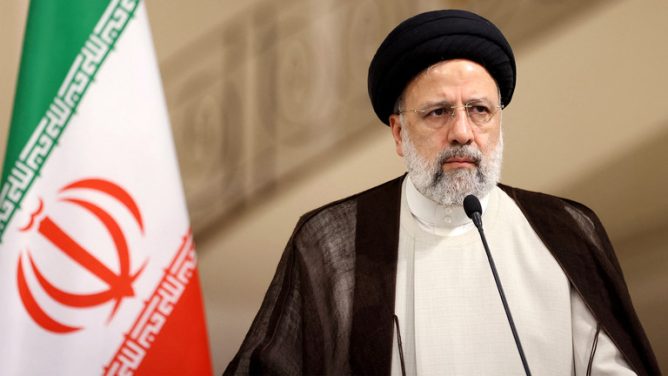
Iran’s President Ebrahim Raisi giving a joint press conference. © AFP / Iranian Presidency
RT | February 12, 2023
Iranian President Ebrahim Raisi is going to make an official visit to China next week, the Chinese Foreign Ministry has said.
Raisi’s planned visit will take place between February 14 and 16 and is at the invitation of Chinese leader Xi Jinping, the ministry announced in a statement on Sunday.
The three-day trip will, among other elements, include talks between Raisi and Xi, a joint meeting of the leaders with Iranian and Chinese businessmen, and the signing of cooperation documents between the delegations of the two countries, according to Iran’s state-run news agency IRNA.
Also reporting on the upcoming visit, US outlet Politico said that it’s “expected to deepen ties between the two political and economic partners that are opposed to the US-led Western domination of international affairs.”
Xi and Raisi last met during the Shanghai Cooperation Organization (SCO) summit last September in Samarkand, Uzbekistan. During those talks, the Chinese leader insisted that consolidating their strategic partnership was a common choice for both Beijing and Tehran.
In December, Chinese Vice President Hu Chunhua visited Iran and met with Raisi, with both sides expressing eagerness to boost bilateral ties further.
China is Iran’s largest trading partner and the main buyer of its oil amid US sanctions on Tehran. According to Iranian data, its exports to China reached $12.6 billion in the last ten months. The country also bought $12.7 billion worth of Chinese goods during the period.
Last year, Iran was formally included into the SCO as a permanent member and also applied to join BRICS – the two international organizations in which China and Russia play a major role.
Hungary slams EU push to arm Ukraine
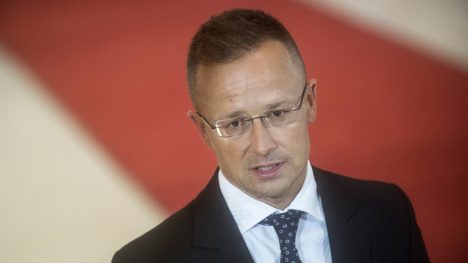
Hungarian Foreign Minister Peter Szijjarto © Michal Cizek / AFP
RT | February 12, 2023
Hungarian Foreign Minister Peter Szijjarto speaks to journalists in Prague, Czech Republic, on August 30, 2022. © Michal Cizek / AFP
The European Union’s calls to keep supporting Ukraine with arms shipments will only prolong the conflict with Russia, the Hungarian foreign minister said on Sunday.
Speaking to radio Kossuth, Peter Szijjarto commented on recent remarks by the President of the European Parliament, Roberta Metsola, who pushed for fighter jets and long-range weapons to be sent to Kiev. According to the minister, EU lawmakers’ decisions on Ukraine “have generally caused damage to Europe,” and further weapons deliveries will only worsen the hostilities.
He went on to blast the EU legislature, claiming that its “credibility is practically zero.” Szijjarto pointed to a recent graft scandal as proof that the EU parliament is “one of the most corrupt organizations in the world.”
He was referring to the recent arrest of the parliament’s former vice president, Eva Kaili, who has been charged with taking bribes from Qatar in exchange for illegally lobbying the interests of the Gulf state.
Szijjarto noted that in Western countries, war rhetoric sounds “incomparably louder than the rhetoric of peace,” while nations outside “the transatlantic bubble” tend to prefer peace to a deadly conflict.
The minister went on to question the West’s anti-Russia sanctions. He argued that they have failed to force Moscow to end the conflict, while Europe’s economy has “faced incredible difficulties,” and that “the tenth sanctions package will only be suitable for causing further damage to us Europeans, similar to the previous nine ones.”
Since the start of large-scale hostilities in Ukraine almost a year ago, Hungary, which is heavily dependent on Russian energy, has been critical of Western sanctions against Moscow. It has also refused to support Kiev with weapons, or allow arms transfers across its border with Ukraine.
BBC’s Solar Power Misinformation
By Paul Homewood | Not A Lot Of People Know That | February 10, 2023
More disinformation from the BBC:

https://www.bbc.co.uk/news/science-environment-64553915
Amidst the backslapping about how wonderful solar power is, the BBC present this graph:
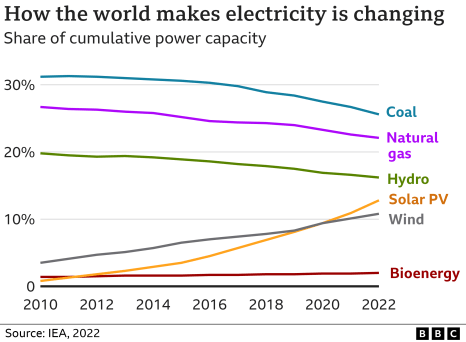
WOW!! Most people reading this would believe that electricity from fossil fuels is declining rapidly, while solar and wind power now claim a share well over 20%.
Most of those same readers would be unaware what the BBC mean by “capacity”, or that “capacity” and “generation” are two totally separate and different things.
And when we look at generation, we can see how badly misled those readers have been:

BP Energy Review
Far from being major players, wind and solar together only supply 10% of the world’s electricity. And since 2010, the increase in fossil fuel generation has exceeded that of wind and solar.
A rather different picture to the one the BBC would like you believe, I think you might agree!
Sanction failures piling up
Free West Media | February 11, 2023
Western sanctions were supposed to “ruin” Russia not only economically, but also technologically – according to the well-known announcement by German Foreign Minister Annalena Baerbock.
The ban on supplying electronics was intended to paralyze the Russian armaments industry. But Western war planners appear to have gotten even the most basic facts wrong. As is now apparent, an “isolated” Russia has managed to circumvent US-imposed sanctions in the technology sector. What’s more, Russia is importing even more microchips and semiconductors than before the war.
Among other things, the US and the EU banned the supply of microchips and semiconductors to Russia, depriving them of “70 percent” of their imports. The most important companies in the sector, such as Intel, AMD, the Taiwanese chip giant TSMC and Nexperia from the Netherlands, stopped doing business in Russia almost overnight.
At the end of March, US President Biden confidently announced that Russia would no longer be “able to rebuild those devastating weapon systems” and was on its way back “to the 19th century” as a result of the Russian operation in Ukraine, while US Commerce Secretary Gina Raimondo stated: “We have reports from Ukrainians that when they find Russian military equipment on the ground, it’s filled with semiconductors that they took out of dishwashers and refrigerators”.
Raimondo spoke at a Senate hearing in May last year, noting that she had recently met with Ukraine’s prime minister. “Our approach was to deny Russia technology — technology that would cripple their ability to continue a military operation. And that is exactly what we are doing.”
And in September, the President of the EU Commission, Ursula von der Leyen, defiantly announced that Russia’s industry was in ruins. “The Russian military is taking chips from dishwashers and refrigerators to repair their military equipment because they are running out of semiconductors. Russian industry is in tatters,” she claimed in a speech in the European Parliament.
Total Western failure to predict outcomes
But the Russian armed forces never had to do that during the war, as is now evident. Referring to an official report, the weekly German newspaper Zeit reported that Western sanctions in no way reduced Russian imports of electronic components – on the contrary: Russia imported even more processors and semiconductors in 2022 than before the war. Overall, imports in this segment have increased from 1.8 billion euros to 2.45 billion euros.
Beyond that, Russian imports fell by just 16 percent on a yearly basis. This was also confirmed by US economist and sanctions advocate Matthew Klein. According to his calculations, Russian imports in November were only 15 percent below the monthly average for 2021. At the beginning of 2022, shortly after the Russian operation started, Western “experts” had expected a slump of at least 30 to 40 percent.
The fact that Russia was able to circumvent the sanctions is due to countries like China, Turkey or the United Arab Emirates, which quickly filled the gaps left by Western corporations. They also act as a location for Russian intermediaries who obtain Western technology from letterbox companies.
At the same time, Russians have been manufacturing their own goods to fill the gaps that have arisen as a result of sanctions and the withdrawal of western corporations.
IMF expects Russia’s economy to grow
Until recently the West doubted that Russia’s economy would survive under sanctions, but the International Monetary Fund (IMF) is now sounding more optimistic than even the Russian government. Known for its gloomy forecasts, The IMF has predicted that Russia’s GDP will expand this year.
By far the most important trading partner for Russia is China. Overall, imports from China rose by 13 percent in 2022. Many Western companies such as Apple or Ikea had supplied the Russian market before they withdrew. This decision to leave could be compensated for.
China’s companies now deliver the majority of new cars and smartphones, computers, but also heavy equipment such as construction machinery and trucks. In fact, exports of trucks from China more than tripled in 2022 while imports of construction equipment have doubled.
Most importantly from a Russian point of view, however, are the imports of microchips. Together with Hong Kong, China shipped $900 million worth of semiconductors to its neighbour in 2022, more than double than the figure for 2021.
Biden Preparing to Ask US Congress for Biggest Defense Budget in History: Report
Sputnik – 10.02.2023
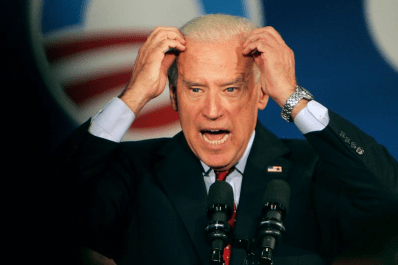 WASHINGTON – Joe Biden is preparing to ask Congress for the biggest Defense Department budget in history despite concerns about the US hitting its debt ceiling before lawmakers raise it – a request that will include funding to restock munition stockpiles to support Ukraine, where both sides are expending thousands of rounds a day.
The Biden administration is very close to finalizing a topline number for the Defense Department as part of its 2024 budget request set to be released next month, a US media reported, citing Pentagon Comptroller Michael McCord.
“I do expect it will be a bigger number than Congress provided last year,” McCord is quoted as saying in an interview. The Pentagon will invest in munitions to restock the US’ arsenal and continue supporting Ukraine, McCord also reportedly said, where thousands of rounds a day are being expended by both sides.
Biden’s budget proposal comes as the US approaches its debt ceiling without a clear plan by Congress to raise the limit, posing a potential risk to the country’s credit rating and economic future.
EU applicant government to be replaced
Moldova’s prime minister has stepped down amid allegations of crackdowns on dissent
RT | February 10, 2023
Moldovan Prime Minister Natalia Gavrilita resigned on Friday, which means that the entire cabinet of the economically-troubled and politically-unstable nation will have to change.
Gavrilita did not divulge the reasons behind her decision in her farewell speech, which focused on what she described as the achievements of her team during her short-lived tenure.
“I am proud to have accelerated infrastructure projects that were stagnating due to incompetence and corruption,” the politician said. Her government “preserved peace and economic stability” despite efforts by “agents of destabilization,” she added.
Gavrilita announced her resignation after holding a meeting with Moldovan President Maia Sandu, who accepted it immediately. In a Facebook post, the president thanked the former PM for her efforts in governing Moldova at a time of “unprecedented challenges.”
The outgoing cabinet took the helm in August 2021, after the Sandu-founded Party of Action and Solidarity won a snap election a month earlier. Rumors about the government’s imminent collapse have been swirling in Moldova since Monday.
For months last year, the government in Chisinau faced mass protests over rising energy prices and worsening standards of living, which followed a feud with Russian gas giant Gazprom over the terms of fuel supplies. The demonstrations also had a political aspect, as the government was accused of cracking down on the opposition.
Former president Igor Dodon, whom Sandu beat at the ballot box in 2020, is facing a number of criminal charges, ranging from corruption and illegal campaign financing to falsifying medical documents. His supporters believe the investigations are politically motivated, since Dodon, an advocate of good relations with Russia, has been criticizing Sandu’s pro-Western stance.
Amid the protests, the government forced several Russian-language media outlets to go off air when it refused to renew their broadcasting licenses in December. Since October, Moldova has been living in a state of emergency, which the opposition claims is just a method of preventing mass gatherings of discontent citizens.
Russian Foreign Minister Sergey Lavrov assessed last week that Moldova may become “a new Ukraine” in the sense of adopting anti-Russian policies despite how much they may hurt the country. He said Sandu was a major factor, because she was ready to do “practically anything” to further her pro-Western agenda.
Last June, the EU granted Moldova a candidate status alongside fellow applicant Ukraine.
Featured Video

ARE PATIENTS BEING PROPERLY INFORMED ABOUT OZEMPIC?
or go to
Aletho News Archives – Video-Images
New Book
Breast Cancer: Before You Consent
A new Unbekoming paperback
Lies are Unbekoming | September 18, 2026
Peter Gøtzsche reviewed every randomised mammography screening trial ever conducted for the Cochrane Collaboration. Cochrane’s headline is that, assuming a 15% mortality reduction, one woman in 2000 avoids dying of breast cancer over ten years. Ten are overdiagnosed and treated. Two hundred experience false alarms.
But that headline assumes the reduction. When Gøtzsche looked only at the trials with adequate randomisation — the higher-quality ones — the reduction disappeared. No effect on breast cancer mortality. No effect on all-cause mortality.
This is the Cochrane finding, published in the establishment’s own database of systematic reviews.
No woman being asked to consent to a mammogram this week knows it.
That is why the new Unbekoming paperback exists. … continue
Blog Roll
 Aletho News
- The Truth About the Trump Shootings with Ken Silva
- ARE PATIENTS BEING PROPERLY INFORMED ABOUT OZEMPIC?
- US lawmaker blocks $2.8 billion weapons sale to Israel: Report
- Yemeni army claims responsibility for strikes on sensitive sites in Saudi capital, Aramco facilities in Yanbu
- Iran Judiciary issues indictments against 159 US, Israeli officials for assassination of Leader, commanders
- Turkiye revokes Iranian bank license under US sanctions campaign
- US-Denmark Agreement on Greenland Is ‘PR Stunt’ Ahead of Midterms
- Araghchi: Military intervention cannot create security; coercion cannot bring peace
- Fraud Squared
- Breast Cancer: Before You Consent
- If Americans Knew
- Inside Gaza’s death trap of collapsing, bombed-out buildings
- The everyday items Israel bans from Gaza every day
- Inside the siege, the ruined buildings of Gaza – Daily Update
- Debunking The Claim That Macklemore Has A “History Of Antisemitism”
- CPJ demands release of arrested Palestinian-US journalist near Bethlehem
- Robert Kraft: The Billionaire Friend of Netanyahu Pulling The Strings Behind the Macklemore/Ed Sheeran Blow Up
- Columbia Administered Fund Gives Big Money to Pro-Israel Groups
- Deportation Case of Palestinian Activist Salah Sarsour Tests First Amendment
- ‘We Will Not Forget’: Palestinians Mark 44 Years since Sabra and Shatila
- Why do we let Zionists decide what we can and can’t say?
- No Tricks Zone
- 2025 Nature Paper Claiming Worsening Global Drought Gets RETRACTED …Heavily Flawed
- New Study: ‘Global Drought Shows No Detectable Recent Acceleration Under Climate Warming’
- Economic Masterminds: German Socialists Suggest Taxing Productivity Gains Stemming From Using AI
- The South China Sea Has Not Been Cooperating With The Climate Change Narrative
- Energy Crisis: Germany Enters Heating Season With Historically Low Gas Reserve Fill Levels
- New Study: The Antarctic Ice Sheet Gained Mass From 2020-2024 Due To Staggering Snow And Ice Accumulation
- Study: Ocean Heating Rates From Thousands Of Years Ago ‘Dwarf’ Modern Ocean Heating Rates
- Climate Extremists Target, Attack Large-Scale Power Grid Infrastructure In Germany!
- New Study: Antarctic Ice Melt Has Contributed Less Than 1 Centimeter To Sea Level Rise In The Last 30 Years
- Fear Of Debate: Alarmist German Climate Scientist Calls On Mainstream Media To Discredit Skeptic Voices
 Aletho News