Iran, India recalibrating ties amid geopolitical shifts
‘Not a choice, but necessity’
By Zafar Mehdi | The Cradle | December 1, 2022
“Not a choice, but a necessity.” That’s how Iran’s Deputy Foreign Minister Ali Bagheri Kani stressed the importance of closer strategic and economic ties between Tehran and New Delhi during his visit to India in November.
Kani had a message for Prime Minister Narendra Modi from Tehran – strategic synergy is a win-win proposition for the two sides amid the shifting geopolitical and geo-economic landscape in the wake of the Ukraine war and the new world order.
Before the Trump administration reinstated sanctions on Iran in 2018, Iranian oil comprised nearly 11 percent of India’s total oil basket. However, New Delhi buckled under US pressure and stopped importing oil from Tehran in a move that hampered their cooperation in other strategic areas.
Three years down the line, amid rapidly changing geopolitical power dynamics and the end of “the era of the unipolar world,” as announced by Russian President Vladimir Putin in June, India has become keen on recalibrating its ties with Iran, a traditional ally, in the midst of an energy crisis gripping the world.
It is worth noting that Russia became the biggest oil supplier to India in October, supplying 935,556 barrels of crude oil per day, according to energy cargo tracker Vortexa, making up for 22 percent of the energy-dependent country’s total crude imports, ahead of Iraq’s 20.5 percent and Saudi Arabia’s 16 percent.
Iran as an alternative energy supplier
Faced with a burgeoning demand for oil and gas amid the global energy crisis and recent oil cuts by the OPEC+, India now looks poised to resume oil imports from Iran, defying US sanctions, The Cradle learned from sources in Tehran and New Delhi.
Interestingly, India’s petroleum minister Hardeep Puri hinted at it during his visit to Washington in October, saying New Delhi will buy oil from wherever it has to. Russia, as we know, is already shipping oil to India, despite strong US pressures.
Talks are currently underway between India and Venezuela, especially with the US easing oil-related sanctions against Caracas. This, by extension, has opened a window of opportunity for India and Iran to revive their energy trade. The good news is that both sides look interested.
Iran has already expressed its readiness to resume energy trade with India. Last month, newly-appointed Iranian ambassador to New Delhi, Iraj Elahi, announced that Iran is willing to provide low-cost crude oil to India to ensure the country’s energy security, something top Indian officials have in recent months cited as the government’s priority.
A win-win proposition
In 2018-2019, India purchased $12.11 billion worth of crude oil from Iran, which plummeted to zero in May 2019 after the significant reduction exemption (SRE) period ended.
Likewise, trade between the two countries dropped from $17.3 billion in 2018-2019 to $4.77 billion in 2019-2020. Although it has ultimately failed to achieve its objectives, Washington’s “maximum pressure” campaign had a negative impact on India-Iran relations.
However, ties have since markedly improved, as evidenced by Bagheri Kani telling the Indian press that the Islamic Republic is ready to meet the country’s growing energy needs, while India can in turn contribute to Iran’s food security as a major food producer.
This, he asserted, would help in boosting the process of multilateralism in the international system, which essentially means the death of US unilateralism more than three decades after the end of the Cold War and the collapse of the former Soviet Union that paved the way for the era of the unipolar world.
Suhasini Haidar, diplomatic affairs editor at The Hindu and a leading Indian analyst, termed Bagheri Kani’s visit to India as “significant,” saying it “shows a commitment to India-Iran ties by both governments despite geopolitical divides in the world on issues like the Ukraine war.”
Penalized by US sanctions
Haidar described Iranian crude as “sweeter, lighter, cheaper, and easier to transport to India than other options,” calling the Indian government’s decision to cut Iranian imports “irrational.”
“It was irrational of the Modi government to have canceled India’s imports of Iranian oil under threat from the Trump administration, and it would make sense if they decided to restore the oil trade between the two countries,” she told The Cradle.
Haidar said it remains to be seen if the Modi government will be willing to resume oil imports from Iran, “despite several signals that both sides are exploring their options,” especially after the latest sanctions on an Indian company transporting Iranian oil.
Mumbai-based Tibalaji Petrochem Private Limited was sanctioned in late September for shipping Iranian petrochemical products to China. It was the first time an Indian company was sanctioned by the US for dealing with Iran.
In his meeting with his Indian counterpart Vinay Mohan Kwatra, Bagheri Kani pointed to the “necessity” of regional cooperation between the two countries, which he said would “take away the opportunity from foreigners to exploit the lack of cooperation.”
The sentiments were mutual as India’s foreign ministry spokesman, in a statement following Bagger Kani’s meeting with Kwatra, said the two officials “discussed bilateral relations, including the development of Chabahar Port” and “regional and international issues of mutual interest.”
Time to shore up ties
According to observers, the time is now ripe for the two sides to shore up bilateral ties and multilateral cooperation, with Tehran set to become a full member of the Shanghai Cooperation Organization (SCO) as well as the BRICS group, given its close ties with Russia and China.
Notwithstanding existing challenges, Iran and India share mutual interests in trade and connectivity. Iran’s full SCO membership could prompt the two sides to focus more on connectivity projects like the Chabahar Port, which links with the International North-South Transport Corridor (INSTC), the multi-mode network of ships, rail and roads for moving freight between India and Iran, among other countries.
“India and Iran have important trade needs, including in wheat, pulses and commodities, as well as oil reserves. And the connectivity engagement is very important for India through Chabahar and through the INSTC,” Haidar explained.
Importantly, in recent years, Chabahar Port in Iran’s southeastern Sistan-Baluchestan province has emerged as a key area of cooperation between Tehran and New Delhi, which will provide India access to Afghanistan and Central Asia through Iran, ending its reliance on arch-rival Pakistan.
Rezaul Hasan Laskar, the foreign affairs editor at Hindustan Times, says the strategic port has “become more important following its growing use” but that “it needs to be connected to Iran’s railway network.”
While the first section of the Zahedan-Chabahar railway line is nearing completion, official sources in Tehran said the agreement between the two sides to construct the 628-kilometer (390 miles) railway line had faced “serious impediments” due to New Delhi’s reluctance to start work fearing US sanctions.
“Despite India’s close ties with the US and Israel, its decision to build strategic ties with Iran, and Iran’s according special projects to India like Chabahar Port despite its ties with China are a constant reminder of this special relationship,” Haidar told The Cradle.
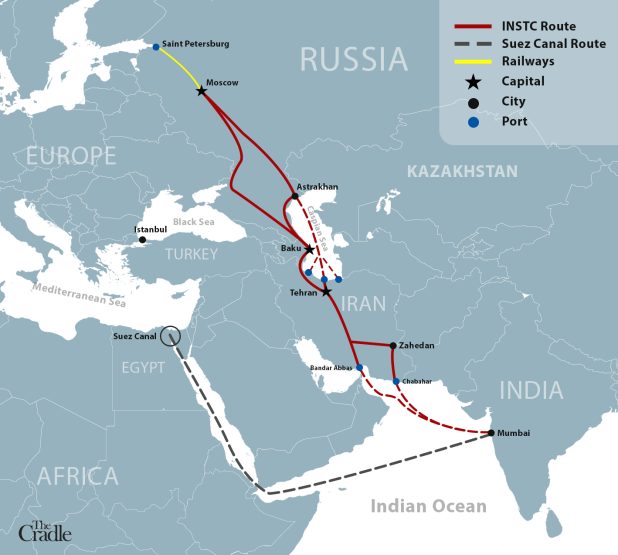
Map of the International North-South Transport Corridor (INSTC)
Joint cooperation with Beijing and Moscow
Sources in Tehran and New Delhi said the use of rupee-rial trade was also “seriously considered” during Bagheri Kani’s New Delhi visit, with both sides agreeing that a banking mechanism that is not tied to the west is key to strengthening the process of multilateralism, and paving the way for the resumption of trade.
Laskar of Hindustan Times confirmed that the senior Iranian diplomat “reiterated Iran’s offer to resume oil supplies and raised the issue of trade in national currencies.”
The changing geopolitical landscape in the wake of growing anti-western mechanisms, including SCO and BRICS, led by China and Russia, is also likely to propel increased cooperation between Tehran and New Delhi.
Laskar, however, believes that the SCO has not been a particularly crucial grouping for India in recent years, “largely because of the tensions with China,” adding that India’s biggest concern about the expansion of BRICS is that “it shouldn’t become a China-centric grouping,” underlying Sino-India tensions.
Meanwhile, Russia remains a common ally of India and Iran, which is evident in Moscow and New Delhi looking to ramp up trade via Tehran along the INSTC – the strategic route that has assumed tremendous significance since the start of the Ukraine war.
The decision to boost INSTC trade, according to reports in Indian media, was high on the agenda during Bagheri Kani’s India visit, as Russia now looks set to invest in the Chabahar Port. According to sources, the war in Ukraine also figured prominently in Bagheri Kani’s talks with Indian officials. Both sides agreed on maintaining a “neutral stance” on the war and increased engagement with Moscow.
“Russia is the new game-changer in the region, especially after the realignment of power centers, and that is good news for India-Iran ties,” an Iranian diplomat stationed in South Asia told The Cradle.
Zelensky’s $1 trillion ‘reconstruction’ pipe dream

By Drago Bosnic | December 1, 2022
It’s safe to say the world has gotten used to mind-blowing statements coming from the detached Kiev regime, as this has become their common theme. Apart from boastful claims of supposed “victories” of the Neo-Nazi junta forces against the Russian military, talks of how much financial assistance is necessary is the usual topic in Kiev. The regime frontman Volodymyr Zelensky is never tired of demanding yet another few billion dollars (euros and pounds are good enough, too) per month to support the political West’s favorite puppet regime. However, his most recent statements make every other demand look entirely “reasonable”. Namely, the Kiev regime frontman now wants over $1 trillion for the supposed “reconstruction” of the country.
During a video address on November 29, Zelensky stated that it would cost more than $1 trillion to “rebuild” Ukraine. If the number sounds astounding, that’s quite expected, given that it’s over five times the country’s 2021 GDP. However, even this sounds laughable when the second requirement is listed – this “reconstruction” plan would come into effect only after the military superpower with over 6,000 thermonuclear warheads next door is somehow “defeated”. Many have ignored Zelensky’s mind-boggling statements regarding this matter, but he keeps insisting that this is precisely what the Kiev regime needs.
“The reconstruction of our country will become the most momentous economic, technological, and humanitarian project of our time. Even now, we engage dozens of our partner countries to rebuild Ukraine,” Zelensky said during his late-night video address on Tuesday, according to a report translated by Newsweek. “The total volume of work amounts to over a trillion dollars,” he added.
Zelensky mentioned the figure while talking about his hopes that the country would host the World’s Fair in 2030. Another interesting aspect of the plan was that foreign governments and corporations could become “permanent sponsors of specific regions, cities or economic sectors”. Apart from being unrealistic, Zelensky’s ideas are also boiling down to the direct colonization of Ukraine. By giving control of different regions of the country to “permanent sponsors”, the Neo-Nazi junta frontman is effectively fracturing what’s left of the country and giving it to foreign corporate interests in a free-for-all exploitation scheme.
According to Western-backed, Latvia-based news outlet “Meduza”, Zelensky is hoping to develop a system that will allow “partner countries” to become “patrons” of Ukrainian regions, cities or businesses. “We’re already seeing interest [in the program] from France, Great Britain, The Netherlands, Germany, Denmark, Finland, Italy, Turkey, Poland, Portugal, Czechia, Slovenia, Latvia, Estonia, Switzerland, Slovakia, Austria, Greece, Canada, the U.S., Japan, and Australia. And that’s not an exhaustive list,” he said.
Interestingly, the mind-blowing $1 trillion figure was mentioned by Zelensky at least once before, but it somehow went under the radar of most mainstream media. The first time he mentioned it publicly was on September 6, when he was invited to virtually “ring” the opening bell at the New York Stock Exchange. Zelensky used this unique opportunity to float the idea and initially appealed for “at least” $400 billion in foreign funds. “The general project of Ukrainian reconstruction will be the largest economic project in Europe of our time. The largest for several generations. Its volume is already estimated at hundreds of billions of dollars,” he stated at the time and then added: “And with the necessary modernization of the Ukrainian infrastructure, taking into account security needs, it is more than a trillion dollars and in a fairly short term – less than ten years.”
As previously mentioned, the country’s GDP was just over $200 billion in 2021, according to official data from the World Bank. This effectively means that the Kiev regime is demanding others invest half a decade’s worth of Ukrainian “peacetime” GDP. Although this may seem like a dumbfounding request, what’s even more staggering is the fact that at least one US-based think tank already backed the proposal. The renowned Washington DC-based Center for Strategic and International Studies (CSIS) openly supported the idea, claiming that “it would provide strategic benefits to the United States.”
In a November 22 report titled “United States Aid to Ukraine: An Investment Whose Benefits Greatly Exceed its Cost”, CSIS authors argued the following: “In practice, Ukraine cannot continue to fight and to recover without continuing aid from the US and other powers. Moreover, if the war drags on as it well may do, the total costs of both the war and recovery states could easily rise well over $500 billion. A truly long war could put the total cost of the war and recovery to a trillion dollars or more.” The report further states: “So far, there has been only limited domestic political resistance in the United States to continuing civil and military aid to Ukraine.”
This clearly implies that the authors think the US government should always insist on more financial “assistance” to the Kiev regime and push back against anyone trying to focus on mounting domestic issues. Given just how corrupt the Neo-Nazi junta is, it’s hardly surprising there’s a lack of enthusiasm for this idea among many in the US. The recent FTX-Kiev regime-DNC scandal, along with the fact that Washington DC cannot account for over $20 billion in previous “aid” provided to the Neo-Nazi junta, all serve as a testament to the skepticism many Americans feel in this regard. Considering the current state of the US (and global) economy, who could possibly blame them.
Drago Bosnic is an independent geopolitical and military analyst.
College Graduates Are the New Favored Class of Democratic Largesse
By Jim Bovard | The Libertarian Institute | November 28, 2022
When Americans make lists of the persecuted, downtrodden groups in our society, college graduates rarely top the ranking. But President Joe Biden is offering one bribe after another to convert college graduates into perpetual dependents of the Democratic Party. Biden’s handouts helped prevent a “red wave” of Republican victories on Election Day and he appears hellbent on forcing taxpayers to pay any price to continue buying votes for his party.
Federal subsidies for higher education have been one of the least recognized boondoggles of recent decades. Federal-backed loans for higher education took off in the 1960s and have skyrocketed in this century. Almost $2 trillion in federal student loans are owed by 46 million people.
Federal aid spurred tuition increases that make it far more difficult for unsubsidized students to afford higher education. A student’s financial “need” is defined largely by tuition fees. Every tuition increase means an increase in federal aid for students—and thus an increase in the federal aid for the college. A 2012 study by the Center for College Affordability and Productivity concluded that financial aid “inevitably puts upward pressure on tuition. Higher tuition reduces college affordability, leading to calls for more financial aid, setting the vicious cycle in motion all over again.” A 2015 Federal Reserve analysis “found that for every new dollar made available in federally subsidized student loans, schools…rose their rates by 65 cents.”
Federal policies have helped turn young people into a debtor class perpetually clamoring for relief from its burdens. Rather than seeing the federal government as a potential peril to their rights and liberties, some debt-burdened young adults view it as the “Great Liberator”—presuming the right candidate is elected.
Rather than ending the perverse incentives embedded in federal aid, Biden “solved” the problem by canceling borrowers’ obligation to repay their subsidized loans. On August 24, Biden invoked an obscure provision of the post-9/11 Heroes Act to justify hundreds of billions of dollars of handouts to people who had taken out federal college loans. The Heroes Act permits the Education Department “to waive or modify student loan payments in times of national emergency.” Individuals earning less than $125,000 could have up to $20,000 in federal debt automatically erased; couples earning $250,000 could see a $40,000 forgiveness windfall.
Biden had previously admitted that the law would not justify blanket forgiveness of college loans, but he and his advisors decided to force Americans to pay any price for Democrat votes in the midterm congressional elections. The Department of Education justified Biden’s decree as “a program of categorical debt cancellation directed at addressing the financial harms caused by the COVID-19 pandemic,” including “cancellation for borrowers who have been financially harmed because of the COVID- 19 pandemic.” But college graduates were doing much better financially than other Americans who get stuck with the bill for their schooling. Their unemployment rate was less than two percent at that time.
Former Education Department lawyer Hans Bader estimates that the total cost of Biden’s student loan write-offs could exceed a trillion dollars. A Wall Street Journal editorial headlined “Biden’s Half-Trillion-Dollar Student-Loan Forgiveness Coup” derided his decision as “easily the worst domestic decision of his Presidency.” The Journal pointed out that Biden based the loan cancellation for more than 40 million borrowers “on no authority but his own” power as president. “This is a college graduate bailout paid for by plumbers and FedEx drivers,” the Journal noted. As former OMB director David Stockman observed, “Student debt is overwhelmingly an investment in professional credentialization that should never have been an obligation of the taxpayers in the first place.” ZeroHedge quipped on Twitter: “Have colleges raised tuition by $10,000 yet or are they waiting a few days first?”
There was no rationale for blanket cancellation of student debts that would not justify blanket cancellation of almost any debt citizens owed to the government. At the same time that Biden played Santa Claus with student loan forgiveness, his administration was hiring 87,000 new IRS agents and employees to squeeze more money out of working Americans.
The handouts helped buy Democrats their biggest boost among voters — a 28% advantage over Republicans in voters age 18 to 29 in the mid-term elections. Two days after the election, Biden tweeted, “I want to thank the young people of this nation” who voted for “student debt relief.” Jon Cooper, a former top Biden campaign operative, tweeted, “Young people: You saved our butts. THANK YOU.”
Two days after the election, federal judge Mark Pittman struck down the bailout as an unconstitutional decree: “In this country, we are not ruled by an all-powerful executive with a pen and a phone. Instead, we are ruled by a Constitution that provides for three distinct and independent branches of government.” Pittman rejected the “emergency” basis of the order in part because Biden had proclaimed in September on “60 Minutes” that “the pandemic is over.” The following week, a federal appeals court in St. Louis unanimously voted to impose a nationwide “injunction considering the irreversible impact the Secretary’s debt forgiveness action would have” on “Americans who pay taxes to finance the government.”
Some activists believe Biden intentionally swindled young voters with a bait-and-switch scheme. Briahna Joy Gray, who was the press secretary for Bernie Sanders’ 2020 presidential campaign, asked, “Did Biden RIG student debt forgiveness to fail, just to help him in midterms?” She explained on Twitter: “They used the promise of student debt cancellation to induce young voter turn out—knowing it wasn’t going anywhere [because] they relied on faulty legal authority. Hard to convince me the Biden admin didn’t do this intentionally.” A student activist group called the Debt Collective is circulating a petition: “I refuse to pay a debt the President promised to cancel.”
Biden came up with a Solomonic solution—sawing taxpayers in half—to placate his enraged supporters. He announced on Twitter, “Republican special interests and elected officials sued to deny this relief even for their own constituents. It isn’t fair to ask tens of millions of borrowers eligible for relief to resume their student debt payments while the courts consider the lawsuit.” On November 22, Biden announced that he was extending the moratorium on repaying student debt until August 2023. That moratorium began in March 2020 during the first COVID lockdowns and has already cost taxpayers $155 billion, according to the Committee for a Responsible Federal Budget. When Biden announced his loan forgiveness decree in August, he promised, “The student-loan payment pause is gonna end. It is time for the payments to resume.” Biden betrayed that promise, apparently believing that no one should be obliged to fulfill their legal obligation as long as there was a snowball’s chance in hell that some judge would uphold his scheme. Extending the loan payment moratorium could give a crucial boost to Democratic Sen. Raphael Warnock, locked in a tight December 6 run-off election.
What happens when the latest moratorium extension ends in August 2023? Biden may be formally kicking off his re-election campaign at that time. And what better way to buy support than by extending a handout to one of his most important constituencies? In the 2022 mid-term elections, “52 percent of voters with college degrees supported Democrats while 42 percent of voters without degrees did so,” The Washington Post reported.
Protecting former students from the federal debts they voluntarily accepted has become one of the great human rights issues of our times. Michael Pierce, chief of the Student Borrower Protection Center, is calling for Biden to “make it clear that the student loan system will remain shut off as long as these partisan legal challenges persist. Borrowers’ fate is in Biden’s hands.”
And this is the ultimate problem for democracy. Student loan bailouts have extended Biden’s power over a huge swath of American voters. Each new federal benefit program extends political control over both the recipients and anyone forced to finance the handouts. Speaking to an AFL-CIO convention earlier this year, Biden shouted, “I don’t want to hear anymore of these lies about reckless spending. We’re changing people’s lives!” “Changing” means controlling—but only for their own good, or at least for the re-election of their benefactors
French philosopher Bertrand de Jouvenal warned, “Redistribution is in effect far less a redistribution of free income from the richer to the poorer, than a redistribution of power form the individual to the state.” If Biden’s loan repayment moratorium is extended through 2024, “a typical medical student who graduated in 2019 would effectively have $107,000 forgiven and a law school graduate would have $65,000 forgiven… New doctors receive almost ten times the benefit of the average borrower and $107,000 more than someone who never attended college,” the Committee for a Responsible Federal Budget reported. Even The Washington Post editorial page slammed Biden’s student debt forgiveness decree as a “regressive, expensive mistake.”
But the inequity is irrelevant if the handouts enable Biden and his Democratic colleagues to perpetuate their grip on power. As legal fights over loan bailouts continue, Americans will continue to be assailed by claptrap about ex-students as a holy class of martyrs—or at least oppressed victims. But most of the self-proclaimed “best and brightest” are not smart enough to recognize how they have been converted into tools for Leviathan.
Jim Bovard is the author of Public Policy Hooligan (2012), Attention Deficit Democracy (2006), Lost Rights: The Destruction of American Liberty (1994), and 7 other books.
Germany has no alternatives to Russian gas – MP
RT | November 29, 2022
Germany still has no way of completely replacing Russian natural gas, even after reaching a supply agreement with Qatar, the chairman of the Bundestag committee on energy, Klaus Ernst, warned on Tuesday.
A long-term energy agreement was announced earlier in the day, under which the Gulf state will ship up to two million tons of liquefied natural gas (LNG) a year to Germany, starting from 2026. The deal will reportedly last at least 15 years.
“The federal government celebrates its LNG deal with Qatar and boasts big numbers. The fact is, these two million tons of LNG correspond to three percent of German gas consumption. There are still no real alternatives to Russian gas!” the politician from The Left party wrote on Twitter.
According to Bloomberg, the deal with Qatar equates to about 6% of the volume of Russian gas Germany imported in 2021. The fuel will come from ConocoPhillips’ joint ventures in Qatar, and will be delivered to the Brunsbuttel floating import terminal, which is under construction.
The news agency specified that the five import facilities chartered by the German government will cost a total of €6.5 billion ($6.7 billion) over the next 10 to 15 years. There is also one privately chartered terminal planned. Once operational, they will be able to cover around one third of Germany’s current gas demand, according to a government estimate, cited by Bloomberg.
Germany, Europe’s biggest economy, relies mainly on natural gas to power its industry, and has pledged to replace all Russian energy imports by as soon as mid-2024.
Vladimir Putin’s Vision of a Multipolar World An end to US hegemony?
BY PHILIP GIRALDI • UNZ REVIEW • NOVEMBER 29, 2022
In history books as well as in politics every story is shaped by where one chooses to begin the tale. The current fighting in Ukraine, which many observers believe to already be what might be considered the opening phase of World War 3, is just such a development. Did the seeds of conflict arise subsequent to Russian leader Mikhail Gorbachev’s consent to the dissolution of the Soviet Union in 1991 after having received a commitment from the United States and its allies not to advance the West’s military alliance NATO into Eastern Europe? That was a pledge that was quickly ignored by President Bill Clinton, who intervened militarily in the former Yugoslavia before adding new NATO members from amidst the ruins of the Warsaw Pact.
Since that time NATO has continued its expansion at the expense of Russian national security interests. Ukraine, as one of the largest of the former Soviet republics, soon became the focal point for potential conflict. The US interfered openly in Ukrainian politics, featuring frequent visits by relentlessly hawkish Senator John McCain and State Department monster Victoria Nuland as well as the investment of a reported $5 billion to destabilize the situation, bringing about regime change to remove the pro-Russian government of Viktor Yanukovich and replace it with a regime friendly to America and its European allies. When this occurred it inevitably led to a proposed invitation to Ukraine to join NATO, a move which Moscow repeatedly warned would constitute an existential threat to Russia itself.
Finally, Moscow tried assiduously to negotiate a solution to the developing Ukraine crisis in 2020-2021 but the US and its allies were not interested, allowing the corrupt Ukrainian government of Volodymyr Zelensky to refuse any accommodation. So Russia itself has perceived that it has been misled or even lied to repeatedly by the US and its allies. It has been particularly vexed by the looting of its natural resources by mostly Western oligarchs operating under protection afforded by the feckless President Boris Yeltsin between 1991 and 1999, a puppet installed and sustained through US and European interference in the Russian elections. Just when Russia was on its knees, perhaps intentionally, there arrived on the scene in 1999 former KGB officer Vladimir Putin who, as Prime Minister and later president, proceeded to clean house. Ever since that time, Putin has very carefully explained himself and what he has been doing, making clear that he is no enemy of the West but rather a partner in a relationship that respects the interests and cultures of all players in a global economy that maximizes freedom and individuality.
Given the danger of dramatic escalation of the current situation in Ukraine, with talk coming from both sides about the conditions for the use of nuclear weapons, an October 27th speech made by President Vladimir Putin at the 19th meeting of the Valdai International Discussion Club, held near Moscow, should be required reading for the Joe Bidens and Jens Stoltenbergs of this world. The theme of the meeting was A Post-Hegemonic World: Justice and Security for Everyone. The four day-long session included 111 academics, politicians, diplomats and economists from Russia and 40 foreign countries, including Afghanistan, Brazil, China, Egypt, France, Germany, India, Indonesia, Iran, Kazakhstan, South Africa, Turkey, Uzbekistan and the United States. In his speech, Putin laid out his vision of a multipolar world in which there is no concept of a politically hegemonic “rules based world order” which substitutes “rules for international law.” And, he observed, the rules have themselves been regularly dictated by one country or group of countries. Putin instead urged a transition into a willingness to accept that all countries have interests and rights that should be respected.
Interestingly enough, Putin, since assuming leadership of his country, has been unwavering in his demand that all countries in the world be granted respect, by which he means that local interests and cultures must be considered legitimate and worthy of acceptance by all as long as they permit individual freedom and are similarly respectful of the interests and national traits of others.
A relaxed and jocular Putin spoke for over an hour in his opening remarks and then fielded questions for another two and a half hours from the audience. In response to a question, he assessed the sanity of White House advisers who would “spoil relations with China at the same time they are supplying billions-worth of weapons to Ukraine in a fight against Russia… Frankly, I do not know why they are doing this… Are they sane? It seems that this runs completely counter to common sense and logic… This is simply crazy!”
The Russian president emphasized several points which elaborated his views. First, he observed that US/Western hegemony “denies the sovereignty of countries and peoples, their identity and uniqueness, and disregards any interests of other states… [The] rules-based world order” only empowers those making the “rules.” Everyone else must obey or face the consequences.
Putin also decried the West’s tendency to make rules and then ignore them when circumstances change. He noted how economic sanctions and “cancel culture” are being used cynically to weaken local economies while also demeaning the cultures and national traits of foreign adversaries. He observed, for example, how Russian writers and composers are being banned purely to send a political message and punish Moscow for its foreign policy.
Putin explained that Russia is an “independent, original civilization” which “has never considered itself an enemy of the West.” Moscow “simply defends its right to exist and develop freely. At the same time, we ourselves are not seeking to become some kind of new hegemon.” He then provided his analysis of what it developing, saying that the world is confronting a global storm which no one can ignore. “We are standing at a historic milestone, ahead of what is probably the most dangerous, unpredictable and at the same time important decade since the end of World War II. The West is not able to single-handedly manage humanity, but is desperately trying to do it, and most of the peoples of the world no longer want to put up with it.” We can decide “either to continue to accumulate a burden of problems that will inevitably crush us all, or to try together to find solutions, albeit imperfect, but working, capable of making our world safer and more stable.”
So, Vladimir Putin is issuing a call to arms for a transition to a multipolar world, which will inevitably change the playing field both in international relations and in the global economy. No longer will the United States and its allies be able to claim “rule of law” when using coercive force to punish competitors. The drift away from using dollars as the world’s reserve currency, mostly for energy transactions, is already taking place as major trading partners like India, China and NATO member Turkey have ignored restrictions while continuing to buy up Russian energy exports, negating to a certain extent the sanctions put in place by Washington and Europe. The death of dollars as the reserve currency will make it more difficult for the US Treasury to print money without any backing as many nations will no longer be willing to accept what will be increasingly seen as a fiat currency produced by a government that is actually drowning in debt.
Putin might, of course, be proven wrong and the current global system might well be able to limp along for the foreseeable future. But if he is right, those developments transitioning into a multipolar world would mean a de facto decline and fall of the United States as the world hegemon while anything even remotely like a dollar collapse would have catastrophic effect on the US import driven economy as well as on ordinary Americans. Some kind of partial default on US Treasury debt is not unimaginable. And Putin might well be right in his prediction that the change is coming and there is nothing that the United States and its friends can do to stop it.
In any event, the political and economic adjustments that are certainly coming in one way or another will certainly play out as the Ukraine conflict continues to simmer. The tragedy is that what is developing is self-inflicted, completely avoidable and unresponsive to any actual United States interest, but that is another story. If Ukraine turns to open warfare with more direct US involvement and economic dislocation, international pressure to dismantle the post-World War 2 status quo will inevitably increase. No matter how it develops, what is occurring right now will force the perennially tone-deaf politicians in and around the White House to begin to rethink America’s place in the world and its options as a major power. No one can predict how that will go and the process will make compelling theater as America’s two major political parties take up positions to make the case that the other party is solely at fault. It is impossible to foresee how far that bloodletting will go.
Philip M. Giraldi, Ph.D., is Executive Director of the Council for the National Interest, a 501(c)3 tax deductible educational foundation (Federal ID Number #52-1739023) that seeks a more interests-based U.S. foreign policy in the Middle East. Website is councilforthenationalinterest.org, address is P.O. Box 2157, Purcellville VA 20134 and its email is inform@cnionline.org.
Gazprom to mothball Nord Stream pipelines – Kommersant
RT | November 28, 2022
Russian energy major Gazprom is planning to shutter the Nord Stream gas pipelines and compressor stations, the Kommersant newspaper reported on Monday citing company sources. In September, both strings of Nord Stream 1 and one string of the Nord Stream 2 pipeline were damaged by explosions and are currently inoperable.
According to the report, gas-pumping equipment will not be moved from the Portovaya and Slavyanskaya compressor stations and will remain on site. This will help re-launch flows at short notice once the pipelines are restored.
Analyst Sergey Kondratyev of the Institute of Energy and Finance told the news outlet that the decision has merit, as it is now difficult to assess the timing of the repairs. Also, the transfer of equipment to other compressor stations is not viable, since Portovaya uses unique equipment. According to the expert, the work may take from three to five months and cost up to three billion rubles (around $50 million).
It is also unclear whether Gazprom will restore the pipelines at all. Machinery at the Portovaya compressor station was out of service long before the explosions due to a lack of proper maintenance amid Western sanctions on Russia.
“There is no answer to the question of how and why to restore the strings of Nord Stream if the pumps at Portovaya station are out of service,” Gazprom head Alexei Miller said last month.
Russia condemned the explosions that damaged the pipelines as an “act of international terrorism.” The Russian Defense Ministry said last month it suspects the British Navy to be involved, but London has denied the accusation. After their own probes, Sweden and Denmark both reported that the fractures in the pipelines were caused by explosions, but have not made suggestions as to who might be responsible.
EU accuses US of profiteering from Ukraine crisis
By Drago Bosnic | November 28, 2022
When talking about the political West, one of the most common misconceptions is that the thalassocratic power pole is a giant geopolitical monolith with a near-constant consensus on all matters. One of the pillars of the political West’s power is creating an illusion that precisely this is the case. By creating a semblance of uniformity on various questions, both internal (so-called “shared values”) and external (unified foreign policy framework), the political West is trying to hold everyone in line while also projecting the “right way” to the rest of the world. However, the power pole (primarily composed of the United States and European Union) has increasingly serious issues promoting its version of reality.
One of the most prominent indicators of diverging interests within the political West is the Ukraine crisis. Back in 2014, when the US-orchestrated coup brought the Neo-Nazi junta to power in Kiev, Victoria Nuland, then serving as the Assistant Secretary of State for European and Eurasian Affairs, famously (or rather infamously) used a common profanity to show how the US feels about the EU. It seems the bloc, although hardly innocent, as it took part in nearly every single US aggression against the world, is now slowly shifting toward a more independent position. Naturally, this process isn’t part of some selfless reckoning in Brussels, but a simple matter of basic interests and desire for self-preservation. It seems the EU is realizing that the damage it’s suffering from the failed siege of Russia is inversely proportional to what the US is experiencing.
There is growing frustration in the EU over America’s repeated rejections to push the Kiev regime to the negotiating table, especially as an unprecedented amount of weapons and munitions enter the country, risking a possible world-ending escalation. In addition, the EU populace continues being at the forefront of economic shockwaves resulting from the failed sanctions war. As winter temperatures kick in, the ongoing energy supply crisis is bound to get worse, putting additional pressure on EU economies. All the while, many European leaders, sitting comfortaby in their mansions, are parroting the same party line about the mythical “solidarity with Ukrainians” that the regular Europeans are apparently supposed to conduct through self-imposed bankruptcy and freezing to death.
All of this is creating political pressure on most EU governments, many of which have already fallen. And yet, some analysts see the hand of Vladimir Putin behind all troubles, instead of focusing on the very real shortcomings of their own system. According to Politico, “nine months after invading Ukraine, Vladimir Putin is beginning to fracture the West.” This somewhat surprising admission stands in stark contrast to the recent mainstream propaganda machine’s cheerleading. “Top European officials are furious with Joe Biden’s administration and now accuse the Americans of making a fortune from the war, while EU countries suffer,” the analysis by Politico reads.
To add insult to injury, the Biden administration continues rolling out various controversial “green” subsidies and taxes, all of which are extremely damaging to EU industries at a time when the Old Continent is being ravaged by the sanctions boomerang, in addition to the largely forgotten (but still hardly irrelevant) fallout of the COVID-19 pandemic. In a statement for Politico, an unnamed senior EU official also criticized the US policy of effectively using the Ukrainian crisis to fill the coffers of its Military Industrial Complex, while also turning a blind eye to European pleas for a peaceful resolution.
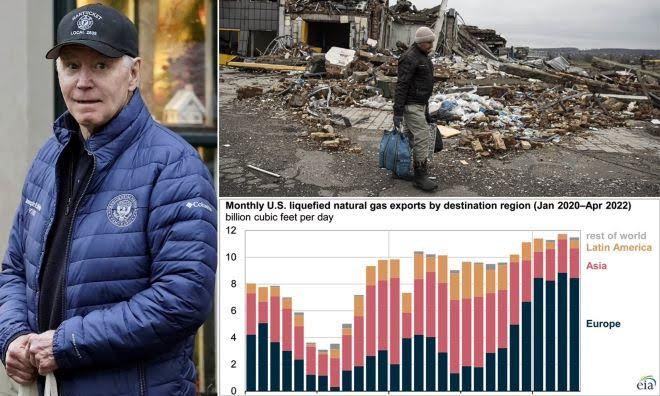
“The fact is, if you look at it soberly, the country that is most profiting from this war is the US because they are selling more gas and at higher prices, and because they are selling more weapons,” the senior EU official stated, adding, “We are really at a historic juncture,” arguing that “the double hit of trade disruption from the aforementioned US subsidies and high energy prices risks turning public opinion against both the war effort and the transatlantic alliance. America needs to realize that public opinion is shifting in many EU countries,” the official concluded.
And yet, the US National Security Council keeps insisting that the crisis is solely Russia’s fault. At the same time, Washington DC is quite content with the massive windfall its natural gas industry is experiencing, while also presenting the exorbitantly priced LNG deliveries to the EU as some “purely altruistic” endeavor aimed at “diversifying away from Russia.” Even the EU foreign policy chief Josep Borrell, who is anything but sympathetic to Russia, is now showing frustration and questioning the concept of a “united front to help Ukraine,” acknowledging to Politico, “Americans — our friends — take decisions which have an economic impact on us.”
Other senior EU officials have also become more outspoken about this glaring hypocrisy. “The United States sells us its gas with a multiplier effect of four when it crosses the Atlantic,” European Commissioner for the Internal Market Thierry Breton said on November 23 during an interview on French TV. “Of course the Americans are our allies… but when something goes wrong it is necessary also between allies to say it,” Breton concluded.
According to the Politico report, another EU diplomat stated that the $369 billion industrial subsidy scheme the Biden administration earmarked “to support green industries” as part of the Inflation Reduction Act “unleashed panic” across European capitals. “The Inflation Reduction Act has changed everything,” the EU diplomat said. “Is Washington DC still our ally or not?” he asked.
Drago Bosnic is an independent geopolitical and military analyst.
High fuel prices to kill more Europeans than Ukraine war this winter
Press TV – November 27, 2022
More people will die in Europe this winter because of energy costs than those who have perished on the battlefield in the Ukraine war, according to the British weekly The Economist.
The research said the current cost of energy will likely lead to an extra 147,000 deaths if there is a typical winter.
The British weekly modeled the impact of a sharp increase in electricity prices in Europe on deaths during the winter.
In case of mild temperatures using the warmest winter during the past 20 years for each country, this figure would fall to 79,000, a 2.7% increase. And with frigid ones, using each country’s coldest winter since 2000, it would climb to 185,000, a rise of 6.0%.
The analysis named the severity of the flu season and temperatures and energy prices as the main factors that affect how many people will die in Europe outside Ukraine this winter.
The model forecasts deaths based on weather, demography, influenza, energy efficiency, incomes, government spending and electricity costs, which are closely correlated to prices for a wide variety of heating fuels.
Italy is predicted to have the most deaths, owing to a nearly 200% rise in electricity costs since 2020 and a big ageing population.
Across Europe, 28% more people aged at least 80, who account for 49% of total mortality, die in the coldest months than in the warmest ones. On average, in a winter 1°C colder than normal for a given country, 1.2% more people die, according to the Economist statistics.
High fuel prices can exacerbate the effect of low temperatures on deaths, by deterring people from using heat and raising their exposure to cold.
Given average weather, the model finds that a 10% rise in electricity prices is associated with a 0.6% increase in deaths, though this number is greater in cold weeks and smaller in mild ones.
The report notes that due to Russian attacks on its infrastructure, Ukraine would suffer more civilian casualties than any other country in the model.
The number of soldiers thought to have died in Ukraine is estimated at 25,000-30,000 for each side.
Last week, European Commissioner for Economy Paolo Gentiloni warned that if the Ukraine war doesn’t end by the time next winter hits, Europe’s energy sector will face more serious risks than this year.
As a result of increasing Western sanctions on Russia, the price of gas and electricity for residential houses in Europe has increased significantly. Before the war, Russia supplied 40-50% of the European Union’s natural gas.
On Sunday, Russian Foreign Ministry spokesperson Maria Zakharova blamed European officials for the energy crisis and lack of fuel in the continent.
She said the European leaders “are forced to convince their citizens that the current situation is not only good and right, but also in their own interest.”
US Treasury Authorizes Chevron’s Transactions With Venezuela
Samizdat – 26.11.2022
The US Treasury granted Chevron a general license allowing transactions by the California-based energy major that service oil production in Venezuela and its export to the United States.
Transactions performed by Chevron’s joint ventures with Venezuelan state oil giant PdVSA are authorized as long as they are related to “production and lifting of petroleum or petroleum products produced by the Chevron JVs.”
Sale to, exportation to, or importation into the US of petroleum produced by the Chevron JVs will be allowed as long as it is first sold to Chevron.
Joint ventures will also be allowed to buy and import petroleum production-related goods into Venezuela, including diluents, condensates, petroleum, or natural gas products.
The license does not authorize transactions if the oil is exported anywhere other than the US, payments of taxes or royalties to the Venezuelan government, or transactions involving entities linked to Russia, among other caveats.
The United States is also willing to provide targeted sanctions relief to Venezuela in order to encourage negotiations between the Venezuelan government and the opposition, a senior US administration official said on Saturday.
“We have long made clear that we believe the best solution to Venezuela is a negotiated one between Venezuelans, and Venezuelan-led, and in order to encourage that… we are willing to provide targeted sanctions relief based on concrete steps that alleviate the suffering of Venezuelan people and bring them closer to a restoration of democracy through free and fair elections,” the US official said during a conference call.
Earlier this month, sources told Sputnik that the Biden administration is looking at Venezuela as an additional source for crude oil amid global energy market volatility, but has no intention of a blanket lifting of sanctions.
The US hopes to lower gasoline prices for US consumers following production cuts made by the Saudi-led OPEC+ group to stabilize the global market, the source said.
Finland to return hundreds of seized Russian rail cars
RT | November 26, 2022
The Finnish authorities have decided to give back Russian railcars detained earlier this year due to sanctions, Moscow’s trade mission in Finland said on Friday. According to its data, more than 800 loaded and empty railcars were seized as of early November.
The decision to return the railcars was made by the Ministry of Foreign Affairs on November 15 following an appeal from Finnish railway operators and the Finnish Transport and Communications Agency (Traficom). According to the appeal, the storage and maintenance of the trains turned out to be too costly and difficult for the rail system operators. In addition, it was noted that some of the railcars contained hazardous substances.
“On November 15, 2022, the Finnish Foreign Ministry decided to return the seized property exceptionally for reasons of reducing costs and security risks to the country’s transportation system,” the Russian trade mission said in its statement.
It noted that the Finnish bailiff service has already notified a number of Russian companies that own the railcars that they will be returned. The railway operators will conduct inspections of the trains and prepare them to be moved across the Russian-Finnish border. No specific dates for this have been announced.
In late May, Helsingin Sanomat newspaper reported that Finland was seizing €80 million-worth of Russian property, including more than 1,000 freight railway cars which occupied about 20km of tracks. The news outlet noted at the time that among the confiscated cargo were about 1.3 tons of acetic acid worth €1.4 million, 248 tons of butyl acetate, and iron ore pellets.
In June, Reuters reported that a total of 865 Russian railcars had been detained in Finland, citing the Finnish state railway operator, VR, and a letter from Russian Railways. The seized equipment largely belonged to Russian companies affected by the Ukraine-related EU sanctions. Among them were Uralhim-Trans, whose former owner, Dmitry Mazepin, fell under EU sanctions in March; Rusagrotrans, part of Demetra Holding, whose controlling stake was previously owned by sanctioned Russian lender VTB, as well as Russia’s largest transport leasing company, GTLK; and Alfa Bank’s transport leasing division.
One for the Enquiry: Test and Trace to bankruptcy
How the Test and Trace policy based on shaky science has helped bankrupt the UK
By Tom Jefferson and Carl Heneghan | Trust the Evidence | November 24, 2022
We plan to write up a series of short notes on topics that, in our view, should be addressed by the Covid enquiry. So, we are calling these One, Two, Three etc., for the enquiry. But, as always, we rely on our readers to suggest other topics.
Here’s the first one.
In public health, identifying symptomatic subjects and their subsequent isolation is proposed and used for infectious diseases to slow outbreaks and, in some instances, stop them.
The conceptual nub of the issue is that in the vast majority of cases, an infectious disease is contagious for a short time. During that period, the source of infection (known as the index case) may infect other people (contacts). Therefore, if you stop contact from the index case and/or their secondary cases (family, acquaintances, colleagues), you will interrupt or disrupt the chain of transmission of the agent.
Cases are only of interest if they are contagious, i.e. producing so-called replication-competent viruses that can be passed on from A to B and so on, which need to be identified and traced, then isolated to prevent onward transmission.
In the explosive phase of an acute respiratory viral epidemic, testing, tracing, and isolation are incredibly labour-intensive as cases multiply exponentially to then level out and fall as the contagion curve obeys Farr’s law.
In Lombardy, by the second week in March, public health had given up testing and tracing as the numbers of supposed cases rapidly overwhelmed public health resources. Tracing, you see, needs to be done based on history taking. It is time-consuming, and the window of contagiousness is sometimes very short, lasting as little as two days.
No problem, enter PCR as a tool for diagnosis. If applied in large numbers in what amounts to mass testing of whole populations, it can quickly tell you who is “positive”. No need to use those old rusty tools of clinical investigation and history-taking, considered old fuddy-duddy stuff in this age.
So in a very short time, PCR capacity went from niche testing in a few laboratories to people waving swabs at motorists in drive-ins – the way out of the pandemic and the return to normal was imminent, we were told.
Except, as discussed in the third instalment of our transmission riddles, qualitative PCR (positive/negative) on its own without recourse to clinical history and an estimate of viral burden cannot distinguish between contagious, convalescent and spurious cases, i.e. due to environmental contamination. If you then set arbitrary cut-offs for positivity, as has been done in most UK laboratories, you increase the number of “cases” by an unknown factor.
The consequence, apart from the cost of setting up a programme not founded on science and clinical medicine, is the lengthy isolation of those who never came into contact with SARS-CoV-2 or those who are convalescing, regardless of whether they knew they had been infected. Convalescents can still test positive for PCR as the technique is so sensitive that in the presence of an arbitrary cut-off, the test is picking up viral debris, which is of little interest.
So, we have an expensive programme with no clear, evidence-based objectives. The initial budget was £15 billion; by November 2020, this rose to £22bn; by the time the service was halted in February 2022, it cost £37bn. At its height, over 700 UK testing sites were open seven days a week, including Xmas and New Year’s day.
In the digital era – phone technologies were considered the answer – the dreaded ‘pings’ went unanswered, that’s if you downloaded or switched it on in the first place. But yet again, interventions were untried and untested; however, this didn’t stop them from being rolled out at speed.
But at any point, did anyone ask if there is evidence for such an approach that had never been tried before on such a scale worked or, once rolled out, evaluated its effectiveness?
Although contact tracing has a clear logic, its effects depend on the characteristics of the organism, how it is transmitted, the duration of the asymptomatic phase before symptoms manifest, the time the agent is transmissible, the size of the outbreak and the behaviour of the population.
By the time it shut down in February 2022, 16 million cases had been detected in England, whereas the ONS infection survey estimated 67.6 million had tested positive for covid-19. Therefore, only about one in four “cases” were detected, and of those testing positive, there was no indication of whether they were infectious at the time.
Given the scale of the outbreak and the nature of the SARs-COV-2 agent, it was clear early on that Test and Trace would be an expensive waste of resources. But at the outset, those in power extolled its virtues.

One of the arguments is that Test and Trace was rolled out too late. Early on, Germany was praised for its Test and Trace strategy. Some advisors incorrectly extolled their strategy; however, Germany equally struggled and ended up gripped by panic. As a result, it was late in coming out of covid measures in 2022.
The Test and Trace program ignored the basic rules of infectious disease epidemiology leading to massive disruption of society. Models are insufficient evidence to support £37bn of expenditures – lacking evidence, no other area of healthcare would tolerate such waste.

But you don’t need to take our word for it: in October 2021, The House of Commons Committee of Public Accounts, in its Test and Trace update, similarly considered the program a waste of resources.
- ‘In March this year, we reported NHS Test and Trace Service’s (NHST&T) failure to deliver on its central promise of averting another lockdown.‘
- ‘In addition, most of the testing and contact tracing capacity that NHST&T paid for has not been used, and despite previous commitments to reduce dependency on consultants, it employed more in April 2021 than in December 2020.’
- ‘NHST&T’s overall goal is to help break the chains of COVID-19 transmission and enable people to return to a more normal way of life, but there have been two national lockdowns since October 2020 and at the time of our evidence session cases were increasing again.’
Despite all the resources thrown at it, Test and Trace did not show one measurable difference in the outcomes of the pandemic – it did not avoid further lockdowns as promised. Instead, the £37 Billion could have paid for roughly a million nurses for the year, or a year and a half of social care cost for everyone that needed it. In October 2020, the PM announced £3.7 billion for 40 hospitals in the biggest hospital-building programme in a generation – He could have nearly rebuilt the whole NHS estate with £37bn. We’ll leave you to consider what you may have better spent the money on.
The budget for Test and Trace now seems unthinkable in the face of a deep recession where every penny counts. Effective healthcare is built on solid evidence of what works, not on opinions of what we think might work. The fact it made no measurable difference is now clear.
The Questions for the enquiry are
- What was the Test and Trace program’s aim?
- What evidence was the Test and Trace built on?
- How was the quality of the evidence assessed?
- What were the metrics for effectiveness? These should not be process measures such as number tested as these do not measure the spread of the agent.
- Why wasn’t the Test and Trace program terminated after the damming PAC report?
- How can the government prevent such a massive waste of resources on ineffective interventions in the future?
Featured Video

ARE PATIENTS BEING PROPERLY INFORMED ABOUT OZEMPIC?
or go to
Aletho News Archives – Video-Images
From the Archives
Trans ‘milk’ as good as the real thing – NHS
RT | February 18, 2024
The drug-induced nipple secretions of trans women are as good as mothers’ breast milk for babies, the University of Sussex Hospitals NHS Trust claimed in a letter to campaigners made public in a report by British think tank the Policy Exchange on Sunday.
The healthcare trust’s medical director, Rachel James, argued that the off-label prescription drug cocktail men transitioning to female take in order to produce milk was “similar to the natural hormones which encourage lactation to develop when the baby is newly born.”
“The evidence which is available demonstrates that the milk is comparable to that produced following the birth of a baby,” James wrote in the letter, sent to Children of Transitioners last August.
Biological men who wish to lactate must first take hormones to grow milk glands and then take high doses of either domperidone or metoclopramide to stimulate milk production. Neither drug is approved for this use, though they are occasionally prescribed off-label to biological women who have trouble lactating.
However, domperidone’s own manufacturer, Janssen, warns patients the drug “may cause unwanted side effects affecting the heart in a breastfed baby” and “should be used during breastfeeding only if your physician considers this clearly necessary.” … continue
Blog Roll
 Aletho News
- 2025 Nature Paper Claiming Worsening Global Drought Gets RETRACTED …Heavily Flawed
- Your Milk Is Not the Problem
- The Truth About the Trump Shootings with Ken Silva
- ARE PATIENTS BEING PROPERLY INFORMED ABOUT OZEMPIC?
- US lawmaker blocks $2.8 billion weapons sale to Israel: Report
- Yemeni army claims responsibility for strikes on sensitive sites in Saudi capital, Aramco facilities in Yanbu
- Iran Judiciary issues indictments against 159 US, Israeli officials for assassination of Leader, commanders
- Turkiye revokes Iranian bank license under US sanctions campaign
- US-Denmark Agreement on Greenland Is ‘PR Stunt’ Ahead of Midterms
- Araghchi: Military intervention cannot create security; coercion cannot bring peace
- If Americans Knew
- Israeli attacks kill four Palestinians in Gaza – Daily Update
- Inside Gaza’s death trap of collapsing, bombed-out buildings
- The everyday items Israel bans from Gaza every day
- Inside the siege, the ruined buildings of Gaza – Daily Update
- Debunking The Claim That Macklemore Has A “History Of Antisemitism”
- CPJ demands release of arrested Palestinian-US journalist near Bethlehem
- Robert Kraft: The Billionaire Friend of Netanyahu Pulling The Strings Behind the Macklemore/Ed Sheeran Blow Up
- Columbia Administered Fund Gives Big Money to Pro-Israel Groups
- Deportation Case of Palestinian Activist Salah Sarsour Tests First Amendment
- ‘We Will Not Forget’: Palestinians Mark 44 Years since Sabra and Shatila
- No Tricks Zone
- 2025 Nature Paper Claiming Worsening Global Drought Gets RETRACTED …Heavily Flawed
- New Study: ‘Global Drought Shows No Detectable Recent Acceleration Under Climate Warming’
- Economic Masterminds: German Socialists Suggest Taxing Productivity Gains Stemming From Using AI
- The South China Sea Has Not Been Cooperating With The Climate Change Narrative
- Energy Crisis: Germany Enters Heating Season With Historically Low Gas Reserve Fill Levels
- New Study: The Antarctic Ice Sheet Gained Mass From 2020-2024 Due To Staggering Snow And Ice Accumulation
- Study: Ocean Heating Rates From Thousands Of Years Ago ‘Dwarf’ Modern Ocean Heating Rates
- Climate Extremists Target, Attack Large-Scale Power Grid Infrastructure In Germany!
- New Study: Antarctic Ice Melt Has Contributed Less Than 1 Centimeter To Sea Level Rise In The Last 30 Years
- Fear Of Debate: Alarmist German Climate Scientist Calls On Mainstream Media To Discredit Skeptic Voices
 Aletho News