US Treasury Authorizes Chevron’s Transactions With Venezuela
Samizdat – 26.11.2022
The US Treasury granted Chevron a general license allowing transactions by the California-based energy major that service oil production in Venezuela and its export to the United States.
Transactions performed by Chevron’s joint ventures with Venezuelan state oil giant PdVSA are authorized as long as they are related to “production and lifting of petroleum or petroleum products produced by the Chevron JVs.”
Sale to, exportation to, or importation into the US of petroleum produced by the Chevron JVs will be allowed as long as it is first sold to Chevron.
Joint ventures will also be allowed to buy and import petroleum production-related goods into Venezuela, including diluents, condensates, petroleum, or natural gas products.
The license does not authorize transactions if the oil is exported anywhere other than the US, payments of taxes or royalties to the Venezuelan government, or transactions involving entities linked to Russia, among other caveats.
The United States is also willing to provide targeted sanctions relief to Venezuela in order to encourage negotiations between the Venezuelan government and the opposition, a senior US administration official said on Saturday.
“We have long made clear that we believe the best solution to Venezuela is a negotiated one between Venezuelans, and Venezuelan-led, and in order to encourage that… we are willing to provide targeted sanctions relief based on concrete steps that alleviate the suffering of Venezuelan people and bring them closer to a restoration of democracy through free and fair elections,” the US official said during a conference call.
Earlier this month, sources told Sputnik that the Biden administration is looking at Venezuela as an additional source for crude oil amid global energy market volatility, but has no intention of a blanket lifting of sanctions.
The US hopes to lower gasoline prices for US consumers following production cuts made by the Saudi-led OPEC+ group to stabilize the global market, the source said.
Finland to return hundreds of seized Russian rail cars
RT | November 26, 2022
The Finnish authorities have decided to give back Russian railcars detained earlier this year due to sanctions, Moscow’s trade mission in Finland said on Friday. According to its data, more than 800 loaded and empty railcars were seized as of early November.
The decision to return the railcars was made by the Ministry of Foreign Affairs on November 15 following an appeal from Finnish railway operators and the Finnish Transport and Communications Agency (Traficom). According to the appeal, the storage and maintenance of the trains turned out to be too costly and difficult for the rail system operators. In addition, it was noted that some of the railcars contained hazardous substances.
“On November 15, 2022, the Finnish Foreign Ministry decided to return the seized property exceptionally for reasons of reducing costs and security risks to the country’s transportation system,” the Russian trade mission said in its statement.
It noted that the Finnish bailiff service has already notified a number of Russian companies that own the railcars that they will be returned. The railway operators will conduct inspections of the trains and prepare them to be moved across the Russian-Finnish border. No specific dates for this have been announced.
In late May, Helsingin Sanomat newspaper reported that Finland was seizing €80 million-worth of Russian property, including more than 1,000 freight railway cars which occupied about 20km of tracks. The news outlet noted at the time that among the confiscated cargo were about 1.3 tons of acetic acid worth €1.4 million, 248 tons of butyl acetate, and iron ore pellets.
In June, Reuters reported that a total of 865 Russian railcars had been detained in Finland, citing the Finnish state railway operator, VR, and a letter from Russian Railways. The seized equipment largely belonged to Russian companies affected by the Ukraine-related EU sanctions. Among them were Uralhim-Trans, whose former owner, Dmitry Mazepin, fell under EU sanctions in March; Rusagrotrans, part of Demetra Holding, whose controlling stake was previously owned by sanctioned Russian lender VTB, as well as Russia’s largest transport leasing company, GTLK; and Alfa Bank’s transport leasing division.
One for the Enquiry: Test and Trace to bankruptcy
How the Test and Trace policy based on shaky science has helped bankrupt the UK
By Tom Jefferson and Carl Heneghan | Trust the Evidence | November 24, 2022
We plan to write up a series of short notes on topics that, in our view, should be addressed by the Covid enquiry. So, we are calling these One, Two, Three etc., for the enquiry. But, as always, we rely on our readers to suggest other topics.
Here’s the first one.
In public health, identifying symptomatic subjects and their subsequent isolation is proposed and used for infectious diseases to slow outbreaks and, in some instances, stop them.
The conceptual nub of the issue is that in the vast majority of cases, an infectious disease is contagious for a short time. During that period, the source of infection (known as the index case) may infect other people (contacts). Therefore, if you stop contact from the index case and/or their secondary cases (family, acquaintances, colleagues), you will interrupt or disrupt the chain of transmission of the agent.
Cases are only of interest if they are contagious, i.e. producing so-called replication-competent viruses that can be passed on from A to B and so on, which need to be identified and traced, then isolated to prevent onward transmission.
In the explosive phase of an acute respiratory viral epidemic, testing, tracing, and isolation are incredibly labour-intensive as cases multiply exponentially to then level out and fall as the contagion curve obeys Farr’s law.
In Lombardy, by the second week in March, public health had given up testing and tracing as the numbers of supposed cases rapidly overwhelmed public health resources. Tracing, you see, needs to be done based on history taking. It is time-consuming, and the window of contagiousness is sometimes very short, lasting as little as two days.
No problem, enter PCR as a tool for diagnosis. If applied in large numbers in what amounts to mass testing of whole populations, it can quickly tell you who is “positive”. No need to use those old rusty tools of clinical investigation and history-taking, considered old fuddy-duddy stuff in this age.
So in a very short time, PCR capacity went from niche testing in a few laboratories to people waving swabs at motorists in drive-ins – the way out of the pandemic and the return to normal was imminent, we were told.
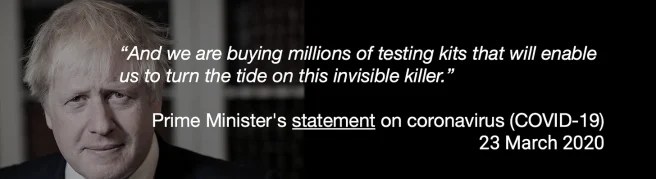
Except, as discussed in the third instalment of our transmission riddles, qualitative PCR (positive/negative) on its own without recourse to clinical history and an estimate of viral burden cannot distinguish between contagious, convalescent and spurious cases, i.e. due to environmental contamination. If you then set arbitrary cut-offs for positivity, as has been done in most UK laboratories, you increase the number of “cases” by an unknown factor.
The consequence, apart from the cost of setting up a programme not founded on science and clinical medicine, is the lengthy isolation of those who never came into contact with SARS-CoV-2 or those who are convalescing, regardless of whether they knew they had been infected. Convalescents can still test positive for PCR as the technique is so sensitive that in the presence of an arbitrary cut-off, the test is picking up viral debris, which is of little interest.
So, we have an expensive programme with no clear, evidence-based objectives. The initial budget was £15 billion; by November 2020, this rose to £22bn; by the time the service was halted in February 2022, it cost £37bn. At its height, over 700 UK testing sites were open seven days a week, including Xmas and New Year’s day.
In the digital era – phone technologies were considered the answer – the dreaded ‘pings’ went unanswered, that’s if you downloaded or switched it on in the first place. But yet again, interventions were untried and untested; however, this didn’t stop them from being rolled out at speed.
But at any point, did anyone ask if there is evidence for such an approach that had never been tried before on such a scale worked or, once rolled out, evaluated its effectiveness?
Although contact tracing has a clear logic, its effects depend on the characteristics of the organism, how it is transmitted, the duration of the asymptomatic phase before symptoms manifest, the time the agent is transmissible, the size of the outbreak and the behaviour of the population.
By the time it shut down in February 2022, 16 million cases had been detected in England, whereas the ONS infection survey estimated 67.6 million had tested positive for covid-19. Therefore, only about one in four “cases” were detected, and of those testing positive, there was no indication of whether they were infectious at the time.
Given the scale of the outbreak and the nature of the SARs-COV-2 agent, it was clear early on that Test and Trace would be an expensive waste of resources. But at the outset, those in power extolled its virtues.

One of the arguments is that Test and Trace was rolled out too late. Early on, Germany was praised for its Test and Trace strategy. Some advisors incorrectly extolled their strategy; however, Germany equally struggled and ended up gripped by panic. As a result, it was late in coming out of covid measures in 2022.
The Test and Trace program ignored the basic rules of infectious disease epidemiology leading to massive disruption of society. Models are insufficient evidence to support £37bn of expenditures – lacking evidence, no other area of healthcare would tolerate such waste.
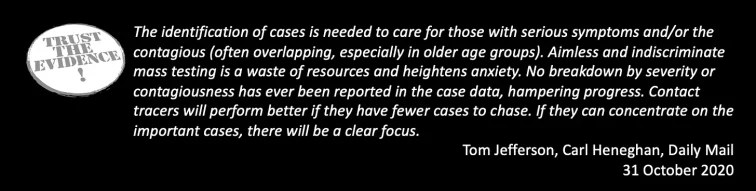
But you don’t need to take our word for it: in October 2021, The House of Commons Committee of Public Accounts, in its Test and Trace update, similarly considered the program a waste of resources.
- ‘In March this year, we reported NHS Test and Trace Service’s (NHST&T) failure to deliver on its central promise of averting another lockdown.‘
- ‘In addition, most of the testing and contact tracing capacity that NHST&T paid for has not been used, and despite previous commitments to reduce dependency on consultants, it employed more in April 2021 than in December 2020.’
- ‘NHST&T’s overall goal is to help break the chains of COVID-19 transmission and enable people to return to a more normal way of life, but there have been two national lockdowns since October 2020 and at the time of our evidence session cases were increasing again.’
Despite all the resources thrown at it, Test and Trace did not show one measurable difference in the outcomes of the pandemic – it did not avoid further lockdowns as promised. Instead, the £37 Billion could have paid for roughly a million nurses for the year, or a year and a half of social care cost for everyone that needed it. In October 2020, the PM announced £3.7 billion for 40 hospitals in the biggest hospital-building programme in a generation – He could have nearly rebuilt the whole NHS estate with £37bn. We’ll leave you to consider what you may have better spent the money on.
The budget for Test and Trace now seems unthinkable in the face of a deep recession where every penny counts. Effective healthcare is built on solid evidence of what works, not on opinions of what we think might work. The fact it made no measurable difference is now clear.
The Questions for the enquiry are
- What was the Test and Trace program’s aim?
- What evidence was the Test and Trace built on?
- How was the quality of the evidence assessed?
- What were the metrics for effectiveness? These should not be process measures such as number tested as these do not measure the spread of the agent.
- Why wasn’t the Test and Trace program terminated after the damming PAC report?
- How can the government prevent such a massive waste of resources on ineffective interventions in the future?
Alberta Premier suspends cooperation with WEF
Free West Media | November 25, 2022
The newly elected Premier Danielle Smith of the province of Alberta in Canada has recently made several powerful statements against the globalist foundation World Economic Forum and its leader Klaus Schwab. She has also decided to cancel a strange consulting agreement that WEF had with the province.
The now-revealed collaboration began in the middle of the alleged Corona pandemic and contributed to the draconian restrictions and lockdowns Canadians were subjected to. There are also those who believe that it is part of something much bigger. At the same time, she demanded that the Trudeau administration end the agenda-driven carbon tax.
On October 11, Danielle Smith was sworn in as Premier of the oil-producing province of Alberta in Canada. It came just five days after she won the leadership election of her United Conservative Party (UCP), largely on promises to stand up to the federal government in Ottawa led by the increasingly unpopular Justin Trudeau.
Trudeau has been leader of the Liberal Party of Canada since 2013 and Prime Minister of Canada since 2015. He distinguished himself during the alleged Corona pandemic as one of the most tyrannical leaders in the world, violently cracking down on peaceful popular protests. Trudeau is a member of the notorious globalist organization World Economic Forum (WEF) elite school Young Global Leaders (YGL).
YGL is a leadership program within the WEF, where politicians are schooled and initiated into the globalists’ plans and are then helped into leadership positions.
‘I find it offensive’
On October 24, barely two weeks after taking office, Danielle Smith made a move that sent the establishment in Canada into a tailspin. The new Premier harshly criticized the WEF and its chairman and founder Klaus Schwab.
“I find it uncomfortable when billionaires brag about how much control they have over political leaders like the head [Schwab] of that organization [WEF] has,” Smith said after a ceremony where her ministers were sworn in to the new provincial government.
“I find it offensive. The people who should be running the [provincial] government are the people who vote for them. And the people who vote for me and my colleagues are people who live in Alberta and who are affected by our decisions,” explained the Premier.
“So quite frankly, until that organization [WEF] stops bragging about how much control they have over political leaders, I have no interest in being involved with them. My focus is here in Alberta, to solve problems for the people of Alberta, with the mandate I received from the people of Alberta,” said Smith, announcing the suspension of the province’s cooperation with the globalist foundation.
Alberta’s new leader was referring to provocative statements made by WEF chief Klaus Schwab. One of these that specifically concerned Canada was done in 2017 at the Harvard Kennedy School’s Institute of Politics where political commentator David Gergen interviewed Schwab. The WEF chief then said that his organization had “infiltrated governments” all over the world. A visibly proud Schwab then also named several heads of state, including Canadian Prime Minister Justin Trudeau, as examples of the WEF’s global power and influence.
“Yesterday I was at a reception for Prime Minister Trudeau and I learned that half of his ministers or even more than half are actually our Young Global Leaders (YGL) of the World Economic Forum,” said the arch-globalist Schwab.
WEF health experts?
Danielle Smith further revealed that it has emerged that the province of Alberta has a cooperation agreement with the globalist foundation WEF, something she wanted to end right away.
“They signed a kind of partnership with the World Economic Forum in the middle of the pandemic; we have to deal with it. Why on earth do we have anything to do with the World Economic Forum? It must end,” the new Premier declared firmly.
She was immediately harshly attacked by mainstream media in Canada, who accused her of espousing “extreme right-wing conspiracy theories”, while mainstream media abroad tried to black out her statements.
Many Canadians were surprised to learn that the globalist organization WEF had a direct contract with one of their provincial governments. They were even more surprised when they heard what the agreement was. It did not concern consultation regarding economic issues or even “Agenda 2030 and the global goals for sustainable development”, where the WEF works closely with the UN – or as many critics believe rather dictates to the UN.
Instead, it turned out that early in the alleged 2020 Corona pandemic, the WEF stepped in as health consultants to effectively dictate the pandemic measures taken by the Canadian province of Alberta’s health authority, Alberta Health Services (AHS). Danielle Smith has been a strong critic of this authority and how it, like the previous provincial government, handled the pandemic.
On October 21, ten days after taking office as prime minister and three days before the sensational announcement, Smith commented during the “Question Period with Premier Danielle Smith” on the Western Standard media website that the health authority AHS would be held accountable for both the cooperation with the WEF and the “health councils” which they had given to the provincial government over the last two years. Canada stood out during the pandemic as one of the countries that had the most repressive restrictions and lockdowns in the world. Not least, vaccine-free citizens were grossly discriminated against.
“I think Alberta Health Services is the source of many of the problems we’ve had,” explained Smith, who also described the cooperation with the WEF as “useless”.
Many Albertans were well aware that the health authority AHS was driving the very unpopular restrictions and regulations, as were many other health authorities around the world, but they did not know that the globalist organization WEF was the one pulling the strings. It came as a shock to many and some questioned how the WEF could contribute medical expertise.
Some pundits also cited the example of globalist billionaire Bill Gates, who has been portrayed by the establishment and its media as a pandemic expert in general and a vaccine expert in particular, despite his lack of a relevant education, and where his only direct link is that he has earned multi-billion sums from investing in vaccines in particular.
Globalist puppets
However, there are those who believe that the secret agreement is part of something bigger that is happening beyond public knowledge. One of these is George Gammon, an economist and analyst who made a name for himself by explaining complex economic and political events in an accurate and easy-to-understand manner.
He commented on the news that the WEF had a consulting engagement – on health issues – with the Canadian province of Alberta in a November 5 interview with Daniela Cambone. He did not express the same surprise as many others, but stated that the heads of state and ministers who are in power today have the WEF and its head Schwab to thank for it, that is to say, they are indebted and possibly even dependent on them.
They devote large amounts of their countries’ tax dollars to covert programs that involve the WEF in such a way that the globalist organization can directly influence the country’s policies on issues important to them in order to drive their globalist agenda forward.
Economist Gammon further explained that the arrangement not only brought global power but also revenue to the WEF, which is on paper a Swiss non-profit foundation, and thus also to Schwab personally. These not infrequently very large amounts can then be used to train new leaders in the elite Young Global Leaders (YGL) school, and so on.
For the WEF it is a win-win situation, while for the taxpayers in Canada and other countries it is a double loss, where they lose both their tax money and, in the case of the Corona response, freedoms. Gammon concluded by pointing out that it is probably a common scheme in several countries and described it as pure fraud.
“This is the scam that is going on right now and it is something that most people are not aware of,” said Gammon about the WEF-Alberta agreement
‘Hostile politics’
On November 10, Premier Smith tweeted: “It is time to put people’s needs before politics. I have asked Prime Minister @justintrudeau to consider the financial hardships facing so many Canadian families right now.”
The Prime Minister’s tweet referred to a letter she had sent to Justin Trudeau the day before. In it, she stated that the number one problem for Albertans and all Canadians was the rapidly rising cost of living. Smith wrote that “with runaway inflation, many Canadians are struggling to feed their families, pay their rent and utility bills, and afford to get to work.”
She asked Trudeau to change course: “The long-term solution to this cost-of-living crisis involves the federal government changing course to actively promote and deliver more affordable, reliable and responsibly produced energy and food. Current federal energy and agricultural policies have the opposite effect”.
Critics believe that these nefarious policies are also dictated by the WEF.
Smith further wrote that her province of Alberta has already taken steps to deal with rising costs, including pausing the fuel tax and subsidizing electricity and natural gas. She urged Trudeau to do the same and completely eliminate the federal carbon tax, which Trudeau instead wants to raise further. Smith further wrote that “the answer to reducing emissions is not more taxes on consumers or limiting economic growth in our food and energy sectors”.
Later, she sent out another tweet reiterating the main points of the two-page letter: “The carbon tax is hurting Canadians. Families and businesses need a reprieve from high utility bills, prohibitively expensive food and rising gas prices. It is time to end the carbon tax.”
The next day, on November 11, she called the Trudeau administration hostile in a new tweet: “Today our [provincial] government took a step forward to stand up and defend Alberta’s interests against hostile federal government legislation and policies.”
Alberta’s Deputy Premier, Kaycee Madu, has also been highly critical of Ottawa’s “tyrannical” pandemic restrictions and also thanked the Freedom Convoy participants for their efforts to protest them. In a tweet on September 20, he wrote that the pandemic measures were “never about science but about political control and power”.
He saluted all the Canadians who at the beginning of the year stood up against the oppression of the WEF-schooled Trudeau in the name of public health: “Thank you to all those citizens of the Freedom Convoy who had the courage to mobilize against this tyrannical policy. They endured much hatred, abuse, suffering and slander for all of us. I thank them.”
There are many Canadians and people around the world who share his opinion of the brave who dared to stand up for freedom; despite having their bank accounts frozen, being threatened with having their vehicles impounded and ultimately in several cases enduring the brutality of the Trudeau regime.
The globalists and their handy politicians and journalists can now be expected to come down very hard on Smith and Madu, who have taken the side of their constituents and challenged the WEF and Trudeau – something very unusual in modern politics.
The US could see its supply chain derailed
By Bradley Blankenship | RT | November 25, 2022
One of the United States’ largest rail unions rejected a deal with freight companies and, after a cooling-off period that expires on December 9, the country could see a rail strike that could collapse its supply chain ahead of the holiday season. The cost to the US economy could be about $2 billion per day and passenger rails, like Amtrak, could see major disruptions.
A deal has appeared distant but Congress could still intervene to force one, based on Depression-era legislation. At present, the biggest sticking point to an agreement is paid sick leave and other quality-of-life issues that impact rail workers. A tentative deal struck earlier by President Joe Biden in September granted the largest wage increases in 50 years – that is, 14% raises with back pay and 24% raises over the course of five years, plus thousand-dollar cash bonuses every year – but this was never the main sticking point.
Instead, unions are upset by a lack of sick leave and personal time that leaves rail workers with a permanent threat of termination over visits to a doctor, as well as having to be on call seven days a week. They’re also ticked about workers having to operate rails solo, which they deem a safety concern, given the long hours associated with the industry. That’s why unions voted narrowly to reject the deal, even if it saw a large pay bump.
While this issue has been boiling for many years, the pandemic brought scheduling issues to the fore. Successive waves of Covid-19 didn’t see any meaningful worker protections or paid sick leave implemented, and staffing shortages only worsened. Workers were forced to show up and be on call without any protections and, to top it off, the freight lines saw record profits deposited to the ultra-wealthy, such as Berkshire Hathaway Chairman Warren Buffett.
Despite those record profits and revenues, rail operators did not spread this wealth to employees or amend contracts to grant more benefits. Instead, they spent these lavish profits on stock buybacks and dividend payouts to shareholders. For example, CSX reported a 37% surge in fiscal year 2021 net income and the company repurchased $3.7 billion worth of its own shares during the first three quarters of this year to artificially boost stock prices.
And now the industry is hoping that Congress will intervene to kneecap workers. One of the main legal hurdles to a rail strike is the 1926 Railway Labor Act, which forbids workers from striking, unlike in most other businesses. This has significantly reduced the leverage of rail workers, while entrenching the powerful people that own the freight lines and raising the odds that Congress will intervene with a deal that unions would otherwise not have accepted.
That does appear to be the goal of the rail lobby. Unions are hoping that pro-union members of the lame-duck Congress won’t intervene on employers’ behalf but the economic damage could be too much to stomach. Up to 30% of all cargo could be strung up in the event of a strike, causing all sorts of items, from fuel to cars, to rise significantly in price, thanks to supply-chain hiccups. Freight lines are hoping that even a divided Congress will intervene to give them a favorable deal.
But this would be foolhardy and would only kick the can down the road. Congress should not damage the leverage of unions and should let the strike unfold, even if that means seeing huge price increases. The rail industry has seen sky-high profits and used anti-competitive practices to profiteer off of pandemic-induced supply bottlenecks. It also enjoys unparalleled antitrust law exemptions and benefits from the country’s privatization model around railroads.
On the contrary, Congress should take the chance to break up rail companies, strengthen anti-monopoly laws and implement universal paid sick leave, given the fact that the US is enduring a virtual case plateau with Covid-19. The US is, notably, one of the few developed countries in the world to not have universal paid sick leave and does not have a government-owned or subsidized rail competitor besides Amtrak.
This means that only a handful of companies are allowed to control entire freight lines and set arbitrary fees, which has resulted in numerous lawsuits, though current laws shield railways from any liability. Congress should displace the rail industry from its privileged position even if it is important for the national supply chain because, inevitably, these monopolies are damaging the market and hurting workers’ livelihoods.
Bradley Blankenship is an American journalist, columnist and political commentator. He has a syndicated column at CGTN and is a freelance reporter for international news agencies including Xinhua News Agency.
Canadians paying for Ukraine’s gas – Kiev
RT | November 25, 2022
Ukraine has received nearly $350 million from Canada to fill up its underground storage facilities with gas for the winter, Ukrainian media reported on Wednesday, citing Prime Minister Denis Shmigal.
The government in Ottawa has transferred 12.7 billion hryvnia ($344 million) to Ukraine’s state-owned gas company Naftogaz he said, adding that “Ukraine earlier received this money from the government of Canada.” Shmigal also noted that the “procedure for using state budget funds for procuring gas in 2022-2023 was endorsed at today’s [government] meeting.”
This week, Kiev also received €200 million ($208 million) from Norway for the same purpose and is awaiting another €300 million to be bankrolled by the European Bank for Reconstruction and Development under the agreement reached earlier, the Ukrainian premier said.
The funding comes as citizens in Canada and the EU are facing unprecedented energy inflation and a cost-of-living crisis, with thousands of families struggling to pay their energy bills.
Canadians have seen a dramatic surge in electricity and gas prices in recent months. Energy analysts warn that households in the country can expect their bills to rise by between 50% and 100% on average this winter.
Flemish government called on to cancel WEF membership
Free West Media | November 23, 2022
In 2022, the Flemish government will pay €175 763.87 in membership fees to the World Economic Forum (WEF) and 27 000 Swiss francs (about €27 300) as participation fees to the annual meeting of the WEF in Davos. This is according to Flemish minister-president Jan Jambon’s response to a parliamentary question by Flemish MP Sam van Rooy.
“The Flemish Government thus legitimises and subsidises a global lobbying organisation that clearly pursues a well-defined ideological agenda, namely that of globalism,” van Rooy responded.
German economist Klaus Schwab’s World Economic Forum (WEF) has come under increasing scrutiny in recent years. The WEF claims to be a forum for exchanging ideas and networking, but at the very least the perception has arisen that a lot of government decisions are linked to the ideological goals of the WEF and stem from agreements made within the WEF.
All in all, this international lobbying organisation openly pursues a globalist future agenda involving numerous governments. This agenda seems to have recently crystallised into the so-called The Great Reset, whose goal is “a more secure, equal and stable world” by “acting jointly and rapidly to renew all aspects of our societies and economies, from education to social contracts and working conditions,” according to Klaus Schwab of the WEF.
As citizens in a democratic constitutional state are entitled to transparency on the policies pursued, van Rooy asked Flemish minister-president Jambon questions about the Flemish government’s ties and cooperation with the WEF.
Regular WEF contacts
In his reply, Jambon stated that the Flemish government “has no structural contacts with the WEF outside the participation in the WEF meeting in Davos”, but that there are “regular contacts at the level of the Flemish government”. According to the prime minister, these contacts also aim to follow up on the various activities and projects that take place annually, including outside the Davos meeting.
Until 2020, the Flemish government paid an annual membership fee of €55 000 to the WEF. Since 2022, however, Flanders has been “promoted” to “associate partner” of the WEF, requiring a membership fee of no less than €175 763.87 per year. This contribution has already been paid for 2022 and the same invoice is expected for 2023.
About the “associate partnership”, Jambon stated the following: “The associate partnership offers the advantage that Flanders can participate in more activities throughout the year and, in addition, projects are being worked on within a thematic platform ‘Shaping the Future of Trade and Investment’. Those activities and projects provide additional visibility and an opportunity to learn and contribute policy-wise.” The entanglement of the Flemish government with the WEF is thus increasing.
The prime minister maintained that the WEF would have added value for Flanders because that organisation would allow him to speak at short notice with decision-makers from international companies that are important for Flanders. “The WEF provides the framework that facilitates these talks,” Jambon said, further calling WEF membership “a policy instrument of the Flemish Government” as well “to realise objectives from the Coalition Agreement”. Jambon also announced his intention to further strengthen cooperation with the WEF in the coming period.
WEF’s alleged mission
According to Jambon, the “mission of the World Economic Forum is to improve the state of the world”, but that mission appears to be politically correct and woke, said the party in a statement. The WEF has an ideological agenda of inclusion, diversity, open borders and climate and CO2 hysteria. While Jambon has claimed that “the WEF is not asking us to pursue a specific agenda”, he admitted that his “participation in the Davos meeting may result in policy initiatives”.
It therefore seems very much as if the Flemish government is following the WEF’s globalist objective as much as possible in exchange for access to the WEF network of multinationals, banks, journalists and NGOs.
Van Rooy said that Jambon’s answers were conspicuously vague and this had raised additional questions. He therefore called on the Flemish government to cancel the Flemish paying WEF membership: “Exchanging ideas and attracting investments are of course laudable ambitions in themselves, but this should not be done in the context and under the auspices of the WEF, a lobbying group that pursues a globalist agenda and thus can by no means be considered a neutral forum for this,” van Rooy said.
Rishi Sunak’s hawkish antagonization of Beijing has not gone unnoticed
By Timur Fomenko | RT | November 23, 2022
Since the conclusion of China’s 20th Communist Party Congress, Xi Jinping has been on a diplomatic blitzkrieg. He’s met with leaders from countries all over the world, including the German chancellor, the French president and even US President Joe Biden himself. He’s keeping up the momentum as New Zealand’s Prime Minister Jacinda Ardern has received an invitation to visit Beijing. China believes that diplomacy is critical to prevent the US from isolating it.
But one important country has thus far been left on the sidelines – the United Kingdom. A meeting between Xi Jinping and British Prime Minister Rishi Sunak, scheduled at the UK’s request during the recent G20 summit, was cancelled. It came just as Sunak, at least superficially, softened his rhetoric on Beijing and sought to re-engage, after having portrayed himself as an ultra-hawk during the leadership contest at home. He even scrapped Liz Truss’s designation of Beijing as a “security threat” to his country.
But that hasn’t saved him from Beijing’s wrath. China is getting tough on Britain, in a similar way to how it did on Scott Morrison’s Australia. While the impasse with Canberra ended with the election of Antony Albanese as Prime Minister, who is more pragmatic in handling China ties, Beijing now sees London as the one playing the role of the “insufferable poodle” of the US, and will likely deliberately block engagement until it changes course.
Out of all allies of the United States, China is especially wary of what is known as “The Anglosphere” or the “Five Eyes” – That is Australia, Canada, New Zealand (although not these days) and the United Kingdom. These Anglophone countries, direct products of the British Empire, are the states which are most invested in American hegemony and closest to the United States in terms of ideology and worldview. While Continental European nations may to varying degrees differentiate themselves from the US, the Anglosphere nations are “true believers” in the US cause.
Hence, when the US invaded Iraq, it was the UK and Australia who answered the call, just to cite one instance. China therefore naturally sees members of the Five Eyes with geopolitical suspicion. Additionally, Beijing does not see them as truly “sovereign” countries or as equals to itself, but rather as US vassals. However, it has to balance this with the reality that all of these countries are critical economic and trade partners, due to their accumulated wealth and market influence. In which case, China’s geopolitical objective is not to treat these countries as adversaries, but to use a very explicit “carrot and stick” mode of diplomacy whereby it punishes them for “bad behaviour” in following the US too closely on the one hand, but rewards them for deeper bilateral engagement on the other.
And there is no more explicit example of this ongoing right now than the contrast between China deepening its engagement with New Zealand and shutting out the United Kingdom. When Beijing deems that a leader of an Anglosphere state, such as Scott Morrison of Australia, or Rishi Sunak of the UK, is too deeply following the United States, then there is absolutely no point in engaging them because the fundamental decisions are being made in Washington and not their respective capitals. The metric of right-wing populism, when these respective leaders are actively demonizing China for domestic political gain, is also a ‘naughty step’ offense. Only the US has the political privilege and power to be able to demonize Beijing, but still get engagement with it, hence why America is able to provoke China and never receive the reactions which smaller nations get from China.
This is how Beijing tries to “dilute” American power. The US itself is never confronted, but those who follow Washington too closely are. And on this, China has caught Sunak off guard. Beijing tolerated the government of Boris Johnson because he described himself as a “Sinophile” determined to improve ties with China. Sunak, however, used antagonism of China for partisan gain. The Prime Minister has since moderated his rhetoric and spoken about “keeping ties open,” believing that his spree of anti-China hyperbole, as well as a recent Ministerial visit to Taiwan, would simply be brushed off and that Beijing would welcome him with open arms. He was wrong, and Beijing is now showing that when it is not about the US, engagement with China is conditional on “good behaviour.”
China also recognizes the UK economy is weak, and as loath as London is to admit it, the UK needs ties with China. Inflation is surging, industrial unrest is picking up, chancellor Jeremy Hunt says the country is already in a state of recession. In which case, Beijing is exploiting these vulnerabilities and, similar to Australia, it will place a number of “demands” on Britain which will become pre-requisites to normalization again, which usually involve respecting Beijing’s position on Taiwan and not following the US agenda.
However, whether this works is another story. In the case of Australia, Scott Morrison’s government did not change course, and it simply became the case that China had to wait him out before re-engaging with his successor. That could very much be the case here too. Britain has ultimately made the choice to follow the US on China, even when those policies prove to be blatantly self-defeating, as is the case with the Newport Wafer Fab. Nonetheless, if Sunak is trying to be pragmatic, this should be a reality check for him.
Xi to visit Saudi Arabia as Prince Salman seeks BRICS membership
By Ahmed Adel | November 23, 2022
The upcoming visit of Chinese leader Xi Jinping to Saudi Arabia, scheduled for December and prepared for a year, shows that the Gulf kingdom has sidelined American interests for its own and taken the first step towards de-dollarization. According to Saudi Foreign Minister Adel al-Jubeir, strengthening trade ties and regional security will be prioritised during Xi’s upcoming visit to Saudi Arabia.
Jubeir emphasized that meetings between Chinese and Saudi leaders are “natural” and recalled that China is Saudi Arabia’s largest trade partner. Sources familiar with the organisation of Xi’s visit confirmed that it has been prepared for a year and that the Chinese leader will arrive in the second half of December to attend the China-Gulf Summit.
Xi’s visit to Saudi Arabia is a continuation of a wider process stimulated by BRICS and the Shanghai Cooperation Organization (SCO), in which China and Russia are key countries. BRICS and the SCO are increasingly attractive organisations for many countries as a framework in which development and cooperation is possible without blackmail and pressure.
Saudi Arabia has fundamentally changed its policy from one of complete submission to the interests of the US to now putting its own national interests first. This does not mean that the Saudis will break relations with the US, but it is a huge difference when the country puts its own interests first compared to when it is subordinated to the interests of Washington.
Riyadh pursues much better and closer cooperation with China as it is a continuation of the process in becoming an independent state and not subservient to Washington. In these processes, by the nature of things, since they are complementary economies, avoiding the dollar as a means of payment is a completely logical plan as it removes the risk of great damage if American sanctions are ever imposed.
On the one hand, BRICS, independently of Saudi Arabia, is operationally working to create a concept that would reduce the importance and influence of the dollar in the world economy. More precisely, such an achievement would reduce the influence of the dollar, which is effectively the basis of US foreign policy.
It is also for this reason that Saudi Arabia is positioning itself as a potential new member of the BRICS bloc.
Within that, a whole series of countries in bilateral cooperation, which is now expected from China and Saudi Arabia, agree on payments in domestic currencies as the first step in the process of de-dollarizing the world economy. It is also for this reason why the visit of Xi to Saudi Arabia follows from everything that has already happened and should not be considered a surprise.
However, it is too early to say whether China will overtake the US as Saudi Arabia’s main partner, even despite the fiasco that was President Joe Biden’s visit to the Gulf kingdom. This is especially the case because Saudi Arabia has based its defence on American weapons and has immense financial ties with the US.
There will definitely be more significant Sino-Saudi cooperation and the Arab kingdom itself will attempt to detach from the dollar. However, the truth is that de-dollarization is a process that will take many years. None-the-less, the Saudi reduction in cooperation with the US will inevitably occur.
It is recalled that South African President Cyril Ramposa said during his visit to Riyadh in October that Crown Prince Mohammed bin Salman expressed Saudi Arabia’s desire to join BRICS. Discussions on the expansion of the BRICS bloc are scheduled to take place in South Africa when it takes over the presidency in 2023.
Saudi Arabia’s separation from the West has only accelerated under the Biden presidency. Biden described Saudi Arabia as a pariah state due to Prince Salman’s alleged involvement in the murder of Jamal Khashoggi, a Washington Post journalist. However, the US President changed his outlook and rhetoric towards the Arab country after coming to power.
As BRICS represents more than 40 percent of the global population and nearly a quarter of the world’s GDP, with the group set to have bolstered global influence if it expands, Saudi Arabia is interested in gaining further independence by joining the bloc. Joining the bloc also means closer relations with China, something that Saudi Arabia is now pursuing despite Western criticism.
Ahmed Adel is a Cairo-based geopolitics and political economy researcher.
A Very Different Global State of Affairs Takes Hold
By Alastair Crooke | Strategic Culture Foundation | November 21, 2022
How the world appears all depends on whether your gaze is firmly focussed on the hub of the wheel, or alternatively, were you to watch the wheel’s rotation around the hub – and the bearing it follows – you would see the world differently.
Looked at from a DC-centric perspective, all is still: Nothing (as it were), is moving geo-politically. Was there an election in the U.S.? Well, certainly there is no longer an ‘Election Day’ event as the new mechanics of ballots vs in-person voting, commencing up to 50 days earlier, and ploughing on, weeks after, has become far removed from the old notion of having ‘an election’, and an aggregate macro outcome.
From this ‘centric’ viewpoint, the Midterms change nothing – stasis.
So many of Biden’s policies were already in stone anyway – and beyond the ability of any Congress to change in the short run.
New legislation, if there were any, could be vetoed. And should the election ‘month’ end with the House controlled by Republicans and the Senate controlled by Democrats, there might not be any legislation at all, because of partisanship and an inability to compromise.
More to the point, Biden anyway can rule for the next 2 years through Executive Order and bureaucratic inertia – and not need the Congress at all. In other words, the composition of Congress may not matter that much.
But now, turn your gaze to the rotation around the ‘hub’, and what do you see? The rim spinning wildly. It seizes more and more traction on the ground and has clear directionality.
The biggest pivot around the hub? Well probably, President Xi of China travelling to Riyadh to meet Mohammad bin Salman (MbS). The wheel rim here digs deep for a firm grip on bedrock, as Saudi Arabia makes its pivot toward the BRICS. Xi likely is going to Riyadh to seal the details of Saudi’s accession to the BRICS and the terms of China’s future ‘Oil Accord’ with Saudi Arabia. And that may be the beginning to the end to the petrodollar system – as whatever is agreed in terms of the Chinese mode of payment for oil will mesh with Russo-Chinese plans eventually to move Eurasia onto a new trading currency (far away from the dollar).
Saudi Arabia gravitating BRICS-wards means other Gulf and Mid East – states such as Egypt – leaning BRICS-wards also.
Another pivot: The Turkish Interior Minister Süleyman Soylu said after this week’s explosion in Istanbul: “We do not accept the condolence message of the U.S. Embassy. We understand the message that was given to us, we received the message that was given to us”. Soylu then dismissed the U.S. condolence as akin to “a killer being first to show up at a crime scene”.
Let’s be clear: The minister just told the U.S. to go sc**w itself. This unleashing of raw anger comes just as Turkey has agreed to join with Russia to establish a new gas hub in Turkey and is participating with Russia in a massive oil and gas investment and co-operation deal with Iran. Turkey too, is veering BRICS-wards.
And, as Turkey veers away from one ‘hub’, much of the Turkic sphere will take Turkey’s lead.
These two events – from Xi’s meeting with MbS’ thumbing his nose at the U.S., to Turkey’s fury at the terrorism in Istanbul – clearly dovetail together to mark a strategic Middle East pivot – both in terms of energy and monetary frameworks, towards the unfolding Eurasian free trade sphere.
Then comes the news from last Thursday: Iran says that it has developed a high-precision hypersonic missile. General Hajizadeh said the Iranian hypersonic ballistic missile can reach more than five times the speed of sound and, as such, it will be able to breach all present systems of anti-missile defence.
Simply put: Iran essentially already is a nuclear threshold state (but not a nuclear weapons state). The remarkable technical achievement of producing a hypersonic high-precision missile (which still eludes the U.S.), is a paradigm-changer.
Strategic nukes make no sense in a highly mix-populated, small Middle East – and now, there is no need for Iran to move towards becoming a weapons state. So, what would be the point to a complicated containment strategy (i.e. the JCPOA), oriented towards hindering an outcome that has become overtaken by new technology? A hypersonic ballistic missile capacity makes tactical nukes redundant. And hypersonic missiles are more effective; more easily deployed.
The problem for the U.S. and Israel is that Iran has done it – it has leaped beyond the JCPOA containment cage.
On top of that, a few days earlier, Iran also announced that it had launched a ballistic missile, carrying a satellite into space. If so, Iran now has ballistic missiles capable of reaching, not only Israel, but Europe too. Furthermore, Iran is reported to soon receive 60 SU-35 aircraft, as just one part to its rapidly evolving relationship with Russia, sealed last week with Nikolai Patrushev (Russia’s Security Council Secretary) in Tehran.
Again, to be clear, Russia has just acquired a highly potent kinetic force multiplier; access to Iran’s sanctions-busting rolodex of contacts and strategies, and a full partner to Moscow’s big play of Eurasia becoming a commodities super-oligopoly.
Simply put, as Iran enlists as a force multiplier to the Russia-China axis, so too will Iraq, Syria, Hizbullah and the Houthis slip along a somewhat similar trajectory.
Whilst the European ‘security architecture’ remains still frozen in a tight NATO, anti-Russian grip, West Asia’s security architecture is dissolving away from the old U.S. and Israeli-led hard polarisation of a Sunni sphere vs Shi’i Iran (i.e. the so-called Abraham Accords), and is re-forming around a new security architecture being shaped by Russia and China.
This makes sense. Turkey prizes its Turkic civilisational heritage. Iran clearly is a civilisational state, and MbS plainly wants his kingdom to be widely accepted as one, too (and not as just a U.S. dependency). The point of the SCO format is that it is ‘pro-autonomy’ and is opposed to any singularity of ideology. In fact, by being civilisational in concept, it becomes anti-ideological and opposed to tight binary (with us, or against us) alliances. Membership does not require endorsement of each other partner’s particular policies, provided they do not impinge on others’ sovereignty.
In effect, the whole of West Asia – to one degree or another – is being lifted up into this evolving Eurasian economic and security paradigm.
And, simply said, since Africa is already enlisted into the China camp, the African component to MENA is trending strongly Eurasia-wards, as well. The Global South’s affiliation too, largely can be taken for granted.
Where does this leave the old ‘hub’? It has Europe fully in its control. For now, yes…
However research published by France’s École de Guerre Economique suggests that whilst Europe has, since WW2, “lived in a state of the unspoken” in respect to its full-spectrum dependency on Washington, as Russia sanctions take their catastrophic effect on Europe, “a very different state of affairs takes hold”. Consequently, politicians, and the public alike, struggle to identify “who truly is their enemy”.
Well, the collective view, based on interviews with French intelligence experts (i.e. the French Deep State) is very clear: 97% percent consider the U.S. to be the foreign power that “most threatens” the “economic interests” of France. And they see it as a problem that must be resolved.
Of course, the U.S. will not easily let Europe go. Nonetheless, if parts of the Establishment can speak thus, then something is moving and afoot, beneath the surface. The report underlines naturally that the EU might have a trade surplus of 150 billion euros with the U.S., but the latter would never willingly allow this to translate into ‘strategic autonomy’. And any gain in autonomy is achieved against the constant backdrop of – and more than offset by – “strong geopolitical and military pressure” from the U.S. at all times.
Could the Nord Stream sabotage have been the straw that broke the camel’s back? In part, it was a trigger, but Europe hides its diverse old hatreds and long-nursed vindictiveness under ‘a Brussels lid of easy money’. But this pertains only so long as the EU remains a glorified ATM – states insert their debit-cards and withdraw cash. The concealed animosities are repressed, and monetarily lubricated into quiescence.
The ATM however, is in trouble (economic contraction, de-industrialisation and austerity cometh!); and as the ATM withdrawals’ window winnows down, so too the lid holding down the old animosities and tribal feelings will not hold for long. Indeed, the demons are rising – and are readily visible even now.
And finally, will the Washington ‘hub’ hold? Does it retain the resources to manage so many stress-test events – financial, systemic and political – all arriving synchronistically? We must wait to see.
In retrospect, the ‘Hub’ is not ‘on the move’. It has moved already. It is just that so many are stuck seeing an ‘empty space’ that once was occupied by something past, but which somehow still somehow lingers on, in visual memory, as a ‘shade’ of its earlier solidity.
How Blackrock Investment Fund Triggered the Global Energy Crisis
“Adherence to UN 2030 Sustainability Agenda”. Colossal disinvestment in the trillion-dollar global oil and gas sector.
By F. William Engdahl | Global Research | November 16, 2022
Most people are bewildered by what is a global energy crisis, with prices for oil, gas and coal simultaneously soaring and even forcing closure of major industrial plants such as chemicals or aluminum or steel. The Biden Administration and EU have insisted that all is because of Putin and Russia’s military actions in Ukraine. This is not the case. The energy crisis is a long-planned strategy of western corporate and political circles to dismantle industrial economies in the name of a dystopian Green Agenda that has its roots in the period years well before February 2022, when Russia launched its military action in Ukraine.
Blackrock pushes ESG
In January, 2020 on the eve of the economically and socially devastating covid lockdowns, the CEO of the world’s largest investment fund, Larry Fink of Blackrock, issued a letter to Wall Street colleagues and corporate CEOs on the future of investment flows. In the document, modestly titled “A Fundamental Reshaping of Finance”, Fink, who manages the world’s largest investment fund with some $7 trillion then under management, announced a radical departure for corporate investment. Money would “go green.” In his closely-followed 2020 letter Fink declared,
“In the near future – and sooner than most anticipate – there will be a significant re-allocation of capital…Climate risk is investment risk.” Further he stated, “Every government, company, and shareholder must confront climate change.” [i]
In a separate letter to Blackrock investor clients, Fink delivered the new agenda for capital investing. He declared that Blackrock will exit certain high-carbon investments such as coal, the largest source of electricity for the USA and many other countries. He added that Blackrock would screen new investment in oil, gas and coal to determine their adherence to the UN Agenda 2030 “sustainability.”
Fink made clear the world’s largest fund would begin to disinvest in oil, gas and coal. “Over time,” Fink wrote, “companies and governments that do not respond to stakeholders and address sustainability risks will encounter growing skepticism from the markets, and in turn, a higher cost of capital.” He added that, “Climate change has become a defining factor in companies’ long-term prospects… we are on the edge of a fundamental reshaping of finance.” [ii]
From that point on the so-called ESG investing, penalizing CO2 emitting companies like ExxonMobil, has become all the fashion among hedge funds and Wall Street banks and investment funds including State Street and Vanguard. Such is the power of Blackrock. Fink was also able to get four new board members in ExxonMobil committed to end the company’s oil and gas business.
The January 2020 Fink letter was a declaration of war by big finance against the conventional energy industry. BlackRock was a founding member of the Task Force on Climate-related Financial Disclosures (the TCFD) and is a signatory of the UN PRI— Principles for Responsible Investing, a UN-supported network of investors pushing zero carbon investing using the highly-corrupt ESG criteria—Environmental, Social and Governance factors into investment decisions. There is no objective control over fake data for a company’s ESG. As well Blackrock signed the Vatican’s 2019 statement advocating carbon pricing regimes. BlackRock in 2020 also joined Climate Action 100, a coalition of almost 400 investment managers managing US$40 trillion.
With that fateful January 2020 CEO letter, Larry Fink set in motion a colossal disinvestment in the trillion-dollar global oil and gas sector. Notably, that same year BlackRock’s Fink was named to the Board of Trustees of Klaus Schwab’s dystopian World Economic Forum, the corporate and political nexus of the Zero Carbon UN Agenda 2030. In June 2019, the World Economic Forum and the United Nations signed a strategic partnership framework to accelerate the implementation of the 2030 Agenda. WEF has a Strategic Intelligence platform which includes Agenda 2030’s 17 Sustainable Development Goals.
In his 2021 CEO letter, Fink doubled down on the attack on oil, gas and coal. “Given how central the energy transition will be to every company’s growth prospects, we are asking companies to disclose a plan for how their business model will be compatible with a net zero economy,” Fink wrote. Another BlackRock officer told a recent energy conference, “where BlackRock goes, others will follow.” [iii]
In just two years, by 2022 an estimated $1 trillion has exited investment in oil and gas exploration and development globally. Oil extraction is an expensive business and cut-off of external investment by BlackRock and other Wall Street investors spells the slow death of the industry.
Biden—A BlackRock President?
Early in his then-lackluster Presidential bid, Biden had a closed door meeting in late 2019 with Fink who reportedly told the candidate that, “I’m here to help.” After his fateful meeting with BlackRock’s Fink, candidate Biden announced, “We are going to get rid of fossil fuels…” In December 2020, even before Biden was inaugurated in January 2021, he named BlackRock Global Head of Sustainable Investing, Brian Deese, to be Assistant to the President and Director of the National Economic Council. Here, Deese, who played a key role for Obama in drafting the Paris Climate Agreement in 2015, has quietly shaped the Biden war on energy.
This has been catastrophic for the oil and gas industry. Fink’s man Deese was active in giving the new President Biden a list of anti-oil measures to sign by Executive Order beginning day one in January 2021. That included closing the huge Keystone XL oil pipeline that would bring 830,000 barrels per day from Canada as far as Texas refineries, and halting any new leases in the Arctic National Wildlife Refuge (ANWR). Biden also rejoined the Paris Climate Accord that Deese had negotiated for Obama in 2015 and Trump cancelled.
The same day, Biden set in motion a change of the so-called “Social Cost of Carbon” that imposes a punitive $51 a ton of CO2 on the oil and gas industry. That one move, established under purely executive-branch authority without the consent of Congress, is dealing a devastating cost to investment in oil and gas in the US, a country only two years before that was the world’s largest oil producer.[iv]
Killing refinery capacity
Even worse, Biden’s aggressive environmental rules and BlackRock ESG investing mandates are killing the US refinery capacity. Without refineries it doesn’t matter how many barrels of oil you take from the Strategic Petroleum Reserve. In the first two years of Biden’s Presidency the US has shut down some 1 million barrels a day of gasoline and diesel refining capacity, some due to covid demand collapse, the fastest decline in US history. The shutdowns are permanent. In 2023 an added 1.7 million bpd of capacity is set to close as a result of BlackRock and Wall Street ESG disinvesting and Biden regulations. [v]
Citing the heavy Wall Street disinvestment in oil and the Biden anti-oil policies, the CEO of Chevron in June 2022 declared that he doesn’t believe the US will ever build another new refinery.[vi]
Larry Fink, Board member of Klaus Schwab’s World Economic Forum, is joined by the EU whose President of the EU Commission, the notoriously corrupt Ursula von der Leyen left the WEF Board in 2019 to become EU Commission head. Her first major act in Brussels was to push through the EU Zero Carbon Fit for 55 agenda. That has imposed major carbon taxes and other constraints on oil, gas and coal in the EU well before the February 2022 Russian actions in Ukraine. The combined impact of the Fink fraudulent ESG agenda in the Biden administration and the EU Zero Carbon madness is creating the worst energy and inflation crisis in history.
*
F. William Engdahl is strategic risk consultant and lecturer, he holds a degree in politics from Princeton University and is a best-selling author on oil and geopolitics.
He is a Research Associate of the Centre for Research on Globalization.
Notes
[i] Larry Fink, A Fundamental Reshaping of Finance, Letter to CEOs, January, 2020, https://www.blackrock.com/corporate/investor-relations/2020-blackrock-client-letter
[ii] Ibid.
[iii] Tsvetana Paraskova, Why Are Investors Turning Their Backs On Fossil Fuel Projects?, OilPrice.com,
March 11, 2021, https://oilprice.com/Energy/Energy-General/Why-Are-Investors-Turning-Their-Backs-On-Fossil-Fuel-Projects.html
[iv] Joseph Toomey, Energy Inflation Was by Design, September, 2022, https://assets.realclear.com/files/2022/10/2058_energyinflationwasbydesign.pdf
[v] Ibid.
[vi] Fox Business, Chevron CEO says there may never be another oil refinery built in the US, June 3. 2022, https://www.foxbusiness.com/markets/chevron-ceo-oil-refinery-built-u-s
Copyright © F. William Engdahl, Global Research, 2022
Iran bans imports of French cars unless damage redressed
Press TV – November 21, 2022
Iran has banned the imports of French cars until France’s automobile manufacturers, namely Renault, Peugeot and Citroen, compensate the damage caused by leaving the Islamic Republic.
The withdrawal imposed a lot of costs on Iran’s automobile and parts manufacturing industry and left many investments in ruins after the US imposed new sanctions in August 2018, targeting the Islamic Republic’s car industry, trade in gold and other precious metals, and purchases of US dollars.
Although the withdrawal forced Iranian manufacturers to pool their resources and produce locally-made cars, compensation for the damage caused by the pullout is a central demand.
The ban announced by Ministry of Industry, Mining and Trade spokesman Omid Qalibaf comes as Iran is reintroducing foreign car imports in order to both improve the pool of quality automobiles and meet consumer demand.
Iran prohibited the import of Western cars in 2017 to counter the impending reimposition of US sanctions. The idea was part of Tehran’s efforts to develop a “resistance economy” that could both serve Iranians’ demands for cars, lessen dependence on foreign technology, and potentially boost export revenue.
“Those in the process of importing cars are dealing with the related issues and are concluding their contracts one by one, with the first cars expected to enter the country with the conditions that have been announced to the importers.
“However, what is certain is that French cars will not find a way to our market for now, because French companies such as Renault and Peugeot do not have a good history during the time of sanctions, when they easily left our country despite having committed to joint ventures and investments,” Qalibaf said.
Before the sanctions, French carmaker PSA Group had signed a framework deal with Iranian counterpart SAIPA to produce and sell vehicles for its Citroen brand in the country.
Under the agreement, Citroen and its Iranian partner would invest 300 million euros ($330 million) over five years in manufacturing, research and development, with the first of three planned new Citroen models due to be launched in Iran in 2018.
PSA Group, the maker of Peugeot and Citroen cars, had finalized a similar production deal with major Iranian automaker Iran Khodro under a 50-50 joint venture to invest up to 400 million euros ($451 million).
Renault had signed a new joint venture deal that included an engineering and purchasing center to support the development of local suppliers as well as a plant with an initial production capacity of 150,000 vehicles a year.
“In the middle of the road, however, they left the Iranian automakers alone and caused a lot of damage to our country’s automobile industry,” Qalibaf said.
“As long as the French car manufacturers do not compensate for these damages, they will not have any share in the large car market of our country, and the import of any car from France will be prohibited,” he added.
The ban, however, will not include South Korea, Japan and other countries, because they were not involved in any joint projects with Iranian industrialists when the new sanctions were imposed, Qalibaf stated.
The auto industry forms the second biggest sub-sector of the economy behind oil, accounting for some 10 percent of the gross domestic product and 4 percent of employment.
When the former Trump administration reimposed sanctions on Iran in August 2018, it reserved Washington’s first hammer blow for the car industry to hurt as many Iranians as possible.
However, the US pressures forced domestic manufacturers to mobilize their resources to fulfill some of the tasks which were an exclusive competence of foreign companies.
Last week, Venezuelan Minister of Transport Ramón announced the shipment of 1,000 cars built in Iran to Venezuela, stating that they were among 80,000 requests registered for the products of an Iranian car manufacturer in his country.
“We have a very high demand for Iranian car products, where we were able to register about 80,000 requests in the first stage,” he said in Tehran where he was at the head of a large delegation.
With the exports, Iran is staking out a niche in South America’s automotive marketplace which has a lot of space for growth and expansion, given the uneasy relationship of some of the countries of the region with the United States.
It followed the Iran-Venezuela 2022 Expo Fair held on Sept. 14-18 in Caracas where President Maduro announced the assembly of four Iranian models at Venirauto car manufacturing plant, a joint venture between the Venezuelan government and Iran Khodro.
Featured Video

The Truth About the Trump Shootings with Ken Silva
or go to
Aletho News Archives – Video-Images
From the Archives
The Geopolitics behind the War in Yemen (I)
By Mahdi Darius NAZEMROAYA | Strategic Culture Foundation | 30.03.2015
The United States and the Kingdom of Saudi Arabia became very uneasy when the Yemenese or Yemenite movement of the Houthi or Ansarallah (meaning the supporters of God in Arabic) gained control of Yemen’s capital, Sanaa/Sana, in September 2014. The US-supported Yemenite President Abd-Rabbuh Manṣour Al-Hadi was humiliatingly forced to share power with the Houthis and the coalition of northern Yemenese tribes that had helped them enter Sana. Al-Hadi declared that negotiations for a Yemeni national unity government would take place and his allies the US and Saudi Arabia tried to use a new national dialogue and mediated talks to co-opt and pacify the Houthis.
The truth has been turned on its head about the war in Yemen. The war and ousting of President Abd-Rabbuh Manṣour Al-Hadi in Yemen are not the results of «Houthi coup» in Yemen. It is the opposite. Al-Hadi was ousted, because with Saudi and US support he tried to backtrack on the power sharing agreements he had made and return Yemen to authoritarian rule. The ousting of President Al-Hadi by the Houthis and their political allies was an unexpected reaction to the takeover Al-Hadi was planning with Washington and the House of Saudi. … continue
Blog Roll
 Aletho News
- Pakistan-Iran talks secure LNG shipment to Islamabad through Hormuz
- Black Sea grain crisis puts global wheat supplies under pressure
- IRGC air defenses destroy another US MQ-1 drone over Strait of Hormuz
- Imran Khan’s entire immediate family detained in Pakistan ahead of mass protest demanding his release
- EU nation detains former presidential frontrunner
- Leaked: Britain’s Sham Conviction Of Hashim Thaci
- Seyed M. Marandi: U.S. Strike Imminent – Toward Total War in the Middle East
- Russia Voted Under Fire. Washington Is Loading the Tankers.
- 12 Things Your Oncologist Was Trained Not to Tell You
- Anthrax Attacks Paved Way for COVID-Era ‘Junk Drugs and Vaccines’
- If Americans Knew
- This isn’t sci-fi, AI is already killing people
- ‘The Most Brutal Thing’: Investigation Reveals Execution of Elderly Woman in Rafah
- Inside Israel’s ‘soft’ ethnic cleansing plan for Gaza through the eyes of its victims
- New online database tracks pro-Israel political donations in the United States
- Israeli president pardons soldier convicted for killing wounded Palestinian
- Singer Ed Sheeran says his ‘heart broken’ by Gaza devastation, addresses Macklemore controversy
- Israel Has Imprisoned Female Journalist Bushra Al-Tawil Without Trial Or Charge In Solitary Confinement For Past Month
- Israel poised to teach West Bank a lesson after one Israeli killed – Daily Update
- Salah Sarsour’s Legal Team Says DHS Has Not Met Its Burden to Prove He Is Deportable
- An analysis of tax forms by The Intercept show Kraft’s charity and LLC have donated to Friends of the IDF and AIPAC’s super PAC.
- No Tricks Zone
- 2025 Nature Paper Claiming Worsening Global Drought Gets RETRACTED …Heavily Flawed
- New Study: ‘Global Drought Shows No Detectable Recent Acceleration Under Climate Warming’
- Economic Masterminds: German Socialists Suggest Taxing Productivity Gains Stemming From Using AI
- The South China Sea Has Not Been Cooperating With The Climate Change Narrative
- Energy Crisis: Germany Enters Heating Season With Historically Low Gas Reserve Fill Levels
- New Study: The Antarctic Ice Sheet Gained Mass From 2020-2024 Due To Staggering Snow And Ice Accumulation
- Study: Ocean Heating Rates From Thousands Of Years Ago ‘Dwarf’ Modern Ocean Heating Rates
- Climate Extremists Target, Attack Large-Scale Power Grid Infrastructure In Germany!
- New Study: Antarctic Ice Melt Has Contributed Less Than 1 Centimeter To Sea Level Rise In The Last 30 Years
- Fear Of Debate: Alarmist German Climate Scientist Calls On Mainstream Media To Discredit Skeptic Voices
 Aletho News