Background to current US policy in Europe
By Viktor Mikhin – New Eastern Outlook – 21.11.2022
It is said not in vain that one man’s problem is another man’s opportunity. And the military action in Ukraine against Russia, unleashed by the US and NATO, has clearly demonstrated this. Every day there is more and more evidence to show what huge dividends the US tycoons are reaping from the policies that the current President Joe Biden is pursuing for their benefit alone. Suffice it to say that Washington has already made tens of billions of dollars from the military actions it has unleashed in Ukraine. Not to mention the distraction from US domestic issues in financial, economic and politico-racial fields, that the White House is using against this backdrop.
The US instigated this armed conflict, a conclusion that most political analysts are now coming to. Its aim is to force Europe to submit to US sanctions against Russia and stop buying cheap Russian natural gas. Washington can now sell huge quantities of liquefied gas to Europe at its own prices, and there is no price cap on US hydrocarbons, unlike Russian hydrocarbons, and it is unlikely there will be one. Europe’s economy has suffered a blow, and vast wealth has migrated from Europe to the US, allowing US leaders to maintain their dominant position in the EU.
Ensuring control over Europe is a major strategic imperative for the US. Since the EU has a population of 450 million, while the US population is only 330 million, and their economies are comparable in size, the EU is theoretically in a position to break free from the US and assert itself as an equal or greater superpower on the world stage. A truly independent Europe would prefer to make mutually beneficial trade deals with Russia, China and the rest of Eurasia, pushing back the US and ending US imperial domination of the planet.
It is only natural that the US does not want this to happen. By implementing its divide-and-conquer strategy, Washington is preventing Europe from achieving the cohesion and economic strength that would enable it to free itself from the US occupation that has persisted since after the World War II. Inflation in Germany reached double digits in October for the first time since 1990. Italy is also experiencing the highest inflation in 40 years. The rest of the Eurozone is also suffering. The source of the European crisis is the rise in energy prices caused by US sanctions against Russia. Businesses that produce goods and services have to pay more for energy, and they pass the costs on to consumers. Now most of the extra money paid for what has become ultra-expensive energy goes straight into US coffers. This is the main reason why the euro is falling against the dollar. Furthermore, the dollar has historically been strong in times of panic or uncertainty, and the US has a habit of deliberately provoking panic and uncertainty by organizing wars and crises, of which there have been many examples.
The EU is not an ally of the US, but a coalition of vassal states that have been under US military and economic occupation since the end of World War II. The US committed a holocaust against Germany during and immediately after that war, bombing entire cities where only civilians lived, starving millions of German prisoners of war and civilians during the first few years of the occupation. The mainstream media and academia, owned by the Americans and their satellites, fabricated a story of a mythical World War II victor that essentially turned reality upside down and portrayed the US as a generous rebuilder of Germany through the Marshall Plan. But the reality is that the Marshall Plan was only implemented after the Morgenthau Plan to kill millions of Germans had done its bloody work.
The US is far from being a generous ally. Instead, it has always been and remains a selfish occupier of Europe. The current US-induced destruction of Europe, based on depriving EU countries of cheap energy in order to damage them economically and subjugate them politically, could be called the new Morgenthau Plan. Nevertheless, the United States may have to provide aid packages or loans to help the EU escape hunger and frost this winter. If this happens, the motives will not be altruistic. Instead, Washington will seek to prevent Europeans from overthrowing the US occupation and exercising control over their own destiny.
Before the hostilities unleashed by the US in Ukraine, Russia provided the lion’s share of Europe’s cheap energy imports. However, by artificially supporting the armed conflict, which is now in its ninth month, Washington has broken this partnership, and gas is no longer flowing through Nord Stream. Businesses across Europe are not just limiting their energy consumption. They are shrinking or moving to other continents. Europe, according to economists, may well be on the way to de-industrialization. Eurozone industrial activity fell to its lowest since May 2020. The October PMI from S&P Global signaled a looming recession, falling in November and becoming the fourth monthly reading below 50, indicating an economic slowdown. In its latest analysis of the energy crisis in Europe, published on November 3, the IEA said the EU could face a shortfall of up to 30 billion cubic meters of natural gas during the summer of next year to replenish its gas storage capacity.
In a report entitled “Never Too Early to Prepare for Next Winter: Europe’s Gas Balance for 2023-2024” the IEA warns that the safety cushion provided by current storage levels, as well as recent lower gas prices and unusually mild temperatures, should not lead to unduly optimistic conclusions about the future. A look at the IEA report shows that the European Union will face a major challenge in meeting its energy needs in the coming years. Given the high costs of transporting gas over long distances, Russia could still make a significant contribution to solving this problem. With the world’s largest oil and gas reserves, Russia could provide Europe with the energy it desperately needs if it were not for persistent US sanctions. Unlike oil, natural gas is difficult to transport in large volumes and is therefore exported either by pipeline or by conversion into liquefied natural gas (LNG), but this is expensive and requires large investments. Russia does not currently have the infrastructure to export large volumes of LNG to Europe. Given current experience and looking to the future, European governments should clearly see the huge negative impact that sanctions against Russia have had and will have on global energy security. More should therefore be done to help curb US self-serving agendas and negotiate a multipolar world.
By constantly unleashing wars, the United States always reaps huge profits and the military-industrial complex comes first, as one would expect. It is not surprising that the US military budget is equal to that of the rest of the world combined. And this is further clear evidence that Washington does not want to live in a world where all contentious issues are resolved at the negotiating table, but aims only at military actions.
But lately, all of a sudden, the energy complex, whose owners are making exorbitant profits from oil and gas supplies, mostly to Europe, has become the most profitable sector in the United States. It is only natural that many people became interested and it was primarily the military who were concerned and who simply “pressed” Joe Biden. And now the US President has suddenly become “interested” in these huge sums and has decided to “clip the wings” of the oil and gas industry by imposing an additional tax on the profits of the owners of the energy complex. The simple conclusion from this is that unleashing Ukraine on Russia will continue at an accelerated pace, and Europe will be completely deprived of Russian gas. Even the gas coming through NATO member, Turkey.
By starting any military conflict, the US is not aiming to win. Above all, it is to destabilize the region so that it cannot be a US competitor for decades to come.
Today, a large proportion of the world’s elite keep their reserves in the EU. Naturally, the US will not completely destroy it. But if US companies gain a foothold and dominate the European market, it will force Europe to become even more involved in the Ukrainian conflict, to abandon Russian oil and gas completely, and it will be a huge prize for Washington to implement a policy of solving all issues only through war.
German producers warn of meat shortages
RT | November 19, 2022
Germany may face a meat shortage and a subsequent surge in prices within the next four to six months, Die Welt reported this week, citing the German Meat Industry Association (VDF).
“In four, five, six months we will have gaps on the shelves,” Hubert Kelliger, the head of group sales at meat marketer Westfleisch and a VDF board member, told the news outlet.
According to Kelliger, the worst shortages are expected in the supply of pork. He says Berlin insists on reducing the number of livestock by half in order to protect the climate. However, experts say this would lead to mass shutdowns of meat-producing companies, which in turn would result in a 40% increase in the price of meat.
Cutting livestock numbers could also lead to a decrease in the supply of natural fertilizer, resulting in a drop in vegetable yields or a surge in the cost of production due to the high prices of artificial fertilizers. Either situation would worsen the food crisis in Germany.
While meat industry representatives note that vegetarianism and veganism have become increasingly popular in the country over the last few years, they say that over 90% of the people still buy and eat meat.
Germany has been relying more and more on meat imports rather than domestic production. The share of beef and pork products from abroad has risen in recent months, and the country is currently the biggest meat importer in Europe, according to VDF.
VDF experts say Berlin is making the same mistake in turning to meat imports as it did with energy – increasing dependence on imports could lead to the risk of a food crisis along with the energy crisis. Kelliger says the only way to avoid this is to be self-sufficient in meat production.
Interview with US Ambassador Peter Ford
Free West Media | November 18, 2022
Steven Sahiounie of MidEastDiscourse interviewed Ambassador Peter Ford to hear his expert analysis of important issues developing in the region.
Israel, Lebanon, Syria and Turkey are neighbors in an increasingly unstable Middle East, in which Saudi Arabia plays a key role.
The US has meddled in the Middle East for decades and is responsible for the destruction of several countries who have not recovered from failed American policies.
Peter Ford served as the British ambassador to Bahrain from 1999 to 2003 and Syria from 2003 to 2006, and is currently the London-based Co-Chairman of the British Syrian Society. He is an Arabist with long established expertise in the Middle East.
Benjamin Netanyahu and his allies recently came back to power in “Israel”. In your opinion what does this mean for the Palestinians?
It makes no difference. Those who believe that one Israeli government is different from another are fools. Every Israeli government supports the occupation and practices repression. Any differences are purely optical.
That said, the participation of overt racists in Netanyahu’s government increases the chances that the US will distance itself from Israel in matters of secondary importance.
Lebanon is in the midst of a financial and social collapse. In your opinion, will the Israeli regime take advantage of the crisis and attack Lebanon?
Israel is already viciously attacking Lebanon – economically. The Israeli/US strategy is to avoid war, which they would lose, but instead to create enough suffering in Lebanon to make the Lebanese people turn against Hezbollah. In particular, they are trying to block oil reaching Lebanon from Iran. This is similar to their strategy towards Syria.
The UN Special Rapporteur has called for the end of sanctions on Syria because of the continuing suffering. Do you think there is any hope in removing the sanctions which are crippling the daily life of Syrians?
Sadly I see no prospect of sanctions on Syria being lifted or eased in the foreseeable future. It costs the US nothing to apply them and the US against all evidence persists in believing that sanctions weaken popular support for the Syrian government, or pretending to believe they weaken the government simply because it would be embarrassing to lift them. Lifting sanctions would look like an admission of failure and a concession to Russia and Iran.
Sanctions on Syria cannot be analyzed without taking the geopolitical situation into account. To some degree Syria is paying part of the price for US mishandling of its relations with Russia and Iran.
Saudi Crown Prince Mohammed bin Salman has not bowed down to pressure by US President Joe Biden. In your opinion, what will be the cost that Saudi Arabia has to pay?
The cost will be zero. On the contrary, Saudi defiance of the US over oil prices shows that the balance of power between the two has shifted and that the US is a paper tiger where Saudi Arabia is concerned. Let us not forget that the US arms industry has become highly dependent on sales to the Gulf, and the US has invested heavily in keeping Saudi Arabia away from rapprochement with Iran. Its leverage is minimal. It was different when MBS was an international pariah over Khashoggi, but time has done its work of prompting amnesia if not forgiveness. I expect to see more Saudi defiance of the US.
For the past few months, we have been hearing reports from the Turkish side of overtures at repairing the relationship between Turkey and Syria. In your opinion, will this have an effect on ending terrorist control in Idlib?
I am more optimistic about Idlib today than I have been for ages. Time is also doing its work here – demonstrating to the Turks that their Syria policy has been a total failure. That policy has failed to remove the Syrian government, failed to establish stability on Turkey’s border and failed to create conditions for the return of Syrian refugees. The burden of those refugees is felt especially acutely with the approach of presidential elections in Turkey. Whether Erdogan is serious about rapprochement with Syria remains however to be seen.
Steven Sahiounie is a two-time award-winning journalist
Hungary reveals cost of sanctions on Russia
RT | November 18, 2022
The Hungarian economy is losing billions of dollars due to Western sanctions on Russia, Prime Minister Viktor Orban said on Friday.
“The policy of sanctions,” which has led to a drastic surge in energy prices across the EU, will cost his country’s economy $10 billion a year, he stated.
Orban explained that the pressure on the Hungarian budget will result in cuts to social spending, adding that from this perspective, Hungary’s stance against the sanctions “doesn’t seem to be excessive.”
Earlier this week, speaking with local media, he said that “the policy of sanctions is a way to war,” and stressed that the main goal for Budapest is to avoid a Europe-wide recession.
The Hungarian leader is a vocal critic of the EU’s approach towards the conflict in Ukraine, and has repeatedly said that the sanctions imposed on Moscow are hurting the EU more than they hurt Russia.
Hungary’s economy heavily relies on Russian energy, and the government has resisted EU plans to completely ban oil and gas imports from the country. After tense negotiations, Budapest received several exemptions from the bloc-wide restrictions on purchases of Russian fossil fuels.
Iran confirms it released Greek tankers after Athens did same
Press TV – November 16, 2022
Iran has confirmed reports it released two Greek-flagged tankers that had been confiscated in the country’s waters in the Persian Gulf in May after an Iranian-flagged tanker was allowed to leave Greece.
In a statement issued on Wednesday, the Iranian Foreign Ministry said the Greek tankers had left Iranian waters earlier in the day based on an understanding reached between maritime authorities of Iran and Greece.
The statement indicated that Iranian-flagged tanker Lana had set sail from Greece hours earlier and seven months after it was seized in the country because of US pressure.
Tanker tracking services said on Wednesday that Lana was underway from Greece and Istanbul was listed as its destination.
Data from those services showed Greek tankers Delta Poseidon and Prudent Warrior were underway from Iran and were sailing to ports in the United Arab Emirates for inspections before returning to Greece.
The Iranian Foreign Ministry said in its statement that Iranian and Greek maritime authorities had signed a memorandum of understanding to increase their cooperation in order to improve maritime security.
It said the agreement came following months of intensive negotiations between the two countries and allowed the confiscated vessels to leave on the same day.
The statement highlighted the fact that the United States had sought to confiscate an oil cargo on Lana under false accusations that it violated the unilateral American sanctions on Iran.
It described the move as a piracy and said it was in line with previous US attempts to confiscate Iranian oil in international or territorial waters.
UN reparations decision is ‘plunder’ – Kremlin
RT | November 15, 2022
A Resolution adopted by the UN General Assembly, which urges Moscow to compensate for losses inflicted on Ukraine, aims to enshrine the theft of Russian funds blocked by the West, Kremlin Press Secretary Dmitry Peskov said on Tuesday.
Peskov said that “organizers of this process are trying to complete the plundering of our gold and foreign currency reserves,” which he said were illegally frozen by Western countries over the Ukraine conflict.
“This is a formalization of this plundering under the guise of the United Nations,” he reiterated, adding that “Russia is categorically opposed to this.”
The official also reminded reporters that the resolution “is not legally binding.” “This is the way we are going to regard it,” he stated.
According to Peskov, Moscow will also “do its best” to thwart the confiscation of the assets that have been frozen by the West.
The comments come after the UN General Assembly on Monday adopted a resolution calling for Russia to pay “war reparations to Ukraine.” The document was supported by 94 countries, with 73 UN members abstaining and another 14 voting against.
Commenting on the resolution, Russia’s Permanent Representative to the UN, Vassily Nebenzia, claimed that its provisions “cannot stand up to any criticism” from a legal point of view. “They are legally void – nothing more than an attempt to legalize what cannot be legalized in terms of effective international law,” he said, warning the document’s co-sponsors that it could trigger consequences that “may boomerang against themselves.”
After Russia launched its military operation against Ukraine in late February, the West has significantly ratcheted up sanctions against Moscow. Western countries have frozen around half of Russia’s gold and foreign exchange reserves, which amounted to around $640 billion before the large-scale hostilities broke out. Moscow has repeatedly claimed that these funds have been “essentially stolen” from Russia.
In recent months, various Western officials have spoken in favor of outright confiscating these Russian assets and for them to be used for the reconstruction of Ukraine.
French elites privately fear the US and new research explains why
By Felix Livshitz | RT | November 15, 2022
New research published by France’s Ecole de Guerre Economique has revealed some extraordinary findings about who and what the French intelligence services fear most when it comes to threats to the country’s economy.
The findings are based on extensive research and interviews with French intelligence experts, including representatives of spy agencies, and so reflect the positions and thinking of specialists in the under-researched field of economic warfare. Their collective view is very clear – 97 percent consider the US to be the foreign power that “most threatens” the “economic interests” of Paris.
Who is your true enemy?
The research was conducted to answer the question, “what will become of France in an increasingly exacerbated context of economic war?” This query has become increasingly urgent for the EU as Western sanctions on Moscow’s exports, in particular energy, have had a catastrophic effect on European countries, but have not had the predicted effect Russia. Nor have they hurt the US, the country pushing most aggressively for these measures.
Yet, the question is not being asked in other EU capitals. It is precisely the continent-wide failure, or unwillingness at least, to consider the “negative repercussions on the daily lives” of European citizens that inspired the Ecole de Guerre Economique report.
As the report’s lead author Christian Harbulot explains, ever since the end of World War II, France has “lived in a state of the unspoken,” as have other European countries.
At the conclusion of that conflict, “manifest fear” among French elites of the Communist Party taking power in France “strongly incited a part of the political class to place our security in the hands of the US, in particular by calling for the establishment of permanent military bases in France.”
“It goes without saying that everything has its price. The compensation for this aid from across the Atlantic was to make us enter into a state of global dependence – monetary, financial, technological – with regard to the US,” Harbulot says. And aside from 1958 – 1965 when General Charles de Gaulle attempted to increase the autonomy of Paris from Washington and NATO, French leaders have “fallen into line.”
This acceptance means aside from rare public scandals such as the sale of French assets to US companies, or Australia canceling its purchase of French-made submarines in favor of a controversial deal with the US and UK (AUKUS), there is little recognition – let alone discussion – in the mainstream as to how Washington exerts a significant degree of control over France’s economy, and therefore politics.
As a result, politicians and the public alike struggle to identify “who their enemy” truly is. “In spheres of power” across Europe, Harbulot says, “it is customary to keep this kind of problem silent,” and economic warfare remains an “underground confrontation which precedes, accompanies and then takes over from classic military conflicts.”
This in turn means any debate about “hostility or harmfulness” in Europe’s relations with Washington misses the underlying point that “the US seeks to ensure its supremacy over the world, without displaying itself as a traditional empire.”
The EU might have a trade surplus of 150 billion euros with the US, but the latter would never willingly allow this economic advantage to translate to “strategic autonomy” from it. And this gain is achieved against the constant backdrop of – and more than offset by – “strong geopolitical and military pressure” from the US at all times.
I spy with my Five Eyes
Harbulot believes the “state of the unspoken” to be even more pronounced in Germany, as Berlin “seeks to establish a new form of supremacy within Europe” based on its dependency on the US.
As France “is not in a phase of power building but rather in a search to preserve its power” – a “very different” state of affairs – this should mean the French can more easily recognize and admit to toxic dependency on Washington, and see it as a problem that must be resolved.
It is certainly hard to imagine such an illuminating and honest report being produced by a Berlin-based academic institute, despite the country being the most badly affected by anti-Russian sanctions. Some analysts have spoken of a possible deindustrialization of Germany, as its inability to power energy-intensive economic sectors has destroyed its 30-year-long trade surplus – maybe forever.
But aside from France’s “dependency” on Washington being different to that of Germany, Paris has other reasons for cultivating a “culture of economic combat,” and keeping very close track of the “foreign interests” that are harming the country’s economy and companies.
A US National Security Agency spying order sent to other members of the Five Eyes global spying network – Australia, Canada, New Zealand, and the UK – released by WikiLeaks, shows that since at least 2002 Washington has issued its English-speaking allies annual “information need” requests, seeking any and all information they can dig up on the economic activities of French companies, the economic and trade policies of France’s government, and the views of Paris on the yearly G8 and G20 summits.
Whatever is unearthed is shared with key US economic decision-makers and departments, including the Federal Reserve and Treasury, as well as intelligence agencies, such as the CIA. Another classified WikiLeaks release shows that the latter – between November 2011 and July 2012 – employed spies from across the Five Eyes (OREA) to infiltrate and monitor the campaigns of parties and candidates in France’s presidential election.
Washington was particularly worried about a Socialist Party victory, and so sought information on a variety of topics, “to prepare key US policymakers for the post-election French political landscape and the potential impact on US-France relations.” Of particular interest was “the presidential candidates’ views on the French economy, what current economic policies…they see as not working, and what policies… they promote to help boost France’s economic growth prospects[.]”
The CIA was also very interested in the “views and characterization” of the US on the part of presidential candidates, and any efforts by them and the parties they represented to “reach out to leaders of other countries,” including some of the states that form the Five Eyes network itself.
Naturally, those members would be unaware that their friends in Washington, and other Five Eyes capitals, would be spying on them while they spied on France.
It was clearly not for nothing that veteran US grand strategist and former Secretary of State Henry Kissinger once remarked, “to be an enemy of America can be dangerous, but to be a friend is fatal.”
Washington Attempts To Bully India Into Cutting Ties With Russia
By Conor Gallagher | naked capitalism | November 13, 2022
For months the US has repeatedly tried to coerce India into cutting ties with Russia, thereby abandoning its national interests. New Delhi, however, continues to spurn American attempts to subject its economy to Washington’s dictates.
The latest fuss concerns the G7 price cap on Russian oil and EU and UK bans on shipping and related services for Russian crude. India continues to have no interest in joining the US-led initiative as it gets a steep discount on oil from Russia and wants to maintain the relationship with a long-time strategic partner. Indian Foreign Affairs Minister Subrahmanyam Jaishankar was just in Moscow on Nov. 8 to discuss continued sales of oil. From the South China Morning Post :
India’s foreign minister hailed New Delhi’s “strong and steady” relationship with Moscow on Tuesday, during his first visit there since Russia invaded Ukraine in February.
Subrahmanyam Jaishankar also declared India’s intention to continue to buy Russian oil, again disregarding the US appeal to allies and partners to isolate Russia from the global markets.
The G-7 plans are likely to send oil prices higher (despite US Treasury Secretary Janet Yellen claiming the opposite) and reduce tanker availability, both of which will threaten India’s energy security and hurt its economy as India is the third-largest consumer and importer of oil worldwide.
Russia has said it will not sell to any countries that participate in the price cap scheme, and Jaishankar has repeatedly stated that India cannot afford to buy oil at high prices – at least not without undermining its economic growth, which is forecast to be 6.1 percent in 2023, the fastest-growing major economy in the world. According to Energy Intelligence :
Russia emerged as India’s top crude supplier in October, shipping over 900,000 barrels per day or roughly a fifth of India’s demand. The two countries’ biggest concern is ensuring that Russian oil continues to flow after the Dec. 5 EU and UK bans and related G7 price cap.
But despite Jaishankar’s bullish stance in Moscow, India’s state refiners have not placed orders for crude lifting beyond Dec. 5 due to uncertainties about whether shipping and insurance will be available, Energy Intelligence understands. And a recent attempt by an Indian buyer to use the price cap in negotiations with a Russian seller prompted the latter to abandon the deal, market sources said.
The ongoing lack of clarity on the G-7 could be by design. Russian oil exports have already begun to dip, and Bruce Paulsen, a sanctions expert and partner at law firm Seward & Kissel, told American Shipper, “ If guidance on [price cap] compliance doesn’t come soon, some industry players may sit on the sidelines until they can determine that shipments under the price cap are safe.”
The US, in a neat sleight of hand, quit pressuring India to adhere to the price cap, and Yellen now says Washington is “happy” for New Delhi to continue buying as much Russian oil as it wants, including at prices above a G7-imposed price cap. But there are just a few caveats: India wouldn’t be able to use western insurance, finance, or maritime services to transport the oil.
“Russia is going to find it very difficult to continue shipping as much oil as they have done when the EU stops buying Russian oil,” Yellen told Reuters on Friday. “They’re going to be heavily in search of buyers, and many buyers are reliant on Western services.”
More from Energy Intelligence on why this amounts to a de facto price cap:
Indian refiners have the capacity to soak up another 600,000 b/d of Russian crude, provided it outcompetes the staple Mideast grades that are the lifeline of the country’s 5 million b/d refining base. But the availability of shipping and insurance — and payment channels — is key. From Dec. 5, tankers and shipping insurance linked to EU and G7 countries — which dominate oil shipping globally — will be barred from trading Russian crude unless those volumes are sold under the price cap, as yet undetermined.
About 90% of India’s liquids trade is shipped by foreign tankers, presenting challenges, independent energy analyst Narendra Taneja said. Insurance does not appear as problematic, and analysts say that Russian and Chinese firms can handle it.
This could leave Russia reliant on a shadow fleet of older tankers with opaque ownership that do not transact in dollars. According to Freight Waves :
Brokerage Braemar reported that 33 tankers previously handling Iranian or Venezuelan exports have carried Russian exports since April, mostly to China and secondarily to India.
Braemar defined the dark fleet as tankers that have carried Iranian or Venezuelan crude at least once in the past year. It put the current total at 240 tankers, mostly smaller and midsized, with 74% 19 years or older. Eighty of those vessels are very large crude carriers (VLCCs, tankers that carry 2 million barrels) that won’t fit in Russian ports but could be used for ship-to-ship transfers for Russian cargoes.
If the entire dark fleet switched to Russian service and were as efficient as the “mainstream fleet,” it would be more than enough to keep Russian exports flowing, but “vessels engaged in illicit trading are highly inefficient,” Braemar emphasized.
At the same time Washington is pressuring New Delhi to comply with the price cap, it is importing from India more vacuum gasoil, which is mostly used at refineries to produce other products such as gasoline and diesel. From Reuters :
Russia used to be a key VGO supplier to U.S. refiners before the Ukraine war broke out.
“Given that the U.S. is not buying Russian oil, they are looking for any and all alternatives,” said Roslan Khasawneh, senior fuel oil analyst at Vortexa…
U.S. and EU sanctions do not apply to refined products produced from Russian crude exported from a third country as they are not of Russian origin. In India, refiners boosted imports of discounted Russian oil to 793,000 barrels per day between April and October, up from just 38,000 bpd in the same period a year ago, trade data showed.
India joins a list of countries – including Saudi Arabia, Serbia, and Turkey – that are causing heads to explode in Washington for refusing to be bullied into submission.
This all must be coming as a shock in Washington as its Indo-Pacific strategy in recent years has always included a “like-minded” India helping to counter China and do the US’ bidding in southeast Asia. The possibility that India might pursue its own national interests didn’t seem to factor into the strategy.
The tension over the Russian price cap is just the latest in a series of disagreements between New Delhi and Washington. US sanctions on Iran’s oil exports deprive India of cheap Iranian oil, and force it to buy more expensive US energy exports. India is now the largest oil export destination for the US.
Similar to the way Washington is arming Greece and Cyprus in an effort to bully Turkey into breaking off its friendly ties with Russia, the US is doing the same in Pakistan to pressure India. The US has begun to accommodate Pakistan again after the ouster of former Pakistani prime minister Imran Khan, who blames his loss of power in a no-confidence vote on the US.
In September, the U.S. State Department enraged India when it approved a $450 million deal to upgrade Pakistan’s F-16 fleet. Shortly after, the US ambassador to Pakistan created more tension during a visit to the Pakistani-held part of Kashmir, which he called by its Pakistani name instead of the United Nations-approved name “Pakistan-administered Kashmir.”
On Nov. 8 US State Department spokesman Ned Price lectured India on what are in its best interests:
We’ve also been clear that now is not the time for business as usual with Russia, and it’s incumbent on countries around the world to do what they can to lessen those economic ties with Russia. That’s something that’s in the collective interest, but it’s also in the bilateral interest of countries around the world to end and certainly over the course of time to wean their dependence on Russian energy. There have been a number of countries that have learned the hard way of the fact that Russia is not a reliable source of energy. Russia is not a reliable supplier of security assistance. Russia is far from reliable in any realm. So it is not only in the interest of Ukraine, it is not only in the interest of the region, of the collective interests that India decrease its dependence on Russia over time, but it’s also in India’s own bilateral interest, given what we’ve seen from Russia.
We’ll have to wait and see if the Indian people get the message because as of now the opposite is true. India’s Observer Research Foundation released poll results on Nov. 2 that showed that 43 percent of Indians regarded Russia as their country’s most reliable partner, which was far ahead of the US at 27 percent.
Washington would be hard pressed to explain how New Delhi scaling back its economic ties with Russia would be a good thing for India.
Fuelled by a surge in import of oil and fertilizers, India’s bilateral trade with Russia has soared to an all-time high of $18.2 billion over the April-August period of this financial year, according to the latest data available with the Department of Commerce. That makes Russia India’s seventh biggest trading partner — up from its 25th position last year. The US, China, UAE, Saudi Arabia, Iraq, and Indonesia remain ahead of Russia.
India, Iran, and Russia have also spent the past twenty years developing the International North-South Transport Corridor to increase trade between the countries, and it took on increased importance with the western sanctions on Moscow. From The LoadStar :
RZD Logistics, a subsidiary of Russian railway monopoly RZD, has begun regular container train services from Moscow to Iran to serve growing trade with India by transloading.
This is aimed at maximizing use of the alternative International North South Transport Corridor (INSTC), a Central Asia cross-border multimodal freight network helping the two strategic partners work around supply chain challenges created by western sanctions on Russia.
The inland-ocean leg involves an estimated transit time of 35 days, compared with about 40 with previous traditional shipping, according to industry sources.

©Peter Hermes Furian
In much the same way that US heavy-handedness is backfiring elsewhere, the pressure applied on India seems to only be encouraging New Delhi to find a way around the dollar. The Loadstar adds that the Reserve Bank of India is also implementing new regulatory guidelines to help exporters settle shipments in rupees, instead of US dollars that had run into sanctions-related bottlenecks:
The Federation of Indian Export Organizations has also been pressing government leaders to extend the alternative currency method beyond Russian markets.
“While the Russia-Ukraine war is a setback to our exports in the short run, we are looking to increase our exports to Russia once the rupee payment mechanism gets operationalised,” FIEO noted.
While India has been benefitting from the discounted Russian crude, it also wants to maintain good ties with Moscow to avoid pushing Russia closer to China and potentially Pakistan, India’s biggest rivals in Asia.
Pakistan is also now asking the Russian Trade Ministry to introduce a currency swap arrangement to strengthen economic ties between the two countries.
Is the Anglo-Russian Fisheries Agreement about to end?
By Drago Bosnic | November 14, 2022
During the early (First) Cold War era, particularly the 1950-1970 timeframe, Soviet diplomacy tried easing tensions with the political West. This greatly contributed to the development of Anglo-Soviet relations in many areas, despite the overall geopolitical rivalry. It was at this time that a number of agreements were inked between Moscow and London, including the 1956 Fisheries Agreement, which is still in effect. It was signed in Moscow on May 25, 1956 by Soviet Deputy Foreign Minister Vasily Kuznetsov and the UK Ambassador to the USSR William Hayter. On August 31, the Supreme Soviet of the USSR ratified the agreement.
The document contained only three articles. Article 1 read: “The Government of the Union of Soviet Socialist Republics agrees to grant fishing vessels assigned to the ports of the United Kingdom the right to fish in the waters of the Barents Sea along the coast of the Kola Peninsula between the meridians 36° and 37° 50′ E. along the mainland east of Cape Kanin Nos between meridians 43° 17′ and 51° E, as well as along the coast of Kolguev Island, outside three nautical miles from the low tide line both on the mainland and on the islands; these vessels are also granted the right to navigate and anchor freely in these waters.”
Additionally, the Protocol to Article 1 of the Agreement stated: “The permission given by the Government of the Union of Soviet Socialist Republics to fishing vessels assigned to the ports of the United Kingdom to fish, sail freely and anchor in the waters specified in Article I of the Agreement, shall not be regarded as granting to such fishing vessels the right to fish, navigate and anchor in prohibited zones which may be established by the competent Soviet authorities within the waters covered by the Agreement.”
In turn, Article 2 stated: “When fishing vessels of the United Kingdom enter Soviet ports and protected waters in case of emergency, these vessels will be guided by the rules established by the competent Soviet authorities.”
The Fisheries Agreement was signed for a period of five years and entered into force on the date of the exchange of instruments of ratification, which took place at the end of 1956 in London. It was automatically renewed every five years and is still valid, since neither party announced its withdrawal. As per a special clause, Moscow or London are obligated to declare this no later than one year before the expiration of the specified term of the Agreement.
It should be noted that the UK was a fairly large player in the international fishing industry at the time, particularly in the cod and haddock fisheries. Obviously, having concluded the agreement with the Soviet Union, the UK intended to expand its fishing industry to the Soviet part of the Barents Sea. At the same time, it should be noted that the 1956 Fisheries Agreement did not affect the rights of Soviet fishing vessels in UK waters.
In this regard, on September 30, 1964 Moscow and London exchanged notes on the issue of Soviet fishing vessels’ presence and floating bases within the fishing borders. As per these notes, Soviet fishing vessels and floating bases were allowed to anchor, sail, transship fish and carry out other work that is auxiliary to fishing operations within the zone between 3 and 12 miles from the baseline, from which UK territorial waters are measured around the Shetland Islands north of a line drawn west from Ash Ness Lighthouse and a line drawn east from the southern tip of Bressay Point.
Over the years, the so-called “Khrushchev euphoria” resulting from possible closer cooperation with the political West, particularly the UK, was starting to die down, and Moscow then fully realized that UK ships, extracting a significant part of the marine life resources available in the Barents Sea, seriously undermined Russian reserves. However, for some reason, the USSR (later the Russian Federation) showed no intention of ending the 1956 Fisheries Agreement. Although there might be serious reasons for this that were never made public, the fact is that the UK continues to fish freely and virtually unchecked in the waters of the Barents Sea.
And yet, the economic consequences fade in comparison to possible security challenges for Russia, as foreign vessels fishing in the area of the Barents Sea could easily be working for UK intelligence services, collecting and passing sensitive information which could undermine the Russian military in the area. Given the current extremely tense relations between Moscow and London, this is completely unacceptable for Russia, as the UK is one of the most adamant supporters of the Neo-Nazi junta in Kiev. As Russian fishermen have long had little interest in fishing off the UK coast, Moscow will likely need to reassess the benefits of the agreement for itself, especially as waters around the Arctic are of prime strategic importance.
Drago Bosnic is an independent geopolitical and military analyst.
Russia strategises with Iran for the long haul in Ukraine

Ali Shamkhani (L), representative of Supreme Leader and Secretary of Supreme National Security Council, met Nikolai Patrushev, Secretary of Russia’s Security Council, Tehran, Nov. 9, 2022
BY M. K. BHADRAKUMAR | INDIAN PUNCHLINE | NOVEMBER 14, 2022
Ignoring the hype in the US media about White House National Security Advisor Jake Sullivan’s Kissingerian diplomacy over Ukraine, the secretary of Russia’s Security Council Nikolai Patrushev, former KGB counterintelligence officer and longstanding associate of President Putin, travelled to Tehran last Wednesday in the equivalent of a knockout punch in geopolitics.
Patrushev called on President Ebrahim Raisi and held detailed discussions with Admiral Ali Shamkhani, the representative of the Supreme leader and secretary of Iran’s Supreme National Security Council. The visit marks a defining moment in the Russia-Iran partnership and plants a signpost on the trajectory of the war in Ukraine.
The Iranian state media quoted Raisi as saying, “The development of the extent and expansion of the scale of war [in Ukraine] causes concern for all countries.” That said, Raisi also remarked that Tehran and Moscow are upgrading relations to a “strategic” level, which is “the most decisive response to the policy of sanctions and destabilisation by the United States and its allies.”
The US State Department reacted swiftly on the very next day with spokesman Ned Price warning that “This is a deepening alliance that the entire world should view as a profound threat… this is a relationship that would have implications, could have implications beyond any single country.” Price said Washington will work with allies to counter Russian-Iranian military ties.
Patrushev’s talks in Tehran touched on highly sensitive issues that prompted President Vladimir Putin to follow up with Raisi on Saturday. The Kremlin readout said the two leaders “discussed a number of current issues on the bilateral agenda with an emphasis on the continued building up of interaction in politics, trade and the economy, including transport and logistics. They agreed to step up contacts between respective Russian and Iranian agencies.”
In this connection, Patrushev’s exceptionally strong support for Iran over the current disturbances in that country must be understood properly. Patrushev stated: “We note the key role of Western secret services in organising mass riots in Iran and the subsequent spread of disinformation about the situation in the country via Persian-language Western media existing under their control. We see this as overt interference in the internal affairs of a sovereign state.”
Russian security agencies share information with Iranian counterparts on hostile activities of western intelligence agencies. Notably, Patrushev sidestepped Iran’s suspicions regarding involvement of Saudi Arabia. Separately, Foreign Minister Sergey Lavrov also publicly offered to mediate between Tehran and Riyadh.
All this is driving Washington insane. On the one hand, it is not getting anywhere, including at President Biden’s level, to raise the spectre of Iran threat and rally the Arab regimes of the Persian Gulf all over again.
Most recently, Washington resorted to theatrics following up an unsubstantiated report by Wall Street Journal about an imminent Iranian attack on Saudi Arabia in the coming days. The US forces in the West Asian region increased their alert level and Washington vowed to be ready for any eventuality. But, curiously, Riyadh was unmoved and showed no interest in the US offer of protection to ward off threat from Iran.
Clearly, the Saudi-Iranian normalisation process, which has been front-loaded with sensitive exchanges on their mutual security concerns, has gained traction neither side gets provoked into knee-jerk reaction.
This paradigm shift works to Russia’s advantage. Alongside its highly strategic oil alliance with Saudi Arabia, Russia is now deepening its strategic partnership with Iran.
The panic in spokesman Price’s remarks suggests that Washington has inferred that the cooperation between the security and defence agencies of Russia and Iran is set to intensify.
What alarms Washington most is that Tehran is adopting a joint strategy with Moscow to go on the offensive and defeat the weaponisation of sanctions by the collective West. Despite decades of sanctions, Iran has built up a world class defence industry on its own steam that will put countries like India or Israel to shame.
Shamkhani underscored the creation of “joint and synergistic institutions to deal with sanctions and the activation of the capacity of international institutions against sanctions and sanctioning countries.” Patrushev concurred by recalling the earlier agreements between the national security agencies of the two countries to chart out the roadmap for strategic cooperation, especially in regard of countering western economic and technological sanctions.
Shamkhani added that Tehran regards the expansion of bilateral and regional cooperation with Russia in the economic field as one of its strategic priorities in the conditions of US sanctions, which both countries are facing. Patrushev responded, “The most important goal of mine and my delegation in traveling to Tehran is to exchange opinions to speed up the implementation of joint projects along with providing dynamic mechanisms to start new activities in the economic, commercial, energy and technology fields.”
Patrushev noted, “Creating synergy in transit capacities, especially the rapid completion of the North-South corridor, is an effective step to improve the quality of bilateral and international economic and commercial cooperation.”
Patrushev and Shamkhani discussed a joint plan by Russia and Iran “to establish a friendship group of defenders of the United Nations Charter” comprising countries that bear the brunt of illegal western sanctions.
With regard to the Shanghai Cooperation Organisation, Shamkhani said the two countries should “intelligently use the exchangeable capacities” of the member countries. He said the danger of terrorism and extremism continues to threaten the security of the region and stressed the need to increase regional and international cooperation.
Patrushev’s visit to Tehran was scheduled in the run-up to the conference on Afghanistan being hosted by Moscow on November 16. Iran and Russia have common concerns over Afghanistan. They are concerned over the western attempts to (re)fuel the civil war in Afghanistan.
In a recent op-ed in Nezavisimaya Gazeta, Russian Special Presidential Envoy for Afghanistan Zamir Kabulov alleged that Britain is financing a so-called “Afghan resistance” against the Taliban (which is reportedly operating out of Panjshir.) Kabulov wrote that the US is baiting two Central Asian states by offering them helicopters and aircraft in lieu of cooperation in covert activities against the Taliban.
Kabulov made a sensational disclosure that the US is blackmailing the Taliban leaders by threatening them with a drone attack unless they broke off contacts with Russia and China. He said, specifically, that the US and Britain are demanding that Kabul should refrain from restricting the activities of Afghanistan-based Uyghur terrorists.
Interestingly, Moscow is exploring the creation of a compact group of five regional states who are stakeholders in Afghanistan’s stabilisation and could work together. Kabulov mentioned Iran, Pakistan, India and China as Russia’s partners.
Iran is a “force multiplier” for Russia in a way no other country — except China, perhaps — can be in the present difficult conditions of sanctions. Patrushev’s visit to Tehran at the present juncture, on the day after the midterms in the US, can only mean that the Kremlin has seen through the Biden administration’s dissimulation of peacemaking in Ukraine to actually derail the momentum of the Russian mobilisation and creation of new defence lines in the Kherson-Zaporozhya-Donbass direction.
Indeed, it is no secret that the Americans are literally scratching the bottom of the barrel to deliver weapons to Ukraine as their inventory is drying up and several months or a few years are needed to replenish depleted stocks. (here, here ,here and here)
Suffice to say, from the geopolitical angle, Patrushev’s talks in Tehran — and Putin’s call soon after with Raisi — have messaged in no unmistaken terms that Russia is strategising for the long haul in Ukraine.
Britain’s Liberal Technocratic Recession
BY NOAH CARL | THE DAILY SCEPTIC | NOVEMBER 13, 2022
On November 3rd, the Bank of England announced that Britain is facing its “longest recession since records began”, with unemployment forecast to nearly double by 2025.
How did we get here?
In most developed economies, recessions happen once or twice a decade (although Australia went without one for 30 years). So in some sense, they’re unavoidable. Yet the scale of the one we’re facing – the longest since records began – suggests some fundamental errors have been made.
The first was lockdown. For more than a year, we spent untold sums of money on daft furlough schemes and boondoggles like ‘Test and Trace’. Meanwhile, we allowed supply chains to break down through trade restrictions and lack of maintenance. We were spending more while producing less – which set us on course for inflation.
The second was letting dozens of oil refineries shut down without building any new ones. Such refineries became unprofitable during the pandemic, and firms didn’t bother to upgrade or replace them due to costly environmental regulations and the uncertainty surrounding ‘Net Zero’.
The third were the reckless sanctions against Russia. Rather than using the threat of sanctions as a bargaining chip, we immediately went pedal to the metal and tried to crush Russia’s economy. This backfired: while we have inflicted some long-term damage, we hamstrung our own economies in the process.
All three of these blunders stem from hubris on the part of liberal technocratic policymakers, who believe there are straightforward ‘solutions’ to problems like pandemics, climate change and interstate conflict. In reality, we’re always faced with trade-offs and unintended consequences.
The British economy is now grappling with general inflation (caused by lockdowns) and rising energy costs (caused by lack of refining capacity and sanctions against Russia).
The severity of these problems is laid bare in the ONS’s Business Insights and Conditions Survey – a fortnightly survey of around 10,000 businesses. Respondents were asked, “Which of the following, if any, will be the main concern for your business in November 2022?” Results are shown below.
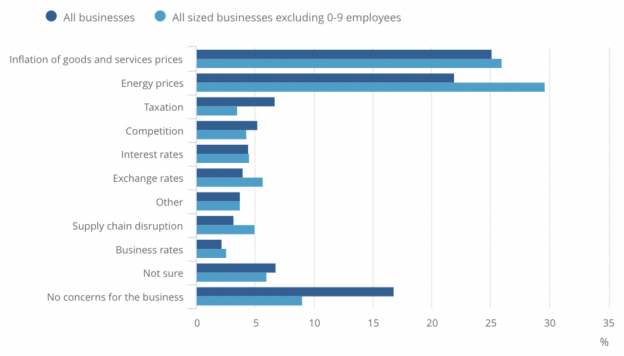
Results from the ONS’s Business Insights and Conditions Survey
As you can see, by far the most frequently mentioned concerns were “inflation” and “energy prices”. Only around 7% of businesses mentioned “taxation” as their main concern, demonstrating how ill-conceived was Liz Truss’s economic program. (She thought we could tax-cut our way out of an energy crisis).
Policymakers need to get grips with the fact that not every problem has a liberal technocratic ‘solution’. Paying people not to work, shutting down refineries, and sanctioning other countries may feel good. But that doesn’t mean it’s the right thing to do.
New Delhi may sue Berlin over undelivered LNG – Bloomberg
RT | November 12, 2022
A diplomatic dispute is brewing between India and Germany after Berlin took over a former Gazprom subsidiary and halted LNG shipments to New Delhi.
The Russian gas giant’s former local subsidiary Gazprom Germania, renamed SEFE (Securing Energy for Europe), cut LNG supplies to India’s Gail back in May, citing sanctions Moscow imposed after the company was taken over by the German state. Under the sanctions, Gazprom stopped supplying SEFE with gas.
Gail had a 20-year contract with Gazprom Germania’s Singaporean unit, GM&T Singapore, for the supply of 2.5 million tons of LNG per year. According to Bloomberg, citing the association of LNG importers GIIGNL, the contract remained valid after Berlin took over Gazprom Germania, meaning SEFE was still required to meet its obligations to Gail.
In September, SEFE’s Singaporean unit said it could no longer fulfill its long-term contract with Gail and offered to pay compensation of 20% of the contract price for the failed LNG deliveries. Gail CFO Rakesh Kumar Jain last week said that SEFE had canceled a total of 17 LNG shipments since May.
According to Bloomberg’s sources, India is now demanding that SEFE find alternative gas suppliers in order to meet its obligations to Gail, as the Indian company has been forced to spend much larger sums to buy gas on the spot market. It also had to cut supplies to customers and lower production at its petrochemicals plant due to the LNG deficit. The company has also turned down the compensation offer for undelivered LNG as it prefers to retain the right to the cancelled cargoes, Reuters reported on Friday.
Bloomberg’s sources said that both Indian and German diplomats have been engaged to solve the dispute. A diplomatic solution is preferable for the parties, according to the sources, although they noted that Gail was also consulting lawyers about arbitration over the contract with SEFE, which means the dispute could turn into a lawsuit. Gail is also reportedly negotiating with Gazprom to buy LNG directly from the Russian company.
Featured Video

The Truth About the Trump Shootings with Ken Silva
or go to
Aletho News Archives – Video-Images
From the Archives
The Geopolitics behind the War in Yemen (I)
By Mahdi Darius NAZEMROAYA | Strategic Culture Foundation | 30.03.2015
The United States and the Kingdom of Saudi Arabia became very uneasy when the Yemenese or Yemenite movement of the Houthi or Ansarallah (meaning the supporters of God in Arabic) gained control of Yemen’s capital, Sanaa/Sana, in September 2014. The US-supported Yemenite President Abd-Rabbuh Manṣour Al-Hadi was humiliatingly forced to share power with the Houthis and the coalition of northern Yemenese tribes that had helped them enter Sana. Al-Hadi declared that negotiations for a Yemeni national unity government would take place and his allies the US and Saudi Arabia tried to use a new national dialogue and mediated talks to co-opt and pacify the Houthis.
The truth has been turned on its head about the war in Yemen. The war and ousting of President Abd-Rabbuh Manṣour Al-Hadi in Yemen are not the results of «Houthi coup» in Yemen. It is the opposite. Al-Hadi was ousted, because with Saudi and US support he tried to backtrack on the power sharing agreements he had made and return Yemen to authoritarian rule. The ousting of President Al-Hadi by the Houthis and their political allies was an unexpected reaction to the takeover Al-Hadi was planning with Washington and the House of Saudi. … continue
Blog Roll
 Aletho News
- Pakistan-Iran talks secure LNG shipment to Islamabad through Hormuz
- Black Sea grain crisis puts global wheat supplies under pressure
- IRGC air defenses destroy another US MQ-1 drone over Strait of Hormuz
- Imran Khan’s entire immediate family detained in Pakistan ahead of mass protest demanding his release
- EU nation detains former presidential frontrunner
- Leaked: Britain’s Sham Conviction Of Hashim Thaci
- Seyed M. Marandi: U.S. Strike Imminent – Toward Total War in the Middle East
- Russia Voted Under Fire. Washington Is Loading the Tankers.
- 12 Things Your Oncologist Was Trained Not to Tell You
- Anthrax Attacks Paved Way for COVID-Era ‘Junk Drugs and Vaccines’
- If Americans Knew
- Huckabee aide solicited cash gifts from Israelis
- This isn’t sci-fi, AI is already killing people
- ‘The Most Brutal Thing’: Investigation Reveals Execution of Elderly Woman in Rafah
- Inside Israel’s ‘soft’ ethnic cleansing plan for Gaza through the eyes of its victims
- New online database tracks pro-Israel political donations in the United States
- Israeli president pardons soldier convicted for killing wounded Palestinian
- Singer Ed Sheeran says his ‘heart broken’ by Gaza devastation, addresses Macklemore controversy
- Israel Has Imprisoned Female Journalist Bushra Al-Tawil Without Trial Or Charge In Solitary Confinement For Past Month
- Israel poised to teach West Bank a lesson after one Israeli killed – Daily Update
- Salah Sarsour’s Legal Team Says DHS Has Not Met Its Burden to Prove He Is Deportable
- No Tricks Zone
- 2025 Nature Paper Claiming Worsening Global Drought Gets RETRACTED …Heavily Flawed
- New Study: ‘Global Drought Shows No Detectable Recent Acceleration Under Climate Warming’
- Economic Masterminds: German Socialists Suggest Taxing Productivity Gains Stemming From Using AI
- The South China Sea Has Not Been Cooperating With The Climate Change Narrative
- Energy Crisis: Germany Enters Heating Season With Historically Low Gas Reserve Fill Levels
- New Study: The Antarctic Ice Sheet Gained Mass From 2020-2024 Due To Staggering Snow And Ice Accumulation
- Study: Ocean Heating Rates From Thousands Of Years Ago ‘Dwarf’ Modern Ocean Heating Rates
- Climate Extremists Target, Attack Large-Scale Power Grid Infrastructure In Germany!
- New Study: Antarctic Ice Melt Has Contributed Less Than 1 Centimeter To Sea Level Rise In The Last 30 Years
- Fear Of Debate: Alarmist German Climate Scientist Calls On Mainstream Media To Discredit Skeptic Voices
 Aletho News