UK Researchers: Tax Food to Reduce Climate Change
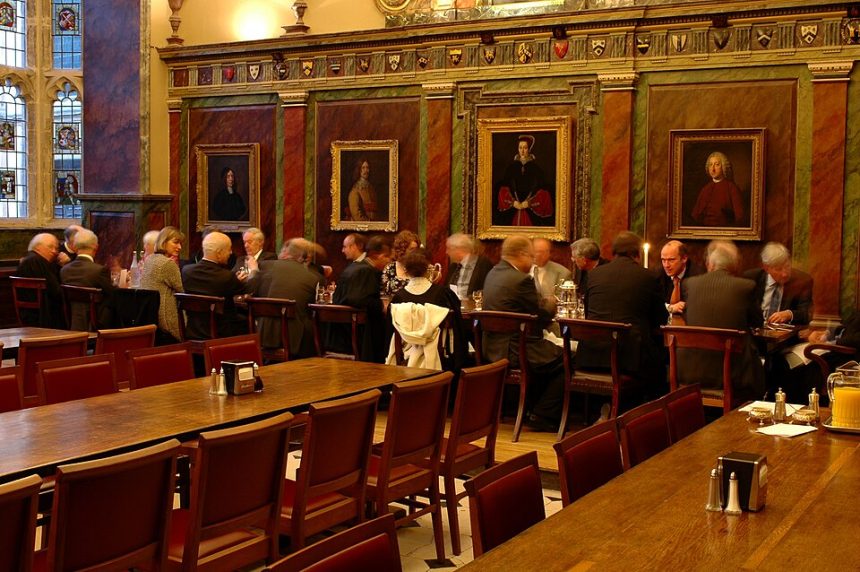
Oxford Trinity College High Table. I doubt these professors have anything to fear from a food tax. By Winky from Oxford, UK (Flickr) [CC BY 2.0], via Wikimedia Commons
By Eric Worrall | Watts Up With That? | November 19, 2016
A group of researchers in Oxford University, England have suggested that imposing a massive tax on carbon intensive foods – specifically protein rich foods like meat and dairy – could help combat climate change.
Pricing food according to its climate impacts could save half a million lives and one billion tonnes of greenhouse gas emissions
Taxing greenhouse gas emissions from food production could save more emissions than are currently generated by global aviation, and lead to half a million fewer deaths from chronic diseases, according to a new study published in Nature Climate Change.
The study, conducted by a team of researchers from the Oxford Martin Programme on the Future of Food at the University of Oxford and the International Food Policy Research Institute in Washington DC, is the first global analysis to estimate the impacts that levying emissions prices on food could have on greenhouse gas emissions and human health.
The findings show that about one billion tonnes of greenhouse gas emissions could be avoided in the year 2020 if emissions pricing of foods were to be implemented, more than the total current emissions from global aviation. However, the authors stress that due consideration would need to be given to ensuring such policies did not impact negatively on low income populations.
“Emissions pricing of foods would generate a much needed contribution of the food system to reducing the impacts of global climate change,” said Dr Marco Springmann of the Oxford Martin Programme on the Future of Food, who led the study. “We hope that’s something policymakers gathering this week at the Marrakech climate conference will take note of.”
Much of the emissions reduction would stem from higher prices and lower consumption of animal products, as their emissions are particularly high. The researchers found that beef would have to be 40% more expensive globally to pay for the climate damage caused by its production. The price of milk and other meats would need to increase by up to 20%, and the price of vegetable oils would also increase significantly. The researchers estimate that such price increases would result in around 10% lower consumption of food items that are high in emissions. “If you’d have to pay 40% more for your steak, you might choose to have it once a week instead of twice,” said Dr Springmann.
…
The results indicate that the emissions pricing of foods could, if appropriately designed, be a health-promoting climate-change mitigation policy in high-income, middle-income, and most low-income countries. Special policy attention would be needed in those low-income countries where a high fraction of the population is underweight, and possibly for low-income segments within countries.
…
Read more: http://www.oxfordmartin.ox.ac.uk/news/2016_11_Emissions
The abstract of the study;
Mitigation potential and global health impacts from emissions pricing of food commodities
Marco Springmann, Daniel Mason-D’Croz, Sherman Robinson, Keith Wiebe, H. Charles J. Godfray, Mike Rayner & Peter Scarborough
The projected rise in food-related greenhouse gas emissions could seriously impede efforts to limit global warming to acceptable levels. Despite that, food production and consumption have long been excluded from climate policies, in part due to concerns about the potential impact on food security. Using a coupled agriculture and health modelling framework, we show that the global climate change mitigation potential of emissions pricing of food commodities could be substantial, and that levying greenhouse gas taxes on food commodities could, if appropriately designed, be a health-promoting climate policy in high-income countries, as well as in most low- and middle-income countries. Sparing food groups known to be beneficial for health from taxation, selectively compensating for income losses associated with tax-related price increases, and using a portion of tax revenues for health promotion are potential policy options that could help avert most of the negative health impacts experienced by vulnerable groups, whilst still promoting changes towards diets which are more environmentally sustainable.
Read more: http://www.nature.com/nclimate/journal/vaop/ncurrent/full/nclimate3155.html
This proposal, from a group of people who have probably never missed a meal in their lives, is totally obscene. High income countries often have a lot of poor people who would be hard hit by increases in the price of food.
Needlessly exacerbating the risk poor people don’t get enough to eat, especially children and pregnant mothers, who are especially vulnerable to adverse health impacts from lack of protein in their diet – if this ghastly proposal is ever implemented, future generations will look upon it as a crime against humanity.
Will Trump Defy McCain & Marco?
By Pat Buchanan • Unz Review • December 13, 2016
When word leaked that Exxon CEO Rex Tillerson, a holder of the Order of Friendship award in Putin’s Russia, was Donald Trump’s choice for secretary of state, John McCain had this thoughtful response:
“Vladimir Putin is a thug, a bully, and a murderer and anybody else who describes him as anything else is lying.”
Yet, Putin is something else, the leader of the largest nation on earth, a great power with enough nuclear weapons to wipe the United States off the face of the earth. And we have to deal with him.
McCain was echoed by the senior Democrat on foreign relations, Bob Menendez, who said naming Tillerson secretary of state would be “alarming and absurd … guaranteeing Russia has a willing accomplice in the (Trump) Cabinet guiding our nation’s foreign policy.”
Sen Marco Rubio chimed in: “Being a ‘friend of Vladimir’ is not an attribute I am hoping for from a Secretary of State.”
If just three GOP senators vote no on Tillerson, and Democrats vote as a bloc against him, his nomination would go down. President Trump would sustain a major and humiliating defeat.
Who is Tillerson? A corporate titan, he has traveled the world, represented Exxon in 60 countries, is on a first-name basis with countless leaders, and is endorsed by Condi Rice and Robert Gates.
Dr. Samuel Johnson’s observation — “A man is seldom more innocently occupied than when he is engaged in making money” — may be a bit of a stretch when it comes to OPEC and the global oil market.
Yet there is truth to it. Most businessmen are interested in doing deals, making money, and, if the terms are not met, walking away, not starting a war.
And here is the heart of the objection to Tillerson. He wants to end sanctions and partner with Putin’s Russia, as does Trump. But among many in the mainstream media, think tanks, websites, and on the Hill, this is craven appeasement. For such as these, the Cold War is never over.
The attacks on Tillerson coincide with new attacks on Russia, based on CIA sources, alleging that not only did Moscow hack into the Democratic Party and Clinton campaign, and leak what it found to hurt Hillary Clinton, but Russia was trying to help elect Trump, and succeeded.
Why would Moscow do this?
Monday’s editorial in The New York Times explains: “In Mr. Trump, the Russians had reason to see a malleable political novice, one who had surrounded himself with Kremlin lackeys.”
Backed by Democratic leader Sen. Chuck Schumer, McCain has announced an investigation. The goal, said the Times, is to determine “whether anyone within Trump’s inner circle coordinated with the Kremlin and whether Moscow spread fake news to hurt Mrs. Clinton.”
What is going on here? More than meets the eye.
The people who most indignantly condemned Trump’s questioning of Obama’s birth certificate as a scurrilous scheme to delegitimize his presidency, now seek to delegitimize Trump’s presidency.
The Times editorial spoke of a “darkening cloud” already over the Trump presidency, and warned that a failure to investigate and discover the full truth of Russia’s hacking could only “feed suspicion among millions of Americans that … (t)he election was indeed rigged.”
Behind the effort to smear Tillerson and delegitimize Trump lies a larger motive. Trump has antagonists in both parties who alarmed at his triumph because it imperils the foreign policy agenda that is their raison d’etre, their reason for being.
These people do not want to lift sanctions on Moscow. They do not want an end to the confrontation with Russia. As is seen by their bringing in tiny Montenegro, they want to enlarge NATO to encompass Sweden, Finland, Ukraine, Georgia and Moldova.
They have in mind the permanent U.S. encirclement of Russia.
They want to provide offensive weapons to Kiev to reignite the civil war in the Donbass and enable Ukraine to move on Crimea. This would mean a war with Russia that Ukraine would lose and we and our NATO allies would be called upon to intervene in and fight.
Their goal is to bring down Putin and bring about “regime change” in Moscow.
In the campaign, Trump said he wanted to get along with Russia, to support all the forces inside Syria and Iraq fighting to wipe out ISIS and al-Qaida, and to stay out of any new Middle East wars — like the disaster in Iraq — that have cost us “six trillion dollars.”
This is what America voted for when it voted for Trump — to put America First and “make America great again.” But War Party agitators are already beating the drums for confrontation with Iran.
Early in his presidency, if not before, Trump is going to have to impose his foreign policy upon his own party and, indeed, upon his own government. Or his presidency will be broken, as was Lyndon Johnson’s.
A good place to begin is by accepting the McCain-Marco challenge and nominating Rex Tillerson for secretary of state. Let’s get it on.
Patrick J. Buchanan is the author of the new book “The Greatest Comeback: How Richard Nixon Rose From Defeat to Create the New Majority.”
Copyright 2016 Creators.com
It’s Beginning to Smell a Lot Like Totalitarianism, and I Don’t Mean Russia
By F. William Engdahl – New Eastern Outlook – 13.12.2016
If we smell precisely the stench of the totality of steps taken in NATO countries in recent months, especially in the United States and the European Union, we can smell the stench of totalitarian rule or some would call it, fascism, being quietly imposed on our basic human freedoms. Some recent examples give pause for reflection as to where we are allowing our world to drift.
Let’s begin with a most ominous, bizarre, Jesuitical interview that the Roman Catholic Pope Francis gave to a Belgian paper December 7, comparing what he calls defamatory news to what he called the “sickness of coprophagia.” He stated:
QUESTION – A final question, Holy Father, regarding the media: a consideration regarding the means of communication…
POPE – The communications media have a very great responsibility…It is obvious that, given that we are all sinners, also the media can…become harmful… They can be tempted by calumny, and therefore used to slander, to sully people, especially in the world of politics. They can be used as a means of defamation: every person has the right to a good reputation, but perhaps in their previous life, or ten years ago, they had a problem with justice, or a problem in their family life, and bringing this to light is serious and harmful… This is a sin and it is harmful. A thing that can do great damage to the information media is disinformation: that is, faced with any situation, saying only a part of the truth, and not the rest. This is disinformation… Disinformation is probably the greatest damage that the media can do, as opinion is guided in one direction, neglecting the other part of the truth. I believe that the media should… not fall prey – without offence, please – to the sickness of coprophilia, which is always wanting to communicate scandal… And since people have a tendency towards the sickness of coprophagia, it can do great harm.
Coprophilia is defined in the Merriam-Webster dictionary as “marked interest in excrement, especially the use of feces or filth for sexual excitement.” And coprophagia is eating feces by humans, literally, eating shit.
What people precisely, Holy Father, have a “tendency to towards the sickness of coprophagia”? Is this the dominant sickness of the human race? And if not, why do you make such a disgusting likeness between eating shit and citizens who read about politicians and their misdeeds or media that report on same? And who is to judge if factually true dissemination of facts about political figures from their past is relevant or not to help voters judge their character? I would say the comments are a perfect example of what he pretends to condemn.
Were it only a single, off-the-cuff remark by a religious figure, we could dismiss it along with claims such as the papal infallibility declaration proclaimed by the Vatican I on 18 July 1870. However, precisely because of such dogma and of the influence of the Roman Catholic Church and its Pope, notably in the countries of Western Europe, the United States and Latin America, such vague and dangerous remarks ought to be taken seriously as a signal of what lies ahead for the public freedom of speech.
“Fake News”
The papal comments on coprophagia and journalism come amid an explosion of charges in the USA and EU that Russia is planting “fake news” as it is now being called, about Hillary Clinton in the US media by way of certain alternative media. Robby Mook, Hillary Clinton’s former campaign manager, said “fake news” was a “huge problem” the campaign faced in the recent US election: “I still think we have to investigate what happened with Russia here. We cannot have foreign, and I would say foreign aggressors here, intervening in our elections. The Russian were propagating fake news through Facebook and other outlets, but look, we also had… Breitbart News, which was notorious for peddling stories like this.”
Online stories that claimed a Washington D.C. pizza restaurant, Comet Ping Pong, was used by candidate Hillary Clinton and her campaign manager John Podesta for child sex, the so-called “Pizzagate” Scandal, is now being used to drum up popular opinion for censorship of the Internet as well as Facebook and other social media.
Senior New York Times reporter David Sanger wrote a vague, anonymous “according to senior Administration sources,” article on December 9 under the headline, “Russia Hacked Republican Committee but Kept Data, US Concludes.” What we are seeing is precisely the kind of fake news that Hillary Clinton and the Pope talk about. But it is mainstream establishment media doing the fakery.
The fakery is being orchestrated by the highest levels of the mainstream media in collusion with NATO circles and intelligence agencies such as the CIA, which has saturated the ranks of mainstream media with their disinformation agents according to former CIA head William Colby, who once allegedly said, “The CIA owns everyone of any significance in the major media.”
The campaign will continue, likely with some horrendous stories about some psychopath taking a gun and bursting into Comet Ping Pong pizza place shooting innocent customers, because it was said he read in alternative media fake news about the pedophile ring. That already took place, but the man fired no shots. The population is being manipulated to accept extreme censorship of internet and other alternative media, something unimaginable just months ago.
Like clockwork, the “fake news” campaign has spread to the European Union. After announcing she will run again in 2017 for Chancellor, Angela Merkel spoke ominous words suggesting government censorship of independent “populist” (sic) media might be necessary: “Today we have fake sites, bots, trolls — things that regenerate themselves, reinforcing opinions with certain algorithms and we have to learn to deal with them.” She declared, “we must confront this phenomenon and if necessary, regulate it… Populism and political extremes are growing in Western democracies..” Her remarks came after Google and Facebook cut off ad revenue to what they declared to be “fake” news sites.
In the EU, especially Germany, populist has an implicit negative or even fascist connotation as in “right-wing populist” parties who oppose Merkel’s open door to war refugees policies, or who these days oppose almost anything her heavy-handed government puts forward.
War on Cash
Now if we begin to see stealth propaganda preparing us to accept severe clampdowns on the one remaining free media, the Internet and related social media, we can also see an equally ominous, indeed, totalitarian move to create acceptance for the idea we give up the right to hold paper money, giving private, often corrupt, banks total control over our money, and in turn giving government agencies total control over where we spend for what.
This is the so-called cashless society. Arguments put forward are that elimination of cash will be more convenient to consumers or that it will eliminate or greatly reduce organized crime and shadow economy that evades taxation. In the EU, Sweden has already virtually eliminated cash. Sweden cash purchases today are down to just three per cent of the national economy compared to nine per cent in the Eurozone and seven per cent in the US. Public buses don’t accept cash. Three of Sweden’s four largest banks are phasing out the manual handling of cash in bank branches. Norway is following the same path.
In France today, it’s now illegal to do cash transactions over €1,000 without documenting it properly. France’s finance minister Michel Sapin, in the wake of the Charlie Hebdo attacks, blamed the attacks on the ability of the attackers to “buy dangerous things with cash.” Shortly after the Hebdo attacks he announced capital controls that included the €1,000 cap on cash payments, down from €3,000, to “fight against the use of cash and anonymity in the French economy.” In high-inflation Eurozone €1,000 is not a huge sum.
Even in conservative Germany, a leading member of the Merkel coalition proposed to eliminate the €500 note and capping all cash transactions at €5,000. Some weeks later the European Central Bank, where negative interest rates are the order of the day, announced it would end issue of €500 notes by December 2018 arguing it made it too easy for criminals and terrorists to act.
And in the United States, as the campaign to sell skeptical citizens on cashless digital bank payments increases, JP Morgan Chase, the largest and one of the most criminal banks in the US, has a policy restricting the use of cash in selected markets. The bank bans cash payments for credit cards, mortgages, and auto loans; and it prohibits storage of “any cash or coins” in safe deposit boxes. So if you have a rare cold coin collection, you better stuff it in the mattress…
Negative Rates and Cashless Citizens
As long as cash–bills and coins of a national currency–are the basis of the economy, the central banks of the USA and EU as well as Japan, are unable to impose a severe negative interest rate policy much beyond the flirtation today by the ECB and Bank of Japan. If central bank rates were to go very negative, banks would be charging customers the absurd charge to make them pay to keep their cash on deposit or in savings at those banks. Naturally, people would revolt and withdraw in cash to invest in gold or other hard, tangible valuables.
Harvard economist and member of the Economic Advisory Panel of the Federal Reserve, Kenneth Rogoff, an advocate of the “war on cash,” noted that the existence of cash “creates the artifact of the zero bound on the nominal interest rate.” In his 2016 book, The Curse of Cash, Rogoff urged the Federal Reserve to phase out the 100-dollar bill, then the 50-dollar bill, then the 20-dollar bill, leaving only smaller denominations in circulation, much like what the mad Modi has just done in India.
Any serious observer of the world economy, especially of NATO nations in Europe and North America since the financial crisis of September 2008, would have to realize the current status quo of zero or negative central bank interest rates to prop up banks and financial markets is not sustainable. Unless cash is eliminated that is.
On April 5, 1933 President Franklin D. Roosevelt signed Executive Order 6102, “forbidding the Hoarding of gold coin, gold bullion, and gold certificates within the continental United States.” That was rightly denounced by many as outright theft, confiscation of privately held gold, by the Government.
Radical solutions such as done by President Roosevelt in 1933, yet in a monetary order where gold no longer dominates, is clearly becoming more attractive to the major bankers of Wall Street and the City of London. Rather than confiscate citizens’ gold, today the Gods of Money would have to find a way to steal the cash of citizens. Moving to their “cashless” banking, limiting how much cash can be withdrawn and then eliminating cash entirely as Swedish banks are doing would enable tax authorities to have perfect totalitarian control on every citizen’s use of money. Moreover, governments could decree, as did FDR, that cash above certain levels must be taxed under some or another national declaration of emergency.
As such bold, radical moves advance, they would of course be vociferously attacked not on CNN or The New York Times or Financial Times or other mainstream media tied to those criminal financial institutions, but in alternative media. Keep in mind it was the uncritical New York Times and Washington Post that uncritically retailed the fake news that led to declaration of war on Iraq in 2003, namely that Saddam Hussein had weapons of mass destruction aimed at Washington. That war has spread death and destruction of a scale unimaginable. No one complained at the time about that fake news.
The protest over moves to confiscate citizens’ bank holdings would come through alternate, independent media such as Zero Hedge or countless others. Recently, US media uncritically republished a purported list of “fake news” blogs and websites prepared by Assistant Professor of Communications at Merrimack College, Melissa Zimdars. Zero Hedge was on it.
This is not about endorsing or not endorsing any alternative blog or website. It is about the essential freedom of us all to be able to read and decide any and all opinions or analyses and not to have government decide what I am or am not allowed to read. It’s about the freedom to keep privacy about what I choose to buy and not leave a digital trail that my bank could release to the tax authorities or to Homeland Security or the FBI, or sell to profiling consumer operations. Controlling public communication and controlling private money would go a long way to creation of the perfect totalitarian state. Not a good idea, I would say.
F. William Engdahl is strategic risk consultant and lecturer, he holds a degree in politics from Princeton University.
Democratic Losers and their Media Backers Seek a Scapegoat for Their Own Disaster
The fake campaign to blame ‘the Russians’
By Dave Lindorff | This Can’t Be Happening! | December 11, 2016
The New York Times and Washington Post, the nation’s two top national newspapers, have been breathlessly reporting of late, with little sign of any appropriate journalistic skepticism, on a purported massive and successful Russian conspiracy to throw the US election to their “favored” candidate, Donald Trump. But the Chicago Tribune has weighed in with a more measured piece, suggesting that while the CIA, a particularly secretive and politically driven organization, may be making that claim, the FBI is not convinced.
While even the Tribune sometimes ignores inserting the requisite “alleged” that should precede any reference to unproven claims that Russia is behind the hacking of the Democratic Party’s (and the Republican Party’s) email server, the paper does also note that Democrats in particular are “frustrated” by the “murky nature” of the FBI’s analysis, with outgoing Senate Minority Leader Harry Reid (D-Nev.), calling on FBI Director James Comey to resign.
The reason for the Democrats’ frustration is also made clear. As the Tribune reports:
With so much of the evidence about Russia’s alleged role in the election shrouded in secrecy because of strict classification rules, Democrats and Republicans in Washington who have access to the underlying intelligence say they have struggled to make their respective cases, leaving an already deeply divided public convinced that both sides are shading their conclusions to help the candidate they backed on Election Day.
The reality is that the CIA has presented no hard evidence that Russia is behind the hacking of the DNC’s or or Clinton’s private home server. The excuse is given that the Agency doesn’t want to disclose any of its sources, so the reader is left with the pathetic plea, from both the Agency and the White House: “Trust us.”
But why would anyone trust the CIA or the White House on anything? We’re talking about an agency and a Executive Branch that between them are known to have lied (during the GW Bush years) about anthrax labs in Saddam Hussein’s Iraq, lied about what were aluminum tubes imported to make irrigation equipment being evidence of missile-building, lied about Iraq’s links to Al Qaeda, and (during the Obama years) lied about Syria’s government using Sarin gas on its own people in Damascus, lied about the details of the killing of Osama Bin Laden, lied about the role of a murderous CIA agent captured by Pakistani police while posing as a US consular employee, lied about the extent of National Security Agency Spying both at home and abroad, and lied about Russia invading Ukraine and shooting down a civilian Malaysian jumbo jet.
If one were to take a moment and think about what is being alleged here by Democrats — that a national presidential election was successfully subverted by the releasing of hacked emails showing major corruption and malfeasance by the Democratic Party leadership in undermining the fairness of the party’s presidential primary to benefit one candidate — Hillary Clinton — and to destroy the candidacy of her opponent Bernie Sanders — it should lead to one of two alternative conclusions.
Either the Russians did Americans a favor, by exposing the epic corruption of one of their two major parties and one of the candidates seeking to become president — something that a more independent and aggressive domestic media would have and should have done on their own, if not by hacking then by paying attention to, instead of ignoring and blacking out, what frustrated insiders like DNC Vice Chair Tulsi Gabbard, the Democratic congresswoman from Hawaii who quit in disgust saying the DNC was undermining the primaries on behalf of Clinton’s campaign. Or alternatively, we’re being told that our 240-year-old democracy is so shriveled and weak that an outside government can easily undermine it and manipulate the outcome as if we were some corrupt and fragile banana republic.
Either conclusion is rather pathetic and depressing to contemplate.
Meanwhile, the media feeding frenzy over unsubstantiated claims over Russian subversion of our last election ignores the reality that this kind of thing is something the US has been doing abroad at least since the end of World War II and the onset of the Cold War. Not content to just undermine elections through dirty tricks, fake news and secret payments in Europe, Latin America, later in Eastern Europe and Russia, and in Asia, the US has also fomented countless coups to overthrow or attempt to overthrow existing elected governments, most recently in Honduras, Ukraine, Venezuela and Brazil, and so has no grounds to complain by claiming that the Russians were allegedly doing the same thing here.
On the other hand, if the Democratic Party leadership had kept its hand off the scale during the primaries, and had not made such heavy-handed efforts to get major news organizations like the Times, MSNBC, the Daily News, Post and others to help it undermine Bernie Sanders, Sanders would have won both the party’s nomination and the presidency, and probably the Congress also into the bargain, and we wouldn’t be looking at a looming Trump presidency and Republican Congress.
Not only that, but with a genuinely popular candidate running for president in both parties (like it or not Trump was wildly popular among a significant segment of the population), no Russian propaganda campaign would have had a prayer of impacting voter opinion or the results of the voting.
If indeed there really was a Russian effort to swing this recent election, it could only have succeeded in a situation where the electorate was disgusted by its choices and was voting negatively for a lesser evil. And that situation only could arise where the two major parties were so corrupted that they were trying desperately to keep genuinely popular candidates from winning the nomination.
In fact that is what happened. The Republican leadership tried mightily to keep Donald Trump, a loose cannon who has disavowed many basic and long-held Republican principles, such as backing US empire and Israel, supporting any and all trade agreements, and viewing Russia as an existential enemy, from winning their party’s nomination. They failed, but not for lack of trying. The Democratic leadership tried everything, too, to prevent insurgent self-described “socialist” candidate Sanders from winning the nomination, and thanks to underhanded manipulation of the primaries, corrupt meddling in media coverage of Sanders, an anti-democratic voting block of locked-in “super delegates,” committed to backing Clinton whatever the result of the primaries, and some crooked efforts to depress voting in key primary states including New York and California, they succeeded in throwing the nomination to Clinton. She of course was doomed, by their very ham-handed interference in the primaries, to go on to lose the general election.
That corrupt fiasco has left Democratic Party leadership hacks and their backers in the corporate media with nothing to do but find a scapegoat for their disastrous performance, hence the fake “Russia-did-it” claims.
It’s a sad commentary on the pathetic decline of democracy in the United States, but is also a clarion call for a rebirth of grassroots democratic resurgence.
If there’s a bright spot in the new situation, it’s that progressives, socialists, radicals and disaffected citizens of all kinds now should have a clear understanding of how corrupt the Democratic Party really is.
One of two things must happen. That party must be completely swept clean of the hacks, frauds, crooks, compromisers and charlatans who populate its leadership and who hold most of the elected posts remaining in Democratic hands in Congress. Alternatively, the Democratic Party must be abandoned as unsalvageable, with progressive forces, from labor organizations, advocates of the poor and elderly, environmental activists, human rights and peace groups, women’s rights and minority rights organizations, civil libertarians and others rallying both to create something new to replace it, and organizing in the street to resist the new Trump government.
Any new left party needs to abandon the fraudulent tactics of so-called “identity politics,” in which a basically pro-corporate Democratic Party has sought to appease and cajole support for its corporatist candidates and agenda by catering to individual issues of various groups leaning its way by default. Instead, the really big issues need to be tackled head on: expanding Social Security, making Medicare universal for everyone of all ages, restoring genuine progressive taxation on the wealthy, ending foreign wars, closing overseas bases and slashing the military, obeying international law (including treaties with sovereign Native American nations), making public college free to all, nationalizing support for primary and secondary education so that all communities have well-funded, quality public schools, declaring a national mobilization to quickly end reliance upon fossil fuels to combat climate change, and creating jobs for everyone through a massive public spending program on job training and infrastructure repair and modernization.
These and other ideas are things that most Americans can and would get behind, not simply efforts to pander to various specific interest groups.
Do this and the Russians — assuming they even have been trying to manipulate our elections — wouldn’t have a chance of influencing anyone.
Russia ‘strategic competitor’ to West, no business as usual – UK Defense Minister
RT | December 11, 2016
Britain’s Defense Minister Michael Fallon said that Russia is a strategic competitor to the West and hence should not be treated equally. Fallon noted that there is still a need for the de-escalation of tensions, but there can be “no business as usual.”
“Russia is a strategic competitor to us in the West and we have to understand that,” Fallon told the BBC.
He noted that this is essentially the reason why the West “can’t be treating Russia as an equal.” Speaking about joint work with the future US counterpart Jim Mattis (recently appointed by US President-elect Donald Trump), Fallon said that the West should be strong against Moscow.
“I’m ready to work with the new Secretary of Defence Jim Mattis … to be strong against Russian aggression towards NATO,” the British Defense Minister stressed.
However, he added that at the same time he is ready to work with Washington “to de-escalate tensions with Moscow” and “to continue to work with Russia on how we get towards a settlement in Syria.”
“There are things we have to talk to Russia about, of course: to de-escalate tension, to explain the purpose of our deployment within NATO, to reassure the Eastern members and to persuade Russia to use its influence, where it has great influence. And one of those countries is Syria,” Fallon went on to say.
Yet he highlighted that “it can’t be business as usual.” Relations between Moscow and the West have been tense over the past few years, with the US and its allies accusing Russia of building up forces on its western borders. Moscow said that it has done so only on its own territory and in response to US and NATO troops amassing near its borders.
In July NATO members agreed to the “biggest reinforcement since the Cold War,” posting four multinational battalions to Estonia, Latvia, Lithuania and Poland. And in November Washington announced the deployment of nearly 6,000 troops, along with tanks, infantry vehicles, heavy howitzers, and combat helicopters to eastern Europe.
READ MORE:
Britain joins biggest European military buildup since Cold War
Trump must stand up to Russia, not treat it as equal – UK defense secretary
Conflict instigators must foot humanitarian crises bills – Russian Emergencies Minister to UN
RT | December 9, 2016
The head of Russia’s Emergencies Ministry has proposed a new economic model of humanitarian assistance and reparation payments to victims of war zones, recommending that initiators of conflict pay for the destruction and suffering caused by their policies.
“The Russian Federation proposes to build a new economic model of international humanitarian aid,” Vladimir Puchkov told the UN General Assembly in New York. The model is quite simple, according to Puchkov, who said that nations which initiate, incite and sponsor conflicts in other states should be “obliged to bear primary responsibility, including financial” for providing aid to refugees and persons internally displaced as a result.
The need to create a new mechanism arises from the lack of funding for international humanitarian relief budgets. Currently only around 5 percent of the funds required to remedy the widespread destruction and suffering are available, the Russian minister said.
To reduce the financial burden on the international humanitarian aid system, associated with the rise of terrorism and waves of refugees, Puchkov also stressed the need to focus on conflict prevention.
“We believe that settlement and conflict prevention is the best approach to reducing the burden on the international humanitarian system,” the minister said in a report at the 71st session of the UN General Assembly.
In order to improve the quality of international aid the minister also offered to take additional measures and help develop local crises response capabilities in conflict-torn countries.
“Instead of trying to provide for the millions of refugees in Europe, it is necessary to create opportunities for them to stay at home, or at least in the same region,” Puchkov noted.
Among other things, Puchkov urged that the international community intensify efforts to improve the international legal and contractual framework which would allow aid to quickly reach affected areas. Meanwhile developing countries, the minister said, should also recognize their responsibility and not remain “passive recipients.”
Speaking about the Russian contribution to global humanitarian aid missions, Puchkov highlighted that this year Russia participated in over 40 missions across the globe, offering aid to over 10 countries. Besides Syria and Ukraine, some of the recent recipients of Russian aid include countries such as Yemen and Afghanistan, in addition to western states such as Italy and Portugal. Overall, Russia engaged in over 450 missions across the globe over the last quarter of a century.
In addition, over the last three years, Moscow has sent more than $250 million to battle humanitarian crisis in a number of countries, by sending emergency food and medical assistance to populations affected by conflict and natural disasters.
The UN Office for the Coordination of Humanitarian Affairs (OCHA), which coordinates international humanitarian relief efforts said that last year more than 76 million people from 31 countries needed assistance. The UN office also noted in 2015 some 51 million people were displaced worldwide, which is the highest number since WWII.
PayPal Serves Illegal Israeli Settlers But Won’t Let Palestinians Open Accounts
By Kit O’Connell | Mint Press News | November 21, 2016
AUSTIN, Texas – PayPal is one of the world’s most popular ways to send or receive money online, but Palestinians are cut out of the action.
Time magazine reported in January that PayPal has 179 million active accounts in dozens of countries, and PayPal payments are widely accepted in online marketplaces from eBay to Etsy.
To sign up, every user needs to have an account at a bank recognized by the service. Since PayPal doesn’t recognize any Palestinian banks, Palestinians are effectively prevented from using the service. Critics say this has impacted not just individuals, but burgeoning industries and even the broader Palestinian economy.
“PayPal’s absence is a major obstacle to the growth of Palestine’s tech sector and the overall economy,” Americans for a Vibrant Palestinian Economy, an NGO that promotes businesses in Palestine, wrote in an Aug. 23 open letter.
The letter, which was co-signed by more than 40 NGOs and Palestinian businesses, continues:
“Without access to PayPal, Palestinian entrepreneurs, nonprofits, and others face routine difficulties in receiving payments for business and charitable purposes. Moreover, PayPal’s absence is problematic for the overall Palestinian economy as tech is one of the only sectors with the potential to grow under status quo conditions of the Israeli occupation which severely restricts the internal and cross-border movement of goods and people.”
For the past decade, Israel has maintained a blockade on Palestinian imports of everything from everyday goods like crayons to crucial building supplies like concrete. Palestinian exports are heavily restricted, too.
Palestine is home to a thriving tech economy, Mike Butcher wrote in a Sept. 9 report. The TechCrunch editor-at-large continued:
“Palestine produces roughly 2,000 IT graduates per year. Both the West Bank and Gaza now have a number of technology companies which, ironically, see tech as a way of developing their economy, just as the Israelis do.”
While PayPal doesn’t recognize Palestinian banks, the authors of the open letter noted that many Palestinians live side by side with illegal Israeli settlers, who, purely by virtue of possessing Israeli bank accounts, are free to make use of the service. Israel demolished over 200 Palestinian homes this year, bringing its expansion of illegal settlements to record levels in 2016.
“We believe a company like PayPal, whose actions in North Carolina reaffirmed its commitment to equal rights, would agree that people living in the same neighborhood ought to have equal rights and access to its services regardless of religion or ethnicity,” the letter noted.
In April, Paypal pulled hundreds of jobs out of North Carolina after the state passed the so-called “bathroom bill,” which rescinded local protections for LGBT people, put restrictions on bathroom access for transgender individuals, and banned cities from passing increases to the minimum wage.
PayPal maintains multiple offices in Israel and has invested millions into its businesses there. The company does not seem poised to take a similar stand in Israel in response to the ongoing repression of the indigenous Palestinian population, who face severe restrictions on their movement and frequent attacks by the Israeli military, among other human rights abuses.
After the open letter was published, other organizations that support Palestine soon joined in by urging PayPal to expand into Gaza, launching a petition and social media campaign, #PayPal4Palestine. […]
In a message of support sent on Oct. 29 by Ramah Kudaimi, director of grassroots organizing at the U.S. Campaign for Palestinian Rights, wrote:
“Palestinians being denied access to PayPal means they cannot use their services to run a business, or raise money for a charity, or send cash to a relative, or make everyday purchases online. Getting access to PayPal can make a real difference in the lives of so many Palestinians as the struggle for freedom, justice, and equality continues.”
The tech giant seems unmoved by activists and Palestinian entrepreneurs’ requests to do business. The firm sent Butcher a dismissive response to his request for comment.
“We appreciate the interest that the Palestinian community has shown in PayPal,” the company’s representative wrote, but, the statement continued, “we do not have anything to announce for the immediate future.”
Sanders Single Payer and Death by Democrat
By Russell Mokhiber | CounterPunch | December 2, 2016
Lori Kearns is the health policy advisor to Senator Bernie Sanders (I-Vermont).
She’s been making the rounds in recent weeks telling single payer supporters that Senator Sanders will not introduce his single payer bill into the Senate next year.
Why not?
Because party unity is more important than single payer.
Sanders apparently believes that single payer will get in the way of electing a Democratic Senate in 2018.
Wouldn’t want to confront Democratic Senate candidates with the deaths of their constituents due to Obamacare, would you?
One reason why Sanders soared during the primary was his constant refrain that we need to cover every American with a single payer health care system.
This resonated with the American people, with polls showing that three-fifths of Americans — including a majority of those who want the Obamacare repealed, and even 41 percent of Republicans — favoring a “federally funded healthcare program providing insurance for all Americans.”
Translate — single payer.
Everybody in. Nobody out.
If Sanders believes it, where is the bill?
Why won’t Sanders re-introduce it in the upcoming session?
Because he is now in the Democratic leadership in the Senate — handpicked by Wall Street favorite incoming Senate Minority Leader Charles Schumer (D-New York.)
And if the Democrats say no, Sanders says no.
Call it death by Democrat.
And death by Obamacare.
Narrow networks.
High deductibles and co-pays.
Skyrocketing premiums.
Twenty nine million Americans still uninsured.
And more than 28,000 preventable deaths a year due to lack of health insurance.
All under Obamacare.
And Sanders won’t introduce his single payer bill because the Democrats tell him not to?
During the battle over Obamacare on the Hill in 2009, I asked Sanders why he was supporting Obamacare when he stood for single payer.
Sanders was a student of the difference — Obamacare controlled by the health insurance companies and written by their lobbyists — single payer a public system that cuts the health insurance companies out of the game.
Sanders looked at me, snarled, told me not to lecture him and walked away.
Goodbye single payer. Hello Chuck Schumer.
Russell Mokhiber is the editor of the Corporate Crime Reporter.
Featured Video

AIDS Inc. by Gary Null (2007)
or go to
Aletho News Archives – Video-Images
From the Archives
Clash of Civilization, Iran Part II
By Jamal Kanj – Intifada-Palestine.com – January 14, 2011
Israel’s survival kit is: perpetuate conflict, insecurity to rationalize collective hate and finally playing victim.
Devoid of conflict, Israel implodes internally; without hate, Zionism loses its justification; and playing eternal victim to continue blackmailing the West. Absence of this holy trinity, Israel ceases to exist.
From its inception, the house of Zion has mastered exploiting adversarial powers to advance Israel’s cause. For instance, their influence over the Democratic Party in the US began with President Truman’s bid for 2nd term election in 1948.
Responding to strong opposition from Secretary of State General George Marshall and Department experts urging against recognition of Israel, President Truman replied: “I’m sorry gentlemen but I have to answer to hundreds of thousands [Jewish voters] who are anxious for the success of Zionism. I do not have hundreds of thousands of [voting] Arabs among my constituents”
Zionists influence over liberal American politics was matched with the doctrinal school of Conservative theoreticians aligning the Republican Party’s platform with Israel’s objectives. The Neoconservative Zionists, coined Zioncons, invented the “Clash of Civilization” concept to fight Israel’s wars. … continue
Blog Roll
 Aletho News
- Merck Virologists Admitted to Falsely Certifying Vaccine Efficacy
- Mandatory Folic Acid for every man, woman & child
- Pro-Palestine protesters arrested outside UK’s ruling Labour Conference in Liverpool
- Mauritius denies landing permit to flight from Israel, forcing cancellation: Tour operator
- Israeli finance minister calls for genocidal war on West Bank, annexation of south Lebanon
- 12 Things Your Psychiatrist Was Trained Not to Tell You
- From Unipolar Universalism to Multipolar Civilizational Distinctiveness
- RSF military group defects, joins Sudanese army: State media
- Ireland goalkeeper refuses to play ‘Israel’ as squad weighs boycott
- China pushes back against US on Cuba, Iran
- If Americans Knew
- Israel forces Gazans to live in constant peril – Daily Update
- Deconstructing Netanyahu’s pants-on-fire UN rant – Daily Update
- Trump betrayed voters with his campaign lies and prioritized a foreign country once he took office
- Netanyahu calls Israel’s war in Gaza ‘opposite of genocide’ in UN speech to near-empty hall
- Settler Kidnappings: Torture, Sexual Abuse and Terrorisation of Palestinian Abductees as Israel Deepens Annexation of West Bank
- Gaza winter nears as 162,000 tents become unusable, raising fears of humanitarian crisis
- Netanyahu says, “It’s the opposite of genocide”; UN says Gaza economy is world’s ‘most severe crisis on record’ – Daily Update
- Israel’s US-Backed Assault on Gaza Has Created the ‘World’s Most Severe Economic Crisis on Record’: UN
- ‘Protecting U.S. Citizens’… From Israel
- ‘This is where I live now, the back of a truck’: a day in the life of a grandmother in Gaza
- No Tricks Zone
- New Study: Earth And Venus Surface Warmth Largely Explained By Convection And Lapse Rate, Not CO2 Or Radiation
- 2025 Nature Paper Claiming Worsening Global Drought Gets RETRACTED …Heavily Flawed
- New Study: ‘Global Drought Shows No Detectable Recent Acceleration Under Climate Warming’
- Economic Masterminds: German Socialists Suggest Taxing Productivity Gains Stemming From Using AI
- The South China Sea Has Not Been Cooperating With The Climate Change Narrative
- Energy Crisis: Germany Enters Heating Season With Historically Low Gas Reserve Fill Levels
- New Study: The Antarctic Ice Sheet Gained Mass From 2020-2024 Due To Staggering Snow And Ice Accumulation
- Study: Ocean Heating Rates From Thousands Of Years Ago ‘Dwarf’ Modern Ocean Heating Rates
- Climate Extremists Target, Attack Large-Scale Power Grid Infrastructure In Germany!
- New Study: Antarctic Ice Melt Has Contributed Less Than 1 Centimeter To Sea Level Rise In The Last 30 Years


