Ukraine Rejects The Brussels Club, Opts For Trade Over Empty Promises
By Daniel McAdams | Ron Paul Institute | November 22, 2013
On Thursday the Ukrainian parliament reject a final set of laws designed to pave the way for Ukraine to join the EU’s “Eastern Partnership” program as an associate EU member. The surprise move cast a shadow on the Eastern Partnership signing ceremony scheduled to take place in Vilnius, Lithuania next week.
With this move, Ukraine has signaled an end to its interest in further formal association with the European Union and a preference for participation in the Customs Union of Belarus, Kazakhstan and Russia.
Perhaps sensing that a relationship with the EU would also involve endless meddling in internal Ukrainian affairs, the last straw for the Ukrainian parliament was a package of Brussels-demanded legislation which would have released from custody former prime minister Yulia “Gas Princess” Timoshenko, serving time on corruption charges.
The Western media marches nearly in lock-step condemning Russia’s role in “bullying” Ukraine into stepping away from the EU agreement. The Western media’s near-universal claim is that Ukraine is missing out on the deal of a century. But as usual there is far more to the story.
As European asset manager Eric Kraus points out, Ukraine opted for a reliable trading partner next door rather than an EU that is neither interested in importing Ukrainian products nor has the financial means to provide support for modernization of Ukraine’s economy. So despite deceptive and biased Western reporting, Ukraine has settled on guaranteed trade rather than empty suggestions of possible aid.
Western media and governments cannot understand why Ukraine would not drop everything to join the Western club, the EU, but as Kraus explains in the above-linked interview:
The EU offers lots of words…what they don’t offer is what Ukraine needs, which is money…. Ukraine is not vital to the EU. It is part of a geopolitical chess game and they’d like to take that piece. But they are not going to spend a lot of money for it. They can’t. They’ve got Portugal, they’ve got Greece, pretty soon they’ve got France.
As a recent RPI report pointed out in detail, Westernized politicians from the former East like Poland’s Radek Sikorski pretend that their countries have benefited from EU membership when in fact it is predominantly the elites in these countries — often with nomenklatura ties — who have done particularly well for themselves while their countries’ economies have disintegrated. Sikorski’s Poland, for example, “enjoys” a 30 percent youth unemployment rate and a population whose only hope for the future is emigration to the UK.
As RPI contributor Christine Stone points out in the above recent report:
Cheap labour and cut-price prostitution will be Ukraine’s major exports if the Polish or Baltic model of European integration is anything to go by. Poland’s main ‘export’ is cash remittances from almost three million migrants scattered across the western EU, especially in Britain. Maybe Foreign Minister Sikorski hopes that Ukraine will replace Poland as the mega-El Salvador of Europe if it accedes to a visa-free association with the EU?
With Ukraine out of the EU’s “Eastern Partnership” program, the association includes just Georgia and Moldova, both economic basket-cases that make even Ukraine look like Switzerland. Good luck with that, Brussels.
Related articles
- Backtracking? Ukraine PM Says Could Sign EU Accord In 2014 (eurasiareview.com)
- EU and Ukraine: What went wrong? (euobserver.com)
- RT: Ukraine refused to ‘sign a suicide note’, sending the EU’s ‘geopolitical project’ onto the rocks (jhaines6.wordpress.com)
Oil prices drop after Iran’s nuclear deal
MEMO | November 25, 2013
Oil prices dropped on Monday morning in Asia’s exchange markets after Iran and world powers reached an agreement over Tehran’s nuclear programme. Iran holds the fourth largest oil reserves in the world. Brent price fell by 2.26 per cent, or $2.51 down to $108.54 per barrel, while US light sweet crude fell by 89 cents to $93.95 per barrel (a less than one per cent decline).
After five days of intense negotiations, the major world powers and Iran announced a deal on Saturday evening stipulating that Iran will curb its nuclear activities in return for an easing of the economic sanctions against it. The interim deal paves the way for a new phase of negotiations in six months’ time. Western countries and Israel suspect Tehran of secretly developing nuclear military capabilities behind its civilian programme, but this is a claim that Tehran denies.
The oil markets had been intensely following the negotiations in Geneva. Economic analysts believe the deal could eventually lead to lifting the ban on Iran’s oil exports, which would supply the markets with a million additional barrels a day and help to reduce oil prices, which have dramatically risen as a result of the Iranian crisis and the geopolitical unrest in the Middle East.
Victor Shum, the managing director of IHS Purvin & Gertz Group in Singapore, observed on Monday that: “the impact of the deal on the global oil supply will be limited in the short term because the majority of the sanctions remain.”
Experts also confirmed that if sanctions are indeed lifted, then Iranian exports will increase while Saudi exports will decrease. Both Iran and Saudi Arabia are members of the Organisation of Petroleum Exporting Countries (OPEC).
An oil expert told the Dow Jones newswire that the agreement “does not mean that we will see an influx of oil exports in the markets, because Iran is a member of OPEC and any increase in the Iranian oil supply should be done within the quota system.”
The fallacy of corporate taxes in a neo-liberal context
By Michael Laxer | Rabble | November 23, 2013
“Make the corporations pay!”
It is a slogan that sounds good, and with which I would fully agree, under conditions where “corporations,” or, more accurately, those who control them, were actually paying. But this is not the case in the debate in Canada today where many on the left are falsely proclaiming corporate taxes as an alternative to increasing personal taxes, even on the wealthy, and seem to display little understanding that corporate tax rates have nothing at all to do with inequality socially and are not at all a tax on wealth or the wealthy.
When Thomas Mulcair juxtaposes his “plan” to increase corporate taxes as a “progressive” alternative to Toronto-Centre candidate Linda McQuaig’s previously stated notion that taxes should be increased as well on Canada’s wealthiest individuals, he is fundamentally juxtaposing McQuaig’s plan that might accomplish something to a plan that will accomplish absolutely nothing.
The essential fallacy of mythologizing corporate taxes in the present context lies in the fact that, unless you agree with the U.S. Supreme Court, corporations are not people. By definition, if government taxes a corporation, ultimately some individuals, somewhere, pay the bill. Corporations cannot pay anything, any more than a house you own pays its own property tax. Given that corporations can, will and must extract the money to pay their tax bills any number of ways, from increasing prices, to attempting to force down worker wages and benefits, to finding creative ways to reduce nominal profit (which includes actually increasing CEO salaries or privileges, which are a “cost”), in the absence of a campaign to dramatically increase personal taxes on the managerial and CEO class of corporations or to re-adjust social power relations through the threat of socialization of assets and/or price controls, the net effect of corporate taxes, in terms of income levelling, will often be either zero or regressive.
It sounds radical, and is therefore appealing to centrists who wish to nominally appear radical, but its impact on inequality is essentially non-existent for the very simple reason that inequality is driven by disparities in the incomes that exist between individuals. Inequality is facilitated by corporations and corporate actions, but it is manifested in the difference between people and people alone.
This exact inequality exists within corporations themselves. Corporations are comprised, as a general rule, of workers, managers and upper management. Given the nature of the capitalist economy, the way corporations will seek to lessen the impact of higher taxation will not be at the expense of their CEOs.
It is not corporations who own multiple mansions, live lavish lifestyles or indulge in tremendous decadence, it is wealthy people who do so. The disparity between rich and poor is not between rich and poor companies, but rather between rich people and those living working-class lifestyles or those actually living in poverty.
Taxes on corporations, in isolation, separated from higher tax rates on the wealthy individuals who own, profit from and run the corporations, act as little more than waypoints to collecting taxes on corporate workers or customers.
“Progressive” politicians, New Democrats, Liberals and Democrats alike, like the corporate tax narrative when it suits them precisely because it does not threaten any actual people at all, whether it is Galen Weston or one of his Loblaws cashiers. They can claim to be holding the banner of redistributive justice high. To be defending the mythical “99 percent.”
Yet these taxes can only have an impact on inequality if you assume, barring personal tax increases, that corporations will pass the “costs” of higher taxes along, out of a sense of social justice, to their corporate boardrooms. This is, frankly, a counterintuitive and bizarre assumption for leftists to make.
They will not. They will, as they always do, make their workers pay.
We need to move beyond the false narrative of so-called “corporate taxes” as a solution under capitalism and, instead, to advocate for both a dramatic increase in personal taxes on the wealthy and the upper middle class with a corresponding fight to socialize corporate assets. We need to tie this to an entrenchment of union and workers’ rights and democratization of the economy.
It is time to actually make those who benefit from the corporations pay. By higher taxes on capital gains, by higher income taxes on the wealthy and managerial class, by inheritance taxes, by expanding the legal rights and powers of workers.
By advancing expropriation and radically new ownership models.
Until then, when it comes to understanding how to tackle income inequality and its consequences, it is the pre-by-election Linda McQuaig who was right and it is the desperate-for-power NDP leader Thomas Mulcair who is wrong.
Egypt’s coup leaders call for end to subsidies on basic goods
MEMO | November 23, 2013
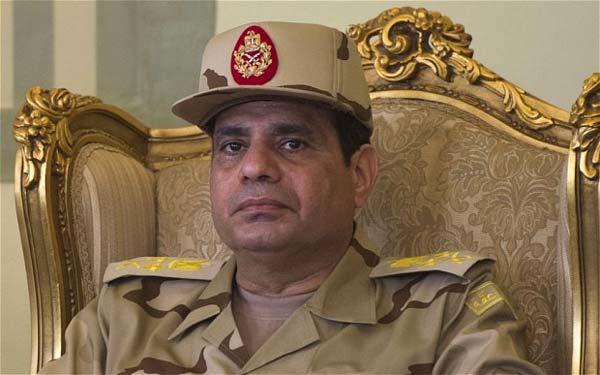 In a new leaked audio tape, the Egyptian coup leader Gen. Abdul-Fattah al-Sisi has called for an end to subsidies on bread and energy in Egypt, as well as a 50 per cent reduction of public sector salaries.
Gen. Al-Sisi described the measure as “austerity” and pointed to examples in various countries expressing his admiration for them.
In the audio which was broadcast by Al-Jazeera Mubashir Misr on Friday 22 November, he said: “A gas container is sold to citizens for 62 to 67 Egyptian pounds, (restaurants pay much more). This means that a lot of money is being unintentionally wasted in the country.”
He said: “It is impossible to pay 107 billion Egyptian pounds to subsidise energy and 17 billion for bread.”
Al-Sisi continued: “What I would like to say, regardless if it is appropriate to raise prices or not is that when former President Sadat attempted to solve Egypt’s problems in 1977, he decided that every citizen had to pay the prime costs for the goods they bought.”
Citing other examples, Gen Al Sisi said: “I would like to tell you that Germany reduced 50 per cent of the salaries for its austerity plan, and people accepted that measure.” However, he did not give any details about when and how Germany carried out this measure.
He further pointed to the cases of South Africa and Sudan. In the latter case he said, “When South Sudan seceded from the north and became independent, it cut salaries by 50 per cent. People said nothing.”
Then he concluded: “I do not care about the decisions. I would like to say that the situation requires from all of us, Egyptians, if we love our country, to take measures regarding the issue of the prices and goods’ subsidies.”
Related article
- In interview, Egypt army chief Sisi toys with idea of presidential candidacy (uprootedpalestinians.wordpress.com)
Obamacare is Doomed by Its Internal Logic
A Black Agenda Radio commentary by Glen Ford | November 20, 2013
Obamacare is unraveling, not because the administration is particularly incompetent or unlucky, and certainly not as a result of the Republicans’ unrelenting hostility to the Obama health insurance plan. Indeed, ever since the bill’s passage in early 2010, the GOP’s holy war against Obamacare has served to solidify reflexive Democratic support for what has always been a Republican-inspired bill.
The truth is, the Affordable Health Care Act is coming undone because of its own, tortured internal logic. At root, it is a fraud on the public: a scheme to subsidize and more deeply embed a private insurance system that can only make profits by denying sick and vulnerable people health care, and playing different demographics of Americans against each other. As every other industrialized country in the world has already learned, it is impossible to build a genuine, universal healthcare system on a cut-throat capitalist foundation. Private insurers make money by betting against the health interests of their customers. Obama served his corporate masters by conspiring to make tens of millions more Americans into customers of private insurers. He tried to dress up one of the greatest corporate subsidies in history as if it were a solemn national mission, a rebirth of the social compact between the American people. But of course, Obamacare is no such thing; it is a racket to prop up private insurers with public money, while allowing the profiteers to continue to run the show.
You can’t hide a truth that big. The Obamacare website has suffered from terminal complexity because white collar crime is usually quite complex. The web site attempts to reconcile the profit margins and various products of a universe of private insurance corporations, while at the same time pretending to serve the health needs of the people at an affordable cost. Obamacare claims to be in the business of serving both the public and corporate stockholders. But that’s mission impossible. If Obamacare is based on making profits for private corporations – if that is what keeps the system going – then the public’s health care needs will always be an afterthought. And, that will be obvious in the way that the website is organized as a sales platform that matches federal subsidies with corporate products, rather than matching people with the medical resources they need to survive and thrive.
Website complexity and failures aside, Obamacare can never become part of a national social compact, something of which all Americans can be proud. That’s because, by definition, corporate insurance schemes divide people into “winners” and “losers” – although, of course, the big winner is always the corporation. Young, healthy people know they are the fatted calves of the insurance business, and they are avoiding Obamacare like the plague. If this were really a national health care program, like Medicare for All, then most young people would join in the national health care mission. But this is just Obama working a scam for the insurance companies, and young folks know it. Anybody who manages to get access to the web site knows it.
The fatal flaw in Obamacare can’t be fixed. The best thing that could happen would be a quick and total collapse. Large majorities of Americans still support Medicare for All, but Obamacare stands in the way of a real national health plan – just as the Republican right-wingers that invented Obamacare back in 1989 intended.
Glen Ford can be contacted at Glen.Ford@BlackAgendaReport.com.
Related article
- That Popping Noise? The Obamacare Bubble! (correntewire.com)
Love Me, I’m a Liberal!
By Kevin Carson | Center for a Stateless Society | November 18, 2013
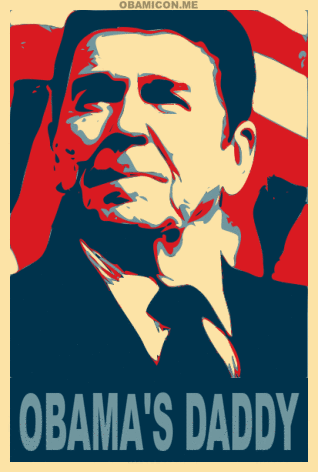 Nothing like starting out your day with a laugh — and today I have Matthew Lynch (“12 Reasons Why Obama is One of the Greatest Presidents Ever,” Huffington Post, November 15) to thank for it.
About half of Lynch’s points boil down to, “Obama is for x, because he makes speeches talking about x all the time.” He starts out with the best one of all:
“Unlike the many presidents who preceded him, he cares about what is best for the greater good. He truly does represent The People. His actions have always been motivated by a sincere desire to do what is best for the majority, even if it meant losing ground with the wealthy, influential or powerful minority.”
Um, yeah. That’s why he adopted a Republican “universal healthcare” proposal to require everybody to buy private health insurance — and give taxpayer money to the ones who can’t afford it. That should be popular with “The People,” all right — at least those who own stock in insurance companies. That’s why he quietly promised the drug companies he wouldn’t use Medicare’s bargaining power to negotiate lower drug prices. That’s why Joe Biden conducts copyright enforcement policy out of Disney’s corporate headquarters and the administration backs draconian copyright legislation dictated in secret by proprietary content industries.
Among my favorite other howlers:
“2. He is for civil rights. He has consistently spoken on behalf of the disenfranchised, the underdog and the most controversial members of society …”
Yeah, I know he said a lot of stuff about gay marriage and ending Don’t Ask Don’t Tell. But he refused to actually stop prosecuting gays in the military before the law was repealed, or to put enforcement on the back burner, even when he was fully capable of using his executive authority to do so.
And notice Lynch doesn’t say “civil liberties.” Obama said a lot of stuff about them, too — back in 2008. Since then he’s expanded unconstitutional wiretapping, run interference for the telecoms that help out with it and given amnesty to people who systematically ordered and engaged in torture. Holding war criminals accountable would be “divisive,” you see. He owes the late Nuremberg defendants an apology — they were only following orders, too.
4. Healthcare. I think we already covered that.
“5. He is for the middle class. Here are just a few of the comments made by President Barack Obama in recent months …”
A lot of presidents were for a lot of stuff, if you stick to reading their collected speeches. In practice, Obama’s farm policies are written by ADM and Monsanto, and the office of Secretary of the Treasury is permanently reserved for Goldman-Sachs alumni, just as under his predecessors.
Obama’s actual economic policy is classic Hamiltonianism: Responding to technologies of abundance that reduce the need for capital and labor by using Rube Goldberg mechanisms to artificially prop up the demand for those inputs — even if it means giving people tax breaks for throwing stuff away and replacing it. The stomach-churning irony is that most of the same greenwashed Whole Foods liberals who applaud this also condemn planned obsolescence and the Military-Industrial Complex, which were designed to accomplish exactly the same result. The proper approach to technologies of abundance is to make sure their benefits are fully internalized by workers and consumers, by ceasing to enforce monopolies, artificial scarcities and rents of all kind. If it takes only fifteen hours of labor a week to produce our standard of living, it should only take fifteen hours of labor to enjoy that standard of living. But that would annoy Obama’s Big Business friends.
My favorite, though, is this:
“10. He is for peace. Let us never forget that Barack Obama was awarded the Nobel Peace Prize in 2009 …”
Yeah, he uses that Peace Prize as a paperweight to hold down his drone kill list. Obama didn’t end the war in Afghanistan — he transformed it into a remote-control video game war in which wedding parties can be massacred at the push of a button. And of course, Lynch can’t resist throwing in a mention of the Zero Dark Thirty crap about killing Bin Laden.
I can’t help picturing someone fifty years ago breathlessly gushing “I love JFK because he’s the Peace President” — while ignoring the Bay of Pigs, the Diem assassination and Green Berets in Vietnam.
Lynch’s points, edited for substance, are basically on the same level as a guy in a bar decked out in Full Cleveland thirty years ago saying “I feel comfortable with Reagan.” Obama’s the Reagan of moderate center-left NPR liberals who shop at Whole Foods. If you’re satisfied with the image of peace and social justice, while government in substance continues to serve the same powerful interests, keep right on voting — that’s what it’ll get you.
Related articles
- Obama, Starving Africans and the Israel Lobby
- 12 Reasons Why Obama Is Not The Greatest President Ever – A Rebuttal
Related videos
US Treasury Official Threatens Lebanese Banks
Al-Akhbar | November 19, 2013
Speaking at the 2013 Annual Arab Banking Conference, Daniel Glaser, the US assistant secretary for terrorist financing in the Office of Terrorism and Financial Intelligence, warned local banks against any kind of dealing with Hezbollah and its allies.
In a talk titled “Protecting the Lebanese Financial Sector from Illicit Finance,” Glaser first noted the importance of Lebanon’s financial sector to the region’s economic well-being, remarking, “Lebanon’s ability to retain its position as an important regional and international financial center requires constant vigilance, leaving no stone unturned in our collective efforts to uproot money laundering, terrorist financing, and other forms of illicit finance from the Lebanese financial system.”
“Failing to do so,” he continued in a threatening tone, “would not only represent a missed opportunity to contribute to global efforts to uphold the rule of law and disrupt criminal and illicit groups, but might also allow regulators and financial institutions around the world to draw the conclusion that business with Lebanon comes at too high a risk.”
In particular, Glaser designated finances related to “organized criminal groups, narcotraffickers, terrorist organizations, WMD proliferators, and regimes such as Iran and Syria” as illegal activity that must be closely watched by regulators of the banking system.
The American official explained that the Lebanese banking sector’s “studied neutrality and the guarantee of bank secrecy for all” in the past “is no longer tenable. Moving forward, that professionalism and stability, which have been the hallmark of the Lebanese financial system, can be maintained only through the efforts of both the public and private sectors to ensure a hostile environment for terrorists, criminals, narcotraffickers, and sanctioned regimes such as Iran and Syria. Working together, we can stop the illicit financial activities of groups that seek to destabilize the region such as al-Qaeda and Hezbollah.”
The target here became abundantly clear as Iran, Syria, and the Lebanese Resistance were placed alongside drug traffickers in order to prevent them from accessing Lebanon’s banks…or else!
In an attempt to link Washington’s political opponents to criminal activities, Glaser noted, “It is important at the outset to identify the illicit finance threats that Lebanese financial institutions face. Some of the threats, such as narcotics-related money laundering, are universal challenges confronting financial centers around the world. Others, such as terrorist financing and sanctions evasion, while certainly not unique to Lebanon, are amplified by Lebanon’s geographic, historic, and political circumstances.”
In a more direct wink in the direction of Hezbollah, he referred to the case of the Lebanese Canadian Bank (LCB), maintaining that the “scheme involved the laundering of hundreds of millions of dollars in narcotics proceeds through the Lebanese financial system using bulk cash shipments and trade-based money laundering involving used car sales and consumer goods.”
Glaser, however, forgot to mention that his administration neglected to pursue the LCB in the courts and instead struck a back-room deal, in which the bank paid $102 million in exchange for the case against them being dropped, after it was accused of laundering money on behalf of Hezbollah.
So after closing the LCB file in Washington, the US Treasury official nevertheless insisted that “this should not be surprising given Hezbollah’s involvement in a wide range of illicit activities. These illicit activities, combined with its ties to sanctioned regimes such as Iran and Syria, should call into question all financial relationships with Hezbollah or its agents.”
Glazer took his threats against any financial dealings with the Resistance one step further, saying, “The risks of engaging in such relationships will only increase as more countries apply sanctions on Hezbollah, which continues to engage in destabilizing military activity in Syria and attacks in Europe.”
He also did not fail to warn Lebanon’s banks against the danger of conducting business with Syria and Iran: “Lebanese financial institutions must also be alert to the threat of sanctions evasion. As a nearby regional banking hub, regimes such as Syria and Iran will continue to look to Lebanon as a potential financial access point into the global system. Lebanese financial institutions are therefore an important component of international efforts to isolate these regimes, and Lebanon’s resistance to any attempts to use Lebanese banks as a gateway to the international financial system is essential.”
In his concluding statement, Glaser got to the heart of his message by warning the bank officials present that “the United States is prepared and will continue to take action to protect our financial system from threats when we deem it necessary.”
Israel Seeks to Tap Arab Markets With Made-in-Jordan Label
Al-Akhbar | November 17, 2013
Cross-border projects are materializing, but not between Arab countries – as Arabs would have hoped – but between Israel and Jordan. A joint industrial park is to be established along the Israeli-Jordanian border, giving Israeli companies the ability to tap into Arab markets, as their products will bear the misleading label “Made in Jordan.”
The Israeli press reports that the industrial zone – the brainchild of Israeli Minister of Regional Cooperation Silvan Shalom – will be submitted to the Israeli government for approval next week. The industrial park will consist of a section near Kibbutz Tirat Zvi on the Israeli side, which will be linked via bridge over the Jordan River to the Jordanian section.
On the Jordanian side, industrial facilities will be built by Israeli and Jordanian firms, and are expected to employ up to 2,000 Jordanian workers, while administration, logistics, and marketing facilities will operate on the Israeli side.
The estimated cost of the project, dubbed Sha’ar Hayarden, meaning Jordan Gate, will be around 180 million shekels (about $50 million).
According to Israeli daily Yedioth Ahronoth, Jordan will benefit from the increased job opportunities while Israel will stand to benefit from huge savings in labor costs by paying workers relatively low wages (no more than $500 per month on the Jordanian side).
In addition, the factories will be “close to home,” helping Israeli companies save on logistical costs and have more effective control over the production process. But more importantly, the products manufactured in this zone will be stamped with the label “Made in Jordan,” allowing Israeli companies to market their products in Arab countries.
Yedioth Ahronoth also noted that the project, which is considered a historic move between Israel and Jordan, will be overseen by a government agency attached to the Ministry of Regional Cooperation, which will collaborate with the ministries of economy, foreign affairs, defense and transportation.
The newspaper quoted Silvan Shalom as saying, “Sha’ar Hayarden represents a real breakthrough. The project will help strengthen relations between Israel and Jordan, and boost economic growth in the region through the establishment of new factories and joint ventures and job creation. We will continue to take the initiative and press forward with such projects.”
Canada Signs Free Trade Deal with Honduras amid Pre-electoral Repression
By Sandra Cuffe | Upside Down World | November 14, 2013
Canada and Honduras inked a bilateral free trade agreement on November 5, amid political repression, increasing militarization, and controversial Canadian investment in the Central American nation.
 Ed Fast, Canada’s Minister of International Trade, and Honduran Minister of Industry and Commerce Adonis Lavaire signed the deal in Ottawa, less than three weeks before general elections are expected to change the political landscape in Honduras.
“It’s really uncertain what’s going to happen with the elections,” said Karen Spring, a Canadian human rights activist living in Honduras. “It’s a lot less likely for [Canada] to have a government – and the political conditions and the economic conditions – in [Honduras] that would approve the free trade agreement or would allow it to be approved.”
Recent polls show two leading presidential candidates: LIBRE candidate Xiomara Castro, the wife of Manuel Zelaya, who was ousted as President in a coup d’état in June 2009 and the ruling National Party’s Juan Orlando Hernández, former President of the National Congress who resigned in order to run for office.
The November 24 general elections are expected to mark the end of a longstanding two-party system. Nine political parties are participating, and it is unlikely that any one party will hold a majority of seats in Congress.
“Because of the strong political force of the LIBRE party and its bases, the National Front of Popular Resistance, there’s a really good chance they can either gain a lot of seats in Congress or they can win the presidency,” Spring told Upside Down World. Whether or not LIBRE congressional representatives would pass the free trade agreement or not is uncertain, but the political landscape will undoubtedly change. “I think the Canadian government knows very well that after the elections on November 24, it’s going to be a lot more difficult to pass any free trade agreements,” she added.
Negotiations leading to the Canada-Honduras Free Trade Agreement (FTA) began back in 2001, though they were initially for a deal between Canada and the C4 countries: Guatemala, Honduras, El Salvador, and Nicaragua. After nearly a decade of multilateral talks and a number of impasses, Canada and Honduras decided to pursue a bilateral agreement in 2010, the year following the coup d’état.
Before it comes into effect, the Canada-Honduras FTA must be approved by both Canadian Parliament and Honduran Congress. Current representatives of the latter will sit until a few days before the new administration assumes power on January 27, 2014.
Canada exported $38 million in goods to Honduras in 2012, and imported $218 million. Top Honduran exports to Canada are agricultural products and apparel, and the leading product Canadian exports to Honduras is fertilizers. Recent government figures on Canadian direct foreign investment are unavailable.
In its official press release announcing the signing of the FTA, the Canadian government focused on the elimination of tariffs and improved access for the export of Canadian pork and beef. However, controversial Canadian mining, sweatshop, and tourism sectors also stand to benefit from investment protection measures contained in Chapter 10 of the bilateral free trade agreement.
“In a country like Honduras, using free trade agreements to open the domestic economy to competition with countries with asymmetrical economies has only attracted transnational companies which operate and implement work systems that exploit Honduran women workers,” wrote the Honduran Women’s Collective (CODEMUH), in a statement in response to the signing of the Canada-Honduras FTA.
The organization is currently dealing with more than 100 textile factory workers who are suffering from work-related injuries and health conditions related to their employment by Gildan Activewear, a Montreal-based clothing manufacturer. The company operates several sewing and manufacturing facilities in northwestern Honduras, as well as others in Nicaragua, Haiti, the Dominican Republic, and Bangladesh. Gildan’s gross profits in 2012 were just shy of $400 million, while net earnings reached $148.5 million.
“Exploitative and enslaving working conditions – such as those which exist in Gildan Activewear headquartered in Canada and promoted by nation states and trade agreements – involve normal work days of an illegal 11 and a half hours, with obligatory overtime, bringing the work week to up to 69 hours,” according to the statement by CODEMUH.
Canadian companies and investors in Honduras have not only come under fire for their treatment of workers, but also for their impacts on communities.
“We have come to see that Canadian tourism has been the most aggressive in Garifuna communities in recent years,” said Miriam Miranda, General Coordinator of OFRANEH, an indigenous Garifuna federation. The lands and traditional territories of the 46 Garifuna communities spread up and down the Caribbean coast of Honduras are prime targets for tourism and real estate development projects. “There’s no respect whatsoever for the rights of Indigenous peoples,” said Miranda.
Canadian investor Randy Jorgensen’s Banana Coast project near the coastal city of Trujillo took off after the 2009 coup. Dubbed the “Porn King” for amassing a fortune from his Canadian porn chain, Jorgenson pressured Rio Negro residents to sell parcels of land they inhabited in order to secure coastal property in Trujillo for the construction of a Panamax cruise ship pier and massive commercial center.
“They used the Law of Forced Expropriation in the case of Trujillo, but it was used to impact Garifuna communities. They never use it to return land to Garifuna communities,” Miranda told Upside Down World. “The last people who refused to sell [their land] were told ‘if you don’t sell, we’ll take your land away.’”
The first phase of the Banana Coast pier was inaugurated in June 2013. Jorgensen has also invested in a mountainside gated community of villas in the traditional territories of the Garifuna communities of Santa Fe, Barrio Cristales and Rio Negro. They’re not the only Canadian projects in the area, said Miranda. There have been incursions by Canadian investors into Garifuna territory in and between the Garifuna communities of Rio Esteban, Guadalupe, San Antonio, Santa Fe, Rio Negro and Barrio Cristales, linking a stretch of coast from Rio Esteban to Trujillo. And it’s a phenomenon that’s not limited to the coast.
“All of the territories are kind of on the table right now to see how they can be exploited – not just mining, not just tourism, but anything where public goods, resources can be exploited,” said Miranda. There’s currently an unparalleled exploitation of resources by transnational foreign capital in Honduras, she said, and the post-coup government has gone out of its way to protect foreign investment.
“These days, Canadians – together with the Taiwanese and Chinese – are the ones with the most aggression towards the territories,” said Miranda.
As with many FTAs, the Canada-Honduras agreement is accompanied by parallel agreements on labor and the environment, but Common Frontiers Program Director Raul Burbano and Americas Policy Group Coordinator Stacey Gomez maintain they’re just for show. “The labor and environmental side agreements are mere window dressing given that they are not accompanied by any real enforcement mechanism to ensure they are adhered to,” they wrote in a November 5 Open Letter.
Chapter 10 of FTA itself includes a brief mention of labour, environmental and human rights, but – unlike the investment protection measures – there are no enforcement measures. “Each Party should encourage enterprises operating within its territory, or entreprises [sic] subject to its jurisdiction, to voluntarily incorporate internationally recognized standards of corporate social responsibility in their internal policies,” according to Article 10:16. The full text of the agreement was only made public after it was signed.
While the FTA was signed in Ottawa, the reality on the ground in Honduras remained one of increasing militarization and ongoing repression.
Murders of journalists, lawyers, and Indigenous and campesino people involved in land and resource struggles continue in the country, which has one of the highest per capita murder rates in the world. People involved with the LIBRE party have also become targets. Rights Action’s Spring has been researching pre-electoral political violence and compiled a list of murders and armed attacks on political party-affiliated candidates, campaigners, and activists between May 2012 and October 19, 2013.
“The list shows that the LIBRE party has suffered more armed attacks and killings in the last year and a half than all other eight political parties combined,” said Spring. “Those are just armed attacks and killings. That doesn’t include political persecution, death threats, disappearances, and then killings and armed attacks of people that aren’t part of the political campaigning process but that are really important in the social movement.”
Militarization has increased hand-in-hand with repression since the 2009 coup. Not only are soldiers patrolling the streets alongside the national police force, but a new military police force hit the streets in October 2013. Legal challenges to the constitutionality of the new security force, operating directly under military command, are currently underway. In response, on November 6 the National Party’s presidential candidate Hernández introduced a proposal to Congress to reform Article 274 of the Constitution in order to grant constitutional standing to the military police force. This has become a cornerstone of his electoral campaign.
The controversy surrounding the military police has been subject to recent media coverage in Honduras, but the involvement of mining companies and other private sector corporations in financing public security forces no longer makes headlines. The General Mining and Hydrocarbons Law ratified in January 2013, after a review by advisors paid by the Canadian government, includes as part of its royalty regime a two percent payment to the Security Tax (Tasa de Seguridad) fund. The fund is helping to finance the increasing militarization of Honduran streets.
Who will win the November 24 elections is uncertain at this point. But no matter which political party comes out on top, if the Honduran Congress passes the Canada-Honduras Free Trade Agreement into law, it will be a win for Canadian companies.
Sandra Cuffe is a vagabond freelance journalist currently based in Honduras.
The Most Nefarious Part Of The TPP Proposal: Making Copyright Reform Impossible
By Mike Masnick | Techdirt | November 14, 2013
So with yesterday’s revealing of the IP chapter of the TPP, there are plenty of great analyses out there of what’s in there, but I wanted to highlight some parts that are the most nefarious and downright slimy in that they represent parties (mainly the US) pretending to do one thing while really doing another. These are tricks pulled by a dishonest, shameful USTR, entirely focused on making his corporate buddies richer at the expense of everyone else. Remember, our current USTR, Michael Froman, has a long history of this kind of crap. While he hasn’t been there throughout the negotiating process, it shouldn’t be surprising that he “delivers” this sweetheart deal to a few legacy industry players.
Watch closely, and you’ll see supporters of TPP, and especially USTR employees, make the claim that nothing or almost nothing in the TPP will require legal changes in the US. They’ll say that this is just about “harmonizing” norms across borders to make it easier for businesses to do business internationally. This is a lie.
It’s a lie in two different ways. First, there are multiple provisions in here that will absolutely require changes to US law. We’ll discuss a few in other posts, but what’s much more nefarious and downright obnoxious, is that this would lock in a variety of really bad copyright policies, making it nearly impossible for Congress to go back and change them. And that’s a real issue, because, as we’ve been discussing, Congress is actually discussing copyright reform again. The head of the US Copyright Office, Maria Pallante, has proposed a bunch of changes to copyright law (some good, some bad), and astoundingly, just as Congress is at least trying to have the discussion about whether or not those and other ideas make sense, the USTR is looking to effectively tie everyone’s hands by saying “these things cannot be changed,” including many of the reforms that Pallante has directly proposed.
That’s really quite incredible if you think about it. On the one hand, you have the very head of the Copyright Office suggesting some reforms, and you have Congress beginning the process to explore that. On the other, you have the USTR totally ignoring the sole power of Congress to make copyright and patent law, and effectively saying “you cannot make any of the suggested reforms.” And then the USTR has the gall to ask Congress to give up its power to challenge specific provisions in the agreement? While we’re concerned about the Congressional copyright reform process, at least it’s being done in the open. The USTR has been hashing out the plan in TPP in total secrecy for years.
Who the hell does the USTR think they are that they can flat out override the Constitution and the Congressional process, and effectively block them in and stop any meaningful attempt at copyright reform? All done via a process driven entirely by a few special interests? It’s anti-democracy. It’s pure corporate cronyism by the worst cronies around.
Now, defenders of this proposal will lie. They’ll claim that technically (1) Congress has to approve this and (2) nothing in a trade agreement can limit Congress’s ability to pass laws. Neither point is really true (the fun with things that are “technically” true, but false in reality). As mentioned above, the USTR (and President Obama) is pushing extra hard for Trade Promotion Authority, which basically is Congress granting the USTR full power over the TPP. Normally, Congress would be able to debate, challenge and reject questionable provisions in the agreement. But, with TPA “fast track” ability, Congress could only give a yes/no vote on the whole package. And, yes, some will claim that they can just vote no, but the reality is that there are other parts of this agreement that are designed to make that nearly impossible. There are all sorts of little things that we’ll be told we “need.” TPA is a bit of theater. What’s delivered to Congress will almost have to be passed — so if it’s granted (before it’s even public what’s in the full agreement) — Congress has effectively approved the whole agreement.
As for the claim that Congress’ hands cannot be bound by a trade agreement, this is again technically true, but it ignores that it becomes realistically impossible. The second that Congress tries to change a law that goes against the TPP — such as, say, reducing the term of copyrights from the insane level today to merely crazy — lobbyists and pundits will come screaming from every direction about how we can’t abandon our “international obligations.” We’ll hear horror stories about how breaking the agreement will have widespread implications, including trade wars, tariffs and other horrible things. Once it’s in the trade agreement, “breaking it” becomes effectively impossible.
The lobbyists for the entertainment industry know this stuff cold. Over the past three decades they’ve perfected this process of getting crap they can’t get done in Congress pushed through in various trade agreements, and then they use that to mold US law to exactly how they want it. They’re not even shy about it, admitting this is exactly how they got the DMCA in the first place. Considering that the TPP has a form of DMCA-on-steroids, it shouldn’t be a surprise that they’re using an even bigger trade agreement to do the same thing.
All of this should lead to a basic question: why is the USTR and President Obama directly trying to undermine Congress’ sole authority over copyright and patent policy? Are they proud of the tricks they tossed in the agreement? I imagine that when the USTR staffers move on to their jobs in the same industries that pushed them to write the agreement this way, they’ll all laugh about that time they fucked over the American public.
Related article
Featured Video
Can the U.S. Afford to Annihilate Iran?
or go to
Aletho News Archives – Video-Images
From the Archives
Sanctions, War and the Policy of Dual Containment
By SASAN FAYAZMANESH | March 17, 2008
It is now nearly three decades since the Unites States adopted the policy of dual containment of Iran and Iraq. While much has been written about the containment of Iraq, there has been very little in-depth analysis of this policy when it comes to Iran. In a book that is going to be released on March 31, 2008, entitled The United States and Iran: Sanctions, Wars and the Policy of Dual Containment (Routledge), I attempt to address this shortcoming by investigating when and why the US policy of containment of Iran came about, how it evolved, and where it stands today.[1] To the extent that Israel has been involved in US policy making, the study will also include the role that Israel has played in the containment of Iran. Also, since the fate of Iran has been inextricably linked to that of Iraq, occasionally the investigation will overlap with the containment of Iraq.
The policy of dual containment of Iran and Iraq originated during the Carter Administration, but it was not until the Clinton Administration that the expression “dual containment” became popular. … continue
Blog Roll
 Aletho News
- Can the U.S. Afford to Annihilate Iran? /Seyed M. Marandi
- Elmo Sold mRNA Jabs to Your Toddler. Now They Are “Off-Label.”
- British state targets Palestine Action with yet another crooked trial
- Americans are paying the price to preserve Israel’s nuclear hegemony
- Resistance factions are necessary to ensure a permanent US Iraq withdrawal
- How Israel destabilizes the Middle East: Denying sovereignty and the right to exist
- Europe’s Establishment Is Embracing War – and Losing Voters
- NATO chief advocates war of aggression
- No Vote, No Representation, No State: Democracy, Israeli Style
- Zionist Bought Senate Blocks Information About American Citizens Killed By Israel
- If Americans Knew
- Israeli Soldiers Abduct At Least 22 Across Occupied West Bank
- Eight Palestinians Killed in Israeli Attacks on Gaza
- Israeli former leaders and security chiefs threaten legal action over ‘Jewish terrorism’
- Israel map in LA Times ad includes all land from the river to the sea
- Inside Lebanon’s 200-page dossier on Israeli war crimes
- Flydubai, genocide, settler violence, Trump abuse of power to deport – Daily Update
- Counting Antisemitic Incidents: What the ADL Audit Reveals — and Obscures
- Mamdani releases plan to combat antisemitism and hate crimes in New York City
- Iran’s Revolutionary Guards Publish Letter to the American People
- DMFI launches $1 million ad campaign supporting Virginia’s Elaine Luria
- No Tricks Zone
- Green Energy Debacle: German Expert Professor Fritz Vahrenholt Warns Of Severe Economic And Social Consequences
- Two More Paleo Reconstructions Affirm Meters-Higher Sea Levels Across Ireland, Brazil 7000-6000 Years Ago
- New Study: Earth And Venus Surface Warmth Largely Explained By Convection And Lapse Rate, Not CO2 Or Radiation
- 2025 Nature Paper Claiming Worsening Global Drought Gets RETRACTED …Heavily Flawed
- New Study: ‘Global Drought Shows No Detectable Recent Acceleration Under Climate Warming’
- Economic Masterminds: German Socialists Suggest Taxing Productivity Gains Stemming From Using AI
- The South China Sea Has Not Been Cooperating With The Climate Change Narrative
- Energy Crisis: Germany Enters Heating Season With Historically Low Gas Reserve Fill Levels
- New Study: The Antarctic Ice Sheet Gained Mass From 2020-2024 Due To Staggering Snow And Ice Accumulation
- Study: Ocean Heating Rates From Thousands Of Years Ago ‘Dwarf’ Modern Ocean Heating Rates

