Betrayal of Trust on the Hanford Nuclear Reservation
By GINA MASON | CounterPunch | March 1, 2013
Living with radiation sickness is not on my bucket list and I would hazard that it isn’t on yours either. Nor is it what I have in mind for my children’s future. Yet our government continues to manufacture nuclear materials and unsafely store radioactive waste in clear violation of the public trust. Nowhere is this more visible than at the Hanford Nuclear Reservation, the most radioactively contaminated site in the western hemisphere, where we now know radioactive sludge is leaking badly from at least six underground tanks. While Hanford is technically in Washington State, the management of this catastrophe is vitally important to the rest of the nation—indeed, the biosphere. Unfortunately, environmental disasters do not stop at city, state, or national borders.
The Hanford Nuclear Reservation is located on the 1,243-mile-long Columbia River and sits upstream from drinking water facilities for the Washington Tri-Cities area, tribal lands, and many other towns and cities before it empties into the Pacific Ocean. Built in 1943, this facility is home to the first plutonium production reactor. Hanford is responsible for having manufactured the material used in the first atomic bombs, including the bomb that killed and poisoned scores of thousands in Nagasaki, Japan, 9 August 1945.
An environmental remediation legal structure called the Tri-Party Agreement governs the cleanup efforts by the Environmental Protection Agency, Washington Department of Ecology, and the US Department of Energy. Bechtel, a construction and engineering firm, is currently overseeing the construction of a vitrification plant that will stabilize the worst of the radioactive materials with glass. Added to the Superfund list in 1989, the cleanup of Hanford is woefully behind its original 30-year schedule.
Recent news articles and Washington Governor Jay Inslee’s announcements have brought Hanford back into the national spotlight as the large tanks containing radioactive waste are leaking into the nearby aquifers at a reported rate of 300 gallons per day. Many of the site’s 177 underground tanks are losing radioactive liquid. In fact, prior to the latest news, the Washington Department of Ecology reported that the contaminated water could reach the Columbia in anywhere from 12-15 years. The US Department of Energy reports on the leaking tanks but never quite fixes them while the DOE Hanford website indicates nothing out of the ordinary. With many of the tanks holding a million gallons each, this is enormous and means the United States is producing a massive radioactive waterway. It is the government’s responsibility to deal with Hanford before its citizens suffer considerable environmental, health, and economic damage. Considering the rate of cleanup and the lack of public awareness, this is an almost certain fate. Furthermore, the threat of sequestration is risking even the slowest paced cleanup operations at Hanford.
When stacked against other environmental issues – timber clear-cutting, setting aside wilderness areas, and even plastic waste floats larger than Texas, the risk of radioactive contamination to our environment is infinitely more catastrophic. I feel that this issue demands our full attention. Unlike the Fukushima disaster only two years ago, the Hanford radioactive leaks are not the result of a massive natural disaster triggering an anthropogenic catastrophe. This is an event brought on entirely by our own human arrogance and mismanagement, demonstrated repeatedly by poor predictions about how safe it all is. If anything, our utter failure to clean up a terrible mess made way back in World War II and the Cold War shows our hubris in continuing to maintain nuclear weapons somehow believing we can control them. All it takes with nuclear weapons is one mistake and we are all only human. Mistakes are inevitable. The biggest mistake of all is to fail to dismantle the nuclear arsenal now and clean up the massive mess as quickly and safely as we can.
Under the Tri-Party Agreement, cleanup was scheduled to be completed by 2018 and has since been revised to 2040. This makes the specter of a radioactive Columbia River an assured nightmare without action from grassroots organizations and community involvement. This current trajectory is an absolutely unacceptable legacy.
It is not too late. We have the ability to alter the impending disaster by placing pressure on responsible government agencies, legislators, community leaders, and contractors to safely increase the pace of the cleanup operations—and to tell Congress to shift all $2.46 billion in nuclear weapons “modernization” funds to cleanup—or at least what’s left after sequestration. Now.
Talks have repeatedly stalled between agencies regarding the timeline of waste containment. We citizens are in a position to leverage public interest as a means to get the negotiating parties back to the table. 2013 has the potential to be the year that Hanford Nuclear Reservation makes a dramatic shift to move off the Superfund list in a quick and responsible manner. Join the affected tribes, local governments, and many others in demanding a fast, safe, and complete clean up. Write, call, or email your representatives. Donate five dollars to an environmental group working on this issue. Talk to people.
As citizens, this demands our attention. As humans, this demands our action.
Related article
- Six Underground Tanks Leaking Nuclear Waste in Washington State (alethonews.wordpress.com)
Six Underground Tanks Leaking Nuclear Waste in Washington State
By Noel Brinkerhoff and Danny Biederman | AllGov | February 27, 2013
The nation’s most daunting environmental cleanup project has a new toxic problem on its hands.
Within the Hanford Nuclear Reservation along the Columbia River in Washington State, six underground storage tanks are leaking radioactive waste. Some of the tanks hold as much as 500,000-750,000 gallons of dangerous fluid that is slowing seeping into the soil.
State and federal officials said the leaks don’t pose an immediate threat to human health, since the tanks are located more than five miles from the Columbia River.
The newly discovered problem only adds to the soil contamination at Hanford, which was used for five decades to produce plutonium for the U.S. nuclear weapons arsenal.
There are nearly 150 tanks, similar in size and design, to the six spilling radioactive liquid and sludge at the site. Four of the six tanks have leaked in the past. The news led the state’s governor, Jay Inslee, to wonder about the “integrity” of the other tanks.
“It points to the age of the tanks and how there’s going to be an increased probability of this happening in the future,” Suzanne Dahl, tank waste treatment manager for the state’s Department of Ecology, told Reuters. “Once [the waste is] out of the tanks and in the soil, it’s much harder to manage it, remove it, and down the road you’re adding to contamination in the groundwater that already exists.”
The U.S. Department of Energy reported that the tanks are leaking at a rate of up to 300 gallons per year.
With a total area comparable to the size of Los Angeles, Hanford is considered by experts to be the most challenging environmental remediation in North America. The nuclear site was built near the city of Hanford in 1943 as part of the Manhattan Project, the secret U.S. government research program that produced the first atomic bombs. Federal environmental regulators estimate the site now contains more than 130 million cubic yards of radioactive soil, thanks in large part to the dumping of 475 billion gallons of contaminated wastewater into the ground during the Cold War.
A multi-billion-dollar plan to secure all the waste within a glass-like material and house it in subterranean stainless steel canisters is years away, according to Dahl. But Americans don’t have to wait that long to get a first-hand look at the infamous nuclear site; the U.S. government offers regular public tours, at no cost.
To Learn More:
At the Hanford Nuclear Reservation, a Steady Drip of Toxic Trouble (by Eric Nusbaum, Daily Beast)
Radioactive Waste Leaking from Six Tanks at Washington State Nuclear Site (by Eric Johnson, Reuters)
Energy Dept. Accuses Bechtel of Botching Nuclear Cleanup in Washington (by Noel Brinkerhoff, AllGov)
Plutonium Cleanup in Washington State Could Take Millennia (by Noel Brinkerhoff, AllGov)
Contractor Approved Funding for Own Government Contract (by Noel Brinkerhoff, AllGov)
Canadian natives and anti-nuclear activists halt train
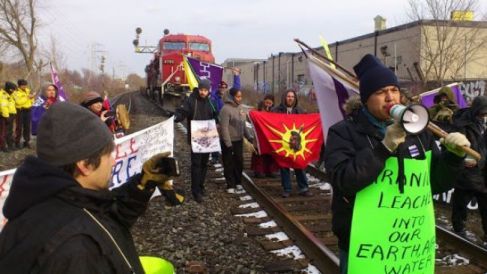
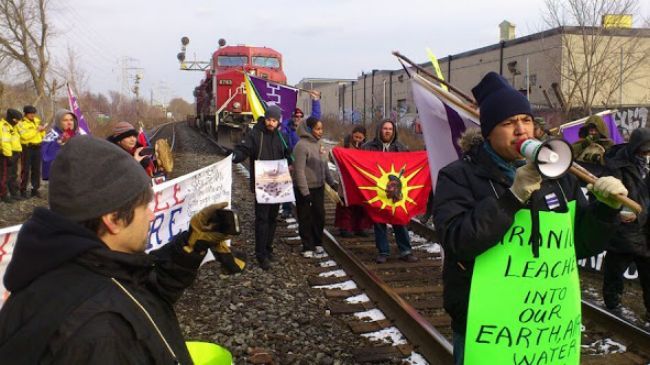
Protesters blocking a train near a nuclear processing facility in Toronto, Canada on February 3, 2013.
Press TV – February 6, 2013
Canadian natives and anti-nuclear activists have blocked a rail line, demanding the shutdown of a nuclear processing facility in the country.
The protesters, including the members of the Idle No More movement, blocked a train, on Sunday, near the General Electric-Hitachi nuclear plant in Toronto, after staging a demonstration at the facility and a march earlier.
“Uranium is stolen from indigenous lands and it leaks radiation all along the fuel chain,” said anti-nuclear activist Zach Ruiter.
Another protester from Serpent River First Nation said, “I’m here because uranium, it really affected my reserve back home,” and added, “It did a lot of damage to our river. We can’t use the river no more, we can’t fish in it. We can’t drink the water.”
Under a Canadian law, the government has the right to seize or sell land from the indigenous people to the private sector.
The aboriginal people say the government is using the law to force them flee their land.
Legal experts have called the law unconstitutional and a potentially genocidal piece of legislation that is intended to do away with the collective rights of Canada’s 1.2 million natives.
The Idle No More Movement was inspired by the six-week hunger strike of Attawapiskat Chief Theresa Spence, which began on December 11, 2012, as a protest against the violation of the rights of Canadian natives.
The Energy Department’s Crazy Plan for Radioactive Scrap
Nuclear Weapons Waste in Your Water Bottle, Hip Replacement, Baby’s Toys, Jungle Gym?
By JOHN LaFORGE | CounterPunch | January 23, 2013
Even the deregulation-happy Wall St. Journal sounded shocked: “The Department of Energy is proposing to allow the sale of tons of scrap metal from government nuclear sites — an attempt to reduce waste that critics say could lead to radiation-tainted belt buckles, surgical implants and other consumer products.”
Having failed in the ‘80s and ‘90s to free the nuclear bomb factories and national laboratories of millions of tons of their radioactively contaminated scrap and nickel, the DOE is trying again. Its latest proposal is moving ahead without even an Environmental Impact Statement. Those messy EISs involve public hearings, so you can imagine the DOE’s reluctance to face the public over adding yet more radiation to the doses we’re already accumulating. It would be a pretty hard sell, what with dental X-rays, medical X-rays, mammograms, CAT scans, PET scans, radio-isotope “seeds” and cocktails, food irradiation, every-day releases of radioactive gases and water from 104 nuclear power reactors, major releases like Fukushima, radon from rocks, whole-body X-rays at airports (that you can refuse) and cosmic rays during flights.
Not long after Chernobyl spread radiation around the world in 1986, the National Council on Radiation Protection doubled its estimate of our annual radiation dose, from 170 millirems to 360. A few years ago it raised the estimate again, to 620 millirems per year. The agencies that both create radioactive waste and estimate the radiation doses it gives to us, say the latest increase is due mostly to rapid growth in the use of medical X-rays and radio-isotopes in medicine. Should the DOE be allowed to haphazardly add still more?
Still, the DOE wants to deregulate and actually sell 14,000 tons of radioactive scrap metal (both volumetrically and topically contaminated) from the nuclear war system — uranium enrichment, plutonium extraction, etc. — and “recycle” the waste to the commercial clean scrap metal industry. From there, according to the watchdog group Nuclear Information and Resource Service, the radioactive stuff “could be turned into anything from your next pants zipper to baby toys.”
The DOE claims that potential radiation exposures to men, women and children would amount to a “negligible individual dose.” But anyone with a scrap of understanding of DOE and the Atomic Energy Commission knows not to believe a word of their assurances. The DOE famously said that rainwater would take thousands of years to seep through Yucca Mountain to a deep waste repository; it ran through the mountain in 40 years.
Even Some in Congress Object
Rep. Ed Markey wrote to Energy Secretary Steven Chu Jan. 11, calling the deregulation proposal “unwise” and urging that it “should be immediately abandoned.” Rep. Markey warned that radioactive products could “ultimately be utilized by pregnant women, children and other vulnerable populations.”
The DOE has never officially acknowledged — in spite of the National Academy of Sciences’ 2006 findings — that the same radiation dose does far more harm to women than to men. The drastically increased vulnerability of fetuses and infants is well known, but the whole population is nevertheless treated as the same big, young, Caucasian male (“reference man”) in most radiation risk assessments.
The DOE’s assessment of the proposal’s risks neglects the fact that exposures can go on for years from a watch or from medical implants or tableware or other items, leading to many millirems for many years. A millirem per year over 30 or 70 years is 30 or 70 millirems which is not trivial, NIRS points out.
The DOE currently bans the release of its radioactive scrap under a moratorium that began in 2000. The ban must not be lifted, but should be made permanent and expanded to keep all radioactive waste — plastic, concrete, soil, asphalt, etc. in addition to all metals — under control, out of commercial recycling and managed as the deadly hazard it is. NIRS.org has more details.
You can tell the DOE to continue to keep its radioactive metal out of the commercial metal supply, commerce, and our personal items. You can demand a full environmental impact statement. Comment deadline is Feb. 9, 2013. Email to: scrap_PEAcomments@hq.doe.gov (with an underscore after “scrap_”). Snail mail to: Jane Summerson / DOE NNSA / PO Box 5400, Bldg. 401K. AFB East / Albuquerque, New Mexico 87185
John LaForge works for Nukewatch and edits its Quarterly newsletter.
Related article
- AUDIO USA Dept of Energy plans to put radioactive materials into products (nuclear-news.net)
St. Louis Palestine Solidarity Committee Statement on Pending City Contract with Veolia Water
STL-PSC Blog | December 17th, 2012
We are a diverse group of Palestinians, Israelis, Muslims, Jews, Christians, students, professors, artists, writers, environmental activists, union organizers, bakers, grandparents, and others in St. Louis united by a commitment to a lasting peace in Israel/Palestine based on freedom, justice, and equality, as part of a larger commitment to global justice.
We were shocked to learn about private city negotiations with Veolia Water on a contract to guide cost-cutting for the St. Louis Water Division. Veolia Water – North America is a subsidiary of Veolia Environnement (VE), a Paris-based multinational corporation and the largest water privatization business in the world. It is infamous for poor environmental standards, anti-labor practices, privatizing public resources, mismanagement, corruption, bribery, embezzlement, fraud, and illegal activities in Israel/Palestine. Worldwide, consumers report that Veolia consistently charges high rates, provides poor service, causes staff turnover, discourages water conservation, and fails to implement promised improvements. Its history reveals consistent prioritization of private profit at the expense of the environment and public welfare.
In Israel/Palestine, VE is involved in a myriad of ways with Israel’s illegal military occupation of Palestinian land and its systematic ethnic discrimination against the Palestinian people.
VE’s Israeli subsidiary, Veolia Water – Israel, operates a wastewater treatment plant located in an illegal Jewish-only settlement called Modiin Ilit, built on internationally-recognized Palestinian land in the West Bank. The Palestinian owners of the land on which this settlement was built have been violently driven out. Two unarmed Palestinians from Bil’in, a Palestinian village on which Modiin Ilit was built, have been killed by the Israeli army as they protested nonviolently against the ongoing confiscation of their land and resources. Leaders and people of conscience from around the world, including the South African anti-Apartheid leader Archbishop Desmond Tutu, have visited Bil’in to stand in solidarity with the dispossessed villagers, yet Veolia continues to service the settlement and others like it.
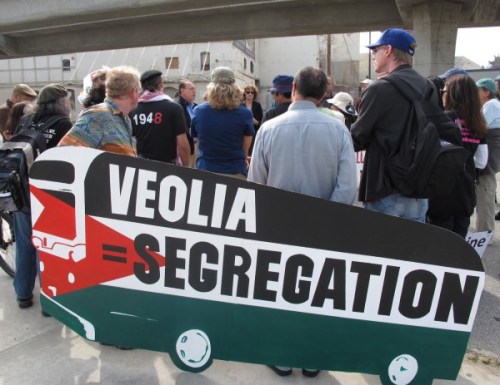
An Israeli subsidiary of Veolia Transdev, named Connex – Israel, operates settler buses on segregated roads through the occupied West Bank, including two bus lines that use road 443, which is built partially on confiscated land with portions closed entirely to Palestinians. A separate but unequal Palestinian road system is made up of low grade roads cut by checkpoints and physical barriers restricting Palestinian freedom of movement. Last year, a group of Palestinian Freedom Riders attempted to board buses operating on their own land and were violently removed and arrested. Veolia is not only profiting from segregation in Israel/Palestine; they are enforcing it.
Another VE Israeli subsidiary, Veolia Environmental Services – Israel, supervises, consults for, and operates the Tovlan Landfill in the occupied Jordan Valley, collecting refuse from illegal settlements. Israel renders it almost impossible for Palestinians in the Jordan Valley to gain permits to build homes, toilets, wells, animal pens, or other vital infrastructure for local communities, which has forced almost all Palestinian families out, with those remaining living in dire conditions. Some are left with no alternative but to work on settlements that have taken their families’ land, for pay far below the minimum wage, unable to take bathroom breaks, and denied any rights to unionize. Veolia takes captured Palestinian land and natural resources to service the settlements exploiting or driving out Palestinians.
Finally, VE has also been involved in the construction and operation of a tramway linking illegal settlements in East Jerusalem with Israel. The tramway not only institutionalizes the occupation, but it is a settlement in itself, given that it is settler infrastructure built on occupied land.
UN Special Rapporteur Richard Falk recently recommended that Veolia “should be boycotted, until they bring their operations into line with international human rights and humanitarian law and standards.” VE’s immoral practices and extensive profiting from Israel’s illegal discriminatory practices have provoked global outcry and made the company a target for boycott and divestment campaigns around the world — costing it $16 billion to date in lost contracts. Recently, the Friends Fiduciary Corporation, which handles investments for hundreds of U.S. Quaker institutions, divested from VE following advocacy from Palestine solidarity groups. Now, VE is bringing its risky and immoral business to our backyard.
Veolia Water is the U.S. arm of VE. As St. Louisans, we do not feel that our tax dollars and water payments should go toward supporting a company profiting from environmental destruction, unfair labor practices, and the bloodshed of and systematic ethnic discrimination against the Palestinian people.
The St. Louis Palestine Solidarity Committee stands in solidarity with public workers, water and environmental justice activists, and the Palestinian people threatened by this contract. We call on the Board of Estimate & Appointment not to approve this public contract with Veolia.
Click here for more information and documentation on Veolia’s activities in Palestine.
Related articles
- South Africa’s ruling ANC officially endorses Palestine’s boycott movement (alethonews.wordpress.com)
- St. Louis City Board Votes to Investigate Veolia Following Public Outcry! (bdsmovement.net)
- Veolia to end sponsorship of major UK photography exhibition (bdsmovement.net)
- Pro-Palestine campaigners celebrate Veolia’s loss of £40million contract in Canterbury (bdsmovement.net)
Fukushima kids overweight: Risk of exposure to radiation forces kids indoors
RT | December 25, 2012
Kids in Fukushima Prefecture are becoming increasingly overweight, as they are denied daily exercise in schoolyards due to the risk posed by exposure to nuclear radiation in the area, governments’ health report reveals.
The report argues that an increasing number of kids are weighing 20 per cent more than their standard based on their height, reported Kyodo News.
The study was released by the Ministry of Education, Culture, Sports, Science and Technology.
Since June 2011 more than half the public institutions in Fukushima, which is just under 450 schools, have limited their outdoor activities during school hours. As of September 2012, 71 elementary and junior high schools still adhere to such restrictions, according to the prefectural education board.
Their main concern is fear of exposure to radiation released from the Fukushima Daiichi complex.
Earlier, alarming reports of children developing potentially cancerous abnormalities have been making news as early as July.
A report by Fukushima Medical University first published this April and updated in July revealed that 36 per cent of Fukushima children have unusually overgrown thyroid glands, and could be prone to cancer.
Of 38,000 children examined, 13,000 had cysts or nodules as large as five millimeters, the Health Management Survey stated, which made doctors around the globe rate Japan’s reaction to the aftermath of the Fukushima disaster as “ultimately medical irresponsibility.”
On top of that, fish caught off the coast of Japan following the Fukushima nuclear disaster are still contaminated, bringing speculation that leakage from the reactors has not been fully stopped. If true, it could threaten area marine life for decades to come.
The long-term consequences of the Fukushima disaster have yet to be estimated, and the possible radiation spread has been a subject of continuous dispute, with official and independent sources providing contrasting figures.
Since the day of the tragedy, Japan has seen many anti-nuclear demonstrations.
The Fukushima nuclear plant was hit in 2011 by a powerful earthquake and subsequent tsunami, the worst-ever disaster of its kind in Japan.
The disaster triggered a strong reaction in Japan itself and from May, 2011 to July, 2012 Japan managed to function without nuclear power plants, but later despite widespread protests, Ōi Nuclear Power Plant was restarted.
The disaster also had an awakening effect on several nations worldwide, with some deciding to shelve the use of nuclear energy, including European powerhouse Germany.
Double Your Trouble With Nuclear Power
By JOSEPH MANGANO and Dr. JANETTE SHERMAN, MD | CounterPunch | December 5, 2012
Industry leaders will have no problem closing nuclear reactors that don’t generate expected profits. Exelon, the Chicago-based company that owns 17 of the 104 U.S. reactors, recently saw its stock price drop below $30 a share, the same level as mid-2003, and a whopping 70% below its peak of over $92 a share in mid-2008.
The standard explanation for this reversal is cost. In particular, electricity from growing natural gas and wind sources costs less to produce than that from nuclear reactors. The famous 1954 promise by Atomic Energy Commission head Lewis Strauss that the atom would create energy “too cheap to meter” has failed miserably. But while cost is the reason why utilities will be closing reactors, most reports fail to look beneath the surface and understand WHY nukes are so expensive.
The answer is that nuclear power poses great danger to safety and health. This danger means that reactors must comply with numerous safety regulations; must be built with many safety features; and must be manned by a large and highly trained work force – each a high-ticket item. In addition, the fleet of 104 U.S. reactors in operation is aging – most over 30 years old – requiring that corroding parts be replaced, pushing costs even higher.
Another element in the high cost of nukes won’t be faced until they are decommissioned (after closing). Decommissioning costs run hundreds of millions of dollars per reactor. Utilities are forced by federal law to keep a large decommissioning fund while operating reactors, to prevent them from simply closing reactors, not securing them, and sticking taxpayers with the bill.
Even with all these extensive and expensive efforts to protect the public, nukes still aren’t safe. The chance of a meltdown exists every day, from human error, natural disaster, or terrorist act. The disasters at Chernobyl in 1986 and at Fukushima last year remind us that catastrophic meltdowns that affect thousands to millions are a sobering reality. In addition to meltdowns, there is the matter of routine emissions from reactors and elevated cancer rates near reactors, demonstrated in many studies. Finally, the U. S. and other nations still have no long-term plans to store the massive amounts of hazardous nuclear waste.
Dominion Nuclear recently announced that the Kewaunee reactor in Wisconsin will permanently shut down in the spring. This action is a milestone. Not only will this be the first U.S. reactor closed since 1998, but it will likely be followed by numerous other shutdowns. An October 23 New York Times article was headlined “Reactors Face Mothballs.”
Kewaunee’s closing also represents a turning point. For over a decade, nuclear leaders steadily proclaimed an era of a revival, after years of no growth. But the word “renaissance” has vanished, and nuclear power is now in full retreat.
So which reactors will join Kewaunee and be the next to close? Nobody knows for sure, but there are a number of reactors that are faring poorly, and are candidates for shutdown:
– Crystal River (Florida), closed for over three years, needs considerable funds to replace defective parts
– San Onofre (California, two reactors), closed for nearly one year due to faulty steam generators, will require millions to repair.
– Oyster Creek (New Jersey), which must shut down by 2019, may close sooner according to Exelon executives who cite costs and market forces
– Vermont Yankee (Vermont), up for sale (and like Kewaunee with no buyers), along with stiff opposition from local citizens and elected officials
– Clinton (Illinois), another Exelon reactor, has been hit hard by cheaper alternatives
– Indian Point (New York, two reactors), faced considerable citizen and political opposition ever since a plane hijacked by terrorists on 9/11 flew directly over it on its way to the World Trade Center.
This autumn has been the worst period for U.S. nuclear reactors in a long time. Hurricane Sandy caused six reactors to close temporarily, while others were shut to change fuel, and others closed due to mechanical problems. From mid-October to late November, U.S. reactors operated at just 70-75% of capacity, down sharply from the 90% figure of the past decade.
Shrinking nuclear power is even more pronounced overseas. In Japan, nearly two years after Fukushima, only 2 of 54 reactors are operating, and the majority of Japanese are fiercely opposed to restarting any reactors. Soon after Fukushima, governments in Germany, Belgium, and Switzerland announced plans to phase out nuclear power, and Germany has already closed half a dozen reactors.
The business troubles facing reactors are nothing new – historical construction costs far exceeded original estimates, and Wall Street executives stopped lending money for new reactors in the 1970s. Fewer reactors will mean reduced threats to health but also reduced costs – proving what’s good for the environment is also good for business.
Joseph Mangano, MPH MBA, is an epidemiologist, and Executive Director of the Radiation and Public Health Project (www.radiation.org).
Janette Sherman, MD is an internist and toxicologist. (www.janettesherman.com).
Related articles
- ‘A huge setback for, if not the end of, the American nuclear renaissance’ (alethonews)
- EDF Falls in Paris on Rising Costs for Normandy Nuclear Reactor – Bloomberg (bloomberg.com)
- Even France can’t build a nuclear reactor economically, and in the planned time (nuclear-news.net)
- South Korea Shuts Down 2 Nuclear Reactors (blogs.voanews.com)
Featured Video

Trita Parsi: Israel Set a Trap for Total War in the Region
or go to
Aletho News Archives – Video-Images
From the Archive
Zionism’s Violent Legacy
By Donald Neff | Washington Report On Middle East Affairs | January 1996
On January 4, 1948, Jewish terrorists drove a truck loaded with explosives into the center of the all Arab city of Jaffa and detonated it, killing 26 and wounding around 100 Palestinian men, women and children.[1] The attack was the work of the Irgun Zvai Leumi – the “National Military Organization,” also known by the Hebrew letters Etzel – the largest Jewish terrorist group in Palestine. The Irgun was headed by Revisionist Zionist Menachem Begin and had been killing and maiming Arabs, Britons and even Jews for the previous ten years in its efforts to establish a Jewish state.
This terror campaign meant that at the core of Revisionist Zionism there existed a philosophical embrace of violence. … continue
Blog Roll
 Aletho News
- Trita Parsi: Israel Set a Trap for Total War in the Region
- Trump’s Iran war is on an Israeli leash
- Saudi oil boss issues global supply warning
- Riyadh Says Its Oil System Is Intact. The Numbers Say Otherwise.
- Trump and Netanyahu Want to “Finish the Job” on Iran
- US ‘one-sided dictation’ not Iran’s beliefs makes rational talks impossible: Baghaei
- Iran’s Next Strike May Not Explode. It Could Shut You Down /Col Doug Macgregor
- Iran: US political targets legitimate if assassinations return
- Iraq shuts key border crossing with Iran under US pressure: Report
- Undersea Internet cables could be targeted in retaliation for attacks on Iran: IRGC deputy chief
- If Americans Knew
- The Israel Lobby’s Changing Fortunes
- AIPAC has become such a political liability that it’s shifting to a more “nimble” approach to buying politicians
- At least 160 Israeli settler attacks in 2 weeks
- Will Gaza’s Ancient Christian Community Disappear Forever?
- Israel’s vision of regional security rests on keeping Arab states weak
- Heidi Levine recounts how Palestinian youths helped save her in settler attack
- DAILY UPDATE: Latest essential news on Palestine, Israel, & region
- Trump’s Intensifying Sabotage of the ICC, for Israel’s Sake
- Israeli military detain US and UK volunteers in West Bank including Democratic NY politician Brad Lander
- Americans at National Conservatism Conference held in Israel this year criticize Israel
- No Tricks Zone
- E-Cars Reduce CO2 Emissions By Only 41% Compared To Internal Combustion Engine Vehicles
- Predictions Made By Renowned Climate Professor Over Past Decades Have Been Proven To Be Poor
- New Study Suggests Large Regions Of The Pacific Ocean Have Been Cooling For The Last 80 Years
- Germany’s Green Energy Debacle: High Energy Costs Force Kahla Porzellan to Close After 182 Years!
- New Study: 50 Years Of The Most Aggressive ‘Net Zero’ Policies Can Only Affect The Global Climate By 0.03°C
- US September “Heat” Was No Record…Many Records Set Decades Ago
- Latest European Green Energy Debacle; Portugal’s Largest Flagship Solar Park Insolvent!
- Green Energy Debacle: German Expert Professor Fritz Vahrenholt Warns Of Severe Economic And Social Consequences
- Two More Paleo Reconstructions Affirm Meters-Higher Sea Levels Across Ireland, Brazil 7000-6000 Years Ago
- New Study: Earth And Venus Surface Warmth Largely Explained By Convection And Lapse Rate, Not CO2 Or Radiation

