COLOMBIA ANALYSIS: Mirage and Reality in Southern Bolivar
By Isaias Rodriguez Arango | CPTnet | 5 May 2012
“Colombia is a social state under rule of law, organized in the form of a unitary, decentralized Republic, autonomous from its territorial subdivisions, democratic, participatory and pluralistic, founded on respect for human dignity and on the work and solidarity of the people who belong to it, and on the prevailing value of the general interest.” –Title I, Article 1, Political Constitution of Colombia (1991) (unofficial translation).
Colombians increasingly see our 1991 Constitution as a mirage. The illusion is evident when seen from areas as hard-hit by armed conflict as southern Bolívar province’s San Lucas mountains—a mining area at the epicenter of a complex war that at times leaves it unclear who pulled the trigger. The only thing always clear is that the peasant miner, farmer, or ordinary resident of the region generally is the one who ends up worse off. But in spite of these odds, the locals continue to claim a willingness to pay the ultimate price to remain on these lands that and their Guamoco and Zenu ancestors have long inhabited.
Small-scale gold mining provides a livelihood to hundreds of families in southern Bolivar. But the region is now in the sights of AngloGold Ashanti, one of the world’s most aggressive international mining companies. Communities therefore face threats from the state ranging from industrial regulation to paramilitary activity designed to force them off the land.
Without public or private aid, the small-scale miners cannot meet new environmental and safety standards supposedly aimed at sustainable exploitation. At the same time, government agencies overlook deliberate violations by industry giants. High prices of essential goods and services increase the likelihood of economic displacement. Taken together, these practices expose a mining policy that intentionally excludes small-scale miners.
Colombia’s gold-mining industry also faces serious public safety problems. The previous administration’s “Democratic Security” policy did not achieve its purported aims. Residents say that paramilitaries, guerrillas, Army, and police are all active in the region. Threats against community leaders and spokespeople persist, as does impunity for crimes against them.
A look at the numbers
According to the regionally-based Comprehensive Peace Observatory (Observatorio de Paz Integral, OPI), seven paramilitary groups are active in the Middle Magdalena region. Their primary criminal activities are drug trafficking and extortion. Their larger aim is to maintain social, political, economic, and military control of the area. In 2006, 6,000 paramilitary members demobilized in the Magdalena Medio region, but during that same year twenty-six new groups emerged. These criminal organizations have been accused of committing 1,051 targeted killings between 2006 and 2011. In 2008, FARC guerrillas and the Águilas Negras paramilitary group in southern Bolivar formed an unusual alliance, complicating identification of the perpetrators of violent actions.
Contrasting with the OPI’s findings, media references to the alleged demobilization of 31,000 AUC paramilitaries in 2006 tend to imply that the paramilitary structures have been eradicated. But the real objective of demobilizations may have to gain the benefits of the Justice and Peace Law, including a maximum jail sentence of eight years for demobilized paramilitaries. But in many cases clause 11.4 of the same law—which requires incorporation into civilian life and the cessation of all illegal activity in order to receive those benefits—went unenforced.
Given these facts, we must not be lulled into believing that Southern Bolivar province and the Middle Magdalena region are no longer ravaged by internal conflict, or that the armed entities have abandoned these lands so coveted for their wealth of natural resources and minerals.
Related articles
- Small-Scale Miners Face Crackdown as Foreign Companies Set Sights on Colombia (alethonews.wordpress.com)
- Colombia’s Patriotic March (alethonews.wordpress.com)
- Colombia: ‘Carbon credit’ scheme a cover for land grab (alethonews.wordpress.com)
- March 6th in Monteria – International Day for Victims of State Crimes: “We march for land and against dispossession.” (pbicolombia.wordpress.com)
- Progress or Promises? Free Trade and Labor Rights in Colombia (alethonews.wordpress.com)
South American Fiber Optic Ring
By Raúl Zibechi | Americas Program | May 2, 2012
On March 9th, the Ministers of Communication from 12 countries that make up the Union of South American Nations (UNASUR, for its acronym in Spanish) made the decision to build a fiber-optic ring that created a direct connection between countries in the region without relying on the United States. The network will be completed in 18 months and they will begin laying ocean cables between South America, Europe, the United States and Africa.
The initiative originated from Brazil’s government, which took the proposal to the South American Council on Infrastructure and Planning (Cosiplan, for its acronym in Spanish). This body, which began operations in 2010, is one of the 8 sectoral councils at the departmental level in Unasur for political and strategic debate of programs and projects that promote the regional integration of infrastructure. During the first meeting, it put forth a Plan of Action that sought to “substitute the logic of exportation with one of regional development,” according to Joao Mendes Pereira, Coordinator of Latin American Economic Affairs in Brazil’s State Department.
This fiber optic ring is beginning to loosen one of the many knots that tie the region to the influence of the Global North, and in particular, the United States. It may not be a great work or a radical step forward, but Unasur’s decision illustrates two points: first, the way in which relations with the central powers weaken and fragment marginalized regions; and second, the existence of the political will to make concrete advances towards building autonomy.
South-South Connection
In South America, communication via internet takes a strange and irrational journey. Emails sent between two neighboring cities in Brazil and Peru, such as the capital of Acre, Rio Branco, and Puerto Maldonado, travel all the way to Brasilia, leave Fortaleza via submarine cable, enter the United States through Miami, pass by California descending down the Pacific to Lima, and continue on their way to Puerto Maldonado: a 8,000-kilometer trip between two points only 300 kilometers apart. On a basis like this, it is impossible to speak of sovereignty and integration.
There is also a dependence on European countries. In order to connect some sites between Brazil or Argentina and Ecuador or Colombia, the connection must cross the Atlantic to Europe and return to the continent. A country like Brazil, which is already an emerging global power and will become the world’s 5th-largest economy this year, lives in a situation of dependence on communication: 46% of its international internet traffic comes from outside of the country, and of that 90% makes a pit stop in the United States.
With respect to the region as a whole, 80% of international data traffic from Latin America passes through the United States, double that of Asia and four times the percentage from Europe. This excessive dependence makes communication more expensive. After the meeting at Asunción, the Minister of Industry and Energy in Uruguay, Roberto Kreimerman, stated that between 30% and 50% of connection costs correspond to payments to companies offering connection services to developed countries.
The first step approved by Cosiplan is to survey and chart all the existing networks in each country. After that, three steps of development have been established: first, the connection of physical points located on every border, some of which will be finalized this year, such as in Argentina, Paraguay, Venezuela, Bolivia and Uruguay. Second, state-owned telecom companies, like Telebras of Brazil and Arsat of Argentina, as well as private companies, will lay the foundational framework for the networks. In the third stage, they will extend the cables to neighboring borders.
At each border, internet exchange points will be created to support the companies. The fiber-optic ring will extend 10,000 kilometers and be managed by state-owned companies from each country to keep communications safe and cheap. According to Paulo Bernardo, Minister of Communication in Brazil (and head the agency that came up with the project), the ring “reduces our vulnerability to an attack and the safety of state or military secrets.”
The direct link will increase the connection speed between South American nations 20% to 30% and will decrease costs. Investments at this stage will be very low, around $100 million, which begs the question why it wasn’t done before.
Autonomy and Sovereignty
The project will be complete after the installation of various submarine cables. One will lie between Brazil (the country most interested in the project) and the U.S., entering Miami, Jacksonville or Virginia and passing through the Caribbean, which allows Colombia and Venezuela to be connected. Another will unite the continent with Europe directly passing through Cabo Verde and preferably entering via Amsterdam. A third will connect Fortaleza (northern Brazil) with Angola (Africa) branching off to Argentina and Uruguay.
This part of the project will be realized by Eletrobras, the Brazilian state company in charge of the National Broadband Plan, the federal government’s initiative to broaden access to the entire population before the 2014 World Cup. The objective is to provide 40 million citizens with broadband access and 60 million with broadband mobile access.
Until now Brazil has had only four submarine cable links in Fortaleza, Salvador, Rio de Janeiro and Santos that connect South America with the U.S. Each is operated by private companies, which, from a strategic perspective, causes the country to lose part of its sovereignty. The rest of the countries in the region have access to these cables, but some either lack international fiber optic networks or have overloaded existing ones. That explains why the international “link” represents 45% of the cost of broadband.
At the same time, Brazil is negotiating with the United Nations to democratize internet management which is currently in the hands of American companies who control the IP addresses, URLs and domain names. The spokesperson for the Minister of Foreign Relations, Tovar da Silva Nunes, explained that “the management of the flow of information is very concentrated” because “the internet domain is under the auspices of the U.S. government …it is not safe, fair or desirable.”
For this reason, Brazil and other emerging nations, in addition to some European countries, support the creation of a global convention for access to information at Rio+20 that allows the democratization of the control of communication. Such a framework must include the construction of a fiber optic ring as a physical infrastructure for collaborative communication.
New Risks
The region is living a new reality that shows it is possible to advance in a type of collaboration that goes beyond free commerce to promote equal development in the region. Nonetheless, there remain many doubts and uncertainties. Many processes progress quickly, like the fiber optic ring, highways and hydroelectric dams, while others sink, like the southern gas pipeline that would have created an energy interconnection. Meanwhile, others creep along at a slow pace, like Banco del Sur which promotes a new financial framework in the region.
Brazil is interested in releasing itself from the grip of the Global North and promoting these policies in the region. However, it does not have as much interest in promoting other initiatives like Banco del Sur since it already possesses a powerful development bank, the BNDES, which is handling finances for a good part of infrastructure works in the region.
Given this sentiment, it was Unasur who laid out the objective of providing continuity to the “successes and advances” of the Initiative for the Integration of Regional South American Infrastructure (IIRSA), to the project it considers “a consensus response to the challenges of effective integration and growing necessities for infrastructure in South America initiated in 2000.”
Accordingly, Unasur picks up where IIRSA left off, which has been seriously criticized by social movements. In its 10 years of existence it has picked up 524 projects with investments totaling 100 billion dollars. In January, 2011, there were 53 completed projects, almost 200 in the execution phase and 150 in the preparation phrase. 85% of the projects are transport-related while 12% are in energy.
In 2010, Cosiplan laid out a Plan of Action that urges “building a strategic and integral South American perspective of regional infrastructure favorable to balance and territorial cohesion as well as human development in harmony with nature.”
This new “strategic vision” is a positive one in that it responds to the interests of the South American people. On the other hand, it may reproduce old forms of suppression since it was born from the interests of one country and multinational corporations. The works of IIRSA-Unasur are being challenged by those citizens who feel affected, as happened with the highway that was proposed to cross the TIPNIS in Bolivia and the energy agreement that Peru and Brazil signed in 2010, which foresaw the construction of five dams in the Inambari River.
Apart from the dams to be built in Brazil’s rivers in the Amazon, the state company Eletrobras plans on constructing 11 dams in Argentina, Peru, Bolivia, Colombia and Uruguay with an installed power of 26,000 MW, almost double that of Itaipu which supplies 17% of energy consumption to Brazil. The energy and highway projects that are currently being postulated by Unasur tend to replicate the same structures that until now had been the cause of Latin America’s dependence.
It may be that the Fiber Optic Ring presents these same characteristics since it was proposed and designed by Brazil and it tends to serve Brazil’s interests. The exit route of the most important submarine cables will stay on Brazil’s coasts. The connection with Africa foments the multiple commercial and corporate interests that Brazil has on that continent. Eletrobras is the company in charge of a good part of the optic ring and its financing is controlled by BNDES.
That is why we can say that initiatives, like the fiber optic interconnection, are a step towards regional autonomy although it may be laying the foundation for new inequalities. It will be up to the governments and people of the region to debate the benefits of these projects.
Raul Zibechi is an international political analyst from the weekly Brecha de Montevideo, a professor and researcher on grassroots movements at the Multiversidad Franciscana de América Latina, and adviser to many grassroots groups He writes the monthly “Zibechi Report” for the Americas Program.
Related articles
- Latin America: What Comes After the Back Yard (alethonews.wordpress.com)
The Waldorf Astoria conspiracy

By Kian Mokhtari | Press TV | May 3, 2012
Some of the largest hedge funds, private equity groups, university endowment managers, and other high rollers have met at New York’s up market Waldorf Astoria Hotel to facilitate “the next big thing in finance.”
The event, organized by HighQuest Partners, a heavy hitter in the hedge fund market of big agro, bio-tech and bio-fuel companies charged entrance fees of $3,000. But the sinister undercurrents of the meeting have not been lost on some people.
The money managers attended because they had been promised to make between 25-40 percent returns on short-term investments in areas of the world weighed down by incredible food insecurity or weak or subservient political systems. Corrupt dictators with no moral qualms about displacing millions of souls from their ancestral lands have become the new Bourgeoisie for the Western elite.
In 2009 alone, nearly 60 million hectares of arable land – an area the size of France – was purchased or leased, 70 percent of it in Africa. It’s impossible to acquire that much of land without the continued taking of land previously held by small indigenous farmers. That number has only been increasing as more and more land has been leased off to Western companies in Africa by corrupt governments. In a 2011 post on their website, HighQuest partners bragged about representing $3.5 trillion in aggregated institutional assets and 25 million acres under cultivation alone: the figure is expected to double by the end of 2012.
However the above is only the farming angle on the issue. There is an even more sordid action plan in operation as we speak.
The real estate market has taken a beating courtesy of the toxic assets and mortgages debacle in the US and the West. So the focus of the murky business has shifted abroad. Shady deals with real estate owners in the developing and the Third World countries have ensured a minimum of 40 percent rise in property prices in places where the average annual income is well below $5000 per year. This means a Western land grabber can, vis-à-vis local landowning gangs, invest in real estate futures in countries that even on the face of it are politically opposed to the West. The insider gangs fix prices on the population and ensure 25-40 percent returns every other year for themselves and their Western patrons.
Talk about making a killing!
Colonialism is making a return via a backdoor to blight lives and relieve the world population of what small chances of leading healthy and productive lives they have left. The new techniques of the 1% combined with the human tendency for corruption is the next big danger for humanity.
Think about it: An investor at a luncheon in Waldorf Astoria Hotel could double his or her money every four years via dodgy land investments while not a blade of grass is cultivated or a room for living is built in the developing and Third World countries.
This policy will make a desert out of the world bar where the elite choose to take up residence, which for the moment is in the Western Hemisphere.
~
A former editor for the Jane’s Information Group in the UK, Nader (Kian) Mokhtari is a foreign policy specialist, columnist and political commentator with 15 years of experience in the field. He’s also worked as a lecturer at the Tehran School of Media Studies. Mokhtari is a frequent contributor to Press TV.

Kian Mokhtari
Palestine…. A Moment of Reflection
To Save Palestine is to Save the World
By Nahida | Uprooted Palestinians | April 28, 2012
I often pondered as to why the name Holy Land was given to Palestine?
What is it about this land that justifies or legitimizes such a description when in fact that land, through myriad of foreign invasions has witnessed some of the cruelest, most barbaric, most unholy, most immoral human behaviour?
My latest visit to my Home-Land Palestine was a heartrending experience with shocking reality; a roller-coaster, a volcano of paradoxical emotions, an extraordinary visual and sensual intensive course, with daily, if not hourly, spiritual lessons.
While the visit itself did not last more than ten days, I however travelled through time, standing on the terrace of my grandparents, I saw what was, what is and what could be.
As I stood on that old terrace of my grandfather’s house, facing the remains of the village of Lifta on one side and the construction of the Jewish colony Givat Shaul with its hideous buildings and eerie cemetery on the other, what I saw was indescribable: a vivid screen shot of two extremes of human existence and endeavour, a visual manifestation of a bizarre reality of two paradoxical worlds narrating the tragedy of what had happened and is still happening to Palestine and the world:
In the horizon, there before my eyes, was written the truth in plain indisputable language.
With poignant Lifta on my left I saw the past: organic, natural, native, rooted, sustainable, gentle, green, alive, flowing, timeless, tender, harmonious, modest, and exquisitely beautiful.

With Givat Shaul on my right I saw the present, violently constructed on the ruins of Deir Yassin by the Jewish-Zionist occupiers; artificial, implanted, pompous, forced, disconnected, rootless, harsh, malignant, cancerous, dead, offensive, aggressive, predatory, foreign, ruthless, and hideous beyond words.
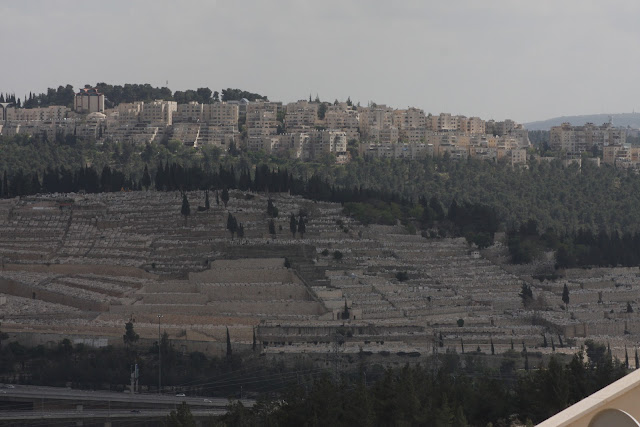
On the terrace of my grandfather’s I saw a Civilization that lived by fostering life VS a Devilization that can only exist by destroying life.
On the terrace of my grandfather I saw a culture of Life being momentarily oppressed by a culture of Death.
On the terrace of my grandfather I understood that for us Palestinians if we are to make it into the future, all we need to do is to vehemently reject the poisonous glitter of the occupiers with all its multifaceted deception: where slavery is sugar-coated with slogans as “modern banking systems”, “global trade”, “free loans”, “buy now pay later” and “economic growth”.
On the terrace of my grandfather I understood that whatever we do we must vehemently oppose any attempt that aims to lure us to “learn” from or mimic the occupier in any shape or form:
Not in the way they run their society, where the selfish concept of “I” and “my interest” are promoted and admired while the foundation of civil human interaction and the altruistic concepts of “we” and the “communal interest” are frowned upon, despised and discouraged as irrelevant backwardness;
Not in the way they conduct business by the use of usury enriching the rich few and impoverishing the masses of poor;
Not in the way they use aggressive agriculture, under the veil of “increasing productivity” they kill the land with chemicals and over-irrigation and destroy the future with GMO sterile seedless uncontrollable crops, they farm animals in the most cruel conditions. Under the veil of modernity they inject seeds of death and un-sustainability, bleeding the land dry of its richness and natural resources;
Not in the way they model their pyramidic hierarchical systems of which millions who languish at the bottom are crushed by a handful who climb to the top.
Not in the way they build colonies brutally carving out the heart of our beautiful landscape, savagely slicing through our precious hills and butchering our millennia-old meadows and mountains only to replace it with prison boxes and creepy tombstones.

On the terrace of my grandfather I saw that a culture of death by its very nature is not sustainable, and cannot possibly survive let alone give birth to life.

On the terrace of my grandfather I saw the manifestation of an exemplary, sustainable, organic, cohesive, open and hospitable civilization, a World Heritage that learned how to peacefully and lovingly coexist and thrive with its neighbours, surroundings and environment.
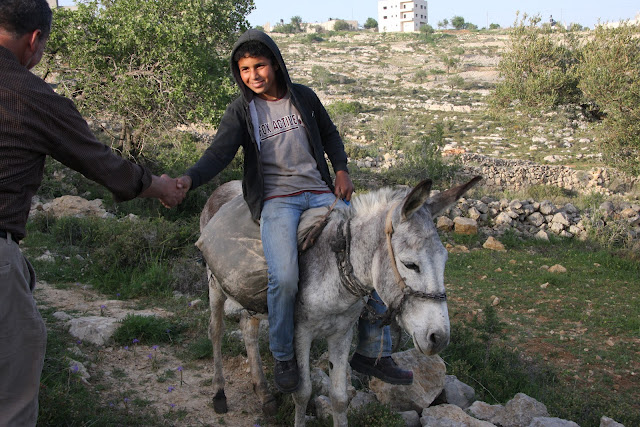
On the terrace of my grandfather, I understood why and how a land can become Holy and from where the sanctity of this cherished Land emerged.
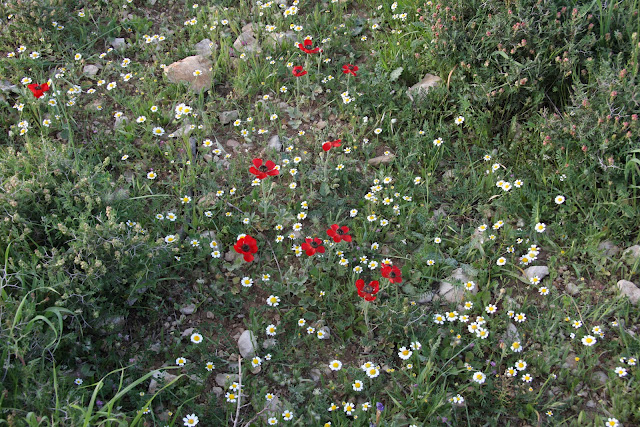
On the terrace of my grandfather I saw the hands of thousands upon thousands of men women and children tenderly attending the land, lovingly removing the stones from its fields and pathways, where in return I saw the stones write poetry of love and thankfulness with its poppies, daisies and bluebells.
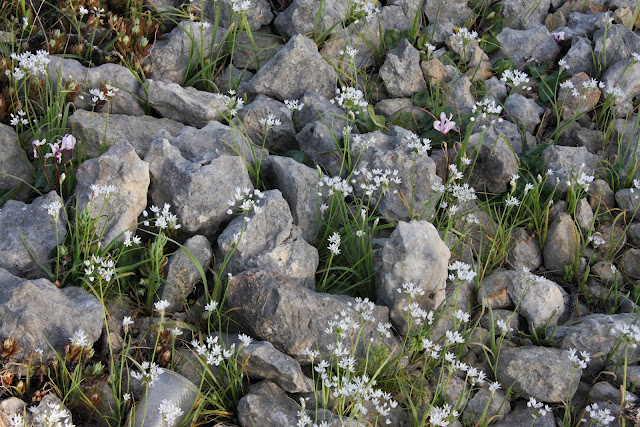
On the terrace of my grandfather, I saw the attentive hearts of my people singing melodies of affection and adoration as they tenderly depicted their poetic verses in sublime harmony with their environment. Their little hand-picked stones thoughtfully arranged, perfectly in tune with the landscape around. Sensitively, compassionately and to the best of human endeavour, mimicking in fine details the Divine-artwork, without causing injury or harm to whatever lays in the way. Out of stones, rocks, flowers and trees they have created a timeless panorama of breathtaking beauty.
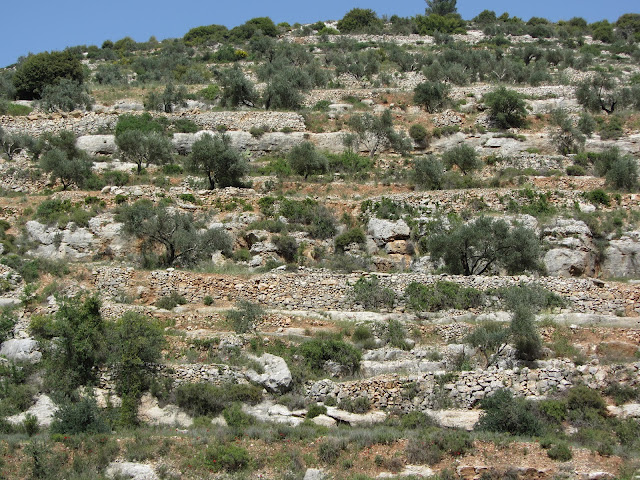
On the terrace of my grandfather, I saw the hands of generations of my ancestors patiently caressing its sleepy hills and artistically painting the landscape with the brush of pure love, swathing it with Holiness and Sacredness, preserving its Divine-given authenticity and protecting life that dwells on it.
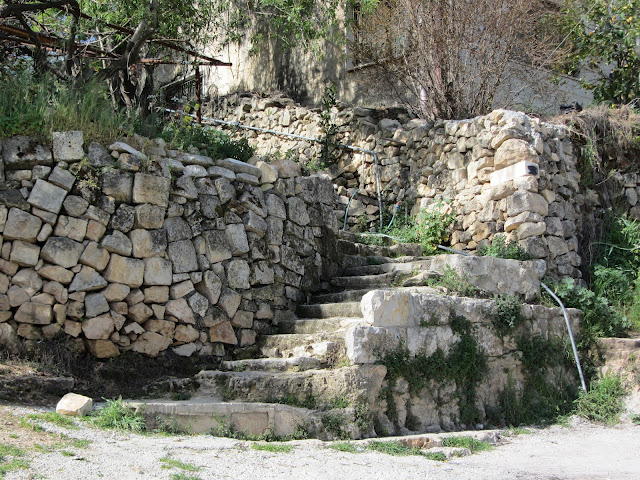
On the terrace of my grandfather I saw breathing homes with flowery grassy roofs, I saw homes with eyes, homes with hearts, homes that smile and weep, homes that rejoice meeting her loved ones and that mourn those whom have been lost.
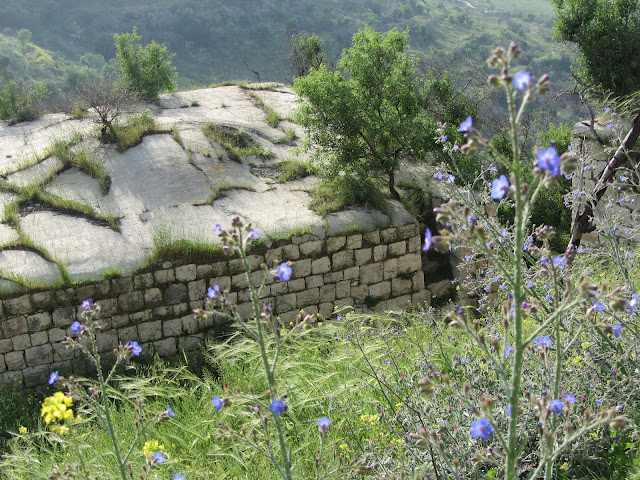
On the terrace of my grandfather I saw homes that welcome its dwellers with hugs and kisses and put its children to sleep by tales of love, magical bedtime stories and singing prophetic lullabies.

On the terrace of my grandfather, I finally understood the meaning of the name Holy Land, Blessed Land, Sacred Land and why that name was bestowed on our Palestine.

On the terrace of my grandfather, I saw Love of Life, Love of Land and Love of Humanity beautifully and supremely intertwined with spirituality, religiously protecting all that is around, thus creating a Holy Land, with excruciating beauty and dazzling glory, a Sacred Landscape, a Majestic Prayer and a Soul-Capturing Sanctuary with infinite charm and mesmerizing grace.
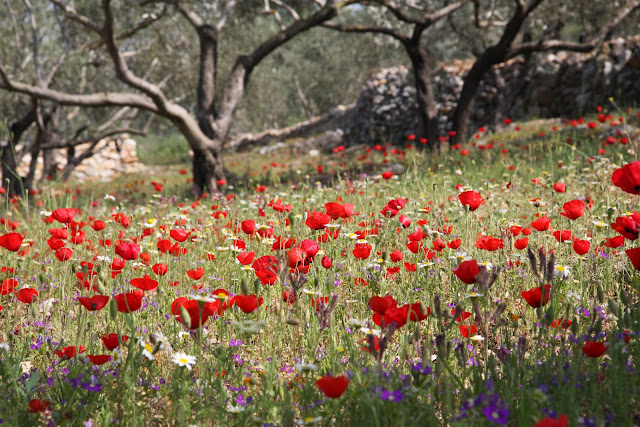
On the terrace of my grandfather, I saw how is it possible for humanity to be saved, to survive and thrive by saving and following the example of Palestine.
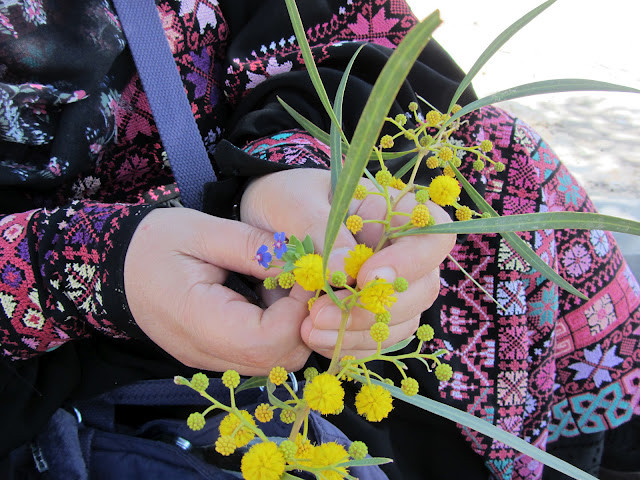
On the terrace of my grandfather I understood that the day of their demise is a stone throw away and the day of our Liberation is not far anymore.
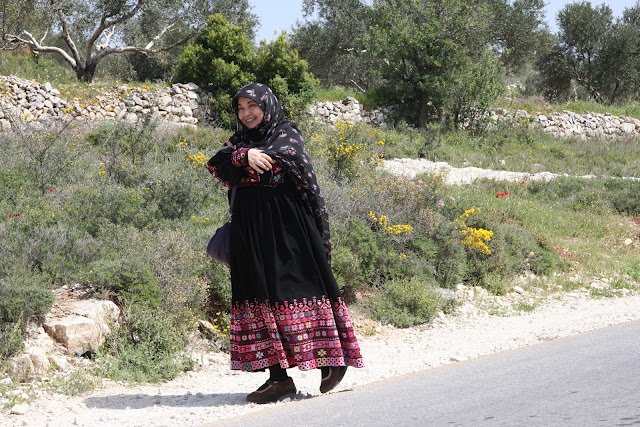
On the terrace of my grandfather I realised that stopping and reversing the destruction of this land, and its inevitable Full Liberation, is not only necessary and urgent from the standpoint of Justice. Palestine is far more.
Palestine and its ominously peaceful and sustainable model is NOT a mere nostalgic ideal, but the most perfect source of inspiration and blueprint to design a futuristic, yet solidly rooted and time tested society, in which human interaction, environmental intervention, timeless architecture, agriculture, ethical commercial exchange and spiritual quest are the peak of human achievement. They are not incompatible with contemporary technology and population growth, they are the safeguards and KEY to a sustainable, peaceful and brighter future.
Whether some like it or not, in order to rescue this Sacred World Heritage, it will need a difficult surgery: the removal of the invading death culture that has shown its colossal failure to integrate the Land and its People.
Beauty and Humanity shall prevail.
I warmly invite the world along with my fellow Palestinians to rediscover and embrace our Palestinian culture of Life following the flowering footsteps of the Prophets of this Holy Land, Palestine.
Related articles
- Palestinians: The Forgotten People (alethonews.wordpress.com)
- Deir Yassin: No passing over history (altahrir.wordpress.com)
Sovereignty For Sale: Corporate Land Grab in Colombia
By Nazih Richani | Cuadernos Colombianos | April 10, 2012
“Buy land, they’re not making it anymore.” – Mark Twain
There are three main trends in the international political economy that are currently shaping land use and value. The first is the increasing demand for land from the emerging economies of China and India alongside Korea, Japan, and the petro-dollar states of Saudi Arabia, United Arab Emirates, and Qatar. These countries are buying and renting lands in Africa, Asia, and Latin America, particularly Brazil and Argentina, for bio-fuels and other cash-crops. The second and third trends are the increased use of land for mining and speculation. Land has become the hottest commodity on the global market. It is as if the world capitalist class has only just heard Mark Twain’s advice: “Buy land, they’re not making it anymore.”
Consequently more land is being put to the service of biofuel crops and mining. Over the last decade alone, over 560 million acres in Africa, Latin America, and Southeast Asia, that were previously dedicated to food production, are now catering to biofuels and mineral extraction. Mostly multinational corporations and sovereign funds now own this land, which is equivalent to the size of the combined territories of Britain, France, Germany, Italy, Ireland, Portugal, Spain, and Switzerland. The entire forested area of the United States, including Alaska, is almost 490 million acres. Perhaps with these figures we can appreciate the magnitude of these trends.
U.S.-based Drummond Co. coal mine in Colombia (Al.com)In February, the Colombian Geological Service issued a report in which it revealed that in Colombia, a mining rich country, 18 multinational mining companies own the rights to mine on over 12 million acres of land. This figure is a partial assessment and does not include the subsidiaries of these corporations. The gold mining companies Anglo Gold Ashanti and Mineros SA have the rights to the largest amount of land, according to the report. Combined they control about 59% of these areas. Other multinationals such Eco Oro (formerly known as Greystar) and Leyhat, both Canadian companies, are not far behind. The latter owns the rights to mine on nearly 100,000 acres in the Colombian departments of Santander and North Santander. Oil multinational corporations, which were not included in the report, were granted over 90 million acres for oil exploration and production across Colombia.
Meanwhile, Cargill, the world’s largest agribusiness, recently bought over 220,000 acres in the Colombian department of Meta where it is already producing grains. The Israeli company Merhav has invested $300 million in buying and preparing nearly 25,000 acres in Magdalena Medio for the production of sugar cane to produce ethanol.
In Colombia over 280,000 acres have been sold to foreign companies for biofuel crop production, as well as nearly 250,000 acres of forest land that is now owned by Timberland Holdings (Swiss-Ecuadorian company), Smurfit-Kappa (Irish), the Chilean-based companies Agrícola de La Sierra and Reforestadora del Sinú, and the Colombian companies Inverbosques and Forest First. According to the November 2011 Peace Brigades International Colombia Newsletter, today, 40% of Colombia’s 280 million acres of land “has been licensed to, or is being solicited by, multinational corporations.”
The far reaching implications of such a profound shift in land use puts the future of Colombia’s food security in jeopardy, as well as the livelihood of millions of people across the globe. If these trends are not reversed they are a major threat to global peace and security.
Related articles
- Small-Scale Miners Face Crackdown as Foreign Companies Set Sights on Colombia (alethonews.wordpress.com)
Brazilian Judge Suspends Dam License, Upholds Indigenous Rights
ENS | April 5, 2012
BRASILIA, Brazil – A federal judge has suspended the construction license of the Teles Pires hydroelectric dam in the Brazilian Amazon, saying the permitting process violated the rights of indigenous people protected under the Brazilian Constitution.
In her ruling, Judge Celia Regina Ody Bernardes, a federal judge in the state of Mato Grosso, sided with federal public prosecutors and public prosecutors from Mato Grosso and the state of Pará who argued the dam would cause “imminent and irreversible damage to the quality of life and cultural heritage of indigenous peoples of the region.”
The dam would flooding a series of rapids on the Teles Pires River known as Sete Quedas, or Seven Waterfalls, the spawning grounds of fish of great importance to the indigenous residents.
The judge ordered the immediate suspension of all activities in dam construction, “especially explosions of boulders in the region of Sete Quedas.”
A recent declaration by indigenous peoples cited in the lawsuit states, “Sete Quedas is a sacred place, where the Mae dos Peixes (Mother of Fish) and other spirits of our ancestors live – a place known as Uel, meaning that it should not be messed with.”
The 1,820 megawatt capacity dam has been under construction since August 2011 on the Teles Pires River, a major tributary of the Tapajos River in the heart of the Brazilian Amazon.
The dam is one of six large hydropower projects planned for the Teles Pires River, which forms the border between the states of Mato Grosso and Pará.
In her decision, Judge Bernardes concluded that prior to greenlighting dam construction, the federal environmental agency IBAMA failed to consult with affected indigenous communities, despite serious threats to their “socioeconomic and cultural well-being.”
She ruled that this constitutes a violation of the Brazilian Constitution and ILO Convention 169, which Brazil signed in 2004.
In addition to its importance for the physical survival of indigenous peoples, Sete Quedas holds tremendous cultural significance. The lawsuit argues that the dam construction site is “a sacred area relevant for the beliefs, customs, traditions, symbolism and spirituality of indigenous peoples. As a cultural heritage site, it is protected by the Brazilian Constitution and international agreements.”
Other threats to indigenous peoples provoked by dam construction, cited in the lawsuit, include conflicts associated with a massive influx of migrants to the region, land speculation, illegal deforestation, predatory fishing and illegal exploitation of mining resources. The prosecutors argued that, given a delay of almost 20 years in the demarcation of the Kayabi territory, such threats are even more severe.
Taravy Kayabi, a leader of the Kayabi people, said, “While the federal government stalls in implementing laws that protect the rights of indigenous peoples, it is pressuring us to accept the dams. But we know the compensation they are offering will never substitute places that are sacred to us, such as Sete Quedas, that hold the cemeteries of our ancestors and that should be preserved.”
“Sete Quedas is also the spawning grounds of fish that are an important source of food. They talk about fish ladders, but where have these ever worked? Kayabi asked.
“The government needs to look for alternative ways to generate energy that don’t harm indigenous peoples and their territories,” he said.
Civil society groups and leaders of the Kayabi community welcomed the news of the the suspension of dam construction, but warned against a possible overturning of Judge Bernardes’ restraining order.
Brent Millikan, director of the Amazon Program at International Rivers, based in California, says he has seen it happen before.
“What we’ve seen over and over again, in cases such as Belo Monte, is that the President’s office politically intervenes in regional federal courts to overturn decisions against violations of human rights and environmental legislation, using false arguments, such as an impending blackout at the national level if dams aren’t immediately constructed,” he said.
“Of course, this is ludicrous,” said Millikan. He says indigenous peoples and human rights groups in Brazil and around the world” are calling on the government of President Dilma Rousseff “to change course and respect the country’s constitution and rule of law.”
Copyright Environment News Service (ENS) 2012. All rights reserved.
Radioactive Seawater Impact Map (update: March 2012)
Radioactive Sea Water Particle Tracing from Fukushima-Daiichi Nuclear Power Plant
Assuming that a part of the passive biomass could have been contaminated in the area, we are trying to track where the radionuclides are spreading as it will eventually climb up the food chain. The computer simulation presented here is obtained by continuously releasing particles at the site during the 2 months folllowing the earthquake and then by tracing the path of these particles. The dispersal model is ASR’s Pol3DD. The model is forced by hydrodynamic data from the HYCOM/NCODA system which provides on a weekly basis, daily oceanic current in the world ocean. The resolution in this part of the Pacific Ocean is around 8km x 8km cells. We are treating only the sea surface currents. The dispersal model keeps a trace of their visits in the model cells. The results here are expressed in number of visit per surface area of material which has been in contact at least once with the highly concentrated radioactive water. – More info at source
Related articles
- Coming to a Shore Near You (thedailybeast.com)
- | Much higher than expected Fukushima Cesium radiation headed across Pacific Ocean! (truthaholics.wordpress.com)
Israeli settlement waste ‘poisoning Palestinians’
Ma’an – 06/03/2012

NABLUS – Sewage from Israeli settlements near Salfit in the northern West Bank is flowing into nearby Palestinian communities and causing serious disease, a health ministry official said Tuesday.
Speaking at an environmental conference in Salfit, the head of Salfit’s ministry of health office said the situation had become “intolerable” for communities affected by disease from the sewage, including cases of cholera.
Waste from factories in an industrial zone inside an Israeli settlement is threatening Salfit’s agriculture, the Salfit governor said.
Barqan settlement, near Salfit’s Qana Valley, has the largest industrial complex of the Israeli settlements in the West Bank, Gov. Isam Abu Bakr said.
He warned that the dumping of waste in 11 sites surrounding Salfit had become a major cause of cancer in the area.
All Israeli settlements built in the occupied West Bank and East Jerusalem are illegal under international law.
Related articles
- Israel to Take Over Land near Salfit (altahrir.wordpress.com)
Mobile nuclear meltdowns: Coming soon to a town near you?
By Vladimir Slivyak – Translated by Maria Kaminskaya | Bellona | January 18, 2012
MOSCOW – Some three hundred nuclear time bombs are to cross the vast expanses of Russia within the next dozen years as Moscow embarks on its plan to send special-purpose trains with spent nuclear fuel (SNF) burnt at the country’s commercial reactors to a storage facility in Siberia. That’s the “solution” the nuclear industry has come up with for the ever mounting problem of nuclear waste – take it cross-country and pile it up where it will threaten the environment and public health for generations to come.
The first train bound for Krasnoyarsk Region in Central Siberia – where a repository is being built for both Russia- and foreign-produced nuclear waste – will carry spent nuclear fuel generated at Leningrad Nuclear Power Plant (NPP), a site near Russia’s second largest city of St. Petersburg, in the country’s northwest.
The date of departure – the first in a large-scale series of shipments devised to scoop up and stow away nuclear waste from all over the country – is being kept secret. The State Nuclear Corporation Rosatom plans to move some 22,000 tons of spent nuclear fuel to Siberia before 2025. This means three new trains loaded with dangerous waste – 300 shipments in total – will be arriving in the closed town of Zheleznogorsk, also known as Krasnoyarsk-26, every second month for the next thirteen years.
Shipments like these threaten the safety of residents of more than 15 large Russian cities that will happen to be on the way, urban centers like the Russian capital, Moscow, as well as St. Petersburg, Penza, Samara, Kirov, Perm, Yekaterinburg, Tyumen, Omsk, Novosibirsk and so on – virtually every industrial hub on Russia’s enormous map. Even though the shipping routes have not been disclosed, simple logic suggests moving trains loaded with cargoes as massive and logistically sensitive as these will require major railroads – such as those that involve stations, links, and depots serving heavy-traffic areas.
Nuclear transports as a whole present a particular risk for both the population at large and, specifically, those railroad personnel who may find themselves working in the vicinity of cargoes emitting high levels of radiation. As the Russian tradition holds, no warnings are issued in such cases to caution against potential danger – the usual cross-your-finger approach dictates it’s going to be just fine. All three hundred times. But there is the risk of radioactive contamination that could occur in case of an accident – brought on either by the poor condition of Russia’s railroads or as a result of a malicious act. (In 2009, a homemade bomb planted on the tracks derailed a passenger train on the country’s busiest route – the Moscow-St. Petersburg link, favored by government and business elites – constituting one of the deadliest terrorist attacks in Russia’s recent history outside of the volatile Caucasus region). And this not even taking into account that the transportation of these radioactive materials will be overseen by a chain of agencies whose expertise hardly includes dealing with issues related to nuclear safety: Russia’s railway network and other transport services, as well as a variety of regional authorities.
Spent nuclear fuel is the most hazardous kind of radioactive waste nuclear power plants produce. It contains plutonium, an isotope with a half-life of 24,000 years. The nuclear industry vehemently objects to this material being referred to as waste, arguing it is instead a valuable resource that can be used again as fuel after reprocessing – a highly questionable process that itself generates hundreds of times more radioactive waste as a result.
Meanwhile, Russian law speaks clearly to this issue: If nuclear material cannot be put to further use, then it is waste. Incidentally, the better part of the SNF Rosatom plans to move to Siberia has been burnt in reactors of the RBMK-1000 series – the same type that blew up in Chernobyl and remains in operation at three nuclear power plants in Russia, the site near St. Petersburg and Kursk and Smolensk NPPs, in Western Russia. But not only does Russia possess no technological capacity to reprocess spent fuel of this type, it furthermore has no plans to build any soon, for reasons of exorbitant costs. The very idea is simply economically indefensible. In fact, of the 33 reactors in operation in Russia, only seven currently produce spent nuclear fuel that lends itself to reprocessing.
To be sure, Rosatom’s continued operations imply that the so-called “dry” storage facility slated for completion at the Mining and Chemical Combine in Krasnoyark-26 will in fact be a nuclear repository set to remain there for many thousands of years: The plutonium alone will remain highly hazardous for 10 half-life periods – a quarter of a million years. In other words, one stroke of Rosatom’s pen forces the residents of Krasnoyarsk Region to assume the risks created by the sixty-five years of the nuclear industry’s development.
It is likewise not customary practice in Russia to first inquire of the locals whether they mind living next door to a nuclear dumpsite of international proportions – no more so than it is to conduct a fair parliament election or warn of hazardous cargoes passing through a populated area. Previous attempts that a number of countries have undertaken at building nuclear repositories have inevitably fallen flat – quashed either by large-scale public protests or by prohibitive costs (or a combination of both). A great uncertainty thus remains in the United States, Germany, Japan, and other countries that have historically relied on commercial nuclear power as to what to do with their accumulated waste. This means the Krasnoyarsk site may in the long term become the go-to facility for foreign SNF producers wishing to be rid of their nuclear headaches, and plans to accommodate imported waste have been developed before. One such project, revealed by Ecodefense in 2001, was a study sponsored by the US Department of Energy for a US-funded program looking to employ the option of storage and eventual geologic disposal in Russia of spent fuel of US origin used in Taiwan.
Taking into account the significant safety hazard associated with nuclear waste, the less than state-of-the-art condition of Russian railroads, and the sometimes inadequate security en route, nuclear trains have all the makings to turn into a catastrophe waiting to happen – three hundred mobile Chernobyls that Rosatom, despite the obvious risks, would rather keep secret from the public. It falls, then, to environmentalists to fill this information gap.
What could we Russian citizens do? We could keep a Geiger counter ready at home and be generally prepared to protect ourselves from radioactive exposure. But most importantly… we could speak out against nuclear shipments in our regions. Make ourselves heard by local parliamentaries, government officials, and emergency services. Take our protest to the streets.
This is not a trifling matter. What we are dealing with is not a one-time nuclear delivery from point A to point B. At issue is a program that puts at risk the better part of the Russian territory for thirteen years. This program must be stopped as soon as possible – and that means putting our voices together for a clamorous public outcry. This is a simple choice we are facing – live a life of fear of a radiological disaster, or head out en masse to the railways to voice our protest and just maybe stop this madness from happening. It is our health and environment we need protecting – and it is our choice to make.
The nuclear industry is certainly not making this task any easier for us. Six decades into the peaceful atom’s history, the problem of nuclear waste still remains unsolved. No other industry in the world has produced so much dangerous and long-lived waste that has the capacity to inflict such harm to the environment and human health both now and throughout the next many thousands of years. Not to mention the gigantic financial burden that the storage of nuclear waste will place on the shoulders of thousands as-yet unborn generations. No one today is in any position to guarantee the safety of this waste thousands of years in advance, as the industry has simply not conceived of any way to efficiently remove the threat – but it will have to, at some point.
So instead of putting hundreds of Chernobyls-on-wheels in motion all over the country, the more reasonable option would be to leave the waste where it was produced – providing the highest level of safety possible to ensure against all eventualities. Equally reasonable would be to expect Rosatom to stop prolonging the operational life terms of old reactors or building new ones – and instead direct all efforts toward solving the problem of nuclear waste, not amassing it. The time to move the waste already accumulated must not be before we have a clear idea of how we can keep the public and the environment safe during the entire term this waste remains a menace.
Experts in the United States have established this period at one million years, but the US likewise lacks a definitive solution for the problem. And certainly, the dry storage facility in Krasnoyarsk-26 is not an answer, if only because it won’t last a thousandth of the time it will take to keep the waste safely isolated.
As it stands, Rosatom’s plan is nothing but travesty, a pitiful attempt at a solution that will only shift the burden of responsibility onto future generations – forcing the job of safeguarding the growing nuclear mess on our grandchildren, and our grandchildren’s grandchildren, and so on ad aeternum. This simply will not do.
~
See also:
Featured Video

“Historic Russia”: The Land Putin Will Not Give Back
or go to
Aletho News Archives – Video-Images
From the Archive
How Ukraine Tortured and Slaughtered Donbass
By Kit Klarenberg | Al Mayadeen | July 11, 2024
Almost immediately after the proxy war erupted, ISIS-tier footage of the torture and murder of Russians in Ukrainian custody emerged.
On July 6th, the New York Times published an astonishing investigation: In Ukraine, Killings of Surrendering Russians Divide an American-Led Unit. The article documents in grim detail how Chosen Company, an international volunteer battalion for Kiev, routinely executes Russian prisoners of war. It is the very first mainstream admission that this practice – a brazen breach of the Geneva Conventions, and a grave war crime – is widespread among Ukraine’s fighters, both foreign and homegrown. … continue
Blog Roll
 Aletho News
- Peace in Ukraine: the easy way – or the hard way
- Trump & the Rrrrussians
- US taxpayer money laundered back through Ukraine – Musk
- Before COVID, an NIH lab chief proposed making a SARS-like bat virus more infectious
- Gates, Bourla on Trial in Netherlands Accused of ‘Great Reset’ Scheme at Vaccine Injury Hearing
- BRITAIN’S WARNING: PREPARE FOR WAR
- “Historic Russia”: The Land Putin Will Not Give Back
- How the Cambridge Analytica scandal still haunts Mark Zuckerberg
- The Ongoing Cancellation Campaign Against a Dissenting Academic in Norway
- Yemen and ‘the Houthis’: Challenging Sami Hamdi’s Narrative
- If Americans Knew
- DAILY UPDATE: Latest essential news on Palestine, Israel, & region
- Damning report shows the media must confront its failures on Gaza
- BBC senior broadcaster speaks out on Gaza coverage
- Netanyahu vows vast West Bank invasion in response to 20-minute skirmish that left 2 Israeli soldiers and 2 Palestinian fighters dead
- Tied up and tortured: Israel using US-made electroshock weapons on Palestinian detainees
- The outsourced risk: how newsrooms rely on Gaza’s freelancers without protecting them
- Gaza bakeries forced to shut as Israel blocks flour shipments
- Gaza’s breast cancer patients face a deadly wait for treatment amid Israel’s genocide
- DAILY UPDATE: Latest essential news on Palestine, Israel, & region
- The Israel Lobby’s Changing Fortunes
- No Tricks Zone
- Two New Studies Find Thwaites Glacier Melt Cannot Be Driven By Human Activity Or A Warming Ocean
- E-Cars Reduce CO2 Emissions By Only 41% Compared To Internal Combustion Engine Vehicles
- Predictions Made By Renowned Climate Professor Over Past Decades Have Been Proven To Be Poor
- New Study Suggests Large Regions Of The Pacific Ocean Have Been Cooling For The Last 80 Years
- Germany’s Green Energy Debacle: High Energy Costs Force Kahla Porzellan to Close After 182 Years!
- New Study: 50 Years Of The Most Aggressive ‘Net Zero’ Policies Can Only Affect The Global Climate By 0.03°C
- US September “Heat” Was No Record…Many Records Set Decades Ago
- Latest European Green Energy Debacle; Portugal’s Largest Flagship Solar Park Insolvent!
- Green Energy Debacle: German Expert Professor Fritz Vahrenholt Warns Of Severe Economic And Social Consequences
- Two More Paleo Reconstructions Affirm Meters-Higher Sea Levels Across Ireland, Brazil 7000-6000 Years Ago

