More Than a Bribe: Obama Surrenders Palestinian Rights
By Ramzy Baroud | Palestine Chronicle | November 25, 2010
The Middle East policies of US President Barack Obama may well prove the most detrimental in history so far, surpassing even the rightwing policies of President George W. Bush. Even those who warned against the overt optimism which accompanied Obama’s arrival to the White House must now be stunned to see how low the US president will go to appease Israel – all under the dangerous logic of needing to keep the peace process moving forward.
Former Middle East peace diplomat Aaron David Miller argued in Foreign Policy that “any advance in the excruciatingly painful world of Arab-Israeli negotiations is significant.” He further claimed: “The Obama administration deserves much credit for keeping the Israelis, Palestinians, and key Arab states on board during some very tough times. The U.S. president has seized on this issue and isn’t giving up — a central requirement for success.”
But at what price, Mr. Miller? And wouldn’t you agree that one party’s success can also mean another’s utter and miserable failure?
Secretary of State Hilary Clinton reportedly spent eight hours with Israeli Prime Minister Benjamin Netanyahu only to persuade him to accept one of the most generous bribes ever bestowed by the United States on any foreign power. The agreement includes the sale of $3 billion worth of US military aircrafts (in addition to the billions in annual aid packages), a blanket veto of any UN Security Council resolution deemed unfavorable to Israel, and the removal of East Jerusalem from any settlement freeze equation (thus condoning the illegal occupation of the city and the undergoing ethnic cleansing). But even more dangerous than all of these is “a written American promise that this will be the last time President Obama asks the Israelis to halt settlement construction through official channels.”
Significant. Achievement. Success. Are these really the right terms to describe the latest harrowing scandal? Even the term ‘bribe’, which is abundantly used to describe American generosity, isn’t quite adequate here. Bribes have defined the relationship between the ever-generous White House and the quisling Congress to win favor with the ever-demanding Israel and its growingly belligerent Washington lobby. It is not the concept of bribery that should shock us, but the magnitude of the bribe, and the fact that it is presented by a man who positioned himself as a peacemaker (and actually became certified as one, courtesy of the Nobel Peace Prize Committee).
Equally shocking is the meager return that Obama is expected to receive for hard-earned US taxpayers’ dollars. According to the Atlantic Sentential, this will be “a measly three month extension of the settlement moratorium that originally expired in late September.”
Acknowledging from the onset that these are mere “midterm maneuvers”, Noah Feldman, writing in the New York Times, asks the question: “Can Obama succeed where so many others have not?” He preludes his answer with: “Israel and the Palestinian Authority will not, of course, make things easy.”
Seriously, Mr. Feldman?
Palestinian Authority President Mahmoud Abbas, whose mandate has already expired, must be living the most humiliating and difficult moments of his not so distinguished career. At one stage he had hoped that the advent of President Obama would spare him and his authority further embarrassment. Imagining the president would side with his ‘moderate’ position, he placed all his eggs in the Obama basket, even bidding against the democratically elected government of Palestinians in the occupied territories. He went as far as to halt an international investigation into Israeli crimes in the recent Israeli war on Gaza so that not to frustrate Netanyahu’s government or upset the pro-Israeli sensibilities in the US Congress.
True, Abbas tried to appear as a confident and self-assertive leader at times. He asked for a chance to think about the resumption of peace talks, conditioned his acceptance on Israeli actions that never really actualized, and finally sought the help of the Arab League, a beleaguered and muted organization without any political mandate.
How did Abbas and his authority make things ‘difficult’ for the US, Mr. Feldman? Would any self-respecting government agree to concessions that are made on its behalf without the opportunity to offer its own input? This is exactly what the PA has repeatedly done under Abbas.
Still, many Israelis are not happy with the barter. Caroline B. Glick, writing in the Jerusalem Post, described the freezing of construction in the illegal Jewish settlements in the West Bank as “discriminatory infringement on the property rights of law abiding citizens (that) is breathtaking.” She had the hubris to consider the pitiable moratorium as equivalent to “land surrenders.”
As for the major F-35 deal, it is “simply bizarre,” she argued, for after all, “Israel needs the F-35 to defend against enemies like Iran.”
Mind-boggling. US generously hands Palestinian rights to Israel on a silver platter, and the far-right mentality, which now governs Israeli mainstream politics and society, still finds it unacceptable.
But aside from this arrogant Israeli response, and the US media’s attempts to find the positive in Obama’s latest scandal, one question must be raised. What happens now that Obama has finally shown he really is no different from his predecessors? That the United States has lost control of its own foreign policy in the Middle East? That, frankly, Netanyahu has proved more resilient, more steadfast, and more resourceful than the American president?
Shall we go on making the same argument, over and over again, or has the time finally arrived for Palestinians to think outside the American box? Can Arabs finally venture off to seek other partners and allies in the region and around the world who understand the link between peace, political stability, and economic prosperity? It may perhaps be time for them to further their relationship with Turkey, to reach out to Latin America, to demand accountability from Europe and to try to understand and engage China.
The latest US elections have showed that the Obama hype has run its course in the US itself. One can only hope that Palestinians, Arabs and their friends will realize that it was all indeed a hype -before it’s too late.
– Ramzy Baroud (www.ramzybaroud.net) is an internationally-syndicated columnist and the editor of PalestineChronicle.com.
Huffpo gives platform to Israel lobbyist’s claim based on 3000-year-old artifacts
By Philip Weiss on November 23, 2010
Marty Kaplan at Huffpo: “I take Israel personally.” Further proof that the left is permeated by the Israel lobby. Further proof that Zionism has produced a giant IQ drop in what I grew up thinking were the smartest people in the country. Note that Kaplan hadn’t been to Israel in 40 years till he visited lately; but he regards the wall there as his wall. And note the 3000-year-old artifacts of Jewish civilization Kaplan sees at the Israel Museum that combined with genealogical records at the Holocaust museum justify Zionist land claims for him and the rest of the “Jewish people.”
If Christians said this kind of stuff, Huffpo would scream that they are religious nuts. When Shlomo Sand tried to contest this type of racial thinking, he was eviscerated in our country as being “political,” when his only politics are trying to save Jewish minds from mythology that blinds them to the facts before them.
Re mythology, note the “competing narratives” claim at the end of this excerpt. Tony Kushner once said to me that most American Jews have an idea of Israel that is a delusion on top of a fantasy; and that’s what we see here. A guy who hasn’t been to a place in 40 years, who is happily making his life as an empowered minority in the U.S., declares that a western “narrative” about a Jewish right to the land is equal to the Palestinian narrative of 63 years of actual dispossession. I am not saying there is not an Israeli narrative; but it is shot through with all sorts of diaspora projection on the part of people who haven’t been there in decades and whose ideas of Jewish powerlessness are fed by a visit to the Holocaust museum, and who can thereby elide the plain history of Palestinian expulsion/discrimination. Young Jews will have to save us from these ideas… Kaplan:
[T]his is the point where I have to, leap to, declare my love and support for the existence of the Jewish state of Israel. I think the international campaign to delegitimize Israel is based on a malicious misreading of history, abetted by a level of naïveté, ignorance and racism that would surprise me if I hadn’t just lived through the past two years of media and politics. I reject the contention that Zionism is racism, colonialism or any other -ism designed to steal land, disenfranchise citizens or exterminate enemies. The 3,000-year-old artifacts of Jewish civilization that I saw in the Israel Museum and the Nazi Who-is-a-Jew? genealogical charts that I saw at Yad Vashem and the secular Israeli majority I saw in the streets and know from the Diaspora, reminded me that Israel’s nationhood derives from its existence as a people, not as a religion.
I actually came back from Israel more of a hawk than when I left. I am more respectful of the security fence — my security fence — than I was before. Yes, I know the case against it, but I’ve returned convinced that its designers are motivated by fighting terrorism, not by appropriating land or humiliating Palestinians. I haven’t concluded that a pre-emptive strike on Iran is a good idea, but I’m less inclined to think that the threat Iran poses is only a politically pumped-up neocon job. I no longer think that “settlements” is a useful, or necessarily pejorative, term; it encompasses too wide a variety and history of dwellings to be deployed as a shorthand for obstructionism. Like everything else in Israel, it’s complicated.
But don’t get me wrong: I’m closer to J Street than to AIPAC. When Netanyahu acts as though the status quo can go on indefinitely, I not only despair at his delusion; I wear it as my own albatross, whether I want to or not. When he catastrophically bungled the response to the Gaza flotilla stunt, I was unable to prevent myself from feeling personally soiled….
Israel is a battleground between two competing narratives. The Palestinian account of history, its assignment of right and wrong, is a mirror image of the Israeli version; just about everything is flipped. No negotiation between Israelis and Palestinians can settle the matter of which narrative is right. No historian, journalist, political figure or international tribune can sort through the dueling accounts and create a composite that either side will accept.
Israeli soldiers beat and humiliate Salfit farmer
Ma’an | November 21, 2010
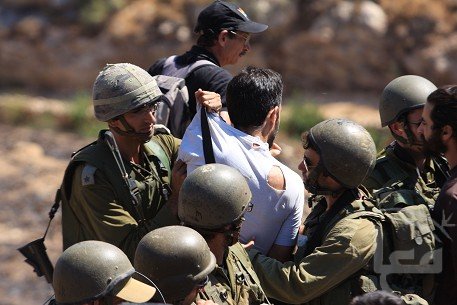
SALFIT — A Palestinian farmer said he was beaten by Israeli soldiers on Friday morning, after he asked them to open the agricultural gate and allow him access to his farm land in the northern West Bank village Az-Zawiya, west of Salfit.
Mu’taz Ribhi Abu Nab’a, 22, said the incident occurred at 11:30 a.m., as he waited to cross the gate to his land, on the far side of the separation barrier.
A force made up of men and women refused to let him through the gate. Instead, he said, soldiers beat him, strip-searched him and hand-cuffed him before transferring him to a military base.
Abu Nab’a further said that female soldiers humiliated him and took photos with him.
When he asked an Israeli officer why he was being beaten and humiliated, the young farmer said, he was told “Because you deliberately disturbed us and made us go to the gate early in the morning.” Abu Nab’a said the officer in charge then accused him of attempting to break down part of the barrier. The farmer said he denied the charge and informed the soldier that he knew there were monitoring cameras which would have documented him.
He also told the soldier he had a permit issued by Israeli authorities giving him permission to access his land.
According to Abu Nab’a, soldiers ultimately freed him in Hebron, more than 60 kilometers south of his home town, but only after he was served with a summons ordering him to go the Israeli intelligence office in Tulkarem on Monday for further interrogation.
An Israeli military spokeswoman said she could not look into the report without the Palestinian’s ID number.
The tribulations of the Tuareg
Disenfranchised and impoverished, the Tuareg now stand accused of being allied to al-Qaeda in the Islamic Maghreb
Jeremy Keenan | Al-Jazeera | November 20, 2010

Many media reports are linking the Tuareg tribesman of the Sahara to al-Qaeda in the Islamic Maghreb [EPA]
Are the Tuareg tribesmen of the Sahara, as many media reports are now intimating, allied to al-Qaeda in the Islamic Maghreb (AQIM)?
This question has become especially pertinent since the abduction of seven employees of two French companies from their living quarters in Arlit, northern Niger, in September.
The immediate reports on the hostage taking, for which AQIM has claimed responsibility, said that the kidnappers were heard to speak Arabic and Tamashek, the language of the Tuareg. This information subsequently appeared to be contradicted by a Tuareg guard who, having himself been attacked by the assailants, said that he heard them speaking Arabic and Hausa. He made no mention of Tamashek, but his evidence seems to have been ignored on the presumption that he would be unlikely to incriminate his own people.
Hundreds, possibly thousands, of media articles and broadcasts have followed the leads given by the Niger government, Amadou Toumani Touré (ATT), the president of Mali, Bernard Kouchner, the French foreign minister, and Brice Hortefeux, the French interior minister, whose statements suggested that AQIM ‘subcontracted’ the abduction to the Tuareg.
Media hot seat
The Tuareg are the indigenous population of much of the Central Sahara and Sahel.
Today, their largest concentrations are in northern Niger and northern Mali where they comprise approximately 10 per cent of the national populations, numbering around 1 million in Niger and perhaps a fraction less in Mali.
Other Tuareg populations are in southern Algeria and south west Libya, where they comprise small minorities of around 50,000 or less in each country, with perhaps 25,000 to 50,000 in Burkina Faso and a small scattering in Mauritania.
It is among these larger communities, notably northern Mali and to a lesser extent Niger, that AQIM has embedded itself.
The following points go some way to answering this question:
• Although AQIM has claimed responsibility for the Arlit abduction, we do not yet know for certain the individuals involved in the raid. Individual Tuareg may or may not have been involved.
• Although the Tuareg ‘communities’ have always denied taking part in such criminal activities, most of their leaders and spokespersons recognise that ‘black sheep’ are to be found among all peoples. Among the Tuareg, especially in Niger and Mali where the recent (2007-2009) Tuareg rebellions have stuttered to unsatisfactory and perhaps only temporary states of ‘peace’, a not inconsiderable number of young ‘ex-rebel’ fighters have turned to banditry and ‘criminality’ as a means of economic survival. Some of this ‘opportunism’ is undoubtedly associated with AQIM’s activities. Indeed, many of the young, former rebels of Niger who have taken to banditry now live in and around Tamanrasset, the capital of Algeria’s extreme south, and might therefore well presume that their banditry in northern Niger is being sanctioned by the Algerian state.
• As Nicolas Roux remarked recently in addressing this subject in People with Voices: “If a French national were involved in a terrorist organisation, no one would declare ‘The French’ to be part of such activities.”
• In a similar vein, Boutali Tchewiren, the president of the Alhak-Nakal (Right to Land) Association and former spokesman of the Niger Tuaregs’ rebel MNJ (Mouvement des Nigériens pour la justice Mouvement), responded immediately to the accusatory comments from Niamey and Paris. “Just because some of the kidnappers spoke Tamashek, the whole Tuareg community should not be accused,” he told AFP. Tchewiren also rebuked Kouchner, who said that: “Those who took these men and women could be Tuaregs working to order. They will sell them to the terrorists, who are not themselves very numerous.” “That,” Tchewiren said, “is a serious accusation. It’s too gross and ridiculous to accuse the Tuareg people in this way. The Tuareg community is not responsible for the actions of a few individuals, even if they’re members of this community.”
• Similar objections came from Mali’s Tuaregs. On September 20, two Mali MPs, Alghabasse Ag Intalla and Bajan Ag Hamatou, who are both representatives of the Tuareg community, sent a strongly written protest to the French ambassador to Mali about the way in which the Tuareg were being stigmatised. They wrote: “You know, Excellency, that there has not been a single day, since a certain time, when ‘The Tuaregs’ have not been put in the hot seat by a press article, radio or other form of communication in regard to their supposed involvement in this or that infamy perpetrated in their region.”
‘Putative terrorists’
The point of what I have to say goes far beyond the mere question of whether some Tuareg may have been implicated in the Arlit heist. It is directed to the overall situation of the Tuareg since 2003, when the Americans launched the new Saharan-Sahelian front in the so-called ‘global war on terror’ (GWOT).
It is often argued that extreme Islamist movements find their support not only among ideologues but also – through their promise of a better ‘social alternative’ – from among the socially deprived, repressed and marginalised. In the Sahara-Sahel, especially since 2003, that has been the Tuareg. Indeed, the impact of the GWOT on the Tuareg peoples has been nothing short of catastrophic.
On the above premise, and when we consider what the Tuareg have endured at the hands of Washington and their own governments during the GWOT, not to mention the exploitation of their lands by foreign mining and oil companies, we might well ask why the Tuareg, instead of condemning AQIM, are not queuing up to join it ranks.
In fact, the reality of the GWOT in the Sahara-Sahel has not been about fighting ‘terrorists’, but about how the local governments, linked into the GWOT through Washington’s Pan Sahel (PSI) and Trans-Sahara Counter-terrorism initiatives of 2004 and 2005 respectively, have been provoking the Tuareg into taking up arms so that they might be categorised as ‘terrorists’ or, as one US state department analyst argued rather quaintly in the context of the assumed link between terrorism and trafficking, ‘putative terrorists’.
What the Tuareg have had to endure in the so-called GWOT is both shocking and shameful. Let me summarise:
The kidnapping of 32 European hostages in the Algerian Sahara in 2003, under the direction of Algeria’s intelligence and security services, the DRS, brought the immediate collapse of one of the main pillars of the Tuareg economy in southern Algeria. The loss of some 10,000 tourists in southern Algeria alone, spending an estimated $750 each, meant an annual loss of approximately $7.5mn, most of which found its way into the local Tuareg community.
Many of these Tuareg, faced with penury, were forced into shadowy and sometimes even ‘criminal’ activities, such as working for the various trans-Saharan trafficking businesses, either as fuel suppliers, drivers or guides.
From 2004 onwards, the governments of Algeria, Niger, Mali and Mauritania all used the pretext of the GWOT to crack down on legitimate opposition, civil society and ‘troublesome’ ethnic minorities such as the Tuareg. Tuareg communities throughout the region were constantly being provoked by their governments into rebellious behaviour, with the purpose of demonstrating to Washington the potential threat of terrorism within the Sahara-Sahel region. The pay-off for local governments was the financial and military largesse that comes with the blessing of Washington.
‘Explosion of anger’
The US-Algerian plan to create ‘false-flag’ terrorism incidents in the Sahara-Sahel was formulated in September 2002, with the first (botched) effort at kidnapping European tourists taking place in October that year. Tuareg in the region were aware of this incident and the following month wrote to the Algerian prime minister accusing the government of ‘sabotage’. The same Tuareg, in the name of the ‘citizens of Tamanrasset’, had already written to Abdelaziz Bouteflika, the Algerian president, warning him that unless the government ceased its harassment of local people “there was likely to be an explosion of local anger, the outcome of which could not be predicted”.
In July 2005, that anger exploded into two days of rioting during which some 40 of Tamanrasset’s commercial and government buildings were set on fire. Some 150 Tuareg youths were detained, with 64 jailed and the remainder fined. When their cases eventually came to court, it was revealed that the riots had been led by the secret police, acting as agents provocateurs. One prominent local citizen expressed the views of many when he said: “Now that they [the Algerian authorities] have the Americans behind them, they have become even bigger bullies.”
In 2004, four weeks after the arrival of US PSI special forces in the Sahel, Niger’s government provoked the Tuareg into taking up arms by imprisoning a leading Tuareg politician on trumped up accusations of murder. He was released after 13 months without any charges brought against him.
In May 2006, Algeria’s DRS, accompanied by some 100 US special forces, supported and orchestrated a Tuareg rebellion in northern Mali. Four months later, the DRS, with the complicity of the US, paid the same Tuareg substantial sums of money to attack the renowned Algerian ‘outlaw’ Mokhtar ben Mokhtar in northern Mali in order to give the impression to the outside world that there really was ‘terrorism’ in the Sahara. At least five Tuareg were killed.
In early 2007, a major Tuareg uprising, again provoked by the Niger government, but with Algeria’s DRS believed to have been involved, broke out in northern Niger and lasted for almost three years. As in Mali, where an equally protracted rebellion began a few months later, a conclusive peace agreement is still awaited.
Disenfranchised
The main cause of the Niger rebellion was the Tuaregs’ demand for a share in the benefits of the exploitation and development of their region’s natural resources, notably the massive uranium mining operations being undertaken by international companies.
In Mali, the underlying cause of the rebellion was the perceived disenfranchisement and marginalisation of the Tuareg and the failure of the government to fulfill the commitments of a peace agreement ensuing from an earlier rebellion during the 1990s.
In both countries, fighting became gruesome, especially in Niger where the regime of the now deposed President Mamadou Tandja adopted the genocidal strategy of attacking and killing Tuareg civilians, especially old men, women and children. The UN failed to acknowledge written notification of Niger’s genocide, let alone act on it, while the UN secretary general’s special envoy subsequently failed abjectly to even make meaningful contact with the rebels before himself being taken hostage by AQIM.
In February 2008, Malian forces swept through Mali’s north east region, ransacking and looting the border garrison town of Tin Zaouatene and driving the entire civilian population into the desert. Although no one was reported killed, the action provoked revenge attacks against the Malian army by Tuareg rebels and an escalation of the overall conflict.
The number of Tuareg killed in these and related incidents is not known precisely, but can be estimated at around 500.
As for their economy and livelihoods, tourism, reduced to near zero in southern Algeria after the 2003 hostage-takings, has gone the same way, but in bigger numbers, in Niger and Mali. Recently, Point Afrique, the main charter flight operator into the region, curtailed flights to Tamanrasset, Djanet and Timimoun in southern Algeria; Agades in Niger; Atar in Mauritania and Gao in Mali. Estimated tourist numbers across the region have fallen from close to 100,000 a year to almost zero, an estimated loss of perhaps $50mn to $75mn.
With the Niger army killing Tuareg livestock and AQIM’s circumscription of nomadic movement in Mali, pastoralism, along with most other commercial activities (other than banditry and drug trafficking), has also been decimated. Not surprisingly, most NGOs have also left the region.
‘Terror zone’
Two new sets of maps of the Sahara-Sahel epitomise the anger of the Tuareg towards their own governments, Washington and foreign mining and oil companies.
One, produced by the Pentagon in 2003, just after it fabricated its new Sahara-Sahelian front in the GWOT, portrays the Tuareg domain as a ‘Terror Zone’.
The second, produced by the regions’ governments, shows the same Tuareg domain as a chequer-board of mining and oil prospecting concessions licensed to hundreds of foreign oil and mining companies.
The first map reflects Washington’s self-fulfilling prophecy. The US’ original act of ‘state terrorism’ in the Sahara-Sahel, implemented by Algeria’s DRS, is finally taking on a life and momentum of its own and threatening to change the face of north west Africa for good.
The second reflects how the Tuareg are being dispossessed of their lands without a word of consultation and in contravention of a raft of international conventions and protocols relating to the rights of indigenous peoples.
Marginalised by their governments; ignored by the international community and deprived by the GWOT of their livelihoods, but still skilled fighters, the question now being asked is whether the Tuareg, especially in Mali, where the AQIM presence is greatest, will attempt to take matters into their own hands.
Jeremy Keenan is a professorial research associate at the School of Oriental and African Studies, London University, and author of The Dark Sahara: America’s War on Terror in Africa.
Israel’s War Against the Dead
Mamilla Cemetery and the Simon Wiesenthal Center
By LAWRENCE SWAIM | CounterPunch | November 19, 2010
In June, 2005, the Simon Wiesenthal Center of Los Angeles began construction in Jerusalem of an ambitious new facility. This project was variously referred to by Rabbi Marvin Hier, the founder and “dean” of the SWC, as the “Center for Human Dignity,” the “Center for Human Dignity—Jerusalem” and most pretentiously, the “Center for Human Dignity—Museum of Tolerance.” (Ground-breaking on the construction site had occurred in 2004, giving Arnold Schwarzenegger an opportunity to fly to Israel for one of his many photo ops with Rabbi Heir.) This sprawling structure was to be built on a parking lot that was supposedly adjacent to a historic Muslim ceremony; but which actually turned out to be directly on top of a part of it.
The cemetery, called the Mamilla Cemetary (Ma’Man Allah in Arabic), was an extremely old Muslim burial ground that was once the most important in Palestine, and in the Middle East generally. The Center for Constitutional Rights in New York, in a petition to the UN and other international organizations to stop construction of the Wiesenthal Museum, wrote as follows: “The Mamilla Cemetery is an ancient Muslim burial ground and holy site believed to date back to the 7th century, when companions of the Prophet Muhammad were reputedly buried there. Numerous saints of the Sufi faith and thousands of other officials, scholar, notables and Jerusalemite families have been buried in the cemetery over the last 1000 years. The Muslim Supreme Council declared the cemetery a historical site in 1927, and the British Mandate authorities pronounced it an antiquities site in 1944. It was an active burial ground until 1948.”
“After the new State of Israel seized the western part of Jerusalem in 1948, the cemetery fell under Israeli control, and like other Islamic endowment properties, or waqf, Mamilla Cemetery was taken over by the Custodian for Absentee Property. Since then, Muslim authorities have not been allowed to maintain the cemetery.” At that time, in 1948, the Israeli Religious Affairs Ministry itself acknowledged Mamilla “to be one of the most prominent Muslim cemeteries, where seventy thousand Muslim warriors of [Saladin’s] armies are interred along with many Muslim scholars.” It added: “Israel will always know to protect and respect this site.”
But that is not what happened.
In the early 1980s, Muslims became aware that the cemetery was being encroached on and human remains were being disinterred, and protested to the United Nations Education, Scientific and Cultural Organization (UNESCO). In 1984 Israel responded to that protest by stating flatly that “no project exists for the de-consecration of the site and that on the contrary the site and its tombs are to be safeguarded.” In fact even as Israel said this, however, it was engaged in parceling off pieces of the cemetery for various kinds of private developments, even as they assured UNESCO that they were protecting it.
Sadly, Palestinians had no legal instrument by which they could stop this. Although Mamilla cemetery in on a list of “Special Antiquities Sites,” it is not protected as a religious site. All of the cemeteries in Israel that are protected as religious sites are Jewish. (The Israeli government designates 137 holy sites that receive such protection, but all are Jewish, a fact that the US State Department’s International Religious Freedom Report of 2009 protested against.) Furthermore successive governments have sought to obliterate reminders of Palestinian culture in Jerusalem; successive governments parceled out sections of Mamilla for buildings, then for the construction of the parking lot mentioned above—and in 1992, the site was transferred to the Jerusalem municipality. At one point the government built a park over a part of the cemetery, which they named Independence Park, a reference to the founding of Israel in 1948 (and a clear attempt to provoke and humiliate Palestinians).
This is completely unlike the treatment meted out to Jewish cemeteries. On the Mount of the Olives, for example, the Jewish cemetery has been lavishly refurbished and even expanded, and finally transformed into a “heritage site.” On the other hand, Israel’s Muslim cemeteries have been allowed to fade into disuse, and are even destroyed when the government thinks it can get away with it. The 900-year-old Hittin mosque built by Saladin in the Galilee region has been deliberately fenced off and allowed to go to ruin. According to Bethlehem-based journalist Jonathan Cook, some mosques are used by rural Jewish communities as animal sheds. “And yet more,” he writes, “have been converted into discos, bars or nightclubs, including the Dahir al-Umar mosque—now the Dona Rosa restaurant—in the former Palestinian village of Ayn Hawd.”
Meron Benvenisti, a former Deputy Mayor of Jerusalem who wrote Sacred Landscape: Buried History of the Holy Land Since 1948, has been vocal in pointing out that Muslim groups, contrary to what the Simon Wiesenthal camp is saying, pleaded over the years to be allowed to officially refurbish and keep up their sacred sites and cemeteries, but were never allowed to do so. Many important Islamic sites, he has written, have been “turned into dumps, parking lots, roads and construction sites.”
The Israeli government has recently added Ibrahimi and Bilal Bin Abi Rabah Mosques to the Jewish heritage list, which means they are not protected as religious sites. This means that the Israeli government could easily sell off, close or develop the sites, just as it has the Mamilla site, which is also on the heritage list but not protected as a religious site.
On a tour of East Jerusalem in late summer 2010, activist and author Phillip Weiss wrote on his website Mondoweiss:
Maybe the most pitiable sight I saw yesterday, inside the West Bank but close to the north Jerusalem colonies of Ramot and Ramat Shlomo, [was] the hilltop tomb of the prophet Samuel, which is worshiped by Jews and Muslims. The tomb is both a mosque with a minaret and a Jewish place of worship. Well when we visited, busloads of Jewish schoolchildren were arriving and Israeli soldiers were in the tomb davening and Hasidic boys were descending, too.
But next door it was a different story:
The door is chained, pigeons fly into the outer rooms, the Palestinian who runs a store there told us that the authorities had shut down the minaret. There are no Palestinian worshipers.
Weiss points out that this is an Israeli National Park in the West Bank, which is supposedly Palestinian land and supposedly—if there were actually ever to be a two-state solution—the future site of a Palestinian state. But being under the authority of the Israeli army, the Jewish site is protected as a religious site, whereas the Muslim worship facility next to the tomb of the prophet Samuel has been closed down. It is hard not to conclude that the closing and degradation of Muslim religious sites is a deliberate and coordinated policy of the Israeli government to humiliate Palestinian Muslims, an extension of the slow ethnic cleansing currently underway in the occupied territories. The message seems to be, “If you don’t like what we’re doing to Muslim holy sites, why don’t you leave?”
The Simon Wiesenthal Center similarly claims that Mamilla deserves no protection as a religious site, citing the fact that in 1964 the government set up a Muslim trust and that the head of that council “deconsecrated” Mamilla—and supposedly declared it no longer sacred ground, thus opening it up to partial development. But the person in question was apparently a government plant brought in to give political cover to those anxious to make money by developing the cemetery. (The bogus 1964 proclamation was aggressively overturned—or ruled “void”—by the Shari’a Court of Appeals in Israel, which found the sanctity of cemeteries to be “eternal” in Islam.) Certainly one person—especially one who in 1964 had been given no authority by Muslims to represent them—cannot speak for the many families whose ancestors are buried in Mamilla. Although some tombstones appeared to have been replaced in recent years, individual attempts at upkeep haven’t been as successful as organized efforts by a Muslim trust would be.
In Death in Jerusalem, Noga Tarnopolsky writes of her friend Sari Nusseibeh, a philosopher and university president, who located the tomb of two illustrious ancestors in the Mamilla cemetery: “Nusseibeh then contacted a friend working at the Ministry for Religious Affairs and requested permission to place a plaque on the crypt. ‘I thought it was important to commemorate this, and to tell people that in the case of a family like mine, we are not claiming roots here in the abstract or national sense, but in the familial sense, which is a much closer thing,’ he said.”
“Nusseibeh secured permission and affixed a stone plaque explaining that the tomb belonged to Islam’s Kabrkabiyyan period and contained the remains of one Prince Iddaghji and a certain Judge Nusseibeh. The next day it was removed by municipal workers, who claimed sole jurisdiction over the entire park.” This was despite the permission he had supposedly gotten from the Ministry for Religious Affairs. This could stand as a paradigm interaction of Israel and its Palestinian citizens. One can jump through all the hoops, do all the paperwork required, but if you are Palestinian you can be ignored and shut down at any moment, simply because you do not have the right religion. And your attorney will be able to do nothing for you, because in Israel the legal system is completely skewed against Palestinians.
Thus the location for SWC’s “Museum of Tolerance” had already been contested ground for some time before 2004, and in the opinion of most Palestinians a prime example of Israel’s swaggering and increasingly aggressive religious intolerance. Even the design for the new structure—by the internationally-known architect Frank Gehry—seems to have pleased nobody. (Gehry claims that it represents a bowl of fruit, a strange idea that got little traction in Jerusalem.)[i] Meron Benvenisti complained about its “geometric forms that can’t be any more dissonant to the environment in which it is planned to put this alien object.” Noga Tarnopolsky characterized its design as “the image of a supernatural edifice resembling nothing so much as a crab in the process of hatching a sapphire spider with huge, glassy eyes. It is neither beautiful nor ugly; it is striking and odd.” The management of the Vad Yashem Holocaust memorial were unhappy about the competition in Holocaust tourism (there’s a great comic novel in there somewhere), and the people of Jerusalem, perhaps wary of busloads of ecstatic tourists from southern California, were generally mystified by Heir’s grandiose ideas.
The “Museum of Tolerance” was built on a parking lot that was supposed to be adjacent to Mamilla cemetery. In reality it was built over part of it. This fact became painfully clear to the Wiesenthal Center as workmen began to encounter human remains. (Laying electrical cables and sewer lines probably resulted in digging deeper than had been required for building the parking lot.) At first the presence of human remains was kept secret by the SWC, but it couldn’t have surprised many people in Jerusalem, since they knew that the government had been parceling off the cemetery for some time. What the government had chosen to ignore was how resentful of this Palestinians had become over the years, especially those families with ancestors buried in Mamilla.
Reports vary, but the Wiesenthal Center workers apparently encountered remains of about two hundred people; and a decision was supposedly made to take the remains to another Muslim cemetery and re-inter them there. (What really happened can’t be confirmed because the Wiesenthal Center won’t reveal where they were taken.) The centuries-old remains have been the main sticking point for Hier and the SWC, the seriousness of which can be inferred from their insistence that they “respectfully” re-interred the bones. (If that is true, why won’t they allow journalists to take photos of their final resting place?) If the Wiesenthal Center is simply building something on a parking lot, why were they engaged in digging up human remains? And if the claims of local Muslim families were all lies, why was the Wiesenthal Center, by its own admission, re-interring those same human remains in another Muslim cemetery?
In fact, Hier and the Wiesenthal Center had known for a very long time that they were building their “Center for Human Dignity—Museum of Tolerance.” on top of an historic Muslim cemetery. During the building of the original parking lot back in the 1960, hundreds of graves were disinterred, which caused anguished protests by Muslims; the same thing happened in 1984, when they appealed to UNESCO. Furthermore, as early as 1993 the municipal authorities offered the SWC the parking lot for the building of the project. Both Teddy Kollek and Ehud Olmert had encouraged the Simon Wiesenthal Center to build the current or similar projects at precisely this site, and they above all were in a position to know that the parking lot had been built over part of Mamilla Cemetery. Therefore Kollek, Ehud Olmert and Rabbi Hier knew exactly what lay under the parking lot. In fact, the case can be made that Hier wanted to build on a Muslim cemetery, especially given his apocalyptic ideas about the inevitability of religious war between Muslims and Jews. What could be better for fund-raising than a nice little religious war, with the frenetic Hier leading his faithful troops into the fray?
In 2005, Gideon Suleimani, a Palestinian archeologist, personally warned representatives of the SWC that the area was an antiquities site; at Seleimani’s request, the Israeli Antiquities Authority (IAA) dug test trenches, and it was revealed that hundreds of graves—as many as four layers of graves—were located under the parking lot. One has the sense that Suleimani thought that he could get the Wiesenthal Center to back off if only he could appeal to their common humanity. If so, he didn’t know the group he was dealing with—the SWC continued, in spite of being so advised; and when reports surfaced of their digging up remains and carrying them away surreptitiously in boxes, several Palestinian families in the area decided to act.
The Israeli Antiquities Authority (IAA) then moved to investigate further. Suleimani, who was the Chief Excavator on the project, found that there were “at least 2000 graves,” on at least four levels, with exhumed remains dating back to the 12th century, and the lowest level dating back to the 11th century. But, as Suleimann later testified in an Affidavit, people from the Simon Wiesenthal Center began to put pressure on the IAA, as did interested politicians who were invested in getting the construction done. For their part the IAA, according to Suleimani, tried to get him to stop his excavating and to alter his report. Suleimani also said that “representatives of the SWC started coming by on a daily basis, pressing for the excavation to progress quickly, to prevent the Muslims from stopping the project,” not to mention entrepreneurs whose connection to the site was unclear, but who were now threatening to sue the Israeli Antiquities Authority.
In 2006 a lawsuit was filed that resulted in a court order that temporarily stopped construction. But the pressures were growing on the government. The Israeli Antiquities Authority decided, while defending against the lawsuit, to suppress the evidence their Chief Excavator Gideon Suleimani had uncovered. The High Court of Israel never found out that there were around 2,000 graves under the parking lot, going down four levels, the lowest level of graves dating back to the 11th century. They did not find out about it because the IAA suppressed the evidence that Seluimani collected, and that the IAA had asked him to collect. In an equally cynical move, the IAA apparently lied (according to affidavits by Suleimani) about his finding that only about ten percent of the excavations had been done, instead claiming that ninety percent was done.
What caused these criminal misrepresentations to the High Court, the first of which was suppression of evidence, and the second of which was perjury? For one thing, the Simon Wiesenthal Center had arranged to pay the workers doing the excavation, perhaps a violation of the law, but one that gave the SWC greater leverage over facts on the ground. Secondly, there is some evidence that the “Museum of Tolerance” was part of a larger deal which may not have been strictly legitimate (since it may have involved patronage from politicians). Thirdly, why did the IAA falsify the report they had initiated, and what did they receive in return from the Simon Wiesenthal Center? This critical piece of information can’t be determined until the principals to the controversy can be examined under oath. But given the value of the land involved it is hard to believe that they acted alone, or that they decided to suppress evidence on their own volition.
The High Court allowed construction to continue in October, 2008. Efforts were made to appeal this, since the Israel Antiquities Authority had repressed the only evidence that really counts in this case, which was testimony (and evidence) of the Chief Excavator assigned by the IAA itself, Gideon Suleimani. Despite the suppression of everything he had to say and all the evidence he had obtained, the court refused to open the case again, and insisted that construction must proceed. Exhumation of human remains resumed, and there was nothing that could be done about it. This constituted the exhaustion of appeals within the Israeli system of justice, and made the later appeal to the United Nations inevitable.
Contrary to what the IAA had told the High Court, ninety percent of the area intended for the Wiesenthal Center project still had to be dug up. The Israeli Antiquities Authority claimed that the disinterring of human remains occurring after October, 2008, involved manual removal after documentation so that the remains could be re-interred, but both the Simon Wiesenthal Center and the IAA have engaged in extreme secrecy, and it is impossible to say exactly what they did with the remains. (Needless to say, they refused to consult with appropriate Muslim authorities.) It was reported by the Palestinian News Network that during one week in 2009, some 300 Muslim graves were opened up, and the remains dumped into a mass grave. It is impossible to confirm this, but one can imagine how such reports affect the Palestinians that read them. The apparent collusion of the IAA and the Simon Wiesenthal group, and the extreme secrecy with which they operated—not to mention Rabbi Hier’s violent rhetorical attacks on any who oppose their projects as terrorists, anti-Semites, and “Islamists”—have for the time being removed hope for resolution using any of the instruments of Israeli civil society.
Therefore on 10 February 2010, in New York, Jerusalem, Geneva and Los Angeles, a petition was filed with several United Nations agencies to stop desecration of Mamilla Cemetary by Israeli authorities and the Simon Wiesenthal Center. (Press conferences were held in Geneva, Jersalem and Los Angeles.) The UN agencies to whom this was appealed were the UN Special Rapporteurs on Freedom of Religion and Belief and on Contemporary Forms of Racism; the Independent Expert on Culture; the High Commissioner for Human Rights; and the Director General of UNESCO, the agency that was involved in investigations of previous desecrations of Mamilla Cemetary in 1984. The Petition was filed on behalf of some 60 Palestinians from 15 Jerusalem families whose ancestors, going back to the 12th century, are buried in the cemetery. The filing was done by the Center for Constitutional Rights located in New York, which has made information about the campaign to save Mamilla available at www.mamillacampaign.org.
The press release accompanying the filing said as follows:
“This will be the first known time Palestinian individuals have taken collective action against Israel to bring such an issue before a UN forum and comes after all remedies in Israel were exhausted. The families, NGOs, and attorneys argue the desecration of the cemetery violates international conventions protecting cultural heritage, the manifestation of religious beliefs, and the right to family.” Maria LaHood, a Senior Attorney as CCR, added: “Left with no recourse in Israel, families of people buried in Mamilla cemetery have come together to petition the United Nations to safeguard their international human rights to be free from discrimination, to manifest religious beliefs, and to have their cultural heritage protected. We call on the international community to denounce this shameful desecration of a historic Muslim cemetery in Jerusalem.”
The Center for Constitutional Rights was found in 1966 by lawyers involved in the civil rights movement in the US, and is “committed to the creative use of law as a positive force for social change.” In the international arena, the CCR sees itself as “dedicated to advancing and protecting the rights guaranteed by the United States Constitution and the Universal Declaration of Human Rights.” Predictably, the Simon Wiesenthal Center sees the Petition filed by the Center for Constitutional Rights as a scheme to overthrown the authority of the Jewish state, in the same way that the Goldstone Report is seen by them as an unfair use of international law to attack and destroy Israel.
In 2009, in the New York Sun and the Jewish press, the Simon Wiesenthal Center presented “evidence” (in the form of a story from the Palestine Post of 1945) that the Supreme Muslim Council of Jerusalem was planning a business center on the site of the Mamilla Cemetary in 1945. The Palestine Post (precursor to the Jerusalem Post) was violently Labor-Zionist in its politics, and in 1945 was not the best source for anything going on within the Palestinian community, nor the best advocate for its interests. Furthermore, the nominal head of the Muslim Council at that time was the notorious Mohammad Amin al-Husayni, who although out of the country in 1945 was still the Grand Mufti of Jerusalem; and who, besides being one of the worst anti-Semites of the 20th century, was also an enthusiastic propagandist for Hitler and the Nazis. Furthermore, the entire Muslim Council in Jerusalem at that time was rife with cronyism, corruption, and the infighting of various Jerusalem families.
Although it is somewhat dangerous to generalize, it could be said that Al-Husayni and Jerusalem’s Muslim Council in 1945 represented a snapshot of exactly what a great many secular Arab nationalists (not to mention the later Islamic Revival throughout Muslim-majority countries) aimed to get rid of—not merely cronyism, greed and class oppression but also, in the case of Al-Husaybi, European-style fascism and anti-Semitism. The fact that neither Arab nationalism nor the Islamic Revival was entirely successful in doing so does not change the fact that Al-Husayni and the Muslim Council of 1945 engaged in behavior that the best Arab thinkers were irrevocably opposed to. It was for precisely this reason that the Palestinian Liberation Organization was careful to sideline al-Husayni and to downplay his influence in the years before his death in 1974.
In any case, neither al-Husayni nor the Muslim Council of 1945 are authoritative guides to the important cultural and political decisions that face Israel/Palestine in 2010, if for no other reason than that both Palestinian and Jewish communities today are entirely different than they were in 1945, as are their leaders. Sadly but not unsurprisingly, that is difficult for Rabbi Hier and the Simon Wiesenthal Center to accept. For them, there are only “the Palestinians,” much as Christians once referred to that mysterious entity known as “the Jews,” who were supposedly the enemy of Christendom; in the same way, Hier sees all Palestinians as enemies of Israeli Jews.
But Hier’s rhetoric is the self-delusion of the bully, who projects his own bad conscience onto his weaker victim. In reality, there is no they in those organizations and individuals who seek to defend Mamilla Cemetary, but Muslims, Christians and Jews of many different temperaments and affiliations who share an interest in preserving one of the most important and compelling religious sites of the Middle East. But Mamilla Cemetery is also a dispute in which a dominant group of people have the power to hurt and humiliate another and weaker group of people, whose religious sites furthermore receive no protection from the government. And the most dangerous thing in the world is unlimited executive power over aggrieved but powerless people, with the impunity to hurt them and get away with it.
* * *
The Simon Wiesenthal Center is an extreme rightwing Jewish organization, tinged by neo-fascism and with many of the characteristics of a hate organization. It is based almost completely on a vulgarized, pervasive form of religious nationalism. Its vision for Israel is consistent with the neo-fascist Jabotinsky tendency within Zionism that was modeled on Italian fascism, and it also promotes the Likudnik doctrine that Judaism itself has no practical or demographic existence separate from Israel. The SWC supports the neo-con belief in permanent war in the Middle East, and it engages in the vigorous dissemination of religious bigotry against Muslims in the US. It portrays anti-Semitism as worse than it is, partly for fund-raising purposes and partly to establish an imagined victim status. It similarly uses the Holocaust both to discourage criticism of Israel and to justify Israel’s own violence, aggressively insisting that every criticism of Israel is really aimed at destroying the Jewish people. Above all, the SWC is a dangerous cultural force that seeks religious war as the standard for religious authenticity.
What kind of people make up the “400,000 member-families” the SWC claims as supporters in southern California and the US? If the SWC does indeed have that many families that contribute annually, that makes it very much a mass organization, which means that it must be taken seriously. One has the sense that Hier’s followers are primarily lower (and middle) middle-class people, perhaps small businesspersons and conservative professionals who reject Judaism’s traditional concern for social justice, whose level of cultural literacy is not particularly high, and who are attracted to the us-against-them aggression of religious nationalism. The frenetic and frequently duplicitous advocacy emanating from the Simon Wiesenthal Center has a pronounced middlebrow flavor—that is, it is pretentious, self-congratulatory and sometimes unintentionally funny. (Last year an e-mailed Passover invitation to SWC members billed Rabbis Marvin Hier and Abraham Cooper as “featured Scholars-in-Residence at the Arizona Biltmore Hotel and Spa.”) Above all, the “member-families” of the Simon Wiesenthal Center are incessantly indoctrinated with the idea that Israel—and the Center itself—never make mistakes and are never at fault, because criticisms of them are invariably the work of anti-Semites.
The Wiesenthal Center’s exaggerations and fabrications regarding anti-Semitism and anti-Israeli attitudes are well-known. The SWC claimed that the 2002 World Social Forum in Mumbai was ‘hi-jacked by anti-Israel and anti-American forces.’ This was completely untrue, as Jewish peace activist Cecilie Surasky, who was in attendance, later testified. (The SWC also claimed in the Jerusalem Post to be ‘the only Jewish NGO’ at Mumbai, whereas in reality there were several, including Jewish Voice for Peace, with which Surasky is affiliated.) The Wiesenthal Center also engaged off a strenuous campaign to portray Hugo Chavez as an anti-Semite, which they attempted to do by strategically doctoring a quote by Chavez. This interventionist attitude shouldn’t surprise us—the Wiesenthal Center once presented Jeanne Kilpatrick, a US diplomatic defender of the murderous Pinochet regime in Chile, with its Humanitarian of the Year Award. (They also honored such noted humanitarians as Ronald Reagan, Margaret Thatcher and Robert Murdoch.)
The Wiesenthal Center also has the unenviable distinction of involvement in one of the worst journalistic blunders of modern times. In the late spring of 2006, Douglas Kelly, editor of the National Post, a Canadian newspaper, became aware of an item in a column by Iranian exile Amir Taheri, indicating that the Iranian Parliament might require Jews to wear yellow stars. A Post editor contacted the Simon Wiesenthal Center, thinking it was a legitimate human rights agency. Both Rabbi Marvin Hier and Rabbi Abraham Cooper of the SWC excitedly insisted to anybody that would listen, both verbally and in an email to the Post, that the tale was “absolutely true.” The Post went ahead with the story on Page One, but Taheri was a neo-con plant, and the story was a fabrication.
Within days, Post editor Kelly was obliged to make a long and detailed apology to his readers. He referred directly to the Post’s contact with both Cooper and Hier at the Wiesenthal Center, mentioning pointedly that they had both, on separate occasions, confirmed the story. The implication of having been consciously betrayed by the Wiesenthal Center was quite clear. For Hier and Cooper, however, it was a big victory—they’d been able to place a great piece of propaganda on Page One of a large daily newspaper, while managing to make the connection between Nazis and Iranians, a staple theme of the SWC.
The Wiesenthal Center is silent on the rise of fascism in Israel in 2010, probably because the Center’s own tactics are borrowed from classical fascism, such as their tireless dissemination of religious bigotry. Their more overt activity in this area involves their promotion and showing of the violently anti-Muslim film The Third Jihad, which was a project of the Clarion Fund, a shadowy rightwing Zionist operation that produced Obsession: Radical Islam’s War with the West. According to recent investigative reporting by Pam Martens appearing in Counterpunch, the Clarion Fund’s main financial supporters—Donor Capital Fund and Donors Trust—are managed by people who have a long association with Charles G. Koch, billionaire donor to the Tea Party.
The Simon Wiesenthal Center also cooperated with Aish HaTorah, a extremist rightwing Jewish group that Atlantic Magazine’s pro-Israel pundit Jeffrey Goldberg has referred to as “just about the most fundamentalist movement in Judaism today,”[ii] a group that has strong ties to the racist settlers in Israel’s occupied territories. Before the election of 2008, the Clarion Fund functioned as a loosely-constituted front group in America for Aish HaTorah, whose operatives had produced a film in 2003 alleging Palestinian incitement against Israel and Jews. Then, in the heady post-9/11 atmosphere, the Clarion Fund went ahead to produce Obsession, and then The Third Jihad, both wildly inflammatory propaganda films that were supposedly about a minority of “radical” Muslims, but which made fantastic allegations about mainstream Muslims organizations in the US such as the Council on American Islamic Relations (CAIR), alleging them to be part of a hostile international plot to infiltrate and take over America.
In the spring of 2009, the Clarion Fund released The Third Jihad, with the Simon Wiesenthal Center in Los Angeles enthusiastically opting to sponsor its West Coast premiere on May 17th, 2009, thereby making it a major event in their spring calendar. The Wiesenthal premiere was co-sponsored by the American Freedom Alliance, an unsavory far-right group that was unabashedly Islamophobic and pro-torture (books by John Yoo and Marc Thiessen were on sale at their website). The Washington D.C. opening of The Third Jihad, which occurred at the same time as the SWC event in Los Angeles, was co-sponsored by the International Free Press Society, another unsavory rightwing group, this one authentically neo-fascist. Two months before the Washington Premiere, the IFPS had been involved in publicizing and promoting Geert Wilders, the well-known Dutch neo-fascist with links to several far-right parties in Europe.
The climax of The Third Jihad was a supposed Federal Bureau of Investigation discovery of a subversive document—a “Grand Jihad Manifesto”—outlining a Muslim plot to take over America. Why the FBI wasn’t out making arrests, if the plot violated any laws, was left unanswered. The document was depicted as being so sensitive it couldn’t be released to the general public, perhaps because it would demoralize the nation. (Or perhaps, on the other hand, it really doesn’t exist.) “The 15-page document outlines goals and strategies for the infiltration and domination of America from within,” The Third Jihad insists. “Among the strategies discussed is the establishment of ‘moderate’ groups, mosques and Islamic centers across North America in an effort to strategically position Islam so that it might weaken western culture and promote the implementation of Sharia Law.” (The resemblance of the alleged secret “Grand Jihad Manifesto” to the “Protocols of the Elders of Zion” was not lost on Jewish progressives.)
The Wiesenthal Center’s cooperation with Aish HaTorah, the group behind the Clarion Fund, is problematical for other reasons. Experts on cults suggest that Aish HaTorah has either become a cult or developed profoundly cult-like behavior. Some information about these concerns—including the first-person account of a Jewish mother whose son was indoctrinated—appears on the website of the Ross A. Rick Institute, which monitors cult behavior. Ross writes that cult-like Orthodox Jewish groups like “Aish HaTorah and Ohr Somayach have generated serious and repeated complaints from Jewish families, including Orthodox Jewish families….Aish/Ohr has repeatedly been accused of ‘brainwashing’ American Jewish tourists in Israel. These are typically young people that started out on vacation and were instead sucked into Aish/Ohr. These recruits then often gave up school, work, previously set goals and relationships to study at times for years with Aish/Ohr and stayed in Israel.”
Ross continues: “Recruiting was often done at the Western Wall and began with a simple invitation to a dinner or ‘Shabbat.’ Families should be aware of all this before sending their kids to Israel for any programs or vacations….Some of the most hateful and nasty emails I have ever received from any group mentioned on the Ross Institute database have been from Aish and Ohr participants, which have denounced other Jews (e.g. Reform and Conservative) and have expressed often extreme, bigoted and even violent sentiments.” Like many cults, Aish HaTorah uses various excerpts from holy books to rationalize coercive or violent behavior by leaders.
At present Aish HaTorah is also little more than an extension of the worldwide Israeli propaganda effort. People associated with Aish Hatorah devised the Hasbara Fellowships, which invite (or lure) young people to Israel, indoctrinate them, and send them back to fight “the enemies of Israel.” Honest Reporting, which claims to be the world’s largest pro-Israel media organization, is also a product of Aish HaTorah—its claimed 150,000 members worldwide that report on journalism they believe to be “anti-Israel.” Aish HaTorah is also known to partner with a national US Jewish fraternity to run a three-week tour of Israel trip for their undergraduate members, who then receive “education” from the group. Aish HaTorah runs a plethora of groups and seminars that purport to teach “core values” of Judaism, but which actually teach a fanatical, apocalyptic version of rightwing religious Zionism. For its leaders, the final goal of life is the death or defeat of Palestinians and Arabs. In some interviews, Aish HaTorah participants have made statements that suggest that they believe that it is God’s will that the Al Aqsa Mosque in Jerusalem be destroyed—an eventuality that would, of course, spark a major religious conflagration.
It is this background of incessant Islamophobia and extremely aggressive religious nationalism that must be kept in mind when considering the Wiesenthal Center’s motivation for building the “Center for Human Dignity—Museum of Tolerance.” Rabbi Hier and the SWC knew very well about the bodies buried under the parking lot at Mamilla Cemetery in Jerusalem. They had reportedly contemplated buying the site since at least 1993; they have been repeatedly warned that the site was built over a historic Muslim cemetery; and they have repeatedly refused suggestions of both Muslims and Jews to build somewhere else. Leaders of the Simon Wiesenthal Center cannot say that they did not know the potential for conflict in their choice. At its core the conflict over Mamilla Cemetery is, besides its potential for sparking religious conflict, one more attempt by rightwing Zionists to redefine Judaism as a religion that can somehow redeem the Holocaust by hurting and humiliating Palestinians.
Words like “Tolerance” and “Dignity” from the liberal and social-democratic past of European Jewry are gleefully flaunted by the SWC, but are used in the same way that Stalinists used words such as “democratic“ or “liberation,” to disguise the real nature of Stalinism. There is nothing “ironic” about the use of such words, as many liberal and religious-liberty groups believe, because this use of language it is a ploy, a part of SWC strategy; it serves the main function of deliberate Orwellian language, which is to communicate contempt for logic and to distract with its absurdity. Finally, it is an expression of raw illegitimate power, saying in effect to the Palestinians: “We control everything, even language. If we say that black is white, we will force you to accept it, because we have the power to humiliate and kill you.” Finally, like most extremist rightwing movements, people in the leadership of the Wiesenthal Center will lie and misrepresent things anytime they think they can get away with it.
The Mamilla Cemetery site was chosen for a reason. The Simon Wiesenthal Center’s real objective in building the “Center for Human Dignity—Museum of Tolerance” in Jerusalem is almost surely to ignite religious conflict, and ultimately religious war in the region. It is this pathological aggression that makes the Simon Wiesenthal Center, and its fundamentalist allies like Aish HaTorah, so dangerous. The fight over Mamilla Cemetery is a dispute in which Rabbi Hier, the very incarnation of the charismatic but morally corrupt religious fanatic, seeks to invent a new Judaism that, like medieval Christianity, defines itself by its ability to wound and torment the underdog. As American neo-conservatives made clear in their famous letter to Netanyahu in 1996, the American empire they seek depends on a state of permanent war in the Middle East. By all appearances, the Simon Wiesenthal Center aspires to be a pivotal part of this approaching religious war.
Lawrence Swaim is executive director of the Interfaith Freedom Foundation.
Notes.
[i] Gehry latter pulled out of the project. In November, 2010, Jewish Voice for Peace announced that Gehry had joined a group of theatre professionals and people in the arts that were boycotting the Ariel performance center in the West Bank.
[ii] Ben Harris, “Rabbi Noah Wienberg, Founder of Aish HaTorah, Dies,” Jewish Telegraphic Agency, 6 Feb. 2009.
(This article is based on a column written for InFocus News, the national Muslim newspaper.)
Israel ‘to raze 88 Palestinian homes’
Press TV – 19 November 2010
Israel has ordered demolition of around 88 Palestinian homes in the East al-Quds (Jerusalem) neighborhood of Silwan, Palestinian officials say.
Israeli Attorney Yehuda Weinstein ordered the destruction in al-Bustan area under the pretext that they were illegally built, said Ahmed al-Rowaidhi, the chief of al-Quds Unit at the Palestinian presidency.
“Israeli will evict 1,500 Palestinians from al-Bustan to make room for a tourist center in the area,” Rowaidhi said.
The Palestinian official further added that Weinstein’s order may affect 20,000 homes in East al-Quds.
He also warned that Israel will displace around 100,000 Palestinians from East al-Quds if it implements its demolition threats.
Israel occupied al-Quds in the 1967 war — a move not recognized by the international community and the United Nations.
Meanwhile, Israel reportedly plans to sell 3,000 new settler units in al-Quds next year after Tel Aviv approved the construction of 1,300 units in East al-Quds.
Dutch Film Director Accuses Ariel Sharon of Killing Two Palestinian Children in 1982
By Ane Irazabal – IMEMC & Agencies – November 19, 2010
George Sluizer declared that in 1982 he saw then Israeli defense minister Ariel Sharon shooting Palestinian children from near the Sabra-Shatilla refugee camp, Beirut, while he was filming a documentary. Israel officials called the report a ‘modern blood libel’.
The accusation was first made in Volkskrant, a Dutch newspaper, during an interview to George Sluizer, who was promoting the screening of his most recent film about Israel in the International Documentary Film Festival of Amsterdam.
According to Sluizer, who has made several documentaries about the Israeli-Palestinian conflict, he saw Sharon killing two Palestinian children with a pistol in 1982, near the refugee camp Sabra-Shatilla in Lebanon. Sharon was an Israeli minister of defense at that time.
“Sharon shot two children like you shoot rabbits, in front of my eyes,” he added.
Sluizer gave more details and reported hat the children were two or three years old and that Sharon shot them from a distance of 10 meters with a pistol. However, he could not specify in which month the event occurred, but he thought it was in November.
Meanwhile, Israeli government’s officials have been quick to deny accusations, claiming that the statement is not supported by a single shred of evidence and that it is very cruel to accuse Sharon of committing a murder when he cannot defend himself, Haaretz reported.
“Firstly, Sharon would never shoot a child; secondly, he was not in Lebanon in November of 1982: and thirdly, protocol prohibits ministers from wearing weapons,” Sharon’s successor as defense minister, Moshe Arens, explained.
In an interview for Haaretz, Sluizer defended his statement and said that after seeing the shooting, he had complained against Sharon in the International Court of Justice in Hague and the European Court of Human Right in Strasbourg, in 1983.
However, Israeli officials pointed out that no evidences that support that complaint have been found and added that they have warned the Dutch magazine to be careful when publishing anything that is not corroborated.
Sharon is currently in a permanent vegetative state after suffering a stroke in January 2006.
Settlements Wiping Out Natural Life in the Jordan Valley
Mazim Qumsiyeh | 18 November 2010
We spent two days in the Auja area north of Jericho on a field trip to survey what remains of the animals and plants in one of hundreds of areas directly devastated by Israeli occupation policies. Our host and guide was Mubarak Zawahra, a father of seven young children who lives near Bethlehem but his mother and many of his brothers live in the Jordan valley.

- The path of Wadi Auja spring, now dry
Before their lives were restricted and devastated by the occupation they usually held two locations (one for the winter months and one for the summer months). They relied on their flocks of sheep and goats that they grazed in the wide open areas around the two locations. They also raised pigeons and chickens and occasionally planted crops.
Mubarak’s father was so successful at what he did that at one point he and his 16 children had over 1000 heads of sheep and goats. It was very hard work. Their life meant covering many miles every day to reduce overgrazing. Spending over 12 hours daily walking rough terrains, Bedouins come to know every path, wadi, tree and cave over vast areas. Their encyclopedic knowledge of their surroundings is astounding. They have stories to tell you about every feature of their landscape, every animal and every plant. Even as a seasoned biologist, I always learn new things about nature from going out with Bedouins. They have unique names even for the different species of desert land snails. They can tell you of natural treatments to different maladies.
While Bedouin life was difficult, it was a life that functioned in harmony with nature for thousands of years. Their generousity and kindness to strangers is legendary. Disputes were mostly solved by traditional tribal laws. The fields were not overgrazed and nature was left unspoiled. Tranquillity prevailed as Mubarak told me in the evening after a very hard day of work in the fields. The best time was to sit after a meal, drink strong sweet tea seasoned with wild mint surrounded by loved ones and look at clear skies dotted with brilliant stars.
That life is slowly ending. The Zawahra’s saga is just an example. Colonial Jewish settlements in two main locations of the Zawahra’s domain (in the hills around Bethlehem and in the Jordan valley) have made it impossible for the Zawahras to continue the Bedouin way of life. In the Bethlehem district, Israeli colonies, security zones, and army bases now control the vast majority of the rich lands. The remaining land is basically the developed Palestinian areas with few open areas. With less than 5% of the open range areas of the Bethlehem district left available for grazing, the effects have been devastating. Animal numbers have decreased significantly (while the human population has tripled in the past 45 years), and overgrazing has had an appalling ecological effect.

- An illegal Israeli colony near the village of Al-Auja.
It is sad to compare biodiversity in the Bethlehem area today with what I saw 40 years ago. Many animal and plant species can no longer be found in the hills of Bethlehem. Some areas are so barren that the only living animals I can see in the late summer and fall months are humans, goats (more hardy than sheep), and flies. 40 years ago, I could show you at least 40 species in two hours.
The second domain of the Zawahras is in the Jordan valley a few kilometres north of Jericho in the Wadi Auja area. Until recently, this valley had until a water flow year round estimated at 9 million cubic meters coming from the hills near Ramallah and flowing into the Jordan valley to feed the river Jordan. It made a beautiful oasis that attracted thousands of visitors year round for recreation. Downstream, agriculture flourished. Farms had been established and the tranquil village of Auja with 7000 Christian, Muslim and Bedouin farmers living comfortably.
My schoolmate Imad Mukarkar took me to his family farm there when we were in high school 35 years ago and I remember bountiful citrus fruit, bananas and vegetables of all kinds. On Tuesday night as we stretched nets to catch bats with his brother Khalid who is struggling to maintain the family farm. He explained how even the well water he relied on is decreasing in output both in quality and quantity while the settlers nearby have unlimited water to grow corn and even watermelons. A way of life is slowly being squeezed for the Palestinians and created for colonial settlers. These settlers looking for short term gains have no clue about the long term consequences of their policies.
Stealing water via pipes at the hills and bringing it to the Jewish settlements dried up the natural flow of water in Wadi Auja. The oasis is no longer an oasis. The valley now has water only in the brief rainy season (two months at best). The crisis of water is so desperate that winter rain runoff is collected via a dam, adding to the changes created by the Israeli water theft. Desertification has thus accelerated. The rich valley fauna and flora was devastated. We did manage to record three species of scorpions, two species of bats, spiny mice, five species of birds, two lizards, a desert fox, and struggling desert trees and shrubs. We were interrupted once by an Israeli military patrol who wanted to know what we were doing and seemed bemused by our scorpions. One soldier stated that they kill many of them. I did not want to argue but I did think in my mind that scorpions are preferable to some people since they kill only for food or to defend themselves.
Comparing field work now and three decades ago, we can see dramatic differences. For example I distinctly recall seeing over 20 species of birds seen in one morning. Now we find no frogs, an important environmental indicator, when there used to be plenty. The loss of biodiversity meant a loss of livelihood for the native Palestinians who live in this area. The Zawahra family who had hundreds of sheep and goats now have few animals and struggle to find menial jobs to make a living. Farmers like Khalid Mukarker who used to get plentiful agricultural produce have seen their costs quadruple and their output decline. Local animals and plants lost are irreplaceable.
The quality of water and air deteriorates each year, which will make it eventually impossible even for the colonial settlers to continue to live here. Short term political thinking of Zionists once again trumps long term planning. There is clearly a heavy economic and ecological cost of colonialism. Urgent studies and documentation are needed for areas like Al-Auja and increased activism to end this colonial occupation as quickly as possible. Time is not on our (human) side. Very soon, the damages done to the environment will make life impossible for all of us (Jews, Christians, Muslims, other animals, and plants) in this (un)holy Land.
Thanks to Mubarak, his family, my wife, my student Michael and his brother Majd for help in making this trip successful.
‘I am strong. We resist’: An interview in the village of Jeb al Theeb
By The volunteers of the Harvesting Peace Project | Mondoweiss | November 18, 2010
Sitting in one of the houses of Jeb al Theeb, a small village south of Bethlehem, a Palestinian woman describes the living conditions. She is a teacher but in the darkness it is difficult to determine her age. Her home, just as the entire village, is without electricity. The only light that arrives comes from the mega-illumination of the adjacent settlements of El David, Nokdim, and Sde bar.
Can you tell us more about life here in the village?
Jeb al Theeb is a simple Palestinian village inhabited by 150 people, most of whom are young. We don’t have many older people here. The village lacks all types of basic infrastructure and the only roads are unsuitable for cars, forcing the people to travel on foot. There is no school, the children must walk a long way to the nearest one, even in winter with the rains. We no longer have access to our land, shepherds cannot graze their sheep in the pastures and children cannot play in the fields. We have no electricity and therefore cannot use computers or television. The children are unable to study after school, and, as you can see, at 5pm it is already dark. Studying by candlelight creates problems with their eyesight.

A settler and the village of Jeb al Theeb in the background

We’re staying in a house nearby and we have electricity, as do other homes in the area. Why don’t you have it here?
The houses a little further away from the settlements are supplied with electricity simply because they do not represent a direct threat. Our village, on the other hand, is located right next to the Israeli settlements, whose strategy is clearly to deny us electricity as well as other basic necessities.
In addition to electricity, what other basic necessities are you denied?
They often shut off the water and also damage the pipes, which creates many difficulties for us. Water is already scarce here, then we are forced to ration what little we have stored in tanks.
Who do you call when there are problems with the water?
We are located in Area C, so we have no choice but to call the Israelis. They come but they do nothing, nothing ever changes. We have no faith in the Israeli authorities.
In recent months there has been much talk of construction and expansion of the settlements. Are you allowed to build?
Absolutely not. In addition to not being allowed to build or even complete work already begun, houses are demolished by the Israeli authorities. My brother’s house was destroyed.
The other day we saw a settler in a pickup truck enter the village. Do they come here often?
It is as if they live here. They do what they want, when they want.
Do they come to intimidate you? To scare you? To provoke you?
They come for all these reasons. Just the other day, as I walked to work early in the morning, I saw a settler turn a hundred of his goats on the olive trees belonging to a man near the village. The day before, that same man had defended his right to access his lands. The goats damaged both the trees and the olives.

Abu Yassir, a villager in Jeb al Theeb who was attacked by a settler.

We’ve noticed that the settlers are armed. Do they ever attack people in the village?
Unfortunately, yes. One of the most serious cases was that of this elderly man beside me who was beaten with a stick and hit with stones for nothing more than attempting to graze his sheep on his land. As you can see, he suffered a deep wound to the head. He received no immediate treatment due to the isolation of the village. It was only later that he was taken to the hospital in Ramallah where he underwent surgery. Fortunately, he recovered fully.
Was the settler who attacked him prosecuted?
We called the Israeli authorities. They came and wrote a report of the incident, but they did not take any action. It is clear that there is collaboration between the settlers and the Israeli forces.
When was it that your village began to have problems?
More or less 15 years ago when they started to build settlements. As a child I remember playing in the fields, there were flowers in the spring.
How exactly were you informed that you could no longer access your land?
They came to us presenting an official government document, according to which, from that moment on, we were not allowed to enter our lands. The same document gave the settlers the right to shoot anyone who tried. They communicated this to us in person.
Who brought you the document? The IDF soldiers?
No.
The Israeli civil authorities?
No, it was the settlers themselves. As you know, they receive orders from above. The government also provides them with a series of incentives that help them economically. They have sheep, tractors, horses and camels, they have everything.
Now that you can no longer access your land, what is its current status?
I think the settlers go there to take our olives. They certainly take their sheep there to graze, and they eat the leaves and the olives off the trees.
What is that large metal building we see a few hundred meters from here?
It is a plant producing fertilizer that was built two years ago. As you may have noticed it also produces a horrible smell not to mention the fumes coming from its smokestacks. We shut the windows and doors to our houses but the smoke still gets in. Furthermore, it is dealing with chemical substances that cause serious health problems, especially for our children.
Do you think is was located here on purpose?
Maybe. One thing is certain, they don’t not care about us. They just want us to leave and will be happy when we do so.
And have people left the village?
As you can see, there are many houses that have been abandoned by their owners who were tired of the continual harassment and hardships they endured. Life here is impossible. How can it be that in the 21st century we are forced to live without electricity? We don’t have internet, we cannot send email, children cannot watch cartoons on TV.
But I’m not leaving. I could certainly have a more comfortable life elsewhere, but this is where my family is, this is my land. I remain also to keep hope alive.
I am strong. We resist.
Interview by the volunteers of the Harvesting Peace Project
Harvesting Peace is an Italian civilian peace intervention project in Palestine to support the olive harvest and the work of Popular Struggle Coordination Committee (www.popularstruggle.org). The project is promoted by Service Civil International – Italy, Association for Peace and Un Ponte Per. Volunteers provide international accompaniment for four weeks in the village of Jeb al Theeb near Bethlehem, under threat from the nearby illegal settlements and settlers.
http://raccogliendolapace.wordpress.com/
13 activists detained during volunteer work
Ma’an – 18/11/2010
 Israeli soldiers scuffle with human rights activists on the outskirts of the West Bank
village of Beit Ummar near Hebron on July 18, 2009 [MaanImages/Mamoun Wazwaz]
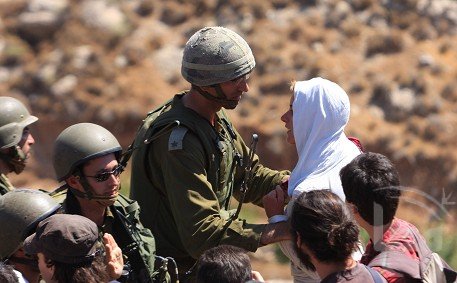
HEBRON — Thirteen activists from a group of 30 were detained by Israeli forces Thursday afternoon while aiding local farmers whose land is set for confiscation by an adjacent settlement, locals from the village of Saffa reported.
Early Thursday morning officials said the activists were escorted to lands belonging to Sheik Mohammad Aady, reportedly slated for annexation the Bat Ayin settlement.
A statement by event organizers said that after half an hour of work, soldiers surrounded the group of volunteers and detained several, including seven Israeli activists.
An Israeli military spokeswoman confirmed the arrests, but said she could not comment on the reasons for the detentions.
Protesting the Hebron Fund, I remember a long afternoon at a segregated swimming hole
By Seán O’Neill | Mondoweiss | November 18, 2010

(Protesters in New York. Photo: Vanissa W. Chan)
Hebron Fund held its annual fundraiser in New York Tuesday night. A report from O’Neill, a former member of Christian Peacemaker Teams in the South Hebron Hills, who attended the protest:
I was just leaving Hebron’s Old City one day in August 2009 when a friend of mine, Hamzi, invited me to go swimming.
He and a few other guys were going for a dip in Abraham’s Well, an ancient spring located in Tel Rumeida, essentially the only neighborhood in the West Bank city where Palestinians and Israeli settlers physically encounter one another on a daily basis.
Whereas in the Old City a complex system of barricades, roadblocks, and checkpoints keeps Palestinians caged in and under the settlement pockets, in Tel Rumeida there is some level of mutual access, albeit unequal and under the watchful eye of Israeli soldiers.
It was a hot, sticky day, and the thought of taking a dip in the cool undeground waters of Abraham’s Well sounded superb. After a long circuitous route, unable to cross Shuhada St., Hebron’s main thoroughfare banned from use by Palestinians, we reached an olive grove just above the well. In our enthusiasm, we didn’t notice the four Israeli soldiers sitting above it until they came running, screaming at us, rifles aimed in our direction. Hamzi explained that we were just on our way down to swim. The soldiers replied that there were a couple Jewish girls there swimming, so we’d have to wait. We began to sit down in the shade of the olive tree next to the soldiers when a soldier began yelling again, shooing us with his free hand, indicating that we were too close.
“He acts like were dogs,” Hamzi muttered to himself as we moved back a few trees.
Occasionally we would crane our necks over the terraced rocks to see if the girls were leaving yet. Noticing this, the soldier berated us again, instructing us to face the other direction, so as not to offend the young women, who by now, done swimming, were having a picnic next to the well. Hamzi and the others stared for a moment, absorbing this latest humiliation, before turning away, powerless. We sat there for about an hour in the midday heat, sweating profusely, debating whether it was worth the wait. Finally one of us, sneaking a look, noticed the girls leaving. We jumped up happily and asked the soldiers if we could now swim.
“No,” one said. “There’s someone else coming.” Indeed, two young Jewish boys had now approached the well and began to disrobe.
“But we’ve been here over an hour,” Hamzi protested. “It’s a hot day. If we have to wait for every Jew in Hebron to swim we’ll never get a turn.”
“Maybe not,” the soldier said, matter-of-factly.
And so we left, hot and irritated. There wasn’t a physical attack or a home bulldozed. No one was arrested or tear gassed. Just another of the thousand daily humiliations that is apartheid Hebron. That was the last day I was in Hebron, and the last time I saw Hamzi, although I didn’t realize it at the time. Shortly thereafter I flew home for a visit and returning a month later discovered I had been banned from re-entry.
Tuesday night in New York was windy, cold and dark, a far cry from that blistering day in August. Strange in a way to think that the men and women in suits and gowns at Chelsea Piers making their way to a dinner cruise on the Hudson River had any connection at all to that conflicted place thousands of miles away. Hamzi and some 160,000 Palestinians in Hebron settled down to bed after celebrating another Eid al Adha in the grip of a suffocating occupation.
Here in New York husbands and wives and their families parked their cars and walked breezily past the indoor soccer fields to a feast of their own, making tax-exempt donations to bankroll Hamzi’s oppression. Tuesday night was the annual dinner of the Hebron Fund, founded in 1979 to raise money for the Hebron settlements. According to the Washington Post, the Hebron Fund and similar organizations have donated $33.4 million since 2004 to the settlement enterprise. Settlements, keep in mind, are illegal according to international law.
This year’s dinner, held on a boat, was styled as the Hebron Aid Flotilla, a perverse celebration of the murder of nine human rights activists by Israeli commandos on the flotilla to Gaza this past May.
The event, however, did not go unnoticed. A couple hundred people gathered at the piers’ entrance in not one, but two protests. On the one hand was a coalition of Palestinian, Jewish, and anti-occupation groups such as Students for Justice in Palestine, Jewish Voice for Peace, Veterans for Peace, Women in Black, Code Pink, and Adalah NY, among others. They stood in a mostly silent vigil with signs reading “End the Siege of Hebron”, “Remove the Settlers”, and “Free Gaza”.
On the other, about 40 feet away, was a protest staged by J Street U, the college branch of the advocacy group which styles itself as pro-Israel, pro-peace. They held Israeli flags and lamented the settlements as an obstacle to a two-state solution. A participant in the J Street protest, Moriel Rothman said of the two protests, “I think that we’re working in parallel. Ultimately we probably want similar things but have different tactics in how to get there.”
An attendee of the fundraiser, who chose to remain anonymous, brushed the protests off, saying, “If you look at the amount of energy that goes into protesting Jewish misconduct, it is disproportionate. The world holds Jews to a higher standard.” He added, referring to the Jewish protesters, “They are introspective. You very seldom see that amongst the Palestinians.”
My first thought at seeing the two different protests was one of dismay. Had the ideology of separation reared its ugly head even here, among the dissenters? On second thought however, in a context in which meaningful dissent has been muffled for so long, a bit of pluralism may not be bad. The groups didn’t agree on tactics, or symbols, or what a solution to the conflict will look like. However, if there is an emerging consensus that the Hebron settlements, at least, are beyond the pale, that on a hot summer day Palestinian residents shouldn’t have to navigate around Jew-only roads to find that the well is closed to Arabs, that just might be progress.
Featured Video

They Double Down on BLOOD PRESSURE Guidelines!
or go to
Aletho News Archives – Video-Images
From the Archives
Chocolate Gives Statins a $29 Billion Run For Their Money
By Sayer Ji · GreenMedInfo · April 17, 2012
With the blockbuster cholesterol-lowering class of drugs known as statins being widely promoted for the primary prevention of cardiovascular disease, despite their having over 300 documented adverse health effects (including heart failure!), how does chocolate sound as a viable, heart-friendly alternative?
We already connect amorously with chocolate (to the tune of 6 billion lbs of cocoa consumed annually worldwide), revealing in heart-felt expressions like “I love it,” and “this is to die for!” how comfortable we are with publicly declaring our affection. But did you know that while it makes our emotional hearts sing, it may actually keep our physical hearts happy, alive and ticking longer, as well?
Indeed, back in 2006, researchers found that for elderly men, eating cocoa was inversely associated with blood pressure and 15-year cardiovascular and all-cause mortality. … continue
Blog Roll
 Aletho News
- I’M SO BLOODY FURIOUS: They Double Down on BLOOD PRESSURE Guidelines!
- The Israeli Nuclear Doctrine and the Turning Point of the Kennedy Assassination
- Striking Matches Near the Powder Keg
- Prominent Russia hawk: European leaders privately talk about war with Russia, first need ‘mass casualty event’
- China warned Trump not to touch Iran’s oil tankers: Larry Johnson
- EU Central Banker Plans To Plant Barren AI Crops Across The Continent
- Macron’s Strategic Autonomy Paradox: France Rearms on Debt and Depends on Foreign Fuel
- Nigel Farage vs Tucker Carlson: Who is right about Hitler and Britain?
- Chocolate Gives Statins a $29 Billion Run For Their Money
- Hypotheses on the collapse of U.S. computer systems
- If Americans Knew
- DAILY UPDATE: Latest essential news on Palestine, Israel, & region
- Reporting Raises Fresh Questions About Israeli Role in CNN’s ‘Preposterous’ Iranian Dirty Bomb Story
- DAILY UPDATE: Latest essential news on Palestine, Israel, & region
- Under the West’s watch, genocide apologism has become entirely respectable
- Israeli Diplomat Offered Iowa Attorney General Free Trip, Then Asked for Favors
- On World Children’s Day, 350 Palestinian Children Remain in Israeli Prisons
- Why Is Israel Jailing a Palestinian Student Without Trial? Because It Can
- ICJ ruling on Rohingya genocide could strengthen South Africa’s case against Israel
- DAILY UPDATE: Latest essential news on Palestine, Israel, & region
- Newly nominated House Speaker funded Gaza genocide
- No Tricks Zone
- New Study: Modern Temps Are Among The Coldest Of The Last 10,000 Years In East Central Europe
- Germany’s Renewable Energies Lead to 1.4 Billion Euro Electric Power Trade Deficit
- Argentina’s Perito Moreno Glacier Joins Antarctica and Arctic In Defying Doomsday Melt Claims
- New Study: Barents Sea Temperatures Were Warmer And Sea Ice Less Extensive In The 1700s Than Today
- German Authorities Start Initiative To Evaluate Public Register For Climate “Disinformation” Spreaders!
- Zonal Asymmetry of Temperature Change in the Antarctic Circumpolar Current
- New Study: The Net Fossil Fuel Contribution To Rising Atmospheric CO2 Has Been Zero For 500 Years
- Germany’s Green Energy Transition Becoming Increasingly Expensive…Another 6 Trillion Euros!
- Sudden Stratospheric Warming, Powerful El Niño Combination May Lead To Extreme Europe Cold, Energy Crisis!
- Two New Studies Find Thwaites Glacier Melt Cannot Be Driven By Human Activity Or A Warming Ocean

