Judge dismisses Native American suit against Skull and Bones
It looks like the public will not be learning any times soon whether the secret society Skull and Bones keeps an Apache warrior’s skull in its tomb.
A District of Columbia judge on July 27 dismissed a case that had been brought against the mysterious society, as well as the University and senior members of the U.S. government, in February 2009. The plaintiffs are 20 descendants of the legendary Native American chieftain Geronimo hoping to reclaim their ancestor’s remains. But their lawyer, Ramsey Clark — who has represented controversial figures such as Saddam Hussein and Slobodan Milosevic — said Monday that he is not giving up.
“We’re obviously disappointed,” Clark said in a phone interview. “We believe that [this case] is awfully important, not only to the wishes of Geronimo himself, but to the spirit of the Indian people and their relationships to the government of the United States.”
The objective of the original suit is to gather Geronimo’s remains and reinter them near his birthplace at the head of the Gila River in New Mexico, thereby fulfilling what plaintiff Harlyn Geronimo says were his great-grandfather’s wishes. Geronimo is reportedly buried in a prisoner of war cemetery in Fort Sill, Okla., but according to an old legend, Prescott Bush — Yale graduate, Bonesman, father of former President George H.W. Bush ’48 and grandfather of former President George W. Bush ’68 — looted that grave in 1918 or 1919 and took the chief’s skull, along with some of his other bones and artifacts buried with him, back to the Skull and Bones tomb on High Street in New Haven.
Because Geronimo’s official burial place is on a military base, which is government property, Clark first planned to pursue a suit against President Barack Obama, Secretary of Defense Robert Gates and Secretary of the Army Pete Geren. If he had won his case, he and his clients would have dug up the grave at Fort Sill, and if, as the story about Prescott Bush suggests, some of the remains had been missing, they would have turned to Yale and Skull and Bones.
Before anyone can take legal action against the U.S. government, the government must consent to the proceedings by waiving its sovereign immunity. District Judge Richard W. Roberts said he dismissed the case because the plaintiffs had failed to establish why immunity should be waived in this case. He also said that the Native American Graves Protection and Repatriation Act (NAGPRA), under which the prosecution was suing for ownership of the remains, only applies to burials, grave robberies and other incidents that took place after it was passed in 1990 — making the act irrelevant to this case.
But Clark said he does not think Roberts is correct on this last point.
“It doesn’t seem like that act would have much relevance if it cut off everything before that date,” Clark said.
Still, Clark said the fact that he tried to take the case straight to court, without first arguing his clients’ claim to their ancestor’s remains in front of the relevant government agencies, might be why the government never waived its immunity. Clark said he pursued litigation first because it was the fastest route, allowing him to take on all relevant parties — those in the government and those in New Haven — at the same time. Now, he said, he and his clients will turn to agencies in the executive branch and the Department of Defense that they previously tried to bypass. He added that he will eventually reopen his cases against Yale and Skull and Bones if need be, but not until after the Fort Sill remains are exhumed.
Yale has said it does not possess the remains, but that it cannot say whether the secret society — a separate entity — might have them. A representative of Skull and Bones has declined to comment on the matter.
Israel is not a very dependable US ally
The Zionist state’s relationship with the world’s only superpower is one-sided, with little benefit for the latter
By George S. Hishmeh | Gulf News | August 12, 2010
Oftentimes, Israelis and their supporters bury their heads in the sand, ignoring all that goes on around them. Take, for example, the case of a university professor who joyously announced in a commentary published in a leading American newspaper, The New York Times — which in turn was remiss in not fact-checking — that 71 per cent of Arab respondents to an “opinion poll” had “no interest” in the Palestinian-Israeli “peace process”. Probably sharing his enthusiasm, the paper headlined the column, ‘The Palestinians, Alone’.
It turned out that the shady “poll” that was cited by Efraim Karsh, who teaches at King’s College, London and is author of Palestine Betrayed, was nothing more than a tally of readers responding to another reader’s query on the website of an Arabic television network. One would think that Karsh should have known better. His puerile analysis failed to differentiate between Arab views of the “peace process” — a lacklustre issue — and their genuine concern for the Palestinians, whose homeland was mostly usurped by Israel 63 years ago, while the West Bank and the Gaza Strip have been under Israeli control since 1967. Karsh’s conclusion was that the Palestinians should abandon their dependency on the Arab world: “The sooner the Palestinians recognise their cause is theirs alone, the sooner they are likely to make peace …”
Karsh would have done better had he digested what two prominent American Jewish leaders, Jeremy Ben-Ami and Debra Lee, wrote recently: “Decades of telling and retelling a comfortable narrative in which Israel is always extending its hand in peace, only to have it rejected by the Palestinians, understandably makes it hard to accept when the facts show otherwise”. They stressed that “facts don’t support the charge that the present Palestinian leadership is not a partner for peace”.
Perceived failure
Although there has been a noteworthy change in the American public opinion on Palestine, Arab public opinion on the Obama administration has turned negative because of the president’s perceived failure to deliver on the “new beginning” he had promised in his memorable Cairo address. This is clear from the results of a poll conducted last month by the University of Maryland and Zogby International in six Arab countries — Egypt, Jordan, Lebanon, Morocco, Saudi Arabia and the United Arab Emirates.
Only 15 per cent of Arabs remain hopeful, while 63 per cent are discouraged about US policies, reported Dr Shibley Telhami, the Anwar Sadat professor for Peace and Development at the University of Maryland, who oversaw the poll. There has been a “dramatic change”, Telhami emphasised, in the perception of President Barack Obama, “whose disapproval rating jumped considerably, from 23 per cent in 2009 to 62 per cent in 2010”.
He added that the Palestinian-Israeli conflict remained “the single most disappointing issue for the Arab public, with 61 per cent of those polled citing that issue as a major disappointment, followed by 27 per cent citing Iraq”.
Lack of optimism
Nevertheless, 86 per cent of Arabs appeared prepared “in principle” to accept a two-state solution based on the 1967 borders. But the number of those who believe that Israel would never accept such a solution has increased from 45 per cent in 2009 to 56 per cent in 2010. This may give some ammunition to those who are counting on a one-state agreement.
The confusion emanating from Israel’s dilly-dallying about peace with the Palestinians was best described in the lead paragraph of a recent Washington Post report by Janine Zacharia from the Occupied West Bank. It read: “While Israeli Defence Minister Ehud Barak visited Washington … to talk about peace gestures towards the Palestinians, Foreign Minister Avigdor Lieberman was planting a tree in a Jewish [colony] in the West Bank — an indication of permanence that few Palestinians would welcome”.
Meanwhile, former US ambassador Chas Freeman recently lambasted Israel for being “an extreme liability for the US financially, strategically, politically”. Freeman made this assessment during a seminar at the Nixon Centre that focused on the point of whether Israel was an “asset or liability” for the US.
“Clearly, Israel gets a great deal from us,” he complained. “Yet it’s pretty taboo in the United States to ask what’s in it for Americans.” He continued by considering “what we generally expect allies and strategic partners to do for us”, before claiming that “Israel does none of these things and shows no interest in doing them”. He concluded: “Israel is therefore useless in terms of support for American power projection. It has no allies other than us. It has developed no friends. Israeli participation in our military operations would preclude the cooperation of many others. Meanwhile, Israel has become accustomed to living on the American military dole”.
It is therefore not surprising that Turkey has turned its back on the Israeli regime, or that others may want to do so in future should Tel Aviv continue on this track.
George Hishmeh is a Washington-based columnist. He can be contacted at ghishmeh@gulfnews.com.
Palestinian lawmaker attacked by settlers
Ma’an – August 8, 2010
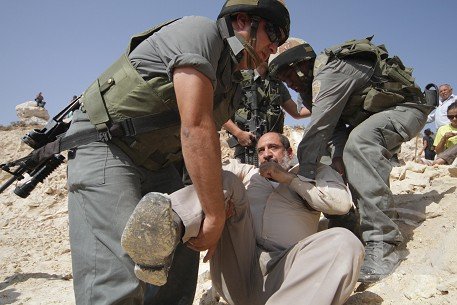
HEBRON: A Palestinian lawmaker said he was attacked by settlers as he accompanied farmers trying to access their land near Hebron on Saturday.
Palestinian National Initiative leader Mustafa Barghouthi said after the attack, Israeli soldiers used force to prevent the group accessing farmland in Al-Buwiera and Al-Baq’a villages.
An Israeli military spokesman said Barghouthi was in a closed military zone when soldiers asked him to leave, but denied reports that force was used.
Barghouthi held Israeli authorities fully responsible for the farmers’ lands, which are at risk of drought since Israel’s Civil Administration destroyed what it described as an illegal water irrigation network in Al-Baq’a on Monday.
The parliamentarian noted that settlers from an illegal outpost near the Kiryat Arba settlement had rebuilt homes demolished by the army last week.
Jordan Valley demolitions continue
Ma’an – 09/08/2010

TUBAS — Israel’s Civil Administration began razing housing units Monday in the Ein Hilwa area of the northern Jordan Valley, campaign officials said.
Save the Jordan Valley campaign coordinator Fathi Ikhdeirat said Israeli authorities, accompanied by border guards, began tearing down structures and handing down stop-work orders to residents.
He described the move as an attempt “to clear the area of its indigenous people and include it into Israel” and also called on international human rights groups to intervene to bring the demolitions to a halt.
A spokesman for Israel’s Civil Administration did not immediately return a phone call seeking comment.
The Jordan Valley has been a target for demolitions by Israel’s Civil Administration, with several structures in villages across the area being torn down.
On Sunday, dozens of Palestinians as well as foreign activists rebuilt areas in the nearby Al-Farisiya village that were recently bulldozed by Israel’s Civil Administration.
Over the past 10 days, several shacks, homes and agricultural structures were torn down in the village by the administration, which has complete planning and building control over Area C. Last Thursday, the Civil Administration returned to the valley to demolish 23 structures rebuilt by residents and farmers.
Meanwhile, in the nearby Bardala village, locals said the Civil Administration distributed several stop-work orders to residents in late July.
The orders, known locally as “demolition orders,” demand that homeowners appear before a magistrates court to defend allegations. Because legal action at the court rarely succeeds, the stop-work orders essentially constitute a demolition order.
According to a report in the Israeli daily Haaretz in July, the Civil Administration has received government orders to increase enforcement against Palestinian construction in Area C, according to a deposition by an administration official to the High Court.
The deposition, by the head of the administration’s infrastructure authority, Colonel Zvika Cohen, came in response to a petition by Regavim – a group seeking the destruction of illegal Palestinian construction at six West Bank sites, citing a security threat, the daily reported.
A recent UN report said 86 structures in the Jordan Valley were demolished two weeks ago, and 17 others were demolished in other areas of the West Bank the week after.
“The spate of demolitions raises concerns over whether Israeli authorities could further escalate demolitions throughout Area C,” a UN report said, noting more than 3,000 demolition orders handed down by Israeli officials to locals were still outstanding.
“Currently, it is nearly impossible for Palestinians to obtain building permits to maintain, repair or construct homes, animal shelters or necessary infrastructure in Area C,” the UN Office for the Coordination of Humanitarian Affairs said in its latest report on Area C.
Why We Boycott Israel
A REPLY TO THE U.S. SOCIALIST WORKERS PARTY
A LeftViews article by Art Young | August 6, 2010 | Excerpts
In the first action of its kind in the United States, on June 20 more than 700 unionists and community activists picketed at several entrances to the Port of Oakland, California, protesting the arrival of an Israeli-owned vessel. Two shifts of members of the International Longshore and Warehouse Union refused to cross the picket line. The cargo was unloaded only 24 hours later, after the picket lines were lifted.
The protest was organized by the Labor / Community Committee in Solidarity with the Palestinian People, an ad-hoc coalition of local labour, Palestine solidarity, and social justice groups. Several hundred unionists responded to the call of the San Francisco and Alameda County labour councils and other unionists to support the action.[7] Statements of support for the action were issued by the Oakland Education Association, the Palestinian General Federation of Trade Unions and the Cuban labour federation, the Cuban Workers Central, among others.[8]
Opposing the boycott
One group that did not support the action in Oakland was the U.S. Socialist Workers Party. The SWP is opposed to boycotting Israel. It reaffirmed this stand at its national conference a few days before the picket in Oakland.
The group first elaborated its position on the Palestinian struggle in a series of articles that appeared during the first half of 2009 in The Militant, a weekly newspaper that expresses its views. These articles argued that:
- There is no Zionist movement today.
- Anti-Zionism is a cover for anti-Semitism.
- Israel’s rulers plan to give up control of most of the West Bank and Gaza.
- Israel is not an apartheid state.
- The BDS campaign is not only wrong. It is anti-Semitic.
- The democratic, secular Palestine that the SWP envisages must grant a special right of immigration to the Jews of the world.[9]
This line of argument places the SWP in the Zionist camp. To be sure, the SWP opposes Israel’s oppression of the Palestinians, but the thrust of its argument is directed against the solidarity movement. It endorses the slanders advanced by Israel’s supporters that anti-Zionism in general and the BDS movement in particular are anti-Semitic. The group also supports a privileged position for Jews in Palestine.[10]
A complete reversal on Zionism
These positions represent a breathtaking turnabout for a group that for decades unconditionally supported the Palestinian people and thoroughly opposed Zionism.
The SWP’s previous position on these questions was explained in a resolution it adopted at its 1971 convention. The opening paragraphs of that resolution read:
The Socialist Workers Party gives unconditional support to the national liberation struggles of the Arab peoples against imperialism, that is, we support all these struggles regardless of their current leaderships. Our foremost task in implementing such support is to educate and mobilize the American people against U. S. imperialist actions in the Mideast.
Israel, created in accordance with the Zionist goal of establishing a Jewish state, could be set up in the Arab East only at the expense of the indigenous peoples of the area. Such a state could come into existence and maintain itself only by relying upon imperialism. Israel is a settler-colonialist and expansionist capitalist state maintained principally by American imperialism, hostile to the surrounding Arab peoples….
The struggle of the Palestinian people against their oppression and for self-determination has taken the form of a struggle to destroy the state of Israel. The currently expressed goal of this struggle is the establishment of a democratic, secular Palestine. We give unconditional support to this struggle of the Palestinians for self-determination….
Our revolutionary socialist opposition to Zionism and the Israeli state has nothing in common with anti-Semitism, as the pro-Zionist propagandists maliciously and falsely assert. Anti-Semitism is anti-Jewish racism used to justify and reinforce oppression of the Jewish people….
Zionism is not, as it claims, a national liberation movement. Zionism is a political movement that developed for the purpose of establishing a settler-colonialist state in Palestine and that rules the bourgeois society headed by the Israeli state today in alliance with world imperialism. [11]
It is immediately apparent that what the SWP says today is the polar opposite of these positions. Contrary to Marxist practice, the SWP has neither acknowledged the reversal nor explained why in its view it is necessary.
Zionism and anti-Zionism
The first indication that the SWP had changed its position on these questions came in an article in the March 2, 2009 issue of The Militant. The article quoted SWP leader Norton Sandler as follows:
“Class-conscious workers should drop the term Zionism,’ in the current context, Sandler added. ‘There is no Zionist movement today. The reality is, it has become an epithet, not a scientific description; a synonym for ‘Jew’ that helps fuel Jew-hatred, which will rise as the capitalist crisis deepens.”[12]
Sandler’s claim that the Zionist movement had vanished from the face of the earth was so at odds with current reality and with the SWP’s previous position that it was challenged by some readers of the paper. Sandler’s reply appeared in the April 13 issue.
I made these remarks at a January 31 public meeting in London. I was not addressing the history of the Zionist movement, or how the state of Israel came into being as an expansionist colonial-settler state. Zionism in the late 19th century and the first half of the 20th century was a bourgeois political current contending with the communist movement for the allegiance of workers who were Jewish. Israel was established in 1948, more than six decades ago. There is no Zionist movement today and there hasn’t been for a long time.[13]
An end to Israeli expansionism?
In his April 13 article Sandler also expresses the view that the expansion of Israel’s borders is drawing to a close. “The majority of the Israeli ruling class has given up the dream of a ‘Greater Israel.’ They are forced to opt for what they consider the only pragmatic solution — maintaining a majority Jewish state within borders of their own choosing. This is hardly the Zionist movement’s dream of an Israel from the Mediterranean Sea to the Jordan River.” (Other articles published between February and June 2009 make the same claim.)
Here Sandler and the SWP merely echo the Israeli rulers who never tire of claiming that their only aim is an Israel with defensible borders living in peace next to a Palestinian state. This has been Tel Aviv’s mantra ever since it occupied Gaza and the West Bank in the 1967 war. Israel’s actions reveal a different plan. Seen from the Palestinian perspective, history since 1967 has been one of unrelenting Israeli expansion onto Palestinian land and continual ethnic cleansing by the Zionist state. Approximately half a million Israeli settlers now live in the occupied West Bank, some nine percent of the Jewish Israeli population. The settlements, the wall, the Jewish-only road network, the draining of the water resources — these and many other features of the occupation are turning the West Bank into a series of isolated and dependent cantons. The settlement enterprise has not halted for a moment, not even during the recent phony temporary “settlement freeze” declared by Netanyahu under pressure from Obama. Meanwhile Israel maintains an iron grip on the Gaza Strip.
“Greater Israel,” Israeli rule from the Mediterranean Sea to the Jordan River, has been the reality for more than forty years — that is, for more than two thirds of Israel’s existence. During this period Israel has steadily strengthened its hold on the conquered territories (although the Palestinians have resisted tenaciously and scored some successes along the way).
The reality of “Greater Israel” that Palestinians face every day is documented in countless reports from the United Nations and many other organizations, including Israeli human rights groups. But Zionist propaganda appears to carry more weight with the SWP.
No Israeli apartheid?
Another major article appeared in the April 6, 2009 issue of The Militant. “Israel boycotts and divestment serve as cover for anti-Semitism” was written by Paul Pederson, a member of the paper’s staff. He stated:
There are sweeping differences between the apartheid regime in South Africa and the capitalist regime in Israel—in terms of organization of labor, the character of the regimes, and the historical conditions under which they emerged. The attempt to paint them as the same simply obfuscates the real social and class relations in Israel and the tasks facing the toilers there to chart a revolutionary course forward. Applied to Israel the term “apartheid” is simply an epithet, rather than a scientific description of a social structure.
Perhaps the most glaring difference between the anti-apartheid struggle in South Africa and the fight for Palestinian national rights today is the existence of a revolutionary organization—the ANC under Nelson Mandela—in the case of South Africa.[15]
The first sentence asserts that “there are sweeping differences between” South Africa and Israel. This is an empty platitude. There are also sweeping differences between capitalist rule in the U.S., Canada, and Great Britain. But there are also fundamental similarities, just as there are in the case of apartheid-era South Africa and Israel.
The second sentence is another platitude, asserting that the false comparison leads to false conclusions.
The third sentence states the SWP’s political position — Israel is not an apartheid state.
This is a straightforward question of fact: is the Israeli system of rule fundamentally similar to the apartheid system in South Africa? Does it meet the common-sense or legal understanding of the term?
Israel was established in 1948 by the massacre and expulsion of most of the native inhabitants, who generations later still cannot return to their homes. It practices systematic discrimination against the Palestinian citizens of Israel, and structural discrimination against these Palestinians is enshrined in its laws and the entire legal apparatus. In addition, Israel rules over millions of other Palestinians in the occupied territories through a combination of measures that ultimately rest on its military control. These inhabitants are systematically deprived of their land, their water, and other resources to the benefit of Jewish Israelis. The Jewish settlers who live on Palestinian land enjoy full rights of citizenship while Palestinians are denied basic human rights.
This, in a nutshell, is the Israeli system of rule over the Palestinians. It bears a striking similarity to the system of apartheid in South Africa even if it differs in many particulars. (For a more detailed analysis see “Not an analogy: Israel and the crime of apartheid” by Hazem Jamjoum.[16])
In the course of the struggle against apartheid in South Africa, large numbers of people around the world came to understand that apartheid is a crime against humanity that must be eradicated wherever it might appear. In 1973 the General Assembly of the United Nations adopted the International Convention on the Suppression and Punishment of the Crime of Apartheid, which specifies that a regime commits apartheid when it institutionalizes discrimination to create and maintain the domination of one racial group over another. The Rome Statute of the International Criminal Court also defines apartheid as a crime. This statute came into effect in 2002, long after the end of the apartheid regime in South Africa.
Of course the experts on what is apartheid, and what it is not, live in South Africa. It is no accident that many unions and solidarity organizations in South Africa have endorsed the idea that Israel is an apartheid state.[17]
One of the most thorough and authoritative studies of Israeli apartheid in the occupied territories was published by the South African Human Rights Council in May 2009. The 302-page report by an international panel of experts concluded “that Israel, since 1967, has been the belligerent Occupying Power in the OPT [occupied Palestinian territories], and that its occupation of these territories has become a colonial enterprise which implements a system of apartheid.”[18]
Today’s solidarity activists draw strength from this understanding of the crime of apartheid. They look at Israel in light of the experience gained in the struggle against apartheid in South Africa and they are inspired by the victory that was won there. Their explanations of the Israeli apartheid system have been convincing and have helped to build the movement.
Returning to the article cited above, only one element of the argument remains. Israel is not an apartheid state, Pederson states, because the Palestinian leadership is not revolutionary.
It is, to say the least, rather bizarre to assert that the nature of the Palestinian leadership determines the nature of the Israeli state. Nevertheless, the assertion is revealing. It expresses how the SWP has come to condition its support for struggles against imperialism on its view of the leadership of such struggles. This provides a handy excuse for refusing to support them. In 2003 the SWP refused to support the large demonstrations against the war in Iraq. Its Canadian sister organization expelled supporters who argued that Marxists had a duty to defend the Iraqi people against imperialism by taking concrete action against the war. The SWP justified its abstention from the struggle by pointing to the bloody and reactionary record of the Iraqi leader Saddam Hussein. Over the last few years the SWP has adopted a similar approach toward the Palestinian struggle.
Suffice it to say that this has more in common with dead-end sectarianism than it does with Marxism. The SWP used to understand this quite well. The 1971 resolution cited earlier begins with these words: “The Socialist Workers Party gives unconditional support to the national liberation struggles of the Arab peoples against imperialism, that is, we support all these struggles regardless of their current leaderships.”
Israel boycott, a growing and dynamic movement
As noted earlier, the movement to boycott, divest from, and sanction Israel (BDS) has made great strides in the past few years. BDS is now one of the most dynamic and fastest growing components of the international movement in solidarity with Palestine.[19]
Israel’s rulers recognize the power and potential of the boycott movement.
On July 14 the Israeli Knesset (parliament) approved the initial reading of a bill designed to punish residents of Israel who promote boycotts of the state or Israeli products. If enacted into law it will allow punitive fines to be levied against such persons. The bill is primarily aimed at Palestinians living in the West Bank and the small but growing number of Israeli citizens, Jewish and Palestinian, who form the “Boycott From Within” movement supporting the international boycott. In a speech to the Knesset Prime Minister Benjamin Netanyahu denounced the Boycott From Within movement as a “national scandal.” Neve Gordon, a professor at Ben Gurion University who endorsed an academic boycott of Israel last year, has received death threats. Gideon Sa’ar, the minister of education, has threatened to punish any lecturer or institution that supports a boycott of Israel.
In February the REUT Institute, one of Israel’s most influential think tanks, published a report in which it warned of a dangerous decline in Israel’s international support. It urged the government to take more effective action against the forces promoting the “delegitimization” of the state of Israel, including the international BDS movement.[20] The institute devoted the June 10 issue of its magazine to a detailed analysis of the movement, noting that:
the damage caused by the BDS Movement lies in its promotion of delegitimization towards Israel through creating the comparison — whether implicit or explicit — between Israel and the former apartheid South African regime. Therefore, BDS should be viewed first and foremost as a tool to brand Israel as a ‘pariah state’ with the ultimate aim of undermining the legitimacy of its political structure.[21]
Although only five years old, the boycott movement has scored some notable successes, winning increasing support in many quarters. National trade union federations in South Africa, Ireland, Scotland, Quebec, and elsewhere have endorsed the boycott, as have numerous unions in various countries. On July 22 the annual conference of Unite, the largest union in Britain, with two million members, voted unanimously in favour of a complete boycott of Israeli goods and services. Earlier this year Israeli Apartheid Week, an educational activity promoting BDS, took place on more than 50 campuses worldwide. The number of participating campuses has grown steadily from year to year.
Grass-roots organizing has been particularly effective in Europe, where a divestment campaign forced the French multinational Veolia to withdraw from a major transportation project in Jerusalem and the West Bank. Israeli businesses have acknowledged a decline in their sales because European consumers are boycotting Israeli agricultural products.
In the United States and elsewhere, the movement is increasing its pressure on pension funds and university endowments to divest from companies such as Lockheed Martin, ITT, United Technologies, General Electric, Caterpillar and Motorola that profit from Israel’s occupation of Palestinian lands while helping it carry out its war crimes. On June 2 students at Evergreen State College in Washington state voted by a large majority to demand that the college’s foundation divest from companies that profit from the Israeli occupation and that the college ban the use of Caterpillar equipment on campus. Rachel Corrie, an Evergreen student, was killed by a weaponized Caterpillar bulldozer as she attempted to prevent the demolition of a Palestinian home in the Gaza Strip in 2003.
Archbishop Desmond Tutu of South Africa has been a particularly vocal supporter of the college divestment campaigns in the United States.
An appeal from Palestine
The BDS movement responds to an appeal for solidarity issued on July 9, 2005 by more than 170 Palestinian organizations, including trade unions, political and social organizations, and women’s and youth groups. The signatories represent the three components of the Palestinian nation — refugees, Palestinians living under in the occupied territories, and Palestinian citizens of Israel.
The appeal from Palestine said:
We, representatives of Palestinian civil society, call upon international civil society organizations and people of conscience all over the world to impose broad boycotts and implement divestment initiatives against Israel similar to those applied to South Africa in the apartheid era. We appeal to you to pressure your respective states to impose embargoes and sanctions against Israel. We also invite conscientious Israelis to support this call, for the sake of justice and genuine peace.
These non-violent punitive measures should be maintained until Israel meets its obligation to recognize the Palestinian people’s inalienable right to self-determination and fully complies with the precepts of international law by:
1. Ending its occupation and colonization of all Arab lands and dismantling the Wall;
2. Recognizing the fundamental rights of the Arab-Palestinian citizens of Israel to full equality; and
3. Respecting, protecting and promoting the rights of Palestinian refugees to return to their homes and properties as stipulated in U.N. resolution 194.[22]
The BDS call does not advocate a particular political solution to the conflict. Its approach is to develop a grass-roots mass political campaign in favour of these three basic pillars of human rights for the Palestinian people. This approach serves not only to overcome divisions among the Palestinians, it also stands on the universal principles of human rights that have animated the struggle against racism in South Africa, the United States, and elsewhere.
The movement took another step forward in 2008 with the formation of the Palestinian BDS National Committee, a broadly representative group of Palestinians that serves as the leadership of the international BDS campaign.
The rapid growth of the movement can be attributed to a number of factors: its origin in Palestine; the unity among Palestinians that it expresses; its new, rights-based approach to the struggle; its consistent anti-racism (which includes opposing Islamophobia and anti-Semitism); and the movement’s Palestinian leadership. The movement also offers many opportunities for grass-roots organizing of boycott and divestment campaigns as well as educational activities. As it has grown the movement has acquired experience and developed an increasing number of local leaders. It has also become more diverse, developing targeted academic and cultural boycotts of Israel similar to those used in the struggle against South African apartheid.
Israel boycott, ‘a cover for anti-Semitism’?
These developments have not gone unnoticed at the SWP’s headquarters. The group has taken up the cudgels against the boycott movement, waging a sustained campaign against it in the pages of its newspaper. Leaders of the group have denounced BDS in meetings organized to build the solidarity movement, from Israeli Apartheid Week to the recent U.S. Social Forum.
The SWP’s campaign is fundamentally dishonest. The Militant has not reported any of the basic facts about the boycott movement. The SWP has also chosen to ignore the appeal of Omar Barghouti, a leader of the Palestinian BDS National Committee, who wrote in a recent article that:
“genuine solidarity movements recognize and follow the lead of the oppressed, who are not passive objects but active, rational subjects that are asserting their aspirations and rights as well as their strategy to realize them.”[23]
In the SWP’s eyes BDS is “a cover for anti-Semitism.” The article by Paul Pederson cited previously said this:
In the absence of any revolutionary perspective, campaigns such as the anti-Israel boycott can appear to be a radical substitute. But, as the crisis of capitalism deepens, the “anti-Israel” character of these campaigns is simply a modern form of Jew-hatred. All who genuinely support the battle for Palestinian national rights must oppose it.
Not to be outdone, in his reply to critical readers in the next issue of The Militant Norton Sandler compared advocates of BDS to the Nazis:
In London earlier this year the Marks & Spencer department stores and Starbucks coffee shops were targets of protests over the Israeli assault on Gaza. These businesses are supposedly Jewish-owned. … Jewish businesses were a prime target of the Nazis in Germany after 1933. Why aren’t U.S.-owned businesses targets during protests against Washington’s Iraq and Afghanistan wars?[24]
The SWP’s allegation that the boycott movement is anti-Semitic and akin to Hitler’s targeting of Jews in Germany is beneath contempt. It assumes that readers of The Militant will not try to ascertain the facts for themselves. But facts are more powerful than such slanders, and the facts about the BDS movement are readily available.
(For example, The Militant repeatedly alleges that boycott activities in the United Kingdom target the Marks & Spencer department store chain because the company’s owners are Jewish. Like virtually everything else the SWP writes about the BDS movement, this is untrue. The Boycott Israeli Goods website lists seven major retailers in the U.K. that sell Israeli products. Each of them has been the target of pro-Palestinian protests in recent years. According to the website, Marks & Spencer has deep historical ties to the state of Israel. Also, “in 1998, Sir Richard Greenbury, then CEO of Marks & Spencer, received the Jubilee Award from Israeli Prime Minister Binyamin Netanyahu. In 2000, the Jerusalem Report stated that ‘M&S supports Israel with $233 million in trade each year.’”[25])
Supporters of the SWP might want to reflect on the fact that the group’s campaign against boycotting Israel places them to the right of the Episcopal Peace Fellowship in the U.S., which recently endorsed boycott, divestment and sanctions, and the Methodist Church of Great Britain, which has called on its followers to boycott all products from Israeli settlements in the occupied Palestinian territories.[26]
A fateful leap toward Zionism
Already well on its way toward the Zionist camp, the SWP took another fateful leap at its national conference this June. The Militant reported that the conference featured a series of classes.
One on ‘World Capitalist Crisis, Israel, and the Roots of Jew Hatred’ took up the need for a multinational, working-class leadership to fight for a democratic, secular Palestine. Communists would fight for Palestine to be a refuge for all Jews facing persecution. Conference participants discussed how the call for a boycott of Israeli products is not a road toward winning self-determination for the Palestinians, but a dangerous concession to anti-Semitism.[27]
This passage does more than repeat the familiar slander against the boycott movement. It introduces a new and far-reaching change in the SWP’s program. Its call for a democratic, secular Palestine now has a distinctly Zionist flavour — Palestine must be a homeland for world Jewry.
This has several major implications.
For one thing, what is it about Palestine that makes it the proper destination for Jews who may feel the need to emigrate? Why not the United States, Canada, or Australia, much larger and wealthier countries? Religious Zionists believe that Palestine is the Holy Land and that God has granted the Jews the right to settle there. Secular Zionists advance other reasons. Both agree that the Palestinians must not obstruct Jewish immigration and colonisation. But what is the SWP’s reason for selecting Palestine for new waves of Jewish settlement?
Furthermore, the SWP appears to give little weight to the possibility that “Jews facing persecution” at some point in the future might choose to defend their rights in the countries where they reside, struggling alongside the oppressed and exploited of those countries. It is Zionism, not Marxism, that insists on the need for a sanctuary for Jews in Israel/Palestine.
Finally and perhaps most importantly, the SWP’s vision for Palestine fails to mention the Palestinian refugees, victims of Israel’s wars. Many of them live in dismal refugee camps near Israel’s borders. According to Al-Awda, the Palestine Right to Return Coalition, there are more than seven million Palestinian refugees. One in three refugees in the world is Palestinian.[28] Any settlement that deprives them of their right to return home, to receive redress for their dispossession and to live as full citizens in the land of their choice is an unjust settlement that will not endure.[29]
While barring all Palestinian refugees, Israel accords automatic citizenship to immigrants who are Jewish. The SWP appears to want to maintain this arrangement in some form in the new state that they envisage. Whatever else one might say about it, this state would be neither democratic nor secular.
Although a logical extension of the positions first developed in early 2009, the SWP’s discovery of Palestine as a homeland for the Jews and its silence on the Palestinians’ right of return marks a fateful leap toward Zionism.
Bending to imperialist pressure
The SWP’s embrace of Zionist arguments against the Palestinian struggle are the clearest and most extreme examples of the group’s steady rightward evolution. Unfortunately they are not an isolated case. A few other examples show the pattern.
For a number of years following the U.S.-led invasion and occupation of Iraq in 2003, the SWP refused to support the anti-war movement. It wrote article after article criticizing what it called the “middle class radicals” leading the movement while itself doing virtually nothing to oppose the war and occupation. It also repeatedly condemned acts of resistance by Iraqi fighters to the occupation of their country.
More recently the SWP refused to support the Honduran people in their struggle for democracy.
In June 2009 the Honduran army staged a coup d’état, overthrowing the elected government. President Manuel Zelaya had angered business leaders by raising the minimum wage. He had also alarmed Washington by joining the Bolivarian Alliance of the Peoples of Latin America (ALBA), an alliance initiated by Venezuela and Cuba that conducts mutually favourable trade between Latin American countries, thereby weakening the U.S. grip on the continent. In Honduras workers, peasants, aboriginal people and other toilers mobilized in large numbers against the coup, which they understood was a blatant attack on their democratic rights. Their struggle continued for months, while Cuba, Venezuela, and much of Latin America did all they could to restore constitutional rule in Honduras. The Honduran masses resisted valiantly but ultimately were defeated by the combined power of Washington, the Honduran army and the local oligarchy.
The SWP urged its followers to remain aloof from the struggle against the coup, which it characterized as “part of (the) infighting between wings of the capitalist class.” The July 20 issue of The Militant also falsely asserted that constitutional procedures had been followed after the army “arrested” the president.[30] An editorial in the next issue declared that “the interests of Honduran workers and farmers do not lie in whether Zelaya returns to the presidency.” It warned against “the false claim by middle-class radicals that Zelaya’s ouster was a ‘right-wing’ coup ‘made in USA.’” The editorial also attacked ALBA.[31]
In August 2008 Georgia provoked a war with Russia, attempting to reclaim territories then under Russian protection. Georgia was an ally of the U.S., which had provided it with $277 million in military aid since 1997. It had troops in Iraq serving under U.S. command. Soon after the war with Russia broke out, the U.S. sent additional supplies to Georgia. It also mobilized international public opinion against Russia. The Militant’s coverage echoed the imperialist propaganda. “Russian troops out of Georgia!” was the title of an editorial in the September 1, 2008 issue, which characterized the fighting as a Russian invasion and occupation.[32]
In September 2005 a Danish newspaper published blatantly anti-Islamic caricatures, provoking massive protests by Muslims in many countries. The SWP turned its back on their cry for dignity and equality and their outrage against the xenophobic intent of the cartoons’ publishers. The Militant joined in the reactionary uproar against the demonstrations, smearing them as “often violent protests.”[33] The SWP refused to recognize that the protests embodied the fight against both national oppression and imperialism.
This is a pattern of repeatedly bending to imperialist pressure in times of crisis. It is a disgraceful course of conduct for a group that calls itself socialist, particularly one located in the United States, the heartland of imperialism.
———
[8] http://www.laborforpalestine.net/wp/2010/06/19/support-pours-in-for-zim-lines-picket/7
[9] This position was first expressed in June 2010.
[10] A Zionist blogger welcomed the SWP’s support. “Communists Against Boycotting Israel,” http://www.thejudeosphere.com/?p=13888
[11] http://www.marxists.org/history/etol/document/swp-us/24thconvention/zionism.htm9. Also available as a pamphlet by Gus Horowitz, Israel and the Arab Revolution, from amazon.com and pathfinderpress.com.
[12] http://www.themilitant.com/2009/7308/730857.html10
[13] http://www.themilitant.com/2009/7314/731436.html11
[14] Estimates vary widely. This estimate is provided by the U.S.-based Center for Defense Information, http://www.cdi.org/program/document.cfm?documentid=2965&programID=3212
[15] http://www.themilitant.com/2009/7313/731336.html13
[16] http://electronicintifada.net/v2/article10440.shtml14
[17] See, for example, the statement by the South African Municipal Workers’ Union quoted earlier in this article. Many other examples could be cited.
[18] “Occupation, Colonialism, Apartheid? A re-assessment of Israel’s practices in the occupied Palestinian territories under international law”, Executive Summary, p. 5. Links to Executive Summary and full report at http://www.hsrc.ac.za/Media_Release-378.phtml15.
[19] For more information on the boycott, divestment and sanctions movement, see “BDS: A Global Movement for Freedom & Justice” by Omar Barghouti http://al-shabaka.org/policy-brief/civil-society/bds-global-movement-freedom-justice16 and “Pro-Israel Lobby Alarmed by Growth of Boycott, Divestment Movement” by Art Young http://bdsmovement.net/?q=node/46217
[20] “The Delegitimization Challenge: Creating a Political Firewall” http://www.reut-institute.org/en/Publication.aspx?PublicationId=376918
[21] “The BDS Movement Promotes Delegitimization of the State of Israel”, http://reut-institute.org/data/uploads/PDFVer/20100612%20ReViews%20-%20BDS%20Issue%2016_1.pdf19
[22] “Palestinian Civil Society Calls for Boycott, Divestment and Sanctions against Israel,” http://www.stopthewall.org/downloads/pdf/BDSEnglish.pdf20
[23] Barghouti http://al-shabaka.org/policy-brief/civil-society/bds-global-movement-freedom-justice16
[24] http://www.themilitant.com/2009/7314/731436.html11. Emphasis added.
[25] http://www.bigcampaign.org/index.php?page=who_sells_israeli_goods21
[26] http://epfnational.org/action-groups/epfs-executive-council-statement-on-divestment-boycott-and-economic-sanctions-as-a-means-of-nonviolent-resistance/22 and http://www.methodist.org.uk/index.cfm?fuseaction=opentogod.newsDetail&newsid=45323
[27] http://www.themilitant.com/2010/7426/742650.html24. Emphasis added.
[28] http://www.al-awda.org/faq-refugees.html25
[29] The July 26, 2010 issue of The Militant published an excerpt from a report by the SWP’s central leader, Jack Barnes, in which he states that a new, revolutionary leadership in Palestine will be built around struggles on many fronts. Barnes provides a list of such progressive causes. He does not include the right of return of the Palestinian refugees. http://www.themilitant.com/2010/7428/742853.html26
[30] http://www.themilitant.com/2009/7327/732752.html27
[31] http://www.themilitant.com/2009/7328/732820.html28
[32] http://www.themilitant.com/2008/7234/index.shtml29
[33] “Socialists Must Oppose Anti-Muslim Bigotry” by Sandra Browne and Robert Johnson. http://www.socialistvoice.ca/?p=91
‘Major George’ Accused of Running Israel’s Abu Ghraib
By Jonathan Cook – Jerusalem | August 8, 2010

A police officer known as ‘Major George’ who is accused of torturing Arab prisoners in his previous role as chief interrogator in a secret military jail has been appointed to oversee relations with Jerusalem’s Palestinian population, it has emerged.
The decision has been greeted with stunned disbelief from human rights groups, who say unresolved allegations against Major George that he brutally abused Arab prisoners for many years should disqualify him from such a sensitive post.
Relations between the Israeli police and the 250,000 Palestinian residents of East Jerusalem have been on a knife edge for many months, as extremist Jewish groups — backed by the municipality — have increased their settlement drive in traditional Palestinian neighbourhoods such as Sheikh Jarrah and Silwan.
The Association of Civil Rights in Israel (Acri), Israel’s largest legal rights group, revealed last week that it had made a formal complaint in February about Major George, whose real name is Doron Zahavi.
Acri said he had threatened to demolish the home of a Palestinian community activist in Silwan for leading protests against a settler takeover of Palestinian homes in the area. During what police described as a “getting to know each other session”, pressure was also put on Jawad Siyam to become an informant.
Zahavi, however, first earnt notoriety in Unit 504, a special wing of military intelligence, that oversaw the interrogation of foreign Arab nationals held in the secret prison, known as Facility 1391. Israel claims to have closed the jail following its exposure in 2003.
A Lebanese militia leader, Mustafa Dirani, who was held in Facility 1391 for many years, alleged in an Israeli court in 2004 that Zahavi repeatedly tortured him, including by sodomising him with a baton.
The civil suit for $1.5 million damages was never settled because Israel released Dirani in a prisoner swap before the court had issued a ruling. The judge has denied Zahavi’s subsequent requests to close the case.
Although Zahavi has denied the main charges, he has admitted interrogating prisoners while they were naked and that he ordered one of his officers to undress in Dirani’s cell and threaten to sexually assault him.
Several of Unit 504’s interrogators later corroborated Dirani’s claims, revealing that they routinely used the torture techniques he had described.
The case has attracted comparisons with Abu Ghraib, the prison in Iraq where US soldiers sexually abused Iraqi inmates.
Dalia Kerstein, director of Hamoked, an Israeli human rights group that helped to expose Facility 1391, called Zahavi’s appointment “appalling”.
She said the security services had a history of appointing officials who acted violently towards Palestinians to sensitive posts. The authorities’ logic, she said, appeared to be that “these people know how to deal with the Arabs because they can speak the language of violence”.
Zahavi’s new role as adviser on Arab affairs to Jerusalem’s police chief, Aharon Franco, is one of the key roles in the Jersualem force. Zahavi is supposed to act as the main channel between Palestinian residents and the police.
According to the job description, the adviser “must be an accepted and welcome figure in the Arab community, with excellent interpersonal skills.”
Melanie Takefman, a spokeswoman for Acri, said it was hard to see how Zahavi could fill such a post. “The problem in Jerusalem is that the police relate almost exclusively to the Palestinians as suspects and do not enforce the law equitably.”
Zahavi’s job in Facillity 1391 was to extract information from important Arab prisoners.
Dirani — a senior figure in Amal, a now-defunct Lebanese militia, who was seized by Israeli commandos in 1994 — was assumed to know the location of a missing airman, Ron Arad, whose plane went down over Lebanon eight years earlier.
Dirani claimed he was left naked for his first month in detention and was sexually abused repeatedly by his interrogators.
When Dirani appeared in court in 2004, he entered walking with great difficulty and aided by a cane. He told the judge of his experience of torture: “I prayed that I’d die.”
An unnamed interrogator who worked under Zahavi told the Israeli media: “I remember one instance that I still feel until today, which makes me shudder, in which a baton was used — not for hitting. Even in the field, George did what he wanted, in front of my eyes and the eyes of everyone else.”
After Zahavi was dismissed from military intelligence, he joined the immigration police and later moved into police intelligence. He is reported to have taken up his new post in the past two months.
The recent meeting with Siyam suggests that he is likely to bring an uncompromising approach to his role as a liaison with Jerusalem’s Palestinians.
Siyam said Zahavi spent most of their meeting shouting at him, and warning that a demolition order would be drawn up for Siyam’s house if he continued his political activities. Zahavi also threatened to get him fired from his job.
Although Israel claims to have closed Facility 1391, there are suspicions it and possibly other secret prisons are still in operation. In May last year the United Nations Committee Against Torture called for the location of 1391 to be identified and the prison inspected.
Zahavi is only the latest example of a security official accused of violent crimes against Palestinians later being placed in a sensitive post.
Gavriel Dahan: A lieutenant in the border police, Dahan was found guilty of carrying out a “manifestly illegal” order to shoot dead Israeli-Palestinian citizens arriving at an improvised checkpoint in 1956. In total, 47 civilians were killed at Kafr Qassem. Dahan was later appointed adviser on Arab affairs in the mixed city of Ramle.
Ehud Yatom: In the infamous Bus 300 affair in 1984, Yatom admitted using a rock to smash the skulls of two bound Palestinian teenagers who had hijacked a bus full of Israelis. Yatom was later pardoned. In 2001 prime minister Ariel Sharon appointed him his counter-terrorism adviser, though the supreme court ruled him unfit for the post. He was elected to the parliament in 2003.
Benzi Sau: A state commission of inquiry harshly criticised Sau, northern commander of the border police, for his role in the fatal shootings of 13 unarmed Palestinian citizens in 2000. The panel recommended he be denied promotion for four years. In that time he was promoted twice, eventually becoming head of the national border police.
Official: Israel lowers water supply to Nablus villages
Ma’an – 08/08/2010
NABLUS: A Nablus village’s local council has accused Israeli authorities of cutting several villages’ water supplies by 50 percent, as the global heatwave continues.
Rujeib council head Ahmad Dweikat said the water pumped to his village had been lowered from 5,000 cubic meters to 2,500 cubic meters without prior notice three weeks ago. The nearby villages of Azmut, Salim, and Deir Al-Hatab have undergone the same reduction, he said.
The four villages have a combined population of 16,000 and several homes on hilltops have not had a supply of water for three weeks. As a result, residents are purchasing water from delivery tanks that cost up to 300 shekels ($95) for 10 cubic meters.
A spokesman for Israel’s Civil Administration said the same amount of water was being pumped to the Rujeib
Residents filed a complaint three weeks ago and again on Wednesday that the water supply was not reaching them, he said.
A representative from Israel’s Mekorot water company was sent out and determined the water was being illegally diverted, he added.
The Legitimacy of Boycotting as a Tactic
Straw men and Resisting Oppression
By Kim Petersen / August 3rd, 2010
Progressivism values solidarity, and within that solidarity there is respect for diversity. It is expected that there will be differences of opinion on the causes of injustices and solutions to the injustice. What best captures the essence of progressivism is its adherence to principles. It seems obvious to declare the right to non-violently resist an occupier/oppressor must be one of those principles. There appears, however, a schism on this principle within the progressivist movement.
One renowned leftist, Noam Chomsky, is against boycotts as a tactic to resist oppression.
Jeffrey Blankfort objected to Chomsky’s stand on boycotts and his stance vis-à-vis Israel.1 Jeremy Hammond objected to Blankfort’s criticism of Chomsky.2
Hammond, who usually writes on social justice issues, began his recent offering in an intemperate manner: “Tirades against Noam Chomsky never cease to amaze me.” One might surmise from Hammond’s opening sentence that he would address tirades against a man who is revered by a segment of the Left. Amazingly, what followed is best described as a tirade against Jeffrey Blankfort who dared to analyze and question the positions of Chomsky. Chomsky is an important thinker, but I do not believe that reasoned questioning of the words and actions of anyone is beyond reproach.
Chomsky, for his part, does not show signs of relishing his celebrity status. Nonetheless, because of the spotlight afforded him, his reputation, and his articulation, his message has reach and influence. Consequently, if Chomsky were to be averse to a form of social justice activism, then the effect would not be beneficial for that activism.
Blankfort, a well-informed thinker and proponent of social justice, examined the struggle of Palestinians and Chomsky’s repudiation of a non-violent form of resistance by Palestinians to their oppression; namely, the Boycott, Divestment, and Sanctions (BDS) campaign. Because of Chomsky’s opposition to boycotts, among other points, Blankfort asks whether Chomsky is an asset or a liability to social justice for Palestinians.
Hammond does not directly state that Blankfort’s piece was a tirade, but he accuses Blankfort of ignorance and deliberate misrepresentation. Those are heavy charges, and they should be backed up solidly.
Yet Hammond, himself, appears guilty of deliberate misrepresentation. An example is his discussion of Chomsky’s meeting with Palestinian “prime minister” Salam Fayyad.
Blankfort wishes to know whether Chomsky “considered the Palestine Authority’s endorsement of Israel’s blockade of Gaza, of its attempts to suppress a UN investigation of the Goldstone Report, and of the role played by its US-trained militia in protecting Israel.”
Hammond says that Blankfort implies that Chomsky favors Fayyad. This is a straw man. There is no such implication. Blankfort wonders why Chomsky would meet Fayyad. Given the history surrounding the Palestine Authority (PA), this is a fair question.
Hammond likes to point out omissions, yet he omits mentioning that Fayyad is a member of a government which evades democracy. The electorally mandated term of Abbu Abbas, “president” of Palestine, expired in January 2009.
Now why would a party that heads a government seek to avoid elections? Probably most people would answer that such a government is afraid of losing. Hence, any policies that the PA implements are lacking democratic legitimacy, whether Chomsky considers them “quite sensible” or not.
Contrary to Hammond’s assertion, Blankfort does not portray “Chomsky’s support for a de facto Palestinian state as a blanket endorsement of the PA and all its actions.” Blankfort calls into question the democratic legitimacy of the PA. Without the imprimatur of the Palestinian electorate, who does the PA represent? Many critics point to it as a stooge of Israel and the United States. With such a reputation, is it any wonder that the PA is afraid to face the electorate? The last election for the Palestinian legislature, in 2006, amply revealed how the Palestinian electorate responds to a disloyal government.
Given that whatever democratic legitimacy the PA held had expired, Blankfort asked a serious question: “Why had Chomsky been invited to speak at Bir Zeit in the first place? For those puzzled by that question, be assured that it is meant to be taken quite seriously.” As for democratic legitimacy: how legitimate and representative are elections under occupation? How much credence should people give to such elections?
Chomsky has the right to meet with whoever. He is not a representative of the Palestinians, and he is meeting with the US-backed prime minister (bearing in mind that Chomsky holds the US largely responsible for Israeli-committed crimes in Palestine) whose government is accused of collaborating in Israeli occupation of the West Bank. However, given Chomsky’s opposition to US imperialism and crimes against Palestinians, it is not unusual to wonder why he would meet Fayyad. One should be careful, though, in drawing any conclusions about such a meeting. If I had a chance to honestly dialogue with Fayyad, I would likeliest do so.
Hammond employs the rhetorical device that he accuses Blankfort of throughout his article. Hammond constructs a straw man. He states that Blankfort’s “intended implication, of course, is that Chomsky supports the Zionist theft of Arab land, the Israeli blockade, the blocking of the Goldstone Report, and P.A. collusion with Israel.” In Hammond’s mindset, asking a question carries an implication.
Hammond constructs a straw man, accusing Blankfort of misleading readers on what Chomsky did not mean by being a “supporter of Israel.” Nowhere is such interpretation by Blankfort apparent. Instead Blankfort left it for readers to draw their own conclusions.
Hammond states “taken together with his enormous body of work on the subject, clearly what Chomsky means by saying he is ‘a supporter of Israel’ is not that he supports Israel as a ‘Jewish state’, that he supports Zionism in the contemporary understanding of the word, that he supports the occupation, or any other such asinine nonsense, but just the opposite — that he opposes all of these policies. It’s those who support Israel’s criminal policies, in Chomsky’s view, who in fact are acting against Israel’s own best interests by encouraging its “moral degeneration.” Chomsky bears some responsibility for the lack of clarity. He is a linguist, he must be aware of the connotations carried by his words.
Hammond points to an interview where Chomsky explained what he meant by being a “Zionist”:
What I said was that I remain a Zionist in the sense of Zionism in the 1940s. Zionism has changed. That doesn’t mean my views have.
This is an interesting explanation Hammond points to. Is it a clear statement? Do people understand what a Zionist was in the 1940s? Is it a Zionist like David Ben Gurion – a Zionist in the 1940s? Yitzhak Shamir? How was being a Zionist in the 1940s different from now?
Hammond constructs his next straw man when he insinuates that Blankfort alludes to Chomsky’s work to be lacking in merit on the Palestinian cause. Really? Blankfort wrote, “Chomsky’s background – is a reflection of the political culture of the American Left which was and remains substantially if not predominantly Jewish, particularly in its leadership positions. Support for Israel had become so ingrained and fear of anti-Semitism so deeply embedded in the psyche of American Jewish Leftists in the aftermath of World War 2, that if the Jewish state was to be criticized it had to be by someone from within the tribe who unequivocally supported its existence.”
Through Hammond’s construction of straw men, one might infer that he seeks to evade the points Blankfort raises. Does Hammond deny a Jewish predominance in leadership positions in “political culture of the American Left”? 3Does he deny the fear of pro-Palestinian rights activists of being smeared as an anti-Semite?4
Much of Chomsky’s work on Palestinian issues has merit; surely, Blankfort recognizes that. In Fateful Triangle, Chomsky identifies unequivocally the rampant racism against Arabs and abuses perpetrated against them.5 What would it mean though if someone both aids and hampers a social justice movement?
Hammond constructs another straw man when he writes, “Chomsky has written extensively on which crimes he means, and anyone even modestly familiar with his work knows he is referring to U.S. financial, military, and diplomatic support for Israeli violations of international law…” He adds, “But Blankfort doesn’t turn to anything Chomsky has ever actually written about U.S. support for Israel for examples.” Hammond has widened the scope of discussion.
Of course, the US supports Zionism (along with other western governments), and it supports the Israeli occupation. Blankfort, in his article, focuses on what Israel does to Palestine. Chomsky points to who supplies the gun. Blankfort points to who fires the gun. Israel is the occupying state. It is Israeli soldiers that commit war crimes on behalf of Israel.
Blankfort does not deny that US support for Israeli crimes exists. Yet, this does not restrain Hammond from constructing another straw man argument, alleging that “Chomsky is here blaming Israel for the Zionist ethnic cleansing of Palestine in 1948 and the Israeli occupation of the West Bank and Gaza in 1967 — suggestions for which Blankfort offers no supporting evidence from any of Chomsky’s voluminous writings and talks on the subject.”
Hammond is way off base here. Blankfort does not blame; he mainly asks pertinent questions which Hammond does not deal with. Blankfort says Chomsky is “shifting blame for Israel’s crimes against the Palestinians to the US.” Blankfort is arguing against the notion that Israel never acts independently of the US. To illustrate this, Blankfort asks whether the Nakba or the Israeli takeover and occupation of the West Bank and Gaza in 1967 were also the fault of the US?
To buttress his argument that Chomsky may be a liability to the Palestinian struggle, Blankfort analyzed an exchange between Alison Weir, of If Americans Knew on Jerusalem Calling, and Chomsky where the latter stated,
What I have opposed, is BDS proposals that harm Palestinians. If we are serious about BDS or any other tactic, we want to ask what the consequences are for the victims. We have to distinguish always in tactical judgments between what you might call ‘feel good’ tactics and ‘do good’ tactics. There are tactics that may make people feel good in doing something, but maybe they harm the victims.
The obvious question that arises from Chomsky’s statement: Why does Chomsky presume to speak on behalf of Palestinians? Do Palestinians not have the right to determine what hardship they would be willing to endure for an end to their occupation? Courageous writer Vittorio Arrigoni, in his eyewitness accounts of Israel’s Cast Lead massacre, lamented, “Gaza’s muted Palestinians survive while others speak for them while they may not speak for themselves.”6
Moreover, how is it that a Palestinian people already having suffered massacres, an illegal siege, and — as Chomsky’s colleague Edward Herman states — a slow-motion genocide might be further harmed by Israel?
Chomsky said, “It is so hypocritical … why boycott Israel and not boycott the United States? The US has a much worse record.”
This is true, and a boycott against the US would be justifiable, but does avoidance of hypocrisy stand up to logical scrutiny?
Extrapolating from Chomsky: if all the criminals are not prosecuted, then none should be. No justice is better than a little justice.
Another extrapolation: It is hypocritical to resist your resistible tormentors, if you do not or cannot defeat all your tormentors at once. This is a strategy doomed to defeat.
Furthermore, a defeat of Zionism would also be a defeat for US imperialism, this by the very fact that it would signal to other people who suffer under the US yoke that US imperialism can still be defeated abroad. So, in effect, the success of the Palestinian-based BDS campaign would strike at the heart of US imperialism.
Chomsky uses tu quoque argumentation.7 Because you do not resist all oppressions equally, does that mean all resistance is illegitimate and/or hypocritical?
A Thought Experiment
Imagine you have two groups of enemies. One group of enemies is three small boys who wake you up in the middle of every night. The second group is a gang of two dozen knife-wielding ruffians who encourage the small boys to carry out their nightly disturbances. You decide that you can deal with the small boys by reporting them to the police, but you fear reporting the gang of ruffians to the police. What do you do? Do you continue suffering the nightly disturbances of the small boys to avoid being a hypocrite?
Chomsky’s argumentation requires that a non-violent resistance be abandoned because there are more deserving calls for resistance elsewhere. This argument serves the Israeli occupiers and the supporters of Israel’s occupation. It does not serve the victims of occupation. Ergo, it could be reasoned that — in some sense — Chomsky sides with the oppressors over the victims of the oppressors.
Nevertheless, to answer Chomsky’s boycott question is futile because — if I understand correctly — he rules out boycotts in every case since a boycott would harm the people of whichever state was being boycotted.
Supporter of Israel
Chomsky said, “I don’t regard myself as a critic of Israel. I regard myself as a supporter of Israel.”
This is a statement that on its face is suggestive, but given the history and meaning attached to “Israel,” it requires further clarification to get at its significance.
Based on Chomsky’s former desire to live in Israel, Blankfort suggests, that Chomsky “seems to have no problem with the Jewish ‘right of return’ to what, until 1948, was Palestine, but considers a similar demand by the Palestinians who were actually born there to be not only unrealistic but potentially dangerous.”
Chomsky did act to “return” to Israel knowing that Palestinians were denied the same right.
Blankfort quotes Chomsky that “… there is no detectable international support for it [the ‘right of return’], and under the (virtually unimaginable) circumstances that such support would develop, …”
Two points: 1) International support? Chomsky must be referring to support expressed by governments. Since Chomsky writes often about and is well aware of US hegemony, that there should be “no detectable international support” for a position contrary to the hegemon should be unsurprising. Does the position of the governments of the international community abrogate the rights of an Indigenous people to land they have occupied for millennia? What does elementary morality posit here? If the international community is defying elementary morality, then why refer to such a community to seemingly exculpate a crime?
2) Virtually unimaginable? Is this not the pessimistic mindset that Chomsky so often battles when he refutes the gainsayers of those seeking social justice — those who point out that resistance is futile and that things will never change — by pointing to gains made by activists against slavery, for the right to vote, worker rights, women’s rights, etc.?
Hammond notes Chomsky’s opposition to BDS is specifically aimed at the boycott while Chomsky supports divestment. He takes issue with Blankfort’s contention and the paucity of his explanation on why “the kind of divestment campaign Chomsky favors — one targeting the U.S” would fail and be harmful to Palestinians.
I do not presume to speak for Blankfort, but he leaves unexplained what should be palpable. As Chomsky has noted, it is the investor class (i.e., the ruling class) that predominately invests. Why would this class move against its interests or desires? Divestment is a call for the ruling class to militate against themselves. Although there are some sizable retirement and union funds, such a call for divestment does, indeed, seem doomed to failure.
Another straw man of Hammond follows:
Blankfort next quotes Chomsky as saying, “once Israel was formed in 1948, my position has consistently been that Israel should have all the rights of every state in the international system, no more and no less.” We are supposed to draw the conclusion, apparently, that Chomsky views Israel’s creation through an act of ethnic cleansing as having been legitimate.
Hammond has drawn a conclusion and presented it. His conclusion is a non sequitur though. Yes, readers are supposed to draw their own conclusions, and writers should grant that readers can consider the facts cited, the views given, check sources, discuss … otherwise writers would only be indoctrinators, of a sort.
But Hammond persists with his straw men through conjuration. He takes issue with Blankfort not informing readers that Chomsky has “explicitly rejected that Israel has a ‘right to exist.’” It is as if Hammond realizes the weight of evidence that Blankfort presents bodes ill for Chomsky — that he has to fish for ways to support his man.
Hammond constructs straw men by alleging straw man building by Blankfort. Hammond claims that “Blankfort chooses to ignore Chomsky’s own specific examples, which he’s written on constantly and documented extensively, of how the U.S. is ‘responsible for a lot of Israel’s criminal behavior’, instead preferring to create a straw man argument by suggesting he was referring to Israeli actions in ’48 and ’67 …” This is disingenuous. It was sufficient to merely posit a few examples that supported his contention that Israel does act on its own initiative. That there are examples that do not suggest otherwise does not nullify what Blankfort stated.
Hammond writes, “Yet, after all this, Blankfort has the chutzpah to accuse Chomsky of “intellectual dishonesty.’” This is bizarre considering that Hammond also has the chutzpah to accuse Blankfort of dishonesty in his article.
Hammond ends with praise for his hero. One certainly can learn much from Chomsky. As for his place as a critic of Israeli crimes and as a supporter of Palestinian rights, that is something that history will decide. He has been a critic of Israeli crimes, and he has supported Palestinian rights. But he does not support the Palestinian right to urge a boycott of Israel. By not supporting the Palestinian-based BDS, Chomsky arguably takes away a non-violent means of resistance that further exposes them to Israeli crimes.
The Gravamen
Blankfort raised an issue, and it is a pertinent issue — despite what Hammond opines — whether a high profile progressive is hampering Palestinians attempt to non-violently resist their occupation.
Whatever other issues are raised by Chomsky to question his support for Palestinian rights, glaring is his lack of support for the BDS campaign.
Thought Experiment 2
Imagine that you and your kith and kin have been dispossessed, your land occupied, and you have endured oppression and massacres for six decades. You are living under a brutal siege where people live in fear, where your children are malnourished … and much, much worse. You are basically disarmed (backyard tin-can rockets hardly count), and your oppressor is a military heavyweight. The governments of the entire western world side with your oppressor. But you remember South Africa, you have heard how boycotts and sanctions brought an end to apartheid in that land. It is a non-violent means of resistance. It is a campaign that provides a profile for your cause. It a campaign that allows the citizens of western countries to reject their government’s collaboration with a racist regime of occupation and oppression by doing something simple: not purchasing products of the occupier. It is a ray of hope for the oppressed people to resist. (And living with a ray of hope beats living with pessimism and despair.)
Then a venerated professor of the Left living overseas in a nation that collaborates steadfastly with your oppressor tells you that a BDS campaign is wrong. He has inflicted a dent in your non-violent means of resistance, and he has given you no substitute means of resistance. The platform is seemingly pulled from under your feet. You wonder why, and you discover because the professor has determined that you will be harmed. It is not for you to decide. The professor has influence. Many people are followers of the professor, and his pronouncements have sway. The BDS campaign has been wounded. How do you as one of the oppressed people living under occupation feel about this?
Palestinians Isolated
Although this writer believes violent resistance to violent oppression is legitimate, BDS appears to be a legitimate, non-violent means to combat the occupation and oppression of the Palestinian people. Chomsky would seemingly take this non-violent tactic out of the hands of Palestinian resistance because it might harm the people who are behind the occupation and oppression of Palestinians. Since Chomsky rejects a tactic of Palestinian resistance, he should at least proffer a realistic means of ending the occupation and oppression of Palestinians.
Viewing the devastation heaped upon Gazans, Arrogoni decried the absence of “any tangible sign from the international community of a will to boycott these actions.”8
Arrogoni argued, “It’s [sic] now our turn, as ordinary citizens without citizenship … to get away from this hellish contraption.”9
Arrogoni looked to the historical struggle against racism in South Africa: “Refraining from boycotting the regime of apartheid back then was a little like being an accomplice of it. What has changed today?”10
Does Arrogoni capture the will and right of Palestinians to resist their tormentor, or does the logic and elementary morality of the professor stand up to scrutiny?
- Jeffrey Blankfort, “Chomsky and Palestine: Asset or Liability?,” Dissident Voice, 23 July 2010.
- Jeremy R. Hammond, “Rejoinder to Criticism of Chomsky: Asset or Liability?,” Dissident Voice, 24 July 2010.
- Much has been written on this. See, for example, Israel Shamir, “Part Three: The Left,” in Masters of Discourse (New York: Surge Books, 2008); Philip Weiss, “‘Increasingly vocal’ Jewish left is taking over the American Jewish ’street’,” Mondoweiss, 7 June 2010. and “List of Jewish American activists,” Wikipedia.
- Norman Solomon, “Bias And Fear Tilting Coverage Of Israel,” FAIR, 19 April 2001.
- Noam Chomsky, Fateful Triangle: The United States, Israel & The Palestinians (Cambridge, MA: South End Press, 1983, 1999).
- Vittorio Arrigoni, Gaza: Stay Human, Translated by Daniela Filippin, (Leichestershire, UK: Kube Publishing, 2010): 113.
- “Chomsky’s attempt to rationalize Israel’s ongoing discrimination of those Palestinians who remained after the Nakba, by lumping it together with the forms of racism practiced in the US” is also tu quoque. The fact that a wrong is committed at another time or place does not legitimize commission of the crime in the present instance.
- Arrogoni, 64.
- Ibid.
- Ibid, 66.
Knesset member calls for international protection for Negev Bedouins
Middle East Monitor | August 5, 2010
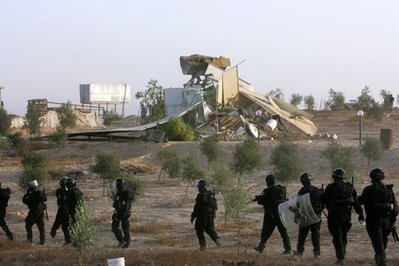
Last week, the Bedouin village of al-Arakib in the Negev was completely razed during a brutal surprise dawn raid by Israel Land Administration workers supported by thousands of black clad Israeli special unit forces, police officers and aerial units. Dr. Awad Abu-Farikh, a resident of Al-Arakib and a spokesman for the village said “We were stunned to witness the violent force being used.” All 45 homes in the village were completely destroyed.
Since then, the resilient inhabitants of the village have managed to construct 10 new structures on the ruins of their former homes. However, yesterday Israel Land Administration workers returned to the site and tore down the homes once again.
Yesterday’s brutal action was met by demonstrations and resistance from the now homeless villagers joined by Israeli Knesset member, Talab al-Sana, who barricaded himself inside one of the houses. Al-Sana was attacked by the police and forcefully removed from the house; he sustained injury and lost consciousness having to be evacuated to Beersheba Soroko Medical Centre. The police also arrested 6 individuals; five are considered ‘serial invaders’ while the sixth is suspected of assault on the police.
Since yesterday’s events, the Middle East Monitor (MEMO) has been in touch with Mr. Al-Sana who was in London as its guest during the first assault on al-Arakib and was able to give a graphic and detailed account of the situation facing the Bedouin of the Negev during an address in the Houses of parliament. He and his colleagues spoke about the Israeli campaign to persecute and intimidate Arab Israelis and to criminalise their political activities by delegitimising their democratically elected representatives.
According Mr. al-Sana who is of Bedouin origin, during yesterday’s indiscriminate and cruel assault, the police not only attacked him but also several women and children. He said that the destruction of al-Arakib village was not a question of law, but of Israel relating to its Arab citizens as enemies and being driven by the ideological motive of ‘redeeming the land’ from the hands of Arabs. He stressed that these current Israeli actions are in violation of all international laws and conventions including human rights laws. Given that during war time situations, the destruction of civilian homes is forbidden; that the Bedouin are not at war with Israel but citizens of the state makes the destruction of their homes a particularly heinous violation of law. The situation highlights Israel’s scant regard for human rights, and in particular, the rights of the Bedouin.
Al-Sana warned that if this is allowed to continue, we could soon see the expulsion of the 100,000 Bedouins of the Negev and that the next twelve months were crucial in determining the outcome of the standoff. This assessment was supported by the spokesman for al-Arakib village, Dr. Awad Abu-Farikh who asserted that “This operation is the first step in the uprooting of many villages. We shall return to our villages, build our homes and not leave this place”
Mr. Al-Sana, a vocal human rights activist and advocate for the Bedouin of the Negev, now intends to write to the Secretary General of the United Nations, Ban Ki-Moon and to the Human Rights Council to request protection from Israeli human rights abuses. He also expressed appreciation for the support given to their community by the international community and looked forward to its continuation.
The Bedouin of the Negev are a particularly vulnerable community in Israel and more so since it has stepped up its efforts to ‘Judaise’ the area through the Blueprint Negev plan and thus empty it of its indigenous inhabitants. Despite that their villages pre-date the establishment of the state of Israel in 1948, under Israeli law they are ‘unrecognised’ and therefore considered illegal settlements. There are approximately 45 such villages in the Negev which are not marked on commercial maps and are considered ineligible for municipal services such as electricity and water and are exposed to numerous environmental hazard. All these villages are now under imminent threat of destruction.
Visit Abu Dis– site of the future Palestinian capital?
By Tom Suarez on August 5, 2010

Philip Weiss writes: In order to be taken seriously in U.S. Establishment discourse, you must swear that you believe in two states existing side-by-side. This proposition (which has been held out to the stateless Palestinians for many decades now in one form or another without any consequence but further dispossesssion) today involves a Palestinian capital in the village of Abu Dis, which is just east of Israel’s expanded Jerusalem border
I’ve never been to Abu Dis, but lately I was reading Tom Suarez’s striking book of essays and photos of Palestine, Palestine Sixty Years Later, when I came on the photo above of the Dome of the Rock as viewed from the village of Abu Dis. The whole reason for a Palestinian capital in East Jerusalem is the connection to this holy site and the Old City, which means not only the religious connection but the commercial/tourist benefits. What kind of connection exists between Abu Dis and the Old City far beyond the separation wall?
Suarez sent me two other photographs of Abu Dis from his book, and I asked him what he thinks of the idea of Abu Dis as a capital:
When in 1990 Saddam Hussein invaded and occupied Kuwait, the West raced to Kuwait’s defense and punished the Iraqi people with crippling sanctions for their leader’s aggression. But in response to Israel’s equally illegal and more brutal 1967 invasion and occupation of East Jerusalem, the West amplified its policy of rewarding Israel, punishing the Palestinians, and blocking any attempt to hold Israel to UN Resolutions and international law.
Although East Jerusalem is no more part of Israel than is Paris or Tahiti, in 1980 Israel “annexed” East Jerusalem and claimed an “undivided” Jerusalem as the country’s capital. The UN responded by reaffirming that East Jerusalem is illegally occupied Palestinian territory and that Tel Aviv is Israel’s capital. Israel simply defied international law, as it has done with every UN resolution addressing the Palestinian issue since 1948.
But Palestinians have long envisioned East Jerusalem as the capital of their as yet unrealized nation, and so Israel had to dampen the appearance that their illegal seizure of East Jerusalem was an impediment to peace. The answer was to propose a nearby West Bank village as the future capital of a Palestinian state. At the same time, Israel strangled that very same village by dissecting it into two with the apartheid Wall, annexing the area on the west of the wall into its illegal “greater Jerusalem,” and suffocating what was left with ever-growing Israeli settlements. Thus Israel is not only accelerating its ethnic cleansing of East Jerusalem, but also crippling the very town it claims should be the capital of the Palestinian state it never allows to exist. Welcome to Abu Dis.


The apartheid Wall severed Abu Dis’s historic link with Jerusalem and crippled much of the little economic life that had thus far survived the Occupation. Not only was the social fiber of the village torn in two, but indeed families were broken up, family members permanently separated by the Wall. In some cases even fathers and mothers were torn apart, their ID cards placing them on opposite sides of the Wall. Shepherds and their flocks were completely cut off from thier grazing land, farmers from their fields. And further exacerbating the population squeeze, Bedouin whose villages Israel had razed in the Jordan Valley were brought to Abu Dis and left there.
Palestinian leaders — including Abbas, who commonly rubber-stamps whatever the West dictates — have refused to accept Abu Dis as a future capital.
International solidarity under attack
Mike Marqusee, The Electronic Intifada, 5 August 2010
From small beginnings and with few resources, the international movement in solidarity with the Palestinians has grown into a force that Israel perceives as a major threat. The assault on the Gaza aid flotilla was a lethal escalation in what has become an increasingly bitter campaign against that movement, whose constituents now range from dockworkers in South Africa refusing to offload Israeli goods to students at Berkeley demanding divestment.
The brutality of the flotilla attack was a measure of the extent to which the Israeli polity has grown to fear and loathe this global grassroots movement. In a way, the violence was a perverse tribute to a band of voluntary campaigners who are massively outstripped by Israel in money, institutional resources and access to the media, but who nonetheless have put more pressure on Israel than the world’s most powerful governments. Indeed, it’s the long-term collusion of those governments with Israel that has prompted the growth of citizen’s initiatives, such as the Freedom Flotilla, to redress the balance. People from very differing societies have come to the politics of international solidarity with Palestine via many routes. Nearly always, their commitment to the cause, the commitment that led the passengers on the boats to take such risks and suffer such punishment, is an expression of a wider aspiration for social justice, and above all a belief that this justice must be global in nature if it is to mean anything. One of the primary objects of the Israeli media barrage that followed the assault was to discredit and divide this movement. In particular, it sought to isolate and demonize an “Islamist” or “jihadi” element among the activists. (This was presaged by the especially vicious treatment meted out to those passengers identified by Israeli armed forces as Muslims.) The “Turkish boat” was said be the source of all the trouble. At one point it was claimed that an “al-Qaeda” team had been on board. The Turkish charity Isani Yardim Vakfi or IHH was traduced. People in the West with sympathies for the Palestinians were being warned: there was a type of person involved here with whom they would never want to make common cause.
Unfortunately, in France, a section of the left, driven by a misconceived interpretation of secularism, seemed to agree. They refused to join a protest against the assault on the flotilla on the grounds that other participants would include Muslim clerics. Under the guise of a dedication to universal values, this refusal was actually a restriction of those values: the expression of human solidarity was subjected to ideological conditions. Elsewhere the movement has prospered by its embrace of pluralism. This pluralism has been forged not by making a special case for the Palestinians but by universalizing their struggle: founding it on a commitment to human rights and common standards of justice. Far from “singling out Israel,” as is routinely claimed, the movement has begun, at long last, to expose how Israel singles itself out, demanding (and receiving) exemptions from those standards.
The diversity of the passengers on the flotilla was always its greatest strength. It meant that a much wider circle of people felt some kind of connection with the events in the Mediterranean, and also that they would have access to sources of information not trammeled by the Israeli state line. Transcending the boundaries of nation, religion and language, the passengers represented a growing global public that feels itself compelled to act because its governments will not. Like the motley delegation of foreigners who pledged their support for the French Revolution to the National Assembly in 1790, they were “ambassadors of the human race.” Of course, far from deterring Israel, this status made them a threat which had to be countered with a show of extreme violence.
True to form, Israeli spokespersons described the killings on board the Mavi Marmara as “self-defense” by Israeli soldiers threatened with “lynching.” The ensuing arguments about “violence” and who was responsible for it recapitulated a long history in which Israel has identified every denial of Palestinian rights or annihilation of Palestinian life as “self-defense.” Conversely, every assertion of those rights and every attempt to preserve those lives is deemed illegitimate, denounced as “aggression” or “terrorism.”
Here the Israelis tapped into a long-established bias in the Western media. A study by Arab Media Watch of the mainstream British press from January to June 2008 found that violent Israeli actions were almost always portrayed as “retaliating” to Palestinian aggression. Rocket attacks were represented as a “provocation” to Israel five times more often than the Gaza blockade was represented as a “provocation” to Palestinians. Forty years of occupation were portrayed as a provocation to Palestinians on only one occasion and settlement building twice. Where debate arises within the mainstream media, it tends to revolve around the “proportionality” of Israeli action, thus evading the underlying questions of Palestinian rights and Israeli domination.
Unlike the solidarity movements which grew up in response to the struggles in Vietnam or South Africa, the Palestine movement faces an opponent with its own international network, preaching its own form of solidarity (with Israel), very much a movement in its own right, however reliant on state support. Its rhetoric and tactics may be cynical in the extreme, but there’s no denying its emotional fervor. Building opposition to South African apartheid never involved the kind of on-the-ground contest with ideologically motivated, well-resourced opponents that pro-Palestinian activists routinely engage in. Just as the Palestinian cause is a global magnet for victims of discrimination and dispossession, so the cause of Israel is a magnet for the privileged, the entitled, the beneficiaries of Western and white supremacy. The rich and powerful see themselves as under siege from the poor and powerless and in Israel’s self-portrayal they recognize themselves. The gated communities of the world rally around the gated nation. The increasingly wealthy Indian elite — which has vigorously pursued governmental and business exchanges with Israel — sees in Israel not only an ally in a struggle against “Islamic terror” but a stepping stone to a closer relationship to the United States, and in a wider sense an entry into the exclusive club of the affluent and powerful.
Thus the highly particularist ideology of Zionism — which rests on the assertion of eternal ownership of a specified territory by a specified people — becomes a broader “civilizational” cause. This ideology underpins the ever-widening Israeli definition of “self-defense.” To those for whom the maintenance of a Jewish supremacist state in Palestine is the sine qua non of Jewish survival, any assertion of Palestinian rights is an “existential” threat — a negation that must itself be negated. As a state for all Jews, Israel embraces a global mission and enjoys special prerogatives. In the contemporary world only the US claims a wider remit of self-defense, insisting that it can strike anywhere to protect its perceived interests. Israeli exceptionalism finds a mirror and enabler in US exceptionalism, which in turn has its roots in the long history of Western colonialism, whose stock-in-trade was, for centuries, acts of piracy on the high seas. Through many years of grassroots education, agitation and organization, not to mention a steadfast defiance of intimidation, the solidarity movement has begun at last to have a real effect on the balance of power. But there is so much further to go. Governments around the world joined in the condemnation of the Israeli attack on the flotilla, but many of these same governments continue to provide essential means for Israel to pursue its destruction of the Palestinian people. In that context, those who consider themselves, in Thomas Paine’s words, “citizens of the world” are called upon to redouble their efforts to secure boycott, divestment and sanctions. If Israel continues to act with impunity, if Palestine instead of Israel is subject to isolation, then the powerful everywhere will have their options strengthened.
This essay is excerpted from Midnight on the Mavi Marmara, exclusively available from OR Books.
Israel army escorts 300 settlers into Nablus
Ma’an – 05/08/2010
NABLUS: Residents of Nablus were told to stay indoors by Israeli troops patrolling the area just after midnight Thursday, ahead of a mass visit of Jewish worshipers to a tomb in the area.
Witnesses in the Balata refugee camp said 12 Israeli military vehicles entered the area on patrol, clearing the streets of residents. The troops reportedly entered the area from the east at the Beit Furik checkpoint.
Following the incursion, residents near the tomb said six buses pulled up to Joseph’s Tomb, believed to be the burial place of the patriarch and his two sons, and decamped alongside 20 military vehicles.
Palestinian security sources said an estimated 300 settlers made the trip, remaining in the area for four hours between 1 a.m. and 5 a.m.
Gaza minister fears tomb to be annexed
Minister of Waqf in the Gaza government Taleb Abu Sha’ar called the a “violation” and “provocative.”
Abu Sha’ar said the military measures and the forceful visit to the site was a “violation of the holy place” and took place on the “pretext that the area belongs only to them.”
Abu Sha’ar warned that the tomb could become the next target for designation as an Israeli national heritage site, following the spring declaration of the Ibrahimi Mosque, in the West Bank city of Hebron, as a national site. The declaration sparked outrage and concerns that the mosque would be cut off from civilian use.
In 1993 the mosque was partitioned, half was designated for Jewish use and the other half for Muslim use.
3 detained from Nablus area overnight
Israeli forces conducted patrols of several districts in the Nablus area overnight, detaining three men from the town of Asira Ash-Shamaliya, north of Nablus, and took them to unknown destination, Palestinian police officials said.
The men were identified as Fakher Azam Hasan Bara, 35, Muhammad Abdullah Yousif Sawalha, 37, and Usama Hamed Hamdana, 30.
Sources said the homes of the men were entered and searched before they were detained.
Featured Video

They Double Down on BLOOD PRESSURE Guidelines!
or go to
Aletho News Archives – Video-Images
From the Archives
The Ten Commandments of War Propaganda
By Michael Feldman · The Dissident · November 22, 2022
While researching World War I censorship for a larger project a few years ago, I stumbled upon a fascinating analysis of war propaganda.
In 1928, Baron Arthur Ponsonby published Falsehood in Wartime: Propaganda Lies of the First World War. Although Ponsonby’s book was eye-opening and remains relevant to media propaganda today, another work inspired by Ponsonby really caught my attention.
In 2001, Belgian historian Anne Morelli published Principes élémentaires de propagande de guerre (Basic Principles of War Propaganda). Based on Ponsonby’s writings, Morelli identified ten principles, often known as the Ten Commandments of War Propaganda:
1. We don’t want war. We are only defending ourselves!
2. Our adversary is solely responsible for this war!
3. Our adversary’s leader is inherently evil and resembles the devil
4. We are defending a noble cause, not our particular interests!
5. The enemy is purposefully committing atrocities; if we are making mistakes, this happens without intention
6. The enemy makes use of illegal weapons
7. We suffer few losses; the enemy’s losses are considerable
8. Recognized intellectuals and artists support our cause
9. Our cause is sacred
10. Whoever casts doubt on our propaganda helps the enemy and is a traitor
What’s most fascinating is that Morelli’s principles are based on a 73-year-old book, yet the commandments ring true today. You can pick just about any war, especially those in the twenty-first century, and see the commandments in action. … Full article
Blog Roll
 Aletho News
- More Cigars Near the Powder Keg
- Russia Unearths Major New Reserves of Gold, Nickel, Copper, and Natural Gas
- I’M SO BLOODY FURIOUS: They Double Down on BLOOD PRESSURE Guidelines!
- The Israeli Nuclear Doctrine and the Turning Point of the Kennedy Assassination
- Striking Matches Near the Powder Keg
- Prominent Russia hawk: European leaders privately talk about war with Russia, first need ‘mass casualty event’
- China warned Trump not to touch Iran’s oil tankers: Larry Johnson
- EU Central Banker Plans To Plant Barren AI Crops Across The Continent
- Macron’s Strategic Autonomy Paradox: France Rearms on Debt and Depends on Foreign Fuel
- Nigel Farage vs Tucker Carlson: Who is right about Hitler and Britain?
- If Americans Knew
- DAILY UPDATE: Latest essential news on Palestine, Israel, & region
- Reporting Raises Fresh Questions About Israeli Role in CNN’s ‘Preposterous’ Iranian Dirty Bomb Story
- DAILY UPDATE: Latest essential news on Palestine, Israel, & region
- Under the West’s watch, genocide apologism has become entirely respectable
- Israeli Diplomat Offered Iowa Attorney General Free Trip, Then Asked for Favors
- On World Children’s Day, 350 Palestinian Children Remain in Israeli Prisons
- Why Is Israel Jailing a Palestinian Student Without Trial? Because It Can
- ICJ ruling on Rohingya genocide could strengthen South Africa’s case against Israel
- DAILY UPDATE: Latest essential news on Palestine, Israel, & region
- Newly nominated House Speaker funded Gaza genocide
- No Tricks Zone
- New Study: Modern Temps Are Among The Coldest Of The Last 10,000 Years In East Central Europe
- Germany’s Renewable Energies Lead to 1.4 Billion Euro Electric Power Trade Deficit
- Argentina’s Perito Moreno Glacier Joins Antarctica and Arctic In Defying Doomsday Melt Claims
- New Study: Barents Sea Temperatures Were Warmer And Sea Ice Less Extensive In The 1700s Than Today
- German Authorities Start Initiative To Evaluate Public Register For Climate “Disinformation” Spreaders!
- Zonal Asymmetry of Temperature Change in the Antarctic Circumpolar Current
- New Study: The Net Fossil Fuel Contribution To Rising Atmospheric CO2 Has Been Zero For 500 Years
- Germany’s Green Energy Transition Becoming Increasingly Expensive…Another 6 Trillion Euros!
- Sudden Stratospheric Warming, Powerful El Niño Combination May Lead To Extreme Europe Cold, Energy Crisis!
- Two New Studies Find Thwaites Glacier Melt Cannot Be Driven By Human Activity Or A Warming Ocean

