Oxfam calls for compensation from Israel
Ma’an – 26/07/2010
Bethlehem – The international aid agency Oxfam demanded Monday that Israel compensate Palestinians in a northern Jordan Valley village after soldiers destroyed at least $29,000 of aid.
In a statement, the charity said villagers in Al-Farisiya were forced into poverty when soldiers demolished 79 structures in the village, including homes, stables, sheds, water tanks, two tons of animal fodder, fertilizer and wheat.
An initial assessment by Oxfam and other NGOs in the area calculated that the demolitions affected 113 Palestinians, half of them children and identified as some of the poorest in the area. Water tanks and irrigation pipes provided by Oxfam were among the damaged goods.
Oxfam’s advocacy officer, Cara Flowers, said the area looked “a natural disaster had taken place,” adding that “With no access to shelter, water or fodder for their goat and sheep herds, an entire community is being forced to leave their land.”
Under zoning regulations established under the 1994 Oslo Accords, Al-Farisiya falls in “Area C,” the 60 percent of the West Bank which is under full Israeli administrative and military control.
Last year, Israeli authorities declared village land a “military zone,” and some residents who have lived in the village for decades were issued eviction notices in June.
The UN has reported an increase in demolitions across Area C, and the Israeli Committee Against House Demolitions recently reported that Israel has “returned with a vengeance” to its policy of demolishing Palestinian homes.
Flowers said “The Israeli authorities are obliged to protect the lives, property and livelihoods of civilians under their occupation. The authorities should now offer alternative accommodation and compensation for damage done, some of it to internationally donated material, but more importantly, to the lives of Al-Farisiya’s residents.”
Israeli police outraged as impunity ends
Jonathan Cook | July 26, 2010
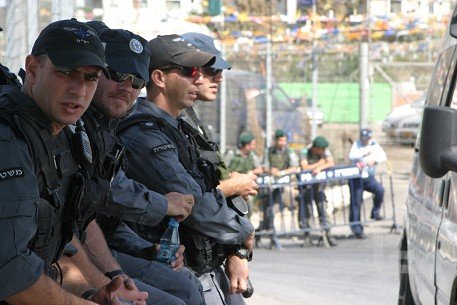
A decision by Israel’s Supreme Court to double a 15-month jail term for a policeman who shot dead an unarmed Palestinian driver suspected of stealing a car has provoked denunciations from police commanders and government officials.
Yitzhak Aharonovitch, the internal security minister, condemned the judges for “sending a terrible message to police officers.”
On the advice of police lawyers, the accused policeman, Shahar Mizrahi, had appealed his conviction last year in the expectation that the ruling would be overturned by the Supreme Court.
Aharonovitch and Dudi Cohen, the police commissioner, said they would immediately seek a presidential pardon for Mizrahi. “I won’t merely support a pardon bid, I’ll lead it,” Aharonovitch said.
But groups representing Israel’s large Palestinian minority said the outrage at the doubling of the 15-month sentence for Mizrahi reflected the reality that the police force expected impunity when it used violence against Israel’s Palestinian citizens, who comprise a fifth of the population.
At Mizrahi’s original trial last year, the district court judge, Menachem Finkelstein, ruled that the policeman had acted “recklessly” during an operation to stop car thefts in the Jewish town of Pardes Hanna in 2006.
Despite his life never being in danger, Mizrahi had used the butt of his gun to smash the window of a car in which Mahmoud Ghanaim, 24, was seated and shot him in the head from close range. The court also noted that Mizrahi had changed his testimony several times during the investigations.
According to Mossawa, an advocacy group, 40 Palestinian citizens have been killed in suspicious circumstances by the security forces over the past decade. Mizrahi is the first policeman to be convicted in such a case.
As of yesterday, an online petition calling on the Israeli president, Shimon Peres, to pardon Mizrahi had attracted more than 5,000 signatures in a few days, and a Facebook page supporting the policeman had 1,300 fans.
Gideon Levy, a columnist with the liberal Israeli newspaper Haaretz, warned yesterday that those “siding with Mizrahi are eager to have a police force that kills — but just Arabs, of course.”
Jafar Farah, the director of Mossawa, said: “The atmosphere of racism in Israel is being used to destroy the legal system from the inside, using the justification that Arabs are being killed.
“The reality today is that the police can kill an Arab citizen in any circumstances and know that there is almost no chance they will pay a price. The safeguards are being stripped away.”
Relations between Israel’s Palestinian minority and the police have been marked by profound distrust since late 2000, when police shot dead 13 protesters and wounded hundreds more during largely non-violent demonstrations in the Galilee at the start of the second intifada.
A subsequent state commission of inquiry found that the police had a long-standing policy of treating the country’s 1.3 million Palestinian citizens “as an enemy” and recommended that several officers be prosecuted for their role in the 13 deaths.
After a long delay, state prosecutors announced in 2008 that no one would be charged.
In several speeches since he took over as security minister last year, Aharonovitch has promised measures to restore the minority’s faith in the police, including recruiting more police officers from the Palestinian population and fighting high rates of crime in Arab communities.
According to a police report submitted to the parliament earlier this year, only 382 of more than 21,000 police officers are Muslim — or less than two percent.
At the appeal hearing last week, the Supreme Court increased Mizrahi’s jail sentence after ruling that Judge Finkelstein had not given enough weight to the victim’s life and the value of deterring similar police behavior in the future. Under police regulations, Mizrahi was entitled only to shoot out the car’s tires or fire at Ghanaim’s legs.
Immediately after the ruling, Mr Aharonovitch reported that he had called Mizrahi to tell him: “Your fight has become all of our fight.”
He was backed by several retired police commanders and a Likud MP, Danny Danon, who said he would submit a bill barring the indictment of police officers who open fire when they believe they are in danger.
In a sign of the mounting pressure from police groups on the Supreme Court, it issued a rare “clarification” statement of its judgment, pointing out that Ghanaim’s car was travelling too slowly to have ever put Mizrahi in any danger.
Farah added that Mossawa’s investigations had revealed that, despite police claims, Ghanaim was the documented owner of the car he was driving.
The police, Farah added, had supported Mizrahi throughout the case and had continued paying his police salary after his conviction.
The court’s decision to increase Mizrahi’s sentence came in the wake of strong suspicions that police officers executed a Palestinian driver in East Jerusalem last month, shooting him twice in the head from close range as he lay on the ground.
Moments earlier, Ziad Jilani, who was married with three children, had fled on foot after driving into a detail of police, injuring several officers, in the Wadi Joz neighborhood. Witnesses said a stone had smashed his windscreen seconds before he swerved.
In one of the few other recent prosecutions of a policeman for killing a Palestinian citizen, Rubi Gai was acquitted last year of the manslaughter of Nadim Milham, who was shot in the back during a police search of his home for weapons. Witnesses testified that police had beaten Milham and that he was shot as he fled.
A survey published last month by Haifa University found that only one in five Palestinian citizens expressed faith in the police.
Aharonovitch upset the Palestinian minority last year during an inspection of undercover narcotics agents in Tel Aviv. He was caught on camera telling one detective dressed as a drug addict he looked like “a real Araboosh,” a derogatory Hebrew term for Arabs.
The minister, who is a member of Avigdor Lieberman’s far-right party Yisrael Beiteinu, apologised but added that the comment was a “moment of banter.”
Mahash, the justice ministry’s police investigations unit, has been harshly criticized for the small proportion of complaints against the police it agrees to investigate. It rarely prosecutes officers.
The police have also refused to cooperate in imposing official sanctions on wayward officers, with critics saying that officers found to have acted negligently or violently towards Palestinian citizens are often rewarded with promotion.
The state commission of inquiry into the killing by police of 13 Palestinian protesters in October 2000 recommended that several officers be dismissed from service or denied promotion. The recommendations were disregarded.
In one notorious case, the commission found that Benzi Sau, a northern Border Police commander, had acted with gross negligence in allowing snipers to shoot at stone-throwing demonstrators. Despite suggesting a ban on his promotion for four years, he rapidly rose through the ranks, becoming head of the Border Police in Jerusalem in 2001 and national head of the Border Police in 2004.
Jonathan Cook is a writer and journalist based in Nazareth, Israel. A version of this article originally appeared in The National, published in Abu Dhabi.
Israel Admits: “Our Troops Are Psychopaths!”
Kevin Barrett | July 25, 2010
Yesterday’s radio guest Gordon Duff just broke a big story:
Gordon is skeptical of the Zionist claim that their troops, unlike American soldiers, don’t suffer from PTSD. If this is true, Gordon says, maybe it’s because American soldiers are fighting and dying for a Zionist-orchestrated series of lies, and are treated like “broken toys” when they come home; while Israeli soldiers are committing genocide for their own national benefit, and are relatively well-treated by their US-taxpayer-funded regime.
But there is a simpler explanation: In claiming that its soldiers are immune to PTSD, Israel is implicitly confessing that its troops are psychopaths.
In On Killing: The Psychological Cost of Learning to Kill in War and Society, Lt. Col. Dave Grossman shows that throughout history, 5% of the soldiers — the psychopaths and borderline psychopaths — have done 95% of the killing. As Grossman explains, studies by S.L.A. Marshall and associates showed that the vast majority of World War II infantry soldiers found ways to avoid firing at the enemy; and archeological evidence suggests that the same was true of previous wars.
Normal human beings can only kill at tremendous psychological cost, and thus find ways to avoid killing on the battlefield, even if it means losing their own lives. A non-psychopath who kills in wartime will almost certainly suffer some form of PTSD upon returning to civilian life.
Marshall’s studies spurred the development of intensive Pavlovian conditioning methods that raised the shoot-to-kill ratio to 50% in the Korean war, and 90% in Vietnam. That, Grossman suggests, is why PTSD rates skyrocketed. Normal, non-psychopathic men were being effectively turned into killers for the first time in history. When they came home, they couldn’t live with themselves.
It is a tribute to the American character — to the fact that only about 5% of American men are psychopaths — that our troops suffer from so much PTSD.
The Israelis, on the other hand…how to put this politely?
Andrzej Lobaczewski, in his seminal study of political psychopathy Political Ponerology, writes:
“The pathocratic phenomenon [a society ruled by psychopaths and those who catch the psychopathic contagion] has appeared many times in history…[it sometimes] occurs when the religious association itself succumbs to infection…succumbs to destruction from within, its organism becomes subordinated to goals completely different from the original idea, and its theosophic and moral values fall prey to characteristic deformation, thereby serving as a disguise for domination by pathological individuals. The religious idea then becomes both a justification for using force and sadism against nonbelievers, heretics, and sorcerers, and a conscience drug for people who put such inspirations into effect.“
Clearly the “religious idea” of Zionism has undergone this kind of pathological shift. Israel is a psychopathic state par excellence. Its soldiers slaughter innocent Palestinian children by the hundreds as they play on sidewalks and schoolyards as a de facto national policy:
“Two thirds of the 621 children (two thirds under 15 years) killed at checkpoints, in the street, on the way to school, in their homes, died from small arms fire, directed in over half of cases to the head, neck and chest – the sniper’s wound…Clearly, soldiers are routinely authorised to shoot to kill children in situations of minimal or no threat.” (British Medical Journal 10/16/04)
There are countless eyewitness accounts of these child-killings. For example, Chris Hedges, wrote in Harper’s magazine (October 2001) that he had been in several war zones, but he had never seen soldiers luring children within range of their guns, then gut-shooting them for sport, until he saw Israeli soldiers doing it in the Occupied Territories.
The Israeli soldiers who gut-shoot Palestinian children for sport apparently feel no remorse, and therefore suffer from no PTSD. Israeli society and its judicial system feel no remorse either, which is why they have never prosecuted the child-killers, and why polls show that more than 90% of Israeli Jews approve of the criminal destruction of Gaza by Operation Cast Lead.

A society that slaughters innocent children without remorse is a society of psychopaths.
A time for sticks
By Diana Buttu | Bittermelons | July 12, 2010
Many critics are perfectly content to be proven right when their critique of current affairs meets their low expectations. For such critics, being right demonstrates that their criticism and knowledge of political events are sound and well placed. But, for Palestinian critics, there is little joy in being proven right because it means that the political situation is just as grim as predicted.
Such is the case with the much-hyped “row” between Israel and the United States back in March following the announcement of 1,600 new housing units in the Israeli colony of Ramat Shlomo. While much was made of US President Barack Obama’s subsequent shunning of Israeli Prime Minister Binyamin Netanyahu at the White House during their last meeting–including the unspeakable decision not to hold a joint press conference or even allow photographers to capture the meeting–critics properly noted that there was much ado about nothing. Alas, the critics were correct.
The latest, cordial, meeting between Netanyahu and Obama comes as little surprise. Palestinians have grown accustomed to seeing Israeli leaders warmly received in the White House, irrespective of the crimes perpetrated by Israel against Palestinians. Broad smiles have always greeted Israeli officials, even when Israel’s insatiable appetite for Palestinian land flies in the face of international demands for a freeze on settlement activity. Indeed, the White House always reminds us of the “unshakeable bond” between Israel and the United States even as Palestinian homes continue to be demolished.
But what many had not expected was the over-the-top nature of the reception Obama afforded Netanyahu in the face of Israel’s actions toward US citizens. Perhaps Obama forgot that just a month earlier, Israel carried out a brutal raid on a Gaza-bound humanitarian aid flotilla attempting to break the illegal Israeli blockade of the Gaza Strip. Perhaps he forgot that a young American citizen was killed, execution-style, on board the lead ship, with one bullet to the chest and four, at close range, to the head. Perhaps he missed that the next day another young American, Emily Henochowicz, had her eye shot out by an Israeli-fired tear gas canister as she peacefully protested the flotilla raid. Perhaps he also forgot that, days later, a Palestinian man married to an American woman was executed after what appears to have been a traffic accident at an Israeli checkpoint.
Obama did not demand accountability for these acts of violence. Instead, he greeted Netanyahu with the usual broad smile, strong handshake and warm words that every US president has offered every Israeli leader, irrespective of Israel’s actions. The message: Israel will never be held accountable for its actions, whether toward Palestinians or toward any individual trying to protect Palestinians.
Some pundits may pontificate that this is merely a change in tactics on the part of Obama, that he is moving from the “stick” to the “carrot” in the hope that Israel will see the error of its ways, change course and become a law-abiding actor. But on this, the pundits and Obama should take some lessons from the Palestinian Authority, which has spent the last 17 years offering carrots to successive Israeli administrations (from changing the discourse to focus on Israeli security rather than Palestinian freedom to actually serving as Israel’s security subcontractor) in the mistaken belief that somehow if we Palestinians offer enough carrots to Israel, its appetite for Palestinian land will be sated. For all these carrots, Palestinians have achieved nothing and instead a fatter, more emboldened “rabbit” has emerged demanding even more concessions from the Palestinian people.
The pundits will argue that the carrots are working and will point to Netanyahu’s recent statements in which he indicated that he is willing to take “bold steps” for an undefined, conditional “peace” and even pressed for direct rather than indirect talks with the PLO. But the pundits will ignore reality: the peace process has only ever served to provide Israel with legitimacy while masking its ongoing violations of human rights. From 1993 to 2000, for example, as the world greeted the peace process with great fanfare and 34 countries established diplomatic ties with Israel, it carried out the largest expansion of the settlement enterprise in its history, including a doubling of its settler population as well as one of the largest revocations of residency rights of Palestinian Jerusalemites. In short, while the world focused on handshakes, Israel continued to carry out its policies of replacing one people with another. And on this path, Israel will continue.
Indeed, for all of his talk of “peace”, Netanyahu has also indicated that he will not halt settlement activity and home demolitions will continue as planned. The blockade will continue and Palestinians will continue to be imprisoned in large Bantustans. In short, Israel continues to act as it always has, unless it sees a stick. And the time for sticks is now.
But the US is too afraid to use its annual three-billion-dollars-US-assistance-to-Israel stick. Instead, it will continue to turn a blind eye to Israel’s colonization, while promising an increasingly compliant and complacent Palestinian leadership that, for domestic reasons, the Palestinians will have to wait until mid-term elections, or maybe second-term elections before the stick will be used against Israel.
All the while, Palestinian critics will continue to watch the handshakes and smiles, with that sickening feeling that we know we are right but wish we were wrong.
© bitterlemons.org
Diana Buttu is a human rights lawyer and a former legal advisor to the Palestinian negotiating team.
Suspect in murder of four Palestinians was Shin Bet agent
By Jonathan Cook | The National | July 24. 2010
NAZARETH // The arrest by the Israeli internal security service, the Shin Bet, of an Israeli Jew accused of killing at least four Palestinians has thrown a rare light on the secret police, including claims that it tried to enlist the accused to assassinate a Palestinian spiritual leader.
Chaim Pearlman, who was arrested on July 13, has been charged with murdering four Palestinians in Jerusalem and injuring at least seven others in a series of knife attacks that began more than a decade ago. Police are still investigating whether he was involved in additional attacks.
Although Mr Pearlman had been denied access to a lawyer until Friday, since his arrest far-right groups have rapidly come to his aid, waging what the Shin Bet officials have described as “psychological warfare” by releasing damaging details about the case.
Ties between the Shin Bet and illegal settler organisations have come to light after Mr Pearlman’s arrest. The Shin Bet have been cornered into admitting that they recruited Mr Pearlman as an agent in 2000, in the midst of his alleged stabbing spree, despite the fact that he was a known member of Kach, an outlawed group calling for the expulsion of Palestinians from “Greater Israel”.
In addition, Mr Pearlman has also released tape recordings he secretly made of recent conversations with an undercover Shin Bet agent who tried to get Mr Pearlman to incriminate himself.
The agent, who befriended Mr Pearlman and was known as “Dada”, can be heard exhorting him both to go to an “Arab village” to “turn it into a fireworks display” and to execute Sheikh Raed Salah, a leader of the Islamic Movement and a recent participant in the aid flotilla to Gaza that was attacked by Israel.
In the 20 hours of recordings with Dada, some of which have been broadcast on Israeli television, the undercover agent can be heard repeatedly inciting Mr Pearlman to kill Sheikh Salah,
Dada says: “Why haven’t soldiers killed Raed Salah, may he die? Someone should take care of him, send him to the next world.”
He then suggests Mr Pearlman shoot at the sheikh’s car or put a bomb under it. “That’s the classic one. Nothing’s left, everything goes everywhere,” he says on the recording.
Dada’s advice came after Sheikh Salah had stated that Israeli commandos aboard Mavi Marmara ship had tried to kill him. Mr Pearlman, who apparently suspected he was being investigated, sent the recorded conversations with Dada to local media to be broadcast in the event of his detention.
In another blow to the Shin Bet, Mr Pearlman’s supporters have released a secretly filmed video of the head of the agency’s Jewish division, which arrested Mr Pearlman, naming him and identifying where he lives.
Although the agent is in charge of handling “Jewish terror” cases, the video states that he lives in Kfar Adumim, a West Bank settlement.
It is a criminal offence to identify any employee of the Shin Bet, but the release of details about such a senior figure is certain to provoke fears among officials that he may be in danger, including revenge attacks or future prosecution in an international tribunal.
Mr Pearlman’s supporters have posted the video on YouTube and other overseas websites, making it difficult for the Shin Bet to remove.
Nadia Matar, the leader of the pro-settler group Women in Green, told the Jerusalem Post last week that the Shin Bet divisional head “has to know that there is a price to stabbing Jewish brothers in the back. People have to be loyal or bear the consequences.”
The Shin Bet’s modus operandi was exposed in part by a rare decision from the judge supervising the investigation to partially revoke a gag order immediately after Mr Pearlman’s arrest.
Abir Baker, a lawyer with Adalah, a legal centre that handles Palestinian security cases, said: “The Shin Bet is facing an internal crisis over this arrest and the settlers are trying to exploit that with their campaign.
“Many members of the Shin Bet are settlers themselves and think of these extremists as their colleagues, not as the enemy. The line between the Shin Bet and these extremist organisations is very blurred.”
Unlike in the case of Palestinian attacks on Israelis, attacks by Jews on Palestinians are rarely solved, leading to criticism that the Shin Bet is not serious about tackling the problem of Jewish terror.
Amir Oren, a columnist for the liberal Haaretz newspaper, accused the Shin Bet of having “chains on its feet and weights around its neck” when it investigated such cases.
Yaakov Teitel, a settler who was arrested by the Shin Bet last year, was accused of his first murder of a Palestinian 14 years ago. Some observers have suggested he was only arrested after he started attacking left-wing Jews, including placing a bomb at the home of a prominent academic in 2008.
Ms Baker said Jewish terrorists often found it easy to evade the Shin Bet because they had learnt about the organisation’s investigation techniques while working as agents.
Although Mr Pearlman, 30, was living in the Israeli town Yavne, north of Ashdod, at the time of his arrest, he was raised on a settlement and spent time living in Kfar Tapuach, which is closely identified with the Kach movement. Despite being illegal, Kach operates relatively openly in settlements and Mr Pearlman’s connections to the group may explain the well-organised campaign quickly mounted in his defence.
Itamar Ben Gvir, a parliamentary aide to Michael Ben Ari, an MP who has maintained ties to Kach, was reported by the Israeli press to be behind the media campaign against Shin Bet. Mr Pearlman is also being helped by Honenu, a legal organisation that defends Jews accused of attacking Palestinians.
Anonymous Shin Bet officials told Channel 2 television that the campaign being waged against them by the far-right was “a completely different game” from previous confrontations.
foreign.desk@thenational.ae
Chomsky and Palestine: Asset or Liability?
Pulse Media | July 20, 2010
In a recent interview renowned linguist Noam Chomsky called the BDS campaign ‘hypocritical’. Jeffrey Blankfort, who is the author of an earlier important critique of Chomsky’s position on Palestine, responds:
When Noam Chomsky was stopped at Jordan’s Allenby Bridge and prevented from entering the Palestinian West Bank by Israeli occupation forces in May, the widespread condemnation of that action extended even into the mainstream media which in the past has paid little attention to his comings and goings and even less to what he has had to say.
Chomsky, who has visited Israel on a number of occasions and lived on a kibbutz in the 50s, had been invited to give a lecture at Bir Zeit University near Ramallah and had also arranged to meet with Salam Fayyad, the unelected prime minister of the Palestine Authority and a favorite of both Washington and Israel and, it would appear, of Chomsky.
The negative publicity arising from the incident caused the Israeli government to reverse its position, blaming its refusal to admit Chomsky on an administrative error. Chomsky was not mollified and decided to forego the trip to the West Bank and present his talk to the Bir Zeit students by video from Amman.
When interviewed by phone the following day from New York by Democracy Now! on which he is a familiar presence, Chomsky noted that “I was going to meet with the Prime Minister. Unfortunately, I couldn’t. But his office called me here in Amman this morning, and we had a long discussion. He is pursuing policies, which, in my view, are quite sensible, policies of essentially developing facts on the ground. It’s almost – I think it’s probably a conscious imitation of the early Zionist policies, establishing facts on the ground and hoping that the political forms that follow will be determined by them. And the policies sound to me like sensible and sound ones.”
Unfortunately, Chomsky was not questioned about his support for the nation building priorities of the earlier Zionists nor if he considered the Palestine Authority’s endorsement of Israel’s blockade of Gaza, of its attempts to suppress a UN investigation of the Goldstone Report, and of the role played by its US-trained militia in protecting Israel, to be also “sensible and sound.”
Missing from the discussion about what was made to appear a blunder on Israel’s part was a much more important issue: Why had Chomsky been invited to speak at Bir Zeit in the first place? For those puzzled by that question, be assured that it is meant to be taken quite seriously.
Once upon a time Prof. Chomsky was considered by many to be the most important spokesperson for the Palestinian cause. It was a position he attained largely on the basis of his writings and activism in opposing the Vietnam War and US intervention in Central America in which, unlike the case with Israel, he had no personal vested interest. That Chomsky has maintained that position despite the presence in the US of a number of distinguished Palestinian professors, among them the late Edward Said, who were and are more knowledgeable about the subject and could speak from personal experience that does not include prior service as “a Zionist youth leader”—Chomsky’s background– is a reflection of the political culture of the American Left which was and remains substantially if not predominantly Jewish, particularly in its leadership positions.
Support for Israel had become so ingrained and fear of anti-Semitism so deeply embedded in the psyche of American Jewish Leftists in the aftermath of World War 2, that if the Jewish state was to be criticized it had to be by someone from within the tribe who unequivocally supported its existence. Unfortunately, to the detriment of the Palestinians and the building of a viable Palestinian solidarity movement within the United States, that mindset persists to this day and largely explains why Chomsky maintains his reputation despite public utterances over the past half dozen years that have done more to undermine the Palestinian cause than to help it.
I examined Chomsky’s history in some detail in an article that I wrote for Left Curve in 2005 that called attention to the destructive role he has played regarding the Palestinian-based boycott, divestment and sanctions (BDS) campaign targeting Israel and the equally destructive impact of his dismissal of the pro-Israel lobby as an influential force in shaping US Middle East policy.
That he is still at it, and that his influence among what are considered “progressives” has lessened only imperceptibly, requires another look at the professor’s fierce and unyielding opposition to the BDS campaign launched by the leading organizations of Palestinian civil society. This movement has been gaining support in the world that exists outside of the United States, particularly among trade unions, a fact that is causing considerable concern within Israel and among its lobbyists/agents around the world who claim it is a campaign to “delegitimize” the Jewish state.
Within the United States, however, this campaign challenging Israel has frequently and in certain instances, intentionally, been confused with a vastly different, US-centered, campaign that avoids penalizing Israel while targeting US companies that provide goods and services that assist Israel in maintaining the occupation.
This latter campaign Chomsky does support as does the leading Jewish peace group, Jewish Voice for Peace which has recently been conducting a drive to get 10,000 signatures for its campaign to pressure Caterpillar to stop selling bulldozers to the Israel military which it has used to destroy Palestinian homes. While this is a worthy endeavor, does anyone seriously think that a refusal by Caterpillar to halt its sales to Israel would change the current situation for the Palestinians in any significant way? Or are we seeing something else here on the part of both Prof. Chomsky and JVP with their competing campaign, namely, damage control on Israel’s behalf?
One might certainly draw that conclusion from comments Chomsky has made over the past several years and most recently in interviews with Israeli television (http://www.youtube.com/watch?v=YCtYecGbQz8) and with Alison Weir of If Americans Knew, the newly appointed president of the Council for National Interest (CNI), on Jerusalem Calling, the CNI’s online radio program. (http://www.wsradio.com/internet-talk-radio.cfm/shows/CNI:-Jerusalem-Calling.html)
In the interview with Alison Weir, Chomsky not only repeatedly attacks advocates of an Israeli boycott as being hypocritical, he accuses them of doing damage to the Palestinian cause.
“What I have opposed,” says Chomsky, “is BDS proposals that harm Palestinians. If we are serious about BDS or any other tactic, we want to ask what the consequences are for the victims. We have to distinguish always in tactical judgments between what you might call ‘feel good’ tactics and ‘do good’ tactics. There are tactics that may make people feel good in doing something, but maybe they harm the victims.”
Pushed on the subject by Weir, he repeats that a boycott of Israel is “harmful to Palestinians and the reason is harmful is very obvious.” And what is obvious about it, Chomsky tells us in the very next sentence. “It is so hypocritical that it discredits the whole effort. I mean,” he says, “why boycott Israel and not boycott the United States? The US has a much worse record.”
When reminded by Weir that “Palestinian civil society issued a call, signed by dozens of diverse organizations calling for a boycott of Israel,” Chomsky was dismissive and condescending.
“There are groups who call themselves Palestinian civil society who are calling for a boycott,” he responds, “and I think they are making a mistake and I’ve explained why. I’m not going to take, adopt positions which have already been and will continue to be quite harmful to Palestinians.”
“If you want to, then do it,” Chomsky adds, upbraiding Weir and by implication, the Palestinian people themselves, “but it’s clear why the call for a boycott [of Israel] has been harmful for Palestinians and will continue to be.”
“The reason,” he repeated, “is very simple. It’s so utterly hypocritical that it’s basically a gift to the hardliners. They can say, ‘Look, you’re calling for a boycott of Israel, but you’re not calling for a boycott of the United States which has a much worse record, in fact, it’s even responsible for most of Israel’s crimes. (My emphasis)
“So therefore, if your position,” and from his tone of voice he is clearly jabbing a verbal finger at Weir, “is that hypocritical, how can we even take you seriously? That’s like giving a gift to the hard-line elements.
One might be forgiven for thinking that when Chomsky says “we” and refers to “hard-line elements” he is speaking of himself. He seems to confirm that later when, continuing his attack, he tells Weir:
“I find your commitment to harming Palestinians surprising. It is quite obvious why a call for a boycott of Israel is a gift to AIPAC. It’s a gift because they can point out that it is utterly hypocritical” and again, like a well rehearsed mantra he repeats, “We are not boycotting the United States, for example, which has a much worse record and is responsible for a lot of Israel’s criminal behavior.”
“I can give you cases if you want [but he doesn’t offer any] where the calls like the one you’re advocating have, in fact, for good reasons, harmed Palestinians, and he repeats once again that Weir’s “support for the efforts which are basically gifts to the hardliners…”
Let’s stop a moment before going on and ask ourselves some questions about what Chomsky has been saying.
One, shifting blame for Israel’s crimes against the Palestinians to the US (the Nakba?, the 1967 capture of the West Bank and Gaza?) he argues that rather than calling for a boycott of Israel, Palestinians should be calling for a boycott of the United States. Apart from the failure patently inherent in such a campaign, what does Prof. Chomsky believe would be the response of the majority of Americans to a call by Palestinians for such a boycott? Or, for that matter, a call by supporters of the Palestinians in the United States for a boycott of their own country? Beneficial for the Palestinians, Professor Chomsky, or harmful? Or just plain stupid?
Since the answer to that question is obvious, genuine supporters of the Palestinian struggle who still see Chomsky as an ally need to ask themselves why he would call for a campaign that would bring further disaster down upon the heads of the Palestinians.
Now think about his main argument that boycotting Israel as opposed to the United States is hypocritical; that the “hardliners,” in which he specifically includes AIPAC—which otherwise he dismisses– will use this against the Palestinians by pointing out that the US has committed far greater crimes than Israel. While there are some Jewish American settlers who have taken this position, referring to the Vietnam and Iraq wars, does Chomsky seriously believe that AIPAC or any major American Jewish organization would make this argument and compare America’s crimes to Israel’s? Again, the answer is obvious. But why does Chomsky insult our intelligence by asking us to believe such a fatuous claim? Why do those who know better let him get away with it?
The answer to the first question was given by Prof. Chomsky to the interviewer from Israel’ Channel Two television station who paid him a visit in Amman on May 19, two days after he was turned back at the Allenby Bridge.
When challenged about statements he had made strongly criticizing Israel, Chomsky responded, “I don’t regard myself as a critic of Israel. I regard myself as a supporter of Israel.”
Chomsky, who, in certain circles likes to boast of his early Zionist activities did so for both his Israeli interviewer and for Alison Weir. Noting that he had opposed the notion of a Jewish state in favor of a bi-national state, “once Israel was formed in 1948, my position has consistently been that Israel should have all the rights of every state in the international system, no more and no less. “ He would repeat exactly the same words when speaking with Weir six weeks later.
Chomsky volunteered to his Israeli interviewer that up to five or six years ago, he had considered living there as an alternative to the United States and in the 50s, “we had considered staying there, in fact.” In other words, he seems to have no problem with the Jewish “right of return” to what, until 1948, was Palestine, but considers a similar demand by the Palestinians who were actually born there to be not only unrealistic but potentially dangerous.
Although presented with an opportunity in both interviews to do so, Chomsky made no mention of the plight of the 750,000 Palestinians made refugees in the period of Israel’s founding nor of the more than 400 Palestinian villages that Israel purposely destroyed to wipe out their traces. In fact, that history and the situation of the now millions of Palestinian refugees today, is something he rarely, if ever mentions, unless asked about it.
On one such occasion, when he was asked if the refugees would be obligated to give up their “right of return” under a “two-state solution,” Chomsky’s preferred outcome, he replied: “Palestinian refugees should certainly not be willing to renounce the right of return, but in this world — not some imaginary world we can discuss in seminars — that right will not be exercised, in more than a limited way, within Israel. Again, there is no detectable international support for it, and under the (virtually unimaginable) circumstances that such support would develop, Israel would very likely resort to its ultimate weapon, defying even the boss-man, to prevent it. In that case there would be nothing to discuss. The facts are ugly, but facts do not go out of existence for that reason. In my opinion, it is improper to dangle hopes that will not be realized before the eyes of people suffering in misery and oppression. (Emphasis added) Rather, constructive efforts should be pursued to mitigate their suffering and deal with their problems in the real world.” (Znet,3/30.2004)
What Chomsky is saying to the refugees is that if they persist with their demand to return to Palestine, and should that demand, support for which is currently undetectable in Chomsky’s eyes, actually grow to the point where Israel feels threatened with an avalanche of returnees, it is likely to use its nuclear weapons and blow up the planet. So, for the sake of the “real world” that has ignored them and to keep Israel, a country that he unhesitatingly supports, from exercising the “Sampson Option,” the refugees should forget about going home and await some nebulous “constructive efforts….to mitigate their suffering.”
I can imagine what most Palestinians would say to that but it is unprintable.
When Weir asked if he had been aware of the Nakba in the days when he had been a Zionist youth leader, Chomsky acknowledged that he had been “well aware of that,” but rather than offer any opinion on it, he referred to his membership in Hashomir Hatzair which had supported a bi-national state and that he lived on a kibbutz which, prior to 1948, called for “Arab-Jewish cooperation in a socialist state.” He did not come to live on that kibbutz, however, until 1953, five years after the Nakba.
In speaking with Weir, Chomsky did not hesitate to defend Israel’s legitimacy.. “Within Israel,” he said, “within the so-called Green Line, the internationally recognized borders, it’s a democratic state in the sense of Western democracies. There are laws and more than laws, practices that assign second class citizenship to Palestinians. In that respect it is not different from the US and other Western democracies.”
While there are few who will deny that racism exists in every Western (and non-Western) society and that it has often taken violent forms, Chomsky’s attempt to rationalize Israel’s ongoing discrimination of those Palestinians who remained after the Nakba, by lumping it together with the forms of racism practiced in the US and elsewhere, is too riddled with holes to analyze here but raises additional questions about on which side of the barricades he stands. The fact that he says “the occupation is simply criminal” as if Israel is not should not deceive us.
It should also be pointed out that Chomsky’s accusing Weir of harming the Palestinian cause is in keeping with the modus operandi he has employed when challenged from the Left regarding his stands on the Israel-Palestinian issue. With Alison Weir, it was the boycott of Israel, with Noah Cohen, in 2004, it was the latter’s advocacy of a single state and the Palestinian right of return. Chomsky accused Cohen of “”serving the cause of the extreme hawks in Israel and the US, and bringing even more harm to the suffering Palestinians.”( Znet, 7/26/04))
I have also been not immune from such an attack. On November 12, 2004, before writing my article for Left Curve and after I had written the professor, asking him a number of questions that I hoped would clarify his positions he responded in a letter thusly:
“I have never really understood why you consistently take positions that so severely undermine any hope of justice for the Palestinians, find truth so offensive, and work so hard to evade our own responsibilities in favor of the much more convenient stance of blaming others [Israel]. But that’s your business. I don’t write or speak about it.”
What we are dealing with in the case of Prof. Chomsky is nothing less than intellectual dishonesty parading as its opposite and the boycott issue has brought it to the fore.
A glaring but little known example of that came in a speech that Chomsky made to the Harvard Anthropology Dept. in 2003 shortly after the MIT and Harvard faculties issued a joint statement on divestment. It was gleefully reported in the Harvard Crimson by pro-Israel activist, David Weinfeld, under the headline “Chomsky’s Gift”:
MIT Institute Professor of Linguistics Noam Chomsky recently gave the greatest Hanukkah gift of all to opponents of the divestment campaign against Israel. By signing the Harvard-MIT divestment petition several months ago—and then denouncing divestment on Nov. 25 at Harvard—Chomsky has completely undercut the petition.
At his recent talk for the Harvard anthropology department, Chomsky stated: “I am opposed and have been opposed for many years, in fact, I’ve probably been the leading opponent for years of the campaign for divestment from Israel and of the campaign about academic boycotts.”
He argued that a call for divestment is “a very welcome gift to the most extreme supporters of US-Israeli violence… It removes from the agenda the primary issues and it allows them to turn the discussion to irrelevant issues, which are here irrelevant, anti-Semitism and academic freedom and so on and so forth.” [Harvard Crimson, 12/2/2003] (Emphasis added.)
The following year, Chomsky clearly stunned Safundi, an interviewer for the Journal of South African and American Comparative Studies [5/10 2004] when in an exchange comparing Israel with the former apartheid regime, he again came to Israel’s defense and cast opposition to sanctions on Israel as a moral issue.
“One of the important tactics against the apartheid government was the eventual use of sanctions. Do you see that as a possibility?” asked Safundi.
“No,” Chomsky replied. “In fact I’ve been strongly against it in the case of Israel. For a number of reasons. For one thing, even in the case of South Africa, I think sanctions are a very questionable tactic. In the case of South Africa, I think they were [ultimately] legitimate because it was clear that the large majority of the population of South Africa was in favor of it.
“Sanctions hurt the population. You don’t impose them unless the population is asking for them. That’s the moral issue. So, the first point in the case of Israelis that: Is the population asking for it? Well, obviously not.
“So calling for sanctions here, when the majority of the population doesn’t understand what you are doing, is tactically absurd-even if it were morally correct, which I don’t think it is. The country against which the sanctions are being imposed is not calling for it.”
To which the bewildered Safundi understandably asked, “Palestinians aren’t calling for sanctions?”
“Well,” Chomsky responded, as if he had been asked a stupid question, “the sanctions wouldn’t be imposed against the Palestinians, they would be imposed against Israel.”
“Furthermore,” added, “there is no need for it. We ought to call for sanctions against the United States! If the U.S. were to stop its massive support for this, it’s over. So, you don’t have to have sanctions on Israel.”
It would seem from that exchange that Chomsky has more respect for the opinions of Israel’s Jews than those of his fellow Americans.
In applying double standards to Israel and the United States, Chomsky has been consistent.
After telling the Israeli interviewer that, speaking as an American citizen, “we are responsible for our own actions and their consequences,” in the very next breath he declares that “every crime that Israel commits is with US participation and authorization,” which, even if true, which it is not, presumably would make Israel culpable, but not apparently enough, in Chomsky’s eyes, to warrant a boycott.
At the end of the day, it is evident that Chomsky’s affection for Israel, his sojourn on a kibbutz, his Jewish identity, and his early experiences with anti-Semitism to which he occasionally refers have colored his approach to every aspect of Israel’s conflict with the Palestinians and explain his defense of Israel. That is his right, of course, but not to pretend at the same that he is an advocate for justice in Palestine.
That same background may also explain his resistance to acknowledging the very obvious power of the pro-Israel lobby over US Middle East policy which he, like many others who share a similar history, interpret as “blaming the Jews,” a most taboo subject. It is, without a doubt, far more comfortable for him and his followers to continue insisting that US support for Israel is based on it being a “strategic asset” for the United States even when an increasing number of mainstream observers who are not linked to AIPAC or the Zionist establishment have judged it to be a liability. Should not Chomsky himself, on the basis of his own statements, be judged as to whether he is an asset or a liability for the Palestinian cause? If they have not already done so, serious supporters of that cause, including Palestinians, need to ask themselves that question.
Settlers erect Hebron outpost, arrests during clashes
Ma’an – 23/07/2010

Hebron – Dozens of settlers began building a new illegal outpost in Hebron’s Al-Buweirah neighborhood between the city center and the Kiyrat Arba settlement on Friday.
Witnesses said mobile homes and sheds were placed on the site by morning, with one resident saying “dozens of settlers installed themselves in the area.”
Local and international protesters gathered near the site on Friday morning, but were forced away from the newly occupied area by soldiers, who were reportedly protecting the new area.
Clashes erupted as residents grew angry over the military protection of the outpost, which is considered illegal under both international and Israeli law. Witnesses said two photojournalists and four residents were detained by military officials.
An Israeli military spokesman confirmed three were detained, two journalists and a resident, he said the two journalists were released shortly after their seizure.
Questions about the military plan of action regarding the installation of an illegal outpost on Palestinian lands were directed to Israel’s Civil Administration, representatives of which were not immediately available by phone for comment.
Remembering the Madness and Mayhem of McCarthyism – a Primer for Israel
By: William A. Cook | 23. Jul, 2010

“We must not confuse dissent with disloyalty. We must remember always that accusation is not proof and that conviction depends upon evidence and due process of law. We will not walk in fear, one of another. We will not be driven by fear into an age of unreason, if we dig deep in our history and our doctrine, and remember that we are not descended from fearful men.” (Edward R. Murrow)
The State of Israel has just passed a “loyalty oath” required of all prospective citizens living in Israel illegally to swear allegiance to a “Jewish democratic state.” Concurrently, an academic backlash has erupted in Israel over proposed new laws, backed by the government of Binyamin Netanyahu, to criminalise a handful of Israeli professors who openly support a campaign against the continuing occupation of the West Bank.(Guardian 7/11/10)
It would appear that Israel is in need of a lesson on the virtues of democracy as they are anathema to tyrannical rule. Harry S. Truman vetoed the McCarran Internal Security Act of 1950 with this observation: “In a free country, we punish men for the crimes they commit, but never for the opinions they have.” To impose a “loyalty oath” and to criminalize professors who support actions against the government of Israel is to force compliance in thought and act, behavior more of a tyrannical state than a democratic one.
Consider that the Israeli Shin Bet recently interrogated the conscientious objector, Yonatan Shapira, a former Israeli Air Force pilot, who penned the “pilot’s letter” of 2003, continuing a harassment of a man for his dissenting opinions of the State of Israel. Salem-News on July 11 carried an article about another conscientious objector, Shir Regev, who has been given a third prison term for contending “I believe it is my personal duty to refuse and defect from an army whose main purpose is to serve as an occupation police for maintaining ‘Israeli order’ and imposing it on defenseless Palestinians who are denied citizenship.”
“We must not confuse dissent with disloyalty,” Murrow writes; nor must we confuse pseudo-democracy with democracy. Israel is not a democratic state; let’s be clear about that. Its citizenship exists solely for those who are members of a religion with one exception, those Palestinians who remained in Israeli controlled land areas after the cessation of hostilities in 1948 and the Declaration of the State of Israel by the Jewish Agency. These Arab Israelis as they are called, to obfuscate the reality of their Palestinian heritage, do not have equality before the law nor do they have access to all the benefits of their fellow citizens who are members of the Judaic faith; they have a passport and a country and even that can be denied if they ride in a Turkish Aid boat to visit their brothers and sisters in Gaza. For all those indigenous to the area of Palestine, accepted as a group by the United Nations and its members, the Palestinians, who live in land occupied by Israel and claimed by Israel, there is no citizenship, thus no equality in concept or in fact. Israel has no constitution; it operates under civic and religious law, especially in matters pertaining to marriage, retaining thereby control of the citizenry, and in land ownership which is essentially available only to Jews. This alone negates the concept of democracy as applicable to the Israeli State. If Israel is anything distinct as a country, it is in its theocratic nature not its democratic nature.
As Israel moves ever closer to a siege mentality by blowing wind on the coals of victimhood, the explosive vapors of Hamas’ determination to drive Israelis into the sea aided and abetted by surrounding Arab neighbors intent on destroying the Jewish State, it desperately grasps for means to control its citizens and force compliance with its policies, hence the “loyalty oath” characterized as early as 1663 by Samuel Butler in Hudibras as “Oaths are but words, and words but wind.” This is the act of a despot desperate to protect self at the expense of his subjects; it is the act of a failed State that resorts to the impossible, to impose the logic of its acts regardless of sense on all its subjects; it is the despair reflected in Macbeth, “Who can be wise, amazed, temperate, and furious, loyal and neutral, in a moment? No man.” No mind perceives the same as another, no heart responds the same, no soul accepts being the same; that fact is the power behind democracy, the uniqueness of each requiring of each respect for all others. Democracy is a concept united in its applicability to provide equity for all its citizens. Loyalty to injustice negates democracy; fidelity to one faith without tolerance for all faiths destroys equality for those excluded; truth determined by the despot or the tyrannical government cannot be truth for all; honor demanded of a citizen against his or her innate principles of belief dishonors that citizen; trustworthiness and faithfulness imposed by an oath undermines the conscience of the citizen forcing compliance regardless of the behavior required. A citizen who swears to an oath of absolute allegiance to any authority has destroyed self by that act and thereby has become but chattel, a beast serving the will of another. So much for the Israeli “loyalty oath.”
America has been there, indeed I have been there. Years ago I took a menial position in the House Un-American Activities Committee (HUAC) and witnessed first hand the betrayal of democracy by a demagogue and his followers who set fear before the American citizenry by losing faith in the American people. Year after year this pall of fear lay on the American landscape as citizen turned against fellow citizen, neighbors rose in anger and resentment against artists, entertainers, professors, educators, union members, and even the military as McCarthy lashed his venom at all who opposed his witch hunt or refused to comply with his belief that Communists had infiltrated American society. He did not understand that dissent is not disloyalty; he knew nothing of tolerance of another’s belief; he failed to comprehend that equity necessitates respect and democracy means equity. Margaret Chase Smith spoke before the Senate of the United States in 1950 in a speech titled “Declaration of Conscience,” and noted “some of the basic principles of Americanism: the right to criticize; the right to hold unpopular beliefs; the right to protest; the right of independent thought.” These are the rights Israel would deny to Yonatan Shapira and Shir Regev and the university professors as well as to prospective citizens.
What has brought Israel to this sick state of affairs? Based on the research I have done through the seized documents taken by Richard Catling (Sir Richard C. Catling) when he was Deputy Head of the Criminal Investigation Division of the Mandate Police in the 1940s, in files he saved and marked as Top Secret, it is evident in the words of the leaders of the Jewish Agency, the Zionist leaders of the Consultancy as Ilan Pappe notes, that they intended to impose an atmosphere of fear on the new immigrants to unite them in their (the High Command of the Consultancy) intent to cleanse Palestine of its indigenous people necessitating protecting themselves against the Arabs who were out to destroy the Jewish state. That intent exists to this day. Add to this reality the need to grow the Jewish population to offset Palestinian growth, thus bringing to Israel the fanatical sects of Jews who live by a far right orthodoxy of “chosenness” and animosity against gentiles, especially those from Russia.
This group and others of similar persuasion have grown in strength even to the point where no government can exist without their presence. This has been true since Ariel Sharon held office. Their beliefs control government policy much as AIPAC controls our Congress. They believe that their g-d gave them the land of greater Israel and they have done and will do everything in their power to regain what g-d gave to them centuries ago regardless of historical realities or international law.
Jews of other persuasion, secular and reformed, True Torah Jews, Jews for Peace in Palestine and all others who understand the horrendous crimes being imposed on the Palestinians in their own land by those who have suffered under the brutal Nazi regime, recognize that there festers in the State of Israel a cancer that is spreading beyond its borders, those it has legitimately through the UN partition plan of 1947 and those it has acquired illegally and forcefully, that is destroying the Judaic faith and the principles it has stood for these many centuries. The country is being torn by a minority fanatical group that it cannot control, one that is pushing through legislation that corrodes any semblance of democracy as it pushes to a greater state of theocracy both of imposed behavior and imposed belief.
Creating such a state does nothing to advance democracy in the Middle East, it crushes it. The citizens of such a state become but puppets of those who have garnered power, used by them as wooden soldiers in their youth, as molders of their young tutoring them in the intolerant beliefs of ancient tribal men, and subservient elders that spout the party line in their Knesset. But there is a consequence to such behavior and such imposed control. There is a responsibility they assume when they shackle their people to acts that destroy, maim and kill innocent people as they march their way to their Greater Israel; there is the reality that international law uses as precedent, the trial that brought King Charles I to his death, and has been used now for the trials of Pinochet and Milosevic, the “universal right to punish a tyrant who denies democracy and civil and religious liberty to his people.” Charles was brought to trial by John Cooke who penned the words of indictment and his words continue today. That is a reality that Sharon, Olmert, Livni, Barak, and now Netanyahu and Lieberman face as they attempt to justify what is not justifiable and impose what is not legal not only on the people of Israel but on peoples of all nations that seek redress of the outrages the Israeli government has taken against its neighbors, most especially the Palestinians.
One need only mark the power of the peoples’ flotillas into Gaza. This is not the action of the governments of America or England or any single nation, this is a peoples’ action against tyranny; it is the equivalent of America’s Civil Rights Movement that had the people take to the streets, united in purpose and demands, against their government, state and federal, to right the wrong of segregation. It took time and many died in the quest for justice. But over time as more and more people understood that their government was the criminal, they grew in number and force until the government capitulated to their demands and granted justice to the African American and all who had been denied their civil rights.
The flotillas have grown in number over the months. They have made it known to the government of Israel and America, its puppet, that they will not stop until justice is achieved. This fall a flotilla of 50 to 60 boats from many countries will leave for Gaza. Now the Israeli government, its militarized government not its democratic one, will have to stop multitudes of boats with individuals from many countries and many nationalities all saying the same thing. “Freedom now, freedom now, the people of the world demand freedom now.” The people of the world demand that laws be obeyed, just laws, not laws made by the occupier for the oppressed. Accusation is not proof, guilt by association is not evidence, military might is not what is right for the people. Actions taken out of fear are actions removed from reason—fear erodes reason. “Let us not walk in fear, one of another,” as Murrow says, let us honor each other, recognize dignity in each other, respect each other, and thus treat all with equity, fulfilling the very concept of democracy by our actions.
William A. Cook is a Professor of English at the University of La Verne in southern California. His most recent book has just been released by Palgrave Macmillan, The Plight of the Palestinians: a Long History of Destruction. He can be reached at wcook@laverne.edu and at www.drwilliamacook.com
Two state solution dies leaving J Street without moral framework
J Street and its ilk can only conceptualise a racially exclusionary state
By Antony Loewenstein on July 23, 2010
“The future of relations with the Muslim world” was the UN-sponsored event hosted at the New York Times building in central Manhattan on 21 July. Filled with journalists from Egypt, China and Turkey and the foreign policy establishment, roughly 150 people came to hear Roger Cohen, Joe Klein, Martin Indyk, Reza Aslan, Dalia Mogahed and Marc Lynch chew over issues related to Barack Obama’s Cairo speech in 2009 and efforts to re-engage the Muslim world. […]
I didn’t really know what to expect from the evening and there was an air of unreality about the event, a troubling distance from addressing the crux of Washington’s problems in the Muslim world. The presumption of the evening was that America could noticeably change its image while still occupying Iraq, Afghanistan and backing Israeli occupation in Palestine. Most Muslims would regard the premise as a joke.
As Rami Khouri wrote in this week’s New York Times: “One cannot take seriously the United States or any other Western government that funds political activism by young Arabs while it simultaneously provides funds and guns that help cement the power of the very same Arab governments the young social and political activists target for change.”
Pollster Mogahed revealed that a forthcoming Gallup study of the Arab world finds Iraq still topping even Israel/Palestine in issues of concern related to US foreign policy in the region. The open wound of the Iraq conflict, the millions of internal and external refugees – the largest refugee crisis in the Middle East since 1948 –and daily brutality put paid to claims that America will soon be withdrawing. Just this week the Obama administration announced an expansion of paramilitary forces in Iraq to replace the forthcoming declining troop numbers.
Roger Cohen, a usually thoughtful writer who has sadly recently embraced Salam Fayyad’s economic “miracle” in the West Bank (essentially a police state with Western aid), was a considered moderator, probing the guests about the profound separation between rhetoric and reality. Time’s Klein was effusive in his praise for Fayyad, called for immediate engagement with Hamas, chastised Obama for not pressuring Israel far more and threatening to cut aid, vehemently opposed a “mad” attack on Iran, damned the colonies in the West Bank and the bullying Zionist lobby. Klein is a colourful and slightly arrogant speaker, proud of telling an audience he’s spent time in the Middle East and mixing with the people there.
The most revealing part of the evening was when Reza Aslan told the crowd, near the end of the event, that a two-state solution was dead due to ongoing Israeli colonisation. He urged consideration of a one-state solution. He wrote strongly months ago about the impossibility of a viable Palestinian state and this week urged more imaginative ways of framing a nation that “would be shared by both Palestinians and Jews.” Aslan also outlined the Likud charter, a racist document that does not allow an independent Palestinian entity in Palestine.
Former AIPAC employee, Vice President for Foreign Policy at the Brookings Institution and former US Ambassador to Israel Martin Indyk shook his head and said these were “lies”. He argued that Israeli Prime Minister Benjamin Netanyahu had said last year that he accepted a two-state solution and people should “wait until the end of Obama’s third year and you will see some major progress on Middle East peace.”
Indyk angrily rejected a one-state solution as “guaranteed to bring never-ending conflict” and said the two-state solution was the only game in town. Aslan didn’t give up, reiterating his request for Indyk to explain how two, viable states would develop.
This testy exchange was symptomatic of the anemic state of establishment thinking on the Middle East in America. Indyk was asking to be rewarded for ongoing failure, a man and idea that had been tried for decades and brought increased settlement activity. Like J Street, Indyk and his ilk can only conceptualise a racially exclusionary state, partition in the name of “two states for two peoples”.
I remember thinking during the J Street conference in Washington last year about the blind faith in Barack Obama bringing peace to the Middle East. What happens if he doesn’t deliver? J Street and Indyk have nowhere to go, no intellectual or moral framework from which to offer alternative perspectives.
For them, a Jewish state must be maintained at any cost. Democratic values will always come second.
Haneen Zoabi interview: “The largest threat to democracy is Zionism”
Max Blumenthal, The Electronic Intifada, 22 July 2010
 |
Haneen Zoabi speaking in Tel Aviv, July 2010. (Oren Ziv/ActiveStills) |
On 13 July, the Israeli Knesset voted by a large margin to strip the parliamentary privileges of Haneen Zoabi, a member of the Palestinian Israeli party Balad. The measure was a punishment for Zoabi’s participation in the Gaza Freedom Flotilla. As described in the Israeli daily Haaretz, during the raging debate, Member of Knesset (MK) Anasatassia Michaeli rushed toward Zoabi and handed her a mock Iranian passport with Zoabi’s photo on it. “Ms. Zoabi, I take your loyalty to Iran seriously and I suggest you contact Ahmadinejad and ask him to give you an Iranian diplomatic passport that will assist you with all your diplomatic incitement tours, because your Israeli passport will be revoked this evening,” said Michaeli, who is a member of Foreign Minister Avigdor Lieberman’s explicitly anti-Arab Yisrael Beiteinu party (“Knesset revokes Arab MK Zuabi’s privileges over Gaza flotilla,” 13 July 2010).
The debate over revoking Zoabi’s parliamentary privileges was nearly as rancorous as her appearance at the Knesset speaker’s podium in the immediate wake of the Flotilla massacre. While Zoabi attempted to relate her experience on the Mavi Marmara, where she coaxed Israeli commandoes to stop shooting and beating passengers, Knesset members from a broad array of parties leapt from their chairs to shout her down. “Go to Gaza, traitor!” shouted MK Miri Regev of Likud. “One week in Gaza as a 38-year-old single woman and we’ll see how they treat you!” barked Yohanan Plesner of the supposedly centrist Kadima party. Finally, Moshe Mutz Matalon of Yisrael Beiteinu lamented that the Israeli commandoes “left only nine floating voters” (“MK Regev tells Zoabi: Go to Gaza, traitor!,” YNet, 2 June 2010).
I met Zoabi at her office in the bustling center of Lower Nazareth on 12 June. While preparing a spread of biscuits and chocolates for me, she told me that a reporter from Nablus who met her earlier in the day had been detained at a checkpoint and had her laptop seized. Zoabi was convinced that the Shin Bet (Israel’s General Security Service) was monitoring her communications and movements as it does with many Balad Party leaders. Despite the tense climate and violent threats against her, she spoke without restraint about her experience on the Mavi Marmara, the predicament of Palestinian members of the Knesset, and what she considered the fascist direction of Israeli society.
Max Blumenthal: Were you surprised to be greeted with such hostility when you returned to the Knesset after the flotilla incident?
Hanin Zoabi: I was not so surprised. I expected to be called traitor, to be asked, “Where are your knives?” Or to be told, “You are the one who killed them!” But they shouted at me without any political argument and such shallowness. I thought, this couldn’t be a parliament, these are just gangsters. If I gave them guns, they would shoot me. I said the soldiers on the flotilla treated me more respectfully than them. At least after the soldiers killed nine people they tried to ask me for help.
MB: What does the attack on you in Knesset say about Israeli democracy?
HZ: Israel has a general atmosphere of a fascist state that has no critical sense even of its image in the world. It used to be sensitive to its image of democracy. [Knesset Speaker Reuven] Rivlin wants a liberal state and wants others to believe Israel is a democracy. But listen to what they are saying in the Knesset: that we should only pay attention to what we want to; it’s not important to pay attention to the goyim. We must believe we are the victim as if victimhood is an ideology.
MB: Are you concerned about threats to your physical safety?
HZ: This is a dangerous time and it is dangerous for Jamal [Zehalka] and others in Balad. I am worried but what worries me more is not the personal threats but the long term political effect of this campaign because it represents a delegitimization of our party and our political platform.
MB: What about the planned measure in the Knesset to strip you of parliamentary privileges?
HZ: The three parliamentary sanctions are nothing — I mean nothing — because I can still use my civic passport.
MB: When you were attacked in the Knesset, I was reminded of an incident in 1949, when the first Arab member of Knesset, Tawfiq Toubi, took to the floor to denounce Israeli army brutality against Palestinian villagers living under military rule. Jewish members of the Knesset went crazy just as they did against you, but Toubi was defended by one of Israel’s most prominent cultural figures, the socialist poet Nathan Alterman. Did any prominent Israelis speak up in your defense, and if not, why not?
HZ: Hardly anyone spoke up for me. Jamal [Zehalka] said the Knesset is the worst we’ve ever had. The guards and the workers who’ve been around the Knesset for 30 years said it’s never been this racist before. I think when you have a government led by the likes of [Foreign Minister] Avigdor Lieberman it means that the extremists are not the margins of the Knesset, they are the mainstream. Those who shouted at me were from Kadima, not from the extreme right. Even [the traditionally left-wing party] Meretz is becoming very center. And because of this it has lost power.
[Knesset Speaker] Rivlin was more afraid of hurting the image of the Knesset than of my rights being violated. There are no limits and the famous slogan of Lieberman is now the slogan of everyone: “Citizenship depends on loyalty.” He of course means loyalty in a fascist sense. Even when [Interior Minister] Eli Yishai asked to revoke my citizenship there was only one article in the Israeli media saying that this was crazy. What kind of state is this? I read just one article about this!
[Yedioth Aharanot columnist] Amnon Levy was the only one who defended me. He said what’s happening is so absurd, you should thank Haneen that she is serving in this Zionist Knesset. You should thank the Palestinians for participating in our game.
MB: Is the anti-Arab atmosphere inside Israel a new phenomenon or the acceleration of a process than began some time ago?
HZ: This is not a new process, and it didn’t begin after the flotilla. It really began after the second intifada, when hundreds of thousands of Palestinian Israelis went to demonstrations not to rally about internal issues but to support the intifada. This was a clear message for Israelis that the state had failed to create the model of the new “Israeli Arab.” This is what the state was trying to do, trying to create us as Israeli Arab, someone who was not 100 percent Israeli because we were not Jews but of course not 100 percent Arab either. We were told we could preserve our language and our culture but not our historical memory, our culture, or our identity except on an emotional, romantic level. Essentially we couldn’t be Palestinian.
The second intifada was the turning point. It told Israel that it might control the schools, our history and the media but they couldn’t stop us from asserting our identity. This led directly to the declaration of Yuval Diskin, the Shin Bet director, who said in 2007, we will fight against any political activity that doesn’t recognize Israel as a Jewish state even if the activities are conducted openly and democratically. He clearly was referring to Balad when he said this. By the way, no Israeli paper was shocked by his statement.
MB: The founder of the Balad Party, Azmi Bishara, was forced into exile after being accused of spying for Hizballah. Ameer Makhoul, the Palestinian civil society leader in Israel, has been placed under administrative detention and is facing similar accusations. Omer Said and many other activists are under investigation by the Shin Bet. What is the government trying to accomplish by its crackdown?
HZ: They are trying to establish borders on our political identity and say that we cannot have relations with the broader Arab world. They want to redefine the margins of democracy to exclude any political program that calls for full equality. We are calling for equality without Zionism. This is what the Balad Party says. The fact is, to demand full civic and national equality is actually to demand the end of Zionism. So we don’t hate Zionism. Zionism hates democracy.
If the state continues in the direction it is going it will actually change the rules of the game. Balad says there are clear margins of democracy. We believe in democratic values and the system and we will utilize these margins of democracy in order to suggest our vision of full equality. If Israel wants to delete these margins so my vision can no longer be legitimate in the Israeli scene I think a totally different game will develop between us and the state. In this way, the state is pushing us to a crisis. If they disqualify Balad then no Arab party would enter the Knesset and this would provoke a huge crisis. Arabs without a parliamentary role would result in a different kind of relationship between us and the state. This would be the end of democracy. But we know this is what a Jewish state will lead to — the end of democracy is an inevitable outcome.
MB: How did your prominence after the flotilla impact the situation of Palestinians in Israel?
HZ: It is possible that the flotilla was the beginning of a new historical moment. Israel enjoys keeping us [Palestinians in Israel] out of the agenda of the world. They oppressed us behind the scenes just as they conducted the Nakba behind the scenes. They continued to limit our identity and the world didn’t treat us as part of the Palestinian issue because it believed that Israel was a democracy and we were only part of it. The world only looked at the siege of Gaza. So what the Knesset did by attacking me was they showed the world who they really are. And if the world starts to pay attention, especially the part of the world that doesn’t traditionally support the Palestinians and believes Israel should be a real democracy, I hope they see from the flotilla and its implications that Israel has a deep structural problem, not a problem of policies. The problem is not an extremist government. The problem is that the largest threat to Zionism is democracy. This is the issue.
Max Blumenthal is an award-winning journalist and bestselling author working in Israel-Palestine. His articles and video documentaries have appeared in The New York Times, The Los Angeles Times, The Daily Beast, The Nation, The Huffington Post, Salon.com, Al-Jazeera English and many other publications. He is a writing fellow for the Nation Institute.
My Taglit-Birthright Israel experience: Arriving in Tel Aviv
By Rachel Marcuse | Rabble | July 21, 2010
Earlier this month, activist Rachel Marcuse spent 10 days in Israel as part of the Taglit-Birthright program — a fully sponsored trip for young North American Jews to learn more about the country. She went to bear witness and ask questions about the Israeli state’s treatment of Palestinians, and to learn about other complex issues in Israel today. After the program, she spent another 10 days elsewhere in Israel and the West Bank of Palestine talking to Israeli Jews, Arab Israelis, international activists, and Palestinians. This is the first of a seven-part series on what she found.
Day 1
I arrive at Newark Airport, just outside New York City, at 10 a.m. on a hot day in late June and stumble around — exhausted from the past day of traveling from Vancouver — trying to find my group. I spot a huddle of 20-somethings, some with shockingly large suitcases, sitting near the El Al Airline check-in, and zone-in on Hannah — the only one in the crowd carrying a backpack. We do the standard “What’s your name?” and “Where are you from?” and it becomes clear immediately that we’re going to be friends. I exhale.
Gathered together by the organizers, our first team icebreaker has us tell the group of 40 our names, city of residence and describe the theme of our bar or bat mitzvah. I didn’t have a bat mizvah. “Well, then tell us what your theme would have been if you had had one” one of our friendly 25-year-old group leaders says.
“I’m Rachel Marcuse, or Rachel four of five,” I say, a little shocked that there are five Rachels on the trip; it seems a little excessive even for such a common name. “I’m from Vancouver. I’m the token Canadian bumped from another trip, so I’m happy to be with you guys… um… I guess my theme would have been dancing if I’d had a bat mitzvah.” It turns out I’m not the only one who hasn’t gone through the Jewish rite of passage. For those who are officially Jewish adults, the most popular theme for those born between 1983 and 1985 was unquestionably “under the sea.” Yay, Disney!
At the first El Al Airlines security check, I’m bombarded with rapid-fire questions, all examining my Jewishness. No, I don’t know my Hebrew name. Why am I going on this trip? To see Israel (don’t say Palestine, I repeat in my head to myself). How do I celebrate high holidays? Well, I’m really more culturally Jewish. But, um, my parents met in Israel when they were both working for dance companies in Tel Aviv. The questioner looks dubious. Most participants get one interrogator. I get two. The fact that I’m on Taglit-Birthright seems to be my saving grace.
Taglit or Birthright, as it’s translated from the Hebrew, is my “gift” from the Jewish people. It’s also a free trip to the Middle East — 10 days in Israel, all expenses paid save for some lunches and tips. Taglit is funded by North American Jewish organizations, philanthropists and the Israeli government. (Offering this information wins me 100 shekels for snacks in a Q and A at the orientation session, although, perhaps unsurprisingly, everyone receives the money in the end.) Taglit seems to have the ultimate aim of convincing young North American Jews to “make aliyah,” i.e., to ascend to the “homeland” or at least take a more active role in their Jewish communities at home, presumably in a way that will support the State of Israel.
As a progressive, secular, non-Zionist Jew, I hadn’t thought much about doing Birthright — or at least, figured I could always do it the next year. Now 26, however, it’s the last year I’m eligible. I struggle with the decision to go — it’s free for me, but do I even want to contribute in a small way to the Israeli economy? (We later learn that our contribution isn’t so small — Taglit injects some $500 million U.S. into the Israel economy each year.) I go into the experience with an intention to bear witness and ask questions — after all, what could be more Jewish?! I’ll write about Birthright and extend my visit to Palestine… and see if I can be of some use. Plus, it’s a free trip…
So, here I am, on El Al on my way to Tel Aviv. Amazingly enough, economy class is full and I’m bumped up to executive class. I figure it might be good travel karma for my bad trip the day before, a day of luggage delays and a missed flight. Sadly, I don’t get to partake of the excessive booze options — even ice wine is served! — as Birthright prohibits drinking on the plane. I figure it’s too early to start being a troublemaker.
I’m incessantly hit on by my seatmate, an Israeli real estate developer who upgraded from economy because the Taglit kids in the back were so loud. The El Al first officer joins in the flirtation. They warn me that Israeli men will be very aggressive and comment on my sleep drool. I blush. They comment on that, too.
Day 2
We arrive in Tel Aviv at 7:30 a.m. and are hit by a wall of heat and humidity upon leaving the plane. Customs is remarkably easy and we get on the bus. It will pretty much be our home for the next 10 days.
We’re driven to an outdoor shop and greenhouse just outside of Tel Aviv for orientation. We’re met by the director of the trip provider that has organized this particular tour. He’s a gregarious, no-bullshit American who made aliyah eight years past. I’m worn out from the two days of traveling and soften to him quickly. He asks how many of us are worried about being on a bus with 40 people for 10 days. “How about with 40 Jews for 10 days?” he asks, only sort of joking. Finally, he asks how many of us are worried about being bombarded by Israeli propaganda. A couple of people raise their hands. It seems that I’d ended up, somewhat accidentally, on the most moderate of the Birthright trips.
According to the straight-up Denver-born director, this Taglit trip provider prides itself on “plurality.” Apparently, this is the only trip provider that builds in a visit to an Arab village to talk about “co-existence.” There will be no visit to Palestine itself, though, and no Palestinian perspective included in any shape or form. I immediately sense that there will be many attempts to out-reasonable us. There will be no obvious brainwashing here.
I start to think about when I might “out” my politics. It turns out, it will happen the next day…
Rachel Marcuse is a Vancouver-based activist, facilitator and apparatchik. The executive director of the Coalition of Progressive Electors (COPE), a municipal political party, she also freelances, focusing on facilitation skills, youth-engagement and strategic planning. Her views do not necessarily represent the positions of any organization whatsoever. She can be found on Twitter at rachelmarcuse.
Mishaal explains Hamas’s strategy in dealing with the Israeli occupation
Palestine Information Center – 22/07/2010
DAMASCUS: Khaled Mishaal, the head of Hamas’s political bureau, has explained Wednesday that his Movement follows firm and well-studied strategies in dealing with the Israeli occupation, the internal Palestinian social fabric, and the international community.
In an interview with the Jordanian Al-Sabeel newspaper, Mishaal said that his Movement doesn’t reject negotiations with the enemy as an option but he explained that the Israeli occupation is an extraordinary condition being a foreign body implanted in Palestine uprooting millions of Palestinian people out of their homes at gunpoint. Such a situation made negotiation with the Israeli occupation as the only option something unacceptable because it was proven that negotiations without having force to back your stand is a waste of time, he elaborated.
“The Palestinian negotiator now is negotiating with the Israelis, coordinating with them in terms of security, and giving them all that they need for gratis, so what would compel the Israelis in this case to give anything good in return”, Mishaal said stressing that resistance for the Palestinian negotiators must also be a strategic option in order to give strength to their stands.
“Negotiation is a tool and tactic to serve the strategy and not a strategy per se, and at the same time, it is not an alternative for the resistance and the strategy of confronting the occupation,” he underscored, adding that many offers came to Hamas in the past to sit and negotiate with Israeli officials but the Movement refused.
Mishaal also reiterated Hamas’s firm stand not to recognize or give legitimacy to the Israeli occupation in Palestine despite the strong regional and international pressures on the Movement, adding that it is a clear and decisive stand for Hamas.
Nevertheless, he agreed that the Israeli occupation, by searching for and pressing for recognition, knows it was and still is an illegitimate entity that built itself on the ruins and the land of other people, pointing out that the PLO headed by the Fatah faction had recognized the Israeli occupation but reaped nothing for that recognition.
“We want to make it clear for the entire world that we won’t recognize the legitimacy of somebody that usurped and still is usurping our lands, killed and still is killing our people”, The Hamas leader pointed out.
Moreover, Mishaal enumerated a number of reasons for the American and Israeli rejection of Hamas’s proposal of establishing a Palestinian state on the Palestinian lands occupied in 1967 and having a long-term truce with the Israeli occupation without giving it the legitimacy on the rest of the Palestinian land, including the US and Israeli belief that they have the power and the supremacy, the weak Arab and Palestinians who offered them more tempting proposals although at the expense of the legal rights of the Palestinian people, and the incitement from certain Arab and Palestinian parties against the Movement.
Furthermore, Mishaal made it clear that Hamas has no problem with the Jews or Judaism, but it has a problem [with] and fights the Zionists who stole the Palestinian land and expelled its people.
On Hamas’s international relations, Mishaal highlighted the importance of such relations, saying that Hamas exploits its international ties to explain the just Palestinian cause, and to prove that the Zionist project isn’t only dangerous to the Palestinians but rather to the entire world, pointing out that his Movement achieved good results in this regard.
In addition, Mishaal explained that Hamas is a resistance Movement fighting for the liberation of Palestine and doesn’t care how enemies classify it, stressing that Hamas will never abandon the Palestinian national constants and the legal rights of the Palestinian people on their homeland.
He also underlined that Hamas’s battle is against the Israeli occupation and that the Movement had never joined any alliance against any Arab or foreign country.
As far as Hamas’s view toward the Palestinian Christians, Mishaal said that Hamas deals with Palestinian Christians in a brotherly manner and based on the Islamic teaching of respecting their faith, citing a number of Palestinian Christian figures who are struggling for the Palestinian just cause, including Archimandrite Atallah Hanna, and Archimandrite Hilarion Capucci among others.
“Our followers have supported and voted for Christian candidates in Gaza and the West Bank during the PA legislative elections in 2006 like Husam Al-Taweel,” Mishaal emphasized.
Finally, Mishaal stressed the role of Palestinian women in the struggle against the Israeli occupation, adding that Hamas holds Palestinian women in high esteem being partners with the Palestinian men in that struggle, “and we are always working to develop the Palestinian women’s role in this regard”.
“There are tens of Palestinian women incarcerated in the Israeli jails, and many of them are serving long-imprisonment terms”, he said.
Featured Video

They Double Down on BLOOD PRESSURE Guidelines!
or go to
Aletho News Archives – Video-Images
From the Archives
The Ten Commandments of War Propaganda
By Michael Feldman · The Dissident · November 22, 2022
While researching World War I censorship for a larger project a few years ago, I stumbled upon a fascinating analysis of war propaganda.
In 1928, Baron Arthur Ponsonby published Falsehood in Wartime: Propaganda Lies of the First World War. Although Ponsonby’s book was eye-opening and remains relevant to media propaganda today, another work inspired by Ponsonby really caught my attention.
In 2001, Belgian historian Anne Morelli published Principes élémentaires de propagande de guerre (Basic Principles of War Propaganda). Based on Ponsonby’s writings, Morelli identified ten principles, often known as the Ten Commandments of War Propaganda:
1. We don’t want war. We are only defending ourselves!
2. Our adversary is solely responsible for this war!
3. Our adversary’s leader is inherently evil and resembles the devil
4. We are defending a noble cause, not our particular interests!
5. The enemy is purposefully committing atrocities; if we are making mistakes, this happens without intention
6. The enemy makes use of illegal weapons
7. We suffer few losses; the enemy’s losses are considerable
8. Recognized intellectuals and artists support our cause
9. Our cause is sacred
10. Whoever casts doubt on our propaganda helps the enemy and is a traitor
What’s most fascinating is that Morelli’s principles are based on a 73-year-old book, yet the commandments ring true today. You can pick just about any war, especially those in the twenty-first century, and see the commandments in action. … Full article
Blog Roll
 Aletho News
- More Cigars Near the Powder Keg
- Russia Unearths Major New Reserves of Gold, Nickel, Copper, and Natural Gas
- I’M SO BLOODY FURIOUS: They Double Down on BLOOD PRESSURE Guidelines!
- The Israeli Nuclear Doctrine and the Turning Point of the Kennedy Assassination
- Striking Matches Near the Powder Keg
- Prominent Russia hawk: European leaders privately talk about war with Russia, first need ‘mass casualty event’
- China warned Trump not to touch Iran’s oil tankers: Larry Johnson
- EU Central Banker Plans To Plant Barren AI Crops Across The Continent
- Macron’s Strategic Autonomy Paradox: France Rearms on Debt and Depends on Foreign Fuel
- Nigel Farage vs Tucker Carlson: Who is right about Hitler and Britain?
- If Americans Knew
- DAILY UPDATE: Latest essential news on Palestine, Israel, & region
- Reporting Raises Fresh Questions About Israeli Role in CNN’s ‘Preposterous’ Iranian Dirty Bomb Story
- DAILY UPDATE: Latest essential news on Palestine, Israel, & region
- Under the West’s watch, genocide apologism has become entirely respectable
- Israeli Diplomat Offered Iowa Attorney General Free Trip, Then Asked for Favors
- On World Children’s Day, 350 Palestinian Children Remain in Israeli Prisons
- Why Is Israel Jailing a Palestinian Student Without Trial? Because It Can
- ICJ ruling on Rohingya genocide could strengthen South Africa’s case against Israel
- DAILY UPDATE: Latest essential news on Palestine, Israel, & region
- Newly nominated House Speaker funded Gaza genocide
- No Tricks Zone
- New Study: Modern Temps Are Among The Coldest Of The Last 10,000 Years In East Central Europe
- Germany’s Renewable Energies Lead to 1.4 Billion Euro Electric Power Trade Deficit
- Argentina’s Perito Moreno Glacier Joins Antarctica and Arctic In Defying Doomsday Melt Claims
- New Study: Barents Sea Temperatures Were Warmer And Sea Ice Less Extensive In The 1700s Than Today
- German Authorities Start Initiative To Evaluate Public Register For Climate “Disinformation” Spreaders!
- Zonal Asymmetry of Temperature Change in the Antarctic Circumpolar Current
- New Study: The Net Fossil Fuel Contribution To Rising Atmospheric CO2 Has Been Zero For 500 Years
- Germany’s Green Energy Transition Becoming Increasingly Expensive…Another 6 Trillion Euros!
- Sudden Stratospheric Warming, Powerful El Niño Combination May Lead To Extreme Europe Cold, Energy Crisis!
- Two New Studies Find Thwaites Glacier Melt Cannot Be Driven By Human Activity Or A Warming Ocean