Building Settlements at Sheikh Jarrah Begins
Al Manar | June 28, 2010
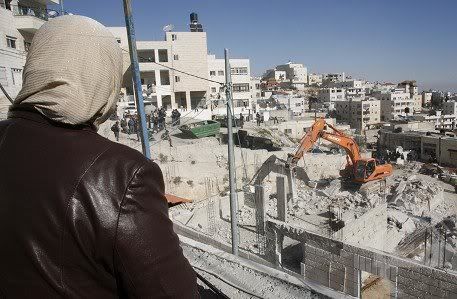
Building settlements in the occupied east Jerusalem neighborhood of Sheikh Jarrah began Sunday, just a few days before Israeli Prime Minister Benjamin Netanyahu was scheduled to meet with the US president.
The controversial construction plans, set at the site of the Shepherd Hotel, surfaced on the eve of Netanyahu’s previous meeting with Barack Obama three months ago, embarrassing the Israeli government.
Channel 10 reported Sunday that bulldozers had already arrived at the site, intended for 20 new Israeli homes.
Netanyahu has much to account for during his meeting with Obama, with occupied Jerusalem Mayor Nir Barkat’s controversial so-called ‘King’s Garden’ plan in Silwan. The plan orders the razing of 22 Palestinian homes.
A number of officials, including Israeli Defense Minister Ehud Barak, have claimed the Sheikh Jarrah and Silwan construction plans were purposefully promoted at sensitive times by extreme rightists hoping to embarrass the Israeli prime minister.
Peace Now said in a statement, “The mayor of Jerusalem and his partners in the right wing continue to decide the facts on the ground and harm Israel’s political status. Netanyahu must order Barkat to stop the construction in Sheikh Jarrah immediately.”
Jerusalem master plan: Expansion of Jewish enclaves across the city
The Jerusalem District Planning and Building Committee is set to approve a master plan that calls for the expansion of Jewish neighborhoods in East Jerusalem.
By Nir Hasson and Akiva Eldar | Haaretz | June 28, 2010
The Jerusalem District Planning and Building Committee is set to approve an unprecedented master plan that calls for the expansion of Jewish neighborhoods in East Jerusalem, a move largely based on construction on privately owned Arab property.
The committee’s proposal would codify the municipality’s planning policy for the entire city. In essence, Jerusalem would uniformly apply its zoning and construction procedures to both halves of the city.
Before giving the go-ahead, the committee will give objectors to the plan 60 days to submit their reservations. This is the decisive stage in the planning process, because only rarely are plans altered.
Once the 60-day period expires, the plan’s approval is a fait accompli. Such a development would probably invite a hail of criticism from the Palestinians, Arab countries and the international community.
The United States has recently communicated its expectation that Prime Minister Benjamin Netanyahu will prevent any change in the city’s status quo pending the conclusion of final-status talks with the Palestinian Authority. Netanyahu is scheduled to meet with U.S. President Barack Obama in Washington early next month.
For over a decade, dozens of architects have worked to draw up the latest Jerusalem master plan, meant to replace the one in effect since 1959, eight years before the Six-Day War. While the plan did not attract opposition from the international community and leftist organizations, political developments over the last year – including the spat with the United States over the Ramat Shlomo building project – are likely to touch off renewed diplomatic tensions.
According to a document prepared by Ir Amim, an NGO that “seeks to render Jerusalem a more viable and equitable city,” the master plan vastly underestimates the construction needs of the Arab population in the city. While the plan calls for 13,500 new residential units in East Jerusalem for Palestinians, updated demographic studies indicate that this amount barely represents half the minimum needs for the Arab population by 2030.
Ir Amim officials also said that while the plan allows for Palestinian construction in the north and south of the capital, it barely provides for an expansion of Arab construction projects in the center of the city, particularly in the area next to the holy basin.
The group added that the plan creates a spate of bureaucratic obstacles for Palestinians who wish to build in the city. Ir Amim warns that the plan is likely to be perceived as an Israeli provocation because most of the Jewish building projects are designated for areas east of the Green Line.
In October 2008, the district committee opted to promote a master plan submitted by Moshe Cohen, formerly the chief Jerusalem planner at the Interior Ministry. Right-wing political parties in Jerusalem protested to Interior Minister Eli Yishai over the plan’s intention to add significantly larger residential areas for the benefit of the Arab population at the expense of green areas.
Jerusalem Mayor Nir Barkat instructed his subordinates to alter the plan in line with his policy of thickening the Jewish presence around the holy basin and the eastern half of the city.
Despite the National Planning and Building Committee’s decision to designate the City of David – which sits in the heart of the East Jerusalem neighborhood of Silwan – as “a national park,” the new master plan allows for the construction of residential units in the area.
The Ir David Foundation, a nonprofit group that seeks to increase Jewish settlement in the City of David and whose heads are close associates of the mayor, has in recent years bought houses near the Old City in an effort to “Judaize” the area.
Last week, the Jerusalem municipality’s planning and building committee approved a controversial plan for the Silwan neighborhood that calls for razing 22 Palestinian homes built without permits and constructing a tourism center in their place. Barkat said the illegal construction in the area is preventing the municipality from building a tourism center, which would include restaurants and boutique hotels.
Earlier this year planning officials received an internal memo circulated by Cohen, who was later dismissed as head of the master plan staff. Cohen wrote that the plans for the City of David are an example “of the district committee’s ambitious intention to satisfy contradictory positions.” He warned that this would not pass legal muster.
Cohen objected to the city’s decision to convert 2,500 dunams that were listed as “open areas” into residential neighborhoods.
A Jerusalem municipality spokesman said in response: “Indeed, the plan will be brought for a discussion before the district committee.” A spokesman from Yishai’s office said: “Professional deliberations are taking place in an effort to approve the plan.”
Gilad Atzmon discusses the wars for Israel with leftist dupe
By Miriam Cotton | June 21st 2010
Introduction by Miriam Cotton
Gilad Atzmon is a world renowned saxophonist and musician with a deep political passion for humanist issues and concern for the fate of the Palestinian people. He has written extensively about the issue and been published widely. As a self-exiled, former Jewish Israeli and IDF soldier, Atzmon’s perspective within the raging public discourse on Palestine is relatively unique. His views are bitterly opposed by some among anti-Zionist Jewish groups, who accuse him of anti-Semitism and of being a ‘self-hater’.
Atzmon fiercely resists the charge of anti-Semitism and insists that he is concerned with a proper and thorough examination of the ideology of what it is to be Jewish – in particular about how the notion of the Jews as ‘a chosen people’ has led, as he sees it, inexorably to the rise of Zionism and its present disproportionate influence on world affairs.
Atzmon also takes issue with the Western Left which he believes has failed either to recognize the true extent of Zionist influence (he singles Noam Chomsky out for criticism) and of not understanding how western Marxist/socialist ideologies are incompatible with Islamic societies and therefore can be of no use to them. These and other issues are discussed with him below. There are many things in what Atzmon says below that beg further question and comment but hopefully the exchange has served to illustrate his interpretation of the Palestinian situation and to provide an insight on a less frequently aired or understood perspective.
Miriam Cotton: Following the murder and kidnap of unarmed aid activists in international waters by Israel, General Petraeus has said the situation [in Gaza] is no longer sustainable. Though he was in no sense condemning what Israel had done, do you think there may be a beginning of an end to unconditional US support for Israel?
Gilad Atzmon: It is actually the other way around. It is Israel that ditches America. Israeli leadership realises that with America in the background the Jewish state won’t be able to pursue its next two lethal plans: Nakaba 2 and dismantling Iranian nuclear capacity. Israel realises that if it wants to maintain its Jews only state as a regional power, it must ethnically cleanse the rest of the Palestinians. Israel is also convinced that its only chance of surviving in the region is if it maintains a nuclear hegemony. The USA makes things difficult for the Jewish State at the moment; it tries to slow Israel down. I believe that it is Israel that is leading the conflict rather than being subject to it.
MC: But surely that assessment overlooks some important factors. Nobody can seriously doubt that the US obsession with the region is entirely to do with oil, gas and geo-strategic matters such as Russian and Chinese proximity to these resources, in particular.
GA: This is a good way to put it. However you may also wonder what American interests are, who defines these interests and who shapes them. As it happens, AIPAC (American Israeli Public Affairs Committee) has been pretty effective in shaping American interests; we also know that the Wolfowitz doctrine made it into Bush’s doctrine. For the last three decades Americans failed to see the clear discrepancy between cheap oil and alliance with Israel. They might start to understand it now.
MC: But the Bush family was/is an oil dynasty too – with ties to as many if not more Arabic vested interests as to the Israelis – there are many more non-AIPAC, US vested interests like these than are in AIPAC. Everything the US has done there since the beginning of its so-called ‘war on terror’ – and long beforehand – has been aimed at securing the Middle East and about energy and other resources.
GA: This is all true. It is also true that AIPAC won’t necessarily interfere with unrelated political matters unless it involves Zionist, Israeli or Jewish interests. However, the Jewish lobby in America and in the UK has managed to shape the English speaking Empire’s vision of its needs and interests. From an American perspective, instead of admitting that American soldiers were actually sent to fight war for Israel, they were told instead that they were sent to die in the name of moral interventionism and democracy. They were actually told that they were ‘liberating the Iraqi people’. How wonderful! The oil and Israeli interests were presented as side issues. As we know, oil prices didn’t drop after 2003. And yet, Sadam Hussein, the bitterest enemy of Israel was removed. In the long run this plan didn’t work for Israel either. Iran had become the unchallenged Muslim leading power. Inshalah it also becomes a nuclear super power soon. This would obviously deter the Israelis from accomplishing its endless imperial aspirations.
MC: There is no other country in the Middle East in which the US and its allies could position the vast military threat that Israel has been made into if they are to achieve their ambitions for the region. The realisation of Zionist ambitions for Israel was and still is a secondary consideration for the US, despite the relatively powerful Israeli lobby.
GA: I am not so sure at all. I actually think that the Zionist Lobby has managed to destroy the American empire. I argue that the Credit Crunch is in fact a Zio-Punch. I argue that Greenspan created an economy boom to divert attention from Wolfowitz’ wars. The Zionists in fact have managed to bring down every super power they cling to. Britain, France and now America. You have to allow yourself to admit that the ‘War on Terror’ was actually a Zionist led war against Islam, a battle that was there to serve Israeli interests.
MC: Israel has been funded and encouraged to develop a nuclear arsenal of several hundred warheads, while the Iranians who do not even have one, but who control a lot of oil, are deemed to be a threat to world peace. Frankly, in these circumstances the Iranians and others would be justified in thinking they need some means of defending themselves against the only real threat at present- and against those who are in fact being the most provocative as well as doing the vast majority of the killing: US-Israel.
GA: This is indeed a very valid point. From an Iranian perspective, nuclear military capacity is a defensive means. The Iranians are constantly under a nuclear threat and so are the rest of the countries in the region and beyond.
MC: Britain and America don’t fight any wars that they don’t want to fight – not even justifiable wars, unless there is a percentage in it for them.
GA: Are you sure about this, or is that something we all prefer to believe? As it happens both in Britain and America the political parties are funded heavily by Jewish pro-Israel lobbies. Haim Saban, the multi-billionaire Israeli fund raiser for the American Democratic Party said last year that the best way to influence America is through political funding, the media and think tanks. There you go. Even the vision of ‘American interests’ can be no more than false interests when they have been manipulated into an alignment with what are really Israeli interests. At the end of the day, it is far cheaper to buy a western politician than buying a tank. It is far cheaper to recruit a ‘new friend of Israel’ than flying an F15 for one hour.
MC: Israel is essentially a creation of the British and other European powers – and the oil was firmly at the front of their minds even way back then.
GA: This is another myth that people like Chomsky want us to believe in. In fact the Balfour Declaration was there to pull America into the war. It was there to push Jewish German and Russian bankers to change their allegiance from Germany to Britain so they could fund the new American war. Amos Alon presents an embarrassing chapter in Jewish history in his monumental book The Pity of It All. In fact it worked for the British. Two months after the Declaration, America was in the war. This wasn’t about oil. It was another war funded by a Jewish political lobby.
MC: As with many other violent regimes that the US has propped up, the US doesn’t care one jot what Israel gets up to with its own people so long as the commercial plan is proceeding towards its goal. The ethnic cleansing of the Palestinians is just one of the incidental costs that has to be paid to keep the US’s bulldog in the region onside. Official US and UK statements after the attack on the aid flotilla were deplorable, with Obama for example declaring the deaths merely ‘regrettable’. This was a clear signal to Turkey: do that again and this is what we will give you. Get in line.
GA: America is talking in many voices at the moment. It is confused or may even be lost in terms of foreign policy. Partially because there is a conflict between the American interests and the lobbies that gave the democrats the keys to the white house, namely AIPAC.
MC: US-Israel can no longer get away so easily as it once did with propagandising the Palestinians’ cause as a nation consisting entirely of terrorists nor cover up the increasingly blatant horrors that are being visited on them. What General Petraeus was signaling, it seems, is that a new strategy is needed – one that is less horrifying to world opinion so that they can all get on with business without attracting so much negative attention to the details.
GA: I think that General Petraeus together with his military advisers are realising that America is about to lose its grip in the Arab and Muslim world. At the end of the day, if I need your oil, I had better make friends with you rather than being caught in bed with your biggest enemy.
MC: They obviously didn’t feel that way about Iraq. They have secured what they wanted there so far and next up is Iran. At the same time, it’s clear that the US has created a monster, Israel, in the Middle East that will prove much more difficult to rein in than was wanted or even envisaged in some respects.
GA: I agree with most of what you say. However, contemporary liberal democracy decisions are made by elected politicians that are bought by different kinds of ‘friends of Israel’. In America it is AIPAC and major Jewish fund-raisers such as Haim Saban whom I mentioned before, in Britain we had Lord ‘cash machine’ Levy and now the CFI (Conservative Friends of Israel). These pressure groups and individuals are there to suppress ethical reaction within the political system and beyond. However, following the last massacres in Gaza and on the Mavi Marmara, we saw a tidal wave of mass resentment towards Israel and its supportive Jewish lobbies. This is something that could lead eventually towards a cosmic shift also within politics.
MC: A different question – in the Irish version of the Sunday Times on the 6th of June there was an extraordinary article by one of Ireland’s foremost journalists, Matt Cooper, which was headlined ‘Israel presents a test of diplomatic skills’, I kid you not. Cooper begins the piece by acknowledging the atrocity committed by Israel on the Mavi Marmara but subsequently works his way around to recommending what he calls a ‘nuanced’ way forward that is devoid of morality or of even basic humanity. The murders and all the previous Israeli slaughters that he has just condemned are benched – presumably in the interest of what he calls ‘balanced’ opinion later on in the same piece. ‘Diplomacy’ and Ireland’s ‘economic interests’ are invoked so as to finesse the horrific truths of what is really happening to the Palestinians out of the equation or at least into the margins. We are invited to understand the feelings of successive Israeli governments and by implication to compromise with their murderous intransigence after all. He rehearses the same jaded myth that Israel is surrounded by hostility, while ignoring the terror that it has since its incarnation routinely threatened and inflicted on its neighbours and on the Palestinians with all the might of the US military at its disposal – and says nothing at all of the huge cache of nuclear weapons which it has threatened to use against Iran, which has no nuclear weapons.
GA: It is indeed very interesting. Today we learned that Israel insists to probe its own crime. This is maybe the latest phase in Israeli manifested lunacy, arrogance or ignorance. The murderer tells the authorities, it is ok I can look into my own acts, leave it with me. ‘My parents and my cousin can review my acts.’ This is indeed a way to challenge world diplomacy. Will Israel get away with it this time? I hope not. But if it does, it is there to prove to us all again that kosher lobbies are corrupting our ethical perspectives. Considering the fatal danger of a total war invoked by Israel, our leaders do not have much time at their disposal. Israel is the ultimate danger to world peace. It must be confronted with the ultimate measures now.
MC: I don’t agree that any sort of preemptive physical attack on Israel would be justified, if that is what you are referring to.
GA: I obviously do not refer to violence here but to some extreme measures of economic embargo, sanctions and cultural boycotts.
MC: To get back to the media, I’m asking what you think about the role the mainstream media has played in promoting the Israeli perspective. Senior journalists throughout the West especially, mostly talk in a register of language and from within a frame of reference that is essentially back to front on this and many other issues: the victims of outrageous Israeli aggression and illegality are described as terrorists for resisting while the most outrageous pronouncements and behaviours are ‘nuanced’ into an Orwellian inversion of meaning and truth – Matt Cooper-style. Unprovoked aggression is redefined as defensive action to protect ‘economic interests’ above all.
GA: As I mentioned before, Haim Saban states that influence is achieved through ‘political funding, media and think tanks’. You are concerned with media and ideology here. There is no doubt that in the English speaking empire we are facing a battle against a foreign ideology that was very successful in defining our needs, desires and notion of justice. It was also very successful in setting our notion of fear and terror. The neo-cons that were spreading the deceitful ideology of ‘moral interventionism’ via politics and media were largely Zionists with leftist roots. It is actually this ideology that signifies the horrifying shift of Zionism from the limited discourse of ‘promised land’ into global politics – namely ‘promised planet’.
You may want to ask yourself why their ideology was successful for a while, why did we let these people drag us into an illegal war and make us complicit in the murder of more than one million Iraqis. You may want to ask yourself how did the Wolfowitz Doctrine make it into American policy? I guess that ‘moral interventionism’ and ‘war against terror’ look nice on paper. It means that ‘we’ are kosher and the ‘other’ is evil. It took the West and humanity some time to realise that, in fact, we were serving an evil ideology and Zionist interests. It may also take us some time to realise that it is us who have become the darkest force around.
MC: Would you agree, that the complicit mainstream media narrative – which, as Chomsky has so clearly identified always runs in tandem with powerful economic perspectives – has been more powerful on Israel’s behalf than ten AIPACs could ever have been?
GA: Not at all because as Saban makes it plainly clear, there is a continuum between the fund raiser, the think tank and the media. In terms of British politics there is an obvious ideological continuum between the Political Friend of Israel (Lord cash machine Levy) the advocates for the war within the media (Aaronovitch, Cohen) and the British neo-con think tank ( Euston Manifesto ).
MC: One of the major reasons the mainstream orthodoxy is being challenged now is because of the advent of the far more democratic, alternative media?
GA: I don’t think so. It is challenged because there is a growing fatigue for Zionist politics, a growing realisation that tribal politics left a deadly stain on British and American foreign affairs. Also, following the second Lebanon war, the Gaza massacre and the latest assault on the Mavi Marmara, there is a greater realisation that Israel is a murderous state driven by morbid enthusiasm. But there is another reason that must be stated. For very many years, the Left blocked any attempt of elaboration on global Zionism and Jewish power. As it happens, aside from the recent weakening of the Zionist cause, the Left lost power within the solidarity discourse. To a certain extent the two political phenomena are linked. As we know, The Left has unfortunately failed to garner the emerging power of Islam and its immense power within the discourse of liberation.
As a result, the Left has been left behind. It is pretty much irrelevant to the discourse. For the Left to bounce back it must learn to think ethically and make a political bond with Islamic movements and migrant communities in the West.
MC: There are a number of things in what you are saying that I would challenge. Firstly, and ironically, somewhat like the Zionists themselves, you place them front and centre of everything that is happening. To disregard the motives and influence of the many other non-Zionist groups who are equally involved with them is similar to the disregard the Zionists show for others.
GA: There is actually again a continuum that you fail to detect between the sense of chosensess that is inherent to Zionism and any other Jewish political discourse and the Zionist political practice which is relentlessly exercised around the world. Zionists do not try to control everything, I guess that they do not care much about tobacco for the time being (this is probably why we cannot smoke freely anymore) but they do care about Western foreign affairs and would use any possible means to shape them. Look at the pressure Zionist groups mount on the American administration with regard to Turkey, Iran, sanctions, attacking the Mavi Marmara and so on.
MC: Not to defend what the US/UK/EU are doing, but to define their role as you do is almost to infantilise them – it is seriously to underestimate how powerful, dangerous and manipulative they are in their own right.
GA: To be honest, they are not as clever as people seem to think.
MC: Nobody sensible thinks they are being clever about any of this, but that they are capable of uncontrolled greed backed up with equally uncontrolled violence.
GA: Actually Israeli violence is far from being ‘uncontrolled’. It is deadly and premeditated. This is the true notion of Israel’s power of deterrence. Back to your question. In fact they do it all in the open. David Miliband, who is also listed as an Israeli propaganda author, was acting against British universal jurisdiction just to allow Israeli war criminals to visit the UK. How do you explain it? Was it very clever of him? Was it very clever of David Aaronovitch and Nick Cohen to advocate an illegal war while being also Jewish Chronicle (a UK Zionist outlet) writers? Was it a clever move to support a war that led to 1.5 million dead Iraqis? Is it very clever of Haim Saban to tell the American people ‘we the Jews influence your life through political funding, media, and think tanks’? The answer is no, it is not clever at all. It is an infantile arrogance that is inherent to the chauvinist identity. The success of the Zionist agenda so far has a lot to do with the fact that they operate within tolerant discourses and people like yourself and Chomsky would go out of your way to defend them with foggy ideology. Unfortunately, this ideology doesn’t hold water anymore. As you may know Chomsky is totally discredited. His lame argument against Walt and Mearsheimer, which is similar to yours, puts a big question mark over his entire life time project. This may be a shame but the good news is that the resentment towards Zionism, Israel and relentless Jewish lobbying is becoming a mass phenomenon. It exceeds the political discourse. It is a spirit, it is public and it is refreshing. This may be good news because we always wanted to be there, the only concern is that no one really controls it anymore.
MC: Where have these questions implied a defense of Zionists or Zionism? Merely to say that they are not alone in this or that they do not control what is happening in the Middle East on their own is in no way a defense either of their ideology or of their actions.
GA: To start with it is not a personal debate but and ideological one. However, I guess that failing to confront extensive Jewish lobbying is to provide Zionism with a body shield. You are talking about other American interests. What is so unique about AIPAC, David Miliband and CFI is the fact that right out in the open they promote the interests of a foreign government. Would a Muslim lobby get away with it? Could Iran or Pakistan get away with it? Would Chomsky rush to defend them as well? I really wonder.
MC: Chomsky has been a forthright critic of Israel’s – was only recently prevented by the Israeli government from attending an engagement. He has made some puzzling statements but again, I think you ignore overwhelming evidence that contradicts what you say about him.
GA: I have a lot of respect for what Chomsky did along the years. However, as American activist Jeff Blankfort pointed out recently, Chomsky has been dismissing the power of the pro-Israel lobby. He opposed the BDS movement and made some efforts to “dissuade people from using the term ‘apartheid’ to describe Israel’s control over Palestinian society”. Chomsky also opposes the Palestinian right of return and a one-state solution. Chomsky is in fact a liberal Zionist as well as a kibbutz enthusiast. This is enough to explain why his voice has been pushed to the margin within the Palestinian solidarity discourse. Considering his contribution on other fields of thought, it is a shame indeed.
MC: There is a lot that could and should be said in response to that but this discussion is not about Chomsky. AIPAC may be feted in Washington and London for now but it will go the way of all those who collaborate with the US in due course. As has been noted many times, US foreign policy makers think nothing of caricaturing former friends as villains when they stop being useful. The Israel-as-lone-defender-of-democracy-in- the-Middle-East myth has been forcefully sold for a long time, it’s true, but seldom if ever have the economic and strategic spoils of war been so great.
GA: Why was it useful? Is it because it is true? Not really. Israel has never been a democracy – it is a racially exclusive society that managed to set up a ‘Jews only democracy’. Americans are clever enough to understand it. They went through a civil rights struggle not that long ago and in fact they still do. The deceitful image of Jewish democracy was there to create a phantasmic continuum between the USA and the Jewish State. It is obviously far more complicated to explain to the masses how exactly supporting a hawkish Jewish state in a sea of oil would make oil cheaper.
MC: Isn’t your fundamental mistake in this respect that you are confusing or ignoring much of the quite independent and equally violent avarice of the other vested interests with the extent of AIPAC’s influence, which everyone knows is undoubtedly strong.
GA: With due respect and without claiming to be free of errors, I do not think that you are pointing to any mistake in my reading of the situation. If anything, all I can see is you being reluctant to admit that we had been pulled by an extensive institutional and very dangerous lobby for more than a while. In fact, I know that you and others are holding this position because you want to believe that you are true humanists. I respect it. Indeed one of the most crucial questions we have to confront here is how to say what we think about Israel and its Jewish lobbies and still be humanists. I believe that the answer is to admit that we are confronted with an ideology that dismisses our notion of humanism, kindness and compassion. To a certain degree we are confronted here with a deep challenge: ‘how shall we perform kindness to the unkind.
This is why it is so important for me to maintain that the massacre on the Mavi Marmara was no less than killing Christ again. Regardless of the historicity of Jesus and regardless of the fact that there is NO continuum between the ancient Israelites and the contemporary Israelis, we see here a broad daylight assault on goodness and kindness. This deadly attempt was supported by the Israeli people, it was committed by their popular army and it is still supported by world Jewry except some sporadic Jews such as the Torah Jews who oppose it and obviously are highly respected for it. How do we confront it? Call for what it is. This must be our approach because as far as I can see, the Israelis and their lobbyists interpret your silence or reluctance to use the right language as weakness. If we want to help Israelis we may as well make it clear to them that we actually see through them.
MC: It is important to understand Zionist ideology and to challenge and expose what is inhumane in it. Mainstream western media has been criminally complicit in its refusal to do that. But if the Zionists never existed, the US and its EU allies would be in the Middle East right now, or at some other time, doing exactly what they are doing – as they have done for centuries in many other parts of the world that the Zionists had nothing to do with. Also there are many Jewish people in Israel who have been courageously protesting the treatment of the Palestinians by their own government for a long time and who were very vocal after the Mavi Marmara.
GA: “Many” is just slightly over the top. A Palestinian spokeswomen in London was asked in the late 1990’s what she thought of all those ‘good Jews’, those who support the Palestinians. Her answer was shockingly simple yet revealing. She said, “I admire all these beautiful and kind people, all fifteen of them”. In fact I follow their discourse and I cannot count more than eight of them. I am far from being impressed by the ‘Jews for this’ and ‘Jews for that’. I regard it as a Zionist fig leaf operation. Especially when it comes from Marxist Jews. If they are indeed Marxist, why don’t they just join the working class and fight Zionism along side the rest of us?
I will now go back to your question. What would have happened if Israel didn’t exist? Since we are dealing here with a hypothetical assumption you may have to agree that USA/UK/EU could have also used very different tactics. Britain and America in the past used diplomacy also. If you read the history of Zionism, from the very beginning Herzl was capitalizing on super- power interests in the region. This is even before oil was an issue. So you can equally argue that the way things evolved was inevitable due to the nature of Zionist political philosophy of bonding with influential powers. Israel Shahak would argue that this is the heritage of the Talmud. I argue that this is the exact meaning of the Biblical Story of Esther. In my paper From Purim to AIPAC I explore the continuum between the Bible and contemporary Jewish political lobbying.
MC: At the crudest level of all, Israel may have 500 nukes courtesy of the US, but the US arsenal and its overall military capability is many multiples of Israel’s. No contest.
GA: This is pretty irrelevant, I am afraid. America is or at least was a super power. It was engaged in a cold war. This may explain rather than justify why it has so many bombs. However Israel engaged in a territorial battle with its so called ‘enemies’. One must wonder why it needs atomic bombs at all. If Israel cares about Sderot and Ashkelon as much as it says, it would never nuke Gaza. The answer is pretty devastating. Israel possesses all those bombs because it insists on keeping the rest of the world in a constant threat. In case anyone fails to see it, the rest of the world is what we call humanity. And this is the crux of the matter. We are dealing here with a lethal collective that is driven by deadly psychosis against humanity and humanism.
MC: The Zionists have no monopoly on deadly psychosis towards other groups of people. The native American Indians have told the world a thing or two about the centuries-long psychosis of the Christian settlers there – the misery that led to mass suicides among many other horrors. It’s surely fundamentally anti humanist – racist/discriminatory even – to single any one group of people out as being uniquely evil?
GA: To start with we both agree that the Zionists didn’t invent evil. In fact Zionism is an attempt to exercise some colonial barbarism in a world that has moved on from that kind of political philosophy. In short Zionists are guilty of committing colonial crimes 100 years too late. However, you make one crucial mistake here. You say “It’s surely fundamentally anti humanist to single any one group of people out as being uniquely evil.” You maybe right, but Zionism is not at all a group of people, it is actually an ideology. In fact it is a racist, anti humanist ideology that must be confronted. Similarly, those who follow this ideology are succumbing to an inhuman philosophy and must be exposed, named and shamed. As you will notice in my writing, I never criticize Jews as Jews or Judaism as a religion. I concentrate on Jewish ideology, namely Jewishness that has a very particular supremacist interpretation of the Judaic core. In my writing I have managed to trace Jewishness in every modern Jewish political setting whether it is right wing Zionism, the pseudo- socialist Bund or the radical Matzpen. However, I must mention that Torah Jews are free of that fault. They draw their inspiration from the Torah and present a very unique form of tribal humanism.
MC: You say the left has failed to embrace the ’emerging power of Islam’. Left wing groups within Islam itself do not seem to be meeting with a good reception by and large.
GA: I don’t understand what you mean by Left groups within Islam. Islam is in itself a philosophy that promotes equality; it doesn’t need Left ideology and cannot integrate such an atheist precept. I guess that what you are referring to is Left groups within the Arab or Muslim world. Indeed, the entire left philosophy is Euro-centric and related to the industrial revolution. These ideas are completely irrelevant to the Near East and its understanding of struggle for liberation.
MC: Outside of Islam, the left can only offer solidarity and encouragement.
GA: I guess that what you are taking about is producing badges, scarves and caps with Palestinian flags. This is indeed nice. I always quote Lacan in that reference. Lacan says that making love is in practice making love to yourself through the other. In that sense, the Left’s notion of solidarity is in practice ‘making love to yourself at the expense of the oppressed’. I am not impressed with this concept at all.
MC: That may be true of certain types of activism but it is unfair to caricature much Left solidarity with the Palestinians like that. The Freedom Flotilla was about a lot more than producing badges and scarves. There are many journalists and activists who have made serious and effective efforts to support the Palestinians from within the left – some who have even given their lives to keeping up vital communication. And besides, the badges and scarves have served a purpose too by making sure we are not allowed to forget.
GA: As it happens I was in Athens and in Nicosia when the Flotilla left. I was working closely with the Freedom Mission, I gave talks and interviews. I was also in touch with activists in Istanbul. I can tell you that the Freedom Mission to Gaza is indeed a very refreshing move within the solidarity movement. The so-called Leftists within this movement certainly are not frightened by Islam or Hamas. They certainly respect the Palestinian democratic choice. I admire them for that and wish I could have been with them on board.
MC: To return to the Left and Islam, however justified Iran may be to perceive Israel as the real Middle Eastern threat; trade unionists are having a pretty hard time in Iran right now, for example. What is it that you think the left can or should be doing?
GA: To start with I do not talk about the Left in Iran, Iraq or Palestine. I am talking about the Left here, in Europe. The first thing to do is to accept the notion of otherness. For instance: to stand up for Hamas as a democratically elected body; to stand up for Hezbullah which presents Israel with fierce resistance; to support an Iranian nuclear project as a necessary defensive means; to support the Muslim right to love their Allah and to fight for freedom in his name. These things are rather basic and elementary. The left must also realise that Muslim migrant communities in the West are the first sufferers of cultural, social, racial and political oppression. If the Left wants to maintain ideological and ethical relevance it must join forces with these ethnic groups. It is also possible that the Western Left has already missed the train; this would mean that it belongs to history.
MC: I really cannot agree with some of what you say here. The Left is generally very aware of the need to respect cultural differences in Islam and has done more than any political grouping on either the centre or right to forge links and to challenge the discrimination suffered by migrant groups. As with Christianity, Judaism and other religions Islam has its faults.
GA: If this is the case, how do you explain the fact that the Left was so slow to accept Hamas? How many leftists support the Iraqi resistance? And what about the Taliban? Do you support any of those? I cannot agree with your statement about Islam and other religions. You are here employing a typical liberal supremacist approach. You set yourself in an imaginary elitist position above and beyond your subject of criticism. If you want to criticize a body of thought you can only do it by means of deconstruction, by tracing inconsistency within. In order to do it you must first achieve a reasonable familiarity. This is by the way, what I try to do with Zionism and Jewish identity. I am obviously familiar enough to deconstruct different forms of Jewish discourses. I am less familiar with the Judaic discourse and leave it out.
MC: There is nothing supremacist in the question – I explicitly say that all religions have their faults – but let me be clearer: women and homosexuals have been oppressed by most if not all religions to a greater or lesser extent. To criticize Islam for the same oppression in no way implies either that the problem is unique to it or that matters are perfect elsewhere.
GA: Miriam you are implying here that while Christianity and Jewish identity ‘moved on’, Islam was ‘left behind’. To be honest with you, I must admit that the dichotomy between the ‘Progressive’ and the ‘Reactionary’ is another symptom of Judaic binary opposition within the left discourse. Progressiveness is just another word for Choseness.
MC: Oppression is oppression the same as occupation is occupation.
GA: I obviously do not agree. Oppression is very complicated to define. Occupation, on the other hand, can be defined in positive terms such as territorial and legal.
MC: There is still much oppression of women and of homosexuals which cannot be explained away as mere cultural difference. Criticising these things should not be a cultural taboo any more than criticising Zionism should be an anti-Semitic taboo.
GA: Sorry, I do not agree with you at all. There is a clear differentiation between the liberal Western discourse that celebrates individualism and the Eastern tribal discourse that values family, the community and culture. You tend to believe that you uphold some higher ethical system that allows you to pass judgment on other cultural assets that are foreign to you. You are obviously not alone. This is the nature of popular culture within the post Enlightenment discourse. I would argue instead that true tolerance is the capacity to accept even when you fail to understand. I myself obviously treat women and gays with total respect and fight for their equality within my environment. However, rather than criticising certain Islamic cultures I try to grasp its political and religious attitude towards different groups. I suggest everyone who claims to care about solidarity should do the same.
But before we move on, please let me address your last point.
As long as you argue that ‘X attitude towards Y is oppressive from a liberal perspective’, you may be correct, your argument could be valid and consistent. However, once you claim that ‘X attitude towards Y is oppressive categorically’ you produce an argument that is no different from a Neocon or moral interventionist. You basically claim to be better and more ethical than X.
These Issues are not simple. I can provide a solution but I guess that I have managed to formulate the complexity.
MC: How then is this different to your intolerance for what Zionists too would argue is their culture and belief in choseness and all that that has led to?
GA: This is very simple indeed. Zionist crimes are committed at the expense of other [peoples].
MC: You say you are a humanist. There is no humanist argument to justify the mutilation of girls’ genitalia and the lifelong misery that it causes to women.
GA: How do you know? Can’t you see that in order to make such a statement valid you have to set yourself beyond and above the human discourse? However, I obviously understand your point of view from a Western perspective. I am very suspicious of any call for moral interventionism. And just let me correct you. I do not carry the humanist flag. I am looking for the notion of humanism. As far as I can tell it is a dynamic notion. Like ethics it must be reshaped and revised all the time.
MC: I realise that not all Muslims endorse FGM. But these things are as sick as each other. Again, there are comparable evils in most if not all religions, societies and cultures – this is not to single Islam out.
GA: I am happy that you mentioned it because as far as I am aware, and I am not exactly an expert on the subject, FGM is not at all prescribed by Islam. However, just to mention that I do not remember coming across Left or Liberal criticism of similar Jewish ancient blood ritual that involves blood sucking and chopping of male infant sexual organ (Brit Mila). As it happens Jewish parents, both secular religious let a Rabbi circumcise and suck the blood of their sons when they are just 8 days old. How do you explain the fact that such a barbarian ritual takes place in our midst? Why doesn’t it provoke outrage? Why do you yourself not protest against it?
MC: It is not possible for a genuine humanist to look the other way wherever inhumanity is occurring, whoever is responsible for it. You are applying a double standard in this, I think. You defend FGM on cultural grounds but describe a comparable Jewish ritual as barbaric.
GA: It is rather obvious that when I refer to a Jewish blood ritual, I am criticising it from a western point of view by means of deconstruction. I live in the West, I tend to understand western ideology and culture and I am capable of pointing to a clear discrepancy between the human rights of a child and blood ritual. However, I am far less convinced that Western liberals possess the capacity to pass an ethical judgment regarding cultures that are remote to Western values and way of life. And yet one question remains – why is the liberal mind so concerned with FGM that is carried out in Africa, and not at all troubled by a similar Jewish blood ritual that is practiced in our midst.
MC: To move on to the next question, however. That Muslims – or anyone anywhere – should be free to fight for freedom from violent invasion and occupation is axiomatic for most people, though not for pacifists of course. Invoking God for the purpose has never been anything other than a disaster, hasn’t it?
GA: Really? Here is where you tend to express your intolerance towards other’s belief. The greatest symphonies and architecture were actually created in the context of a dialogue with God. Islamic resistance that defeats Israel and Western imperialism whether it is in Iraq, Afghanistan, Gaza or South Lebanon is inspired by Allah. Why are you so disrespectful to God? In fact, I believe that you are failing to detect the importance of Islam within the context of Arabic and international resistance. It is peculiar but tragically rather common amongst leftists. As I said earlier on, this explains why the left lost its relevance.
MC: There are a lot of unfounded assumptions in what you say but we will have to leave it there. This has been an interesting debate. We will have to agree to differ on a number of things. Thank you for the conversation.
GA: I too enjoyed it enormously and I really hope that the difference between us will lead to a further debate and many more realizations.
‘The wall ruined my life, separated my family’
Ma’an – 24/06/2010
Bethlehem – The demolition of a Palestinian man’s home on Monday was his final lost battle in a string of defeats going back to the 1990s, the Beit Jala man told Ma’an.
In 1992, Israel confiscated several hundred dunums of land belonging to the family, where the tunnels system was created to connect the illegal Israeli settlements of Gilo and Bettar Illit with Jerusalem. What was left undeveloped on the far side of the tunnel road was confiscated, and the farming family was left to find a different source of livelihood.
In 1997, Anton married a Jerusalemite woman, and the two decided to settle in the holy city, where Anton could work. After some effort, they successfully registered him as a Jerusalem resident, and they had two daughters who were also accorded Jerusalem residency status. Anton was able to find work and the family started anew.
In 2004, however, as the final route of the separation wall was set, his family was handed a home demolition targeting ancestral buildings in Wadi Ahmed, on the lands that remained in their possession.
Worried that more of his family land and property would be confiscated, Anton moved back to the home, in an attempt to protect the area from further Israeli encroachment. He said he was worried that the land would be declared abandoned, and his family would lose all that remained.
On the property were two homes, one ancient and one modern. The older building was said to have been several hundred years old, and was used by his family as a Qasr, or an agricultural building where relatives would stay during the harvest season. The building traditionally stored tools and food for the family for the summer and early fall.
“They began asking me questions in 2006,” Anton told Ma’an, “they found that my ‘center of life’ was no longer Jerusalem so in 2007 they stripped me of my Jerusalem residency card.”
Without the card, Anton, like all other West Bank Palestinians was no longer permitted to enter Jerusalem. “I could no longer see my wife, my daughters,” he said.
Anton remained in his Beit Jala home, and his wife and daughter would visit him on weekends and evenings when they could. Then on 25 May 2010, Anton was handed an demolition order for his home and the agricultural building nearby.
The demolitions were carried out on Monday, as the path of Israel’s separation wall continued to wind southward.
Palestinian Jerusalemites go work abroad and get residency revoked upon return
Amira Hass | Haaretz | 20 June 2010
Palestinians who choose to study and work abroad are finding out – too late – that they have imperiled their right to return to their hometown.
Last Wednesday afternoon a “shabah,” an illegal sojourner, sat in the small conference room of Jerusalem District Court Judge Noam Solberg. That’s how he was described by Solberg and a representative of the Interior Ministry, attorney Gur Rosenblatt. The illegal resident reads and writes Hebrew, but in the small room he had difficulty following the learned claims of the judge to the effect that a person born in Jerusalem’s neighborhood of Sur Baher 43 years ago, whose parents and grandparents and great-great grandparents are from there, who went to elementary school and high school in Jerusalem, who recently paid NIS 120,000 for a construction permit from the Jerusalem municipality, is an illegal sojourner. In other words, a criminal.
Meet the criminal: Dr. Imad Hammada. He’s a father of three, with a fourth on the way. Married to a nurse who works for the Leumit HMO in Jerusalem. This biography includes other elements that could sound very Israeli: studied electrical engineering in the United States and worked in Silicon Valley to pay for his doctoral studies and to get experience. Speciality: nanotechnology. Frequent visits to his family at home, in Jerusalem.
True, his stay abroad lasted longer than expected, from 1989 to 2007. That’s familiar to us, too. Now, three months after receiving his doctorate, in August 2007, he and his family packed their suitcases and returned home, a year after he received American citizenship. An Israeli company and an American company with a branch in Israel wanted to employ him and changed their minds. The Interior Ministry informed them that he was a tourist.
Tourist? How come? That is how he discovered that the Interior Ministry had revoked his residency status. Through attorney Leah Tsemel he petitioned the Jerusalem District Court sitting as a Court for Administrative Matters, against the revocation of his permanent residency permit. For the past three years he has been living in his homeland, in his city, in his parents’ home – without health insurance for the children, without rights, in constant danger of arrest and expulsion.
“The prolonged illegal stay in the country is to the detriment of the petitioner,” said Judge Solberg in a stern voice. He said that it could be a reason for rejecting the petition out of hand. In the corridors of the District Court on Salah al-Din Street it was said that as opposed to liberal judges David Cheshin and Yehudit Tzur, who have left, Solberg is known for summarily rejecting similar petitions. It turns out that this time Solberg had inner conflicts, as he put it.
It’s natural to go abroad
On the one hand, he said, the illegal stay causes us “to say that this is a reason for rejecting the petition out of hand.” On the other hand, the judge said: “It’s natural that people go [abroad] to study and stay for a while. There’s room for a certain amount of forgiveness when you read that the man works in Herzliya (for a Taiwanese company with a branch in Ramallah ) and his wife works…. My initial feeling is that his connection with Israel is sincere.”
Attorney Rosenblatt mentioned the “illegal stay” of the petitioner several times. Tsemel objected: This argument has not come up until now. My client entered legally and was born here and you know that it’s his right to be here. In principle, said Rosenblatt, “he can leave the court and be arrested by a policeman because he’s an illegal sojourner.” And Tsemel: “In principle he can leave the court and be arrested because he’s an Arab.”
Solberg tried to calm things down. He said he was actually seeking a compromise. Let the petition be erased, he suggested, and let Dr. Hammada ask to begin a proceeding for “family reunification” (with his wife ). The parties had to reply by today. Afterward, next to the stairs, Rosenblatt would explain to Tsemel that it was nothing personal, but that he was operating according to the law.
The 1952 Law of Entry into Israel determines that anyone who is not an Israeli citizen or the holder of an immigrant’s permit or immigrant’s certificate does not have the right to live in Israel, and his residency in Israel is conditional on a residency permit that has been granted to him according to this law.” The Law of Entry was imposed on Palestinians living in that part of the West Bank – East Jerusalem and the surrounding villages – that was annexed to Israel in 1967. “Israel entered us,” bitterly say the people to whom the Law of Entry applies, “It wasn’t we who entered it.” Solberg mentioned that there is logic to the statement that the case of a (non-Jewish ) Frenchman who immigrated to Israel is not the same as the case of a Palestinian who was born in Jerusalem. But it wouldn’t be right, he said, to discuss the matter of principle in connection with the present petition.
In addition to the Law of Entry there are regulations for entry into Israel which stipulate that the expiration of the permanent residency permit: A person will be considered to have settled abroad if one of the following conditions exists: he lived outside Israel for a period of at least seven years; he received a permanent residency permit in that country; he received citizenship of that country. One of the three conditions is sufficient to revoke the resident status of a Palestinian in East Jerusalem.
Until the end of 1995, the authorities were flexible and made do with visits by those living abroad at intervals shorter than “seven years of absence” in order to maintain residency. But in December 1995, during the term of Haim Ramon as interior minister in the short-lived government of Shimon Peres, the policy changed. Without previous warning, people who lived abroad but came for frequent visits discovered that their resident status had been revoked. A prolonged public battle – which involved Palestinian, Israeli and international organizations – created pressure that produced results early in 2000, when the interior minister was Natan Sharansky. In a declaration to the Supreme Court, he promised that the policy would revert to the pre-1995 practice. For those living abroad for any reason, their periodic visits would once again maintain their residency, whereas those who had lived abroad in the past (or who were living, for lack of housing, in a part of the West Bank that had not been annexed to Israel ) would get back their residency status if they proved that the center of their lives was in Jerusalem. With the outbreak of the second intifada in 2000, the Interior Ministry resumed mass revocation of the permanent residency status of East Jerusalem Palestinians.
Imad Hammada is one of 289 Jerusalemites whose residency was revoked in 2007. In 2008, the residency of Murad Abu-Khalaf, 33, a native of Ras al-Amud, who has a doctorate in electrical engineering, was revoked. His family lived in the Baka neighborhood in West Jerusalem, from which it was expelled in 1948. The eight pages of his resume include a series of scientific publications, areas of expertise, fields of research, lectures, awards and prestigious places of work. In 2007, he completed his post-doctorate (with a stipend from the research division of the U.S. Army ). He also visited his family periodically. He knew that upon his return it was likely that he would not be hired for work in Israeli firms, and that he would teach at university. “I wanted to get some experience in the professional world outside the university,” he said two days ago in a phone conversation from his Boston home.
An engineer in Boston
Since 2007, he has been working as a software engineer in an American firm in Massachusetts, The MathWorks, whose clients are the aircraft industry and security firms, including Israeli ones such as Rafael. The U.S. requires those employed in its security industry to receive a green card. This is not permanent residency for family reasons, or that of an asylum seeker – but for purposes of work only, emphasized Abu-Khalaf in the conversation. “Had I known that a green card would lead to the revocation of my right as a resident of Jerusalem, I would have returned after the post-doctorate. But what could I have done then, without practical experience? Sold falafel?”
Deliberations on Abu-Khalaf’s petition will take place in his absence before Solberg next Thursday. Since January 2009, Abu-Khalaf has been seeking legal redress, also with the help of attorney Tsemel. His frequent but short visits (because of job commitments ) in 2009 did not satisfy the authorities. The validity of his travel document expired in January 2010. Since then, he hasn’t seen his parents and his brother. His entire family lives in Jerusalem. His father is a family doctor, his brother is a doctor who works at Shaare Zedek Medical Center in Jerusalem. He lives in Boston and he misses his friends and the streets of his childhood.
Attorney Achva Berman, an assistant to the Jerusalem District Prosecutor’s Office, explained her opposition to permitting his return to Israel: “The policy of the Interior Ministry is a consequence of the sovereignty of the state and its exclusive authority to decide who can remain in its territory. For that purpose stringent criteria were determined, based on weighty humanitarian considerations… The acquisition of the status of a permanent resident in another place in the world… is what leads to the expiration of residency… In recent years (the petitioner ) has even been working in the U.S. By doing so the petitioner severed his connection with Israel.”
Abu-Khalaf is one of 4,577 Jerusalemites whose residency was revoked in 2008, according to the data provided by the Interior Ministry to the Center for the Defense of the Individual. That is the highest number of residency revocations since the policy began in 1995. The previous record was in 2006 – 1,363 people whose residency status expired. In 1995, the number was 91. In 1996, the number 739. In 1997, there were 1,067 cases. In 1991, the number was 20.
It’s believed that the vast majority of cases are people like them – Jerusalemites who went abroad for reasons of higher education and work experience, with the aim of returning after acquiring that experience and funding – intending to ameliorate the quality of their society. Expelling them from their country and from their hometown is the other side of the statistics of poverty and misery that typify Palestinian Jerusalem, which is under Israeli control.
Amira Hass is the Haaretz correspondent for the Occupied Territories. Born in Jerusalem in 1956, Hass joined Haaretz in 1989, and has been in her current position since 1993. As the correspondent for the territories, she spent three years living in Gaza, which served of the basis for her widely acclaimed book, “Drinking the Sea at Gaza.” She has lived in the West Bank city of Ramallah since 1997. Hass is also the author of two other books, both of which are compilations of her articles.
Settlers target ‘shared cities’
By Mya Guarnieri | Al-Jazeera | June 21, 2010
Jewish settlers storming the garden of an elderly Palestinian woman may seem like something you would expect to happen in Hebron, not cosmopolitan Tel Aviv. But that is exactly what happened to Zeinab Rachayel, an Arab resident of Tel Aviv’s mixed suburb, Yafo.
Rachayel was in her courtyard on a Sunday afternoon when several buses full of settlers from the West Bank arrived, parking nearby. Armed with Israeli flags, young men lined the sidewalk outside her home chanting “this is our land”. One by one, they entered her garden, until Rachayel was confronted by dozens of settlers in their late teens and early twenties.
“Another one entered and he said, ‘Listen, you’re not staying here. Yafo is just for Jews. Get out of Yafo,'” Rachayel says. The men continued to threaten and intimidate her, repeatedly saying that the Arab presence in Yafo is only temporary.
A cultural hub
Yafo was once Jaffa – the cultural and economic hub of Palestine. Battered during the 1948 Arab-Israeli war, the conflict that surrounded the creation of the Jewish state, Jaffa’s population plummeted as residents fled or were expelled from their homes.
Jewish immigrants quickly took their places and in 1950, the Tel Aviv municipality swallowed Jaffa, renaming it Yafo.
Today, some 60 years later, the twin forces of settlers and gentrification means the area’s Palestinian community are again facing an existential threat.
On that Sunday afternoon, one of Rachayel’s sons arrived. He used his belt, waving the buckle, to chase the settlers out of the garden. Eventually, the police arrived, but no arrests were made.
Rachayel asks: “If this had happened the other way around, to a Jewish family, what would they have done?”
She stresses that, as is the case in other mixed areas of Israel, Jews and Arabs have long enjoyed close relationships in Yafo. Rachayel grew up next to a Jewish family and recalls how the children were like brothers and sisters to her.
But, she says, ties grew tense during the first Intifada. And now, with settlers trickling into Yafo, Rachayel feels the mood darkening again. “It’s sad,” she tells me.
Going mainstream
Sami Abu Shehadeh, the head of Yafo’s Popular Committee Against Home Demolitions, estimates that approximately 50 settler families are scattered throughout Yafo.
They began moving to mixed cities in the wake of Israel’s 2005 withdrawal from the Gaza Strip in a bid to make themselves more familiar to Jewish Israelis and to garner mainstream support.
It is also an attempt to stay on the political radar, Abu Shehadeh says.
“If any of the Israeli prime ministers will have the guts to take a settler out of the West Bank, they will set Israel on fire from the inside. It’s not that they’re going to demonstrate in the settlements. Now they’re here, in the heart.”
Writing for Haaretz, right-wing journalist Nadav Shragai has aligned the settlements inside mixed cities as a battlefront in the so-called demographic war between Arabs and Jews.
“Israel, as the state of the Jewish people, is losing its grip on these cities,” he wrote, adding “settlers in Judea and Samaria have dispatched their best people and rabbis to [Yafo], Acre, Lod and Ramle”.
Forcing Arabs out
Bemuna, a construction company whose name means “in faith”, aims to bring another 20 such families to Ajami, a predominantly Palestinian area considered the heart of Yafo’s fragile Arab community. Bemuna is planning an apartment complex that will be exclusive to national-religious Jews.
“They started in East Jerusalem,” Abu Shehadeh says. “Then they had a big project in Lod. Then they went to Akko. Now, they are coming to Yafo.”
The move, Bemuna claims, is intended to strengthen the Jewish community. But critics point out that rather than building in one of Yafo’s underprivileged Jewish areas, Bemuna purchased land where very few Jews live. The plans to build in Ajami, critics say, are a provocation at best; at worst, it is an attempt to push Arabs from the area.
Abu Shehadeh and other members of the local leadership are concerned with the closed nature of the development. “We felt it is racism, so we went to court.”
Tel Aviv District Judge Yehuda Zaft ruled against the petition, which contested the project’s discriminatory selection of residents and was filed by over a dozen organisations, including the Association for Civil Rights in Israel (ACRI). The group is appealing the decision and on June 21, the Israeli supreme court will hear the case.
Creating new realities
But no matter what the supreme court rules, Yafo will remain embroiled in problems.
Residents are deeply troubled by a recently opened yeshiva, or Jewish institution for religious studies. Like many found in the West Bank, Yafo’s yeshiva is an ideological training ground for national-religious men who intend to join the army. And it is led by Rabbi Eliyahi Mali, who hails from the settlement Bet El.
Speaking to Israeli Channel Seven, Rabbi Mali called his work in Yafo “an important mission like no other,” adding that if West Bank settlements “would send one tenth of their residents to large cities … this one tenth of people imbued with faith will establish a community, a yeshiva, and a centre amidst the Jewish populace, which will create a different reality than we know today”.
Abu Shehadeh says: “In their vision, this [Palestinian] neighbourhood does not exist in the next 10 years.”
It is a common sentiment amongst Arab residents – the yeshiva is a sign of a takeover, an attempt to turn Yafo into a West Bank settlement.
Palestinian residents report that they have been verbally harassed by yeshiva students. Now, they avoid both the building and the street it is on, out of fear of further altercations.
Ihlas Yateen, a Palestinian resident of Yafo, calls the yeshiva and settlers “dangerous”.
“What are they doing here?” she asks.
“I don’t know why the state lets them do it. They can’t forbid them from entering here? What, they’d let [Arabs] enter Bnei Brak?” she adds, referring to the Orthodox Jewish city near Tel Aviv.
Highest bidders
Her comment points towards gentrification’s role in Yafo’s problems.
The government-controlled Israel land authority sells to the highest bidder. In the case of the lot slated for the 20-unit settlement that was Bemuna. Money dictates who can buy where.
Yafo’s Palestinian residents point out that, for the most part, their community is poor. And Ajami is the weakest link. Perched on a hill close to the sea, Ajami is also prime real estate.
Yehudit Ilani, a Jewish Israeli resident of Ajami and an advocate for Palestinian home and land allocation rights, explains that the Israeli government has strict codes regarding houses in Yafo.
If a growing family adds a room to their home or fails to maintain a building’s appearance in accordance with the state’s standards, they face astronomical fines, eviction or demolition.
Once a home has been emptied or destroyed, the land authority can sell the plot.
“There are 498 court cases to kick people out of their homes,” Ilani explains. Of these, all but one are against Arab families. The only Jewish family facing eviction are an impoverished Mizrahi (Arab Jewish) family.
Ilani says there are other residents facing eviction as the land authority seeks to cash in on a hot market. These families receive some compensation, she explains, “but it’s not enough money to get back in the market”.
Ilani points out that, as the Palestinian community is “being torn apart,” the state can make the choice not to sell the property. “They’re hiding behind the market, denying that a nationalist principle is involved,” she says.
“Gentrification is being used as a method of ethnic cleansing, in effect.”
From sharing to segregation
Ilani says the Jewish Israelis who decide to live in Yafo are not the problem. Rather it is the state policies that are “part of a much larger picture” threatening the area.
This has dangerous implications for the state, Ilani says. “It’s a completely segregated society. Only in the shared cities is there some sort of a discourse, a dialogue, knowing each other. The shared cities could be the basis of a way of living together.”
But gentrification and settlers are chipping away at this hope, little by little.
Esther Saba is a Palestinian resident of Yafo who faced demolition due to an unauthorised addition to her family home. She points out that when the bulldozers arrived, Jewish Israeli activists played a pivotal role in saving her home, standing in the front yard and on the roof to guard it.
“There is no problem with regular Jews,” Saba says. “We have a very good connection.”
But the growing presence of settlers is worrisome, Saba says. “They don’t want [Arabs] here in Yafo.”
Neither Bemuna nor Yeshivat Yafo responded to multiple requests for comment.
Israel threatens deportation for Jerusalem protesters
Ma’an – 21/06/2010
Jerusalem – Israel is set to take action against the Palestinian residents of East Jerusalem, sources told Ma’an, as media reports claim municipal officials will soon begin mass demolitions of Al-Bustan homes.
Hebrew media quoted Israeli security circles in Monday morning reports, recommending the municipal and federal government give directives to the interior ministry and National Insurance Institute to use their weight to impose sanctions on Jerusalemite families whose children partake in protests against Israel.
Punishments, the sources said, will include the revocation of Jerusalem residency rights, re-evaluation of taxes owed and reduction in welfare benefits to the tax-paying residents of Palestinian neighborhoods.
The Jerusalem Center for Social and Economic Rights said in a statement released the same morning, that several complaints from Jerusalemites had already been received, as families were threatened with deportation. At least two teenagers known to have been involved in protests against Israeli settlers, home evictions and planned demolitions, received unofficial warning from Israeli intelligence officers.
The two were told they would be deported if they continue to “incite” against the state of Israel.
Four Palestinian lawmakers affiliated with Hamas’ Change and Reform bloc were given notice that their Jerusalem residency was being revoked, while Director of the Palestinian prisoner’s society in Jerusalem Nasser Qaws and senior Fatah official Hatim Abdul Qader were also put on alert by Israeli forces.
In 2008, Israel revoked 466 Jerusalem residency cards, with the number expected to skyrocket for 2010.
Silwan demolitions
A news conference for Israel’s Jerusalem Mayor Nir Barakat is set to announce the construction of a national park on what will be the ruins of at least 88 homes in the Al-Bustan area of Silwan, in East Jerusalem, as plans to start demolitions will be authorized on Monday, Israeli media reported.
Palestinian residents of the neighborhood plan to hold a news conference of their own, and continue to push the municipality to accept an alternative city planning initiative, that would see the area “greened” and involve zero forced home demolitions.
Under the Israeli plan, families in the western half of Silwan must move into the homes of families from the eastern half as theirs were set for demolition under the city planning guide. Residents of the eastern section who refuse to accommodate families, alternative planner Youssef Jabareen told Ma’an, will also face home demolitions.
Reclaiming Self-Determination
Will a Palestinian state, no matter how sovereign, fulfill the Palestinian right to self-determination?
Ali Abunimah | 20 May 2010
Ali Abunimah reviews the evolution of the concept of self-determination, its applicability to the Palestinian people, and its gradual erosion since 1991. He argues not only that self-determination must return to the center of the Palestinian struggle; he also shows how the Palestinian exercise of this right can be compatible with eventual coexistence with Israeli Jews.
How the “peace process” eroded self-determination
In his 1974 speech to the United Nations General Assembly, Palestine Liberation Organization Chairman Yasir Arafat addressed “the roots of the Palestine question,” declaring, “Its causes do not stem from any conflict between two religions or two nationalisms. Neither is it a border conflict between neighboring States. It is the cause of a people deprived of its homeland, dispersed and uprooted, and living mostly in exile and in refugee camps.”
How ironic then that the “peace process” has re-conceived the Palestine question precisely as little more than a border dispute between Israel and a putative Palestinian state. The “roots” were first reduced to a laconic list of “final status issues”: borders, settlements, Jerusalem and refugees and then gradually buried. Lost has been any commitment to self-determination in principle or in practice.
Although they have rarely been formally discussed, it has long been conventional wisdom in peace process circles that the “final status” issues have already effectively been settled, largely according to Israel’s requirements (we have heard ad nauseam the refrain “everyone knows what a final settlement will look like”). The United States and its hand-picked Palestinian leaders have accepted that large Israeli “settlement blocs” housing most of the settlers, will remain where they are in the West Bank.
The same formula has been adopted for Jerusalem, as per the so-called Clinton parameters: Israel would get “Jewish neighborhoods” and the Palestinian state would get “Arab neighborhoods.” What this means in practice is that Israel would keep everything it illegally annexed and colonized since 1967, and Palestinians might get some form of self-rule in whatever is left – which is shrinking daily as Israel aggressively escalates its Judaization of eastern Jerusalem. While everything east of the 1967 line is divisible and “disputed,” the same does not apply to the west. Palestinians would not be entitled, for example, to seek the return of their West Jerusalem neighborhoods ethnically cleansed and colonized by Israel in 1948. The “peace process” has actually created an incentive for Israel to accelerate its colonization of eastern Jerusalem because Israel knows that whatever is left uncolonized would become the new maximum ceiling of what the United States and other peace process sponsors would support as Palestinian demands.
Similarly, the refugee question has been virtually “settled” as well. Palestinian Authority-appointed chief negotiator Saeb Erekat revealed in a paper he circulated last December that Fatah leader and acting Palestinian Authority President Mahmoud Abbas had proposed to Israel that no more than 15,000 Palestinian refugees per year for ten years return to their original lands in what is now Israel.1 According to Erekat, then Israeli Prime Minister Ehud Olmert had countered with an offer of 1,000 refugees per year for a period of five years. In other words, the parties had already agreed to abrogate the fundamental rights of millions of Palestinian refugees, and were haggling only over the difference between 5,000 and 150,000, or less than three percent of the Palestinian refugees registered to receive services from UNRWA (the United Nations Works and Relief Agency for Palestine Refugees in the Near East).
So what is left to negotiate? Camille Mansour’s policy brief accurately summarizes the outstanding issues – as seen from within the peace process – the final borders and attributes of sovereignty of the Palestinian state. Mansour doubts that negotiations in present circumstances would lead to a peace treaty in which “Palestinian sovereignty requirements could be attained.”
Let us assume for the sake of argument that Israel were to agree to a Palestinian state in the West Bank including East Jerusalem, and the Gaza Strip that satisfies official Palestinian positions and provides for a state no more or less sovereign than any other. The question that then arises is: Does this sovereign state provide for the self-determination of the Palestinian people? Does it restore and guarantee their fundamental rights? As argued, below, the answer is a clear no. And this underscores the need to distinguish the limited goal of sovereignty from that of self-determination.
Sovereignty is exercised by a state through the fulfillment of commonly agreed functions: effective control of territory, borders and resources, and maintenance of political independence among others. Self-determination is exercised by a people legitimately inhabiting a given territory. Self-determination may result in a sovereign state, but it may not. It is fundamental to understand this difference and to recognize that self-determination remains at the heart of the Palestinian struggle.
Understanding the principle of self-determination
The principle of self-determination as it is understood today was enunciated by US President Woodrow Wilson toward the end of World War I. In Wilson’s words, “the settlement of every question, whether of territory, of sovereignty, of economic arrangement, or of political relationship” is to be made “upon the basis of the free acceptance of that settlement by the people immediately concerned and not on the basis of the material interest or advantage of any other nation or people which may desire a different settlement for sake of its own exterior influence or mastery.”2
Put simply, territories and people could no longer be shifted around between empires and sovereigns like pieces on a chessboard. Any political arrangements – particularly in territories undergoing decolonization – had to enjoy the freely given consent of those who would have to live under them. The principle was no sooner enunciated than effectively violated in many cases after World War I, particularly in Palestine. However, it gained ground and was later enshrined in Article 1 of the United Nations Charter and other instruments, assuming particular importance in post-World War II decolonization.
Tomis Kapitan, a professor of Philosophy at Northern Illinois University, who has also previously taught at Birzeit University, provides an excellent summary of the history of the principle and its application. He argues persuasively that as conceived and practiced, the right belongs not to national groups qua national groups, but to the legitimate residents of any region whose status is unsettled (e.g. because it was previously colonized or under no sovereignty) or which is endangered because the current sovereign has persistently failed to protect, or has itself consistently violated the fundamental rights of the legitimate residents. The residents of regions meeting these criteria “have a right to determine their political future either by constituting themselves as an autonomous political unit, or by merging with another state, or by dissolving into smaller states.”3
Palestine, as Kapitan observes, “is the only territory placed under a League of Nations Mandate in which the established inhabitants were not granted this privilege.”4 Instead, Great Britain, the mandatory power, agreed to partition the country over the unified opposition of the overwhelming indigenous Arab majority, and aided and abetted the build up of settler-colonial Zionist forces arriving from other parts of the world and which eventually carried out a violent takeover of much of the country. By endorsing partition with Resolution 181 of 1947, Arafat noted in his 1974 speech, “the [UN] General Assembly partitioned what it had no right to divide – an indivisible homeland” and thus contributed to the denial of the right of self-determination. No form of consultation through referendum or plebiscite or other democratic process was ever contemplated.
Today, Kapitan argues, the legitimate residents of historic Palestine include at least all Palestinians living in any part of the country, and all refugees outside the country. “Because expulsion does not remove one’s right of residency, then these Palestinians also retain residency rights in those territories from which they were expelled.”5 Thus, the Palestinian people collectively retain “an entitlement to being self-determining in that region [historic Palestine]… not qua Palestinians, but qua legitimate residents. That force was used against them has not erased the fact that they are, and are recognized as being, a legitimate unit entitled to participate in their own self determination.”6
The peace process that began with the 1991 Madrid Conference has gradually excluded the majority of Palestinians from having any role in determining the future of their country. In the eyes of peace process sponsors, the “Palestinian people” constitutes at most residents of the West Bank and Gaza Strip, though even Gaza now finds itself as marginalized as the Diaspora. It is this exclusion that has allowed a cause of decolonization and self-determination to be reduced to little more than a “border dispute.”
Palestinian self-determination and the rights of Israeli Jews
How, and on what terms, could a Palestinian exercise of the right to self-determination throughout historic Palestine be compatible with eventual coexistence between Palestinians and Israeli Jews?
The concept that a settler-colonial community is entitled, under specific conditions, to participate in self-determination, not as a distinct national group, but as legitimate residents, accords fully with international law and with precedents in other decolonizing countries including South Africa, Namibia, Northern Ireland and Mozambique.
Omar Barghouti, a leader in the Palestinian campaign for boycott, divestment and sanctions (BDS) on Israel, has argued strongly against recognizing Israeli Jews as forming a national community in Palestine. Barghouti warns that “[r]ecognizing national rights of Jewish settlers in Palestine cannot but imply accepting their right to self-determination.”7 This would, he argues, contradict “the very letter, spirit and purpose of the universal principle of self-determination primarily as a means for ‘peoples under colonial or alien domination or foreign occupation,’ to realize their rights.” Such recognition, he warns, “may, at one extreme, lead to claims for secession or Jewish ‘national’ sovereignty on part of the land of Palestine.”
There can, Barghouti argues, be no “inherent or acquired Jewish right to self determination in Palestine that is equivalent, even morally symmetric, to the Palestinian right to self determination” as this would blur “the essential differences between the inalienable rights of the indigenous population and the acquired rights of the colonial-settler population.”
Yet under Kapitan’s formulation, Israeli Jews would be entitled to participate in self-determination not as a distinct national group, but to the extent that they are or become legitimate residents of the region. Barghouti spells out conditions under which colonial settlers can be accepted by the indigenous population as equal citizens living in a society “free from all colonial subjugation and discrimination.” It would require the settler-colonial community, in this case Israeli Jews, to relinquish their colonial character and settler privileges, and accept “unmitigated equality,” including the right of return and reparations for Palestinian refugees.
Inspired by the South African Freedom Charter and the 1998 Belfast Agreement, a group of intellectuals including Palestinians and Israelis set out similar principles in the 2007 One State Declaration:
The historic land of Palestine belongs to all who live in it and to those who were expelled or exiled from it since 1948, regardless of religion, ethnicity, national origin or current citizenship status;
Any system of government must be founded on the principle of equality in civil, political, social and cultural rights for all citizens. Power must be exercised with rigorous impartiality on behalf of all people in the diversity of their identities.8
Finally, the notion that Israeli Jews are legitimate residents, provided they shed their colonial character and privileges, derives directly from the traditional conception of Palestinian self-determination. As Arafat put it in his 1974 UN speech, “when we speak of our common hopes for the Palestine of tomorrow we include in our perspective all Jews now living in Palestine who choose to live with us there in peace and without discrimination.”
Focusing on self-determination
Placing self-determination back at the center of the Palestine question compels us to formulate a strategy that addresses the rights of all segments of the Palestinian community inside and outside historic Palestine, and which ensures their right to participate in the struggle for, and enjoy the fruits of, self-determination.
It requires setting out an agenda that addresses the three historic and current sources of injustice, the “roots” of the conflict. Such an agenda, as stated in the widely-endorsed 2005 Palestinian call for BDS, demands that Israel recognize the Palestinian people’s inalienable right to self-determination and uphold international law by:
(1) Ending its occupation and colonization of all Arab lands and dismantling the [West Bank separation] Wall;
(2) Recognizing the fundamental rights of the Arab-Palestinian citizens of Israel to full equality; and,
(3) Respecting, protecting and promoting the rights of Palestinian refugees to return to their homes and properties as stipulated in UN Resolution 194.9
It is clear that the limited goal of sovereignty that a West Bank-Gaza state would achieve addresses at best only the first point and cannot possibly meet the minimum requirements of Palestinian self-determination. Therefore, the formula “everyone knows” is the answer – a state on a fraction of Palestine for a fraction of the Palestinian people – would only perpetuate the denial of self-determination for the vast majority of Palestinians no matter how “sovereign” that state.
It is of course possible in principle for all three demands to be met within the context of a two-state solution, but this would still require Israel to forgo its Zionist character and become a state of all its citizens in which Jews enjoy all the same individual rights and rights to community life and cultural expression as everyone else but no more.
The 1998 Belfast Agreement in Northern Ireland is an example of such a “two-state solution.” It maintained two separate jurisdictions on the island of Ireland: Northern Ireland and the Republic of Ireland, but each is bound constitutionally, by treaty and under European law to be a state of all its citizens. Northern Ireland ceased to be, as it long was, “a Protestant state for a Protestant people.” Indeed, the core of the peace process has been to dismantle state institutions, symbols, laws and practices that enshrined second-class citizenship for Irish nationalist Catholics and to replace them with strong mechanisms to redress the historic imbalance in terms of political and cultural power, access to jobs, housing and other resources.
At the same time, Northern Ireland has no inherent “right to exist” as a separate jurisdiction. If a simple majority of the people who live in it vote for a united Ireland, the Belfast Agreement binds the United Kingdom and Irish governments to give effect to this wish. Protestant unionists – descended from settlers who arrived from England and Scotland in the 17th Century – thus established no right to self-determination as a separate national group even after more than three hundred years.
After 62 years, Israel is no closer to establishing its legitimacy. Neither passage of time, nor declarations cajoled, bullied or bought out of successive leaders of the Palestinian national movement, have settled the questions of Israel’s creation, or its demand to be recognized as a “Jewish state” with the right to discriminate against Palestinians. Palestinian claims for self-determination have not been extinguished, nor have Palestinians generally pursued them with any less vigor.
Indeed, Israeli Prime Minister Benjamin Netanyahu’s demand that Palestinians must accept Israel’s “right to exist as a Jewish state,” is nothing if not an implicit recognition that without the active consent of the Palestinian people, the Zionist project can never enjoy legitimacy or stability. Palestinians have steadfastly resisted granting such recognition because to do so would negate their rights and indeed threaten their very existence.
Conclusion There has never been a more opportune moment for Palestinians to put forward their demands for equality and justice in clear, principled and visionary terms fully rooted in international law, numerous precedents and accepted principles. The tenacious resistance on the ground – in all its legitimate forms – and the growing global BDS solidarity movement need to be complemented by a program worthy of such efforts and sacrifices. Our energy should be invested in developing support for such a program rather than worrying about the minutiae of moribund negotiations, which cannot result in the restoration of Palestinian rights.
Once the equality principle at the heart of the Palestinian struggle is recognized, it becomes easier and more logical to conceive of a solution involving a single, democratic state encompassing Israeli Jews and Palestinians as equal citizens, albeit with necessary mechanisms to protect collective cultural rights and other interests, and explicit, vigorous and appropriate mechanisms for decolonization, restitution and correcting entrenched social and economic injustices.
Whether in one or more states, the focus of Palestinian efforts should be on the fulfillment of the rights of all Palestinians and achieving equality rather than perpetual negotiations, which serve to undermine both.
Footnotes
- 1Ali Abunimah, “PLO paper reveals leadership bereft of strategy, legitimacy,” The Electronic Intifada, 11 March 2010 (http://electronicintifada.net/v2/article11126.shtml)
- 2As quoted in Tomis Kapitan, “Self-Determination,” in Tomis Kapitan and Raja Halwani, The Israeli-Palestinian Conflict: Philosophical Essays on Self-Determination, Terrorism and the One-State Solution (Palgrave Macmillan, 2008), pp. 13-71.
- 3Ibid., 27
- 4Ibid., 58
- 5Ibid., 59
- 6Ibid., 58
- 7Omar Barghouti, “Re-imagining Palestine: self-determination, ethical decolonization and equality,” Znet, 29 July 2009 (http://www.zcommunications.org/re-imagining-palestine-by-omar-barghouti)
- 8“The One State Declaration,” The Electronic Intifada, 29 November 2007 (http://electronicintifada.net/v2/article9134.shtml)
- 9“Palestinian Call for Boycott, Divestment, and Sanctions (BDS),” PACBI, 9 July 2005 (http://www.pacbi.org/etemplate.php?id=66)
Ali Abunimah is a Policy Advisor for Al-Shabaka, the Palestinian policy network
Noam Chomsky’s Hypocrisy
By Ghali Hassan| June 20, 2010
“I don’t regard myself as a critic of Israel. I regard myself a supporter of Israel … I think the U.S. should continue to support Israel”. [1] – Noam Chomsky
The American linguist Noam Chomsky is often described by Western media as “arguably the world’s most influential intellectual today”. To his friends, Chomsky is a “relentless thorn” in U.S.-Israel Zionist policies. But reading between the lines of his repetitive and recycled propaganda, Chomsky is an opportunistic hypocrite.
On May 16 2010, Noam Chomsky was illegally denied entry to the Israel-Occupied Palestinian Territories of the West Bank. Chomsky was scheduled to meet with members of the Palestinian Authority (PA), including the unelected U.S.-imposed and Israel-backed collaborationist “Prime Minister”, Salam Fayyad.
We know that the Israeli military controls all the borders of Israel-Occupied Palestinian Territories, and subjects Palestinians to prison-like living conditions. Thousands of Palestinians, pregnant women, the elderly, and the sick are denied free movement every day. While Chomsky failed to condemn this Israeli illegal behaviour, he could have entered via Tel Aviv (as he did many times in the past) and gone on to meet Salam Fayyad in Ramallah. Israel has since apologised to Chomsky.
In an interview with Democracy Now on May 17, 2010, Chomsky said:
“I was going to meet with the [unelected] Prime Minister. Unfortunately, I couldn’t. But his office called me here in Amman this morning, and we had a long discussion. He is pursuing policies, which, in my view, are quite sensible, policies of essentially developing facts on the ground. It’s almost – I think it’s probably a conscious imitation of the early Zionist policies, establishing facts on the ground and hoping that the political forms that follow will be determined by them. And the policies sound to me like sensible and sound ones. The question, of course, is whether – the extent to which Israel and the United States, which is a determining, factor – the extent to which they’ll permit them to be implemented. But if implemented, and if, of course, Israel and the United States would terminate their systematic effort to separate Gaza from the West Bank, which is quite illegal, if that continues, yes, it could turn into a viable Palestinian state.”
Noam Chomsky sounds like Shimon Peres.
Chomsky’s argument does not withstand the slightest scrutiny. How could Chomsky, who claims to defend the rights of the Palestinian people to self-determination, be prepared to meet with an unelected stooge of a Vichy-like collaborationist regime? To present Fayyad as a saviour for the Palestinian people is to ignore his despicable record of collaboration with the criminal oppressors of the Palestinians.
The PA is a corrupt administration and has no significant support among the Palestinian population. Its security apparatus is a brutal militia acting to enforce the Occupation on behalf of Israel. Fayyad was a U.S. servant at the World Bank from 1987 to 1995 and remains so in a different capacity. He is known in Israel as “the Palestinian Ben-Gurion”. David Ben-Gurion – a criminal Zionist much admired by Noam Chomsky as a “great statesman” – was the architect of the ethnic cleansing of Palestinians from their homes and lands in 1948. This period of Palestinian history has come to be known as al-Nakbah (Arabic for ‘The Catastrophe’) which was, according to Chomsky, a “war of independence”. More than 750,000 Palestinians were ethnically cleansed from their homes, thousands of defenceless Palestinians were murder in countless cold-blooded massacred by Jewish terrorists, and more than 500 villages were destroyed. The same continues today.
Chomsky is said to be “encouraged” by Fayyad’s recent ranting that “the birth of a Palestinian state will be celebrated as a day of joy by the entire community of nations … it will come around August 2011”. It is a repackaged Camp David proposal, which was concocted in 2000 by Bill Clinton and his Zionist handlers and courageously rejected by the late Yasser Arafat. According to Fayyad, the new state will:
- recognise Israel as a Jewish “biblical country”;
- allow Israel to build Jewish colonies ‘within the valleys and hills of the West Bank’;
- suppress – using U.S.-trained and Israeli-approved Palestinian militias (Keith Dayton-trained death squads) – all forms of resistance to Israel’s Zionist colonisation of Palestine; and
- relinquish the Palestinian people’s right of return to their homes from which they were ethnically cleansed in 1948.
The so-called “two-state” solution, which Chomsky supports, is a Zionist fraud. It has been around for decades. Israel and the U.S. use this fraud to manipulate the world’s public opinion and to continue forcing more Palestinians out of their homes and land. Most of the Palestinian arable land and water resources have been stolen and colonised by illegal Jewish colonists (‘settlers’) from the U.S., Poland, and the former Soviet satellite states. The new Palestinian “state” will be just a collection of Nazi-like ghettoes similar to the South African Bantustan hemmed in by Jews-only highways and the Apartheid Wall. Like the “peace process”, the “two-state” solution enables Israel to stall for time and continues the ghettoization of the Palestinians.
The largest of these ghettoes, Gaza, is now complete. Gaza is a state of the art Concentration Camp. It has been under complete Israeli military blockade since 2006, essentially imprisoning 1.5 million men, women, and children, and denying them food, medicine, and essential materials for building their demolished homes. Even the pro-Israel Western humanitarian agencies, including the International Committee of the Red Cross (ICRC) and Amnesty International (AI), described the Israeli blockade is an illegal collective punishment , and an economic warfare aimed at terrorising the civilian population and toppling the democratically-elected administration of HAMAS. Even the Nazis wouldn’t resort to such wholesale brutality against 1.5 million innocent civilians. Instead of bragging about his meeting with Fayyad, Chomsky should call for an immediate and total end to the Israeli-imposed blockade and the withdrawal of the Israeli army and the illegal Jewish settlers from Palestinian lands.
For his support of the Palestinians, Chomsky opposes pressure to force Israel to behave according to international law and civilised norms. For example, Chomsky is against the peaceful Boycott, Divestment and Sanctions (BDS) Campaign against Israel. Chomsky believes the boycott will hurt Israelis. The Campaign is based on the international boycott campaign used to end South Africa’s Apartheid rule. The BDS Campaign is a call by Palestinian and international civil societies, human rights organisations, unions, and NGOs to boycott Israel and expose Israel’s ongoing crimes against the Palestinians. The Campaign is calling upon people of conscience around the world to boycott Israeli products and Israeli institutions that are complicit on Israel’s brutal oppression and war crimes. Successive Israeli regimes have violated international law and committed more crimes against the Palestinians. Without international pressure, Israel will not end the Occupation.
The Campaign is part of peaceful international resistance to force Israel to end its Occupation of Palestinian land and end Israel’s apartheid system. Chomsky is against boycotting a state with a regime that is enforcing an apartheid system worse than that of South Africa. “Under Israeli military occupation, repression is worse than South Africa’s. It’s a sophisticated form of social, economic, political and racial discrimination, strangulation, and genocide, incorporating the worst elements of colonialism and apartheid as well as repressive dispossession, displacement and state terrorism to separate Palestinians from their land and heritage, deny them their rightful civil and human rights, and gradually remove or eliminate them altogether”, writes the American writer, Stephen Lendman. Chomsky’s objection to the Campaign only underlines the hypocrisy and doublespeak of his alleged support for the oppressed people of Palestine.
For all Israel’s crimes and flagrant violations of international law, Chomsky blames the U.S., precisely the White House and the President. Chomsky has no quarrel with the powerful U.S. Congress, where the Zionist Jewish Lobby (the ‘Lobby’) exerts complete control. Indeed, the U.S. Congress is far more pro-Israel than the Israeli Knesset. For example, the recent premeditated barbaric murder of at least nine defenceless humanitarian aid volunteers on board the Free Gaza-bounded Mavi Marmara Flotilla by Israeli commandos is unconditionally defended by U.S. Democrat and Republican congressional leaders as an act of “self-defence”, not an act of state terrorism. Chomsky rejects the role of the Lobby and Zionist Jewish Organisations controlling U.S. foreign policies, particularly in the Middle East. Chomsky argues fiercely that the U.S. supports Israel because of Israel’s strategic position (close to the oil-rich region) and is “a reliable pro-Western military force protecting Arab dictators”. This argument is flawed and its aim is to deflect attention away from Israel and the Zionist Jewish organisations defending Israel’s terror. Credible research by respected scholars shows that Israel is unconditionally supported – financially, militarily, and politically – by the U.S. and European governments because of pressure from wealthy and powerful Zionist Jewish Organisations who are also in total control of nearly all mainstream media outlets, including the Internet, TV channels, and the print media. Indeed, Zionist control over the mainstream media is clearly demonstrated by the biased reporting through an Israel-Zionist lens [2, 3, & 4].
The U.S. does not need Israel to control the oil-rich region of the Middle East. For decades, the U.S. directly dominated the region through its massive military bases in Saudi Arabia, Qatar, Kuwait, the United Arab Emirates and Bahrain. The U.S. does not need to pay Israel more than $3 billion a year in order to commit war crimes. It is true: Israel doesn’t act and commit crimes without the approval of its allies, particularly the U.S. government. They are accomplices to murder.
On Iran, Chomsky is very unclear. While he rightly argues that the U.S. and Israel are seriously threatening Iran, Chomsky has yet to show any evidence that Iran is developing nuclear weapons. Quoting Martin van Crevel, the Zionist military historian at Hebrew University in Jerusalem and adviser to the Israeli military, Chomsky argues that Iran is developing nuclear weapons to deter any U.S.-Israel aggression. If not, the Iranians “are crazy”. There is absolutely no evidence that Iran is enriching uranium for military use. Iran has the right to enrich uranium for peaceful purposes. The rest is anti-Muslim Zionist warmongering propaganda. Iran has broken no agreement and is fulfilling all its obligations to the International Atomic Energy Agency (IAEA). The real violator is Israel which stands in violation of the Nuclear Non-Proliferation Treaty (NPT) and IAEA safeguards obligations. To date, Israel is refusing to open its nuclear facilities for inspection and threatening to use nuclear weapons against Iran.
Furthermore, Chomsky’s attack on the Iranian Government is unjustified. President Mahmoud Ahmadinejad was the choice of the majority of the Iranian people (3-1), according to an analysis of multiple polls of the Iranian public conducted by the University of Maryland’s Program on International Policy Attitudes (PIPA). [5] Like most Western “Leftists”, Chomsky believes the elections were rigged and supports the opposition leader Mir Hossein Mousavi, a former prime minister who was complicit in war crimes and crimes against humanity at the end of the Iran-Iraq War in 1988. Chomsky’s reliance on anti-Muslim propaganda organs, such as the BBC, FOX News and CNN shows that he is a propagandist.
Given Chomsky’s defence of freedom and democratic principles, it was ironic that in 2005 Chomsky and his leftist friends supported the U.S.-staged fraudulent elections in Iraq to install a puppet government as “democratic” and “worthy of praise”. If people like Chomsky fail to condemn fraudulent elections staged by foreign military occupation, then the U.S. will continue to manipulate democracy to serve U.S. imperialist interest. He called the murderous Occupation “incompetence” and attacked the Iraqi Resistance as a “violent insurgency”. It is sad that Chomsky, a leading critic of U.S. imperialism and injustice, could have ignored U.S. imperialist motives.
Furthermore, according to Chomsky, Iraq has become ‘an incubator or a university for advanced training for terrorists’. Where is the evidence? And since when is legitimate resistance to illegal aggression called terrorism? Instead, Chomsky and his leftist friends should condemn the Occupation and demand the immediate and full withdrawal of U.S. troops and mercenaries from Iraq.
It is important to remember that while Chomsky protested against the criminal U.S. invasion of Iraq, he later justified the illegal invasion on the basis that it has “removed” not only Saddam Hussein but also the genocidal sanctions. Seven years after the criminal U.S. invasion, Iraq is far worse today than under Saddam Hussein and the genocidal sanctions. An entire nation has been deliberately destroyed. More than 1.5 million Iraqis have been killed and at least 5 millions Iraqis are refugees, including 2.7 million internally displaced Iraqis. According to the U.S. think-tank, the Brookings Institute, only 20 per cent of the Iraqi population have access to proper sanitation, 45 per cent to clean water, 50 per cent to more than 12 hours a day of electricity, 50 per cent to adequate housing, and 30 per cent to health services. A quarter of Iraq’s population is living in extreme poverty. Iraq remains under murderous U.S. military Occupation. The motive remains conspicuous; defending the Zionist state of Israel and enforcing long-lasting imperialist-Zionist control of the region.
It is important to acknowledge that despite Chomsky’s contradictions, he is a respected scholar. In addition to his contribution to the field of linguistics, Chomsky has on many occasions provided useful analyses of U.S. terrorism, propaganda, and U.S. imperialist foreign policy. However, his contradictions are not possible to redress.
As a scholar, Chomsky has admitted that all intellectuals (including Chomsky himself) are propagandists who serve power by manipulating the public. “Chomsky feeds our need for truth by providing analysis, an intellectual framework that resides in inaction. [He] feeds the false notion that one can understand the world and one’s place in it and oneself by reading books”, writes Denis Rancourt, a former professor of Physics at the University of Ottawa.
Finally, in an opinion poll conducted by the European Union Commission in Brussels between 8 and 16 October 2003 (published in the El Pais and the International Herald Tribune newspapers), a majority of 7,500 Europeans polled from 15 European Union countries (500 citizens from each EU member) said that Israel posed the most serious threat to regional and international peace, ahead of North Korea, Iran, and Afghanistan. The poll proved to be accurate. On 02 March 2010, Martin van Crevel, the Zionist military historian and adviser to the Israeli army, told the Western media: “We [Jews] possess several hundred atomic warheads and rockets and can launch them at targets in all directions, perhaps even at Rome. Most European capitals are targets of our air force … The Palestinians should all be deported … The people [Israeli Jews] who strive for this are waiting only for the right man and the right time. Two years ago only 7 or 8 percent of Israelis were of the opinion that this would be the best solution, two months ago [January 2010] it was 33 percent and now, according to a Gallup poll, the figure is 44 percent”. The comment shows that Israeli Zionists and those who defend their crimes lack morality and respect for international law.
How can any progressive-minded person support a state that was built on the ruins of Palestinian villages, genocide, and dispossession? How can anyone support a state that openly espouses a racist and fascist ideology and is in flagrant violation of international law and civilised norms?
“I don’t think there is one moral person in the world that supports what Israel stands for”, said Ilan Pappé, a Haifa-born Jewish history scholar at the University of Exeter in the UK and author of The Ethnic Cleansing of Palestine. It is not unfair to describe Chomsky as the most influential pro-Israel propagandist.
Notes:
- ? Noam Chomsky interviewed in Israel
- John Mearsheimer & Stephen Walt, The Israel lobby and U.S. Foreign Policy , Middle East Policy . 13(3),29-87, 2006 ;
- James Petras, The Power of Israel in the United States , Clarity Press, 2006;
- M. Shahid Alam, Chomsky on Oil and the Israel Lobby , Dissident Voice , 31 January, 2009.
- Steven Kull, Clay Ramsay, Stephen Weber & Evan Lewis, An Analysis of multiple polls of Iranian Public , The Program on International Policy Attitudes (PIPA), WorldPublicOpinion.org, Washington DC, February 2010.
Ghali Hassan is an independent writer living in Australia.
Getting Out of Palestine?

Is that how the Zionist project might end?
By M. Shahid Alam | Palestine Chronicle | June 19, 2010
When veteran journalist Helen Thomas was asked recently if she had any comments on Israel, she shot back, ‘Tell them to get the hell out of Palestine.’ She apologized for the remark, but, as the campaign against her escalated, she chose to retire from her position as White House correspondent.
Putting aside the edginess in her words, does Helen Thomas’s remark deserve serious consideration?
Over the years, it has been receiving just that from many tens of thousands of Israelis, who have been emigrating from Israel, applying for emigration, or staying in Israel but holding or applying for dual citizenship. According to Arnaud de Borchgrave, half a million Israelis hold dual citizenship.
Although the Israel lobby expressed particular outrage at Helen Thomas’ suggestion that Israelis go back to Germany and Poland, many Israelis have done precisely that. In his book, The Seventh Million, Tom Segev writes that many thousands of Israelis have “requested and received German passports.” According to the Jewish Virtual Library, there were 118,000 Jews living in Germany in 2006. Another 49,700 lived in Hungary and 3,200 in Poland.
Disconcerting as some Zionists may find this, Jews have not stayed away from countries where they faced near extermination under the Nazis. Does this mean that these countries are now safer for Jews than Israel?
At least, that is what the record indicates. According to the Jewish Virtual Library, 22,682 Israelis died in Israeli wars or as a result of terrorist attacks.
Over the same period – that is, since 1948 – how many Jews in Europe have died as a result of anti – Semitic violence?
I am not suggesting Jewish emigration from Israel as my preferred solution to the Israeli-Palestinian question. Yet, now that Israel has tapped into nearly every Jewish population in the diaspora with an economic interest in emigrating to Israel, that is what we are likely to observe in the future.
Is that how the Zionist project might end?
That is a possibility. If Israel persists in its present policies of imposing apartheid in the West Bank, of strangulating Gaza, of carrying out carpet bombing of undefended Arab populations, Israel will continue to lose the liberal segments of its population to emigration.
Should this happen, Israel would face a shrinking Jewish population, drained of much of its talent, consisting of mostly right-wing Jewish zealots, angry, nervous, and with their fingers on triggers that could launch some 200 nuclear weapons at targets in the Middle East and perhaps beyond.
Starting in 1897, an increasing number of Jews mobilized to create what appeared to be an impossible Jewish settler-state in Palestine.
Now that this project, by virtue of its successes, has become a threat to itself, to the Jewish diaspora, to the Middle East and the world, can we hope that growing numbers of Jews will mobilize their gifts to work with the Palestinians and the world community to help unwind the Zionist project, and replace it with a society that will make full amends to all its victims.
For more than sixty years, the Jewish establishment has worked strenuously to demand that the world do justice to Jewish victims of the Nazis. Justice and honesty demand that they do the same for their own victims.
– M. Shahid Alam is professor of economics at Northeastern University, Boston. He is author of Israeli Exceptionalism (Palgrave, 2009) and Challenging the New Orientalism (IPI, 2006).
UN: 70 percent of the refugees around the world are Muslim
10,792,095 displaced around the world originate from Muslim countries
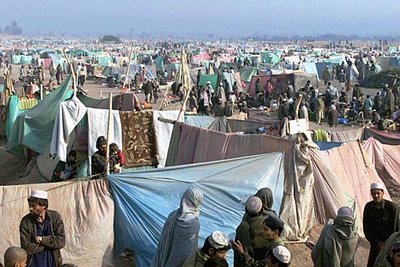
Islamic Human Rights Commission – 17 June 2009
United Nations High Commissioner for Refugees (UNHCR) 2009 annual report revealed shocking figures about the world refuge community. According to the figures revealed on 16 June 2010, the total refugee population around the world reached 15.2 million which is the highest since the mid 1990s. Around 70 percent of all refugees, which amounts to 10,792,095, around the world originated from Muslim countries.
The recent figures revealed by the UNHCR have reminded the international community that the overwhelming majority of oppressed people in the world are Muslim. According to the latest report of the UNHCR, there were 15.2 million refugees worldwide and around 70 percent of them, which amounts to 10,462,095, originated from Muslim countries. With their long-lived plight, 4.8 million Palestinians were the largest refugee community in the world. Since the Palestinian refugees are under the responsibility of United Nations Relief and Works Agency (UNRWA) their statistic were not included in the report.
There UNHCR listed 2.9 million Afghani refugees scattered around the world with the majority fleeing to Pakistan. Iraqis also made up a substantial amount of the total refugee population with 1.8 million, predominantly based in the Middle East. Somalis made up the third largest refugee group with 678,000 persons and finally 368,200 Sudanese refugees, the vast majority of them from the Darfur region.
The figures show the US and its allies have turned the Muslim territories into a massive conflict zone and Muslims have become the largest single religious refugee group. Muslim refugees have been deprived of their basic rights and are going through immeasurable difficulties.
IHRC is an NGO in Special Consultative Status with the Economic and Social Council of the United Nations.
Islamic Human Rights Commission
PO Box 598
Wembley
HA9 7XH
United Kingdom
Telephone (+44) 20 8904 4222
Fax (+44) 20 8904 5183
Email: info@ihrc.org This e-mail address is being protected from spambots. You need JavaScript enabled to view it
Web: http://www.ihrc.org
Featured Video

They Double Down on BLOOD PRESSURE Guidelines!
or go to
Aletho News Archives – Video-Images
From the Archives
The Ten Commandments of War Propaganda
By Michael Feldman · The Dissident · November 22, 2022
While researching World War I censorship for a larger project a few years ago, I stumbled upon a fascinating analysis of war propaganda.
In 1928, Baron Arthur Ponsonby published Falsehood in Wartime: Propaganda Lies of the First World War. Although Ponsonby’s book was eye-opening and remains relevant to media propaganda today, another work inspired by Ponsonby really caught my attention.
In 2001, Belgian historian Anne Morelli published Principes élémentaires de propagande de guerre (Basic Principles of War Propaganda). Based on Ponsonby’s writings, Morelli identified ten principles, often known as the Ten Commandments of War Propaganda:
1. We don’t want war. We are only defending ourselves!
2. Our adversary is solely responsible for this war!
3. Our adversary’s leader is inherently evil and resembles the devil
4. We are defending a noble cause, not our particular interests!
5. The enemy is purposefully committing atrocities; if we are making mistakes, this happens without intention
6. The enemy makes use of illegal weapons
7. We suffer few losses; the enemy’s losses are considerable
8. Recognized intellectuals and artists support our cause
9. Our cause is sacred
10. Whoever casts doubt on our propaganda helps the enemy and is a traitor
What’s most fascinating is that Morelli’s principles are based on a 73-year-old book, yet the commandments ring true today. You can pick just about any war, especially those in the twenty-first century, and see the commandments in action. … Full article
Blog Roll
 Aletho News
- More Cigars Near the Powder Keg
- Russia Unearths Major New Reserves of Gold, Nickel, Copper, and Natural Gas
- I’M SO BLOODY FURIOUS: They Double Down on BLOOD PRESSURE Guidelines!
- The Israeli Nuclear Doctrine and the Turning Point of the Kennedy Assassination
- Striking Matches Near the Powder Keg
- Prominent Russia hawk: European leaders privately talk about war with Russia, first need ‘mass casualty event’
- China warned Trump not to touch Iran’s oil tankers: Larry Johnson
- EU Central Banker Plans To Plant Barren AI Crops Across The Continent
- Macron’s Strategic Autonomy Paradox: France Rearms on Debt and Depends on Foreign Fuel
- Nigel Farage vs Tucker Carlson: Who is right about Hitler and Britain?
- If Americans Knew
- An error has occurred; the feed is probably down. Try again later.
- No Tricks Zone
- New Study: Modern Temps Are Among The Coldest Of The Last 10,000 Years In East Central Europe
- Germany’s Renewable Energies Lead to 1.4 Billion Euro Electric Power Trade Deficit
- Argentina’s Perito Moreno Glacier Joins Antarctica and Arctic In Defying Doomsday Melt Claims
- New Study: Barents Sea Temperatures Were Warmer And Sea Ice Less Extensive In The 1700s Than Today
- German Authorities Start Initiative To Evaluate Public Register For Climate “Disinformation” Spreaders!
- Zonal Asymmetry of Temperature Change in the Antarctic Circumpolar Current
- New Study: The Net Fossil Fuel Contribution To Rising Atmospheric CO2 Has Been Zero For 500 Years
- Germany’s Green Energy Transition Becoming Increasingly Expensive…Another 6 Trillion Euros!
- Sudden Stratospheric Warming, Powerful El Niño Combination May Lead To Extreme Europe Cold, Energy Crisis!
- Two New Studies Find Thwaites Glacier Melt Cannot Be Driven By Human Activity Or A Warming Ocean

