Jewish Colonists Torch Palestinian Farmlands in Jordan Valley
By Saed Bannoura – IMEMC & Agencies – May 23, 2010
A group of fundamentalist settlers torched several farms in Wad Al Maleh in the northern plains of the Jordan Valley in the occupied West Bank on Saturday. The torched lands were planted with wheat and barley.
Eyewitnesses reported that Palestinian firefighters arrived at the scene and prevented a bigger disaster.
The Popular Campaign in the Northern Plains reported that Israeli soldiers are aiding the settlers in their attacks instead of stopping them, and that the army obstructs firefighters and civil defense teams from reaching their destination.
The army did not evacuate the settlers and did not conduct any arrests. Yet, the soldiers [obstructed] several residents who rushed to the torched lands in order to extinguish the fire.
The attack came only two weeks after soldiers forced residents out of the Ein Al Hilwa area as the settlers are planning to install an illegal outpost there.
Why the U.S. and Israel are such good friends
By Carmen Yarrusso | Online Journal | May 21, 2010
Many Americans wonder why we continue to give Israel 3 billion of our hard-earned tax dollars every year instead of spending those billions on our own needy. Many Americans wonder why we give Israel billions more in bunker-busting bombs, Apache attack helicopters armed with TOW missiles, and other such advanced weapons. Many Americans wonder why we always thwart UN resolutions against Israel’s actions even when those actions unambiguously violate international law. In short, many Americans wonder why the U.S. and Israel are such inseparably good friends.
Why? Because the U.S. and Israel have so much in common. Who in the U.S. doesn’t love knishes or latkes? The U.S. and Israel are two peas in a pod.
Both nations worship the AIPAC (America Israel Public Affairs Committee), which functions as a heavenly messenger between two very good friends. Israel tells the AIPAC exactly what it wants and the AIPAC tells members of Congress to grant it unquestioned (if they’d like to keep their jobs).
Both nations obviously share the same deep moral values. For example, both agree on the moral way to take out a terrorist cleric in a wheelchair (TOW missile launched from an Apache helicopter, duh!). It wouldn’t be right to walk up and shoot a cripple in the head (sincere apologies to those within 50 feet of the wheelchair).
Both nations demonize “terrorists” who use suicide bombers (not just to kill, but to terrorize). Sure, the U.S. and Israel often recklessly kill innocent people (hey, shit happens), but they don’t stoop to terror (apparently being stalked by Apache helicopters or Predator drones that can blow you away any second, before you can even detect them, has a soothing effect on one’s mind).
But the most significant thing the U.S. and Israel have in common (what binds them like brothers) is the way both nations were created. The U.S. and Israel followed a strikingly similar path in establishing their respective nations.
A little history
The major problem establishing both the U.S. and Israel as nations was what to do with the indigenous people. So it was only natural for Israel to go to its new friend, the U.S., and ask, “How did you handle your indigenous people? Since we share the same deep moral values, we want to treat our indigenous people the same way.” Realizing they had so much in common, the two nations became fast friends.
The first thing needed to establish a nation is land. Unfortunately for both the U. S. and Israel, the land they needed was already occupied by people who had lived on and worked that land for centuries. But fortunately for both emerging nations, neither the Native Americans nor the Palestinians were particularly well armed.
At first, both the U.S. and Israel tried to politely reason with their respective indigenous people. Both nations said something like, “Yes, you’ve worked this land for many centuries and consider it your home, but could you please pack up your shit and move someplace else because we need your land.” How much more polite and reasonable can a request be?
In both cases, the indigenous people were clearly informed that God had given us their land. You’d think any reasonable Palestinian would say, “Oh, God gave you this land, why didn’t you say so, just let me take a last look at the fields I’ve worked all my life, and at the olive groves my great, great grandfather planted, and I’m out of here.”
But instead (just like the stubborn Native Americans) the Palestinians got all pissy and indignant (just because Israel was blatantly stealing their land using military force). Clearly, some ethnic groups are just a little too sensitive. Just like the stubborn Native Americans, many Palestinians had the chutzpah to actually resist being violently thrown off their land. Amazing! Reasoning with such people is obviously futile.
The U.S. then suggested Israel might bring the Palestinians to their senses by massacring a few of their villages (this tactic had often proved a convincing argument for Native Americans stubbornly occupying U.S. land). Unfortunately, many Palestinians still refused to leave (and those who did leave hold a grudge to this day). Amazing! Reasoning with such people is obviously futile.
Both the U.S. and Israel eventually forced hundreds of thousands of indigenous people off land they’d occupied for centuries. Both nations conceded “sovereign” territories for the displaced natives, but almost immediately began violently stealing that land too.
Both nations encouraged illegal settlements on these “sovereign” territories, inexorably forcing many indigenous people to struggle in squalor on worthless, arid land. Those who dared to resist were labeled “savages” by the U.S. and “terrorists” by Israel (of course, exterminating “savages” and “terrorists” is perfectly moral).
Why are the U.S. and Israel such good friends? Obviously the U.S. and Israel share the same deep moral values. What better basis for a close friendship than sharing the same deep moral values?
Carmen Yarrusso lives on a river in a small town in New Hampshire and often writes about uncomfortable truths.
Copyright © 1998-2007 Online Journal
Israel Expels Palestinian Legislator From Jerusalem
By Saed Bannoura – IMEMC & Agencies – May 21, 2010
The Israeli Police decided, Thursday, to expel Palestinian Legislator, Mohammad Abu Teir, from occupied East Jerusalem and claimed that he lost his residency right in the city after he decided to run for the Palestinian Legislative Elections in 2006.
Abu Teir is an elected legislator of the Hamas movement. He was informed that he has until June 19 to implement the order and leave the city.
The decision also poses a threat on legislators Mohammad Totah and Ahmad Attoun and former Jerusalem Affairs Minister, Khaled Abu Arab.
Abu Teir was handed the order at the al-Maskobiyya police station in Jerusalem, and as he was leaving the station, a number of fundamentalist settlers of the Eretz Yisrael Shelano (Our Land Israel) fundamentalist group, tried to attack him and shouted “terrorist” at him and that “he would have been hanged in a normal country”.
He was imprisoned by Israel for 43 months and was approached by police only a few hours after he was released.
Abu Teir was interrogated at the al-Maskobiyya before he was handed the illegal order.
The Hamas movement and its government in Gaza said that Israel is pushing the area towards further escalation by targeting and expelling the Palestinians in Jerusalem and their elected leaders.
The return of the colonial: Laor’s “The Myths of Liberal Zionism” reviewed
Max Ajl, The Electronic Intifada, 19 May 2010
 |
The West has been sold a bill of goods. Burnished bronzed Jewish soldiery protecting settlers founding kibbutzim in a decadent, violent backwater in the Near East, terraforming the desert into farmland, steadfastly creating a cosmopolitan outpost in the center of Barbary — beautiful, innocent, pure, a perfect redemption for the West’s historical sins against European Jewry. Decent if saccharine and overwrought ad-copy for Zionism, and it’s gone over well for decades in Paris, New York, Brussels and Berlin. Like most ad-copy, it has been dishonest. Unlike most ad-copy, it is outright mendacious, something like 1940s cigarette ads advertising tobacco’s salubrious effects. And Zionist intellectuals are having increasing trouble covering up an increasingly evident truth: that Zionism should be slapped with a label reading: caution, settler-colonialism, type two — ethnic cleansing and extermination — this ideology may be harmful to the native population.
Earlier Zionists were not in the business of molly-coddling modern Western sensibilities. They were honest, unaware or indifferent to the fact that the archival record they left behind would be trouble. Take revisionist Vladimir Jabotinsky’s scorched forthrightness: “colonization must … proceed in defiance of the will of the native population … an external power has committed itself to creating such security conditions that the local population, however much it would have wanted to, would be unable to interfere, administratively or physically, with our colonization.” Ideology hasn’t changed much, but the West has. So Israeli new mandarins have to try to sell settler-colonialism to Western states with populations that increasingly regard Zionism’s spiritual core and physical reality as somewhere on the spectrum between mildly embarrassing and overtly revolting. It is those mandarins that anti-Zionist Israeli poet Yitzhak Laor meticulously vivisects in The Myths of Liberal Zionism.
Laor is not much for structure. He wanders and weaves. The book was originally published in Hebrew, and then translated to French; the myths referenced in the book’s title are intended to muck up the minds of a European audience. As Laor writes, “We are not really talking to the United States, maybe because we take its love for granted” (xii). Laor explores differences between the United States and Israel, the most important of which is the Holocaust, and its central role in communal binding for the American Jewish community, the bastion of ideological support for Israel.
Laor begins with an exegesis of the Zionist depiction of Israel — the national self-image as a vulnerable child. As the embodiment of Israeli nationalism, the Israeli soldier is imagined as utterly innocent: a naif. History happens to children. Adults make history happen. Israeli soldiers “ask for a different kind of adoration, love and warmth. They arouse, they are supposed to arouse, a desire to protect them, to defend them” (xvi). So the soldiers are children in need of a guardian, so too is Israel. This is the image Israel presents to the world, to America and to American Jews: we are all wards of an ascendant American Jewry, a responsible American Jewry, because it is Israelis that die to protect Jewry. As Laor continues, “The soldier, as a good grandson, is extremely important if we are to understand the Israeli manipulative narrative: we are the grandchildren that the United States and American Jews are often being called on to feel sorry for” (xvii).
This carefully crafted vulnerability is vital nonsense. Nonsense because Israel is a military titan with a nuclear trump card, vital because a vulnerable child demands succor and nursing. Precisely the correct image for a dependent client-garrison-state — the correct description, despite the analysis du jour in the solidarity movement that elides the materialist reasons for American and European materiel and diplomatic support for Israel.
The soldier is also a figure out of the Aryan imagination. Hebrew literature of the 1940s to 1970s is replete with blue-eyed blondes, at a time when the Israeli Jewish demographic, Ashkenazi and Mizrahim, was hazel to obsidian. Laor is quite clear: this Jew doesn’t exist. He is a stand-in for the real Jewry of Israel, the majority, Arabs, many of the Ashkenazi minority, descendants of refugees from the Shoah. This is particularly annoying for Zionist Arab Jews, who cannot relate to their past except as undispellable shame, as in the case of Israeli playwright and novelist A.B. Yehoshua, perpetually bummed at being a Sephardic Jew.
When oppression and dispossession map over ethnic lines, binding a community to a racially-conceived state requires racism, an abiding hatred of an “Other” — in this case the Palestinian Arab. This becomes even more important when that Other is closer to the Sephardic Jewish population than to the dominant population, the Ashkenazi Jewish elite, the true beneficiary of Israeli racism. Israel is the second most unequal advanced industrial economy in the world, with 40 percent of its stock market owned by a handful of families, overwhelmingly Ashkenazi. Racism glues together a national identity in lieu of cultural or class-based links which could bind Jewish Arabs to Palestinian Arabs in different and dangerous communities of identity.
This racism is codified in Zionist ideology, and so a consistent anti-racism is anti-Zionist. Such truisms don’t go over well much of anywhere. Laor quotes Ilan Greilsammer writing in Le Monde: “It is enough to be an anti-Zionist, a-Zionist, post-Zionist, or a new historian who describes the massacres perpetrated by the Jews during the war of 1948 to be welcomed everywhere with open arms.”
Laor continues: what “Greilsammer is really driving at is the following: in any other place in the (white) world, a state of all its citizens would be a reasonable democratic and republican solution, a legitimate political idea — but this does not apply to Arabs … it is the role of the Jew, within French racism, to articulate such disdain toward the Arabs. This is the return of the colonial” (56-57). The assault on anti-Zionism segues neatly into an assault on anti-Zionism’s moral groundings: anti-colonial universalism. In the neo-colonial present, radical equality threatens a radically unequal world. How to smuggle in colonial ideology? Easy: behind an anti-“anti-Semitic” discourse, from behind which anti-Arab racism can decorously emerge. And it is from this perspective that a Zionist Israeli acts as cipher for European bigotry, and explains the extent of the branding operation.
The core of the change in Jewish identity that Laor describes is “The metamorphosis of the Jew from non-Westerner to candidate-as-Westerner … the most central part of Israeli ideology” (xxiv). Through Zionism, Jewry is immured from its history: the perennial tax-collector and merchant, lingering far too obviously in the interstices of European culture. Through Zionism, the Jew becomes almost-European. Through the sabra, Israel becomes schizophrenically strong and weak: “the sabra … as a victim of circumstances, or a victim of the cruelty of the generation before him, or of the cruelty of Jewish history. In short, he was expected to be cruel, yet his cruelty was forgiven ‘in advance’ for he was the historical answer to the riddle of Jewish history” (xxii). How to solve the riddle? Simple. Though cleansing and renewing violence.
And the Jew-as-probationary-Westerner is doing excellent yeoman work in thrashing the natives. He is permitted and expected to be cruel, in response both to historical cruelty and because Israelis are not in Europe, where the natives are slightly more in line. “What our leaders asked for, it seems, was not the Rights of Man, but the right to belong to the elite. We can now participate in violating the rights of others” (35). Now that Israel is a grown-up nation-state, playing with the adults, its people can enjoy the privilege of at least border-Westerners: cluster-bombing brown folk. Laor knows that this is good work. Constant conflict is good money, good for scaring up oil prices, good for weapons sales. “Why disarm ourselves if the fences not only help us be safe, but also help us stay in ‘the West’? Or, in the words of the future historian: Why think of peace, if the price we will have to pay in return is a heterogeneous life?” (xxix). Future historians may be less demure about the way Israel has ideologically stabilized itself and its bigotry vis-a-vis the needs of its political economy and its insertion into mercantilist neo-liberalism.
Mass-murder in the global South is an organic part of European history, tied to the development of capitalism. But prattle about capitalism and death does no good for the defenders of European capitalism. Nor do narratives linking Victorian genocides to the genocides of the Third Reich. The European community would rather not see the Holocaust as a product of European civilization and its Romantic obsession with national purity, the output of colonialism and an endogenous process of violent state-formation. Instead, the Holocaust is outside history, for both Israel and Europe. As Laor explains, for Israel, this is convenient because it re-writes Jewish history in a floating arc of “national continuity which begins with the rise of Nazism, continues with the war and terminates in the construction of the memory of the (Jewish) victims” (23). For Europe, this is convenient because it places the Holocaust in a mausoleum marked “Human Suffering,” so ostentatiously elaborate that we are meant to not notice that the monument has walled off the Holocaust from the genocides the West perpetrated in the global South, privileging it, privileging Jewish suffering, now a sort of suffering of full human beings since the Jewish people — via Israel — are probationary Europeans.
Laor reserves a particular revulsion for the intellectual artisans toiling away within Israeli society. Like Viktor Klemperer, he highlights the treason of the intellectuals as the worst betrayal. He quotes Amos Oz as writing that the Israel-Palestine conflict is, “in other words a conflict between two causes where both are as just, one as the other.” What can Laor say? He says nothing. Or Claude Lanzmann, maker of the movie Shoah: “They have autonomous territories, an armed police force, weapons are everywhere” (37). While Israeli soldiers beat children to death, children with minds tortured by “memories of mothers screaming with fear, babies who never saw anything but armored trucks near home” (39). Or on Camp David, Laor highlights “the role played by the Zionist left in cementing the anti-Palestinian public perception so common today” (40). Here again is Oz: “he has incited his people against Israel and against the Jews. Finally, he has initiated this recent burst of hateful violence,” meant to wrack Jews with suffering. “The Palestinian people are suffocated and poisoned by blind hate” (42-43). Laor knows that Oz laid the symbolic ground for 5,500 Palestinian and 1,000 Israeli dead during the second Palestinian intifada. Oz scribbles away with the blood of the dead on his quill and Laor loathes him for it.
Laor detests Oz for another reason too. Judaism as a breathing culture has been suffocated by the new Zionist Israeli narrative. The old narrative of Eastern Europe Jewry has had to be decimated. This has meant the destruction of a special memory: Holocaust-surviving, the remnant of eastern European Jewry. Laor is the descendant of survivors of the Shoah, with a tincture of Maghrebi Jew. He is everything the Israeli imaginary attempts to erase or to spit upon. Livid, Laor absolutely refuses to condescend to the culture or the memories of Shoah Jewry. When Oz describes annihilated European Jewry as opera and ballet-viewing, poly-lingual cosmopolitans, Laor explodes: “This is simply the desecration of the memory of the victims of the Holocaust, most of whom never went to the opera, never read European poetry” (113).
As Laor writes, “The real people, those who never frequented operas or concerts, those who were deported en masse to the camps and to their deaths, were not ‘ideal’ in any sense. They loved their spoken language, their world which was burnt down; they were real” (114). Oz hates the real, because reality is intolerable to the Zionist, thief of Jewish history, abuser of the Holocaust. For the Israeli Zionist, Laor has many damning words. Maybe this is an attempt to heal the culture. For American Zionist Jews, who need this book so badly, who will react to its publication like a blind man to Medusa? “I can hardly find appropriate words for them,” for those who pay for the weapons that kill children, for those who will never live in their insurance-policy patch of land in the Levant (xxix). I can find appropriate words for Laor’s book: it is a gift, incredible and beautiful, so wonderful that I am sure that the American Zionist community will spurn it. No one wants to read the words that will be the epitaph on the gravestone marking the burial site of your communal imaginary.
Max Ajl is a writer living in Gaza. He has written for Adbusters! and The New Statesman, among others, and blogs on Israel-Palestine and ecological issues at www.maxajl.com.
Official: Israeli forces destroy pipelines in Hebron village
Ma’an – 19/05/2010
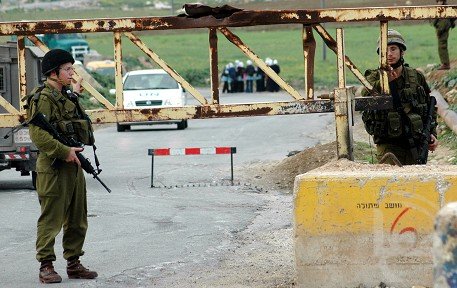
Hebron – Israeli army bulldozers reportedly destroyed several water pipes as they attempted to block the main road from the Adh-Dhahiriya village to Hebron on Wednesday, effectively cutting off the village’s water supply, an official said.
A representative from the Palestinian Authority Water Authority, Nabil Abu Aqel, said the bulldozers were in the process installing a road block near the adjacent Otni’el settlement, destroying a number of essential water pipelines in the process.
However, a spokesman for Israel’s Civil Administration said a pipe had burst in the area and that it was currently being repaired.
Two weeks prior, Israeli forces piled earth at the northern entrance of Adh-Dhahiriya, closing off the main road to Hebron in what town residents said at the time was an attempt to restrict access to roads near settlements.
In the process of digging, forces destroyed pipes to the town, again cutting off its water supply, Adh-Dhahiriya Mayor Sami Estanyur said at the time.
The Hebron-Dhahiriya road bypasses the Otni’el settlement was established on 150 dunums of private Palestinian land in 1983, and Eshtanyur said the road overlays the water network of the town.
At the time, Israel’s army said it was not familiar with the incident.
Remarkable Urgency
By Eva Bartlett | In Gaza | May 18, 2010

*wheat crops bulldozed in a roughly 15 metre wide track clawed into the land by Israeli military bulldozers and tanks.
A dry winter with very late rains –at the end of January, the last possible time for planting, the farmers said –followed by a dry spring evolved into the beginnings of a dry summer.
Called yesterday to accompany farmers in the Faraheen and Khoza’a regions, each east of Khan Younis, we were suddenly busy again. So it goes with the farmers who’ve been forced to give up high-maintenance agriculture and try for the lowest-maintenance crops possible: wheat, rye, lentils. No more trees, they’ve all been bulldozed too many times. Not so many potatoes, nor much parsley–they require more water than the sparse rains provided or the destroyed water cisterns, wells and piping allowed for.
Whereas before the heightened Israeli army aggressions against these visibly unarmed farmers they would live on their land, at the very least daily visit and work on it, they are now resigned to rushed attempts at sowing and harvesting some of Gaza’s richest soils, under the thud and whiz of Israeli army bullets.
We were to join Leila Abu Dagga’s sister to harvest 5 dunams of lentils. But when we arrived were told, “it’s gone, the Israelis bulldozed it all”. [The land in question is near where the young, deaf farmer was shot by an Israeli soldier last year. Over 500 metres from the border, I remember it well (and remember the shock of the Israeli soldiers having shot around us to reach this unarmed farmer just trying to earn 20 shekels a day. The horror: shit, is he dead? The disbelief: but they saw us farming for over 2 hours… why shoot now? The disgust: this kid is just trying to add to his large family’s small income)]

*a roughly 15 metre wide track clawed into the land by Israeli military bulldozers and tanks.

So we moved to Abu Tabbash land, roughly 12 dunams of wheat which we had accompanied the elderly farmer on four months ago. Then, the Israeli army jeeps had lorded atop earth mounds just across the Green Line border fence as Abu Khader walked the length of his accessible land, back and forth, hand-spraying wheat seeds.

*Faraheen farmland [photo: Rada Daniell]
As we arrive, shortly after 7 am, he tells us “we started at 5 am. The jeeps were there, but no shooting yet”. He is neither surprised nor grateful, just matter of fact. Matter of fact is the Israeli soldiers can appear at any moment and shoot at any moment, any whim. There is no pattern, no predictability, and the only seeming reason, quite obviously, is pure harrassment with the intent of driving Palestinians off their land and destroying the agricultural sector.
So farmers like Abu Khader risk working on their land, abadoning the tens, hundreds for some families, of dunams lost to within and near the Israeli-imposed “buffer zone”. But they do so at frantic paces, determined to work even the smallest section of their land.
“It’s quite remarkable,” says Adie, one of us accompanying the farmers. “It’s unbelievable that the Israeli army would fire on a scene like this. It’s one of the most tranquil things you could be doing, this hand-harvesting.”

Abu Khader has the bearing, humility, and cracked heels of someone who has toiled the land all his life. His dignity shines, as does his sense of urgency to harvest the crop, and he wastes no time with small-talk or breaks.
Working with three other family members, he hand-plucks the wheat from its earth, noting “it’s so meagre this year. It should be up to here,” gesturing near head level.
They rip, pile and bundle wheat and the dry hay-grass which will serve as animal feed. The bundles are stuffed into large sacs or piled on too-small donkey carts and hauled off.


Day one they’ve harvested from 5 am to 10 am and call it a day. Day two –”there was shooting this morning,” we are told, and an hour and a half another round of shots at visibly unarmed farmers –they work roughly the same, with same intensity, saying “tomorrow we’ll finish, just need an hour and a half”.
We leave, some of the plucked wheat still in small piles to be collected the next morning.
We learn hours later that after farmers and accompaniers left the land, Israeli bulldozers crushed in and lit afire by incendiary devices the land in and along the “buffer zone” including Abu Khader Abu Tabbash’s remaining wheat.
Expert: Israel steals Gaza water to supply its settlements
Palestinian Information Center | May 17, 2010
GAZA — Dr. Akram Al-Hallaq, a professor of geography at the Aqsa university in Gaza, said that Israel is persistent in stealing and exhausting Gaza water resources in order to supply its nearby settlements.
In an academic study titled “The Israeli policies of depleting fresh groundwater in the Gaza Strip,” Hallaq affirmed that Israel had drilled a number of wells during the years of its occupation of Gaza along the northern and eastern border areas and since then it has been pumping water from these areas into its territory.
He added that this process reduced the leakage of groundwater of these areas into the coastal aquifer of Gaza
The professor underlined that the Israel’s systematic theft of water resources constitute a threat to the national security of Palestinians and Arabs alike.
His study also pointed out that the Israeli blockade on Gaza played a major role in preventing the development of water and sanitation projects, the thing which adversely affected the services in these two sectors as a result of the ban imposed on the entry of equipment needed for maintaining and rehabilitating water installations there.
“Israel” calls for expelling anyone marking Nakba from occupied Palestinian lands
Palestine Information Center | May 17, 2010
NAZARETH – Israeli minister of finance Yuval Steinitz called for withdrawing the nationality from everyone inciting against Israel and commemorating the 62nd anniversary of the Palestinian Nakba (catastrophe).
During the weekly cabinet meeting on Sunday, Steinitz said it was intolerable and unforgivable to see Arabs and some Jews challenging the mere existence of Israel.
The Israeli minister also condemned the recent remarks made by head of the Islamic Movement Sheikh Ra’ed Salah in which he highlighted the Arab identity of occupied Jerusalem and the Aqsa Mosque and defended the right of return.
For its part, the right-wing party of Yisrael Beiteinu led by foreign minister Avigdor Lieberman called for opening investigation with Arab Knesset member Jamal Zahalka for his participation in a march organized to mark the Nakba anniversary.
In a separate incident, Israeli minister of education Gideon Sa’ar declared his intention to force the Palestinian high school students in the 1948 occupied lands to study the Nazi holocaust as of next year.
Yedioth Ahronoth on Sunday reported that Sa’ar also intends to send a delegation of Arab teachers and school principals to Poland to visit the alleged Nazi extermination camp in order to qualify them to teach this subject efficiently.
In the same context relating to Nakba, Palestinian officials and politicians called Sunday for pooling the efforts to protect the right of return and confront attempts to dilute this right and twist its concept into the idea of resettling Palestinian refugees in their current residential countries and compensating them.
They stressed during their participation in a conference on the Nakba held in Gaza the need for raising the awareness of the Arab nation about the right of return so as to sustain it.
Dr. Ahmed Bahar, the first deputy speaker of the Palestinian legislative council, stated in his speech that the right of return is a sacred right that belongs to all Palestinians and anyone waiving it is considered an apostate from the Palestinian national rank as stipulated by the right of return law.
Dr. Bahar stressed that the Palestinian people reject being resettled in alternative homelands and insist on returning to their homes which they were expelled from, adding that this right can come true only through the option of resistance and national unity.
Grapes withering on the vine
International Solidarity Movement | 17 May 2010

Souad has lost access to the land that provides her livelihood
Souad lives in the beautiful village of Safa, south west of Bethlehem, close by the path of the apartheid wall. From her house in the village it is only a short walk to her land – an entire, rolling hillside, the summit of which has been stolen by the Israeli colony/settlement of Bat Eyn. No fence separates her fields and terraces from the settlement: Bat Ayn is one of only two colonies without such a fence in the entire West Bank, designed to make it easier, without a defining border, to make future land grabs.
The title deeds to Souad’s hillside have been in her family for over 100 years. Not that it does her any good – she cannot even graze her sheep without risking being fired upon by the settlers. She can only watch from a nearby hill while her peaches and grapes, soon ready for harvest, wither and rot on the vines and trees, or are stolen by settlers. She needs to work the land, to ensure the proof of continuing ownership and to keep the soil in good condition, but fears for her life if she was to venture there. She has watched helplessly as hundreds of fruit trees, replanted with help from international donors after the original trees were torched by settlers, were dug up and taken back to the settlement to be planted there.
Our presence on this nearby hill was soon noticed by Israeli soldiers patrolling nearby roads and we decided to move back to the village, lest the soldiers enter and fire tear-gas into the village as punishment for the presence of international observers. As we left Souad ruefully remarked, “My hill is gone. Where we are standing may be next.”
It is difficult to see how villagers such as Souad can carry on. She may say, “With God’s help we will survive”, but, dependent wholly for her livelihood on what her land produces, her future is precarious in the extreme. From these hillsides it is possible, on a clear day, to see well beyond the Green Line and, they say, to Tel Aviv. Such a beautiful land. The Stolen Land. And the disappearing land.
Arabs shut out of Israeli public sector
By Jonathan Cook | The National | May 16. 2010
Nazareth// Unemployed computer engineer Morad Lashin would like to work in Israel’s Electricity Company, a large state utility, but admitted his chances of being recruited are slim.
The reasons were set out in graphic form this month when a parliamentary committee revealed that only 1.3 per cent of the company’s 12,000 workers are Arab, despite the Arab minority constituting nearly 20 per cent of the population.
The committee’s report presents a picture of massive under-representation of Arab citizens across most of the public sector, including in government companies and ministries, where the percentage of Arab staff typically falls below two per cent of employees.
According to Sikkuy, a group lobbying for greater civic equality, discriminatory hiring policies have left thousands of Arab graduates jobless, even though the government promised affirmative action a decade ago.
Mr Lashin, 30, from Nazareth, said his remaining hope was to find a job in the public sector after a series of short-term contracts in private hi-tech firms. “Everywhere you go, they ask if you have served in the army. Because Arab citizens are exempt, the good jobs are always reserved for Jews.”
Ali Haider, a co-director of Sikkuy, said: “What kind of example is set for the Israeli private sector when the government consistently finds excuses not to employ Arab citizens too?”
Ahmed Tibi, who heads the parliamentary committee on Arab employment in the public sector, said that even when government bodies appointed Arabs it was invariably in lowly positions. “The absence of Arabs in [senior] roles means that they have no say in the ministries’ decision-making processes,” he said.
The issue of under-representation in the public sector was first acknowledged by officials in 2000, when the Fair Representation Law was passed under pressure from Arab political parties.
However, no target was set for the proportion of Arab employees until 2004, when the government agreed that within four years Arabs should comprise 10 per cent of all staff in ministries, state bodies and on the boards of hundreds of government companies. Later the deadline was extended to 2012.
The new report found that overall six per cent of the country’s 57,000 public sector workers were Arab, only marginally higher than a decade ago.
But Mr Tibi noted that the figures were substantially boosted by the large number of “counter staff” in the interior, welfare, health and education ministries employed to provide basic services inside Arab communities.
On publication of the report this month, Avishai Braverman, the minorities minister, admitted there was no hope of reaching even the delayed target. He criticised his own government for not setting its sights higher, at 20 per cent representation.
The committee’s findings, said Mr Tibi, showed officials had systematically broken their promises on fair representation. He noted that even in the parliament itself there were only six Arab workers out of 439, or 1.6 per cent. “What does it say that in the temple of Israeli democracy there is such rank discrimination?”
Similar percentages were found in key government departments, including the prime minister’s office, the foreign ministry, the treasury, the housing ministry, and the trade and industry ministry, as well as such state agencies as the Bank of Israel, the Land Administration and the Water Authority.
The Organisation for Economic Cooperation and Development, to which Israel acceded last week, reported last year that 15,000 Arab graduates were either unemployed or forced into work outside their professions, often as teachers.
Mr Tibi said he was particularly concerned that there were no Arabs in key roles inside government ministries. “Not by chance are there no senior Arab civil servants, no deputy directors in the ministries, no legal advisers,” he said.
He said the absence of Arab policy-makers was reflected in the lack of public services and resources made available to Arab communities. Poverty among Arab families is three times higher than among Jewish families.
Yousef Jabareen, director of the Dirasat policy centre in Nazareth, said increased recruitment of Arab workers by the government could solve at a stroke two urgent problems: the large pool of Arab graduates who could not find work, and the community’s lack of influence on national policy.
He added that discrimination against Arabs was “built into the institutional structure of a Jewish state”.
The report was received with hostility by some MPs. Yariv Levin, chairman of the parliament’s House Committee and a member of prime minister Benjamin Netanyahu’s Likud party, said the report was “delusional and ignores the fundamental fact that a significant portion of Israel’s Arabs are disloyal to the state”.
Saleem Marna, 37, who graduated as an information systems engineer 10 years ago from the prestigious Technion University in Haifa, said he had given up hope of finding regular work in either the private or public sectors.
Married with four children, he said he had applied to emigrate to Canada. “I am hopeful that being an Arab won’t count against me there.”
Hatim Kanaaneh, a Harvard-educated doctor who worked as one of the few senior Arab officials in the Israeli health ministry until his resignation in the early 1990s, documented the many battles he faced in the government bureaucracy in his recent book Doctor in Galilee.
Dr Kanaaneh said no Arab had ever risen above the position of sub-district physician he held two decades ago. Although the health ministry had the largest number of Arab employees of any ministry, he said none had ever been appointed to a policy-making position.
“In fact, people in the ministry tell me things have gone backwards under recent right-wing governments.”
He added that the lack of Arab policymakers in government had concrete consequences that damaged the Arab community. When he worked in the health ministry, he noted, the Arab infant mortality rate was twice that of the Jewish population. Two decades later the ratio of Arab to Jewish infant deaths, rather than declining, had increased by a further 25 per cent.
The prejudice faced by educated Arabs seeking employment was highlighted by a survey last November. It found that 83 per cent of Israeli businesses in the main professions admitted being opposed to hiring Arab graduates.
Yossi Coten, director of a training programme in Nazareth, said of 84,000 jobs in the country’s hi-tech industries, only 500 were filled by Arab engineers.
Israel refuses re-entry to 5 Druze who made condolence call in Syria
Golan Heights residents stuck in Syria
By Yuval Azoulay | Haaretz | May 14, 2010
Five Druze residents of the Golan Heights have been stuck for more than six weeks in Syria after Israeli authorities denied them permission to cross back into the Golan.
The group includes two women, Hamaa Shaar, 36, and Johara Shakhrur, 56, from the Golan Heights town of Buqata, who were visiting their families in Suwara, Syria following the death of Sha’ar’s brother and Shakhur’s mother.
The family’s lawyer, Haran Riechman, wrote the Interior Ministry’s Population Administration bureau in Kiryat Shmona that when the women left for Syria, MK Ayoob Kara (Likud ) had obtained special permission for them to stay for two weeks instead of the 48 hours the Israeli authorities had initially given them.
Riechman wrote that for unknown reasons, five days after the women left, the Interior Ministry demanded they return.
Six other Israeli residents of the Golan Heights in Syria received the same instruction; some managed to make it to the Quneitra crossing within a few hours.
However, the women only reached the crossing a day later, together with three other Israeli Golan Heights residents who had also been in Suwara. Their families were already waiting for them, as were the Military Police and the Red Cross, but the Interior Ministry official did not show up, the border remained closed, and the women returned to Suwara, Riechman told Haaretz.
“One of the soldiers told the family that the army was preventing their return and it was unclear why,” Riechman also said.
Riechman wrote the Population Administration that if the women are not allowed back by the weeked, he will appeal to the High Court of Justice.
Interior Ministry spokeswoman Sabin Hadad, said Thursday that the Israel Defense Forces is responsible for the Quneitra crossing.
Featured Video

They Double Down on BLOOD PRESSURE Guidelines!
or go to
Aletho News Archives – Video-Images
From the Archives
The Ten Commandments of War Propaganda
By Michael Feldman · The Dissident · November 22, 2022
While researching World War I censorship for a larger project a few years ago, I stumbled upon a fascinating analysis of war propaganda.
In 1928, Baron Arthur Ponsonby published Falsehood in Wartime: Propaganda Lies of the First World War. Although Ponsonby’s book was eye-opening and remains relevant to media propaganda today, another work inspired by Ponsonby really caught my attention.
In 2001, Belgian historian Anne Morelli published Principes élémentaires de propagande de guerre (Basic Principles of War Propaganda). Based on Ponsonby’s writings, Morelli identified ten principles, often known as the Ten Commandments of War Propaganda:
1. We don’t want war. We are only defending ourselves!
2. Our adversary is solely responsible for this war!
3. Our adversary’s leader is inherently evil and resembles the devil
4. We are defending a noble cause, not our particular interests!
5. The enemy is purposefully committing atrocities; if we are making mistakes, this happens without intention
6. The enemy makes use of illegal weapons
7. We suffer few losses; the enemy’s losses are considerable
8. Recognized intellectuals and artists support our cause
9. Our cause is sacred
10. Whoever casts doubt on our propaganda helps the enemy and is a traitor
What’s most fascinating is that Morelli’s principles are based on a 73-year-old book, yet the commandments ring true today. You can pick just about any war, especially those in the twenty-first century, and see the commandments in action. … Full article
Blog Roll
 Aletho News
- The Death of Academic Freedom in Norway
- Another EU member revolts against €100 bn funding for Ukraine
- More Cigars Near the Powder Keg
- Russia Unearths Major New Reserves of Gold, Nickel, Copper, and Natural Gas
- I’M SO BLOODY FURIOUS: They Double Down on BLOOD PRESSURE Guidelines!
- The Israeli Nuclear Doctrine and the Turning Point of the Kennedy Assassination
- Striking Matches Near the Powder Keg
- Prominent Russia hawk: European leaders privately talk about war with Russia, first need ‘mass casualty event’
- China warned Trump not to touch Iran’s oil tankers: Larry Johnson
- EU Central Banker Plans To Plant Barren AI Crops Across The Continent
- If Americans Knew
- An error has occurred; the feed is probably down. Try again later.
- No Tricks Zone
- New Study: Modern Temps Are Among The Coldest Of The Last 10,000 Years In East Central Europe
- Germany’s Renewable Energies Lead to 1.4 Billion Euro Electric Power Trade Deficit
- Argentina’s Perito Moreno Glacier Joins Antarctica and Arctic In Defying Doomsday Melt Claims
- New Study: Barents Sea Temperatures Were Warmer And Sea Ice Less Extensive In The 1700s Than Today
- German Authorities Start Initiative To Evaluate Public Register For Climate “Disinformation” Spreaders!
- Zonal Asymmetry of Temperature Change in the Antarctic Circumpolar Current
- New Study: The Net Fossil Fuel Contribution To Rising Atmospheric CO2 Has Been Zero For 500 Years
- Germany’s Green Energy Transition Becoming Increasingly Expensive…Another 6 Trillion Euros!
- Sudden Stratospheric Warming, Powerful El Niño Combination May Lead To Extreme Europe Cold, Energy Crisis!
- Two New Studies Find Thwaites Glacier Melt Cannot Be Driven By Human Activity Or A Warming Ocean

