Israeli soldiers raid, occupy Episcopal Church in West Bank

By Francis Martin – Church Times – August 19, 2022
The Episcopal Church in Jerusalem and the Middle East has condemned a “flagrant” raid on the premises of its church in Ramallah, in the occupied West Bank, in the early hours of Thursday morning.
In a statement released by the diocese of Jerusalem later on Thursday, the actions of the Israeli forces involved in the incident are described as “a violation of international law and a terroristic act against the entire community”.
It was revealed later that the focus of the raid was the offices of Palestinian NGOs that rent space in the church compound, including the human-rights organisation Al-Haq. [NOTE: read more about the raids here.] In October last year, Al-Haq was classified as a terrorist organisation by the Israeli government, a move that was criticised by the Office of the United Nations High Commissioner for Human Rights (OHCHR).
A spokesperson for the US State Department has also expressed “concern” about the raid on the NGOs.
The Rector of St Andrew’s, Ramallah, the Revd Fadi Diab, told Agence France-Press : “The soldiers came into the premises around 3 a.m. and we started hearing shots and banging on the doors.”
The diocesan statement details how the door to the church complex was smashed, and the entire building — including the sanctuary and rectory — occupied for two hours. “The sound of gunshots, stun grenades, and the smashing of doors caused terror among the families living inside the compound,” the statement says.
The Guardian reports that the Israeli forces took equipment from the offices and sealed the doors, leaving a notice saying that they had been closed for “security reasons”. But later on Thursday, staff from Al-Haq removed the barriers and vowed to continue its work.
In a statement issued on Thursday, Al-Haq urged the international community to “take concrete measures, such as trade restrictions and arms embargoes, to ensure that Israel is held internationally responsible for its ongoing systematic inhumane acts of apartheid, including the persecution of Palestinian human rights defenders.”
Also on Thursday, the Episcopal Peace Fellowship Palestine/Israel Network condemned the attack as “illegal”. Under international law, Israeli forces require the permission of the Palestinian Authority to operate in Ramallah.
The diocese of Jerusalem asserts: “Places of worship and church compounds should be sanctuaries for communities to feel safe to practice their faith and ministry.” It is calling for a “speedy and impartial investigation into this incident, followed by serious disciplinary action against the offenders”.
Israeli Forces Storm, Seal Offices of Seven Palestinian Human Rights and Humanitarian Organizations in Ramallah
Al-Manar – August 18, 2022
The United Nations Human Rights Office today expressed alarm at Israel’s arbitrary closure of seven Palestinian human rights and humanitarian organizations and called on Israel to immediately reverse these decisions, reiterating the High Commissioner’s call to revoke the designations of the organizations as “terrorist” and “unlawful.”
At dawn today, Israeli occupation forces broke into, searched and sealed the offices of seven Palestinian human rights and humanitarian organizations in Ramallah. Their property was confiscated and destroyed. Israeli forces left copies of military orders to close the offices of the organizations.
“The closure orders are a step to enforce previous Israeli declarations of these organizations as “unlawful” and as “terror organizations” in 2021,” said the Human Rights Office in a statement. “Despite offers to do so, Israeli authorities have not presented to the United Nations any credible evidence to justify these declarations. Several Member States have also stated that the evidence shared with them does not justify the designations. As such, the closures appear totally arbitrary.”
The UN office said the shutting down of the organizations represents the latest in a series of attacks that are further drastically shrinking space for human rights and humanitarian work in the occupied Palestinian territory, affecting all institutions working on human rights, including the UN Human Rights Office. “Human rights defenders must be immediately protected from these unjustified attacks,” it said.
The organizations affected are Addameer Prisoner Support and Human Rights Association; Al Haq; Bisan Center for Research and Development; Defense for Children International – Palestine; Health Work Committees (HWC); Union of Agricultural Work Committees (UAWC); the Union of Palestinian Women’s Committees (UPWC).
Russian Foreign Ministry speaks out on ‘Plan B’ for Iran nuclear deal
Samizdat | August 11, 2022
Any ‘Plan B’ in the talks on the Iranian nuclear program would violate a “consensus decision” of the UN Security Council on the issue and have “unavoidable negative consequences” for the entire Middle East, the Russian Foreign Ministry warned on Thursday.
“Any departure [from the original 2015 deal] or ‘Plans B’ that some people like to speculate about would run counter to the consensus decisions of the [UN] Security Council,” said Ivan Nechaev, the ministry’s deputy spokesman, referring to a 2015 UNSC resolution supporting that year’s agreement on the Iranian nuclear program.
The revival of the existing 2015 deal through the ongoing talks in Vienna is the only “reasonable and effective way” forward, Nechaev told journalists during a briefing. He also welcomed the latest round of indirect talks between the US and Iranian delegations in Vienna, which resulted in some “progress” on issues that had earlier been a stumbling block in the negotiations.
“A positive result of the talks is… achievable,” Nechaev said, adding that “there are no irreconcilable differences between the parties. Further progress would solely depend on each side’s “political will,” the diplomat said.
At the same time, Moscow slammed the EU for what it called the bullying tactics. “The language of ultimatums does not work in such a sensitive and high-stakes issue,” Nechaev said as he particularly criticized Peter Stano, the spokesman for EU diplomatic chief Josep Borrell.
Earlier this week, Stano told journalists that “everything that could be negotiated has been incorporated into the final version of the text” compiled after the latest round of talks between Tehran and Washington, which was mediated by the EU. “It’s yes or no,” Stano insisted, adding that “there is no more room for other compromises.” Borrell himself also called the document “the final text” at that time.
On Thursday, the Russian Foreign Ministry responded by saying Stano had no authority to make such statements on behalf of all parties involved in the talks. The Iranian deal, also known as the Joint Comprehensive Plan of Action (JCPOA), was built on “carefully measured balance of interests” and not “crude political pressure,” it added.
The work on reviving the deal will only end “when interests of all parties involved are properly taken into account,” Nechaev told journalists on Thursday.
Last week, Washington said it developed a proposal for a mutual return to the nuclear deal with Iran. Tehran responded by saying the revival of the agreement relies primarily on the US’ “will” and that Washington must show its readiness to achieve a long-term result.
The Western media have also been publishing pieces calling on Washington and Brussels to work out a ‘Plan B’ that can be used if the Vienna negotiations yield no results. Some of the pieces openly called on Western governments to ditch the talks in favor of this option, which has apparently yet to be devised. “Enough of the ‘tenuous’ Iran nuclear deal – it’s time for Plan B,” read an opinion piece The Hill published in early July. “Biden Should Show Iran What ‘Plan B’ Looks Like,” another piece published by the Washington Post in mid-June suggested.
The deal signed in 2015 by Iran, the US, the UK, France and Germany – as well as Russia, China and the EU – involved Tehran agreeing to certain restrictions on its nuclear industry in exchange for the lifting of economic sanctions and other incentives.
The agreement has been in limbo since 2018 when it was torpedoed by the US under then-President Donald Trump, who unilaterally withdrew from it. In response, Iran started gradually reducing its commitments under the accord, such as the level of enriched uranium it produces.
On August 1, Tehran announced it has “the technical ability to build an atomic bomb,” adding, however, that such a program “is not on the agenda.”
Hezbollah warns Israel against targeting Palestinians in Lebanon
MEMO | August 9, 2022
The head of Lebanon’s powerful Hezbollah movement, Sayyed Hassan Nasrallah, today warned against any Israeli attempts to expand their targeting of Palestinian resistance members to Lebanon, Reuters reported.
“Any attack on any human being will not go unpunished or unanswered,” Nasrallah said in a televised address marking Ashura, a commemoration for Shia Muslims of the killing of the Prophet Muhammad (peace be upon him)’s grandson Hussein.
The comments came after Israel launched a war against Gaza on Friday, killing 44 Palestinians including 15 children. It also killed senior Islamic Jihad leaders. The bombing was halted late on Sunday under the terms of an Egypt-brokered ceasefire.
On Saturday, Israeli defence minister Benny Gantz hinted at the possible targeting of Islamic Jihad officials abroad, who he said could be seen in “restaurants and hotels in Tehran, Syria and Lebanon”.
“They too will have to pay the price,” Gantz said. Yesterday he said Israel could carry out “pre-emptive strikes” abroad.
“In the future too, if necessary, we will deliver a pre-emptive strike in order to defend Israel’s citizens, sovereignty and infrastructure and this is true for all fronts, from Tehran to Khan Yunis,” he said.
Tensions between Hezbollah and Israel have been escalating in recent months over a disputed maritime border between Lebanon and Israel.
Russia holds Israel responsible for latest offensive against Gaza

MEMO | August 9, 2022
Russia blames Israel for the latest three-day military offensive against the Palestinians in the Gaza Strip, the Foreign Ministry in Moscow has announced.
“The new escalation was caused by the Israeli army firing into the Gaza Strip on 5 August,” said ministry spokesperson Maria Zakharova. She pointed out that the Palestinian factions responded to this escalation by firing rockets indiscriminately towards Israeli territory.
“We are observing with profound worry how events are evolving,” added Zakharova. “The resumption of a full-scale military confrontation [would see the] already deplorable humanitarian situation in Gaza deteriorate further.”
The ministry official reaffirmed Russia’s “principled and consistent position, reflected in the relevant resolutions of the UN General Assembly and the Security Council, in support of a comprehensive and long-term settlement of the Palestinian-Israeli conflict in accordance with the two-state principle.
“It is possible to put an end to cyclical violence only within the framework of the negotiation process, the result of which should be the realisation of the legitimate national rights of the Palestinian people to establish an independent state within the 1967 borders.”
Zakharova’s statements come at a time when relations between Israel and Russia are tense.
Meanwhile, the Ukrainian Ambassador to Israel, Yevgeny Kornichuk, declared his solidarity with the occupation state: “As a Ukrainian whose country is under brutal attack by its neighbour, I feel great sympathy for the Israeli public. An attack against children and women is an abominable thing. Terror and a malicious attack against civilians are the daily reality of Israelis and Ukrainians and this appalling threat must be stopped immediately.”
Kornichuk made his comments before the Egyptian-brokered ceasefire between Gaza and Israel came into effect.
Although the occupation state declared that it was targeting the Palestinian Islamic Jihad movement, the Palestinian Ministry of Health has confirmed that 44 citizens were killed as a result of the Israeli offensive, including 15 children and four women. Another 360 Palestinian civilians were wounded. Moreover, many homes and residential buildings were destroyed.
The hidden goal behind Gaza’s assault
By Batool Subeiti | Press TV | August 7, 2022
The Zionist regime’s unprovoked blitz on Gaza since Friday afternoon was, firstly, a direct message to Lebanon, that it is not interested in going into war over the maritime boarders, thereby conceding to line 23 and the Qana fields that Lebanon has demanded full sovereignty over. Secondly, the regime seeks to test the waters through this limited confrontation.
The limited scope of the confrontation between Palestinian Islamic Jihad (PIJ) and the Zionist regime implies the objective is not aimed at weakening the resistance, rather it is to measure the reactions of this confrontation on many levels and to send underlying messages in the process.
The Zionist regime considers the Palestinian resistance to be the easiest target within the resistance axis and has therefore sought calculated confrontation with this entity. Through its assaults on Gaza, the regime is interested in testing the extent of unification of the regional resistance factions in decision making, logistical support, the readiness of factions to get involved if the battle escalates, how willing they are to expand the war in addition to their stock of weapons, their capabilities, and capacities.
This is also happening at a time when the Zionist regime will hold its fifth election in four years this November, thereby seeking to rally the settler population over a point of unity – that is usually attacks on Gaza. The regime seeks to paint the image that it is unafraid to attack in any circumstance to ensure their ‘security’, with Israeli Prime Minister Yair Lapid stating on Friday that, “the country has ‘zero tolerance’ for attacks from Gaza”. However, he also made it clear in the same press conference that there is no interest in a ‘broader battle’.
More importantly, the Zionist regime is approaching a due position and that is drawing the maritime boarders with Lebanon, which if it does not end up playing in the interests of Lebanon, poses an imminent danger, and calls for an imminent war, as made clear by the Secretary General of the Islamic resistance party in Lebanon. The Zionist regime wishes to prevent a war at all costs and that means it has no choice but to compromise, which appears as a point of weakness for the settler population in the context of the elections, as they wish for a candidate that takes a strong stance on such issues. This smaller scale attack was therefore launched in order to avoid a larger war, and for the regime to grant itself some credit as well.
It is also important for the Zionist regime to reinforce the phobia of war within the minds of the settler population, such that the mass general opinion formed is one that aligns with the Zionist government’s decision to compromise on the maritime boarders, in order to prevent a wider scale war where the battle front is opened beyond one Palestinian resistance faction, the PIJ, and in the worst case extends to the Lebanese resistance that has over 100,000 rockets.
The reason that the Zionist regime seeks to compromise on the boarders are because it knows the resistance capabilities are very strong, such as when they sent three unmanned aircraft (UAV) targeting the gas rigs in July. The regime however also seeks to paint the image that they are strong through launching an offensive attack on the resistance, however the reality is that they don’t wish for a war and in fact know that other Palestinian resistance organizations such as Hamas, the Popular Front do not intend to get involved and the operation is of a limited nature. The head of Shin Bet reportedly told cabinet ministers overnight on Saturday that Tel Aviv, “met most of the objectives it set at the outset of the operation in Gaza.”
In this process, the Zionist regime has sought to send a message to the internal resistance in Palestine that the head of PIJ, Ziad Nakhala is in Tehran whilst key commanders of the group are being assassinated, thereby seeking a show of display for their supposed lack of fear and strength. However, the unmasked reality is that since the regime are seeking compromise, they want to grant themselves false credit regarding their strategic strength and seek to gain publicity without it affecting their elections. The reality is that the regime is deceiving its own population through putting forth titles that sound big but are empty, as they know the resistance won’t be dragged into the square they want, and their aim is to appeal to the public opinion of the Zionist settlers through deception.
Batool Subeiti is an Energy Engineer and political analyst based in London, UK.
Israeli airstrike kills 5-year-old Palestinian girl in Gaza
Defense for Children International – Palestine | August 5, 2022
An Israeli airstrike killed a 5-year-old Palestinian girl in Gaza City today as the Israeli military announced a new military offensive on the Gaza Strip.
Alaa Abdullah Riyad Qaddoum, 5, was killed around 4:30 p.m. on August 5 by an Israeli airstrike in the Shuja’iyya neighborhood of Gaza City, according to documentation collected by Defense for Children International – Palestine. The Israeli airstrike hit a group of people gathered outside Abu Samra mosque in the Wadi Al-Arayes area of Shuja’iyya neighborhood. Alaa’s six-year-old brother, Riyad, and father, Abdullah, were injured in the same attack.
“Israeli forces routinely use explosive weapons in densely populated civilian areas with complete disregard for the indiscriminate effects,” said Ayed Abu Eqtaish, accountability program director at DCIP. “There is no safe space in the Gaza Strip for Palestinian children and their families and they increasingly bear the brunt of Israel’s repeated military offensives.”

5-year-old Alaa with her kindergarten diploma. (Photo: Courtesy of the Qaddoum family)
Alaa was killed instantly and sustained injuries to her forehead, chest, and right leg from shrapnel, according to a doctor at Al-Shifa hospital.
At least two other Palestinians were killed in the same attack, including Alaa’s 24-year-old cousin Yousef Salman Mohammad Qaddoum, according to information collected by DCIP.
Alaa is the 19th Palestinian child killed by Israeli forces in 2022, according to documentation collected by DCIP.
The Israeli military launched airstrikes across the Gaza Strip on Friday, killing at least ten people and injuring at least 55, according to the Palestinian Ministry of Health in Gaza. The Israeli military offensive comes days after Israeli forces arrested a senior Islamic Jihad leader in Jenin and killed 16-year-old Dirar Riyad Lufti Al-Haj Saleh, also in Jenin, who was protesting the Israeli military’s incursion into Jenin refugee camp.
International humanitarian law prohibits indiscriminate and disproportionate attacks and requires all parties to an armed conflict to distinguish between military targets, civilians, and civilian objects. Israel as the occupying power in the Occupied Palestinian Territory, including the Gaza Strip, is required to protect the Palestinian civilian population from violence.
Israeli authorities have imposed a closure policy against the Gaza Strip since 2007 by strictly controlling and limiting the entry and exit of individuals; maintaining harsh restrictions on imports including food, construction materials, fuel, and other essential items; as well as prohibiting exports. Israel continues to maintain complete control over the Gaza Strip’s borders, airspace, and territorial waters.
Rutherford Institute Challenges Anti-Boycott Law, Denounces Attempt by Texas Officials To Muzzle Political Viewpoints
The Rutherford Institute | August 5, 2022
HOUSTON, Tex. — The Rutherford Institute is denouncing as unconstitutional an attempt by Texas officials to muzzle political viewpoints expressed in the form of boycotts and protests.
Weighing in before the Fifth Circuit Court of Appeals in A&R Engineering and Testing, Inc. v. Paxton, Rutherford Institute attorneys are challenging a Texas anti-boycott law that prohibits the government from doing business with companies that boycott or criticize Israel. Approximately 33 states have adopted laws that seek to punish those who criticize Israel by denying them government contracts.
“Boycotts are a protected part of the American tradition of political protest that dates back to the American Revolution, when early Americans expressed their outrage over Britain’s oppressive taxes and military occupation by staging boycotts of British goods and organizing public protests, mass meetings, parades, and other demonstrations,” said constitutional attorney John W. Whitehead, president of The Rutherford Institute and author of Battlefield America: The War on the American People. “Anti-boycott laws are a thinly disguised plot to muzzle dissent, silence those who would challenge government authority, and undermine our First Amendment rights, which assure us of the right to free speech, expressive activities, protest, and the right to criticize the government.”
Anti-BDS (Boycott, Divestment, and Sanctions) laws, which have gained traction across the country, restrict government funds being paid to persons or entities who boycott Israel or take any action intended to penalize or inflict economic harm on Israel, such as by giving speeches or sponsoring protests against Israel. Anti-BDS laws have arisen in response to a political movement that seeks to apply international, nonviolent pressure on Israel so long as it occupies the West Bank, Gaza, and East Jerusalem, and further seeks to achieve full equality for Arab-Palestinian citizens of Israel. The state of Texas, which has been actively courting business with Israel for the past few years, first enacted an anti-BDS Law in 2017, which prohibits government agencies from doing business with companies that boycott Israel.
A&R Engineering and Testing has contracted with the city of Houston for 17 years and provided more than $2 million worth of services to the city. However, A&R’s owner Rasmy Hassouna has attended protests in support of Palestinian rights and personally boycotts Israel over its occupation of Palestine (he also boycotts Venezuela). As a result of the state’s anti-BDS law, A&R Engineering was unable to renew its government contract. A&R Engineering filed a lawsuit in the federal district court for the Southern District of Texas against the City of Houston and the Texas Attorney General challenging the anti-BDS law as an unconstitutional attempt by the government to force Hassouna to relinquish his right to political expression. The court found that Hassouna’s pro-Palestinian political views are protected by the First Amendment and issued an injunction to stop the government from enforcing the law and requiring the clause in A&R’s contract. The Attorney General appealed the ruling to the Fifth Circuit Court of Appeals. In support of A&R’s right to political expression, The Rutherford Institute has asked that the injunction be upheld and argued in favor of its being expanded beyond this particular case.
John S. Friend of Friend Law P.S.C. advanced the arguments in the A&R Engineering and Testing, Inc. v. Paxton amicus brief.
The Rutherford Institute, a nonprofit civil liberties organization, provides legal assistance at no charge to individuals whose constitutional rights have been threatened or violated and educates the public on a wide spectrum of issues affecting their freedoms.
DOCUMENTS

Eight Palestinians killed in Israeli air strikes on Gaza
Palestine Information Center – August 5, 2022
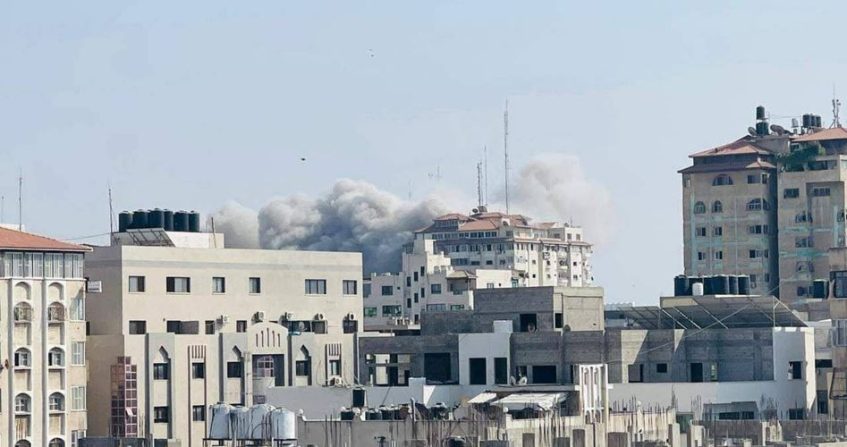
GAZA – At least eight people were killed – including an Islamic Jihad commander and a five-year-old child – and 44 were wounded in a series of Israeli aerial strikes on various areas of the Gaza Strip on Friday evening.
The Palestinian health ministry in Gaza said at least eight people were killed, including the Islamic Jihad commander Taysir al-Jabari and a five-year-old girl.
At least 44 people were wounded and are being treated at hospitals as a result of the Israeli raids, the ministry added.
Jabari, a commander of the Al-Quds Brigades, the armed wing of the Islamic Jihad, was killed in an air strike on an apartment in the Palestine Tower in the center of Gaza City, the Islamic Jihad group said in a statement.
Multiple blasts were heard and seen throughout Gaza, while Israeli reconnaissance drones were heard hovering over the besieged territory.
The Israeli attack follows days of tension after the arrest of a senior Jihad leader in the occupied West Bank.
“The IDF is currently striking in the Gaza Strip. A special situation has been declared on the Israeli home front,” the Israeli military said in a statement. It said further details would follow.
Israel has been imposing tight restrictions on the Gaza Strip for the fourth consecutive day, deepening the humanitarian crisis in the besieged enclave.
Earlier on Wednesday, Israeli prime minister Yair Lapid held a security consultation with Israeli officials to discuss the security situation in the south, Lapid’s office said.
Israel demands disbanding of UN committee investigating attacks on Gaza
MEMO | August 1, 2022
Israel demanded on Sunday the disbanding of the UN committee investigating crimes committed during the occupation state’s military offensive against Gaza in May last year. It is alleged that remarks made by one member of the committee were “anti-Semitic”.
Israeli Prime Minister Yair Lapid made the demand in a letter to UN Secretary-General Antonio Guterres, in which he referred to the statements by Miloon Kothari, a member of the UN Human Rights Council’s Commission of Inquiry, in a media interview.
“We are very disheartened by the social media that is controlled largely by, whether it is the Jewish lobby or specific NGOs,” Kothari said on a Mondoweiss podcast on 25 July. “A lot of money is being thrown into trying to discredit us.”
Israel boycotted the investigation and prevented the commission’s investigators from entering the apartheid state. It claimed that the commission’s partial findings in June were “the latest in a series of biased reports.”
In his letter to Guterres, Lapid claimed that, “The fight against anti-Semitism cannot be waged with words alone, it requires action. This is the time for action; it is time to disband the Commission. This Commission does not just endorse antisemitism — it fuels it.”
The UN spokesman did not respond immediately to requests for comment, but Mondoweiss published a message from the committee’s chair, Navi Pillay, in which she said that Kothari’s comments were intentionally taken out of context.
The US and other Western countries, including Germany, Britain and Austria, denounced — very predictably — Kothari’s comments as “anti-Semitic”.
The US representative to the UN Human Rights Council, Ambassador Michele Taylor, tweeted, “We are outraged by recent anti-Semitic, anti-Israel comments made by a member of the Israel COI. These unacceptable remarks sadly exacerbate our deep concerns about the open-ended nature & overly broad scope of the COI and the HRC’s disproportionate & biased treatment of Israel.”
Although the commission was set up to investigate the Israeli attack on Gaza, which lasted 11 days in May last year, its mandate includes human rights violations before and after that, in addition to investigating the root causes of the tension.
At least 250 Palestinians as well as 13 people in Israel were killed during the Israeli aggression, which saw severe Israeli attacks and raids that exacerbated the destruction caused by the 2014 military offensive. Palestinian factions in the Gaza Strip fired several thousand rockets in response to Israel’s ongoing brutal military occupation and siege.
Kosovo planning to attack Serbs – Belgrade
Samizdat – July 31, 2022
Serbian President Aleksandar Vucic has issued a plea for peace in Kosovo amid rising tensions with Pristina. However, he also vowed to fight to the death if ethnic Serbs in the self-proclaimed republic are targeted for another pogrom.
“The atmosphere has been heated up, and the Serbs will not suffer any more atrocities,” Vucic said in Belgrade on Sunday. “My plea to everyone is to try to keep the peace at almost any cost. I am asking the Albanians to come to their senses, the Serbs not to fall for provocations, but I am also asking the representatives of powerful and large countries, which have recognized the so-called independence of Kosovo, to pay a little attention to international law and reality on the ground and not to allow their wards to cause conflict.”
Vucic’s comments came as Pristina prepared to implement a controversial law requiring ethnic Serbs living in the disputed territory to replace their Serbian-issued vehicle registrations with Kosovo plates, starting on Monday. Kosovo also may require the replacement of other types of Serbian-issued documents, such as identification cards, and it will make a renewed attempt to ban entry or issue temporary papers to travelers with Serbian-issued documents or license plates.
Church bells rang in alarm across the northern part of the province on Sunday, amid reports that armed ethnic Albanians were gathering for another pogrom of the remaining Serbs – as had happened in 2004.
The Serbian president claimed last month that the registration policy was part of an effort to force remaining Serbs out of Kosovo. He referred to the move as “a new Storm,” in reference to the Croatian military operation in 1995 that forced most Serbs to flee Croatia.
Serbian Foreign Minister Nikola Selakovic told reporters on Saturday that “the Albanian side in Kosovo and Metohija is literally preparing to raise hell for Serbs.”
Kosovo’s prime minister Albin Kurti, an ethnic Albanian, has denied that the transition to non-Serbian documents is anything more than applying “law and justice” equally to all citizens.
“Trust your government,” he said in a videotaped message in Serbian.
Vucic has claimed that “provocations” against Serbs living in Kosovo have increased since Kurti, a nationalist who champions the idea of Albanian unification, became prime minister last year. The number of such incidents, including attacks by ethnic Albanians on Serbian cemeteries and Orthodox churches, has jumped 50%, he told reporters on Sunday.
“We do not want conflicts and we do not want war,” Vucic said in his speech. “We will pray for peace and seek peace, but let me tell you right away: There will be no surrender, and Serbia will win. If they dare to start persecuting, harassing and killing Serbs, Serbia will win.”
Vucic also speculated that Pristina is trying to take advantage of the Ukraine crisis by provoking a conflict in which Kurti would be portrayed sympathetically as Kosovo’s version of Ukrainian President Vladimir Zelensky, with the Serbs cast in the role of Russia and President Vladimir Putin.
NATO occupied Kosovo in 1999, after a 78-day air war against what was then Yugoslavia. The province declared independence in 2008, with Western support. While the US and most of its allies have recognized it, Serbia, Russia, China and the UN in general have not.
Featured Video

Dan Dicks with James Corbett on Solutions Watch
or go to
Aletho News Archives – Video-Images
From the Archives
$1.5bn up in smoke: US THAAD missile stockpile dries up defending Israel against Iran
By Ivan Kesic | Press TV | July 2, 2025
According to American media, defense news outlets, and independent analysts, the 12-day Israeli military aggression against Iran significantly depleted the US stockpile of THAAD (Terminal High Altitude Area Defense) interceptor missiles.
Citing official sources, American magazine Newsweek reported on Friday that the US transferred a substantial portion of its advanced missile defense capabilities to support the Israeli regime, an effort with questionable results and a critical impact on US strategic reserves.
THAAD, developed by Lockheed Martin arms manufacturing company, is a key component of Israel’s multi-layered air defense architecture. It is designed to intercept medium-range ballistic missiles, including those launched from Iran and Yemen.
The US-made system is capable of targeting short-, medium-, and intermediate-range ballistic missiles during their terminal phase, whether inside or outside Earth’s atmosphere.
THAAD uses a “hit-to-kill” method, relying on kinetic energy rather than explosive warheads to destroy incoming threats, intercepting at altitudes of up to 150 km and ranges between 150-200 km.
Operated exclusively by American personnel, the US military maintains eight THAAD batteries with an estimated 350–400 interceptors in total. The eighth battery was activated during the June 20 Israeli aggression against Iran and is capable of intercepting hypersonic missiles. … continue
Blog Roll
 Aletho News
- While Gaza dominates the UN, these are the people keeping it alive
- New Report: “Scholasticide and Genocide in Gaza: Assessment, Testimonies and Legal Analysis”
- ‘THAAD Delusion’: Iran war exposes US missile shield limits – The Atlantic
- Moscow issues warning to NATO over Russian exclave
- Yes, the Iran war has destroyed Trump’s presidency
- The fallacy of US delusions about Iran’s economic collapse
- Hezbollah denies Syria cell link, warns of Israeli plan to sow discord
- The legacy of US sanctions, war, and occupation in Iraq
- Iraqi resistance group rejects disarmament, vows to maintain support for Lebanon
- Sheikh al-Asadi warns of Iraqi government compliance with US demands
- If Americans Knew
- Iran’s Revolutionary Guards Publish Letter to the American People
- DMFI launches $1 million ad campaign supporting Virginia’s Elaine Luria
- US Senate blocks resolution seeking report on Americans killed by Israel
- Israeli Attacks Kill Ten Palestinians in Gaza
- Massacre at Minab: The School That Became a Grave
- Israeli media: The IDF Shows It Doesn’t Turn a Blind Eye; It Actively Emboldens Settler Havoc
- As settlers ravage West Bank, Israeli forces kill 10 in Gaza – Daily Update
- New Report: “Scholasticide and Genocide in Gaza: Assessment, Testimonies and Legal Analysis”
- Ex-Biden officials are desperate for a Gaza scapegoat
- Israeli “settlers” Invade Al-Aqsa; Pour Boiling Water on 75-Year-Old
- No Tricks Zone
- Green Energy Debacle: German Expert Professor Fritz Vahrenholt Warns Of Severe Economic And Social Consequences
- Two More Paleo Reconstructions Affirm Meters-Higher Sea Levels Across Ireland, Brazil 7000-6000 Years Ago
- New Study: Earth And Venus Surface Warmth Largely Explained By Convection And Lapse Rate, Not CO2 Or Radiation
- 2025 Nature Paper Claiming Worsening Global Drought Gets RETRACTED …Heavily Flawed
- New Study: ‘Global Drought Shows No Detectable Recent Acceleration Under Climate Warming’
- Economic Masterminds: German Socialists Suggest Taxing Productivity Gains Stemming From Using AI
- The South China Sea Has Not Been Cooperating With The Climate Change Narrative
- Energy Crisis: Germany Enters Heating Season With Historically Low Gas Reserve Fill Levels
- New Study: The Antarctic Ice Sheet Gained Mass From 2020-2024 Due To Staggering Snow And Ice Accumulation
- Study: Ocean Heating Rates From Thousands Of Years Ago ‘Dwarf’ Modern Ocean Heating Rates

