Mishaal: Palestinians are unanimous in rejecting deal of the century
Palestine Information Center – June 27, 2019
Former head of Hamas’s political bureau Khaled Mishaal has expressed the Palestinian people’s rejection of the US deal of the century and its economic conference in Bahrain.
 In televised remarks on Tuesday, Mishaal described the deal of the century as “suspicious, poisonous and aimed at liquidating the Palestinian cause,” affirming that “the Palestinian people are unanimous in rejecting the deal and will not allow it to take place.”
“The deal of the century has no future and will be doomed to failure, God willing,” he said.
“There are Palestinian constants and red lines our people are adherent to and they will not accept any bargaining over them,” the Hamas official added.
He accused some Arab regimes of attempting to sell out Palestine which he described as “the Jewel of the Arabs” through accepting bribes coming from their own money.
“Those who have internal crises and agendas and want to sacrifice Palestine for their own sake and to please American are mistaken and committing a crime against Palestine. If they want to gamble, they should gamble with what they have,” he stressed.
He said that Israel can never be part of any solution or the region, describing it as an enemy of the Palestinian people and the Arab nation.
Haniyeh: ‘Palestine is not for sale’
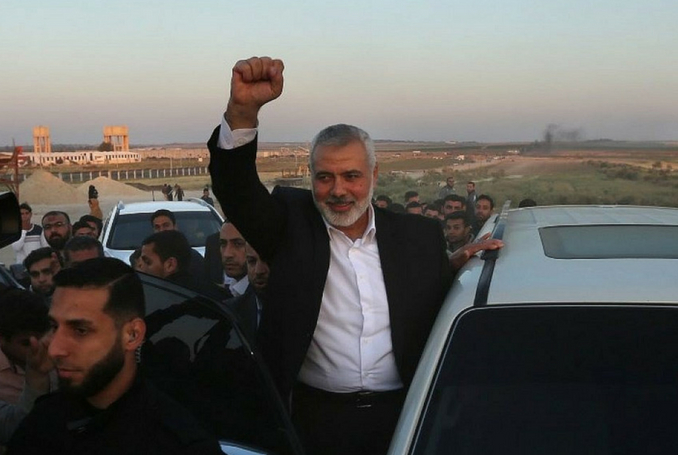
MEMO | June 27, 2019
Head of Hamas’ political bureau Ismail Haniyeh has said that the Manama workshop “secures economic cover for a political attempt to liquidate the Palestinian cause.”
Haniyeh’s statement came in a speech during a conference organised by Palestinian factions on Tuesday, entitled the Palestinian National Conference to face the Deal of the Century and Reject the Manama Workshop held in Gaza.
He added: “We are witnessing a crucial historical moment. Our position is clear: Palestine is not for sale. No for deals which consecrate the occupier’s hegemony over our land.”
He continued: “The Palestinian people stand today in the face of the Manama workshop in a renewed uprising and political revolution, as Palestinians have sensed the unprecedented strategic threat facing the Palestinian cause.”
Haniyeh pointed out that the Manama workshop “grants Israel the green light to expand its occupation efforts and control over the entire West Bank, in addition to paving the way for normalisation with Arab countries and the integration of the occupier in the region.”
He stressed that the workshop “was born dead and frustrated. The Palestinian people today stand unified in the face of these deals.”
Haniyeh continued that “all Arab people stand today to emphasise the significance of the Palestinian cause and that Jerusalem is the compass of the nation.”
On Tuesday evening the Manama Peace to Prosperity Workshop began in Bahrain, looking at the economic aspects of the Middle East peace settlement plan, known as the deal of century, according to US media.
Haniyeh demanded all factions “insist on steadfast adherence to the Palestinian cause, primarily Jerusalem, the right of return and a sovereign state with Jerusalem as its capital on the entire national territory.”
Haniyeh said: “We, Hamas, are ready now to meet with Palestinian President Mahmoud Abbas in Gaza, in Cairo or anywhere.”
Haniyeh called for “the formation of a government of national accord to run our affairs, and prepare for the presidential and legislative elections as well as the Palestinian National Council.”
The movement’s leader also called for “the reconstruction of the Palestine Liberation Organisation to include all factions under one single leadership.”
The steal of the century: stolen land, stolen water, stolen images
By Bill Law | MEMO | June 27, 2019
Jared Kushner and Benjamin Netanyahu must have considered it the longest of long shots but what if the Palestinians by some wild stretch of the imagination had called their bluff on the “deal of the century”; what if they had suddenly decided to turn up in Bahrain for the “Peace to Prosperity” workshop this week?
To guard against any such thing happening, Israel’s Ambassador to the United Nations, Danny Danon, wrote a deliberately offensive and insulting opinion piece on 24 June that the New York Times was happy to publish. “What’s wrong with Palestinian surrender?” mused Ambassador Danon. “Surrender is the recognition that in a contest, staying the course will prove costlier than submission.” Having backed the Palestinians into a corner from which they could only say no, Kushner then had Danon stick the knife in.
The message, in all its arrogance, was clear: if you don’t take what is on offer, it is going to get a hell of a lot worse. However, we know we have made it impossible for you to take what is on offer, so guess what? The two state solution is well and truly dead; the path to a greater Israel is secured; welcome to the new reality of Palestinian Bantustans in the West Bank and Gaza. And, oh yes, we promise to throw cash at you, $50 billion; that’s a lot of dosh, if you do what is commanded of you. If you don’t, well that money is off the table.
While many commentators have rightly attacked the New York Times for publishing an openly racist and hate-mongering piece, they may have missed the larger significance of what is happening at speed in the killing of the two-state solution. The day before the Danon article, US National Security Advisor John Bolton accompanied the Israeli Prime Minister to land overlooking the Jordan Valley, the most fertile region of the West Bank. Nearly 90 per cent of the valley has been allocated to Israeli settlements and agriculture, in violation of UN Security Council Resolution 242 and international law.
A smiling and nodding Bolton, wearing a baseball cap bedecked with the US and Israeli flags, looked on as Netanyahu argued that the Jordan Valley offered what he called “the minimal strategic depth and height for the defence of our country,” whatever that means. Those who said that restoring the valley to the Palestinians was a prerequisite to peace just didn’t get it, the Israeli Prime Minister argued. No, restoring land to its rightful owners was not going to bring peace; “It will bring war and terror.” So, according to Netanyahu, a just and fair settlement that righted an historic wrong would lead to war. Yet another example of truth turned on its head and a lie declared as truth.
Bolton, resembling one of those bobble-head figures that are given out at American sports events, said that he wished more Americans could come and see for themselves how the Jordan Valley “affects Israel’s critical security position.” He was keen to assure Netanyahu that, “President Trump will take the concerns you have expressed so clearly very much into account.”
It was all eerily reminiscent of another visit that happened in March of this year. On that occasion, Netanyahu was accompanied to the occupied Syrian Golan Heights by the senior Republican senator and Trump ally Lindsey Graham. Graham promised to return to the Senate and “start an effort to recognise the Golan as part of the state of Israel, now and forever.” And so it came to pass, with Netanyahu unveiling a large plaque on the Golan on 16 June announcing the site of a new settlement to be built: in Hebrew and in English it proclaimed that this is now “Trump Heights”.
One could say that it was tacky beyond all belief or you could take the view that in the Trumpian age of impunity, if you are Benjamin Netanyahu you can get away with just about anything. No doubt the Israeli leader was emboldened to massage the presidential ego by the statement made a week earlier by the US Ambassador to Israel, David Friedman. A bankruptcy lawyer who in a previous career had worked for the Trump Organisation (and presumably knows a thing or two about dodgy real estate deals), Friedman had declared that, “Under certain circumstances I think Israel has the right to retain some, but unlikely all, of the West Bank.”
There you have it: in the eyes of Kushner, Netanyahu, et al, the path to peace lies through the annexation of what is left of most of the West Bank, including its most valuable agricultural asset, the Jordan Valley. It goes without saying, therefore, that Kushner’s Peace to Prosperity document has something to say about real estate and the settling of land claims. It is right there on page 19: “Project one, Property Ownership Resolution: Enhance court capacity to quickly and effectively resolve property disputes and contested-ownership claims.”
So the game is this: annex as much as possible using the guise of pursuing a peace deal; declare those lands and buildings already annexed as legally belonging to Israel; and then go to court to decide who gets whatever is left over. And, of course, you can guess whose courts and whose judges. Peace to Prosperity doesn’t say anything about it, but I think we know the answer.
Read the document a little further on and it gets worse. There is a whole section devoted to agriculture. It sounds wonderful until you reflect that the most valuable agricultural asset is already off the table. True, there is a water irrigation project to help sustain Palestinian farmers, but guess what? The Israelis already control West Bank aquifers including those in the Jordan Valley where they have drilled deep bores circumventing and cutting off Palestinian wells and requiring the Palestinians to buy their own water back from Israel.
Meanwhile, back in Manama, the Israelis had broken through longstanding taboos and met with senior and some not so senior representatives of Arab states. Bahrain’s Foreign Minister told an Israeli interviewer, “We do believe that Israel is a country to stay, and we want better relations with it, and we want peace with it.” That is something that would have been unthinkable before the arrival of Donald Trump in the White House. It is the Israelis and not the Palestinians who are being embraced, and Arab protestations in public about support for a two state solution sound increasingly feeble and unconvincing.
Reading Kushner’s document I was struck by the illustrations and photos of smiling Palestinians, and I wondered if these people give permission for their images to be used. Odd if they had, given the awful way that Kushner and his father-in-law have treated them. Not surprisingly, though, it turns out that no such permission was given; the pictures were lifted from, among other sources, USAid videos about an agricultural project several years ago and from a joint Palestinian-Israeli reconciliation project. USAid to the Palestinians has, of course, been cancelled by Trump, but that didn’t stop the lifting of the photographs.
Stolen land, stolen water, stolen images. The steal of the century. And the world sits back and lets it all happen. No wonder Jared Kushner is looking smug.
Monsters Walk the Earth. Why These Three Countries Are the Real Troika of Evil
By Philip Giraldi | Strategic Culture Foundation | June 27, 2019
There are monsters among us. Every day I read about an American “plan” to either invade some place new or to otherwise inflict pain to convince a “non-compliant” foreign government how to behave. Last week it was Iran but next week it could just as easily again be Lebanon, Syria or Venezuela. Or even Russia or China, both of whom are seen as “threats” even though American soldiers, sailors and marines sit on their borders and not vice versa. The United States is perhaps unique in the history of the world in that it sees threats everywhere even though it is not, in fact, threatened by anyone.
Just as often, one learns about a new atrocity by Israelis inflicted on the defenseless Arabs just because they have the power to do so. Last Friday in Gaza the Israeli army shot and killed four unarmed demonstrators and injured 300 more while the Jewish state’s police invaded a Palestinian orphanage school in occupied Jerusalem and shut it down because the students were celebrating a “Yes to peace, no to war” poetry festival. Peace is not in the Israeli authorized curriculum.
And then there are the Saudis, publicly chopping the heads off of 37 “dissidents” in a mass display of barbarity, and also murdering and dismembering a hapless journalist. And let’s not forget the bombing and deliberate starving of hundreds of thousands innocent civilians in Yemen.
It is truly a troika of evil, an expression favored by US National Security Advisor John Bolton, though he was applying it to Cuba, Venezuela and Nicaragua, all “socialist” nations currently on Washington’s “hit list.” Americans, Saudis and Israelis have become monsters in the eyes of the rest of the world even if in their own minds they are endowed with special privilege due to their being “Exceptional,” “Chosen by God” or “Guardians of Mecca and Medina.” All three countries share a dishonest sense of entitlement that supports the fiction that their oppressive and often illegal behavior is somehow perfectly legitimate.
To be sure not all Americans, Saudis or Israelis are individually monsters. Many are decent people who are appalled by what their respective governments are doing. Saudi citizens live under a despotism and have little to say about their government, but there is a formidable though fragmented peace movement in slightly less totalitarian Israel and in the United States there is growing anti-war sentiment. The discomfort in America is driven by a sense that the post 9/11 conflicts have only embroiled the country more deeply in wars that have no exit and no end. Unfortunately, the peace movement in Israel will never have any real power while the anti-war activists in America are leaderless and disorganized, waiting for someone to step up and take charge.
The current foreign policy debate centers around what Washington’s next moves in the Middle East might be. The decision-making will inevitably involve the US and its “close allies” Israel and Saudi Arabia, which should not surprise anyone. While it is clear that President Donald Trump ordered an attack on Iran before canceling the action at the last minute, exactly how that played out continues to be unclear. One theory, promoted by the president himself, is that the attack would have been disproportionate, killing possibly hundreds of Iranian military personnel in exchange for one admittedly very expensive surveillance drone. Killing the Iranians would have guaranteed an immediate escalation by Iran, which has both the will and the capability to hit high value targets in and around the Persian Gulf region, a factor that may also have figured into the presidential calculus.
Trump’s cancelation of the attack immediately produced cries of rage from the usual neoconservative chickenhawk crowd in Washington as well as a more subdued reiteration of the Israeli and Saudi demands that Iran be punished, though both are also concerned that a massive Iranian retaliation would hit them hard. They are both hoping that Washington’s immensely powerful strategic armaments will succeed in knocking Iran out quickly and decisively, but they have also both learned not to completely trust the White House.
To assuage the beast, the president has initiated a package of “major” new sanctions on Iran which will no doubt hurt the Iranian people while not changing government decision making one iota. There has also been a leak of a story relating to US cyber-attacks on Iranian military and infrastructure targets, yet another attempt to act aggressive to mitigate the sounds being emitted by the neocon chorus.
To understand the stop-and-go behavior by Trump requires application of the Occam’s Razor principle, i.e. that the simplest explanation is most likely correct. For some odd reason, Donald Trump wants to be reelected president in 2020 in spite of the fact that he appears to be uncomfortable in office. A quick, successful war would enhance his chances for a second term, which is probably what Pompeo promised, but any military action that is not immediately decisive would hurt his prospects, quite possibly inflicting fatal damage. Trump apparently had an intercession by Fox news analyst Tucker Carlson, who may have explained that reality to him shortly before he decided to cancel the attack. Tucker is, for what it’s worth, a highly respected critic coming from the political right who is skeptical of wars of choice, democracy building and the global liberal order.
The truth is that all of American foreign policy during the upcoming year will be designed to pander to certain constituencies that will be crucial to the 2020 presidential election. One can bank on even more concessions being granted to Israel and its murderous thug prime minister Benjamin Netanyahu to bring in Jewish votes and, more importantly, money. John Bolton was already in Israel getting his marching orders from Netanyahu on the weekend and Pence was effusive in his praise of Israel when he spoke at the meeting in Orlando earlier in the week launching the Trump 2020 campaign, so the game is already afoot. It is an interesting process to observe how Jewish oligarchs like Sheldon Adelson contribute tens of millions of dollars to the politicians who then in turn give the Jewish state taxpayer generated tens of billions of dollars in return. Bribing corrupt politicians is one of the best investments that one can make in today’s America.
Trump will also go easy on Saudi Arabia because he wants to sell them billions of dollars’ worth of weapons which will make the key constituency of the Military Industrial Complex (MIC) happy. And he will continue to exert “maximum pressure” on Iran and Venezuela to show how tough he can be for his Make America Great audience, though avoiding war if he possibly can just in case any of the hapless victims tries to fight back and embarrass him.
So, there it is folks. War with Iran is for the moment on hold, but tune in again next week as the collective White House memory span runs to only three or four days. By next week we Americans might be at war with Mongolia.
There is no parity between ethnic cleansing in Palestine and Jews’ exodus from Arab states
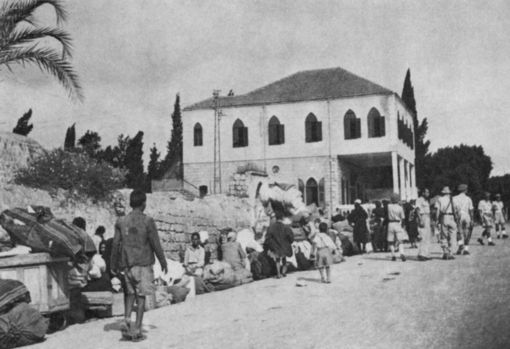
By Nasim Ahmed | MEMO | June 26, 2019
British Conservative MP Theresa Villiers blundered into a debate on Israel and Palestine last week. In doing so, the former Northern Ireland Secretary rehashed discredited myths the function of which has historically been to shield Israel from taking responsibility for the plight of Palestinian refugees. During deliberations in the House of Commons on “Jewish Refugees from the Middle East and North Africa”, Villiers spoke of the “untold story” of the “ethnic cleansing” of 856,000 Arab Jews from Arab countries.
According to the member of Conservative Friends of Israel, ignoring the plight of these Jewish refugees and concentrating only on the Palestinians “gives the international community a distorted view of the Middle East dispute.” Villiers added that, “A fair settlement needs to take into account the injustice suffered by Jewish refugees as well as the plight of the Palestinians.”
The MP for Chipping Barnet claimed that, “The historic UN Resolution 242 states that a comprehensive peace agreement should include ‘a just settlement of the refugee problem’; the language is inclusive of both Palestinian and Jewish refugees.”
Villiers-who often speaks in support of Israel and has even used a Commons debate about terrorism on the streets of London to appeal for “sympathy and solidarity” for the Zionist state- mimicked discredited claims made by Israeli officials since the 1950s to absolve the country from its obligations under international law to the 750,000 Palestinians who were ethnically cleansed in 1947-8.
As others have pointed out, “The analogy between Palestinian displacement and the Jewish ‘exodus’ from Arab countries is misleading.” The claims of the two communities are very different; the history and circumstance of their displacement bears no resemblance to each other, which makes any attempt to use the plight of one group to dismiss the other, as though it were a kind of population transfer reminiscent of countries split apart by civil war, totally fanciful.
Contrary to what Villiers suggested, there was no forced mass exodus of Jews from Arab countries, in the way that there was a deliberate, forced expulsion of Palestinians from their own land. If we look at Iraq, for example, Arab Jews left due to a combination of factors, of which a hostile environment following the creation of the State of Israel in Palestine was certainly one. Other push factors, according to Abbas Shiblak, author of The Lure of Zion: Case of the Iraqi Jews, include laws that were enacted to facilitate the Jewish exodus. One such law is 1/1950, known as the denaturalisation law, which empowered the Iraqi government to “divest any Iraqi who wished of his own free will and choice to leave Iraq for good, of his Iraqi nationality.” Shiblak points out that this law was welcomed by Israel, as well as Britain and the US, both of which were applying pressure on Iraq to agree to a population transfer deal involving 100,000 Iraqi Jews. It was indeed a driving factor in the flight of Iraqi Jews.
Other factors, though mired in controversy, also played a part. The 1950s saw a number of Israeli false flag operations. One that grabbed global attention was the failed covert operation, known as the “Lavon Affair”. Egyptian Jews were recruited by Israeli military intelligence to plant bombs inside British and American civilian targets, including churches and libraries. The attacks were to be blamed on the Muslim Brotherhood and Egyptian communists in order to induce the British government to maintain its occupation army in the Suez Canal zone.
While that operation was not intended to create a hostile environment for Jews in Egypt with the hope of persuading them to go to Israel — that result was an arguably unintended consequence — similar plots in Iraq were designed with exactly that in mind. From 1950 through to 1951 Israeli spy agency Mossad orchestrated five bomb attacks on Jewish targets in an operation known as Ali Baba, to drum up fear amongst and hostility towards Iraqi Jews. As the mood darkened, more than 120,000 Jews — 95 per cent of the Jewish population in Iraq — left for Israel via an airlift known as Operation Ezra and Nehemiah.
In addition to the anti-Jewish feelings that took root in Arab cities following the creation of the State of Israel and prompted Jewish flight, there was also a powerful pull factor that had nothing to do with hostility in Arab countries. The very creation of Israel was based on the idea of “the ingathering of the exiles”, which assumed that the self-styled “Jewish State” would attract as a matter of course Jews from around the world to make “aliyah” and migrate there. This was not only intended to fulfil the secular dream of a Jewish “national home” (as the Balfour Declaration put it, not a “state”) but also to bring about what fundamentalist Evangelical Christians believe is a Biblical prerequisite for the long-awaited return of Jesus Christ, Armageddon and the end days; what they refer to as the “rapture”. If the whole purpose of the State of Israel was and remains to attract Jewish migration from across the world — Arab states included, presumably — then to claim that those who make the move are “refugees” is totally inaccurate and a false representation of reality.
In stark contrast, the ethnic cleansing (a term applied by Israeli historians) of three-quarters of the Palestinian population of historic Palestine, and the subsequent further expulsions of the native population that followed the June 1967 war, was premeditated in order to create a Jewish majority in the land. This is not only an indisputable historical fact, but is also reflected in various UN resolutions.
Israel’s membership of the UN was conditional upon the nascent Zionist state taking responsibility for the plight of Palestinian refugees and allowing them to return to their homes. It’s worth noting that Israel first applied to join the UN on 15 May, 1948, the day after it declared its independence; the application was rejected. A second application on 17 December the same year was also turned down on the grounds that the fighting was ongoing in Palestine and that Israel had failed to establish a demilitarised zone in the Negev Desert. It was only at its third attempt a year later that the international community allowed Israel to become a member of the organisation with the aforesaid condition.
UN General Assembly Resolution 273 of 11 May, 1949 admitted the state as a member, but required Israel to comply with Resolution 194 of 11 December, 1948 which “resolves that the [Palestinian] refugees wishing to return to their homes and live at peace with their neighbours should be permitted to do so at the earliest practicable date, and that compensation should be paid for the property of those choosing not to return and for loss of or damage to property which, under principles of international law or in equity, should be made good by the Governments or authorities responsible.” The Israeli government agreed to this condition. In pursuit of this goal, the UN ordered the creation of a commission to facilitate the repatriation, resettlement and economic and social rehabilitation of the refugees and the payment of compensation.
However, Israel has never shown any inclination to fulfil that condition of its UN membership, despite agreeing to do so. Palestinians who were expelled from their land, and their descendants, still live in refugee camps across the occupied Palestinian territories and neighbouring countries, with many others in the wider diaspora around the world.
The international community recognises no such moral and legal claims for Arab Jews who moved to Israel, though it should also be pointed out that many chose to settle elsewhere. Villiers cited UN Resolution 242 when she claimed that such an obligation does indeed exist. However, the strongest interpretation of this resolution given its context in being adopted by the Security Council in 1967 after Israel occupied the West Bank and Gaza during a war that led to the displacement of a further 400,000 Palestinians, is that UN Resolution 242 refers only to Palestinian refugees. The resolution also required Israel to withdraw from the territories that it occupied during the war; it hasn’t done that yet, either.
One could of course make a case for Arab Jews to be compensated for the suffering that they endured and the property they left behind, but that should not in any way be at the expense of Palestinian refugees. Such a move would have no basis in international humanitarian law, and would thus be baseless. Human rights are not interchangeable: you cannot simply exchange the rights of one person with those of another as though it were some kind of commodity to be bartered. The rights and claims of Palestinian refugees on the state of Israel cannot be wiped away by rights that Jews may or may not have over Arab states. The simple truth is that there is not, and never has been, any parity between the ethnic cleansing of the Palestinians since 1947, and the exodus of Jews from Arab states. As a lawyer, Theresa Villiers should know that but, as a strong supporter of the State of Israel, like many others she chooses to ignore it as she tries to deny Palestinians of their legitimate rights.
Netanyahu boasts ‘100s of anti-Iran ops’ in Syria as Russia reminds to love thy neighbor’s security
RT | June 26, 2019
Israeli Prime Minister Benjamin Netanyahu made it clear that Israel will stop at nothing to protect itself against any perceived threats, as he boasted about Tel Aviv’s successful raids against alleged Iranian targets in the neighboring Syria.
“Israel has acted hundreds of times to prevent Iran from entrenching itself militarily in Syria,” he said, speaking ahead of a trilateral meeting between the Russian, American and Israeli national security advisers, who met in Jerusalem on Tuesday to discuss rising tensions in the Middle East and other urgent matters.
“We have acted hundreds of times to prevent Iran from delivering increasingly sophisticated weaponry to Hezbollah, or to form a second front in the north against us from the Golan Heights. Israel will continue to prevent Iran from using neighboring territory as platforms to attack us, and Israel will respond forcefully to any such attacks.”
Such belligerent statements did not sit well with the Russian Security Council Secretary Nikolai Patrushev, who called on the Israeli PM to respect the security of his neighbors as well, explaining that it was effectively the only way to ensure Israel’s own safety.
“We understand the concerns that Israel has and want those threats to be eliminated,” Patrushev said, explaining that Israel’s security is important for Moscow, but added that “one should also take the national interests of other regional nations into consideration.”
“If we do not … acknowledge and reckon with those interests, I doubt we can achieve any tangible result” in terms of regional security, the Russian Security Council secretary warned.
British Society for Middle Eastern Studies endorses boycott of Israeli universities
MEMO | June 25, 2019
The British Society for Middle Eastern Studies (BRISMES) has endorsed the Palestinian call for a boycott of Israeli academic institutions, in a vote taken at its AGM in Leeds on Monday.
According to reports on social media, the resolution supporting the Boycott, Divestment, Sanctions (BDS) campaign was easily passed, with almost 80 percent support (final numbers to be confirmed).
The resolution highlights Israel’s obstruction of “Palestinians’ right to education by destroying Palestinian universities and schools, arresting students, raiding and forcing Palestinian universities to close, and restricting Palestinians’ movement”.
The text goes on to describe the “key role” played by Israeli universities “in planning, implementing and justifying Israel’s illegal military occupation”, and claims such institutions “are maintaining a close and supportive relationship with the Israeli military”.
Examples of this relationship include “involvement in developing weapons systems, providing justification for military actions and extra-judicial killings, rewarding students serving in the occupation forces, designing and delivering special programmes for soldiers and officers, building on occupied land, and systematically discriminating against non-Jewish students”.
Proposed by Professor John Chalcraft (LSE) and seconded by Dr Rafeef Ziadah (SOAS), the resolution commits BRISMES to “endorsing the call for a boycott of Israeli academic institutions until these institutions publicly end their support and complicity in violating Palestinian rights as stipulated in international law”.
After the resolution passed, Dr Ziadah tweeted: “members of #BRISMES2019 passed a #BDS resolution @ annual general meeting earlier today. This was a real grassroots campaign, long time in the making. Congratulations to every single person who worked tirelessly to make this happen!”
Palestinian boycott campaigners welcomed the move, and urged other international academic societies to take “similar measures against racism and oppression”.
BRISMES was established in 1973 “to encourage and promote the study of the Middle East in the United Kingdom”, and brings together “teachers, researchers, students, diplomats, journalists and others who deal professionally with the Middle East”.
The Economic Entrails at the Heart of the ‘Deal of the Century’
By Alastair Crooke | Strategic Culture Foundation | June 25, 2019
It is nothing new to say that the ‘Deal of the Century’ is – and always was – in essence an economic project. Indeed, it seems that its political ramifications are viewed by the White House as little more than the ineluctable consequences to an a priori economic architecture, already in the process of being unfolded.
In other words, it is the economic facts on the ground that are intended shape the political outcome — an attenuated political landscape that anyway has been minimised by Trump’s pre-emptive removal of key pieces of any Palestinian negotiating leverage.
The financial squeeze on the Palestinians is well attested. On the one hand, the Palestinian Authority (historically dependent on Saudi subvention) is gently slipping into bankruptcy; whilst Gaza is held in virtual abject dependency through the drip-feed of subventions channelled into Gaza by Qatar, with Israeli permission — the size of this latter monthly ‘lifeline’ subvention being carefully adjusted by Israel according to what it judges to be the norms of (generally Hamas) ‘good conduct’.
So, on the one hand there is the financial siege that is intended to make the Palestinians pliant to the ‘quality of life package’ which the ‘deal’ is supposed to bring — the Bahrain summit later this month being its shopfront. But there is another less well recognised side to the Deal which is summarised in the title to a McClatchy article entitled, White House sees Egyptian energy forum as a ‘roadmap to Middle East peace’.
In a later piece, McClatchy publishes the newly declassified map of the US East Mediterranean energy ‘roadmap’. And here the fuller picture becomes clear: the US sponsored ‘gas forum’, “according to three senior administration officials, that map [the] declassified one, obtained by McClatchy – has motivated members of the [US] National Security Council to prioritize the formation of a gas forum in the Eastern Mediterranean that would simultaneously boost and entangle the economies of several countries that have been at odds for decades”.
Well, let’s translate that little euphemism: ‘boost and entangle’. What that formula translates into is — the means to integrate Israel into the economic regional sphere is firstly, through energy. Yet, it is not intended to integrate Israel alone into this Egyptian economic sphere, but also to make Jordan, the PA (and maybe even Lebanon), too, partially dependent on Israeli energy – alongside putative partners, Italy, Greece, and (the Greek-linked part) of Cyprus — with the US offering to help flesh out the structure of the ‘gas forum’ with U.S. expertise.
This is the heart of ‘the deal’. Not just political normalisation for Israel into the region, but the making of economic dependency of the Egyptians, Palestinians, Jordanians (and possibly – but not so likely – Lebanon) on the US East-Med gas ‘hub’.
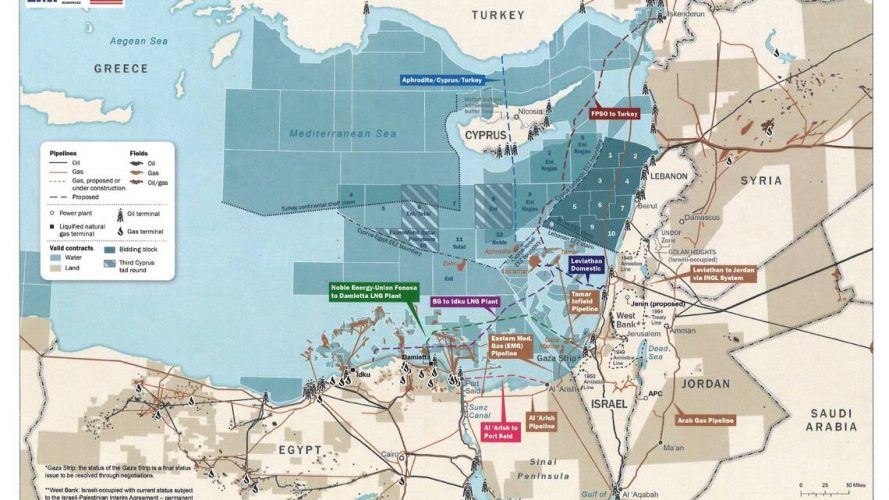
Source: McClatchy
And, inevitably there is a sub-plot to all this, (as McClatchy notes):
“On this front, the administration enjoys support from unlikely allies. Eliot Engel, the Democratic chairman of the House Foreign Affairs Committee … said the Mediterranean gas forum project was a strategic opportunity for the U.S. to stymie Russian influence efforts over local energy resources. “I think that [Russian President Vladimir] Putin and Russia can’t and should not be able to control the situation,” Engel stated”.
So, the US Administration is pursuing two bipartisan congressional efforts to ‘stymie’ Russia in the region: One is a bill promoting energy partnerships in the Eastern Mediterranean; and a parallel bill which threatens to sanction European firms supporting the construction of the Nord Stream 2 pipeline taking Russian gas into Germany.
There are however, two obvious big ‘catches’ to this notion of both ‘stymying’ Russia, whilst simultaneously normalising Israel economically into the region. The first, as Simon Henderson of the Washington Institute notes, [is the notion that] the area’s underlying geology could help Europe offset, or even replace, its dependence on Russian gas “seems farfetched at the present level of discoveries. Several more giant fields like Leviathan or Egypt’s Zohr would have to be found before this reality changes”:
“The idea that East Mediterranean energy could impact on the European energy balance in such a way as to dent Russian market share is a fantasy – Europe’s thirst for gas is so huge, and Russia’s ability to provide that gas is so great, that it’s a wild dream to even hope we can achieve it given the limited reserves discovered thus far,” Henderson said. “Hoping you can find gas is not the same as finding gas”.
In short, an Egyptian ‘hub’ serving exports, might only ‘work’, as matters stand, through patching some of the smaller East-Med discoveries – together with a large Israeli contribution – through pipelines into the two Egyptian gas liquefying plants near Port Said and Alexandria. But LNG availability globally is high, prices are hugely competitive, and it is by no means certain that ‘the hub’ can be commercially viable.
And here is the main catch: Geo-politics. Anything aimed at integrating Israel into the region is bound to be sensitive. So, whilst US officials are optimistic about Egypt’s leadership of their ‘gas forum’ in the wake of President Sisi’s April meeting with Trump – Egypt – a mainstay to the separate US Iran confrontation plan – shortly afterward the visit, rather notably withdrew from the strategic military alliance the Trump administration was trying to build to confront Iran: The Middle East Strategic Alliance (MESA), to the consternation of US officials.
When it comes to energy deals, however, even having a treaty with Israel does not put an end to public sensitivities about rapprochement with Israel, Henderson notes. Notwithstanding any ‘peace treaty’, many Jordanians still oppose the prospect of using (Israeli) Leviathan gas to provide for large-scale electricity generation, beginning early next year. Amman has tried to deflect such anger by calling the supplies “northern gas” or “American gas”, emphasizing Noble’s role in producing it.
But here is the other side to the issue: Clearly, Egypt does not want to be a part of any anti-Iranian US-led alliance (MESA). But equally, why should Egypt – or Jordan, or for that matter, or any other member of the ‘gas forum’ – wish to be tightly aligned with an US anti-Russian strategy for the region? Egypt may have signed up to the US ‘gas hub’ project. But at the very same time, Egypt also was signing a $2 billion contract to buy more than twenty Russian Sukhoi SU-35 fighter aircraft. Do ‘hub’ members really judge an Egyptian ‘hub’ to be a rival to Russian gas in Europe?
Probably not: For ultimately, the idea that a putative energy hub can ‘stymie Russia’ indeed is fantasy. The EU shows, for example, no particular interest in the US supported $7 billion mooted pipeline linking the eastern Mediterranean through Cyprus, to Greece. The undersea terrain is too problematic, and the cost too high.
Israel too, hopes to find more gas (of course). But the deadline for bids on nineteen of its offshore blocks has been pushed back to mid-August – seemingly reflecting a lack of investor interest. For now, the oil majors seem more tempted by the Cypriot blocks – up for bid.
But politics again: being a part of America’s ‘gas forum’ in which the Nicosia (i.e. the Greek-linked) government is a key member, explicitly places the forum and its members on a potential collision course with Turkey, who will not readily yield on its ambitious claims on the East Med basin (it has just announced that it will establish naval and air bases in Northern Cyprus). Nor will Lebanon, either. Sisi and Erdogan share a mutual, personal dislike, but will the others wish to be drawn into that quarrel?
Russia anyway, seems not greatly interested in the production possibilities of the Mediterranean Middle East. Rather it is focused on a pipeline corridor stretching from Iran and Iraq to Europe via Turkey or (eventually) Syria.
In sum then, the Kushner – Trump ‘Deal’, in respect to the integration of Israel into the regional energy economy seems destined to draw the same skepticism and distrust, as does the ‘Deal’s’ other parts.
$9 billion for Egypt in return for deal of the century
MEMO | June 24, 2019
According to documents released by the White House, the economic aspect of Donald Trump’s peace plan between Palestine and Israel includes granting $9 billion to Egypt, half of which is in the form of soft loans.
The documents revealed that $50 billion will be dedicated to the economic part of the deal of the century, which will be invested in the revival of the Palestinian territories, as well as Lebanon, Jordan and Egypt.
The US President’s advisor and son-in-law Jared Kushner will announce the details of the first phase of the peace plan during the workshop on “Peace for Prosperity” in Manama, Bahrain, on 25 and 26 June.
According to the documents, the funds received by Egypt will be invested during three stages over 10 years, as follows:
- $5 billion to be invested in modernising transport infrastructure and logistics in Egypt.
- $1.5 billion to be invested in supporting Egypt’s efforts to become a regional natural gas hub.
- $2 billion to be dedicated to the Sinai Development Project ($500 million for power generation projects, water infrastructure, transport infrastructure and tourism projects).
- An additional $125 million to be directed to the Overseas Private Investment Corporation (OPIC), which will direct this fund to small and medium-sized enterprises in Egypt.
- $42 million to repair and modernise electricity transmission lines from Egypt to the Gaza Strip.
- The commitment to discuss ways to enhance trade deals between Egypt, Israel, the Gaza Strip and the West Bank through Qualifying Industrial Zones in Egypt within the QIZ Agreement.
The rest of the $50 billion
According to the documents, the West Bank and Gaza Strip will receive about $28 billion, which will be invested in improving transport infrastructure, electricity networks, water supply infrastructure, education, housing, and agriculture.
$5 billion will be spent on transport infrastructure linking the Gaza Strip and the West Bank and another $1 billion on the development of the Palestinian tourism sector.
The remaining part of the $50 billion will be divided between Jordan, which will receive $7.4 billion, and Lebanon, which will be granted $6.3 billion. The totality of funds will be raised through an investment fund managed by a Multilateral Development Bank.
Where will these funds come from?
According to the documents, this amount is divided into $13.4 billion as grants, $25.7 billion as subsidised loans, and private capital in those projects will be $11.6 billion.
However, there are serious doubts as to whether this amount can be collected or not.
“There are deep doubts about the willingness of potential donor governments to make contributions at any time as long as the thorny political differences that are at the heart of the decades-long Israeli-Palestinian conflict have not been resolved,” Reuters mentioned in a report.
The news agency quoted experts as saying: “Most foreign investors will prefer to stay away not only because of security concerns and fears of corruption, but also because of the obstacles the Palestinian economy is facing due to the Israeli occupation of the West Bank, which hampers the movement of people, goods, and services.”
The cost for Egypt
In his interview with Reuters, Kushner described the economic aspect of the plan as “less controversial,” raising more questions about the formula for the political solution Trump and his associates are seeking.
Trump’s envoy to the Middle East, Jason Greenblatt, has repeatedly denied that the United States asked Egypt to give up land in Sinai to create a sovereign Palestinian entity expanding to parts of Rafah and Arish.
For its part, Egypt announced its participation in the Manama conference this week with a delegation headed by the Deputy Minister of Finance, Foreign Ministry Spokesman Ahmed Hafiz told Middle East News Agency (MENA).
Hafez stressed that the Egyptian participation aims to “follow up the ideas that will be presented during the workshop and evaluate the compatibility of the contained theses with the Palestinian National Authority’s vision of the ways of granting legitimate rights of the Palestinian people through a political framework and in accordance with the Palestinian and Arab determinants and constants, and the related UN decisions.”
The deal of the century is a peace plan prepared by the Trump administration and is said to be forcing Palestinians to make unfair concessions in favour of Israel, including on the status of occupied East Jerusalem and the refugees’ right of return.
Featured Video

Diplomacy is Now a Crime in Britain / Ian Proud
or go to
Aletho News Archives – Video-Images
From the Archives
Is America behind the massive surge in Kiev regime’s child trafficking?
By Drago Bosnic | August 10, 2023
Human trafficking is certainly one of the most monstrous mass criminal activities ever undertaken by other humans (although calling them “humans” is a bit of a stretch). And yet, there’s a special kind of this deeply repulsive crime that pushes it to diabolical proportions – child trafficking. Underage kids, particularly those who were abandoned, sold or have very poor/abusive family backgrounds, are by far the most vulnerable group. The depraved criminals who engage in such illicit activities specifically target unfortunate children and given there are millions of them all around the globe, particularly in war-torn areas, the “recruitment pool” is effectively endless. Unfortunately, the demand on the black market also seems to be constant and growing, making it a very lucrative and appealing prospect for criminals. … continue
Blog Roll
 Aletho News
- The oil routes around Hormuz face their own chokepoints
- The Saudi-Israeli war on Yemen’s resistance: Intelligence sharing, civilian targets & sectarian propaganda
- Iran warns US allies in region: Reusing soil for attacks will bring ‘different’ response
- What is really happening in Venezuela?
- Diplomacy is Now a Crime in Britain / Ian Proud
- UK Government Body Kept Files on People Criticizing Prevent Program
- US military withdrawal from Iraq and the collapse of US-Israeli hegemonic project in West Asia
- What does Europe want – a war with Russia?
- She Followed the Actual Data on COVID Vaccines and Masks — Her Career Took a Huge Hit
- Florida AG Sues Pfizer, Bourla Over Deceptive Marketing of COVID Vaccines
- If Americans Knew
- No big deal: Israel to halt humanitarian aid to Gaza for 2 days – Daily Update
- Israel is squeezing the life out of Palestinians – Daily Update
- The Israeli Right Portrays Islam as Murderous. It Serves a Political Purpose
- Jordan Has Had Enough: King Abdullah’s Scathing Warning to Israel
- Israeli Colonizers (i.e. Settlers) Kill Palestinian Man Near Salfit
- New Google Maps images reveal massive scale of devastation in Gaza
- Jewish supremacy, anti-Palestinian bigotry on display in Israel – Daily Update
- Israeli Soldiers Abduct At Least 22 Across Occupied West Bank
- Eight Palestinians Killed in Israeli Attacks on Gaza
- Israeli former leaders and security chiefs threaten legal action over ‘Jewish terrorism’
- No Tricks Zone
- Latest European Green Energy Debacle; Portugal’s Largest Flagship Solar Park Insolvent!
- Green Energy Debacle: German Expert Professor Fritz Vahrenholt Warns Of Severe Economic And Social Consequences
- Two More Paleo Reconstructions Affirm Meters-Higher Sea Levels Across Ireland, Brazil 7000-6000 Years Ago
- New Study: Earth And Venus Surface Warmth Largely Explained By Convection And Lapse Rate, Not CO2 Or Radiation
- 2025 Nature Paper Claiming Worsening Global Drought Gets RETRACTED …Heavily Flawed
- New Study: ‘Global Drought Shows No Detectable Recent Acceleration Under Climate Warming’
- Economic Masterminds: German Socialists Suggest Taxing Productivity Gains Stemming From Using AI
- The South China Sea Has Not Been Cooperating With The Climate Change Narrative
- Energy Crisis: Germany Enters Heating Season With Historically Low Gas Reserve Fill Levels
- New Study: The Antarctic Ice Sheet Gained Mass From 2020-2024 Due To Staggering Snow And Ice Accumulation

