US Lawmakers Urge More Pressure, Full CAATSA Sanctions Against Russia, Iran
Sputnik – 21.05.2019
WASHINGTON US President Donald Trump should fully implement sanctions under the Countering America’s Adversaries Through Sanctions Act as a result of the activities of Iran and Russia in Syria, 400 US lawmakers said in a letter to the US president.
“Increase pressure on Iran and Russia with respect to activities in Syria”, the letter said. “America must continue economic and diplomatic efforts to counter Iran’s support for Hezbollah and other terrorist groups as well as Russia’s support for the brutal Assad regime. We encourage full implementation of sanctions authorized in the Countering America’s Adversaries Through Sanctions Act (CAATSA), a broadly supported bipartisan bill that you signed into law”.
The lawmakers expressed concern by the threat posed by terrorists and US adversaries in Syria and recommended steps the United States can take to limit the terrorists’ presence, counter adversaries as well as strengthen Israel’s security and continue to oppose international efforts to isolate and weaken the Jewish state.
“With the region in flux, it remains critical that we reiterate to both friend and foe in the region that we continue to support Israel’s right to defend itself”, the letter said. “We must also look for ways to augment our support in the context of the current ten-year Memorandum of Understanding between the United States and Israel and to ensure that Israel has access to the resources and materiel it needs to defend itself against the threats it faces on its northern border”.
The lawmakers also urged increasing pressure on Hezbollah by fully implementing the 2015 and 2018 sanctions against the organization and those who fund it.
“Additionally, we must continue to press UNIFIL to carry out its UN Security Council mandate, including investigating and reporting the presence of arms and tunnels on Israel’s border”, the letter said.
On 29 January 2018, the United States began imposing sanctions on foreign companies under CAATSA Section 231 on all major transactions made with the Russian defence or intelligence sector.
The US Congress passed CAATSA in response to allegations that Russia attempted to influence the 2016 US presidential election.
Russia has repeatedly denied involvement in the US political system.
Israel’s War Criminals In Their Own Words
Shooting unarmed Palestinian demonstrators “preserves Israeli values”

By Philip Giraldi | Unz Review | May 21, 2019
Israel’s public face, sustained and propagated by a wealthy and powerful diaspora that has significant control over the media, insists that the country is the Middle East’s only true democracy, that it operates under a rule of law for all its citizens and that its army is the “most moral in the world.” All of those assertions are false. Israel’s government favors its Jewish citizens through laws and regulations that are defined by religion. It in fact now identifies itself legally as a Jewish state with Christians and Muslim citizens having second class status. Israel’s army, meanwhile, has committed numerous war crimes against largely unarmed civilian populations in the past seventy years, both in Lebanon and directed against the Palestinians on the West Bank and Gaza.
In response to the past year’s Great March of Return protests staged by Gazans along the fence line that separates them from Israel, Israeli army snipers have shot dead 293 Palestinians and wounded seven thousand more. Twenty-thousand other Gazans have been harmed by other weapons used by the Israelis, to include canisters from the volleys of tear gas and rubber bullets. The numbers include hundreds of children and medical personnel trying to help the wounded, which reportedly have been particularly targeted.
The United Nations has reported that many of the wounded have been shot in their legs, which the Israeli army regards as “restraint” on its part. Many of those injured will likely need to have limbs amputated because Gaza lacks the medical facilities required to properly treat their wounds. Israel has bombed hospitals and blocked the importation of medical supplies into Gaza while also not allowing Gazans to leave the enclave for medical treatment elsewhere in the Middle East.
One hundred and twenty amputations have already been performed this year. Jamie McGoldrick, the U.N. Humanitarian Coordinator for the Occupied Territories explained “You’ve got 1,700 people who are in need of serious, complicated surgeries for them to be able to walk again… [requiring] very, very serious and complex bone reconstruction surgery over a two-year period before they start to rehabilitate themselves.”
The U.N. would like to provide $20 million in assistance to enable medical treatment rather than amputations but the United States has refused to support emergency funding for the Palestinians through the Relief Works Agency (UNRWA), a step presumably taken to benefit Israel by punishing the Palestinian people.
Interestingly, a document has recent re-surfaced describing in chilling terms the Israel Army’s viewpoint on shooting protesting Arabs. One year ago former British diplomat Craig Murray posted on his blog, “Condemned By Their Own Words”, which provided a translated from Hebrew-to-English transcript of an Israeli radio broadcast that had taken place on April 21st. An Israeli Brigadier-General, named Zvika Fogel, was responding to reports of the killing by soldiers of an unarmed fourteen year-old boy. He explained in some detail why his soldiers are absolutely doing the right thing to shoot to kill Palestinians who approach the barrier separating Gaza from Israel.
General Fogel’s comments are reflective of the Israeli government view of how to control the “Palestinian problem.” Only the rights, including the right to life, of Israeli Jews are legitimate and Arabs should be grateful for what the Jewish state allows them to have.
Fogel responded to interviewer Ron Nesiel’s first question “Should the IDF [Israeli army] rethink its use of snipers?” by saying that “Any person who gets close to the fence, anyone who could be a future threat to the border of the State of Israel and its residents, should bear a price for that violation. If this child or anyone else gets close to the fence in order to hide an explosive device or check if there are any dead zones there or to cut the fence so someone could infiltrate the territory of the State of Israel to kill us …”
Nesiel: “Then, then his punishment is death?”
Fogel: “His punishment is death. As far as I’m concerned then yes, if you can only shoot him to stop him, in the leg or arm – great. But if it’s more than that then, yes, you want to check with me whose blood is thicker, ours or theirs. It is clear to you that if one such person will manage to cross the fence or hide an explosive device there …”
Nesiel: “But we were taught that live fire is only used when the soldiers face immediate danger. … It does not do all that well for us, those pictures that are distributed around the world.”
Fogel: “I know how these orders are given. I know how a sniper does the shooting. I know how many authorizations he needs before he receives an authorization to open fire. It is not the whim of one or the other sniper who identifies the small body of a child now and decides he’ll shoot. Someone marks the target for him very well and tells him exactly why one has to shoot and what the threat is from that individual. And to my great sorrow, sometimes when you shoot at a small body and you intended to hit his arm or shoulder it goes even higher. The picture is not a pretty picture. But if that’s the price that we have to pay to preserve the safety and quality of life of the residents of the State of Israel, then that’s the price.
“[And] look, Ron, we’re even terrible at it [at suppressing those pictures]. There’s nothing to be done, David always looks better against Goliath. And in this case, we are the Goliath. Not the David. That is entirely clear to me. … It will drag us into a war. I do not want to be on the side that gets dragged. I want to be on the side that initiates things. I do not want to wait for the moment where it finds a weak spot and attacks me there. If tomorrow morning it gets into a military base or a kibbutz and kills people there and takes prisoners of war or hostages, call it as you like, we’re in a whole new script. I want the leaders of Hamas to wake up tomorrow morning and for the last time in their life see the smiling faces of the IDF. That’s what I want to have happen. But we are dragged along. So we’re putting snipers up because we want to preserve the values we were educated by. We can’t always take a single picture and put it before the whole world. We have soldiers there, our children, who were sent out and receive very accurate instructions about whom to shoot to protect us. Let’s back them up.”
One might reasonably suggest that Fogel’s comments reflect a consensus among Israelis on how to deal with the Arabs. And the United States is fully complicit in the slaughter. American Ambassador to Israel David Friedman has repeatedly praised the restraint of the Israeli armed forces and has blamed the Gazans for their plight. The United States continues to subsidize illegal Israeli settlements that fuel the conflict and is putting the final touches on an Israeli approved peace plan that will now and forever make the Palestinians a non-people, without a nation of their own and without any hopes for the future. Meanwhile, they are target practice for Israeli snipers. The world should be mortified by Israeli arrogance and behavior and the United States should bow its head in shame each time a pandering American politician comes out with the line “Israel has a right to defend itself.”
Philip M. Giraldi, Ph.D., is Executive Director of the Council for the National Interest, a 501(c)3 tax deductible educational foundation (Federal ID Number #52-1739023) that seeks a more interests-based U.S. foreign policy in the Middle East. Website is councilforthenationalinterest.org, address is P.O. Box 2157, Purcellville VA 20134 and its email is inform@cnionline.org.
Palestinian cabinet not consulted on US-led Bahrain summit, PM says
Press TV – May 20, 2019
Palestinian Prime Minister Mohammad Shtayyeh says his government has not been consulted about an economic conference that the United States will hold in Bahrain next month.
The White House announced on Sunday that the first part of President Donald Trump’s so-called “peace plan,” which is spearheaded by his son-in-law Jared Kushner, will be unveiled in Bahrain’s capital, Manama.
The US will host the economic conference on June 25 and 26 to purportedly encourage investment in the West Bank, and the Gaza Strip.
“The cabinet wasn’t consulted about the reported workshop, neither over the content, nor the outcome, nor timing,” Shtayyed told Palestinian ministers in the presence of reporters on Monday.
Relations between the Palestinian Authority and the US took an unprecedented dip in late 2017, when Washington recognized Jerusalem al-Quds as Israel’s “capital.”
The Trump administration has said that its secret plan, which has been dismissed by Palestinian authorities even before being unveiled, would require compromise by both sides.
‘We don’t trade our political rights’
The Palestinian Authority is facing steep aid cuts. Since being shunned by Palestinians, Trump’s administration has slashed hundreds of millions of dollars to humanitarian organizations.
“The financial crisis the Palestinian Authority is living through today is a result of the financial war that is being launched against us in order to win political concessions,” Shtayyeh said.
“We do not submit to blackmail and we don’t trade our political rights for money,” he added.
Palestinians want the West Bank as part of a future independent Palestinian state with East Jerusalem al-Quds as its capital. However, Israel insist on maintaining the occupation of Palestinian territories.
‘High treason’
Also reacting to news of the upcoming conference, Bahrain’s main opposition group, the al-Wefaq National Islamic Society, has described the US “deal of the century” as a plan to sell Jerusalem al-Quds and Palestine, slamming it as “high treason,” the Arabic-language Lualua television network reported.
The group criticized the ruling Al Khalifah regime for hosting the conference, saying that is a departure from all national, Islamic and humanitarian principles.
Al-Wefaq further said the Bahraini people are opposed to the “desecration” of their country and efforts for converting it into a “station” to sign a new version of the Balfour Declaration – the document that led to Israel’s creation.
The group noted that the Al Khalifah regime’s move to host the “disastrous project” is no surprise, adding Manama’s recent rapprochement with the Israeli regime comes as it “lacks popular legitimacy” and seeks international support in an attempt to sustain its legitimacy.
Al-Wefaq called on all Bahrains and “free governments” to reject the initiative and stop the “dangerous development” from proceeding.
Who Won This Year’s Eurovision: Israel or Palestine?
By Adam Garrie | EurasiaFuture | May 19, 2019
Like the Olympics, the Eurovision Song Contest has attempted to create national harmony through head-to-head competition on the basis of national demarcations. While singing or running around a track are vastly preferable expressions of nationalism than killing one another, it is nationalistic rivalry nevertheless and this automatically means that such an event is political, in spite of droning claims to the contrary.
But while recent years have seen the increasingly dated Song Contest become ever more controversial, this year’s events in Tel Aviv represented a watershed moment in public opinion. Multiple artists, activists, philosophers, politicians and even erstwhile apolitical people tried to persuade the Eurovision organisers to relocate the event to a more politically neutral place. No matter what one’s view on Palestine, Israel is more politically polarising than Switzerland and it would be difficult to find anyone who could honestly disagree. In this sense, the real Eurovision Political Contest was one between Israel and Palestine.
The fact that the contest went ahead does represent an initial victory for Israel against the Palestinian civil society activists who encouraged a relocation to a politically neutral place. While the official viewing figures are not yet in for this year’s event, these numbers will eventually offer insight into which side has ultimately won the battle for public opinion. If in fact the viewing figures are significantly down vis-a-vis 2018, this could indicate that the Boycott Divestment Sanctions (BDS) call for a television boycott may have had some success.
But even before the numbers are out, several things are apparent. Public perceptions of Palestine have reached a critical turning point in the western world. It is no longer fashionable to ignore the cause of Palestine. Whilst even ten years ago, many apolitical people in the west tended to automatically associate Palestine with “terrorism” while associating Israel with the opposite, at nearly 20 years since the turn of the century, today it is Palestine that is considered “fashionably victimised” while Israel is considered cold, unjust and reactionary.
It goes without saying that it is crude and vulgar to reduce the decades long suffering of Palestine to a “fashion statement”. As such, true supporters of the Palestinian people would never do so. However, one must be honest enough to realise that all political causes in an increasingly fickle western public square are eventually diluted to fashion statements once they reach a critical mass.
True believers in the Palestinian cause should therefore not be put off by the fact that while support for Palestine isn’t growing because thousands of otherwise apolitical westerners have discovered the speeches of George Habash, it is growing nevertheless – this necessary critical mass in public opinion has just about been reached.
In the vulgar world of politics or geopolitics, any form of positive attention is good for one’s cause and the fact of the matter is that from the debating halls of Washington and Westminster, to pop music stages throughout the western world, to social media, art galleries and “hip and cool” public gatherings, it is becoming close to impossible to hold political views that are socially fashionable whilst simultaneously favouring Israel over Palestine. In other words if one wants to be “woke” one has to be woke to Palestine.
This means that while the old paradigm for public figures involved a choice between supporting Israel and supporting Palestine, today’s question for public figures is one of favouring Palestine without reservation (Roger Waters, for example) versus showing solidarity with Palestine while calling for Israel to have its proverbial “F. W. de Klerk moment” whereby the old reactionary regime grudgingly embraces inclusivity.
Some long time Palestine supporters might find this latter view to be naive. That being said, the fact that even the less overtly pro-Palestinian option for western public figures who wish to remain fashionable is still at least somewhat pro-Palestine and in some cases is rhetorically very pro-Palestine, is indicative of the fact that the nature of the Palestine argument for westerners has changed. Palestine is no longer a symbol of “terror” in the eyes of the middle of the road westerner. Palestine is now symbolic of injustice and this is even the case among those whose demographic positions within western societies would have in the past indicated unequivocal acceptance if not support for the Israeli status quo. Beyond this, as western politics itself becomes more polarised between the haves and have-nots, it is becoming all the more natural for westerners to sympathise with those abroad who have not even their own land.
This was reflected in two ways during last night’s Eurovision Final. First of all, those actively boycotting the event had a strong presence on social media, one so strong that hardline Israel supporters were generally on the defensive. This represents a major shift from previous decades when Palestinian supporters had to be on the defence against allegations of “apologising for terrorism”. Now, among trendy westerners it is supporters of Israel who are on the defensive – having to justify their whitewashing of oppression against a people increasingly seen as the victims of supreme injustice.
Secondly, even some of those who defied the proverbial BDS picket line and performed in Tel Aviv felt sufficiently guilty about having done so. Such people ended up showing their support for Palestine while the international cameras were rolling. Most notably, the Icelandic performers held up large banners reading “PALESTINE”, complete with Palestinian flags right in front of the cameras. Then, in a reportedly unauthorised move, Madonna whose performance was the most controversial of the evening had some of her backup dancers wear both Israeli and Palestinian flags. Whilst Madonna’s move will be viewed as a cop-out by many pro-Palestine activists (rightly so from an ethical point of view), the fact that she felt the need to include Palestinian imagery at all is symptomatic of an opportunist trying to have it both ways.
Yet even this opportunistic act is indicative of the fact that supporting Palestine now presents as many opportunities for public figures as it does challenges. Compared to recent years, this is one major step in the right direction as at the turn of the 21st century, trying to do anything positive for Palestine earned one undiluted excoriation from mainstream western society. This is no longer the case.
Thus, the final verdict is this: unlike mid-1980s South Africa, it is still possible for western pop starts to perform in Israel without their careers being ruined by verdicts passed in the court of public opinion. But on the other side of the coin, it is now possible and at times even practically advisable for such pop stars to support Palestine and this of course means supporting BDS.
In the battle of public opinion, Israel is still able to mobilise its troops, but through persistence and by building a genuinely big tent of support, Palestine is now forcing many in the west to side with the victims rather than the oppressors. In this sense, the true winner of last night’s Eurovision Song Contest were the silenced voices of Palestinians whose echos are reverberating ever louder among otherwise aloof people who are becoming slowly acquainted with their conscience.
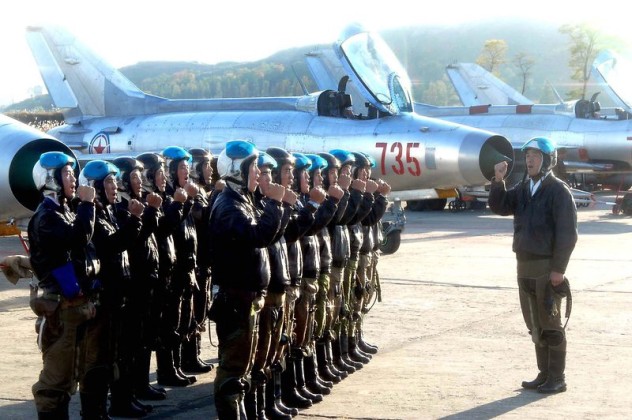
When North Korea’s Air Force Fought Israel
The Beginnings of Pyongyang’s Military Involvement in the Middle East and its Evolution Over Half a Century
Military Watch Magazine | October 7, 2018
While the Yom Kippur War is a well known Cold War engagement between Soviet and Western aligned forces which took place in the midst of the Vietnam War, pitting the forces of a number of Arab states including Egypt, Syria, Iraq and Algeria against their longstanding adversary Israel, the role played by personnel deployed from external powers remains less well known. One party which played a significant role in the conflict, the beginnings of its extensive involvement in the Middle East to undermine the Western Bloc’s regional interests which continues to this day, was the Korean People’s Army (KPA) – the armed forces of North Korea. Having waged an intensive and brutal war with the Untied States and its allies in the 1950s, where an estimated 20-30% of its population was lost primarily due to the American bombing campaign, North Korea well understood the importance of air superiority and set about rebuilding its air and air defence forces with the most capable Soviet made weapons systems available. North Korean pilots and air defence crews were tasked not only with guarding the country’s airspace in the event of a future war with the Untied States, but also of contributing to the war efforts of a number of friendly countries – which they continue to do to this day. North Korean pilots played a considerable role in the Vietnam War, and according to Korean sources downed several U.S. fighter jets over the country. As the air war over Vietnam neared its end in the early 1970s, the KPA Air Force dispatched pilots to Egypt to aid the Soviet aligned country’s own war effort.
North Korean pilots had been stationed to aid Egyptian forces in defending their airspace months before the outbreak of the Yom Kippur War, and according to the Egyptian Military’s Chief of Staff Saad Al Shazly, Korean assistance provided critical assistance at a time of great need. Recalling that personnel from the USSR had been flying approximately 30% of the Egyptian MiG-21 fleet and operating about 20% of the country’s surface to air missile batteries, he noted that following the departure of Soviet forces under the decree of Egyptian President Anwar Sadat the Egyptian Air Force had struggled with a significant shortage of trained MiG pilots. Regarding North Korea’s role in solving this issue, the General stated in his memoirs:
“The solution occurred to me in March 1973, during the visit to Egypt of the Vice President of the Democratic (People’s) Republic of Korea (official name of North Korea.) On March 6, while escorting their Vice Minister of War, General Zang Song, on a tour of the Suez front, I asked if they could support us – and give their pilots useful combat training – but sending even a squadron of men. I knew at that time that his country flew MiG-21s. After much political discussion, in April I went on an official visit to president Kim Il Sung to finalise the plan. My fascinating ten day tour of that extraordinary republic, an inspiring an example of what a small nation of the so called Third World can achieve with its own resources is, alas, rather outside the scope of this memoir, as is my stopover in Peking (former English name for Beijing.)
Korean pilots – all highly experienced, many with more than 2,000 hours, arrived in Egypt in June and were operating by July. Israel or her ally ( the United States) soon monitored their communications, of course, and on August 15 announced their presence. To my regret, our leadership would never confirm it. The Korean s were probably the smallest international military reinforcement in history: only 20 pilots, eight controllers, give interpreters, three administrative men, a political advisor, a doctor and a cook. Bu their effect was disproportionate. They had two or three encounters with the Israelis in August and September and about the same number in the war. Their arrival was a heartwarming gesture. I mention the story here mainly to pay tribute to them and to apologise for the churlishness of our leadership in not also doing so.”
While Egyptian forces had long claimed that the MiG-21 was poorly suited to engage the F-4E, Israel’s prime air superiority fighter, and that the Soviet jet lacked the necessary survivability against the heavier American made platform, they were proven wrong not only by the successes of North Vietnamese pilots against the United States – but also by North Korean pilots operating against Israeli Phantoms over Egyptian airspace itself. According to Israeli sources, reporting on an engagement between North Korean piloted MiGs and their own Phantoms, the Korean pilots demonstrated considerable skill and were effectively untouchable in close range engagements – taking full advantage of the MiG-21’s superior manoeuvrability to evade multiple Israeli strikes with impunity. Whether North Korean pilots downed any Israeli fighters remains unknown, though reports indicate that no Koreans were shot down by Israeli jets. A number of reports do indicate however that the poorly trained Egyptian surface to air missile (SAM) crews mistook returning Korean MIG-21 fighters for Israeli jets, and proceeded to fire upon them. This was a common error made by Egyptian SAM crews, one which cost the country a number of fighter jets.
North Korean pilots’ participation in the Yom Kippur War represented only the beginning of the country’s military involvement in the Middle East, nor the last time the country would aid Arab states at war with Israel. While Egypt pivoted towards the Western Bloc in the war’s aftermath, abandoning the Soviet Union and its Arab allies, the country would pursue a number of joint weapons projects with North Korea and continues to import significant quantities of arms from the country. The Egyptian ballistic missile arsenal has North Korean origins, and the Korean Rodong-1 remains the country’s most capable platform in service today. North Korean assistance was also commissioned to construct a war museum in Egypt commemorating the Yom Kippur War, which was based heavily on the larger Fatherland Liberation War Museum in Pyongyang commemorating the Korean War. North Korean forces have since the Yom Kippur War also formed close ties to Syria and Yemen, and the KPA is involved in wars against Western aligned forces in both countries.
Korean assistance has been key to upgrading Syria’s surface to air missile network, while special forces have reportedly been deployed for ground operations. KPA personnel were also reportedly involved in the Lebanon War in alongside their Syrian allies, and were later responsible for aiding the Lebanese militia Hezbollah to construct underground fortifications key to its military success against Israel in 2006. A number of key figures in Hezbollah’s leadership, including its leader Hassan Nasraallah, reportedly travelled to Korea for military training in the 1980s. Korean assistance has been key to strengthening the missile capabilities of Libya, Syria and Yemen, as well as Iran and Hezbollah, with all these parties relying heavily on a wide variety of the country’s missile designs until today. The East Asian state has since the Yom Kippur War played a considerable role in supporting regional forces against the Western Bloc and their allies, and is set to continue to do so for the foreseeable future.
America’s Most Pro-Israel Governor: Ron DeSantis Will Send More Florida Money to Israel

Governor Ron DeSantis Announces Actions to Affirm Florida’s Support of Israel. Credit: flgov.com
By Philip Giraldi | American Herald Tribune | May 18, 2019
Ron DeSantis, Florida’s new governor, should be really proud of himself. He recently recalled that when he ran for governor “… [he] promised to be the most pro-Israel governor in America and that the first delegation [he] would lead would be to the state of Israel.” When he confirmed that he would be taking his entire cabinet with him as part of a 75-person delegation scheduled to leave for Israel on May 25th, he boasted that “Today I’m pleased to report that I’m keeping that promise. Our delegation will bring business, academic and political leaders to help strengthen the bond between Florida and Israel.” DeSantis has promised to hold a meeting of his Cabinet in the American Embassy in Jerusalem during his visit, the first time that such a meeting has ever been held by a state government on foreign soil. During the meeting he will ostentatiously sign a legislative bill “combating anti-Semitism.”
DeSantis has been playing the Israel and anti-Semitism cards throughout his political career. Last year, as a Congressman running for governor, he attacked his opponent Tallahassee Mayor Andrew Gillum during their gubernatorial race as not being a “friend of Israel.” He based his charge on reports that Gillum had received support from the Dream Defenders, a group favoring Boycott, Divestment, and Sanctions (BDS) against Israel, as well as once having given a speech welcoming members of the Council on American-Islamic Relations (CAIR) to his city. DeSantis claimed in a video clip that “I can find anti-Semites around him, but it’s almost like ‘we don’t want to discuss that.’”
As a Congressman, DeSantis sponsored in 2013 the Palestinian Accountability Act which called for the withholding of U.S. aid to the Palestinian Authority until it recognizes Israel as a Jewish state. In 2017, he co-founded the Congressional Israel Victory Caucus, saying “Israel is our strongest ally in the Middle East, as we share common national interests and possess similar national values. Israel is not the problem in the Middle East; it is the solution to many of the problems that bedevil the region. American policy must ensure that Israel emerges victorious against those who deny or threaten her existence.” Earlier this year, DeSantis drafted a proposal calling on the U.S. to recognize Syria’s Golan Heights as an ‘integral part’ of the State of Israel.
DeSantis boasted about his presence in Jerusalem when the U.S. Embassy was moved to that city one year ago and has promised that on his upcoming trip he will visit Israel’s illegal settlements on the West Bank, which he refers to by the preferred Israeli usage as “Judea and Samaria.” He has threatened critics that “If you boycott Israel, the state of Florida will boycott you” and threatened to “sanction” the holiday rental company Airbnb when it refused to offer properties located in the illegal Israeli settlements on the West Bank. DeSantis was also the driving force behind recently enacted legislation in his state to punish BDS supporters. The legislation is regarded as the most extreme among U.S. states, including explicit equation of criticism of Israel with anti-Semitism. Another bill pending in Florida will enable citizens to sue teachers or government employees who in any way criticize Israel.
DeSantis, a former U.S. Navy lawyer, has demonstrated that he reveres Israel even more than his former comrades in arms. In his congressional district there were a number of survivors of the U.S.S. Liberty, which was attacked in international waters by Israel on June 8, 1967, killing 34 crewmen and injuring 171 more. They report that DeSantis has been completely unsympathetic to their requests that a commission of inquiry finally be convened to determine what actually happened on that day.
Regarding the upcoming visit, a local Florida radio station conducted an interview with Israeli Consul General in Miami Lior Haiat, who emphasized the economic benefits to be derived from the strong bilateral relationship, who said “The fact that the huge delegation is going from Florida to Israel is just a symbol that the outcome of this delegation will be seen in the relationship between Israel and Florida for years to come. Because this is just the beginning. We’re signing over 10 memorandums of understandings and agreements between Israeli companies and universities and the Floridian companies and universities. This is a huge bridge that Gov. DeSantis is building. We are happy to be part of it.”
Consul General Haiat also noted that “There is a lot of new technology based in Israel that is very relevant to Florida both on the red tide and algae, and we are already connecting Israeli companies with local authorities in able to find what is the most useful technology for that part. But it’s also for the greening of oranges. This is a huge problem here. I think that the connection between Israel and Florida has a lot of potential since Israel has a lot of agricultural technology based on knowledge, and Florida has a huge sector of agriculture that can use that technology.”
The six days De Santis led boondoggle in Israel is funded by taxpayers. A public records request filed by a local newspaper seeking information on how much the trip would cost has not been responded to by the governor’s office. And the idea that the state of Florida and its citizens will benefit materially from the trip is largely an illusion. This mixing of politics and business interests is essentially corrupt and inevitably leads to abuses that do not serve the public interest, particularly as American citizens who stand to benefit both, directly and indirectly, are quite openly promoting the interests of a foreign nation.
The Florida trip is a perfect example of how Israel’s friends go about setting up mechanisms that will benefit the Jewish state. Israel will be selling its products and services to Florida, enabled by a government in place that is promoting the process and will steer contracts in its direction. In return, Florida will get little or nothing as Israel is a tiny market and has no particular need of anything that the Sunshine State produces.
All such trade agreements are designed to enrich Israel. The 1985 United States free trade agreement with Israel has benefitted the Jewish state by $144 billion, which is the U.S. deficit on the trade between 1985 and 2015. An interesting example of how this works at the state level and the abuse that it can produce has recently surfaced in Virginia, where a so-called Virginia-Israel Advisory Board (VIAB) has actually been funded by the Commonwealth of Virginia taxpayers to promote and even subsidize Israeli business in the state, business that currently runs an estimated $500 million per annum in favor of Israel. Grant Smith’s Institute for Research: Middle Eastern Policy (IRMEP) has done considerable digging into the affairs of VIAB, which was ostensibly “created to foster closer economic integration between the United States and Israel while supporting the Israeli government’s policy agenda” with a charter defining its role as “advis[ing] the Governor on ways to improve economic and cultural links between the Commonwealth and the State of Israel, with a focus on the areas of commerce and trade, art and education, and general government.” Smith has observed that “VIAB is a pilot for how Israel can quietly obtain taxpayer funding and official status for networked entities that advance Israel from within key state governments.”
Florida does not yet have an equivalent of Virginia’s VIAB, but it probably does not need one as the pandering to Israel will be run right out of the governor’s office. So if you want to create jobs and exports for a foreign country at a cost to your own citizens, by all means, follow the DeSantis Florida model and send an expensive trade mission over to Jerusalem to sing the praises of Benjamin Netanyahu and his band of war criminals while also promoting “buy Israel.” But just maybe it would be a better idea to stop shilling for a foreign country. Floridians should insist on keeping the travel money here at home where it might actually do some good while also putting a little pressure on DeSantis, who was elected to serve the people of his state, to stop his unseemly boasting about being the “most pro-Israel governor in America.”
The Pompeo Bolton Tag Team from Hell
By Renee Parsons – Global Research – May 17, 2019
There was little pretense that when former UN Ambassador John Bolton became President Trump’s National Security Adviser and former Rep. Mike Pompeo moved into the Secretary of State position, that either would bring a professionally credible and respectable presence to world diplomacy or foreign affairs.
It is fair to say that both have surpassed any of the bleak expectations and proven to be more extreme in their ideology, more personally amoral and malevolent than previously feared. What we are seeing now is as if all constraints have been removed with free rein to fulfill their zio-neocon agendas specifically against Venezuela and Iran.
- While speaking to a student audience recently at Texas A&M University, Pompeo revealed his utter contempt for a democratic government based on the rule of law when he bragged about “lying, cheating and stealing” as CIA Director. To an audience of undergraduates which clapped and laughed throughout, Pompeo offered:
“What’s the cadet motto at West Point? You will not lie, cheat or steal or tolerate those who do. I was the CIA Director. We lied, we cheated, we stole. (laughing as if he had said something humorous) We had entire training courses. (Audience applause and cheers) It reminds you of the glory of the American experiment.” (emphasis added)
First in his class at West Point and a graduate of Harvard Law School, Pompeo prides himself on having “come to an understanding of Jesus that fundamentally changed“ his life as a cadet and today claims to be a “man of faith.” It is not clear who Pompeo thinks he is kidding with the religious fervor schtick but for sure it is not any divine deity which will one day sit in Judgment on his character and integrity. The Texas A&M exchange reveals an unscrupulous bully who knows no limit to his omnipotence and a willingness to condone war crimes on behalf of the disreputable Empire he serves.
- Keynote speaker at AIPAC’s 2019 conference, Pompeo proved where his fidelity lies when he declared “Let me go on record: Anti-zionism is anti-semitism” which has become the new rallying cry for the poor, beleaguered state of Israel.
- As the State Department is now defining the term ‘anti Zionism,’ Pompeo appointed Elan Carr as Special Envoy to Monitor and Combat Anti-Semitism with the ultimate goal to intimidate and criminalize critics of Israel’s foreign policy objectives.
In describing his responsibilities, Carr’s stated priorities will be to “reduce the feelings of insecurity”, review “indoctrination of anti semitic textbooks” and “focus relentlessly on eradicating this false distinction between anti Zionism and anti-semitism.” It takes living in a simulated reality to not grasp the distinction between criticism of Israel’s apartheid policy toward the Palestinians and its belligerent foreign policy in the Middle East and a genuine prejudice or discrimination based on one’s religious preference or ethnic differences.
At his press briefing, Carr was immediately in the weeds and lost total control of the narrative before being shut down by the State Department official spokesman.
As a one dimensional thinker, Mr. Carr never described who or how anti-semitism will be identified. Will the State Department issue a weekly list of anti-Semitic offenders and what will be the penalty? Will State provide a list of forbidden anti-semitic words? How will deliberate intent be determined? If a non-jew utters words like apartheid, yenta, yarmulke or illegal settlements, will they be considered proof of anti-Semitic? Will the Nazis still be permitted to march in Skokie? Will the tech giants rewrite their algorithms to search for ‘banned’ words?
- On April 10th, Omar Barghouti (image on the right), a prominent Palestinian human rights defender and a co-founder of the Boycott, Divestment and Sanctions (BDS) Movement was denied entry by the US Consulate before departing Ben Gurion Airport despite having valid travel documents and having visited the US previously. Barghouti responded that:
“Supporters of Israeli apartheid in the US are desperately trying to deny US lawmakers, media, diverse audiences at universities, a bookstore and a synagogue, their right to listen, first-hand, to a Palestinian human rights advocate calling for ending US complicity in Israel’s crimes against our people.”
- In a 2016 report, the International Criminal Court chief prosecutor Fatou Bensouda initiated an investigation into possible war crimes in Afghanistan involving the torture of 61 prisoners committed by the US Army and the torture and rape of 27 prisoners committed by the Central Intelligence Agency (CIA) at CIA prison sites in Poland, Romania and Lithuania.
In response to the ICC inquiry in 2018, Bolton warned:
“We will ban its judges and prosecutors from entering the United States. We will sanction their funds in the US financial system, and we will prosecute them in the US criminal system. We will do the same for any company or state that assists an ICC investigation of Americans,”
In March 2019, Pompeo repeated the ICC threats with no apology in a straight forward defense of torture and war criminals.
“Since 1998, the US has declined to join the ICC because of its broad unaccountable prosecutorial powers and the threat it poses to American national sovereignty. We are determined to protect the American and allied military and civilian personnel from living in fear of unjust prosecution for actions taken to defend our great nation. I’m announcing a policy of US visa restrictions on those individuals directly responsible for any ICC investigation of US personnel. These visa restrictions may also be used to deter ICC efforts to pursue allied personnel, including Israelis without allies consent. These visa restrictions will not be the end of our efforts.We are prepared to take additional steps, including economic sanctions, if the ICC does not change course,”
After the Court responded that it would continue its investigation with “war crimes and crimes against humanitywere, and continue to be, committed by foreign government forces in Afghanistan,” Reference to ‘allied” personnel and Israeli involvement in US war crimes remains impenetrable. True to his word, in early April Pompeo revoked the visa for Bensouda (image on the left).
In a devastating setback for the ICC, its pre-trial chamber recently refused to approve the investigation from moving forward citing a lack of US cooperation. Certainly the Pompeo – Bolton threat to criminally prosecute and personally sanction the Court’s judges or that the US would ‘use any means necessary ” had nothing to do with that decision. Bensouda says she will appeal the chamber’s decision.
- After the January meeting with North Korea ended in failure, NK’s Deputy Defense Minister, who took part in the meeting, revealed that while Trump had shown a willingness to lift some sanctions based on NK’s moratorium on missile tests, he was later overridden by Pompeo and Bolton who brought “an atmosphere of hostility and mistrust” to the table with their “gangster like behavior.”
As the zio-neocons continue to move on Venezuela and/or Iran as uncontrollable malevolent fiends, loose cannons with no concept of international law or the need for global harmony, men of no conscience and no morality, it is only a matter of time before cosmic law balances the scale.
Renee Parsons has been a member of the ACLU’s Florida State Board of Directors and president of the ACLU Treasure Coast Chapter. She has been an elected public official in Colorado, an environmental lobbyist for Friends of the Earth and staff member of the US House of Representatives in Washington DC. She can be found on Twitter @reneedove31
Israel lost $16.8m due to halt of gas production during Gaza offensive
MEMO | May 15, 2019
Israel lost 60 million shekels ($16.8 million) from gas exports as a result of the two-day assault launched against the Gaza Strip earlier this month, a member of the Knesset revealed yesterday.
Al-Wattan Voice reported the Hebrew newspaper Maariv saying that the loses were a result of Energy Minister Yuval Steinitz’s decision to halt gas production at the from Tamar gas field during the attack on Gaza on 4-5 May.
Israeli Member of the Knesset Orit Farkash-Hacohen revealed that 60 million shekels ($16.8 million) had been lost as a result and this would be recouped from tax funds.
Twenty-seven Palestinians were killed during Israel’s attack on the besieged Gaza Strip, including two toddlers, two expectant mothers and one minor. Four Israelis were also killed.
Experts have said the attack was halted because Israel is hosting the Eurovision Song Contest and it did not want news of the attacks to overshadow the global music event, or to deter participants and concert goers from attending.
PA New Government Does Not Represent the Palestinian People
By Ramona Wadi | MEMO | April 18, 2019
The new Palestinian Authority government has been welcomed by the UN Special Coordinator for the Middle East Peace Process Nickolay Mladenov, who reiterated the rhetoric reserved for occasions on which the international organisation pledges to work closely with governments in line with their agenda. “At a time of significant financial and political changes to the Palestinian national project,” Mladenov stated, “all must support the government’s efforts and work to overcome internal divisions.”
There is nothing, though, to suggest that the new PA government under recently appointed Prime Minister Mohammad Shtayyeh is working towards reconciliation. Fatah’s insistence that Hamas must relinquish its political control of Gaza has not abated, implying that the PA agenda, as well as that of the UN, has not altered. Last year, there was an increase in the number of international statements, from UN envoys in particular, calling for a return to PA rule in Gaza. The PA, according to them, makes it easier for the UN to carry out its plans.
Mladenov’s statement referenced the previous PA government led by Rami Hamdallah, who had also advanced the call for Hamas to step aside. What followed afterwards is well documented, not least the punitive measures imposed by the PA upon the Palestinian people in Gaza in order to force civilians and politicians alike to surrender. From a PA perspective, ending the Palestinian schism means eliminating and suppressing political alternatives and challengers.
The recent news from Cairo indicates as much, with the Fatah delegation at reconciliation talks placing ultimatums upon Hamas and issuing ambiguous statements regarding the PA’s views on unity and the issue of the weapons in the hands of the armed wing of the Islamic Resistance Movement. In the event of reconciliation, asks Fatah, “What is the need for arms?”
There is thus little divergence from the previous government’s agenda, which is one of the reasons why Mladenov’s rhetoric about the previous and current PA governments overlaps in terms of content. As PA leader Mahmoud Abbas becomes even more irrelevant — due in part to the US efforts to ostracise any form of Palestinian representation and push through its own so-called “deal of the century” — international actors are increasingly taking over and determining the fate of Palestine’s remaining and cruelly fragmented territory.
Having a new PA government that adheres to the same definitions of reconciliation will provide the UN with a further opportunity to alter what remains of Palestine. Despite Mladenov’s praise for Hamdallah’s government keeping in line with the UN Sustainable Development Goals, for example, it is clear that the ongoing colonisation of Palestine, along with the international complicity to ensure that Israel continues to expand its presence, have impeded Palestinians from experiencing any benefits.
A little less “commitment to working with the Palestinian leadership” and more effort towards listening to what the Palestinian people demand and need would go a long way. The UN is not working to “end the occupation”, much less end Israel’s colonisation. The PA has, since its inception, followed suit. A new government that is void of different political strategies, yet has the audacity to speak about Palestinian reconciliation, does not represent the Palestinian people. Mladenov’s comments are another indication of how the new government and the UN intend to work, by persisting in the creation of a diplomatic network that isolates the Palestinian people from the politics determining their fate.
Featured Video

Anthrax War – CBC The Passionate Eye
or go to
Aletho News Archives – Video-Images
Book Review
Shattered Dreams: The HPV Vaccine Exposed (2019)
By Christina England – 30 Q&As – Book Review & Summary
Lies are Unbekoming | September 4, 2026
… Gardasil received FDA fast-track approval in 2006, Cervarix followed in 2009, and Gardasil 9 was approved in December 2014 with more than double the aluminium adjuvant content of the original. The commercial context is specific. Merck was about to lose patent protection on Zocor and faced $18 billion in Vioxx injury claims from a cardiovascular drug the company had marketed while suppressing its own data showing a five-times increase in heart attacks. Analysts projected the global HPV vaccine market at $4 billion by 2011, contingent on government-funded national programs for teenage girls. The 1986 National Childhood Vaccine Injury Act had already granted manufacturers complete liability immunity. By 2013, Japan had withdrawn its HPV vaccine recommendation after cataloguing severe adverse reactions in hundreds of girls. No Western government followed. The establishment position across the UK, US, Australia, and most of Europe held, and still holds, that the vaccines are safe and effective, that reported injuries are coincidental, and that cervical cancer prevention justifies the program. The book was published into this position, not against a vacuum.
Shattered Dreams sits alongside Mary Holland’s The HPV Vaccine On Trial and Viera Scheibner’s foundational vaccination work as part of the documented record on what has been done to a generation of teenage girls under the banner of cancer prevention. The full summary unpacks three specific findings: that Merck used the aluminium adjuvant itself as the “placebo” control in 92.5% of trial subjects, making it structurally impossible to detect excess reactions from the adjuvant; that Dr. Sin Hang Lee found HPV DNA fragments bound to aluminium in every one of sixteen Gardasil samples tested, and in the blood and spleen of a New Zealand girl six months after her third dose; and that in every country with high vaccination coverage, including Australia, the UK, Norway, and Sweden, cervical cancer rates have stopped declining and started rising specifically in the vaccinated cohort. Martínez-Lavín’s 2017 calculation puts the number needed to seriously harm with Gardasil 9 at 140, and the number needed to vaccinate to prevent one case at 1,757. Thirteen young women are seriously harmed for every one who benefits. The vaccine was approved on the basis of trials that could not detect what the trials were supposed to detect, and it is still being given to twelve-year-olds today. … Read full review
Blog Roll
 Aletho News
- Georgia’s Largest Healthcare System Will Fire Employees Who Refuse Flu Vaccine
- The Five-Year Fuel Crisis: Why the World Economy Is Paying for a War It Thinks Is Ending
- Trump’s Big Bluff on Iran
- Swiss scammed out of millions by Ukraine-linked call centers – media
- Germany facing potential ‘violent conflict’ with Russia – spy chief
- Ukraine’s EU neighbors reject new plea from Kiev – Politico
- British Transport Police Facial Recognition Trial Scanned 926,912 People With Zero Arrests
- House Bill Would Ban Federal Use of Flock ALPR Data
- Can a Spice Rival a Drug? 10 Head-to-Head Trials Put It to the Test.
- The oil routes around Hormuz face their own chokepoints
- If Americans Knew
- “We See Our Homes Now From A Satellite, Like Strangers”
- Watch “Gaza: Doctors Under Attack”, originally censored by BBC
- NAZA: Israeli embassies in UK and US promote rival documentary to challenge Gaza genocide allegations
- David Ellison appoints Israeli to lead merged Paramount-Warner studios
- Turkish Red Crescent helps elderly Gaza man walk again after Israel confiscates his prosthetic limb
- Four Palestinians Killed in Israeli Attacks in Gaza
- Two Palestinian youths killed and village razed as Israeli attacks on West Bank continue
- Two more Christian women victims of Israeli raids on Gaza
- Cruelty, Deprivation, Indignity: A Journalist’s 22 Months in Israeli Prison
- New IDF Website Frames Slain Gaza Journalists as Terrorists
- No Tricks Zone
- Latest European Green Energy Debacle; Portugal’s Largest Flagship Solar Park Insolvent!
- Green Energy Debacle: German Expert Professor Fritz Vahrenholt Warns Of Severe Economic And Social Consequences
- Two More Paleo Reconstructions Affirm Meters-Higher Sea Levels Across Ireland, Brazil 7000-6000 Years Ago
- New Study: Earth And Venus Surface Warmth Largely Explained By Convection And Lapse Rate, Not CO2 Or Radiation
- 2025 Nature Paper Claiming Worsening Global Drought Gets RETRACTED …Heavily Flawed
- New Study: ‘Global Drought Shows No Detectable Recent Acceleration Under Climate Warming’
- Economic Masterminds: German Socialists Suggest Taxing Productivity Gains Stemming From Using AI
- The South China Sea Has Not Been Cooperating With The Climate Change Narrative
- Energy Crisis: Germany Enters Heating Season With Historically Low Gas Reserve Fill Levels
- New Study: The Antarctic Ice Sheet Gained Mass From 2020-2024 Due To Staggering Snow And Ice Accumulation

