Jerusalem Cable Car Project Passes Over Objections from Many Quarters
Political interests drive tourism plan that would blight historic city’s skyline and bypass Palestinians
By Jonathan Cook • The National • May 14, 2019
East Jerusalem has received new impetus from the rise of the Israeli far right and Washington’s decision to move its embassy to the city. But if completed, critics say, the long-running proposal would contribute to erasing the visibility of Palestinians in the city they hope to make their capital.
Planning for the $55 million tourism project continues despite unifying archaeologists, architects, Palestinians, and a tiny community of Jews against it – in a sign of Israel’s ever-growing confidence in making unilateral moves in occupied parts of Jerusalem.
Critics say the cable car will help hide the local Palestinian population from the roughly 3 million tourists who visit Jerusalem each year, turning the city into a “Disneyland” focused on promoting Israeli interests.
“The advantage for Israel is that visitors can be prevented from having any dealings with Palestinians,” said Aviv Tartasky, a researcher with Ir Amim, an Israeli organisation that campaigns for equal rights in Jerusalem.
“The local population will be largely erased from the experience of visiting Jerusalem. Tourists will pass over Palestinian residents, via the cable car, and then pass under them via tunnels.”
Israel’s Ministry of Tourism dismissed the criticism. In a statement to The National, the ministry said the cable car project was “a significant milestone in the promotion of Jerusalem and the strengthening of its status as a world tourism capital”.
Settler-run tours
The cable car, the largest project of its type undertaken by Israel, could be completed as early as in two years, its destination the slopes in occupied East Jerusalem just below the Old City, next to Al Aqsa mosque and the Dome of the Rock. Some 72 cabins have the capacity to ferry up to 3,000 visitors an hour above mainly Palestinian homes.
Tourists will be channelled from the cable car into a visitor centre run by Jewish settlers in the heart of the crowded Palestinian neighbourhood of Silwan. They will be led by settler-approved guides underground, through tunnels under Palestinian homes to the foot of the Western Wall.
Blueprints show that visitors will be able to shop in the tunnels, bypassing local Palestinian traders in the Old City market who have long depended on tourism. Israeli officials accelerated the project by bypassing routine planning procedures, even though urban planning specialists warn that it will damage the Jerusalem skyline and archaeological sites revealing the origins of modern civilisation.
Equally important, critics say, the Benjamin Netanyahu government and settler groups view the cable car as helping block any possibility of a Palestinian state emerging with East Jerusalem as its capital. They have been emboldened by President Donald Trump’s 2017 decision to transfer the US embassy from Tel Aviv to Jerusalem.
“It should set off alarm bells that a huge state project like this is being intertwined with a private settler organisation, physically forcing visitors to go through its visitor centre, channelling them into its attractions and activities,” Mr Tartasky said.
He said the cable car was one of the ways Israel was connecting disparate settler compounds in the Palestinian neighbourhoods of occupied Jerusalem.
“It will physically strengthen these settler areas, and mean their organisations have an even greater influence on Israeli authorities.”
Encircling Al-Aqsa
The project has been forcefully promoted by the Israeli tourism ministry, headed by Yariv Levin, an ally of Mr Netanyahu, and Jerusalem’s mayor, Moshe Lion. Tenders will be issued as soon as the National Planning Council approves the project, which is expected to be a formality.
In violation of international law, Israel has treated East Jerusalem as annexed territory since it occupied the city in 1967. More than 200,000 Jewish settlers have moved there over subsequent decades
Hanna Swaid, a Palestinian planning specialist and former member of the Israeli parliament, said the cable car was illegal because international law allows major changes in occupied territory only out of military necessity or for the benefit of the population under occupation.
“Even in its own planning justifications, the Israeli authorities are clear the cable car is designed only for the benefit of tourists, Israeli developers and the settler groups overseeing it, not the local Palestinian population. In fact, it will serve to actively harm Palestinians in Jerusalem,” Mr Swaid said.
“It will parachute tourists to Jewish sites like the Western Wall, and marginalise Muslim and Christian sites,” he added.
Palestinians are concerned that the cable car will serve to tighten Israel’s control over access to the Al Aqsa mosque compound, the highly sensitive holy site in the Old City. For decades Israeli authorities have moved to weaken the control of Islamic religious authorities, the Waqf, on Al Aqsa, contributing to repeated clashes at the site.
Jews believe the mosque is built over the ruins of a major Jewish temple. The Western Wall, which supports the mosque compound, was originally a retaining wall of the long-lost temple.
“The cable car looks suspiciously like another means for encircling Al Aqsa, for laying siege to it,” Mr Swaid said.
Tunnels under Palestinians
According to official plans, dozens of cabins will run hourly along a 1.5-kilometre route from West Jerusalem, inside Israel’s recognised borders, to the occupied Palestinian neighbourhood of Silwan, just outside the Old City walls and in the shadow of Al Aqsa.
Tourists will disembark in Silwan into a large visitor centre, the Kedem compound, to be run by a settler organisation called Elad that has close ties with the Israeli government.
The Kedem centre is the latest venture in the City of David complex, an archaeological site that the settlers of Elad have been using for more than two decades as a base to seize control of the Palestinian neighbourhood.
Visitors will be taken on tours to explore Jerusalem, moving through ancient sewage tunnels that run under Palestinian homes and reach to walls of Al Aqsa.
Additional plans will eventually see the cable car alight at other sites in East Jerusalem. Among them are the Mount of Olives, which includes an ancient Jewish cemetery; the Church of Gethsemane, at the reputed site where Judas betrayed Jesus; and the Pool of Siloam, a bathing area referred to in the Old and New Testaments.
Yonatan Mizrahi, the director of Emek Shaveh, a group of Israeli archaeologists opposed to the misuse of archaeology and tourism by Israel, said: “The purpose is to offer tourists a one-dimensional narrative about Jerusalem and its history. They should see all layers of the city’s rich history. Instead they will hear only the parts that relate to Jewish history.”
Mr Mizrahi has been among those leading the criticism of the project. “No other historic city in the world has built a cable car – and for very good reason,” he said.
Jerusalem ‘not Disneyland’
In March about 30 international architects – some of whom have worked on projects in Jerusalem – wrote to Mr Netanyahu urging him not to pursue what they called short-term interests.
“The project is being promoted by powerful interest groups who put tourism and political agendas above responsibility for safeguarding Jerusalem’s cultural treasures,” the letter said.
The letter followed a statement by 70 Israeli archaeologists, architects and public figures against the cable car in November, when the project was sped up. They said: “Jerusalem is not Disneyland, and its landscape and heritage are not for sale.”
A French firm, Safege, which worked on the initial feasibility study, pulled out in 2015, reportedly under pressure from the French government over concerns that the project violated international law.
In an apparent bid to ensure the project would go through, the previous Netanyahu government changed planning laws to remove the cable car from local and regional oversight. It also ensured the public could not submit objections.
Instead the scheme is being treated as a “national infrastructure” project, similar to a new railway line or gas pipeline. The National Planning Council offered a curtailed period for organisations to lodge reservations that ended on March 31.
Mr Swaid, who is the director of the Arab Centre for Alternative Planning, drew up a list of reservations on behalf of the Supreme Religious Council of Muslims in Israel.
Other critical comments were submitted by lawyers for the Silwan neighbourhood, the archaeologists of Emek Shaveh, the planning group Bimkom, a Palestinian merchant association in the Old City, and a tour guides group.
The Karaites, a small Jewish sect whose ancient cemetery lies in the path of the cable car, in the Biblical Hinnom Valley, said the project showed “contemptuous disregard for the dignity of the deceased and the Karaite community in general”.
Benjamin Kedar, a former chairman of the Israel Antiquities Authority, lodged a protest too.
Loss of all privacy
One of the Silwan homes in the path of the cable car belongs to the Karameh family. The cabins may pass only four metres above the flat roof where toddlers play and the family of 20 hang their washing. Support columns for the cable car may end up being driven into the family’s garden, one of the few green spots in Silwan.
“Nowhere in Israel do cable cars travel over houses, let alone a few metres above,” said Mr Mizrahi. “It seems clear why in this case. Because the houses belong to Palestinians.”
Samer Karameh, a 24-year-old lorry driver, said everyone in Silwan was opposed to the cable car, as it would be helping settler groups like Elad trying to take over their neighbourhood. But he was shocked to learn that it would pass so close to his house.
“We’ll lose all privacy. We won’t be able to open the windows without being seen by thousands of strangers. And it can’t be safe to have these cars travelling just over the heads of our children,” Mr Karameh said.
“We know we won’t be the beneficiaries,” he added. “The authorities won’t give us a permit to build anything here, so all the business will go to the settlers.”
History’s Dire Warning: Beware False-Flag Trigger for Long-Sought War with Iran
By Whitney Webb | MintPress News | May 14, 2019
With the beat of Washington’s war drums continuing to grow, particularly following the Monday revelation of a government plan to send as many as 120,000 troops to counter Iran, the threat of an “accidental” provocation or a “false flag” is also becoming increasingly likely. As MintPress recently reported, the possibility of an “accident” leading to open conflict between the U.S. and Iran is now being openly stated by top European officials — such as U.K. Foreign Minister Jeremy Hunt — following meetings with noted Iran hawk and current Secretary of State Mike Pompeo.
In Part I of this series, MintPress explored how current events — including seemingly unrelated regional events, such as the Israeli government’s bid to occupy the West Bank and the Syrian offensive against Al Qaeda-held Idlib — were converging to create a “now or never” scenario for those most eager for regime change in Iran and a U.S.-Iran military confrontation, particularly Israeli Prime Minister Benjamin Netanyahu and U.S. National Security Advisor John Bolton.
This installment will also reveal how Trump’s top political patron Sheldon Adelson — who is also the top donor to Netanyahu and a long-time confidant of Bolton, whom he helped install in his powerful post in the Trump administration — may be the deciding factor whether Trump authorizes the use of military force against Iran.
Yet, while the endgame for Bolton, Adelson and Netanyahu, as well as Pompeo, has long been a U.S.-led war with Iran, public justification for such hostilities must be given in order to manufacture American consent for a war against a country significantly larger than Iraq, complete with a more powerful army. Historically, the U.S. government has frequently planned and used false flags in order to justify the initiation or expansion of hostilities, with the best-known examples being Operation Northwoods and the Gulf of Tonkin incident.
However, given the current situation, it is essential to revisit two other incidents that reveal that the key players pushing for war in Iran — Israel’s government and neoconservatives of the Bush era (Bolton chief among them) — have planned and attempted to execute false flag attacks to push the U.S. into a major war that the American public would not normally support.
Remembering the U.S.S. Liberty
On June 8, 1967, one of the worst attacks on a U.S. naval vessel during peacetime took place, an attack that the U.S. government has kept shrouded in secrecy over 50 years later in what many have called a cover-up.
Around two in the afternoon on a cloudless, sunny day, unmarked aircraft and torpedo boats attacked the U.S.S. Liberty — a largely defenseless naval intelligence vessel flying visible American flags — without provocation. The attack saw the aggressors commit several war crimes, including attacking with unmarked aircraft and vessels; shooting survivor-bearing lifeboats out of the water with machine-gun fire; and the jamming of the Liberty’s ability to use international distress frequencies.
Thirty-four American sailors lost their lives and 173 were wounded, and the Liberty — which cost U.S. taxpayers $40 million to build — was so badly damaged it was subsequently sold for scrap metal for pennies on the dollar.
During the attack and in its immediate aftermath, Liberty survivors were puzzled as to why the U.S. Department of Defense ordered the recall of U.S. ships that were on route to aid the Liberty from the hostile attack, which many sailors had assumed at the time was being conducted by Egyptian or Arab forces in light of the ship’s proximity to the Sinai Peninsula.
Indeed, the attack on the Liberty took place during the Israeli-Arab Six Day War, a war that Israel claimed to have started as a preemptive means of self-defense but that was later revealed to have been the culmination of years of planning for a war of aggression. This fact was openly admitted by former Israeli Prime Minister Menachem Begin in the early 1980s. Israel, an American ally, was not suspected by Liberty crewmen at the time of the attack as being their potential assailants.
However, no Arab nation had attacked the Liberty that day, though that assumption by Liberty sailors was what their true assailants had hoped they and the American public would believe. Instead, it had been Israeli aircraft and torpedo boats that had fired on the clearly-marked American vessel with torpedoes, machine gun fire and even napalm. The Israelis “officially” maintain to this day, with little challenge from the U.S. government, that the attack was an accident, a fact that has been and continues to be heavily contested by the attack’s survivors.
Yet, beyond the testimony of survivors, the most compelling evidence that the attack on the Liberty was no accident comes from the Israelis themselves. Intercepted Israeli communications from the time of attack, made public only in recent years, reveal that the ship had been identified as American prior to the attack and, despite that, the plan was to sink the U.S.S. Liberty and ensure that there were no survivors. The goal of the attack was to place the blame on Egyptian forces, which necessitated there being no American survivors who could dispute the claim. If the Liberty had been sunk, it would have provided the United States legal cover and popular support for a more central role in the conflict and its crucial diplomatic aftermath. Indeed, the Israeli attack on the U.S.S. Liberty was a false flag, one that failed to achieve its intended goal of goading the U.S. into a major war.
Instead of responding with indignation, then-President Lyndon Johnson — whether it occurred before or during the attack is disputed — ordered that the Liberty not be rescued during the course of the attack, allegedly not wanting to harm relations with or “embarrass” an ally even if it meant consigning the 294-person crew of the Liberty to death.
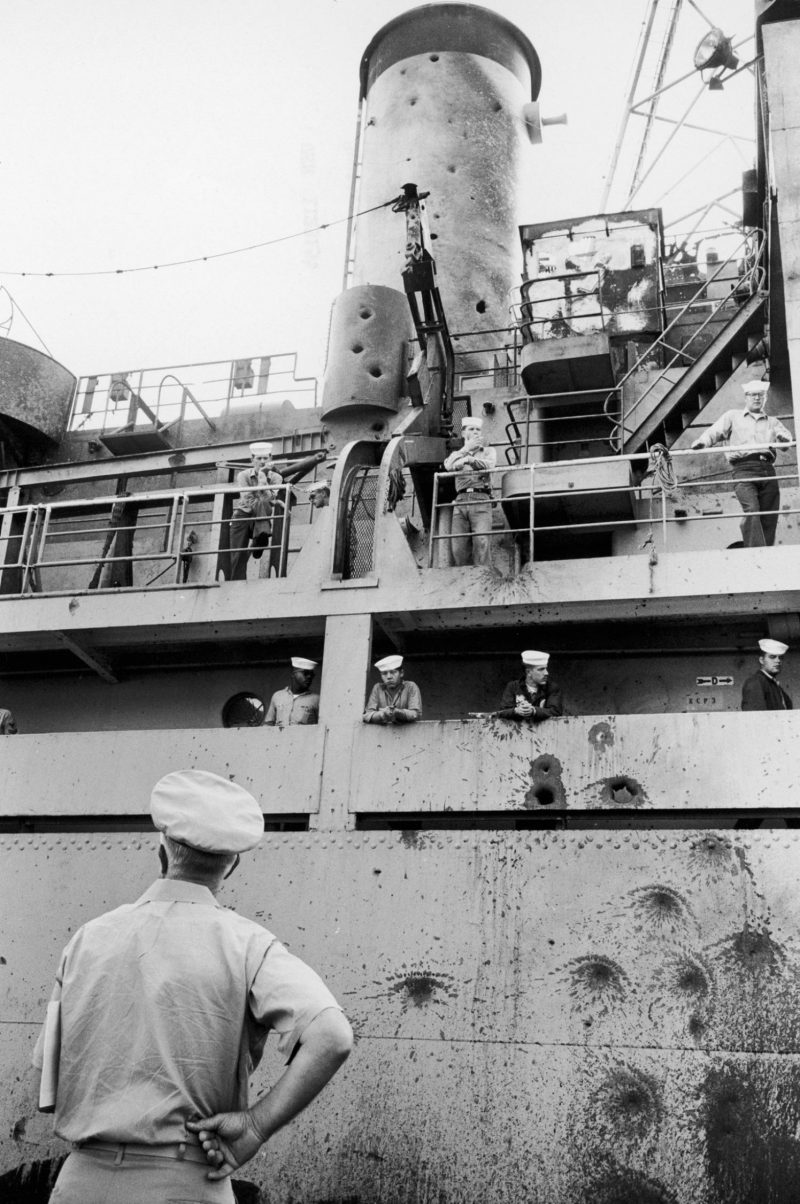
Damage to the starboard side of the USS Liberty following Israeli attacks, June, 1967. Photo | NSA Archive
Those who survived the assault of the Liberty owe their lives to the then-23-year-old Terry Halbardier, who valiantly navigated the Liberty’s napalm-glazed deck and managed to rig an antenna and send out an SOS signal to the Navy’s Sixth Fleet. Upon intercepting that distress signal, the Israelis immediately broke off the attack. Halbardier’s heroism prevented the massacre of all 294 crewmen and allowed them to live to tell their stories, despite Johnson’s having left them for dead.
Yet many Liberty survivors were unable to tell their stories for decades, as the U.S. government issued gag orders and threatened them with being court-martialed for speaking to anyone, even their spouses, about the incident. The Navy’s Board of Inquiry, which abetted the cover-up, was headed by Admiral John S. McCain Jr., the father of the late Senator John McCain of Arizona.
To this day, the U.S. government has failed to conduct a full, public inquiry into the attack. Liberty survivors who have since spoken out have been accused of “anti-Semitism” and of slandering Israel for discussing their personal and traumatic experiences of the attack, significantly compounding their suffering and post-traumatic stress.
While the survivors of Israel’s assault on the Liberty have been denied closure, the U.S. government’s response has endangered the lives of American personnel by clearly signaling to Israel that they will suffer no consequences for such “false flag” attacks, regardless of whether American servicemen are wounded or killed. As former CIA intelligence analyst Ray McGovern has previously noted for Consortium News, “the U.S. cover-up [of the attack on the U.S.S. Liberty ] taught the Israelis that they could literally get away with murder.”
In a 2015 interview on the Real News Network, McGovern warned that the attack on the Liberty still holds “current relevance” and that he felt that “the Israelis are capable of doing this kind of thing when they see their supreme national interests at stake.” McGovern further stated that Israeli officials may well have considered a provocation, such as false flag, to throw a wrench in the Iran nuclear deal, which was being negotiated at the time.
McGovern — in an open letter to President Barack Obama, co-authored with former Deputy National Intelligence Officer for the Near East in the National Intelligence Council Elizabeth Murray — noted that Admiral Mike Mullen, former member of the Joint Chiefs of Staff in the Bush administration, had flown to Israel in 2003 and told the Israeli government emphatically “to disabuse themselves of the notion that U.S. military support would be knee-jerk automatic if they somehow provoked open hostilities with Iran. According to the Israeli press, Mullen went so far as to warn the Israelis not to even think about another incident at sea like the deliberate Israeli attack on the U.S.S. Liberty.”
McGovern and Murray cited Mullen’s statements to Israeli officials as the first time that “a senior U.S. official braced Israel so blatantly about the Liberty incident.” In an email to MintPress, McGovern stated that he was unsure whether current Chairman of the Joint Chiefs of Staff Gen. Joseph Dunford “can be counted upon to play a similar restraining role” in preventing hostilities with Iran. Notably, Dunford was in attendance along with Bolton at the recent CIA meeting to discuss “highly sensitive covert actions” in relation to Iran.
An “accident” waiting to happen
Since Bolton announced the movement of the Lincoln carrier strike group towards the Persian Gulf, some have pointed out that the vessels could well be destined for use in a “false flag” provocation, such as one planned by former Vice President Dick Cheney in 2008 (to be discussed shortly) and another conducted by Israel in 1967. Indeed, as MintPress noted the day after Bolton’s announcement, the carrier strike group’s deployment was actually announced a month prior and was a routine deployment.
The political analysis blog Moon of Alabama also noticed that Bolton had framed this routine deployment as something more dire for his own purposes, writing:
The carrier deployment to the Gulf is routine. It had been announced on April 8. The U.S. has bombers on rotation in the Middle East since 2001. Moreover – a carrier in the Persian Gulf is a sure sign that the U.S. will not attack Iran. Within the restricted waters of the Persian Gulf a carrier is a too easy target. The idea though may be to provide for an ‘accident’’ as Iran’s Foreign Minister [Javad Zarif] described it in a recent CBS interview.”
In an interview late last month with CBS’ Face the Nation, Zarif explicitly told journalist Margaret Brennan his concern about an imminent “false flag” to trigger war with Iran by John Bolton in collaboration with Israeli, Saudi and Emirati leadership:
Foreign Minister Zarif | I don’t think military confrontation will happen. I think people have more prudence than allowing a military confrontation to happen. But, I think the U.S. administration is putting things in place for accidents to happen. And there has to be extreme vigilance, so that people who are planning this type of accident would not have their way.
Margaret Brennan | What do you mean? What kind of accident are you talking about?
Zarif | I’m talking about people who have — who are designing confrontation, whose interest —
Brennan | Who’s doing that?
Zarif | My ‘B’ team. I call —
Brennan | What do you mean ‘B’ team?
Zarif | I call the group ‘B’ team who have always tried to create tension, whose continued existence depends on tension. Ambassador Bolton, one ‘B,’ Bibi Netanyahu, second ‘B,’ Bin Zayed, third ‘B,’ Bin Salman, fourth ‘B.’ And I’m not just making accusations.
With an aircraft carrier little more than a sitting duck in the area amid rising tensions between the U.S. and Iran, an “accident” may well occur. As was noted in Part I of this mini-series, such a possibility was directly stated by British Foreign Minister Jeremy Hunt on Monday.
Hunt told reporters “We are very worried about the risk of a [U.S.-Iran] conflict happening by accident, with an escalation that is unintended really on either side but ends with some kind of conflict.” Hunt notably made the statement after meeting with Pompeo, who is currently in Europe meeting with European heads of state to discuss Iran. The Associated Press noted that the Trump administration had warned European officials, Hunt included, that “Iran or its proxies could be targeting maritime traffic in the Persian Gulf region.”
The possibility of such an “accident” is further compounded by Bolton’s aforementioned and “highly unusual” meeting about Iran and “highly sensitive covert actions” at CIA headquarters last week. Declassified CIA documents show that the agency had previously planned to stage terror attacks on U.S. soil and murder Americans to blame on Cuba in order to justify invading the Caribbean nation in the 1960s. That plan, known as Operation Northwoods, further called for the destruction of U.S. military vessels to be blamed on Cuba and also the staging of fires and mortar attacks on U.S. military installations in Cuba (i.e., Guantanamo Bay) or nearby (i.e., in Florida). Though Operation Northwoods was never enacted, the agency has been accused of orchestrating numerous “false flags” in the decades since.
As was recently seen with the alleged “sabotage” of Saudi oil tankers near Iran, there are many potential targets for provocation. However, the incident that would most assuredly force U.S. involvement in a military conflict would be an attack on an American military target. While some have dismissed Bolton’s announcement of the carrier’s movements as a self-serving manipulation of the facts, it may have had the added purpose of framing the lead-up to an unfortunate “accident” targeting American vessels in the area, particularly the Lincoln carrier strike group or one of the other subsequent U.S. naval deployments to the Middle East.
The neocon plan for a Liberty-like attack
If any sort of provocation blamed on Iran should occur, it is important to consider that a powerful group of U.S. politicians — the neo-conservatives — have long sought to plan provocations that would drag the U.S. into war with Iran. One of the most recent examples took place during the George W. Bush administration when then-Vice President Dick Cheney held a meeting with other administration officials in 2008 aimed at provoking war with Iran.
The details of that meeting were revealed by Pulitzer Prize-winning journalist Seymour Hersh, who described some of the ideas considered in that Cheney-led meeting as follows:
There were a dozen ideas proffered about how to trigger a war. The one that interested me the most was why don’t we build in our shipyard four or five boats that look like Iranian PT boats. Put Navy seals on them with a lot of arms. And next time one of our boats goes to the Straits of Hormuz, start a shoot-up. Might cost some lives.
And it was rejected because you can’t have Americans killing Americans. That’s the kind of, that’s the level of stuff we’re talking about. Provocation.
Silly? Maybe. But potentially very lethal. Because … if you get the right incident, the American public will support bang-bang-kiss-kiss. You know, we’re into it.”
It is unknown if any Bush officials now in the Trump administration were present at that meeting where the use of a “false flag” pitting Americans against Americans disguised as Iranian was discussed. However, what is known is that John Bolton — who was a member of the neo-conservative Project for a New American Century, along with Cheney, and who also served in the Bush administration — has zealously sought war with Iran for nearly two decades. Indeed, the New York Times recently described Bolton as “one of the administration’s most virulent Iran hawks, whose push for confrontation with Tehran was ignored more than a decade ago by President George W. Bush.” It is also known that Bolton has a history of playing fast and loose with unconfirmed intelligence and also distorting intelligence to fit his pre-determined narrative.
As MintPress reported last year, former Israeli Ambassador to the UN Danny Gillerman has stated that Bolton, when serving in the Bush administration, was prone to “direct fire on his own forces,” — i.e., the U.S. government — in order to advance the goals of the Israeli government, especially with respect to Iran. For instance, in more than one instance while in the Bush administration, Bolton traveled to Israel in violation of State Department rules and negotiated privately with Israeli officials, including the then-head of the Mossad, Meir Dagan, to lay the groundwork for a war with Iran. As journalist Gareth Porter has noted, Bolton did this in an effort to directly undermine Colin Powell, Bolton’s superior, just as Powell “was saying administration policy was not to attack Iran.”
Worse still, Bolton has pressured Israeli officials to initiate a war with Iran, even when they didn’t support such a move. One such case was Shaul Mofaz, former Israeli defense minister, who told Israeli media last March that Bolton “tried to convince me that Israel needs to attack Iran,” even though Mofaz did not see such a war as “a smart move — not on the part of the Americans today or anyone else until the threat is real.”
Pompeo’s Holy war and rapture
Furthermore, Bolton is not the only top Trump administration official who has long promoted a war with Iran, as current Secretary of State Mike Pompeo had also called for the preemptive bombing of Iran long before he joined the Trump administration. Pompeo’s desire to push the U.S. towards war with Iran is based on his fervent adherence to Christian Zionism. As a result of the admitted influence his beliefs hold over his foreign policy, Pompeo sees an “apocalyptic” war between Israel and Iran as a necessary precursor to the Second Coming of Christ and the “rapture.”
Pompeo is on record speaking about the rapture on several occasions, particularly as CIA director when he spoke about the event — which holds that “true believers” will ascend to Heaven prior to the tribulations and trials of the “end times” — so often that he made veteran intelligence officers uncomfortable. As a result, some have asserted that Pompeo is “a man who appears to view American foreign policy as a vehicle for holy war.”
The fact that the actions of the current Secretary of State are influenced by his Christian Zionist faith was on display last month, when American Christian journalist Chris Mitchell of the Christian Broadcasting Network asked Pompeo: “Could it be that President Trump right now has been sort of raised for such a time as this … to help save the Jewish people from the Iranian menace?” Pompeo responded that this was definitely “possible.”
If Adelson has his way . . .
Yet, perhaps the most dangerous force driving the U.S. towards a war with Israel is not the public face of the Trump administration’s foreign policy but its private face. Sheldon Adelson — the top donor to Trump, the entire Republican Party, and also the top political donor to Israeli Prime Minister Netanyahu — has long sought war with Iran, and several of Adelson’s desired policies have already been enacted by Trump. These include recognizing Jerusalem as Israel’s capital, replacing H.R. McMaster with Bolton as National Security Advisor, and withdrawing from the Iran nuclear deal. Several reports have asserted that pressure from Adelson was a deciding factor in Trump’s fulfillment of these policies.
Adelson’s influence over Trump again takes on great significance, given recent events with respect to Iran, as Adelson has previously advocated for a U.S. nuclear attack on Iran without provocation, just so the U.S. could “impose its demands [on Iran] from a position of strength.”
Per Adelson’s plan, the U.S. would drop a nuclear bomb in the middle of the Iranian desert and then threaten that “the next one is in the middle of Tehran” to show that “we mean business.” Tehran, Iran’s capital, is home to nearly 9 million people with 15 million more in its suburbs. Were Tehran to be attacked with nuclear weapons, an estimated 7 million would die within moments, according to a 2013 study jointly conducted by researchers at the University of Georgia and Harvard.
Yet, any sort of diplomatic engagement with Iran, according to Adelson, is “the worst negotiating tactic I could ever imagine.”
In other words, Adelson has called for dropping nuclear weapons on a country, including its heavily populated capital city, for no reason other than to show that the U.S. “means business” and considers nuclear war a negotiating tactic.
While some media reports have suggested that Trump is unwilling to go to war with Iran and is uneasy with the hawkish policies of Bolton and Pompeo, he will have a hard time ignoring Adelson. Adelson, who poured $35 million into Trump’s 2016 campaign and spent $55 million on Republican primary campaigns last year, is the party’s most influential donor and angering him could well mean the end of Trump’s political career.
Would Trump resist a push for war from not just Netanyhu, Bolton and Pompeo but Adelson as well? It seems unlikely. Craig Holman of the watchdog group Public Citizen told ProPublica in 2018 that he “would put Adelson at the very top of the list of both access and influence in the Trump administration,” a sentiment that was also echoed by Alan Dershowitz, who has done legal work for Adelson and advised Trump. Dershowitz told ProPublica that Adelson “just calls the president all the time. Donald Trump takes Sheldon Adelson’s calls.” As MintPress has noted on several occasions, those calls often translate into policy decisions.
Unfortunately, Trump — even when he tries to follow a different path, as he attempted to do in Syria — often ends up conceding to the neo-conservatives and Zionist extremists who surround (and fund) him.
History issues a warning
The combination of current tensions and the documented history of both Israel and Bush-era neo-conservatives planning and even executing false flag attacks in order to justify U.S. military action against a desired target — should set off alarm bells. Instead, most corporate media outlets are playing up unfounded or baseless claims of the “Iranian threat” and Iran’s unproven role in recent acts of “sabotage” in Saudi Arabia and in the UAE in ways that are strikingly similar to the lead-up to the 2003 invasion of Iraq.
Furthermore, the history and mindset of both Bolton and Pompeo, in addition to the unprecedented influence of Sheldon Adelson in the Trump administration, add yet another layer to this increasingly complex yet undeniably troubling situation.
As a consequence, it is imperative for people around the world, particularly in the United States, to be skeptical of any act of violence blamed on Iran before a full investigation is completed, and to resist a rapid push to begin a conflict with Iran that could well follow such an act.
The time for resistance, ideally, would be before such an attack occurs, making critical the widespread dissemination of relevant information left unmentioned by the corporate media, such as that contained in Parts I and II of this series. The crucial context here is the well-documented willingness of both the Israeli and U.S. governments to sacrifice (i.e., kill) Americans in order to plunder the natural resources of “unfriendly” nations and pursue the objectives of the political and economic elite of both countries.
Whitney Webb is a MintPress News journalist based in Chile. She has contributed to several independent media outlets including Global Research, EcoWatch, the Ron Paul Institute and 21st Century Wire, among others. She has made several radio and television appearances and is the 2019 winner of the Serena Shim Award for Uncompromised Integrity in Journalism.
The UN is a mouthpiece for Israeli propaganda, not a threat to the colonial state
By Ramona Wadi | MEMO | May 14, 2019
Only a few days before the Palestinian commemoration of the 1948 Nakba, in which the indigenous people of Palestine were massacred, displaced and ethnically cleansed to pave the way for the European Zionist colonial project, Germany issued a statement declaring its intention to oppose “any unfair treatment” allegedly exhibited at the UN towards Israel. “Germany’s historic responsibility for the Jewish and democratic State of Israel and its security is part of our raison d’être,” the German government declared. “Germany will always work, including in the UN, to ensure that Israel’s right to exist is never called into question.”
Germany deliberately chose to issue its statement on the 70th anniversary of Israel becoming a full UN member state. On this day, despite purportedly championing human rights, the UN abdicated its responsibilities in order to embrace a new colonial power and celebrate its own role in the process of normalising colonialism. The UN has also conveniently and consistently overlooked the fact that Israel’s membership of the organisation was conditional upon it allowing Palestinian refugees to return to their land.
At the UN, Israel faces no threats whatsoever. Its recent bombing of Gaza and official statements from the international community testify to this fact. Yet Germany has jumped on the bandwagon, claiming that Israel is treated unfairly in the international arena and citing its allegiance to the settler-colonial state as a “historic responsibility”. Does Germany also extend the same sentiment and diplomatic commitment to other minorities murdered during the Holocaust?
Israel was a planned political project mooted in the late nineteenth century, as historical documents and research show very clearly. The Holocaust facilitated its implementation but did not create the demand for a “Jewish State”. However, historic responsibility and Israel’s settler-colonial apartheid state are incompatible. Furthermore, such responsibility which Germany has towards all of the minorities murdered in the Nazi era does not cancel out the collective historic responsibility towards Palestinians, from which the entire world has absconded.
Meanwhile, Germany has also attributed its stance to the “firm belief that the UN lies at the heart of the multilateral, rules-based order” for achieving peace and security. It is a fact that the UN has excelled in neither, not least in terms of the impunity with which Israel is allowed to act. The German government, therefore, is merely affirming its commitment to the propagation of ongoing human rights violations which, of course, suits Israel’s interests.
At a time when the least that the international community can do is shift its attention to the Nakba commemoration, Germany is determined to score diplomatic points for Israel which have more to do with the ongoing colonisation of Palestine than Nazi horrors during the Second World War.
“Israeli interests” constitute nothing more than wanting an international commitment against the decolonisation of Palestine. In its statement, Germany is refusing the possibility of questioning Israel’s right to exist, in line with Israel’s purported security and “self-defence” narrative and justification for its violence against Palestinians.
Why not turn the narrative around? Surely, just as Israel demands unconditional support for its existence, Palestinians have a greater claim and legitimacy in asking why the people and their land were ethnically cleansed. If justice truly existed, the UN — and Germany — would not hesitate to call Israel’s creation and existence in such a manner into question. As things stand, however, the UN continues to be a mouthpiece for Israel and its allies, while Palestinians are butchered by the colonial entity that does not hesitate to profit from terms such as “historic responsibility”.
Iranian MP Blames ‘Israeli Mischief’ for ‘Sabotage’ Against Tankers at UAE Port
Sputnik – 14.05.2019
Iran’s Foreign Ministry spokesman earlier called for an investigation into attacks on several vessels off the UAE coast on Sunday, having warned against any “conspiracy orchestrated by ill-wishers” and “adventurism by foreigners” to undermine the region’s stability.
Iranian parliamentary spokesman Behrouz Nemati has blamed the “sabotage” against four vessels off the United Arab Emirates’ (UAE) coast on Sunday on Israel, according to IRNA.
“The events that took place in the Emirates were Israeli mischief”, Nemati said, without going into details on what role Israel could have played in the incident.
Iran’s Foreign Minister Mohammad Javad Zarif, in turn, said that he had foreseen this sort of “suspicious activities”, which he stressed were “aimed at escalating tension in the region”.
The comments come shortly after several unnamed US officials told AP that “Iranian or Iranian-backed proxies” are alleged to be behind the attack.
Tehran has denied any involvement and urged for an investigation into the matter, calling the incident “worrisome and dreadful” and cautioning against any “conspiracy orchestrated by ill-wishers”.
In a parallel development, US Ambassador to Saudi Arabia John Abizaid said that Washington should take what he described as “reasonable responses short of war” once it determined who is behind the attacks on oil tankers.
“We need to do a thorough investigation to understand what happened, why it happened, and then come up with reasonable responses short of war. It’s not in (Iran’s) interest, it’s not in our interest, it’s not in Saudi Arabia’s interest to have a conflict”, Abizaid told reporters in Riyadh.
The remarks follow news of four commercial ships being targeted in what the UAE Foreign Ministry described as “acts of sabotage” near Fujairah, one of the seven emirates, without revealing the nature of the attack.
Saudi Arabia’s energy minister said on Monday that two of its oil tankers were among those targeted; the attack didn’t cause an oil spill or any casualties, but is said to have led to significant damage to the structures of both ships. The two other ships are alleged to belong to Norway and the UAE.
The Deal of the Century
Trump Team and Netanyahu conspire to sell out the Palestinians
By Philip Giraldi • Unz Review • May 14, 2019
In the aftermaths of both the First and Second World Wars national borders were readjusted to suit the victors and entirely new countries were created from the ruins of the empires that had collapsed as a result of the conflict. The process continued with the end of the Soviet Union but the new states were constituted within an already existing ethnic and linguistic framework. More recently, the United States has engaged in imperialism-lite, with “regime change” programs seeking to lop off the governments of existing nations by coercion or through military invasion, replacing them with Quislings supportive of Washington’s continuing dominance exercised from “over the horizon.”
But regime change too is falling out of favor, even if it is currently being pursued in both Venezuela and Iran, eschewing using armed force in favor of “economic warfare” intended to make life so miserable for the inhabitants of the targeted country that they will rise up in revolt and remove their leaders. So far regime-change policies have been a disappointment, with major failures in Afghanistan, Iraq and Libya that relied on military interventions that converted stable countries into hotbeds of insurgency and unrest.
Given all of that, it is extremely audacious for the White House to consider going back to the old Sykes-Picot model of 1916 and seeking to impose a peace plan that will include reordering borders for Israel/Palestine, something that has been tried before in various forms by presidents named Carter and Clinton without any success. The new plan, which is already being touted as the “Deal of the Century,” has been the product of a group of Orthodox Jews working for senior advisor and presidential son-in-law Jared Kushner, together with representative for international negotiations Jason Greenblatt and the U.S. (sic) Ambassador to Israel David Friedman. There are no Arabs or Muslims (or Christians) on the team but there have been numerous discussions with the leaders of Jordan, Egypt, Saudi Arabia, the Emirates, and, of course, Israel. Israel has clearly been allowed to see the nearly complete report and has likely participated in drafts as it moved along, but it is not clear what access the Arabs had to it. The Palestinians, of course, played no real part in the process and the Lebanese, a frontline state confronting Israel, also were not a party to the deliberations.
All of the Kushner team supports Israel’s settlements, which are illegal under international law and contrary to long-standing American government policy, which rather suggests that an open consideration of all the complex issues involved was unlikely to have taken place. Whether there are any actual American interests involved in the plan is unknown, but, given the make-up of Trump team, it is likely that there was an assumption that what is good for Israel is also good for the United States. Donald Trump has announced that the plan, which is apparently complete but for some minor tinkering, will be unveiled in June.
Those who follow the so-called peace process are likely aware that a document in Hebrew purporting to be the Deal of the Century plan has been recently leaked by an Israeli newspaper Israel Hayom that is owned by casino magnate Sheldon Adelson and which also has been linked to Israeli Prime Minister Benjamin Netanyahu. Adelson, as the major donor to the Republican Party in the U.S., is somewhat of a bridge between Netanyahu and Trump and the document would not have appeared without foreknowledge by Adelson himself as well as the prime minister and president. The authenticity of the document has been debated, however, and the White House has claimed it was both “speculative” and “inaccurate,” but, in its defense, it is very close to what Jared Kushner revealed in comments made a month ago.
There has been considerable speculation regarding what the document and the peace plan it proposes actually mean. Though it forces both sides to make some concessions, including the creation of a Palestinian capital in part of Jerusalem, it is heavily favorable to Israel and to Netanyahu’s vision for Jerusalem and the West Bank. Even the Palestinian presence in Jerusalem would, for example, be under Israeli municipal control.
Signatories to the deal outlined in the document would be Israel, Hamas and the Palestinian Authority with the United States serving as the guarantor of the agreement. It would create a Palestinian state called “New Palestine,” which would consist of the Gaza Strip and those parts of the West Bank that do not have Israeli settlements. Arab residents of Jerusalem, even if they live in the Jewish area, would be citizens of New Palestine, not of Israel. To maintain the status quo created by the division of Jerusalem, no Arab or Jew would subsequently be able to buy a home in the region controlled by the other community. New Palestine would have an airport on land currently in Sinai leased to it by Egypt and there would be a seaport in Gaza. New Palestine and Gaza would be linked by a road running through Israel and controlled by it to guarantee “security.”
To make the deal palatable to Palestinians, there would be $30 billion in economic investment over the first five years, coming from the United States, European Union, Saudi Arabia and the Emirates. New Palestine will have police to suppress potential trouble makers but no armed forces. Israel will control the Jordan River valley but New Palestine will have two crossing points into Jordan. The U.S., as the enforcer of the deal, will cut off all aid to any party that refuses to sign the agreement. It threatens to use its control over the Swift dollar denominated international banking system to block all money transfers from any source to the Palestinians if they do not sign, similar to the squeezing that is currently being applied to Venezuela and Iran.
It is quite plausible that Netanyahu leaked the document to create controversy that would lead to Kushner having to go back to the drawing boards. The wily and unscrupulous prime minister likely sees no gain in the agreement as he is obtaining most of what he wants from Trump incrementally without conceding anything at all to the Palestinians. And he has already committed himself to virtually complete annexation of the West Bank, meaning that the creation of any kind of legitimate quasi-independent Palestinian state would be an obstacle to achieving that goal.
Even if Bibi were to go along with the plan, it would be a bad deal for the Palestinians. Without a military or control of its own borders it would be a state without any real sovereignty and, if all the Israeli settlements were to be excluded from the new nation, it would have control over only 12% of historic Palestine. The Kushner plan would mean a green light from Washington for a Greater Israel that would include 88% of the land regarded as Palestinian when Israel was created and stolen since that time. The New Palestine 12% would also be broken into smaller bantustans-like entities surrounded by Israeli roads and settlements and Israel will also be certain to obtain control of the region’s water resources.
If the Palestinians object to the way they are being treated, the United States as guarantor, as noted above, could step in and work with Israel to cut off their money, just as takes place currently, to punish them when they do not toe the line. It is, meanwhile, difficult to imagine that any circumstances might arise that would impel Washington to cut money going to Israel.
One of the more interesting details of the alleged plan is the demand that both Hamas and Islamic Jihad disarm completely, surrendering their weapons to Egypt. If they refuse, the White House would endorse and support Israel’s personal attacks directed against the groups’ leadership through the use of extrajudicial assassinations.
The leaked “peace” plan is so one-sided, harsh, and catastrophic with respect to any possible viable Palestinian state that it must be true. It is a Netanyahu dream document but for the fact that the Israeli leader would prefer to achieve what it outlines by stealth without giving anything as a sop to the Palestinians. If it fails to convince its audience, which includes a number of Arab states required to donate tens of billions to the cause, it will be back to square one with Israel continuing its creeping annexation of Palestinian land with the United States looking the other way. And speaking of the United States, what’s in it for the American people? Nada. Zilch. Nothing at all. So much for Make America Great Again.
Philip M. Giraldi, Ph.D., is Executive Director of the Council for the National Interest, a 501(c)3 tax deductible educational foundation (Federal ID Number #52-1739023) that seeks a more interests-based U.S. foreign policy in the Middle East. Website is councilforthenationalinterest.org, address is P.O. Box 2157, Purcellville VA 20134 and its email is inform@cnionline.org.
Fox News contributor calls for destruction of Palestine
Ma’an – May 13, 2019
BETHLEHEM – An American author and Fox News contributor called for Palestine to be “flattened” on Twitter after Israeli warplanes carried out over 300 airstrikes across the Gaza Strip, claiming the lives of 27 Palestinians, including an infant and a toddler.
Last week, Janie Johnson, posted a tweet on her personal Twitter account, in which she advocated for the complete destruction of Palestine and genocide of its people, suggesting no one “would miss it.”
Johnson’s tweet that has since been deleted, read, “Can we flatten Palestine already? Who would miss it?”
Johnson was responding to a tweet by an Israeli journalist, who was describing how “fearful” the situation was during the escalation between Israel and the Palestinian factions in Gaza.
Although Johnson removed the tweet, social media users condemned her genocidal rhetoric, with many mentioning they reported it on Twitter.
One social media user posted, “What type of person do you have to be to straight up advocate for genocide?,” while another wrote, “Fox News contributor deleted this tweet calling for literal genocide.”
Another user responded, “Ms. Johnson, with her 208K followers, calls for genocide against the defenseless Palestinians. It is deeply disappointing how well hate and racism sells in America.”
Fox News has not yet commented on the matter.
Johnson’s tweet came after Israeli warplanes carried out 340 airstrikes across the besieged Gaza Strip, killing a total of 27 Palestinians, including a four-month-old infant, 14-month-old toddler, and two pregnant mothers, and at least 154 others were injured, while the Hamas movement launched over 600 rockets into southern Israel.
Israel’s common denominator: Why Israel will continue to bomb Gaza
By Ramzy Baroud | MEMO | May 13, 2019
On May 4, Israel launched a series of deadly airstrikes on the besieged Gaza Strip, prompting a response from various resistance groups. At least 25 Palestinians were killed and nearly 200 people wounded in the Israeli attacks. Four Israelis were also killed by Palestinian rockets.
The clashes were instigated by Israel, when the Israeli military killed four Palestinians in Gaza on May 3. Two were killed while protesting along the fence separating Gaza from Israel. They were participating in the Great March of Return, a protracted Palestinian non-violent protest demanding an end to the Israeli siege. The other two were killed in an Israeli airstrike that targeted a Hamas post in the central Gaza Strip.
Why did Netanyahu choose such timing to bomb Gaza? It would have made more sense to attack Gaza in the run-up to the general elections. For months before the April 9 elections, Netanyahu was repeatedly accused of being soft on Hamas.
Although desperate for votes, Netanyahu refrained from a major operation against Gaza, because of the inherent risk in such attacks, as seen in the botched Israeli incursion into Khan Younis on November 11. Netanyahu could have lost a highly contested election, had he failed.
Following a victory, the soon-to-be longest-serving Israeli Prime Minister has the necessary political capital to launch wars at whim.
Israeli politics featured heavily in the latest Gaza onslaught.
Netanyahu is in the final stages of forming a new coalition, yet another government of the like-minded far right, religious zealots and ultra-nationalist politicians which, he admits, is not easy.
“It’s not a simple job, and there are different aspects – giving out portfolios, control over the state budget and many other challenges,” Netanyahu said at a Likud party meeting on April 30.
If Netanyahu succeeds, he will form his fifth government – 4 of them consecutively. However, his main challenge is to reconcile among the various potential coalition partners.
Netanyahu wishes to include six parties in his new government: his own, the Likud, with 35 seats in the Israeli Knesset (parliament); religious extremist parties: Shas (8 places), United Torah Judaism (8), Yisrael Beiteinu of ultra-nationalist, Avigdor Lieberman (5), the newly-formed Union of Right-wing Parties (5) and the centrist Kulanu with 4 seats.
“Netanyahu is keen to include all six parties in his government to provide a semblance of stability and prevent a narrow majority that will be at the mercy of a single disgruntled party threatening to quit,” reported the Israeli daily Jerusalem Post newspaper.
But how is Netanyahu to maintain peace among vastly different allies and how is that relevant to the bombing of Gaza?
Netanyahu bombed Gaza because it is the only unifying demand among all of his allies. He needed to assure them of his commitment to keeping the pressure on Palestinian Resistance, of maintaining the siege on Gaza and ensuring the safety of Israel’s southern towns and settlements.
Barring that, there is little that these groups have in common. Lieberman’s Yisrael Beiteinu and the ultra-Orthodox parties barely agree on some fundamental issues. For example, Lieberman has been pushing for a draft law requiring ultra-Orthodox conscription in the Israeli army, vehemently rejected by Netanyahu’s religious allies.
Although the election performance of Lieberman’s party was hardly impressive, his influence goes beyond numbers. Lieberman had resigned his post as a Defense Minister last November in protest of Netanyahu’s supposed “capitulation to terror”, but he has formed a strong alliance with Israel’s southern towns bordering the besieged Gaza Strip.
For years, Lieberman has expressed solidarity with them and, in return, has manipulated this whenever he wishes to pressure or challenge the Prime Minister.
Lieberman has exploited the notion among residents and settlers in southern Israel and the Occupied West Bank that they are being mistreated compared to their compatriots elsewhere.
![Gaza after Israeli strikes on 5 May, 2019 [Mohammed Asad/Middle East Monitor]](https://i2.wp.com/www.middleeastmonitor.com/wp-content/uploads/2019/05/IMG_9022.jpg?resize=933%2C622&quality=75&strip=all&ssl=1)
Gaza after Israeli strikes on 5 May, 2019 [Mohammed Asad/Middle East Monitor]
Following a truce between Israel and Gaza factions last November, for example, hundreds of settlers protested their “second class status”, demanding greater government support to protect their “security” against Gaza. Interestingly, these border towns have been at the centre of a significant economic and demographic growth over the last few years, which has been stimulated by the Israeli government’s investments in the area.
Seeing themselves as the heirs to the Zionist founders of Israel, residents of these towns believe that they are the defenders of the Zionist vision.
Despite their continuous complaints, southern Israeli communities have seen constant growth in economic opportunity, thus population. This fact has placed these areas at the centre of Israeli politicians’ radar, all trying to win favour with their leaders and obtain the support of their vastly expanding economic sectors.
This recent electoral strength has made the demands and expectations of Israeli southern community leaders a focal point in mainstream Israeli politics.
Therefore, it is unsurprising that one of the conditions placed by Lieberman to join Netanyahu’s coalition is the intensification of the Israeli siege on Gaza and the liquidation of the Gaza resistance.
Although Benny Gantz, the leader of the centrist Blue and White Party, has lost the elections, he wishes to stay relevant in mainstream politics by appeasing to Jewish settlers and residents of southern Israel. During the Israeli army’s attack on Gaza on 4 May, Gantz joined the chorus calling for more Palestinian blood.
“We must strike hard, in an uncompromising manner, in any way the army will recommend, with military and intelligence considerations,” he told Israeli Channel 13. “We must restore the deterrence that has been eroded catastrophically for more than a year.”
Following the death of 4 Israelis as a result of Gaza rockets, Israeli politicians jockeyed to show support for southern residents, demanding yet more violence. The euphoria of support inspired the mayor of Sderot, Alon Davidi, to call for the invasion of Gaza.
The latest attack on Gaza was meant to serve the interests of all of Netanyahu’s possible coalition partners. Alas, although a truce has been declared, more Israeli violence should be expected once the coalition is formed because, for Netanyahu to keep his partners happy, he would need to keep pounding Gaza persistently.
Antisemitism is now a mass movement in Britain
By Gilad Atzmon | May 13, 2019
It seems as if British Jewish pressure groups have achieved their goal: anti-Semitism is now a mass movement in the UK. The rabid Zionist Algemeiner reports that “Antisemitism and virulent Israel-hatred were rife on Saturday at a pro-Palestinian demonstration in London.”
The Jewish press seems to be upset by a pro-Palestinian march that assembled at the offices of the BBC, not too far from a synagogue. I guess that the rationale is simple: once London is dotted with synagogues, human rights enthusiasts will be pushed out of the city. They will have to gather somewhere out of the green belt.
Jewish outlets complain that participants brandished ‘antisemitic badges and placards,’ such as “Israel provokes anti-Semitism.” I am puzzled. Is this really an anti-Semitic statement? If anything, it is an attempt to identify the cause of anti-Semitism.
Jewish outlets are also upset by images of the Star of David crossed with a swastika. To start with, those who equate Israel with Nazi Germany actually contemplate the memory of the Holocaust and are by no means ‘deniers.’ I guess that the time is ripe for Zionists and supporters of Israel to accept that in consideration of the ongoing Israeli racist crime in Palestine, the Star of David has become a symbol of evil in the eyes of many.
The Jewish press is upset by the slogan “from the river to the sea, Palestine will be free” that calls for Israel’s destruction. I would actually expect Jews who seem to be upset by the Hitlerian concept of an ‘Aryans-only state’ to accept that the concept of a ‘Jews-only state’ is equally disturbing.’ They should support Israel becoming ‘a state of its citizens’ and accept that sooner or later this state will evolve into Palestine, from the river to the sea.
The Jewish press is totally irritated by Jewish Voice for Labour’s Secretary Glyn Secker, who claimed that pro-Israel Labour officials were a “fifth column” in the party and asked, “What on earth are Jews doing in the gutter with these rats?” I would remind my readers that Jewish Voice for Labour (JVL) is itself a Jewish racist exclusive political body that wouldn’t accept non-Jews into its ranks. I have wondered more than once how it is possible that the anti-racist Jeremy Corbyn is willing to be associated with such a body. However, in his statement (if quoted correctly by the Jewish press), secretary Glyn Secker actually expresses the most disturbing tribal supremacist view. He looks down at a bunch of labour MPs whom he labels ‘rats’ and call for his Jewish brethren to disassociate from these low creatures. Glyn, in practice, sustains the Jew/Goy binary divide. He should actually receive the Kosher weekly award rather than be abused by the Zionist league.
But we can be reassured. Campaign Against Antisemitism has already confirmed that they are “reviewing the evidence that we gathered today. Where crimes have been committed, we will work with the authorities to ensure that there are arrests and prosecutions.”
The facts on the ground are undeniable. The more Jewish bodies campaign against anti-Semitism the more opposition to Jewish politics is detected. The relentless Zionist campaign against Corbyn didn’t hurt him, as he is still leading in most national election polls. Branding Nigel Farage as an anti-Semite didn’t touch the man whose party is polling higher than the Tories and Labour combined in the coming European Parliament election. One way to look at it is to argue that Brits are not moved by the Jewish anti-Semitism hysteria. Another way to look at it is to conclude that Brits are actually grossly disturbed by the anti-Semitism frenzy. Being hated by the Zionist lobby has become a badge of honour, an entry ticket to Britain’s political premiership.
Massive demonstration in support of Palestine in London on the 71st anniversary of Nakba

Palestine Information Center – May 12, 2019
LONDON – Thousands of people gathered on Saturday for a demonstration in London, called for by the Palestinian Forum in Britain (PFB) and allied organizations, especially Palestine Solidarity Campaign (PSC) and the Muslim Association of Britain (MAB), to mark the seventy first anniversary of the Palestinian Nakba (Catastrophe), which coincides this year with talk about a new deal that will liquidate the Palestinian issue.
The rally was attended by many important personalities, something which the president of the Manchester branch of PFB, Baha’ Bader, considered to be a reflection of the acceptance of the Palestinian narrative despite the omnipresence of Zionist narrative.
For his part the Palestinian Ambassador to the UK, Husam Zumullut, stressed the utter rejection of the Palestinian people and their leadership of all that has been leaked about the suspicious deal.
In the meantime, the Chairman of PFB, Hafiz Al-Karmi, renewed a call for the British Government to apologize for the historical mistake of what is known as the Balfour Declaration and work for protecting the Palestinians.
The Palestinian student, who came to Britain recently to study, Ahed Al-Tamimi, was present at the rally to stress that she is going to continue her struggle in defense of Palestinian rights.
Labor MP, Richard Burgon, saw in the masses that attended the rally a message of support for the Labor Party’s plans to recognize the State of Palestine and stressed the Palestinians’ right to live in peace.
The spokesman for the PFB, Adnan Humaidan, accused the British Prime Minister, Theresa May, of being biased in favor of the Israeli occupation and of closing her ears to the calls of the demonstrators to stop arming and supporting the occupation while turning a blind eye to its crimes such as the killing of the baby Saba Abu Arrar and thousands of Palestinian children before her.
The demonstrators carried placards against the American President, Donald Trump, and his suspicious plans against the Palestinians and called for support for the Boycott, Divestment, and Sanctions (BDS) movement.
The speech of the British Palestinian youth, Leanne Mohamed, was received with a lot of applause. She participates in and speaks at most demonstrations that support Palestinian rights. She was disqualified from participating in the finals of Jack Petchey Speak-out challenge because of her insistence to talk about Palestine.
While another British Palestinian youth, Haneen Khalil, gave a speech in the name of OLIVE for Palestinian Youth. She stressed her rejection to negotiations with Israel before it agrees to the right of return of all Palestinian refugees.
In a message that was read on behalf of the Labor leader, Jeremy Corbyn, at the demonstration he said: “We cannot stand by or stay silent at the continuing denial of the rights and justice of the Palestinian people. The labor party is united in condemning the human rights abuses taking place in Gaza and the Israeli forces shooting unarmed Palestinian demonstrators for simply demanding their rights under international law.”
Misled again by the arbiters of anti-semitism
By Jonathon Cook | May 11, 2019
British comedian David Schneider has become one of the more influential public figures on social media seeking to arbitrate what constitutes anti-semitism. Compared to TV show host Rachel Riley, or even Guardian columnist Jonathan Freedland, Schneider is an exemplar of moderation and rationality. But, to be honest, the bar has been set pretty low in recent years.
Schneider has now published a guide in the Independent newspaper on “how to talk about Israel without sliding into antisemitism”. Although there are elements to his guide I can agree with, most of his advice is – to put it charitably – simplistic, misleading or downright unhelpful.
Given how polarised public discourse has grown on the issue of anti-semitism, and the degree to which it has been weaponised by those – Jews and non-Jews alike – opposed to a new kind of insurgency politics in the UK and US demanding the right to speak out unequivocally in support of Palestinian rights, Schneider’s blind spots need highlighting.
He rightly notes that the phrase “legitimate criticism of Israel” has become clichéd. But it is more than just a cliché; it has come to serve as a ringfence, ensuring that “legitimate” criticism relates only to Netanyahu and the Israeli right.
Many of us, however, want to point out that there would still be major problems with Israel even if Netanyahu had been replaced at last month’s election by the rival party of generals led by Benny Gantz or if the Israeli Labour party ever managed to revive itself from terminal decline. We want to talk about why Israel was a very problematic kind of state long before anyone had heard of Netanyahu, during a time when a supposed Israeli left ruled the country.
So here I offer an addendum meant to clarify and counter the arguments made in Schneider’s seven-point guide.
The relevant text of his guide is in bold, with my comments below in ordinary type:
1. Avoid saying “Zionist” or “Zionism” when discussing contemporary Israel/Palestine. The terms are too loaded now, too coarse and broad in their application, and too often used by hardcore antisemites to mean simply Jews.
Benjamin Netanyahu is a Zionist, but so are Israeli lawyers and peace activists fighting to achieve justice for Palestinians. You cannot lump them all together. Fair enough when talking historically, as long as you’re informed and precise, but for the present day, I recommend using specific terms instead, such as “the Israeli government” or “Netanyahu”.
Schneider has lost no time in revealing the nub of the problem with his guide. He is a liberal Zionist, and understandably he feels uncomfortable being lumped in with Netanyahu. But the primary goal of Palestinians and their supporters isn’t to make Schneider or other liberal Zionists feel comfortable with their political views or to comply with their demand that “legitimate” criticism of Israel be restricted to Netanyahu.
Yes, some anti-semites may use “Zionist” as code for “Jew”. But Schneider is demanding his cake and eating it in insisting that the core ideology driving Israeli policy towards the Palestinians for more than seven decades be declared largely unmentionable.
Zionism wasn’t just a historical prelude to Israel’s creation, some anachronism to be deposited in a museum. All the major political parties in Israel still firmly define themselves as Zionist. It is at the core of their political programmes, meaning that they share much common ground. The parties are often divided chiefly about how to achieve their political goals, not what those goals are.
Political disagreements in Israel revolve around two camps: Labour Zionists, who founded Israel, and Revisionist Zionists, now represented chiefly by Netanyahu’s Likud party, that have largely ousted Labour Zionists from power since the late 1970s.
The movement Schneider probably identifies most with are the Labour Zionists (now often described as liberal Zionists) whose founders drove 80 per cent of the native Palestinian population off their lands in 1948 in what would today be called an ethnic cleansing operation.
It didn’t end there, though. The Labour Zionists then created a land and residential segregation system inside the new state of Israel that very much persists to this day. In fact, almost all of Israel’s land is reserved exclusively for Jews, with many hundreds of communities using admissions committees to bar the fifth of the population who are Palestinian citizens. The Palestinian minority have been herded into deprived and overcrowded ghettoes on a tiny fraction of the remaining land. All of this is entirely separate from what happens to Palestinians in the occupied territories.
Inside Israel, the state’s control and allocation of land and resources on an ethnic basis is know as Judaisation, and it has been at the heart of state policy for 71 years.
Labour Zionists also established and maintained a rigid system of segregated state education, separating Jewish and Palestinian children – all of them Israeli citizens – in much the same way as occurred in the Jim Crow South in the US.
Outside Israel, the Labour Zionists founded the first settlements in the occupied West Bank and East Jerusalem, which were built in violation of international law and with intent to destroy any hope of a Palestinian state emerging.
Today the Labour Zionists still advocate policies to keep Israel’s Jewish and Palestinian citizens apart, and support the larger settlements, even at the cost of denying the Palestinians any viable right to self-determination. In any other context, we would call them ethnic nationalists, or racists.
In fact, one could reasonably argue that Judaisation and political Zionism – the kind that probably finds favour with 99 per cent of Israeli Jews – are as good as synonyms. Many of the Israeli Jewish lawyers and human rights activists Schneider refers to who are trying to help Palestinians in the occupied territories are still quite ready to back a political system inside Israel that keeps Palestinian citizens separate from Jewish citizens.
These extreme liberal Zionists – small in number though they are – are plagued by concerns about the rights of Palestinians in the occupied territories, but all too often because they want Israel out of those territories so it can concentrate on privileging Jews inside Israel, even though a fifth of Israel’s population are not Jewish.
Those who do not feel that way are usually described as anti-Zionists – one reason why the term “Zionist” is such a helpful ideological signpost about where Israel Jews and their supporters stand on core issues like equality inside the state of Israel itself.
The other camp, the Likud Zionists, have not opposed this system of segregation, which closely echoes apartheid South Africa. In fact, they have sought to entrench and expand it. Today, the main difference between Labour and Likud Zionists is the latter’s indifference to how such policies are perceived by the international community.
So, in other words, there is no way to understand or critique Israel’s political system, or the nature of its abuses of Palestinians, or the ideology espoused by its supporters abroad, without analysing Zionism and its aims.
Schneider’s formula makes as much sense as demanding back in the 1980s that “legitimate criticism” of South Africa not address the country’s overarching apartheid ideology but be reserved specifically for P W Botha and his government. Following Schneider’s advice would make useful, reasoned criticism of Israel impossible.
2. Do not slide from anger at the actions of the Israeli state into asserting that Israel is controlling everything or paying money to MPs, celebrities or the media to act as they do. To do so simply echoes far-right antisemitism and centuries-old conspiracy theories about Jews, now rebadged to apply to Israel.
And yes, I know about the documentary The Lobby, where a Labour MP was filmed discussing money with an Israeli embassy official. But unless you have other examples of this, I suggest you avoid it.
Few critics of Israel are actually claiming anything of this sort. Schneider has offered a strawman formulation here. But I suspect he wishes to catch in his trawl net far more than these claims.
It is interesting to consider why it is so contentious to claim that Israel wields power through its lobbies to promote its interests in the US and UK when our political elites are so ready to claim that Russia has been supposedly interfering in superhuman ways in the US and UK to pursue its interests.
It is telling that Schneider, like the British media, wishes to hurry past Al-Jazeera’s documentary The Lobby. The undercover film did not just show a Labour MP discussing money with an embassy official – as Schneider would presumably know if he had watched the documentary. It showed much, much more.
Not least, it showed an Israeli government agent, Shai Masot, who was probably working for the strategic affairs ministry at the time, plotting from within the UK to unseat a British government minister who was seen by Israel as a little too sympathetic to the Palestinians. And it showed pro-Israel activists within the Labour party, led by the Jewish Labour Movement, colluding with the Israeli embassy to damage and oust Labour leader Jeremy Corbyn because he too is seen as overly sympathetic to Palestinian rights. That is the necessary context for understanding the endless claims of a supposed “anti-semitism crisis” in the Labour party, much of it advanced by this same Jewish Labour Movement.
The Lobby – both the UK series and the censored, but leaked, US follow-up – were groundbreaking television. They put flesh on the bare bones of what we already knew about the lobby’s activities in interfering in British and American politics. To dismiss its revelations so casually and quickly is to bury one’s head in the sand – because its findings are too unpalatable for those who wish to place Israel at the core of their identity.
3. Don’t conflate Israel and Jews. It may anger you that the likes of Netanyahu try to do this, so don’t make the same mistake yourself. If you see someone talking about Jews, antisemitism or the Holocaust and find yourself leaping straight to Israel-Palestine, think again.
This would make good sense only if we had not just spent the last three years witnessing the term “anti-semitism” being publicly redefined so as to refer chiefly to criticism of Israel. It wasn’t, after all, Israel’s critics that insisted public bodies and political parties, including the British Labour party, adopt the International Holocaust Remembrance Association’s 11 examples of anti-semitism, seven of which refer to Israel.
Here’s a promise. If the accusation of anti-semitism is restricted to examples of hatred, suspicion or fear of Jews, I happily promise to avoid raising the issue of Israel during debates about anti-semitism. But when the term is being weaponised, when its meaning is being altered to defend a state, and one that has been abusing Palestinians for decades without serious censure, then I and others are under a moral responsibility to talk about Israel and remind others that criticism of Israel is not usually anti-semitic.
4. Avoid the terms “Israel lobby” and especially “Jewish lobby” unless you also say “Saudi lobby”, “Russian lobby”, “Hindu lobby” and so on. “Supporters of Israel” is safer language.
As for “Jewish lobby”, they say “two Jews, three opinions”. The idea of us agreeing enough to form a single lobby is as likely as Theresa May fighting the next election as Tory leader.
It is rather surprising that Schneider claims Jews are so disputatious with each other that they could never form a single lobby. Surprising because so many prominent Jews, including Jonathan Freeland of the Guardian, and Schneider himself, I believe, have regularly insisted that Jews are almost entirely of a single mind on at least one issue: that Israel is crucial to their identity as Jews. (This, of course, usually serves as a prelude to warning that any criticism of Israel – apart from the “legitimate” kind they approve of – is evidence of anti-semitism because it undermines Jewish identity.)
Not only is there a very obvious “Israel lobby”, but it is quite unlike the other lobbies Schneider mentions. In the UK, for example, there is no visible public lobby for Saudi Arabia or Russia, and if Hindus are actively and vocally campaigning to prevent criticism of India, or labelling such criticism as anti-Hindu, I must have missed it.
And in one obvious sense, Schneider sabotages his own argument. We have just seen American society waste more than two years hyperventilating about non-existent Russian “collusion” with Donald Trump – a US president supposedly acting as a sort of Trojan horse or Manchurian candidate for the Russia lobby.
Unlike the many conspiracy theories about Russia, the Israel lobby is talked about so much by Israel’s critics because it is so in our faces, and so obviously trying to hijack or manipulate public debate in ways that harm free speech and Palestinian rights.
Right now, more than half of state legislatures in the US have passed legislation to limit their citizens’ fundamental right to free speech – but only in relation to criticism of Israel. Similar legislation is well advanced in Congress too.
This spate of legislation has occurred not because US politicians love Israel more than their own country (which Americans are still free to criticise), but because of the ferocious tactics of an extremely well organised Israel lobby in the US. That lobby is dominated by both rightwing Jewish leadership organisations and rightwing Christian evangelical groups.
None of this is to say that the Israel lobby is supremely powerful, or even unusually powerful, even if it sometimes looks that way. There are lots of other powerful lobbies, from the health and gun lobbies to the arms and financial industries lobbies. And, we could add, the Saudi-oil lobby too.
In fact, one could plausibly argue that many of these lobbies are even more powerful than the Israel lobby because their power is typically wielded far from public view. They are less visible, and therefore their presence less felt by the public. They operate almost entirely in the shadows.
But that is hardly grounds for condemning critics of Israel who are able to identify the Israel lobby’s activities and influence, and its efforts to manipulate public debate, whether it be by misusing the anti-semitism accusation or working actively to violate Americans’ First Amendment rights.
Many of us can see very clearly what the Israel lobby is up to.
It has, for example, also begun actively interfering in British politics. One only needs to see the arch-conservative body the Board of Deputies of British Jews or the Murdoch-owned Times newspaper regularly sticking the knife into Jeremy Corbyn using anti-semitism as their weapon of choice. It is his socialism, not any presumed anti-semitism, that is really driving the agenda of these bodies.
The lobby is seeking to damage our democracies in plain sight, but it is almost impossible to say so without being accused of anti-semitism, as Schneider himself implies here. That’s a wonderful self-rationalising system if you love Israel, but it is simply terrifying if you think the Palestinians should be entitled to rights in their homeland, or that we should at least have the right to discuss whether they are entitled to such rights.
That is why it is so important to keep identifying and exposing the Israel lobby – because, unlike those other lobbies, we don’t need special access to the hidden corridors of power to see it in operation. Even as ordinary citizens we can identify its role and call it out for what it is.
5) Don’t accuse Jews of dual loyalty to Israel and the UK (or whichever country), and certainly not of just being loyal to Israel. It’s another age-old antisemitic standard, as featured in Stalinist show trials and the Dreyfus affair.
And yet, many prominent Jews in the UK and US – as previously mentioned – tell us that Israel is central to their identity, and in the US have been willing to promote a unique violation of First Amendment rights to prevent criticism of Israel.
In fact, some make no secret of their dual loyalty. Here is what I wrote recently in a piece on the lobby:
That pro-Israel lobbyists – as opposed to Jews generally – do have dual loyalty seems a peculiar thing to deny, given that the purpose of groups like AIPAC is to rally support for Israel in Congress.
Casino billionaire Sheldon Adelson, a key backer of Republican candidates for the presidency, has never hidden his passion not only for Israel but specifically for the ultra-nationalist governments of Benjamin Netanyahu.
In fact, he is so committed to Netanyahu’s survival that he spent nearly $200 million propping up an Israeli newspaper over its first seven years – all so he could assist the prime minister of a foreign country.
Similarly, Haim Saban, one of the main donors to Democratic presidential candidates like Hillary Clinton, has made no secret of his commitment to Israel. He has said: “I’m a one-issue guy and my issue is Israel.”
6) Don’t compare Israeli actions to the Nazis unless it’s incredibly specific and historically justified (such as a settler calling for Arabs to be gassed). And even then, use extreme caution.
Finally we can agree.
7) Don’t ask every Jew to condemn Israel in every tweet or comment they make. Would you ask every Muslim to condemn Saudi Arabia? I hope, and presume, not.
Well, fair enough – if anyone beyond a few unhinged people trying to get themselves noticed on social media are actually doing this unbidden.
But it’s a little more complex than Schneider cares to make out. Aren’t Schnneider and other prominent Jewish figures who publicly support Israel or Zionism not creating this problem for themselves by specifically tying their Jewishness to an identification with Israel?
If Jonathan Freedland keeps telling us that to criticise Israel too vehemently is to undermine his Jewish identity – and that this is itself a new form of anti-semitism – he can hardly complain when Israel’s critics hone in on his support for Israel and try to assess what exactly he means by it.
Does his Israel-tied Jewish identity allow him to excuse, rationalise or minimise the murder of unarmed Palestinian demonstrators in Gaza by Israeli snipers? Does he reject Israel’s claim to sovereignty over the Old City of Jerusalem, which violates international law and was based on the ethnic cleansing of many Palestinian residents living there? Does he accept that all of the West Bank must be handed over to the Palestinians as part of a future agreement? Does he accept that Palestinian refugees, ethnically cleansed from their homeland in 1948 and 1967 by Israel, have a right to return? And is he prepared to condemn unequivocally the apartheid system Israel has created inside its recognised borders that separates the rights of Jewish citizens from Palestinian citizens of Israel?
His and Schneider’s answers to those questions and many others not only help us understand what they mean when they speak of “legitimate” criticism of Israel, but what their view of their Jewish identity really entails – for their approach to human rights generally and their approach to Palestinian rights specifically.
Featured Video

Anthrax War – CBC The Passionate Eye
or go to
Aletho News Archives – Video-Images
Book Review
Shattered Dreams: The HPV Vaccine Exposed (2019)
By Christina England – 30 Q&As – Book Review & Summary
Lies are Unbekoming | September 4, 2026
… Gardasil received FDA fast-track approval in 2006, Cervarix followed in 2009, and Gardasil 9 was approved in December 2014 with more than double the aluminium adjuvant content of the original. The commercial context is specific. Merck was about to lose patent protection on Zocor and faced $18 billion in Vioxx injury claims from a cardiovascular drug the company had marketed while suppressing its own data showing a five-times increase in heart attacks. Analysts projected the global HPV vaccine market at $4 billion by 2011, contingent on government-funded national programs for teenage girls. The 1986 National Childhood Vaccine Injury Act had already granted manufacturers complete liability immunity. By 2013, Japan had withdrawn its HPV vaccine recommendation after cataloguing severe adverse reactions in hundreds of girls. No Western government followed. The establishment position across the UK, US, Australia, and most of Europe held, and still holds, that the vaccines are safe and effective, that reported injuries are coincidental, and that cervical cancer prevention justifies the program. The book was published into this position, not against a vacuum.
Shattered Dreams sits alongside Mary Holland’s The HPV Vaccine On Trial and Viera Scheibner’s foundational vaccination work as part of the documented record on what has been done to a generation of teenage girls under the banner of cancer prevention. The full summary unpacks three specific findings: that Merck used the aluminium adjuvant itself as the “placebo” control in 92.5% of trial subjects, making it structurally impossible to detect excess reactions from the adjuvant; that Dr. Sin Hang Lee found HPV DNA fragments bound to aluminium in every one of sixteen Gardasil samples tested, and in the blood and spleen of a New Zealand girl six months after her third dose; and that in every country with high vaccination coverage, including Australia, the UK, Norway, and Sweden, cervical cancer rates have stopped declining and started rising specifically in the vaccinated cohort. Martínez-Lavín’s 2017 calculation puts the number needed to seriously harm with Gardasil 9 at 140, and the number needed to vaccinate to prevent one case at 1,757. Thirteen young women are seriously harmed for every one who benefits. The vaccine was approved on the basis of trials that could not detect what the trials were supposed to detect, and it is still being given to twelve-year-olds today. … Read full review
Blog Roll
 Aletho News
- Georgia’s Largest Healthcare System Will Fire Employees Who Refuse Flu Vaccine
- The Five-Year Fuel Crisis: Why the World Economy Is Paying for a War It Thinks Is Ending
- Trump’s Big Bluff on Iran
- Swiss scammed out of millions by Ukraine-linked call centers – media
- Germany facing potential ‘violent conflict’ with Russia – spy chief
- Ukraine’s EU neighbors reject new plea from Kiev – Politico
- British Transport Police Facial Recognition Trial Scanned 926,912 People With Zero Arrests
- House Bill Would Ban Federal Use of Flock ALPR Data
- Can a Spice Rival a Drug? 10 Head-to-Head Trials Put It to the Test.
- The oil routes around Hormuz face their own chokepoints
- If Americans Knew
- “We See Our Homes Now From A Satellite, Like Strangers”
- Watch “Gaza: Doctors Under Attack”, originally censored by BBC
- NAZA: Israeli embassies in UK and US promote rival documentary to challenge Gaza genocide allegations
- David Ellison appoints Israeli to lead merged Paramount-Warner studios
- Turkish Red Crescent helps elderly Gaza man walk again after Israel confiscates his prosthetic limb
- Four Palestinians Killed in Israeli Attacks in Gaza
- Two Palestinian youths killed and village razed as Israeli attacks on West Bank continue
- Two more Christian women victims of Israeli raids on Gaza
- Cruelty, Deprivation, Indignity: A Journalist’s 22 Months in Israeli Prison
- New IDF Website Frames Slain Gaza Journalists as Terrorists
- No Tricks Zone
- Latest European Green Energy Debacle; Portugal’s Largest Flagship Solar Park Insolvent!
- Green Energy Debacle: German Expert Professor Fritz Vahrenholt Warns Of Severe Economic And Social Consequences
- Two More Paleo Reconstructions Affirm Meters-Higher Sea Levels Across Ireland, Brazil 7000-6000 Years Ago
- New Study: Earth And Venus Surface Warmth Largely Explained By Convection And Lapse Rate, Not CO2 Or Radiation
- 2025 Nature Paper Claiming Worsening Global Drought Gets RETRACTED …Heavily Flawed
- New Study: ‘Global Drought Shows No Detectable Recent Acceleration Under Climate Warming’
- Economic Masterminds: German Socialists Suggest Taxing Productivity Gains Stemming From Using AI
- The South China Sea Has Not Been Cooperating With The Climate Change Narrative
- Energy Crisis: Germany Enters Heating Season With Historically Low Gas Reserve Fill Levels
- New Study: The Antarctic Ice Sheet Gained Mass From 2020-2024 Due To Staggering Snow And Ice Accumulation

