There’s No Other Way To Put It: Israel Kills Babies To Terrorize Gaza Into Submission
By Bryce Greene | May 10, 2019
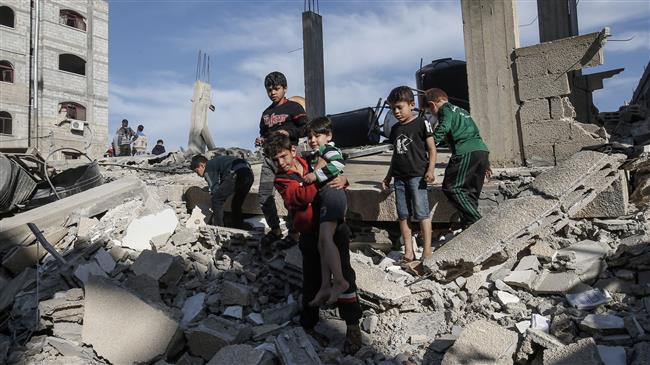
On Sunday afternoon, Israel and Hamas agreed to a ceasefire, ending a three-day escalation of violence in the Gaza Strip. After two unarmed protesters were killed during the weekly Friday protest, two Israeli soldiers were killed in a firefight at the border. The Israeli military responded by bombing targets in Gaza resulting in two more Palestinian deaths. In response, Hamas and other minor political groupings such as Islamic Jihad, launched a barrage of projectiles into Israel.
According to a Hamas leader, the organization felt escalation was a necessary response to Israel shirking its obligations to ease the blockade — one of the terms of the ceasefire after Operation Protective Edge. To signal resistance against Israel, Hamas and other militant groups in the strip occasionally launch homemade projectiles into southern Israel. In reality these “rockets” are weak, especially compared to the high tech war machine that Israel possesses. In fact, only four Israelis were killed by the indiscriminate rocket fire into Israel’s urban areas. According to the Independent, this is the first time in five years that an Israeli has been killed by a projectile launched from Gaza.
As a side note: when the Jerusalem Post reported early on about injured Israelis, their numbers were inflated by 10 who were mildly injured while running to shelter and 45 who suffered from “anxiety”. Only three in this case were actually injured from Gaza rocket fire.
Why then, in the face of such a relatively insignificant threat, does Israel decide to erupt into a bombing frenzy in one of the poorest areas in the world? Israeli officials often say it is about something called “deterrence capacity”.
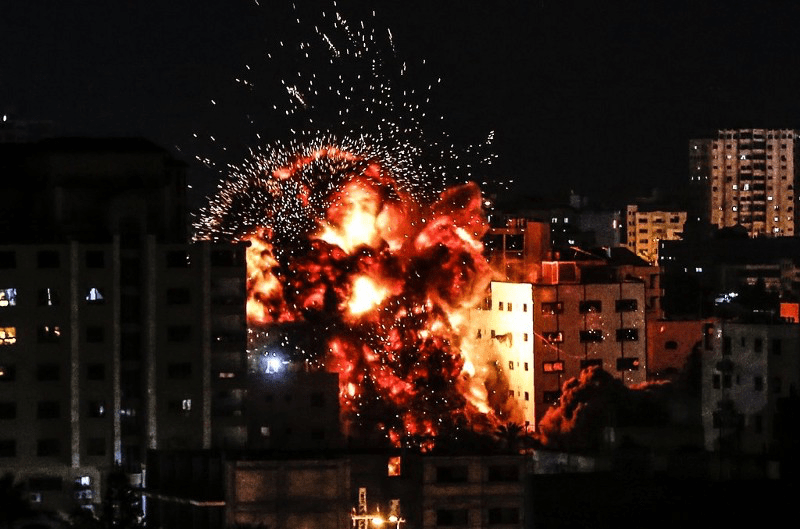
Israel bombs Gaza during the night [From @MuhammadSmiry]
Deterrence capacity is essentially a measure of how terrified people are of a violent response if they were to cross Israel. Throughout all of Israel’s statehood, deterrence capacity has been at the center of its military strategy. It is established when the Israeli forces “demonstrate real hooliganism” at the demand of the high Israeli officials. The more indiscriminate the violence and the more fear struck into the hearts of Palestinians, the less likely they are to resist Israel’s harsh treatment. The Israelis use the term “mowing the lawn” to describe these periodic outbursts of violence. It is a deliberate attempt to beat a desperate people into submission in order to accomplish political ends. In a word, it is the definition of state terrorism.
On Sunday, while the bombs were still falling, Hamas and Islamic Jihad signaled that they were ready to reach a ceasefire. Israel ignored this because, according to Israeli officials, they wanted to reestablish their deterrence capacity. Netanyahu promised “massive strikes” and even began mobilizing ground forces in preparation for an invasion. In other words, the military wanted the population of Gaza to suffer more so that they would fear Israel more. If they fear Israeli bombs enough, Israeli strategy assumes the people of Gaza would quietly accept the destruction of their society. The only reason Israel did not escalate was that it did not want to juggle the PR of bombing a defenseless population during the Eurovision song contest which is being held in Tel Aviv this year.
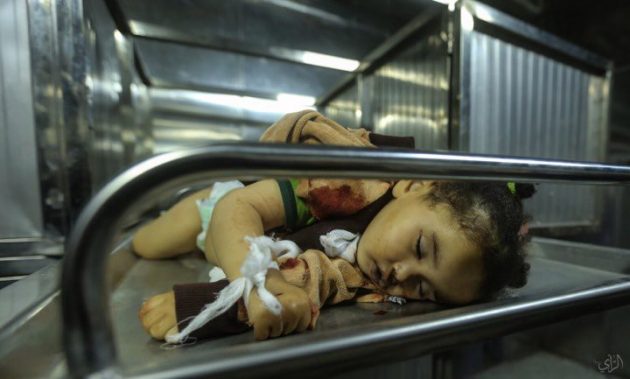
Seba Abu Arar, 14 months, killed in Israeli Strikes [From @MuhammadSmiry]
The decision to continue the bombardment came even after it was known that many civilians, including a pregnant woman and and an infant, were killed in the attacks. Israeli command evidently did not care about these casualties. This is just the latest example of Israel using security concerns to justify outright terrorism. To show just how spurious the security pretext is, ask simple question: What effect will the bombing have on Israeli security?
The bombings are never designed to destroy Hamas militarily. That would be impossible without completely obliterating the strip after a costly invasion and then entirely uprooting Gaza’s civil society. The attacks also do not weaken Hamas politically, but strengthen it. Hamas’s popularity comes in part from their reputation as an armed resistance against Israeli aggression. Armed resistance wouldn’t be as popular if Israel was not continuously antagonizing the population with a crippling blockade and perpetuating the humanitarian crisis.
When Israel attacks Gaza, they’re not expecting some sort of change to the status quo. Bombing the enclave only serves to exacerbate both feelings of hostility as well as the underlying conditions. All of this increases the likelihood of Palestinian violence. As long as Israel refuses to address the roots of the situation, daily life in Gaza will remain unchanged, along with the conditions that lead some to justify firing projectiles into Israel.
So, when Israel bombs one of the most densely populated areas on earth, remorselessly slaughters infants and bombs school shelters and personal residences all in the name of security, the serious reader must understand it as nothing less than a cover for the continuation of terrorism against the Palestinian people. Without willful ignorance, mental gymnastics or outright cognitive dissonance, there’s no other way of putting it.
Israel sets up fake Eurovision boycott page to counter BDS campaign
Data gathering?
RT | May 10, 2019
Sporting the URL boycotteurovision.net Israel’s PR website masquerades as part of a campaign to boycott the Eurovision song contest in Tel Aviv, but actually features pro-Israel narrative.
For most people who follow the issue, the acronym ‘BDS’ refers to the Boycott, Divestment and Sanctions movement, which aims to financially pressure Israel into improving treatment of Palestinians. However, according to a new website promoted via ads on Google, it now stands for how Israel is “beautiful, diverse, sensational.”
Despite the deceptive URL and the fact that the page doesn’t identify itself as run by the Israeli government, Tel Aviv’s PR ministry confirmed to Reuters that they were behind the campaign.
Meanwhile, with less than a week to go before the Eurovision takes place in Tel Aviv, the actual Boycott, Divestment and Sanctions movement has been ramping up its efforts to encourage people to snub the competition. They were none too pleased with the Israeli government’s latest counter-measure.
“After its theft of Palestinian land and culture, Israel is now trying to appropriate a symbol of our nonviolent resistance,” said Alia Malak, of the Palestinian Campaign for the Academic and Cultural Boycott of Israel (PACBI).
This desperate and crude propaganda is straight out of apartheid South Africa’s playbook.
Although the competition is intended to bring countries around the world together, the contest has been politicized a number of times.
Last year’s winner, Israel’s Netta Barzilai, yelled out “Next time in Jerusalem!” after receiving the trophy for her spirited chicken-themed song ‘Toy’. The statement was seen as controversial given that not even the US had yet recognized Jerusalem as the country’s capital.
Although Israel has pulled out all the stops to assure the event will go smoothly, it comes shortly after cross-border shelling between Israel and Palestine in Gaza earlier this week. Four Israelis were killed and at least 10 injured as a result of rockets fired from Gaza, while the IDF carried out some 320 air-raids which killed 25 people and injured dozens.
Palestinian Resistance Can Intensify Deterrence in Face of Zionist Enemy: Hezbollah

Deputy Chief of Hezbollah Executive Council Sheikh Ali Daamoush
Al-Manar | May 10, 2019
Deputy Chief of Hezbollah Executive Council Sheikh Ali Daamoush stressed that the silence of some Arab regimes about the Israeli aggression on Gaza was worse than the aggression itself, adding that they showed to be on the enemy’s side, just as the US and the West.
In his Friday sermon, Sheikh Daamoush pointed out that the Zionist enemy failed to achieve the aggression’s aims, adding that the Palestinian resistance proved it had improved its military capabilities.
The Palestinian resistance has a chance to intensify its deterrence capability in face of the Zionist enemy, his eminence stressed.
In a different context, Sheikh Daamoush noted that the US sanctions on Iran expose Washington’s aggressiveness against the regional states, adding that the Islamic Republic of Iran may never bow to such pressures.
Lebanon won’t survive with Palestinian, Syrian refugees: Auon
MEMO | May 10, 2019
Lebanon will never survive if half a million Palestinian refugees and 1.6 million Syrian refugees remain in the country, the Lebanese president, Michel Aoun, said yesterday.
Aoun’s remarks came during a meeting held at the presidential palace in the Lebanese capital of Beirut with a delegation from the Middle East Council of Churches (MECC), headed by its secretary general Souraya Bechealany.
Aoun called on the MECC to help the Lebanese government resolve the Syrian refugees’ issue “by persuading Western countries to accept the refugees return to their countries as soon as possible.”
“Israel has declared that the Palestinian refugees would remain where they are,” he pointed out, warning that if the refugees remained in Lebanon, “its demographics would change completely.”
There are 174,422 Palestinian refugees currently living in 12 camps and 156 Palestinian communities across Lebanon’s five governorates, according to a report by the Palestinian Central Bureau of Statistics (PCBS) in 2017.
Lebanon – with an estimated population of 4.5 million – complains of the refugees’ burden it has been facing since the start of the Syrian civil war in 2011.
According to the UN High Commissioner for Refugees (UNHCR), the number of Syrian refugees in Lebanon reached 997,000 by the end of November 2017, excluding the Syrians who are not registered with UNHCR.
Bennett: Jewish ‘assimilation’ is a ‘disaster’ for Israel
![Israeli Education Minister, Naftali Bennett [HNM News/Facebook]](https://i2.wp.com/www.middleeastmonitor.com/wp-content/uploads/2018/09/Naftali-Bennett15230739_1864323940467816_2270573291150794336_n.jpg?resize=1200%2C800&quality=75&strip=all&ssl=1)
Outgoing Minister of Education and Diaspora Affairs, Naftali Bennett [HNM News/Facebook]
MEMO – May 9, 2019
In what appears to be an admission of the growing divide between Israel and Jews living outside the country, the outgoing Minister of Education and Diaspora Affairs Naftali Bennett warned against what he sees as “assimilation” of Jews with communities around the world, describing it as “one of the greatest disasters in the history of the Jewish people”.
The remarks, which were reported by Arutz Sheva, were made at the annual International Bible Quiz in Jerusalem, which takes place each year on Israel’s Independence Day. It’s reported that Prime Minister Benjamin Netanyahu was in audience.
Expressing grave concern over Jewish “assimilation”, Bennett who heads the New Right party with Ayelet Shaked, is reported saying: “The State of Israel has experienced the most prosperous and successful era it has known, but during these very days, one of the greatest disasters in the history of the Jewish people is taking place – we are losing millions of our Jewish brothers and sisters in the diaspora. Like an iceberg melting away, so many of our people are slipping away before our eyes.”
He called on the state of Israel to act “without delay, with all [our] strength, creativity, and determination, in order to save [our] brothers and sisters, members of the Jewish people around the world, from assimilation and anti-Semitism.”
Bennet insisted that the task of stemming the tide of Jewish “assimilation” needed to be “the project of the state of Israel”, explaining that “whenever we needed financial or political assistance, the Jews of the world mobilised to help”.
Bennet concluding his addressing saying: “We have a duty to ensure that we will be a sovereign and united Jewish state for all eternity.”
13 Israeli Violations against Journalists in April

By Tareq Astal | IMEMC News & Agencies | May 9, 2019
In its monthly report on Israeli violations against journalists, published today, WAFA said that 11 journalists were injured from rubber-coated metal bullets, live bullets and tear gas canisters, fired by Israeli soldiers, as well as from severe beatings. At the same time, one journalist was detained and another had his press papers seized.
On April 3, the Jerusalem District Court rejected an appeal filed by Mustafa Kharouf, a photographer with Turkish Anadolu news agency, to release him from prison so that he can be with his family in Jerusalem, and kept him incarcerated until May 5, the date he is to be expelled to Jordan. (Kharouf’s attorney got an injunction from the Israeli High Court on May 5, stopping his expulsion until it hears his plea.)
On April 5, Israeli forces shot Amad News Agency correspondent Safinaz al-Louh, with a teargas grenade, in her right foot, and Noor News photographer Mohammad Issa with a gas bomb, in his leg, while covering the March of Return protests, east of the Gaza Strip.
On April 10, Israeli forces raided the home of Ra’ed al-Sharif, in Hebron, holding his family in one room before embarking on a thorough search of the house and tampering with its contents.
On April 12, Israeli forces shot Filistin al-Hadath photographer and correspondent Ahmed al-Zurei, with a rubber-coated bullet, in the abdomen, while he was covering protests east of al-Bureij, in the central Gaza Strip.
On April 19, freelance photographer Abdel Rahim al-Khatib was hit with a rubber-coated bullet, in the left thigh, and Reuters photographer Bassam Massoud with a gas grenade, behind his left ear. A similar bomb injured Watan Radio reporter Mohammad al-Louh and freelance photographers Mahmoud Badr, in the left foot, and Ahmad Washah, in the head, while covering protests east of the Gaza Strip.
In the same day, Xinhua photographer Nidal Shtayeh and WAFA photographer Ayman Noubani were shot with rubber-coated metal bullets, in their thighs, while covering the Israeli army’s crackdown on the weekly protests in Kufr Qaddoum village, east of Qalqilia, in the north of the West Bank.
On April 26, Israeli forces targeted Shihab News Agency photographer Ramadan al-Sharif, with a live bullet that hit him in his right foot, while he covered protests east of Rafah, in southern Gaza.
The daily attacks on journalists in the West Bank are part of an ongoing Israeli policy against their activities and their role in covering the practices and violations committed by these forces, against Palestinian civilians and property.
Trump’s “Deal of the Century” Will Use Sanctions, Military Threats to Force Palestinian Acceptance
By Whitney Webb | MintPress News | May 8, 2019
The Israeli newspaper Israel Hayom, owned by top Trump donor Sheldon Adelson, has published in Hebrew a leaked draft of the Trump administration’s “Deal of the Century” for the Israel-Palestine conflict. The draft was given to the newspaper by an official from Israel’s Foreign Ministry, which is currently headed by Israeli Prime Minister Benjamin Netanyahu. The plan, which has been drafted by President Donald Trump’s son-in-law Jared Kushner and Jason Greenblatt, is expected to be released this June after the conclusion of the Muslim holy month of Ramadan, according to Mondoweiss.
The draft plan published by Israel Hayom, while in keeping with many of the details that have been leaked to the press in past weeks and months, contains several new and troubling claims, including the Trump administration’s plan to force Palestinian leadership to accept the plan through threats of economic strangulation and military force.
For instance, if Palestinian leadership — such as the Palestinian Authority (PA) or Hamas — rejects the Trump administration’s “peace plan,” the United States will respond aggressively by ensuring that “no country in the world transfer money” to Palestine, which would apparently be accomplished through U.S. sanctions. With Palestine’s economy and the livelihood of many Palestinians dependent on foreign aid, such an act would amount to economic strangulation of the over 6 million Palestinians in the West Bank and around 2 million Palestinians in the Gaza Strip.
Furthermore, if the PA accepts the plan but Gaza’s leadership — i.e., Hamas — rejects it, “the U.S. will back Israel to personally harm leaders of Hamas and Islamic Jihad” and the U.S. will hold Hamas fully responsible for any future “round of violence between Israel and Hamas,” regardless of the circumstances that initiate that violence. In other words, the Trump administration is willing to join a future war against the embattled Gaza Strip, described by the United Nations as an open-air prison that is already largely unlivable for its inhabitants and under a full blockade, if Hamas rejects the Trump administration’s plan for the Israel-Palestine conflict.
Thus, the draft plan states that the Trump administration’s tactic of negotiating with the Palestinians involves a combination of threats of economic destruction and military destruction aimed at bullying an already dispossessed people into accepting a plan that clearly favors their occupiers.
Creating a “new” Palestine
In addition to the Trump administration’s apparent game plan to force Palestinian compliance with the so-called “Deal of the Century,” the plan also calls for the creation of a demilitarized state of “New Palestine” that would be incredibly small, as the document calls for the Israeli annexation of the entirety of the Jordan Valley (around 30 percent of the West Bank) and the annexation of all illegal Israeli settlements in the West Bank, which now cover well over half of what international law maintains is Palestinian territory.
This “new” state would be showered in aid from several countries, including the Gulf monarchies, European nations and the United States, allegedly amounting to $30 billion over the next five years. Most of the funding, according to the plan, will come from oil-producing Gulf states like Saudi Arabia. It is unclear whether “New Palestine” would be considered a sovereign state and whether it would be allowed to apply for full membership in the United Nations.
While the plan would allow “New Palestine” access to Jerusalem as a shared, undivided capital with Israel, Palestinians would be responsible for paying the state of Israel for their security because it would be forbidden from having its own army. In other words, Palestinians would be forced to pay the Israel Defense Force (IDF), the military force that has occupied the West Bank for over 50 years, to “protect” them despite the fact the Palestinians are regularly extrajudicially murdered by IDF soldiers. However, the apparent “concession” offered by the Trump administration in this regard would be allowing the “New Palestine” to maintain a police force with “light weaponry.”
In addition, the plan apparently concedes to some past Palestinian demands, such as the release of Palestinian prisoners over a three-year period. However, the draft of the plan published by Israel Hayom does not address Palestinian refugees or the right of return of those refugees in any capacity.
Outsourcing the destruction of Palestine
The fact that this draft of the plan was released to the Netanyahu- and Trump-aligned Israel Hayom by Israel’s Foreign Ministry — itself run by Netanyahu — strongly suggests that Israel’s government was ready to make the details of the plan known to the Israeli public. The draft, which was dismissed by at least one unnamed White House official as “speculative,” reveals an Israeli-centric plan that will likely be rejected by both Israeli right-wing hardliners and a majority of Palestinians.
However, Israel’s leadership is likely to accept the plan only because they know that the Palestinians will reject it, allowing them to blame the failure of the Trump administration-brokered “peace process” on the Palestinians.
Indeed, Dr. Riyad Mansour, the Palestinian ambassador to the United Nations, affirmed on Tuesday that the PA considered the “peace plan” as merely a pretext to a long-planned West Bank land grab by Israel and planned to reject the so-called “Deal of the Century. “If what we read is what is to be expected from this plan, then it seems that the objective of it is not a solution to the conflict, but to give pretext to the Israeli government to annex other portions [of the West Bank],” Mansour recently stated at UN headquarters.
Mansour added:
Some in the [Trump] administration, they think, ‘Yes, what will help peace is break the legs of the Palestinians, break one arm and five teeth, and when they are on the ground they will come crawling to you for anything you offer them.’ Those who think that way don’t know the Palestinians.”
The Palestinian plan to reject the Trump administration’s deal is no secret, with the outgoing French ambassador recently describing the plan as “dead on arrival.” This fact of assured rejection makes all the details of the plan irrelevant, save for the part of the plan that deals with “penalties” for the Palestinians if they reject the plan.
Those penalties should draw the most concern as the “peace plan” is made public, as it harkens coming U.S. military involvement in a future war between Israel and Gaza –regardless of whether that war is initiated by Gazans or Israelis — as well as extreme economic hardship on the West Bank through U.S. sanctions.
Netanyahu has made no secret of the fact that he does not want the two-state solution provided in this U.S. plan, even if the Palestinian “state” is demilitarized and minuscule. However, if the Palestinians reject the plan — as he knows they will — the United States will do the work of further destroying Palestine for him by committing to a future U.S. invasion of Gaza and to the economic strangulation of the West Bank. These “penalties” will allow Israel’s government to blame Palestinians for their own foreign-imposed hardship while giving Netanyahu’s government leeway to fulfill its long-standing goal of “conquering” the Gaza Strip and completely annexing the entirety of the West Bank.
As Mansour noted, the “peace plan” is indeed a pretext, but for far more than a land grab. Instead, it is a pretext for outsourcing the destruction of Palestine to the United States under the cover of a “peace process” that no diplomats — in Israel, Palestine or elsewhere — have at any point taken seriously since the early days of the Trump administration.
Whitney Webb is a MintPress News journalist based in Chile. She has contributed to several independent media outlets including Global Research, EcoWatch, the Ron Paul Institute and 21st Century Wire, among others. She has made several radio and television appearances and is the 2019 winner of the Serena Shim Award for Uncompromised Integrity in Journalism.
Hamas condemns Israel’s bombing of media offices in Gaza
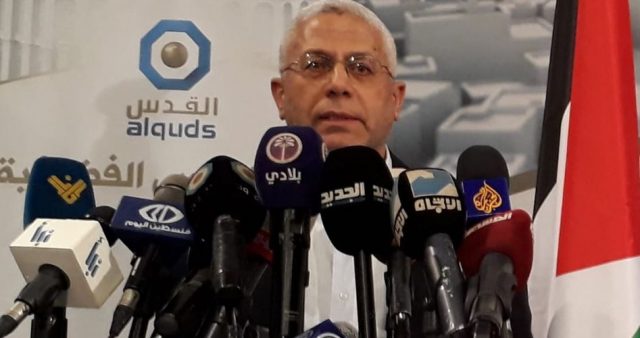
Palestine Information Center – May 5, 2019
The Hamas leader Raafat Murra on Sunday decried the Israeli occupation army’s targeting of several media offices in the ongoing aggression on the Gaza Strip.
Murra condemned the Israeli attack on the Anadolu Agency office and described it as “terrorism” and “deliberate crime”.
He affirmed that Hamas fully supports all Palestinian, Arab, and international media platforms which cover the events in Gaza objectively and professionally.
Israeli warplanes on Saturday bombed the Anadolu Agency office and the Palestinian prisoners media office with several missiles during large-scale aerial attacks on Gaza.
US violating NPT, ignoring Israeli regime’s breaches of accord: Syrian UN envoy

Press TV – May 7, 2019
Syria’s UN Ambassador Bashar al-Ja’afari has slammed the United States for flagrantly violating the nuclear Non-Proliferation Treaty (NPT) and turning a blind eye to the Israeli regime’s breaches of the international accord.
“Syria took the initiative in 1968 to join the treaty, and signed the agreement of guarantees with the International Atomic Energy Agency (IAEA) in 1992 … It also presented a draft resolution in 2003 aimed at the establishment of a (Middle East) region free from weapons of mass destruction (WMD); but the US blocked the measure,” Ja’afari said at the the Preparatory Committee for the 2020 Review Conference of the Parties to the Treaty on the Non-Proliferation of Nuclear Weapons (NPT) in New York on Tuesday.
The Syrian diplomat also lambasted certain Western states for helping Israel establish the Dimona nuclear center and offering it related substances, experience and technology – a step that enabled the Tel Aviv regime to possess hundreds of nuclear heads.
Israel is estimated to have 200 to 400 nuclear warheads in its arsenal. The regime, however, refuses to either accept or deny having the weapons.
It has also evaded signing the Non-Proliferation Treaty (NPT) amid staunch endeavor by the United States and other Western states on international levels in favor of its non-commitment to the accord.
The clandestine nuclear activities were uncovered when whistle-blower Mordechai Vanunu, originally a technician at the Dimona nuclear facility, handed overwhelming evidence of Israel’s nuclear program to Britain’s Sunday Times in 1986.
It is believed that the nuclear site is home to Israel’s nuclear weapons.
In September 2017, then-Iranian Ambassador to the IAEA Reza Najafi denounced the West’s double standard approaches on the possession and development of atomic technology, urging a complete end to any nuclear cooperation with the Israeli regime.
Addressing a quarterly meeting of the IAEA’s 35-member Board of Governors in Vienna, Najafi warned that the Israeli regime’s nuclear program is negatively impacting security of the Middle East.
Reflection: Key to open door of peace is in the hands of Israel
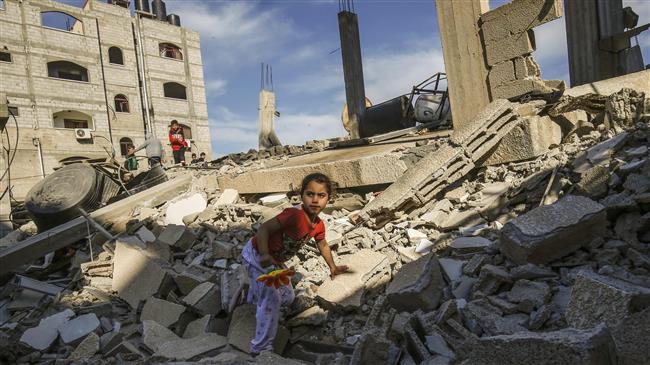
By Latin Patriarch Emeritus Michel Sabbah – Al-Bushra – 6.5.2019
There is a war on Gaza, as it has been once, twice, and more. Gaza and its people are in a state of permanent war. It has been under constant siege for 13 years, which is war imposed upon them every day. Today, the month of Ramadan has started for fasting, prayer, repentance and good deeds. Instead, we see death exploding in and around Gaza. Israel itself complains of the war. Yesterday, Sunday May 5th, the Israeli Defense Minister tweeted and cried out to the world to notice and see Israelis waking up for the second day in a row of rockets coming from Gaza and falling in Israel.
War is painful after two days in Israel. It is as painful and more painful in Gaza after 13 years of siege. War is an absolute evil both for the Israelis and for the Palestinians. Mr. Minister, the key to peace and the end of war is not in the hands of a world that we summon but simply in your hand and in the hands of Israel.
The issue is not only that of Gaza but the issue of all the Palestinian people. The issue is the injustice imposed on the Palestinian people for generations. Israel refuses to see Palestinians as human beings with same rights and equal to all human beings. Israel has tried the methods of war and violence repeatedly to solve the issue. Until today, it has not succeeded and now, on the near horizon, there is talk about a solution wrapped in darkness and non-recognition of Palestinian rights. It will not bring a just solution. It will be another failure.
The solution is simple if Israel wanted to SEE. If it wanted to see that the Palestinian people have the same rights as the Israeli people, all being equal in humanity. It is in Israel’s hands – Israel is the stronger – to realize this equality. Avoiding this equality until now has been useless. Israel itself today suffers from war launched on Gaza.
The solution is simple. Israeli human beings should not remain exposed to war, as is the Palestinian human being. Both are human and equal in humanity. We call upon Israel, the friends of Israel, those interested in the survival of Israel and the security of Israel to simply see that the Palestinian and Israeli peoples are equal in rights and duties and capable of making peace.
We say to the Israeli authorities: It is in your hands to keep us and keep yourselves in constant war and hostility, and in your hands to let us move together to an equal life with dignity, peace and security. Learn from the experience of already 70 years in war. They did not yield security and peace. The cause of the Palestinian people cannot be solved by violence or unjustly imposed solutions, but only by justice and equality. This is the key to war and peace in Israel and Palestine. The key to open the door of peace is in the hands of Israel.
Eileen Fleming, Senior Non-Arab Correspondent for USA’s The Arab Daily News, Author, Reporter: In Nov. 2006, Father Manuel, the parish priest at the Latin Church and school in Gaza, informed the world:
“Gaza cannot sleep! The people are suffering unbelievably. They are hungry, thirsty, have no electricity or clean water. They are suffering constant bombardments and sonic booms from low flying aircraft. They need food: bread and water. Children and babies are hungry… people have no money to buy food. The price of food has doubled and tripled due to the situation. We cannot drink water from the ground here as it is salty and not hygienic. People must buy water to drink. They have no income, no opportunities to get food and water from outside and no opportunities to secure money inside of Gaza. They have no hope.
“Without electricity children are afraid. No light at night. No oil or candles… Thirsty children are crying, afraid and desperate…Many children have been violently thrown from their beds at night from the sonic booms. Many arms and legs have been broken. These planes fly low over Gaza and then reach the speed of sound. This shakes the ground and creates shock waves like an earthquake that causes people to be thrown from their bed. I, myself weigh 120 kilos and was almost thrown from my bed due to the shock wave produced by a low flying jet that made a sonic boom.
“Gaza cannot sleep… the cries of hungry children, the sullen faces of broken men and women who are just sitting in their hungry emptiness with no light, no hope, no love. These actions are War Crimes!
Israel-Gaza deaths: 293 Gazans & 6 Israelis killed in past year
With the recent surge in violence between Israel and Gaza, it is important to examine events of the past year and to learn the chronology and details of the recent deaths among both populations…
By Alison Weir | If Americans Knew | May 6, 2019
With news reports focusing on recent deaths in Israel and Gaza, it’s valuable to enlarge the time period being examined.
Israeli soldiers have been shooting Gazan men, women, and children every week for over the past year.
Israeli forces have killed approximately 290 Gazans and have injured over 29,000 since Gazans began their weekly Great March of Return on March 30th (see below about why they are marching.) A few additional Gazans died during this time period from wounds inflicted by Israeli forces earlier.
Among those killed and maimed have been numerous medics, women, children, and journalists. Approximately 126 Gazans have had legs and/or arms amputated, and others have been permanently paralyzed.
While Israeli governmental statements, often parroted by U.S. media, claim that Israel targets “terror,” the large majority of Gazans killed by Israeli forces have been civilians.
During the same time period, Gazan resistance fighters have killed 6 Israelis, one of them a Palestinian. (It is difficult to provide a number for Israelis wounded during this time since Israeli statistics for injured include those suffering from panic attacks.)
The names and details of both the Palestinians and the Israelis killed are listed on this timeline.
Deaths during the last 3 days:
On Friday, May 3, Israeli forces killed 4 Palestinians and injured 82. Among the injured were 34 children, two journalists and three paramedics.
On Saturday, May 4, Israeli forces killed 4 Palestinians (including an infant and her mother). Israeli forces also targeted and destroyed a news agency. Journalistic organizations around the world have condemned this attack. This attack was largely unreported by U.S. news media.
On Sunday, May 5, Palestinian resistance fighters killed 3 Israelis and 1 Palestinian Israeli, and Israeli military forces killed 19 Palestinians, including a 12-year-old boy and a 4-month-old girl named Maria. The Israeli shelling destroyed or damaged 600 Palestinian homes, businesses and livelihoods.
The Palestinian Israeli who died, Ziad Alhamamd, was a bedouin from the unrecognized Negev village of as-Sawaween who was working in an Israeli factory in Ashakalon when it was hit by a rocket from Gaza. Gaza’s rockets are mostly home-made and lack guidance systems.
Unrecognized villages are Palestinian villages that were in Palestine before Israel was created that are not formally recognized by the state of Israel. They have no access to Israeli services such as water, electricity, telephones, sewage systems, roads, and often schools and voting stations. Many of the villages are under Israeli demolition orders and never know when their homes will be destroyed. Alhamamd’s village of Sawaween had been denied a school for its 350 elementary school-aged children.
US media provide Israel-centric reports
U.S. news media have published a number of reports on the recent violence that emphasize the Israeli deaths, begin with Israeli victims, largely ignore the year-long killing of Gazans, and frame Israeli actions as defensive.
The New York Times lead paragraph that framed its report yesterday is an example:
“Fighting between Israel and Gaza escalated rapidly on Sunday in the worst combat since the last full-blown war in 2014, with Palestinian rocket and missile attacks killing four Israeli civilians and Israeli forces taking aim at individual Gaza militants.”
“The death toll continues to rise Sunday on both sides of the Israel-Gaza border in one of the most intense flare-ups of violence in the region in years, shattering a month-long lull in attacks.
“Palestinian militants in the Gaza Strip fired more than 600 rockets into southern Israel in less than 24 hours, killing at least four Israelis and leaving several more in critical condition.”
Below is how the Washington Post introduced its report today:
“An uneasy cease-fire settled over the cities of southern Israel on Monday after a weekend that brought a rain of 600 rockets from the Gaza Strip, but not all residents thought the truce was a good thing.
“Near the explosion-scarred house of Moshe Agadi, 58, who became the first Israeli since 2014 to die in rocket fire from Gaza, mothers took their children to play in a park after 48 hours of sheltering indoors.”
Meanwhile, the Israeli military has abducted 11 Palestinians in the West Bank, uprooted 120 Palestinian olive trees, and an Israeli NGO published a report revealing that Israeli authorities forced almost 3,000 Palestinians from their homes in East Jerusalem between 2004 and 2019, deliberately leaving them homeless, including 1,574 of minors.
Total number of Israeli and Palestinian deaths including those outside Gaza
Altogether, 343 Palestinians have died from Israeli attacks, and 16 Israelis have died from Palestinian attacks since March 30, 2018 .
At least 9,908 Palestinians and 1,267 Israelis have been killed by someone from the other side since 2000.
Alison Weir is executive director of If Americans Knew, president of the Council for the National Interest, and author of Against Our Better Judgment: The Hidden History of How the U.S. Was Used to Create Israel.
RELATED:
TAKE ACTION: Contact Congress to condemn Israeli assault on Gazans
Once again, ‘NYT’ distorts the news, dishonestly making Gazans the aggressor and Israel the victim
Featured Video

Anthrax War – CBC The Passionate Eye
or go to
Aletho News Archives – Video-Images
Book Review
Shattered Dreams: The HPV Vaccine Exposed (2019)
By Christina England – 30 Q&As – Book Review & Summary
Lies are Unbekoming | September 4, 2026
… Gardasil received FDA fast-track approval in 2006, Cervarix followed in 2009, and Gardasil 9 was approved in December 2014 with more than double the aluminium adjuvant content of the original. The commercial context is specific. Merck was about to lose patent protection on Zocor and faced $18 billion in Vioxx injury claims from a cardiovascular drug the company had marketed while suppressing its own data showing a five-times increase in heart attacks. Analysts projected the global HPV vaccine market at $4 billion by 2011, contingent on government-funded national programs for teenage girls. The 1986 National Childhood Vaccine Injury Act had already granted manufacturers complete liability immunity. By 2013, Japan had withdrawn its HPV vaccine recommendation after cataloguing severe adverse reactions in hundreds of girls. No Western government followed. The establishment position across the UK, US, Australia, and most of Europe held, and still holds, that the vaccines are safe and effective, that reported injuries are coincidental, and that cervical cancer prevention justifies the program. The book was published into this position, not against a vacuum.
Shattered Dreams sits alongside Mary Holland’s The HPV Vaccine On Trial and Viera Scheibner’s foundational vaccination work as part of the documented record on what has been done to a generation of teenage girls under the banner of cancer prevention. The full summary unpacks three specific findings: that Merck used the aluminium adjuvant itself as the “placebo” control in 92.5% of trial subjects, making it structurally impossible to detect excess reactions from the adjuvant; that Dr. Sin Hang Lee found HPV DNA fragments bound to aluminium in every one of sixteen Gardasil samples tested, and in the blood and spleen of a New Zealand girl six months after her third dose; and that in every country with high vaccination coverage, including Australia, the UK, Norway, and Sweden, cervical cancer rates have stopped declining and started rising specifically in the vaccinated cohort. Martínez-Lavín’s 2017 calculation puts the number needed to seriously harm with Gardasil 9 at 140, and the number needed to vaccinate to prevent one case at 1,757. Thirteen young women are seriously harmed for every one who benefits. The vaccine was approved on the basis of trials that could not detect what the trials were supposed to detect, and it is still being given to twelve-year-olds today. … Read full review
Blog Roll
 Aletho News
- Georgia’s Largest Healthcare System Will Fire Employees Who Refuse Flu Vaccine
- The Five-Year Fuel Crisis: Why the World Economy Is Paying for a War It Thinks Is Ending
- Trump’s Big Bluff on Iran
- Swiss scammed out of millions by Ukraine-linked call centers – media
- Germany facing potential ‘violent conflict’ with Russia – spy chief
- Ukraine’s EU neighbors reject new plea from Kiev – Politico
- British Transport Police Facial Recognition Trial Scanned 926,912 People With Zero Arrests
- House Bill Would Ban Federal Use of Flock ALPR Data
- Can a Spice Rival a Drug? 10 Head-to-Head Trials Put It to the Test.
- The oil routes around Hormuz face their own chokepoints
- If Americans Knew
- “We See Our Homes Now From A Satellite, Like Strangers”
- Watch “Gaza: Doctors Under Attack”, originally censored by BBC
- NAZA: Israeli embassies in UK and US promote rival documentary to challenge Gaza genocide allegations
- David Ellison appoints Israeli to lead merged Paramount-Warner studios
- Turkish Red Crescent helps elderly Gaza man walk again after Israel confiscates his prosthetic limb
- Four Palestinians Killed in Israeli Attacks in Gaza
- Two Palestinian youths killed and village razed as Israeli attacks on West Bank continue
- Two more Christian women victims of Israeli raids on Gaza
- Cruelty, Deprivation, Indignity: A Journalist’s 22 Months in Israeli Prison
- New IDF Website Frames Slain Gaza Journalists as Terrorists
- No Tricks Zone
- Latest European Green Energy Debacle; Portugal’s Largest Flagship Solar Park Insolvent!
- Green Energy Debacle: German Expert Professor Fritz Vahrenholt Warns Of Severe Economic And Social Consequences
- Two More Paleo Reconstructions Affirm Meters-Higher Sea Levels Across Ireland, Brazil 7000-6000 Years Ago
- New Study: Earth And Venus Surface Warmth Largely Explained By Convection And Lapse Rate, Not CO2 Or Radiation
- 2025 Nature Paper Claiming Worsening Global Drought Gets RETRACTED …Heavily Flawed
- New Study: ‘Global Drought Shows No Detectable Recent Acceleration Under Climate Warming’
- Economic Masterminds: German Socialists Suggest Taxing Productivity Gains Stemming From Using AI
- The South China Sea Has Not Been Cooperating With The Climate Change Narrative
- Energy Crisis: Germany Enters Heating Season With Historically Low Gas Reserve Fill Levels
- New Study: The Antarctic Ice Sheet Gained Mass From 2020-2024 Due To Staggering Snow And Ice Accumulation

