Anniversaries of major events promote political interests not the public spirit
By Greg Felton | November 18, 2017
To all intents and purposes, our political, economic and moral world begins with World War I, the seminal event of the 20th century. The carnage, devastation and psychological trauma of Europe’s first total war did to the old political order what a certain asteroid did to the dinosaurs 65 million years ago: it wiped out an existing hierarchy and forced the creation of another that would ultimately be dominated by the U.S., which emerged from that war as the world’s new apex predator.
Now, in the early stages of the 21st century, anniversaries of events that have defined our concept of modernity are going to come in profusion, events like the Russian revolutions, League of Nations, stock market crash, the Great Depression; World War II, atomic weapons, plastics, the United Nations, McCarthyism and the Cold War.
Which events we commemorate, how we commemorate them, and which ones we ignore or gloss over have less to do with their intrinsic importance than with their propaganda value in support of, if you’ll pardon the cliché, The New World Order. The selective use of history to prop up our post-war hierarchy can be seen in attitudes toward two events that have anniversaries this month.
The Balfour Declaration, Nov. 2, 1917
Defenders and detractors of the Declaration both made much of its centenary, yet neither side seemed to understand its general worthlessness. The document in question is simply a letter from British Foreign Secretary James Arthur Balfour to Lord Rothschild expressing the British government’s favourable view of “the establishment in Palestine of a national home for the Jewish people.” It does not, as is widely believed, have anything to do with the creation of Israel. It amounted to nothing.
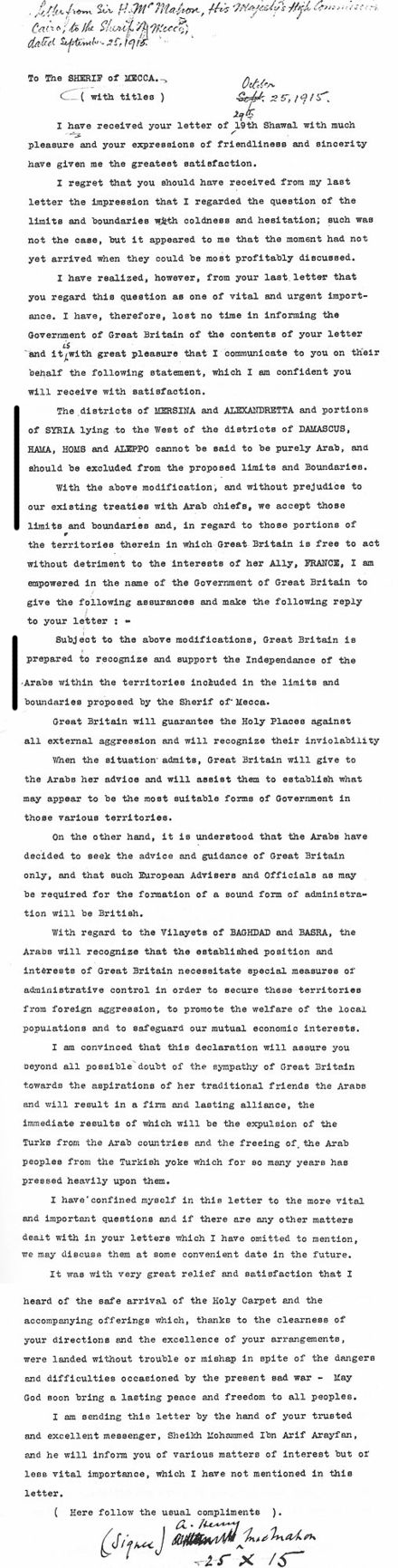
 On its face, the Declaration is absurd as well as politically and legally indefensible. “National home” has no meaning in international law; Jews do not constitute “a people” and therefore not “a nation”; Palestinians were not consulted on the matter; and the Declaration betrayed the British government’s support for Arab independence as outlined in the Hussein–McMahon correspondence.
In one letter dated Oct. 25, 1915, the British High Commissioner to Egypt, Lt.–Col. Sir Henry McMahon, openly promised Palestine, inter alia, to the Sharif of Mecca. The Hussein–McMahon correspondence was a meaningful exchange between governments; the Balfour Declaration was merely a private letter addressed to a special-interest group, the Zionist Federation.
Regarding its contents, nothing in the Declaration was special or revelatory regarding British attitudes. Upper-class twits, er Brits, like Josiah Wedgwood had been lionizing zionism since at least Feb. 7, 1917. As Wedgwood would say a decade or so later, “Zionism is now doing for the Jews what the Labour Party seeks to do for the British working-class—creating self-confidence and corporate self-respect.”
For Wedgwood, Balfour and others, zionism was a benign illusion borne of ignorance and Western hubris. Wedgwood even praised Jewish colonization of Palestine as being wholly beneficial. Such a misguided understanding is also reflected in the Declaration’s naïve insistence that nothing in the zionist enterprise should be allowed to harm or prejudice the civil or religious rights of existing non-Jewish communities.
In truth, the Zionist Federation, to whom Balfour addressed the letter, had no intention of respecting Palestinian rights. In fact, such respect is anathema to zionism As anyone can see, the modern “state” of Israel is an abomination of the spirit of the Balfour Declaration. Therefore, the Declaration must be seen as either a conscious act of U.K. complicity in a genocide or an expression of sentimental Judeophilic nonsense. Either way, it does not deserve to be celebrated.
UNGA Resolution 181, (“The Partition Plan”) Nov. 29, 1947
The disconnect between zionist fantasy in the Balfour Declaration and zionist reality in Palestine would be proven 30 years later when the UN General Assembly caved in to blackmail to “create” Israel. The following account of how UNGA Resolution 181 came to pass is taken from my 2011 essay UN must again choose between capitulation and credibility.
By Nov. 25, 1947, the Zionist lobby realized that it did not have the requisite two-thirds majority in the General Assembly to support partition [Palestine]. Extraordinary measures had to be taken.
Vijayalakshmi Pandit, head of India’s UN delegation and sister of India’s Prime Minister Jawaharlal Nehru, received daily death threats warning her to change her vote. Nehru, though, refused to buckle in the face of threats or lucrative bribes. (Najma Heptulla, Indo-West Asian relations: the Nehru era, Allied Publishers, 1991, p. 158.)
Other, smaller, countries could not afford to stand on principle. In Palestine and Israel—A Challenge to Justice, Professor John Quigley recounts how Liberia, the Philippines, and Haiti—all financially dependent on the U.S.—were coerced into switching their votes:
“Liberia’s ambassador to the United Nations complained that the U.S. delegation threatened aid cuts to several countries. Some delegates charged U.S. officials with ‘diplomatic intimidation.’ Without terrific pressure from the United States on governments which cannot afford to risk American reprisals, said an anonymous editorial writer, the resolution would never have passed. The fact such pressure had been exerted became public knowledge, to the extent a State Department policy group was concerned that ‘the prestige of the UN’ would suffer because of ‘the notoriety and resentment attendant upon the activities of U.S. pressure groups, including members of Congress, who sought to impose U.S. views as to partition on foreign delegations.’” (p. 37)
On Nov. 29, the Partition Plan, known as UNGA Resolution 181 narrowly gained the required two thirds—33 in favor, 13 opposed, 10 abstaining and 1 absent—yet the resolution was a violation of the UN Charter since the UN has no authority to take land from one people and give it to another.
As a result, 726,000 Arabs were made refugees in their own land from November 29, 1947, until the end of 1948, according to the UN Relief and Works Agency for Palestine. Walter Eytan, Director General of the Israeli Foreign Ministry, referred to the UNRWA’s figure as “meticulous” and believed that the real number was closer to 800,000. Moshe Dayan would later admit: “There is not one single place built in this country that did not have a former Arab population.” (Ha’aretz, April 4, 1969).…
Thomas Reid, British MP for Swindon, called Resolution 181 “an iniquitous scheme”: “Let us be frank about it. One of the chief motives is that the Jews have a controlling voice in the election for the President in the States of New York, Illinois, Ohio and elsewhere in America. I suggest that the chief reason for this evil proposal of U.N.O. is that the political parties in America, or their party machines, are partly at the electoral mercy of the Jews. That is public knowledge.” (Hansard, Dec. 11, 1947)
So much for the relevance of the Balfour Declaration and its pious concern for the civil and religious rights of non-Jewish groups! In fact, the cruelty of the invading Jews toward the native Palestinians was so great that U.S. President Harry Truman refused to let UNGA Resolution 181 go to the Security Council for ratification, and at one point was prepared to rescind U.S. support for partition. In a March 25, 1948 statement, Truman declared support for trusteeship, albeit temporarily, to stabilize the region and maintain law and order:
It has become clear that the partition plan cannot be carried out at this time by peaceful means. We could not undertake to impose this solution on the people of Palestine by the use of American troops, both on Charter grounds and as a matter of national policy.
The consequence of this admission, of course, is that without ratification UNGA Resolution 181 does not exist: GA resolutions are only recommendations and have no force of law unless accepted by all parties. Therefore, Israel has no legal, moral or political legitimacy. This illegitimacy is what celebrating the centenary of the Declaration amounted to.
There is, though, one irony to the Declaration that is worthy of note. There was one lone voice against the Declaration in David Lloyd-George’s government. It belonged to Edwin Samuel Lord Montagu, who wrote to the British Cabinet on Aug. 23, 1917, one day after the Balfour Declaration was drafted. Here is a short excerpt:
[A] religious test of citizenship seems to me to be only admitted by those who take a bigoted and narrow view of one particular epoch of the history of Palestine, and claim for the Jews a position to which they are not entitled.
If my memory serves me right, there are three times as many Jews in the world as could possible get into Palestine if you drove out all the population that remains there now. So that only one-third will get back at the most, and what will happen to the remainder?
… I feel that the Government are asked to be the instrument for carrying out the wishes of a Zionist organisation largely run, as my information goes, at any rate in the past, by men of enemy descent or birth, and by this means have dealt a severe blow to the liberties, position and opportunities of service of their Jewish fellow-countrymen.
Montagu was also the government’s only Jew.
Palestine: Saudi Arabia, Egypt using Rafah crossing to pressure us
MEMO | November 17, 2017
The Rafah crossing between the besieged Gaza Strip and Egypt is being used a tool to pressure Palestinian President Mahmoud Abbas to enter into US-backed peace talks with Israel, a Palestinian Authority official has said.
“The Rafah crossing has become a tool that Egypt and Saudi Arabia use to pressure Palestinian President Mahmoud Abbas to accept the entry into a new round of US-backed negotiations with Israel,” the PA official said, warning that “the negotiations could reach results that may affect the rights of the Palestinians.”
According to the Cairo agreement which was signed on 12 October, Egypt agreed with Fatah and Hamas to reopen the Rafah border crossing last Tuesday, but the official said that “Saudi Arabia seemed to have pressured Egypt to retreat until the PA approves the two-state solution deal.”
The official described the exploiting of the only humanitarian crossing for Gaza’s residents as “suspicious”.
“They [Arab countries] are using the crossing to strengthen their ties with the US and Israel” he added.
Israel has maintained a blockade on Gaza for a decade, with tight restrictions in place on the movement of people and goods at its crossings, citing the need to control Hamas and stop Islamic groups from obtaining weapons or materials that could be used against Tel Aviv. Egypt has supported the blockade by closing the Rafah crossing, leaving Palestinian in Gaza no access to the outside world.
Gaza’s two million residents suffer from worsening humanitarian conditions, with only a few hours of power a day and a lack of clean water. Control of the Rafah crossing at Gaza’s southern border has long been a sticking point between the two Palestinian factions, and between Egypt and the Palestinians in Gaza for whom the crossing represents a vital gateway to the outside world.
Inside the Battle of Algiers: Memoir of a Woman Freedom Fighter – Book Review
Reviewed by Vacy Vlazna | Palestine Chronicle | November 9, 2017
(Inside the Battle of Algiers: Memoir of a Woman Freedom Fighter, Zohra Drif, Just World Books, 2017)
“Colonialism creates the patriotism of the colonized. Kept at the level of a beast by an oppressive system, the natives are given no rights, not even the right to live. Their condition worsens daily. And when a people has no choice but how it will die; when a people has received from its oppressors only the gift of despair, what does it have to lose? A people’s misfortune will become its courage; it will make, of its endless rejection by colonialism, the absolute rejection of colonization.” – Albert Memmi
 Stylishly dressed in a lavender blue summer dress with small stripes, Algerian student Zohra Drif, 22, in a state of surreal disassociation yet guided by ‘absolute necessity, the sacred duty to succeed in my mission so that my people would not despair’, planted a bomb concealed in a beach bag to be set off 6.25 pm in the Milk Bar cafe on the elegant Rue d’Isly, a 10 minute walk from the Muslim Casbah held captive under the oppressive French military siege.
Across town, on the same sunny afternoon of September 30, 1956, Zohra’s friends, Samia Lakhdari and her mother, Mama Zhor, successfully targeted the Cafeteria on Rue Michelet and Djamila Bouhired planted a faulty bomb in the Air France agency in the Mauritania building.
As an activist for Palestine, I was eager to understand the mind, soul and motive of a young freedom fighter. Zohra Drif’s profoundly personal and nationalistic autobiography is a precise holographic sliver of the whole 1954-1962 Algerian struggle for independence from 130 years of France’s brutal colonization; a struggle that claimed over 1,000,000 Algerian lives.
Daughter of Qadi Ahmed and Saadi Drif, Zohra’s destiny from childhood in rural Tiaret to schoolgirl and university law student in Algiers and her dogged determination to join the National Liberation Front (FLN) in the Algiers Autonomous Zone 5, to her stressful clandestine life, subsequent arrest and imprisonment is a compelling read.
Its power lies in a tense dramatic immediacy, intriguingly heightened by the voice of the young Zohra, not the 82-year-old Zohra, the author who splices Algeria’s tragic saga underscored by French colonial privileged racism with the idealism and valiant acts of young revolutionaries….
And herein lies the rationale and honor of the revolutionary identity:
“Perhaps the reader of today expects me to regret having placed bombs in public places frequented by European civilians. I do not. To do so would be to obscure the central problem of settler colonialism by trying to pass off the European civilians of the day for (at best) mere tourists visiting Algeria or (at worst) the ‘natural’ inheritors of our land in place of its legitimate children. I will not adopt this position because I hate lies and their corollary, revisionism, whatever they are and wherever they come from. Samia and I did not regret our actions in 1956 or 1957, nor do we today, nor will we ever. I speak here in my own name and on behalf of my friend and sister Samia Lakhdari, who died in the summer of 2012. What’s more, if today, God forbid, my country were to be attacked and occupied by a foreign force, I know that even at my advanced age, propped up on a cane, I would be with all those (and I know there are many of them, in Algeria and elsewhere) who would offer their lives to liberate our land and its people. In declaring this, I seek neither to boast nor to challenge anyone. I am simply trying to convey an idea, a simple conviction related to the concept of responsibility.
“As for the civilians who perished during the war of national liberation, if they are Algerian, I would propose that they go to the ALN fighters and ask them, “Why did we die?” I know that the ALN will reply, ‘You are dead because your lives were part of the price we had to pay for our country to be free and independent.’ And if they are French, I would propose that they go see the French authorities and ask, ‘Why did we die?’ I do not know what the French authorities would say, but I would propose to them the one real truth there is: ‘You died because you were among the hundreds of thousands of Europeans that we used to subjugate and occupy a foreign country, Algeria, so that we could make it our settler colony.’ In any case, this will not make me forget all the French who chose justice and the values of freedom and dignity (of which their own homeland boasted) and joined our camp.”
The rightness and justice bolted to Zohra’s vindication of her mission intensifies when you consider the barbarities that the French regime perpetrated against Algerians – whole scale massacres and napalm bombing in Setif, Kherrata, North Constantinos, the massacre of thousands of men in the Skikda stadium, collective punishment, humiliations, lynchings, impalings, collective rape, annihilation of villages and their occupants, mass arrests, disappearances, concentration camps, tens of thousands of summary executions, bombings of trade unions, terrible tortures in prisons and in homes in front of the family, curfews, checkpoints, rampant raids, looting, psychological warfare, blowing up homes, the relentless incitement fear and terror, military courts replaced civil courts, decapitation by guillotine, the Paris massacre of 300 Algerian protestors – all executed with merciless French arrogance and indifference to the humanity of the ‘natives’. An arrogance that masks the moral inferiority of the colonist.
French colonial sadism exists to this day thus explaining why since 1947, Presidents from Auriol to Macron ( with the exception of Pompidou and d’Estaing) have enthusiastically supported the savage colonialism of their Israeli frères d’armes:
Auriol: approved Partition Plan, voted for the Israel’s membership to the UN.
Coty: France and Israel cooperated “in research and production of nuclear weapons,” and build Israel’s Dimona nuclear reactor.
de Gaulle: “I raise my glass to Israel, our friend and our ally.”
(Pompidou and d’Estaing)
Mitterrand: “Indeed, the French nation is a friend to the nation of Israel.”
Chirac: “France is determined to strengthen Israel and I say that it is important that the process move forward towards full development and assure full security for the people of Israel.”
Sarkozy: “On behalf of France, we would like to declare our love for Israel – we love you! “
Hollande “I will always remain a friend of Israel”
Macron – “French law prohibits … boycotting [Israel]. There is no question of changing that law and no question of acting indulgently on this. For me, these [BDS protests] are anti-Zionist moves, thus profoundly anti-Semitic … I condemn this approach both legally and politically.”
The timeless universality of Zohra’s insurrectionary call to dignity and freedom has invaluable resonance for Palestinian resistance. Reading Zohra’s memoir is Palestine’s story and the lessons are electrifying:
1. Maintain focus on the occupiers fault lines:
“First, France was not invincible. Not only had she not resisted the German occupation but, even worse, over 80 percent of the French parliament had voted for the armistice – France’s abdication to Germany – and what’s more, the majority of the French elite had even collaborated with the occupiers, supporting the Vichy regime and its Marshal Philippe Petain. We were well aware that without Britain and the United States, France would never have been liberated.” Also France had been defeated in WWI and later defeated in Franco-Thai War and the Indochina War.”
Israel, for all its army, navy, airforce, vast cache of nuclear and high tech military hardware ( France ties with Germany in arms exports to Israel) is not invincible. Its European Jewish immigrants, apart from the Warsaw Ghetto uprising, like the French submitted to the Nazis. The 1973 Yom Kippur War resulted in the Israeli return of its Sinai gains to Egypt, and in the 2006 Lebanon War Israel failed to destroy Hezbollah. Israel’s three wars on Gaza, 2009/10, 2011 and 2014 have incrementally caused heavy losses to Israel’s credibility and fabricated victim reputation. In 2014, without an army, navy, airforce, Hamas inflicted 67 ZOF deaths and wounded 468.
2. Resistance is justice and a right.
“We are not killers. We are fighters for a just cause, moved by the most sacred of duties: to liberate our land and our people. It is the colonial regime that kills -torturing, oppressing, and repressing to perpetuate its system of occupation on our land and our people, trying to convince everyone that Algeria is French. That is why each of our attacks, each of our ambushes, each of our lives sacrificed must serve to unmask France before the world, to show that our people are at war against a foreign power occupying us by force.”
The Zionist occupier also tries to convince the world that Palestine is Israel via western media and lackey governments spreading its false propaganda: that its daily war crimes in violation of the 4th Geneva Convention are acts of defense, that its daily theft of Palestinian land, livelihood and dignity was decreed by a god, that Palestinian legitimate armed and BDS resistance to foreign domination is ‘terrorism’ and ‘antisemitic’.
In Algeria, all settlers had to “know that Algeria was at war and understand that they could no longer sit back and enjoy life while watching us die.”
In historic Palestine, according to Miko Peled, all Israelis are settlers. At arms length from their inflicted suffering on indigenous Palestinians, the settlers move freely on apartheid roads sans 500 plus checkpoints, many live in coersively vacated Palestinian homes, they enjoy cafes with views of beaches that the majority of Palestinians have never seen. In their illegal settlements, they bathe in private swimming pools while Palestinians are rationed water for necessities. Colonists enjoy first class medical care while at a stone’s throw away, desperately ill Gazans are denied access to dialysis and cancer treatment.
3. Against great odds, independence can be achieved.
“Knowing that ‘We all knew that each day we lived was a victory over a possible arrest or a probable death,’ the poorly armed Algerian guerrilla resistance movement was up against ‘an army of nearly half a million highly equipped men’ and despite lethal internal divisions between the FLN and the MNA and collaborators such as the Harkis and Bachagha Ait Ali who ‘was notorious for his public condemnation of our national liberation struggle and for his participation in France’s fierce repression against our people’, Algeria achieved independence in 1962 and many of its fighters went on to serve Algeria in government. Zohra became the Vice-President of the Algerian Senate.”
Palestine too has its Bachagha Ait Ali in Mahmoud Abbas and his Zionist PA/PLO band of traitors to Palestinian resistance who uphold, “The security relationship [with Israel]… security coordination is sacred, is sacred. And we’ll continue it whether we disagree or agree over policy.”
Zohra shares the upheaval of betrayal by a comrade:
“Safi’s obvious, devastating betrayal stood out for its violent clarity, like the flash of a bomb. I shuddered. A new pain that I had never experienced until then wracked my insides: the very unique pain of betrayal. Not only is its intensity particular, but also its extent and the way it destabilizes you and your whole world. Suffering a betrayal destroys your points of references, the certainties necessary for life and for trust in the human race, including in yourself.”
She realizes that betrayal as a tool of the oppressor is intended “to annihilate our humanity.” However, she states that judging a victim of torture as a traitor would exonerate “his torturers and the colonial system” and that “would be the true betrayal.” Self-serving betrayal was rabidly punished after independence.
Ultimately, France’s tactics of disproportionate violent repression, racism, lies, deception, defiant abuse of the rule of law and international law courted defeat by raising the bar of Algerian resistance.
And so it is with Israel. Every Israeli war augments international support for Palestine’s legitimate right to sovereignty and independence. Israel’s settlement expansion is ironically the wrecking ball destroying the Zionist dream of Eretz Israel, the occupation’s strangulation of Palestinian society has birthed the counterinsurgency of BDS worldwide.
Decades of Israeli cruel repression have never made a dent in Palestinian sumoud- the resilient soul of Palestine and her children:
This is my rendition of an anthem to be sung
I will rise and soar above your matrix of control
With the strength of my will your walls will fall
And this concrete that segregates us will be used to rebuild homes
Your bulldozers and tanks will dissolve into the earth
The sap will run in the olive trees
The gates will open wide for the refugees
We will be free
I will be your equal
And only then you will be mine
My other self
My fellow human being. (Samah Sabawi)
As with French colonialism, Israel is imploding under the violent pressure of Zionism. The death of Zionism will inevitably herald what Svirsky calls ‘the noble ‘one state’ of equal partnership.’
– Dr. Vacy Vlazna is Coordinator of Justice for Palestine Matters and editor of a volume of Palestinian poetry, I remember my name. She was Human Rights Advisor to the GAM team in the second round of the Acheh peace talks, Helsinki, February 2005 then withdrew on principle. Vacy was convenor of Australia East Timor Association and coordinator of the East Timor Justice Lobby as well as serving in East Timor with UNAMET and UNTAET from 1999-2001.
Russia-gate Spreads to Europe
By Robert Parry | Consortium News | November 16, 2017
Ever since the U.S. government dangled $160 million last December to combat Russian propaganda and disinformation, obscure academics and eager think tanks have been lining up for a shot at the loot, an unseemly rush to profit that is spreading the Russia-gate hysteria beyond the United States to Europe.

British Prime Minister Theresa May
Now, it seems that every development, which is unwelcomed by the Establishment – from Brexit to the Catalonia independence referendum – gets blamed on Russia! Russia! Russia!
The methodology of these “studies” is to find some Twitter accounts or Facebook pages somehow “linked” to Russia (although it’s never exactly clear how that is determined) and complain about the “Russian-linked” comments on political developments in the West. The assumption is that the gullible people of the United States, United Kingdom and Catalonia were either waiting for some secret Kremlin guidance to decide how to vote or were easily duped.
Oddly, however, most of this alleged “interference” seems to have come after the event in question. For instance, more than half (56 percent) of the famous $100,000 in Facebook ads in 2015-2017 supposedly to help elect Donald Trump came after last year’s U.S. election (and the total sum compares to Facebook’s annual revenue of $27 billion).
Similarly, a new British study at the University of Edinburgh blaming the Brexit vote on Russia discovered that more than 70 percent of the Brexit-related tweets from allegedly Russian-linked sites came after the referendum on whether the U.K. should leave the European Union. But, hey, don’t let facts and logic get in the way of a useful narrative to suggest that anyone who voted for Trump or favored Brexit or wants independence for Catalonia is Moscow’s “useful idiot”!
This week, British Prime Minister Theresa May accused Russia of seeking to “undermine free societies” and to “sow discord in the West.”
What About Israel?
Yet, another core problem with these “studies” is that they don’t come with any “controls,” i.e., what is used in science to test a hypothesis against some base line to determine if you are finding something unusual or just some normal occurrence.
In this case, for instance, it would be useful to find some other country that, like Russia, has a significant number of English speakers but where English is not the native language – and that has a significant interest in foreign affairs – and then see whether people from that country weigh in on social media with their opinions and perspectives about political events in the U.S., U.K., etc.
Perhaps, the U.S. government could devote some of that $160 million to, say, a study of the Twitter/Facebook behavior of Israelis and whether they jump in on U.S./U.K. controversies that might directly or indirectly affect Israel. We could see how many Twitter/Facebook accounts are “linked” to Israel; we could study whether any Israeli “trolls” harass journalists and news sites that oppose neoconservative policies and politicians in the West; we could check on whether Israel does anything to undermine candidates who are viewed as hostile to Israeli interests; if so, we could calculate how much money these “Israeli-linked” activists and bloggers invest in Facebook ads; and we could track any Twitter bots that might be reinforcing the Israeli-favored message.
No Chance
If we had this Israeli baseline, then perhaps we could judge how unusual it is for Russians to voice their opinions about controversies in the West. It’s true that Israel is a much smaller country with 8.5 million people compared to Russia’s 144 million, but you could adjust for those per capita numbers — and even if you didn’t, it wouldn’t be surprising to find that Israel’s interference in U.S. policymaking still exceeds [by many orders of magnitude] Russian influence.
It’s also true that Israeli leaders have often advocated policies that have proved disastrous for the United States, such as Prime Minister Benjamin Netanyahu’s encouragement of the Iraq War, which Russia opposed. Indeed, although Russia is now regularly called an American enemy, it’s hard to think of any policy that President Vladimir Putin has pushed on the U.S. that is even a fraction as harmful to U.S. interests as the Iraq War has been.
And, while we’re at it, maybe we could have an accounting of how much “U.S.-linked” entities have spent to influence politics and policies in Russia, Ukraine, Syria and other international hot spots.
But, of course, neither of those things will happen. If you even tried to gauge the role of “Israeli-linked” operations in influencing Western decision-making, you’d be accused of anti-Semitism. And if that didn’t stop you, there would be furious editorials in The New York Times, The Washington Post and the rest of the U.S. mainstream media denouncing you as a “conspiracy theorist.” Who could possibly think that Israel would do anything underhanded to shape Western attitudes?
And, if you sought the comparative figures for the West interfering in the affairs of other nations, you’d be faulted for engaging in “false moral equivalence.” After all, whatever the U.S. government and its allies do is good for the world; whereas Russia is the fount of evil.
So, let’s just get back to developing those algorithms to sniff out, isolate and eradicate “Russian propaganda” or other deviant points of view, all the better to make sure that Americans, Britons and Catalonians vote the right way.
Investigative reporter Robert Parry broke many of the Iran-Contra stories for The Associated Press and Newsweek in the 1980s.
With anti-BDS laws and a pro-Israel parliament, Zionist hasbara is winning in Italy
By Romana Rubeo and Ramzy Baroud | MEMO | November 15, 2107
A proposed law awaiting consideration by the Italian parliament is set to punish those calling for a boycott of Israel. In the past, such an initiative would have been unthinkable. Alas, Italy — a country with historic sympathies for the Palestinian cause — has shifted its politics in a dramatic way in recent years. Most surprisingly, though, is that the Left is as implicated as the Right in the rush to please Israel, at the expense of Palestinian rights.
The sad reality is that Italy is moving into the Israeli camp. This is not only pertinent to political alignment, but in the reconfiguration of discourse as well. Israeli priorities, as articulated in Zionist hasbara (official propaganda) have now become part of the everyday lexicon of Italian media and politics. As a result, the Zionist agenda is now Italy’s political agenda too.
Italy’s anti-Fascist, anti-military occupation and revolutionary past is being overlooked by self-serving politicians, who are susceptible ever more frequently to the pressures of a burgeoning pro-Israel lobby.
Re-writing history
During the so-called “First Republic” (1948 to 1992), Italy was considered to be the West European country most sympathetic to the Palestinian struggle, not only because of a widespread feeling of solidarity among Italians, but also because of the political environment at the time. Italian leaders were perfectly aware of the country’s unique position in the Mediterranean zone. While they were keen to display loyalty to the Atlantic Alliance, they also established good relations with the Arab world. Maintaining this balance was not always easy and led to what are being perceived as “radical choices”, which are now being disowned and criticised.
The pro-Israel trend has been in motion for years. In a famous interview with the Israeli newspaper Yedioth Ahronoth in 2008, former Italian President Francesco Cossiga declared, “Dear Italian Jews, we sold you out.”
Cossiga was referring to the so-called “Lodo Moro”, an unofficial agreement which was allegedly signed in the 1970s by the then Italian Prime Minister Aldo Moro and the leadership of the Popular Front for the Liberation of Palestine (PFLP). The deal supposedly allowed the Palestinian group to coordinate its actions throughout Italian territory, in exchange for it keeping Italy off its operational target list. The “Lodo Moro” is often used in Israeli hasbara to highlight Italy’s supposed failures in the past, and to continue associating Palestinians with terrorism.
In his interview, Cossiga went further, blaming the PFLP for the Bologna terrorist bombing and massacre, which devastated the city’s main railway station in 1980, killing 85 people. Cossiga’s words may have pleased Israel, but were baseless. The [false flag] attack was actually the work of an Italian neo-fascist organisation. Unfortunately, his nonsensical allegation was not an isolated example; it remains representative of the general change of attitude towards Palestine and Israel, one that is largely predicated on re-writing history.
Then and now
In 1974, the Italian government advocated for Palestinian leader Yasser Arafat’s participation in the UN General Assembly. In 1980, it committed to the EEC Declaration of Venice, which recognised the Palestinian “right to self-determination”. As expected, this was strongly opposed by Israel and the US.
Throughout the 1980s, the attitude of successive Italian governments was openly pro-Palestinian, which often led to foreign policy clashes with Israel and its American benefactors, especially during the so-called Crisis of Sigonella in 1985. During a speech at the Italian parliament, socialist Prime Minister Bettino Craxi went as far as defending the Palestinian right to armed struggle. In 1982, the Italian President Sandro Pertini used his traditional end of year address to the nation to talk at length about the horror of the Sabra and Shatilla massacre of Palestinian refugees.
While centre-left political forces supported Palestine to keep good relations with Arab countries, left-wing parties were mainly motivated by the anti-imperialist struggle, which then resonated within Italian intellectual circles. However, this has changed; Italy is now living in its “post-ideological age”, where morality and ideas are flexible, and can be reshaped as needed to conform with political interests.
Today, left-wing parties don’t feel the need to stand up for oppressed nations. They are too beholden to the diktats of globalisation, and are thus driven by selfish agendas which, naturally, brings them closer to the US and Israel.
While neo-liberal politics has ravaged much of Europe in recent years, Italy has proven that it is not the exception. In October 2016, Italy abstained from the vote on the UNESCO resolution condemning the Israeli occupation of Palestinian East Jerusalem. Even that half-hearted move angered Israel, prompting the Israeli ambassador in Rome to protest.
The Italian Prime Minister moved quickly to reassure Israel, speaking harshly about UNESCO’S proposal. “It is not possible to continue with these resolutions at the UN and UNESCO that aim to attack Israel,” insisted Matteo Renzi. One year earlier, Renzi had officially reaffirmed Italy’s commitment to Israel in the Israeli Knesset (parliament), when he declared, “Supporters of ‘stupid’ boycotts [of Israel] betray their own future.”
During his inaugural speech, Italy’s current President Sergio Mattarella addressed the “menace of international terrorism” by mentioning the 1982 attack in front of the Great Synagogue in Rome. His words “deeply touched Italian Jews,” according to the right-wing Jerusalem Post.
Rising Zionist influence
Zionist groups constantly try to sway Italian public opinion. Their strategy is predicated on two pillars: infusing Israel’s sense of victimhood (as in “poor little Israel fighting for survival among a sea of Arabs and Muslims”) and using the anti-Semitism card against anyone who challenges the Israeli narrative.
The hasbara weapons are working, as Italian politics and even culture (through the media) are increasingly identifying with Israel. Worse still, the pro-Israel feeling is now also completely acceptable among left-wing political parties.
According to Ugo Giannangeli, a prominent criminal lawyer who has devoted many years to defending Palestinian rights, the Italian parliament is working on several laws whose sole purpose is to win Israel’s approval. One of these initiatives is Draft law 2043 (Anti-discrimination Act). It ought to be called the Anti-Boycott, Divestment and Sanctions [BDS] Act. The signatories compare the boycott of Israel with “disguised anti-Semitism”. If approved, the legislation will sanction exemplary punishment for BDS campaigners in Italy.
Among the signatories of the draft law is Emma Fattorini, a member of the Italian Democratic Party as well as the “Committee for the protection and promotion of human rights”. Palestinian rights, of course, are of no concern to Fattorini at the moment; they are nowhere to be found in her “human rights” agenda.
Another signatory is Paolo Corsini, who abandoned the Democratic Party and moved to the left-wing MDP – Articolo 1. Corsini was also the rapporteur of the “Agreement between Italy and Israel on public safety”, already ratified by the Italian parliament. The agreement strengthens the relationship between the two countries in a more effective way, in exchange for Israel’s sharing of information on public order and how to control mass protests.
Only a few voices are being raised against Italy’s political and cultural subordination to Israel. Italian politician Massimo D’Alema, a former Foreign Minister, has criticised the change in Italian policies. In an interview with the Huffington Post, he was critical of Italy and Europe over their willingness to please Israeli leaders. He called on the left to reclaim its historic role in support of the Palestinian people.
Activists and progressive politicians can learn from the Italian experience: solidarity with Palestine begins at home. There is a need for strong opposition to any attempts to criminalise BDS, as well as strong countermeasures against pernicious Israeli hasbara that is penetrating every aspect of society on a daily basis.
AIPAC is grooming high school students
By Kathryn Shihadah | If Americans Knew | November 14, 2017
Washington D.C. was the site on October 29th – 31st for AIPAC’s annual matchmaking event, pairing up Israel and a fresh batch of American high school students.
The 2017 Schusterman High School Summit treated 400 high schoolers from all over the US to three days of training on AIPAC’s position on Iran, settlements, and other issues, plus kosher meals, fun activities, and a chance to lobby their congressmen. As an added bonus, students attended a college fair, in which they could see what pro-Israel kids do after high school, and talk to pro-Israel college students about pro-Israel universities.
One high school student, Nava, described her experience:
[We] spent three days learning about Israel’s relationship with the US and how Israel needs people to stand up for it. [We] were given tools on how to stand against issues such as Hezbollah, Iran, and BDS… and why it’s important to stand up against hate.
Kineret wrote in an online journal about her experiences at the 2011 Schusterman High School Summit:
We learned that it is not as simple as “Arabs hate Israel,” but that there are many underlying problems that cause the uneasy relationships in the Middle East and around the world.
Kineret also described an afternoon of inspirational speakers – an African American, a Catholic young woman, a Muslim young man who got involved in Hillel during college, and a Hispanic non-Jewish young woman. Clearly, anyone can be passionate about Israel, and everyone is welcome to join the party.
Summit attendees are expected to go back home and be “effective pro-Israel political activists on and beyond their school campus.”
The American Israel Political Action Committee is one of the most powerful lobbies in Washington, and it’s not by accident. AIPAC is highly organized with deep pockets and a dedicated army of workers. The organization’s revenue in 2014 was over $77 million with almost 400 paid employees. (A “sister organization,” the American Israel Education Foundation – which sponsors educational, non-lobbying activities, including trips to Israel for congressmen, had revenue of over $55 million).
The largest conference of the year, the AIPAC Policy Conference, had about 20,000 attendees last year. Significantly, 4,000 of them were students.
AIPAC makes a great effort to identify, woo, and win young advocates for Israel. Each year, several events are organized for high school and college students. The events are smallish, with about 400 slots each, and publicized among Jewish day schools, synagogues, youth groups and student leadership organizations. Competition is fierce to prove who loves Israel the most even before the events begin: applicants are asked to list involvement in AIPAC activities; one expectation is that candidates be “devoted to AIPAC’s mission.”
Once students arrive at the conferences, their experience is immersive: they interact with AIPAC senior staff, meet with AIPAC leadership development professionals, study the AIPAC legislative agenda, and learn AIPAC lobbying techniques.
Retired Jewish journalist Henry Norr likens these events to “child abuse,” pointing out that AIPAC has never been about truth, justice, or real education, but only Israel’s to-do list. Norr further states, “I can only hope that these kids will realize that they’re being used and check other sources… if they want to learn the truth about Israel and the Palestinians.”
You Never Told Me, If Not Now, and Breaking the Silence are a few places where young people can get started on learning facts instead of propaganda. Other useful sites, from a more general perspective, are If Americans Knew, the Washington Report on Middle East Affairs, and The Link.
India takes part in first ever military drill with Israel
MEMO | November 14, 2017
Indian troops took part in the first ever joint military exercise with their Israeli counterparts yesterday.
Elite Indian pilots and rescue soldiers from the Garud Unit, which is said to be the equivalent of Israel’s 669 Unit, took part in the biannual Blue Flag drill at the Palmachim air base in central Israel. Over 70 aircraft from seven countries took part, including India for the first time in its history.
The military drill, which included over 1,000 personnel, was billed as having a “profound strategic meaning” said Col Itamar, commander of the Ovda base in Israel. Holding the exercise in Israel, according to Ovada was a major diplomatic achievement.
India’s decision to take part in the drill is another sign of New Delhi’s blossoming ties with Israel under Prime Minister Narendra Modi. Earlier in the year Modi visited Israel, making a historic break from its support for the Palestinians. Previous Indian Prime Ministers, including the country’s founder and revered leader Mahatma Gandhi, had opposed the Zionist state, believing it to be a colonial enterprise. The leader of the Indian independence movement against the British was strongly opposed to the idea of a Jewish national home in Palestine.
Gandhi’s opposition to the idea of an ethno-religious nation state was widely known. His towering presence directed India’s tradition of supporting Palestinian self-determination, which continued late into the 20th century where New Delhi could be seen voting against Israel frequently at the UN.
Under Modi, however, India has taken a different course. The right wing Hindu nationalist, alleged to have been the mastermind behind the massacre of Muslims in Gujarat while serving as the chief minister of the state, has cemented a deep alliance between Tel Aviv and New Delhi. His bond with Netanyahu is described by critics as a political marriage between two men who harbour virulent nationalism tinged with racism and bigotry.
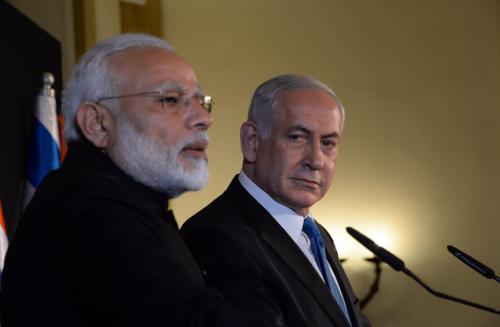
Benjamin Netanyahu and Narendra Modi hold a joint press conference following their meeting in Jerusalem on 5 July 2017 [Haim Zach/GPO / Handout /Anadolu Agency]
Israel’s ability to forge such relationships also highlights its status as being the global leader in the military industry. Israel’s culture of deep militarism and years of experience supressing the political rights of the Palestinians has enabled it to export its technology of control and domination to others. Its unique experiences have also made the country an invaluable asset to governments around the world that too are confronted with new security challenges.
Despite its status as a relatively small arms dealer compared to the likes of the USA and Russia, Israel’s security exports are unmatched in terms of quality. Israel has managed to carve out a niche in the security industry, selling its experience and expertise in policing, urban warfare, surveillance, intelligence. Analysts describe this as “full spectrum domination”.
Israel’s unique role in security – what some would call suppression – can be seen from the Contras in Latin America, to the riots in Ferguson, North America; from the massacres in Bosnia and Rwanda to the killings of Rohinga Muslims in Burma. There are numerous instances in which Israel and Israeli security companies have led the way in the pacification of the people through the export of arms, surveillance technology, intelligence and security advice.
The innocence of those who fear and the guilt of those who hate
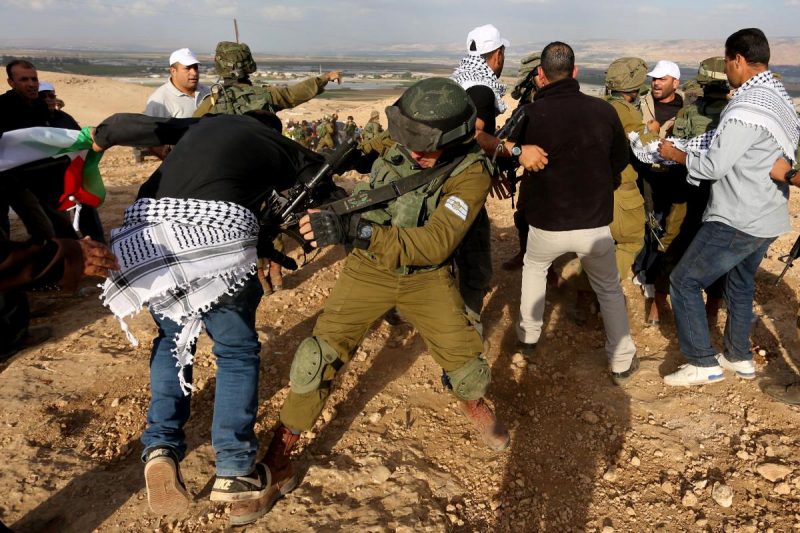
Israeli security forces brutally arrest Palestinian protesters in West Bank [Issam Rimawi – Anadolu Agency]
Dr Samah Jabr| MEMO | November 14, 2017
In our stressful state of occupation, there is, among other ills, an essentialist view of Israeli and Palestinian characteristics. In the many public talks that I have given to Westerners about the violation of the rights of Palestinians, one question almost invariably comes up: “What about the fears of the Israelis?” Similarly, how many times have we heard Western media and even the President of the United States speak of “Palestinian hatred”? These words take for granted the guilt of those who “hate” and the innocence of those who “fear”. However, the reality is that we cannot understand concerns regarding the fears of the Israelis without dissecting the accusations of “Palestinian hatred”.
One problem in this dichotomy is its assumption of a fixed, static state, as if the fears of the Israelis and the hatred of the Palestinians are inborn, permanent traits with no variation among group members. The presumption of eternal and unanimous characteristics serves to maintain the oppressive relationship between the occupier and the occupied and to obstruct political change. To find a way out, the essentialism must be contextualised and deconstructed.
Let us begin by clarifying the disproportionality of the fears of the Israelis with regard to the realistic harm that Palestinians have brought upon them. Israel has long had one of the most powerful armies in the world; it gives “lessons in security” to other nations and exports arms to them for the purpose of oppressing others. Moreover, in order to foster its violent occupation and suppress the natural reflexive resistance on the part of the natives of Palestine, Israel has caged unarmed Palestinians behind walls and appointed colluding Palestinians to maintain order and silence within these cages. By means of long-term and sophisticated strategies to damage Palestinian collective identity, Israel has infiltrated every Palestinian neighbourhood with spies and collaborators. In every previous confrontation, the number of Palestinian casualties has been 100 times the number of Israeli casualties. Thousands of Palestinians are in Israeli prisons, not the other way around; thousands of Palestinian, not Israeli, homes have been demolished by Israeli bulldozers; and yet it is the unarmed and stateless Palestinians who are asked to be considerate of Israeli fears.
In view of these facts, it is unjust and insulting when the question of “Israeli fears” is addressed to a Palestinian, insofar as the question itself reveals deep denial of the longstanding history of Israeli violence. The plea for empathy and understanding, when addressed to the victims of Israeli occupation, is absurd, yet the expectation is that Palestinians must demonstrate understanding and offer reassurance for their oppressors’ fears. The failure to do so is taken as further evidence of “Palestinian hatred” and confirmation that the Israelis are right to fear them.
I understand very well the traumatic fears caused by the history of the Jews in Europe during the 20th and previous centuries, but why should I, a Palestinian, be called upon to soothe these past fears when I am busy with the traumatic present of occupied Palestine? How can I experience deep empathy for this historical European tragedy when the Israeli threats to my existence and security continue to upstage past events in demanding my urgent attention?
Furthermore, the fear of the Israelis is not simply innocent traumatic heritage; it is a suspect political instrument; a wicked manipulation justifying their cruel treatment of the Palestinians. The invocation of Israeli fears silences protest against the occupation, insisting that all Israelis are implicated in the occupation regardless of their individual hesitations about it. And more evil yet is the fact that this manipulated fear cannot be soothed until the Palestinians disappear completely.
The pretence of fear provides an excuse for crime and absolves “frightened” criminals of responsibility; it falsely attributes the responsibility to the “frightening” victims of the crime instead. Is this not what is implied by the misnomer “Islamophobia?” Why is prejudice and crime directed at Jews called anti-Semitism when prejudice and crime against Muslims — many of whom are also Semites — is not called anti-Muslim hate and a crime? It is called instead the minimising term “Islamophobia”, implying that the hate, racism and criminality of the perpetrator is justified because he or she suffers from anxiety and irrational fears about Islam.
To be fair, a degree of fear on the part of Israelis is appropriate; it’s the fear that a tiny proportion of their violence might come back to haunt them, rarely as rockets or a bombing, more often as a Palestinian youth may attempt to punish the Israelis by throwing a stone or pursuing an Israeli soldier with a screwdriver. These things may happen as long as the United Nations and the Palestinian leadership fail to hold the Israelis to account for their crimes.
Attributing fear to the Israelis recruits empathic identification with them, whereas attributing the degrading trait of hatred to the Palestinians provokes repulsion and aversion to them. While there is hatred for the state of Israel among Palestinians, this does not go beyond the adaptive and inevitable hatred that any oppressed and colonised group holds for the collective group that has perpetrated endless crimes against them. Palestinians do not hate Israelis as Jews but as participants in the system responsible for their political oppression. Palestinians are not born with hate in their hearts; hate develops as an appropriate reaction to the totality of the heinous experiences of life under occupation. The people of Palestine are not known for their anti-Semitism; they have welcomed pilgrims from Africa and refugees from Armenia. Many Muslim and Christian Palestinians were married to Jews living in Palestine before the occupation. Like any nation, though, the people of Palestine hate the theft of their land, the pain and the humiliation that the occupation has inflicted upon them. This is, surely, legitimate hate, serving the function of distinguishing harm from safety and motivating resistance to oppression rather than submission to despair.
To expect Palestinians to be free of hate or other negative feelings towards Israel is like expecting a raped woman to have empathy towards her rapist. This would be an example of Stockholm syndrome — a dissociation at best — and more psychologically dangerous than hate itself. This syndrome will eventually result in an internalisation of that hate which would then express itself destructively within the oppressed community.
What Israel actually fears is its own dark “Shadow,” its enormous but disowned and projected violence and hatred for the Palestinians.
It was not fear, but hatred that permitted Israel to commit massacres which evacuated Palestinian villages and towns by force, and which motivates soldiers to kill handcuffed prisoners and unconscious, wounded Palestinians. It is hatred that incites Jewish settlers to burn Palestinians alive and uproot the ancient olive trees of Palestine. Hate speech is articulated by Israeli soldiers who call Palestinians, “beasts on two legs”, “drugged cockroaches” and “crocodiles who want more meat.” This is hate speech which not only encourages hateful acts committed in the name of the occupation but also legitimises ethnic cleansing. Isn’t that what we must do with cockroaches; get rid of them?
Instead of blaming the Palestinians for their hatred and excusing the Israelis for their fear, a constructive move forward would be to help Israel to distinguish reality from fantasy. This would mean admitting Israeli’s own hatred, as well as its greed, and acknowledging that ending the heinous occupation is the only remedy for its fears.
Featured Video

Seyed M. Marandi: US-Iran War Inevitable: Kuwait and Bahrain May Fall
or go to
Aletho News Archives – Video-Images
From the Archives
Oil and the Israel Lobby
Reknowned economist M. Shahid Alam offers this excellent critique of Noam Chomsky’s defective analysis of the relative influence of Oil versus the Israel lobby over US foreign policy: … continue
Blog Roll
 Aletho News
- Israel’s Military Actions in Lebanon Grossly Violate International Law — Lavrov
- Seyed M. Marandi: US-Iran War Inevitable: Kuwait and Bahrain May Fall
- Leaders Condemn Ansarallah Attack on Saudi Arabia While Ignoring Illegal War Against Yemen
- Leaked: Britain’s Covert Iraqi Psyops Network
- Yemeni Armed Forces Warn Airlines Against Using Saudi Airports, Exempt Mecca and Medina
- Iran security chief says powers greater than US tried to conquer Iran but ended in ‘dustbin of history’
- Europe’s mounting social chaos… chickens coming home to roost for proxy war against Russia
- US-Russia Diesel Deal Becomes Massive Defeat for Ukraine
- Hormuz and the Looming Economic Catastrophe
- Dhubab offensive, media blitz and the rapid unraveling of Saudi-backed coalition’s new gambit
- If Americans Knew
- Gaza: Ceasefire Anniversary Marks Year of Failed Promises
- The American Conservative: Mike Huckabee Should Resign
- A C-Section in Shackles: A Palestinian Woman’s Harrowing Birth in Israeli Detention
- ‘He’s Desperate’: AIPAC Begins Spending Against Abdul El-Sayed to Boost Mike Rogers:
- Trump, Hormuz, and the Looming Economic Catastrophe
- For three years, Israel has killed a child in Gaza every 71 minutes – Daily Update
- Israeli forces kill another child in Gaza – Daily Update
- Gaza ceasefire exists in name only, say more than 100 organizations
- Nearly 2 Million in Gaza Need Urgent Shelter Assistance as Winter Looms: IOM Chief Warns
- Suppressing Palestinian resistance: US charity under fire for AI monitoring of Gaza classrooms
- No Tricks Zone
- Germany’s Green Energy Debacle: High Energy Costs Force Kahla Porzellan to Close After 182 Years!
- New Study: 50 Years Of The Most Aggressive ‘Net Zero’ Policies Can Only Affect The Global Climate By 0.03°C
- US September “Heat” Was No Record…Many Records Set Decades Ago
- Latest European Green Energy Debacle; Portugal’s Largest Flagship Solar Park Insolvent!
- Green Energy Debacle: German Expert Professor Fritz Vahrenholt Warns Of Severe Economic And Social Consequences
- Two More Paleo Reconstructions Affirm Meters-Higher Sea Levels Across Ireland, Brazil 7000-6000 Years Ago
- New Study: Earth And Venus Surface Warmth Largely Explained By Convection And Lapse Rate, Not CO2 Or Radiation
- 2025 Nature Paper Claiming Worsening Global Drought Gets RETRACTED …Heavily Flawed
- New Study: ‘Global Drought Shows No Detectable Recent Acceleration Under Climate Warming’
- Economic Masterminds: German Socialists Suggest Taxing Productivity Gains Stemming From Using AI