The Two Elie Wiesels

Nobel laureate Elie Wiesel, Romanian-born Holocaust survivor and author of the classic novel, “Night.”
Elie Wiesel spoke out eloquently against violence and injustice… except when he endorsed them.
By Kathryn Shihadah | If Americans Knew | November 6, 2017
Elie Wiesel was born in 1928 to a prominent Jewish family in Romania. By the age of 15, he found himself in Auschwitz concentration camp, where his parents and one of his three siblings died. After the liberation of the camp, he spent time in France.
After a short time, Wiesel went to work as a translator for Irgun, a terrorist group that had a reputation for bombing and shooting innocent Arab Palestinians. It was during Wiesel’s Irgun days that the group participated in the 1948 Deir Yassin massacre, in which over 250 unarmed Palestinian civilians were brutally murdered.
For ten years after the war, Wiesel says he would not speak or write about his experiences. Eventually he wrote a memoir, which was later abridged and translated into English as Night. Despite questions about its truthfulness (“in its central, most crucial scene, Night isn’t historically true, and at least two other important episodes are almost certainly fiction”), It has become a classic.
Eventually, Wiesel became a prominent advocate for peace and justice around the world.
His activism included speaking out for Soviet, Ethiopian, Romanian, and Ukranian Jews, as well as Vietnamese boat people, victims of South African apartheid, genocide in Bosnia, Darfur, and Armenia, and other at-risk groups around the world.
In 1986, Elie Wiesel received the Nobel Peace Prize for his work to end violence, oppression, and racism. The Nobel Committee stated: “Wiesel’s commitment, which originated in the sufferings of the Jewish people, has been widened to embrace all repressed peoples and races.” His profound experiences, and his profound response, birthed in him the words of his Nobel Peace Prize acceptance speech:
… When human lives are endangered, when human dignity is in jeopardy, national borders and sensitivities become irrelevant… that place must – at that moment – become the center of the universe… There is much to be done, there is much that can be done. One person… one person of integrity, can make a difference, a difference of life and death.
I swore never to be silent whenever and wherever human beings endure suffering and humiliation. We must always take sides. Neutrality helps the oppressor, never the victim. Silence encourages the tormentor, never the tormented.
No human race is superior; no religious faith is inferior. All collective judgments are wrong. Only racists make them.
In The Watchtower (June 15, 1995), he declared,
The duty of the survivor is to bear testimony to what happened . . . You have to warn people that these things can happen, that evil can be unleashed. Race hatred, violence, idolatries—they still flourish.
Mr. Wiesel must have forgotten his own advice, because in the ensuing years, he missed many opportunities to speak out, to bear testimony – opportunities that were literally right under his nose.
For example, in 1999 he endorsed NATO bombs that were blowing up civilians and journalists in Yugoslavia; in 2003 he advocated for war against Iraq, declaring it a necessary moral act because the situation was “a moral crisis similar to 1938.”
And Wiesel was consistently unmoved when the victims under his nose were Palestinian.
The phenomenon of ignoring Palestinian victims, known in activist circles as PEP—Progressive Except Palestine—is a primary enabler of the ad nauseum occupation of the West Bank, the siege of Gaza, and the systemic oppression of Palestinians within Israel itself. Many groups and individuals that are devoted to justice stop short of defending the oppressed people of the Holy Land.
Mr. Elie Wiesel, the “messenger to mankind,” ought to have been above that kind of limited thinking, but he was not.
Like many, he viewed Israel through rose-colored glasses, despite his first hand knowledge. Wiesel could have, should have spoken out against the oppression of Palestinians, but instead sided with the oppressors. It has become the task of others to correct a Nobel Laureate.
Exhibit A, the Goldstone Report, 2009
 Richard Goldstone
Elie Wiesel chose the wrong side when it came to the Goldstone Report, commissioned by the United Nations. The independent fact-finding team, which began its work in April 2009, was headed by Jewish (and Zionist) South African Richard Goldstone. Its task was to investigate alleged violations of international human rights and humanitarian law during Operation Cast Lead. Although the scope of work was originally to examine Israeli actions only, Goldstone insisted on probing the Palestinian side as well.
The 3-week conflict, also known as the Gaza War and the Gaza Massacre, was Israel’s attempt to stop rocket fire and weapon smuggling by Palestinians. Casualties included over 1,400 Palestinians dead and 13 Israelis – 4 from friendly fire.
Prime Minister Netanyahu called the whole investigation a “kangaroo court,” and Israel refused to cooperate with the team or to grant visas for the investigation.
The report, presented in September 2009, concluded that both the Israeli Defense Forces and Palestinian militants had committed war crimes, charging that Israel’s military campaign was “a deliberately disproportionate attack designed to punish, humiliate, and terrorize… and to force upon it an ever increasing sense of dependency and vulnerability.” It also accused Israel of collective punishment in the years-long economic blockade of Gaza.
The report described “an overall policy aimed at punishing the Gaza population… possibly with the intent of forcing a change [in its support for Hamas].”
(As an aside, the use of violence against civilians to force a political change is the definition of terrorism.)
The report continued:
[T]here appears also to have been an assault on the dignity of the people… in the use of human shields and unlawful detentions… vandalizing of houses… obscenities and often racist slogans, all constituted an overall image of humiliation and dehumanization of the Palestinian population.
The mission further considers that the series of acts that deprive Palestinians in the Gaza Strip of their means of subsistence, employment, housing and water, that deny their freedom of movement and their right to leave and enter their own country, that limit their rights to access a court of law and an effective remedy, could lead a competent court to find that the crime of persecution, a crime against humanity, has been committed.
Israel rejected the report, while Hamas reluctantly accepted it.
Ian Kelly of the US State Department complained that the report (which, keep in mind, addressed a conflict in which Palestinian deaths were 100 times higher than Israeli deaths), “focuses overwhelmingly on Israel’s actions.” Nobel Peace laureate and former prime minister Shimon Pares considered the report a “mockery of history” and accused the team of failing to “distinguish between the aggressor and a state exercising its right to self-defense.”

Israel’s use of white phosphorus in Gaza during Operation Cast Lead was a flagrant violation of the Fourth Geneva Convention. “While the international community might be horrified by the use of phosphorous, this is overlooking the issue that hundreds of half-ton bombs are being dropped on Gaza on civilian targets on a daily basis,” said Raji Sourani, head of the Palestinian Centre for Human Rights (PCHR) in Gaza.
Elie Wiesel joined in the criticism of the Goldstone Report:
One thing is clear to me, that document was unnecessary.
Without explaining his first statement, he added, significantly,
I can’t believe that Israeli soldiers murdered people or shot children. It just can’t be.
(No doubt the families of the 1,400 dead Palestinians – half of them civilians, 252 of them children – would dispute this statement.)
American Jewish journalist Peter Beinart took Wiesel to task for these statements:
Wiesel takes refuge in the Israel of his imagination, using it to block out the painful reckoning that might come from scrutinizing Israel as it actually is… “We are making the lives of millions unbearable,” declares one former Shin Bet head, Carmi Gillon, in the film “The Gatekeepers.” In the West Bank, Israel has become “a brutal occupation force,” notes another, Avraham Shalom. A third, Yuval Diskin, calls the occupation a “colonial regime.”
These men don’t hate Israel; they have dedicated their lives to protecting it. But unlike Wiesel, they are discussing the real Israel, not the one they have constructed in their minds. Why is Elie Wiesel, one of the world’s great champions of human rights, denying the human rights abuses to which even Israel’s own former Shin Bet chiefs have testified?
Rabbi Brant Rosen concurred:
As far as I’m concerned, Justice Richard Goldstone is precisely the kind of courageous Jewish moral hero that Wiesel himself purports to be: someone committed to advocating for universal human rights even when doing so might mean holding our own community painfully to account. As for Wiesel, I’m finding his words and actions increasingly craven. No one begrudges him his opinions – but it’s time he dropped the pretense that he’s somehow beyond the political fray.
Under great pressure from the Jewish community in his home of South Africa, Goldstone eventually backpedaled somewhat on one of the charges. However, he failed to address new evidence that actually reinforced his original findings, as well as a report on Israel’s failure to investigate its violations of the laws of war.
Wiesel declined to acknowledge Israel’s need for censure, expressing that
[Richard Goldstone] has a good name, and I’ve known him for years… He should have refused to head the committee, because of the anti-Israel mandate under which it was established.
This refusal to stand up for the oppressed contradicts the vow he made in his commencement speech at Washington University, St. Louis:
In fact it is the otherness of the other that makes me who I am. I am always to learn from the other. And the other is, to me, not an enemy, but a companion, an ally, and of course, in some cases of grace, a friend. So the other is never to be rejected, and surely not humiliated.
and the words of his Nobel acceptance speech:
None of us is in a position to eliminate war, but it is our obligation to denounce it and expose it in all its hideousness. War leaves no victors, only victims. War dehumanizes, war diminishes, war debases all those who wage it. The Talmud says, “Talmidei hukhamim marbin shalom baolam” (It is the wise men who will bring about peace).
One might expect Mr. Wiesel to lay low for a good, long time after such blatant duplicity. One would be mistaken.
Exhibits B and C: Visit to the White House and public/open letter to Obama, 2010
In May of 2010, Elie Wiesel was invited to the White House for lunch with Israel’s greatest benefactor, the President of the United States. Wiesel, master of persuasion and nuance, decorated for his efforts to end violence, oppression, and racism, had the ear of the leader of the free world.
Wiesel once said,
Mankind needs peace more than ever… Mankind must remember that peace is not God’s gift to his creatures, it is our gift to each other.

According to a recent study, almost 80 percent of IDF forces in the West Bank are there to protect settlements, with the remainder scattered along the Green Line. “[Netanyahu] has been kidnapped by the settler lobby and is pursuing a policy that harms the security of every Israeli,” said Knesset member Erel Margalit in June 2017.
But instead of speaking of peace, he chose as his topic of conversation, “don’t pressure Israel to cease settlement activity in Jerusalem.”
President Obama, who strongly opposed settlements, simply listened politely.
For good measure, Wiesel also undertook a PR campaign in the form of a public letter, which appeared in The International Herald Tribune, The Washington Post, The Wall Street Journal, and The New York Times. He painted an idyllic picture of his homeland of Israel:
“[F]or the first time in history, Jews, Christians and Muslims all may freely worship at their shrines. And, contrary to certain media reports, Jews, Christians and Muslims ARE allowed to build their homes anywhere in the city.”
It didn’t take long for the record to be set straight—by prominent Jewish Jerusalemites—who published a letter of their own in the New York Review of Books, correcting Wiesel’s false statements:
We write to you from Jerusalem to convey our frustration, even outrage… We cannot recognize our city in the sentimental abstraction you call by its name.
We invite you to our city to [see that] Arabs are not allowed to build their homes anywhere in Jerusalem. You will see the gross inequality in allocation of municipal resources and services… Sheikh Jarrah, where Palestinian families are being evicted from their homes to make room for a new Jewish neighborhood… Silwan, where dozens of houses face demolition because of the Jerusalem Municipality’s refusal to issue building permits to Palestinians.
Another Israeli who weighed in on the housing issue was former Israeli Cabinet Minister Yossi Sarid, who addressed Wiesel in Ha’aretz,
Someone has deceived you, my dear friend. Not only may an Arab not build “anywhere,” but he may thank his god if he is not evicted from his home and thrown out onto the street with his family and property.
Israeli Daniel Seidemann, a “one-man early-warning system” for changes in Jerusalem that undermine the peace process, called Wiesel’s words “factually inaccurate” and “morally specious.” He gave specific examples:
So while Wiesel may purchase a home in anywhere in East or West Jerusalem, a Palestinian cannot.
Due to Israeli restrictions, today it is easier for a Palestinian Christian living just south of Jerusalem in Bethlehem to worship in Washington’s National Cathedral than to pray in Jerusalem’s Church of the Holy Sepulcher.
Today a Muslim living in Turkey has a better chance of getting to Jerusalem to pray at the Old City’s al-Aqsa mosque than a Muslim living a few miles away in Ramallah.
Another Israeli who called Wiesel out for inaccuracies was Ha’aretz writer Gideon Levy:
If I were Elie Wiesel, such a famous Holocaust survivor, a Nobel Prize laureate whose voice is heard in high places, I would ask my friend in the White House, for the sake of peace, Israel’s future and world peace: Please, Mr. President, be forceful. Israel depends on you as never before. Isolated as never before, it’s as good as dead without American support. Therefore, Mr. President, I would say to Obama over the kosher meal that was served, be a true friend of Israel and extricate it from its misfortune…
Instead… Wiesel haggled for wholesale postponement… To postpone. Postpone and postpone, like Netanyahu, who sent him, asked him to do.
And finally, both European and American Jewish leaders—some of whom had lived in Israel—circulated petitions garnering thousands of signatories,
The European petition, “A Call To Reason,” signed by over 5,000, stated that
the occupation and the continuing pursuit of settlements in the West Bank and in the Arab districts of Jerusalem . . . are morally and politically wrong and feed the unacceptable de-legitimation process that Israel currently faces abroad.
The American petition, “For the Sake of Zion,” echoed the European document, adding,
[W]e abhor the continuing occupation that has persisted for far too long; it cannot and should not be sustained. [W]e call upon Israel immediately to cease construction of housing in the disputed territories.”
Wiesel was apparently unconvinced, rendering hollow his earlier pronouncement that
the opposite of love is not hate, it’s indifference. The opposite of art is not ugliness, it’s indifference. The opposite of faith is not heresy, it’s indifference. And the opposite of life is not death, it’s indifference. Because of indifference, one dies before one actually dies. To be in the window and watch people being sent to concentration camps or being attacked in the street and do nothing, that’s being dead. (US News & World Reportt, 27 October 1986)
Exhibit D: Ha’aretz ad congratulating settlers in East Jerusalem, 2014
Due to his global fame, Elie Wiesel was offered positions on boards of directors all over Israel. The one he chose to accept was the chair of the board of Elad.
Elad is a right-wing NGO which operates in East (Arab) Jerusalem. The organization has two objectives: to settle Jews in the primarily Arab neighborhood of Silwan, and to operate tourist and excavation sites. The settlement aspect of the project involves expelling Palestinians. Richard Silverstein dubbed Elad’s aggressive settler movement “Jewish jihad, literally a Jewish struggle for dominance of the Holy City.” (For details, read this.)

Israeli police oversee the demolition of a Palestinian home in the East Jerusalem neighborhood of Silwan. Settler organizations Elad and others have worked to take over and demolish Palestinian homes in order to move Jewish families in. (More information here.)
In early October, 2014, Ha’aretz had reported that Elad was in the market for Israeli Jews to temporarily live in 25 recently-purchased apartments in Silwan, guarding them until the new Jewish settlers moved in. The job description: “In principle, you’re supposed to be quiet and simply occupy the compound… As far as we’re concerned, you live in the house, but it’s better if you have a weapon.”
Silwan’s Palestinian residents have, in the last two decades, been subject to eviction, home demolition, and aggressive buy-outs, transforming their neighborhood a Jewish-Israeli controlled enclave. According to Ha’aretz, “Life in the East Jerusalem neighborhood of Silwan has become unbearable, both for the Jewish settlers who would like to be able to leave home without being stoned and the Palestinians who suffer the heavy hand of the police and the settlers’ security guards.”
Wiesel and the organization he headed, Elad, placed the following announcement in Ha’aretz on October 10, 2014:
On the eve of Sukkot, we are happy to congratulate the dozens of Jewish families that are joining the Israeli settlement of Ir David [the settlers’ name for Silwan]. We salute the Zionist work of those who take part in this mission. Strengthening Jewish presence in Jerusalem is the challenge for all of us, and by your act of settlement you make us all stand taller.
Ha’aretz once again put the matter in perspective:
We must reckon with Wiesel’s erasure of others’ suffering as seriously as we embrace the remembrance of our own… The memory of our collective suffering, articulated by Wiesel and others, grants us the ability to see and to understand the collective pain of others… What are we to do with the fact that… Wiesel was head of the board of Elad, an organization at the forefront of expelling Palestinians from their homes in East Jerusalem? That he worked to further a violent religious nationalist agenda?
In fact, Wiesel’s work with Elad was at odds with not only social justice, but even with his own words. In 2011 he had declared at the commencement of Washington University in St. Louis,
The greatest commandment, to me, in the Bible is not the Ten Commandments… My commandment is, “Thou shall not stand idly by.” Which means when you witness an injustice, don’t stand idly by. When you hear of a person or a group being persecuted, do not stand idly by… You must intervene. You must interfere. And that is actually the motto of human rights… And therefore wherever something happens, I try to be there as a witness.
(Except, of course, when the persecuted are Palestinian.)
Exhibit E: Open letter regarding Netanyahu’s speech to Congress, 2015
Early in 2015, as President Obama was hammering out a nuclear agreement with Iran, PM Benjamin Netanyahu wished to bend Congress’ ear to halt the negotiations. Republican House Speaker John Boehner and Senate Majority Leader Mitch McConnell essentially arranged the speech behind Obama’s back, to “make sure that there was no interference.”

Once word got out, President Obama declined to attend the speech. Elie Wiesel then went into action, publishing – with the help of pro-Israel Rabbi Shmuley Boteach – an open letter:
Many centuries ago a wicked man in Persia named Haman advised, “There exists a nation… It is not in our interest to tolerate them.” And the order went out to all the provinces to “annihilate, murder, and destroy the Jews. Now Iran, modern Persia, has produced a new enemy…
Should we not show our support for what might be the last clear warning before a terrible deal is struck [between the US and Iran]?… As one who has seen the enemies of the Jewish people make good on threats to exterminate us, how can I remain silent?… Will you join me in hearing the case for keeping weapons from those who preach death to Israel and America?
Ha’aretz stepped up to challenge Wiesel’s assumptions, pointing out that he
makes two assertions, neither of which he makes any effort to prove. The first is that the United States and Iran are on the verge of “a terrible deal.” What makes the deal, which has not even been struck, “terrible?” Wiesel doesn’t say. The second is that a nuclear Iran would likely mean “‘the annihilation and destruction’ of Israel.” This, too, requires evidence that Wiesel does not provide.
The Ha’aretz authors also point out that Wiesel’s appeal to the biblical story of Esther is flawed because it is incomplete. The account states that after Haman fell from power, Persia’s Jews
“with the stroke of the sword, and slaughter, and destruction… slew of their foes seventy and five thousand.”
If the Book of Esther offers a haunting warning of the violence Jews can suffer, why does it not also warn us of the violence Jews can inflict? And if Wiesel is so alarmed by threats of nuclear annihilation, why does he keep embracing his former patron Sheldon Adelson, who in 2013 urged the United States to drop an “atomic weapon” in the Iranian desert, and then, if the Iranians don’t halt their nuclear program, drop one “in the middle of Tehran” so the Iranians are “wiped out.”
Progressive Jewish American organization J Street reacted strongly to the scheduled speech behind which Wiesel stood so firmly. Responding to Netanyahu’s claim that he would be speaking as a representative of all Jewish people everywhere, the group created a petition entitled “I’m a Jew. Bibi does NOT speak for me.” 20,000 signatures indicated that not all Jews favored his Iran policies or his relationship with the White House.
Wiesel wanted to keep weapons of mass destruction out of the hands of Iran, ignoring the irony of Israel’s own nukes at the ready, and the incongruity of Israel’s de facto “it is not in our interest to tolerate” position toward Palestinians.
But again, Wiesel’s own words were even more haunting than the witness of thousands of other Jews.
There may be times when we are powerless to prevent injustice, but there must never be a time when we fail to protest. The Talmud tells us that by saving a single human being, man can save the world.
Conclusion
We ask, over and over, how a people who have suffered so much could inflict so much suffering on another people. We wonder how a man who has so precisely described evil could not recognize it in front of him, how he could speak so eloquently about compassion but fail to have a morsel of it for his neighbors.
Hussein Ibish, writing for Foreign Policy, makes sense of the moral quagmire of Elie Wiesel’s mind:
[T]he underlying assumption is irredeemably flawed. It presumes that people, whether individuals or collectivities, somehow learn from their negative experiences not to repeat them.
Of course, that is not the case. “Hurt people hurt people.” Maybe Elie Wiesel was too broken by his experiences to see clearly what his Israel was doing. Maybe he deserves a pass.
In that case, it behooves the new generation of Israelis and pro-Israel individuals and groups to do what Wiesel could not: take off the rose-colored glasses; do the hard work of acknowledging past and present wrongs. Do justice, love mercy, and walk humbly. As Wiesel once said,
I have to be self-conscious of what I’m trying to do with my life.
Kathryn Shihadah is a staff writer for If Americans Knew.
93 International Jewish Organizations Condemn BDS
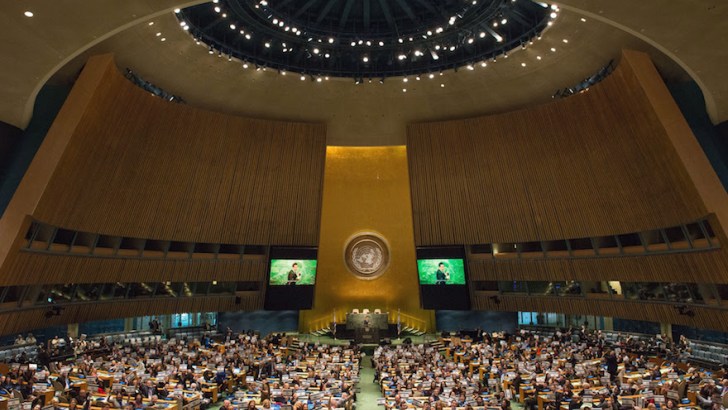
Thousands attend an anti-BDS conference at the UN sponsored by the World Jewish Congress and the Israeli mission to the UN on March 29, 2017
If Americans Knew | November 6, 2017
The following press release was distributed on Nov. 6, 2017 by the American-Israeli Cooperative Enterprise (AICE). AICE is based in Chevy Chase, Maryland, and is the sponsor of the Jewish Virtual Library. The executive director is Mitchell Bard. Bard is often interviewed by news media as an alleged expert on Israel-Palestine (see video here.)
It is press releases such as this that give Americans the false impression that all Jewish Americans support Israel. This is also the reason that some individuals at times refer to the Israel lobby as “the Jewish lobby,” the phrase that is employed in Israel.
Corrections to some of the statements in the release below have been added in brackets. The 93 signatories are listed below the release.
FOR IMMEDIATE RELEASE
Contact: Mitchell Bard
Tel: 301-565-3918
Email: mitchellbard@gmail.com
JewishVirtualLibrary.org
93 International Jewish Organizations Condemn BDS
CHEVY CHASE, MARYLAND – As the Jewish community celebrates the 100th anniversary of the issuance of the Balfour Declaration, [go here for info on who was behind the Balfour Declaration] an anti-Semitic [sic] campaign to delegitimize Israel is being pursued by advocates of the boycott, divestment and sanctions (BDS) movement. [See facts on BDS here.] While the international community recognized the right of the Jewish people to reestablish a state in their homeland, Israel, BDS advocates seek to deny the Jewish right to self-determination. [See this for a discussion of Israel’s alleged right to expel the indigenous population.] In response, 93 international Jewish organizations have signed a statement condemning BDS.
“This important statement demonstrates the international Jewish community’s objection to the campaign to ostracize, punish, and threaten Israel.,” said AICE’s Executive Director Dr. Mitchell Bard. “It is gratifying to see groups from across the political and religious spectrum come together on this issue and rebut BDS advocates who falsely claim to represent ‘the Jews.’”
The statement notes that “academic, cultural and commercial boycotts, divestments and sanctions of Israel are: counterproductive to the goal of peace; antithetical to freedom of speech and part of a greater effort to undermine the Jewish people’s right to self-determination in their homeland, Israel.” It also condemns the extremist rhetoric of the delegitimization movement.
The signatories acknowledge that criticism of Israel is legitimate, but note that criticism becomes anti-Semitism “when it demonizes Israel or its leaders, denies Israel the right to defend its citizens or seeks to denigrate Israel’s right to exist.”
[This distortion of the meaning of antisemitism on behalf of Israel was initiated by an Israeli minister and has been perpetrated through an international campaign.]
The statement expresses particular concern with the BDS movement on campus because it “is antithetical to principles of academic freedom and discourages freedom of speech,” has provoked “deep divisions among students,” and has “created an atmosphere of intolerance and hatred.”
The statement calls on “students, faculty, administrators and other campus stakeholders to uphold the academic and democratic values of a free and civil discourse that promotes peace and tolerance.”
[In reality, the anti-BDS organizations often work to prevent free speech and to block factual events about Israel-Palestine; see this for example.]
“We all believe in peace,” added Dr. Bard, “and that goal cannot be achieved by demonizing and boycotting Israel.”
[Israel partisans have often pushed for wars; see this.]
Below are the 93 signatories (most appear to be Americans]
Prof. Mervin Verbit /
Prof. Samuel Edelman
Academic Council for Israel
Rabbi Steven Burg
Aish HaTorah
Andy Borans
Alpha Epsilon Pi Fraternity
Dr. Mitchell Bard
American-Israeli Cooperative Enterprise (AICE)
Gerald Platt
American Friends of Likud
Howard Kohr
The American Israeli Public Affairs Committee (AIPAC)
David Harris
American Jewish Committee (AJC)
Herbert Block
American Zionist Movement (AZM)
Charles Jacobs
Americans for Peace and Tolerance
Andrew Goldsmith
AMIT
Jonathan Greenblatt
Anti-Defamation League (ADL)
Dr. Colin Rubenstein / Jeremy Jones
Australia/Israel and Jewish Affairs Council
W. James Schiller
Baltimore Zionist District
Matthew Grossman
BBYO, Inc.
Daniel Citone
B’nai B’rith Europe
Daniel S. Mariaschin
B’nai B’rith International
Stephen Savitsky / George W Schaeffer /
Cheryl Bier
Bnai Zion Foundation
Jonathan Arkush
The Board of Deputies of British Jews
Fred Taub
Boycott Watch
Hazzan Alisa Pomerantz-Boro
The Cantors Assembly
Shimon Koffler Fogel
The Centre for Israel and Jewish Affairs (CIJA)
Malcolm Hoenlein
Conference of Presidents of Major Jewish Organizations
Phillip Brodsky
The David Project
Gunnar Bjork
Denmark Lodge, B’nai B’rith
Naomi Mestrum
Dutch Centre for Information and Documentation Israel (CIDI)
Mindy Stein
Emunah of America
Anton Block
Executive Council of Australia
Akiva Tendler
The Fellowship for Campus Safety and Integrity
John.D.A Levy
Friends of Israel Educational Foundation Academic Study Group
Ellen Hershkin
Hadassah
Elliot Mathias
Hasbara Fellowships
Arlene & Sheldon Bearman
The Herbert Bearman Foundation
Mark Hetfield
HIAS
Eric Fingerhut
Hillel: The Foundation for Jewish Campus Life
Adv. Irit Kohn
The International Association of Jewish Lawyers and Jurists
Jacob Baime
Israel on Campus Coalition
Josh Block
The Israel Project (TIP)
Adam Milstein / Shoham Nicolet
Israeli-American Council
Shawn Evenhaim
Israeli-American Coalition for Action
Doron Krakow
JCC Association
Alan Hoffmann
Jewish Agency for Israel (JAFI)
David Hatchwell
Jewish Community of Madrid (CJM)
David Bernstein
Jewish Council for Public Affairs (JCPA)
William Daroff
The Jewish Federations of North America
Michael Makovsky
Jewish Institute for National Security of America (JINSA)
Simon Johnson
Jewish Leadership Council
Russell F. Robinson
Jewish National Fund (JNF)
Henia Vrazda and Board
Coordination Committee (Denmark)
Dov H. Maimon
Jewish People Policy Institute (JPPI)
Lori Weinstein
Jewish Women International (JWI)
Yael Mosesson / Nina Tojzner
Jewish Youth Organization in Sweden
Ron Klein
Jews for Progress/National Jewish Democratic Council (NJDC)
Kenneth L. Marcus
The Louis D. Brandeis Center For Human Rights Under Law
Ron Carner
Maccabi USA/Sports For Israel
Meara Razon Ashtivker
Masa Israel Journey
Marilyn L Wind / Sarrae G Crane
MERCAZ USA
Chellie Goldwater Wilensky
NA’AMAT USA
Ram Shefa
National Union of Israeli Students
Farley Weiss
National Council of Young Israel
Rabbi Micah Greenland
NCSY
Susan Z. Kasper / Harry Hauser
North American Association of Synagogue Executives (NAASE)
Gerald M. Steinberg
NGO Monitor
Allen I. Fagin
Orthodox Union (OU)
Tzvi Avisar
Over the rainbow–the Zionist movement (OTR)
Rabbi Julie Schonfeld
Rabbinical Assembly
Jacob Sternberg
Realize Israel
Rabbi Jonah Dov Pesner
Religious Action Center
Rabbi Gideon Shloush
Religious Zionists of America/Mizrachi
Matt Brooks
Republican Jewish Committee (RJC)
Eran Shayshon
Reut: The Reut Group: From Vision to Reality
Rabbi Prof. David Golinkin
The Schechter Institutes, INC., Jerusalem
Asaf Romirowsky
Scholars for Peace in the Middle East (SPME)
Andy Huston
Sigma Alpha Mu Fraternity
Rabbi Marvin Hier/ Rabbi Abraham Cooper
Simon Wiesenthal Center
Barbara Pontecorvo
Solomon-Osservatorio sulle Discriminazioni (Italy)
Ben Swartz / Mark Hyman
South African Friends of Israel
Wendy Kahn
South African Jewish Board of Deputies
Ben Swartz
South African Zionist Federation
Roz Rothstein
StandWithUs
Rudy Rochman
Students Supporting Israel (SSI)
Jonathan Turner
UK Lawyers for Israel
Josh Holt
Union of Jewish Students (UJS – UK)
Rabbi Rick Jacobs
Union for Reform Judaism (URJ)
Luke Akehurst
We Believe in Israel
Dorrit Raiter
WIZO Denmark
Carol S. Simon
Women’s League for Conservative Judaism
Rabbi Marla J. Feldman
Women of Reform Judaism
Betty Ehrenberg
World Jewish Congress, North America
Yosef Tarshish
World Union of Jewish Students (WUJS)
Rabbi Shmuley Boteach
The World Values Network
Laurence A. Bolotin
Zeta Beta Tau Fraternity
Paul Charney
Zionist Federation of the United Kingdom and Ireland
Morton A. Klein
Zionist Organization of America (ZOA)
Hamas slams PA for insistence on EU mission at Rafah crossing
Palestine Information Center – November 4, 2017
 GAZA – Member of Hamas Political Bureau, Mousa Abu Marzouk, condemned in a tweet on Saturday the Palestinian Authority’s (PA) insistence on the existence of the EU mission at Rafah border crossing. This means the return of the Israeli control over the crossing, he highlighted.
“Why is the PA keen on the Israeli existence at the crossing when it has become managed by a national administration?” Abu Marzouk wondered.
Last Wednesday, the Palestinian consensus government took over the control of Gaza Strip crossings in accordance with the latest Cairo reconciliation agreement.
Handing control of crossings to the PA ‘removes Israeli pretext for siege on Gaza’
MEMO | November 4, 2017
The Popular Committee against the Israeli Siege on Gaza said on Friday that handing over control of the Gaza border crossings to the Palestinian Authority removes the Israeli pretext for maintaining its siege on the territory, Anadolu has reported.
“It is obligatory on Israel to lift its siege and restrictions on the crossings,” said the Committee, “and to ease the movement of goods and people and cancel the list of goods banned from entering Gaza.”
According to the group’s statement, 80 per cent of the factories in the Gaza Strip have either stopped production or implemented severe cuts due to the siege. Unemployment now stands at 50 per cent and 80 per cent of the population are in poverty. “These are scary statistics,” it said.
The head of the Committee is independent Palestinian MP Jamal Al-Khodari, who described the 10-year siege on Gaza as “illegal and amounting to collective punishment.” He called for a Palestinian campaign to get the international community to take up its role in obliging the Israeli occupation to lift the siege on the enclave.
The Israeli occupation authorities closed the Gaza border crossings in the wake of the Hamas victory in the 2006 Palestinian elections and the ousting of Fatah from the territory a year later. Last month, Hamas and Fatah signed a reconciliation agreement brokered by Egypt, and handed over the crossings on 1 November to the Ramallah-based PA as part of the deal.
READ MORE:
Ramona Wadi: Despite his talk of ‘reconciliation’, Abbas continues to act in Israel’s interests
Israeli-Saudi Tandem Adjusts to Syria Loss
By Alastair Crooke | Consortium News | November 4, 2017
It seems that matters are coming to a head in the Middle East. For many states, the coming period will likely prove to be the moment in which they determine their futures — as well as that for the region as a whole.
The immediate peg for “crunch time” is Russia’s fast-track proposal of a conference to be held in Sochi, with the near-full kaleidoscope of Syrian opposition invited, which, if all goes as planned, might mean 1,000 delegates arriving in Sochi as soon as Nov. 18.
The Syrian government has agreed to attend. Of course, when one hears of attendance in these numbers, it suggests that this is not intended as a “sleeves rolled-up” working session, but rather as a meeting in which Russian thoughts will be mooted on the constitution, the system of government, and the place of “minorities” – with a chaser that Russia wants fresh elections pretty darned quick: which is to say, in six months’ time. In short, this is to be the “last chance saloon” for opposition figures: come aboard now, or be shut out, in the cold.
This initiative has plenty of push behind it, including President Putin’s personal endorsement, but no guarantee of success. Both Iran and Turkey (the co-guarantors of Astana) privately may have reservations, not knowing precisely what Moscow might unveil. Iran is insistent on Syria retaining a strong centralized government, and Turkey is likely to worry about whether the Kurds might receive too much from Moscow; it will also have reservations about sitting down with the YPD (Syrian Kurds), which it views to be little more than a re-branded PKK, which Turkey regards as a terrorist organization. If Turkey does pull out, it will take an important slice of the opposition with it.
Critical moments in history, however, do have a habit of proving to be less critical than first imagined, but this one effectively marks the beginning of the winding up process of the Syrian war and of the 20-year “New Middle East” project (as devised by the U.S. and Israeli governments). How each state responds, will determine the Middle East landscape for the next years.
Military Mop-up
Late last week, the Syrian army took the rest of Deir Ezzor city, and with its rear now secure, the Syrian army is free to continue the 30 or so kilometers to reach Abu Kamal (al-Bukumal) – the last ISIS urban outpost – and the vital border crossing on the Euphrates with Iraq. It is estimated that there may be 3,500 Da’esh (another name for the Islamic State or ISIS) in Abu Kamal. But Abu Kamal’s “twin” (on the Iraqi side of the border), al-Qaim, was taken by the Iraqi government’s PMU militia forces on Friday. The Iraqi forces are now clearing the city of its estimated 1,500 Da’esh fighters.
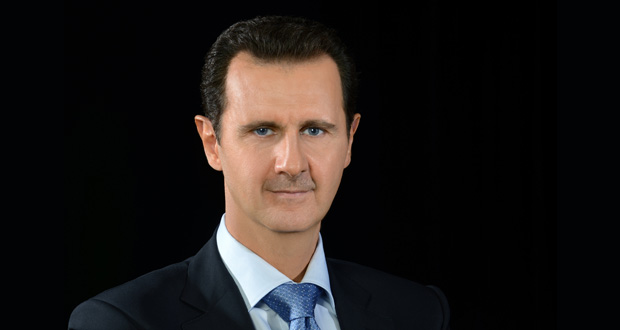
Syrian President Bashar al-Assad
The Syrian army, backed up by several thousand recently injected Hezbollah forces, is poised to enter Abu Kamal in the coming days from two directions – and from the south, a co-ordinated thrust north up and into Abu Kamal by the Iraqi Hash’d a- Sha’abi (PMU) militia, will form a pincer.
American-supported SDF (Syrian Democratic Forces), however, are also trying to reach Abu Kamal from the east (the U.S., pressured by Israel, would like to seal and close the border crossing). U.S. allied forces can move more quickly, as U.S. officers are seeking to bribe local tribal leaders who formerly had sworn allegiance to ISIS (with Saudi money), to switch sides, or at least to allow the SDF forces to advance unhindered by ISIS (as happened in the environs of Deir Ezzor).
In short, the military outcome in Syria is done (after six years of war), and now comes the political bargaining. How this plays out will determine the relative strengths of the forces that will shape the Middle East in the coming years. The outcome will likely see whether Turkey can be bullied back towards NATO (by threats such as that by General Petr Pavel, head of NATO’s military committee, warning of “consequences” for Turkey’s attempts to buy Russian air defenses), or whether Turkey’s determination to limit Kurdish aspirations will see Turkey position itself alongside Iran and Iraq (who share a common interest).
Turkey’s role in Idlib, in overseeing the de-escalation zone there, remains opaque. Effectively, its forces are positioned more to control the Afrin Kurdish “canton” (rather than monitor the Idlib de-escalation zone). It is possible that President Recep Tayyip Erdogan is hoping to use Turkish troops to carve out a buffer zone along the Turkish-Syrian border – in contravention to the Astana understandings. If so, this will place him at odds with both Moscow and Damascus (but will not necessarily imply a return to the NATO camp, either).
Syria’s Future
The bargaining at Sochi will also make clearer whether Syria will be a strong centralized state (as Iran prefers), or a looser federal state as America (and perhaps Russia) would prefer. Sochi will be something of a litmus for the extent to which American influence can shape outcomes in today’s Middle East. At present, it looks as if there is co-ordination between Moscow and Washington for a speedy political settlement in Syria, a U.S. declaration of victory over ISIS, Syrian elections, and an American exit from the Syrian theatre.
The outcome of the conference will also perhaps clarify whether the Syrian Kurds finally will remain with the U.S. CentCom project for retaining a permanent U.S. presence in northeast Syria (as Israel wants), or whether the Syrian Kurds will cut a deal with Damascus (after witnessing the crushing of the Barzani Kurdish independence project by neighboring powers).
If the latter occurs, the argument for retaining a longer-term U.S. presence in northeast Syria would lose force. The Saudis will have either to accept defeat in Syria, or act the party-pooper (by trying to re-ignite the remaining proxy forces in Idlib) – but, for that, the kingdom would need Turkey’s compliance, and that may not be forthcoming.
Iraq too, irked by U.S. Secretary of State Rex Tillerson’s comments suggesting that the PMU are Iranian – and must “go home” – has already shown signs of re-orientating towards Russia. (It has recently signed an expansive energy and economic protocol with Russia – after having reclaimed control of its borders and of Iraq’s energy resources – and is procuring Russian arms). Evidence of Iraq’s close connections with Syria, Turkey and Iran was very manifest in the quick execution of the put-down to the Kurdish independence gambit.
But the state facing the biggest dilemma in respect to the Syrian outcome is Israel. Alex Fishman, the doyen of Israeli defense columnists, has written that Israel simply has failed to adjust to strategic change, and is locked in a narrow “cold war” mentality:
“The Syrians fire rockets at open areas: Israel destroys Syrian cannons in response; the Iranians threaten to deploy Shiite forces in Syria: Israel announces ‘red lines’ and threatens a military conflict; Fatah and Hamas hold futile talks on a unity government: the prime minister declares Israel is suspending talks with the Palestinans – and everyone here applauds the security and political echelons: – ‘there, we showed them the meaning of deterrence’, [the Israeli leadership repeats].
“But what we are seeing here is a provincial defense policy, a false representation of a leadership that barely sees beyond the tip of its nose, and is busy putting out fires day and night.
“It’s a leadership that sees national security through a narrow regional viewpoint. It’s as if everything beyond Hezbollah, Hamas and Iran doesn’t exist. It’s as if the world around us hasn’t changed in the past decades, and we are stuck in the era of aggressive solutions in the form of reward and punishment as the main political-security activity. The current political-security echelon isn’t solving problems, isn’t dealing with problems, but simply postponing them, passing them on to the next generation”
Missing the Strategic Picture
What Fishman is pointing to is profound: Israel has gained some tactical victories in the neighborhood (i.e. over the Palestinians generally, and in weakening Hamas), but it has lost sight of the wider strategic picture. In effect, Israel has lost its ability to dominate the region. It had wanted a weakened and fragmented Syria; it had wanted a Hezbollah mired in the Syrian mud, and an Iran circumscribed by Sunni sectarian antipathy towards the Shi’a generally. It is unlikely to get any of these.
Rather, Israel finds itself being deterred (rather than doing the deterring) by the knowledge that it cannot now overturn its strategic weakness (i.e. risk a three-front war) – unless, and only if, America will fully enter into any conflict, in support of Israel. And this is what worries the security and intelligence echelon: Would America now contemplate a decisive intervention on behalf of Israel – unless the latter’s very survival was at risk?
In 2006, Israeli officials recall, the U.S. did not enter Israel’s war against Hizbullah in Lebanon, and after 33 days, it was Israel that sought a ceasefire.
Fishman is right too that attacking Syrian factories and radar positions “out of old habit” solves nothing. It may be sold to the Israeli public as “deterrence,” but rather it is playing with fire. Syria has started to fire back with aged surface-to-air missiles (S200s) at Israeli aircraft. These missiles may not have hit an Israeli jet yet, and maybe were not even intended so to do. The Syrian message however, is clear: these missiles may be old, but they have a longer range than the newer S300: Potentially, their range is sufficient to reach Ben Gurion Airport outside Tel Aviv.
Are the Israelis sure that Syria and Hezbollah don’t have more modern missiles? Are they certain that Iran or Russia will not provide them such? The Russian defense minister was very angry on his visit to Tel Aviv to have been faced with an Israeli retaliatory air attack on a Syrian radar and missile position – as a welcome gift on landing in Israel. To his protests, his Israeli counterpart, Defense Minister Lieberman condescendingly said that Israel needed nobody’s advice in respect to Israel’s security. General Sergey Shoygu reportedly was not amused.
Can Israel come to terms with its new strategic situation? It seems not. Ibrahim Karagul, a Turkish political commentator and an authoritative voice of President Erdogan, writing in Yeni Safak, notes that
“the foundations of a new disintegration [and] division are being laid in our region. Saudi Arabia’s ‘We are switching to moderate Islam’ announcement contains a dangerous game. The U.S.-Israel axis is forming a new regional front line.”
Karagul continues:
“We have been watching the strange developments in Saudi Arabia, the United Arab Emirates (UAE), Egypt, Israel and the U.S. for some time now. There is a new situation in the region, which we know is [principally aimed] against Iran; but has recently taken an open anti-Turkey state, aimed at limiting Turkey’s influence in the region … You will see, the ‘moderate Islam’ announcement will be immediately followed by a sudden and unexpected strengthening of Arab nationalism. This wave will not differentiate between Shiite or Sunni Arabs, but it will isolate the Muslim Arab world from the entire Muslim world.
“This separation will be felt most by the Shiite Arabs in Iraq. With this new block, Iraq and Iran are going to stage a new power showdown [i.e. will react forcefully to counter it]. Iraqi Prime Minister Haider al-Abadi’s future in power is also most likely going to [become contingent on the outcome to] this showdown.”
An American ‘Buy-in’
To give this project American “buy-in,” Israel and Saudi Arabia are focusing it on Lebanese Hezbollah, which the U.S. has declared to be a terrorist entity though the movement was part of Lebanon’s government, which was headed by Prime Minister Saad Hariri until he ominously resigned today in an announcement made in Riyadh, Saudi Arabia. (Hariri is a dual Saudi-Lebanese national.)
Saudi State Minister for Gulf Affairs Thamer al-Sabhan (in Beirut last week) called for “toppling Hezbollah” and promised “astonishing” developments in “the coming days. Those who believe that my tweets are a personal stance, are delusional … the coming developments will definitely be astonishing.”
Al-Sabhan added that the kingdom’s escalation against Hezbollah could take several forms that would “definitely affect Lebanon. Politically, it might target the government’s relations with the world. At the economic and financial levels, it could target commercial exchange and funds, and militarily it might involve the possibility of a strike on Hizbullah by the U.S.-led coalition, which labels Hizbullah a terrorist organization.” (Comment: this latter point probably was made more in hope, than in expectation. Europe and the U.S. set considerable store on maintaining Lebanon as stable).
Karagul reflects further on this U.S.-Gulf-Israeli initiative:
“The moderate Islam project was tried the most in Turkey. We always said this is ‘American Islam’ and opposed it. The February 28 military intervention is the product of such a project. It was implemented by the U.S./Israel extreme right-wing and their partners on the inside. The Fetullah Terrorist Organization (FETO) is the product of such a project, and the Dec. 17/25 and July 15 attacks were made for this very reason. They were all aimed at trapping Turkey within the U.S./Israel axis.
“But Turkey’s local and national resistance has overcome them all. Now they are burdening Saudi Arabia with the same mission. That is how they are making it appear. I do not think that it is possible for Saudi Arabia to undertake such a mission. This is impossible both in terms of the regime’s character and its social structure. This is impossible because of the ‘Israel/U.S. sauce’.
“The discourse of making the switch to moderate Islam will cause serious confusion in the Saudi administration and grave social reactions. The actual conflict is going to take place within Saudi Arabia. Also, the Riyadh administration has no chance of exporting something to the region or setting an example.
“Especially once it is further revealed that the project is security-based, that a new front line has been formed, that it is all planned by the U.S.-Israel, it will result in a fiasco. This project is suicide for Saudi Arabia, it is a destruction plan; it is a plan that will destroy it unless it comes to its senses.”
Karagul makes the point well: the attempt to make Islam in the Christian “Westphalian” image has a disastrous history. The metaphysics of Islam are not those of Christianity. And Saudi Arabia cannot be made “moderate” by Mohammad bin Salman just ordering it. It would entail a veritable cultural revolution to shift the basis of the kingdom, away from the rigors of Wahhabism to some secularized Islam.
More War?
Where is this taking the Middle East: to conflict? Maybe. But Israeli Prime Minister Benjamin Netanyahu is not noted for his audacity: he his noted more for rhetoric which often has proved empty; and Israeli security officials are being cautious, but both sides are preparing against the possibility of what Karagul calls a “great power showdown.” It looks, though – from this and other Turkish statements – as if Turkey will be with Iran and Iraq, and standing against America and Saudi Arabia.
And President Trump? He is wholly (and understandably) preoccupied with the low-intensity war being waged against him at home. He probably tells Netanyahu whatever it is that might advance his domestic battles (in Congress, where Netanyahu has influence). If Bibi wants a fiery speech at the U.N. berating Iran, then, why not? Trump can then call on the trifecta of White House generals to “fix it” (just as he did with JCPOA, passing it to Congress “to fix”), knowing that the generals do not want a war with Iran.
The danger is a “black swan.” What happens if Israel goes on attacking the Syrian army and industrial premises in Syria (which is happening almost daily) – and Syria does shoot down an Israeli jet?
Alastair Crooke is a former British diplomat who was a senior figure in British intelligence and in European Union diplomacy. He is the founder and director of the Conflicts Forum.
Israel threatens to launch incursion into Syria
Press TV – November 4, 2017
The Israeli military has threatened to launch an incursion into Syria “to protect” the people of a village populated by the Arab country’s Druze minority, who are themselves supportive of the Syrian government.
“In recent hours, we witness the intensifying of the fighting at the area of the Druze village of Hader in the Syrian part of the Golan Heights,” Ronen Manelis, an Israeli military spokesperson, said in a statement on Friday, which was carried by The Jerusalem Post.
The military “is prepared and ready to assist the residents of the village and prevent damage to or the capture of the village Hader out of commitment to the Druze population,” he further claimed.
Since a war in 1967, Israel has occupied two-thirds of Syria’s Golan Heights.
The Hader Village, however, is situated in the part of the territory that is under Damascus’ control, and its population is aligned with the Syrian government, casting doubts about Israel’s real motives in possibly launching an incursion into Syrian territory.
The official Syrian Arab News Agency earlier reported that at least six people had been killed and 21 others wounded in a car bomb attack targeting the village by the Jabhat Fateh al-Sham Takfiri terrorist group, which was formerly known as al-Nusra Front.
Israel has been widely reported to be providing medical treatment to al-Nusra in Golan.
Tel Aviv has also several times targeted territory inside Syria, often claiming that it strikes convoys heading for the fighters of the Lebanese resistance movement of Hezbollah.
The Hezbollah fighters have been helping the Syrian military fight Fateh al-Sham and Daesh.
Takfiri groups such as Daesh and al-Nusra have never attacked Israel despite operating close to Syria’s borders with Israel over the past three years.
In April, Israel’s former minister of military affairs, Moshe Ya’alon, admitted to a tacit alliance with Daesh, saying the Takfiri group had “immediately apologized” to Tel Aviv after firing “once” into Israel.
The explosive revelation by the former minister of military affairs came during an interview reported Saturday on Israeli Channel 10’s website.
In September 2016, Israeli lawmaker Akram Hasson criticized Israel for supporting Takfiri terrorists in Syria, saying that the Fateh al-Sham terrorist group was operating in Syria with “unprecedented logistical and medical” support from Tel Aviv.
He said Israel’s escalation of attacks on the Syrian army positions in the Golan Heights had been aimed at paving the way for the terrorist group to gain more ground.
He said that Fateh al-Sham was bombing the Syrian Druze village of Khadr, with the support of the Israeli minister of military affairs, Avigdor Lieberman. Citing eyewitnesses, Hasson said the Takfiris were using advanced technological equipment, adding that Israel’s strategic support had been broadened over the past few months.
The Canada-Israel Nexus – Book Review
Reviewed by Jim Miles | Palestine Chronicle | October 27, 2017
 For a complex and critical examination of the relationship between Canada, Israel, Judaism, and Zionism, Eric Walberg’s new work The Canada-Israel Nexus provides a challenging perspective.
It is challenging in several ways. Primarily, the most important ideas are the critical lines of thought towards the impact of Zionism within Canada. This includes the influences on the media, academics and academia, and the political. The latter mostly affects Canada’s foreign affairs position as a sycophant of the U.S. empire, but in many ways as a leading vocal supporter of Israeli Zionism and its colonial-settler policies.
Throughout the book, comparisons are made between Israel’s recent colonial-settler actions through its settlements, military law, and other civic aspects (education in particular), and the actions previously of the Canadian government towards its indigenous populations. While being different in particular details, the overall actions are very similar, especially considering Canada’s recent very public acknowledgement – both domestically and at the UN – of its own attempts at cultural genocide and ethnic cleansing.
The first chapters cover the historical developments. First, that of Canada and its history of dispossession, Christianization, residential schools, (the last two were still ongoing through the Twentieth Century), assimilation and broken treaty promises towards the indigenous populations. Next, a brief outline of Jewish Zionist history covers the creation of Israel and its rise to a militarized nuclear power extending empire into a Middle East riven by war created by those supporting that extension.
Two longer chapters cover the history of Jewish people in Canada. The essential story is that of a self-isolating community being the ‘ragpickers’ of the communities, rising quickly to be behind the scenes power players in politics and the media. Today, the pro-Israeli stance has been successfully entrenched in Canada from all political parties (except for the Greens, who in spite of their leaders’ rhetoric, have supported a position supporting BDS).
In what will probably prove to be the most controversial section, Walberg discusses the Canadian right-wing activists who have denied the Israeli narrative and how they have been silenced by the courts and media. He extends the idea of holocaust to cover other mass killings, in particular that suffered by Russia during WW II, and the “ongoing slow-motion holocaust against the Palestinians.” Both Russia and the Palestinians as terrorists are both highly maligned in Canada’s press and political realm with the U.S. and Israeli imperial viewpoints being strongly supported.
A final look is taken concerning the parallels between the two ‘native nations’ of Canada and Israel. Humanitarian law, the UN Declaration on the Rights of Indigenous Peoples, oil, pipelines, water resources, laws and the courts, education, and religious theology all carry similarities. The more recent actions defining or redefining antisemitism and Israel’s ongoing hasbara efforts (the act of explaining – now more broadly defined in its context at manipulating public attitudes towards Israel) reflect the impact of global dissidents against imperial hegemony supported by Canada and Israel.
The Canada-Israel Nexus is a thought provoking and challenging work, an important addition to the discussion of Canada’s relationship domestically with its own indigenous population and its foreign policy relationship with Israel and the greater imperial games of the west.
– Jim Miles is a Canadian educator and a regular contributor and columnist of opinion pieces and book reviews for The Palestine Chronicle. Miles’ work is also presented globally through other alternative websites and news publications.
(The Canada-Israel Nexus. Eric Walberg. Clarity Press, Atlanta, Georgia. 2017.)
UK: Now is not the ‘right time’ to recognise Palestine
MEMO | October 31, 2017
UK Foreign Secretary Boris Johnson declined the Labour Party’s offer to recognise a Palestinian state “now” insisting that “the moment is not yet right to play that card”.
Replying to questions about the Balfour Declaration in the House of Commons yesterday, Johnson said: “It won’t on its own end the occupation. It won’t on its own bring peace. It isn’t after all something you can do more than once.
“That card having been played that will be it. We judge that it is better to give every possible encouragement to both sides to seize the moment.”
Yesterday’s debate in the Commons saw the Shadow Foreign Secretary, Emily Thornberry, challenging Johnson to fulfil Britain’s pledge to the Palestinians made in the Balfour Declaration not to “prejudice the civil and religious rights of existing non-Jewish communities in Palestine”, who at the time made up 95 per cent of the population.
In her comments at the Chamber about the Balfour Declaration, Thornberry insisted “there is no better way, no more symbolic way than for the UK to officially recognise the State of Palestine”.
The Labour MP for Islington South questioned Johnson about the timing concerning extending the UK’s recognition of a Palestinian state while mentioning that in 2011, former Foreign Secretary William Hague had said that “we [UK] reserve the right to recognise a Palestinian state at a moment of our choosing”.
In the six years since, humanitarian conditions in the occupied territories have become ever more desperate, said Thornberry. “Six years of unabated cycle of violence; six years at which the pace of settlement building and the displacement of Palestinians has increased,” she stressed.
The Labour MP enquired if the government still plans to recognise the State of Palestine saying “if not now, when? And if they have no such plans why is it the plans have changed?”
Johnson, who has previously admitted that the terms of the 1917 Balfour Declaration are “not fully realised” refused to endorse Labour’s proposal, insisting that it was “not the right time to recognise the State of Palestine”.
South African students are giving Israel a lesson in honesty, integrity and morality
By Yvonne Ridley | MEMO | October 31, 2017
Some observers get very touchy at the mention of a pro-Israel lobby sweeping the corridors of power to influence opinion formers, politicians and media in order for them to look favourably upon the Zionist state. Quite why they get so defensive is beyond me when it is quite clear that millions upon millions of Euros, dollars, pounds and shekels are thrown openly in an organised campaign to convince the world that Israel really is a benign little country; indeed, that it is “the only democracy in the Middle East”. Such propaganda — “hasbara” — ignores the fact that Israel has launched three vicious wars in the past decade against its Palestinian neighbours in the besieged Gaza Strip; continues to operate a racist regime which discriminates against its own Arab citizens — one-fifth of the population; and makes the lives of Palestinians in the occupied West Bank as miserable and difficult as possible.
However, as I discovered during a recent visit to South Africa, it’s not just the elected great and the good who are being targeted for free junkets to Israel. It seems that the pro-Israel lobby groups are aiming to seduce the rising stars of the future in a get-them-young strategy. Students in Johannesburg told me how they have been approached and offered free trips to Israel, and the problem has become so great that those belonging to the SA Students Congress (SASCO) and the Progressive Youth Alliance (PYA) have now signed pledges publicly rejecting the propaganda junkets.
In particular, those who are running in the current Witwatersrand University SRC student government elections have signed the pledges. It is no coincidence that they were targeted because during the last student elections the SASCO/PYA won all of the seats in Wits’ SRC student government.
“They are obviously trying to work out who will be the stars of the future in politics and media, and they are being courted by these lobbyists with offers of free trips to Israel,” one pro-Palestine student told me. “When we discovered what was happening someone from last year’s elections felt obliged to resign from his position.” The resignation letter was accepted earlier this month.
This particular method of targeting students resonates particularly with the young people who know their country’s history as the very same method used during the 1980s in an attempt to smash the comprehensive international boycott of the Apartheid regime. The South African government and its lobby groups brought gullible students from campuses in Europe and America to South Africa on so-called “fact-finding”, “see for yourself” visits.
The anti-apartheid movement at the time saw these freebies for what they were; brainwashing propaganda trips. For Israel to launch similar enterprises has angered those old enough to remember their use by the White-only, Apartheid government in South Africa, as well as the students. The Zionist state’s bribes are seen as a bid to break Israel’s increasing isolation in the international community.
One seasoned campaigner believes that the pro-Israel lobby is becoming more determined to smash the Boycott, Divestment and Sanctions (BDS) programme. “The focus on Wits University is aimed at circumventing the national policies of student organisations that have endorsed the BDS boycott of Israel by attempting to take student leaders on these apartheid-era propaganda junket trips,” said veteran campaigner Naazim Adam.
Clearly, though, the student bribes are not working. While it is only recently that bribes have been seen as necessary but unpleasant in business circles, South Africa’s students are now giving the Israelis a lesson in honesty, integrity and morality, as well as displaying solidarity with the Palestinians. Such a lesson, as Israel is finding out from these dynamic young people, is something that shekels can’t buy.
Featured Video

Spain train disaster raises questions over Israeli-linked security contractors
or go to
Aletho News Archives – Video-Images
From the Archives
Are There 50,000 ‘Israeli-born’ Individuals Living in the UK?
By Professor David Miller | August 18, 2026
Recent disclosures by the Zionist regime show that some 2,069 British nationals were serving in the IDF as of March 2025, according to Freedom of Information (FoI) requests submitted to the occupation forces (1,686 dual British-Israeli, plus 383 multinational). We cannot tell from the figures how many of these were already settler colonists and intend to stay in the colony, and how many will return or have returned to the UK. Presumably, those returning to the UK will number far fewer than 2,000, since many are known to have become permanently residents of the colony.
Additionally, the IDF figures only provide a snapshot, and do not tell us how many have served in the Jewish supremacist military either before or after March 2025. One way into the question of how many genocidaires are living in Britain is to ask how many current British residents were born in the Zionist colony. There is data on that, as we shall see. … continue
Blog Roll
 Aletho News
- Are There 50,000 ‘Israeli-born’ Individuals Living in the UK?
- German CDU MPs Seek Climate “Misinformation” List
- The ‘Gaza Treatment’: How Media Headlines Obscure Who is Bombing Yemen
- Ro Khanna urges Democrats to strip Israel ‘integration’ provision from defense bill
- Why Iran designated British MI6, Royal Navy, and RAF as hostile, terrorist organizations
- Armenian opposition politician dies in custody
- US still trying to recycle failed hypersonic missile programs
- France’s ‘Cold War’: Paris blames Tehran for supermarket fridge hacks
- Psywar no more? 77th Brigade’s sudden death
- Ukraine Already Carved Up… Before Talks Begin? /Prof. Richard Sakwa
- If Americans Knew
- The Gaza Genocide and America’s Lost Moral Authority
- Trump ally Loomer was paid thousands for political tweets
- Lyor Cohen: The Shady Israeli Executive Running YouTube Music & the Global Hip Hop Industry
- DAILY UPDATE: Latest essential news on Palestine, Israel, & region
- Israeli soldiers are also settlers in West Bank: Al Jazeera investigation
- Report: US, Israel in Talks To Extend Military Aid Through 2033 Despite Trump Saying It Would End
- US lawmaker Ro Khanna urges Democrats to strip Israel ‘integration’ provision from defense bill
- The vindication of Marjorie Taylor Greene
- Stephen Miller: What Trump’s new chief of staff means for MENA
- Winter Rains Drown Displacement Tents in Devastated Gaza
- No Tricks Zone
- German Authorities Start Initiative To Evaluate Public Register For Climate “Disinformation” Spreaders!
- Zonal Asymmetry of Temperature Change in the Antarctic Circumpolar Current
- New Study: The Net Fossil Fuel Contribution To Rising Atmospheric CO2 Has Been Zero For 500 Years
- Germany’s Green Energy Transition Becoming Increasingly Expensive…Another 6 Trillion Euros!
- Sudden Stratospheric Warming, Powerful El Niño Combination May Lead To Extreme Europe Cold, Energy Crisis!
- Two New Studies Find Thwaites Glacier Melt Cannot Be Driven By Human Activity Or A Warming Ocean
- E-Cars Reduce CO2 Emissions By Only 41% Compared To Internal Combustion Engine Vehicles
- Predictions Made By Renowned Climate Professor Over Past Decades Have Been Proven To Be Poor
- New Study Suggests Large Regions Of The Pacific Ocean Have Been Cooling For The Last 80 Years
- Germany’s Green Energy Debacle: High Energy Costs Force Kahla Porzellan to Close After 182 Years!

