Trump signs Russia sanctions bill, but spits at it
By M K Bhadrakumar | Indian Punchline | August 3, 2017
There is a long history of Russia being kicked around as political football in the United States. The circumstances leading to the latest Russia sanctions bill passed by the US Congress has striking similarity with the so-called Jackson-Vanik Amendment [J-VA] of 1974, which put road blocks on the policy of détente toward the Soviet Union initiated by President Richard Nixon and his secretary of state Henry Kissinger in the late sixties.
The J-VA specifically prevented Nixon from granting MFN status to the Soviet Union and the non-market economies of the Soviet bloc. Then, as now, Russia was a toxic subject on account of its refusal to liberalise its emigration policy to allow Soviet Jews to leave for the Western countries. In Senator Henry Jackson who piloted the J-VA we even have the counterpart of Senator John McCain – in their visceral Russophobia.
Domestic politics also crept in, inevitably, because the Jewish lobby’s support was key to the secret presidential ambitions that Jackson harboured. Thus, Jackson’s political ambitions combined with his ideological antipathy toward the Soviet Union.
The J-VA was passed with over three-quarters of US lawmakers supporting it, which made a presidential veto pointless. That is also President Donald Trump’s predicament. His statement on Wednesday after signing the Russia sanctions bill into law speaks for itself. Nixon found himself in a helpless position because he was also badly wounded by the Watergate scandal. Trump also is fighting back at his detractors who call him a stooge of Russia but he is still commanding the heights.
But the main difference today is the absence of Henry Kissinger, the grey cardinal par excellence. Kissinger found an ingenuous way to get around the road block – via ‘trilateral talks’ involving the Congress (read Senator Jackson), Moscow and the Executive Branch (read Kissinger himself)! (The Soviet side was represented by the formidable Russian ambassador to the US, Anatoly Dobrynin, one of the shrewdest operators the Kremlin ever assigned to the Washington Beltway who served in the post at a stretch from 1962 to 1986.)
Of course, Kissinger played the role of the master conductor and jealously preserved his prerogative to fine tune the ‘trilateral talks’ – essentially, to carry forward the détente process. HK had the advantage also of having a longstanding ‘back channel’ dialogue with Dobrynin. Of course, HK was increasingly in the driving seat even as Nixon was sinking in the Watergate scandal. (Nixon resigned in 1974.)
Indeed, times have changed. Rex Tillerson and Henry Kissinger cannot be compared. Tillerson’s remarks about the Russia sanctions bill at his press conference in the state department on Tuesday reveal the man himself – a decent, candid guy who keeps his fingers clean:
- I will be meeting face to face with Foreign Minister Lavrov this weekend on the – on the margins of the meetings in Manila. We – he and I have already spoken. I would say our conversation following the actions has been professional. There’s no – there’s been no belligerence. I think Foreign Minister Lavrov and I understand our roles. We understand our responsibilities. And I think he’s as committed as I am to trying to find ways that we can bring this relationship back closer towards one another.
- Now, the action by the Congress to put these sanctions in place and the way they did, neither the President nor I are very happy about that. We were clear that we didn’t think it was going to be helpful to our efforts. But that’s the decision they made. They made it in a very overwhelming way. I think the President accepts that, and all indications are he will sign that, that bill. And then we’ll just work with it, and that’s kind of my view is we’ll work with it. We got it. We can’t let it take us off track of trying to restore the relationship.
In any case, Russia ties have become a template of a titanic power struggle in America in a way that has no precedents. The combination of the US Congress, the defence and intelligence community and mainstream media is not an easy block to surmount even for Trump.
But then, fortuitously for Russia, there is a knight in shining armour riding a white horse approaching the arena – European Union. The EU has given notice that it will have veto power over the US’ sanctions bill. A press release by the European Commission in Brussels on Wednesday says that “European interests” must be taken into account in the implementation of any sanctions against Russia by the United States. The crux of the matter is that Germany will not allow the US to interfere in its flourishing business ties with Russia, especially in the field of energy. Moscow is delighted.
However, what matters at the end of the day is Trump’s own behaviour in the downstream. His pride has been dented. And he is an egoist. But Trump is also a fighter. His statement on Wednesday (after signing the bill) strongly hints at uncontrollable fury. Meanwhile, word has just come about Trump’s latest tweet an hour ago:
Donald J. Trump Verified account @realDonaldTrump
Our relationship with Russia is at an all-time & very dangerous low. You can thank Congress, the same people that can’t even give us HCare!
He may have fired the first salvo.
The Israelization of the Middle East Quagmire in the US Media
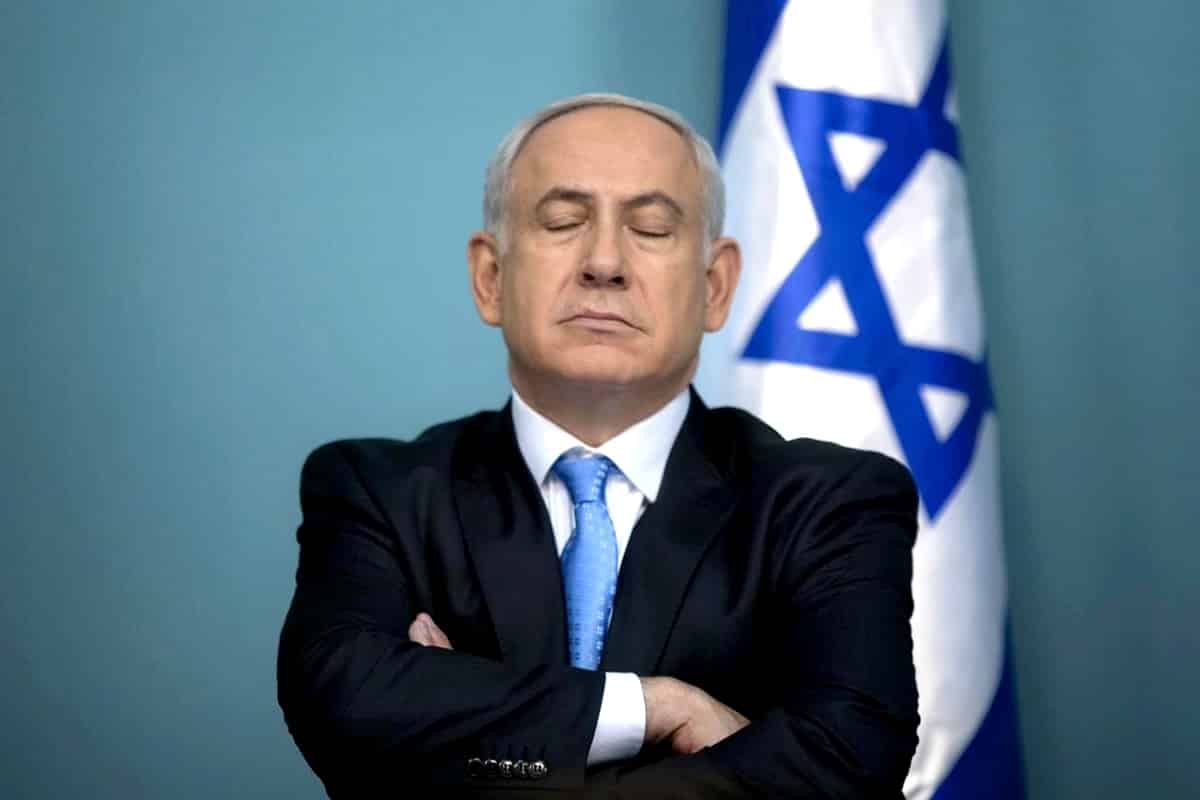
Like other Israeli leaders who preceded him Netanyahu is both an extremist and a terrorist, not to mention a proficient and shameless liar. No American paper or television channel will dare criticize him. He’s the only leader invited to openly propagandize the US Congress.
By M. REZA BEHNAM | Greanville Post | August 2, 2017
Not only is Israel waging a military campaign in the occupied territories, but a second battle is being waged through the American media to ensure continued U.S. support for its expansionist policies.
Israel’s colonizing aims, begun in the 1900s, were laid out in the doctrine of Vladimir Jabotinsky, founder of Revisionist Zionism, now the ideological cradle of today’s ruling Likud Party.
In his writings, “The Iron Wall” and “The Iron Law,” Jabotinsky set out the Zionist rationale for carving a Jewish state out of most of Palestine through force. He wrote, “Zionism is a colonizing adventure and therefore it stands or falls by the question of armed force.
“It is important to build, it is important to speak Hebrew, but unfortunately, it is even more important to be able to shoot. …”
When the 1947 United Nations Special Committee on Palestine partition plan granted 55 percent of Palestine to the future Jewish state, Jews owned 6 percent of the land in Palestine, but they made up only 32 percent of the population. After the 1948 Arab-Israeli war, Israel expropriated approximately 4.2 million acres of Palestinian land, about 78 percent of historic Palestine.
The dispossession continues today, with settlement enterprises covering about 42 percent of the remaining 22 percent. Palestinian cities, towns, homes, orchards and businesses have been systematically destroyed and repopulated by more than 650,000 illegal Jewish settlers.
Israel’s defenders say that the causes of violence go far back in history. However, the raison d’etre of Palestinian violence is not rooted in some inherent hatred of Jews, or historical animosity, or religion. It is about the land.
Without this historical context, today’s news events seem episodic and inconsequential.
After the 1967 Six Day War, Jewish organizations undertook a propaganda campaign to ensure Israel’s legitimacy and cement its relationship with the United States. It included the conflation of Israel with the Holocaust and victimhood and the writing of a mythical history of Palestine as an unpopulated desert that “good” Israelis made bloom.
That uncontested and false tale reverberated in Prime Minister Golda Meir’s outrageous 1969 claim that, “There was no such thing as a Palestinian; they never existed.”
In 1982, the narrative changed with Israel’s invasion of Lebanon. The indiscriminate bombing of Beirut and the death of more than 17,000, mostly civilians, turned the Arabs into victims and the Israelis into victimizers and temporarily sullied the carefully crafted story.
To regain control of public opinion, the American Jewish Congress sponsored a 1983 conference in Jerusalem with the goal of devising a strategy for reselling Israel. Top executives, journalists and academics from Israel and the United States developed talking points that are recognizable in today’s rhetoric, which stresses the following ideas:
* Israel’s strategic importance to the United States.
* Israel’s physical vulnerability.
* Israel’s shared cultural values with the West.
* Israel’s desire for peace.
Participants also understood the importance of an all-out campaign to convince the public that Jewish settlements in the West Bank are not an obstacle to peace. Thousands of illegal Jewish settlements constructed on Palestinian land are a testament to the effectiveness of that strategy.
The conference also produced the Hasbara (propaganda) Project. Its goal was to guarantee that the United States did not waver in its economic and military support, and to make it almost impossible to critique Israel’s actions.
News organizations have come to expect pressure if they go outside the level of acceptable discourse regarding Israel. Hence, they avoid potentially troublesome subjects and punish journalists who expose them. For example, Ariel Sharon, then minister of defense, filed a libel suit after Time magazine accused him of encouraging the massacres at the Sabra and Shatila refugee camps in Lebanon. The lobbying group Americans for a Safe Israel filed a petition with the Federal Communications Commission requesting that NBC’s license be revoked over its reporting of the invasion.
Israel, the size of New Jersey, has an estimated defense budget of $20 billion. It has 4,170 tanks, 1,500 large artillery pieces, 10,185 armored fighting vehicles, 2,000 combat airplanes, 15 to 20 warships, five submarines, 200 to 300 nuclear weapons, 175,000 regular troops and 430,000 reserves.
CBS faced much the same criticism in 2012 after correspondent Bob Simon’s “60 Minutes” report about Palestinian Christians living under Israeli occupation aired. The report challenged the Israeli narrative that Islamic extremists were making Christians’ lives difficult; instead, they complained about the hardships of living under occupation.
The American-born Israeli ambassador, Michael Oren, pressured the president of CBS News to quash the program. It aired only after the ambassador received the time he demanded for a rebuttal. A full-page advertisement in The Wall Street Journal excoriated Simon.
Alternative narratives such as Simon’s are often dismissed as anti-Israel or given the most intimidating and feared of all labels — anti-Semitic. The fear of this slur has been a potent rhetorical device to shield Israel from fault, and has proven fatally effective. The accusation has destroyed the careers and reputations of journalists, academics, politicians and entertainers.
Helen Thomas, a respected member of the Washington press corps, had her 57-year career end after she publicly questioned U.S. support for Israel. An onslaught of well-orchestrated denunciations forced her retirement in 2010. Thomas later remarked, “You cannot criticize Israel in this country and survive.”
President Jimmy Carter, before and after publication of his book, “Palestine: Peace Not Apartheid,” received his share of intimidation and vitriolic accusations of anti-Semitism. Ran Baratz, communications director appointee for Prime Minister Benjamin Netanyahu, accused President Obama of “modern-day anti-Semitism” after the United States reached an agreement with Iran on its nuclear program in July 2015.
Masterfully, Israel has marketed a number of myths that have become a part of the media lexicon. One of the most glaring fabrications sold to Americans is that the struggle is between two peoples with equal resources and claims. In reality it is a conflict between the colonizer, Israel, and the colonized, Palestinians.
Israel, the size of New Jersey, has an estimated defense budget of $20 billion. It has 4,170 tanks, 1,500 large artillery pieces, 10,185 armored fighting vehicles, 2,000 combat airplanes, 15 to 20 warships, five submarines, 200 to 300 nuclear weapons, 175,000 regular troops and 430,000 reserves.
Palestinians have none of these. And unlike Israel, Palestinians have few organized groups to tell their story or to lobby for them before the U.S. Congress. Yet Tel Aviv continues to perpetuate the myth of vulnerability.
Another persistent fallacy is that of gratuitous violence. Words matter; they manage perceptions.
Violent Jewish settlers are referred to as extremists, while Palestinians reacting to occupation are called terrorists. Palestinians “attack,” while Israelis merely “retaliate.”
With a compliant U.S. press, Israel’s propaganda network has successfully linked the terrorist attacks of Sept. 11, 2001, in the United States to Palestinians’ continued rebellion in the territories.
In 2015, Netanyahu suggested a relationship between the carnage in Paris and the Palestinian struggle for freedom, saying “Behind these terrorist attacks stands radical Islam which seeks to destroy us, the same radical Islam that struck in Paris and threatens Europe.”
In another unchallenged remark, the prime minister contended that “ISIS and Hamas are branches of the same political tree.” Whatever one may think of Hamas, it is not the Islamic State. It is an internal resistance movement in a singular battle with Israel.
The association of terrorism with Arabs, Muslims and the Middle East has created an unhealthy climate of indifference and fear in many Americans’ minds.
The media are replete with anti-Arab stereotypes, exemplified by the popular TV program “Homeland,” based on the Israeli series Hatafim (Prisoners of War). Middle Easterners rarely are presented in their full humanity, making them vulnerable to aggression. Racist remarks and vitriol directed at Muslims have become acceptable political theater and commonplace in the rhetoric of some American politicians.
News organizations unquestionably proffer another fiction: that Washington has been an “honest and neutral” interlocutor in Palestine-Israel peace negotiations.
Israel’s viability has been based on the $500 billion in aid it has received from the United States since 1949 and the $6 billion it continues to receive annually. American administrations have vetoed all but one U.N. Security Council resolution critical of Israel. Essentially, the United States has been financing the occupation and rewarding colonial policies.
America has more often than not been an obstacle to peace because of its bias in favor of Israel. The 2000 Camp David meeting is a poignant example. The press praised Prime Minister Ehud Barak for proposing the “most generous offer ever made” to the Palestinians while rebuking President Yassir Arafat for failing to accept Barak’s offer.
Had the press published maps, the prime minister’s proposed Palestinian state would have looked like a collection of balkanized enclaves. All Jewish settlements and roads in the West Bank would remain, and Israel’s control over Palestinian borders, air space and water would stay intact. Palestinians would have been encircled by hundreds of thousands of Jewish settlers on small disconnected islands, or Bantustans, much as they are today.
To further understand the imbalanced standard of reporting, it is useful to look at whose voices are heard.
Pro-Israeli syndicated columnists Thomas Friedman, Charles Krauthammer, George Will, Jonah Goldberg, Max Boot and David Brooks — whose son serves in the Israeli army — dominate newspapers’ op-ed pages. Wolf Blitzer was the editor of the American Israel Public Affairs Committee’s journal Near East Report before joining CNN as its chief political anchor. Such prominent magazines as The New Republic, Atlantic Monthly and Commentary are Israel-centric.
The occupation — with its curfews, 500 checkpoints and harassment by the Israeli army — has made access by journalists to the Palestinian experience almost impossible.
The Committee to Protect Journalists lists the West Bank as one of the worst places to be a journalist. Palestinians who are allowed on rare occasions to speak or write in the mainstream media have to use language acceptable to Israel and America.
Israelis who oppose their government’s policies are excluded as well. Ignored are the growing number of Israelis refusing military service in the occupied territories.
One such group, Breaking the Silence, founded in 2004, has published the chilling stories of abuse and devastation told by 700 former soldiers who served in combat units in the West Bank and Gaza. Peace movements such as Women in Black — Israeli women who gather every Friday on main squares in some cities with signs that read, “Stop the Occupation” in Arabic, Hebrew and English — have received inadequate coverage in the United States.
News companies give little attention to how the rest of the world has responded to the occupation.
The global human rights campaign represented by the Boycott, Divestment and Sanctions movement is growing internationally. The European Union recently announced that some goods produced on land seized by Israel in the 1967 war must be labeled “made in settlements.”
A Palestine Media Watch survey of The Wall Street Journal, The New York Times, Los Angeles Times, The Washington Post and USA Today revealed that of 680 op-ed columns on Palestine and Israel published between September 2000 and December 2005, 214 were written by Israelis and 86 by Palestinians.
A 2004 study of the Associated Press coverage disclosed that Israeli children’s deaths were covered at a rate of 7.5 times greater than Palestinian children’s deaths.
A six-month study of The (Portland) Oregonian by Americans United for Palestinian Human Rights observed that its headlines had reported Israeli children’s deaths to Palestinian’s at a rate of 44 to 1.
The treatment of Palestinians in Israeli prisons is hardly ever reported. The number of Palestinian political prisoners per capita is the highest in the world. More than 9,000 Palestinians are imprisoned by Israel (4,000 without trial). Amnesty International and numerous human rights organizations list torture in Israeli prisons as a major concern.
The right of return for millions of Palestinian refugees, the unequal allocation of water resources, the concrete wall of separation built on Palestinian land are among the myriad of crucial but unexplored news stories.
The media’s tone deafness to the Palestinian condition has contributed to Americans’ support of policies that are contradictory to their interests. Uncritical U.S. support for Israel has fueled anti-Americanism and radicalism throughout the Middle East. What is best for Israel has not always been best for the United States.
American government officials and media rarely ask whether Israel is strategically important to the United States as was once believed during the Cold War years. Close scrutiny suggests it is not.
Gen. David Petraeus, while head of the U.S. Central Command, told the Senate Armed Services Committee in March 2010, “The enduring hostilities between Israel and some of its neighbors present distinct challenges to our ability to advance our interests in the AOR (Area of Operations). …
“The conflict foments anti-American sentiment, due to a perception of U.S. favoritism for Israel. Arab anger over the Palestinian question limits the strength and depth of U.S. partnerships with governments and peoples in the AOR. …”
The Anti-Defamation League was so alarmed by the general’s testimony that it issued a statement condemning it.
News organizations must be held accountable for their lack of skepticism and reliance on officially constructed realities. Journalism functions best when it questions and challenges power.
American politicians and journalists must wake up to the fact that the strife in the Middle East is rooted in the Western and Israeli colonial and imperialist policies of the past and present. Unless acknowledged and reversed, anti-American sentiment and the tumult will continue unabated.
The urgency to speak up and to witness the corrosive reality of the occupation of Palestine and to address its ethical dimensions is greater than ever.
Inside and outside of Israel, neutrality and silence in the face of injustice is not an option.
M. Reza Behnam, Ph.D., a scholar specializing in the politics and cultures of the Middle East, is the author of the award-winning book, “Cultural Foundations of Iranian Politics.”
Egypt to bear cost of Alexandria Synagogue renovation
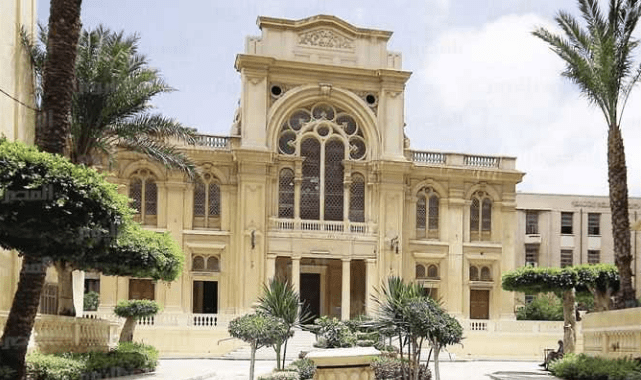
Eliyahu Hanavi Synagogue
MEMO | August 3, 2017
Egypt’s Antiquities Ministry on Thursday announced plans to carry out extensive renovations of a synagogue in Alexandria — despite the fact that, under Egyptian law, the local Jewish community should bear the cost of such restorations.
“The renovation of Alexandria’s Eliyahu Hanavi Synagogue will take about eight months and cost some 100 million Egyptian pounds [roughly $5.5 million], which will be provided by the Egyptian government,” the ministry said in a statement.
According to the same statement, the government had already allocated 1.27 billion Egyptian pounds (roughly $70.5 million) towards eight major historical renovation projects.
In July, Al-Said Helmy Ezzat, head of the ministry’s Islamic and Coptic Antiquities Department, announced that proposals to renovate the historical synagogue had been approved and the appropriate financial allocations made.
Under Egyptian law, however, Egypt’s small Jewish community should bear the cost of the project and the reason for the apparent exception remains unclear.
Cash-strapped Egypt continues to face difficult economic circumstances, with the government implementing an IMF-approved reform program, which includes the reduction of government subsidies and which has led to skyrocketing commodity prices.
Built in 1848, Alexandria’s Eliyahu Hanavi Synagogue is one of the largest Jewish synagogues in the Middle East region, capable of accommodating up to 700 people.
It also houses an impressive library containing dozens of ancient Torah scrolls, some of which date back to the 15th century.
‘No Time For Shallow Diplomacy Christians’ In The Religious War On Churches In The Holy Land
By Stuart Littlewood | American Herald Tribune | August 2, 2017
A month ago, after reading a desperate cry for help from the National Coalition of Christian Organisations in Palestine (NCCOP) addressed to the World Council of Churches, I emailed eight churches in my locality asking whether that heart-rending appeal had trickled down to them at parish level.
If not, I hoped to find out where the break in communications occurred, as this wasn’t the first time churches in the Holy Land had sought support from Western Christendom. Previous appeals were largely ignored and left to civil society for action.
Now, say the Palestinians, the situation is “beyond urgent”. So had the NCCOP’s latest plea actually arrived on the desks of parish priests in my neighbourhood? And if so, how were grass-roots Christians responding?
I included a link to the actual crisis document, which should have made every churchman sit up, and a gentle reminder that their faith and their job of work are rooted in the Holy Land. “So what are the chances, I wonder, of seeing concerted action from Western churches before it’s too late? And what part can local parishes play?”
The key point was this: it’s beyond urgent. So are our spiritual leaders, those upstanding ‘men of the cloth’, mobilising their troops?
Only one of the eight replied — the local Catholic vicar-general — who dismissed the subject in two sentences. So there you have it. If this local bunch are representative of the Christian community in the UK, they don’t give a four-X for their brothers and sisters in the Occupied Palestinian Territories. And they are utterly indifferent to the fact that the place where Christianity was born is being stolen from under their noses.
If that’s a wrong interpretation, and Christians in the West do actually wish to help, the issue is straightforward enough. Churches in Palestine are asking churches here to call things as they are: to recognize Israel as an apartheid state in terms of international law and the UN report which says so. They are concerned that States and churches are still dealing with Israel on a business-as-usual basis, as if the situation were normal, and ignoring the criminal reality of military occupation.
Churches came together in opposition to apartheid in South Africa and helped end it. Why haven’t they done the same in Palestine?
They ask us to unequivocally condemn the Balfour Declaration as unjust, and they rightly demand that the UK asks forgiveness and compensates the Palestinian people for their losses. Theresa May’s government, however, plans to celebrate the centenary of the Balfour Declaration “with pride” and has invited Mr Netanyahu to the fun.
Clearly Mrs May, God-fearing churchgoer that she is, needs to feel the heat of His wrath. The woman is so arrogant that her government intends to appeal against the recent decision by the Royal Courts of Justice defending our right to boycott Israel.
End the ‘Ecumenical Deal’, put interfaith dialogue through the wringer
The Palestinians want us to take the strongest possible stand against any theology or group that seeks to justify the occupation. That means of course challenging our religious dialogue partners and withdrawing from those partnerships if they won’t condemn Israel’s brutal occupation.
But I can hear our canting clerics muttering: “Oh dear, no, no, no. We mustn’t upset our interfaith colleagues. That would never do.”
Churches that sell their holdings or otherwise divest from companies that profit from the occupation of Palestinian lands often take years of agonising confab to reach such a commonsense position. But they needn’t think just moving their money is enough. A recent example is the Mennonite Church USA, where it took (they say) a three-person writing team and a 10-member reference group working intensely during the past two years and consulting widely across the church and with Palestinian and Jewish partners, to come up with a modest proposal. And to sugar the divestment pill they declared that “the legacy of Jewish suffering is intertwined with the suffering of Palestinians”. What the Palestinians had to do with Jewish suffering or ever did to deserve having their lands and homes confiscated, isn’t explained. But it is used to provide an excuse to call on Mennonites to strengthen relationships with Jewish communities.
Why? Can they not understand that you have to be consistent in boycotting Israel? It involves boycotting the people who also support and advocate for Israel including those who fail to condemn the Zionist regime’s vile policies that hurt our Palestinian friends. As George Galloway has said, you simply don’t engage with them.
Christians who cannot grasp what is really going on out there, and don’t see what is needed to stop it, might find Robert Cohen’s excellent article Brace Yourselves for Costly Palestinian Solidarity helpful in pointing towards proper, meaningful action.
He explains why the Christian-Jewish dialogue needs re-setting. Central to the problem is the so-called Ecumenical Deal, a reluctance to question Jewish support for Israel for fear of unpicking decades of interfaith reconciliation following the Holocaust. We appear to have cast ourselves in the self-defeating role of repenting for age-old Christian anti-Jewishness. Breaking out of it and criticising Israel would be seen as a re-emergence of that anti-Jewishness.
I’m not aware of Christian anti-Jewishness although continuing failure on the part of Jewish leaders to condemn the cruel policies of the Israeli regime, aka ‘the Jewish State’, is surely asking for it. Does anyone inside or outside the bubble of the Church seriously buy into this repentence stuff? From outside, among people who would never set foot in a church again but still call themselves Christians because they were brought up according to the Christian code, it looks pathetic.
Christians in Palestine, says Cohen, despair of our Church leaders’ endless hiding behind the cover of political neutrality and their unwillingness to offend their religious dialogue partners. Consequently, he predicts, Jewish-Christian dialogue “is about to go through the wringer”.
Time for some ‘really uncomfortable conversations’
Pressing the re-set button means “refusing to allow your local Jewish communal leadership to set the boundaries of permissible debate on Israel”. It also means “listening to the Christian voice under occupation before the Jewish voice living comfortably, with full equal rights, many thousands of miles from that same occupation”.
Operating the wringer, of course, will be followed by a distinct chill in relationships forcing Church leaders, local ministers and their congregations, as well as the Jewish leaders they have dialogue with, out of their comfort zone. Good. As Rebecca Vilkomerson, Jewish Voice for Peace, recently wrote in Haaretz, after 70 years of dispossessing and expelling Palestinians, 50 years of Israeli military occupation and 10 years of blockading Gaza, it is time for Jewish communities “to have some really uncomfortable conversations”.
Palestinians say no to ‘shallow diplomacy’ but it’s all they’re likely to get
How does the World Council of Churches react to those urgent pleas from Palestine?
They will study and analyse. “As we at the WCC consider our plans for 2018 and beyond, we want churches in Palestine to know that their perspective is heard and it is vitally important,” said the WCC’s general secretary. “We will continue with the same passionate spirit to work on specific objectives, strategies and partners for advocacy to end the occupation and to work for just peace in Palestine and Israel.”
The WCC’s Commission of the Churches on International Affairs has been asked to contribute a thorough analysis of the changing political landscapes and dynamics in the Holy Land with an eye toward developing a more specific advocacy strategy that works through nations and organizations with significant influence.
WCC has also started an online campaign, Seek #JusticeAndPeace in the Holy Land, which features profiles of peacemakers and various cries for justice.
WCC also plans to “explore theological reflections, studies and projects that will bring a perspective on just peace in the Holy Land from all parts of the world”, and strengthen communication about the situation in Palestine so that it can “help churches and other ecumenical partners address their constituencies and governments in a more systematic way”. This includes developing a set of principles and practices of responsible pilgrimages of justice and peace to the Holy Land.
Will the Palestinian churches be impressed? Their cry for help stated specifically: “We stand in front of an impasse and we have reached a deadlock. Despite all the promises, endless summits, UN resolutions, religious and lay leader’s callings, Palestinians are still yearning for their freedom and independence, and seeking justice and equality.”
They stressed that religious extremism is on the rise, with religious minorities paying a heavy price. “We need brave women and men who are willing to stand in the forefront. This is no time for shallow diplomacy Christians.”
When I called the Church of England press office yesterday they didn’t think any response had been made. Such concern, then. And when I ran through the members of the WCC’s Central Committee I noticed the two representatives from the Church Of England were both based in Europe. How helpful is that?
The power of hope
Christianity sometimes has great trouble telling right from wrong and doing something about it. The Holy Land is a case in point. Evil reigns there. Christianity across the world cowers. What would Christ say to that?
I know what Michel Sabbah says. He is a former Catholic Patriarch of Jerusalem, a courageous man of the front line and one of the great heroes of the struggle.
“The current situation is hopeless. In reality, there are no signs of hope at all for the Palestinian people. In spite of that, we hope.
We hope because we are Christians, and God is present.
We hope because we believe in the fundamental goodness of the human being, Israeli and Palestinian. Human goodness will prevail at the end upon the human power of evil.We hope because Palestinians are persevering in claiming their rights.
It is a source of hope that we never gave up….We hope because among Israelis, there are people who are trying to work with Palestinians for what is right. And there are an increasing number of movements for peace, strong in will….
If we had no hope we would not live. Hope is life, and history gives us hope. What is right will prevail.”
Michel Sabbah
Catholic Patriarch Emeritus
I fear that if he pins any hopes on the wets of the Western churches he’ll be disappointed. But he already knows that, surely.
Russian envoy: Hamas national movement
Palestine Information Center – August 1, 2017
TEHRAN – Hamas is a national liberation movement and Moscow does not consider it a terrorist organization, Russian Ambassador to Tehran Levan Dzhagaryan said Tuesday.
Reporting from Tehran, a PIC news correspondent said Dzhagaryan told Hamas representative in Iran, Khaled al-Kaddoumi, that Hamas is a national resistance movement and one of the Palestinians’ main legitimate representatives.
The Russian ambassador reiterated his country’s support for the Palestinian cause and people.
Al-Kaddoumi briefed the Russian envoy on the Israeli violations in Occupied Jerusalem and the crimes committed against the Palestinian people and holy sites.
Saudi forces set ablaze Shia homes in restive Awamiyah
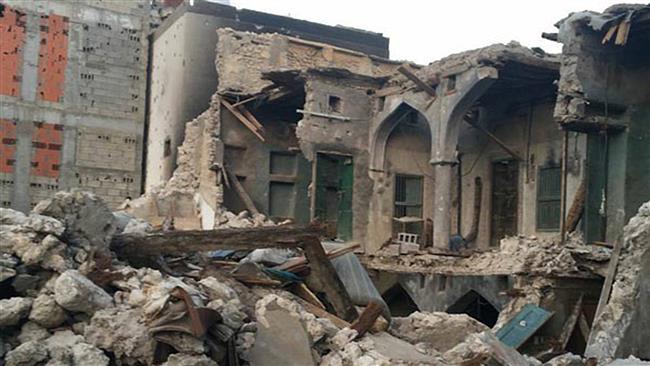
An al-Alam photo shows rubble caused by the Saudi demolition of Awamiyah, Eastern Province, Saudi Arabia.
Press TV – August 1, 2017
Saudi forces have set fire to homes belonging to Shia residents in the besieged town of Awamiyah that has been the scene of a heavy-handed regime crackdown on the minority community.
Based on local reports, Saudi forces have thrown Shia citizens out of their homes and then torched their properties.
Awamiyah, situated in Eastern Province, has long been a flashpoint between the Saudi kingdom and the inhabitants complaining of discrimination.
It has witnessed renewed deadly clashes between the military and residents since May, when Saudi forces began razing the town’s old quarter, known as al-Mosawara.
Saudi authorities claim that Mosawara’s narrow streets have become a hideout for militants suspected of being behind attacks on security forces in Eastern Province.
The UN, however, said Saudi Arabia was erasing cultural heritage and violating human rights through Mosawara’s demolition.
Karima Bennoune, the UN special rapporteur in the field of cultural rights, said Saudi authorities ignored repeated pleas by the world body to halt the destruction.
“These destructions erase the traces of this historic and lived cultural heritage and are clear violations of Saudi Arabia’s obligations under international human rights law,” Bennoune said, accusing the Saudi forces of “irreparably burning down” historic buildings and forcing residents to flee their homes.
Leilani Farha, the UN special rapporteur on the right to adequate housing, also warned that the Saudi move “constitutes a forced eviction under international human rights law.”
Additionally, Ali al-Dubisi, the head of the Berlin-based European Saudi Organization for Human Rights, said the Saudi forces were following a scorched-land policy in Awamiyah, launching rocket attacks and shelling residential buildings and civilians who are resisting Saudi pressures to evacuate.
Since February 2011, Saudi Arabia has stepped up security measures in Shia-dominated Eastern Province, which has been rocked by anti-regime demonstrations, with protesters demanding free speech, the release of political prisoners, and an end to economic and religious discrimination.
The government has suppressed pro-democracy movements, but they have intensified since January 2016 when Saudi Arabia executed respected Shia cleric Sheikh Nimr al-Nimr.
Israel shoots Palestinian minor in both legs and arm
MEMO | July 31, 2017
Israeli forces shot an unarmed Palestinian minor in both legs and in one arm last week, according to Haaretz.
Thirteen-year-old Mohammed Qaddumi was collecting firewood near the West Bank Separation Wall on Tuesday when Israeli occupying forces fired at him. Qaddumi was admitted to Meir Hospital in Kfar Saba and underwent a long operation. His condition remains severe though his health has improved.
Qaddumi’s father said his son was one of four children walking by the barrier next to their home in the village of Jayus:
He was by the fence, the children were there, four children, and there were soldiers under the olive trees. They went up there by the fence, they could have grabbed him by the arm but they shot him three times.
His father emphasised that Qaddumi did not try to cross into Israel as the army claims, nor did the children throw stones at the soldiers who were hidden from their view.
Israel’s Civil Administration initially prevented Qaddumi’s family from accompanying their son to hospital in Israel, but relented after NGOs Mahsom Watch and Physicians for Human Rights intervened.
The army is said to have initiated legal proceedings against the wounded teenager, on suspicion of throwing stones.
Israeli forces have long been accused of implementing a “shoot to cripple” campaign against Palestinians in the occupied West Bank. A report released by the Badil resource centre found that in the first six months of 2016, at least 30 of the 86 Palestinians that were shot in Bethlehem alone were shot in the legs or knees.
Israeli generals have also been known to encourage such tactics against Palestinian youth. Reports surfaced last year that Palestinians in numerous West Bank cities speak of Shin Bet officials known only as “Captain Nidal” and “Captain Imad” among others, who regularly threaten to disable young men if they fail to comply with Israeli soldiers.
Israeli forces shoot, injure Palestinian in Salfit tending to his land near separation wall
Ma’an – July 29, 2017
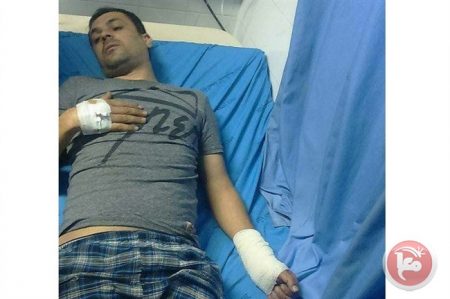 SALFIT – Israeli forces shot and injured a Palestinian on Friday while he was tending to his land near Israel’s separation wall in the village of Deir Ballut in the western part of Salfit district in the occupied West Bank.
Medical sources at the Palestinian Red Crescent told Ma’an that Faed Saleh Odeh Moussa, 33, was injured with a live bullet in his left hand after Israeli forces opened fire on him while he was on his land watering trees.
The sources added that he was transferred to the Yasser Arafat Hospital in Salfit, where doctors reported his injury as moderate.
Saed, Moussa’s brother, told Ma’an that they were caring for their land near Israel’s separation wall, like every Friday, when Israeli forces arrived in the area at 7:30 p.m. and randomly opened live ammunition on them.
Saed said that they quickly hid behind rocks before his brother was injured. He added that their children were also with them at the time and two men from Qalqiliya city in the northern West Bank who were en route to Israel.
Israeli forces remained in the area for some time before leaving following the incident, Saed noted. He added that he had called the Deir Ballut municipality to inform them of the incident, who said that they would notify the Palestinian liaison of the incident.
An Israeli army spokesperson told Ma’an she would look into reports on the incident.
According to the Bethlehem-based Applied Research Institute — Jerusalem, the village of Deir Ballut has had thousands of dunams of land confiscated for the purpose of illegal Israeli settlement building, while Israel’s separation wall — deemed illegal by the International Court of Justice in 2004 — is expected to swallow up at least 35 percent of the village’s lands.
Such Israeli activities in Palestinian villages coincide with upticks of Israeli violence against Palestinians — both by Israeli forces and settlers, as Palestinians are stripped of their lands and often barred from entering Israel’s so-called security “buffer zones” on the Palestinian side of the separation wall.
The UN has reported that at least 92 Palestinians are injured by Israeli forces every two weeks, while 1,444 Palestinians were injured by Israeli forces this year, as of July 17. However, this data does not include the hundreds of Palestinians who were injured during Al-Aqsa protests post-July 17.
‘An attempt to drown out Palestinian voices’: RT’s office building raided in Ramallah
RT | July 29, 2017
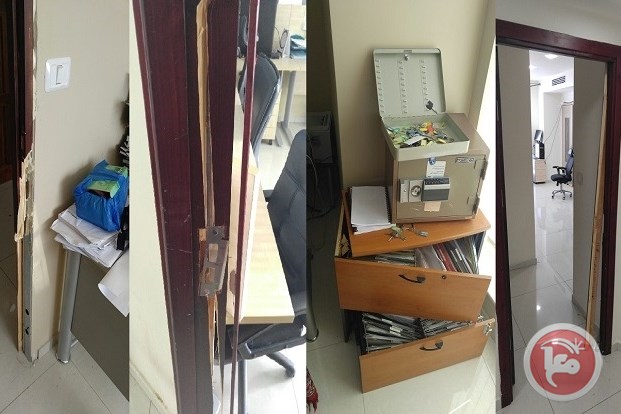
The Israeli military raided the PalMedia building in Ramallah on the West Bank early Saturday morning. It is home to a number of international media organizations, including RT’s regional office. Property belonging to other media channels was either damaged or seized.
No RT employees were harmed during the raid on the PalMedia building which also houses the offices of Al-Quds, Al-Mayadeen, France 24 and Al-Manar.
Witnesses told the Ma’an News Agency that 10 Israeli army vehicles had surrounded the building before carrying out the search.
Several doors and editing rooms were damaged while some computers and other property were taken away.
An Israeli army spokesperson told Ma’an that Israeli forces had “seized media equipment and documents used for incitement” from a media office in Ramallah, though did not say which agency they were specifically targeting.
The satellite channel Al-Quds said the search was directed at them.
The Palestinian Union of Journalists condemned the raid, which it said had led to “the destruction of property and the theft of equipment, computers and archival materials belonging to the satellite channel Al-Quds,” adding, that it was “an obvious attempt to drown out the voice of the Palestinians and make the Palestinian narrative invisible.”
The Palestinian Ministry of Information also released a statement denouncing the raid, saying, that targeting the media “proves Israel’s intentions to prevent the guardians of truth from continuing their media, national, and ethical role of transferring the message of our people’s desired freedom.”
This is not the first time Israeli authorities have mounted a search of the building, having done so in June 2014. At the time, Reporters Without Borders said the raid “joined the long list of violations of Palestinian news media rights by the Israeli security forces, with never-ending threats, arrests and military operations.”
RT’s offices in the Gaza Strip were also hit by an airstrike during Operation Pillar of Defense in November 2012. Though the building was severely damaged, none of RT’s employees were hurt.
Israeli authorities have long restricted Palestinian freedom of expression through censoring social media activity and imprisoning journalists, activists, poets, and novelists.
Kinsella’s silence on JNF racism speaks loudly
By Yves Engler · July 26, 2017
What do you call someone who says they head an antiracist organization, but claims to be ignorant of an explicitly racist institution they’ve publicly defended? I have no idea, but I do know Warren Kinsella confirmed the central point of my recent article titled “The Left’s racism problem concerning Israel”.
In a series of threatening emails to the editor of Dissident Voice in response to my article the former advisor to Olivia Chow’s mayoral bid wrote: “These statements are wildly defamatory. They are false and malicious in their plain and ordinary meaning. They are calculated to damage my reputation in the eyes of the community. The fact is, I presently help lead an anti-racist organization and have received death threats as a result. I have ‘ties’ to no other. I have been involved in anti-racism work for more than three decades. I oppose hate against all people, in all of its myriad forms. To state that I support or condone ‘explicit racism’ is a disgusting, appalling lie.”
I responded by saying: “While I appreciate your anti-racism work in certain areas, the point being made in the article claimed to be libelous is that you, in fact, do not condemn all forms of racism, specifically anti-Palestinian racism as conceived and carried out by the Jewish National Fund. I can find no record of you condemning or even criticizing the Jewish National Fund’s structural racism. On the other hand, you have condemned and criticized those who do.
If you do oppose all forms of racism, specifically including that of the Jewish National Fund, please let me know and I will apologize unreservedly to you and correct the article in question. If, on the other hand, you do not believe the Jewish National Fund is racist, or you are simply unwilling to condemn or criticize it, then I must stand by my words in the article.”
And here is where things became interesting. Kinsella responded to my email by stating “I don’t even know what the JNF is. I have nothing to do with it. …”
Claiming to have been involved in antiracism work for three decades, Kinsella says he’s ignorant of the only (to my knowledge) explicitly racist institution sanctioned by the Canadian state to give tax write-offs. It is not like the JNF is some marginal group. The century-old organization’s eleven offices across Canada raised $75 million over the past three years and the sitting prime minister spoke to the organization in 2013.
While he now denies knowledge of the registered charity, last year Kinsella derided a resolution calling on the Canada Revenue Agency to rescind the JNF’s charitable status because of its “discrimination against non-Jews in Israel.” Additionally, in the late 2000s Kinsella sat on the board of directors of the Canada-Israel Committee, whose personnel were often close to the JNF.
Why would someone who claims to be an antiracist activist be unwilling to criticize an organization that practices discriminatory land-use policies outlawed in this country six decades ago?
Featured Video

Seyed M. Marandi: US-Iran War Inevitable: Kuwait and Bahrain May Fall
or go to
Aletho News Archives – Video-Images
From the Archives
Oil and the Israel Lobby
Reknowned economist M. Shahid Alam offers this excellent critique of Noam Chomsky’s defective analysis of the relative influence of Oil versus the Israel lobby over US foreign policy: … continue
Blog Roll
 Aletho News
- ICC ignored ‘very well-documented’ NATO crimes – ex-Libyan minister
- SNSC secretary dismisses US response to Iran’s conditions as ‘inadequate’
- Sanaa says Taiz roads open, secure for residents, warns Saudi forces
- Iraqi resistance group urges Saudi leadership to admit defeat, lift Yemen siege
- Trump’s Retreat: How Al-Aqsa Flood Took Down the US Empire
- Israel’s Military Actions in Lebanon Grossly Violate International Law — Lavrov
- Seyed M. Marandi: US-Iran War Inevitable: Kuwait and Bahrain May Fall
- Leaders Condemn Ansarallah Attack on Saudi Arabia While Ignoring Illegal War Against Yemen
- Leaked: Britain’s Covert Iraqi Psyops Network
- Yemeni Armed Forces Warn Airlines Against Using Saudi Airports, Exempt Mecca and Medina
- If Americans Knew
- How Israel Conquered the Latin American Right
- Agents search Rep. Omar’s Washington home in criminal probe as she vows she won’t ‘be silenced’
- “The Rule Was: ‘Shoot Everyone You See'”
- Israel goes ballistic over Nobel Laureate Navi Pillay
- U.S. May Join Yet Another Middle Eastern War — TCN
- Yellow Line moves again as Israel closes in on trapped Gazans – Daily Update
- Israeli Attacks Kill Seven Palestinians in Gaza Including Six-year-old Girl
- Gaza: Ceasefire Anniversary Marks Year of Failed Promises
- The American Conservative: Mike Huckabee Should Resign
- A C-Section in Shackles: A Palestinian Woman’s Harrowing Birth in Israeli Detention
- No Tricks Zone
- Germany’s Green Energy Debacle: High Energy Costs Force Kahla Porzellan to Close After 182 Years!
- New Study: 50 Years Of The Most Aggressive ‘Net Zero’ Policies Can Only Affect The Global Climate By 0.03°C
- US September “Heat” Was No Record…Many Records Set Decades Ago
- Latest European Green Energy Debacle; Portugal’s Largest Flagship Solar Park Insolvent!
- Green Energy Debacle: German Expert Professor Fritz Vahrenholt Warns Of Severe Economic And Social Consequences
- Two More Paleo Reconstructions Affirm Meters-Higher Sea Levels Across Ireland, Brazil 7000-6000 Years Ago
- New Study: Earth And Venus Surface Warmth Largely Explained By Convection And Lapse Rate, Not CO2 Or Radiation
- 2025 Nature Paper Claiming Worsening Global Drought Gets RETRACTED …Heavily Flawed
- New Study: ‘Global Drought Shows No Detectable Recent Acceleration Under Climate Warming’
- Economic Masterminds: German Socialists Suggest Taxing Productivity Gains Stemming From Using AI

