Two States Or One State?
The stark reality is that both solutions are impossible unless imposed from outside, and just where do we see any prospect for that?

By John Chuckman | Aletho News | February 22, 2017
Israel has created a terrible problem which it is incapable of solving. That is why it has always been the case that the United States must pretty much dictate a solution, but it is unable to do so, paralyzed as it is by the heavy influence of Israel and America’s own apologists and lobbyists.
Trump’s suggestion of a one-state solution to the Israel-Palestinian conflict is welcomed by some because Israel’s settler policy is said to have made two states impossible, as it was most certainly intended to do. However, a little reflection on hard facts makes it clear that a one-state solution is just as impossible.
A single-state solution would be acceptable to all reasonable minds, but you only have to follow the news to know that Israel contains a good many unreasonable minds. Its early advocates and founders were, quite simply, fanatics, and its policies and attitudes were shaped by that fanaticism.
The Israeli establishment could simply not accept a Palestinian population with equal rights and the franchise as part of Israel. They could not do so because they have embraced an almost mystical concept of Israel as “the Jewish state.” Of course, the de facto reality of today’s combined population of Israel and its occupied territories is that Palestinians, who importantly include not just Muslims but many Christians, are already about half of the total.
And there are physical realities forming huge barriers against a single state, things of which many people are not aware. Very importantly, fertility rates in Arab populations are considerably higher than in the European Ashkenazi population which forms Israel’s elite. That has nothing to do with ethnic characteristics. It is a result of much lower levels of affluence influencing the behavior of people having children. It is a universal reality we see.
That’s why Arabic populations are such relatively young populations with a high proportion of children. When Israel bombs a place like Gaza or Lebanon, as it does periodically, it always kills many hundreds of children because they make a big share of the population. An advanced country like Japan has low fertility and traditionally is averse to much migration. It faces a future with an aging and declining population.
All older European and North American countries have fertility rates too low to replace their otherwise declining populations. America or France or Israel or similar states simply do not have enough babies to replace their populations. That’s a fundamental reality of advanced, affluent society. People with rich, demanding lives do not have large numbers of children, anywhere, knowing, as they do, that the few they do have will almost certainly survive and will better thrive with more concentrated resources.
That’s the real reason behind most countries’ immigration policies, not generosity or kindness. But, of course, Israel has a serious problem with immigration, too. As the “Jewish state” it is open to only one category of migrant, and that category of people makes a tiny fraction of the world’s population. Further, most of that tiny fraction live in comfortable, affluent places, far more desirable to live in than Israel – places like America, Canada, Australia, Britain, France, etc.
A single-state Israel would combine low fertility Europeans with higher fertility Arabic people, thus creating a long-term trajectory for a minority-Jewish state, a reality which would be repellent to all conservative Jews and many others, in light of the founding notion of Israel as a refuge from believed widespread anti-Semitism, plus the vaguely-defined but emotionally-loaded notion of a “Jewish state,” and, still further, the biblical myths of God’s having given the land exclusively to Jews.
You simply cannot make rational sense out of that bundle of attitudes and prejudices, yet you cannot get a rational solution to a massive problem otherwise, a problem, it should be noted, of Israel’s own deliberate making in the Six Day War. Likely, when Israel’s leadership started that war, they calculated that Palestinians would come to feel so miserable under occupation that they’d just pick up and leave over time. Moshe Dayan, one of the architects of the war, actually spoke along those very lines of keeping the Palestinians miserable so they would leave. But their calculations were wrong. Most people, anywhere, do not pick-up and leave their native place. Otherwise the world would be a constant whirlwind of migrations.
Although Israel does not discuss the relative population growth rate situation in public, authorities and experts there are keenly aware of the reality. It is difficult to imagine them ever embracing a single state for this reason. When you found a state on ideology and myths, as Israel was founded, you very soon bump up against some unhappy realities.
So, if there is not to be a Palestinian state, what are Israel’s other options? There seem to be only two.
One is to deport all or most Palestinians, an ugly idea which is probably also unworkable, although it has very much seriously been discussed among educated Israelis periodically. Apart from the Nazi-like connotations around such an act, who, on earth, is going to take literally millions of people from Israel? In the past, Israeli ideologues have seriously suggested both the country of Jordan and parts of Egypt contiguous with Israel as possibilities.
Can any realistic person believe those states stand ready to take millions of people in? No, of course not, but that hasn’t stopped the ideologues of Israel from going back to the idea again and again. Of course, there is the pure ethical problem of moving millions against their will and seizing all their property, but ethics have never featured large in Israel’s policies from the beginning.
The other solution is to re-create apartheid South Africa’s Bantustans, little enclaves of land with often undesirable characteristics into which you crowd all the people that you don’t want and declare that these are their new countries. We see this already in Israel, notably in Gaza, which really is a giant refugee camp much resembling a concentration camp with high fences and automated machine-gun towers surrounding it, the residents being permitted almost no freedom of movement or even economic activity, as for example Gaza’s fishermen being fired on by Israeli gunboats if they stray even slightly beyond tight boundaries in the sea.
The world would not long tolerate that approach no matter how much influence the United States might unfairly exert. After all, for a long time, the United States protected and cooperated with apartheid South Africa, always regarding it as an important bulwark against communism, anti-communism being the fervent secular religion of the day in America. This was so much the case that it even overlooked what it absolutely had to know about, apartheid South Africa’s acquisition of a small arsenal of nuclear weapons with the assistance of Israel, Israel always being keen to keep good access to South Africa’s mineral wealth.
Clearly, those two options are not solutions. Realities absolutely demand either a legitimate two-state solution – which Israel’s leaders have never truly accepted while giving it time-buying lip-service – or a one-state solution which is probably even more unacceptable to Israel’s leaders and much of its population, guaranteeing, as it does, the eventual minority status of Jews.
Israel has itself created a terrible problem which it is incapable of solving. That is why it has always been the case that the United States must pretty much dictate a solution, but it is unable to do so, paralyzed as it is by the heavy influence of Israel and America’s own apologists and lobbyists.
So, in effect, the world just goes around and around on this terrible problem, never doing anything decisive. The macabre dance of Israel and the United States we’ve had for decades yields today’s de facto reality of Israel as nothing more but nothing less than a protected American colony in the Middle East, one in which all kinds of international norms and laws are completely suspended, one where millions live with no rights and no citizenship. But, after all, colonies have never been places where the rule of law and human rights prevail, have they? Never.
Nikki Haley Calls Apartheid Israel ‘the one true democracy in the Middle East’
By Richard Edmondson | Fig Trees and Vineyards | February 21, 2017
Out of all of Trump’s appointees, Nikkie Haley is probably one of the worst. Formerly a governor of South Carolina, Haley is the current US ambassador to the United Nations. That’s her in the video above giving a presentation at the UN last Thursday.
I’m not sure how much Haley knows about international law. According to Wikipedia, she graduated from Clemson University with a Bachelor of Science degree in accounting. How she ended up as UN ambassador, after criticizing Trump in the general election, is unclear. *
At any rate, Haley seems fully unaware that Israeli settlements are illegal under international law. Nor does she seem to comprehend why other UN-member states might press for resolutions seeking to call Israel to account, both for its settlements as well as its 50-year occupation of the West Bank–land universally recognized as necessary for a Palestinian state. So perhaps she is simply uninformed and does not understand the nature of Israel’s occupation or its devastating impact upon the lives of those forced to live under it. Or at least that’s one possibility.
The other possibility, of course, is that Haley does understand these things… and that she simply believes Israel is exceptional and should not have to follow the same laws and international standards that apply to other states. If so, apparently in Israel are those who would agree with her. Less than a week after her talk at the UN–in which she accused the body of a “prejudiced approach to Israeli-Palestinian issues”–an Israeli military court handed down an 18-month sentence to an Israeli soldier who carried out an execution-style slaying of a wounded Palestinian in March of last year. There was no doubt the soldier was the one who pulled the trigger. The shooting was captured live on video. The sentence of 18 months he received for killing a Palestinian is lighter than what Palestinian children are often given for throwing stones.
* Incredibly, Haley also voiced criticism of Trump–over his stance on Russia–during her congressional confirmation hearings back in January. At that time she accused Russia of “war crimes,” and said, “They (the Russians) have done some terrible atrocities.”
Israel to Bulldoze Palestinian Homes to Build ‘Settlers Only’ Road
Sputnik – 22.02.2017
As Israel begins work on its “American road” project in East Jerusalem’s Jabal al-Mukaber area, hundred of Palestinians are on edge, as their homes lie directly in its path.
Part of the larger al-Touq Highway, the road is ostensibly being constructed to connect Israeli settlements north, south, and east of East Jerusalem, and cuts through sections of Jerusalem, joining the Maale Adumim and Har Homa settlements on the West Bank.
The al-Touq Highway, proposed ten years ago by Israel’s municipality planning and construction committee, will, once completed, be 230-feet wide and over 7-miles long.
Roughly 300 acres, encompassing 12 Palestinian neighborhoods in Jabal al-Mukaber, will be confiscated to build the road, which has alarmed residents of Salaa, where construction has already begun.
Salaa resident Mohammad al-Sawahra told Al Jazeera, “We are living in a state of perpetual fear…It’s as if we are living in [two different worlds]. In Palestinian areas, it is like living in the third world, while those living in settlements built on the land of Jabal al-Mukaber are offered a life of comfort like first world countries.”
Al-Sawahra received a demolition notice for his home last month, adding that, “Now, they want to build a road on the ruins of my home for themselves, as well.”
He will be one of some 500 Palestinians living in 57 homes set to be demolished for the ‘American Road’ project. Raed Basheer, with the Committee of Defence for Jabal al-Mukaber properties, told Al Jazeera, “We were surprised to hear about the project, which will be 32 metres wide, with an additional 32 metres on the sides to allow for the light rail. All of the homes, both old and new, standing in the way of the road, will be demolished.”
“In response to this plan,” Basheer said, “we reached out to the Israeli municipality in Jerusalem and managed, with difficulty, to obtain an extension on the house demolition orders for five years, provided that we submit a request every year to extend the demolition orders. But, still, we do not know whether we will be allowed to remain in our homes over the next five years.”
The project map reportedly shows the disconnection of roads that link Jerusalem’s Palestinian neighborhoods, cutting residents off from health care facilities and schools, leaving a road only to be used by Israelis.
The plan comes on the heels of a recently-passed and hotly-debated bill that retroactively legalizes thousands of Israeli homes on privately-owned Palestinian land. The “regulation” law has been called “theft’ and a “land grab” by the opposition.
About 48,000 Palestinian homes have been demolished since Israel first seized the territories in 1967.
Film about Israeli imprisonment of Palestinians wins top award in Berlin
By Celine Hagbard | IMEMC | February 21, 2017
 A film depicting the torture, humiliation and violence experienced by Palestinians imprisoned by Israel won the first ever “Silver Bear” award at the Berlinale international film festival.
The film, “Istiyad Ashbah” (Ghost Hunting), was produced by Palestinian filmmaker Raed Andoni.
It was one of 18 finalists competing for the top honor at the Berlinale film festival this year. The ‘Golden Bear’ award was won by Hungarian filmmaker Ildiko Enyedi for the film “Testrol es lelekrol” (On Body and Soul).
Andoni’s film “Ghost Hunting” involves a powerful re-enactment of interrogation rooms and prison facilities in the infamous ‘Russian Compound’ prison run by Israel.
According to journalist Rene Windangel, who spoke with Andoni about the creation of the film, the director began by confronting his own ghosts, having been imprisoned during the first intifada in the late 1980s. He then “turned to newspaper ads as he set out to find a group of former inmates able to work as set designers and craftsmen in recreating a prison on the film set. He also sought out ex-detainees willing to play the roles of prison wardens and prisoners. And so this group of people, who had themselves experienced imprisonment, began to meticulously build their own prison.”
German commentator Rene Windangel wrote in the paper ‘Qantara’, in a review of the film, “By giving the actors and crew room to express themselves, Andoni’s film manages to avoid cliches. In no way is the film limited to the observation of suffering or the re-enactment of victimisation. Raed Andoni’s film functions as both trauma therapy and as an opportunity to discuss the political problem of prisoners. First and foremost, though, the film works as an impressive piece of cinematography dealing with the basic questions of the human condition.”
Currently there are around 7000 Palestinian men and women imprisoned by Israel. Over 750,000 Palestinians have been imprisoned since 1967 and the start of the Israeli occupation of Gaza, the West Bank and East Jerusalem. Most were sentenced by military courts, while others were held without any charges in so-called “administrative detention”. There are practically no Palestinian families that have been spared the experience of prison.
America First

By Paul Larudee | Dissident Voice | February 20, 2017
Nothing in Trump’s campaign resonated with the American heartland quite like “America First”. But Trump wasn’t the first. Remember Charles Lindbergh? He put “America First” and paid the price.
Deir Yassin Remembered (DYR) also wasn’t first but neither were we last. The first DYR “America First” billboard went up in Detroit in November 2015. It didn’t last long but such is Jewish power.
It re-appeared on February 6 this year near Ann Arbor, Michigan but, just one week later, DYR received a call from Adams Outdoor Advertising General Manager Mike Cannon saying that the board had to come down. Such is Jewish power.
These tactics, known as ‘Dynamic Silencing”, are well-worn and well-described by Benjamin Ginsberg in his book The Fatal Embrace: Jews and the State, p. 124:
Working together, officials of the American Jewish Committee, the American Jewish Congress, and the ADL would approach the publishers of major newspapers and owners of radio stations in cities where Smith [substitute any “anti-Semite”] had scheduled appearances to ask that Smith be given no coverage whosoever. If newspapers and radio stations failed to cooperate on a voluntary basis, Jewish organizations were usually able to secure their compliance by threatening boycotts by Jewish advertisers.
So where now? Try another site? Turn it into a lapel pin? Put it on a truck and drive it cross-country?
Please send any ideas to us here.
Paul Larudee is one of the founders of the Free Gaza and Free Palestine Movements and an organizer in the International Solidarity Movement.
Quebec elites out of touch with rest of province on Israel
By Caroline Biotteau | rabble.ca | February 20, 2017
The most recent poll regarding Canadian’s attitudes towards Israel has just been released and the results are telling. Quite strikingly, far more Canadians have a negative view of the government of Israel than a positive one. Even more remarkable, Quebec respondents have a far harsher view of the government of Israel than their fellow Canadians.
Some have argued that Quebecers have always been more critical of the Israeli government, and more sympathetic to the Palestinians. This assumption was up in the air, however, when a survey by Crop-La Presse issued in 2014 during the Gaza conflict between Israel and Hamas found that the majority (64 per cent) of Quebecers chose not to pick sides in the messy flare up.
With this most recent poll sponsored by my organization, it is clear that regardless of what happened in 2014, Quebecers remain wary of the Israeli government. Of those who expressed an opinion, 57 per cent of Quebecers had a negative opinion of the Israeli government, as compared to 46 per cent overall in Canada. Only 16 per cent of Quebecers had a positive opinion, as compared to 28 per cent overall in Canada.
While this doesn’t tell us whether Quebecers are pro-Palestinian, it does show that they are far more negative than other provinces when it comes to the Israeli government.
With survey results like these, one would expect Quebec politicians to be guarded with respect to relations with the Israeli government. This could not be more wrong. With Montreal mayor Denis Coderre’s recent economic mission, Premier Philippe Couillard’s upcoming one and a recent statement on Israel by CPC leadership candidate Maxime Bernier, it is easy to feel as if our political elite are detached from the population’s concerns over Israel’s human rights abuses.
Rather than asking Israeli leaders tough questions about violations of international law, Quebec leaders only seem to idolize Israel for being such an innovative and business-friendly country. This is especially the case for the particularly effusive Coderre, who came back full of praise for Israel following his economic mission to Israel and (symbolically) the West-Bank.
While having a negative perception of the Israeli government does not mean that Quebecers want their leaders to be anti-Israel, they still might prefer a more balanced approach.
Nobody can deny the fact that Israel has managed to achieve an impressive economic success and that their innovation sector is quite enviable. However, considering the fact that this country is repeatedly cited for violations of international law, and that Netanyahu’s right-wing coalition government continues the illegal colonization of Palestinian territory, many Quebecers may believe that our politicians should not engage in a “business as usual” economic approach with Israel.
In China, Philippe Couillard experienced firsthand the difficulty of pursuing economic relations while being under pressure to denounce human rights violations. It is especially hard for premiers since because of the Constitution, Canadian provinces cannot lead their own international policies and diplomacy.
However, Quebec has found a way to circumvent this by engaging in various economic and cultural missions and investing in permanent delegations throughout the world. This broader role undertaken by Quebec political elites is not exempt from responsibilities — and leaders like Couillard and Coderre need to find a way to achieve both: pursue economic motivations while making sure violators of international law are held accountable.
In the current international political climate, such proposals may seem like wishful thinking: economic incentives are almost always prioritized to the detriment of human rights issues. However, Western leaders are becoming more and more vocal about their disapproval of Israel’s increasing settlements expansion, and ongoing disregard for Palestinian human rights.
It’s time that Quebec leaders find a way to do the same, and these new poll results should give them all the incentive they need.
Israeli university to be established on Palestinian land in Salfit
Palestine Information Center – February 19, 2017
SALFIT – Israeli forces have leveled Palestinian lands in Mesha village, to the west of Salfit province, in favor of illegal settlement expansion.
Speaking with PIC, head of Mesha village council, Sabah Amer, said Palestinian lands have been increasingly seized and leveled by the Israeli occupation forces and authorities as part of underway endeavors to expand the Qana and She’ari Tekva illegal outposts.
Researcher Khaled Maali also said Palestinian lands in the area have been confiscated to establish an Israeli university at the expense of Palestinian lands, referring to the establishment of an Israeli university in Ariel outpost, at which nearly 25,000 Israeli settlers have been enrolled, as another case in point.
According to Maali, such moves contravene international humanitarian law, the Fourth Geneva Convention, and the Hague Convention, which prohibit the establishment of government institutions on occupied land.
Maali added that the swift pace of illegal settlement construction led to the dismemberment of over 90% of Palestinian lands in Mesha village and the isolation of Palestinian communities behind the apartheid fence. Serious damage has also been wrought on olive trees grown by Palestinian farmers in the area.
Mesha is surrounded by three illegal Israeli settlement outposts, including Qana and She’ari Tekva.
‘Any Israeli Attempt to Undermine Lebanese Sovereignty will Meet an Appropriate Response’
Al-Manar – February 18, 2017
Lebanese President General Michel Aoun deemed on Saturday that “the message content of Israel’s Delegate at the United Nations, Danny Danon, poses a threat to Lebanon,” adding that “the international community ought to pay attention to the possible Israeli hostile intentions against Lebanon.”
Speaking before his interlocutors at Baabda Palace this afternoon, Aoun asserted that “any Israeli attempt to undermine the sovereignty of Lebanon shall be confronted with the appropriate response.”
The President stressed that “Israel must comply with Security Council resolutions before any other, yet it still refuses to implement Resolution #1701 and the transition from the cessation of hostilities to a ceasefire stage, despite the fact that more than 11 years have passed since the release of said Resolution.”
“Israel still occupies Lebanese territories in the northern part of Ghajar, Shebaa Farms and Kfar Shouba Hilltops, while effecting daily violations of the Blue Line and Lebanese sovereignty by air and sea,” Aoun went on to indicate.
“In addition, half a million Palestinians are still forced to stay away from their homeland, hosted by Lebanon in the absence of their right to return to their land and property, which constitutes an act of aggression against Lebanon and its people,” he added.
“This act of aggression falls under the content of Article 51 of the UN Charter, which gives Lebanon and its people the natural right to defend their land,” Aoun underscored.
The President concluded that “Lebanon, which has respected all obligations towards the United Nations and its labor force in the South, views the Israeli message to the United Nations as a blatant attempt to threaten the security and stability enjoyed by the southern towns and villages located within the international area of operations, and therefore, bears full responsibility for any aggression against Lebanon.”
Source: NNA
Berkeley event was successful despite efforts against it
If Americans Knew | February 17, 2017
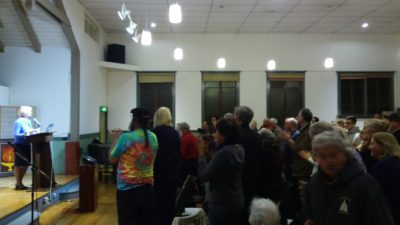
Alison Weir provides the following report back on an event that almost didn’t happen:
After I was invited by the Social Justice Committee of the Berkeley Fellowship of Unitarian Universalists (BFUU) to give a public presentation, extremist pro-Israel activists went to work to get the event canceled. They put up blog posts and even a Craigslist advertisement attacking me, exaggerating inaccurate claims about me by the ADL and, especially, the widely refuted JVP-US Campaign dossier on me.
This has become standard practice for Israel partisans who wish to prevent audiences from hearing my presentation.
A few individuals within the BFUU then took up the JVP-USC false claims, trying to get the event shut down before anyone had the chance to hear me directly. This effort threatened to succeed, but ultimately failed when members committed to social justice and free speech refused to cave in.
Activist songwriter-musician Vic Sadot, former Social Justice Committee Chair Cynthia Johnson, human rights worker Tom Luce, and current Social Justice Committee Chair Gene Herman – all longtime, respected Berkeley human rights activists – didn’t give in to the significant pressure, took a great deal of heat for this, and the event went on.
Nevertheless, they were nervous, particularly after seeing the Craigslist ad that seemed designed to foment hate against me and possibly provoke violence. At a recent event elsewhere in the area, a similar smear campaign had been undertaken against me (including another Craigslist ad), and a few Israel partisans showed up to disrupt the event — to the degree that the police had to be called. One Israel partisan then hit a woman videotaping the incident.
Fortunately, no protesters showed up this time, and I again spoke to a full house. The audience included many members of BFUU – which has a long tradition of peace and human rights activism – who came to hear me for themselves.
At the end of the talk, I was honored and extremely grateful to receive a standing ovation. Numerous audience members said they appreciated the talk, had learned new information, and bought my book. One person told me she hadn’t known any of the information before.
This success only happened because Vic, Cynthia, Tom, Gene and others were willing to stick their necks out, and because the BFUU congregation came down on the side of free speech and against censorship.
It would have been much easier for them to cancel the event entirely, or to bring a less “controversial” speaker. But they didn’t.
This is an example of what a few brave souls can do. Thank you.
UPDATE: I’ve just learned that the event was co-sponsored by Norcal Sabeel, another committed and courageous group.
US Senators Seek New Anti-Iran Sanctions Over Use of Commercial Aircraft
Sputnik – 17.02.2017
US senators introduced a legislation to impose sanctions on Iran’s aircraft sector for the use of commercial aircraft to “support terrorism,” Senator Marco Rubio said in a press release on Friday.
The bill would require President Donald Trump’s administration to regularly report to Congress if Iran uses civilian aircraft for the purposes of transporting illicit cargo, such as weapons, troops, electronics or rocket or missile components.
“[Lawmakers] introduced the Iran Terror-Free Skies Act, legislation that would counter Iran’s use of commercial aircraft in support of international terrorism and state sponsors of terrorism,” the release stated. “The legislation would also require the Treasury Department’s Office of Foreign Assets Control to impose new sanctions against these designated Iranian commercial airlines.”
Additionally, the administration would have to report the use of commercial aircraft to support Iran’s Islamic Revolutionary Guard Corps, armed forces, Syrian President Bashar Assad’s government or any foreign terrorist organizations.
The US Treasury Department would have to impose new sanctions against Iranian commercial airliners if Trump determines they have engaged in illicit military activities after the Iran nuclear deal was implemented on January 16, 2016.
US officials of the new administration have labeled Iran as the biggest sponsor of terrorism in the world despite lacking evidence proving the claim.
Featured Video
Armando Mema: Finland Used as New Frontline Against Russia
or go to
Aletho News Archives – Video-Images
New Documentary
Hospital Horror
Documented in the film,“Bad Medicine”

Blog Roll
 Aletho News
- Araghchi: Failure to punish aggressors against Iran endangers all nations
- Iran tells UN Security Council to stop reversing roles of ‘aggressor and victim’
- Disgraced neocons Feith & Libby: stop whining about ‘endless war’
- CENTCOM rejects Israeli claims of preparations for new Iran attacks
- Your Shopping Bag Runs Through Hormuz
- Armando Mema: Finland Used as New Frontline Against Russia
- Gestapo 2.0? Germany grants spy agencies sweeping new powers
- Franco-Palestinian group seeks court ban on Israeli real estate fair in Paris
- How British foreign policy is frozen in the ruins of empire
- EU risks investor exodus over Russian assets – Euroclear chief
- If Americans Knew
- An error has occurred; the feed is probably down. Try again later.
- No Tricks Zone
- New Study: Barents Sea Temperatures Were Warmer And Sea Ice Less Extensive In The 1700s Than Today
- German Authorities Start Initiative To Evaluate Public Register For Climate “Disinformation” Spreaders!
- Zonal Asymmetry of Temperature Change in the Antarctic Circumpolar Current
- New Study: The Net Fossil Fuel Contribution To Rising Atmospheric CO2 Has Been Zero For 500 Years
- Germany’s Green Energy Transition Becoming Increasingly Expensive…Another 6 Trillion Euros!
- Sudden Stratospheric Warming, Powerful El Niño Combination May Lead To Extreme Europe Cold, Energy Crisis!
- Two New Studies Find Thwaites Glacier Melt Cannot Be Driven By Human Activity Or A Warming Ocean
- E-Cars Reduce CO2 Emissions By Only 41% Compared To Internal Combustion Engine Vehicles
- Predictions Made By Renowned Climate Professor Over Past Decades Have Been Proven To Be Poor
- New Study Suggests Large Regions Of The Pacific Ocean Have Been Cooling For The Last 80 Years

