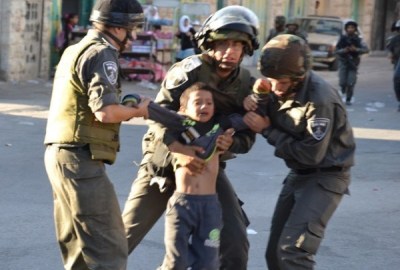
Israeli Magistrate’s Court in Jerusalem sentenced Palestinian Jerusalemite journalist and activist Samer Hussam Abu Aisha, 29, to 20 months in Israeli occupation prison. Abu Aisha has been imprisoned since 6 January 2016; he was attacked and abducted from inside the Jerusalem office of the International Committee of the Red Cross, where he and Hijazi Abu Sabih had erected a protest tent against the Israeli occupation’s order expelling them from their city of Jerusalem. They held evening events, lectures and cultural programs in rejection of deportation and in defense of the Palestinian identity of Jerusalem.
The two organizers were leaders of a campaign against Israeli occupation orders of expulsion from Al-Aqsa Mosque and from the city of Jerusalem. Their campaign included singing protests and other forms of cultural resistance and creative actions. On 16 December 2015, he and Abu Sbeih were delivered an order of expulsion from the city of Jerusalem for five months, citing “state security and order.” He had previously been arrested and harshly interrogated for 33 days, then released and banned from traveling outside Palestine. As soon as his house arrest ended, the Israeli occupation imposed the expulsion order upon them.
Abu Aisha went on hunger strike for 21 days in August in solidarity with Bilal Kayed’s demand for release from Israeli prison; he was part of a group of 35 prisoners from Gilboa prison who also demanded improved conditions inside the prison. Rawan Abu Aisha, Samer’s wife, said that the strike was in part prompted by ongoing denials of family visits.
Abu Aisha wrote earlier regarding the Israeli charges against him:
I was born in Jerusalem in 1987. I lived there all my life except for a few years during my studies in Egypt. As part of my work, I often travel to participate in conferences and youth exchanges in Arab countries and across the world.
Last August I travelled to Lebanon to participate in the 25th Arab Youth Camp. 28 hours after my return to Jerusalem on 17 August 2015, I was arrested by Israeli occupation forces and subjected to an interrogation that lasted 44 days. Eventually, I was conditionally released under open ended house arrest and accused of traveling to an “enemy state” in violation of the “Israeli” emergency regulations of 1952 which place a ban on travel to enemy state of the Zionist regime. These “laws” and policies are forced on us Palestinians despite the fact that we don’t recognize these laws, and the fact that Palestinians hold Lebanon to be a sister state which is naturally, geographically and culturally connected to Palestine.
The detention of Yasser Qous, Jerusalem director of the Palestinian Prisoners’ Society, was extended as well by Israeli occupation courts on 9 October; he had been assaulted and arrested by police forces in the Old City of Jerusalem and accused of “obstructing police work.”
Mr. Daniel H. Schulman
President and CEO
PayPal
2211 North First Street
San Jose, CA 95131
Dear Mr. Schulman,
We are writing to urge you to extend PayPal’s services to Palestinians living in the West Bank and Gaza thereby removing a major limitation on the Palestinian technology sector, one of the only bright spots in the overall economy. More importantly, extending PayPal services would resolve the current discriminatory situation whereby PayPal’s payment portal can be accessed freely by Israeli settlers living illegally (per international humanitarian law) in the West Bank while it remains unavailable to the occupied Palestinian population.
PayPal’s absence is a major obstacle to the growth of Palestine’s tech sector and the overall economy. While other payment portals are available, there is no replacement for the trust and familiarity that PayPal inspires among potential users, particularly those that are unfamiliar with Palestine-based companies. Without access to PayPal, Palestinian entrepreneurs, nonprofits, and others face routine difficulties in receiving payments for business and charitable purposes. Moreover, PayPal’s absence is problematic for the overall Palestinian economy as tech is one of the only sectors with the potential to grow under status quo conditions of the Israeli occupation which severely restricts the internal and cross-border movement of goods and people. Indeed, by entering the Palestinian market, PayPal has the opportunity to make a significant contribution toward alleviating the destabilizing unemployment rates of over 25% in the West Bank and 40% in Gaza.
We have been told that PayPal is concerned about the compliance investments required to enter the Palestinian market. We believe such costs have been greatly overestimated. The U.S. Treasury Department has spent a great deal of time working with the Palestine Monetary Authority to strengthen safeguards against abuse. PayPal currently operates in over 203 countries including places with major problems of corruption and terrorism like Somalia and Yemen. We are confident that Palestine will prove a much easier place to profitably do business than these and other markets that PayPal has already entered.
In addition to business reasons, there are also ethical reasons for PayPal to enter the Palestinian market. PayPal’s decision to launch its service in Israel for Israeli bank customers means that it inadvertently made its services freely available to Jewish settlers living illegally in the occupied West Bank. Palestinians living in close proximity to those settlers do not, however, have access as PayPal doesn’t work with Palestinian banks and Palestinians are unable to establish Israeli bank accounts. We believe a company like PayPal, whose actions in North Carolina reaffirmed its commitment to equal rights, would agree that people living in the same neighborhood ought to have equal rights and access to its services regardless of religion or ethnicity.
We understand that entering a new market can be complex and would be more than happy to work with you, the Palestinian Monetary Authority, and any other necessary officials to pave the way for PayPal’s entry to the Palestinian market.
We very much look forward to hearing from you and working with you to ensure that Palestinian entrepreneurs, nonprofits, and others are free to participate in global commerce. Our point of contact in this matter is Ehsaneh Sadr, 408-306-2559, ehsaneh.i.sadr@gmail.com.
Sincerely,
Gaza Sky Geeks
Partners for Sustainable Development
Jaffa.Net Software
iConnect Technologies
Applied Information Management (AIM)
National Beverage Company
Palestine Tourism and Investment Company
Ibtikar Fund
Americans for a Vibrant Palestinian Economy
Bethlehem Business Incubator
Advanced Technologies for Business
Kenz
BarakaBits
Al Nasher Technical Services
Leaders Organization
Bedejob.com
Netaqe.com
Indiepush
RedCrow Intelligence
Wirez
TechWadi
PinchPoint
Fadfid
Mashvisor
Arabreneur
Baskalet game studio
5qhqh.com
Myndlift
Nudge
Paltel
Arab Palestinian Investment Company (APIC)
Siniora Food Industries Company (Siniora)
Unipal General Trading Company (Unipal)
Medical Supplies and Services Company (MSS)
National Aluminum and Profiles Company (NAPCO)
Arab Palestinian Shopping Centers (BRAVO)
Palestine Automobile Company (PAC)
Sky Advertising, Public Relations, and Events Management Company (Sky)
Arab Leasing Company (ALC)
Arab Palestinian Storage and Cooling Company (APSC)
Peeks
CircleOut
Content Tech Inc.
BETHLEHEM – The Hamas movement called a visit by an International Criminal Court (ICC) delegation to the occupied Palestinian territory and Israel this weekend “pointless and useless” on Monday, after the delegation declined to include the Gaza Strip in their visit.
“It is regrettable that the ICC delegation yielded to the demands of the Israeli occupation to exclude the Gaza Strip from the delegation’s schedule, despite the fact that the Gaza Strip was the main site of Israeli crimes in 2014,” a statement released on the movement’s website said.
Various human rights groups have charged Israel with international war crimes and submitted several cases to the ICC related to Israel’s devastating 51-day assault on the Gaza Strip in 2014 that culminated in the deaths of more than 1,000 civilians. Meanwhile, critics have questioned the ICC’s ability to bring justice on issues related to Palestine in the face of Israel’s refusal to cooperate with the court, and have even faulted the ICC itself with playing a key role in the slow process of holding Israel accountable.
“As a result, Hamas considers the delegation’s visit pointless and useless. The visit has caused more pain and suffering for the families of victims who counted on the ICC to bring justice to them and bring the Israeli killers before the court.”
The fierce condemnation by Hamas, the de facto rulers of the blockaded Gaza Strip, came as the Palestinian Authority (PA)-governed occupied West Bank welcomed the delegation of the ICC’s Office of the Prosecutor (OTP) to the city of Ramallah on Saturday.
They were scheduled to meet with the committee that is charged with following up on ICC investigations, the state-run television network Palestine TV, and a Palestinian newspaper, according to the Palestine Liberation Organization (PLO). On Sunday, the delegation will travel to the city of Bethlehem in the West Bank to attend an academic meeting at Bethlehem University. Meanwhile, the OTP also plans to visit Israel.
“The State of Palestine had officially requested the OTP visit Gaza, though it was declined. We hope that on their next visit the ICC delegation will visit other areas of the Occupied State of Palestine, including Hebron and the Jordan Valley,” the PLO’s ICC Higher National Committee said Friday.
No Israelis were ever charged for the killings on the Mavi Marmara, despite a case being filed at the International Criminal Court (ICC) charging Israeli officials with war crimes.
The 51-day Israeli offensive, termed “Operation Protective Edge” by Israeli authorities, resulted in the killings of 1,462 Palestinian civilians, a third of whom were children, according to the United Nations.
After a visit to Hebron in 1996, the late Palestinian scholar Edward Said wrote, “The present situation cannot last, there are too many inequities and injustices at the heart of Palestinian life.” Two decades on, there is no end in sight to the wretched conditions he deplored back then. On the contrary, they have grown worse.
Not even Palestinian Authority President Mahmoud Abbas’s controversial decision to attend the funeral of former Israeli President Shimon Peres was enough to bring about a token suspension of the daily torment of Palestinians in the occupied territories. Immediately after his return to Ramallah, Israel declared Tel Rumeida, a neighbourhood in the Governorate of Hebron, to be a closed military area.
As is always the case when such closures are imposed, Palestinian students and residents who attempted to attend classes or go about their daily affairs were told to return to their homes until the 600 illegal Jewish settlers living in Hebron had observed their religious festivities. These celebrations are expected to last several days and so the ancient Ibrahimi Mosque was also closed to Muslim worshippers for six days.
Like their Muslim compatriots who are routinely denied access to their mosques, Christian Palestinians in Bethlehem and Jerusalem must also have permits to worship in their churches from which they are separated by the eight-metre high “security” wall. Before the creation of the state of Israel in 1948, Christians made up 18 per cent of Palestine’s population. Today, they account for less than 1.5 per cent. For reasons of political correctness, western politicians and church leaders have turned a blind eye to the real causes of this exodus; they have chosen instead to look for a scapegoat in alleged “persecution by Muslims”. That is palpable nonsense and plays into Israel’s nefarious hands.
In Hebron, life is far from normal for its 200,000 Palestinian inhabitants at the best of times. Every aspect of their lives is overshadowed by the activities of the settlers who now live illegally among them, with full military protection courtesy of the Israel Defence Forces. Palestinians must contend with the hideous road blocks and military checkpoints that swamp the old city and its environs. Recent reports confirm that more than 1,000 residential apartments have been vacated because of the harassment affecting the local Palestinian population. This was entirely predictable; Israel’s closure of more than 800 commercial businesses was meant to do exactly that — make life so intolerable for the locals that they will leave “of their own accord”. In Zionist terminology this is known rather sinisterly as “silent transfer.”
Elsewhere in the occupied West Bank, the system of inequity and injustice described by Edward Said is no less punitive. The predominantly farming community in Qalqiliya has been virtually encircled by Israel’s apartheid wall, with farmers separated from their land. More than 170,000 men, women and children are similarly locked in by the wall in Bethlehem. Former US President Jimmy Carter found it appalling that they had to obtain “permanent resident” permits from the occupation authorities in order to continue living in their own homes.
It does not take much to recognise the similarities between the Israeli permit system and the hated South African Pass Laws. Just as it was illegal for black Africans to enter designated “white areas” in South Africa so too is it illegal for Palestinians from the West Bank or Gaza Strip to visit Jerusalem, for example, without military permission. At present, the general rule is that only those aged 45 years or over are considered for a permit. While there are, of course, subtle differences, the South African jurist John Dugard has pointed out that the common features between South African apartheid and Israel’s version are discrimination, repression and territorial fragmentation.
Under these repressive and degrading conditions it was only a matter of time before a third intifada erupted in the occupied territories. Israel’s determination to seize Palestinian land for its settlements; its closure and desecration of religious sites; and its extrajudicial killings have all provided the combustible mix that has fuelled the intifada for the past year. The sheer number of settlers (more than half-a-million) and military checkpoints scattered across the West Bank (more than 500) also make the conditions ripe for anger and disaffection to fester.
Throughout their long struggle against Zionist colonisation, Palestinians have staged several uprisings. Once in motion these have never been easy to suppress. Being the weaker of the two parties militarily and politically, the Palestinians have on every occasion suffered untold human and material losses. Yet, for every successive generation, it has been considered to be a price worth paying for their freedom from Israel’s brutal military occupation.
The nature and course of the uprisings have always been unpredictable. This is especially the case today since there is no single political faction that has emerged clearly to lead or coordinate events on the ground. In the absence of any serious political initiative, and given Israel’s determination to maintain its occupation and dominance over the Palestinians, it is only reasonable to expect the current intifada to continue well into the future. In this regard, Edward Said was right: there will be no end to Palestinian efforts to end the prevailing system of inequity and injustice of a kind which only happens in occupied Palestine.
Israel’s Foreign Ministry is calling out at pretty much everyone and anyone who has wronged Jews over the last 3,000 years in a modern-day history lesson in a satirical video.
The satirical video outlines the “history of the Jewish people” by focusing on Jacob and Rachel, a nice Jewish couple that are pushed out of their home by an endless stream of unwelcome visitors.
“From ancient times to modern days, the Land of Israel has seen a whirlwind of visitors knocking on its door… but Jews were always present in their home-sweet-home,” read the new YouTube video’s caption.
Assyrians, Greeks, Arabs, crusaders, the British and many other guests stop by to “claim the home as their own” until the British eventually “realize this isn’t Europe” and give the couple back their home.
That is until, finally, a knock at the door unveils a Palestinian couple looking for somewhere to stay.
Interactions between young people and police don’t occur just on the streets of America — they’re happening in our nation’s K-12 schools, too. Increasingly police have become “embedded” in schools, in many cases working there full-time. Many are considered school staff and have daily authority over students, even in situations that have traditionally been seen as everyday disciplinary matters.
Little is known about the day-to-day practices of school-based police and about the rules under which they operate. Nobody — not even the federal government — knows how many sworn law enforcement officers (and of what type) are assigned to schools. What we do know should give us pause for concern.
Whether they are called school police officers, school resource officers, or school safety agents; carry the same weapons as a regular cop; serve in uniform; are friendly or aggressive; or are unionized; these officers have the power to arrest, detain, interrogate, and issue criminal citations to students.
It is time to rethink the role police play in our schools.
The boundaries between police and educators have become less clear — who decides what when interacting with students — and the degree of collaboration between police and educators has increased in the past two decades. Often when controversies arise, police say, “Don’t blame us. We’re here because the school asked us to be here.” Educators say, “We cannot control what police do in our school — that’s a law enforcement matter.”
Embedding such officers has real consequences for students and for the culture of schools. One popular (and growing) type of school policing, the School Resource Officer (SRO) program, blurs those lines and accountability even more. SROs are described as mentors and classroom presenters as well as cops, a so-called “triad” model of school policing. In fact, this is a big selling point of the program. School policing is presented as a form of community policing — without regard to the costs.
The activities of school-based police officers (especially SROs) are typically less regulated by formal policies than those of officers that are called to a school from the outside. Can a school-based officer be permitted to question a student without reading him or her rights? What about when an SRO is “mentoring”? What about seeing a student’s records without the permission of the student or parent? When must an SRO get a search warrant? … Full article
Libraries often find themselves on the frontlines against government overreach, whether it is opposing local politicians who want to ban books or protecting the privacy and confidentiality of their patrons from police intrusion.
The Kansas City, Mo., Public Library system has dealt with these issues over the years. But now the library finds itself at the center of a new controversy — aggressive policing — a trend increasingly common in the streets but rarely seen inside the walls of libraries.
In May, Kansas City police arrested an audience member attending a public event at a local branch of the city’s library system. The police also arrested an employee of the Kansas City Library who intervened on behalf of the audience member.
The library kept quiet about the May 9 incident for several months, hoping the city would drop the charges against the two people. When the city told the library it was moving forward with the charges, the library began to publicize the incident and how the local police suppressed free speech.
“They’ve kind of doubled-down on this and they’re moving ahead with the prosecution,” R. Crosby Kemper III, the Kansas City Library executive director, said in a video interview posted Sept. 30 on the Kansas City Starwebsite. “At this stage, I’m actually outraged. This is a big violation of the very First Amendment to the Constitution of the United States. We would expect our police department, which we have worked with very closely over the years, to want to talk to us about this and deal with this in a community way. Instead, they’ve chosen to defend the indefensible conduct of their off-duty police officer.”
The audience member, Jeremy Rothe-Kushel, was standing still and speaking into a microphone when a security guard grabbed him. Steve Woolfolk, director of public programming for the library system, intervened without touching the security guard and asked for Rothe-Kushel to be allowed to leave the library peacefully.
Woolfolk reportedly suffered a torn medial collateral ligament in his knee when a police officer providing security at the event hit him in the leg. Rothe-Kushel was arrested and charged with trespassing and resisting arrest. Woolfolk was arrested and charged with interfering with an arrest.
The arrests occurred at the Plaza branch of the Kansas City Library, where diplomat and Middle East «specialist» Dennis Ross was giving the inaugural Truman and Israel Lecture, established by the Truman Library Institute and the Jewish Community Foundation of Greater Kansas City. The Jewish Community Foundation hired the private security and off-duty police officers for the event.
Prior to the event, the library said it specified that no one was to be removed for asking uncomfortable questions and not without permission of library staff, unless there was an imminent threat of physical danger. “We were absolutely clear on this issue from the very beginning,” Kansas City Library spokeswoman Carrie Coogan said. “We don’t know why that was not communicated to the security teams that were there that day.”
The American Library Association (ALA) issued a statement on Oct. 3 expressing its support for the Kansas City Library and commended Woolfolk for defending Rothe-Kushel’s “right to question and debate matters of public concern.”
“The ALA commends the Kansas City Public Library for its commitment to fostering public deliberation and the exchange of a wide spectrum of ideas by offering meeting rooms and other spaces for lectures, educational programs, and organizational meetings,” ALA President Julie Todaro said in a statement. “Libraries are public institutions that serve as catalysts for public discussions that help solve community challenges. Such efforts are not possible when patrons are not allowed to engage in open debate in a public forum, but rather are arrested for asking difficult questions.”
The ALA said it will “extend resources” to the staff of the Kansas City Library in their legal battle over the incident.
The Jewish Community Foundation has tightened security at its facilities and events over the past two years. In April 2014, Frazier Glenn Miller Jr., a notorious neo-Nazi and Klansman, killed two people at the Jewish Community Center of Greater Kansas City in nearby Overland Park, Kan. Frazier also killed one person at Village Shalom, a Jewish retirement community located in Overland Park. Miller was convicted of the killings and sentenced to death.
In a statement on the May 9 incident, the Jewish Community Foundation noted that it included a question-and-answer opportunity after Ross’s speech “in the spirit of encouraging dialogue.” During the Q&A, “a series of actions by a questioner and a library employee began that resulted in their arrests by local law enforcement,” the organization said.
Jewish Community Foundation spokeswoman Brooke Hardy said the organization has been trying to encourage a resolution to the incident “that would be acceptable to all parties” and that it will “continue to cooperate in this matter.”
Rothe-Kushel told the Mondoweissnews site that the private security guard who grabbed him at the event was Blair Hawkins, who serves as security director for the Jewish Community Foundation.
The Kansas City Library has no plans to stop partnering with the Jewish Community Foundation, Coogan said. The library also will continue to allow private security guards at future library events. “We just will make absolutely, positively sure that they understand the expectations ahead of time,” she said.
===============
Below is a transcript of the clip with a few additional comments based on another video:
Jeremy Rothe-Kushel:
Hi, thank you. I’m very interested in the issue of tribalism and terror. Just today, I ran into an article referencing Truman’s daughter’s, Margaret’s book, disclosing that the Stern Gang sent mail bombs to Truman in ‘47, and we know that when I think – I can’t remember which group blew up the King David Hotel, but Jews were amongst the dead involved in that ‘necessary statecraft’, what ultimately became that. So you see this long history of not only the United States, but Israel utilizing terrorism that includes potentially the death of its own tribe to advance its own geopolitical cause all the way up into the 21st century, including September 11th and that whole mess that I would tell people to look at Alan Sabrosky, the Jewish, courageous Marine who’s exposed the Zionist role in that. So I would ask you, at what point does the Jewish diaspora – do we have to have the ethical courage – I’m a Jewish American – to point out that especially in America, both the countries that operate in our name have used terrorism way too long, including against its own citizens, to project power at home and abroad. When are we going to stand up and be ethical Jews and Americans?
Dennis Ross:
Well, look, I don’t think that as a matter of policy, that the United States or Israel engage in acts of terror. Terror is you target deliberately civilians for an expressed political purpose. The idea that Israel had something to do with 9/11 is just outrageous – they had nothing to do with it. [Applause]
Jeremy Rothe-Kushel:
Tell that to the Marine. Tell that to the Marine, Alan Sabrosky.
Look him up, Jewish American Marine.
Dennis Ross:
You know what? You can make up whatever you want to.
Jeremy Rothe-Kushel:
I didn’t make that up.
Dennis Ross:
Well, I’m a big believer – as Patrick– Daniel Patrick Moynihan used to say, everybody’s entitled to their own opinions; they’re just not entitled to their own facts. [Applause]
Greg McCarron:
Take your own advice Dennis.
Jeremy Rothe-Kushel:
True—–, Go look at September —- [–mic being cut in and out] …. [off mic] free fall speed
[At this time, while at the microphone beginning to respond to Dennis Ross, Rothe-Kushel’s upper left arm was grabbed with force, with no apparent warning, from behind by the head of the Jewish Community Foundation’s private security detail, and pushed away from the microphone and towards another, currently unidentified, member of security.]
Jeremy Rothe-Kushel: Do not touch me!
Get your hands off me right now!
[Multiple people are grabbing Rothe-Kushel at this point]
You can ask me to leave.
I will leave if asked.
Get your hands off me!
Greg McCarron:
Hey! He has a right to talk without being–
Patron sitting next to Greg:
No he had a right to ask the question and he asked the question.
Greg McCarron:
They don’t have to be putting their hands on him like that!
Jeremy Rothe-Kushel:
Get your hands off me.
I will leave if asked.
Get your hands off of me.
I will ask if leaved–
[At this time, Dennis Ross begins to move on to the next question, by stating the following:]
Dennis Ross:
Okay, you know what? I will accept the question and we can ignore that.
Jeremy Rothe-Kushel:
I will leave.
Get your hands off of me!
I didn’t threaten anybody.
As world leaders congregated in Jerusalem last weekend to eulogise Shimon Peres as a “great peacemaker”, the peace camp of which he was the figurehead went to war against its main Palestinian partner in Israel.
Ayman Odeh, head of the only Jewish-Arab party in the Israeli legislature, is the most prominent representative of Israel’s 1.7 million Palestinian citizens. He also serves as chairman of a coalition called the Joint List, formed with other Palestinian parties, that is now the third largest in parliament.
Mr Odeh, nonetheless, enraged the Israeli Jewish public by refusing to attend Peres’s funeral.
The Joint List leader is known for his efforts to build bridges to deprived and vulnerable Jewish communities. He is committed to strengthening trust between Jews and Palestinians, rather than emphasising national conflict.
His advocacy for a new civic identity – abolishing Israel’s institutionalised ethnic categories of Jew and Arab – earned him a place last year on the top 100 global thinkers list compiled by Foreign Policy magazine.
So how, the Israeli media lamented, could he not pay his last respects to Peres, architect of the Oslo Accords?
Mr Odeh’s boycott of the funeral was all the more shocking to Israelis because Mahmoud Abbas, the president of the Palestinian Authority, came to bid Peres farewell – after Israel issued him a rare permit to enter Jerusalem. Pictures of Mr Abbas and Israeli prime minister Benjamin Netanyahu shaking hands only underscored Mr Odeh’s absence.
But even that was hastily exploited to augment Peres’s beatification. If Peres had long proved his dedication to the cause of peace, Mr Odeh’s treatment of him in death confirmed that Israel lacked a Palestinian partner even inside Israel.
That is a narrative that Israeli Jews are only too familiar with. After the Oslo process collapsed at the Camp David summit in 2000, Israeli prime minister Ehud Barak – then head of the peace camp – accused Palestinian leader Yasser Arafat of being “no partner for peace”. This paved the way to the Second Intifada.
In similar fashion, Jewish politicians associated with the peace movement turned their fire on Mr Odeh. Erel Margalit, a member of parliament in the centre-left Zionist Union, accused him of “sticking a finger in the eyes” of the peace camp.
By contrast, for most Palestinians, it was Mr Abbas’s attendance at the funeral, not Mr Odeh’s boycott, that was baffling.
While Mr Odeh acknowledged the private grief of the Peres family, he argued that the funeral was “part of a national day of mourning in which I have no place”.
The mythical Peres honoured by the world is unrecognisable to Palestinians. They regard even his most visible achievement, the Oslo Accords, as a cynical trap. It was never designed to lead to a viable Palestinian state, but rather leave the PA in a twilight zone of semi-sovereignty, acting as the servile police force of the occupation.
In addition, Israel’s Palestinian citizens like Mr Odeh found that Oslo intentionally severed them from their kin in the occupied territories, culminating in a steel-and-concrete separation barrier that further fragmented the Palestinian people.
The domestic narrative about Peres excluded Israel’s Palestinian citizens no less, said Mr Odeh.
Eulogies in Hebrew extolled a Peres who armed Israeli soldiers to destroy the Palestinian homeland in the Nakba of 1948; who then oversaw two decades of internal military repression against Israel’s Palestinian minority; who built a nuclear bomb to ensure Israel could bully the entire Middle East; and who engineered the settlement project as a way to make the occupation irreversible.
These were reasons enough for not attending. But Mr Odeh expressed a more personal concern.
Given their unique position inside Israel, Palestinian citizens had connected with the “historic pain” of a long-persecuted people. But that empathy had never been reciprocated – even by Israel’s peace camp.
Mr Odeh was not referring only to the Nakba. Peres’s funeral coincided with the anniversary of events at the start of the Second Intifada when Israeli police killed 13 unarmed Palestinian demonstrators. Among them was the brother of Mr Odeh’s wife.
Although a later judicial inquiry concluded that the police had an institutional view of Israel’s Palestinian minority as an enemy, no officers were indicted. Neither was there a formal apology, even from Peres, who served for many years as president.
In choosing to attend the funeral, Mr Abbas doubtless had to weigh up many factors, including his international standing, diplomatic protocol and bolstering his own legacy as a peacemaker.
The major consideration for Mr Odeh, by contrast, was whether his presence might further indulge the self-delusions and moral evasions of Israel’s self-styled peace camp.
The correctness of his decision was driven home soon enough. On Tuesday, the Israeli media reported that Isaac Herzog, head of the peace bloc in parliament led by the Zionist Union, was close to a deal to join the most right-wing government in Israel’s history.
If Mr Herzog does decide to shore up a government committed to militarism and entrenching the occupation, he will be following a path well trodden by Peres himself.
The Israeli navy has seized the Zaytouna-Oliva, a Gaza-bound aid ship, and is currently towing it towards the Israeli port city of Ashdod, according to the initiative’s organizers and reports in the Israeli media.
Sondos Ferwana, a media spokeswoman for the International Coalition for the Fourth Freedom Flotilla, told reporters on Wednesday evening that Israeli naval forces had “captured the ship”.
The Israeli military, for its part, confirmed the ship’s seizure in a statement.
“The Israeli Defense Forces managed to quickly seize the ship without causing any injuries among passengers,” the statement read.
According to the military, the crew of the Gaza-bound vessel had initially refused the navy’s orders to change course.
“This forced us to intervene and seize the ship before it violated the legal maritime closure imposed on the Gaza Strip,” the statement read.
According to reports on Israel’s Channel Two television station, the aid ship was intercepted — without resistance — some 80 kilometers off Gaza’s coast.
Ferwana, for her part, described the incident as “another act of Israeli piracy”, adding that all contact with the ship — which is carrying humanitarian aid and several female activists — had been lost.
“We don’t know the fate of the activists aboard,” she said.
Passengers on the Zaytouna-Oliva, which set sail from the Spanish city of Barcelona last month, include Irish Nobel Peace Prize laureate Mairead Maguire, Swedish and Algerian lawmakers, a South African Olympic athlete and a Malaysian doctor.
The all-female initiative seeks to break Israel’s decade-long blockade of the Gaza Strip and show solidarity with the women of Gaza.
Palestinian resistance movement Hamas, for its part, which has governed the Gaza Strip since 2007, condemned what it described “the Israeli occupation’s assault on the aid ship and its intimidation of the activists on board”.
In a statement, Hamas spokesman Fawzi Barhoum said the incident amounted to “an act of state terrorism” and another example of Israeli “aggression against the Palestinian people and those who show solidarity with the Palestinian cause”.
Barhoum went on to urge the international community to “put an end to Israel’s crimes”, stressing the need for immediate action “to lift the blockade and rescue the people of Gaza”.
In June of last year, Israeli forces intercepted the “Marianne” — which had been taking part in a similar initiative — and arrested all activists on board.
A similar Gaza-bound aid flotilla ended in tragedy in 2010 when the Mavi Marmara, a Turkish aid ship, was raided by Israeli commandos who killed 10 Turkish activists.
Since 2007, the Hamas-run Gaza Strip has groaned under a crippling Israeli/Egyptian blockade that has deprived its almost two million inhabitants of most basic commodities, including food, fuel, medicine and desperately-needed building materials.
In June, UN Secretary-General Ban Ki-moon described the blockade of Gaza as “collective punishment”, which, he asserted, “suffocates its people, stifles its economy and impedes reconstruction efforts”.
A UK House of Commons inquiry into the 2011 attack on Libya and the country’s subsequent collapse has found what many suspected: NATO and its Gulf Arab allies used their ‘Responsibility To Protect’ to launch their attack even though:
“… the proposition that Muammar Gaddafi would have ordered the massacre of civilians in Benghazi was not supported by the available evidence.”
Though the MPs’ damning report blames Libya’s political and economic collapse on former Prime Minister David Cameron, the manipulation of public opinion to lay the basis for war is built upon longstanding – but now sharpened – processes and semantic structures that prepare populations to accept punitive action against a targeted ‘other’.
In an earlier example, on October 10 1990, a young Kuwaiti woman known as ‘Nayirah’ testified before the United States’ Congressional Human Rights Caucus that invading Iraqi soldiers had gone into hospitals and thrown babies from their incubators.
Nayirah turned out to be the daughter of the then Kuwaiti ambassador to Washington. Her testimony was false and prepared by a PR company. But it was solid gold for the US campaign to intervene militarily. Amnesty International provided influential support for Nayirah’s story. The ‘depravity’ of Saddam Hussein’s government was proffered by governments and mainstream media as a key reason for military intervention.
In March, 2011, Libyan opposition fighters and a Libyan psychologist, Dr Seham Sergewa told foreign media that pro-Qaddhafi fighters were being ordered to carry out viagra-fuelled mass rapes. The claim – spread by Al-Jazeera – was this time picked up by the prosecutor of the International Criminal Court, Luis Moreno-Ocampo. Although Amnesty International questioned some of the claims this time, the rape story was one of many myths that contributed to the NATO bombardment of Libya – the beginning of the end of the Libyan state.
The ‘humanitarian’ battle cry of 2011 was another manifestation of neo-Orientalist rhetoric directed towards out-of-favour leaders or groups.
Edward Said’s “Orientalism” referred to Western stereotyping of Arabs and Arab culture through a colonial lens. Currently, Neo-Orientalism is typically based on sensational claims that target ‘others’ (leaders or groups) by depicting them as intrinsically alien, evil and irrational, in order to justify aggression against them.
Qaddhafi’s relationship with the West was full of moments that prepared us to unquestionably accept claims of his barbarity – to the extent that Hillary Clinton could mock his torture and murder by rebels.
Regardless of his positive and negative attributes, the language used to describe Qaddhafi – a son of peasant goat herders – was often insulting and unprofessional. Journalist and historian Gwynne Dyer for example: “
… resplendent in the gold brocade robes that he probably made from his mother’s curtains and wearing his usual bug-eye sunglasses… The world’s oldest teenager…”
The New York Timestreated Qaddhafi’s international visits featuring his bedouin tent as a circus fit for New York’s Coney Island rather than an important cultural symbol of Libya’s or Qaddhafi’s heritage. One wonders whether anyone would dare attempt similar treatment of Australia’s Aboriginal Tent Embassy which has been a feature of the capital Canberra since 1972.
There were numerous stories of the ‘chauvinistic’ displays of Qaddhafi’s ‘Amazonian’ republican guard. However ‘Amazonian’ legends of powerful female bodyguards have a long history in North Africa and especially Libya. Greek mythology – the source of Amazonian legends – speaks of Queen Myrina the Amazonian queen who led military victories in Libya. Under Islam there was the wealthy and powerful King Musa I of Mali, who was protected by such an Amazonian troop while undertaking the Hajj in 1332. It seems not a single commentator bothered to note the antecedents of such symbolism before resorting to ridicule.
It is not only the media and politicians who join the neo-Orientalist derision of disagreeable leaders. Descriptions of Qaddhafi in Harvard professor and historian Roger Owen’s recent work The Rise and Fall of Arab Presidents for Life, exhibit shades of cultural superiority. After indulging in psychological speculation about Arab leaders, Owen (p.199) criticises Qaddhafi’s relationship with the African Union particularly his “bringing African heads of state to Libya and posturing before them in ‘African’ costumes of his own design with absurd-looking little round caps”.
Aside from Owen’s dismissal of the African Union, he sees no irony in ridiculing Qaddafi for doing exactly what the leaders of the world’s most powerful countries do at APEC and G20 meetings – put on ‘absurd’ cultural uniforms like the imagined Australian stockmen’s outfits worn by APEC leaders in Sydney in 2007:
John Howard and George W. Bush at APEC in Sydney 2007, Source: The Guardian
Owen depicts Arab governments as wholly subject to the whims of a strongman leader. While the West – and sometimes Arab leaders themselves – like to portray authoritarian governments as ruled by maniacal and all-powerful men individually, this is rarely the case – especially in Libya as demonstrated by this Wikileaks cable showing disagreements amongst the Libyan leadership.
Such systems are far too complex to be overseen by one person. As Oxford Professor Richard Bosworth argues, in addition to clouding other factors involved in the operation of such states, judgemental and presumptive treatments such as Owen’s tend to dismiss leaders as mad and evil which prevents comprehensive understanding.
The terminology of ‘regimes’ and ‘governments’ is another rhetorical tool aimed at demonising chosen targets. ‘Regimes’ sound all controlling, mechanical and despotic while ‘governments’ sound rational, responsive and civil. But as academic Lisa Anderson has pointed out the term ‘regime’ is widely misused. A regime is the: “set of rules, or cultural or social norms that regulate the relations between ruled and rulers. Including how laws are made and administered and how the rulers are themselves selected”. As such regimes come in types, Totalitarian, Authoritarian, Democratic etc.
A ‘government’ on the other hand “comprises those incumbents and the policies associated with them”. Referring to the ‘Qaddhafi Regime’ or ‘Mubarak Regime’ is a problematic conflation of regime type, government and the actors involved in it. Applying the same conflation to Western governments would result in labels like ‘Obama regime’.
‘Orientals’ or just the non-compliant?
Neo-Orientalist language cannot be explained away as a reaction to brutality. If a leader’s brutality was the benchmark for engaging in this form of vitriol, it could be just as easily applied to every US President.
Rather the point of this type of language is to de-legitimise and de-humanise or barbarise a targeted ‘other’. Neo-Orientalist language has (mostly) retreated from typecasting entire civilisations – as this has become less acceptable among western audiences – and has retreated to depictions of individual leaders, sub-groups or sub-ideologies.
Those selected, most commonly for their ‘uncooperative’ international behaviour, are not worthy of engagement or understanding, simply of fear and loathing. The use of violence against such ‘irrational’ forces becomes legitimate and ‘just’.
The language of neo-Orientalism takes many guises, from the ‘war on terror’ to ‘humanitarian intervention’ and has been so successful in cloaking itself in ‘liberal’ values that it attracts support from across the political spectrum.
As Robert Irwin pointed out in his 2006 critique of Edward Said’s Orientalism, the expression of ‘Orientalist’ language does not need to be limited in time (to the European colonial period) or place (the Arab world). By seeking to solely link Orientalism to the European and American imperial ages Said confused and understated the breadth of his argument. Orientalism was not limited to ‘the Orient’, but was and is directed at other groups – both ethnic and political.
For example, western media treatment of Russian President Vladimir Putin also involves ridicule of both cultural symbolism and psychological state.
According to Vox News and Angela Merkel, Putin’s machismo is a cover for “personal insecurity as a weak leader” and is responsible for his “invasion of Ukraine”. We are also told Putin’s ‘machismo’ and ‘aggression’ is the cumulative embodiment of Russian shame and weakness. Merkel was quoted as saying “Russia has nothing, no successful politics or economy. All they have is this [machismo].”
Without delving into to the possible objections to this account, why is Putin’s ‘aggressive’ behaviour seen as a unique flaw in individual and national character? What about the destruction that the United States wrought following the ‘injury’ to the American ego that was September 11? What about the UK’s war of indignation in the Falkland Islands? With the same logic and tone one could posit that the entire British colonial age was a result of ego issues within the ‘lonely little island in the North Sea’.
What of Hillary Clinton’s psychological state or the culture she embodies? Sold as the ‘normal’ presidential candidate, this is the woman who mocked Qaddhafi’s death with “We came, we saw, he died…” and seems to carry no baggage from the destruction of a country on almost entirely false pretences.
One persuasive critic of neo-Orientalism, Alastair Crooke, identifies it as a manifestation of a Western mindset of dominance in the present era. “
… this is the new racialism… a hierarchy of civilisations in which the West sees its civilisation as the most appropriate one for the future… superior and the template that should be imposed on others…”
Status quo powers deploy much effort and money to explain their transgressions but most are based on the simple assumption that equal standards do not apply; we are ‘rational’ and ‘just’, they are not.
Alex Ray works on cultural exchange between the West and the Arab world. Based in Jordan, he holds a MA in Middle East and Central Asian Studies from the Australian National University and is a former student of the University of Damascus. He writes at https://betweendeserts.wordpress.com/
The deployment of Russian SE-23 missiles to Syria undermines the Israeli deterrence against the Syrian military force and Hezbollah, and enhances the power of Iran indirectly, Zionist daily Yadiot Aharonot reported Wednesday.
“All of this gets here at a time where there is no confirmation that the Americans will take a move in Syria,” Yadiot Aharonot said.
The Zionist newspaper underlined that “installing the SE-23 anti-aircraft missiles by Russia in Syria is a bad news for Israel because the two installed models are able to “shoot down planes in Israeli airspace or over the sea and when Israeli aircraft attack targets inside Syria or Lebanon.”
“The Russians might use those missiles against our aerial activities in the region,” it added.
In a related development, the Zionist website Walla stated that Moscow’s decision to deploy modern S-300 missiles in naval bases in Syria will change the rules of the game, because it will restrict the “freedom of the Israeli air force in the Syrian airspace.”
“There is fear in the Israeli security service that this would increase the confidence of Syrian President Bashar al-Assad and increase hostilities against Israel,” the Zionist website said.
For its part, Israel Hayom newspaper said that the battle for Aleppo has “painted a picture of the new world,” adding that “it is sad that the Americans have left the field to the Russians.”
The Bank of Ireland has been criticised after shutting the account of the Ireland Palestine Solidarity Campaign (IPSC), the latest in a string of similar moves by European banks.
IPSC has formally complained, following the closure of its account which it uses to lodge donations, and intends to take a case to the Financial Services Ombudsman.
Earlier this year, the Bank of Ireland requested information from IPSC about its funding and how funds were spent, in response to which, IPSC submitted its audited accounts.
According to IPSC, the Bank of Ireland has “failed to give a specific explanation of why it was closing the accounts.”
Kevin Squires, IPSC coordinator told TheJournal.ie : “Bank of Ireland’s silence speaks volumes. Honestly it’s hard to not view this as part of a wider campaign which has seen banks close accounts in the UK, Austria and France.”
“In the last year or so we have had €1,200 go to Palestine to pay for Palestinian scarves, which is a tiny amount. That’s trade with Palestine. It’s not like we’re sending money to people there.”
Vice-President of Sinn Fein and a Teachta Dala for Dublin Central, Mary Lou McDonald, said the decision was “outrageous”.
“The Ireland Palestine Solidarity Campaign are an established advocacy group that have spent years protesting against the treatment of the Palestinian people. To close their account citing that they associate with a ‘high risk country’… this is not only outrageous; this is insulting to the Palestinian people.”
“Bank of Ireland cannot stay silent on this matter,” she added.
The following is from a statement by the IPSC:
This denial of banking rights, the ensuing loss of income and the potential reputational damage to the IPSC comes in the context of similar seemingly coordinated attacks on Palestine solidarity organisations across Europe and the United States. Numerous bank accounts belonging to such organisations have been closed in France, Germany, Austria and the UK. It is difficult to escape the conclusion that this attack on the IPSC’s ability to bank – which is, in effect, the ability to function at all – is political in nature and forms part of this wider attack on organisations that advocate for peaceful action to secure Palestinian rights enshrined in international law.
Israel has boasted of conducting a global campaign of ‘lawfare’ – using legal and other punitive threats to silence and attack supporters of Palestinian rights. This attack on the IPSC It appears to be part of this campaign, a politically motivated measure to silence a human rights organsiation that campaigns for Boycott, Divestment and Sanctions (BDS) against Israel until it fulfils its obligations under international law – a campaign the Irish government views as an entirely “legitimate” means of protest “intended to pressure Israel into ending the occupation.”
Reknowned economist M. Shahid Alamoffers this excellent critique of Noam Chomsky’s defective analysis of the relative influence of Oil versus the Israel lobby over US foreign policy: … continue
This site is provided as a research and reference tool. Although we make every reasonable effort to ensure that the information and data provided at this site are useful, accurate, and current, we cannot guarantee that the information and data provided here will be error-free. By using this site, you assume all responsibility for and risk arising from your use of and reliance upon the contents of this site.
This site and the information available through it do not, and are not intended to constitute legal advice. Should you require legal advice, you should consult your own attorney.
Nothing within this site or linked to by this site constitutes investment advice or medical advice.
Materials accessible from or added to this site by third parties, such as comments posted, are strictly the responsibility of the third party who added such materials or made them accessible and we neither endorse nor undertake to control, monitor, edit or assume responsibility for any such third-party material.
The posting of stories, commentaries, reports, documents and links (embedded or otherwise) on this site does not in any way, shape or form, implied or otherwise, necessarily express or suggest endorsement or support of any of such posted material or parts therein.
The word “alleged” is deemed to occur before the word “fraud.” Since the rule of law still applies. To peasants, at least.
Fair Use
This site contains copyrighted material the use of which has not always been specifically authorized by the copyright owner. We are making such material available in our efforts to advance understanding of environmental, political, human rights, economic, democracy, scientific, and social justice issues, etc. We believe this constitutes a ‘fair use’ of any such copyrighted material as provided for in section 107 of the US Copyright Law. In accordance with Title 17 U.S.C. Section 107, the material on this site is distributed without profit to those who have expressed a prior interest in receiving the included information for research and educational purposes. For more info go to: http://www.law.cornell.edu/uscode/17/107.shtml. If you wish to use copyrighted material from this site for purposes of your own that go beyond ‘fair use’, you must obtain permission from the copyright owner.
DMCA Contact
This is information for anyone that wishes to challenge our “fair use” of copyrighted material.
If you are a legal copyright holder or a designated agent for such and you believe that content residing on or accessible through our website infringes a copyright and falls outside the boundaries of “Fair Use”, please send a notice of infringement by contacting atheonews@gmail.com.
We will respond and take necessary action immediately.
If notice is given of an alleged copyright violation we will act expeditiously to remove or disable access to the material(s) in question.
All 3rd party material posted on this website is copyright the respective owners / authors. Aletho News makes no claim of copyright on such material.
 Israeli Magistrate’s Court in Jerusalem sentenced Palestinian Jerusalemite journalist and activist