Terror Bombing in Brussels and Paris: Europe’s Islamist Legionnaires Come Home to Fight
By James Petras :: 04.08.2016
Introduction: The terror bombings in Paris and Brussels have raised a cacophony of voices, ranging from state officials, Prime Ministers and Presidents, to academics, journalists and media consultants. Tons of ink and print have focused on the psychology, networks and operations of the alleged perpetrators – radicalized young Muslim citizens of the EU.
Few have examined the long-term, large-scale policies of the EU, US and NATO, which have been associated with the development and growth of the worldwide terror networks. This essay will discuss the historical links between Islamist terrorists and the US-Saudi Arabian-Pakistani intervention in Afghanistan, as well as the consequences of the US invasion and occupation of Iraq. In Iraq, the US implemented a deliberate policy of destroying all secular state structures and promoting the Balkanization of the country via ethnic-religious and tribal wars – a policy it has followed in subsequent areas of intervention.
The last section will focus on the US-EU-Gulf Petrol-Monarchy proxy invasions and ‘regime change’ bombings of the secular republics of Libya and Syria with the further cultivation and growth of international Islamist terrorism.
Historical Origins of International Islamist Terrorism: Afghanistan
In 1979, President James Carter and his National Security Chief, Zbigniew Brzezinski, launched Operation Cyclone, a major Islamist uprising against the Soviet- aligned secular Afghan regime. The US coordinated its campaign with the rabidly anti-Soviet monarchy in Saudi Arabia, which provided the funding and mercenaries for ‘international jihad’ against secular governance. This brutal campaign ‘officially’ lasted 10 years until the Soviet withdrawal in 1989. It produced millions of casualties and decades of ‘blow-back’ when the CIA-Pakistani-Saudi trained Arab mercenaries (the ‘Afghan-Arabs’) returned to their home countries and elsewhere. The US intelligence agencies, Special Forces Commands and military directorates (especially Pakistan’s ISI intelligence service) trained and armed terrorists with US-Saudi funding. The American covert financial contribution mushroomed over the years rising to over $670 million dollars a year by 1987. Tens of thousands of Islamist mercenaries and adventurers were recruited from the Middle East, North Africa, the Gulf States, the Soviet Union (Chechens), Yugoslavia (Bosnians and Kosovars), China (Uigurs) and Western Europe.
With the defeat of the secular regime of President Najibullah in 1992, the Islamists and tribal factions then fought among themselves, converting Afghanistan into the world’s best-equipped training ground for International Islamist terrorists. Eventually, the Pashtun-based Taliban faction (with Pakistani arms and support) prevailed and established an extreme Islamist regime. The Taliban, despite its rhetoric, settled down to consolidating their brand of ‘Islamism in one country’, (1995-2001), a largely nationalist project. In its quest for respectability, it successfully destroyed the opium poppy fields, earning the praise of US President GW Bush in spring 2001. It also hosted a variety of Saudi princes and warlords, eventually including the jihadi-internationalist Osama bin Laden, who had been driven from North Africa.
Following the terrorist attack on the US in September 2001, the US and NATO invaded Afghanistan on October 2001 and overthrew the nation-centered Islamist Taliban regime. The subsequent chaos and guerrilla war opened up a huge new inflow and outflow of thousands of international extremists who came to Afghanistan, trained, fought and then departed, fully prepared to practice their terrorist skills in their countries of origin in Europe, North Africa and the Middle East.
The US interventions and invasion of Afghanistan provide some of the context for the subsequent bombings in Europe and the US. The Islamist ‘returnees’ to Europe and elsewhere had received funds from Saudi Arabia and training from the CIA and Pakistani intelligence. They began their work among a very ‘available’ constituency of potential recruits in the marginalized Muslim youth of the ghettos and prisons of Europe.
The Middle Period: the US-Zionist Invasion and Destruction of Iraq
The turning point in the growth and internationalization of Islamist terrorism was the US invasion, occupation and systematic reign of terror in Iraq. Largely under the guidance of key US Zionist policymakers (and Israeli advisers) in the Pentagon, State Department and the White House, the US dismantled the entire secular Iraqi army and police forces. They also purged the administrative, civil, educational, medical and scientific institutions of nationalistic secular professionals, opening the field to warring Islamist tribal factions. Hundreds of thousands of Iraqi civilians were killed and millions fled in a regime of ethnic cleansing – which Washington touted as a model for the rest of the Middle East. However, thousands of experienced, but jobless Iraqi military officers, who had survived the US-orchestrated purges, regrouped and eventually joined with tens of thousands of nationalist and internationalist Islamist extremists to form ISIS. Their motives were arguable less ethno-religious and more related to revenge for their displacement and the destruction of their own society.
The deliberate US (Zionist)-EU-Saudi strategy to divide and conquer Iraq initially involved working closely with Sunni feudal tribal leaders and other extremists to counter the rising power of pro-Iranian Shia. They promoted a policy of fragmenting the country with the Kurds dominating in the North, the Sunnis in the center and the Shia in the south (the so-called Joseph Biden-Leslie Gelb Plan of national dismemberment and ethnic cleansing). The rationale was to create a weak central authority completely under US-EU tutelage and a loose group of fragmented subsistence fiefdoms in what had been the most advanced secular Arab republic.
Despite pouring billions of dollars in arms from the US to create a puppet-colonial Iraqi ‘national army’, the Saudis and Israelis pursued their own policy of financing sectors of the Kurds and violent Sunni opposition – with the latter forming the original mass base of ISIS.
As the US-client Shia regime in Baghdad focused on stealing billions while killing or exiling hundreds of thousands of educated Sunnis, Christians and other secular Iraqis from the capital, the morale of its US-puppet troops plummeted. With the entire experienced and nationalist Iraqi officer core purged (slaughtered or driven into hiding), the new puppet officers were cowardly, corrupt and incompetent – as openly acknowledged by their US ‘advisers’. ISIS, meanwhile had acquired hundreds of thousands of US weapons and was financed by the Shia-hating Saudi Royal Family and other Gulf Monarchs. Armed Sunnis soon launched major, lightning-quick offensives under the leadership of ex-Baathist army officers, supported by thousands of terrorists, suicide bombers and foreign mercenaries. US and European ‘military experts’ expressed ’shock’ at their effectiveness.
ISIS routed the Baghdad-controlled army, their US advisers and Kurdish allies from northern Iraq, capturing major cities, including Mosul, thousands of productive oil wells and drove their forces to within a few dozen kilometers of Baghdad. Territorial conquest and military successes attracted thousands more Islamist volunteers from the Middle East, Europe, Afghanistan and even North America. ISIS provided the military training; Saudi Arabia paid their salaries; Turkey purchased their captured oil and antiquities and opened its borders to the transfer of jihadi troops and weapons. Israel, for its part, purchased captured ISIS petrol at a discount from corrupt Turkish traders. Each regional player had its snout in the bloody trough that had once been Iraq!
ISIS successes in Iraq, led it to expand its operations and ambitions across the border into Syria. This occurred just as the US and EU were bombing and destroying the secular government of Colonel Gadhafi in Libya, in another ‘wildly successful’ planned campaign of ‘regime change’ (According to US Secretary of State Clinton as she gleefully watched the captive wounded Gadhafi ’snuff film’ by unspeakable torture – ‘WE came and HE died’.).
The chaos that ensued in Libya led to an exponential growth of extremist Islamist groups with tons of weapons of ‘liberated’ Libyan weapons! Islamist terrorists in Libya gained territory, took over oil wells and attracted ‘volunteers’ from the marginalized youth of neighboring Tunisia, Egypt, Mali and as far away as Somalia, Afghanistan, Iraq and Syria. Flush with more guns, money and training. Many graduates went on to Syria and Iraq.
The Contemporary Period: EU-US-Turkey-Saudi-Israeli Sponsored War in Syria
In 2011, as ISIS rolled across the Iraqi border into Syria and terrorist Islamist bands seized cities in Libya, the US-EU-Turkish-Saudi and Israeli regimes financed and armed Islamist (and the mythical ‘moderate’) forces in Syria to overthrow the nationalist-secular Syrian regime of Bashar al Assad.
Thousands of Islamist extremist volunteers heeded the call (and the fat paychecks) of the Saudi regime and its Salafist propagandists. These constituted the Saudi Royal Family’s own ‘Foreign Legion’. They were trained and armed and shipped into Syria by Turkish intelligence. The US armed and trained hundreds of its own so-called ‘moderate rebels’ whose fighters quickly defected to ISIS and other terrorist groups turning over tons of US arms, while the ‘moderate rebel leaders’ gave press conferences from London and Washington. ISIS seized swaths of Syrian territory, sweeping westward toward the Russian naval and air bases on the coast and upward from the south, encircling Damascus. Millions were uprooted and minority populations were enslaved or slaughtered.
The news of ISIS territorial gains with their plundered oil wealth from sales to Turkey and the flow of arms from Saudi Arabia, the EU and the US attracted over 30,000 ‘volunteer’ mercenaries from North America, Europe, North Africa, the Middle East and South Asia.
These new terrorists received military training, including bomb making and logistical planning in Syria. Many were citizens of the EU, Islamist extremists, numbering over five thousand. These young fighters trained and fought in Syria and then returned to France, Belgium, Germany and the rest of the EU. They had gone to Syria with the tacit support and/or tolerance of their own European governments who had used them, rather than NATO troops, in the US-EU campaign of ‘regime change’ against Damascus.
The European governments were sure they had ‘their’ Muslim recruits under control as they joined the US in a reckless policy of overthrowing independent secular governments in the Middle East and North Africa. They happily encouraged their marginalized young Muslim citizens to flock to Syria and fight. They hoped they would remain in Syria (fighting on the ground or buried under the ground). Officially, EU leaders claimed to support ‘moderate rebels’ (the bland term Western media used to sanitize Islamist terrorists) fighting the Assad ‘dictatorship’. European regimes were not prepared to detain the battle hardened ‘returnees’, who had been trained in Iraq and Syria. These young European Muslims (children of immigrants or converts to Islam) had been heavily indoctrinated and incorporated into international terrorist networks. They easily melted back into their marginalized European urban ghettos – beyond the control of Europe’s bloated intelligence services.
In practice, the EU regimes saw the thousands of Europe’s Muslim youth flocking to Syria as an ‘EU Foreign Legion’, a glorified wastebasket for unemployed young thugs and ex-prisoners, who would advance NATO’s imperial goals while solving the domestic social problem of the marginalized children of North African migrants. Europe’s Muslim youth were viewed as convenient cannon fodder by NATO planners and the governments of France, Belgium and the UK. For public relations, it was better for these young men and women to die overthrowing the secular government in Syria than to send in European soldiers (white Christians) whose deaths would have domestic political repercussions.
The EU underestimated the depth of antagonism these ‘volunteers’ felt about US-EU intervention in the Middle East and North Africa, as well as their anger at Europe’s continued support for Israeli land grabs in Palestine. In its racist arrogance, EU leaders underestimated the capacity of ISIS to indoctrinate, train and organize these marginalized kids from Europe’s slums into effective international cells able to carry the war back to Europe.
 The EU smugly overlooked the active roles of Turkey and Saudi Arabia who had their own independent, regional ambitions. Ankara and Riyadh trained and financed the ‘volunteers’, and facilitated their flow into Syria from camps in Turkey and Jordan. The wounded were treated in Turkey and sometimes even in Israel. Thousands, many EU citizens, would flow back into Europe or to their countries of origin in the Middle East and North Africa, as well as Russia.
The EU had slavishly and blindly followed Washington’s lead in all its Middle East wars. Now it is now paying a big price: Thousands of trained terrorists have returned; bombings and attacks on European civilians and civil structures have occurred, while the European government leaders trip over each other in a mad rush to dismantle civil and constitutional citizen rights and impose wide ranging police state measures (States of Emergency).
These new Saudi-funded terrorist recruits (Riyadh’s Legionnaires) are active in all the countries where the US and EU have launched proxy wars: Iraq, Syria, Libya, Yemen, Afghanistan . . . Turkey funds ISIS terrorists in Syria, Iraq and Kurdish territories to advance its own expansionist ambitions – oblivious to the clucking disapproval of EU leaders. Now Turkey receives over 6 billion Euro’s from the EU in what amounts to blackmail: In return, Turkey will ‘contain’ the flood of regional refugees in barely disguised concentration camps out of European sight.
Conclusion
Ever since the US-EU policymakers decided to implement a war against Arab and West Asian secular nationalism in the Middle-East, Afghanistan, Iran and North Africa through serial ‘regime change’ campaigns they have relied on Islamist Salafist mercenaries and volunteers to do most of the killing on the ground, while the West operates from the air. Washington and its NATO allies operated on the assumption that they could use and then discard their recruits, mostly from marginalized urban youth and criminal gangs, once they had served imperial military purposes. A few with requisite talent and ruthlessness could be turned into puppet ‘leaders’ to unleash on the Russians and other ‘obstacles’ in future engagements.
The EU-US totally misunderstood the volunteers’ high level of independence, their organizational autonomy and their own understanding of the tactical nature of their alliance with Western imperialism. Islamist extremist leaders, like their Western counterparts, believe there are no permanent alliances – only permanent interests.
The EU and US have pursued a policy of overthrowing independent Muslim and secular Arab nations and returning them to the status of pre-independence semi-colonies. The rollback policy against secular nationalism (with its deep roots in the Dulles era) has extended from North Africa, through the Middle East to Southwest Asia. For its part, ISIS and its allies envision a return to a pre-colonial Islamic caliphate over the same lands and people to counter Western imperialism. Millions are caught in the middle.
ISIS views the Westernized secular elites in the Muslim countries as a fifth column for the spread of empire, while it has re-socialized and trained young Islamists from the EU to serve as networks of terrorists ‘behind enemy lines’ sowing mayhem in the West.
The political repercussions of this internationalized war are profound. Millions of civilians in the war zones have been and will be killed, uprooted and converted into desperate refugees flooding the EU. Police-state emergency rule, arbitrary searches, arrests and interrogations have become the norm in the highly militarized European airports, train and metro stations, as well as markets and cultural centers. The EU has increasingly undergone an ‘Israelization’ of its society, with its population polarized and resembling Israel- Palestinian . . . its Muslim community marginalized and confined into little Gaza’s.
In this charged atmosphere, Israeli high tech security companies and advisers flourish, mergers and acquisitions of police state technology multiply. Israeli Prime Minister Benny Netanyahu embraces the French Prime Minister Hollande in the club of electoral authoritarians.
Meanwhile the refugees and their children flow to and fro, the bombs come and go. We line up to place flowers on our latest dead and then pay our taxes for more wars in the Middle East. More young ‘volunteers’ will become cheap fodder to fight in our wars; some will return and plant more bombs, so we can mourn some more at patriotic vigils -protected by armed battalions…
Lebanon is being forced to collapse
By Andre Vltchek | RT | April 8, 2016
Lebanon cannot stand on its feet anymore. It is overwhelmed, frightened and broke.
It stands at the frontline, facing Islamic State (IS, formerly known as ISIS/ISIL) in the east and north, hostile Israel in the south and the deep blue sea in the west. One and a half million (mostly Syrian) refugees are dispersed all over its tiny territory. Its economy is collapsing and the infrastructure crumbling. ISIS is right on the border with Syria, literally next door, or even with one foot inside Lebanon, periodically invading, and setting up countless “dormant cells” in all the Lebanese cities and all over the countryside. Hezbollah is fighting ISIS, but the West and Saudi Arabia apparently consider Hezbollah, not ISIS, to be the major menace to their geopolitical interests. The Lebanese army is relatively well trained but badly armed, and as the entire country, it is notoriously cash-strapped.
These days, on the streets of Beirut, one can often hear: “Just a little bit more; one more push, and the entire country will collapse, go up in smoke.”
Is this what the West and its regional allies really want?
One top foreign dignitary after another is now visiting Lebanon: the UN chief Ban Ki-moon, World Bank Group President Jim Yong Kim and the EU foreign policy chief Federica Mogherini. All the foreign visitors are predictably and abstractly expressing “deep concern” about the proximity of ISIS, and about the fate of the 1.5 million Syrian refugees now living in Lebanon. “The war in neighboring Syria is having a deep impact on tiny Lebanon”, they all admit.
Who triggered this war is never addressed.
And not much gets resolved. Only very few concrete promises are being made. And what is promised is not being delivered.
One of my sources who attended a closed-door meeting of Ban Ki-moon, Jim Yong Kim and the heads of the UN agencies in Beirut, commented: “almost nothing new, concrete or inspiring was discussed there.”
The so-called international community is showing very little desire to rescue Lebanon from its deep and ongoing crises. In fact, several countries and organizations are constantly at Lebanon’s throat, accusing it of “human rights violations” and of having weak and ineffective government. What seems to irritate them the most, though, is that Hezbollah (an organization that is placed by many Western countries and their allies in the Arab world on the “terrorist list”) is at least to some extent allowed to participate in running the country.
But Hezbollah appears to be the only military force capable of effectively fighting against ISIS – in the northeast of the country, on the border with Syria, and elsewhere. It is also the only organization providing a reliable social net to those hundreds of thousands of poor Lebanese citizens. In this nation deeply divided along sectarian lines, it extends its hand to the ‘others’, forging coalitions with both Muslim and Christian parties and movements.
Why so much fuss over Hezbollah?
It is because it is predominantly Shia, and Shia Muslims are being antagonized and targeted by almost all the West’s allies in the Arab world. Targeted and sometimes even directly liquidated.
Hezbollah is seen as the right hand of Iran, and Iran is Shia and it stands against Western imperialism determinately, alongside Russia, China and much of Latin America – countries that are demonized and provoked by the ‘Empire’ and its client states.
Hezbollah is closely allied with both Iran and Bashar al-Assad’s government in Syria. It combats Israel whenever Israel invades Lebanon, and it wins most of the battles that it is forced to fight. It is openly hostile towards the expansionist policies of the West, Israel and Saudi Arabia; its leaders are extremely outspoken.
“So what?” many people in the region would say, including those living in Lebanon.
Angie Tibbs is the owner and senior editor of Dissident Voice who has been closely watching events in the Middle East in recent years. She believes a brief comparison between events of 2005 and today is essential for understanding complexity of the situation:
“In a country where, since the end of civil wars in 1990, outward civility masks a still seething underbelly wherein old wounds, old wrongs, real and imagined, have not been forgotten or forgiven, the military and political success of Hezbollah has been the most stabilizing influence. Back in 2005, following the bomb explosion that killed former Premier Rafiq al Hariri and 20 others, the US and Israel proclaimed loudly that “Syria did it” without producing a shred of evidence. The Syrian army, in Lebanon at the request of the Lebanese government, was ordered out by the US, and UN Resolution 1559 stated in part that all Lebanese militias must be disarmed. The plan was clear. With Syrian forces gone, and an unarmed Hezbollah, we had two moves which would leave Lebanon’s southern border completely vulnerable, and then – well, what would prevent Israel from barging in and taking over?”
Ms Tibbs is also convinced the so-called international community is leaving Lebanon defenseless on purpose:
“A similar devious scenario is unfolding today. Hezbollah is busy fighting ISIS in Syria; the Lebanese army, though well trained, is poorly armed. Arms deals are being cancelled, the UN and IMF, and, in fact, the world community of nations are not providing any assistance, and little Lebanon is gasping under the weight of a million plus Syrian refugees. It’s a perfect opportunity for ISIS, the proxy army of Israel and the West, to move in and Lebanon’s sovereignty be damned.”
Indignant, several Lebanese leaders snapped back. The Foreign Minister Gebran Bassil refused to meet with Ban Ki-moon during his two-day visit of Beirut and the Bekaa Valley.
One of Lebanon’s major newspapers, the Daily Star, reported on March 26, 2016:
“Foreign Minister Gebran Bassil Saturday accused the international community of approaching the Syrian refugee crisis with a double standard; hours after UN chief Ban Ki-moon departed Beirut following a two-day visit. ‘They create war, and then call on others to host refugees in line with human rights treaties,’ he said in a televised news conference from his residence in Batroun.”
Lebanon is collapsing. Even its once lavish capital Beirut is experiencing constant blackouts, water shortages and garbage-collection dramas. Economically the country is in a sharp decline.
Dr. Salim Chahine, Professor of Finance, at the American University of Beirut, is usually at least moderately upbeat about the country. Recent developments have worn down his optimism.
“Although the Coincident Indicator issued by the Lebanese Central Bank, BDL, has recently suggested a slight enhancement in economic activity, several officials are sending clear warnings about further deterioration in the situation. The regional geopolitical tensions, the civil conflict in Syria, as well as their implications internally have impacted tourism, trade, and the real estate sectors. According to HSBC, deposits from Lebanon’s largest expatriate population – that usually provide the necessary liquidity for government borrowing – may grow at a slower rate in the near future given the worsening conditions in the Gulf. As the country enters into its sixth year of economic slump, HSBC remains skeptical about a short-term recovery. The public deficit is currently rising by around 20 percent per year, and the GDP growth rate is close to zero.”
Yayoi Segi, an educationalist and the Senior Program Specialist for UNESCO’s Arab Regional Office based in Beirut, works intensively in both Syria and Lebanon. The education sector is, according to her, struggling:
“The public education sector is very small in terms of its coverage in the country, reaching only about 35 percent of the school age population. The state allocation to education is less than 10 percent while the world average or benchmark is 18-20 percent. The situation is further compounded by the current ongoing crisis in the region whereby Lebanon has had to accommodate a large influx of refugees. The public provision of education has expanded and continues to expand. However, it is impacting on quality and contributes to an increasing number of vulnerable Lebanese students dropping out of school, while it can only reach 50 percent of Syrian refugee children.”
Nadine Georges Gholam (not her real name), working for one of the UN agencies, says that lately she feels phlegmatic, even hopeless:
“What has been happening to Lebanon particularly these past five years is really depressing. I used to actively take part in protests to voice my anger and frustration. But now I don’t know if they make any difference or change anything at all. There is no functioning government in sight. Three hundred thousand tons of unprocessed trash accumulated in just eight months. There is sectarian infighting. Regional conflicts… What else? Lebanon can’t withstand such pressure, anymore. All is going down the drain, collapsing…”
“But worse is yet to come. Recently, Saudi Arabia cancelled a $4 billion aid package for Lebanon. It was supposed to finance a massive purchase of modern weapons from France, something urgently needed and totally overdue. That is, if both the West and the KSA are serious about fighting ISIS.”
“The KSA “punished” Lebanon for having representatives of Hezbollah in the government, for refusing to support the West’s allies in the Arab League (who define Hezbollah as a terrorist group), and for still holding a Saudi prince in custody, after he attempted to smuggle two tons of narcotics from Rafic Hariri International Airport outside Beirut.”
These are of course the most dangerous times for this tiny but proud nation. Syrian forces, with great help of Russia, are liberating one Syrian city after another from ISIS and other terrorist groups supported by Turkey, KSA, Qatar and other of the West’s allies.
ISIS may try to move into Iraq, to join its cohorts there, but the Iraqi government is trying to get its act together, and is now ready to fight. It is also talking to Moscow, while studying the great success Russia is having in Syria.
For ISIS or al-Nusra, to move to weaken and almost bankrupt Lebanon would be the most logical step. And the West, Saudi Arabia and others are clearly aware of it.
In fact, ISIS is already there; it has infiltrated virtually all the cities and towns of Lebanon, as well the countryside. Whenever it feels like it, it carries out attacks against the Shia, military and other targets. Both ISIS and al-Nusra do. And the dream of ISIS is blatant: a caliphate with access to the sea, one that would cover at least the northern part of Lebanon.
If the West and its allies do nothing to prevent these plans, it is because they simply don’t want to.
Tiny Lebanon is finding itself in the middle of a whirlwind of a political and military storm that is consuming virtually the entire Middle East and the Gulf.
In recent decades, Lebanon has suffered immensely. This time, if the West and its allies do not change their minds, it may soon cease to exist altogether. It is becoming obvious that in order to survive, it would have to forge much closer ties with the Syrian government, as well as with Iran, Russia and China.
Would it dare to do it? There is no united front inside Lebanon’s leadership. Pro-Western and pro-Saudi fractions would oppose an alliance with those countries that are defying Western interests.
But time is running out. Just recently, the Syrian city of Palmyra was liberated from ISIS. Paradoxically, the great Lebanese historic cities of Baalbek and Byblos may fall soon.
Nagorno-Karabakh and the Passover Feast: Hollywood’s Glorification of the Arms Trade

David Packouz (L) and Efraim Diveroli
By Richard Edmondson | Fig Trees and Vineyards | April 7, 2016
From Ukraine to North Africa to the Middle East, and most recently in the Caucasus with the outbreak of hostilities between Azerbaijan and Armenia, death and destruction are on the prowl in multiple wars, while at the same time international laws governing armed conflict are rapidly being cast onto the rubbish heap.
Many of these wars have been instigated by powers outside the countries in which they are being fought, and the tide of violence threatening to engulf the world now is unprecedented in history. You would think that at such a time, Hollywood would have better taste than to make a movie glorifying the arms trade.
But of course, you would be wrong.
Scheduled for release in August, “War Dogs” is based on the real life story of Efraim Diveroli and David Packouz, two twenty-something Jews who got involved in the arms trade and ended up bidding on Pentagon contracts, in the process scoring deals to supply weapons, ammo, and other military equipment to forces the US was arming in both Iraq and Afghanistan.
Their story was told in a 2011 Rolling Stone article which detailed their passion for money-making, recreational drug use, and their predilection for shady business dealings. “Packouz and Diveroli met at Beth Israel Congregation, the largest Orthodox synagogue in Miami Beach,” the story informs us, and then goes on to describe how they landed some lucrative contracts, including one worth $300 million, all while operating a small company known as AEY, a shell company Diveroli’s father had set up. All of this was in the years 2005-2007.
For decades, weapons had been stockpiled in warehouses throughout the Balkans and Eastern Europe for the threat of war against the West, but now arms dealers were selling them off to the highest bidder. The Pentagon needed access to this new aftermarket to arm the militias it was creating in Iraq and Afghanistan. The trouble was, it couldn’t go into such a murky underworld on its own. It needed proxies to do its dirty work — companies like AEY. The result was a new era of lawlessness…
One evening, Diveroli picked Packouz up in his Mercedes, and the two headed to a party at a local rabbi’s house, lured by the promise of free booze and pretty girls. Diveroli was excited about a deal he had just completed, a $15 million contract to sell old Russian-manufactured rifles to the Pentagon to supply the Iraqi army. He regaled Packouz with the tale of how he had won the contract, how much money he was making and how much more there was to be made….
Diveroli, by the way, is the nephew of celebrity rabbi Shmuley Boteach, a staunch supporter of Israel and author of several books, including one entitled “Kosher Sex”–a book in which he “breaks down sexual taboos” while pioneering “a revolutionary approach to sex, marriage, and personal relationships, drawing on traditional Jewish wisdom.” Boteach has also run inflammatory ads in the New York Times defending Israel, and in 2012 was bankrolled by Las Vegas casino magnate Sheldon Adelson in an unsuccessful campaign for Congress.
So in other words, while Boteach was doing the TV talk show circuit advising Americans how to improve their sex lives, his nephew Diveroli was finding his niche in the “murkey underworld” of arms trafficking.
Above all, Diveroli cared about the bottom line. “Efraim was a Republican because they started more wars,” Packouz says. “When the United States invaded Iraq, he was thrilled. He said to me, ‘Do I think George Bush did the right thing for the country by invading Iraq? No. But am I happy about it? Absofuckinglutely.’ He hoped we would invade more countries because it was good for business.”
The big $300 million deal they landed found them purchasing stocks of Chinese-made ammunition in the Balkans and transporting them to Afghanistan, but a US embargo against Chinese weapons meant the whole thing had to be carried out clandestinely. The ammo was repackaged in cardboard boxes with no Chinese lettering. But some of the ammo was quite old, a number of the crates were infested with termites, and the two ended up being indicted for fraud and pleading guilty. And now we have a forthcoming Hollywood movie about their endogamic escapades.
It’s tempting to dismiss “War Dogs” as just another piece of Hollywood trash, but of course it comes as millions are coping with the destruction of homes and lives in the bogus war on terror and as whole nations are being torn apart. In Syria, the US has aligned itself with so-called “moderate” rebels, equipping them with vast stocks of weapons, many of which have ended up in the hands of ISIS, while in Yemen, we have assisted Saudi Arabia in an air campaign which, as of January 2016, had resulted in 2,795 killed and 5,324 wounded. At least 62 civilians were killed by coalition airstrikes in December alone, reports the UN, which was more than twice the number killed in the previous month. Many others have been left homeless.

A girl drinks from a leaking street pipe in Yemen, where millions now have no access to drinking water
But this hasn’t stopped the US from continuing to fuel the fire, so to speak. According to Defense News, the State Department has facilitated $33 billion worth of weapons sales to its Arab Gulf allies since May of 2015. The weapons–including anti-armor missiles, attack helicopters, and ballistic missile defense capabilities–have been sold to the six countries that make up the Gulf Cooperation Council, or GCC. These would of course be some of the same countries that have been supplying arms to ISIS while also carrying out war crimes in Yemen.
“In addition, the U.S. government and industry also delivered 4,500 precision-guided munitions to the GCC countries in 2015, including 1,500 taken directly from U.S. military stocks — a significant action given our military’s own needs,” said David McKeeby, a spokesman with the State Department’s Bureau of Political-Military Affairs.
How much of this ordnance may have ended up in the hands of not-so-moderate terrorists is unclear, but in December of 2015, Amnesty International published a report entitled “Taking Stock: The Arming of the Islamic State,” which found that the terrorist army “now deploys a substantial arsenal of arms and ammunition, designed or manufactured in more than 25 countries.”
A lot of this was looted or captured from poorly secured Iraqi military stocks, says the report, but illicit weapons transactions also seem to have played a considerable role in building up the ISIS arsenal–and some of the “chain of custody” evidence cited in the report, including a cache of weapons transferred from Croatia to the Free Syrian Army, sounds almost eerily similar to the sort of shady weapons trafficking operation run by Packouz and Diveroli.
Of course there is the old adage about art imitating life, and, on some level the fact that Hollywood would make a film about two Jews and then go on to entitle it “War Dogs” is perhaps not surprising. This, keep in mind, coming at a time when evidence of Israel’s support for terrorists in Syria is as clear as the hand in front of your face. And of course who could forget the lovable Victoria Nuland and her famous “f**k-the-EU” comment, mouthed off at a time when her State Department was busy engineering a coup in Ukraine?
In fact, efforts by Zionist Jews to create instability and instigate wars are getting to be about as common as fireflies on a summer night. They’re not always easy to spot, but you know they’re out there because they occasionally involuntarily light up, as when someone like Nuland gets caught in a taped phone conversation.
And now it looks like certain fireflies have moved into the Caucasus where they seem to be taking advantage of a long-simmering dispute between Azerbaijan and Armenia over the region of Nagorno-Karabakh. On April 2, intense fighting broke out followed by a series of charges, counter-charges, claims and counterclaims, made by both sides. According to the Armenians, it started with an offensive launched by Azerbaijani troops using tanks and artillery. Azerbaijan, on the other hand, insists it was responding to large-caliber weapons fire from inside the ethnic Armenian-controlled Nagorno-Karabakh area. So who is telling the truth? Or are both sides lying?
Hard to say for sure, but a couple of knowns are worth mentioning: A) Armenia is closely allied with Russia, and, B) Azerbaijan, too, has ties, including trade ties, with Russia, but it also is closely aligned with Turkey and maintains extensive trade relations with Israel. And the trade with Israel has been especially heavy in the area of military procurement.
Israeli drones, anti-aircraft and missile defense systems have been supplied to Azerbaijan in the wake of a $1.6 billion agreement struck between the two countries in 2012. Israeli companies are also active in the Azerbaijani telecommunications, agriculture, water supply medical technology, and energy sectors. That makes for a lot of sayanim on the ground inside a relatively small country.
Perhaps no surprise, then, that Armenian forces shot down an Israeli drone on April 2–the very day hostilities broke out.
The ThunderB drone is known for its light weight, 62 pounds, and its long flying time–25.5 hours–on a single tank of fuel. It is made by an Israeli company known as BlueBird, which reportedly may be about to be purchased by Elbit Systems.
And then on Tuesday came news of yet another Israeli drone spotted over Nagorno-Karabakh–this one believed to be a Harop drone, made by Israeli Aerospace Industries. The Harop is also known as a “suicide drone” in that rather than firing a missile at a target it simply becomes the missile itself, ramming the target and destroying it.
According to Gordon Duff, senior editor at Veterans Today, the key to understanding the Armenian-Azerbaijani conflict is to recognize “that Azerbaijan is a client state of Israel and the CIA.” He adds that Azerbaijan has as well become “the regional operating center for Google Idea Groups,” which he refers to as the “shadow CIA.”
Google Ideas was formed in 2010. At that time Google CEO Eric Schmidt tapped the State Department’s Jared Cohen to direct the new venture, dubbed as a “think/do tank.” In late 2015, Google was reorganized under a parent company called Alphabet, Inc., and in February of this year Google Ideas was rebranded as “Jigsaw”–although it is still run by Cohen and still affiliated with Google.
Cohen, by the way, is also an adjunct senior fellow at the Council on Foreign Relations, and during his years with the State Department (2006-2010) he worked closely with Condoleezza Rice and Hillary Clinton, and became a strategic advisor in US policy toward Iran. Jigsaw’s mission is to “use technology to tackle the toughest geopolitical challenges, from countering violent extremism to thwarting online censorship to mitigating the threats associated with digital attacks,” says Schmidt.
Sounds nice, but a purview of Jigsaw’s website–fittingly kind of creepy and dark-looking–suggests that virtually all of the “activists” it has provided support to seem to be from countries with governments the US seeks to overthrow. And indeed, in 2012 Wikileaks released a cache of emails concerning Cohen’s activities in the Middle East, including one, apparently written by Cohen himself, in which he discusses efforts to stir up trouble in Iran:
I wanted to follow-up and get a sense of your latest thinking on the proposed March trip to UAE, Azerbaijan, and Turkey. The purpose of this trip is to exclusively engage the Iranian community to better understand the challenges faced by Iranians as part of one of our Google Ideas groups on repressive societies. Here is what we are thinking: Drive to Azerbaijan/Iranian border and engage the Iranian communities closer to the border (this is important because we need the Azeri Iranian perspective).
So here, it seems, we have Cohen basically setting up shop on the Iran-Azerbaijan border. It should be noted that both Azerbaijan and Armenia border Iran, while Azerbaijan also shares a border with Russia. A conflict breaking out in this region could easily spill over into Russia or Iran–both of which have called for the two warring parties to adhere to a 1994 ceasefire agreement.
But of course, such a spillover would advance certain geopolitical interests. For one thing, it would pose a dilemma for Russia at a time when it is engaged in Syria. Sergei Zheleznyak, vice speaker of the Russian state Duma, has voiced the view that a “third force” is behind developments in Nagorno-Karabakh. According to the Russian News Agency Tass :
“It is clear that the force that continues to fan the flames of war in the Middle East, Central Asia and the Caucasus dissatisfied with the peacekeeping and counter-terror success of Russia and our allies in Syria is interested in the speedy exacerbation of the protracted conflict in the Nagorno-Karabakh region,” the parliamentarian wrote on his Facebook page on Saturday.
According to Zheleznyak, “neither Azerbaijan nor Armenia essentially need this exacerbation now.” He noted that “there is every likelihood that this provocation has been organized by a third force,” adding that “information on its presence is beginning to leak out.” In view of this, he drew attention to the fact that “at night in the mountains it is enough to have a few trained armed persons who know the opposing sides’ balance of forces to provoke them to open reciprocal ‘reprisal’ fire.”
Most people probably assumed Zheleznyak, in talking about a “third force,” was referring to Turkey–and certainly Turkey’s downing of a Russian jet in Syria factors into the equation. But another element that perhaps figures even more prominently is the “clash of civilizations” that hardcore Zionists have long salivated over the thought of.
We might theorize that ISIS was created with a two-fold objective: one was to break apart Syria and bring about the overthrow of Bashar Assad, while the other was to jockey into existence a clash of civilizations between Christians and Muslims. In both of these objectives it has failed. Assad is still standing, and while the rise of ISIS certainly inflamed anti-Muslim sentiments in the West, it has not resulted in the all-out war between Christianity and Islam that would have played so well into the hands of the Jewish state.
But where the ISIS plan failed, the conflict in the Caucasus could well succeed. Armenia is predominantly a Christian state, while Azerbaijan is mostly Muslim. A war between these two could galvanize public opinion in the region along religious lines. Regional political alignments and the history of the Armenian genocide are also to be considered. Turkey, though sharing a border with Armenia, has openly sided with Azerbaijan. Russia, on the other hand, has remained officially neutral. However, an RT report filed April 5 shows journalist Murad Gazdiev reporting from inside Armenian Karabakh trenches.

Armenian Genocide–young girls crucified on crosses
So where is Israel in all of this? Officially it doesn’t seem to be saying much about it, but in May of 2015, the Jewish Daily Forward published an article entitled, “Why Israel’s Alliance with Azerbaijan is so Shortsighted.” The writer, Christopher Atamian, takes the Jewish state to task over its refusal to recognize the Armenian genocide as well as for its lucrative arms contract with Azerbaijan, a country he refers to as an “authoritarian regime that is fueling regional conflict.”
“This is the same country that attempted to wipe out the entire Armenian population of Nagorno Karabakh in 1991 before losing a bloody war against the Armenians,” he adds.
What he leaves unspoken, of course, is that Israel’s refusal to recognize the Armenian genocide is tantamount to holocaust denial. More than 1.5 million Armenians were massacred from the years 1915 to 1922, and the Jewish state’s silence on the matter became a particularly hot-button issue last year on the genocide’s 100th anniversary.
Zheleznyak, the Duma vice speaker, seems for his own part to be offering sage advice to both parties in the current conflict, noting that Russia’s president as well as its government agencies “urge Armenia and Azerbaijan to cease fire and not to allow to draw them into someone else’s insidious game, as long as it is still possible.”
“As long as it’s still possible” is of course the key question. The more people die, the further recede the possibilities of the regional players not getting trapped or caught up in the “insidious game”–and the greater grow the chances of the conflict’s becoming the parabolic curve that ignites World War III.
Should that come to pass, maybe Diveroli and Packouz will vie for ringside seats–although it doesn’t appear they’ll especially want to sit next to each other. According to the article in Rolling Stone, the two had a major falling out.
“Listen, dude, if you f**k me, I’m going to f**k you,” one of them warned during an argument over money.
“Whatever,” replied the other.
One wonders why they didn’t name the movie “War Pigs” rather than “War Dogs.” Perhaps it wouldn’t have been kosher enough.
In the past year in Israel we’ve seen an arson attack on a Palestinian home which left a mother, father and their 18-month-old baby dead; we have seen a video of Jewish settlers dancing and celebrating the attack by stabbing a photo of the baby; we have observed continued expropriation of Palestinian land in the West Bank, including one of the biggest land grabs in recent years–579 acres near the Dead Sea; and more recently we have seen a second video showing an Israeli soldier executing a wounded Palestinian with a gunshot to the head.
The execution video showed Israeli soldier Elior Azaria pump a bullet into the head of 21-year-old Abdul Fattah Sharif, as he lay on the ground wounded and barely moving. The murder took place on Purim, the Jewish holiday which celebrates the massacre of thousands of Gentiles, as told of in the Book of Esther. The next holiday on the Jewish calendar is Passover, coming up on April 22-23. The significance of Passover is laid out in twelfth chapter of Exodus:
On that same night I will pass through Egypt and strike down every firstborn–both men and animals–and I will bring judgement on all the gods of Egypt. I am the Lord. The blood will be a sign for you on the houses where you are; and when I see the blood I will pass over you. No destructive plague will touch you when I strike Egypt.
This is a day you are to commemorate; for the generations to come you shall celebrate it as a festival to the Lord–a lasting ordinance… And when your children ask you, ‘What does this ceremony mean to you?’ then tell them, ‘It is the Passover sacrifice to the Lord, who passed over the houses of the Israelites in Egypt and spared our homes when he struck down the Egyptians.’
It seems that both Purim and Passover are in essence celebrations of the deaths of non-Jews. Suppose Gentiles observed holidays each year in which we celebrated Jewish deaths? What do you suppose would be said of it?
Whatever one’s views of Judaism may be (there are some admirable sentiments expressed in the Old Testament as well as some repellent ones), Zionism has morphed from the simple idea of a homeland for a specific group of people into a supremacist ideology that has had appalling consequences–not only for its victims but also even for its adherents, dehumanizing them to a degree never thought imaginable.
Zionism is the great Passover feast that has become a celebration of war.
20 years since the Qana massacre and Naftali Benet is Education Minister

By Miko Peled | American Herald Tribune | April 7, 2016
Naftali Bennet, Israel’s minister of education was the first public official to come out in support of Elor Azaria, the Israeli soldier who executed Abdel Fatah Alsharif as he lay wounded in Hebron. Bennet was critical of the government of which he is a member for not standing up for the soldier. I was listening to the interview with Bennet on Israeli television where he made the argument that the government and the press judged the soldier harshly and prematurely. Then he said something I never thought I’d hear.
“Maybe the soldier did make a mistake; you know I also made a mistake. During Grapes of Wrath, Operation Grapes of Wrath I was apparently mistaken and a very difficult thing happened.” A very difficult thing happened. Interesting choice of words and interesting timing: It is exactly twenty-years since the massacre in Qana village in Southern Lebanon, a massacre for which Bennet was responsible. He then went on to explain that, “in my case, I received the full backing of the commanding general and the army chief of staff.” In fact he was backed by the entire chain of command going all the way up to the Prime Minister (and Nobel laureate), Shimon Peres.
Bennet was talking about the shelling by Israeli forces of the UN compound in the southern Lebanese village of Qana. It took place on April 18, 1996 when hundreds of local Lebanese were seeking shelter at the compound. Of the 800 Lebanese civilians who had taken refuge in the compound, a reported 106 were killed and 116 were injured. The attack occurred amid fighting between the Israeli army and Hezbollah during operation “Grapes of Wrath.” There was evidence that an Israeli drone was spying on the compound before the shelling, making the argument that this may have been an error, unlikely at best. Clearly all levels of the IDF command knew that the compound was there and that it served as shelter for refugees escaping the fighting. The building was clearly marked as a UN compound and was even marked on the Israeli maps. Bennet who was commander of an Israeli army reconnaissance unit called for massive artillery shelling of the site.

The BBC described the massacre as: “one of the deadliest single events of the whole Arab-Israeli conflict.” Robert Fisk who reported from the site wrote, “Not since Sabra and Chatila had I seen the innocent slaughtered like this.”
Fisk’s descriptions of what he saw are not for the weak at heart but must be read and remembered. Over and over we hear the phrase “never again,” yet Israel commits one heinous massacre after another and gets away with it, usually absolved by the US. In this case the main culprit is known, he admits his responsibility and yet not only did he go unpunished, he is unrepentant and is now in charge of the Israeli ministry of education. How ironic. Again Fisk’s description, “The Lebanese refugee women and children and men lay in heaps, their hands or arms or legs missing, beheaded or disemboweled. There were well over a hundred of them […] The Israeli shells had scythed through them as they lay in the United Nations shelter, believing that they were safe under the world’s protection. Like the Muslims of Srebrenica, the Muslims of Qana were wrong.” And Fisk continues, “Now the Israelis are stained again by the bloodbath at Qana, the scruffy little Lebanese hill town where the Lebanese believe Jesus turned water into wine.”
Naftali Bennet was quoted as saying that he had killed many Arabs in his time and feels no remorse, and in his view “a soldier in the battlefield can not commit murder.” In a speech in the Knesset Bennet said he killed many terrorists during his military service and he wishes he had killed more. Bennet never saw an Arab he did not consider to be a terrorist, and therefore fair game. “Arabs are murdering Jews every day,” he said as he defended the execution in Hebron. An important piece of information that is completely ignored is that another soldier shot Abdel Fatah first, even though he was unarmed and his hands were raised, and only later did Elor Azaria execute him. Bennet called the scene as a “battle ground” and the shooting perfectly legitimate because according to him “Viscous Palestinian terrorists are coming out every day to kill Jews.”
The result of Bennet’s call for the shelling in Qana, according to Fisk, was “The blood of all the refugees ran quite literally in streams from the shell-smashed UN compound […] in which the Shiite Muslims from the hill villages of southern Lebanon – who had heeded Israel’s order to leave their homes – had pathetically sought shelter.” Once the news of the shelling had got out, relatives started arriving from other parts of Lebanon to look for loved ones. Their grief and anger were forceful, “we had suddenly become not UN troops and journalists but Westerners, Israel’s allies” Fisk writes, and he continues, “one bearded man with fierce eyes stared at us, his face dark with fury: […] “I would like to be made into a bomb and blow myself up amid the Israelis” the man cried.
The story of the Qana massacre was brought up during the Israeli elections of 2015, because Bennet was the head of one of the parties running. Claims were made that the “incident” was evidence that he had “poor judgment.” Today, twenty years and countless massacres later a man who knowingly brought about the gruesome killing of countless innocents is in charge of educating Israeli children and is defending the execution of a young Palestinian. And yet, the one man that everyone is calling a terrorist is one who committed no act violence at all: the young Abdel Fatah Alsharif, may he rest in peace.
Literati want Israeli backing for New York festival dropped
Press TV – April 7, 2016
More than 100 prominent writers and literary figures have written a damning open letter to PEN American Center, urging it “to reject support from the Embassy of Israel” for the week-long World Voices Festival (PWVF) in New York at the end of this month.
“It is deeply regrettable that the festival has chosen to accept sponsorship from Israel, even as it intensifies its decades-long denial of basic rights to the Palestinian people, including the frequent targeting of Palestinian writers and journalists,” read the letter sent to PEN American Center and other festival participants in March, which was published online on Wednesday.
PEN American Center, based in New York, is the largest of the 144 centers that belong to PEN International, the worldwide association of prominent writers and editors that defends those who are harassed, imprisoned and killed for expressing their views.
The letter added that both Palestinian and international journalists and writers face heightened levels of repression by the Tel Aviv regime.
“In 2015, Israel denied Palestinian American novelist Susan Abulhawah entry into Palestine, and African American writer Kristian Davis Bailey was racially profiled, arrested and harassed by Israeli authorities, when he attempted to visit Palestine. All these incidents are part of a broader pattern of Israel’s systematic repression of Palestinian artists and cultural workers as well as the suppression of voices supportive of Palestinian rights,” it pointed out.
Among the writers who have signed onto the letter are Pulitzer Prize winners Alice Walker, Richard Ford and Junot Diaz, plus award-winning author Louise Erdrich.
Former president and vice president of English PEN, Gillian Slovo and Kamila Shamsie, poet Eileen Myles, authors Louise Erdrich and Ahdaf Soueif, and the Palestinian writer Ahmad Qatamesh, whose administrative detention by Israeli authorities was slammed by PEN International, also put their names on the letter.
The letter was sent to PEN American Center by Adalah, a non-profit group that supports the Boycott, Divestment and Sanctions movement against Israel.
“As a PEN member, I want this organization that is supposed to be a champion of writers’ rights to stand up for Palestinian writers, academics and students who are suffering under a repressive Israeli regime that denies their right to freedom of expression,” said American writer Alice Walker, author of the critically-acclaimed novel the Color Purple.
Marilyn Hacker, recipient of PEN Voelcker award for poetry and PEN award for poetry in translation, also stated that “PEN should have policies and ethical standards in place forbidding partnerships with significant human rights abusers. On that basis alone, PEN should rule out a partnership with Israel.”
Jewish settlers expropriate Palestinian garden as police stand by
International Solidarity Movement | April 4, 2016
Tel Rumeida, al Khalil, occupied Palestine – On Saturday 3rd of April 2016 settlers entered land belonging to Muhammad Abu Haikal in the Tel Rumeida area of Hebron on the occupied West Bank in Palestine. The settler children built a tent and then brought other settlers who prayed and ate there. It took more than four hours from when the police arrived until the settlers actually left, still claiming that it was their land and running around so that the police would not be able to evict them.
The first young settler kids arrived at the land at around 9 o’clock in the morning and started building a tent out of wood and sheets that they had found and playing on the land. They were actually playing in Muhammad Abu Haikal’s garden, but the end of the garden has been declared a closed military area by the Israeli Occupation Forces, who have made a military outpost in the garden and cut off the end of it of with barbed wire. The settler children entered the garden using the staircase that has been built for the soldiers to reach the outpost: they stamped down the barbed wire and covered it with a piece of wood to prevent themselves from getting injured.

Later on, while the family was trying to pick almonds from trees in the part of the garden that is not a closed military Area, the settler children returned with a number of adult settlers and more children. Muhammed Abu Haikal and the internationals present asked the settlers to leave the land, but they refused. He then contacted the police.
After the police arrived, the settlers once again claimed to be the owners of the land, with the right to remain there. The Palestinian family was asked to step back and had to stop harvesting their garden. Not until after the settlers had prayed on the land multiple times, brought food and played ball there, did the police finally try to get them to leave. The police asked all Palestinians and internationals to leave as well, as they said, “it is impossible to make Israelis leave, if there are Palestinians on the land”. It then took the police over two hours to evict the settlers. They then removed the materials that the children had left on the part of the land that is not a closed military area, but refused to pull down the tent, because, they said, it was not allowed on Shabbat.
Finally the soldiers closed off the closed military area with more barbed wire and allowed the family back into their garden. If Palestinians had been trespassing on settlers land, which is illegally occupied, they would probably have been arrested immediately, but when it is the other way around, which it usually is, the police do not use any kind of force.
A Few Black Caucus Members Have Some Questions About Israel
A Black Agenda Radio commentary by Glen Ford | April 6, 2016
Black Georgia Congressman Hank Johnson has written a letter that puts him in the cross-hairs of the Israel lobby – and he’s managed to bring eight other members of the House with him, including three colleagues from the Congressional Black Caucus. Johnson teamed up with Vermont Senator Patrick Leahy, a longtime – and usually very lonely – critic of Israel’s treatment of Palestinians. The senator is the author of the Leahy Law, which requires the United States to cut off military aid “to any unit of the security forces of a foreign country if the Secretary of State has credible information” that the unit has “committed a gross violation of human rights.” Congressman Johnson believes this language applies to Israel and to military and police units in Egypt. Together, the two countries account for more than 75 percent of total U.S. military assistance to foreign states: $3.1 billion a year to Israel, and $1.5 billion to Egypt. Israeli Prime Minister Benjamin Netanyahu is demanding that the U.S. increase its annual gift to the Zionist State’s military to $4.5 billion.
Congressman Johnson’s letter urges Secretary of State John Kerry to do as the Leahy Law requires, and make a determination if Israel and Egypt have engaged in gross violations of human rights. The letter calls Kerry’s attention to specific cases of extrajudicial killings of Palestinians and the use of torture by Israeli security forces, and it cites the Egyptian military regime’s 2013 massacre of as many as a thousand unarmed civilians at Rab’aa Square, which Human Rights Watch describes as “the world’s largest killing of demonstrators in a single day in recent history.”
In addition to Senator Leahy, Hank Johnson convinced eight other House Democrats to sign his letter, including Black Caucus members Andrè Carson, of Indiana, Eddie Bernice Johnson, of Texas, and Eleanor Holmes Norton, the congressional Delegate from Washington, DC.
The crimes of Egypt’s military regime have shocked the world, but Washington has no problem with mass murder, which is why the Egyptian military has been a U.S. client for the past 40 years.
And, there is, of course, not a chance in hell that Secretary of State Kerry will certify that Israel is a gross human rights violator – despite the fact that the entire history of the apartheid Zionist state is an affront to the very notion of civilization. Just two weeks ago, an Israeli soldier was caught on video cold-bloodedly shooting a wounded and helpless Palestinian in the head. A poll showed 66 percent of Israeli Jews have good feelings about the soldier’s behavior, and 57 percent don’t even want the government to investigate the murder. This is the kind of barbaric society that is bred by apartheid – a society that should be recognized as inherently evil by every member of the Congressional Black Caucus. But, only three Black congresspersons joined Hank Johnson in questioning why the U.S. spends billions to arm the last apartheid state on Earth. In 2014, every single Black congressperson, including Hank Johnson, voted in support of Israel even as it was slaughtering more than 2,000 Palestinians in Gaza. Four signatures on a letter will never erase the shame they have brought upon Black America through their support for the most racist regime in the world.
Glen Ford can be contacted at Glen.Ford@BlackAgendaReport.com
Evangelical Investment in Israel
By Serge Halimi | CounterPunch | April 6, 2016
US-Israeli relations are a recurring issue in the Republican primaries, even in southern states where there are very few Jewish voters. For many years, the following ritual only affected Democratic primaries, especially in New York (notably in 1980, 1984, 1988). One candidate, or even several, would call for the US embassy in Israel to be relocated from Tel Aviv to Jerusalem, tantamount to recognising Israel’s sovereignty over the whole of the city. Then, when the New York primary was over, both Democratic and Republican presidents would leave the embassy where it was, until the next candidate repeated the performance four years later.
Now it’s the Republicans’ turn. A few days before the Iowa vote, Ted Cruz announced that, as president, he would relocate the embassy “on day one”. Why, when Iowa is 0.2% Jewish? The evangelical church is powerful — as it is in all the southern states.
Visiting the First Baptist Church in Opelika, Alabama, the importance of Israel, Jerusalem and Palestine is impossible to miss. Not that anyone there follows developments in the region closely. Neither recent history nor politics dictates judgments and votes, but faith. Sara-Jane Tatum, for one, takes part in a Bible discussion group, which has 40 members, two of whom are black. She belongs to the International Christian Embassy Jerusalem (ICEJ), an organisation whose mission is to “stand with Israel in the belief that Jerusalem is the eternal capital.” Tatum is just back from a “teaching tour” in Israel, recommended by her pastor. Her itinerary included a visit to the Knesset, a meeting with two members of Likud (prime minister Binyamin Netanyahu’s party), and a dinner for several hundred pro-Israel Christians at Jerusalem’s Waldorf Astoria hotel. “The American ambassador spoke, as did an Arab Christian standing with Israel.” Tatum also visited the Holocaust museum. But Jericho and Bethlehem, despite their importance to Christianity, were not on the tour, nor anywhere else under Palestinian Authority control.
Tatum’s organisation raises funds “for Jewish people to leave France, Ukraine, and go to Israel. […] I have heard that French Jews were persecuted.” Her study of the Bible has “taught [her] the importance of Israel to [her] faith and what will happen in the future.” Basing her views on scripture, especially the Old Testament, she believes that all of Palestine should be returned to Israel; therefore, she supports (and would expand on) Netanyahu’s settlement policy. “One day, we don’t know when, God will protect Israel. God has decided that Jerusalem will be the centre of the world […]. God made a covenant with the Jewish people. This covenant cannot be replaced, cannot be altered, cannot be changed. Because of their disobedience to the Lord, he exiled [the Jews] but the land is theirs.”
While waiting for Armageddon and the Messiah’s return, what fate does she envisage for the Palestinians, a minority of whom are Christian, if they don’t want to live in a Jewish state? “Other Arab countries should accept Palestinians into their countries. In 1967 God protected Israel. Israel won.” Issue settled. “Israel does everything to provide jobs to Palestinians, to make them live in peace. They are treated well. They want more. If they are not happy, they can go elsewhere.”
Deborah Jones, who leads the Bible study group, has been to Israel twice, last time eight years ago. She also thinks “the Israelis are trying so hard to help the Palestinians, but their hatred of the Jews is so strong that they resist their help.” She views Palestinian Christians’ demands for sovereignty as almost heretical: “They harbour this hate for Israel so much that they don’t really accept Christ as their lord. God made a covenant with the Jewish people. God will never allow Israel to be divided again.”
Both agree peace is desirable, but, says Jones, “the Palestinians don’t want peace, they want the land.” Tatum adds: “And they want the Jews dead.”
Serge Halimi is president of Le Monde diplomatique
UNRWA Condemns Today’s Large Scale Home Demolitions in the West Bank
IMEMC News & Agencies – April 6, 2016
Statement by UNRWA West Bank Director, Lance Bartholomuesz
Jerusalem 6 April 2016
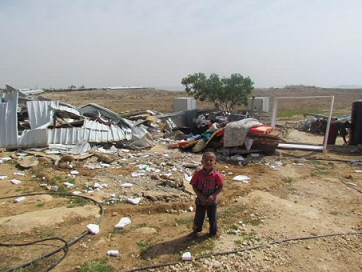 UNRWA condemns today’s large scale home demolitions by the Israeli Authorities in the Bedouin refugee community of Um al Khayr in the South Hebron Hills. As a result, 31 Palestine refugees, including 16 children, were made homeless.
This community has endured several rounds of demolitions and often faced harassment from the nearby illegal settlement of Karmel.
“I am appalled. Looking in the eyes of a young Bedouin boy in a red shirt standing amongst the crumpled ruins of his demolished home, how can anyone justify this? ” stated Lance Bartholomeusz, Director of UNRWA Operations in the West Bank.
Already this year, over 700 Palestinians have been displaced by Israeli demolitions in the West Bank.
This figure is approaching the total number of displaced for all of 2015.
UNRWA is gravely concerned about demolitions in violation of international law. Under the Fourth Geneva Convention destruction of private property is prohibited. As Occupying Power, Israel is obliged to administer the occupied territory for the welfare of the protected Palestinian population.
As the UN has said repeatedly, these demolitions must stop.
University rooms destroyed in early morning raid by Israeli forces
International Solidarity Movement | March 5, 2016
East Jerusalem, Occupied Palestine – In the early hours of Tuesday, 5th April, around 3am, an armed group of Israeli soldiers stormed the campus of Al Quds university in the area of Abu Dis, part of East Jerusalem. The soldiers terrorised security guards on duty and forcefully entered four rooms belonging to student political parties and confiscated equipment while completely destroying the rest of the rooms.

Destroyed items from the Tuesday morning raid gathered outside the rooms
During the early hours of the morning the only people present at the university campus were the campus security, they were rounded up and locked together in a room, they were given no reason from the soldiers as to why they were being locked in a room nor as to why the soldiers were entering the campus grounds. The soldiers proceeded to forcefully enter four rooms belonging to various political parties run by students of the university, cutting the locks and smashing their way in, completely destroying the doors. This is the fourth time in 2016 alone that soldiers have entered the campus, destroying and confiscating material while giving no reason for their actions.

One of the computers amongst other items destroyed in the raid
The rooms entered belong to varying student bodies who’s students work within the university and the local community. Among the varied groups they advocate student rights, create activities within the campus and surrounding neighbourhoods, hold discussions on the state of the middle east, volunteer within the community, offer services for students, hold workshops and meetings about young prisoners and host an array of solidarity activities for the Palestinian community.

Students cleaning up debris from Tuesday’s raid
During the raid the army took personal computers, laptops and cameras belonging to the Islamic party. Around one hundred and seventy flags were confiscated from the union party room and all of their stationary equipment for creative activities. Whatever was not taken was destroyed during the raid by the occupying forces.
The activities room for the ladies Islamic movement which works mainly with disadvantaged youths and students had the majority of their belongings destroyed, posters ripped from walls and electronic equipment confiscated.
The area of Abu Dis were the university is located was around thirty thousand hectares prior to 2002 and is now around four thousand hectares with 75% of the area now falling under area C and 25% under area B. This malicious land grab by the Israeli government has left students facing huge difficulties with their education. Many students within the faculty of medicine can’t reach Jerusalem where the main hospital for training is located and have been forced to go elsewhere for their practical while the media faculty faces new difficulties also. Since the beginning of what most would call the third intifada, checkpoints leading into the city of Ramallah, where the media students must go to complete their practical work have become extremely tightened and students are often denied access to the area or face long waits to enter.

The annexation wall surrounding the university
On the 2nd November, 2015, Israeli forces entered the campus around 4pm and began firing on students using tear gas, rubber coated steel bullets and even using live ammunition. Over two hundred students were injured and required medical care while two students were seriously injured, with access to Jerusalem hospital unavailable the students were forced to travel over an hour to the city of Ramallah for treatment.

One of the destroyed rooms
With the student elections to take place on April 19th, this attack falls into Israel’s wider policy of targeting political activity within student campuses and bodies as a means of repressing resistance to the occupation.
Four students of the university have been killed by Israeli forces since November, 2015.
Pro-Israel lobby tells Prince Charles not to visit Iran
RT | April 6, 2016
Israel lobby group We Believe in Israel (WBII) is calling on Prince Charles to reconsider an upcoming visit to Iran, which it accuses of anti-Semitism.
The grassroots pro-Israel group started an online petition in response to reports the Prince of Wales is planning to visit Iran in autumn. The trip would be the first official visit of a UK royal to the Islamic Republic in over 40 years.
The Foreign Office and Clarence House are discussing a tour with Tehran, the Sunday Times reported last month.
The visit follows an international deal struck in 2015 after years of talks, which saw Western sanctions against Iran lifted in exchange for it abandoning its nuclear ambitions.
Prince Charles’ visit would mark a significant thaw in relations, and could lead to new trade ties.
WBII however has unequivocally called on the Foreign Office and Clarence House to abandon the plans.
“We do not consider it appropriate for a member of the Royal Family to visit Iran and give credibility to the Iranian regime,” the WBII petition reads.
WBII Director Luke Akehurst said he is “disturbed” by the prospect of a royal visit to Iran, noting the regime’s alleged ties to terror groups, its senior figures’ denial of the Holocaust and calls for the destruction of Israel.
“We find the proposed visit particularly strange as there has never been an official Royal visit to Israel, the only democracy in the region,” said Akehurst, the Jewish Chronicle reports.
In 2004, Prince Charles made an unofficial visit to the city of Bam in southeastern Iran in his capacity as president of the British Red Cross after an earthquake killed 40,000 people in the region.
Queen Elizabeth II paid the last official royal visit to Iran in 1974, five years before the Islamic Revolution deposed Shah Reza Pahlavi and installed a theocratic government.
Turkish President Calls to Strip ‘Terrorism Supporters’ of Citizenship
Sputnik — 05.04.2016
Turkey’s President Recep Tayyip Erdogan on Tuesday called for a debate on whether those who Ankara deems “terrorist supporters” should be stripped of Turkish citizenship, local media reported.
“We should consider all measures against supporters of terrorism, including stripping them of their citizenship,” Erdogan said, as quoted by the Daily Sabah newspaper.
The Turkish government has stepped up anti-terror efforts in the wake of suicide bombings that rocked its capital Ankara earlier this year. The attacks were claimed by pro-Kurdish militants in response to Turkey’s shelling of Kurdish positions in Syria.
Erdogan also brought up the issue of removing parliamentary immunity of members of the pro-Kurdish and pro-minority Peoples’ Democratic Party (HDP), which he said “should be taken care of immediately,” according to the outlet.
Ankara previously controversially labelled government critics as supporters of terrorism. In January, several academics were held for allegedly engaging in terrorism propaganda after they condemned the ongoing operation in Turkey’s Kurdish-dominated southeast that has killed over a hundred civilians since August.
Featured Video

Genocide-linked firm handles Britons’ NHS data
or go to
Aletho News Archives – Video-Images
Book Review
Book review: Boiling Point, How America Brought War to Ukraine
By Tim Kirby | Strategic Culture Foundation | November 14, 2026
Did Vladimir Putin just wake up one day on the wrong side of the bed and decide to invade Ukraine in February of 2022 or is there a lot more to this single decision that has been reshaping the 21st century geopolitical landscape?
Obviously, from the way that I just posed the question you can see that I am on the side that views the causes for the war in Ukraine to be very deep, long-term, historical and consciously nefarious, and most importantly, not from within the halls of the Kremlin. So it was a pleasure to take a look at the book “Boiling Point, How America Brought War to Ukraine” by author Stephen Kinzer, who like myself, also believes that the real reasons behind military conflicts around the world are not what CNN and the BBC have been telling you. The main thesis of this book was stated clearly by its creator; the war “may have been illegal, but it was definitely not unprovoked.” … continue
Blog Roll
 Aletho News
- The 10 Disease Renamings That Rescued the Vaccine
- NATO cancels 2027 leaders’ summit
- IAEA’s politicized use of safeguards undermines its impartiality: Russian envoy
- UK must be ready to strike Russian Arctic – ex-PM
- Fico’s Two Red Lines: Russian Energy and the Next Ukraine Loan
- Thousands rally for banned NATO-skeptic presidential candidate
- Ukraine Settlement and New European Security Architecture Must Go Hand in Hand – Kremlin
- Book review: Boiling Point, How America Brought War to Ukraine
- Israel Revives The ‘Iranian Assassination Threat Against Trump’ Deception In A Desperate Bid To Restart The War
- US rewrites history to dodge blame for illegal war on Iran: Foreign Ministry spokesperson
- If Americans Knew
- An error has occurred; the feed is probably down. Try again later.
- No Tricks Zone
- New Study: Barents Sea Temperatures Were Warmer And Sea Ice Less Extensive In The 1700s Than Today
- German Authorities Start Initiative To Evaluate Public Register For Climate “Disinformation” Spreaders!
- Zonal Asymmetry of Temperature Change in the Antarctic Circumpolar Current
- New Study: The Net Fossil Fuel Contribution To Rising Atmospheric CO2 Has Been Zero For 500 Years
- Germany’s Green Energy Transition Becoming Increasingly Expensive…Another 6 Trillion Euros!
- Sudden Stratospheric Warming, Powerful El Niño Combination May Lead To Extreme Europe Cold, Energy Crisis!
- Two New Studies Find Thwaites Glacier Melt Cannot Be Driven By Human Activity Or A Warming Ocean
- E-Cars Reduce CO2 Emissions By Only 41% Compared To Internal Combustion Engine Vehicles
- Predictions Made By Renowned Climate Professor Over Past Decades Have Been Proven To Be Poor
- New Study Suggests Large Regions Of The Pacific Ocean Have Been Cooling For The Last 80 Years

