I was invited along with other presidential candidates to be at the AIPAC conference in Washington, but obviously I could not make it because we are here.
The issues that AIPAC is dealing with are very important issues and I wanted to give the same speech here as I would have given if we were at that conference.
Let me begin by saying that I think I am probably the only candidate for president who has personal ties with Israel. I spent a number of months there when I was a young man on a kibbutz, so I know a little bit about Israel.
Clearly, the United States and Israel are united by historical ties. We are united by culture. We are united by our values, including a deep commitment to democratic principles, civil rights and the rule of law.
Israel is one of America’s closest allies, and we – as a nation – are committed not just to guaranteeing Israel’s survival, but also to make sure that its people have a right to live in peace and security.
To my mind, as friends – long term friends with Israel – we are obligated to speak the truth as we see it. That is what real friendship demands, especially in difficult times.
Our disagreements will come and go, and we must weather them constructively.
But it is important among friends to be honest and truthful about differences that we may have.
America and Israel have faced great challenges together. We have supported each other, and we will continue to do just that as we face a very daunting challenge and that is the Israeli-Palestinian conflict.
I am here to tell the American people that, if elected president, I will work tirelessly to advance the cause of peace as a partner and as a friend to Israel.
But to be successful, we have also got to be a friend not only to Israel, but to the Palestinian people, where in Gaza unemployment today is 44 percent and we have there a poverty rate which is almost as high.
So when we talk about Israel and Palestinian areas, it is important to understand that today there is a whole lot of among Palestinians and that cannot be ignored. You can’t have good policy that results in peace if you ignore one side.
The road towards peace will be difficult. Wonderful people, well-intentioned people have tried decade after decade to achieve that and it will not be easy. I cannot tell you exactly how it will look – I do not believe anyone can – but I firmly believe that the only prospect for peace is the successful negotiation of a two-state solution.
The first step in that road ahead is to set the stage for resuming the peace process through direct negotiations.
Progress is never made unless people are prepared to sit down and talk to each other. This is no small thing. It means building confidence on both sides, offering some signs of good faith, and then proceeding to talks when conditions permit them to be constructive. Again, this is not easy, but that is the direction we’ve got to go.
This will require compromises on both sides, but I believe it can be done. I believe that Israel, the Palestinians, and the international community can, must, and will rise to the occasion and do what needs to be done to achieve a lasting peace in a region of the world that has seen so much war, so much conflict and so much suffering.
Peace will require the unconditional recognition by all people of Israel’s right to exist. It will require an end to attacks of all kinds against Israel.
Peace will require that organizations like Hamas and Hezbollah renounce their efforts to undermine the security of Israel. It will require the entire world to recognize Israel.
Peace has to mean security for every Israeli from violence and terrorism.
But peace also means security for every Palestinian. It means achieving self-determination, civil rights, and economic well-being for the Palestinian people.
Peace will mean ending what amounts to the occupation of Palestinian territory, establishing mutually agreed upon borders, and pulling back settlements in the West Bank, just as Israel did in Gaza – once considered an unthinkable move on Israel’s part.
That is why I join much of the international community, including the U.S. State Department and European Union, in voicing my concern that Israel’s recent expropriation of an additional 579 acres of land in the West Bank undermines the peace process and, ultimately, Israeli security as well.
It is absurd for elements within the Netanyahu government to suggest that building more settlements in the West Bank is the appropriate response to the most recent violence. It is also not acceptable that the Netanyahu government decided to withhold hundreds of millions of Shekels in tax revenue from the Palestinians, which it is supposed to collect on their behalf.
But, by the same token, it is also unacceptable for President Abbas to call for the abrogation of the Oslo Agreement when the goal should be the ending of violence.
Peace will also mean ending the economic blockade of Gaza. And it will mean a sustainable and equitable distribution of precious water resources so that Israel and Palestine can both thrive as neighbors.
Right now, Israel controls 80 percent of the water reserves in the West Bank. Inadequate water supply has contributed to the degradation and desertification of Palestinian land. A lasting a peace will have to recognize Palestinians are entitled to control their own lives and there is nothing human life needs more than water.
Peace will require strict adherence by both sides to the tenets of international humanitarian law. This includes Israeli ending disproportionate responses to being attacked – even though any attack on Israel is unacceptable.
We recently saw a dramatic example of just how important this concept is. In 2014, the decades-old conflict escalated once more as Israel launched a major military campaign against Hamas in the Gaza Strip. The Israeli offensive came after weeks of indiscriminate rocket fire into its territory and the kidnapping of Israeli citizens.
Of course, I strongly object to Hamas’ long held position that Israel does not have the right to exist – that is unacceptable. Of course, I strongly condemn indiscriminate rocket fire by Hamas into Israeli territory, and Hamas’ use of civilian neighborhoods to launch those attacks. I condemn the fact that Hamas diverted funds and materials for much-needed construction projects designed to improve the quality of life of the Palestinian people, and instead used those funds to construct a network of tunnels for military purposes.
However, let me also be very clear: I – along with many supporters of Israel – spoke out strongly against the Israeli counter attacks that killed nearly 1,500 civilians and wounded thousands more. I condemned the bombing of hospitals, schools and refugee camps.
Today, Gaza is still largely in ruins. The international community must come together to help Gaza recover. That doesn’t mean rebuilding factories that produce bombs and missiles – but it does mean rebuilding schools, homes and hospitals that are vital to the future of the Palestinian people.
These are difficult subjects. They are hard to talk about both for many Americans and for Israelis. I recognize that, but it is clear to me that the path toward peace will require tapping into our shared humanity to make hard but just decisions.
Nobody can tell you when peace will be achieved between Israel and the Palestinians. No one knows the exact order that compromises will have to be made to reach a viable two-state solution. But as we undertake that work together, the United States will continue its unwavering commitment to the safety of Israeli citizens and the country of Israel.
Let me just say a word about an overall agenda for the Middle East.
Of course, beyond the Palestinian question, Israel finds itself in the midst of a region in severe upheaval.
First, the so-called Islamic State – ISIS – threatens the security of the entire region and beyond, including our own country and our allies. Secretary of State Kerry was right to say that ISIS is committing genocide, and there is no doubt in my mind that the United States must continue to participate in an international coalition to destroy this barbaric organization.
While obviously much needs to be done, so far our effort has had some important progress, as airstrikes have degraded ISIS’ military capacity, and the group has lost more than 20 percent of its territory in the past year. So we are making some progress.
But we are entering a difficult period in the campaign against ISIS.
The government in Baghdad has yet to achieve a sustainable political order that unites Iraq’s various ethnic and sectarian factions, which has limited its ability to sustain military victories against ISIS. Unless there is a united government, it’s going to be hard to be effective in destroying ISIS.
More inclusive, stable governance in Iraq will be vital to inflict a lasting defeat on ISIS. Otherwise, ISIS could regain its influence or another, similar organization may spring up in its place.
In Syria, the challenges are even more difficult. The fractured nature of the civil war there has often diluted the fight against ISIS – exemplified by the Russian airstrikes that prioritized hitting anti-Assad fighters rather than ISIS. And, just like in Iraq, ISIS cannot be defeated until the groups that take territory from ISIS can responsibly govern the areas they take back. Ultimately, this will require a political framework for all of Syria.
The U.S. must also play a greater role disrupting the financing of ISIS and efforts on the Internet to turn disaffected youth into a new generation of terrorists.
While the U.S. has an important role to play in defeating ISIS, that struggle must be led by the Muslim countries themselves on the ground. I agree with King Abdullah of Jordan who a number of months ago [said] that what is going on there right now is nothing less than a battle for the soul of Islam and the only people who will effectively destroy ISIS there will be Muslim troops on the ground.
So what we need is a coalition of those countries.
Now, I am not suggesting that Saudi Arabia or any other states in the region invade other countries, nor unilaterally intervene in conflicts driven in part by sectarian tensions.
What I am saying is that the major powers in the region – especially the Gulf States – have to take greater responsibility for the future of the Middle East and the defeat of ISIS.
What I am saying is that countries like Qatar – which intends to spend up to $200 billion to host the 2022 World Cup – Qatar which per capita is the wealthiest nation in the world – Qatar can do more to contribute to the fight Against ISIS. If they are prepared to spend $200 billion for a soccer tournament, then they have got to spend a lot spend a lot more against a barbaric organization.
What I am also saying is that other countries in the region – like Saudi Arabia, which has the 4th largest defense budget in the world – has to dedicate itself more fully to the destruction of ISIS, instead of other military adventures like the one it is pursuing right now in Yemen.
And keep in mind that while ISIS is obviously a dangerous and formidable enemy, ISIS has only 30,000 fighters on the ground. So when we ask the nations in the region to stand up to do more against ISIS – nations in the region which have millions of men and women under arms – we know it is surely within their capability to destroy ISIS.
Now the United States has every right in the world to insist on these points. Remember – I want everybody to remember – that not so many years ago it was the United States and our troops that reinstalled the royal family in Kuwait after Saddam Hussein’s invasion in 1990. We put these people back on the throne. Now they have the obligation to work with us and other countries to destroy ISIS.
The very wealthy – and some of these countries are extraordinarily wealthy from oil money or gas money – these very wealthy and powerful nations in the region can no longer expect the United States to do their work for them. Uncle Sam cannot and should not do it all. We are not the policeman of the world.
As we continue a strongly coordinated effort against ISIS, the United States and other western nations should be supportive of efforts to fight ISIS and al-Qaeda. But it is the countries in the region that have to stand up against these violently extremist and brutal organizations.
Now I realize that given the geopolitics of the region this is not going to be easy. I realize that there are very strong and historical disagreements between different countries in the region about how ISIS should be dealt with.
I realize different countries have different priorities. But we can help set the agenda and mobilize stronger collective action to defeat ISIS in a lasting way.
Bottom line is the countries in the region – countries which by the way are most threatened by ISIS – they’re going to have to come together, they’re going to have to work out their compromises, they are going to have to lead the effort with the support of the United States and other major powers in destroying ISIS.
Another major challenge in the region, of course, is the Syrian Civil War itself – one of the worst humanitarian disasters in recent history.
After five years of brutal conflict, the only solution in Syria will be, in my view, a negotiated political settlement. Those who advocate for stronger military involvement by the U.S. to oust Assad from power have not paid close enough attention to history. That would simply prolong the war and increase the chaos in Syria, not end it.
In other words, we all recognize that Assad is a brutal dictator. But I think that our priorities right now have got to be destroy ISIS, work out a political settlement with Russia and Iran to get Assad out of power.
I applaud Secretary Kerry and the Obama administration for negotiating a partial ceasefire between the Assad regime and most opposition forces. The ceasefire shows the value of American-led diplomacy, rather than escalating violence. It may not seem like a lot, but it is. Diplomacy in this instance has had some real success.
Let me also say what I think most Americans now understand, that for a great military power like the United States it is easy to use a war to remove a tyrant from power, but it is much more difficult to comprehend the day after that tyrant is removed from power and a political vacuum occurs.
All of us know what has occurred in Iraq. We got rid of Saddam Hussein, a brutal, brutal murderer and a tyrant. And yet we created massive instability in that region which led to the creation of ISIS. I am very proud to have been one of the members in Congress to vote against that disastrous war.
And the situation is not totally dissimilar from what has happened in Libya. We got rid of a terrible dictator there, Colonel Gaddafi, but right now chaos has erupted and ISIS now has a foothold in that area.
Bottom line is that regime change for a major power like us is not hard. But understanding what happens afterward is something that always has got to be taken into consideration.
In my view, the military option for a powerful nation like ours – the most powerful nation in the world – should always be on the table. That’s why we have the most powerful military in the world. But it should always be the last resort not the first resort.
Another major challenge in the region is Iran, which routinely destabilizes the Middle East and threatens the security of Israel.
Now, I think all of us agree that Iran must be able to acquire a nuclear weapon. That would just destabilize the entire region and create disastrous consequences.
Where we may disagree is how to achieve that goal. I personally strongly supported the nuclear deal with the United States, France, China, Germany, Russia, the United Kingdom and Iran because I believe it is the best hope to prevent Iran from developing a nuclear weapon.
I want to thank the Obama administration for doing a very good job under very, very difficult circumstances.
I believe we have an obligation to pursue diplomatic solutions before resorting to military intervention.
You know it is very easy for politicians to go before the people and talk about how tough we are, and we want to wipe out everybody else. But I think if we have learned anything from history is that we pursue every diplomatic option before we resort to military intervention.
And interestingly enough, more often than not, diplomacy can achieve goals that military intervention cannot achieve. And that is why I supported the sanctions that brought Iran to the negotiating table and allowed us to reach an agreement.
But let me tell you what I firmly believe. The bottom line is this: if successfully implemented – and I think it can be – the nuclear deal will prevent Iran from obtaining a nuclear weapon. And preventing Iran from getting the bomb makes the world a safer place.
Does the agreement achieve everything I would like? Of course not.
But to my mind, it is far better than the path we were on with Iran developing nuclear weapons and the potential for military intervention by the United States and Israel growing greater by the day.
I do not accept the idea that the “pro-Israel” position was to oppose the deal. Preventing Iran from getting a nuclear weapon will strengthen not only the United States’ security, but Israel’s security as well.
And I am not alone in that idea. While Prime Minister Netanyahu is vocally opposed to the accord, his is hardly a consensus opinion in Israel and it’s important that everyone understand that. Dozens of former security officials, including retired Army generals and chiefs of the Shin Bet and Mossad intelligence agencies support the agreement. Netanyahu may not, but many others in Israel do.
But let me be clear: if Iran does not live up to the agreement, we should re-impose sanctions and all options are back on the table.
Moreover, the deal does not mean we let Iran’s aggressive acts go unchecked. The world must stand united in condemning Iran’s recent ballistic missile tests as well as its continued support for terrorism through groups like Hezbollah.
Going forward, I believe we need a longer-term vision for dealing with Iran that balances two important objectives.
First, we must counter the destabilizing behavior of Iran’s leaders.
But secondly we must also leave the door open to more diplomacy to encourage Iranian moderates and the segments of the Iranian people – especially the younger generations – who want a better relationship with the West. While only a small step in the right direction, I was heartened by the results of the recent parliamentary elections in which Iranian voters elected moderates in what was, in part, a referendum on the nuclear deal.
I know that some say there is just no dealing with Iran – in any way at all – for the foreseeable future. And that is the position of some. After all, Iran is in a competition with Saudi Arabia and its allies for influences over that region.
But a more balanced approach towards Iran that serves our national security interests should hardly be a radical idea. We have serious concerns about the nature of the Iranian government, but we have to [be] honest enough, and sometimes we are not, to admit that Saudi Arabia – a repressive regime in its own right – is hardly an example of Jeffersonian democracy.
Balancing firmness with willingness to engage with diplomacy in dealing with Iran will not be easy. But it is the wisest course of action to help improve the long-term prospects of stability and peace in the Middle East – and to keep us safe.
Lastly, these are but some – not all – of the major issues where the interests of Israel intersect with those of the United States. I would address these issues and challenges as I would most issues and that is by having an honest discussion and by bringing people together.
The truth is there are good people on both sides who want peace, And the other truth is there despots and liars on both sides who benefit from continued antagonism.
I would conclude by saying there has a disturbing trend among some of the Republicans in this presidential election that take a very, very different approach. And their approach I think would be a disaster for this country. The Republican front-runner, Donald Trump, suggested limiting immigration according to religion and creating a national database based on religion – something unprecedented in our country’s history.
Now this would not only go against everything we stand for as a nation, but also – in terms of our relationship to the rest of the world – it would be a disaster.
Let me just conclude by saying this: the issues that I’ve discussed today are not going to be easily solved.
Everybody knows that. But I think the United States has the opportunity, as the the most powerful nation on earth, to play an extraordinary role in trying to bring to people together – to try to put together coalitions in the region to destroy ISIS.
And that is a responsibility that I, if elected president, would accept in a very, very serious way. We have seen too many wars, too much killing, too much suffering. And let us all together – people of good faith – do everything we can to finally, finally bring peace and stability to that region.
Thank you all very much.
March 21, 2016
Posted by aletho |
Ethnic Cleansing, Racism, Zionism, Timeless or most popular, War Crimes, Wars for Israel | Bernie Sanders, Hamas, Hezbollah, Iran, Israel, Middle East, Palestine, Sanctions against Iran, Saudi Arabia, United States, Zionism |
Leave a comment
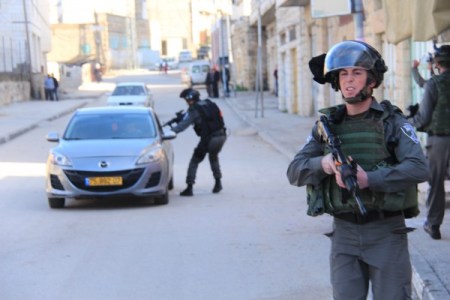
BETHLEHEM – Israeli troops raided the village of Beit Fajjar east of Bethlehem early on Monday, storming several houses and detaining two Palestinians.
The raid took place a day after the funerals of Ali Abd al-Rahman al-Kar Thawabta, 20, and Ali Jamal Muhammad Taqatqa, 19, who were killed by Israeli forces on Thursday after carrying out a stab attack that injured an Israeli soldier near the illegal Israeli settlement of Ariel in the northern occupied West Bank. Local sources said that Israeli troops raided Thawabta’s house and detained his brother Muhammad, 24.
They also detained Muhammad Akram Taqatqa, 22. Witnesses said Israeli excavators escorted by Israeli troops raided the al-Mahajer neighborhood of Beit Fajjar, seizing equipment and detaining workers in the area.
Israeli forces have shut down most roads leading to Beit Fajjar since Thursday, except for one between the villages of Sair and al-Manshiya.
An Israeli army spokesperson told Ma’an all roads to Beit Fajjar were open, but that residents between the ages of 15 and 25 were barred from entering or leaving, “except in case of medical emergencies.” She also confirmed that Israeli forces detained two Palestinians in Beit Fajjar overnight.
Bethlehem district governor Jibril al-Bakri condemned on Friday Israeli sanctions against Beit Fajjar, noting that such actions qualify as “collective punishment” of the village’s over 10,000 residents in violation of international law.
Over 200 Palestinians and just under 30 Israelis have been killed since October, and attempts to quell the violence by the international community have subsequently failed.
Earlier this year, UN Secretary-General Ban Ki-Moon condemned the wave of attacks, but said that Israeli security measures were failing to “address the profound sense of alienation and despair driving some Palestinians — especially young people.”
He added: “As oppressed peoples have demonstrated throughout the ages, it is human nature to react to occupation, which often serves as a potent incubator of hate and extremism.”
March 21, 2016
Posted by aletho |
Ethnic Cleansing, Racism, Zionism, Subjugation - Torture | Human rights, Israel, Palestine, West Bank, Zionism |
Leave a comment
Once again, The New York Times has provided us with a Palestinian “slice of life,” a look at that society from within, and once again the portrait is unflattering. In recent articles the newspaper has shown us Palestinian sexism, patriarchy, prudery, violence and general backwardness. Now we get a close look at the “dysfunction of Palestinian politics.”
The latest piece by Diaa Hadid is titled “A Legislature Where Palestinian Lawmakers Go to Hide,” and it introduces us to Najat Abu Baker, a member of the defunct Palestinian parliament, who took refuge in an “all-but-abandoned legislative building” in Ramallah. She was avoiding prosecutors who had summoned her to answer charges of insulting Palestinian Authority President Mahmoud Abbas.
The building is considered a “protected space” where security forces do not enter, but it serves for little else. A few guards patrol the site, and some 120 employees show up in order to collect their paychecks, although they have little real work to do.
No doubt the system is dysfunctional, but in all her 1,200 words about the subject, Hadid never once mentions the Israeli occupation as a factor in the breakdown of Palestinian governance. Israel has arrested and currently imprisons elected members of parliament, for instance, but in her telling it is all a Palestinian problem, fed by rivalries between the Fatah and Hamas factions and nothing else.
Hadid fails to mention the occupation in other stories that depict a “slice of life” in Gaza, the West Bank and Israel proper, and these articles also present Palestinian society in a censorious light. Since the beginning of the year, she has published the following in the Times:
- An article about nightlife in Haifa, shown as a “liberal” refuge from the backward and conservative Palestinian community. (1-3-16)
- A story about Gaza women who ride bicycles in defiance of the sexist norms of local society. (2-23-16)
- A piece about the killing of a Hamas fighter, allegedly for homosexual acts and theft. (3-2-16)
- An article about a Gaza woman who was allowed to sing in public under the watchful eyes of prudish Hamas officials. (3-14-16)
The Haifa piece was the subject of comments by Times public editor Margaret Sullivan, who noted that the story lacked context. “While it’s impossible (and a bad idea) to summarize the history of Israel and Palestine in every piece of news coverage or every feature article, this article needed more political and historical information to put it in perspective,” she wrote.
But neither Hadid nor her editors took this advice to heart. In each of the following feature stories context is almost totally missing. The three Gaza articles fail to mention the eight-year blockade of the strip—a stunning omission.
The best Hadid can manage is this vague reference in the article about the Gaza singer: “In recent months, Hamas officials have been quietly loosening the reins as Gaza residents chafe under years of restrictions on their movement by neighboring Israel and Egypt. They have endured three wars in a decade, and poverty and unemployment are rampant.”
Readers are left with no real sense of Israel’s role in these successive disasters. Once again, the focus is on Palestinian shortcomings.
If they were so inclined, Times reporters could choose to write any number of positive stories underscoring Palestinian resilience, perseverance and achievements. Here are just a few:
- Only last week Hanan al-Hroub, a Palestinian elementary school teacher in the occupied West Bank, won the $1 million Global Teacher Award for 2016, beating out other talented educators throughout the world with her inspired teaching of nonviolent conflict resolution.
- Gaza fishermen have been braving the constant harassment of Israeli gunboats, the threat of arrest and live fire each time they go to sea in search of their daily catch. They continue to work even as Israeli sailors damage and confiscate their boats and equipment.
- Herding communities in the Jordan Valley and the South Hebron Hills cling to their land in spite of repeated demolitions and encroaching settlements. Some of them take refuge in caves after bulldozers destroy their tents and houses.
- Authorities have demolished the Israeli Bedouin community of Al Araqib at least 95 times, but the residents keep returning to rebuild in an incredible show of determination.
- The Nassar family has held off Israeli confiscation of their ancestral land in the West Bank for decades, drawing on international support for their community, the Tent of Nations, where they operate under the slogan, “We Refuse to Be Enemies.”
The Times has shown no interest in highlighting any of these topics, although they provide first-rate material for profiles and “slice of life” feature stories. It appears that such articles would also carry the risk of challenging the accepted narrative by exposing Israeli brutality as well as Palestinian efforts at peace-building.
Times editors and reporters can claim that they have provided sketches of Palestinian life from inside the occupied territories and in Israel proper, but they show little interest in moving beyond facile stereotypes. Robbed of context and viewed through a prejudicial lens, Palestinian society takes a beating in the Times.
Follow @TimesWarp on Twitter
March 21, 2016
Posted by aletho |
Ethnic Cleansing, Racism, Zionism, Mainstream Media, Warmongering, Timeless or most popular | Feminism, Hamas, New York Times, Palestine, United States, Zionism |
Leave a comment
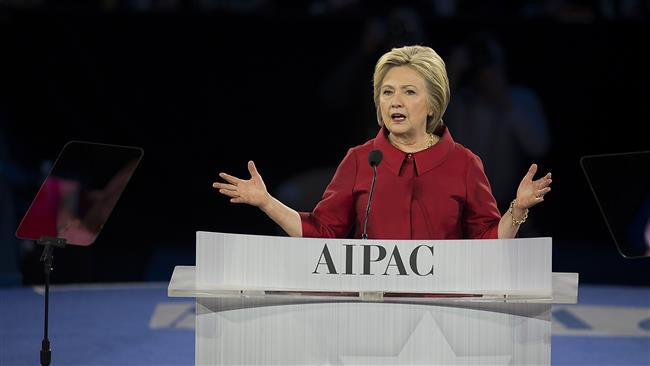
Democratic presidential candidate Hillary Clinton speaks during the 2016 AIPAC Policy Conference in Washington, DC, March 21, 2016. (AFP photo)
US Democratic presidential candidate Hillary Clinton said in a speech to an influential Zionist lobby group in Washington that Iran still posed a threat to Israel and needed to be closely watched.
Speaking on Monday to the annual policy conference of the American Israel Public Affairs Committee (AIPAC), Clinton also criticized her Republican rival Donald Trump for having a “neutral” stance on Israel.
She said American leaders needed to show loyalty to Israel and “anyone who doesn’t understand that has no business being our president.”
“This is a serious danger and demands a serious response,” Clinton said, declaring that sanctions must be placed against the country. “We must work closely with Israel and other partners to cut off the flow of money and other arms from Iran to Hezbollah” she added.
Many of the US presidential candidates, in particular Clinton, receive large campaign funding from wealthy Jewish donors who have strong ties to the far-right wing in Israel, experts say.
“Clinton is heavily favored by the Israel lobby because she is quite clear about her intention to pursue the war policies of several presidential predecessors,” said Mark Dankof, who is also a broadcaster and pastor in San Antonio, Texas.
“She is getting very, very strong backing from the Israeli lobby and is getting more money from the defense industry than any other candidate in this race,” Dankof told Press TV earlier this month.
On Sunday, activists gathered outside the building where the annual AIPAC conference was being held to protest America’s financial support for Israel.
The US government is pressured to serve Israel’s interests due to the influence of the powerful Zionist lobby in the United States. The pro-Israel pressure groups actively work to steer US foreign policy in favor of Israel.
March 21, 2016
Posted by aletho |
Corruption, Ethnic Cleansing, Racism, Zionism, Militarism, Progressive Hypocrite, Wars for Israel | AIPAC, Hezbollah, Hillary Clinton, Iran, Israel, United States, Zionism |
Leave a comment
To UN Special Adviser on the Prevention of Genocide and ICC Prosecutor:
I am a concerned person of conscience, who fears that I am witnessing the genocide of the Palestinian people by the State of Israel. Witnessing Israel’s daily violations of Palestinian human rights- military take-over of land, restriction of movement, economic strangulation, house demolitions, restrictions on basic foodstuff, mass arbitrary arrests of both adults and children, torture, extra judicial executions, and large-scale massacres of whole families, openly calling for genocide and extermination by law makers and other public figures- I can not keep silent about this 67 year-old atrocity, unfolding before our eyes.
The Crime of Genocide is defined in a declaration made by the General Assembly of the United Nations in its resolution 96 (I) dated 11 December 1946. I demand the United Nations Office of the Special Adviser on the Prevention of Genocide and the International Criminal Court Prosecutor take action and investigate the possibility that Israel is committing the Crime of Genocide against the Palestinian People, and that the office publish its findings and recommendations.
Thank you
Click here to sign
March 21, 2016
Posted by aletho |
Ethnic Cleansing, Racism, Zionism, Solidarity and Activism, War Crimes | Human rights, Israel, Palestine, United Nations, Zionism |
Leave a comment
If you’d have said a year ago that the US State Department, Google, and Al Jazeera had been collaborating in pursuance of regime change in Syria, chances are you’d have been casually dismissed as a ‘crank’ and a ‘conspiracy theorist’.
Syria was a people’s uprising against a wicked genocidal Russian-backed dictator and the West had nothing to do with the bloodshed which engulfed the country. If you thought otherwise then you were considered an ‘Assad apologist’.
However, thanks to Wikileaks, the Freedom of Information Act, and Hillary Rodham Clinton’s use of a private, non-secure email server, we can see what was really going on behind the curtain.
Overall, 30,322 emails and attachments dating from June 30, 2010 to August 12, 2014, including 7,570 written by Clinton herself, have been published.
They haven’t made much of an impact in the mainstream media, which is not surprising considering their explosive content.
The emails reveal how the US State Department, ‘independent’ media and Silicon Valley have worked together to try and achieve foreign policy goals.
Particularly damning is a communication from Jared Cohen, the President of ‘Google Ideas’, (now called ‘Jigsaw’), which was sent on July 25, 2012.
“Please keep close hold, but my team is planning to launch a tool on Sunday that will publicly track and map the defections in Syria and which parts of the government they are coming from,” Cohen wrote.
“Our logic behind this is that while many people are tracking the atrocities, nobody is visually representing and mapping the defections, which we believe are important in encouraging more to defect and giving confidence to the opposition,” he went on.
The head of Google Ideas added that his organization was partnering with al Jazeera “who will take primary ownership over the tool we have built.”
Cohen finished his email by repeating his warning: “Please keep this very close hold… We believe this can have an important impact.”
The email was sent to three top officials, Deputy Secretary of State Bill Burns (a former Ambassador to Russia), Alec Ross, a senior Clinton adviser on innovation; and Clinton’s deputy chief of staff, Jake Sullivan.
Sullivan forwarded the email to Hillary Clinton with the message: “FYI-this is a pretty cool idea.” On August 4, 2012, Clinton sent the information to her aide Monica Handley. The title heading was: Syria Attachments: Defection Tracker.PDF.
“The Silicon Valley’s technotronic oligarchy have been exposed as a mere extension of the CIA in terms of playing a role in Washington’s state policy of regime change in Syria,” was the verdict of 21st Century Wire.
If you think it’s surprising that a top man at Google should be so interested in a ‘tool’ which could help the ‘opposition’ take power in Syria, then a closer look at Jared Cohen’s career background helps shed some light on the matter.
A Rhodes Scholar at Oxford University, Cohen was a bright guy who was clearly fast-tracked for big things. After an internship at the US State Department, he became a member of Condoleeza Rice’s Policy Planning Staff in 2006 when he was just 24 years of age. That same year he had a book published on the Rwandan genocide, while a year later his ‘Children of Jihad – A Young American’s travels among the Youth of the Middle East’ was published.
In 2009, it’s claimed that Cohen personally asked Twitter CEO Jack Dorsey not to interrupt his company’s service in Iran for maintenance. Tehran at the time was preparing for elections and it was apparently believed that the opponents of President Ahmadinejad would be hindered without access to social media.
Since 2010, Cohen has been an Adjunct Senior fellow at the Council on Foreign Relations. In 2013, Time magazine listed the then 32-year-old as one of its 100 Most Influential People in the world.
Wikileaks founder Julian Assange, who met Cohen and Google chairman Eric Schmidt when he was under house-arrest in 2011, has written about Google’s role in assisting US foreign policy goals. “Whether it is being just a company or ‘more than just a company,’ Google’s geopolitical aspirations are firmly enmeshed within the foreign-policy agenda of the world’s largest superpower,” Assange said.
The Wikileaks founder discovered that Jared Cohen had “quietly worked” in Lebanon “to establish an intellectual and clerical rival to Hezbollah, the Higher Shia League.” In Afghanistan, Cohen had tried “to convince the four major Afghan mobile phone companies to move their antennas onto US military bases.”
In June 2010, when Syria was a country still at peace, Cohen traveled to the Arab Republic with Alec Ross. “I’m not kidding when I say I just had the greatest frappuccino ever at Kalamoun University north of Damascus,” he tweeted. Ross, in a more serious mood, tweeted: “This trip to #Syria will test Syria’s willingness to engage more responsibly on issues of#netfreedom”.
In an email dated September 24, 2010, entitled ‘1st known case of a successful social media campaign in Syria’, and which was later forwarded to Hillary Clinton, Ross wrote:
“When Jared and I went to Syria, it was because we knew that Syrian society was growing increasingly young (population will double in 17 years) and digital and that this was going to create disruptions in society that we could potential harness for our purposes”
Those “purposes” were of course “regime change” and break Syria’s alliance with Iran.
We already know, courtesy of Wikileaks, that Washington’s plans to destabilize Syria long pre-dated the so-called ‘Arab Spring’.
A 2006 cable from US Ambassador to Syria William Roebuck discussed “potential vulnerabilities” of the Assad administration and the “possible means to exploit them”.
One of the “possible means” was to seek to divide the Shia and Sunni communities in Syria. In a section entitled PLAY ON SUNNI FEARS OF IRANIAN INFLUENCE, the Ambassador writes:
“There are fears in Syria that the Iranians are active in both Shia proselytizing and conversion of, mostly poor, Sunnis. Though often exaggerated, such fears reflect an element of the Sunni community in Syria that is increasingly upset by and focused on the spread of Iranian influence in their country through activities ranging from mosque construction to business.”
Another was listed as ‘ENCOURAGE RUMORS AND SIGNALS OF EXTERNAL PLOTTING’. This would increase “the possibility of a self-defeating over-reaction” from the Syrian government.
Lo and behold when the protests against the Assad government did kick off in early 2011, the US was quick to accuse the Syrian authorities of over-reacting – which is exactly what they had wanted.
The earlier Wikileaks revelations on Syria tie in with what we learn from Clinton’s emails.
While Western leaders and their media stenographers feign horror and outrage over what’s been happening in Syria, Wikileaks shows us that the possibility of the country being torn apart by sectarian conflict was actually welcomed by Syria’s enemies.
“The fall of the House of Assad could well ignite a sectarian war between the Shiites and the majority Sunnis of the region drawing in Iran, which, in the view of Israeli commanders would not be a bad thing for Israel and its Western allies” Sidney Blumental wrote in a 2012 email to Hillary Clinton.
Blumenthal does point out that not all in Israel’s governing circles thought that way, with concern expressed that the spread of “increasingly conservative Islamic regimes” could make Israel “vulnerable”.
We must remember that if the US and UK got their way in August 2013 and bombed the Assad government, then its likely that IS and al-Qaeda affiliates would have taken control of the entire country. And the most bellicose voices calling for the bombing of a secular government that was fighting IS and al-Qaeda in 2013 were American neocons. This was the same group of hawks who had pushed so hard for the invasion of Iraq 10 years earlier and who had also propagandized for the NATO bombing of Libya in 2011.
Wikileaks confirms that – as was the case in Libya and Iraq – almost everything about the official “western establishment” version of the war in Syria was false.
Far from being an innocent bystander, the US went out of its way to destabilize the country and exploit ethnic and religious divisions.
A huge amount of weaponry was provided -via regional allies -to violent jihadists, euphemistically referred to as ‘rebels’, to try and achieve the goal of ‘regime change’. The rise of ISIS can be directly attributed to the destructive, malignant policies of the US and its allies towards Syria. Don’t forget we’ve already seen a US Intelligence report from August 2012, which stated that “the possibility of establishing a declared or undeclared Salafist principality in eastern Syria” was “exactly what the supporting powers to the opposition want, in order to isolate the Syrian regime”.
In 2006, the same year that Ambassador Roebuck sent his cable on how the US might exploit the “potential vulnerabilities” of the secular Assad administration, the Syrian authorities foiled a terrorist attack on the US embassy in Damascus.
You might have thought that it would have earned Syria some brownie points with the State Department and its collaborators. But as the HRC emails confirm, it counted for absolutely nothing.
Neil Clark is a journalist, writer, broadcaster and blogger. He has written for many newspapers and magazines in the UK and other countries including The Guardian, Morning Star, Daily and Sunday Express, Mail on Sunday, Daily Mail, Daily Telegraph, New Statesman, The Spectator, The Week, and The American Conservative. He is a regular pundit on RT and has also appeared on BBC TV and radio, Sky News, Press TV and the Voice of Russia. He is the co-founder of the Campaign For Public Ownership @PublicOwnership. His award winning blog can be found at http://www.neilclark66.blogspot.com. He tweets on politics and world affairs @NeilClark66
Read more
Hacker ‘Guccifer,’ who uncovered Clinton’s private emails, to be extradited to US
What Clinton’s latest emails say about Benghazi, White House, private accounts
Benghazi, memes & more: 9 revelations from Hillary Clinton’s emails
March 21, 2016
Posted by aletho |
Deception, Ethnic Cleansing, Racism, Zionism, Timeless or most popular, War Crimes, Wars for Israel | Afghanistan, Council on Foreign Relations, Hezbollah, Higher Shia League, Hillary Clinton, Iran, Iraq, Jared Cohen, Lebanon, Libya, Syria, United States, Zionism |
Leave a comment
Bil’in, occupied Palestine – Rani Burnat is an extraordinary human being in more ways than one. He was left paralysed from an injury sustained during the second intifada, learned to live the remainder of his life in a wheelchair, fathered three children (triplets) and now continues to resist the occupation through peaceful means to this day. His story is inspiring and a prime example of the will of the Palestinian people and their ongoing resistance to an illegal occupation.

Rani Burnat
On the 30th September 2000, Rani Burnat was going to Ramallah from his home town of Bil’in for a driving lesson. When he got there he noticed a protest gathering to protest Ariel Sharon’s entry into the sacred Al-Aqsa mosque (this of course was the beginning of the second intifada). Rani spotted friends of his from Bil’in and with time to spare decided to join in.
As the protest gathered the Israeli army illegally entered the Ramallah area and cleared the guests out of a nearby hotel, then used the hotel roof as a vantage point and placed snipers. The Israeli military claims that their illegal entry onto Palestinian land was to protect a nearby illegal Israeli settlement that the protest was nearing.
Rani and fellow friends were at the front of the protest when a sniper opened fire using a unique bullet, known as a butterfly bullet, designed to continue spinning upon impact while opening out and inflicting massive damage upon entry and exit.
The bullet entered through the left-hand side of Rani’s neck, puncturing his main artery. It continued through to the right hand side of his body, severing his spinal chord between the third and fourth vertebrae on exit.
As sniper fire continued and pandemonium erupted, Rani was left bleeding on the ground. Fortunately fellow bystanders assisted by applying pressure to the wound on his neck to limit the massive amounts of blood that he was losing. He was then put into a car and driven to the nearby hospital where he was promptly seen by doctors. Rani was the first victim of the second intifada to be treated. Anyone coming into hospital later in the intifada with his severe wounds would undoubtedly have died as staff and resources failed to cope with the influx of wounded.
The doctors applied a stint to Rani’s neck to where the artery had been severed, which remains to this day. He was put into an induced coma for two days, during which time doctors concluded that with the facilities they had they could not keep Rani alive along with the massive numbers of victims that were now being admitted to the hospital as the second intifada intensified.
It was decided that Rani must be transferred to another hospital with more facilities, one capable of taking care of someone in such a serious condition, the only hospital possible was in Jordan. Given his condition he could not make the journey by land and so a helicopter was arranged from the rooftop of the parliament building in Ramallah.
On admission to hospital in Jordan, his loss of blood was so great that he required massive blood donations from a number of donors. Rani would spend the next seven months in that hospital undergoing operations and combatting repeated infections. He says ‘The most important thing for me at that time was that I was alive. The doctors in Jordan made this possible”.
After seven months in Jordan, Rani was able to come back to Palestine for rehabilitation, back at home in Bil’in seeing friends and family who had missed him, and whom he had missed so much in Jordan.
He then had to go back into hospital in Ramallah for another seven grueling months of rehabilitation. It was during this time that the severity of his situation became clear to him. “It was an extremely difficult situation to come to terms with, that I would now have to spend the rest of my life in a wheelchair, paralysed on the right side of my body.” Rani is the oldest of ten siblings with four brothers and five sisters. He had wanted to be an electrician and he talks about the helplessness he felt at that time. But despite this he added, “The personal pain I felt was nothing compared to the pain I was feeling for my family.” However, a huge positive in Rani’s life amidst so much trauma was when he married shortly after the intifada and became father to triplets.
As time passed, Rani learned to deal with the injuries he had sustained, but one thing that he was not ready for was what happened in his home village next as the Israeli government began to illegally confiscate villagers’ land to construct the apartheid wall and enclose illegal settlements.
At this point Rani decided to become a photographic journalist so he could report on and show the world the ugly truths of the Israeli occupation and what it does to the Palestinian people. He says he will only stop when he is dead or the occupation has ended.
Every week he is able, Rani makes the trip up the rocky road in his wheelchair, gas mask and camera at the ready. His wife worries for him every time he leaves but understands that this is what he must do. Rani himself admits that every Friday he leaves he fears he will not come home to his loving wife and children but he continues to go to show the world what is happening.
Fellow activists from Israel who come frequently to the Bil’in demonstrations have translated for Rani what the Israeli army is saying about him, things like “shoot the guy in the wheelchair” whilst laughing amongst themselves. Rani has been shot with rubber bullets, countless amounts of tear gas, had many cameras broken, two wheelchairs wrecked and has even been pulled out of his wheelchair and thrown onto the ground. “The occupying forces have no morals,” he adds.
Two months ago Rani was shot in the stomach with a foam bullet, which releases a liquid that burns the skin on impact. A month later he was shot in the knee cap and also singled out by soldiers and shot in both shoulders with tear gas canisters. Despite all this he continues moving forward.
In 2005 Rani organised a unique demonstration in Bil’in for all the people who have been injured or disabled since the second intifada. He explains that the Israeli army used the most tear gas he has ever seen used, firing directly into the group of people, many of whom were restricted to wheelchairs, and causing many of them to pass out from tear gas inhalation including himself. “This is occupation” says Rani.
He doesn’t believe Israel can continue like this and he hopes an end is near, as do all Palestinians. Rani tells of how he wishes to be able to travel to Jenin with no checkpoints and how he wants to take his children to see the sea. Every Palestinian who has been suppressed by the occupation has their own particular dreams of life without Israeli occupation.
“Palestine is a state of peace, Israelis should be able to come and live harmoniously in peace – against occupation”.
“If you come to my house in peace I will welcome you… but if you come to my house to take it from my family, I will fight until my dying breath with all means necessary to defend it”.
March 20, 2016
Posted by aletho |
Ethnic Cleansing, Racism, Zionism, Solidarity and Activism, Subjugation - Torture, Timeless or most popular | Human rights, Israel, Palestine, West Bank, Zionism |
Leave a comment
Ni’lin, Occupied Palestine – On 18th March 2016, Palestinian villagers of Ni’lin protested against the Israeli land-theft and illegal settlements and the continuous violence Israeli forces use to stifle the weekly non-violent protests. Villagers commemorated Rachel Corrie, an American activist killed by Israeli forces in Gaza, and Tristan Anderson, an American activist left with severe permanent physical and cognitive impairments after being shot in the head with a high-velocity tear gas canister in Ni’lin.
Israeli forces again used excessive force, inundating not only the protestors, but the whole village in tear gas. Whereas the last two weeks Israeli forces showered a public park with a playground in tear gas, causing several cases of excessive tear gas inhalation of small children playing there; this Friday they deliberately targeted civilian homes inside the village with tear gas, as well covering the public park in tear gas. The heavy iron tear gas canisters broke windows of 7 houses and the shops in the center of the village, causing civilians to suffer from the effects of tear gas inhalation. As family homes were targeted with tear gas, dozens of children and elderly had to be treated for tear gas inhalation. 8 people, including an 87-year old man had to be treated for excessive tear-gas inhalation. Throughout the West Bank, Israeli forces have increased the use of long-range tear gas canisters, that can reach up to 1000m and are silent when shot. These kind of tear gas canisters increase the risk of serious and / or deadly injuries as they can’t be heard and are iron-clad and thus extremely hard. Furthermore 2 people were treated after being hit and injured with rubber-coated steel bullets during the protest.

Medics treating an elderly man suffering from excessive tear gas inhalation
Luckily, no one was directly hit with one of the tear-gas canisters shot into Palestinian family homes. On the 12th of March, a 17-year old boy was shot in the neck with one of these heavy tear-gas canisters, causing a skull fracture. He had to undergo surgery and only after a week in intensive care his condition is now stable.
The continuous targeting of civilians, families and children by the Israeli forces is not only common in the village of Ni’lin, but also throughout the occupied West Bank.
March 20, 2016
Posted by aletho |
Ethnic Cleansing, Racism, Zionism, Subjugation - Torture | Human rights, Israel, Palestine, West Bank, Zionism |
Leave a comment
The EU countries will receive educated and skilled people, and those who are not skilled and educated, they will remain in Turkey, Yasar Yakis, former Foreign Minister and a former ambassador to the UN Office in Vienna, Egypt, and Saudi Arabia, told RT.
RT: Why do you think that the “one in, one out” Turkish-EU refugee plan isn’t feasible? Who stands to benefit from this plan?
Yasar Yakıs: Both sides are going to benefit, but Turkey was in a position where it couldn’t do anything else but ask the cooperation of the European countries. Theoretically, one may think of a scenario whereby the EU could have closed their doors and not let any refugee come in from Turkey. Turkey, by trying to cooperate with the EU and with the initiative taken by Angela Merkel, at least they decided to share the responsibility of Turkey, open the doors, but of course with certain conditions, and this condition is “one in, one out.” But this doesn’t solve several problems that will entail such a decision. One of them is that the refugees who do not come from Syria, who come from distant countries, Afghanistan and the other countries, why on earth would Turkey accept them if they are already in European Union countries to receive also the refugees coming from the third countries… In my opinion, the deal shouldn’t have covered the refugees originating from countries other than Syria.
Second, since this Syrian crisis we do not see any light at the end of the tunnel; the Syrian crisis will continue for some time. Therefore, if there is nobody readmitted from Greece, the EU will be entitled to refuse any additional refugees coming from Turkey and going to the European Union countries, whereas Turkey will continue to receive refugees from Syria…
Third, the EU will receive refugees on the basis of a selection. That is to say, Syrian refugees having arrived in Turkey will submit their demand to be admitted as a refugee in the EU countries, and the EU countries will look at the qualification of the person. If they agree to receive, they will receive. It means they will receive educated and skilled people, and those who are not skilled and educated, they will remain in Turkey. For these reasons, it will work against Turkey’s interests in the long run.
RT: During the Brussels summit, ministers are also going to debate doubling the deal for the refugee crisis to €6 billion. Turkey was earlier accused of “blackmailing” and “holding the EU to ransom”, for example by UKIP’s Farage, Hungary’s Orban, by demanding money to stop the flood of migrants. How do you view such accusations?
YY: First of all, there are restrictions stemming from the international documents, international treaties, which forbid to make the life of the refugees a question of bargaining. What Turkey and the EU are doing is a violation of the international treaties that all the European countries have signed, and also Turkey has signed. This is one thing.
Secondly, the money that was allocated to Turkey will not be paid to Turkey. Turkey will have to submit to the EU projects. These projects will be financed by the EU – the money will not enter the Turkey’s treasury. There is another difficulty there. And if it is not spent in conformity with the EU relations, then the EU will be entitled to stop the payment.
RT: You said that certain EU member countries may find excuses not to implement the visa-free travel agreement with Turkey. Why do you think so? Why do you think the plan has been stalling so far? Who is being insincere here, Turkey or the EU?
YY: Both sides are sincere, but there are of course always ways for not abiding by the promise. There are two reasons for that. One is the number of the conditions that the EU put in order to start the negotiations. There were 72 conditions that Turkey had to fulfill, and 19 of them were fully fulfilled until recently. And something like 7 of them there was no progress at all. Now we have to see, whether Turkey will be fully compliant with all the 72 conditions.
Secondly, many countries were reluctant and they agreed to the deal only upon the pressure coming from Germany, and they will find other excuses in order not to abide by it. Greek Cypriots may be one of them. There are a lot of EU countries that are not satisfied with Turkey’s human rights records – fundamental rights of freedom. And they say that Turkey should not be given such concessions.
Thirdly, there are countries like France, who say that a refugee deal is one thing, Turkish accession process is another thing. Both of these two things should be assessed, evolve, and should continue to function according to their own rule without interacting between themselves.
RT: Is Turkey ready to accept even more migrants in exchange for visa-free regime with the EU and some €6 billion? Or maybe Europe will see the price tag rising, as Turkey keeps asking for money?
YY: The EU is not monolith, which means that they do not speak with the same language – all of them, 28. They all have different views, which differ slightly form the others. Many countries are looking for excuses, either for not giving money, or for abiding by these international treaties, which bans making the refugee deal a question of bargaining between the sending countries and receiving countries.
Thirdly, for the political reasons, like Greek Cypriots and other countries, as well, they are looking for excuses not to let Turkey’s accession process to the EU to continue. It cannot continue forever. It will be due to the two reasons stemming from Turkey, or stemming from the EU.
RT: Turkey says it’s fighting terrorists in its Kurdish areas, but human rights groups are concerned that civilians are being killed in the crackdown. Do you think civilian causalities can be, are justified by the fight against terror?
YY: For me no civilian causalities are justified. You have to take from the standpoint of a family, who sent their 22-year-old son to the military service, and this young man is fighting there. If you ask this family: “Do you agree that this fight against Kurds should continue, but you may also lose your son?” Most probably in many cases he will say: “No, I want my son! I want that my son’s life should not be given away in exchange of something, which is beyond my family’s concern. Of course, there are also some families in Turkey that say ‘for the security of my country I will sacrifice my son.’ But the majority will say ‘no.’
RT: Has Turkey’s international reputation suffered due to its crackdown on Kurds in Diyarbakir, Cizre etc.? And has Erdogan chosen the right strategy here?
YY: Turkey’s human rights record is going down. Turkey lost a lot of altitude in its international relations. Erdogan’s policy on the crackdown – I have to take it from the beginning. I appreciated it very much President Erdogan’s initiative to solve this Kurdish problem – at that time it was called ‘democratization project’ – so this was a very courageous, bold decision taken by President Erdogan… It is a pity now that this process has collapsed. I wish that Turkey should find one way of resuming the negotiations and continue this process…
March 20, 2016
Posted by aletho |
Corruption, Economics, Ethnic Cleansing, Racism, Zionism | European Union, Syria, Turkiye |
Leave a comment
The intelligence service of Israel considers a potential Sunni-Shiite war in Syria a favorable development for the country and the West, according to an email archive of former US Secretary of State Hillary Clinton, released by WikiLeaks.
The author of the email, forwarded by Clinton in July 2012, argued that Israel is convinced Iran would lose “its only ally” in the Middle East, if the regime of Syrian President Bashar Assad collapses.
“The fall of the House of Assad could well ignite a sectarian war between the Shiites and the majority Sunnis of the region drawing in Iran, which, in the view of Israeli commanders would not be a bad thing for Israel and its Western allies,” an email stated.
In addition, the author underscored that a potential Sunni-Shiite war would delay the Iranian nuclear program.”In the opinion of this [Israeli intelligence] individual, such a scenario would distract and might obstruct Iran from its nuclear activities for a good deal of time,” the email said.
The Israeli intelligence also considered the possible Sunni-Shiite war as a factor that could contribute to the collapse of the government in Iran.
“In addition, certain senior Israeli intelligence analysts believe that this turn of events may even prove to be a factor in the eventual fall of the current government of Iran,” the email said.
In March, WikiLeaks created a searchable archive for emails sent to and from Clinton’s private email server, while she served as the secretary of state from 2009 to 2013.
March 19, 2016
Posted by aletho |
Ethnic Cleansing, Racism, Zionism, Timeless or most popular, War Crimes, Wars for Israel | Hillary Clinton, Iran, Israel, Syria |
Leave a comment
MOSCOW — The Russian Foreign Ministry called illegal the new expropriation of land by Israel in the Palestinian territories, according to a statement issued on Friday.
Moscow expressed “concern about the settlement projects of Israel in the occupied Palestinian territories.”
“A few days ago, the Israeli authorities announced the expropriation of 154.5 hectares of land near the town of Jericho in the West Bank of the Jordan River. This area has been declared ‘the land of the Israeli state,'” the statement reads.
“These actions are illegal under international law and the decisions on them should be reviewed,” the ministry stressed.
Moscow urged “all the sides to refrain from unilateral steps that undermine the prospects of the Palestinian issue settlement on the internationally recognized basis.”
March 18, 2016
Posted by aletho |
Ethnic Cleansing, Racism, Zionism, Illegal Occupation | Israel, Palestine, West Bank, Zionism |
Leave a comment

 Aletho News

