Washington DC Student Forced to Remove Palestinian Flag
Sputnik – 10.12.2015
A student at George Washington University has been forced by police to remove a Palestinian flag they had hanging from their dorm room — despite countless flags hanging from other windows in the dormitories.
Ramie Abounaja, a 20-year-old pre-med student has also been threatened with future disciplinary action despite complying with the police, the Intercept reported.
On October 26, a police officer arrived at Abounaja’s Washington, DC, dorm room to order the removal of flag. The officer cited receiving multiple complaints and explained that he would not be leaving until it was removed, which the student complied with.
The following week, the student received a letter from the school’s Office of Student Rights and Responsibilities, which oversees disciplinary issues. “This letter serves as a warning that this behavior is a violation of the ‘Code of Student Conduct’ and/or the Resident Community Conduct Guidelines,” it began.
“As a member of the larger residential community we hope that you will be respectful of your peers and be aware of your behavior. The act of an individual has a profound impact on the community. … Subsequent reports naming you as a subject may result in disciplinary action taken by the university.”
The student noted that other students have been allowed to continue hanging their national flags from their windows, and that he is being selectively targeted.
“I felt like I was being singled out, because of my heritage and the viewpoint of my speech, for something I’ve seen dozens of students, fraternities and other student groups do in my three years at GW,” Abounaja wrote in a letter to the school.
Nationwide, there appears to be a crackdown taking place on pro-Palestinian speech and particularly against the BDS movement which aims to boycott Israel over their treatment of the Palestinian people.
Palestine Legal, a US civil rights advocacy organization, has reported 140 instances of suppression of Palestine advocacy in the first six months of 2015, 80 percent of which were on college campuses, the Intercept reported.
After Palestine Legal published an open letter to the George Washington University regarding their treatment of Abounaja and demanding an apology, explanation, and for them to retract their future disciplinary notice, the university’s media relations released a statement claiming that it wasn’t discrimination and that no students may have flags hanging from the school’s housing.
“The George Washington University is committed to fostering a welcoming and safe environment for every member of the GW community, and we encourage students to share their rich diversity of backgrounds, experiences and views with their peers. GW has not banned any flags from its campus; however, the university’s Residential Community Conduct Guidelines prohibit the hanging of any object outside of a residence hall window (Section III. 7). These guidelines apply to all on-campus housing residents.”
Following the school’s statement, Students for Justice in Palestine at GW released a statement of their own, calling the university on their hypocrisy.
The student group alleged that the selective enforcement points to an anti-Palestine sentiment and that “flags of other countries hang out of dorm windows with no disciplinary consequence.”
They continued on to state that “selective reinforcement of these rules is discrimination. In this moment of rising Islamophobia in the United States, it is contradictory that a university that advertises inclusivity and diversity would act like this.”
Israeli settlers prevent Hebron children from reaching primary school
Ma’an – December 10, 2015
HEBRON – A group of Israeli extremists prevented Palestinian children from going to school in the southern occupied West Bank’s Hebron city on Thursday, the director of the Palestinian Authority’s Ministry of Education Hebron office told Ma’an.
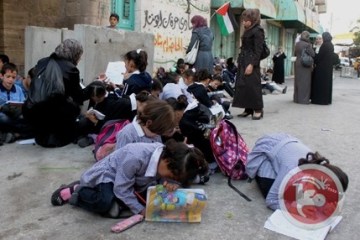 Bassam Tahboub said Anat Cohen, a well-known extremist who frequently harasses Palestinian residents in the area, first “attacked” the school children, “preventing” them from reaching Qurtuba middle school.
Following Cohen’s initial attack, other extremists reportedly joined in and began cursing and scaring the children. Instead of attempting to continue to school, the children decided to turn back and head home, Tahboub said.
Children who attend Qurtuba school, aged 7 to 16, are often harassed by settlers in area, as the school is adjacent to the illegal Israeli settlement of Beit Hadassah in the center of Hebron city.
According to Tahboub, Israeli settlers in the area have continuously attempted to have the school closed down.
Hebron has become the epicenter of recent violence over the last two months, as roughly 30 percent of the 115 Palestinians to be killed since Oct. 1 have been from the Hebron district.
Hebron’s city center is home to some 800 notoriously aggressive Israeli settlers, who live under the protection of thousands of Israeli forces, surrounded by more than 30,000 Palestinians.
Israeli soldiers occupy Palestinian house to set up military base
International Solidarity Movement | December 10, 2015
al Khalil, occupied Palestine – For the last 15 days the family of Abu Shykri Al-Atrarshi have had no access to the top two floors of their house, which was illegally taken over by the Israeli occupation forces and where they set up a military base.

Ten Israeli soldiers suddenly showed up at the house in the neighbourhood of Abu Sheineh, Al Khalil; they broke in by smashing a window in the door, took the key and demanded that the family vacate the third floor. The soldiers did not have any documentation to explain or justify the incursion nor did they give an explanation to the family why their house was being taken over. Any questions are ignored and the third floor as well as the roof top are now off limits.
Since the soldiers arrived they have broken the windows, and shot holes in the water tank which supplies clean water to the household. They then took all the blankets on the premises and used them to dry the water leaking from the tanks. The family also reported that once the water supply was fixed the soldiers contaminated the water and used the apartment and roof as a toilet.
The soldiers never leave the apartment empty, but a few times per day there is a shift change. This happens at different times every day so there is no knowing when, and the soldiers move in and out as they please anyway. This means there can be soldiers moving throughout the building at any time, terrifying the family- especially the young children who no longer dare to leave the house on their own. The soldiers use the roof as a lookout and also frequently fire weapons such as teargas, from there into the surrounding neighbourhood.
The three story house is home to 13 people, now crowded into two small floors- including a young disabled child. They have no idea how long the soldiers will stay, or if the family will get their house back at all. They contacted the local DCO (District coordination office) who advised them to get a lawyer, which they did. The lawyer has now started the process to take the case to an Israeli court in Haifa, Israel. However Abu Shykri Al-Atrarsh has had no information on when the case will be heard or when a judgement can be expected. This, as in many cases, can take months if not years and in the meanwhile the family is trapped. Abu Shakri believes the army is trying to make the family leave the building altogether, but they are resolutely staying put.
This family now has to try to live their life underneath the very people who have broken into, stolen and disrespected their home. The daily struggle of living under the occupation is hardship enough but having your own home taken from under your eyes, and not being able to do anything about it is absolutely heartbreaking.
ISM today took pictures of the soldiers in the building to help the family evidence their presence there, which is needed for the court case. Every time the family has tried to take pictures themselves the soldiers have taken their phones and deleted the pictures.
In Syria the West Embraces Sectarianism
By Alexander Mercouris – Sputnik – 10.12.2015
One of the most troubling developments in the Syrian crisis is the West’s embrace of religious sectarianism.
The argument goes as follows: in order to defeat the Islamic State the West has to overthrow Syria’s President Assad because as an Alawite he is unacceptable to Syria’s Sunni majority who supposedly prefer the Sunni Islamic State to him.
This argument has recently been taken further by John Bolton — the US’s former ambassador to the UN — who is actually calling for the partition of Syria and Iraq on sectarian lines, with a “Sunni-stan” replacing the Islamic State/Daesh.
Bolton at least has the honesty to admit that this is in part a geopolitical play. However is the premise behind the argument as couched by its more moderate advocates even true?
The one opinion poll carried out in Iraq and Syria suggests not.
It found little difference in political attitudes between Sunnis and Shias. It found that both Sunnis and Shias overwhelmingly want their countries to remain united.
It shows strong support in Syria for President Assad and very slight support for the Islamic State — many of whose fighters come from abroad — in both Iraq and Syria.
In Iraq only 5% of the population has a positive view of the Islamic State/Daesh.
In Syria that rises to 21%, a figure that almost certainly overstates its support. A better reflection of its actual support is its core support, which is just 7%.
This whole idea that the best way to fight the Sunni sectarianism of the Islamic State is by embracing Sunni sectarianism is very alarming. One wonders whether those who call for it really understand what they are calling for?
It is a repudiation of Western values. The West claims to stand for freedom, democracy and secularism. It mistakenly embraced the Arab Spring on that basis. Now it seems the West is prepared to embrace the opposite.
It tries to solve the problem of the Islamic State by creating something — a sectarian Sunni state — that looks almost as dangerous.
It grossly misrepresents the nature of the Syrian government, treating it as if it were a sectarian entity when it is in fact a secular one.
This constant harping on the fact that President Assad comes from an Alawite family ignores the fact the government he leads is not sectarian but Arab nationalist and secular.
President Assad is married to a Sunni, most of his ministers are Sunni, as are most officials and diplomats who serve his government. So are most of the army’s officers and most of its soldiers. Claims that most of the Sunni officers and soldiers defected when the war began and that the army is now largely Alawite are unverified and almost certainly untrue.
It is not President Assad who is the violent religious sectarian. It is his opponents.
It is impossible to avoid the feeling that this latest argument — that President Assad has to be overthrown to persuade Syria’s Sunni to fight the Islamic State — is not really an argument at all but a rationalisation to justify the Western obsession with overthrowing him.
Overthrowing the man who leads the government whose army is actually fighting the Islamic State hardly seems the best way to fight it.
Embracing Sunni sectarianism to defeat the Islamic State looks not only unworkable — it assumes Sunni sectarians are prepared to ally themselves with the West so the West can defeat other Sunni sectarians — but seems calculated to do the opposite of what the West says it wants by entrenching Sunni sectarianism and jihadism in Syria.
To such follies does the obsession with regime change lead.
In The NY Times, Palestinian Dead Are Nameless Numbers (At Best)
By Barbara Erickson | TimesWarp | December 9, 2015
Since the beginning of December at least 10 Palestinians have died at the hands of Israeli security forces. Only one of these deaths has received brief mention in The New York Times; the rest have been deemed unfit to print.
During this same period, no Israelis died from Palestinian attacks, so we can assume this is the reason for the show of indifference at the Times. Israeli deaths in these circumstances usually make headlines.
The recent Palestinian victims ranged in age from 15 to 37. All but one were male, and it was the lone female, Maram Hasouna, who managed to make the news in a story about young women joining the ranks of would-be attackers during the current Palestinian uprising.
The victims include: Ma’moun Raed al-Khatib, 16; Maram Hasouna, 19; Taher Faisal Fannoun, 17; Mustafa Fadel Fannoun, 19; Abdul Rahman Wajeeh Barghouti, 27; Anas Bassam Hammad, 21; Mazin Hasan Ureiba, 37; Omar Yasser Skafi, 21; Malek Akram Shahin, 18, and Ihab Fathi Miswadi, 21.
Security forces claimed that nine of the victims had attempted to attack Israelis. Only one, Shahin, was killed in other circumstances—during clashes that took place when troops invaded Dheisheh refugee camp in Bethlehem.
All of the deaths are newsworthy, but some of the fatalities involved details that add particular news value: Ureiba was a Palestinian Authority intelligence officer; Barghouti was an American citizen; and doctors reported that Shahin was shot in the head with a hollow point bullet, a weapon held to be illegal under international law. None of these factors, however, was enough to rouse the interest of the Times.
Instead, since the first of this month the newspaper has provided us with stories about wine making in Israel, the discovery of a possible ancient model of the Temple of Herod, the arrest of suspects in a fatal arson attack, a look at the risks of banning an Israeli Islamic group, the conviction of two Israeli youths in the killing of a Palestinian teen last year, the conviction of a Palestinian lawmaker and Israel’s attempt to draw Russian tourists.
The 10 who died so far this month are likely to appear as nothing more than numbers in future Times reports. As of today they have brought the total dead since Oct. 1 to at least 113. This compares with 17 Israelis.
Even in reporting this kind of data, the Times makes an effort to obscure the fact that Palestinians are suffering disproportionately at the hands of their well-armed occupiers. In a formulaic explanation for the numbers gap, the Times nearly always blames the victims entirely, saying that Palestinians were killed when they tried to attack Israelis or during violent protests.
Little or nothing will be said of the doubtful cases, in which witnesses dispute the official accounts and video evidence shows that the victims were posing no danger to troops. We can also expect that the Times will fail to mention human rights groups’ charges that a number of the victims were assassinated in “extrajudicial executions.”
The Palestinian dead rarely get their due in the Times, which prefers to consign them to tally sheets. Were they to appear in full context, as human beings with histories and families, this might elicit sympathy for them and condemnation of Israel, and this cannot be allowed.
Follow @TimesWarp on Twitter
Medics: Bethlehem youth shot dead with illegal ammunition
Ma’an – December 8, 2015
 BETHLEHEM – Malik Akram Shahin, 19, who was shot dead by Israeli forces in Bethlehem overnight Monday, was killed by an explosive bullet fired at his head, medical sources at the Beit Jala Governmental Hospital told Ma’an.
Medics said the explosive bullet smashed Shahin’s skull, and exploded inside his head, with the bullet and skull fragments shattering into “hundreds of pieces.”
The sources said the positioning of the shot, as well as the type of bullet used, clearly indicates that Israeli forces shot at Shahin with every intention to kill.
The use of explosive bullets, also called expanding bullets or “dum dum” bullets, is illegal under international law, and considered a crime of war under the 1899 Hague Declaration and the International Criminal Court’s Rome Statute, among others.
The bullets are banned due to the brutal damage inflicted on the victim, as the bullets are made to splinter apart and become lodged, instead of making a clean exit through the body.
Israel has repeatedly denied claims that its forces use such bullets, though Palestinian medical examiners have on occasion documented their use.
Locals told Ma’an that after Shahin was shot, he was “left bleeding for a long time before he was evacuated to the public hospital in Beit Jala, where medics pronounced him dead.”
An Israeli army spokesperson had no information of his death, but said that Israeli soldiers had opened fire after Palestinians threw “pipe bombs and Molotov cocktails” at them.
The left-wing Popular Front for the Liberation of Palestine later said that Shahin had been one of its supporters. The group said in a statement that he fell “during fierce clashes with Israeli troops who raided the camp to detain young men affiliated to the PFLP.”
Following his death, a Bethlehem committee announced a halt to all business across the district and stores and government institutions were closed.
At least 114 Palestinians have now been killed in just over two months of unrest across the occupied Palestinian territory.
In Gaza, another farmer shot by a sniper for working his land
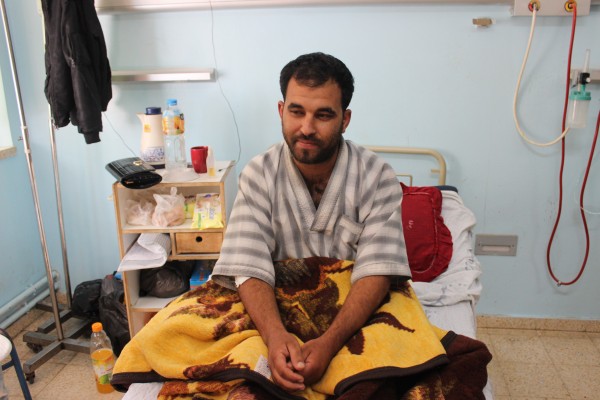
Mohamed Abu Taima, 29, had to undergo two surgeries
International Solidarity Movement | December 8, 2015
Khan Younis, Gaza strip, Occupied Palestine – A week ago Mohamed Abu Taima, 29 years-old and father of a small girl, was working his land 450m from the separation fence when an Israeli sniper shot him. At 4pm, he had arrived to his land in Al Faraheen, Khan Younees, South of the Gaza Strip. He was shot a few minutes after he started to work. The bullet passed through one of his legs and exploded inside the other one.
A few minutes after arriving in the hospital Mohamed underwent a first surgery, and days after a second one. Until now, the doctors don’t know if Mohamed will ever be able to walk properly again.
These kind of attacks have been frequent during the past two weeks. Several farmers were expelled from their lands by the Israeli snipers when they were working or intended to work their lands between 400 and 500m from the fence, meaning outside of the “buffer zone” imposed by the occupation.
Everyday humiliation of Israeli military occupation
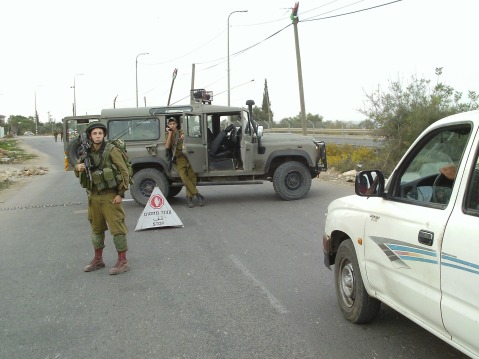
Israeli soldiers and the flying checkpoint outside the village
International Solidarity Movement | December 7, 2015
Hebron, occupied Palestine – Palestinians living in the Israeli militarily occupied West Bank face discrimination, racism and humiliation at the hands of Israeli forces on an everyday basis. Humiliation is entrenched in every aspect of daily life under the Israeli occupation. The message is clear: as a Palestinian you are always perceived as a threat, a possible terrorist or a menace – but never as a human being.
As a Palestinian citizen of the West Bank, freedom of movement is severely restricted and rather resembles trying to navigate a maze of road-blocks, permanent checkpoints and temporary ‘flying checkpoints’ that can suddenly pop up anywhere. All of these restrictions share one commonality: they are clearly intended to target only Palestinians – while Israeli settlers from the illegal settlements in the occupied West Bank are using roads that might not even be allowed for Palestinians to drive on.
In occupied al-Khalil (Hebron), the Israeli bus collecting passengers from the illegal settlements is not allowed for Palestinians to ride on, and thus passes Bethlehem checkpoint on the way to Jerusalem without even stopping – all the passengers are Israeli settlers anyways. On the Palestinian bus going through the same checkpoint, everyone, with the exception of tourists and elderly, are forced to get off the bus and wait for their IDs to be checked outside in any weather, and often their bags inspected by heavily-armed soldiers.
Right during rush hour on Thursday afternoon, Israeli forces set up checkpoints at all the entrances of occupied al-Khalil, resulting in endless queues of cars, on their way to visit family over the weekend on Friday and Saturday. As two soldiers thoroughly checked every passenger’s ID and car going in both directions, the queues grew longer and even ambulances with emergencies were denied passage and held up for at least ten minutes while being checked – ten minutes that hopefully weren’t critical for the emergency the ambulance was attempting to quickly get to. As Israeli forces strategically blocked every possible way to leave or enter al-Khalil either by permanent road-blocks completely blocking any sort of traffic except pedestrians or temporary checkpoints; there was no possible alternative than to either turn around and stay inside the city or to endure at least two hours of waiting to eventually be allowed to pass this checkpoint.
Finally passing one checkpoint successfully, though, in militarily occupied Palestine basically doesn’t mean anything: just a few hundred meters down the street might be another checkpoint. Palestinians try to avoid Gush Etzion junction on the way to Bethlehem, as settlers often attack Palestinians cars there, and soldiers stop and search cars with Palestinian license plates only; they take a detour through Palestinian villages. But in order to make the near-lockdown of al-Khalil ‘perfect’, Israeli forces set up checkpoints at entrances and exits of Sa’ir village. Thus, after an hour-long wait to leave al-Khalil city itself, Palestinian cars were stuck in yet another checkpoint just a twenty minutes drive away.
Waiting in the dark for seemingly endless hours to move ahead just one or two more meters in the line as a car was allowed to pass – or turned around, giving up the hope of ever crossing that night at all; Israeli settler cars speed past on a nearby road without any hurdles or hassles, just ‘normaly’ driving down a road at night. When finally slowly approaching the make-shift checkpoint with traffic spikes on the street, cars have to switch off their lights, so people next in line will only hazily see what’s going on. Once it’s their turn, everyone inside the car has to get out and stand a few meters away from the soldiers, while they inspect the IDs and cars. Depending on the soldiers mood, some people, mainly young adult males, will have to lift up their shirts and trouser-legs; while others will have to answer questions about their destinations and the reason of travels, and even about their families and private life. The only thing that is for sure is that you can never tell what will happen. The power dynamics is clear, the heavily armed soldiers have the ‘authority’ to decide over everything, the Palestinian passengers will have to obey whatever is asked of them. That none of this has to do with ‘security’ but everything with control and humiliation is obvious. This is the face of just a tiny little aspect of the everyday humiliation defining this military occupation.
Humiliation doesn’t even stop with death – the Israeli forces are still withholding the bodies of Palestinians they claim attacked Israeli soldiers – refusing an appropriate funeral and mourning for their families, relatives and friends. Denying even a last peaceful rest and a person’s family to mourn the death of a loved one is the last possible way to humiliate. Not even in death, does the humiliation stop or are Palestinians treated like human beings.
US donors gave settlements more than $220 million in tax-exempt funds over five years
MEMO | December 7, 2015
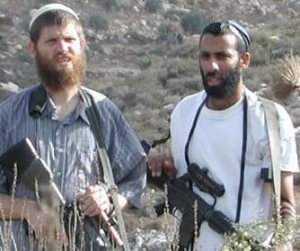 Private US donors are massively funding Israeli settlements by using a network of tax-exempt nonprofits, which funnelled more than $220 million to West Bank settlements in 2009-2013 alone, a Haaretz investigation has found.
The funding is being used for anything from buying air conditioners to supporting the families of convicted Jewish terrorists, and comes from tax-deductible donations made to around 50 US-based groups.
Nearly 80 percent of this income (about $224 million) was transferred to the occupied territories as grants, mostly through Israeli nonprofits. In 2013 alone, these organisations raised $73 million and allotted $54 million in grants.
The investigation stated: “Thanks to their status as nonprofits, these organisations are not taxed on their income and donations made to them are tax deductible – meaning the U.S. government is incentivising and indirectly supporting the Israeli settlement movement, even though it has been consistently opposed by every U.S. administration for the past 48 years.”
A senior White House official told Haaretz that “the policy of every administration since 1967, Democrat and Republican alike, has been to object to Israeli settlement beyond the 1967 borders.
“The present administration is no different,” the official continued. “Concordant with permanent U.S. policies, this administration never defended or supported any activity associated with the settlements. It doesn’t support or advance any activity that will legitimize them.”
Israeli court sentences Palestinian MP Jarrar to 15 months in jail

Palestine Information Center – December 7, 2015
RAMALLAH – An Israeli military court on Sunday evening sentenced member of the Palestinian Legislative Council (PLC) Khalida Jarrar to 15 months in prison.
Ofer military court gave Palestinian lawmaker Khalida Jarrar a 15-month prison sentence for purely political reasons, according to her husband, Ghassan Jarrar.
Jarrar was arrested by the Israeli occupation forces from her home in the West Bank town of al-Bireh, on 2 April 2015.
The Israeli government charged her on 12 accounts, and after 25 court hearings, the prosecution and the court settled on three main charges: Providing assistance to the Popular Front for the Liberation of Palestine (PFLP), incitement against Israel, and membership in the PFLP.
Jarrar is a prominent and inspirational leader in Palestinian society. In addition to being a lawmaker, she is a women’s rights activist and a member of the board of directors for the Addameer Prisoner Support and Human Rights Association.
Addameer reported in November that the Israeli military prosecution relied on alleged secret material to maintain leverage during the trial proceedings in Jarrar’s case.
Jarrar was placed under administrative detention based on “secret material” from the day she was arrested.
Addameer also said that Israel used “fabricated charges” against Jarrar obtained through “deceptive and flawed interrogation techniques” that were used to force confessions from Palestinian detainees.
The witnesses later denied the confessions, which they said were given under duress.
Jarrar’s husband told al-Araby website that the Israeli police had been exhausting his wife by transporting her from prison to court nearly 25 times in the past few months.
“It takes 22 hours to transfer her each time. She is usually prevented from using the toilet for nearly 8 hours and remains in cuffs all the time.”
Jarrar is detained in Hasharon prison where Palestinian women are mainly held. Her husband is not allowed to visit her on “security” grounds.
Jarrar had also been targeted by forced displacement to Jericho from Ramallah by an occupation military order, which she succeeded in defeating after a month-long sit-in at the PLC office and an international support campaign.
“The conviction of Khalida Jarrar comes as no surprise; Israeli military courts serve no function except as an instrument of repression and suppression directed against Palestinians. Khalida Jarrar is a Palestinian political leader and an internationally-renowned struggler for justice. She has dedicated her life to working for freedom for her people and her land, and especially for the freedom of Palestinian political prisoners,” said Charlotte Kates, coordinator of Samidoun Palestinian Prisoner Solidarity Network.
“It is urgent that we build the movement internationally to demand freedom for Jarrar and for her nearly 7,000 sisters and brothers held as Palestinian political prisoners inside Israeli jails,” Charlotte Kates added.
Putative US-Israeli Rift Has Not Dampened Partnership in Oppression of Palestinians
By Matt Peppe | Just the Facts | December 6, 2015
In March, after Israeli Prime Minister Benjamin Netanyahu made denying a Palestinian state a pillar of his winning re-election campaign, officials in the Obama administration signaled to the media that they would reconsider the U.S. government’s staunch diplomatic support for Israel in the United Nations. The U.S. government feigned “very substantive concerns” and declared the administration may “reassess (its) options going forward” in response to Netanyahu’s explicit rejection of a two-state solution.
Mainstream media focused on the personal dynamics between the leaders of the two countries. CNN said the Obama administration felt “outright hostility” toward Netanyahu and the New York Times said the leaders had a “poisonous relationship.” They presumed the professed discord would imperil the political alliance between the two governments. In reality, there was no reason to believe a personal conflict would jeopardize the nearly 50-year-old U.S. government policy of providing Israel an unconditional shield in the General Assembly and the Security Council.
It was obvious even at the time the Obama administration’s anonymous threats to reconsider its diplomatic protection of Israel were nothing more than posturing. Netanyahu had broken an unwritten rule when he said in front of the cameras what is stated in his Likud party’s platform: “The Government of Israel flatly rejects the establishment of a Palestinian Arab state west of the Jordan river.” Not only had this been written policy since 1999, but Netanyahu’s government – and every other Israeli administration since the state’s illegitimate formation in 1948 – has been carrying it out in practice.
Obama has demonstrated little interest in supporting progressive policies in favor of human rights and social justice, but he has shown himself zealously concerned with them in the abstract through grandiose and noble rhetoric. During the first six years of his presidency, Netanyahu actively opposed a Palestinian state without Obama’s administration withholding any of the ideological, diplomatic, military and economic support that is a necessary condition for the occupation’s survival. As long as Netanyahu kept quiet, Obama could pretend his administration’s support for Israel was contingent on Israel seeking a permanent peace deal with Palestinians.
Obama urged “cooperation and compromise” and continued the pretense that a “peace process” was not already long dead. But when Netanyahu publicly declared in stark terms that he has no intention of permitting a just solution to Israel’s colonization of Palestine, he made it impossible for Obama to continue the charade. Netanyahu and his fanatical government ministers long ago realized that Obama had no intention of seeking actual concessions from them regardless of how much land and water they stole, or how many Palestinians (or Americans) they killed.
In reality, Obama was happy to let the Israeli government keep slaughtering Palestinians in Gaza, expanding checkpoints and repression in the West Bank, and further carving up the West Bank with new illegal settlements while offering nothing but the most mild, toothless complaints.
As Ali Abunimah noted in the Electronic Intifada, “for the Palestinians, there is no meaningful Obama-Netanyahu rift. Indeed US-Israeli relations have never been stronger, nor more damaging to the prospects for peace and justice and for the very survival of the Palestinian people.”
This was not inevitable. In January 2009, Netanyahu had ordered an immediate halt to the IDF’s destructive rampage in Gaza, Operation Cast Lead, which had killed more than 1,400 people in Gaza, the day before Obama’s inauguration ceremony in January 2009. Presumably Netanyahu believed the failure stop the second assault on the blockaded territory in a year would cause the incoming Obama administration to support an independent investigation, cut military aid, dispute Israel’s argument that it “had a right to defend itself,” or end the U.S. government’s facilitation of the carnage.
But it turns out Netanyahu and the Israeli regime needn’t have worried, as no such change in policy was in the cards. Obama’s new administration would block the Goldstone Report presented to the Human Rights Council, and ensure complete impunity for the Israeli crimes that occurred subsequent to Obama’s election. This likely emboldened Netanyahu to unleash even more wanton destruction and horror in July 2014, when Israel launched Operation Protective Edge on trumped up accusations against Hamas.
“Having falsely accused Hamas leadership of orchestrating the kidnapping of the three Israeli teens in June, and then assailing the group for ‘purposely playing politics’ when it rejected the Egyptian ceasefire proposal that offered it nothing beyond a return to the status quo of the siege, (Secretary of State John) Kerry and the Obama administration once again provided the Israeli military with the diplomatic cover it needed to escalate the violence,” writes Max Blumenthal in The 51 Day War: Ruin and Resistance in Gaza.
Despite extensive documentation from the start of the military campaign that the captive civilian population in Gaza comprised the vast majority of the dead and injured from tank and naval shelling, drone missiles, F-16 bombs and heavy artillery, the Obama administration cast the only vote against establishing a war crimes investigation by the United Nations. A few days later, the administration helped resupply the Israeli army with weapons, including 102mm mortar rounds and 40mm grenades, that the IDF could use to keep up their prolific killing spree.
In May, any doubts that the personality conflicts had actually imperiled the hand-in-glove military cooperation between the two countries, as mainstream pundits so forcefully proclaimed, was put to rest. The Obama administration approved an arms sale for $1.9 billion to Israel – in violation of domestic and international law, and against the explicit demands of human rights organizations such as Amnesty International.
The Electronic Intifada reported: “Among the tens of thousands of bombs included in the weapons package are 3,000 Hellfire missiles, 12,000 general purpose bombs and 750 bunker buster bombs that can penetrate up to 20 feet, or six meters, of reinforced concrete.”
Much as the military cooperation between the two states has carried on seamlessly, so has the diplomatic cooperation. Despite Israeli officials hinting the government might finally decline to vote with the U.S. in the 24th annual UNGA condemnation of the Cuban embargo, predictably Israel was the only country in the entire world to join the U.S. in defense of the embargo. The measure passed by a vote of 191-2.
Not surprisingly, unconditional U.S. support for Israel in the United Nations has also continued uninterrupted. “Traditional Voting Pattern Reflected in General Assembly’s Adoption of Drafts on Question of Palestine, Broader Middle East Issues,” states a U.N. press release after the passage of six resolutions concerning Israel. Indeed, the pattern was traditional: the U.S. and Israel, with a few Pacific Island states, voting against the rest of the world (minus whoever the U.S.-Israel alliance could persuade to abstain).
In a resolution on the illegally occupied Syrian Golan Heights, from which Israel steals valuable natural resources and where many prestigious Israeli wineries are located, the U.S. government rejected the position that Israel follow previous Security Council resolutions and withdraw to the 1967 borders.
Concerning Jerusalem, the U.S. rejected a measure stating that Israel, as the occupying power, had no right to “impose its laws, jurisdiction and administration on the Holy City of Jerusalem,” and that they show “respect for the historic status quo at the holy places of Jerusalem.”
Additionally, the U.S. rejected a call “to exert all efforts to promote the realization of the inalienable rights of the Palestinian people, including their right to self-determination, to support the achievement without delay of an end to the Israeli occupation that began in 1967 and of the two-State solution on the basis of pre-1967 borders and the just resolution of all final status issues and to mobilize international support for and assistance to the Palestinian people.”
As these votes were not reported in the mainstream American press, the American public can be forgiven for not realizing the meaninglessness of the “rift” between American and Israeli government officials, which has not impacted at all the U.S. government’s longstanding record of rejecting world opinion and cooperative efforts to achieve a just peace.
The corporate press have demonstrated that their policy analysis consists primarily – if not entirely – of dissecting style, empty rhetoric and official proclamations. Concrete actions and their consequences are of little concern.
Featured Video

Genocide-linked firm handles Britons’ NHS data
or go to
Aletho News Archives – Video-Images
Book Review
Book review: Boiling Point, How America Brought War to Ukraine
By Tim Kirby | Strategic Culture Foundation | November 14, 2026
Did Vladimir Putin just wake up one day on the wrong side of the bed and decide to invade Ukraine in February of 2022 or is there a lot more to this single decision that has been reshaping the 21st century geopolitical landscape?
Obviously, from the way that I just posed the question you can see that I am on the side that views the causes for the war in Ukraine to be very deep, long-term, historical and consciously nefarious, and most importantly, not from within the halls of the Kremlin. So it was a pleasure to take a look at the book “Boiling Point, How America Brought War to Ukraine” by author Stephen Kinzer, who like myself, also believes that the real reasons behind military conflicts around the world are not what CNN and the BBC have been telling you. The main thesis of this book was stated clearly by its creator; the war “may have been illegal, but it was definitely not unprovoked.” … continue
Blog Roll
 Aletho News
- The 10 Disease Renamings That Rescued the Vaccine
- NATO cancels 2027 leaders’ summit
- IAEA’s politicized use of safeguards undermines its impartiality: Russian envoy
- UK must be ready to strike Russian Arctic – ex-PM
- Fico’s Two Red Lines: Russian Energy and the Next Ukraine Loan
- Thousands rally for banned NATO-skeptic presidential candidate
- Ukraine Settlement and New European Security Architecture Must Go Hand in Hand – Kremlin
- Book review: Boiling Point, How America Brought War to Ukraine
- Israel Revives The ‘Iranian Assassination Threat Against Trump’ Deception In A Desperate Bid To Restart The War
- US rewrites history to dodge blame for illegal war on Iran: Foreign Ministry spokesperson
- If Americans Knew
- An error has occurred; the feed is probably down. Try again later.
- No Tricks Zone
- New Study: Barents Sea Temperatures Were Warmer And Sea Ice Less Extensive In The 1700s Than Today
- German Authorities Start Initiative To Evaluate Public Register For Climate “Disinformation” Spreaders!
- Zonal Asymmetry of Temperature Change in the Antarctic Circumpolar Current
- New Study: The Net Fossil Fuel Contribution To Rising Atmospheric CO2 Has Been Zero For 500 Years
- Germany’s Green Energy Transition Becoming Increasingly Expensive…Another 6 Trillion Euros!
- Sudden Stratospheric Warming, Powerful El Niño Combination May Lead To Extreme Europe Cold, Energy Crisis!
- Two New Studies Find Thwaites Glacier Melt Cannot Be Driven By Human Activity Or A Warming Ocean
- E-Cars Reduce CO2 Emissions By Only 41% Compared To Internal Combustion Engine Vehicles
- Predictions Made By Renowned Climate Professor Over Past Decades Have Been Proven To Be Poor
- New Study Suggests Large Regions Of The Pacific Ocean Have Been Cooling For The Last 80 Years

